Rather surprisingly, gods have not been at the centre of modern discussions of Greek religion until very recently. Although they usually appear relatively late in twentieth-century histories of Greek religion,Footnote 1 the situation has changed dramatically in the last decade or so.Footnote 2 And rightly so, given the importance of the gods within Greek religion. There are several questions worth asking: what is a god? What did the Greeks see as important differences between themselves and the gods, and between gods and heroes? Which factors helped to define the identity of individual gods (§1)? How should we study the pantheon (§2)? What did the Greeks consider to be the sphere of influence of individual gods? What was the nature of the divine hierarchy? And, last but not least, were the gods persons or powers – or both (§3)?
1. God, gods, and heroes
At an early stage of their history, the Greeks replaced the Indo-European word *deiwos (Latin deus) with theos, cognates of which have been recognized in Armenian and Phrygian. The new term semantically developed from ‘to put, to place’ to ‘what has been characterized by what has been put/built in a sacred place, by the divine, by the sacred’.Footnote 3 Sometimes, however, the Greeks used a different term. Whenever the presence of the divine remained vague enough not to be pinned upon one of the major deities, or when the Greeks felt that a god intervened for a short period directly and concretely in their lives, they spoke of daimôn, which acquired its unfavourable meaning mainly in later time.Footnote 4
Greek gods resembled and differed from the Christian God in important aspects.Footnote 5 Like Him, they had agency and were mostly invisible, anthropomorphic, and immortal,Footnote 6 but they seem to have had their own language,Footnote 7 and were not loving (Chapter I, §2), almighty, or omnipresent; moreover, they were ‘envious and disorderly’ (Hdt. 1.32.1), their presence could be uncanny, sometimes horrific, and, occasionally at least, they were frivolously amoral.Footnote 8 In particular, the divine sense of justice in Homer is problematic, but we reach a better understanding when we consider the relationships between gods and mortals as analogous to those between princes and commoners. Although gods did uphold the rules of justice, their obligations to kin and friends had priority. This attitude reflects the absence in Homeric society of a developed legal system, and it is only natural that in a more regulated period such a lack of a divine sense of justice came to be questioned.Footnote 9 Divine uncanniness comes to the fore in tragedy, as for example in Euripides’ Hippolytus, where Poseidon despatches a bull from the sea in order to kill Hippolytus. This darkness of divinity is typical of tragedy, but its prominence in this particular genre should not lead us to make it the starting point of generalizations: approaching the gods from their role in comedy would lead to completely different results.Footnote 10 Rather, it is typical of Greek religion that it combined this polarization and radicalization of experiencing the divine.
The gods’ frivolous behaviour accentuates mortal plodding and is typical of their outspoken anthropomorphism, which is Homer's greatest contribution to Greek religion.Footnote 11 Even Greek onomastics shows its success: names indicating the gift of a specific deity, like Athenodorus or Apollodorus, appear only after Homer.Footnote 12 However, the resemblance between gods and humans is only relative. As the appearance of Demeter in her Homeric Hymn (275–80) illustrates, divine epiphanies show the gods as tall, beautiful, sweet-smelling, awe-inspiring – in short, as ‘superpersons’.Footnote 13 Precisely because of divine anthropomorphism, it was necessary to stress the immortal–mortal boundary. In several Greek myths, gods are being tested: Ariadne challenging Athena's weaving skill or Marsyas questioning Apollo's flute-playing genius. The stories invariably end badly for mortals, as do love affairs with gods: Semele was burned to ashes, when she begged Zeus to appear in full glory. The message of these myths is clear: the gap between gods and humans is unbridgeable,Footnote 14 as Pindar noted: ‘for the one race is nothing, whereas the bronze heaven remains a secure abode forever’ (Nem. 6.3–4, trans. Race 1997).
The success of Homeric anthropomorphism should not make us forget that the gods were also regularly associated with animals. Whereas Christian theologians thought long and wrote much about the body of God,Footnote 15 it is not so easy to discover what the Greeks thought about the body of their divinities,Footnote 16 let alone about their theriomorphism. However, we should not forget that some Greek gods were closely connected with animals or even (partially) identified with these, such as Pan with his goat's legs or Dionysos appearing as a bull. In a way, the theriomorphic body of these divinities puts them in opposition to the anthropomorphic ones and is a signifier of their alterity, which is confirmed and supported by the non-standard rituals connected with them.Footnote 17 An older layer of Greek religion even imagined gods in the shapes of stones or trees.Footnote 18 Yet such representations continued to coexist with the anthropomorphic shapes well into late antiquity. Surely, all Greek divinities were different, but some were clearly more different than others.
Anthropomorphism made the gods vulnerable to criticism,Footnote 19 which Xenophanes (c. 500 bc) was the first to state publicly. Subsequent generations of intellectuals took these criticisms seriously and tried to counter them through the strategies of allegory and rationalization.Footnote 20 Others would be more daring, and Herodotus’ allusion (2.53.1) to Protagoras’ famous statement ‘Concerning the gods I am unable to discover whether they exist or not, or what they are like in form’ (B4 Diels/Kranz) shows to what extent fifth-century intellectuals were already questioning the traditional picture of the gods (Chapter VII, §3).
If the gods differed from humans, they also differed from another category of supernatural beings: the heroes, who occupied a kind of intermediate position between gods and humans. Although the origin of this supernatural category is still unclear, hero cult as such developed relatively late, not before the middle of the sixth century bc, and should not be retrojected into earlier centuries. In that period we have tomb cults, cults of ancestors, and cults of founders of cities, but it is only from the late archaic age onwards that we start to have hero cults in the technical sense of the word. Before that time, the term ‘hero’ simply does not occur in a religious sense.Footnote 21
In the end, ‘hero’ seems to have become a kind of lowest common denominator for mythological grandees like Heracles, faded divinities like Helen (Chapter V, §2; Chapter VI, §1), mythological culture heroes like Prometheus, and important historical figures like Brasidas, a Spartan general who was killed in action in 422 bc (Chapter VII, §3). Usually, heroes were benevolent and played an important role in guarding oaths and protecting cities, but they could also be malicious and send all kinds of diseases. In a fragment published only in 1967, the chorus of Aristophanes’ Heroes says: ‘we are the guardians of good things and ill; we watch out for the unjust, for robbers and footpads, and send them diseases – spleen, coughs, dropsy, catarrh, scab, gout, madness, lichens, swellings, ague, fever. That's what we give to thieves.’Footnote 22 Even though gods and heroes regularly overlapped in function, and heroes were sometimes called ‘gods’, the heroes’ radius was usually more limited and their cult concentrated on a tomb. Yet the boundaries between gods and heroes were often fluid, and conceptions of the hero varied widely in the Greek world.Footnote 23
What established the identity of an individual god? The question is not easy to answer, as local manifestations of gods could vary widely even within a single city. Yet a number of factors contributed to a recognizable core. Most important was the name of the divinity, although its meaning was usually, like that of heroes, opaque: their awesomeness forbade a straightforward approach.Footnote 24 The name was often further specified by an epithet denoting function or origin, like Hermes Agoraios, ‘Of the market’, or Demeter Eleusinia, ‘From Eleusis’ (Chapter VII, §1). The significance of these divine epithets is not always clear, and recent research has only partially succeeded in satisfactorily explaining their sense and function. Robert Parker notes two main functions: to distinguish the worship of the same god in different places, such as Athena Polias and Athena Nike in Athens, and to stress a particular power or function of a divinity. It remains unclear, though, if the ordinary Greek saw these epithets as referring, eventually, to one god, or simply considered, say, Artemis Agrotera as a goddess different from Artemis Lochia. Or was the same name sufficient in evoking a kind of general picture of a divinity?Footnote 25
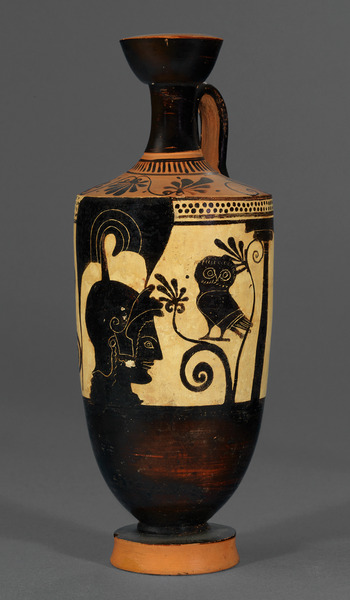
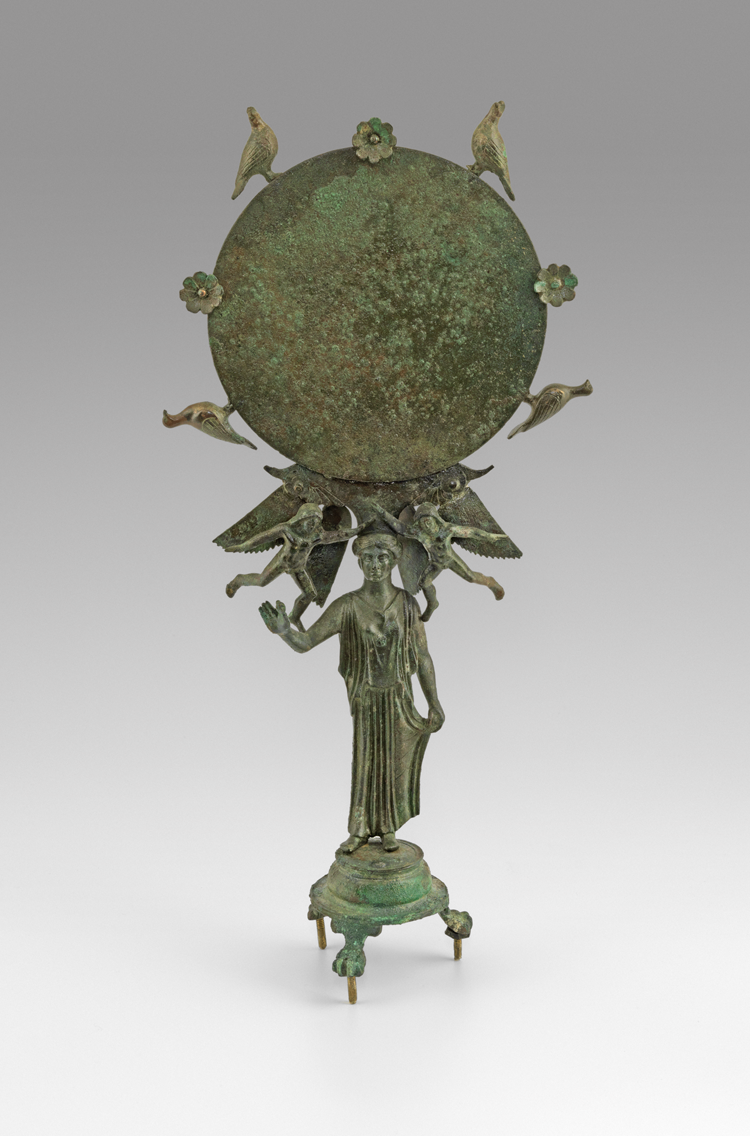
However that may be, a divinity's name was given substance by myth (Chapter V), which related his or her family and deeds. Family ties were means of establishing connections or indicating related functions among divinities: we cannot separate Leto's motherhood of Apollo and Artemis from the connection of all three divinities with initiation.Footnote 26 Deeds helped to define and reflect on divine functions. The Homeric Hymns, for example, show Hermes as thief, Aphrodite as seductress, and Demeter as founder of the Eleusinian Mysteries. The Hymns also relate divine appearances: Dionysos looked ‘like a young man on the brink of adolescence’ and Apollo like a ‘vigorous youth on the brink of manhood’. Art equally reflected on and contributed to the mental image that the Greeks made of their gods. Vases and mirrors frequently display gods with fixed attributes: Poseidon with a trident, Athena with an owl (Figure 1), Zeus with a thunderbolt, Aphrodite with doves (Figure 2).Footnote 27 These attributes must have helped to identify individual gods, just as in dreams gods appeared in a shape familiar from the (often local) painted and sculptured representations.Footnote 28 A final determining factor was cult. The place in the calendar, prominent or not (Chapter IV, §3); the location of a sanctuary, be it in town or country (Chapter III, §2); the nature of the sacrificial victim, normal or ‘abnormal’ (Chapter IV, §2); the mode of ritual, supportive of or undermining the social order (Chapter IV, §3): all these elements contributed to a specific perception of individual gods and helped to reinforce their image for their worshippers.
Athena with her owl. Attic black-figure lekythos, Athena Painter, c. 490 bc.

Greek bronze mirror with Aphrodite and doves, c. 470 bc. In Greece, doves were a typical lovers' gift.

2. The pantheon
Before we discuss individual gods, we must first look at the Greek pantheon as a whole. The main gods were a group of twelve who resided on Mount Olympos. The number goes back at least to about 600 bc, when Alcaeus uses the expression ‘one of the twelve’ (fr. 349e Voigt/Liberman) in his poem about the entry of Dionysos into Olympos with the help of Hephaistos. This shows that around 600 bc the idea of a Dodekatheon was already prevalent on Lesbos, an island where Hittite influence is in evidence. The latter suggests the role of the twelve gods in Hittite religion via the twelve Titans, who were almost certainly derived from the Hittites.Footnote 29 However, it was not until the late sixth century that the younger Pisistratus dedicated an altar to the Twelve Gods in the Athenian agora (c. 520 bc: Thuc. 6.54.6). The reduction to a main group of twelve gods coincides with the rise of the category of heroes and the distinction of a god from his or her statue (Chapter III, §1). For reasons still unclear, it seems that the pantheon was rationalized to some extent in the later sixth century.Footnote 30
How do we find order in the ragbag of Greek gods which, in addition to the major ones, comprised many minor divinities, such as Pan and the Nymphs (Chapter VII, §3), but also rivers and the winds?Footnote 31 A popular approach has long been to distinguish between Olympian and Chthonian gods (that is, those of the earth and of the underworld). This view originated during the Romantic period and was already prevalent in the early 1800s. Following a notice in Porphyry's The Grotto of the Nymphs (6), Olympians were claimed to have temples and high, square altars for food sacrifices, whereas Chthonians and heroes had only low, circular altars for burnt offerings (Chapter III, §1). In fact, modern archaeology has proved that this distinction has no general validity for the classical period. Even though some gods have connections with the dead and the underworld, there is no clear-cut distinction to be made on these grounds in the Greek pantheon.Footnote 32
More recently, Jean-Pierre Vernant (1914–2007) and his school have stressed that the pantheon is a system whose structures we should study instead of concentrating on divinities as individuals.Footnote 33 Which gods are paired and which are opposed to each other? What is the precise mode of intervention? What logic governs their being? In addition to these questions, we should try to search for the, often hidden, hierarchies within the pantheon. Here new possibilities have been opened up by a study of divine representations. A fine example is a black-figured cauldron of the painter Sophilos (c. 580 bc) with the wedding procession of Thetis and Peleus moving towards the house of Peleus: we see Hestia and Demeter, Chariclo and Leto, Dionysos, Hebe, Cheiron, Themis, and three Nymphs; Hera and Zeus on a cart followed by three females (the accompanying inscription has been lost); Amphitrite and Poseidon on a cart followed by three Charites; Aphrodite and Ares on a cart followed by five Muses; Apollo and Hermes on a cart followed by three Muses; Athena and Artemis on a cart followed by three Moirai, Okeanos, and two Eileithyiai (Chapter III, §2). The procession is concluded by Hephaistos on the back of a donkey; naturally, Hades had no place in this festive happening. The images show not only the pairing of certain gods but also a clear hierarchy: some gods go by cart, others on foot. Following this approach, I will now discuss the major gods and conclude by analysing the structures and hierarchies within the Greek pantheon, and the problem of whether the Greek gods were persons or powers – or perhaps both.Footnote 34
3. Gods orderly and disorderly
The main divinity of the Greek pantheon was Zeus, whose development from a weather god worshipped on mountaintops to the supreme god shows influences from Anatolia, which was also the source of the succession myths relating his coming to power (see Appendix). However, Zeus never reached the same position in Greece as Jupiter Capitolinus in Rome: his festivals were not important, and only a few cities named months after him. Instead, he became the protector of the social and moral order.Footnote 35 Zeus's first wife was probably Dione, whose name is attested in Linear B, but who ‘survived’ only in outlying Dodona and, as Diwia, in faraway Pamphylia;Footnote 36 by Mycenaean times she had already been replaced by Hera, whose name may mean ‘Mistress’. Hera was the goddess who ‘holds the keys of marriage’ (Ar. Thesm. 973), and in this function her cult was Panhellenic but not prominent.Footnote 37 On Samos, she received votives in the shape of ships, and it is typical of the plasticity of Greek polytheism that the importance of the sea for Samos could add this local aspect to her cult.Footnote 38
If Zeus was the ‘chief’ of the pantheon, Athena and Apollo had the greatest number of main polis sanctuaries (Chapter III, §2). Athena's temple is attested on many acropoleis throughout the Greek world; her statuette, the Palladium, functioned as a polis talisman, and she frequently received the epithet Polias or Poliouchos. As a city goddess she also watched over the new generation. In Athens, youths were integrated into the phratries (the primary civic community for most people, with hereditary membership and usually fixed localityFootnote 39) during her and Zeus's Apatouria festival, and during the Arrhephoria young girls, the Arrhephoroi, ended their participation in weaving the new peplos for the Panathenaea (Chapter IV, §2) via a secret ritual that confronted them with sexuality, thus preparing them for adult life (Chapter VI, §1). Although this initiatory function was not entirely absent elsewhere, it was prominent in Athena's special city: one more testimony to the fluidity of Greek polytheism.Footnote 40
Athena's protecting function was reflected in her armed appearance, which was probably influenced by the popular armed goddesses of the Orient. In war, Athena especially functioned as an adviser to warriors – witness her close relationship with Achilles and Odysseus in Homer. She displayed the same intelligence as Athena Ergane, the supervisor of spinning and weaving, two of the main tasks of Greek women: many sanctuaries of Athena contain dedications of distaffs and loom weights. However, Athena's intelligence connected her not only with women's crafts but also with artisans (and thus with Hephaistos), with carpenters in building the Argo and the Trojan Horse, and with knights in mastering horses. In all these cases Athena represents civilization and cleverness against nature and brute force.Footnote 41
The name of Apollo, the other central polis god, has been thought to derive from the yearly Doric assembly, the apellai, where the youths were incorporated into the community of the adults. Yet the etymology remains disputed (and was so even in antiquity),Footnote 42 and we can hardly say more than that the god possibly derives from Anatolia, where his mother, Leto, and sister, Artemis, also originated.Footnote 43 In any case, Apollo is clearly situated between adolescence and adulthood. It is this aspect which made him not only the supervisor of initiatory rites, but also the centre of political institutions of the polis, especially when worshipped with the epithets Delphinios and Lykeios. From this function it also becomes understandable why Apollo was closely connected with music and dance, given that Greek youths had to be able to sing and dance, and it explains why he was the god of Greek colonization: the position of groups of colonists often resembled that of the initiands outside civilization. The incorporation of ephebes also meant a fresh start for society. Apollo embodies this aspect of renewal by being closely associated with purification, which often separates the new from the old, culture from nature, and the pure from the impure. This ‘purificatory’ aspect perhaps explains his ‘divinatory’ function as god of seers and ‘owner’ of the Delphic oracle: just as he separated the pure from the impure, so he separated the certain from the uncertain in the present, past, and future – even though his utterances often remained, to humans, opaque.Footnote 44
Apollo's sister, Artemis, goes back to an age in which hunting was still of prime importance, witness her title ‘Mistress of the Animals’ (Il. 21.470) and the corresponding iconography. Ethnology shows that such ladies/lords of the animals were often initiatory gods, and this may explain why Artemis supervised the transition of girls into womanhood and in some cities even boys’ initiation. The initiatory role is reflected in myth, which often pictures Artemis and her nymphs hunting in the wild.Footnote 45 According to Vernant, Artemis manages ‘the necessary passages between savagery and civilization…strictly maintaining the boundaries at the very moment they have been crossed’.Footnote 46 Indeed, she represents the incursion of disorder in festivals of reversal (Chapter IV, §3), and she marks the boundaries of normality by receiving sacrifices before and after battle.
Like Apollo, Artemis played a role in the life of the state in her manifestations as Phosphoros (‘Light-bringer’) and Soteira (‘Saviour’). ‘Light’ often means ‘life’ or ‘salvation’ in Greek, and many a legend related the intervention of Artemis in a difficult situation for the community: a beam of light showed Thrasybulus and his band the way in their successful attempt at restoring democracy in Athens in 403 bc, and the Byzantines were saved from Philip II and his tunnel-digging Macedonians through clouds of fire sent by Artemis Phosphoros. As with ‘purificatory’ Apollo, this ‘saving’ aspect can be understood from Artemis’ initiatory role, which saved the community from extinction through the access of new members.Footnote 47
If Zeus, Athena, and Apollo especially stood in the centre of the polis, the position of some other gods was more ‘off centre’. Poseidon was connected with the sea, horses, and men's associations. Homer pictures him as driving his chariot over the waves, while the monsters of the deep play beneath him: ‘they know their lord’ (Il. 13.28). Poseidon also controlled the power of the earth: earthquakes were ascribed to his anger, and many cities, especially on the earthquake-prone western coast of Turkey, worshipped him as Asphaleios (‘Immovable’). In addition to ruling the powers of nature, the god was widely associated with horse racing and breeding, as his epithet Hippios illustrates. Finally, Poseidon was the ancestor of various tribes, such as the Boeotians and Aeolians, the god of alliances of cities, such as the pan-Ionic league, and the supervisor of boys’ maturation. Not surprisingly, women were forbidden entry into some of the sanctuaries of this macho god. In short, Poseidon is the god of chaos in nature and brute force in men and animals.Footnote 48
Various myths describe Poseidon's defeat by other gods, in particular Apollo and Athena, as is well illustrated by a famous Athenian myth. When Athena and Poseidon struggled for supremacy over Attica, he brought forth a salt sea, traces of which were said to be visible on the Acropolis, whereas she planted the first olive tree: in the ensuing trial, Athena prevailed. In Delphi, it was related that Apollo had obtained the city from Poseidon in exchange for the oracle of Taenarum; according to another version, Poseidon had ceded Delphi to Apollo in return for Kalaureia. The message of these myths is clear. Even though his power was inescapable, there was no place for Poseidon in the ordered society of the Greek city-state or its most famous oracle.Footnote 49
In many places Poseidon was closely connected with Demeter. According to Arcadian myth, he even turned himself into a stallion when Demeter fled from him in the shape of a mare, thus begetting the first horse – a type of myth with clear Indo-European parallels.Footnote 50 The nature of the association is obscure but strongly suggests that Demeter was perceived as a goddess whose relationship to the social order was problematic. This impression is confirmed by the extramural location of many of her sanctuaries (Chapter III, §2) and the fact that her favourite sacrificial victim was the ‘abnormal’ pig (Chapter IV, §2). More positively, the Homeric Hymn to Demeter movingly relates how Demeter searched for her kidnapped daughter, Persephone – her motherliness is an important difference from HeraFootnote 51 – and on her return instituted the Eleusinian Mysteries (Chapter VII, §1); later times, drawing on Demeter's connection with fertility (Chapter VI, §3), added the gift of agriculture. In various places the goddess was even closely associated with political power – witness her cult among the ruling Sicilian family of the Deinomenids and the royal family of Ephesus.Footnote 52 Demeter's festival, the Thesmophoria, was the great women's festival, when men were excluded from sex and sometimes, if only symbolically, from power (Chapter VI, §3). It is surely this aspect of the goddess, not her agricultural function, which made her position ‘eccentric’ in the male-dominated social and religious order.
Finally, Dionysos, the god most discussed in modern times,Footnote 53 as his elusive nature well fitted both the Romantics and our own postmodern times. It was long thought that he was a latecomer among the gods until a Linear B tablet from Cretan Khania firmly established his presence in the Mycenaean pantheon.Footnote 54 Vernant and his school paid much attention to Dionysos, defining him as the Other who is at the same time male and female, young and old, near and far, and so forth, but the polar opposites on which this view is based are mostly neither attested very early nor always persuasive: the effeminate Dionysos seems to have a background in initiation, when boys were temporarily dressed as girls (Chapter IV, §3).Footnote 55
Methodologically, this approach also takes the wrong turn, because our point of departure should be the god's festivals. These are the oldest testimonies to his sphere of action and speak a clear language: although they abounded with merrymaking, the festivals also displayed characteristics of a break-up of the social order, such as the split of society into its two gender halves during the widespread Agrionia; the equality of slaves during the Anthesteria (Chapter IV, §3); or the prominence of the phallus during the Dionysia. Perhaps the performance of plays at the god's festivals would be another example of a temporary dissolution of the normal order.Footnote 56 At times, this ‘anti-order’ aspect could make these festivals unpleasantly ambiguous: on Chios, armed forces occupied the streets leading to the agora, where, presumably, the sacrifice for Dionysos took place during the Dionysia. In a few neighbouring islands, the ‘dangerous’ side of Dionysos also came to the fore in some of his epithets: on Chios he was called Omadios (‘Raw’), on Lesbos Omestes (‘Eater of raw meat’), and on Tenedos Anthroporrhaistes (‘Destroyer of man’). Myth stressed this negative side by letting Dionysos arrive from a barbarous country, Thrace, as it did with Ares, another problematic god (Chapter IV, §3).Footnote 57
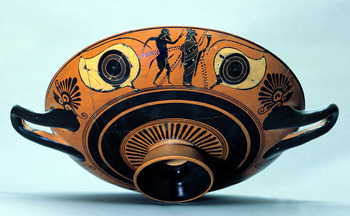
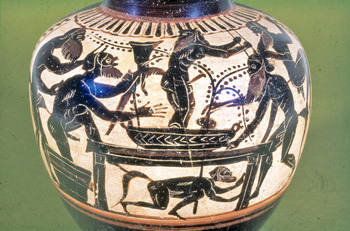
Similar ambiguities came to the fore among the satyrs and maenads, Dionysos’ mythical followers. Satyric drama and vases often show us the happy side of the Dionysiac world through the satyrs: buffoonery, drinking, and all kinds of sexual activities (Figures 3 and 4). Yet some of the last, such as masturbating and coupling with animals, were definitely not socially acceptable, although the god himself was also sometimes associated with the mule, a very randy animal (Figure 5).Footnote 58 And tragedy and vase-paintings showed his female followers, the maenads, both resting in serene peace and committing the most gruesome murders in their ecstasy (Chapter VI, §3), as Euripides’ Bacchae well illustrates; in fact, Dionysos frequently received the epithet Bakchos (or one of its variants), the Greek term par excellence for ecstasy and madness.Footnote 59
Dionysos with cantharus and satyr with erect member. One side of Attic black-figure eye-cup, c. 530 bc.

Satyrs treading grapes, while a monkey sits under the table. Attic black-figure oinochoe, Gela Painter, c. 500–490 bc.

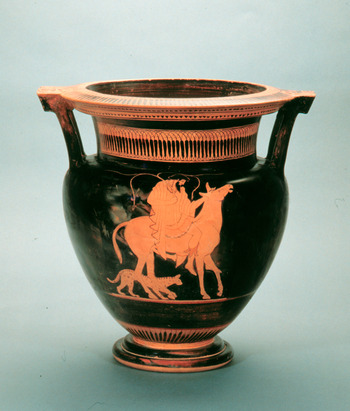
Dionysos on a mule with his panther. Attic red-figure krater, Flying Angel Painter, c. 570 bc.

Dionysos’ divine relationships similarly display this tension between order and ‘anti-order’. He was sometimes, understandably, connected to Aphrodite: in antiquity, too, wine and love went together. He was also connected with Artemis and it fits in with her marking of the boundaries of normality (see above) that she more than once supervised the restoration of order after Dionysiac disorder, as when she cured the madness of Proitos’ daughters (Chapter VI, §2). It is rather surprising that he was even associated with Apollo, most clearly in Delphi where Dionysos ‘ruled’ three months in the winter and Apollo the rest of the year. Yet this relationship perhaps sums up best Dionysos’ position in Greek society: society cannot live without a temporary relaxation of the social order, but order has to be restored.Footnote 60
If I had more space, I would also have analysed Hermes (but see below), Hephaistos, Aphrodite, and Ares (Chapter IV, §3), personifications like Eirene (‘Peace’) (Chapter VII, §3) and Thanatos (‘Death’),Footnote 61 or even a very small god, despite his oversized member, such as Priapus.Footnote 62 However, the discussion so far is sufficient to draw some conclusions: first, Vernant and his school were clearly right to draw attention to connections and relationships of similarity and difference between gods. It is important to see that both Athena and Poseidon are connected with horses in rather different ways, that Apollo and Athena always defeat Poseidon, that Apollo and Dionysos are opposites but both still necessary for the city. On the other hand, these connections do not replace a study of the sphere of action of the individual gods. Athena and Apollo are both more than the sum of their connections: the Greek pantheon was not the product of an ancient logician.
Second, when we now return to Sophilos’ vase, we see that those at the centre of the social order went by cart: Zeus, Athena, Apollo, and Artemis. Considering the disruptive effects of male power and sex, it may surprise that they were joined by Poseidon, Ares, and Aphrodite, but male force always remained necessary for the survival of the polis, while sexual pleasure was necessary for its reproduction.Footnote 63 However, the location of Poseidon's sanctuaries (Chapter III, §2) and the deviant nature of the sacrificial victims of Ares and Aphrodite (Chapter IV, §2) show that these last three gods clearly were considered to be more at the margin of the social order.Footnote 64 On the other hand, the great gods who went on foot, Demeter and Dionysos, are those with festivals in which the normal social order was temporarily dissolved, whether by the dominance of women or by the prominence of wine and the phallus. Since both gods are (virtually) absent in Homer and both are the gods of Greek mystery cults (Chapter VII, §§1–2), both were evidently seen as different and occupying an ‘eccentric’ position in the pantheon. The position of gods on other Attic vases confirms this picture:Footnote 65 a central place for Zeus and Apollo but an eccentric position for Ares, Hermes (the god of thieves, merchants, and ephebes – in short, of socially marginal groups), Poseidon, and Dionysos.Footnote 66 Evidently, a divinity's relationship to the social order was an important consideration for the Greeks in the (conscious or unconscious) construction of their pantheon.
Yet we cannot speak of a Greek divine hierarchy without two important qualifications. The picture I have sketched is, perhaps inevitably, too static. The pantheon was not a fixed entity but was subject to constant negotiation and repositioning. Worshippers of Pan and the Nymphs gained much in prominence in the course of the classical period (Chapter VII, §3), and in 340/339 bc a Delphic hymn to Dionysos proclaimed that the god should be worshipped the whole year round – not only during the winter as had been usual.Footnote 67 The picture also insufficiently takes into account the fact that each city had its own pantheon, in which particular gods could be more prominent than in other cities. For example, Demeter was especially popular in Sicily and she, naturally, was the most important divinity in Eleusis (Chapter VII, §1), whereas on Chios Dionysos enjoyed a particular popularity – reputedly, the first settler of the island was his son Oinopion.Footnote 68 In short, the picture is basically a Panhellenic model, from which we should not automatically extrapolate to individual cities and moments in time.
Third and finally, whereas Burkert approached the Greek gods as persons, Vernant and other francophone scholars prefer to see them as powers.Footnote 69 Indeed, to a certain extent Greek gods did personify specific powers and qualities. This appears clearly from the oppositions between gods (above, §2): when Poseidon and Aphrodite are contrasted in ritual (Chapter IV, §3), the opposition can hardly be separated from their respective embodiments of ‘brute power’ and ‘love’. Similarly, when Athena defeats Poseidon, many a Greek would not have failed to notice that ‘intelligence’ defeats ‘brute power’. The distinction I have posited between ‘orderly’ and ‘disorderly’ gods in the Greek pantheon would, if correct, be an additional illustration of this side of the Greek gods. Moreover, the growing allegorization and euhemerization of the Greek gods in the course of the fifth century (Chapter VII) could hardly have taken off without this quality. On the other hand, art, cult, and literature incessantly impressed upon the Greeks the personal aspect of their gods. ‘Power’ and ‘person’ are two sides of the Greek gods which could both come to the fore at different times and in different contexts. Poets stressed the personal side, whereas philosophers started to promote the ‘power’ aspect of the divinities. The two approaches coexisted for a long time and the tension between them reflects an essential quality of the ancient Greek gods.Footnote 70