When Herodotus describes the religion of non-Greek people, he mainly concentrates on their ritual. Consequently, it seems a reasonable conclusion that he, and presumably also his fellow Greeks, understood the significance of religion largely in ritual terms.Footnote 1 Although recent scholarship has paid much attention to belief (Chapter I), there can be little doubt that ritual constitutes the heart of ancient Greek religion. Accordingly, Burkert began his analysis of classical Greek religion with a chapter called ‘Ritual and Sanctuary’.Footnote 2 However, as the content of the term is not self-evident, I will start this chapter with some introductory observations on the use of the term and on the possibilities for studying ancient ritual (§1). Subsequently I will analyse important ritual acts, such as prayer, procession, and, in particular, sacrifice (§2). I conclude with a discussion of various larger ritual complexes (§3).
1. What is ritual?
Considering the importance attached to ritual by Herodotus, it is perhaps surprising to notice that the Greeks did not have an all-embracing category called ‘ritual’.Footnote 3 They were not alone in this. We find the same phenomenon in, for example, Japanese and Turkish religions. Apparently, when ritual is the core of a religion, it need not be distinguished as a discrete class of religious phenomena.Footnote 4 The Greeks approached ritual acts and processes from at least three different angles. First, they called many of their ritual activities ta nomizomena (‘what is customary’; see Chapter I, §3); modern scholarship of ritual similarly stresses the importance for rites to look traditional, even if they are recent constructions or innovations.Footnote 5 Second, they often named rituals after their central, most prominent part: the Athenian festival Anthesteria was often called Choes from its most striking day (see §3), and the sphagia, a type of sacrifice which was not followed by a banquet, was named after its most salient act, the ‘piercing of the throat’.Footnote 6 Third, many elaborate rituals were called heortai, a term associated with good food, good company, and good entertainment, as appears from a statement by the philosopher Democritus: ‘a life without heortai is like a road without inns’ (B230 Diels/Kranz).Footnote 7 The term is usually translated as ‘festival’, but our modern equivalent hardly covers the variety of ancient festivities or the presence of sombre aspects among them.Footnote 8 The heortê, then, was an important way of celebrating the gods, which provided a pleasant interruption to the routines of everyday life.
The fragmentation of the vocabulary of what nowadays is called ‘ritual’ is not a purely Greek phenomenon, but can be observed in many cultures.Footnote 9 In fact, it was only about 1900 that anthropologists and historians of religion started to use ‘ritual’ as the standard term for repetitive, representational behaviour that often has to be decoded.Footnote 10 In other words, by introducing a new classification based on only one aspect of a mass of heterogeneous phenomena, viz. its prescribed and repetitive character, they could reduce both single rites, such as prayer (see §2), and extended rituals, such as initiation (see §3), to a common denominator. I follow the modern categorization but keep in mind that ‘ritual’ is not a native category.
It is not easy to analyse ancient ritual, since the evidence usually stems from different periods, places, and genres. Moreover, the nature of the evidence rarely enables us to integrate the opinions of the participants or to describe a ritual in all its details, since ancient authors focused on the unusual and habitually considered the usual too well known to be mentioned.Footnote 11 Necessarily but regrettably, our descriptions, then, often have to focus on the structure of a ritual and to be brief on its psychological impact or historical development.
2. Prayer, procession, and sacrifice
The more elaborate Greek festivals were made up of a limited number of basic ritual acts: dances,Footnote 12 which were especially important for girls in the archaic period,Footnote 13 musical and athletic contests,Footnote 14 prayers and hymns, processions, and, most important of all, animal sacrifices. Prayers usually followed a structure of invocation, claim for attention, and request, as when Achilles prays to Zeus (Il. 16.233–48). Striking differences from Christian prayer were the lack of a feeling of gratitude (instead, the Greeks offered expressions of praise and honour), the posture (Greeks usually did not kneel but prayed with hands raised – see Appendix), the loudness (silent prayer became more usual only in late antiquity), and the regular singing of prayers in the form of hymns;Footnote 15 the latter sometimes developed into a special genre for a particular god: paeans for Apollo and dithyrambs for Dionysos.Footnote 16
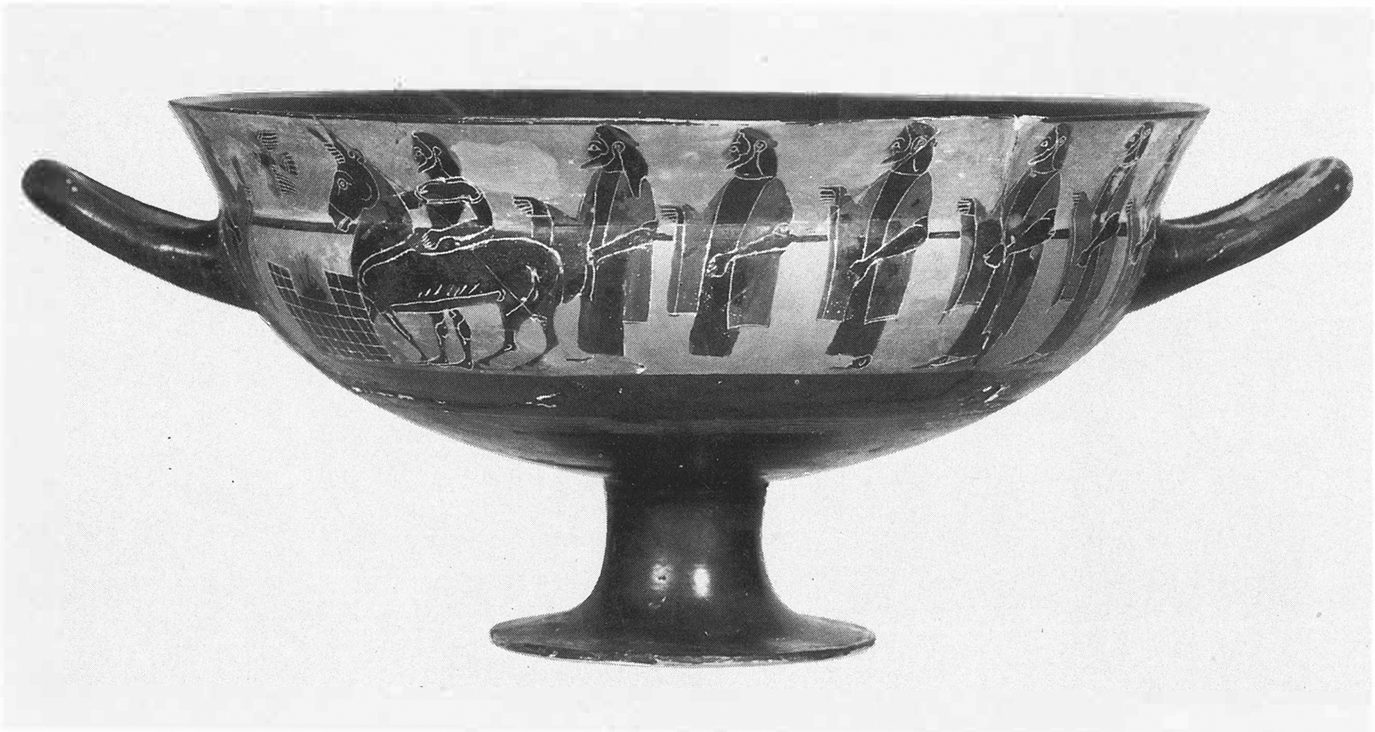
Processions were part and parcel of Greek life.Footnote 17 The sacrificial procession paraded the value of the sacrificial victim and the piety of the sacrificers (Figure 8). The wedding procession advertised the official nature of a wedding. For more than half a millennium, a yearly procession kept the memory alive of those who had fallen at the Battle of Plataea in 479 bc, even though the ritual will hardly have remained unchanged in all those years. Processions with a divine statue were often part of festivals in which the normal social order was inverted, as when slaves were free to do what they wanted or women were on top for a day (see §3). Yet they could also stress the existing order, as when, once a year, the leading Milesian aristocrats, the Molpoi, travelled in procession to Didyma singing paeans at all the sanctuaries along the road. Processions could even symbolize the restoration of the old order, as when Thrasybulus solemnized the reinstatement of Athenian democracy in 403 bc with a march from the Piraeus to the Acropolis. In short, the functions of processions were manifold.Footnote 18
Sacrificial procession. Attic black-figure Siana cup by the C Painter, c. 570–565 bc.

Processions were particularly suited to making symbolic statements about power relations, since they often drew large audiences. For example, during the sacrificial procession of the Panathenaea, Athenian colonies and allies had to parade a cow and panoply, the daughters of Athenian metics carried parasols for female citizens, and adult metics carried sacrificial equipment; colonies also had to contribute a phallus to the procession of the Great Dionysia.Footnote 19 Whereas these processions showed Athenian dominance, others could demonstrate modesty. During the Spartan Hyacinthia festival, adolescent girls rode down in a procession to Amyclae, showing themselves off to the community after, probably, an initiatory seclusion at the border area. Some aristocratic girls rode in race-carts, others in carriages with the shape of griffins or goat-stags. The daughter of the Spartan king Agesilaus went in one of the latter vehicles, a public one, which was ‘no more elaborate than that of any other maiden’. Evidently, the Hyacinthia procession normally demonstrated that some Spartans were more equal than others, although Spartan ideology claimed otherwise.Footnote 20
All these elements were important, but the pivot of Greek ritual was undoubtedly animal sacrifice.Footnote 21 In the 1970s and 1980s, both Burkert and Vernant (and his school) devoted much of their scholarly efforts to the meaning of sacrifice and its place in Greek society – although drawing very different conclusions.Footnote 22 We still lack investigations of local practices (though a start has been madeFootnote 23), but two developments in particular now enable us to evaluate these studies in a more satisfactory manner than even a few decades ago. First, we now know that Attic vases and votive reliefs are important sources for sacrificial representations,Footnote 24 even though we should realize that iconographical representations have their own problems and are not, so to say, realistic depictions of the ritual.Footnote 25 Second, biologists have increasingly paid attention to the faunal remains of excavated altars – a practice often nowadays called zooarchaeology – which allows glimpses of the realities of Greek sacrificial practice rather than the often idealizing representations of literature and vase-paintings.Footnote 26 Here, instead of a step-by-step analysis of normative Greek animal sacrifice,Footnote 27 sacrifices at the beginning of battle, at the crossing of rivers, or at the conclusion of oaths,Footnote 28 the difference between chthonian and Olympian sacrifice (a debate that has much advanced in recent years),Footnote 29 the banqueting and group worshipping, or even human sacrifice,Footnote 30 space limits us to two questions.
Bearing in mind our attention to the hierarchy within the Greek pantheon (Chapter II, §3 and Chapter III, §2), I will first briefly look at the choice of sacrificial victims. Did all divinities receive the same animals or did some fare better than others? Although cattle constituted the most valued victims, the preferred victims for all major gods were sheep and goats.Footnote 31 The main exceptions to this rule were Hestia (the goddess of the [city] hearth), who customarily received a preliminary, usually cheap, sacrifice, and Demeter, who traditionally received a pig(let); on Attic vases, Dionysos was also regularly associated with a pig sacrifice.Footnote 32 Polluted Eileithyia (Chapter III, §2), cruel Ares (below, §3), and spooky Hekate received dogs, of which the consumption was much more widespread than is usually thought, as recent faunal analyses show;Footnote 33 Aphrodite was honoured with birds, Asclepius with cockerels, and randy Priapus with fish.Footnote 34 Most gods, then, received cattle, sheep, and goats, whereas inedible or cheap animals were offered to those divinities that were connected with impurity and/or situated at the margin of the social order. The ‘eccentric’ position of Demeter and Dionysos, which was already noted during discussion of the gods (Chapter II, §3) and the locations of their sanctuaries (Chapter III, §3), is confirmed by the ‘eccentricity’ of their victims, the pigs, whose rooting, digging habits made them less suitable for densely populated areas.Footnote 35 Evidently, the choice of sacrificial victims reflected and helped to reinforce the divine pecking order.
The question of sacrificial hierarchy has received very little attention in recent times, but the second question goes to the heart of a long debate on Greek sacrifice: what was the significance of the ritual surrounding the killing of the sacrificial victim? Modern debate started with a highly learned study by the Swiss classicist and folklorist Karl Meuli (1891–1968), who argued that Greek sacrifice ultimately derived from hunting practices and that hunters, feeling guilty for having killed their game, regularly tried to disclaim their responsibility.Footnote 36 There can be no doubt that Meuli was partially right and partially wrong: a number of features of Greek sacrifice, such as the disclaiming of responsibility, the hanging up of the sacrificial victim's skull, the burning of small pieces of meat, the burning of bones, the tasting of the innards, and the preservation of the skin of the victim, all have their closest parallels in hunting practices. Yet the Greeks were no archaic hunters and, unlike them, broke the bones of the sacrificial victims to extract the marrow; they did not give back the bones to a Lord/Lady of the Animals; and they used grains in their sacrificial ritual – to mention only some of the differences from hunting societies.Footnote 37
Walter Burkert made the feeling of guilt, as analysed by Meuli, the focus of his sacrificial theory. His crowning witness is the Dipolieia, an Athenian festival in the month Bouphonion, during which an ox was sacrificed because it had tasted sacrificial cakes. Subsequently the sacrificial knife was condemned and expelled from the city, but the ox ritually re-erected, yoked to a plough. In the aetiological myth, the killer of the ox eased his conscience by suggesting that everybody should partake in the killing of the sacrificial victim.Footnote 38 Burkert took this ‘comedy of innocence’ to be paradigmatic for every sacrifice: humans experience angst when actually killing the animals and have feelings of guilt over the blood which they have shed.Footnote 39
However, Burkert's observations cannot be accepted in their totality, since there are virtually no testimonies of actual fear and guilt among the Greeks: Attic vases constantly connect sacrifice with ideas of festivity, celebrations, and blessings.Footnote 40 The question of disclaiming is also more complicated than Burkert thought.Footnote 41 The ritual of the Dipolieia cannot wholly make up for this absence: it presupposed the developed Attic rules of justice and had only limited circulation, being found only in Athens and a few neighbouring communities,Footnote 42 even though the month name Boukation, which is related to Bouphonion, in central Greece suggests that comparable festivals were more widespread once.Footnote 43 Its protagonist was a plough-ox, which, reportedly, it had once been a crime to kill at Athens.Footnote 44 Meuli considered the plough a latecomer in the ritual, but it was its vital position in Athenian society and its closeness to the farmer that made the killing of the plough-ox the subject of an elaborate ritual: Theophrastus (fr. 584A Fortenbaugh) explicitly notes that the ritual was inaugurated to enable people to eat the ox.
The expansion of the Athenian state, however, which required the sacrifice of numerous oxen in order to feed the people at the banquets accompanying state festivals – Isocrates mentions sacrificial processions of 300 oxen (Ar. 29) – removed the original tie which the farmers of an earlier, smaller Athens would have felt with their plough-oxen. It is no wonder, then, that Aristophanes in his Clouds (984–5) considers the Dipolieia/Bouphonia an archaic affair. Yet there seem to be no really convincing arguments against the fact that we have here an ancient ritual that with its ‘comedy of innocence’ preserved a mode of behaviour that clearly went back to hunting practices. In other words, it is not an unusual development, as Robert Parker has stated, but an unusual survival.Footnote 45
Finally, in explicit opposition to Meuli and Burkert, Jean-Pierre Vernant argued both that Greek sacrificial rites should not be compared with hunting rituals but resituated within their proper Greek system and that the killing of the victim does not constitute the centre of gravity of sacrifice, although he explicitly noted that rituals, myths, and representations are all painfully careful in avoiding any reference to the actual killing of the sacrificial victim. In this way, according to Vernant, the Greeks wanted to exclude the elements of violence and savagery from their sacrifice in order to differentiate it from murder.Footnote 46 Vernant was certainly right in questioning Meuli's and Burkert's all-too-strong accentuation of the influence of hunting traditions: Meuli overlooked the influence of Syro-Palestine,Footnote 47 which shows that there is not a straight line between Greek sacrificial and archaic hunting practices, and other differences with societies of hunters (see above). On the other hand, the differentiation between sacrifice and murder does indicate an underlying feeling of unease with the ritual, as is confirmed by other indications. In the myth of the Dipolieia, the killer of the ox is a foreigner and the sacrificial knife is hidden as long as possible;Footnote 48 the Greeks employed the euphemism ‘to do’ for sacrificing; and, without the existence of some mixed feelings about sacrificial killing, it remains hard to explain why Orphics, Pythagoreans, and Empedocles rejected animal sacrifice altogether.Footnote 49 Killing for sacrifice, then, did not generate fear and angst, but it certainly generated feelings of unease in some circles of Greek society.
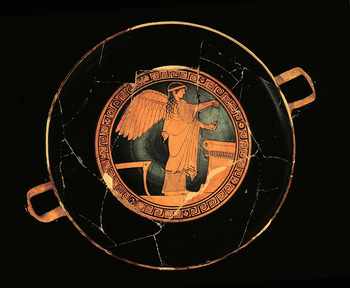
There is one last point to make. Whereas the Greeks themselves did represent gods in the act of sacrifice (Figure 9), the protagonists in the modern debates feel apparently ill at ease with the religious functions of sacrifice and approach the subject in a strikingly secular manner. For Meuli, it was nothing but ritual slaughter; for Burkert, the shared aggression of the sacrificial killing primarily leads to the founding of a community; and for Vernant sacrifice was, fundamentally, killing for eating.Footnote 50 Clearly, however, this act, which stands at the centre of Greek ritual, is much richer than these reductive formulas suggest. In order to do justice to the rich and varied evidence, studies of sacrifice will be satisfactory only if they are based on the combination of literary, epigraphical, iconographical, and osteological evidence and not if they concentrate on just one of these aspects.
Sacrificing Nike. Tondo of Attic red-figure cup, Sabouroff Painter, c. 460 bc.

3. Initiation and festivals
Regarding more elaborate rituals, modern anthropology often distinguishes between one-off rites of transition and cyclical rites that are repeated at regular intervals, such as New Year. I will conclude this chapter with a discussion of both types, paying special attention to their performance, function, symbols, and logic. I start with initiation, which has been a productive concept in the last half-century, although not uncontested.Footnote 51 Instead of the more often discussed rites of Athens and Sparta,Footnote 52 I will concentrate on Crete, as the fourth-century historian Ephoros has left us a detailed, contemporary report about its male initiation.Footnote 53 As was the case with ‘ritual’ (§1), the Greeks had no term for ‘initiation’, but Minoans and early Indo-Europeans practised it,Footnote 54 the Spartans called their initiatory process agôgê (‘the leading of a horse by the hand’: see below on agela), and the names of various initiatory festivals have survived. We, the outsiders, construct a whole, whereas the insiders focused more on the different parts.Footnote 55 Naturally, there will have been local differences between the various Cretan cities. My reconstruction should therefore be taken as an ‘ideal’ ritual rather than assuming that every detail will have been practised in every Cretan city, but the cities resembled one another sufficiently structurally to warrant the analysis.Footnote 56
Cretan political power was in the hands of an aristocratic elite which dominated both the serfs (the native Cretans) and the less privileged free. The aristocrats were organized in clubs and dined in ‘men's houses’ (andreia), where young Cretan boys, summer and winter dressed in the same dirty garment, waited on the adults. They received little food and drink, and their main activity was fighting.Footnote 57 At seventeen, the boys who were ‘most conspicuous and also most influential’ – surely the sons of the elite – collected as many boys as possible around them into an agela (‘herd of horses’): apparently, the youths were seen as unruly foals who had to be domesticated.Footnote 58
The ‘herds’ were supervised by the fathers of these boys, who also directed their most important activities: running, hunting, dancing in choruses, marching over steep roads, and fighting in gymnasia ‘with the fist and with clubs, as was prescribed by law’ (Heraclides Lembus fr. 15). On certain appointed days, the agelai fought against each other, ‘marching rhythmically into battle, to the tune of pipe and lyre, as is their custom in actual war’. In addition to these physical activities, the boys had to learn their letters and songs, ‘prescribed by the laws’, which consisted of laws, hymns to the gods, and praises of brave men, although Plato, who still knew them, rated their quality rather low (Laws 2.666D).Footnote 59
The final stage of Cretan education began with a ceremonial casting off of the dirty garment: in fact, in various Cretan cities the technical term for leaving the agela was ‘to undress’. The change is firmly located in an initiatory setting by the aetiological myth of the Ekdysia (‘Undressing’) festival at Phaistos for Leto, an initiatory goddess (Chapter II, §3): a girl who had been brought up as a boy actually changed into a real boy the moment she became an adolescent. Transvestism seems indeed to have been a common feature in archaic initiation, which survived in classical times only at a few places, such as in the Athenian Oschophoria festival, where two youths dressed as girls performed, which, hardly fortuitously, was connected with the initiatory myth of Theseus (Chapter V, §3).Footnote 60 Further Cretan details are absent, but both the names ‘nude ones’ and ‘very nude ones’ for adolescents near maturation, and the existence of a ‘Festival of the Garment’ (Periblemaia) at Lyttos, strongly suggest that the order of the final stage of initiation was: undressing, being nude, and donning the new adult garment. The focus on the garment during the ‘graduation’ is hardly surprising, since Ephoros tells us that the elite were characterized by a distinctive dress. Clearly, the transition from dirty garment to adult dress was too great to be made in one step. It had to be eased and dramatized by a series of festivals.Footnote 61 In Sparta, where the difference between youths and adults was even more strongly marked, initiation was also concluded with a series of festivals, but in Athens, where the difference was much less strong, a concluding festival no longer existed.
In addition to nudity, the contrast with the future status was expressed in a different manner. Ephoros tells us that shortly before official adulthood the aristocratic boys were ‘kidnapped’ for a brief pederastic relationship; in fact, in more or less formalized ways pederasty was widespread in the Greek world. As, ideologically, the boys could only play a passive role in the relationship, this part of the ritual stressed their non-manhood before they became real males, just as was done by the myth about the transformation from a girl into a man.Footnote 62
The physical side of Cretan initiation, then, prepared the boys for a life in which fighting was of the utmost importance, while songs helped to instil the corresponding ideology. At the same time, the initiatory process had been adapted to the political situation of Crete. The prominent position of the elite's sons and the focus on the garment impressed the domination of the elite on their inferiors but, by incorporating the latter into the agela, feudal ties were promoted which helped to support the political system. As ritual often pretends to be of great antiquity, it is equally important to note its innovative powers and flexibility. This is shown by the introduction of literacy in the training (though this did not pre-date the fifth century), and the stress on running, which was absent from Athenian and Spartan initiation. Crete is very mountainous and Cretans could hardly have survived as soldiers without the ability to run. In fact, running was so important that the Cretan term for adult was dromeus (‘runner’): even ecology can be a factor in the shaping of a particular ritual.Footnote 63
Contrasts not only played a role in the logic of rites of transition; we also find them in cyclical rituals, as a Theban festival may illustrate. According to Xenophon (Hell. 5.4.4–6), Theban polemarchs (generals) customarily celebrated a festival of Aphrodite at the end of their period in office. In the winter of 379, the pro-Spartan polemarchs were promised a night with women and wine, but the veiled women turned out to be conspirators in disguise, who efficiently disposed of their opponents and liberated the town from the Spartans. How do we explain this connection of the military with the goddess of love?
The connection is less surprising than might be expected at first sight. Aphrodite was associated with the god of war, Ares, in literature (witness Homer's delightful story of their liaison), in art (witness the representation of Ares assisting with Aphrodite's birth), and in cult (witness their communal temples and altars). Moreover, Aphrodite was widely associated with magistrates, both civilian and military, whose harmonious cooperation she was believed to promote. Yet the goddess was also sometimes contrasted with Ares because in the Homeric Hymn to Aphrodite (9–10, with Faulkner ad loc.) Athena states that she took no pleasure ‘in the works of golden Aphrodite but liked wars and the work of Ares’.Footnote 64 So how do we approach the Theban case?
The answer is found on Aegina, the island from which Plutarch explains the otherwise unknown ritual of the ‘solitary eaters’ in his Greek Questions (301e–f). The male Aeginetans celebrated a festival of Poseidon by isolating themselves in their homes and by feasting in silence without the presence of non-kinsmen and slaves for sixteen days. The festival shows all the signs of a disturbance of the social order: normally the Greeks feasted uproariously in the company of family and friends. Interestingly, the festival was terminated with the Aphrodisia before the return of normal life. Since Poseidon was also a macho god (Chapter III, §3), he was in various ways comparable to Ares. So in both cases the transition from the sphere of war and virility to peace was eased by passing through the opposite of war: love.Footnote 65 At the same time, we may assume that the juxtaposition of the two festivals put their contrasting contents in sharper relief: the significance of individual parts of a more elaborate ritual cannot be separated from their position within the ritual.
We now turn to more elaborate festivals, the analysis of which has made much progress in recent decades. Festivals are shorter or longer periods of intense worship, usually local by nature and celebrated at a certain date in the year. Modern anthropologists and scholars of religion stress their community-affirming nature, but this function was long ago seen by Plato: ‘so that…people may fraternize with one another at the sacrifices, and gain knowledge and familiarity, since nothing is of more benefit to the polis than this mutual acquaintance’ (Laws 5.738d–e, trans. Bury 1926, adapted).Footnote 66 The mention of sacrifices shows that the shared consumption of meat was considered a prominent part of the festivals. Burkert's Homo necans (1983) and Graf's Nordionische Kulte (1985) still provide some of the best discussions of festivals, although at the time the former's combination of structuralism, functionalism, and ethology was deemed so revolutionary that the leading German review journal Gnomon was unable to find a reviewer for the original German edition of Homo necans (1972).Footnote 67 I will try to build upon these insights in an analysis of what is perhaps the most complex Greek festival we know of, the Athenian Anthesteria. As is often the case with Greek festivals, we partially depend on later sources for our reconstruction, not all events are securely attested, and we cannot be certain that all elements were integral to the festival from the very beginning, which goes back to the second millennium bc.Footnote 68
The festival took place on three successive days in the month Anthesterion, roughly the end of February, which were called Pithoigia, Choes, and Chytroi. The first day, ‘The opening of the wine jars’, dramatized the opening of the festival, as did the first day of the Thesmophoria (Chapter VI, §3). On that day, the farmers of Attica brought their jars with new wine to the sanctuary of the god of the wine, Dionysos ‘in the marshes’ (Chapter III, §2), to have the wine ceremonially opened, mixed with water, and tasted for the first time. This was also the moment of celebrating the god. As a fourth-century eyewitness noted, ‘delighted then with the mixture, the people celebrated Dionysos in song, dancing, and calling upon him as Flowery, Dithyrambos [see §2], the Frenzied One and the Roarer’ (Phanodemus FGrH 325 F 12). Wine mixed with water was the main drink in Greece and an indispensable part of libations.Footnote 69 It is therefore not surprising that the advent of new wine was a matter of general concern and controlled by the community.
But, as with the Cretan ‘graduation’, the advent of such an important drink as new wine had to be extended in time. The next day, the Choes (‘Jugs’), which often gave its name to the whole festival (see §1), started with the chewing of leaves of buckthorn (a rather unappetising plant). Doors were smeared with pitch, temples were closed (with the exception of that of Dionysos), and men on wagons reviled passers-by. This dissolution of the social order preceded a strange drinking contest in the late afternoon, which was held both centrally, supervised by the highest magistrate, and at home in the various Attic demes (districts and villages).Footnote 70 Contrary to custom, the Athenians brought unmixed wine and their own large jug (chous), and were seated at separate tables, whereas normally guests were regaled, drank mixed wine from cups, and reclined together on couches: the separateness of the drinkers must have even been so striking that it is reflected on the vase-paintings of the Choes jugs.Footnote 71 Crowned with ivy, the plant dear to Dionysos, the banqueters awaited the sign of a trumpet, seen as an uncanny instrument by the Greeks, before trying to drain their 3.28 litres (!) as quickly as possible in complete silence.Footnote 72
The ritual shows a clear resemblance to that of the Aeginetan ‘solitary eaters’ and illustrates how the Greeks shaped a ‘negative’ (part of a) ritual by a reversal of normal practices. Other means are the absence of wreaths; libations of unmixed wine, water, or oil instead of mixed wine;Footnote 73 or the dark colour and/or holocaust of the sacrificial victim instead of a sacrifice ending in a banquet.Footnote 74 It was the presence and intensity of these ritual markers that determined the nature, positive or negative, of a ritual.
The resemblance with Aegina extended to the level of myth. The Aeginetans explained their festival as recalling the return of the survivors of the Trojan War. Since they had no wish to hurt the feelings of those whose relatives had not returned, they feasted separately and secretly. In a comparable way, the Athenian custom of silent drinking was explained by the arrival of the matricide Orestes, whom Athenians did not want to entertain except in silence and at a separate table.Footnote 75 A different, perhaps later, aetiology connected the strange features with the Athenian murder of Aetolians who had brought them the wine. These myths can be used as a substitute for the unknown reactions of participants, since they tell us how the atmosphere was perceived. We have another indication of the sombre mood: we are told that at the time of the Choes Sophocles had choked on an unripe grape. Since at that time of year grapevines could hardly have finished blossoming, the anecdote is most likely not historical – the more so since Anacreon reportedly also choked on a grape. Yet it is important to note that the sad event was said to have occurred during the Choes, thus fitting the sombre atmosphere of the ritual.Footnote 76 The myth of Orestes focused on the strange nature of the contest, which can only have lasted a few minutes. Afterwards everybody indulged in a copious dinner and even a misanthrope would have at least one table companion. The picture of the banquet in Aristophanes’ Acharnians is a happy one, and that is obviously how the Athenians abroad remembered the festival (see below).Footnote 77
So far one might have thought that the festival was only for Athenian male citizens, but nothing would be further from the truth. Miniature jugs, confusingly also called choes, show that children of all ages received such jugs as toys and were probably the centre of special attention on this day. The festival is attested as a milestone in a small boy's life in Roman times, but this should not be retrojected to classical Athens.Footnote 78 Slaves, too, had a good time and their licence was explained by the great number of Carians among them or the one-time Carian ownership of a part of Attica: the stress on Carians seems to suggest mumming by the enslaved. Another, late explanation spoke of the Keres, spirits of the dead. It is hard to choose from these explanations and perhaps unnecessary, since (ancestral) Carians and spirits of the dead are structurally equivalent: both are entities normally absent from ordered Athenian life.Footnote 79
The licence permitted to the enslaved was one more sign of the dissolution of the social order. Their inclusion in the general atmosphere of merriment may well have contributed to better relations with their owners, since such festivals of reversal could work as a safety valve, as the testimony of former American enslaved people confirms. But did they also have a legitimizing function as has been suggested? Perhaps in the eyes of the ruling classes, but hardly from the point of view of the enslaved. Such a view could only be sustained if Athens had been a relatively static society. The enslaved in Athens, however, had often been imported during their own lifetimes, and their massive flight during the Peloponnesian War shows their refusal to accept the existing order. In fact, several of these festivals of reversal became the scene of revolution, as they have been in more modern times, which is hard to explain if they really helped to legitimize the existing order.Footnote 80
The discovery of a sacrificial calendar in Thorikos, dating from the 430s or 420s, shows that during the Choes this deme sacrificed to Dionysos a tawny (or perhaps black) billy goat that had lost its milk teeth. The dark colour fits the character of the day and the small size of the victim seems to suggest the absence of a public banquet: such a goat can hardly have fed many stomachs. Apparently, the Attic demes contributed a modest public supplement to the many festivities at home.Footnote 81
Yet society cannot live in permanent disorder and at the end of the Choes a herald announced the third day of the festival, the Chytroi (‘Pots’). Although the event has sometimes been called into doubt,Footnote 82 it is certain that the return to order was celebrated by a symbolic wedding between the wife of the highest magistrate and the god, which is reflected on vase-paintings at a mythological level by Dionysos’ wedding with Ariadne.Footnote 83 At home, the ‘Pots’ was celebrated by remembering the flood.Footnote 84 People ate a stew of all kinds of vegetables cooked in earthenware pots and sacrificed to Hermes Chthonios, the god associated with the victims of the flood.Footnote 85 Aristophanes’ Frogs mentions a procession with drunken people on the Chytroi (211–19) and thus the festival seems to have been officially concluded with choruses at the place where it had all begun: the sanctuary of Dionysos.Footnote 86
For the Athenians themselves, one of the most striking features of the festival must have been the licence accorded to the enslaved. It is therefore not surprising that their return to normality had to be dramatized. So at the end of the festival the owners, presumably, said: ‘Begone ye Carians/ Keres. [It's] no longer Anthesteria.’ Similarly, the enormous phallus which had been carried round Athens during the Dionysia was ceremoniously burned at the end of that festival.Footnote 87
On the third day, another feast also took place. Girls commemorated the maiden Erigone by swinging: she had hanged herself after shepherds had murdered her father, Ikarios, who had introduced wine to them. This feast, the Aiora, is not found in non-Athenian Anthesteria festivals and is not attested in literature before the Hellenistic era, but iconographical evidence for the swinging attests to its celebration in the fifth century. Although the myth fits the Dionysiac themes of the festival, and the special place of the girls fits that of young children and enslaved people, this part seems to be a later addition from a particular local festival: one more testimony to the flexibility of ritual.Footnote 88
Of all their festivals, the Anthesteria perhaps lay closest to the Athenians’ hearts. As a political refugee, Themistocles introduced it to Magnesia, which he had received as a fiefdom from the Persian king. It was also celebrated at the court of the Sicilian tyrant Dionysius, where it may well have been organized for, or perhaps by, Plato during his stay in Sicily. This feeling lasted into the third century, since the followers of Epicurus countered accusations of atheism against their master with the argument that he had celebrated the Choes and had advised his pupils to do likewise. And Callimachus mentions an Athenian who celebrated the Anthesteria in Alexandria in Ptolemaic times. Clearly, the festival had become part and parcel of Athenian identity, like Christmas once for European colonists, or, today, Ramadan for many Muslims in the West.Footnote 89
The Anthesteria displays the typical signs of la grande festa, as ethnologists have called the type of festival which all over the world dramatized the advent of the new harvest/fruit/wine by a sharp break with the existing order. The festival therefore resembled a New Year celebration, and this may explain why teachers were paid during it (Eubulides, fr. 1). Yet its New Year character was naturally stressed less than that of the official Athenian New Year, which was celebrated in Hekatombaion, a month marked by two official New Year festivals, Synoikia and Panathenaea (see §2), and preceded by two festivals characterized by a dissolution of the social order, the Kronia (Chapter V, §3), with the role reversal of the enslaved, and the Skira, with the women on top (Chapter VI, §3).Footnote 90
As was customary in Greece, the Anthesteria had given its name to the month in which it was celebrated: Anthesterion. This old Ionian month went back to the period before the Ionian colonization (around 1000 bc), as Thucydides realized; we may thus safely assume that the Anthesteria was one of the oldest Greek festivals. Its Ionian occurrence perhaps explains that several elements look like imports from the Near East (see the Appendix), such as the Sacred Marriage, a household festival that celebrated the institution of marriage,Footnote 91 and, perhaps, the expulsion of the Carians.Footnote 92 Greek calendars are under-researched, but they can be important for determining the connotations, positive or negative, attached to a festival and for the varying positions of divinities in Greek cities. Yet here, too, we have to be careful. The month Anthesterion, like other months, did not occupy the same place in the year in the calendar of every Ionian city: evidently, names of months were moved around and could even change in the course of the centuries, thus altering their original characters.Footnote 93
We have seen that the study of smaller and larger rituals has to take into account different aspects: the calendrical order, the spatial organization, gender, social groups and relations, systems of classification, psychological and emotional features, power aspects, the place of divinities, local peculiarities, the internal logic, and commentaries of participants. The fragmentary state of our tradition often makes it impossible to pay attention to all these aspects or to apply all modern insights, such as those of performance theory and cognitive science (but see Chapter VI, §3),Footnote 94 but we should at least try. In many ways, the study of Greek ritual has only just begun.