



No CrossRef data available.
Article contents
The Talpioth Ossuaries Again
Published online by Cambridge University Press: 05 February 2009
Extract
In September 1945 members of the Museum of Jewish Antiquities of the Hebrew University excavated a burial chamber near the Talpioth suburb of Jerusalem. The tomb, which was cut in soft limestone, was furnished with five loculi (kokhim) or burial recesses together with a number of ossuaries, that is small stone boxes containing the bones of corpses which had first been laid within the loculi and then transferred to such a box once the flesh had decomposed. Early rumours concerning the nature of these ossuaries gave rise to sensational press-reports of ‘what is believed to be an eye-witness account of the death of Christ’ which ‘may give first hand testimony to the trial and death of Jesus’. But it was not until 1947 that a comprehensive account of the finds was published by Dr E. L. Sukenik, the director of the excavations and the greatest living authority on ossuaries.
Information
- Type
- Articles
- Information
- Copyright
- Copyright © Cambridge University Press 1963
References
page 49 note 1 For archaeological details of these excavations see the report of Sukenik, E. L., ‘The Earliest Records of Christianity’, A.J.A. LI (1947), 351–65.Google Scholar
page 49 note 2 On the use of ossuaries in antiquity see Sukenik, E. L., A.A., J.D.A.I. XLVI (1931), 309–16. S. Krauss, ‘La double inhumation chez les Juifs’, R.E.J. XCVII (1934), 1–34.Google Scholar
page 49 note 3 The following are the inscriptions found on the ossuaries at Talpioth:  Simeon Barsaba (ossuary no. 1);
 Miriam, daughter of Simeon (ossuary no. 4); │ησους ıου (ossuary no. 7); │ησους αλωθ (ossuary no. 8);
 abbreviation for
 = Mattathias (ossuary no. 10).
page 49 note 4 Sukenik (above, note 1), p. 365.
page 50 note 1 E.g. │οú │οú δúστηνος: Soph. Tr. 1143; │οú │οú βοᾶν: Ar. Nub. 543. Liddell and Scott, s.v. │οú.
page 50 note 2 This was originally suggested by Dr M. Runnes; Sukenik (above, note 1, p. 49), p. 363 note 5.
page 50 note 3 Vulg. Act. i. 23: Ioseph qui vocabatur Barsabas, qui cognominatus est Iustus. Vulg. Act. xv. 22: Iudam qui cognominabatur Barsabas et Silam, viros primos in fratribus.
page 50 note 4 Sukenik (above, note 1, p. 49), p. 365.
page 50 note 5 ‘P E F’: Quarterly Statement (1874), pp. 7–10. See also Archaeological Researches in Palestine, I (1899), 381 ff.
page 51 note 1 See Vincent, L. H., Atti Pont. Acc. VIII (1932), 215 ff. A. Reifenberg, Ancient Hebrew Arts (New York, 1950), p. 65.Google Scholar
page 51 note 2 Bagatti, B. and Milik, J. T., Gli Scavi del ‘Dominus Flevit’, I, La Necropoli del Periodo romano (Jerusalem, 1958), cf. R. Bibl. LXVI (1959), 299–301; Antonianum, XXXIV (1959), 345–7; Th.L., Z. LXXXIV (1959), 569–97.Google Scholar
page 51 note 3 Kraeling, Notably C. H., ‘Christian Burial Urns?’, Bibl. Arch. IX (1946), 16–20; H. R. Willoughby, J.B.L. LXVIII (1949), 61–5; Bo Reicke, Svenska Jerusalems Föreningens Tidskrift, XLIII (1949), 2–14; H. Ludin Jansen, ‘Notes on the Ossuary Inscriptions of Talpioth’, Symbol. Oslo, XXVIII (1950), 109–10 (Jansen quotes an article not available to me by Professor O. Moe, ‘De äldest mindesmerker om Kristendommen’ in Erevna for 1949); S. L. Agnello, Nuov. Did. IV (1950–1), 86–7; E. Stauffer, ‘Zu den Kreuzeszeichen von Talpioth’, Z.N.T.W. XLIII (1950–1), 262; E. Dinkier, ‘Zur Geschichte des Kreuz-symbols’, Z.f.T.K. XLVIII (1951), 148–72; B. Gustafsson, ‘The Oldest Graffiti in the History of the Church’, N.T.S. III (1956–7), 65–9.Google Scholar
page 51 note 4 Willoughby (above, note 3), p. 64.
page 52 note 1 Cabrol, Dictionnaire 32, col. 3056.
page 52 note 2 Lexicon für Theologie und Kirche (Freiburg, 1961), pp. 606–18, s.v. Kreuz; M. Sulzberger, Byzantion, II (1925), 386. An example from the third century is probably heretical. Cf. C. Cecchelli, Monumenti Cristiano-Eretici di Roma (Rome, 1944.), pp. 86, 119.
page 52 note 3 Maiuri, Notably A., ‘La Croce di Ercolano’, Rend. Pont. Acc. xv (1939), 193–218; cf. H. Fuhrmann, A.A. (1940), pp. 504ff. Sukenik uses the Herculaneum cross as a key piece of evidence to show that the Talpioth crosses may be Christian. On the general development of the cross in Christian symbolism see A. Grillmeier, Der Logos am Kreuz. Zur christologischen Symbolik des älteren Kreuzigungsbildes (Munich, 1956), pp. xii and 151; J. Fink, ‘Grundlagen des Kreuzigungsbildes’, Th. Rev. LIII (1957), 241–8; E. Peterson, Frühkirche, Judentum und Gnosis (Freiburg, 1959), 15 ff.Google Scholar
page 52 note 4 C.I.L. IV, 679. On this whole question see D. Atkinson, ‘The Origin and Date of the SATOR Word-square’, J. Eccles. H. II (1951), 16–17.
page 52 note 5 E.g. Atkinson (above, note 4); M. Guarducci, ‘Osservazioni sulla croce di Ercolane’, M.D.A.I. (R.), LX/LXI (1953–4), 224–33.
page 52 note 6 Bruyne, L. de, ‘La “crux interpretum” di Ercolano’, Riv. Arch. Crist. XXI (1945), 281 ff. Cf. P. de Jerphanion, ‘La Croix d'Herculaneum?’, Or. Christ. Per. VII (1941), 5 ff. The absence of good evidence does not necessarily preclude the presence of Christians at Pompeii before its destruction. We know from the literary record that there were Christians at Rome, for example, long before our earliest tangible evidence begins (Tacitus, Ann. 15. 44.), perhaps also at Puteoli, where St Paul once stayed (Acts xxviii. 13).Google Scholar
page 52 note 7 Above, note 3, p. 51.
page 52 note 8 ix. 8. Cf. St Justin, Dialog. 90. 4–5; 91. 2–4; Tertullian adv. Marc 3. 22.
page 53 note 1 The use of Greek on Jewish ossuaries is quite common. See Sukenik (above, note 1, p. 49), pp. 363–4; S. Klein, Jüduch-palaestin. Corpus Inscriptionum (1920), pp. 8ff.; S. Leibermann, Greek in Jewish Palestine (New York, 1942), pp. 30, 37–9; H. J. Leon, The Jews of Ancient Rome (Philadelphia, 1960), p. 75.
page 53 note 2 Willoughby (above, note 3, p. 51) gives no explanation of the diagonal stroke behind ıου; cf. S. L. Agnello (above, note 3, p. 51) who suggests that this may have been part of a Δ.
page 53 note 3 II Chron. xix. 2; xxii. 8 (│ηου A); xxii. 9 (│ηου A).
page 53 note 4 For full documentation see Hatch, E. and Redpath, H. A., A Concordance to the Septuagint (Graz, 1954), II, 55, s.v. Ε│σú; p. 85, s.v. Ίσú.Google Scholar
page 53 note 5 Ant. Jud.8. 299, 309, 352; 9. 1, 105–7, 110–39 et passim.
page 53 note 6 Dinkler (above, note 3, p. 51), p. 156 note 1, quoting F. Preisigke, Namenbuch (Heidelberg, 1922), p. 146 and Vitelli, Papiri Florentini, I (1906), 71, 273.Google Scholar
page 53 note 7 Similarly, O. Moe (above, note 3, p. 51)Google Scholar derives αλωθ from the infinitive form  ; to rise, ascend—which might then suggest some such interpretation as ‘Jesus is the Resurrection’. With this may be compared the more recent suggestion of B. Gustafsson (above, note 3, p. 51) who believes that in these graffiti we have prayers addressed to Jesus Christ as the living and risen Lord, as man's deliverer from death. Alternatively, H. Ludin Jansen (Ibid.) links αλωθ with
 , which in the Old Testament meant burnt-offerings (cf. Amos v. 22). Whatever their respective linguistic merits none of these three interpretations seems to me as likely as that suggested below.
page 53 note 8 The normal Greek word for the aloe plant is άλóη (e.g. John xix. 39). Cf. Liddell and Scott, s.v. άλóη; Arndt and Gringrich, A Greek-English Lexicon of the New Testament (Cambridge, 1957), s.v. άλóη. See also R. Strömberg, ‘Griechische Pflanzennamen’, Göt. Hög. Arskr. XLVI (1940), 1–190. On p. 114 Strömberg gives the following references to the aloe plant (άλóη): Ps. Dioskurides 3. 22 (2.28, 15 W), Theophrastus, Hist. Pl. 1. 4, 3.
page 53 note 8 Quoting Preisigke, Namenbuch. 21 and Grenfell-Hunt-Hogarth, Fayum Towns and Their Papyri (London, 1900), papyrus 68.
page 54 note 1 S. L. Agnello (above, note 3, p. 51) believes that ıου and αλωθ may be patronymics but quotes no evidence.
page 54 note 2 Thesaurus Linguae Latinae, s.v. Barsabas. For modern studies on Jewish names see H. J. Leon (above, note 1, p. 53), p. 93 note I.
page 54 note 3 E.g. Juvenal, Satires, 6. 546–7; Origen, Contra Celsum 1.26. For a modern discussion of superstition and magic among the Jews see M. Simon, Verus Israel (Bibl. des ´coles franç. d'Athènes et de Rome, fasc. 166; Paris, 1948), pp. 394–431; E. R. Goodenough, Jewish Symbols in the Greco-Roman Period (New York, 1953), vol. II, pp. 153–295.
page 54 note 4 While condemning the invocation of unclean spirits and evil powers the Jewish rabbis condoned in certain cases the use of the Holy Name for magical purposes. In both Jewish and Christian tradition Solomon was considered the patron of such lawful magic (Josephus, Antiquities of the Jews, 8. 2. 5).
page 54 note 5 See, e.g. the collections of K. Preisendanz, Papyri Gracae Magicae (P.G.M.), vols. 1 and 2 (Leipzig, 1928–31) and S. Eitrem, Papyri Osloenses (P.O.), fasc. 1 and 2 (Oslo, 1925–31).
page 55 note 1 E.g. in the famous inscription discovered in the Necropolis of Hadrumetum. L. Blau, Das Altjüdische Zauberwesen (Strassbourg, 1898), pp. 96–106; cf. I P.G.M. 3, col. 5, p. 8, line 119: έξορκíʒω; σε κατῆς έβραίκῆς [ф] ωνῆς.
page 55 note 2 E.g. Frey, C.I.J. 229: EN IRENE QVIMESIS SV (= έν είρήνη ή κο│μησ│ς σου).
page 55 note 3 E.g. I P.O. 1, col. 6, p. 10, lines 172ff.: 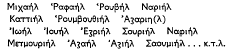 .
page 55 note 4 E.g. I P.O. I, col. 1, p. 5, lines 5–9: 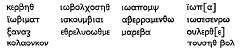 .
page 55 note 5 E.g. II P.G.M. 36, col. 10, p. 171, lines 244–5;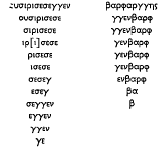 .
page 55 note 6 In this text a vocalic series is combined with both magical words and magical names (II P.G.M. 10, col. 2, p. 53, lines 42–9):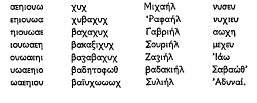 .
page 56 note 1 E.g. I P.G.M. 1, col. 3, p. 14, line 227: αααααα [ıı]ııı ωωωω ίεω ίεω ίεω ίεω ίεω ίεω.
page 57 note 1 See above p. 1, note 49.
page 57 note 2 Cf. II P.G.M. 12, col. 9, p. 78, line 301:…τον Ίωο…τον Ίαфεθανα, α′ ε′ η′ ı′ ο′ υ′ ω′. This compares closely with II P.G.M. 13, col. 19, p. 125, lines 856–8:…βλέπων πρóς άπηλıώτην 〈λέγε〉·ά·εε·ηηη·ıııı·│οοοοο · υυυυυυ · ωωωωωωω … πρóς τóν νóτο[ν] βλέπων λέγε. ιοο υυυ / ωωωω ααααα εεεεεε ηηηηηηη κ.τ.λ.
page 57 note 3 I P.G.M. 4, Bl. 33, pp. 170–2, lines 3054–5. The name could apparently be applied also to the heavenly host of angels…Militia autem caeli non tantum sol appellatur et luna et astra rutilantia, sed omnis angelica multitudo eorumque exercitus, qui Hebraice appellatur Sabaotlz, id est virtutum sive exercituum (St Jerome ep. 121, ad Algasiam 10).
page 57 note 4 See L. Blau (above, note 1, p. 55), pp. 96–106 quoting the following references to illustrate the use of abbreviations (out of reverence for pronouncing the Holy Name), Erubin 18b, Pesikta rabbathi 21, 104a.
page 58 note 1 II P.G.M. 39, p. 177, lines 1–12 (= I P.O. p. 20, lines 1–12) has the combination ωλθα amidst a jumble of magic letters: 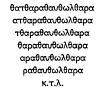 .
Cf. II P.G.M. 36, col. 1, p. 163, lines 22–4 …Πήσθ │ αθλ Ίω │ κγ ιη….
page 58 note 2 In Symb. Oslo. XXVII (1949), 144 Varia 109, S. Eitrem drew attention to the occurrence of ıου in magical papyri. This brief note suggested the main lines of my argument.
page 59 note 1 Kraeling (above, note 3, p. 51).
page 59 note 2 Dinkier (above, note 3, p. 51) quotes ten examples of similar crosses from Jewish funerary inscriptions, including four from the catacombs of Rome. vid. ad loc. 160–1. E. Stauffer (above, note 3, p. 51) notes that in the years A.D. 132/5 Bar Kochba issued a series of silver-coins showing an equal-armed cross. These signs have certainly no Christian connexion. Cf. G. F. Hill, Catalogue of the Greek Coins of the British Museum; Palestine (London, 1914), pl. 32, 5 f.
page 59 note 3 Dinkier (above, note 3, p. 51), p. 164 note 1. The word thau itself, of course, means ‘sign’ or ‘mark’ just as aleph means ‘ox’ and beth ‘house’. D. Diringer, The Alphabet (New York, 1948), p. 219.
page 59 note 4 Similarly, the cross-signs on the ossuaries from the Dominus Flevit are best interpreted as thou signs. R. Bibl. LXVI (1959), 299–301. From the fact that both rectangular and diagonal crosses are found here (both forms occur on ossuary 12 from no. 79) it would seem that as a sign on ossuaries the two forms are interchangeable. In palaeo-Hebrew script, on the other hand, ĵ was regularly x from the eighth century B.C. to the second century A.D.
page 59 note 5 For full discussion see E. R. Goodenough (above, note 3, p. 54), vol. 1, p. 132.
page 59 note 6 Dinkier (above, note 3, p. 51), p. 170.
page 59 note 7 Sukenik (above, note 1, p. 49), p. 363.
page 60 note 1 Simon (above, note 3, p. 54), pp. 407–8.
page 60 note 2 Cf. St John Chrystostom, Ps. viii. 3: κ'ᾶν έρωτήσης αύτους δıά τı έσταυρώσαβε τóν χρıστó ν; λέγουσıν ώς πλάνον και óντα.
page 60 note 3 Similarly ossuaries 6 and 12 from no. 79 of the Dominus Flevit are uninscribed save for cross symbols.
- 1
- Cited by