


1. An unresolved residual issue in descriptions of the Swedish vowel phoneme system
1.1 Justifying phonological units: A background perspective
Descriptions of the phonology of individual languages lay the indispensable foundations for phonological theory, phonological typology, areal phonology, contrastive phonology, phonology in second language acquisition, and other fields of general phonological inquiry.Footnote 1 In the past, a long, well-established structuralist tradition of linguistic research centered on ascertaining and justifying phonological units, typically phonemes, in various languages, and on describing the systems of which those phonemes form a part. A subsequent dominant, generative, school focused on phonological processes, and its successor, Optimality Theory, on constraints. Neither of the latter two has felt much need to substantiate their assumptions about phonological units and systems. Yet units and systems are as essential as rules or constraints, and comprehensive descriptions must account for both. With more databases of phoneme inventories and phoneme types now being built up (UPSID, PHOIBLE, EURPhon, SegBo, etc.), the descriptive underpinnings of these are becoming critical. To achieve cross-linguistic comparability, the primary descriptions of phonological units and systems must be well founded and complete, a desideratum that holds equally for numerous other applications of descriptive phonology. In line with the search for completeness, this paper will discuss an unresolved, somewhat marginal, but not entirely inconsequential issue in Swedish phonology that has recently resurfaced in the literature.
1.2 Recapitulating a few basics of Swedish vowel phonology
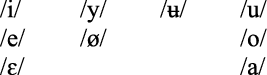
For ease of reference and before addressing the issue itself, some elementary facts of Swedish vowel phonology may be recalled. Since the early 1970s there has been growing agreement among scholars who have paid more than limited attention to Swedish phonology that Central Standard Swedish possesses a vowel phoneme system consisting of the nine units reproduced in Figure 1.Footnote 2
The system of simple underlying vowels in Swedish.

In process approaches to phonology, the system in Figure 1 presupposes a limited set of general rules, which account for the profusion of segments on the phonetic surface. Disregarding more special cases, the following processes affect all or some selection of the nine vowels, with several processes potentially applying to one and the same segment:

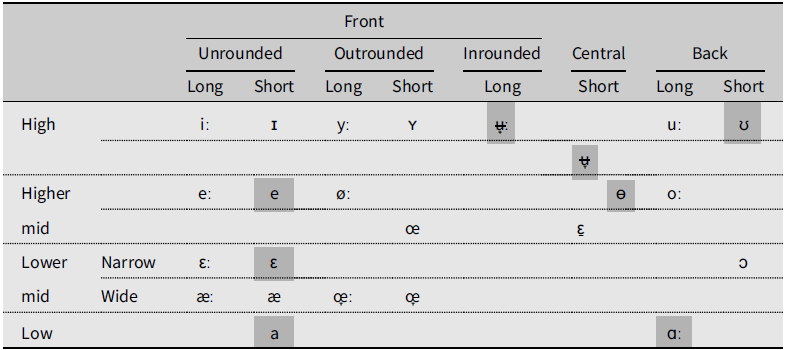
The phonetic vowel inventory of a conservative variety of Central Standard Swedish

Note: Narrow transcription, heavily schematized; vowel qualities of special concern to the following discussion are shaded.
Traditional work on Swedish phonetics accordingly presents up to twenty-four major vowel qualities, as schematized in Table 1.Footnote 3 The vowel [ʉ̟ː] is near-high. The distribution of the three /ʉ/-variants is described in detail by Lyttkens & Wulff (Reference Lyttkens and Wulff1916:69–85) and Riad (Reference Riad2014:28–29); all three occur e.g. in the word muskulatur [mɵskʉ̞laˈtʉ̟ːr] ‘musculature’. The units [ʉ̟ː, ʉ̞, ɵ, uː, ʊ, oː, ɔ] are all inrounded, though to varying degrees, with [oː, ɔ] being the least rounded. Most Central Swedish speakers nowadays neutralize the short vowels [e] and [ε]. Some speakers additionally adopt other changes that need not concern us here. The retracted [ε̠] (Riad Reference Riad2014:22), used in post-stress syllables as in the second syllable of väder [ˈvεːdε̠r] ‘weather’, corresponds to the vowel traditionally transcribed as schwa ([ə]). For ease of representation, the sounds [ɪ, ʏ, ʊ] will in the following simply be rendered in broad transcription as [i, y, u], except that [ʊ] as part of a diphthong will be kept in narrow transcription. Given the preceding considerations, the set of underlying vowels in Swedish and the general productive processes affecting these vowels seem well defined.
1.3 The place of au and eu in the Swedish vowel phoneme inventory
Occasionally, however, a residual problem surfaces in descriptions of the Swedish vowel phoneme system. In his thorough and comprehensive exposition of the phonology of Swedish, Riad (Reference Riad2014:42) observes:
There are three diphthongs [in Swedish], written <au>, <eu>, and <ou> or <oa>. They occur almost exclusively in loans and have marginal distribution. Their status in the vowel system is unclear. They could be analysed as combinations of single short vowels, but it would then not be obvious which two vowels combine in each of them.
The question whether phonetic diphthongs in various languages should be interpreted as unitary phonemes or phoneme clusters was eagerly debated in structuralist phonology (Trubetzkoy Reference Trubetzkoy1935, Reference Trubetzkoy1939; Martinet Reference Martinet1939, etc.), and the general issue remains relevant in any description of languages possessing such sounds.Footnote 4 As for Swedish, the question is whether this language, too, includes underlying diphthongs and, if not, how the corresponding phonetic entities should be understood phonologically. Since among the three diphthongs mentioned by Riad, ‘The third diphthong is possibly not assimilated into Swedish phonology’ (Riad Reference Riad2014:43), the present paper will focus on the other two, which for convenience we refer to by their orthographic forms au and eu.Footnote 5 In the manner of Riad (Reference Riad2014:42), typical examples of diphthongal pronunciations are given in (2):Footnote 6

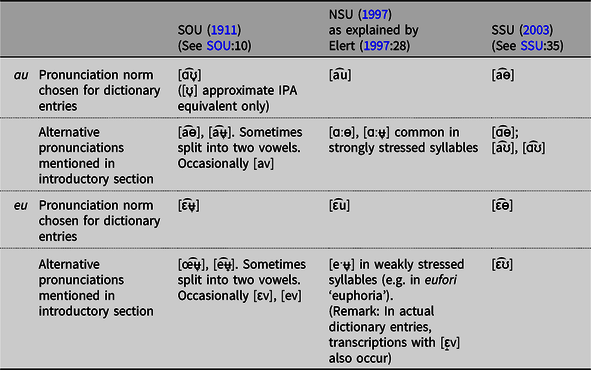
When phonetically transcribed, diphthongal or optionally diphthongal au/eu will be represented here by [a͡ɵ] and [e͡ɵ], respectively, except where attention is drawn to alternative pronunciations such as [a͡ʊ, ɑ͡ʊ, e͡ʊ, ε͡ʊ] or in direct quotations from other sources, whose original transcriptions will usually be retained.Footnote 7 Varying pronunciations, including non-diphthongal ones, regularly occur (see NSU and SSU) and we will consider many of these as we go along. The number of words containing au is relatively high (the number of morphemes, of course, less so), whereas eu is not all that common (compare Noreen Reference Noreen1903–1924 II:60, 61). The transcription practices of three Swedish pronunciation dictionaries, one old (and to some extent normative) and the two current ones, are shown in Table 2.Footnote 8
Transcription practices for au, eu in three Swedish pronunciation dictionaries

Note: SOU and SSU transcriptions converted into regular IPA.
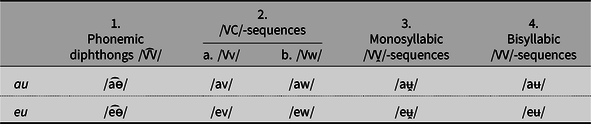
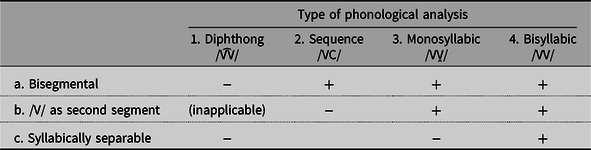
The phonetic entities corresponding to written au/eu have been described phonologically in four major ways, as shown in Table 3.Footnote 9 While analysis 1 views au/eu as unitary, indivisible phonemes, the other proposals see au/eu as each consisting of two separate phonemes. Analyses of type 2 view the second element of au/eu as a consonant. Analyses 3–4 take it to be a vowel, but differ on how they assess the syllabicity of that vowel. Whereas analysis 3 posits that the vowel does not form a separate syllable, analysis 4 implies that it can be syllabified independently of the preceding a- or e-. The term bisyllabic will here be used of the latter analysis, but with no implication that syllable structure is necessarily a property of underlying forms. Rather syllabification is assumed to be a lower-level process that applies in the course of phonological derivations.
Major types of phonological analyses considered or proposed for Swedish au/eu

This paper takes each of the positions of Table 3, together with the reasons put forward to support them, as a point of departure for a more detailed discussion of the phonological status of Swedish au/eu. Since structuralists showed a particular concern for issues of this sort, prime attention will be accorded to their work. But because reflections on the Swedish case have often been interjected into treatments of other themes, the arguments have not always been fully pursued, and alternative analyses have not been discussed at length. It therefore remains to develop the implications of the proposals more fully, as well as to adduce new considerations and evidence, which may enable a better-founded choice along the spectrum of possible analyses.
2. Unitary underlying diphthongs?
2.1 Views expressed
The first to adopt a diphthongal phonemic analysis of au/eu was Sigurd (Reference Sigurd1965). Although he lists no phonemic diphthongs in his inventory of Swedish vowel phonemes (Reference Sigurd1965:21), elsewhere in the same work he operates with two such entities: in his own transcription, au and eu. Morpheme-internally, his practice is largely identical to analysis 1 of Table 3. He apparently assumes a phonemic diphthong au in stressed position, as in paus ‘pause’ and in the root morphemes of aula ‘auditorium’ and fauna ‘fauna’, but is uncertain about the existence of the diphthong eu in the same position, since he finds just one good example, neutrum ‘neuter’ (Reference Sigurd1965:142; compare also 145, 164). On the other hand, he evidently thinks that both diphthongs occur in syllables before the one carrying the principal stress, as in augusti ‘August’ (month), europé ‘European’ (n.), etc. (Reference Sigurd1965:144; compare also 133, 145, 164). In post-stress syllables, on the other hand, he proposes the vowel sequences /aʉ/ and /eʉ/ (with /ʉ/), as in Kapernaum ‘Capernaum’, linoleum ‘linoleum’, and petroleum ‘petroleum’ (Reference Sigurd1965:161). The sequence interpretation also appears for eu in stressed position in museum ‘museum’, Matteus ‘Matthew’, and Pireus ‘Piraeus’ (Reference Sigurd1965:159), but he gives no corresponding examples for au (Reference Sigurd1965:160). Judging from his data, he regularly postulates phonemic sequences rather than phonemic diphthongs whenever a morpheme boundary can be considered to separate the components of au/eu.Footnote 10 His way of phonemicizing au/eu in simplex (i.e. non-compound) words is summed up in Table 4.
Sigurd’s (Reference Sigurd1965) apparent phonemic interpretations of au and eu in non-compound words

Note: Sigurd’s transcriptions retained here.
Besides Sigurd, a few other scholars assume phonemic diphthongs for Standard Swedish. Dahlstedt (Reference Dahlstedt1967:28) speaks of ‘The only stable diphthong /au/ in Swedish,’ as opposed to ‘the Sw[edish] phoneme sequences /ejj/∼/äjj/ and /ajj/’.Footnote 11 Linell (Reference Linell1973:8) postulates ‘two genuine diphthongs, /au/ … and /eu/’, adding, though, that they are ‘very marginal and will henceforth be ignored’. Lindqvist (Reference Lindqvist2007:73) notes that ‘as the only Germanic language, Swedish does not – except in some loanwords – possess phonological diphthongs’. Accordingly, he assumes the customary nine vowel phonemes for Swedish, and explicitly restricts the two phonological diphthongs ‘/au̯, eʉ̯/’ to specific lexeme groups belonging to the borrowed stratum of the vocabulary (Reference Lindqvist2007:98). Quite marginalized phonemic diphthongs have also been alluded to. Bruce (Reference Bruce2010) thinks that ‘with some limited exception, today’s Swedish has no true phonological diphthongs’ (Reference Bruce2010:119) and that ‘true diphthongs as contrasting vowel phonemes are rare in Swedish as it is spoken today’ (Reference Bruce2010:120). Similarly, according to Frid et al. (Reference Frid, Schötz and Löfqvist2012:85), ‘Swedish has – with only a few exceptions – no true phonological diphthongs.’ The latter two publications do not specify what the exceptional diphthongs are.
None of the authors mentioned carry out any extensive linguistic analysis to support their adoption of some variant or other of the phonemic-diphthong solution, and the reasons for choosing this solution are not always made explicit. At least four considerations should be examined as to whether they call for special treatment of au/eu: (i) the fact that diphthongal pronunciations of au/eu occur, (ii) the quality of the first component, a-, of au, (iii) the varying quality of the second component, i.e. the offglide u-, of au/eu, and (iv) the behavior of au/eu with respect to stress. We shall discuss these in turn.
2.2 Diphthongal realizations
Unless good reasons exist for violating phonological naturalness, an essential condition for regarding au/eu as single indivisible phonological units is that they can indeed be pronounced as diphthongs, at the very least in some positions and styles. Without doubt, this is the prime motive behind the phonemic-diphthong position. That diphthongal pronunciations occur is easy to observe and is backed up by the authority of phoneticians, both in the past and in modern times. Among scholars who, from a phonetic point of view, have described au/eu as diphthongs, we may mention Sweet (Reference Sweet1879 [1913:372]), Lyttkens & Wulff (Reference Lyttkens and Wulff1889:26*; SOU:10), Witting (Reference Witting1959:92, 109, 120), Bergman (1966:11), and Elert (Reference Elert1997:27–28). Furthermore, like the older SOU, the recent SAOL (xxi, passim) and the two modern pronunciation dictionaries NSU and SSU routinely furnish examples of diphthongal pronunciations. The notion of diphthong also underlies the recommendations for hyphenation of Svenska skrivregler (2008). While the work allows word divisions such as soci-al ‘social’, jubile-erna ‘the jubilees’, and muse-um ‘museum’, it advises against dividing the words faun ‘faun’, geist ‘go, drive’ (n.), soul ‘soul music’, and rauk ‘stone formation’ (2008:84). Yet the attempt to justify au/eu as diphthongs phonologically by referring to their phonetically diphthongal nature will be complicated by two further phonetic considerations.
First, there is the noted fact that au/eu are often pronounced not as unitary diphthongs but as vowel sequences. For example, Noreen (Reference Noreen1903–1924 II:59, 60, 62, IV:8–9) observes that the u-diphthongs, which are found in loanwords, tend to be replaced by non-diphthongal vowel sequences as these loanwords become assimilated (see Sections 5.2 and 6.3).Footnote 12 Risberg (Reference Risberg1932–1936 I:56) says that the pronunciation with hiatus is the usual one in paus, Paulus, Europa, and the like. Dahlstedt (Reference Dahlstedt1962:18) speaks of occasional ‘pronunciations with hiatus of the type a´ula (trisyllabic) and pa´us (bisyllabic)’.Footnote 13 Some authors have in fact completely rejected the idea of diphthongs in Swedish. Malmberg (Reference Malmberg1960:69, Reference Malmberg1968:58) unequivocally asserted that, except for the frequently diphthongal pronunciation of long high vowels, such sounds are absent in the standard language. Somewhat later, Elert (Reference Elert1970:88) expressed a similar view. Although the latter positions may be too extreme, it is clear that, rather than as pure diphthongs, au/eu are quite commonly realized as vowel sequences.
Second, while Lyttkens & Wulff (Reference Lyttkens and Wulff1889), for instance, may seem to assume only two phonetic diphthongs in Swedish, the same authors in a later work (SOU:11) recognized several i-diphthongs in addition to au/eu, and the same is true of Sweet (Reference Sweet1879 [1913:372]) and Noreen (Reference Noreen1903–1924 II:58–63).Footnote 14 Examples are [a͡i] along with [aʝː] in aj ‘ouch!’ and [ε͡i] along with [εʝː] in säg ’say!’ (imperative). If a diphthongal pronunciation alone were a sufficient condition for postulating phonemic diphthongs, then these phonetic i-diphthongs would be candidates for the same kind of interpretation. But the modern scholars who regard au/eu as special unitary phonemes have not interpreted the phonetic i-diphthongs in a parallel fashion.Footnote 15
In sum, the reliance on diphthongal realization as a criterion faces two difficulties: (i) diphthongal pronunciations occur in morphemes of the type aj/säg, without necessarily resulting in the postulation of phonemic diphthongs, and (ii) in many morphemes the putative phonemic diphthongs au/eu are not always realized as phonetic diphthongs. Ideally, to be consistent the phonemic-diphthong solution should assume phonemic diphthongs throughout, but when this does not hold, it requires some process of diphthong fission. Descriptively, the necessity of a process of diphthong fission must be weighed against the advantage of a reverse process of diphthong formation that operates especially in fast speech and unstressed position (see Section 6.5). Most strikingly, however, the descriptions positing phonemic diphthongs do not provide examples of contrasts with sequences. Such contrasts seem indispensable for positing phonemic status for au/eu.
2.3 The quality of a- in au
Whether the scholars who assumed phonemic au/eu-diphthongs had other arguments in mind is uncertain. Their case would be stronger if the components of the putative diphthongal phonemes were specific or unique to these. One fact, therefore, that might be considered is how the first element of au is realized phonetically. Lyttkens & Wulff (Reference Lyttkens and Wulff1885:78) observed that ‘the low ɐ forms a diphthong with ω, or ũ …, thus ɐω or ɐũ’, while giving as examples not only faun ‘faun’, bautasten ‘(kind of) memorial stone’, and kautsjuk (i.e. kautschuk) ‘rubber’, where the diphthong occurs in a stressed environment, but also paulun ‘canopy’, augusti ‘(month of) August’, and auktion ‘auction’, where the diphthong is unstressed.Footnote 16
To this, we may add that the back quality of a- in au in stressed position in a given morpheme may optionally remain in unstressed position after stress relocation. Outside the realm of diphthongs, the vowel quality [ɑ] will regularly appear when the vowel is stressed and long, while the quality [a] will occur in most other instances, as the examples in (3) illustrate:

Also in the case of au, there is a tendency for the quality [ɑ] to occur in unstressed position (narrow transcription):

At first glance the optionally retracted variant [ɑ] in au might be seen as signaling a special structural connection with the following [ʊ] or [ɵ]. Yet, as Lyttkens & Wulff (Reference Lyttkens and Wulff1885:78 fn. 2) suggest, the backing must be an effect of coarticulation with the following sound segment.Footnote 17 The adjustment of [a] before [ʊ] has counterparts in other languages. For instance, in Modern Icelandic the quality of [a] in [au] is a little retracted as compared to the slightly fronted quality of [a] in [ai] (Einarsson Reference Einarsson1927:21). Similarly, Kohler (Reference Kohler1977:176, Figure 13 [1995:175, Figure 11]) notes a backed articulation of a- in German au. Korlén & Malmberg (Reference Korlén and Malmberg1960:88) further observe about the German au that ‘The starting point of [au] is … somewhat retracted in comparison to [ai] due to the influence of the following [u] (approximately Sw[edish] long a in bada [‘bathe’]).’ Likewise, Ambrazas (Reference Ambrazas1997:29) notes that the first element of the Lithuanian diphthong au is partially assimilated to its second element in the context of circumflex (rising) tone. An example is šauk [´ʃɔuːk] ‘shout!’ (with circumflex tone) as compared to šauk [`ʃɑˑʊk] ‘shoot!’ (Reference Ambrazas1997:56; both imperatives, transcriptions slightly adjusted). Hence the backed onset in Swedish au signals no special phonological connection with the offset.
2.4 The quality of -u in au/eu
The nature of the second portion of au/eu is more multifaceted, as orthographic u in this instance may reflect two distinct phonemes. Riad (Reference Riad2014:42–43) remarks that
there is disagreement on what sound the written <u> corresponds to, making an analysis in terms of combinations of single vowels quite different for the two dictionaries: NSU /ɑu/, /eu/; SSU /ɑʉ/, /eʉ/.
As indicated in Table 2 above, both dictionaries allow for alternative pronunciations. In his introduction to NSU, Elert (Reference Elert1997:28) notes that that work has chosen to transcribe diphthongal au/eu as ‘[a͜u]’ and ‘[ε͜u]’, but that the second component of bisyllabic au/eu is often realized as [ɵ] or [ʉ̞]. SSU, for its part, represents the offglide of au/eu as [ɵ], but says that ‘with certain speakers it can, however, have a quality which is considerably closer to the vowel in ost, for which reason transcriptions such as [a͜ʊ] and [e͜ʊ] might also have been used’ (SSU:35; compare the SSU:551 transcription [ʊsːt] ‘cheese’). Thus the discrepancy between the two dictionaries primarily represents alternative choices of pronunciation norm as transcriptional standard.Footnote 18
Orthographically, the [ʊ]-pronunciation stands out as it fails to correspond to the normal sound value of Swedish <u>. Whether chronology is involved, such that pronunciations with [ʊ] were previously more frequent, is not known. For his time, as far as au is concerned, Noreen (Reference Noreen1903–1924 II:60) partly questions them: ‘It seems to me likely that ɷ [i.e. in this case ʊ] can actually occur individually, even though this is probably not particularly common.’ The present-day geographical and sociolectal spread of the [ʊ]-pronunciation is similarly undetermined.
The Swedish [ʊ]-pronunciation is more clearly than the [ɵ]-pronunciation a trace of the original donor-language diphthongs (for classical times, see Allen Reference Allen1965:60, 63, Reference Allen1968:76), underlining the special connection between the two parts of au/eu. Phonologically, however, its survival suggests no special phonemic status of au/eu. In an alternative scenario (Section 5), its presence alongside the [ɵ]-pronunciation amounts mainly to postulating varying lexical representations /au/∼/aʉ/ and /eu/∼/eʉ/, depending on the speaker.
Hence neither the phonetic character of the first diphthong component nor that of the second one carries much weight as evidence in favor of the phonemic-diphthong interpretation of au/eu.
2.5 The behavior of au/eu before pre-stressed suffixes
The previous considerations are purely phonetic in nature. A further, conspicuous, characteristic of au/eu is clearly phonological. Note the following data:

These examples, all of which contain contiguous vowels, illustrate the general rule that the derivational suffix -́isk ‘-ish’ causes the main stress to fall on the closest preceding vowel of the word.Footnote 19 But au behaves differently:

Here the stress does not fall on the [-ɵ], which is the last vowel element before the pre-stressed suffix -́isk, but on the [a-].Footnote 20 The same holds true of au before the suffix -́iker: nautiker [ˈna͡ɵtikε̠r] ‘navigator’. In fact, the u in aeronautisk and hydraulisk may even be dropped in casual speech: [ærɔˈnɑːtisk] and [hyˈdrɑːlisk] (also in hydraulik [hydraˈliːk]) (NSU:7, 488). The other entity, eu, does not seem to occur frequently as a diphthong in derivations with -́isk and -́iker. Words such as propedeutisk [prupeˈdεfˑtisk, -ˈdεvˑtisk] ‘preparatory’ and farmaceutisk [farmaˈsεfˑtisk, -ˈsεvˑtisk, -ˈsεpˑtisk] ‘pharmaceutical’ are commonly pronounced with [εfˑ], [εvˑ], etc., rather than [ε͡ɵ] (or perhaps [e͡ɵ]) (see Section 3.2). But when the latter, diphthongal, pronunciations do occur, they are stressed on their first, not their second component (compare SSU:218, 600). These facts of stress placement obviously favor the phonemic-diphthong solution.
2.6 Sigurd’s (Reference Sigurd1965) treatment of eu in unstressed versus stressed position
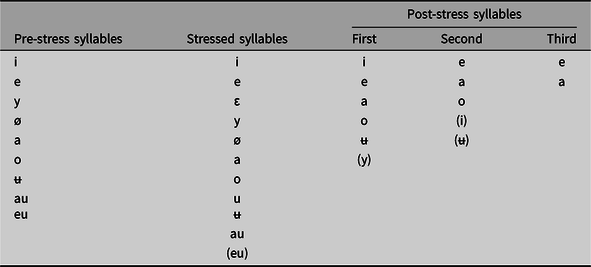
What has just been said applies in general to both au and eu. A further comment should be added on the precarious status of eu in Sigurd’s (Reference Sigurd1965) analysis (see Section 2.1). Postulating a phonemic diphthong eu before, but not in, stressed position has certain disadvantages. First, it eliminates the phonotactic parallelism with the other diphthong au, which Sigurd assumes in both positions. Second, it is not consistent with Sigurd’s observation (Reference Sigurd1965:143–145) that the systems of vowel phonemes in the positions before and after stressed vowels are considerably reduced in comparison with the system in stressed position. See Table 5.Footnote 21 A new and marginal phoneme might not be expected to appear in pre-stress position. Third, this assumption requires adding to the grammar an alternation between a sequence of two vowel phonemes in [ˈneːʉ̞trɵm] and a phonemic diphthong in [ne͡ɵˈtrɑːl] and its derivatives, an alternation which, moreover, would not be matched by a corresponding interchange in paus [ˈpa͡ɵs] ‘pause’ (n.) vs. pausera [pa͡ɵˈseːra] ‘pause’ (v.). Thus, if a phonemic diphthong /e͡ɵ/ is assumed at all in pre-stress position, these three considerations would favor postulating /e͡ɵ/ in stressed environments, too. Fourth, the diphthongal [e͡ɵ] rather than the non-diphthongal [eʉ̞]/[eɵ] in unstressed position may simply illustrate a tendency to weaken the articulation of vowel sequences in this environment (see Section 6.5).
Vowel quality contrasts in different positions in non-compound words in a variety of Swedish according to Sigurd (Reference Sigurd1965)

Note: Adapted from Sigurd (Reference Sigurd1965:145, similarly Reference Sigurd1965:164). Sigurd’s transcriptions retained, but quantity distinctions eliminated.
2.7 Summary and concluding remarks
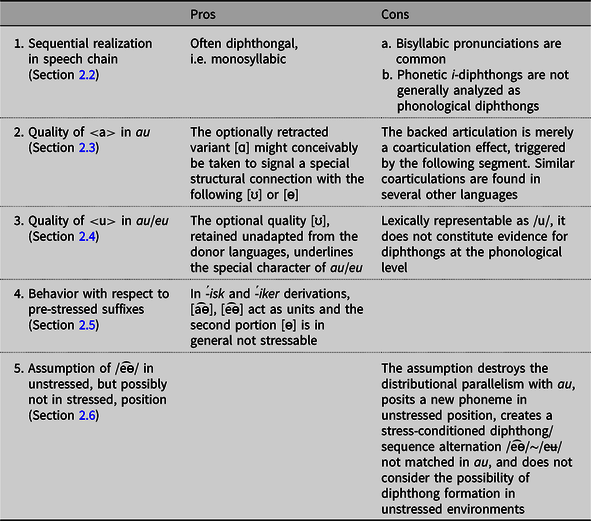
The main considerations for and against viewing au/eu as underlying diphthongs that have been discussed thus far are summed up in Table 6.
Some potential pros and corresponding cons of a phonemic-diphthong analysis

A few additional comments may be in order. The sequential fluctuation of the phonetic realizations of the Swedish putative phonemic diphthongs au/eu (Table 6, point 1) is startling when the latter are compared to the diphthongs of many other languages. For instance, whether they are phonemic or not, Standard German diphthongs do not fluctuate sequentially (compare Werner Reference Werner1972:32–34). German Pause ‘pause’ is [ˈpa͡ʊzə], not optionally *[ˈpa.ʊzə], with [a] and [ʊ] assigned to two different syllables. While the diphthongal realization of Swedish au/eu is no doubt the prime reason for the /V͡V/-interpretation, this evidence is highly ambiguous (see Section 5.2). The sequential fluctuation makes au/eu rather volatile phonemes, a fact that contrasts with the permanence of most undisputed phonemes such as /i/, /y/, and /u/.
As for the optionally retracted quality of a in au (Table 6, point 2), it is relevant to recall Raffelsiefen & Geumann’s (Reference Raffelsiefen and Geumann2016:155) observation that ‘Diphthongs, which are defined by a movement from a starting position to a different finishing position within the syllable, appear to be particularly prone to coarticulation among its two members.’ Thus the [ɑ]-pronunciation offers little support for a phonemic-diphthong interpretation of au.
The [ʊ]-pronunciation of u in au/eu (Table 6, point 3) differs from the [ɑ]-pronunciation in being, not primarily articulatorily, but sociolectally or stylistically based. Many au/eu-words have entered the language through written texts, yielding reading pronunciations with [ɵ], i.e. [a͡ɵ], [e͡ɵ], etc. The unadapted [ʊ]-pronunciation, on the other hand, reflects a stronger (mediated) influence from the phonetics of the donor languages. To this extent, it might be seen as a sign of the unitary nature of au/eu; but, again, the circumstance provides little support for assuming phonemically indivisible diphthongs. On the contrary, the varying [ʊ]/[ɵ]-realizations ‘indicate the lack of stability for diphthongs in Swedish’ (Riad Reference Riad2014:43).
Furthermore, as Ladefoged & Maddieson (Reference Ladefoged and Maddieson1996:322) observe, ‘The kinds of vowels that occur as targets in diphthongs are no different from those that occur as single vowels’. That is, no diphthong components are specific to diphthongs. This holds true of Swedish au/eu as well.
In regard to stress placement before pre-stressed suffixes (Table 6, point 4), au/eu act as unitary vowels, which does support treating them monophonemically. In a bivocalic interpretation, the assignment of stress must include a special provision that eliminates the -u in most morphemes as a candidate for stress placement when it appears immediately after a- and e- (see the end of Section 6.6). In the phonemic-diphthong analysis, on the other hand, the non-stressability of -u simply follows from the definition of phonemic diphthongs as unitary entities.
The assumption of unstressed, but possibly not stressed, /e͡ɵ/ (Table 6, point 5) makes /e͡ɵ/, as Sigurd (Reference Sigurd1965) is aware, a very marginal phoneme, hence raising the question of whether it can be totally eliminated in the analysis.
In sum, the diphthongal realizations, especially in stressed position, and the non-stressability of -u before pre-stressed suffixes constitute the major arguments in favor of the phonemic-diphthong solution.
3. Underlying /VC/-sequences?
3.1 Au/eu as underlying /av/, /ev/
Several alternatives to a pure diphthong solution appear in the literature. One of the more distinct ones is the /VC/-analysis 2a in Table 3 above, proposed by Hoard (Reference Hoard1966:14), at least for many instances of au/eu in stressed position:
Swedish has two phonetic diphthongs [ɑʉ] or [ɑɵ] and [eʉ] … Phonemically, however, these phonetic diphthongs may be analyzed as the clusters /avː/ and /evː/. This solution has two advantages: (1) it avoids the setting up of phonemic diphthongs i[n] Swedish, (2) it fills out the distribution of /v/ which otherwise would not have a long allophone … Examples of these clusters are /avːla/, [ɑʉla] ‘(lecture) hall’, and /˟nevːtrum/, [˟neʉtrɵm] ‘neuter’.[Footnote 22 ]
The proposal has parallels elsewhere, as when Jakobson (Reference Jakobson1962:223) phonemicizes Slovak pravdou [pra͡udo͡u] (instrumental) ‘(by) truth’Footnote 23 as /pravdov/, or when Heike (Reference Heike1972:43–44) suggests that German blau [bla͡u] ‘blue’ might be phonemicized as /blav/. Neither of Hoard’s reasons is compelling, however. First, no /VC/-sequences need to be set up in Swedish to avoid postulating phonemic diphthongs. As we will see, other scholars suggest other possibilities (Sections 4, 5, and recall Table 3). Second, while the argument that /v/ lacks a long allophone is essentially correct (compare Lyttkens & Wulff Reference Lyttkens and Wulff1916:242–246, Danell Reference Danell1937:71–72), occasional exceptions exist. Long v’s occur optionally, for instance, in [ˈhɵ̀vːɵd] for huvud [ˈhʉ̟̀ːvɵd] ‘head’, [ˈstœvːε̠l] for stövel [ˈstøːvε̠l] ‘boot’, usually in kaviar [ˈkavːiar, ˈkavˑʝar] ‘caviar’, and obligatorily in vovve [ˈvùvːε̠] ‘dog’ (from the interjection vov! [ˈvuvː] ‘bow-wow!’). Thus the hole in the pattern that Hoard wants to exploit is not entirely clear-cut. Actually, the [avˑ] of [ˈkavˑʝar] contrasts phonetically with the [a͡ɵ] of the word kauri [ˈka͡ɵri] ‘cowrie’. Hoard´s analysis obliterates this distinction by representing both as /avː/ (with prosodic /ː/). This choice, in turn, requires kaviar to be lexically specified as an exception to the /avː/ → [a͡ɵ] rule that is needed in his analysis (*[ˈka͡ɵˑʝar] is not a possible pronunciation of this word).
3.2 [V͡ɵ]∼[Vv] alternations
Strikingly, however, Hoard does not refer to the link between [ɵ] and [v] illustrated by the alternations in (7):

In these examples, the second component of au/eu varies freely with the consonant v (before a voiceless stop optionally devoiced into f), which provides much better support for the /Vv/ analysis than Hoard’s own arguments.
3.3 Limitations
Nevertheless, the data in (7) fail to establish the /Vv/-analysis as a viable alternative. Two complications arise. One concerns the range of the [ɵ]∼[v] alternation in the lexicon. The other relates to the creation of remote segments in non-alternating morphemes and the introduction of underlying word-final clusters that never surface phonetically in the words in question.
First, the [ɵ]∼[v] alternation does not appear freely in words containing au/eu, but is limited to a subset of them, largely those of Greek origin (Noreen Reference Noreen1903–1924 II:61). Moreover, the number of items that allow varying [ɵ]∼[v]-pronunciations may have diminished since the time Noreen published his list of examples (Reference Noreen1903–1924 II:61–62).Footnote 24 Regarding the pronunciation of the graphemic sequence eu, Widmark (Reference Widmark1972:31) observes:
It seems to me as if pronunciation habits are in the process of stabilizing in two directions: either, in accordance with Classical Greek, the pronunciation ev-, which is probably normal, e.g. in neuros [‘neurosis’], or a pronunciation completely in accordance with the spelling, as in neutrum.
Second, since the [ɵ]∼[v] alternation is lexically restricted, it cannot be generalized to all instances of au/eu without additional support. The larger body of non-alternating au’s and eu’s includes well-established words that in Hoard’s analysis would end up with phonetically remote underlying segmental forms, such as:

These words are never pronounced with [v]. The analysis in (8) undesirably increases the number of abstract relations between the phonological and phonetic levels.
Moreover, the move introduces novel final clusters:

No -vn, -vl, -vs, or -vt clusters appear in final position in free morphemes, the -vd in hävd [ˈhεvˑd] ‘tradition’ being the only synchronically homomorphemic -vC-sequence to occur in this environment.Footnote 26 Besides, remote representations of the type /avl+a/ for aula – or /avːla/, if Hoard’s length prosodeme is kept – require some further clarification as to how they relate to the type avla [ˈɑ̀ːvla] ‘breed’, as the /v/ of the latter’s underlying form /avel+a/ (< avel ‘breeding’) is not subject to vocalization. Finally, the direction [ɵ] → [v] of the alternation process seems more natural in Swedish than /v/ → [ɵ], as it aligns the morphs more neatly with Swedish phonotactics generally (Section 6.2).Footnote 27
In sum, while drawing on the [ɵ]∼[v] alternation may at first sight seem an interesting idea, the /Vv/-solution is not sufficiently supported by other facts and, in addition, unnecessarily increases abstractness.
3.4 Underlying /aw/, /ew/
A related option is to analyze the second component of au/eu as a separate phonemic semivowel or glide, /w/. In his review of Sigurd (Reference Sigurd1965), Haugen (Reference Haugen1967:806) touches on this possibility but promptly rejects it, for ‘if one is to regard au and eu as VC, it requires positing a phoneme /w/ which occurs nowhere else’. Borrowings such as speedway, squash, swimmingpool, Wales, weekend, etc. commonly keep their original pronunciation with [w], but do not support introducing an abstract entity /w/ into the phonological representations underlying the entirely different instances of phonetic au/eu. Besides, when loans with English [w] are borrowed, the [w] is either retained as [w, ʊ̯] (compare Elert Reference Elert1970:106 and, especially, Aktürk-Drake, Reference Aktürk-Drakeforthcoming) or turned into [v] (Noreen Reference Noreen1903–1924 IV:332); it is not turned into [ɵ]. Note also Bergman’s (1966:56–57) transcriptions oäl´sisk for walesisk ‘Welsh’, vi´kend for weekend, and vis´ky for visky/whisky ‘whisky’.Footnote 28 No structure-internal facts, morphophonemic, distributional, or other, justify an underlying /w/, distinct from the diphthong component [ʊ], in au/eu. Furthermore, /w/ neither accounts for the alternative diphthong component [ɵ], nor for the fact that au/eu can be realized as bisyllabic sequences.
4. Underlying /VV̯/-sequences?
4.1 Haugen’s (Reference Haugen1967) unified view of quantity and diphthongs
As an alternative to Sigurd’s (Reference Sigurd1965) phonemic-diphthong analysis, Haugen (Reference Haugen1967:806) instead proposes analyzing au/eu as monosyllabic sequences of two short vowels, that is, analysis 3 in Table 3 above.Footnote 29 He couples this suggestion to the description of two other phenomena in the language: Vj-sequences, which may be realized as diphthongs (i.e. i-diphthongs), and the quantity of vowels.Footnote 30 In fundamentally the same fashion as he treats au/eu, he interprets Vj-sequences as phonological ‘/Vi/, with a short non-syllabic vowel in the second position’ (emphasis added). He adds that ‘By this analysis both vowels in the sequences can be identified with a previously existing short vowel’ (Reference Haugen1967:806). In a further step, he lines up his analysis of au/eu and the Vj-sequences with his treatment of the long vowels and long consonants, all of which he considers to be geminates. Thus the three types of vowel nuclei will be alike in that they will all consist of a monosyllabic sequence of two short phonemes, here represented as /Vʉ̯/, /Vi̯/, and /VV/, where the second /V/ is qualitatively identical to the preceding /V/. How strong are the parallels between the u-diphthongs, on the one hand, and the i-diphthongs and the long vowels, on the other?
4.2 Parallel with i-diphthongs
The strength of the parallel that Haugen draws with i-diphthongs depends on how one views the linkage between the vocoid [i] and the approximant/fricative [j]/[ʝ] (see Riad Reference Riad2014:59–60 for the distribution). Witting (Reference Witting1959:108–109, 119–120) had broached the issue of whether single morpheme-final j as in haj ‘shark’ should be regarded as a consonant phoneme or a realization of the vowel phoneme /i/, and had settled for the former, albeit not with entirely conclusive arguments. From a phonotactic point of view, the decision to reanalyze j as /i/ is made difficult since it appears after postvocalic sonorants as in the imperatives tälj ‘carve!’, tänj ‘stretch!’ (Lindqvist Reference Lindqvist2007:42). Underlying forms such as */tεli/, */tεni/ clash head on with the normal structure of native morphemes (Section 6.2). Moreover, the latter decision would lead to the question of whether the j in initial prevocalic position as in ja ‘yes’ should then be analyzed as /i/, too. But also underlying forms of the type */ia/ deviate from normal underlying morpheme structure, and in addition require this /i/ to be marked as non-syllabic. Thus the analysis of Vj-sequences as i-diphthongs is not straightforward. This being so, the comparison with long vowels becomes especially crucial for the proposal to analyze au/eu as monosyllabic vowel clusters.
4.3 Parallel with long vowels
4.3.1 The internal composition of diphthongs and the geminate-vowel theory
Haugen’s argument that his analysis of long vowels supports analyzing au/eu as monosyllabic clusters hinges crucially on the view that long vowels are in fact geminates. It is therefore necessary to determine whether the geminate-vowel analysis itself is valid, an undertaking rendered difficult by a contradiction in Haugen’s presentation of gemination. For the greater part of his discussion, he seems to understand the term ‘gemination’ more or less in its ordinary phonological sense, meaning that genuinely long sounds in Swedish (such as i in vis ‘wise’ and ss in viss ‘certain’) correspond to two identical segments at the phonological level. Towards the end of his discussion, however, he considers lengthening to be prosodic: ‘In the case of neither consonants nor vowels does gemination mean actual repetition, only that more of the same be added’ (Haugen Reference Haugen1967:806). But since the second portion of V<u>- and the Vj-sequences cannot be equated to a prosodic feature, only his first approach will be considered here. We will comment on the geminate-vowel analysis in relation to three kinds of facts: (i) segmental phonotactics, (ii) morphological evidence, and (iii) the occurrence of length in relation to stress. Subsequently, we will see whether the geminate-vowel approach supports the monosyllabic-cluster analysis of au/eu.
4.3.2 Segmental phonotactics
Interpreting both long vowels and long consonants as underlying geminates creates the expectation that geminate vowels and geminate consonants should be freely combinable. For instance, Suomi et al. (Reference Suomi, Toivanen and Ylitalo2008:39) observe for Finnish:
contrastively short and long vowels can occur before and after both contrastively short and long consonants … and the contrasts exist in stressed as well as unstressed syllables
But Central Standard Swedish has what is termed compensatory length, such that in e.g. monomorphemic stressed ˈV(C)-rhymes with at most one consonant, either the vowel is long or else the following consonant (if any), but not both at the same time. According to widely accepted views in phonology, this complementary distribution should lead us to represent only one of the two complementary facts at the phonological level, either the underlying equivalent of phonetic vowel length or the underlying equivalent of phonetic consonant length. But since the consonants may with good reason be regarded as geminates (Haugen Reference Haugen1967:806) whereas the vowels may not, it follows that vowel gemination is unnecessary.
A further phonotactic consideration relates specifically to vowel nuclei. In regular native Swedish morphemes, sequences of unlike vowels never occur (see Section 6.2). Hence the native lexicon contains no intra-morphemic sequences of different vowels (e.g. ao, oa, etc.) that could provide a parallel for treating phonetically long vowels ([ɑː], [oː], etc.) as consisting of two identical vowel phonemes (/aa/, /oo/, etc.). Nor do the intra-morphemic vowel clusters that appear in borrowings offer any such evidence. Actually, vowel sequences in foreign morphemes may themselves include phonetically long vowels, which, in the geminate-vowel analysis, complicates underlying representations, sometimes multiply. Thus the word kaos ‘chaos’ would need to be represented as /kaaoos/ or the like, because of shifting length in [ˈkɑːɔs] and kaotisk [kaˈuːtisk] (recall (5) in Section 2.5 and see Section 4.3.4).
Finally, long vowels and diphthongs do not match distributionally in as much as (fully) long vowels do not occur in unstressed syllables, whereas diphthongs occur in both stressed and unstressed syllables.
4.3.3 Lack of morphological evidence for geminate vowels
Moreover, morphological evidence for vowel gemination is missing. In several languages, the combination of two identical vowels that belong to different morphemes results in a phonetically long vowel. For instance for Finnish, Trubetzkoy (Reference Trubetzkoy1939 [1962:170]) views the final long vowels in the partitive forms kukkaa ‘flower’ and leipää ‘bread’ as ‘sicher polyphonematisch’ [‘definitely polyphonematic’], because they contain an internal morpheme boundary (< kukka ‘flower’ and leipä ‘bread’ + partitive allomorphs -a, -ä, respectively), and by analogy extends the biphonemic analysis to all long vowels in the language, that is, also to non-alternating, morpheme-internal ones.Footnote 31 For Sanskrit, Allen (Reference Allen1953:58; see also Reference Allen1972:30) refers to forms such as nāsti ‘is not’ < na ‘not’ + asti ‘is’, and sādhūktam ‘well spoken’ < sādhu ‘good’ + uktam ‘spoken’, where, again, the resulting long vowels include a morphological boundary. Swedish possesses no process that converts two identical adjacent vowels into a single long one.
4.3.4 Length in relation to stress shifts
Finally, unlike the situation in Finnish (see the quote in Section 4.3.2), structurally relevant length in Swedish is obviously dependent on stress: it occurs only in stressed syllables. The geminate-vowel hypothesis accordingly faces a difficulty in regard to shifting stress, as in motor [ˈmùːtur] ‘motor’, motorer [muˈtuːrε̠r] ‘motors’, motorism [mutuˈrisˑm] ‘motorism’. Applying the geminate-vowel analysis, these words would, in terms of a process model of phonology, have derivations such as those in (10):

If, instead, geminate coalescence is taken to precede stress placement, the stress rules would have to be supplemented with a rule shortening long unstressed vowels. In either case, geminates appear underlyingly and are subsequently reduced in positions that have not been assigned stress.
On the other hand, a vowel-lengthening approach results in the following derivations:

A comparison of the derivations in (10) with those in (11) illustrates the formal drawbacks of assuming geminate vowels rather than vowel lengthening.
First, phonological forms are more complex in the geminate-vowel analysis. The simple /mutur/ is replaced by the representation /muutuur/. That longer representations should be more costly than shorter ones is acknowledged by a good many linguists, including Chomsky & Halle (Reference Chomsky and Halle1968), whose very first universal marking convention [u seg] → [-seg] (Reference Chomsky and Halle1968:404) expresses precisely the notion that ‘short lexical items are simpler than long ones’ (Reference Chomsky and Halle1968:408), and Prince & Smolensky (Reference Prince and Smolensky1993:196), whose constraint ‘*Spec : Underlying material must be absent’, operative in language learning, favors representations ‘with fewest featural and segmental specifications’. Second, while both the geminate-vowel and the vowel-lengthening analysis presuppose stress rules, the geminate-vowel analysis requires two rules regulating quantity, fusion of stressed geminates and degemination of unstressed geminates, compared with a single rule in the alternative. Third, as the geminate-vowel analysis entails a large number of remote segment clusters that have to be converted into single long segments, it is less felicitous, not only with respect to morpheme length and the number of rules, but also in regard to economy of derivational processing.
Aside from these formal considerations, the assumption of vowel geminates obscures the crucial factual link between stress and length, as stress actually triggers vowel length, given the appropriate segmental conditions. Hence phonetic vowel length must not be reflected in underlying representations.
4.4 Summary and conclusion
In several languages such as Finnish, phonetically long vowels may be understood as sequences of two short vowel phonemes. In Swedish, long vowels cannot be split up in this fashion. Facts of distribution, morphophonemics, and stress assignment fail to support, and even contradict, such a proposition. Underlying vowel geminates deviate from the patterns characteristic of native Swedish phonology and increase descriptive complexity. Length in Swedish vowels is assigned by rule, and no vowel length or any equivalent thereof occurs in the underlying representations of native morphemes. Consequently, an analysis of Swedish long vowels as underlying geminates will not in turn support the analysis of au/eu as monosyllabic clusters /VV̯/. Furthermore, this solution also lacks decisive parallels elsewhere in the language. Finally, there remains the question of whether a useful empirical distinction can be drawn between underlying diphthongs, as in analysis 1 in Table 3, and monosyllabic vowel clusters, as in analysis 3. Like analysis 1, the /VV̯/-analysis will neatly handle the -́isk/-́iker pattern, however (Section 2.5).
5. Underlying /VV/-sequences?
5.1 An across-the-board bisyllabic analysis
To recap, the diphthong analysis of au/eu implies that, phonologically speaking, the two parts of au/eu are firmly glued together, and that the parts cannot be equated with phonemes occurring elsewhere in the language’s phoneme inventory. The non-diphthongal interpretations of au/eu take such identification to be possible. Hoard (Reference Hoard1966) eliminates the need for phonological diphthongs by identifying the second component of au/eu with the consonant /v/. Haugen (Reference Haugen1967) argues that the component is a vowel phoneme and that this vowel phoneme belongs intrinsically to the same syllable as a- and e-. Thus he rejects the indivisibility assumption of the diphthong analysis, but retains its assumption of underlying monosyllabicity. The remaining option, analysis 4 of Table 3, also drops the underlying monosyllabicity assumption. That is, the components of au/eu constitute two separate underlying units that, at a lower level, may either be syllabified into two different syllables or alternatively joined together as diphthongs.
In fact, most accounts of Swedish phonology include only monophthongs in their phoneme inventories, which implies that au/eu are tacitly viewed as combinations of two ordinary vowel phonemes. But one researcher has quite explicitly advocated a strict, across-the-board bisegmental analysis of au/eu. Reviewing Sigurd (Reference Sigurd1965), Elert (Reference Elert1966:193) says:
In his book, Sigurd does not discuss it as a problem but, contrary to traditional manners of description, he introduces the concept of diphthong in the description of such words as paus ‘pause’ and, with some doubts, neutrum ‘neutre’ (p. 142). The only possible way of describing such vowel sequences in Swedish is to ascribe the two vowels to different syllables.
In Elert (Reference Elert1970:88), he reasserts this position:
In principle all vowels can be combined, and a very large number of the possible combinations of vowel–vowel are represented, even those with identical vowels. There is no reason to treat vowel sequences in loanwords, e.g. aula, Europa, etc., any differently. They are non-diphthongal in Swedish, even if the donor language has a diphthong in the corresponding words.
As is evident from the heading of the relevant section in Elert (‘Restrictions on phoneme sequences in monomorphemic words’, Reference Elert1970:87), this statement refers to how au/eu are to be interpreted phonologically.
5.2 Bisyllabic realizations
The first and foremost argument in favor of analysis 4 is that ɑu/eu are commonly pronounced as bisyllabic sequences. Such pronunciations are repeatedly mentioned in the literature, old and new (Noreen Reference Noreen1903–1924 II:60–61, 62; Risberg Reference Risberg1932–1936 II:111; Elert Reference Elert1997:28, etc.). Comparing with the Finland-Swedish exclusively diphthongal pronunciations, Bergroth (Reference Bergroth1924:54) says that in Central Standard Swedish bisyllabic pronunciations of au are exceedingly common: ‘Pā-ul, Lā-ura, Brā-un, A-ulin, centā-ur, a-udiens, pa-ulun, and so forth’. Bisyllabic, besides diphthongal, pronunciations of au/eu may also occur with the same individual speaker (Risberg Reference Risberg1932–1936 I:56–57). With some speakers they may even, on the whole, be more frequent than the diphthongal pronunciations (compare Gjerdman Reference Gjerdman1954:383, Elert Reference Elert1997:28). Moreover, many diphthongal realizations of ɑu/eu (optionally or sometimes perhaps even obligatorily) seem to depend on segmental context, speech tempo (allegro pronunciation), rhythm, etc. (compare Section 6.5). Hence the individual and sociolectal variability with respect to diphthong/sequence pronunciations and the phonetic tendency towards diphthongal pronunciation in specific environments circumscribe the domain in which to look for unquestionably underlying diphthongs. Noreen (Reference Noreen1903–1924 IV:9) observes about the words with au that ‘hardly very many exist which do not appear with both a more foreign and an adapted Swedish pronunciation’. Given the possibly limited domain of invariably diphthongal au/eu, the recurring bisyllabicity provides rather strong evidence for a biphonemic treatment of au/eu in general. Besides, such a view of au/eu will agree with the normal syllabification patterns of Swedish, which, in precise and careful pronunciation, favor dividing adjacent vowels between separate syllables (Gårding Reference Gårding1967:30 fn. 4).
5.3 Lack of contrast between diphthongs and corresponding vowel sequences
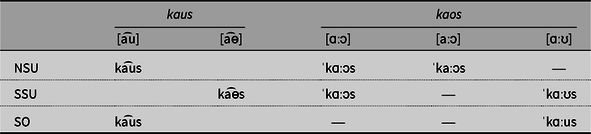
The two-vowel interpretation of au/eu comes rather naturally, moreover, by virtue of Elert’s (Reference Elert1970:88) argument that no phonological contrast exists between a diphthongal and a bisyllabic pronunciation of these entities. Although the idea that Swedish has phonemic diphthongs involves the implicit claim that such contrasts do occur, minimal pairs have not been cited (end of Section 2.2), and seem hard to come by. The closest approximation found in the present study involves the word kaus ‘gutter ring, grommet’ in comparison with particular pronunciation variants of the word kaos ‘chaos’. See Table 7.Footnote 32
Pronunciations of kaus ‘grommet’ and kaos ‘chaos’ in three Swedish dictionaries

All three dictionaries in Table 7 view au in kaus as diphthongal and ao in kaos as bisyllabic, and they represent the first component of au as a front [a]. NSU, in addition, recognizes that also ao in kaos may alternatively be pronounced with [aː]. SSU and SO, moreover, record [u]-pronunciations of <o> in kaos. Hence, if [aː]-pronunciations in kaos can be combined with [u]-pronunciations, yielding phonetic (*)[ˈkaːus], this bisyllabic pronunciation would contrast minimally with the diphthongal pronunciation [ka͡us] of kaus.Footnote 33 Nonetheless, this constructed minimal pair is not of much avail in assessing /a͡u/ as a potential independent phoneme more generally.
In addition, the identification of the constituent parts of the alleged phonemic diphthongs with simple vowel phonemes is straightforward. No part of au/eu is unique – both can be found elsewhere (recall Ladefoged & Maddieson Reference Ladefoged and Maddieson1996:322 and see also Haugen Reference Haugen1967:806). Thus the old structuralist aim of reducing the inventory of phonemes as far as possible encounters no obstacle here, turning ‘suspicious’ sound matter into two separate phonemes that are present in the inventory anyway. This holds both for the pronunciation type [a͡ʊ]/[e͡ʊ] and for the pronunciation type [a͡ɵ]/[e͡ɵ] (Section 2.4). The former will combine /a/ and /u/, the second /a/ and /ʉ/.
5.4 Vowel sequences in Swedish: Native and borrowed
Additionally, Elert (Reference Elert1970:88) draws a parallel to vowel sequences in Swedish. These are of two distinct types: (i) native, which always involve a morpheme boundary (see Section 6.2), and (ii) borrowed, which are frequent both across morpheme junctures and within morphemes. Examples of the former type are li-e ‘scythe’ (pl. liar), ry-a ‘long-pile rug’ (pl. ryor), tjo-a ‘holler’ (v.; < tjo interj.). Examples of the latter, within morphemes, include:

Following Elert’s argument, all vowel sequences, whether morpheme-internal or not, will be analyzed in precisely the same way.
5.5 Lengthening of the first component of au/eu in stressed position
A further piece of evidence is how au/eu behave in relation to vowel lengthening. When au/eu are pronounced as diphthongs, the first diphthong component is in principle relatively short. But when they are pronounced as vowel sequences, their first component is lengthened in stressed position, as in [ˈpɑːɵs], [ˈsɑːɵna], [ˈneːʉ̞trɵm].Footnote 34 Lengthening does not affect au/eu evenly as a whole, but primarily only their first elements. This contrasts, for instance, with how long and short diphthongs are distinguished in Icelandic. No measurements of the internal durational properties of Icelandic diphthongs seem to exist, but it appears that lengthening is distributed more or less equally over the two components of Icelandic long diphthongs (Magnús Pétursson, pers. comm. 31 January 2022). Hence the prolongability of precisely the first component of Swedish au/eu suggests that these two components are not indivisibly glued together, but function separately.
5.6 No morphophonemic alternation with simple vowel phonemes
Still another consideration is that Swedish ɑu/eu do not participate as units in morphophonemic alternations. Compare that Schane (Reference Schane1973:20) suggests that English vowel alternations as in profane vs. profanity or Spanish vowel alternations as in miente ‘he lies’ vs. mentir ‘lie’ (v.) and duermo ‘I sleep’ vs. dormir ‘sleep’ (v.) may be taken to support a functionally unitary interpretation of English and Spanish diphthongs. Strong verb alternations of the type schneiden ‘cut’ (v.) vs. schnitt ‘cut (past)’ and saugen ‘suck’ vs. sog ‘sucked’ provide Ternes (Reference Ternes1999:102) with the same sort of argument for German. The strength of this kind of argument may be debated, but suffice it to note that no similar situation arises in Swedish. No instances of ɑu/eu alternate morphophonemically with simple vowels.
5.7 Consonantization of offglide and offglide deletion
Beyond bisyllabic realizations, two further, related, kinds of free variation yield additional clues to the composite nature of au/eu. The first is the [ɵ]∼[v] alternation or process [ɵ] → [v] referred to in Section 3.2. A second kind of variation in au/eu involves the optional loss of the second segment of these sequences, i.e. [ɵ] → Ø:

The three types of variation are summed up in Table 8. All these types of variation indicate that au/eu are not truly indivisible phonemic diphthongs.
Sequential pronunciation variation involving au/eu

a [evˑ], or in narrow transcription [e̞vˑ], occurs in euro ‘euro’ in dialects that contrast short and long [e] and [ε].
5.8 Cases with an intervening morpheme boundary
Morphological structure, too, plays a role in the assessment of au/eu. As is clear from Sigurd’s (Reference Sigurd1965) practice (see Section 2.1 above), several borrowings in -um require a bisegmental interpretation of orthographic eu on morphological grounds:Footnote 35

Here the eu is obviously split between two different morphemes, a fact reinforced by the assignment of tonal accent (i.e. ‘accent 2’) in stressed position. Equivalent data for orthographic au do not seem to exist, but note that Latin or Latinized proper names in archaic and set expressions may occasionally show traces of Latin inflection: Nikolaus [nikɔˈlɑːɵs], genitive Nikolai [nikɔˈlɑːi], Olaus [uˈlɑːɵs], genitive Olai [uˈlɑːi]. The nominative forms Nikolaus, Olaus rhyme perfectly with bisyllabically pronounced paus [ˈpɑːɵs] ‘pause’, but differ from the latter in that they clearly contain a grammatical boundary between the a and the u. Correspondingly, NSU indicates no diphthongal pronunciations for any of these.Footnote 36
5.9 Au/eu with stressed -u in words of non-Western origins
As we have seen (Section 2.5), au/eu resist taking stress on their second component, contrary to the pattern of many uncontested vowel combinations. Compare, for example etui [etʉ̞ˈiː] ‘case’ and fluidum [ˈflʉ̟ːidɵm] ‘fluid’, where the same underlying vowel combination /ʉi/ is stressed on its second and its first member, respectively. There are exceptions, actual or potential, to the typical first-component stress of au/eu, however. First, we consider three specific examples of au, then one of eu, with some of their cross-linguistic equivalents.
One is the toponym Nauru (in Micronesia; formerly Pleasant Island; once under German rule). According to NE 14 (71), the name is pronounced ‘[naʉː´rɵ]’ (i.e. [naˈʉ̟ːrʉ̞]), with the same stress pattern as German Nauru [naˈuːru], which mirrors the Nauruan name of the island, [næoˈero], a word of unknown etymology (Hughes Reference Hughes2020:4 and pers. comm. 2 January 2022).
A further item is aul, this one of Turkic origin, which SAOB (II: column A 2686) translates as ‘Kyrgyz tent village’ and transcribes (converted into IPA) as [ɑˈʉ̟ːl] or [aˈʉ̟ːl], both ‘without diphthongization’.Footnote 37 The diphthongal pronunciations [a͡ɵl] and [ɑ͡ul] are also mentioned. Duden (176) represents the word Aul in German with a diphthong, while Russian has aul [aˈul] (Avanesov & Ožegov Reference Avanesov and Ožegov1959:37).
A third, potential, example is the word family gagauz, gagauzisk, and Gagauzien (in Moldova, formerly part of the Soviet Union). The word gagauziska ‘Gagauz (language)’ is transcribed ‘gaˈga͜ɵsɪska’ in SSU (276), perhaps following the transcription [-gau-] of NE 7 (294). The recorded English pronunciations vary. The Oxford Dictionary of English (715) gives [gəˈgaʊz]. The Collins English Dictionary (662) renders the name of the language as Gagauzi with the phonetic transcription ‘(gəˈgɔːzɪ)’.Footnote 38 The Longman Pronunciation Dictionary (295), on the other hand, gives [ˌgægɑːˈuz]. The Concise Dictionary of World Place-Names gives the transcription ‘(Găgăuzia)’ for the corresponding place-name.Footnote 39 In the Gagauz language itself, gagauz, an ethnonym of obscure origin and not the original self-designation, is pronounced with stress on the u. The Gagauz specialist Astrid Menz (pers. comm. 12 January 2022) confirms this account: ‘eine diphthongische Aussprache des -au- ist tatsächlich ausgeschlossen, das Wort hat drei Silben, die Betonung liegt auf der letzten Silbe: ga-ga-'uz’.Footnote 40 German, and Russian follow the latter pattern, thus German Gagause [gagaˈuːzə] ‘Gagauz man’ (Duden:347) and Russian gagaúz ‘Gagauz man’, gagaúzskij ‘Gagauz’ (adj.) (Avanesov & Ožegov Reference Avanesov and Ožegov1959:102). Given the Gagauz pronunciation, it is likely that Swedish orthoepists will eventually admit the same accentuation.
The graphic sequence eu, finally, occurs in the word family aleut ‘Aleut (person)’, aleutiska ‘Aleut woman’, and Aleuterna ‘the Aleutian Islands’. For aleut and aleutiska, SSU (63) suggests the pronunciations [aˈlᴇ͜ɵt]/[aˈlᴇfːt] and [aˈlᴇ͜ɵtɪska]/[aˈlᴇfːtɪska] (where the symbol ᴇ corresponds to IPA ε). The English pronunciation, in contrast, is Aleutian [əˈluːʃən], the German one Aleuten [aleˈuːtn̩] (Duden:145). Since Russia owns some of the Aleutian Islands, it is also of interest to note that the Russian morpheme aleut and its derivatives are always stressed on the u (i.e. aleút, Avanesov & Ožegov Reference Avanesov and Ožegov1959:28). In Swedish, too, the toponym is often pronounced with the stress on the u: [aleˈʉ̟ːtε̠ɳa] (but also [aˈlεvˑtε̠ɳa]), similarly the ethnonym aleuter [aleˈʉ̟ːtε̠r] ‘Aleutian (person)’ (compare NSU:15).
In conclusion, the dominant first-component stress of au/eu in words of the type paus/neutrum reflects conditions in the languages (most commonly Greek, Latin, German, etc.) from which the words in question were borrowed. When words originate from other more remote sources, second-component stress in au/eu is entirely possible. Consequently, the origin of a word will co-determine the treatment of the orthographic sequences au/eu.
5.10 Variable metrical treatment of au/eu
Owing to its special character and requirements, poetry will not necessarily yield conclusive information. Nevertheless, it is worthy of note that Risberg’s (Reference Risberg1932–1936 II:108–110) extensive sampling of vowel sequences in metrically bound verse appears to yield little evidence that the metrical treatment of au/eu differs from that of other, uncontested, vowel sequences. Dieresis, the dissociation of vowel combinations into their constituent elements in two different syllables, is amply attested in this material, but the opposite phenomenon of syneresis, i.e. combining the two vowels into one syllable, is also found fairly often. This is true of ordinary vowel clusters as well as the more special cases of au/eu. Examples involving au/eu are:Footnote 41

Thus, whereas au in auktor ‘author’ in (15a) is securely contained within one syllable, the au of Saul in (15b) is divided between two syllables. Similarly, whereas eu in Europa ‘Europe’ in (15c) is treated as a single syllable nucleus, the same entity in Europas ‘Europe’s’ (15d) constitutes two different syllables. Nor does Risberg indicate any difference between uncontested vowel combinations and au/eu when commenting on his data, but observes quite generally (Reference Risberg1932–1936 II:108):
in loanwords … often names, especially those of Greco-Roman or Romance origin, in which two vowels combine, the two vowels may be treated as sustaining two syllables or only one syllable, all according to taste and ease. Thus we often find that, in one and the same author, the same, or at any rate fully equivalent, words are sometimes used one way, sometimes the other.
Hence metrical information underlines the extensive variability of the diphthongal vs. sequential character of au/eu.
5.11 Summary
A good deal of evidence can be adduced in favor of viewing diphthongal au/eu as underlying vowel sequences. These entities are very often segmentalized phonetically speaking. They do not contrast with the corresponding vowel sequences. They largely, though not entirely, pattern like undisputed vowel combinations in borrowed morphemes. Their first component is lengthened in stressed position, not the whole diphthong as in Icelandic. They do not alternate with single vowels as in English, German, and Spanish, and fulfill no morphological function. Their second component may disengage itself, turning into v or zero. In some cases, underlying diphthongs cannot be posited because, in addition to being normally pronounced as bisyllables, the two elements are divided by a morpheme boundary. Sporadically, new borrowings may enter the language, in which the second component of au/eu is stressable. Metrically, au/eu are variously treated as diphthongs and sequences. In comparison, the prime arguments for postulating monophonemic diphthongs (Sections 2.2 and 2.5) are weak.
6. Avoidance, adaptation, and integration of diphthongs in Swedish
6.1 The deep-seated aversion to underlying diphthongs in Swedish
The notorious resistance to phonemic diphthongs in Central Standard Swedish is striking. Bergroth (Reference Bergroth1924:54) mentions the ‘prominent anti-diphthongal tendency in standard Swedish’. SOU (10) notes that ‘In general the Swedish standard language does not cherish diphthongs.’ Concerning au, Noreen (Reference Noreen1903–1924 II:61 fn. 3) comments on ‘How foreign the diphthong appears to the rank and file of society’. Dahlstedt (Reference Dahlstedt1967:26) holds that ‘To the Swedish standard language diphthongs are basically foreign … and only /au/ has through loanwords gained a secure foothold in our language.’ But even with respect to au, he speaks of ‘the alien status of this sound sequence to a genuinely Swedish linguistic consciousness’ (Dahlstedt Reference Dahlstedt1962:18). Pamp (Reference Pamp1972:33), finally, describes au as ‘un-Swedish’. Historically, the East Scandinavian monophthongization swept through the region in the early Middle Ages (Marklund Reference Marklund2018 with references). Low-level phonetic offgliding and rapid-speech diphthong formation have not radically altered the disinclination towards underlying diphthongs. According to Braunmüller (Reference Braunmüller2007:36) and Lindqvist (Reference Lindqvist2007:73), Central Standard Swedish is now unique among the Germanic languages in lacking underlying diphthongs in its native morpheme inventory. Areally, it is completely surrounded by languages with diphthongs (compare Ternes Reference Ternes1998:144, Eliasson Reference Eliasson2000:37–39).
6.2 The two native Swedish root-morpheme templates
From a synchronic point of view, the Central Swedish aversion to foreign diphthongs is phonotactically deeply rooted. Only two general canonical types of underlying root morphemes exist in the native Swedish lexicon, monovocalic (16a) and bivocalic (16b) (adapted from Eliasson Reference Eliasson2009:59):Footnote 42

Swedish monovocalic root morphemes, e.g. å [oː] ‘stream’ (n.), tår [toːr] ‘tear’, ork [ɔrˑk] ‘strength’, strand [stranˑd] ‘shore’, include 0 to 3 onset consonants, have one and only one vowel in the nucleus, and 0 to 2, sometimes 3, coda consonants. Karlsson (Reference Karlsson2013:49) and Eliasson (Reference Eliasson, Caro Reina and Szczepaniak2014:70) list the occurring shapes. The latter mentions no instance of VCCC; Karlsson (Reference Karlsson2013:50) registers the item ilsk ‘angry’, etymologically an -sk-derivation (Hellquist Reference Hellquist1980 I:403) like a number of other -sk- formations with synchronically unidentifiable roots (Eliasson Reference Eliasson2009:75). Generally, the set of morpheme-final -CCC clusters is extremely constrained, many of these being loans or else due to special language-internal developments (Eliasson Reference Eliasson2009:60, 75–79), a fact that in combination with the low number of CCC- onsets explains why the type *CCCVCCC is unattested. Karlsson (Reference Karlsson2013:49) details the number of items in the different canonical classes (CVCC 1437 instances, CCVCC 821, CVC 778, etc.), in his analysis a total of 4114 monovocalic root morphemes, only 149 (3.6%) of which begin with CCC- and a mere 82 (2%) contain a final -CCC combination (Reference Karlsson2013:49, 50). A fair degree of cluster complexity is thus possible with consonants, but none with vowels.Footnote 43
Bivocalic root morphemes, e.g. virvel [ˈvìrˑvε̠l] ‘whirl’ (n.), bolster [ˈbɔlˑstε̠r] ‘feather bed’, and vatten [ˈvat:ε̠n] ‘water’, are built in essentially the same way as monovocalic ones, but with the addition of a non-stressable, unstable vowel (v), most often [ε̠] (in certain morphemes not realized phonetically, because the conditions for its appearance do not arise), followed by l, n, or r. It is worth noting, however, that in native bivocalic root morphemes one medial consonant is compulsory, thus avoiding hiatus.Footnote 44
Significantly, then, in neither of the two basic types of native root morphemes, nor in any other related lesser type in the native lexicon, is it ever the case that two vowels combine intra-morphemically: a vowel never follows a vowel in a native Swedish morpheme. Nor is the vowel V in the formulas (16a) and (16b) ever natively an indivisible underlying diphthong. Finally, no vowel length exists underlyingly (equated, for instance, to two moras) that might provide a parallel for positing diphthongal nuclei, too, at the underlying level.
6.3 Adaptation strategies for foreign diphthongs
The morpheme patterns in (16) recur over and over again in the Swedish lexicon. While the elements in their onsets and post-V codas are largely optional, the template nucleus obligatorily consists of one single vowel, with no allowance for complex nuclei. The analogical force of this pattern seems to be so strong that it largely counteracts the adoption of foreign diphthongs. Three major adaptation strategies affect au/eu:

Risberg (Reference Risberg1932–1936 I:56) elucidates the first two processes as follows (emphasis added):Footnote 45
In the pronunciation of foreign languages or of words borrowed or derived from foreign languages, especially by persons whose own language does not have the same diphthongs or no true diphthongs at all (like our standard Swedish language of today), it … occurs to a large extent that either u and i are actually consonantized into v or j … or else that the diphthong is broken up into two vowels, expiratorily separate, each carrying its own syllable, and with hiatus … Naturally, the original diphthong, composed of two vowel sounds … is also preserved in many cases, especially by persons with language training or in certain dialects.
Bisyllabification is reinforced by lengthening of the first component of au/eu in stressed position (Section 5.5). Beyond au/eu, (optional) consonantization of [i̯] to [ʝ] regularly appears in imported i-diphthongs, e.g. guide [ˈgaʝˑd] ‘guide’ (n.) (< English guide), geist [ˈgaʝˑst] ‘go, drive’ (n.) (< German Geist ‘mind; spirit’), and pojke [ˈpɔ̀ʝˑkε̠, ˈpɔʝˑkε̠] ‘boy’ (< Finnish poika ‘boy’). A possibly illusory hapaxlegomenon-type strategy is dropping of the diphthong head, the most sonorous part:

In the standard language, (18) is, it seems, only attested in the widespread, very frequent pronunciation [restʉ̞ˈraŋː] of restaurang ‘restaurant’, instead of [resta͡ɵˈraŋː].Footnote 46 All adaptation strategies are partly dependent on whether the syllable in question is stressed or not, and individual words vary as to the extent to which they undergo the processes. Lindqvist (Reference Lindqvist2007:95) notes that ‘Die Art der Anpassung an das zentrale Lautsystem ist weitgehend lexemgebunden.’Footnote 47
6.4 Swedish diphthong avoidance in second language acquisition and learning
Interestingly, the fundamental tendency to remodel foreign diphthongs extends to Swedes’ second language acquisition and learning. The same modifications we just noted in loanword adaptation also appear here: (i) diphthong fission (dieresis), (ii) consonantization of offglide, and (iii) lengthening of diphthong head in stressed position.
Dieresis and, in stressed syllables, concomitant lengthening of the diphthong head frequently occur among Swedes learning German. In a prescriptive statement, Martens & Martens (Reference Martens and Martens1961:79, emphasis added) say concerning Standard German diphthongs:
Die Diphthonge sind einsilbig. Sie haben also die sprachliche Quantität eines Einzelvokals. Der erste Teil der Zwielaute [ae, ao, ɔø] (also [a-, a-, ɔ-]) ist stärker betont als der zweite Teil, darf aber auf keinen Fall gedehnt werden.
[‘The diphthongs are monosyllabic. They thus have the linguistic quantity of a single vowel. The first part of the diphthongs [ae, ao, ɔø] (i.e. [a-, a-, ɔ-]) is more strongly stressed than the second part, but must on no account be lengthened.’]
Hence the component parts of the German diphthongs should essentially both be short. Correspondingly, Gejrot (Reference Gejrot1960:8) advises Swedish speakers learning German that the a in German au should be pronounced as ‘Dark a as in Sw[edish] “far” [“father”], but short’. The pronunciation *[ˈhaː.us] for German Haus [ˈhɑ͡ʊs] ‘house’, with Swedish-induced dieresis and lengthening, is a typical error.
As for consonantization, we may first note that in second language learning Swedes frequently consonantize the offglides of foreign i-diphthongs, since j, the Swedish consonant generally associated with the semi-vowel [i], is often rendered as a fricative, [ʝ]. Hjorth & Lide (Reference Hjorth and Lide1958:4) say that German ‘ai, ei are pronounced [ai], … note, not with j , as in Sw[edish] “aj” [“ouch!”]’. Similarly, Korlén & Malmberg (Reference Korlén and Malmberg1960:87) warn against mispronouncing the German diphthong [ai]: ‘Swedes must … carefully see to it that, under all circumstances, the final element becomes vocalic (i, or possibly e), never a consonantal [j] as in Swedish aj, kaj [“quay”], etc.’Footnote 48 In the same vein, Malmberg (Reference Malmberg1966:47–50 passim) cautions against producing fricative offglides in the English i-diphthongs [e͡i, a͡i, ɔ͡i], but also in the English u-diphthongs [ɑ͡u] and [o͡u].
6.5 Diphthongal realizations in unstressed position and rapid speech
At the level of articulation, the difference between diphthongs and vowel sequences constitutes a continuum, affected by factors such as speech rate (rapid vs. lento speech), speech rhythm, and stress (unstressed vs. stressed position). Generally, given the ‘reduction of the vowel space at faster speech rates’ (Petersen Reference Petersen2018:iii, 248), certain vowel clusters may in rapid speech tend to be realized as diphthongoids (i.e. elements somewhere along the continuum between monophthongs and diphthongs) or even as fully fledged diphthongs. Regarding unitary or bivocalic realizations of Swedish au/eu, Gjerdman (Reference Gjerdman1954:383) refers to sentence rhythm as a factor (emphasis added):
The line between the two pronunciations is … not always easy to draw. Most often it is perhaps the rhythmic conditions in the surrounding linguistic material that determine what pronunciation appears.
Moreover, it is striking to observe the recurring reference in the literature to au/eu in unstressed vs. stressed syllables. Noreen (Reference Noreen1903–1924 IV:9), for instance, says that ‘the diphthong is relatively frequent in less common or more recent loanwords, above all in weakly stressed syllables’ (emphasis added). His examples include (i) paulun ‘four-poster bed’, eunuck ‘eunuch’, (ii) autograf ‘autograph’, eufemism ‘euphemism’, pseudonym ‘pseudonym’, and (iii) automobil ‘automobile’, tautologi ‘tautology’, where au and eu at varying distances to the final stressed syllable are often pronounced as diphthongs. The frequent reference to stress conditions raises the suspicion that some of the diphthongs in unstressed position or in rapid speech, rather than reflecting underlying diphthongs, may actually result from low-level phonetic processes. This assumption may solve Sigurd’s (Reference Sigurd1965:142) problem with the precarious diphthong eu in neutrum vis-à-vis the derivative neutral (see Sections 2.1, 2.6, and 5.1 above). If the eu in neutrum [ˈne͡ɵtrɵm] is actually /eʉ/, the diphthongal quality in neutral [ne͡ɵˈtrɑːl] may simply reflect the appearance of /eʉ/ in unstressed position immediately before the syllable carrying the main stress. Diphthongal realizations in unstressed position do not infallibly indicate that the entities concerned are diphthongs phonologically.
6.6 How well integrated are au/eu with the Swedish phoneme system?
What criteria should be applied in determining whether or not au/eu are part of the Swedish phoneme system? Especially the notion of contrast is crucial to phonology. Grossman et al. (Reference Grossman, Eisen, Nikolaev and Moran2020:5317) remark on segment borrowing in general:Footnote 49
Phonological segment borrowing is a process in which a certain sound becomes a contrastive segment in a language, or in which a marginal segment in a language becomes contrastive in more domains and environments, due to lexical borrowing.
The first and foremost requirement, then, is that the units under discussion actually contrast with native phonemes. This is the case in Swedish with certain other borrowed sounds. When the loanword bag [ˈbæːg, ˈbægː, ˈbεgː, ˈbagː] ‘bag’ (see NSU:85, SSU:95) retains its English vowel quality [æː], it forms a sub-minimal pair with the native väg [ˈvεːg] ‘way’ with [εː]. Similarly, the word twist ‘twist’ (dance), when pronounced [ˈtwisˑt] in Swedish, forms a minimal pair with tvist [ˈtvisˑt] ‘dispute’.Footnote 50 In both instances, a borrowed sound contrasts with native sounds. In principle, diphthongal au/eu, too, contrast with native segments (faun [ˈfa͡ɵn] ‘faun’ vs. fan [ˈfɑːn] ‘the Devil’, fån [ˈfoːn] ‘fool’, etc.). Nevertheless, they fail to contrast with non-diphthongal au/eu, occurring rather in free variation with these (Sections 5.2 and 5.3). Hence they enjoy no totally independent status in the Swedish phoneme inventory.
Another criterion is whether the putative phonemes have entered the native lexical stock (Campbell Reference Campbell, Hans Goebl, Nelde and Wölck1996:99). But the diphthongs au/eu only show up in loans and in an interjection (mjau ‘miaow’). If appearance in the native lexicon is a must for nativized phonemehood, diphthongal au/eu cannot be part of the Swedish phoneme system.
Nor are diphthongal au/eu easily accommodated under the assumption of a coexistent phonemic system in a limited foreign (largely classical) stratum of the Swedish lexicon.Footnote 51 The two units do not contrast with corresponding sequences even there. Rather than as separate indivisible phonemes, they are, therefore, perhaps best accounted for by a special descriptive stipulation valid for a borrowed sub-domain of the lexicon, possibly something like (19):

lexically specifiable refers to lexical and phonological clues to the more or less specific non-native origin of a given word and hence clues to its pronunciation (compare Tamm Reference Tamm1887). lexically marked refers to item-specific lexical marking.
7. Summary and conclusion
The borrowed entities written au/eu in Swedish are variously pronounced as diphthongs ([a͡ɵ, a͡ʊ]/[e͡ɵ, e͡ʊ], etc.), bisyllabic sequences ([aɵ]/[eɵ], etc.), and, in certain words, even as vowel-consonant combinations ([av]/[ev], etc.) or single vowels ([a]/[e], etc.). They have been interpreted phonologically in four major ways: as (i) phonemic diphthongs, (ii) /VC/-sequences, either /Vv/ or, merely hypothetically, /Vw/, (iii) monosyllabic /VV̯/-sequences, where /V̯/ is a non-syllabic vowel, and (iv) bisyllabic /VV/-sequences, with two structurally equivalent vowels (Section 1.3). The four types of analysis with their defining properties are summarized in Table 9 (compare Table 3 in Section 1). Analysis 1 considers diphthongal au/eu to be indivisible, unitary phonemes in contrast to the other analyses, which treat them as consisting of two separate phonemes. Analyses of type 2 take the second part of au/eu to be a consonant, in analyses 3–4 it is a vowel. Analysis 3 shares the idea that au/eu are monosyllabic with 1, but the idea that they are bivocalic with 4, while excluding the suggestion of analysis 2 that the second diphthong element is consonantal. Analysis 4, finally, treats au/eu as underlying bivocalic sequences, whose parts belong to two different syllables or are separately syllabifiable. Which alternative is to be preferred?
Basic characteristics of various phonological interpretations of Swedish au/eu

Analyses 2 and 3 encounter major difficulties when they are placed within the larger structure of the language. The prime piece of evidence for a /VC/-type analysis, specifically the /Vv/-analysis, is the free variation between [V͡ɵ] and [Vv] in a subset of words, but neither the /Vv/-analysis, nor the alternative /Vw/-solution are easily aligned with certain other phonological facts (Sections 3.3 and 3.4). The variation [ɵ]∼[v] is more conveniently seen as consonantization, synchronically speaking, and Swedish has no [w] distinct from [ʊ̯] and separate from ordinary [w] in English loans. Analysis 3, moreover, is to a considerable extent motivated by the distributional parallel with Vj-sequences which are said to consist of two short monosyllabic vowels and by the parallel with long vowels which are seen as geminates. However, the interpretation of Vj-sequences is not straightforward (Section 4.2) and the view of Swedish vowel length as gemination is implausible (Section 4.3). For the rest, analysis 3 may be said to share advantages and disadvantages above all with analysis 1. Consequently, analysis 1 (the /V͡V/-analysis) and analysis 4 (the /VV/-analysis) emerge as the main contenders.
The characteristics in (20) suggest that au/eu are unitary, indivisible phonemic diphthongs:

The considerations in (21) favor the view that au/eu are best regarded as phonological sequences:

Facts (20a) and (20b) indicate that there is something special about au/eu in Swedish. These facts must be accounted for. The question is whether they are best described by assuming separate indivisible phonemes in a lexical sub-domain or by a special descriptive stipulation, perhaps such as (19) above. The advantage of the latter approach seems to be strong. The absence of minimal pairs demonstrating contrasts between diphthongal au/eu and the corresponding sequences is a crucial argument against assuming phonemic diphthongs and in favor of an interpretation as sequences of vowel phonemes (21a). Rampant free variation of several kinds occurs between diphthongal and non-diphthongal pronunciations, making the former highly unstable units (21b–d). The components of au/eu can be modified individually in four partly intertwined adaptation processes, viz. bisyllabification (21b), head lengthening (21c), offglide consonantization or offglide deletion (21d), contrary to what should hold for unitary, indivisible diphthongs. Phonotactically, diphthongs clash head on with the two native underlying root-morpheme templates, allowing only monophthongs as syllable nuclei (21e). Despite frequent low-level phonetic diphthongizations, no phonemic diphthongs have since the time of the early medieval monophthongization made their way into the native standard lexicon, and apart from an isolated interjection, au/eu never show up outside the realm of borrowings. Lexically, the small set of morphemes with eu would make /e͡ɵ/ a particularly precarious phoneme (21f). Diphthongal pronunciations of au/eu in unstressed position and rapid speech may in part be phonetic in nature (21g). The variable metrical treatment of au/eu further underlines the unstable character of these entities (21h).
The case for regarding au/eu as unitary phonemes, to some extent nativized in Swedish, is thus weak. While the facts in (20) must be accounted for in any description of Swedish phonology, the considerations in (21) – most particularly, the lack of diphthong/sequence contrasts and the wide-ranging compositional and sequential variability of the diphthongs – suggest that au/eu should in the first place be analyzed as bivocalic sequences that are independently syllabifiable. By the same token, the existence of these entities does not alter the typological classification of Swedish as a language without phonemic diphthongs.
Acknowledgements
I am greatly indebted to three anonymous reviewers of the Nordic Journal of Linguistics for valuable comments and suggestions, which helped improve the presentation of several specific points. One of the reviewers in particular provided an unusually judicious and thorough examination of the paper. Éva Csató-Johanson, Kevin Hughes, Astrid Menz, Magnús Pétursson, and Renate Raffelsiefen responded to queries. The Royal Society of Humanities in Uppsala (Kungl. Humanistiska Vetenskaps-Samfundet i Uppsala) covered the cost of the stylistic editing of the pre-final version of the paper. Remaining errors and shortcomings are my own.