1. Introduction
It was not until the beginning of this century that electroacoustic music in Chile had a systematic and technically fitting dissemination space with national and international reach.Footnote 1 From the listening sessions conducted by José Vicente Asuar and Juan Amenábar in the 1960s and 1970s (Asuar Reference Asuar1963) to the limited works presented at the Anacrusa festivals in the 1980s (Cáceres Reference Cáceres1990; Fugellie Reference Fugellie2022) and, in a slightly larger proportion, at the contemporary music festivals organised by the Institute of Music of Universidad Católica, public presentations of these types of works were sporadic and often inappropriate in terms of listening devices. This article focuses on two aspects that were relevant to those who participated in the development of this festival, at least during the studied period: (1) the circulation of national and international works and composers, with an emphasis on works by Latin American composers; and (2) the perspective of the electroacoustic concert as a space for research in devices and formats deemed appropriate for a particular musical experience, as is electroacoustics. To this end, mainly primary sources are consulted, as there is little literature accounting for these aspects in Chile aside from the writings of Schumacher (Reference Schumacher2005; Reference Schumacher2013) and Candela (Reference Candela and Schumacher2019). There are also documentary sources such as the festivals’ programmes, some available on the Web,Footnote 2 and press publications. The selected period spans from 2001 (the first festival) to 2012, the year of the last festival held in an uninterrupted sequence that was suspended due to changes in the state funding conditions that had been received in the last six editions. Although the festival continues to be held to date with some interruptions, the feasibility conditions after 2012 are diverse and different from those in the period covered by the article.
2. Early stages
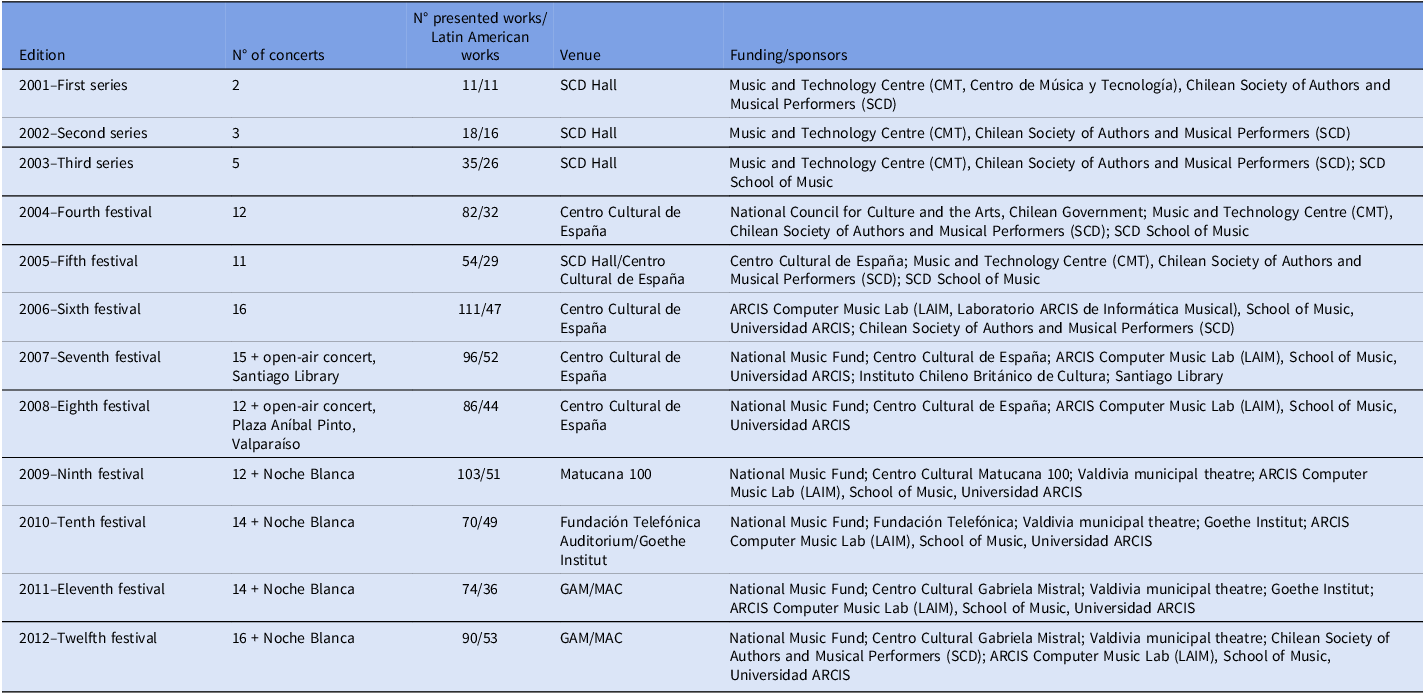
In 2001, composer José Miguel Candela and others produced a series of concerts called Primer Ciclo de Conciertos de Música Electroacústica (First Electroacoustic Music Concert Series), which included two concerts at the Bellavista Hall of the Chilean Society of Authors and Musical Performers (SCD, Sociedad Chilena del Derecho de Autor).Footnote 3 A direct precedent of this initiative was a concert organised in 2000 by composer José Miguel Fernández to conclude a creation project awarded by Chile’s Cultural Funds. This concert featured composers such as Mario Arenas, José Miguel Candela, Paola Lazo, Edgardo Cantón and Federico Schumacher. Likewise, in 1996 and 1998, the Contemporary Music Festival of the Institute of Music of Universidad Católica de Chile had organised concerts dedicated to electroacoustic music with some of these composers, as well as others like Felipe Otondo and Mario Mora. That is how, at the turn of the century, there seemed to be a critical mass of national composers whose musical production required spaces and suitable conditions for presenting to the public. This first series was followed by another two in subsequent years, and by the 2004 version, it had come to be known as the Ai-Maako International Electroacoustic Music Festival.Footnote 4 During the period under study, the festival experienced constant and sustained growth: the two initial concerts (one dedicated to Chilean works and another to Latin American works) became 16 in 2006, when 50 years of León Schidlowsky’s Nacimiento, the first electroacoustic work composed in Chile, were commemorated. In the following editions, the number of concerts stabilised at about 14. The festival was relocated from the small SCD Hall to the hall of Centro Cultural de España (2007, with capacity for 140 people),Footnote 5 then to Centro Cultural Matucana 100 (2009, with capacity for 500 spectators),Footnote 6 the hall of Fundación Telefónica (2010)Footnote 7 and finally to Centro Cultural Gabriela Mistral (GAM),Footnote 8 the main cultural centre in Santiago. The following table shows this evolution:
Experimenting in spaces other than those of traditional hall concerts began in the 2007 edition, when an open-air concert was programmed on the forecourt of the Santiago Library.Footnote 9 A similar concert was held in 2008 at Plaza Aníbal Pinto in Valparaíso, and the Noche Blanca (White Night) concerts, described later, started to take place annually as of 2009, first at the Visual Arts Gallery of Matucana 100, then at the Goethe Institut Hall (2010), a traditional hall dedicated to contemporary music in Santiago, and finally at the hall of the Contemporary Art Museum (MAC) in Parque Forestal.Footnote 10 As mentioned, since the 2007 edition, the festival sought a decentralised presence with the open-air concert in Valparaíso. As of the 2009 edition, it was also held annually in Valdivia, 800 kilometres south of Santiago, at the city’s municipal theatre, with which the festival was expanded to two weeks (three dates in Santiago and three in Valdivia) for the next four years. Four concerts and other activities at Condell Theatre in Valparaíso were added in 2012, which gave the festival a presence in three regions of the country.
Furthermore, the festival began to systematically welcome international guests in the fourth edition, thanks to both state funding and funding arranged by the guests from sources in their own countries. That is how the festival was attended by some of the most prominent composers in the global landscape of electroacoustic music. They not only presented works at specially dedicated concerts but also interacted with specialised and non-specialised audiences in talks and workshops offered as part of the programme.
To close this brief introduction about Ai-Maako’s evolution, first, it is important to note the audience development to which the festival contributed, both in terms of listening spaces with the best technical conditions for presenting and listening to works of this genre and the effort to disseminate, in all its aesthetic diversity, the production of electroacoustic works by composers from 42 countries (869 works in total were presented during the studied period). Although the festival had an internationalist vision, from the outset, there was an attempt to give a relevant presence to works by Latin American composers, which were usually about 50% of the programming (see Table 1). Additionally, the Gustavo Becerra Schmidt Latin American Electroacoustic Composition Competition, which, as its name suggests, aimed to reward the Latin American composition of electroacoustic works, was organised under the auspices of the festival. All of this resulted in a continuous increase in attendance to and interest in the festival. There was a full house at GAM in the 2011 and 2012 versions, and one thousand people attended the Noche Blanca concert in January 2012. Second, it must be pointed out that the festival has not had systematic institutional support. From its inception, it was (and continues to be) organised by a group of composers from the Electroacoustic Community of Chile (CECh, Comunidad Electroacústica de Chile). In its early years, it had financial support from the SCD School of Music, then from the School of Music of Universidad ARCIS, and in several editions, it received funding from the Chilean government’s Cultural Funds. The constant and often erratic changes in the application terms of these funds marked the end of this first stage of the festival when the 2012 call for entries required projects to have 20% of the requested amount provided by the applicants, which was impossible for an organisation without institutional support like CECh.
Evolution of Ai-Maako festival, 2001–2012

3. Networks, circulations and aesthetic crossovers at Ai-Maako
Ai-Maako emerged at a particularly fertile moment for electroacoustic music in Latin America. Until the beginning of the century, there were only the Primavera in Havana Festival, which had been held on the island since 1981,Footnote 11 and the International Biennial for Electroacoustic Music of Sao Paulo, led by Flo Menezes in Brazil since 1996.Footnote 12 At a more local level, the Electroacoustic Music Weeks in Argentina, held since 1983 and more intended for electroacoustic works by Argentinian composers, are noteworthy (Schumacher, Reference Schumacher2005). More or less simultaneously with Ai-Maako, the Sonoimágenes Festival, directed by composers Raúl Minsburg and Daniel Schachter, arose in Argentina under the auspices of Universidad Nacional de Quilmes, and the Visiones Sonoras Festival, led by composer Rodrigo Sigal, appeared in Mexico in 2005. Although Primavera in Havana was in decline at the turn of the century, there are no historical records of such a wealth of electroacoustic music festivals in Latin America as in that period. A common aspect in most of these festivals was transcending the local activity to bring musical productions that reflected the diversity of formats in electroacoustic music closer to various audiences, as well as the possibility of creating networks amongst different festivals. All the aforementioned composers were international guests at Ai-Maako at some point, and several Chilean composers and CECh members attended these festivals in the same capacity. Just to name a few, José Miguel Candela presented works of his own as well as by Cristian Morales and Federico Schumacher at Primavera in Havana in 2002 (Candela Reference Caandela2003). He also participated in the Sonoimágenes Festival in 2007 and in Visiones Sonoras in 2013. Bryan Holmes participated in the Biennial for Electroacoustic Music of Sao Paulo at a concert with works by Chilean composers curated by Schumacher in 2012 that featured works by Alejandro Albornoz, Felipe Otondo, Adolfo Kaplan, Holmes himself and Schumacher.
Along with the circulation of works and composers at Latin American festivals, Ai-Maako welcomed a considerable number of composers from various countries around the world, as shown in the following table describing the guests and academic activities (courses, talks, workshops) carried out during their participation:
As the table shows, from 2004 to 2012, the festival was attended by 45 international guests, mainly from Argentina, France, Spain and Sweden (14 different countries in total). A particular case was that of Chilean composers currently or formerly residing abroad; some of them were invited as part of the ‘side by side’ concerts that brought together one Chilean composer residing abroad and one composer residing in the country. The list of guests included leading names in the global electroacoustic music landscape, such as Francis Dhomont, one of the genre’s pioneers; Beatriz Ferreyra, who, apart from the quality of her compositions, collaborated with Pierre Schaeffer in the music theory of the sound object; Ake Parmerud, probably the composer who has received the most awards in international composition competitions; Annette Vande Gorne, prominent composer and director of the Metamorphoses Festival (Belgium); and Miller Puckette, developer of software that is widely used in music today, such as Max/MSP and Pure Data. They were joined by fundamental Chilean composers such as José Vicente Asuar, a pioneer of electroacoustic music in Chile who was paid a heartfelt tribute in 2010 that helped to revitalise his figure at a national level, and Gabriel Brncic, who has led an extensive career in Argentina and Spain.
Table 2 also shows that both guests and national artists carried out numerous academic and outreach activities such as talks, discussion panels and workshops aimed at specialists and the general public in the three cities where the festival was held. For instance, during the 2012 festival, Alejandro Albornoz led a Composition with Electronic Media Workshop in Valparaíso aimed at a non-specialised audience, as it was the first time that the festival took place in that city. Conversely, the Composition with Electroacoustic Media Workshop led by Ake Parmerud that same year was intended for a specialised audience that could discuss their work with a noted composer. This criterion for differentiating and segmenting activities based on different audiences seemed necessary starting in 2009, when the first edition in the city of Valdivia was held, and a pedagogical approach was developed to train new audiences. Supporting these new audiences in their training and transition towards a more active creative activity was also an aspiration. Many people wished to become involved in electroacoustic music from a creative angle and could not find formal or informal training options in the field at the time. There are several cases in which participants in these activities became electroacoustic music composers. A paradigmatic case is Alejandro Albornoz, currently an academic of the bachelor’s degree in music and sound arts at Universidad Austral de Chile in Valdivia with a PhD in electroacoustics.
Festival guests and academic activities

The festival was also a space for aesthetic crossovers between electroacoustic music and adjacent music and sound practices, both due to the used technologies and a concern for sound and listening as a relevant aspect of a musical piece. During the 2009 festival, there was a sound art exhibition with installations distributed in various areas of Matucana 100, its venue in Santiago. Artists such as Ana María Briede, Andrés Torres, Ariel Bustamante and Rainer Krause participated in this exhibition, curated by visual and sound artist Félix Lazo. The Sound in the 21st Century Colloquium took place the following year with sound artists Sebastián Jatz, Ana María Estrada and Rainer Krause, as well as musicians Aliocha Solovera and Federico Schumacher. During the colloquium, there was a lively discussion on different approaches to the role of sound in the audience’s experience in works that favoured a crossover of various artistic disciplines.
However, the most systematic, productive and sustained dialogue was related to music that came from a non-academic tradition of electronic music, in other words, what is known as experimental electronic music. The story of this connection and dialogue is told by Martini and Figueroa in ‘Pueblo Nuevo y La Electroacústica: Un Oído Particular’ (Pueblo Nuevo and Electroacoustics: A Particular Ear) (Reference Martini, Figueroa and Schumacher2019), so this article will refer to how this convergence process was manifested in various activities linked to the Ai-Maako festival. But some context is needed first. A spatialisation workshop led by Federico Schumacher was held in 2004 in which the participants were familiarised with sound signal dynamic control techniques using the mixing console in a multi-speaker system. This workshop was attended by a significant number of electronic musicians with non-academic training, mainly interested in learning about spatialisation techniques. After the workshop, most participants decided to continue to meet and keep sharing experiences and knowledge. This was the birth of the Electro Workshop, consisting of electronic and electroacoustic musicians from various backgrounds. Behind the creation of this space for dialogue was a shared opinion of transcending the aesthetic boundaries between academic and non-academic music by affirming the electro roots of both generic denominations (electroacoustic and electronic). A year later, the 2005 edition of the festival offered a concert dedicated to works by the workshop’s members, including a presentation by Electrodo Ensamble, a heterogeneous improvisation group formed by some members of the workshop.
From that edition on, electronic music works and exponents were always present at Ai-Maako in both specially dedicated concerts and concerts integrated into the general programming as a way to establish an equal status between the musical genres. In 2006, whilst celebrating 50 years of León Schidlowsky’s Nacimiento, the first Chilean electroacoustic work, a concert was held that presented remixes of pioneering Chilean works. The inclusion of the remix practice, so typical of the electronic music culture, was led by members of the Electro Workshop. The Rockola Electrónica concert was held the following year, in which the presence of electronic musicians was expanded to others that were not necessarily participants in the electro-workshop. This also posed some problems due to the various presentation formats of different genres and their adaptation to the concert format used in the festival. For this reason, the invitation was to use this concert as a space for experimentation that was different from what they were used to doing in their usual presentations. As of the 2009 edition, electronic works began to be incorporated into the regular concert programming and also the Noche Blanca concerts, whose first version was that year. The format and duration of this activity that lasted all night allowed for greater flexibility in the electronic music presentations.
Another relevant aspect in this electroacoustic-electronic aesthetic crossover process was the Gustavo Becerra Schmidt Latin American Electroacoustic Composition Competition. It was created in 2010 as a tribute to the late Chilean composer, considered a pioneer of electroacoustic music in Chile and trainer of generations of composers, and was organised by CECh and the Ai-Maako festival. In addition to the initial Acousmatic and Mixed Music categories, its second version incorporated a category called Electrónica de Fronteras (Frontier Electronics), which sought to reward electronic music works with an experimental edge. In the two subsequent editions of the competition, this category came to be known as Electronic/Experimental Music. The winning works in each of the three categories received a cash prize (in the last two versions contributed by SCD), were presented in a concert during the festival and were published in online disc format by the Pueblo Nuevo Netlabel.Footnote 13 These aesthetic crossovers between electroacoustic and electronic music not only manifested in the development of shared spaces in the context of the festival but also in creative processes that combined both languages, as was already mentioned in regard to the remixes of pioneering electroacoustic works. This was supplemented by the Jetlag project in which electronic musician Daniel Jeffs (aka DJeff) and electroacoustic composer Federico Schumacher participated, which consisted of a collaborative and remote (hence the Jetlag) composition of two fixed media pieces, Jetlag+6 Hrs and Jetlag-6 Hrs, and a live improvisation: JetLive.
These aesthetic crossovers at Ai-Maako, which extend to the festival’s current editions, not only enabled a discussion on the boundaries between academic and popular to base these perspectives on a common matrix: the electro root and sound experimentation. They also allowed a genre that was largely unknown at the turn of the century in Chile to reach audiences that would hardly have attended artistic events initially confined to spaces often perceived as reserved for a cultural elite. One of the most visible and permanent results over time has probably been the development of the Pueblo Nuevo Netlabel, which practically emerged in conjunction with this collaborative process and has included a significant number of electroacoustic music publications in its catalogue, both in physical and virtual format. The fundamental triple CD 50 Años de Música Electroacústica en Chile (50 Years of Electroacoustic Music in Chile) is prominent among them.
4. The electroacoustic concert as a space for experimentation
As recounted by José Miguel Candela in ‘El Concierto Acusmático como Laboratorio’ (The Acousmatic Concert as a Laboratory) (2019), since the beginning of the festival, executing the concerts was a technological and aesthetic challenge. This was due to the fact that, until then, there had been no concerts spatialised with a multi-speaker device in Chile, as was already common in other countries, so the aesthetic implications permitted by this technology when presenting electroacoustic works to the audience had not been estimated. In general, experimentation in relation to the festival’s concerts could fall into two major lines: the development of a technical sound device that was flexible and suitable to the requirements of the various formats of electroacoustic works (mixed, acousmatic, audiovisual or live improvisations) and the search for non-traditional concert spaces and typologies that could be more appropriate for the musical experience suggested by this genre.
Before Ai-Maako, the dynamic spatialisation of works in multi-speaker systems did not exist in Chile. When electroacoustic pieces were presented at contemporary music festivals, they were reproduced in front stereo or, as in the case of events held at the Goethe Institut Hall, by means of four speakers mounted on the ceiling, pointing in different directions. Actually, these devices were designed as sound reinforcement for the amplification of instrumental works and were in no case suited for enhancing the sound characteristics of electroacoustic works. From its first edition, the festival faced the challenge of installing sound devices that enabled the best possible listening experience for the presented works. According to Candela (Reference Candela and Schumacher2019), soon there was a shift from an installation of six spatially distributed speakers in 2001 at the SCD Hall to an installation of 24 speakers in 2004 at the Centro Cultural de España. This installation had 16 wide-spectrum speakers distributed around the audience and in depth on the stage, two subwoofers specialised in low frequencies and six tweeters specialised in high frequencies hanging from the ceiling over the audience. This last element sought to enhance the presence of generally recurring high frequencies and granular textures (Schaeffer Reference Schaeffer1966) contained in some works as part of their sound material. The stereophony of these three pairs of tweeters was arranged along different axes: left-right, front-back and diagonal. This generated a certain unpredictability in the spatial trajectories of these sounds, which seemed to flutter over the audience’s heads. Research into these types of devices resulted in the introduction of the Ai-Maako speakers in the 2009 version, developed in conjunction with a small audio technology design company that is currently extinct (Figure 1). They were an acoustic box in the shape of a triangular hexahedron made of high-density cardboard with a tweeter installed on two of its three sides. These loudspeakers (16 were produced) had filters at different cut-off frequencies, some at 3 Khz and others at 5 Khz. They also had a visual component: a small LED bulb on one of its vertices that lit up when the speaker received sufficient power in the frequency range to which it responded. They were used for the first time during the first Noche Blanca concert held at the Visual Arts Gallery of Matucana 100. The characteristics of the place, approximately 60 metres long and 15 metres wide, also led to finding a particular solution to the difficulty of installing a sound device without altering the equidistance amongst the main speakers. In this case, the installation consisted of two devices with eight wide-spectrum speakers arranged in circles. The spatialisation console was located in the first device, and the second was an exact copy of the actions executed by the spatialising performer on the first device. The 16 Ai-Maako speakers were hung from the ceiling throughout the hall at different heights. All of this allowed the attendees to position themselves in any of these two circles and enjoy the same listening experience.
Even though devices like the one just described were not installed in the same way in future festivals again, for each edition and activity involving a change of location where a concert was held, installations were designed that considered the spatial and acoustic features of the place. As mentioned, the purpose was for these devices to be sufficiently flexible to ensure that each work format could be presented under the best listening conditions based on the listening experience of the audience.
Ai-Maako speaker.

A second aspect has to do with the question about the concert in itself and which typology could be most suitable to this genre in particular. This question entails a discussion about the traditional Italian-style frontal hall concert and the implicit associated rituals. At least two strategies that sought an answer to this question were designed during the studied period. The first was implemented in the 2007 and 2008 versions with concerts in open spaces in Valparaíso and Santiago. For these installations, it was considered that one option to reach a wider audience and facilitate access to this musical genre was to install sound devices in the public space that let the presented works converse with the city and its inhabitants. Additionally, using open spaces allowed designing installations that were not constrained by the spatial features of concert halls, which usually favour frontality and define the location of the audience and artists. A major challenge in these types of concerts was programming works that could resist the noise pollution of these spaces. This was particularly problematic during the concert held at Plaza Aníbal Pinto in Valparaíso, a large open square surrounded by streets through which a substantial amount of public transportation circulated, even though the concert was on a Sunday. Surely, the merit of these concerts was that passers-by could come into contact with musical expressions they likely would not have experienced otherwise. Nonetheless, the overall assessment was not positive. These types of concerts involved a high financial cost, as high-power audio equipment was rented. On the other hand, the assembly and disassembly of the sound system had to be completed on the same day of the concert, causing stress to the technical and artistic team. This aspect also had a bearing on limited times for rehearsal and familiarisation with the device, a necessary element given that the sound response varied depending on the acoustic features of each place, even though the installations had fixed standards. At the same time, there was some difficulty amongst the attendees or passers-by in recognising when it was a rehearsal and when it was the actual concert. Ultimately, the perspective of conversing with the city and its inhabitants resulted in an increased noise pollution due to the high volumes required to compete, for instance, with vehicles and public transportation. All of this resulted in the abandonment of this strategy.
The Noche Blanca concerts were the second adopted typology or strategy, starting in the 2009 edition. This was a long concert that normally took place from ten in the evening to nine o’clock the next morning. The invitation was to bring the necessary means to spend the night at the place of the concert. The idea of a white night, a night dedicated to artistic expressions, was inspired by similar events in various countries of Europe and the AmericasFootnote 14 at the beginning of this century. Based on these experiences, an adaptation was developed that considered several assumptions that were not always shared by the organisers: that listening whilst sleeping is a musical experience in itself; that maintaining the ritual of static permanence at a concert was not necessary, let alone when it was this long; and that sleeping together whilst listening to music could be a valuable community experience enabled by the particular characteristics of electroacoustic music.
Regarding the first assumption, these concerts took sleep stages as a source of reference.Footnote 15 It was not about the works making direct references to them but rather about them being a common thread when it came to assessing and choosing the works that could be most suitable to accompany them. The stages used to guide the programming were light sleep, subjective rest, sensory gating, deep sleep and wake. This part of the programme, entirely composed of acousmatic works, began at around one o’clock in the morning after various presentations that combined live or audiovisual music and acousmatic pieces. This approach required a significant understanding of the repertoire, both to plan approximately 10 hours of music and to select the works that seemed most appropriate for the stage intended to be represented.
The second assumption was that in a concert of this magnitude (10 hours), it was impossible for the audience to remain static and seated on a chair or stool in a conventional hall. The attendees had complete freedom to arrive or leave whenever they wanted. Moreover, because the neighbourhood surrounding the Contemporary Art Museum (MAC), where the last Noche Blanca concerts were held, was full of bars and restaurants, many people decided to take a break at one of these establishments and return to the concert later to wait for dawn together. This leads to the third assumption: the community experience. The instructions given at the start of the concert were simple: do not intervene in the listening experience of the person next to you. This rule was respected in every edition except for isolated cases, considering that about one thousand people attended this concert in the 2011 version, and there were no actual security personnel besides the organising CECh members. In general, those who went to these concerts had no prior knowledge of electroacoustic music, but they were interested in the proposal of an unusual concert that suggested a different type of listening at a historical landmark like the central nave of MAC, located in a park in downtown Santiago.Footnote 16
This typology or strategy of an electroacoustic concert experience was confirmed as the most apt amongst those described and remains in the imaginary as a collection of exceptional situations in the history of electroacoustic music in Chile. Several mass media covered the event, which was unprecedented for a practically unknown genre to the general public and proves the relevance of mass media in disseminating all forms of art. Of course, this particular typology does not replace the traditional, frontal hall concert one. However, under certain conditions, it seems possible to supplement the latter with typologies that extend the characteristics of this particular musical experience.
5. Conclusion
The development of the most relevant stage of the main electroacoustic music festival in Chile, which had substantial repercussions in the country and internationally, has been briefly outlined. Reviewing and leaving a record of these efforts has documentary value but also serves as an account of the reflections and perspectives that the production teams wanted to execute to give a particular stamp to the festival. Two aspects that seem relevant have been mainly addressed. The first is the generation of networks amongst festivals and composers that allowed for a greater circulation of the genre’s works in Latin America, as well as the fostering of aesthetic crossovers in which spaces for dialogue between electroacoustic music and adjacent artistic expressions were promoted, considering sound a central or important element of the work. The second entails a contribution to the training of an audience that was not accustomed to this musical genre. In addition, several actions have been described that sought to innovate in concert typologies that enabled a particular listening experience of electroacoustic music. They were not always successful, but they transformed the concert, as a form of public representation of the work, into a space for experimentation.