





1. Introduction
Interruptions are broadly understood as intervening events that temporarily cease the flow of continuity. The Oxford Dictionary defines interruption as ‘an occasion when someone or something stops something from happening for a short period’. Transferring conceptualisations of interruptions to the domain of sound and composition is straightforward given the range of everyday experiences we have of interruptions that involve sound, whether that be in conversations, audio playback situations or technological glitches that all involve the breakage of sonic continuity. Paying close attention to interruptions, when they occur, how they materialise and how they impact a situation, has led to a new way of appreciating and studying interruption. I posit that all interruptions follow a co-dependent structure involving (i) the pre-existing, (ii) the interruption itself and (iii) the resumption stage (comprised typically of the pre-existing or another competing, dominant entity), where present. This three-part structure provides a tidy event-based model for understanding and evaluating interruptions in accordance with the presence of these essential components. The development of this model raises questions about the interactions between the constituent parts and queries what possible variations exist within this arrangement. In every case of interruption, be it within a conversation, a music performance or a train journey, the element that exists beforehand (the pre-existing) symbolises a form of continuity. It embodies forward motion, suggesting something that has begun and is progressing towards completion. To frame this point within the context of a real-world situation, when we switch on an electric kettle, we initiate a domestic appliance to carry out a function, and we await the completion of this activity. Our awareness of the start, middle and end points of the process give reassurance of its progress and eventual completeness through sound, while a hypothetical power cut would interrupt the continuity needed for the kettle to reach boiling point. As Hillman and Phillips explain, ‘we use the word interruption when we have a sense of a completable process. Only something with an assumed (or already known) beginning, middle and end can be interrupted’ (Reference Hillman and Phillips2007:8). I argue that when transferring these ideas to the compositional domain, sonic interruptions are structures with identifiable phases, perceptual consequences and practical construction methods.
2. Interruption templates
This article introduces a range of templates which offer starting points for establishing interruptions within acousmatic music. These have been arrived at through practice research, specifically that of making acousmatic music in the studio, reflective listening and comparison with examples from the repertoire. To maximise the use of these templates, the following features have been included:
-
1. Terminology: Each interruption type is assigned a label for identification. This terminology has been informed by extant terms as found when observing interruption making in different situations and disciplines. The fields of communication studies and linguistics have made significant contributions to interruption categorisation, offering an established set of terms to draw upon. In some cases, these terms mapped directly onto the interruption templates presented below for application within the sonic domain. In other cases, these terms were irrelevant since conversational interruptions involve human voices within social contexts, whereas interruptions within acousmatic music do not utilise voices but instead involve multiple sounds that intentionally blend and interact with each other to create distinct auditory experiences. Due to this reason, a number of new terms were also devised for these creative moments.
-
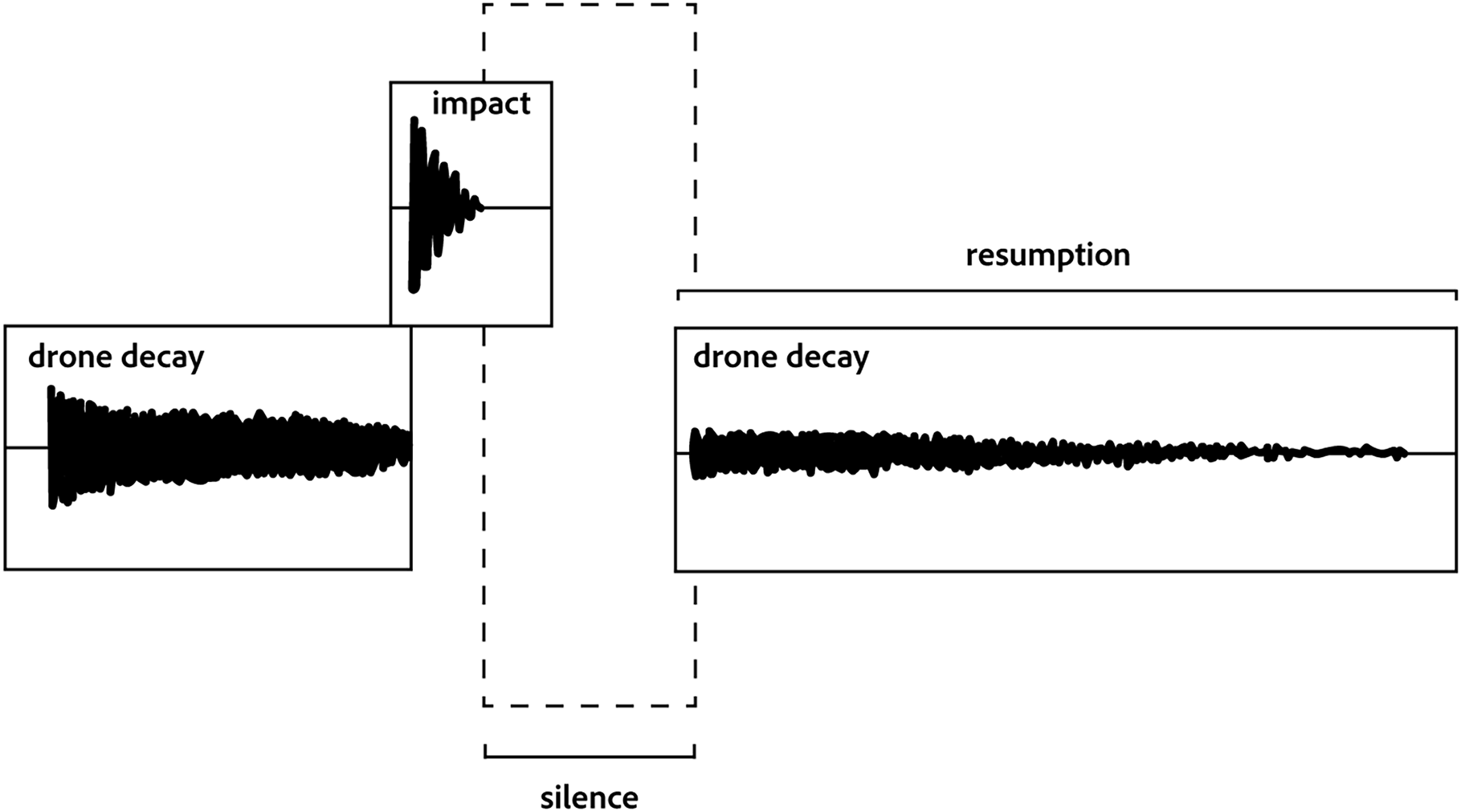
2. Graphic illustrations: Graphic representations of each interruption type have been created. These representations are geometric, shape-based approximations of sound that generalise the perception of sound. These are plotted within a time (x axis) versus frequency (y axis) grid summarising a snapshot of the sound’s evolution through time. Such representations were first used in my earlier publication, ‘The Visual Sound-Shapes of Spectromorphology’ where sound-shape illustrations were conceived to represent the intricacies of Denis Smalley’s Spectromorphological vocabulary, offering ‘a pertinent step between text descriptions and acousmatic music composition’ (Blackburn Reference Blackburn2011: 5). The ongoing reliance upon images within this context further enhances the understanding of sound-based music aesthetics and pedagogy, taking account of what Smalley deems a visual synaesthesia where ‘one does “watch” sounds; and in spite of their invisibility, sounds do have a potential visual character to them… They have dimensions. They’re small, large. One can physically imitate the kind of textural movement, for example, in various ways. One can draw a graphic diagram of a texture, freeze it visually’ (Reference Austin and Smalley2000: 19). Lembke’s psychoacoustic experiments on ‘hearing triangles’ reinforces this point by showing that listeners can distinguish perceptual qualities such as clarity, opacity and symmetry in spectrotemporal sound shapes, suggesting that sound-shape correspondences extend beyond a loose analogy (Reference Lembke2018: 608). Crucially, image representations of sound can also stimulate compositional activity by providing visual inspiration for new work. As Ryan confirms in his chapter exploring the graphic scoring of sound, ‘drawing in relation to sonic realities can visualise this aspect of imagining virtual sound worlds – a projection of potentials and possibilities’ (Reference Ryan, Chorpening and Fortnum2020: 484). This instructional prospect, locked within graphics, can be activated for purposes of future music making in addition to their role as conveyors of complex musical ideas in simplified form. The numerous attempts in the literature, which have been put forward as visual representations of sound are indicative not only of the demand for such graphic equivalents but also of the challenge posed in arriving at an agreed consensus or stable system for this translatory act. Given the subjectivity involved in individualistic interpretations, which oversees this task, the likelihood of unanimity remains an unlikely prospect. Schaeffer himself circled around this predicament when he warned that ‘any premature notation is not only impossible but disastrous’ (Schaeffer Reference Schaeffer2017 [1966]: 393 quoted in Valiquet Reference Valiquet, Schuiling and Payne2022: 57) when discussing the topic of notation for acousmatic music. This warning of failure was rooted in Schaeffer’s concerns of individuals ‘pre-judging relationships between visual and sound’ prior to the listening experience. Valiquet’s position on acousmatic music notations assert that such music-to-shape conversions are in fact ‘representations of listening, rather than representations of musical sound’ (Ibid.: 51) which recognises the issue of subjectivity when it comes to linking perceptions of sound within visual equivalents. Despite these tensions and unresolved challenges, which have lingered since the advent of musique concrète, the contemporary discourse continues to reiterate the importance and need for visual representations of sound for a multitude of reasons. These include the support visuals offer to musicological study where there is no score (Couprie Reference Couprie2022). Further, such representations are used within analyses of sound-based music (Morrison Reference Morrison2014; Di Santo Reference Di Santo2015; Ibid.), specialised acousmatic listening scores (Ibid.), automated annotations (Klien et al. Reference Klien, Grill and Flexer2012), notations of sound-based music for performance, for example, live sound diffusion scores (Wyatt et al. Reference Wyatt1999; Moore Reference Moore2016; Merlier Reference Merlier2018) or practices which seek to perform from or improvise with sound-based music (Patton Reference Patton2007; Fober et al. Reference Fober, Orlarey and Letz2012; Hron Reference Hron2014; Vickery Reference Vickery2014, Reference Vickery2018; Hope Reference Hope2017), sound classification systems (Ibid.; Thoresen and Hedman Reference Thoresen and Hedman2007) and pedagogical purposes (Blackburn Reference Blackburn2011). The implementation of visual representation within this article thus recognises that representations of sound enable a more specific study of microevolutions within the material (Couprie Reference Couprie2022: 563) and that once sound is translated into a visual form, it becomes a more tangible and explicatable entity within discussion and, importantly, provides a more directive template for compositional ventures. Representations of sound have taken many forms, from the informal and personally constructed, such as sketches and impressions, to the more formal and scientific which include audio waveforms and Fast Fourier Transform (FFT) visualisations, such as sonograms, which are derived directly from the audio signal using software. Whilst my visualisations sit in the former category, these are nonetheless informed by an awareness of scientific visualisation practices that take heed of conventions and layouts. In the process of creating these visual representations, I have settled on a design that favours equivalence between sound and graphic that is sensitive to wider acknowledgements regarding symbols and archetypes for sound in the visual form. As the typology below demonstrates, these visual representations are simple, uncomplicated designs that reduce the complexity of sound-based music construction into a basic monophonic utterance, where one shape equals one sound, while simultaneously appreciating that such images cannot provide a ‘complete or total representation of musical activity’ (Ibid.:127). My position on these visual representations acknowledges that these shapes cannot encapsulate everything about the sound, in fact the shapes below are indicative of basic morphological features such as their unfolding through time (position), their approximate amplitude (size) and their structural form in relation to other sounds (layered or juxtaposed configuration). My images indicate nothing of a sound’s timbre, sound quality or internal content, and while not completely moot or disregarded, this absent detail is in fact an open invitation for the reader or composer to insert their own sounds into these templates which operate as placeholders, for whatever sounds one may wish to use.
-
3. Audio Region Illustration: An additional illustration is presented beneath the graphic representation to demonstrate the configuration and arrangement of individual audio files, depicted as waveforms, during the sequencing process within software applications. This second view offers a critical insight into how sounds are positioned and layered together in a typical Digital Audio WorkstationFootnote 1 (DAW) and has a pedagogical purpose to demonstrate the typical layered arrangement of sound as ‘clips’ or ‘regions’. These illustrations importantly reveal how to construct interruptions practically, which achieve the perceived sonic result shown in the graphic illustrations.
-
4. Description of interruption: Written descriptions accompany each interruption type to explain identifying features and contain links to accompanying audio-visual examples where such interruptions can be heard.
3. Interruption typology
Each template that follows can be understood according to the presence, absence or transformation of the components of the three-part model: the pre-existing sound, the interrupting event and the resumption. Some templates omit resumption entirely, while others reintroduce the pre-existing sound, replace it with new material or mask it without removing it. While the templates in this typology have been developed in relation to acousmatic music, there are clear analogues in relation to historical and traditional musical practices. Sudden contrasts, thwarted continuities and unexpected turns have long shaped musical form and dramatic narrative, for example, in opera and ballet where musical interruption can intensify or redirect stage action. The contribution of this typology lies less in claiming these behaviours as entirely new and more in articulating how they function within sound-based composition. The following typology also treats interruption as both a perceptual event and a compositional procedure, moving from minimal or failed interruptions through to more complex forms of masking, suspension, negative space and processing.
3.1 No interruption
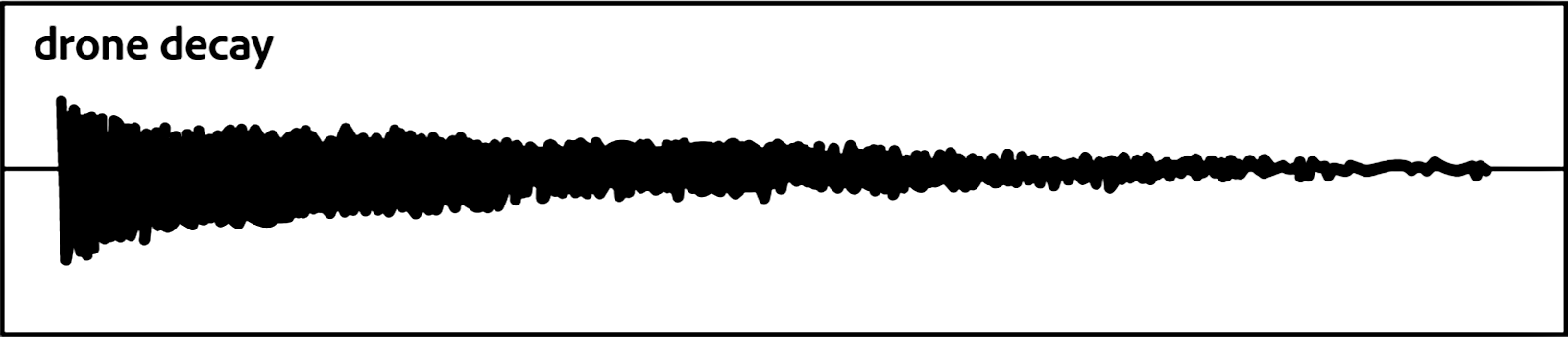
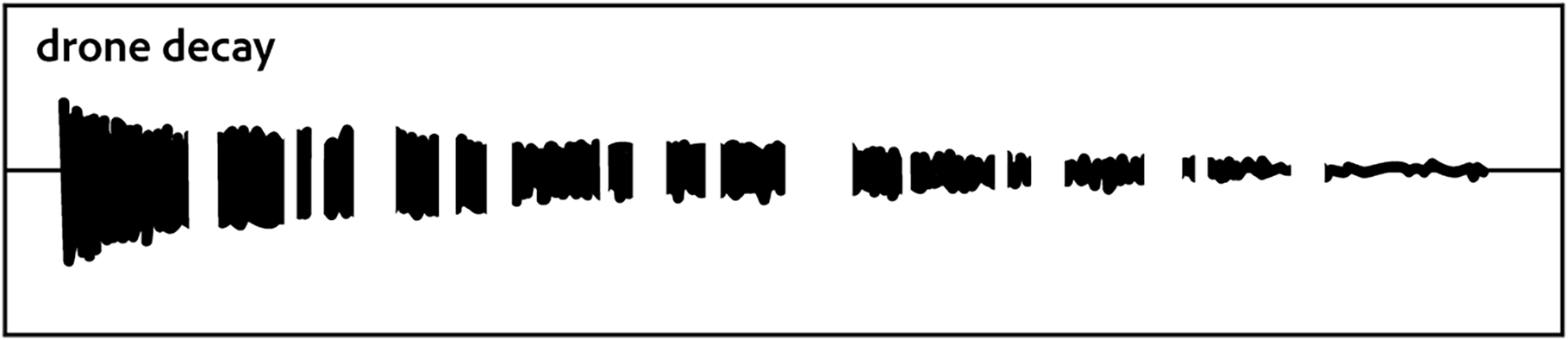
A sustained drone with a long decay, if left in its solo state, without interference or encroachment by any other sound, exhibits continuity without interruption. This example of no interruption (Figure 1 shows a graphic illustration, while Figure 2 shows an audio region illustration of this example) exists as a control that provides a point of comparison with the other interruptions featured in the typology. See Movie 1.
Sounds without interruption are those that present their full intended duration without interference from another external sound. These sounds come to an end naturally in their own time.
Graphic illustration – No interruption.

Audio region illustration – No interruption.

3.2 Unsuccessful interruption
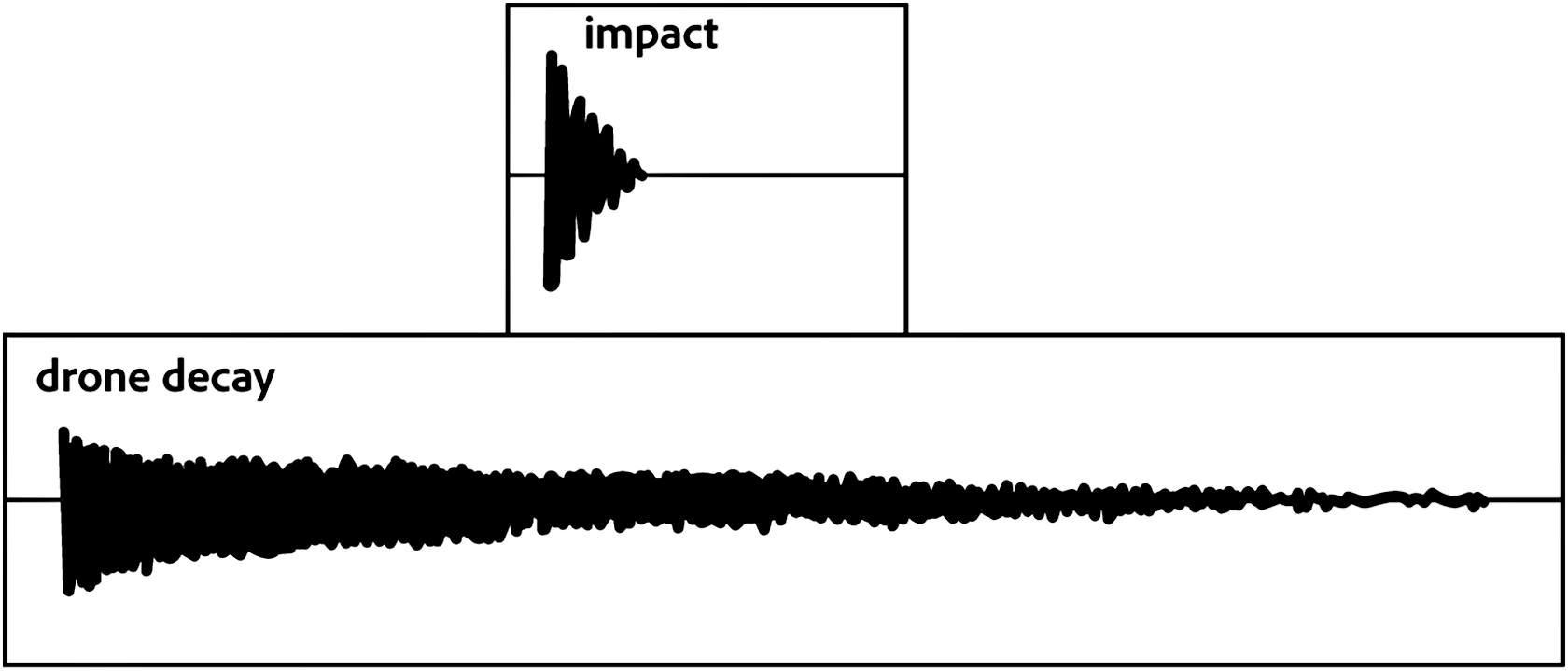
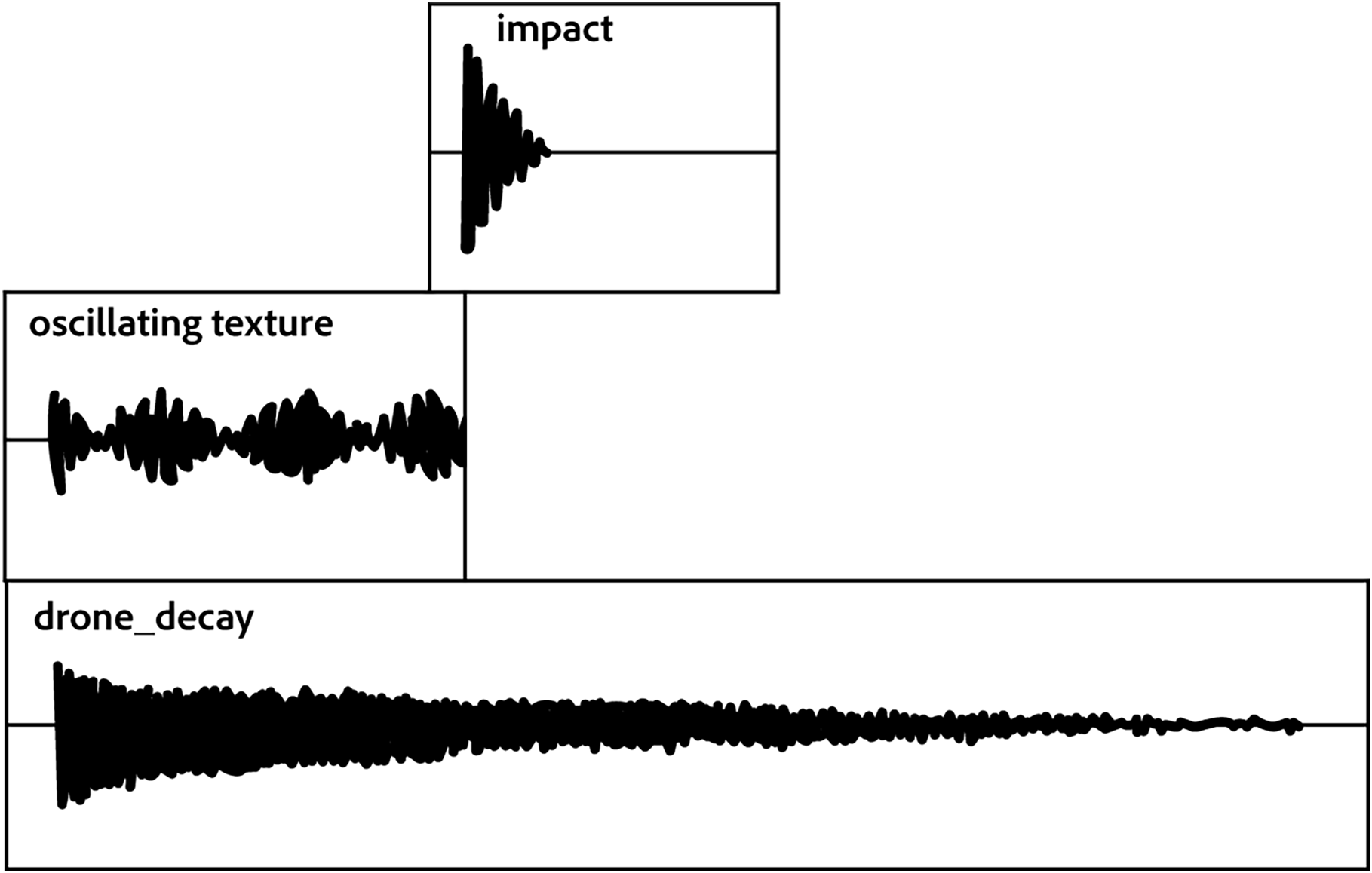
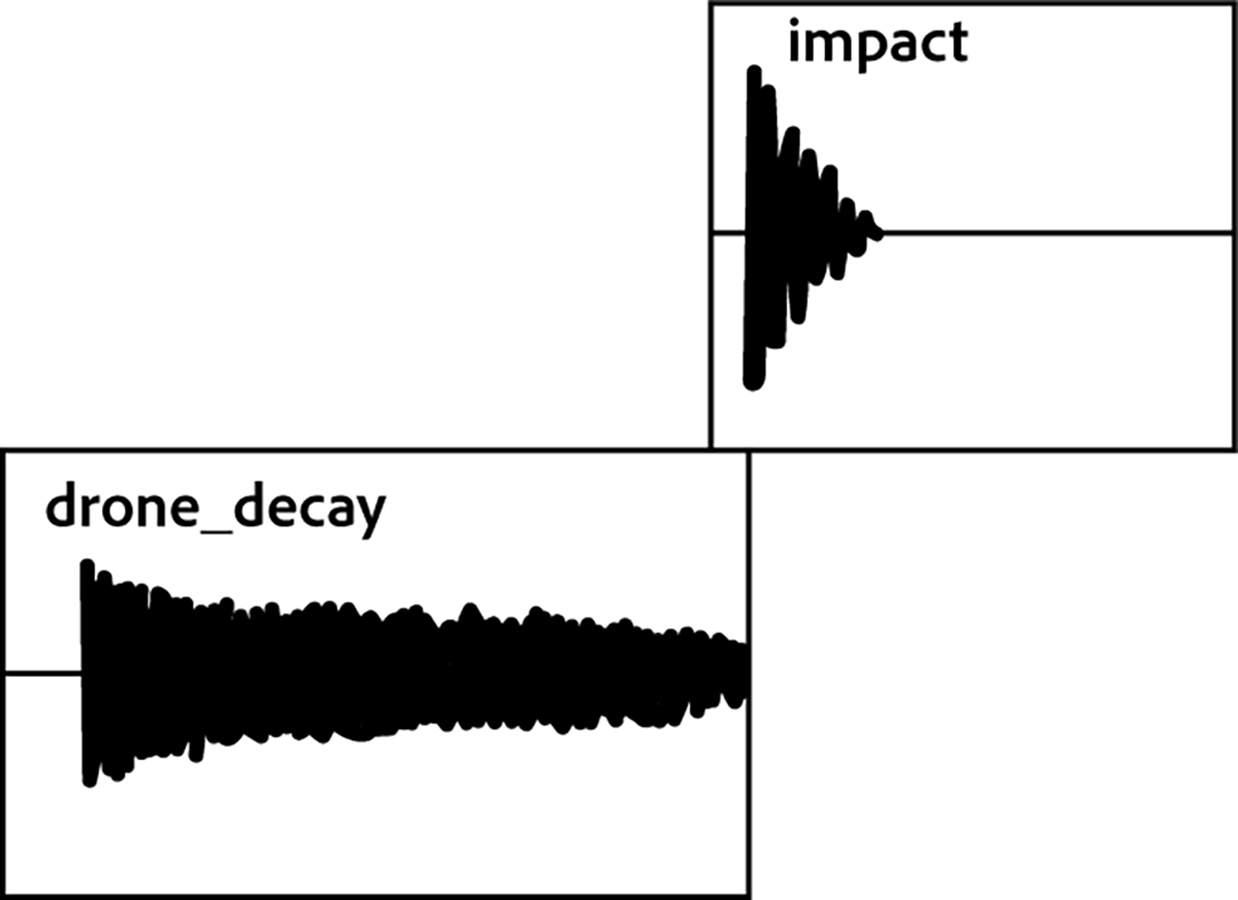
An unsuccessful interruption (Figure 3) is one that perceptually fails to disturb the continuity of the pre-existing sound. For example, in Figure 4 a drone decay sound begins; however, a second sound, in this instance, an impact, occurs part way through the drone sound. Despite the occurrence of the impact, the drone sound continues without pause or breakage and remains unaffected, so the interruption is deemed unsuccessful. The word ‘unsuccessful’ denotes the impact’s inability to alter or interfere with the pre-existing drone, but this is still recognised as an ‘attempt’ to interrupt.Footnote 2
Graphic illustration – Unsuccessful interruption.

Audio region illustration – Unsuccessful interruption.

The term ‘unsuccessful interruption’ is derived from its application within communication studies and correlates with a range of instances, for example, within a conversation, a person may try to speak over another but fails to take the floor, so is thus deemed unsuccessful. Unsuccessful interruptions can vary in their intention and are not always floor-taking attempts. These have different roles in conversations such as ‘back channel behaviours’ (Yngve Reference Yngve1970), and ‘accompaniment signals’ (Kendon Reference Kendon1967), which generally account for interjectory remarks (such as ‘uhm’, ‘yeah’, ‘that’s true’ and ‘exactly’). Ferguson notes that the function of these interjectory remarks seem to be ‘the very opposite of effecting a change in speaker, since they appear to ensure that the speaker who is holding the floor continues to do so’ (Reference Ferguson1977: 296). This version of unsuccessful interruption has an equivalent within the sonic domain, where such sonic interjections are too weak or benign to pose a real threat to the pre-existing sound. These are very different to unsuccessful interruptions which have a stronger presence and pose a threat to the pre-existing due to their dynamic level, magnitude or force. See Movie 2.
Repertoire examples demonstrating the unsuccessful interruption
Armando Balice’s
Light Garden
(2021). Opens with a continuous static crackle overlaid with a repeating whistle drone. The continuity of this ongoing sound is undeterred by short sharp thuds (unsuccessful interruptions) that occur every four seconds (Sound example no. 1).
Åke Parmerud’s
Raw
(2013). Opens with a continuous synth bass drone which gradually becomes inflicted with short individual attack sounds which all fail to disturb or break the continuity and prominence of the bass drone (Sound example no. 2, 0’00–0’39).
3.3 Subliminal interruption
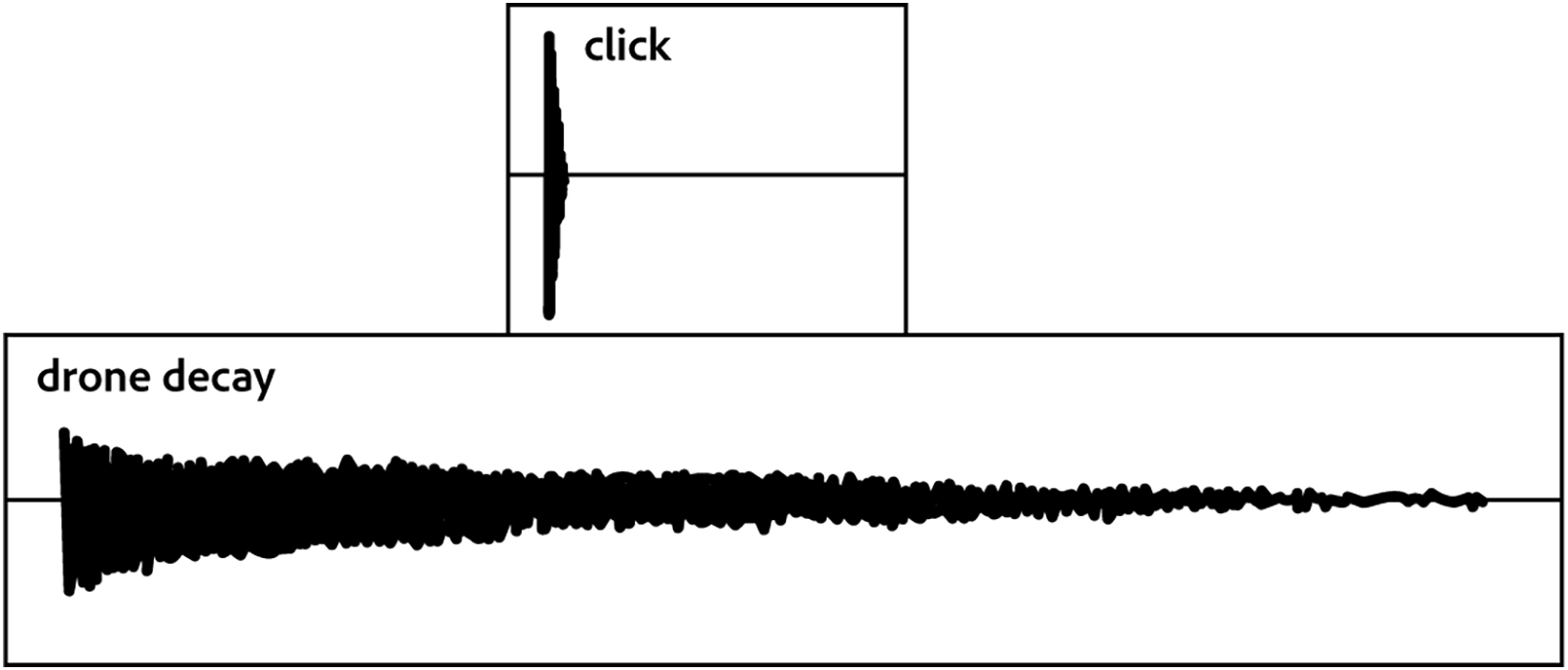
A variant of the unsuccessful interruption is the subliminal interruption (Figure 5), where a very brief, momentary sound, for example, a ‘click’ or ‘pop’, offers a brief, barely-there flash of audio that is not powerful enough to cease the continuity of the pre-existing drone decay sound (Figure 6).
Graphic illustration, subliminal interruption.

Audio region illustration – Subliminal interruption.

3.4 Successful interruption
For an interruption to be considered ‘successful’, the impact sound must crucially be perceived to cease the continuity of the drone decay sound. There are different configurations of successful interruptions (outlined below), which all demonstrate variation in what occurs at the point of the interruption.
3.5 Terminating interruption
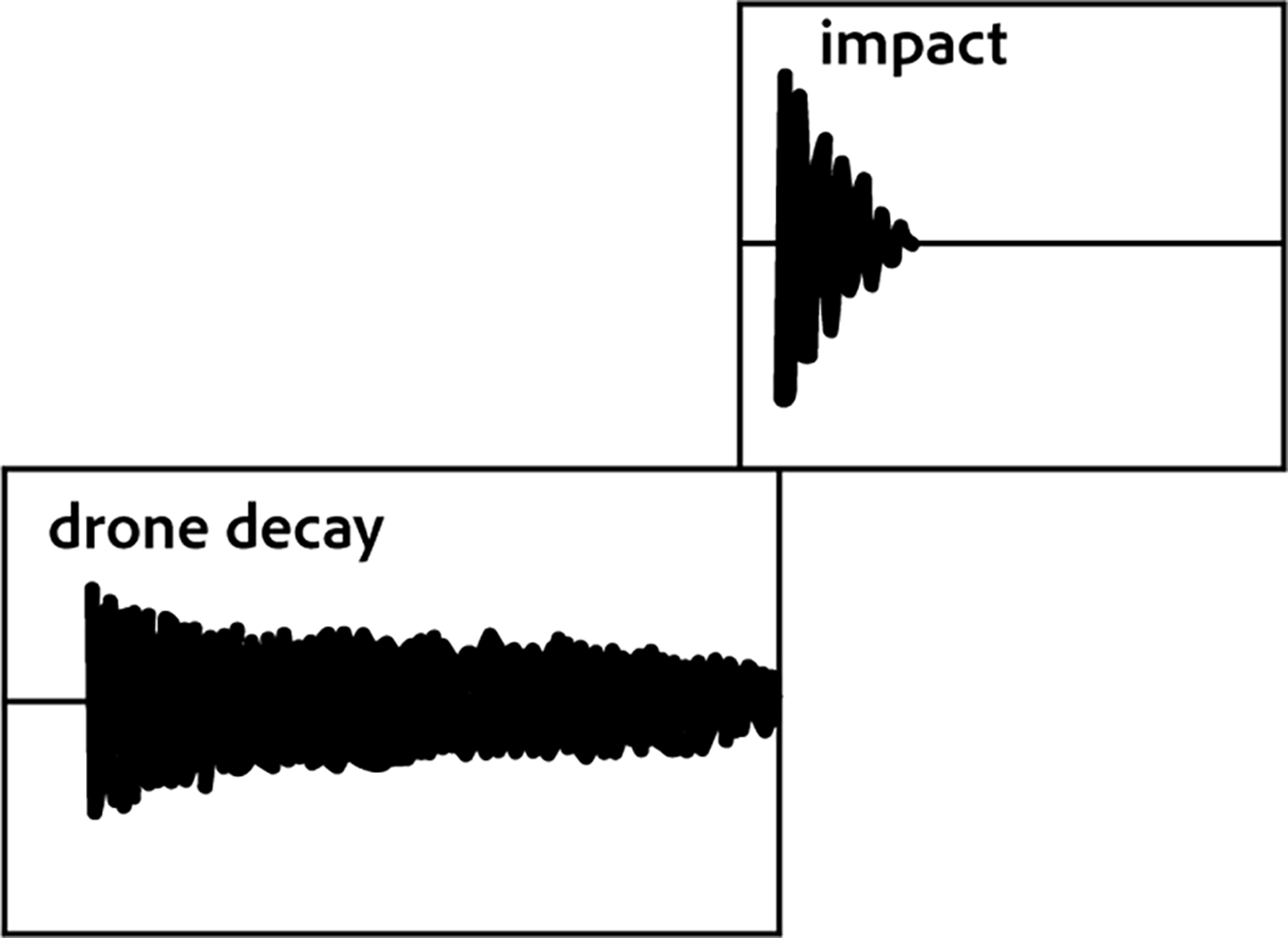
In a terminating interruption (Figure 7), the occurrence of the impact prematurely ends the continuity of the drone sound. Importantly, there is no resumption of the drone decay (Figure 8). Terminating interruptions are finalising because they fully halt what was previously occurring. See Movie 3.
Repertoire example demonstrating a terminating interruption:
James O’Callaghan,
Empties-Impetus
(2011–14). This excerpt (0’22–0’30) demonstrates the termination of a busy texture by a sudden, unprepared impact sound. Sound example no. 3.
Graphic illustration – Terminating interruption.

Audio region illustration – Terminating interruption.

3.6 Transitioning interruption
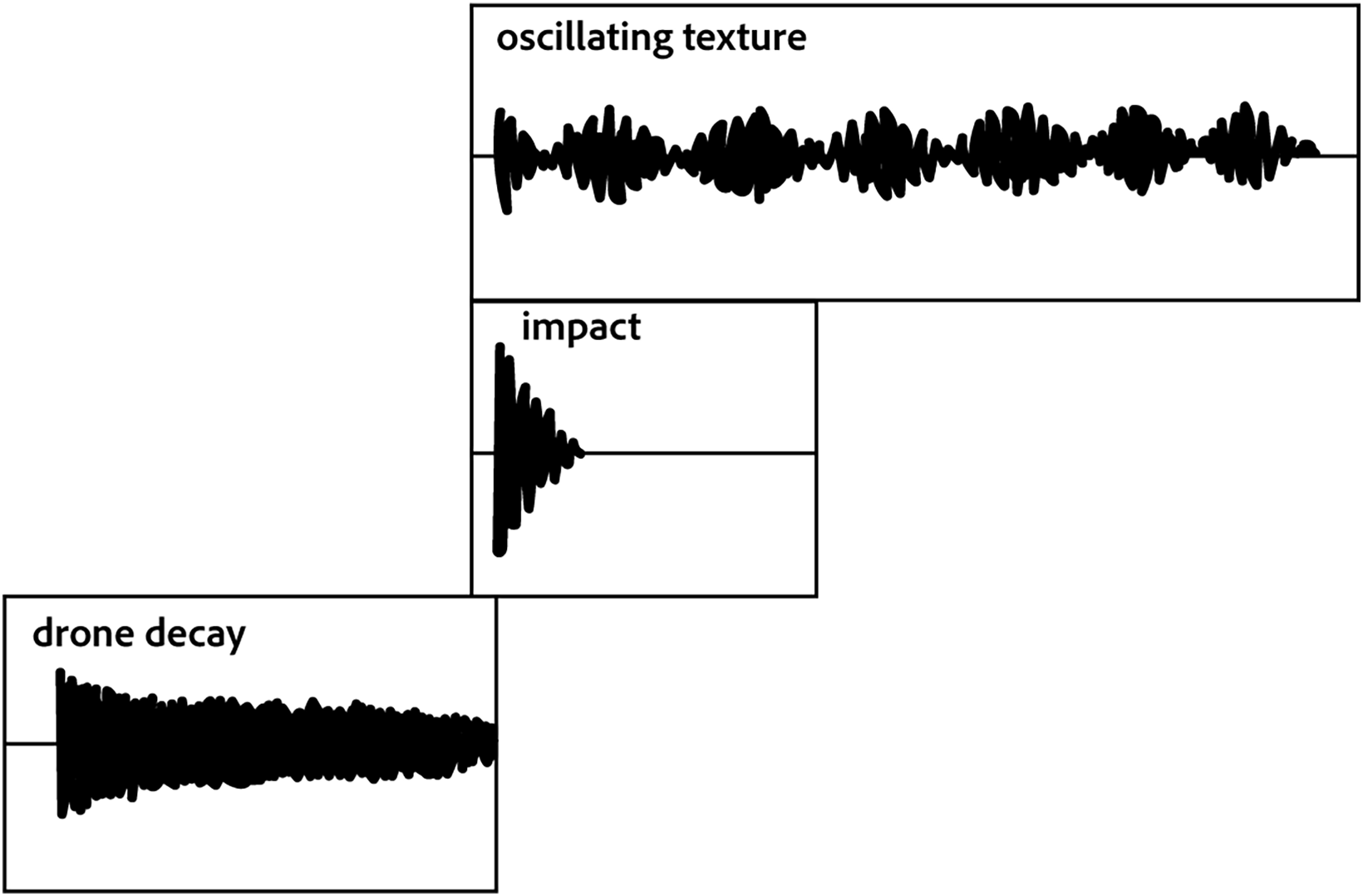
Within a transitioning interruption (Figure 9), the impact sound terminates the drone decay sound prematurely and acts as a moment of transition by introducing a new oscillating texture. Figure 10 shows the drone decay sound being cut short by the impact, while the impact appears to initiate the entry of the oscillating texture. Placing an impact sound at this point offers some framing to the moment of transition, acting as a synchronised but sudden segue into new material. See Movie 4.
Transitioning interruption repertoire example:
Jonty Harrison,
Espaces cachés
(2014). At 2’05 a door creak and squeak sound terminates the continuity of the bird song and simultaneously acts as the segue into a new sound of church bells ringing (1’54–2’06). This interruption acts as a kind of punctuation, allowing a rapid switch to another texture or space. Sound example no. 4.
Graphic illustration – Transitioning interruption.

Audio region illustration – Transitioning interruption.

3.7 Temporary interruption
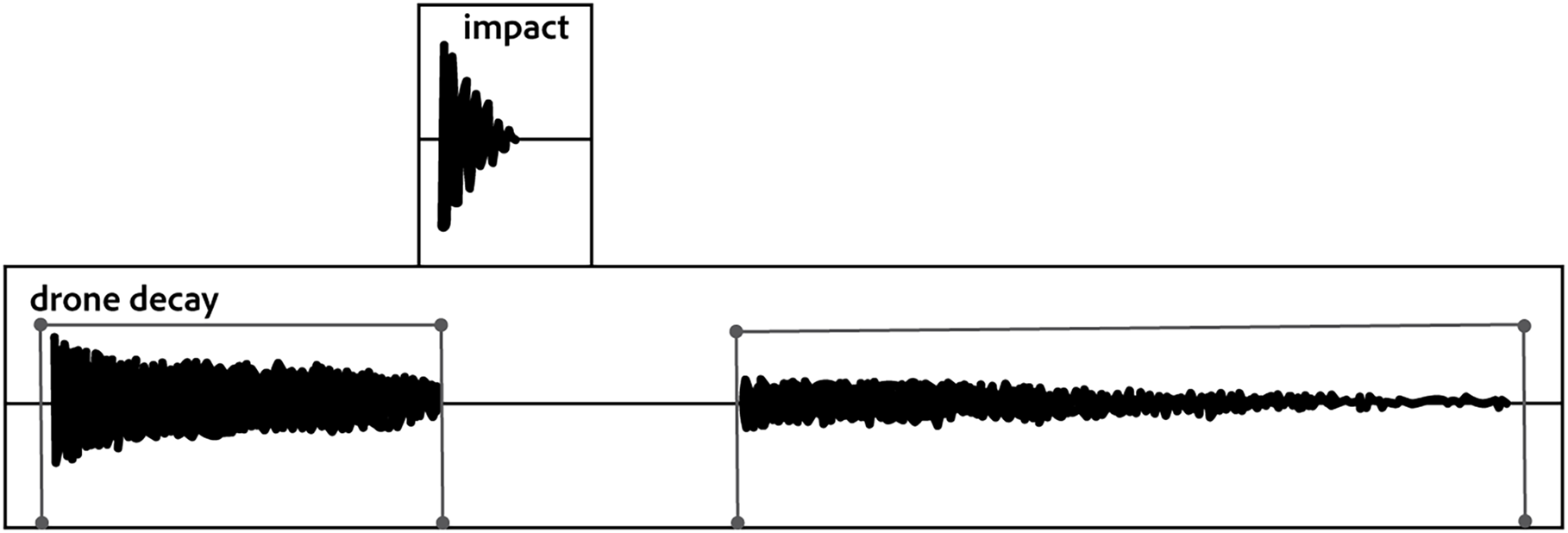
Within a temporary interruption (Figure 11), the impact ceases the continuity of the drone decay sound, so it ends prematurely. The impact, as an interruption, triggers a pause or a temporary silence, after which the drone sound then resumes. As a feature, temporary interruptions involve resumptions; however, these can pick up from the instance of the termination or may restart the pre-existing sound from the beginning (see Temporary interruptions with restarted resumptions). Figure 12 indicates the moment of silence in between the impact and the resumption of the drone’s natural decay. The length of the silence may vary from milliseconds to seconds. See Movie 5.
Temporary interruption repertoire example:
Manuella Blackburn,
Home Truths
(2023). At 2’20 a continuous pitch is held and at 2’34 a sound of a door latch closing terminates the continuity of the pitched sound. A momentary silence offers a pause before resuming the pitched sound once again (this time at a high frequency). Sound example no. 5.
Graphic illustration – Temporary interruption.

Audio region illustration – Temporary interruptions.

It is worth noting that the use of volume envelopes within DAWs can result in an alternative audio region layout than what is shown in Figure 12. Volume envelopes are visible automation lines indicating the amplitude level of a track within a DAW. These can be drawn or altered with the positioning of nodes. The vertical position of a node upon an audio region indicates the amplitude at that moment in time. Figure 13 shows how volume envelopes would be implemented to achieve the same sound result as achieved in Figure 12.
Temporary interruption utilising volume envelopes.

3.8 Temporary interruption with restarted resumption
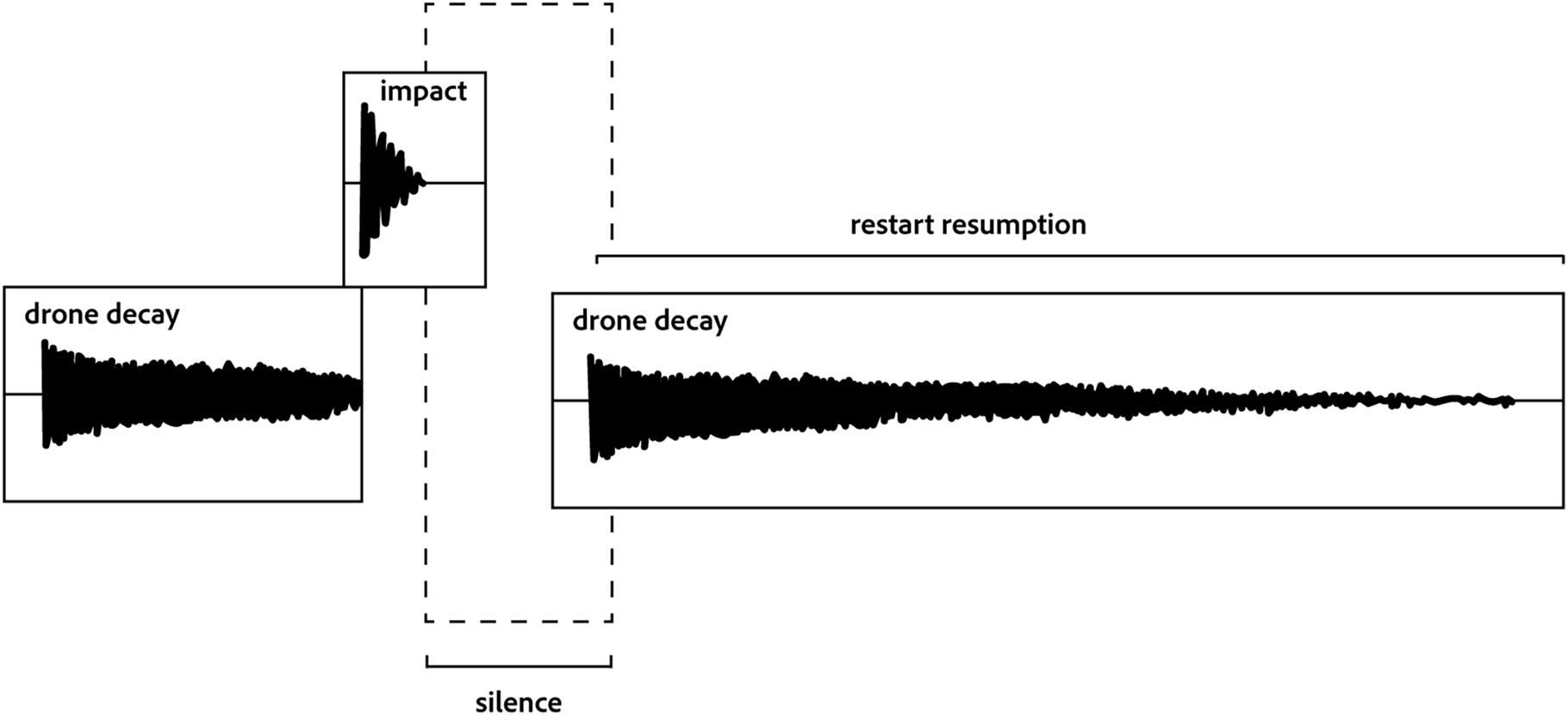
A variant of the temporary interruption exists where the impact sound interrupts and prematurely ends the drone decay and triggers a silence; however, resumption takes the form of a restart of the drone decay sound. Restarting the drone sound is an attempt to articulate the drone decay in full, without an interruption. Figure 14 shows the drone decay sound restarting within the resumption phase.
Temporary interruption with restart resumption.

3.9 Partial interruption
Interruptions in this category are only partially successful in ceasing the continuity of the pre-existing sound. Within a partial interruption (Figure 15), a drone sound and oscillating texture occur simultaneously. The impact prematurely interrupts the oscillating texture but does not cease the continuity of the drone decay. Figure 16 demonstrates the continuity of the drone sound which is not interrupted by the impact. In these instances, the effect is a sudden thinning of texture, which results in a partial drop-out, but without the imposition of a silence. See Movie 6.
Graphic illustration – Partial interruption.

Audio region illustration – Partial interruption.

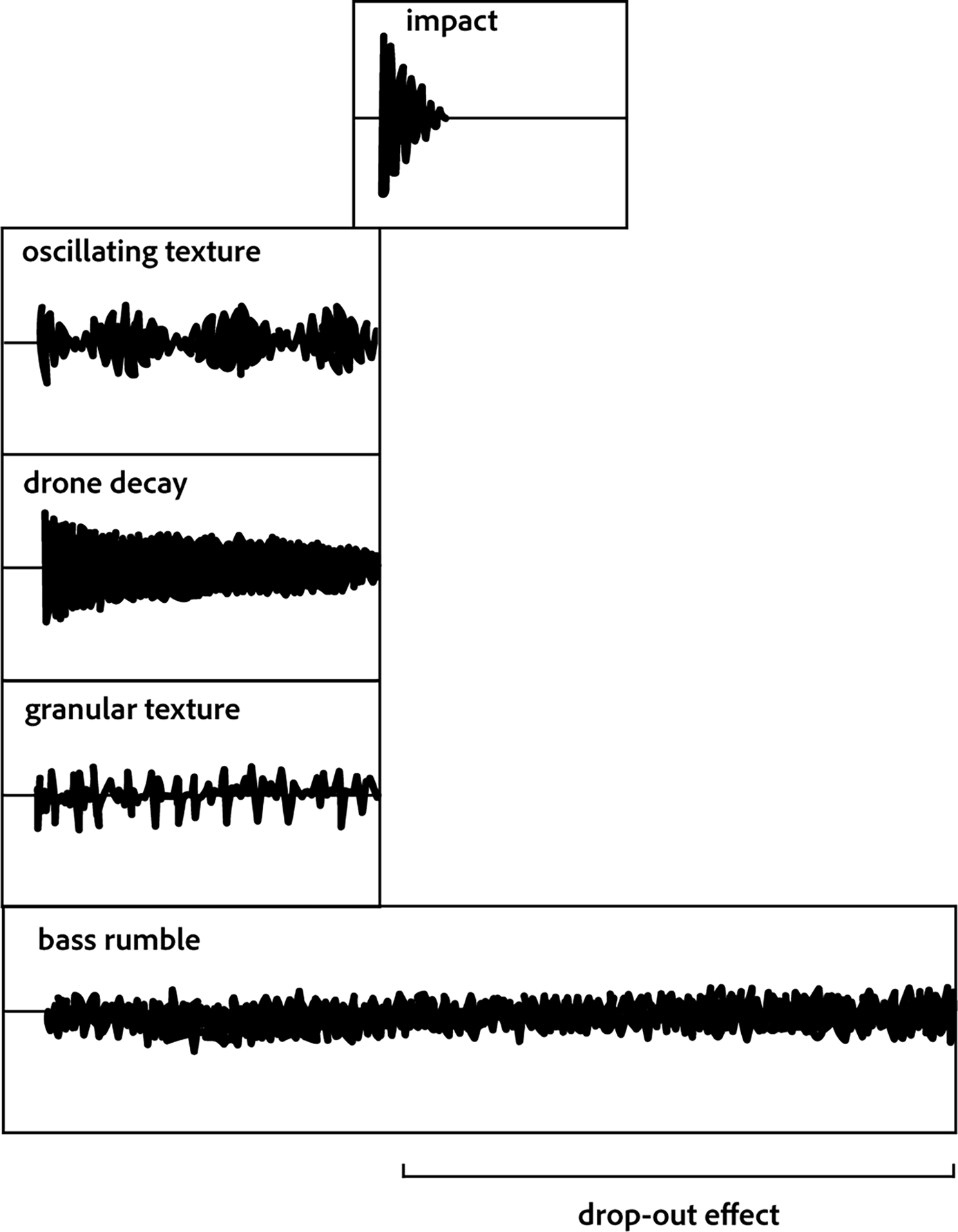
If additional layers of sound are present in the initial stage, partial interruptions become especially intriguing. These overlapping sounds create a rich complexity that suddenly disappears when the interruption occurs, resulting in a more pronounced effect. In Figure 17, multiple sounds (oscillating texture, drone decay, granular texture and bass rumble) play together until an impact interruption silences all but one.
Partial interruption variation (increased drop-out effect).

Figure 17. Long description
The image contains five separate waveform graphs, each representing a different sound effect and its drop-out effect. Panel A shows a waveform labeled ‘impact,’ characterized by a sharp peak that quickly tapers off. Panel B displays an ‘oscillating texture’ waveform, which features a repeating pattern of peaks and troughs. Panel C illustrates a ‘drone decay’ waveform, starting with a high amplitude that gradually decreases over time. Panel D presents a ‘granular texture’ waveform, consisting of numerous small, irregular peaks. Panel E depicts a ‘bass rumble’ waveform, with a consistent, low-frequency pattern that extends across the entire duration. Each waveform graph has a horizontal axis representing time and a vertical axis representing amplitude. The drop-out effect is indicated by a bracket at the bottom, showing the point where the sound suddenly stops.
3.10 Juxtaposition interruption
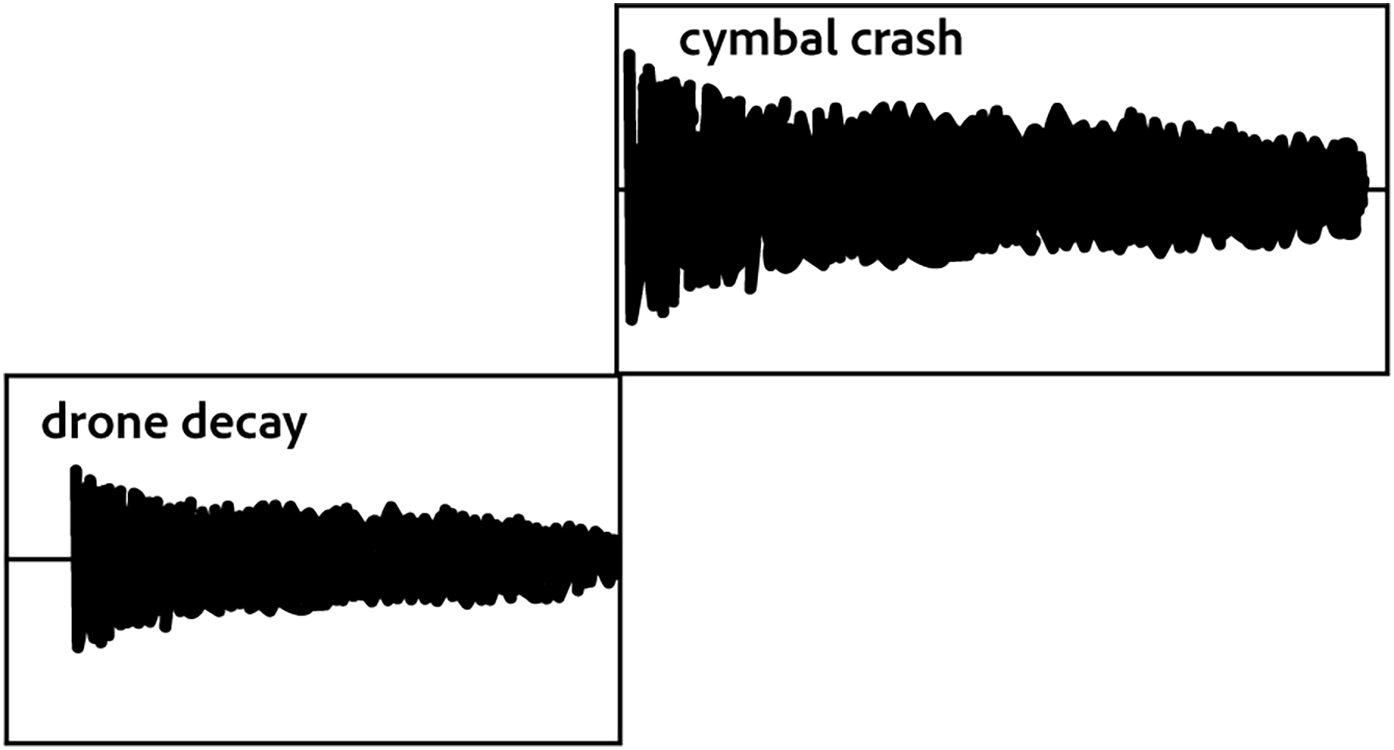
Within a juxtaposition interruption (Figure 18), two sonically different sounds are presented in sequence. The drone decay’s continuity is cut short by the appearance of a cymbal crash. The interruption is caused by the sudden transition between the two sounds. Figure 19 shows this juxtaposition occurring over two tracks. The same effect can be achieved in a side-by-side configuration. See Movie 7.
Graphic illustration – Juxtaposition interruption.

Audio region illustration – Juxtaposition interruption.

3.11 Suspension interruption
The suspension interruption (Figure 20) functions as a blend of the juxtaposition, partial and negative space interruptions, resulting in a complex design. Importantly, this type of interruption exhibits a frozen-in-time quality taking place in between the pre-existing and the resumption components. The interruption space is occupied by a static moment that appears to freeze the content between the pre-existing and resumption. This static moment has a connective function, reuniting two parts of the same sound, while placing the sound in a moment of suspension.
Graphic illustration – Suspension interruption.

3.12 Masking interruption
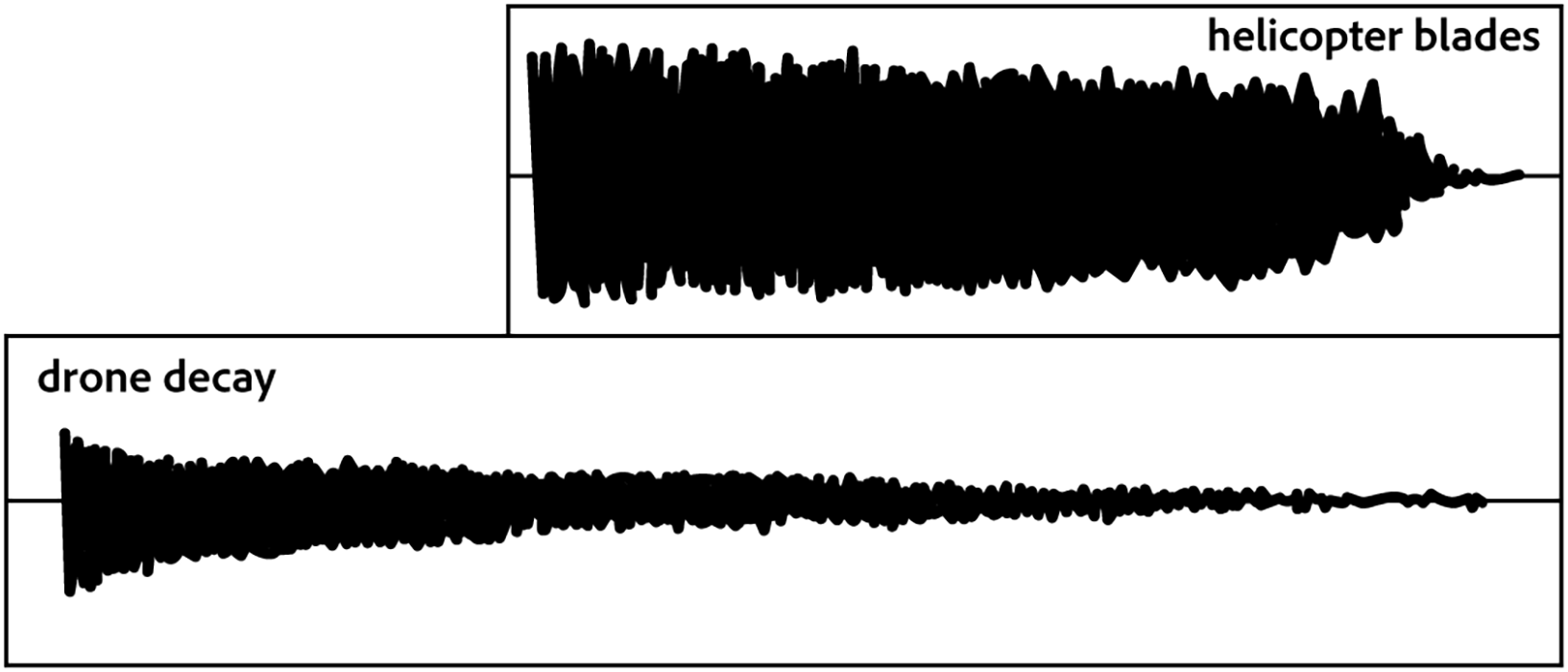
In a masking interruption (Figure 21), the drone sound continues in its entirety; however, a louder, more present sound, for example, the sound of a helicopter’s rotor blades, is layered over the drone decay, which masks the drone’s frequency content. In masking interruptions, the interruption takes the form of a more powerful, louder sound that eclipses the sound of the pre-existing, even though the pre-existing is still present within the mix. Figure 22 demonstrates the overpowering nature of the helicopter sound, which has a bigger amplitude indicated by the size and heaviness of its waveform. Whilst the layering of audio is visibly enacted, the audibility of this layering is not always wholly apparent. Within masking interruptions, the sounding result can be one of audio obliteration, where the interruption overpowers the pre-existing either through volume and presence, or through competing frequencies where multiple sounds can occupy the same range of sonic frequencies, leading to frequency masking and loss of clarity. This overpowering behaviour resonates with Horrigan’s discussion of ‘sonic dominance’ and ‘sonic interruptivity’, where interruption is understood as one of sound’s capacities to intrude upon, dominate or redirect attention within a given environment (Reference Horrigan2022: 219). In masking interruptions, this dominance is enacted materially where the interrupting sound does not remove the pre-existing sound but occupies its perceptual space. See Movie 8.
Graphic illustration – Masking interruption.

Audio region illustration – Masking interruption.

3.13 Negative-space interruption
Within negative-space interruptions, silence features as a gap appearing within the pre-existing sound. There are two variants termed as ‘cut-outs’ and ‘segmentations’. In both instances, it is notable that a sonic interruption is absent (so far, I have described these as impact sounds) and, instead, interruption is achieved by the interjection of silence and empty space resulting from audio extraction or segmenting a sound into smaller sections. In these cases, the space without sound (the void) itself becomes the moment of interruption. See Movie 9.Footnote 3
3.14 Cut-out interruption
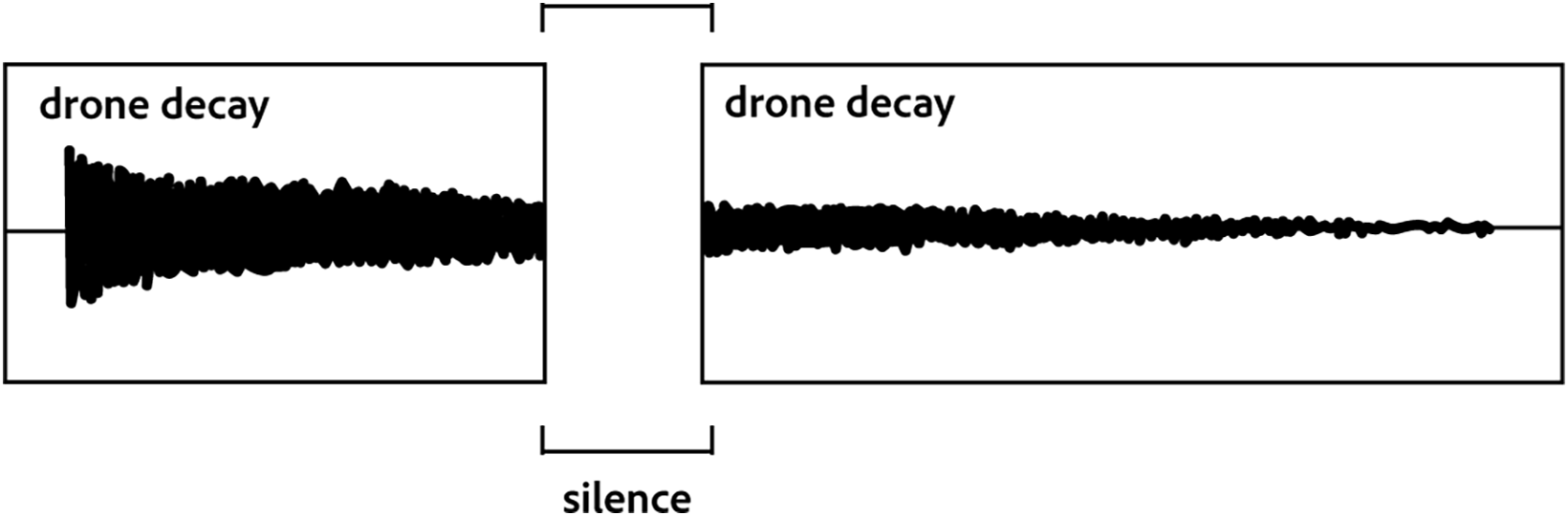
In a cut-out interruption (Figure 23), the drone decay sound is subjected to a removal of its content so that a space or gap appears within its morphology. The effect achieved is a sudden drop-out of sonic content – a silence. Figure 24 demonstrates the absence of a chunk of the drone decay sound. After the silence, the drone sound resumes. The duration of a cut-out interruption is variable, and different effects can be achieved by reducing or extending this extraction. A gap of a few milliseconds offers a subliminal cut-out interruption, whereas a lengthier gap of three or four seconds can leave audiences wondering if the sound has finished through termination.
Cutout interruption repertoire example:
David Berezan’s
Starboard
(2015). At 0’15 there is a complete cessation of audio content, with all sound layers dropping out. Content resumes approximately after a second of silence. Of interest here is that new content is introduced, rather than a resumption of the pre-existing. This example is thus a blend of a terminating interruption using the cut-out interruption technique. Sound example no. 6.
Graphic illustration – Cut-out interruption.

Audio region illustration – Cut-out interruption.

3.15 Segmentation interruption
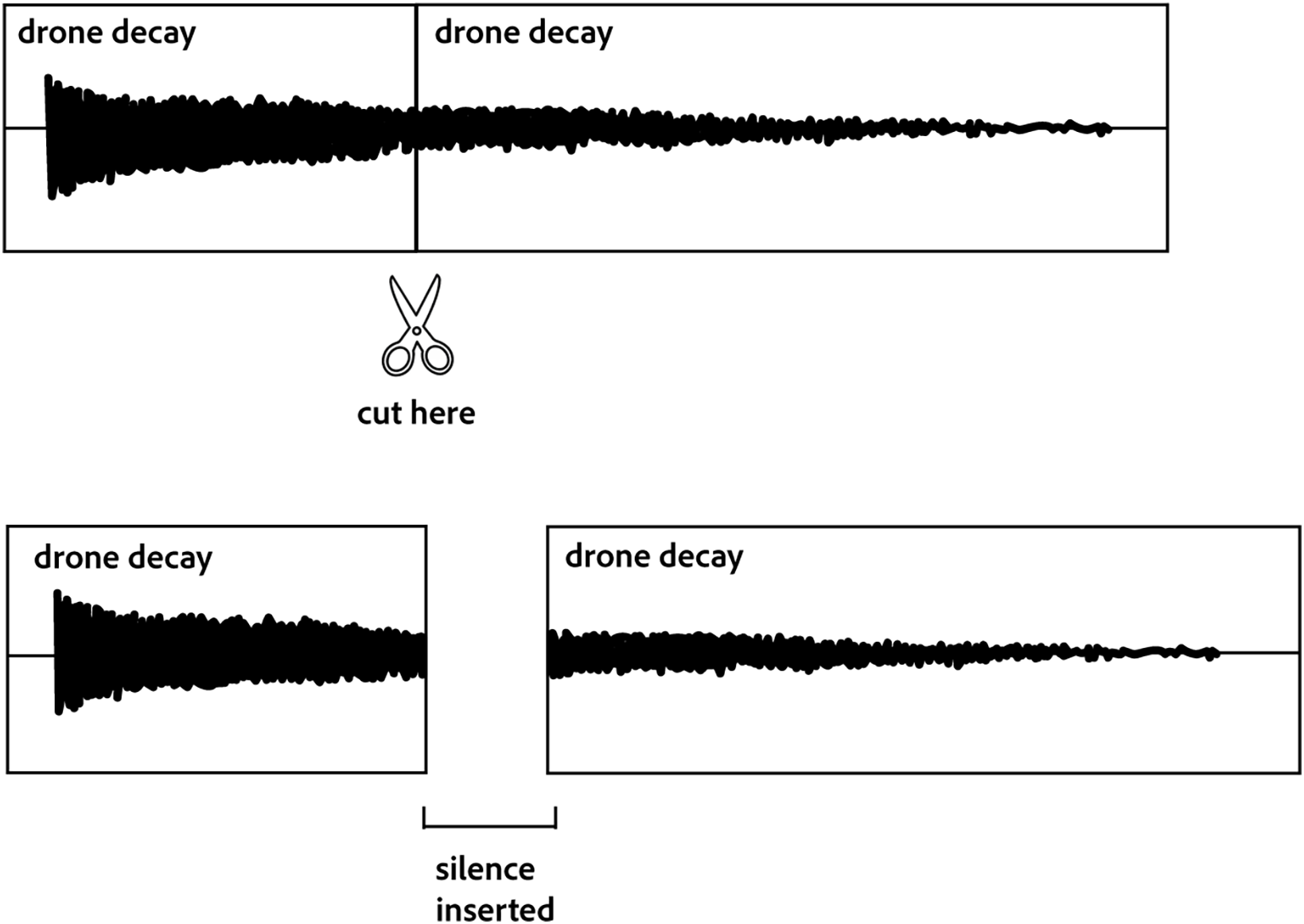
Segmentation interruptions are like cutout interruptions; however, they involve making an incision within the pre-existing sound rather than extracting audio from the original soundfile. The drone decay sound is cut using the edit tools (scissor/cut), and then the two parts of the sound are separated or pulled apart in the linear timeline. This action creates a void in between the two previously connected segments. While belonging to the same order of negative space interruptions, segmentation interruption creation is distinctly different since it does not involve the removal of sonic content to create the silence but instead involves the insertion of silence. Figure 25 shows the process of making an incision and the subsequent separation of the two segments.
Segmentation interruption.

3.16 Processing interruption
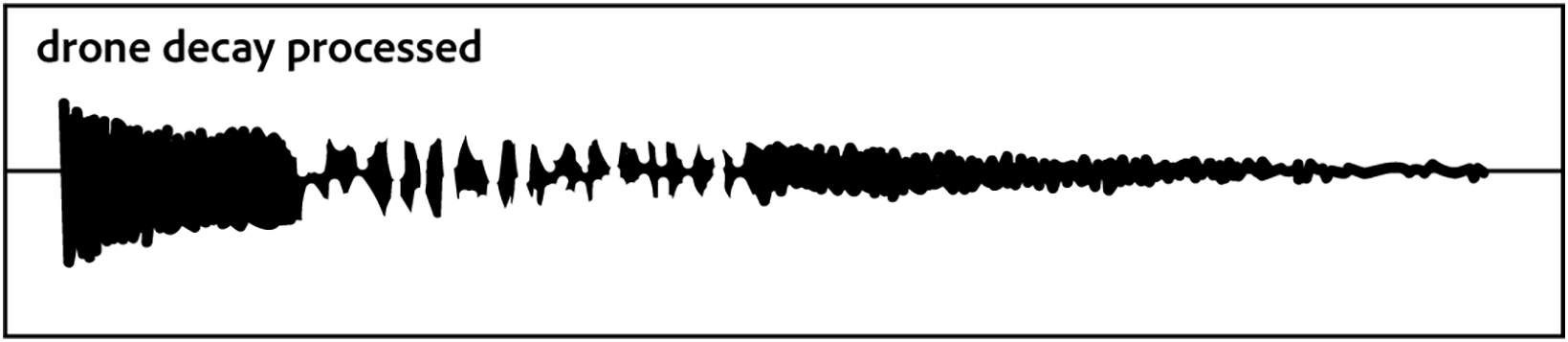
A processing interruption occurs when the pre-existing sound is subjected to a processing tool, for example, a stutterer, granulator or slicer. The processing tool breaks apart the drone decay’s continuity and achieves an iterative, rearranged quality. The waveform of a processing interruption may exhibit a string of micro-interruptions, closely packed together, as demonstrated in Figures 26 and 27. See Movie 10. The effect of interruptions occurring in succession is described in more detail in a later discussion (see successive interruptions).
Processing interruption repertoire example:
Christian Bouchard,
UHF-Complex
(2017–19). From 0’00 to 1’35. This example displays successive cut-out interruptions arising from the result of processing sound using a buffer effect. These quick cutouts of sound produce an iterative quality. Sound example no. 7.
Graphic illustration – Processing interruption.

Audio region illustration – Processing interruption.

4. Sound sculpting
The appeal of the interruption is its gesture-making capacity and assertive quality in defining angular-like phrasing. The most striking feature of these interruptions is the hard-edge cut, which brings a sound to a close in a rather sudden, blunt way. This premature curtailing of a sound has long been favoured by my ear, partly because it negates continuity (i.e. long stretches of sustained sound) and partly because the cut paradoxically contributes to establishing momentum and energy. In cutting something short, a forward driving, chop-and-change quality results, especially when this sequential arrangement is repeatedly used. The abrupt nature of the blunt cut creates a clean vertical line that divides this sound from that, effectively boxing sounds off from one another, and preventing spillover of sustained sonic content over time. With the implementation of interruption, tidiness and clarity can be achieved since sounds become compartmentalised into distinct areas, shapes and sections. What I am describing here is something that belongs to a certain aesthetic and conceptualisation of sound sculpting. This term, popular within the vernacular of acousmatic music composers, speaks to the malleability of digital sound material, since composers have within their gift the ability to control any given sound in infinite ways, for example, attenuating a sound’s volume, shape, duration, profile, direction and playback speed, plus any number of parameters within transformation effects, which each have their own set of controls for altering a sound. Gershon observes that ‘sound can be bent, bifurcated, and tortured like a scrap of metal or softly moulded and compressed like a clay vessel’ (Reference Gershon2013: np) which underscores the kinship between acousmatic music creation and the plastic arts, transcending beyond a mere poetic analogy. While the days of using a physical hand-held razor to cut and splice magnetic tape, as a material process belonging to musique concrète, have long been replaced with the computer, keyboard shortcuts and cursor clicks, I posit that a pseudo-tactility is retained in the DAW software that still demands the composer’s handicraft in deciding on the placement of sounds (as waveform representations of sounds) and cuts. When crafting interruptions, these arrangements require many attempts, with the ear curious to hear the best placement for these events. The position of an interruption is auditioned multiple times over, through loudspeakers in the studio, allowing for an infinite number of adjustments to satisfy the ear through subtle nudges in sometimes minute increments, all in service of discovering the optimal location. The beauty of this sculpting process is the non-destructive nature of adjusting and editing, where all attempts can be undone and reset as part of the process of searching for the best sounding result. Over days, weeks and months, these finely sculpted moments of interruption incur numerous adjustments and additional layers all guided through intense listening. These interruptions are far from haphazard or arbitrary happenings.
4.1 The causality of interruptions
The concept of causality plays a significant part within the making of sonic interruptions. Smalley describes causality ‘where one event seems to cause the onset of a successor or alter a concurrent event in some way’ (Reference Smalley1997, 118) and is widely accepted as fundamental to the language of acousmatic music. Establishing causality demands some understanding of the ‘voluntary-pressured continuum’ (Ibid.: 119) within acousmatic music. This terminology can be best explained by imagining the placement of individual sounds along a horizontal timeline and then altering the distance between these sounds. Within a voluntary motion passage, two sounds may be far apart, with distance separating their occurrence, whereas in a pressure motion passage, two sounds might be tightly packed, close in proximity so that one sound exerts a pressurising urgency upon the next, appearing to influence its occurrence. As my illustrations of interruptions have shown, it is the presence of the impact sound that commands the pre-existing (before) sound to cease. Thus, the causal relationship is deemed somewhat ‘inverted’, providing a more appropriate descriptor for the impact’s effect on the previous sound (Figure 28).
Inverted causality within a successful interruption.

Inverted causality is important for interruption making since their clout comes from their surprise entry and unexpectedness. In this regard, in a successful interruption, the pre-existing sound should give no clues of an interruption’s forthcoming appearance. By way of a helpful reminder, Proy acknowledges that ‘in the acousmatic situation we do not have a [visual] causal element that supports our interpretation. There is no movement of the violin bow which makes us expect the sound. In the acousmatic situation we are touched by sounds unexpectedly’ (Reference Proy2002: 16). Thus, the ambition to create unexpected interruptions capitalises on the absence of visual information and further avoids signals or preparations which might give away the moment of surprise. The thinking around how to establish these unexpected sounds draws on heuristic knowledgeFootnote 4 which refers to ‘imperfect rules of thumb about what is likely to happen next’ and knowing how different sounds lend themselves to certain situations within the acousmatic situation. Given that ‘one of the great successes of acousmatic music is in its capacity to establish anticipation and expectation’ (Andean Reference Andean2020: 215), I am certain of the compositional knowhow in circulation to offer the inverse, when seeking to deny such predictability. Nolan Hildebrand’s composition, Amygdala Hijacker (2026) is one such example which exploits audio situations that lack predictability by establishing a series of unprepared audio jump scares, where sharp bursts of sound interrupt passages of silence (see sound example 8). It is worth noting that sounds which rise or descend, increase, crescendo or generally intensify over time are regarded as anticipation and tension builders that tend to result in an event or release at the end of their trajectory. This arrangement of sound offers excellent gestures known as ‘graduated continuants’ or ‘reverse attack decay’ archetypes. These, however, are not interruptions as such. Placing an impact sound at the mid-point or end of one of these ‘builds’ would not strictly achieve a successful interruption, since expectation of an event has been determined with causality already in progress. In other words, the element of surprise has already been diminished. What works more effectively is the selection of a sound that is void of this build-like quality and something that possesses a wholeness or totality that one would expect to hear in full. Such sounds might include the sounds of a train chugging along a track, eggs frying in a pan, footsteps running through a long corridor, water trickling from a fountain and shopping centre ambienceFootnote 5 as audio content that meets this criterion of regular, continuous sound. In choosing such sounds as candidates to be interrupted, it becomes possible to set up what Huron calls a ‘violation of expectation’ (Reference Huron2006: 26). Establishing a moment of surprise in acousmatic music is thus an attempt to thwart one’s expectation of a sound’s typical lifespan and behaviour so that we might encourage a [listening] failure to accurately anticipate possible future events (Ibid.: 39).
4.2 The illusion of interruption
A key objective in crafting interruptions is to empower the impact sound (the interruption) with an enhanced, unnatural capacity to disrupt existing auditory environments and effectively terminate the pre-existing sound prematurely. The synchronisation of the impact’s entry at the precise moment where the pre-existing sound is cut within the DAW results in a satisfying coincidence, fusing the two sequential sounds into a new, cohesive, but entirely illusory musical unit. These highly arranged moments establish a perceived aural illusion of interruption, where a break in continuity is seemingly caused by another sound. This aural result or perception overrides the technological reality of the situation, which was created by a human operating a scissor-tool edit at this precise moment, which severed the sound, rather than the impact sound, which has carefully been juxtaposed at this precise edit point. Bestowing sounds with the illusion of termination is thus the goal, achieved by the composer through this precision act of sound arrangement.
4.3 Sounds and their interrupters
When analysing how an interruption is created together with its element of surprise, it is also necessary to consider where to position the interruption. So far, I have mentioned that the interruption needs no clue or hint of its entry from the pre-existing to maintain its element of surprise. I have also suggested that delaying an interruption’s entry towards the end of the pre-existing’s natural trajectory also does not achieve the status of an interruption, since the sound is naturally coming to an end and is conforming to our expectations of how sound progresses and organically ends. To play with expectations of how or if a sound’s completeness will unfold, it may be useful to first consider what type of sound is being used in the first instance, as mentioned above, and there are certain attributes to look out for before deciding where an interruption should be placed. To demonstrate, I will use the example of a sound recording of a car driving by at high speed which taps into our understanding of this trajectory as experienced that typically moves across the stereo window, from left to right or right to left. Severing this motion partway through the car’s trajectory with an interruption breaks the continuity and violates our understanding of this sound, as experienced in the real world. This aesthetic approach to creating and handling gesture in acousmatic music creation embraces the more unconventionally placed cut and develops a feature from it to revel in the discontinuity and momentum that results from such severing.
4.4 From corrective editing to sculptural cutting
Traditionally, the cut has often been framed as a corrective editing technique: a means of removing imperfections, unwanted noise or extended silences between takes (McNally and Gaskell Reference McNally and Gaskell1984; Langford Reference Langford2013). This pragmatic understanding has a longer history in Schaeffer’s Traité des objets musicaux (2017 [1966]), particularly in relation to his concept of the ‘sonorous object’. As Schaeffer observed, ‘any new object after a cutting will have a head, a body, and a tail’, comparing the cutting of a sonorous object to the cutting of a magnet into smaller parts, where ‘each of the new magnet parts will have their respective polarisations’ (Schaeffer, quoted in Godøy Reference Godøy2006: 151). Cutting is thus not just a removal process but an action that produces new objects with their own morphological properties. At the same time, Schaeffer acknowledged that arbitrarily extracting a fragment from a continuous stream of sound could produce artefacts, suggesting that ‘sonorous objects should be cut at what could be considered “natural” discontinuities in the continuous stream of sound, by the principle of stress-articulation’ (Schaeffer stated in Ibid.: 151). Although stress-articulation was originally significant for sound analysis and for transforming the perception of the sound object, its principles continue today in pragmatic editing practices, where waveform views help identify attacks, transients, zero-crossings and natural points of discontinuity or termination.
Contemporary writing on cutting sound belongs largely to the discourse of audio editing, often appearing in music production manuals that present editing as a preparatory activity prior to the creative process. Elsea, for example, focuses on the practicalities of setting edit points accurately. Of relevance is his demonstration of a ‘bad splice’ (Reference Elsea2013: 78), where a cut made at a non-zero crossing point can produce an undesirable click or pop. This identifies a possible risk of abrupt editing: the technological artefact. However, it is important to distinguish between a cut that is technically flawed because it introduces unwanted artefacts, and a cut that is aesthetically abrupt, aggressive or obvious. The removal of clicks does not necessarily imply a desire for smooth or unobtrusive musical transitions; it may simply reflect the wish to avoid unintended noise. A click-free cut can still be instantaneous, forceful and brutal to the ear. Elsea notes that ‘some audio editors approach this problem by overlapping and blending the ends of clips (crossfading) whenever you perform an operation. This harkens back to tape editing, where we always made the cut on an angle to produce a short crossfade’ (Ibid.). Such techniques remain fundamental to transparent editing and to the adage of the ‘inaudibility of good sound editing’. The vertical edits appearing in my typology, however, sit outside these principles. They represent a deliberate aesthetic use of abruptness rather than examples of faulty editing. There is therefore a degree of non-compliance within sonic interruption that runs contrary to the norms and protocols associated with ‘good’ sound editing.
Of course, I am not the first to break with such editing conventions as similar procedures appear in the abundance of harsh cuts within noise and glitch music, as well as in the filmic practice of montage, which emerged in the 1920s through Soviet cinema. Montage films exhibited assemblages of shots where the editing rather than the content of the shot alone constituted the force of a film. As Bordwell notes, ‘the theory of montage, viewed most abstractly, can be applied outside film. The fundamental principles-assemblage of heterogeneous parts, juxtaposition of fragments, the demand for the audience to make conceptual connections, in all a radically new relation among parts of a whole-seem transferable to drama, music, literature, painting, and sculpture’ (Reference Bordwell1972). While Bordwell’s comment primarily concerns the meaning-making potential of juxtaposition, it is the bluntness of the cut that enables such relations to become perceptible. Montage therefore provides a useful historical reference point for the creative appropriation of ‘bad’ or aggressive editing. It is understandable, then, that many editing traditions have sought to keep the cut unobtrusive so that it does not call attention to itself or reveal the hand of the composer, producer or underlying technology. My atypical compositional cuts move in the opposite direction. Rather than serving pragmatic or corrective purposes, such as audio cleanliness or the pruning of imperfections, they are applied with sculptural intentions, cutting into the often usable ‘flesh’ of the sound in search of new forms and sonic interest.
4.5 The interruption as spectromorphological termination
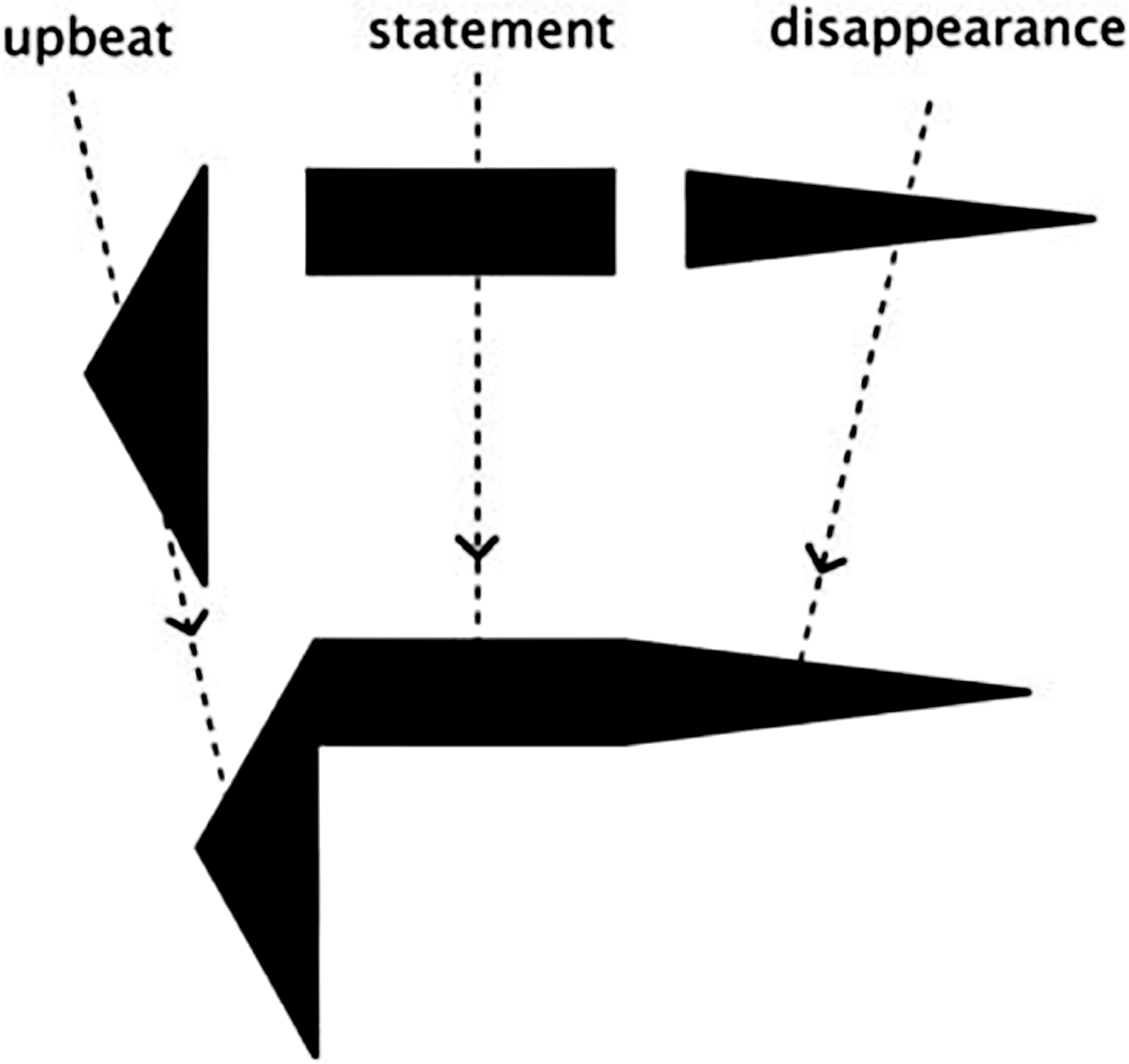
The visual schematics of interruptions within the sonic domain shown at the beginning of this article demonstrate an inherent linkage with Smalley’s spectromorphological concepts, most specifically with his ‘structural functions’ terminology. My earliest writings and contributions to the discourse of acousmatic composition methodologies were concerned with transforming Smalley’s spectromorphological terminology into illustrated form to visually represent the structures composers can create when composing with sound. This contribution (Blackburn Reference Blackburn2011) introduced the basics of shaping a single sound or piecing together sound units from multiple sounds, all using terminology as an influential guide (Figure 29 demonstrates the construction of a sound unit from three sounds identified as an upbeat, statement and disappearance).
An example sound unit construction (Blackburn Reference Blackburn2011: 7).

This new contribution goes further in attempting to demonstrate the sculpting of sound, using interruptions as the main device. In the case of terminating interruptions, the visualisation (Figure 7) shows how this sound event operates similarly to a typical sound unit, with observable onset, continuant and termination components. In this example, the termination is the interruption, which brings the pre-existing sound to an end. Through the lens of spectromorphological thinking, all interruptions within the sonic domain are essentially terminations. These two structural components share behaviours and functionality. Of key importance is that both terminations and interruptions have the ability to halt the continuity of the pre-existing sound. It is worth noting, however, that not all terminations are interruptions. Smalley’s indication of termination differences makes this point clear by stating that ‘terminations vary in their feelings of completion. “Disappearance” is a weak termination without much purpose, while “resolution” and “release” have strong relaxant functions. “Arrival” and “plane” express structural goals achieved’ (1997:115). By pointing out a termination’s strength and assertiveness, we are better able to observe a sonic form of ‘brute force’ as a necessary attribute for a sound which qualifies as an interruption and not all terminations qualify as such. The words ‘termination’ and ‘interruption’ are thus not interchangeable. Another point within this argument is Smalley’s discussion of a sound’s function attribution which ‘may be double or ambiguous’. In reference to my discussion of sonic interruptions, it would be perfectly acceptable to regard the interruption (e.g. an impact sound) as both a termination to the pre-existing sound and as an onset, in its own right. When consulting Smalley’s structural functions vocabulary for onsets, these words are immediately better suited to describe an impact that has a clear attack-like profile. Double function attribution is something I have previously commented on in relation to morphological stringing, where I claim that it is inevitable that sounds will take on dual roles within a string of successive sound units (Blackburn Reference Blackburn2011). A similar situation arises when discussing interruptions since they both halt the pre-existing sound and, in themselves, are onsets or onsets to new material, for example, as found in transitioning interruptions.
5. Successive interruptions
Until now, I have focused on individual instances of interruption in acousmatic music. However, it is also necessary to observe how interruptions function in succession. When multiple interruptions to sound are placed in close succession, the aural result can be particularly striking since certain audio effects and psychoacoustic phenomena are activated. Within the temporal experience of audio, a sound which is interrupted at regular intervals adopts a rhythmic quality and given the ear’s sensitivity to expectation and patterns, these so-called interruptions lose their unexpected status and transition instead into predictable entities. Despite this shift in status, the discussion to be had on successive interruptions is still worthwhile for the vast creative potential and sonic variation this process can offer. As the ‘processing interruption’ example from the typology has already indicated, when a sound is impacted by many interruptions, its original identity and form begin to dwindle, and this reworking can often result in a new fragmentary appearance. In some extreme cases, the pre-existing sound can be overcome by the frequency or duration of interruptions resulting in a reduction of its presence, for example, less pre-existing sound and more interruption. For example, there may be many successive interventions, which I term ‘micro-interruptions’ which hack away at a sound’s original waveform and sonic profile (Figure 30).
Micro-interruptions.

Successive interruptions are particularly interesting because of the textural detail they exhibit from their sequential patterns or configurations. Whereas the one-off isolated interruption event establishes a gestural event, repeated instances of continuity breakage create texture and tactility.
Successive cutout interruptions applied in unison to layered sounds are particularly effective in building a sense of sculpted composite audio, where multiple sounds blend and mix as one (Figure 31). Applying successive cutout interruptions to layers of sound is carried out as if one was carving out gaps and spaces in a textural sonic passage. Different outcomes of this carving or chiselling process can be achieved by varying the duration of the dropout gap. This sculptural removal process subtracts audio, and effectively discards chunks of sound, cutting across the vertical arrangement of multiple sounds (Figure 32) and inevitably moves the listener towards a ‘systemic failure’ listening mode, commonly experienced within glitch genres. A practical way to achieve these successive interruption variations is to replicate the same volume envelopes across multiple tracks of audio.
Single cutout interruption applied to multiple sounds in unison.

Successive cutout interruptions applied in unison using volume envelopes.

6. Conclusion
Arriving at a typology of interruption types that occur within the sonic domain provides a foundational step in transforming the complexity of sound arrangement in acousmatic music into formal patterns that can be observed, compared and reused. Research on interruptions in external fields such as communication and linguistics have always come hand-in-hand with the work of classification, signalling the inherent variation of entities encapsulated by the term. The typology presented in this article has aimed to provide a parallel form of classification for the sonic world, elucidating the act of composing interruptions and providing a new way to both assess and analyse such breakages to continuity.
The typology outlined here has sought to facilitate future sound sculpting endeavours. Each graphical depiction of interruption has organically led to discussions regarding the phrasing and organisation of sound, demonstrating a broader understanding of this phenomenon within current repertoire. This approach provides a novel framework for perceiving and analysing similar elements in other repertoires.
Although the typology of interruption making is not a complete, step-by-step method, my contribution showcases various ways sounds can be organised and shaped at crucial moments or structural points. It also highlights an important part of my own practice, specifically, how I arrange and sculpt sounds within acousmatic music. By outlining these sound-sculpting techniques, the intention was to address the hidden nature of these actions, which often remain unseen behind the studio door. This method is accessible to anyone, even those who do not consider themselves composers or producers familiar with mixing and arranging sounds. By treating interruption as both a perceptual structure and a compositional technique, this article offers a vocabulary for discussing moments of rupture that are often heard as striking but left analytically unnamed.
Supplementary material
The supplementary material for this article can be found at https://doi.org/10.1017/S1355771826101587
Audio examples
Armando Balice, Light Garden (2021)
Light Garden
© 2021, Armando Balice (SACEM)/Ymx média (SOCAN)
℗ 2025, Enregistrements i média (SOPROQ)
Released on the album Du noir tout autour, empreintes DIGITALes, IMED 25199
https://ymxmedia.com/en/oeuvre/49181-light-garden
David Berezan, Starboard (2015)
Starboard
© 2015, David Berezan (SOCAN)/Ymx média (SOCAN)
℗ 2018, Enregistrements i média (SOPROQ)
Released on the album Cycle nautique, empreintes DIGITALes, IMED 18154
https://ymxmedia.com/en/oeuvre/39181-starboard
Manuella Blackburn, Home Truths (2023)
Home Truths
© 2023, Manuella Blackburn (PRS)/Ymx média (SOCAN)
℗ 2024, Enregistrements i média (SOPROQ)
Released on the album Interruptions, empreintes DIGITALes, IMED 24194
https://ymxmedia.com/en/oeuvre/52860-home-truths
Christian Bouchard, UHF-Complex (2017-19)
UHF-Complex
© 2017-19, Christian Bouchard (SOCAN)/Ymx média (SOCAN)
℗ 2023, Enregistrements i média (SOPROQ)
Released on the album IV, empreintes DIGITALes, IMED 23185
https://ymxmedia.com/en/oeuvre/47618-uhf-complex
Jonty Harrison, Espaces cachés (2014)
Espaces cachés
© 2014, Jonty Harrison (PRS)/Ymx média (SOCAN)
℗ 2016, Enregistrements i média (SOPROQ)
Released on the album Voyages, empreintes DIGITALes, IMED 16139
https://ymxmedia.com/en/oeuvre/37170-espaces-caches
Nolan Hildebrand, Amygdala Hijacker (2026).
James O’Callaghan, Empties-Impetus (2011-14)
Empties-Impetus
© 2014-15, James O’Callaghan (SOCAN)/Ymx média (SOCAN)
℗ 2016, Enregistrements i média (SOPROQ)
Released on the album Espaces tautologiques, empreintes DIGITALes, IMED 16140
https://ymxmedia.com/en/oeuvre/38410-empties-impetus
Åke Parmerud, Raw (2013)
Raw
© 2013, Åke Parmerud (STIM)/Ymx média (SOCAN)
Released on the album Bruit noir, empreintes DIGITALes, IMED 22179














 Open access

