

1. INTRODUCTION
On perusing the literature dedicated to the music of the twentieth century, the development of technological repetitive devices such as closed grooves and tape loops appears to be intrinsically linked to that of electronic music. Numerous studies insist on it: the reiterative devices fabricated in the experimental music studios of the post-war period were no less than the prerequisite for the birth of experimental and electronic aesthetics. As a result, the idea that these audio technologies were ‘discovered’ or ‘invented’ by the first representatives of electronic music tends to appear as an implicit consequence – and all the more so due to the rarity of works which deal with the ‘prehistory’ of these devices.Footnote 1 However, on looking further into the long history of musical technology, from the Banu Musa automatic flute of the ninth century to the Hammond organ of the 1930s, it appears that similar devices were not only used by the earliest experimenters in musical automation, but also evolved in a variety of contexts entirely remote from any form of musical institution. What is this other history of repetitive audio technologies? Why has it remained in the shadows? How should these two antagonistic visions of the same historical object be dealt with? These are the questions this article aims to answer. First, however, a brief account of the institutional history of repetitive audio technologies is called for.
2. THE INSTITUTIONAL HISTORY OF REPETITIVE AUDIO TECHNOLOGIES
The history of repetitive audio technologies is frequently dated – more or less explicitly – to 1948. This was the year that Pierre Schaeffer – broadcaster and founder, a few years earlier, of the Studio d’Essai in Paris, dedicated to radiophonic experimentation – discovered looping through the presence of dust and scratches on a vinyl gramophone record. Dust and scratches, he observed, not only resulted in audio clicks, but also caused the needle to keep skipping back to a previous position, resulting in the repetition of the same sound over and over again or, in other words, the unintentional creation of a locked groove. In the words of Daniel Teruggi, ‘This was one of the first accidents that caught the attention of Pierre Schaeffer at the beginning of 1948 and led him to use this and other techniques to make music in a different way, which he called “musique concrète”’ (Teruggi Reference Teruggi2007: 213). For Schaeffer, the continuous repetition of a fragment of sound isolated ‘the “in-itselfness” of audio phenomenon’ (Schaeffer Reference Schaeffer1952: 21), thus revealing ‘concrete’ sound.
In the early 1950s, following a period of experimentation dedicated to engraving closed grooves on shellac records, Schaeffer set up the first magnetic tape loops. The procedure went as follows: sound was recorded on a section of magnetic tape which was then cut and spliced end-to-end to create a loop that could be played continuously. For concrete composers, this opened up new organisational possibilities with respect to the gramophone. Looping devices began to be integrated into new machines such as the phonogene and the morphophone, enabling Schaeffer and his colleagues to extend their experiments with sound modelling far beyond repetition. Indeed, no sooner did concrete composers feel themselves to have attained the maximal benefits of repetition, than they veered sharply away from it. In the meantime, Schaeffer’s studio had become a landmark. One after the other, composers such as Olivier Messiaen, Edgard Varèse and Karlheinz Stockhausen worked there. Other studios and places of experimentation appeared. Stockhausen – who had used the Studio d’Essai’s phonogene to create his Etüde, one of the first works of electroacoustic music, in 1952 (Stockhausen Reference Stockhausen1992) – subsequently worked at the studio of the Westdeutscher Rundfunk in Cologne. Luciano Berio and Bruno Maderna were active in the Studio di Fonologia Musicale in Milan. In the United States, Louis and Bebe Barron had already begun experimenting with magnetic tape loops thanks to their first Stancil-Hoffman recorder in 1949,Footnote 2 and Otto Luening and Vladimir Ussachevsky were simultaneously testing similar techniques at the Columbia Tape Music Center. In the 1960s, repetitive audio technologies spread beyond these electronic music studios: Terry Riley and Steve Reich used them to found the aesthetic which came to be known as minimalism and which culminated in the 1970s. A few years later, Kraftwerk used magnetic tape loops to invent techno and Afrika Bambaataa’s exploration of gramophonic repetition contributed to define hip-hop (Shapiro Reference Shapiro2000: 15). Less than half a century after Pierre Schaeffer’s first experiments, repetitive audio technologies had conquered the world (Fink Reference Fink2005). That, at least, is how the ‘discovery’ or ‘invention’ of these technologies often appears in works dedicated to the history of recorded, electronic and/or experimental music. For example, Tom Holmes’s Electronic and Experimental Music (Holmes Reference Holmes2008: 50, 131, 197), Simon Emmerson’s Living Electronic Music (Emmerson Reference Emmerson2007: 67), Richard Osborne’s Vinyl: A History of the Analogue Record (Osborne Reference Osborne2012: 20), Brian Kane’s Sound Unseen: Acousmatic Sound in Theory and Practice (Kane Reference Kane2014: 16–17), as well as numerous research articles by composers and musicologists like Marc Battier (Battier Reference Battier2007) and Daniel Teruggi (Teruggi Reference Teruggi2007), to name but two.
3. ANOTHER HISTORY OF REPETITIVE AUDIO TECHNOLOGIES
Delving a little deeper into the use of repetitive audio technologies, it seems, however, that the concomitance between their appearance and the works produced in the experimental music studios of Pierre Schaeffer and his peers needs to be nuanced: repetitive audio technologies have not only been traced back to mediaeval projects of musical automation, but also explored and used in many other places than these post-war experimental music studios. Certainly, in 1948, Schaeffer dreamed of creating ‘an organ with each key linked to a turntable that would have appropriate discs put on it as required’ (Schaeffer Reference Schaeffer1952: 7–8). This does not alter the fact that, from the Telharmonium to the Hammond organ, instruments had been functioning on a similar principle for decades before this. Nor can it be denied, that, while Schaeffer effectively exploited the principle of closed grooves on shellac records, the technique had been patented since the 1870s in the United States. Again, while the French broadcaster and his colleagues did indeed transfer the technique of looped repetition to magnetic tapes in the early 1950s, looped tapes were already in use in the field of telephony some twenty years earlier. What then is the alternative history of repetitive audio technologies?
3.1. Mechanical instruments
The history of repetitive audio technologies can be traced back at least as far as the middle of the ninth century. At this time, three scholarly brothers from Baghdad, known as the Banu Musa, designed an automatic flute player which could reproduce an audio sequence with minimal human intervention. The basis of this machine’s automatism was hydraulic pressure, generated by flowing water in a reservoir. The flute’s melody was encoded on rotating cylindrical drums by way of raised pins which activated levers to open or close the flute’s holes (Figure 1; Koetsier Reference Koetsier2001: 590–1). Some eight centuries later, around 1650, Athanasius Kircher’s automatic hydraulic organ, presented in his Musurgia Universalis, was based on a very similar principle (Figure 2).
The Banu Musa automatic hydraulic flute player (Farmer Reference Farmer1931: 101).

The Kircher automatic hydraulic organ (Farmer Reference Farmer1931: 164).
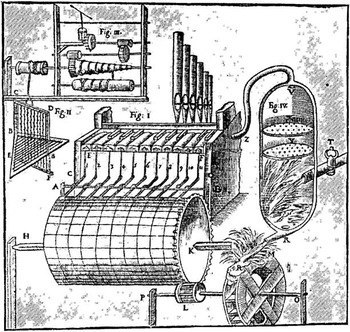
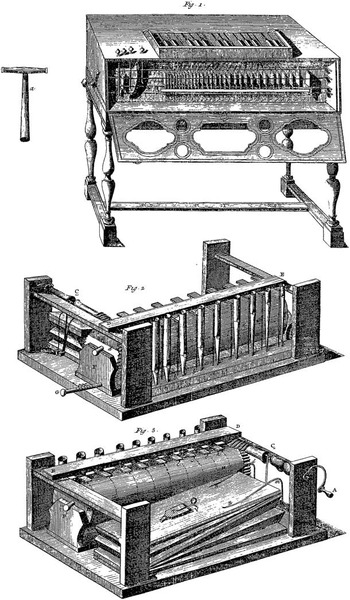
Kircher’s organ was not in fact the first Western European mechanical device to encode melody by way of a rotating pinned cylinder: from the fourteenth century, cylinders of this kind were used to activate church bells, and from the sixteenth century, full carillons.Footnote 3 Around the same time, similar mechanisms started to be used for barrel organs, in order to enable them be heard above the general noise of streets and fairs. In the eighteenth century, small barrel organs known as serinettes were quite fashsionable among the French aristocracy as a means of teaching melodies to pet birds – hence the French verb seriner (‘to teach something through continuous repetition’), akin to the English expression ‘to drum something in’ (Figure 3). The nineteenth century saw the advent of organettes and orchestrions. These portable organs, capable of reproducing predetermined musical sequences, were still essentially based on the model provided by the automatic flute player, but the raised pins were now replaced by perforated bands of paper wrapped around the cylinder; in certain cases, the whole pinned drum was replaced by a flat perforated rotating disc (Figure 4).
Serinette (Diderot and D’Alembert Reference Diderot and d’Alembert1780: 4).
Ariston organette (Hattaway and Bowers 1968).

At the end of the nineteenth century, player pianos (or pianolas), incorporating perforated cardboard rolls or sheets transcribing compositions by Mahler, Debussy and Gershwin, among many others, marked a definitive step towards modern recording – and, simultaneously, their own demise: the success of Thomas Edison’s phonograph (1877) and Emile Berliner’s gramophone (1888), which transferred the cylindrical mechanism to zinc discs (Morton Reference Morton2004: 31–42), put an end to the reign of mechanical music in the early years of the twentieth century. With a view to increasing the length of the reproduced musical sequences, these machines favoured the helicoidal or spiral engraving of sound on flat discs introduced by the orchestrions several years before. Circular mechanisms died out – the sole vestige of their inherent continuousness being the final grooves of discs, closed on themselves to keep the needle on a circular track and thus prevent it from sliding across the labelled centre of the record.
A series of inventions nevertheless continued to attest the persistence of repetitive audio technologies – even in the phonographic sector. In 1878, for example, only a few months after having patented his phonograph, Thomas Edison himself invented a machine for teaching the alphabet, based on a cylindrical drum engraved with the letters of the alphabet, which ‘turned on itself’ in the manner of a serinette (Davies Reference Davies1996: 7). In 1906, in America, the Connolly brothers filed a request for the patent of a phonographic instrument endowed with grooves disposed in parallel loops, which could not only imitate, but also ‘dilate’ the various tones of flutes, clarinets and the piano (Figure 5). Along similar lines, the inventor Ralph Colling, had, ten years earlier, filed a patent application for an instrument based on a looped phonogram which enabled the pitch of the reproduced sound to be varied via the speed at which the disc was rotated, thereby enabling effects of legato and portamento unobtainable on the original instruments (Figure 6; Feaster Reference Feaster2011: 191–6).
Thomas A. Connolly, Joseph B. Connolly, ‘Musical Instrument’, US patent 851,634, 23 April 1907.

Ralph Colling, ‘Musical Instrument’, US patent 1,246,055, 13 November 1917.

3.2. Optoelectronic devices
Circular repetitive technologies were also present in other technological fields at the beginning of the twentieth century, in particular optoelectronics. The marked connection between circular technologies and optics at this time had already been curiously prefigured by the experiments carried out, and published in the American Journal of Science by the physicist Alfred M. Mayer in 1874 (Figure 7). Drawing inspiration from the magic lantern, ancestor of the cinematographic projector, Mayer managed to produce a looped moving image of a sound wave by engraving the graph of the wave, end to end, on an otherwise opaque circular glass disc and using a lantern to project it onto a screen (Mayer Reference Mayer1874: 180–1). Though the purpose of Mayer’s experiment was purely didactic, the totally silent image of a sound wave anticipated the way, several decades later, optical tracks would be used to develop photoelectric instruments in the field of cinema. Like Mayer’s wave, cinematic tracks consisted in visual renditions of sound waves – encoded now on tapes, and translated into electric signals and amplified by photoreceptive cells (Levin Reference Levin2003). Looped – again like Mayer’s wave – these tracks enabled an uninterrupted flow of synthetic sound to be maintained.Footnote 4 This technology also served as the basis for the Syntronic Organ of 1935 and the Welte-Lichtton-Orgel of 1936.Footnote 5 At the time, similar attempts were starting to be explored in the field of magnetic reproduction; these experiments would, however, only come to fruition in the 1960s with the Mellotron, which would in fact abandon discs for unlooped bands (Davies Reference Davies1996: 6).
Alfred M. Mayer. Six Experimental Methods of Sonorous Analysis Described and Discussed. American Journal of Science 108 (1874): 180.

In the meantime, a slightly different kind of technology was being employed for certain kinds of electronic organs, notably thanks to experiments carried out by the South African Johannes Van Der Bijl at the Western Electric of New York in the mid-1910s and by Charles-Emile Hugoniot in France in the early 1920s. These experiments combined optical technology with the principle of the phonic wheel. At this time, the principle of the phonic wheel consisted in a toothed disc which, when rotated before a sensor, generated an electric signal and produced a series of notes whose frequency was determined by the speed at which the disc was rotated and the number of teeth. This principle had already been used since the late eighteenth century for sirensFootnote 6 and for electromechanical instruments such as the Choralcelo (1903) and the Telharmonium (1905).Footnote 7 Imported into the optical field, the procedure underwent slight modification: a light ray was projected onto a notched disc and when the disc was set to rotate at a constant speed, the light, passing through the notches at regular intervals, generated a periodic tension which was caught and amplified by a photoelectric cell. This procedure was used to create the Cellulophone in 1927 and the Radio Organ of a Trillion Tones in 1931.
Still in the field of photoelectric sound generation, in 1931, the ‘proto-experimentalist’ composer Henri Cowell teamed up with Léon Theremin to devise the Rhythmicon – the ancestor of the rhythm machine or beatbox. The rhythmic content was generated by rotating discs that periodically interrupted the light beam triggering the photoelectric cells (Holmes Reference Holmes2008: 23), and the finished result was an instrument capable of simultaneously producing all sorts of rhythms impossible to execute manually using traditional musical instruments (Glinsky Reference Glinsky2000: 135).
3.3. Magnetic sound
It was in the field of telephony, in the 1930s, that the first experiments with looped magnetised sound were carried out (Davies Reference Davies1996: 7). Among these early experiments were the prototype voice recorders distributed by the American company Telephone & Telegraph among local American operators. Based on the continuous circular rotation of magnetic steel wires, these machines, which rapidly fell into oblivion, again had a didactic purpose, that is, to teach, through repetition, new employees how to use their voices efficiently (Morton Reference Morton2004: 106–7). Steel wire, whose use in recording technologies had been discovered and demonstrated – through the magnetic variations of an electromagnet during recording – by Valdemar Poulsen in 1898, was abandoned in favour of ribbon or tape, which had the advantage of being easier to edit. In 1935, the magnetophone was created by Fritz Pfleumer in Germany. In the post-war period – following the discovery by the allies of numerous German innovations – this kind of technology was developed and democratised throughout the world (Thiele Reference Thiele1992; Morton Reference Morton2004: 127).
German influence was in fact already manifest even before the war. In 1939, following a series of experiments set up between 1935 and 1937, the American Brush Development Company brought out the Soundmirror, a recorder based on a system of looped magnetic steel tape (Morton Reference Morton2004: 121; Paige Reference Paige1972: 60). In 1944, the Jefferson-Davis Radio Manufacturing Corporation announced the creation of a recorder based on an eight-minute loop of cellophane ribbon (‘Cellophane Records called Revolutionary Development’ 1944: 63). In 1954 – the moment when Pierre Schaeffer transferred the closed groove to magnetic loops – George Eash introduced Fidelipac cartridges to the market. Used to diffuse jingles and advertisements on the radio, and inspired by Bernard Cousino’s ‘Audio Vendor’ (1953) and ‘Mohawk Message Repeater’ (‘TelePro Cartridge Patent Plea Fails’ 1967: 3), as well as cinema and the kind of on-the-loop films shown in exhibition rooms (still an ongoing practice – Morton Reference Morton2004: 156–7), Fidelipac-style cartridges would remain in use until the 1990s. The model they provided was notably used by the San Francisco Tape Center when it installed itself in the studios of KPFA radio in 1963 (Callahan Reference Callahan2008: 183). Around the same time, Don Buchla also made use of this kind of cartridge when he created, at the request of the composers of the same Tape Center, his ‘ten-touch’ instrument (one touch for each cartridge), which prefigured portable studios and analogue sequencers (Subotnick Reference Subotnick1992).
4. DEALING WITH TWO ANTAGONISTIC DISCOURSES
The uses and aims of mechanical, optoelectronic or magnetic devices are not identical in all regards. For example, mechanical instruments (whether carillons, barrel organs or mechanical pianos) largely aim at making it possible to reiterate or replay entire pieces. The role of their cylinders or discs is to facilitate the (immediate or later) return to the start of the piece. In contrast, optoelectronic devices do not aim to replay a musical piece but to generate continuous sounds (through the uninterrupted rotation of the disc), within the organological framework of the creation of the first synthesisers. The rotational speed of the cylinders and discs then differs considerably: in the case of mechanical devices, each complete cycle may correspond to a few minutes, while optical disks spin tens of times per second. In both cases, repetition is a technical means rather than an (aesthetic) end in itself: if it is heard, this is fortuitous rather than intentional.
Magnetic loops, which are more easily manipulated, have a more diverse range of uses but are most often used as part of the first system, either that enabling pieces or, in this case, sequences of a few seconds, to be re-played, as shown notably in the case of the jingles and adverts mentioned above. Pierre Schaeffer’s ‘locked grooves’, for their part, have another purpose, that of the ad nauseam repetition of sound sequences (which are first identifiable as such) for the aesthetic ends of a concrete music. It is this manifest and audible repetition of sound segments which was to encounter unprecedented success in the history of post-war music, beginning with the works of minimalist composers such as Terry Riley and Steve Reich (Music for The Gift in 1963, for the former; It’s Gonna Rain in 1965, for the latter).
These different forms, uses and aims, however, do not prevent these technologies from using one long-standing piece of equipment; the circular devices on which the sound is ‘inscribed’ and upon which it can be repeated at will. The goal of this article was to observe this in detail. In light of these observations, it consequently seems necessary to temper the idea that repetitive audio technologies were ‘invented’ or ‘discovered’ in the electronic music studios of the post-war period, although, in doing so, there is no intention of negating the aesthetic originality of Pierre Schaeffer and his peers’ contribution. These technologies not only date from far earlier, but also evolved in many other places besides these institutional studios. The history of loops touches a whole panoply of objects: from mediaeval ‘automates’ to the first synthesisers; from fire-engine sirens to sound film. It came into play in fairs, bell towers, bedrooms and on radio waves, as well as in experimental studios. In brief, a whole other history of repetitive audio technologies exists.
Rather than substituting one history for another, however, the aim here is to raise the following question: if an alternative history exists, how did it come to be overshadowed? A partial response is furnished by Douglas Kahn. For Kahn, it was essentially post-war institutional development – accompanied by a certain form of historical amnesia – that raised what were essentially episodic explorations to the status of continuous practice, and thereby legitimated concrete music as a phenomenon and genre (Kahn Reference Kahn1999: 123–39). The idea of ‘historical amnesia’, in particular, calls for attention, notably in the light of the Actor-Network theory, of which Bruno Latour’s Science in Action (Latour Reference Latour1987) constitutes one of the pioneering works. What is it that this theory highlights? Principally the idea that scientific (or, in this case, historical) facts become established through a process of collective interests. In other words, certain views of history become established not because they are intrinsically truer or more rational than others, but because they manage to attract and bring together so many allies that they impose themselves to the detriment of others. The idea that repetitive audio technologies were born in experimental studios in the post-war period perfectly illustrates this process of imposition. It met with the interests of a large number of actors who took it up and then transmitted it. Among these actors were – and are – notably defenders of the kind of electronic music produced in studios attached to radio stations, universities and other institutions. The modernist vision of the invention or discovery of repetitive technology helped to legitimise the originality of their own activity. Furthermore, the creation of an autonomous ‘electronic’ category (notably through the efforts of personalities such as Hugh Davies) with respect to the other technological forms and musical genres that emerged in the 1950s and 1960s, contributed to free repetitive technologies from their ‘organological’ roots and thus avoid eventual criticism concerning the idea of an ‘invention’ or ‘discovery’.
The idea that repetitive audio technologies first appeared in the post-war experimental music studios also met with the interests of a series of theorists aiming, on their side, to establish the even more controversial idea that the (re)discovery and success of repetitive or ‘minimalist’ music in the last third of the twentieth century was firmly attached to the Western art music tradition. The idea that repetitive technology was discovered or invented in the post-war period added weight and legitimacy to this other ‘discovery’, that is, musical repetition as an aesthetic in itself, notably promoted by the use made of looped magnetic tapes by Terry Riley and Steve Reich (see Strickland, Reference Strickland1993: 146–7; Potter, Reference Potter2000: 105–7).
How then should we deal with these two antagonistic discourses – one celebrating the invention of repetitive technologies in the experimental music studios of the post-war period; the other underlining the recurrence of such technologies throughout the history of the manipulation of sound? Again recourse to the Actor-Network theory is helpful. As Benjamin Piekut has rightly observed, this theory encourages us to ‘provide an empirically justified description of historical events, one that highlights the controversies, trials, and contingencies of the truth, instead of reporting it as coherent, self-evident, and available for discovery’ (Piekut Reference Piekut2014: 193). The history of music is diverse and multiple. Presumably then, the most suitable approach is not to try to reduce it to a series of unidirectional schemas, but rather to endeavour to reveal its richness and diversity.



