Bulgakov made a parallel between the name and the icon: ‘The phoneme corresponds to the colours of the form of an icon, the morpheme to the hieroglyphic character of the original that provides the design for the representation. The syneme is the name itself, the energy of the representation’. (Arjakovsky Reference Arjakovsky2005)
1. The Network
The Network (physical and metaphorical) has been the overarching muse in our research, permeating not only the science of the practice, but the aesthetics, methodology, pragmatics and theory of network music. An article by Mark Wigley captures an epoch-making set of exchanges between McLuhan and Fuller among others signalling the transition from an age of electronics to an age of networks (Wigley Reference Wigley2001). These set of symposia, convened by the architect Doxiadis, occurring aboard a yacht sailing the Aegean, could be placed in significance beside the Macy conferences as being among the foundational conversations in the study of network music. Fifty years later this article explores the implications of electroacoustics as solidly embedded in the network paradigm.
With little caution, we venture that the network, like such epoch-defining and emblematic technologies as the telescope, does not as a simple effect extend the known outward and toward greater complexity, but reflexively changes the order of the musical immediate. In other words, electroacoustics is likely to be profoundly remediated by a complex of new terms, practices and technologies that underlie the field of network arts – for example, in such areas as the analysis of network structure in music (Tse and Small Reference Tse and Small2008; Liu, Tse and Small Reference Liu, Chi K. and Michael2009). Networks have already had an obvious impact upon the field in terms of distribution and access, but a new stage has been reached as we move toward live global telematic performances, a stage on which sound, for the greater part of its path, travels near the speed of light (Tanaka Reference Tanaka2000; Carot and Werner Reference Carot and Christian2007), altering drastically the acoustic upon which musicians have relied upon their entire organism-hood.
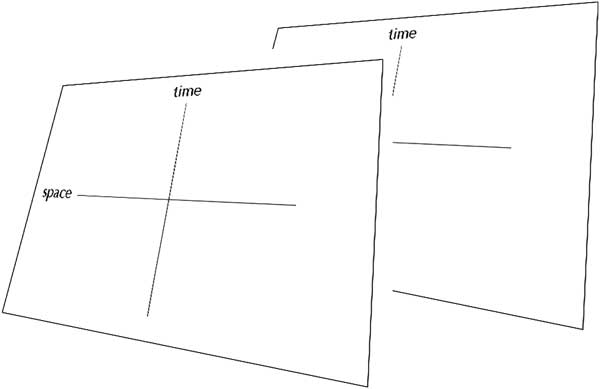
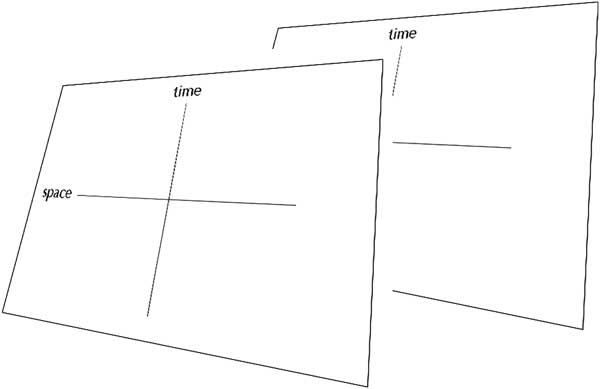
Most significantly for artists, the expanded performance space of network music impels experimentation with musical strategies that address the phenomenon of disjunct chronotopic (literally time/space) frames. We adopt this term, which Bakhtin first introduced as a constitutive category of literature, as the ‘intrinsic connectedness of temporal and spatial relationships that are artistically expressed’ (Bakhtin Reference Bakhtin1983: 84) – the space in which narrative forms. As applied to network music, sonic material can be developed within uniquely emergent chronotopic relationships that form in and between disparate time/zones and network conditions (figure 1).
Two chronotopes creating a higher-order chronotopic space.
Emerging questions are posed for network performance: is the network performance space a linear extension of the concert hall – using long cables? Is the network to be considered an instrument in itself, exhibiting reflective and resonant properties? What models/schema best represent the actor network space of networked performance? What are the organisational forces that network music brings into play – from aesthetics to institutions? Are the musicological concerns of electroacoustic music reframed/remediated in the context of its practice over the medium of networks? Or, are research networks simply an optimised distribution mechanism for music: faster downloads, with less jitter and packet loss? For most early adaptors, the tendency has been to regard the network not as a neutral component, but a principle actor defining a new medium.
Network music can be distinguished by a host of novel scenario and terminology: timezone, presence, telematic, IPV6, port, traceroute, nodes, actor network theory (Latour Reference Latour2007), P2P, Jabber, E/O conversion (electrical to optical), packet and jitter. The most obvious feature that physically qualifies this new practice is the class of network it is practised on, the Internet 2 – a group of research and educational networks that afford the streaming of multi-channel, multi-peer, uncompressed audio (1 to 10 Gbps or greater). Syneme focuses exclusively on the practice of network music, aiming to optimise methods and interfaces to this new performance space.
2. Liveness
In 2005 Fibreculture Journal published a unique collection of articles on the underdeveloped subject of distributed aesthetics (Gye, Munster and Richardson Reference Gye, Anna and Ingrid2005). Within network music literature, Schroeder alone mentions liveness (not to be confused with the term ‘real-time’) as a defining value of network music performances (Schroeder, Renaud, Rebelo and Gualda Reference Schroeder, Alain B., Pedro and Fernando2007). From the organisational point of view, the dramaturgical issues raised by Rebelo and Schroeder are useful in conceptualising networked music production, authorship, collaboration and the network performance environment as an artistic setting (Schroeder Reference Schroeder2009). Syneme's problem space has focused strongly on the qualitative dimensions of the production and aesthetics of presence as encountered in the multiple aspects of the tele-situational.
Couldry and others regard the issue of liveness as a primary historical feature of television, radio and other media (Couldry Reference Couldry2004). ‘The aesthetics, economics and politics of “live” radio were largely recapitulated in the early development of TV’ (Vianello Reference Vianello2011: 27). While early television programming included live spectacle, ‘the shift from live to taped programs which occurred in the USA in the 1950s did not end the narratives about television liveness and belief that television viewers participate in synchronous and geographically situated events’ (White Reference White2006: 5). The same should be observed in the shift from early experiments in radio art (Artaud, Schaeffer and Cage) to the live radio serial and ultimately to taped programming of top-40 pop music.
That liveness diminishes with the imprinting of an event in a medium – writing, painting, photography, phonography, film and video – is a contentious issue. To follow this logic to its conclusion within the medium of real-time network systems, buffers would be the insidious (micro-) imprinters of the telematic: the larger the buffer, the greater the mediational value. Though large and redundant buffers can offer squeaky clean audio, free of the gritty packet loss of unpredictable networks, the very fact of a signal's reproduction in transit diminishes the liveness value. Ultimately, buffers would serve to mediate between liveness and the more intrusive algorithms that are becoming associated with the deep packet inspection of so-called smart networks.
David Zemmels challenges the superstition assigning second-orderedness to recorded/mediated liveness (Zemmels Reference Zemmels2004). He draws from commentators Auslander, Kwan, Gumbrecht and Wurtzler in showing how the concept of liveness itself is created by mediated forms. He offers a narrative of liveness/presence in the encounter with technologically mediated forms, from cinema and television to virtual reality and the Internet. He develops the concept of how presence and liveness are ontologically linked to axes of time/space through experiential parameters of immediacy/intimacy and intensity/proximity.
Gumbrecht propitiously brings the ‘materialities of communication’ to the fore in his Production of Presence (Gumbrecht Reference Gumbrecht2004). He contrasts meaning and presence effects, both of which entail the transference of energy in such a way that one divergently ‘understands’ or ‘feels’ something. The acousmatic knows this formula though with the effect of bringing forth the materialities of sonic material. To place the materialities of communication at the core of a tele-aesthetic would possibly require the introduction of a method such as reduced communication, which would be when a signal is not received hermeneutically (interpreted) or aesthetically (appreciated) – both relating to the signal's content – but as a purely received communication: in quality measured in packet loss and jitter and in value measured as a function of feeling (presence/liveness) over time/distance (presentification).
The network composer's task then is to explore a myriad of organisational paradigms (systems, ecological, autopoietic) in investigation of chronotopic behaviour. The approach must give rein to the heterogenous, to the smooth and striated space of Deleuze and Guattari (figure 2), or to Boulez’ ‘nonmetric and metric multiplicities, directional and dimensional spaces’ (Deleuze and Guattari, Reference Deleuze and Félix2004: 477). ‘In striated space, one closes off a surface and allocates it according to determinate intervals, assigned breaks; in the smooth, one distributes oneself in an open space’ (Deleuze and Guattari, Reference Deleuze and Félix2004: 481). Network music has thus far gravitated to the nonmetric and smooth, characterised by intensities, textures, haptics, forces and sonorities.
Striated and smooth space.

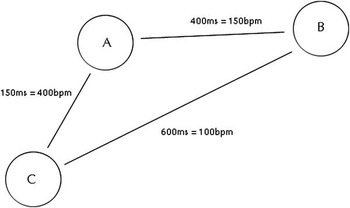
Figure 3 demonstrates the difficulty of ‘metric multiplicities’. Two nodes can agree upon a common pulse (bpm) by dividing 60,000 by the network delay in milliseconds: A and B can play together at 150 bpm; B and C can play together at 100 bpm. If B wants to play both with A and C they can find a common dividend (50) and subdivide accordingly, resulting in a 3 against 2 rhythm. If all nodes want to play together, the result is 2:3:4(8). Adding a fourth node while realising that such convenient proportions of latency rarely occur on the network shows that trans-chronotopic metricity obviously becomes unworkable – unless of course one considers the music of the Uzbek-Tajic's ‘limping’ metro-rhythmic genre called Talqin: ‘asymmetrical rhythms may be metrically framed, and it is precisely the tension between systematic asymmetry … that may help to produce trance states (Levin and Süzükei Reference Levin and Valentina2006: 249).
Metric multiplicities: three nodes.

Television and radio are broadcast media, while network performance can be looked upon as taking up the promise of those early live mediums in the age of ubiquitous tele-presence. If ‘Radio art is art which is specifically composed for the medium of radio and is uniquely suited to be transmitted via the airwaves’ (Reference FennerFenner n.d.), then network music is music which is specifically composed for the medium of networks and is uniquely suited to be transmitted via high-speed networks. Absent this emphasis on live aesthetics, high-speed networks too will likely be co-opted toward economic convenience, automation, and pre-programmed repetitive experience.
3. Telemusic Studio
Network music contributes an added layer of both physical and virtual complexity to the electroacoustic music studio, transforming it into a collaborative tele-presence space: lights, cameras, interaction. Video has become an essential musical consideration as much for signalling remote presence as for the distribution of dynamic graphic scores. The presentation of the body (musician's) has been traditionally a matter of low priority in electroacoustic music, built as it is around a theory of the acousmatic, but what we have found early in our research is that the intervention of an aesthetics of presence suggests that aspects of tangibility and remote human presence hold a significant place.
Thus, for every audio cable/device in the electroacoustic music studio, add its video companion: audio/video mixer, mic/camera, speaker/projector, ADC/ADVC, DAW/VDMX, and acoustic/optic environment treatment (spot lights, photo grey projection surfaces). The tele-conference unit that connects four to six nodes is currently the necessary but contentious participant, as a utilitarian device devised for tele-conferencing talking heads with little intervention allowed into default configurations. Unfortunately, the field has yet to evolve its own digital presence workstation (DPW).
The intentionality of the audio workstation changes ever so slightly but significantly in a networked studio into that of a more relational component of a potentially large generative sound grid. What comes into focus in this new configuration are end-points (sound nodes), routers, the social/artistic network, gesture capture systems/instruments, ethernet cables and the front and centre Jack Router window (JACK). The OSCGroups software provides a client and server system to multicast control streams to global partners (OSCgroups). The Open Sound Control (OSC) protocol (Wright Reference Wright2005) is how musicians transmit local gestures to remote controlled interfaces.
Previously, when the electricity was turned off, the electroacoustic music studio went silent; for the tele-music studio, when the electricity goes out, a global network of actors disappear. There is an obvious need now to move more vigorously into considering the implications of the combination of electroacoustics, social networking platforms and high-speed networks. As IPV6 comes online allowing all devices in the studio to be connected by addressing over fibre optics, network models and terminology will fully encroach into all aspects of networked studio praxis. Further background on the networked music studio can be found in Theberge's article (Theberge Reference Theberge2004).
The use of IPV6 (IP version 6) has been a leading technical consideration in our implementation of network music due to many collaborations with Beijing over the China Educational Research Network (CERNET2) which uses the IPV6 protocol exclusively. Beijing University student Wang Ke compiled an IPV6 version of Jacktrip (Cáceres and Chafe Reference Cáceres and Chris2009) in order to utilise the optimised next-generation Internet protocol for real-time performance and streaming. Given the fact that this year the Number Resource Organization (NRO) announced that IPV4 addresses have all been allocated (Gross Reference Gross2011), the attention to IPV6 infrastructure has been one of Syneme's major accomplishments with full support from Alberta's Cybera regional network, which connects to CANARIE (Canada Advanced Research and Innovation Network). An inter-Asian/Australasian network music project convened in 2010, at a meeting of EMSAN in Beijing, will have its first performance in October 2011 completely over IPV6 networks.
Overlaying this, XMPP takes a more significant and symbolic role in the pantheon of protocols, swapping with the granddaddy of Internet protocols, HTTP. ‘Much as HTTP and HTML define the protocols and data formats that power the World Wide Web, XMPP [and XML] define the protocols and data formats that power real-time interactions over the Internet’ (Saint-André, Smith and Tronçon Reference Saint-André, Kevin and Remko2009: 8). Without entering into an extended discussion of the divers functioning (streaming, negotiating) of various protocols (UDP, SIP, etc.), this reinforces an important shift in our perception/use of the web from an archive of documents to a live web consisting of multiple points-of-presence (mPOPs) – modelled by an online presence ontology (OPO). With the approach of 100 Gbps transport, a whole set of Internet music strategies pivoting around a balance between media quality and bandwidth/storage conservation (encoding, compressing, centralising, shaping, and redundant buffering) risks obsolescence.
4. Artsmesh
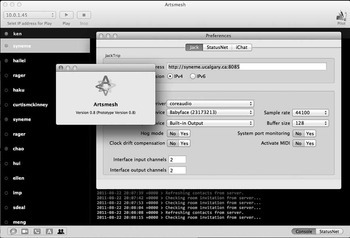
Artsmesh (Fields and Wang n.d.) is a DPW prototype designed to manage presence data between logged-in users and make visible the online state of the music network (figure 4). The Artsmesh preference tabs organise the practical task space of network music, bringing together multiple applications for convenient configuration. After an initial set-up, there is no longer the need for the lengthy configuration process that ubiquitously accompanies the telematic connection session.
Artsmesh interface.

Artsmesh triggers terminal commands to run Jack Audio, Jacktrip (compiled for IPV6) and OSCgroupClient, and feeds a collaborative microblog called Stremes (Status Net). During performances, chat text can be directed to our Status Net server, where web observers can follow the activity stream from the Internet. Status Net, using concise syntax for tagging () and routing messages to individuals (@) and groups (!), is also an invaluable tool for project management, archiving, pre-production and knowledge sharing. Artsmesh uses extended RDF user profiles, a home page in a linked-data system (semantic web) using the FOAF schema: ‘The Friend of a Friend (FOAF) project is creating a Web of machine-readable pages describing people, the links between them and the things they create and do’ (FOAF n.d.).
Artsmesh would be an access grid (AG) for artists. Syneme early on explored the potential of the AG as promoted by the MARCEL network: a global network of media arts and technology. Our findings were that the AG was potentially a sufficient tool for tele-conferencing, though conceived before an age of hyper-social networking platforms. What was obvious was that the contribution of a dramaturgy of live performance meets social/semantic web could transform such an ‘access grid’ into an ‘arts mesh grid’. The more significant aspect of this study was the realisation that a more concerted effort would be needed for the investigation of human–network interaction.
Toward this end, a joint project investigating the telematic performance space has been initiated at IT University Denmark by Kjell Peterson with Guto Nobrego (UFRJ, Brazil) and Ken Fields (Central Conservatory of Music, China). The first working symposium was held in Rio in April 2011 (Telemediations), where Thomas Pederson presented a useful method for the analysis of the telematic performance space using a Situtated Space Model (Pederson and Surie Reference Pederson and Surie2008). The project will design and analyse a telematic performance between the three participants, producing a detailed interaction model to inform the design of a graphic network user interface (GNUI). Performances are complex in themselves, while additionally a tool to support collaborative design, production schedules, training, symposia and knowledge, archiving presents further requirements for extended functionality.
Other graphic user interface systems that use similar methods are Scenic and Arthron. Arthron focuses on the VLC media player for media streaming, and Scenic uses the GStreamer multi-media framework, with the ability to send raw, uncompressed audio streams. While Artsmesh uses Apple's iChat for backstage, walkie-talkie communication, for performances we opt for tele-conference hardware. Software video encoding/decoding alone cannot approach the low-latency performance of uncompressed audio using Jack/Jacktrip. VLC does have the capability to run on a dedicated GPU and over IPv6, the implementation of which remains an urgent task for us.
Just as the desktop metaphor for human–computer interaction (HCI) smoothed the way to personal computing for the masses, a more concerted effort will be necessary to make the online presence web a more hospitable place. Looked at from such a perspective, it can readily be seen that the cloud is a particularly unhelpful metaphor in this regard if the goal is to illuminate the potential of network space, rather than encouraging people to cluster passively around centralised social network systems. Artsmesh promotes a model of P2P or S2S (server to server) creativity, making it feasible for people to independently manage nodes on a flourishing World Live Web (WLW).
5. Net Works
In our various net works over the years, we have looked for continuities and stabilities of praxis. One of the outcomes of Syneme's experiments has been a diminishing emphasis on live multi-channel sound distribution in the concert hall, toward considered strategies for the live geo-diffusion of sound. Tele-music is more concerned with representing place with sound than perception of sound in space. The cocktail effect is less significant in the network paradigm than the polis-effect (what city is that sound coming from?). While Syneme aims to maintain a quality of audio, it must also maintain the general quality of connectedness, in terms of both the physical network condition and the continuity of psychological and social awareness streams – which always shows a propensity to entropy in situations of low presence.
6. Musicacoustica 2009
The tele-music concert at Musicacoustica 2009 in Beijing was a collaboration between Syneme, the IDS studio (Emily Carr University of Art and Design) and the China Electronic Music Center (CEMC) (Central Conservatory of Music). Sound Play, by David Eagle (Reference EagleEagle n.d.), explored the remote control of an eight-channel mix, taking care to calibrate local to remote speaker configurations. The other pieces performed from Vancouver were Stefan Smulovitz’ Improvisation, Jean Routhier's Coastal Calls, Philippe Pasquier's Improviser Automaton, and Martin Gotfrit's dance film Wake. Of these pieces, Smulovitz’ was the more explorative of the network aesthetic in remote processing of and improvisation with the shakuhachi played by Bruce Gremo in Beijing.
The piece V4V6, by Ken Fields, explored two parallel network paths between Beijing and Calgary. A practical goal was to demonstrate the different levels of fitness of IPV4 and IPV6 protocols for network performance. While multi-directional eight-channel audio and HD video streamed seamlessly over the IPV6 connections, we visualised and sonified the parallel IPV4 traffic jam and frequent time-outs happening over the commercial China Internet. For this, an application was written by Wang Ke (Beijing University) to convert the raw output of the Traceroute application to OSC data. This application drove a Supercollider instrument which was percussive in nature. The OSC data was also sent over IPV4 to a VVVV (multi-purpose toolkit) application in Calgary and the live image was streamed back over a Lifesize tele-conference unit to Beijing. Bruce Gremo on shakuhachi in Beijing and Jeremy Brown on saxophone in Calgary improvised over a sonic bed of live-coded improvisation with Supercollider.
Calgary Interventions by Bruce Gremo was performed in Beijing by the composer on his Cilia flute controller with Jeremy Brown on sax. This piece was described by Gremo as ‘taking a soprano saxophone signal from Calgary, and introducing the sax into FFT routines that the Cilia is controlling. It is also pitch tracking the sax and taking three continuous control streams from that, allowing it to intervene in his own playing.’ This piece has turned into a sequence of experiments investigating coupled interaction of instrumental parameters over distance. The piece is described further in Gremo's article in this journal issue.
7. NetTets 2010
NetTets is an annual tele-music event staged in collaboration with the Happening Festival at the University of Calgary. NetTets 2010 was a collaboration between Syneme, CEMC, Tavel Arts Technology Research Center, the Yong Siew Toh Conservatory of Music with the Interactive and Digital Media Institute of the National University of Singapore and the Sonic Arts Research Centre (SARC) in Belfast. The challenging aspect of this event was the utilisation of our lab as a remote mixing studio to the event. The Syneme lab was responsible for routing all streams between our concert hall over a local area network (LAN) and the other nodes on the research network. This is a useful role for a non-performing node (without audience), allowing one to focus exclusively on complex technical routines while freeing up the other nodes to focus on priorities of the presentation. In fact, outsourcing/netsourcing of critical tasks may be a unique benefit afforded by network music.
Stones, by Christian Wolff (from his Prose Collection, 1968–74), utilised the most primitive of instruments over the medium of the most advanced networks. Performers in Singapore (Ang Mo Faux, Ty Constant, Peter Ivan Edwards and Steven M. Miller) and Calgary (David Eagle and Ken Fields) processed the sounds of stones being hit and scraped together. It was an effective piece as the full-bodied sound of the stones due to close miking was transmitted intact for thousands of miles making this an intimate exploration of remote presence.
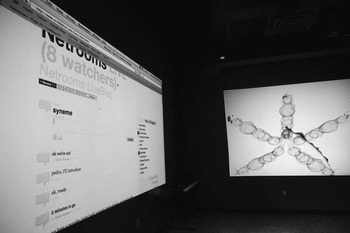
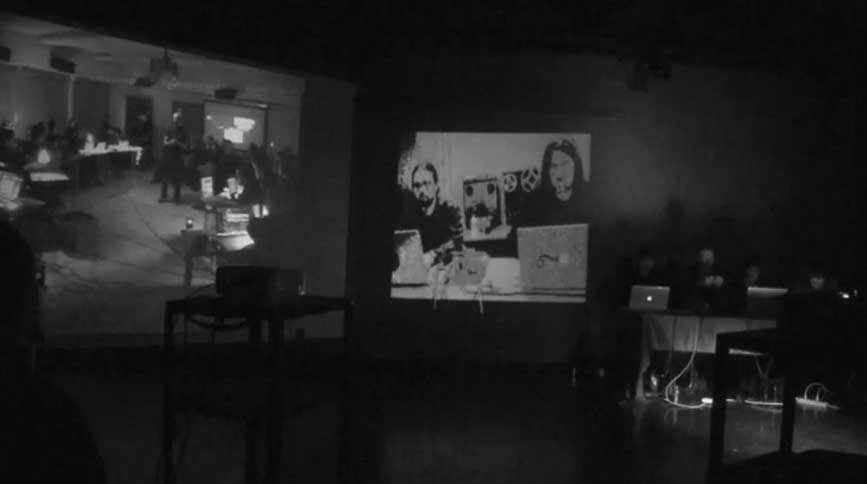
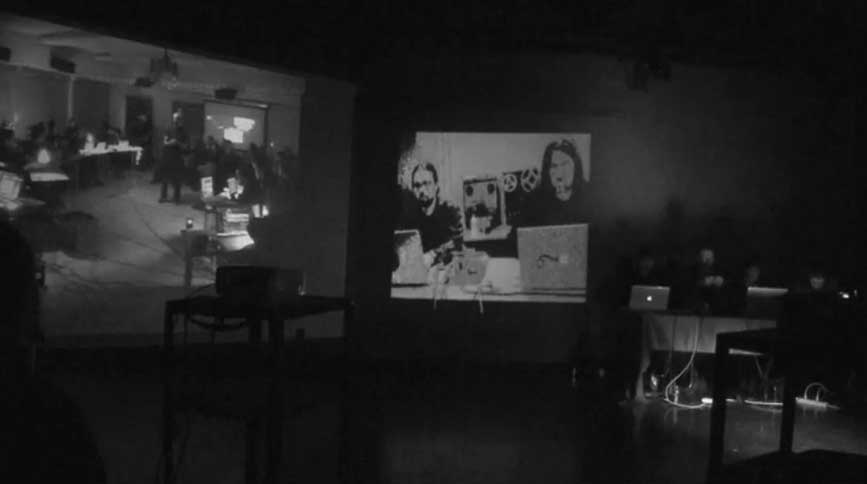
Netrooms, by Pedro Rebelo (SARC) is a mature and often performed work that mixes multiple remote audio signals together at the site of the performance. This iteration of Netrooms experimented with remote ambisonics, encoding a six-channel signal in real-time and sending it to to Calgary. SARC's speakers were matched to Syneme's in order to duplicate SARC's mix as closely as possible. Furthermore, a visualisation/representation of the performer network was sent to Syneme using VLC (figure 5).
Netrooms performance with visualisation in Calgary.

Nou Ri Lang, by Zhang Xiaofu (Beijing) was a logistically and compositionally challenging piece using four percussion players in four cities, accompanied by an electroacoustic track from Beijing. Zhang solved the problem of metric multiplicities through an orchestration strategy in which the players were assigned solo roles in four sections while the rest of the players played ambient percussion behind the soloist.
8. Syneme Summer Workshop
Syneme has held two summer workshops (Syneme Summer). In July 2010, the workshop resulted in a distributed production entitled Treasure Book. In a distributed production, ‘each node retains authorship while contributing specific content and expertise to a shared production’ (Rebelo Reference Rebelo2009: 391). Syneme's role was to shape the hugely diverse contributions: a dancer in Hong Kong wearing a body motion capture suit whose data was converted to OSC and sent to Calgary (application written by Wang Ke), live Skype poetry readings organised by Clair Huot and Robert Majzels, music by Ian Whalley in New Zealand with time-delayed (8 hours) ‘recursions’ by Curtis McKinney (see below), video by Ellen Pearlman, Max/Jitter video display patch by Raj Gil, and recorded erhu sections by Yu Hongmei.
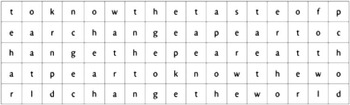
As Huot and Majzels write, ‘In this visual text work, excerpts from The Bible and Chairman Mao's Book of Quotations have been translated into 85 English letters aligned equidistantly, without spaces between words or punctuation, as they would be in classical Chinese and ancient Hebrew [figure 6]. The visual texts are then displayed over the net and read by viewers in real-time over Skype.’Footnote 1
Mao Ze Dong, ‘The Taste of Pear’ (from Treasure Book).

RecursionNet: Automated Jacktrip Feedback Loops by Curtis McKinney (Bournemouth) is a system ‘designed for creating and manipulating dynamic audio feedback loops over a network. The system allows users to seamlessly and automatically connect to each other in a group and to create OSC and audio networks without having to manually setup connections.’Footnote 2 This piece created an engaging improvisational scenario. As a strategy to incorporate parts from extremely divergent timezones, we performed and recorded RecursionNet in the morning with Bournemouth and in the evening played back the recording in Calgary as an input to Whalley's system in New Zealand.
9. Musicacoustica 2010
Musicacoustica 2010 was a collaboration between Syneme in Calgary, the University of Waikato's Interactive Music Project (IMP) in New Zealand and CEMC in Beijing. Whalley's piece, Mittsu No Yugo, explored ‘sound-based composition/performance/machine agent approaches to composition that are suited to Internet2 music making, while considering and exploring the juxtaposition and synthesis of regional aesthetics in the creation of new works’ (from programme notes). The piece is fully described by the composer elsewhere in this issue.
Grid, by Ken Fields, was a (pseudo-)demonstration of distributed grid audio computation. Though not running a properly distributed job over XGrid, we ran eight Supercollider audio servers on an eight-core computer in Calgary controlled by a TouchOSC interface in Beijing. The eight Supercollider instruments were computationally demanding and were meant to push as much of the available CPU resources as possible. A solo laptop improvisation was performed over this massive multi-channel sonic palette streamed back to Beijing over IPV6. The laptop improvisation used the Freesound download code written by Josh Parmenter (Reference ParmenterParmenter n.d.). Using specific search criteria (duration, sample rate, channels, tag) I loaded samples into a buffer and mixed, scratched and looped them with the Apple MacBook Pro touch-pad using Parmenter's FingerNeedle application.
10. NetTets 2011
NetTets 2011 was performed at the University of Calgary. Featured was CanDLE (Canadian Distributed Laptop Ensemble), consisting of three laptop ensembles in Montreal, Calgary and Edmonton, each location mixing two to twenty musicians down to stereo channels. Calgary occupied channels 1 and 2 (performing word/phrase-length sounds); Montreal was routed to channels 3 and 4 (performing drone sounds) and Edmonton was routed to channels 5 and 6 (performing short/click sounds). This is an affective compositional technique for distinguishing between the divers origination of geo-distributed sound (figure 7).
First performance of CanDLE: Canada Distributed Laptop Ensemble.
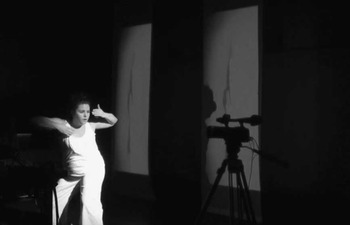
Nuclear Sweet, by Ellen Pearlman and Raj, Gill explored live motion-capture of a dancer which controlled both a Max/MSP granular synthesis patch and an Isadora video patch. Many of Pearlman's experiments are oriented toward finding an optimal mapping/language of body gesture to remote parametric control of audio/visual effects. The dancer improvised bodily/sonically with Scott Deal on vibraphone in Indiana (figure 8).
Nuclear Sweet by Ellen Pearlman. Programmer: Raj Gill. Dancer: Jennifer Manhood.

11. Conclusion
Syneme has developed a tele-media arts studio prioritising next-generation IPV6 connectivity. We have gained practical experience in network music performance as well as collaborative design processes. The net works that Syneme has pursued tend toward experimentation with prototypes of network music practice: parametric dependencies, grid computing, network sonification, gesture control of remote effects. In general, the role of the network is indispensable in the construction of the musical effect. We have favoured embodied, improvisational and phenomenological methods in the exploration of an aesthetics of presence through the materialities of communication as embedded in chronotopic heterogenity. The techniques that we have found most conducive to successful works involve cultivating multiplicity and openness.
Circuitously, through Gumbrecht, Bakhtin and back to the Bulgakov quoted at the top of this article, we arrive at a formulation: the syneme is the signal itself, the energy of the communication. Applying this ideal would allow that high transfer rates of data need not necessarily serve the ‘illusion of non-mediation’ as in virtual reality or impeccable tele-presence, but could allow for the intimate revelation of the occasional lost packet. Such an approach to network aesthetics might then emphasise the network glitches (zipping) and empty buffer artefacts created by small buffer settings as a key feature promoting an appreciation of the live/unpredictable state of the network.
WEBSITES
All accessed May 2011.
Access Grid. http://www.accessgrid.org.
Arthron. Grupo de Trabalho em Mídias Digitais e Artes. http://www.lavid.ufpb.br/gtmda/arthron.html.
CANARIE. http://canarie.ca.
CERNET2. http://www.edu.cn/cer2_1556/20060323/t20060323_158675.shtml.
EMSAN. Electroacoustic Studies Asian Network. http://omf.paris-sorbonne.fr/EMSAN.
IP version 6. http://playground.sun.com/ipv6.
JACK. Jack Audio Connection Kit. http://jackosx.com.
Jacktrip. https://ccrma.stanford.edu/groups/soundwire/software/jacktrip.
MARCEL. Multimedia Art Research Centers and Electronic Laboratories. http://www.mmmarcel.org.
Mendeley: Network Music Bibliography. http://www.mendeley.com/groups/549251/network-music.
Netrooms. http://www.somasa.qub.ac.uk/~prebelo/netrooms.
OPO. Online Presence Ontology. http://online-presence.net.
OSC. Open Sound Control. http://opensoundcontrol.org.
OSCgroups. http://www.rossbencina.com/code/oscgroups.
Scenic. http://scenic.sat.qc.ca/en/Scenic.
Status Net. http://status.net.
Stremes. http://syneme.ucalgary.ca:8080.
Syneme. http://syneme.ucalgary.ca.
Syneme Summer Workshop. http://syneme.ucalgary.ca/synemesummer.
Telemediations. Exploring aesthetic paradigms in hybrid ecologies. http://www.eba.ufrj.br/ppgav/nano/telemediacoes.
TouchOSC. http://hexler.net/software/touchosc.
Weaver, Sarah. http://www.sarahweaver.org.
XMPP. Extensible Messaging and Presence Protocol. http://xmpp.org/about-xmpp/history.