


Introduction
To reverse biodiversity loss, we need to assess the conservation status of species and implement conservation interventions (Brooks et al., Reference Brooks, Mittermeier, Da Fonseca, Gerlach, Hoffmann and Lamoreux2006; Stephenson & Stengel, Reference Stephenson and Stengel2020). Assessment must be repeated periodically to evaluate the effectiveness of management actions and to allow us to amend them when necessary (Westgate et al., Reference Westgate, Likens and Lindenmayer2013). In this context, Red Lists are valuable conservation tools because they categorize species and populations according to their risk of extinction and track any change in status over time (Raimondo et al., Reference Raimondo, Young, Brooks, Cardoso, Van Der Colff and De Souza Dias2023).
Since 1964, the IUCN Red List of Threatened Species has provided periodical evaluations of the conservation status of species at a global scale. Within this framework, thousands of specialists carry out diagnoses using standardized criteria (IUCN, 2012a, 2024). Given its extensive geographical coverage and the global range of species analysed (c. 169,000 species in version 2025-1), the IUCN Red List is an informative tool (Hochkirch et al., Reference Hochkirch, Bilz, Ferreira, Danielczak, Allen and Nieto2023; Raimondo et al., Reference Raimondo, Young, Brooks, Cardoso, Van Der Colff and De Souza Dias2023) that identifies areas that are important or vulnerable because of the rarity or endemicity of the species they host (Nania et al., Reference Nania, Ficetola, Falaschi, Pacifici, Lumbierres and Rondinini2024), and highlights species and taxonomic groups with insufficient information (Hochkirch et al., Reference Hochkirch, Samways, Gerlach, Böhm, Williams and Cardoso2021). As a result, it contributes to the prioritization of actions for protecting biodiversity (Rodrigues et al., Reference Rodrigues, Pilgrim, Lamoreux, Hoffmann and Brooks2006; Betts et al., Reference Betts, Young, Hilton-Taylor, Hoffmann, Rodríguez, Stuart and Milner-Gulland2020).
The IUCN Species Survival Commission (SSC) created National Species Specialist groups in 2021 as part of the 2020–2025 Action Plan. National Species Specialist Groups aim to ‘…bring together efforts at the national level to collaborate in making the best decisions to achieve biodiversity conservation based on the best scientific knowledge available. Their main purpose is not to work with any particular biological group but to help or contribute with other SSC Groups to generate products appropriate to the reality of each country’ (IUCN SSC, 2024).
With > 500,000 km2 of land area, one million km2 of marine exclusive economic zone and almost 50 million inhabitants, Spain requires special conservation attention given its location within a biodiversity hotspot (Myers et al., Reference Myers, Mittermeier, Mittermeier, Da Fonseca and Kent2000; Fig. 1). The IUCN SSC Spain Species Specialist Group, the first national specialist group in Europe, was officially constituted in February 2024 (Cano-Alonso et al., Reference Cano-Alonso, Acedo, Almunia, Bellido, Calmaestra and Tellería2024). It is a science-based network of volunteer experts with a mission to ‘conserv[e] nature through providing scientific knowledge, conservation expertise and positive action to both prevent the loss and aid recovery of the diversity of life on the land, freshwaters and marine waters under the jurisdiction of the Spanish State’ (IUCN SSC Spain SSG, 2023). Among its key outputs, the Spain Species Specialist Group is committed to developing a monitoring programme that will contribute to increasing the number of species assessed on the IUCN Red List, as well as suggesting legal and management changes through the channels of participation provided by Spanish and European legislation. The backbone of this monitoring programme is to promote, supervise and manage an IUCN National Red List Programme (National Red List Working Group, 2024) in accordance with the IUCN Red List criteria at regional and national levels (IUCN, 2012b) for non-endemic species and IUCN Red List categories and criteria (IUCN, 2012a) for endemic species. The group currently comprises c. 150 specialists from 14 scientific societies and associations who have expressed an interest in participating at an institutional level. Additionally, new groups of specialists have formed ad hoc to evaluate the conservation status of lesser-known species (e.g. spiders and cave invertebrates; Table 1). This has also led to the inclusion of other Spanish specialists as assessors for the IUCN Red List. This is part of the collaboration and coordination undertaken with those responsible for the IUCN Red List and the regional Red Lists for Europe and the Mediterranean.
The ecoregions of Spain, including mainland terrestrial and freshwater ecoregions of the Iberian Peninsula and the Canary and Balearic Islands, and marine ecoregions. Terrestrial ecoregions follow Dinerstein et al. (Reference Dinerstein, Olson, Joshi, Vynne, Burgess and Wikramanayake2017) and marine ecoregions follow Spalding et al. (Reference Spalding, Fox, Allen, Davidson, Ferdaña and Finlayson2007). (Readers of the printed journal are referred to the online article for a colour version of this figure.)

Taxonomic working groups of the IUCN Spain Species Specialist Group, and the relevant scientific society or association. All internet links were correct as of September 2026.

Table 1 Long description
A table with two columns and multiple rows. The first column lists taxonomic working groups under categories of Fauna, Flora, and Funga, including specific groups like Amphibians & reptiles, Birds, Fishes, Algae, Bryophytes, and Lichens. The second column lists the corresponding scientific society or association for each group, with some entries including URLs. The table also includes a section for ad hoc working groups such as Cave invertebrates, Spiders, Marine mammals, and Sharks, rays & chimaeras without associated societies listed.
Here, we discuss the background to the process, knowledge gaps and the capacity to address them, and how to collaborate most effectively with other partners and the Spanish administration for effective biodiversity conservation.
The Master List Of Wild Species occurring in Spain
Knowing which species occur in Spain is important for two reasons. Firstly, it allows these species to be considered legally for conservation purposes. Secondly, this information can help correct biases in species monitoring because of taxonomy, geographical distribution or habitat preferences. However, such information is often difficult to obtain for poorly studied taxonomic groups, for which the occurrence of certain species and, more rarely, the existence of previously undiscovered species, remains uncertain, and for which knowledge of geographical distribution is incomplete. These limitations are commonly referred to as the Wallacean and Linnaean shortfalls, respectively (Brown & Lomolino, Reference Brown and Lomolino1998). Spain has a Master List of Wild Species, which was compiled by the Ministry for Ecological Transition and the Demographic Challenge with the collaboration of experts and societies (MITECO, 2017; revised in 2020). We have begun to update this list, considering taxonomic changes, and descriptions of new species, as the availability of taxonomic specialists allows. Our initial revision of the Master List (63,981 species, excluding non-native species and infraspecies, as of 1 July 2025) detected a further 3,328 additional native species as a result of the incorporation of data from previously neglected groups. This tentative assessment of Spain’s taxonomic diversity reveals that the most abundant phyla are arthropods, vascular plants, molluscs, fungi and chordates (Fig. 2). However, we believe this is an incomplete estimate of the number of species present in Spain from the most diverse groups. For example, a review of the number of new species discovered in Spain during the last 10 years shows that numerous vascular plants, insects and molluscs are still being discovered (Supplementary Material 1).
Relationship between the number of species per Phylum recorded in the Master List of Species of Spain and their presence in the List of Species under the Special Protection Regime (LSSPR) and in the IUCN Red List of Threatened Species (RLTS) version 2025-01. Only species of the 20 most diverse phyla assessed as Vulnerable, Endangered or Critically Endangered since 2016 on the IUCN Red List are represented. Non-native species and infraspecies are excluded. Unlisted refers to species that are not protected in the Spanish Catalogue of Threatened Species (see main text for an explanation of the relationship between the List of Species under the Special Protection Regime and the Spanish Catalogue of Threatened Species) and are not categorized on the IUCN Red List as threatened (i.e. Critically Endangered, Endangered or Vulnerable), and have been assessed since 2016.

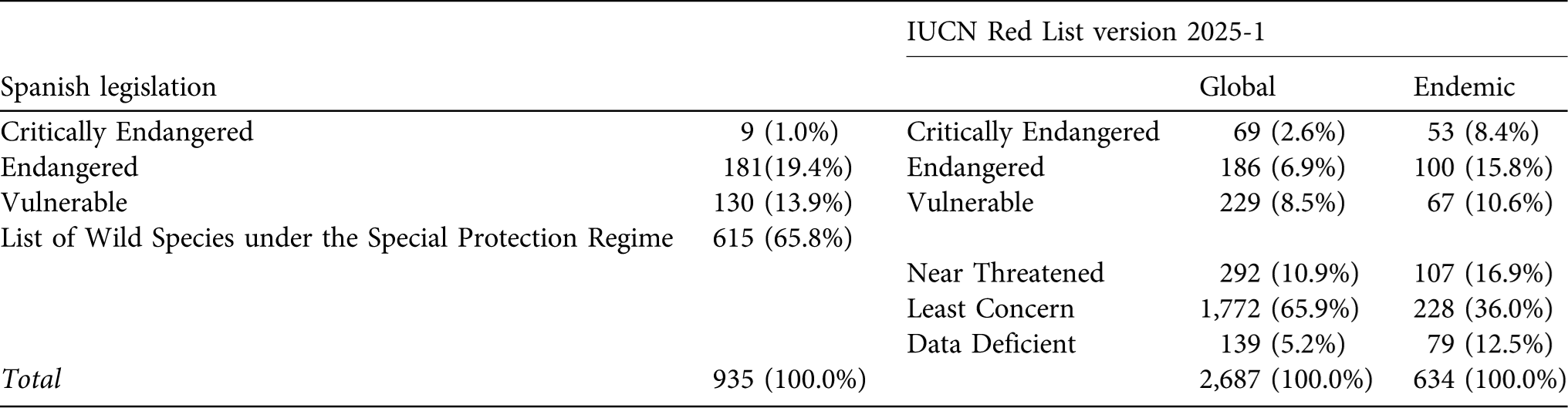
With respect to species conservation, Spain has two complementary catalogues maintained within a single database and regulated under the same legislative framework. The List of Wild Species under the Special Protection Regime (commonly referred to as LESRPE species) includes species that require legal protection because of conservation concerns but do not meet the criteria for inclusion on the second list, the Spanish Catalogue of Threatened Species. Inclusion on the List of Wild Species under the Special Protection Regime helps to conserve species’ habitats and prevents their capture, and is therefore a first level of conservation. The Spanish legal and technical framework has a protocol for the evaluation of species for inclusion in the Spanish Catalogue of Threatened Species (Resolution Law of 6 March, 2017). This protocol is based on a modification of the IUCN Red List criteria (extinct species are not considered, and Data Deficient species can be included as special protected species; Table 2).
Comparison of the number of species (and per cent) in Spanish legislation (i.e. Critically Endangered, Endangered or Vulnerable species in the Spanish Catalogue of Threatened Species, and specially protected species in the List of Wild Species under the Special Protection Regime) and in the IUCN Red List assessed from 2016 to date. Species categorized as Extinct and Extinct in the Wild in the IUCN Red List are excluded here.

Table 2 Long description
The table compares the number of species and their percentages under Spanish legislation and the IUCN Red List. It has two main sections: Spanish legislation and IUCN Red List version 2025-1. The Spanish legislation section includes categories like Critically Endangered, Endangered, Vulnerable, and List of Wild Species under the Special Protection Regime. The IUCN Red List section includes categories like Critically Endangered, Endangered, Vulnerable, Near Threatened, Least Concern, and Data Deficient. Each category lists the number of species and their percentages. The table has 7 rows and 5 columns. Row 1: Critically Endangered, 9 (1.0 percent), Critically Endangered, 69 (2.6 percent), 53 (8.4 percent). Row 2: Endangered, 181 (19.4 percent), Endangered, 186 (6.9 percent), 100 (15.8 percent). Row 3: Vulnerable, 130 (13.9 percent), Vulnerable, 229 (8.5 percent), 67 (10.6 percent). Row 4: List of Wild Species under the Special Protection Regime, 615 (65.8 percent), Near Threatened, 292 (10.9 percent), 107 (16.9 percent). Row 5: Total, 935 (100.0 percent), Least Concern, 1,772 (65.9 percent), 228 (36.0 percent). Row 6: Data Deficient, 139 (5.2 percent), 79 (12.5 percent). Row 7: Total, 2,687 (100.0 percent), 634 (100.0 percent).
The List of Species under the Special Protection Regime includes species that, in accordance with EU regulations and international conventions signed and ratified by Spain, require special protection, and also species deserving special attention and protection because of their scientific, ecological or cultural value, uniqueness, rarity or degree of threat. The Spanish Catalogue of Threatened Species includes species categorized as either Vulnerable or Endangered, for which specific conservation and recovery measures are legally required. In addition, there is an exceptional conservation category that elevates the status of certain species from Endangered to Critically Endangered (Natural Heritage and Biodiversity Law 42/2007; Table 2). These species do not appear under this category within the catalogue itself (where they remain listed as Endangered), but are instead included in a separate section. From 2018 to the present, nine species or subspecies have been given this legal consideration (one plant: Cistus heterophyllus subsp. carthaginensis; two molluscs: Margaritifera auricularia and Pinna nobilis; two mammals: Mustela lutreola and Galemys pyrenaicus; four birds: Lanius minor, Marmaronetta angustirostris, Tetrao urogallus cantabricus and Fulica cristata).
The List of Species under the Special Protection Regime and in the Spanish Catalogue of Threatened Species are updated by agreements of regional and state administrations, based on scientifically justified proposals from the administration, associations or citizens, and provide special legal protection for all the species considered, explicitly enforcing the creation of recovery or conservation plans for all those included in the Spanish Catalogue of Threatened Species. Scientific reports from an independent scientific committee are considered in the updating process, although they are not binding.
A comparison of the species included in the List of Species under the Special Protection Regime and the Spanish Catalogue of Threatened Species on 1 July 2025 with our revised Master List (Supplementary Material 2) indicates that the number of species in the Special Protection Regime (935) accounts for 1.5% of the 63,981 species recorded to date (Fig. 2), and that there is a marked taxonomic bias, with an abundance of vascular plants and vertebrates, a scarcity of arthropods or molluscs, and a lack of many other groups that do not include any protected species (Fig. 2; see Supplementary Material 3 for further details). The List of Species under the Special Protection Regime and the Spanish Catalogue of Threatened Species are not therefore an accurate reflection of the conservation status of species in Spain. This limitation is likely attributable to the criteria for inclusion, which require prior evidence of an unfavourable conservation status (The Spanish Catalogue of Threatened Species List Resolution Law of 6 March 2017). As a result, extending legal protection to lesser-known taxonomic groups or to those with poorly documented populations is challenging. Furthermore, the exclusion of non-threatened species from the Spanish Catalogue of Threatened Species hinders a comprehensive assessment of the conservation status of Spanish biodiversity, particularly analyses of the proportion of threatened species across taxonomic groups and habitats, and according to other relevant factors.
Spanish species on the IUCN Red List
The IUCN Red List is not just a list, nor does it concern only threatened species. Rather, it is a database with extensive information on all animals, fungi and plants, categorized according to their extinction risk (IUCN, 2025). This approach lays the foundation for monitoring by considering species that are not currently threatened but may become so in the future, as well as others that may recover, decreasing their risk of extinction, or those that become more threatened. It also includes Data Deficient species, highlighting those for which information required to assess their risk of extinction is absent or uncertain (Table 2). This provides diagnostic capacity by quantifying any trends of threatened species, as well as advances in knowledge of the various taxonomic groups.
Only 2,687 species on the Spanish Master List of Wild Species have been assessed on the IUCN Red List, a small and taxonomically biased sample of the species present in the country (4.2%; Fig. 2). Therefore, the information provided by the IUCN Red List on the conservation status of Spanish species suffers from biases that should be mitigated through a strategic selection of taxonomic groups for monitoring. Additionally, there is a difference between the species included in the List of Special Protection Regime and the Spanish Catalogue of Threatened Species and those identified as threatened in the IUCN Red List (i.e. those categorized as Critically Endangered, Endangered or Vulnerable; Table 2). Of the 1,322 species included in these lists, only 97 (7.3%) are present in both (Supplementary Fig. 2.1): 484 species at risk according to the IUCN Red List are not included in the List of Wild Species under the Special Protection Regime and the Spanish Catalogue of Threatened Species. Similarly, when comparing endemic species, only 41 (8.8%) of 464 species are included in both lists (Supplementary Fig. 2.2). Discrepancies between national and global Red Lists have also been highlighted in other countries, and thus merit further attention (Rodríguez et al., Reference Rodríguez, Ashenfelter, Rojas-Suárez, García Fernández, Suárez and Dobson2000), including efforts to standardize criteria and achieve consistency in assessments at the global, regional and national levels (Hilton-Taylor et al., Reference Hilton-Taylor, Mace, Capper, Collar, Stuart and Bibby2000).
These limitations allow us to identify five main goals for the Spain Species Specialist Group. Firstly, the taxonomic spectrum of the species covered needs to be broadened to provide a more complete picture of the conservation status of Spanish biodiversity (Cardoso et al., Reference Cardoso, Erwin, Borges and New2011). Secondly, the analyses should not be restricted to rare or well-known species, because including Least Concern and Data Deficient species is key to understanding conservation trends and the quality of the information covered (Bachman et al., Reference Bachman, Field, Reader, Raimondo, Donaldson, Schatz and Lughadha2019). Thirdly, the Spain Species Specialist Group, and specifically the national Red List team, should encourage the analysis of all species included in the List of Special under Protection Regime and the Spanish Catalogue of Threatened Species. Fourthly, as Spain is within one of the 25 global biodiversity hotspots and is one of the most biodiverse countries in the EU (SCBD, 2007), there is a need to prioritize monitoring of Spanish species, especially those that are endemic, given that their conservation depends on national legal and management decisions (Kraus et al., Reference Kraus, Enns, Hebb, Murphy, Drake and Bennett2023). Fifthly, monitoring of isolated populations at the limit of their distribution area or restricted to islands should not be neglected, because of their high vulnerability to global change (Hampe & Petit, Reference Hampe and Petit2005).
Spain Species Specialist Group capabilities: knowledge asymmetries
Taxonomic biases in the conservation assessment of the List of Special Protection Regime and the Spanish Catalogue of Threatened Species and the Red List ultimately indicate an inability to assess lesser-known or taxonomically more complex groups because of a lack of data and/or expertise. Linnean and Wallacean shortfalls are a general problem (Bachman et al., Reference Bachman, Field, Reader, Raimondo, Donaldson, Schatz and Lughadha2019) and manifest differently in each country (Cortés-Fossati et al., Reference Cortés-Fossati, Caro-Miralles, Barreda, Caballero-López, Castro and Cuadrado2025) depending on the strength of its scientific institutions and, for the most accessible and popular groups, on the contributions of citizen science (Chandler et al., Reference Chandler, See, Copas, Bonde, López and Danielsen2017). The formation of a group to promote the National Red List of Threatened Species in Spain criteria requires an initial assessment of its capabilities.
To understand the capabilities of the Spain Species Specialist Group (Table 1), we conducted a survey to determine the number of native, endemic and new species described in Spain since 2016, and the number of Spanish specialists who can contribute to the work of the Spain Species Specialist Group. This approach allowed us to quantify the complexity of the objectives (number of species, newly described species and endemicity) and our capacity to address them (number of specialists). Additionally, to evaluate the accessibility of information suitable to apply the IUCN Red List categories and criteria (Cazalis et al., Reference Cazalis, Di Marco, Zizka, Butchart, González-Suárez and Böhm2024), we obtained the georeferenced records in Spain since 2016 from the Global Biodiversity Information Facility (GBIF, 2025). Although some of the groups consulted did not answer our questions fully or only reported on a few well-known taxa, the datasets resulting from this survey allowed us to identify some general patterns (Fig. 3).
Capability of the Spanish scientific system to evaluate some species groups using the IUCN Red List criteria. The y-axis shows the number of Global Biodiversity Information Facility (GBIF) georeferenced records available from 2016 to date, divided by the number of species present in Spain. The x-axis shows the number of specialists per species (× 100), as reported in the survey of the Spain Species Specialist Group (Supplementary Material 4). Species groups in the most and least favourable situations are highlighted by the shaded rectangles.

Despite high variability, groups with the greatest number of species had the highest number of new species, endemic species and specialists, and more records in the Global Biodiversity Information Facility (Supplementary Material 4, Supplementary Table 4, Supplementary Fig. 4). To visualize any differences between taxonomic groups in the monitoring of their focal species, we calculated the number of researchers per species and the number of Global Biodiversity Information Facility records per species. The results show that terrestrial vertebrates and butterflies are the groups with the greatest number of scientists per species and the greatest amount of information in the Global Biodiversity Information Facility. In contrast, the limited availability of data and the relatively small number of researchers working on other insects, molluscs, bryophytes, algae and spiders presents significant challenges for assessing the conservation status of these groups (Fig. 3). Whereas the best-known groups (birds and butterflies) benefit from specific monitoring programmes in Spain and Europe (Moersberg et al., Reference Moersberger, Valdez, Martin, Junker, Georgieva and Bauer2024) that enhance and update knowledge about population trends, most other taxonomic groups continue to grapple with the Linnaean shortfall. This is the case for insects other than butterflies (a minimum of 359 new species in Spain from 2016, according to our survey; Supplementary Table 1), vascular plants (> 236) and molluscs (214; Supplementary Material 1, Supplementary Table 1). Ultimately, these results reveal significant differences in the ability of working groups under the Spain Species Specialist Group to assess the conservation status of Spanish species. This lack of experts in many groups results in a lack of taxonomic literature, making it difficult to identify species or for students and scientists to (self-)train. It is important to correct these biases in conservation priorities in Spain, which ignore many taxonomic groups despite their phylogenetic uniqueness, scarcity or key role in ecosystems (Martín-López et al., Reference Martín-López, Martín-Forés, González and Montes2011; Gerlach et al., Reference Gerlach, Samways, Hochkirch, Seddon, Cardoso and Clausnitzer2014).
The IUCN National Red List in Spain as a monitoring programme
The limitations described above should not hinder or prevent the development of a National Red List. In this context, the aim is not to catalogue as many species as possible while overlooking the effective conservation of Spanish biodiversity, as this would be like ‘counting books while the library burns’ (Lindenmayer et al., Reference Lindenmayer, Piggott and Wintle2013). We should avoid working on a large species catalogue that lacks diagnostic value. This could be achieved by using a sampled Red List Index approach, an indicator of the average extinction risk of groups of species that reflects their trends through time (Butchart et al., Reference Butchart, Akçakaya, Berryman, Brooks, Burfield and Chanson2025). Thus, in addition to including the global targets established for the IUCN Red List, we propose to set our own targets as part of the Species Conservation Cycle (Rodríguez et al., Reference Rodríguez, Sucre, Mileham, Sánchez-Mercado, De Andrade and Bezeng2022). To this end, for 2026–2029 we propose focusing on the assessment of a minimum number of species per group, selected by experts, which will form the basis for an IUCN National Red List periodic monitoring programme in Spain (Henriques et al., Reference Henriques, Böhm, Collen, Luedtke, Hoffmann and Hilton-Taylor2020). This database, arranged by habitat (e.g. freshwater, marine, mountain, forest, caves), geographical area (Mediterranean, Eurosiberian, Macaronesian), ecosystem process (e.g. pollination, seed dispersal) and threat (e.g. urban development, pollution, poaching and collecting), will enable us to monitor changes in the conservation status of the ecosystems in which species are found and suggest appropriate management measures.
The Spain Species Specialist Group aims to work towards ‘conserving nature through providing scientific knowledge, conservation expertise and positive action to both prevent the loss and aid recovery of the diversity of life on the land, freshwaters and marine waters under the jurisdiction of the Spanish State’ (IUCN SSC Spain SSG, 2023), and this includes contributing to biodiversity conservation by collaborating with the Spanish administration through the established legal framework. We also aim to contribute to maintaining, updating and extending the global work carried out for the IUCN Red List, including the regional assessments undertaken for Europe and the Mediterranean. The Spain Species Specialist Group can contribute to the identification of species to be proposed for inclusion in the List of Special Protection Regime and the Spanish Catalogue of Threatened Species. It can also increase the amount of information generated by the 6-yearly reports submitted by each EU member state on the conservation status of species of community interest and species subject to special conservation measures included in the annexes of the Birds and Habitats Directives. Similarly, IUCN can advance its global mission by relying on the Spain Species Specialist Group and its experts to assess populations of Spanish species, in particular those that are endemic.
The capacity for action of the Spain Species Specialist Group will depend on the strength of the Spanish scientific system in training and supporting specialists, in particular for the most complex taxonomic groups. This will require national scientific policy that acknowledges the need to advance taxonomic and ecological knowledge, and technical and financial support from both the Species Survival Commission and the Spanish administration. The approach of the Spain Species Specialist Group, as outlined here, could be replicated in other countries through the new national specialist groups of the IUCN Species Survival Commission.
Supplementary material
The supplementary material for this article is available at doi.org/10.1017/S0030605326103627
Author contributions
Study design: JLT, data collection: JLT, CA, MAF, AAL, MM, R Martínez, R Miranda, PR, P Oromí, P Ondina, JQ, BAB, EA-S, M Altamirano, M Arnedo, JRAB, EAL, CB, AIC, RDC-P, AICG, OdP, DD, ED, EG, JG, BJGM, JHC, NH, DJ, DJA, ML-D, ALG, NMH, AM-O, IM-S, JMC, NR, J Reis, J Román, EJR-R, HR, CR, CA, CS, PS-B; data analysis: JLT, PG, LSC-A; writing: all authors.
Acknowledgements
We thank Catherine Numa, Caroline Pollock, Domitilla Raimondo, Neil Cox and Sophie Ledger for their support in establishing the National Red List for Spain; Javier Palomo, Javier Calzada, Juan Herrera and Jorge Tobajas for their contributions to the assessments of terrestrial mammals; John Lawrence Muddeman for reviewing this text; and Craig Hilton-Taylor and an anonymous reviewer for their insightful comments and corrections. The Spain Species Specialist Group thanks the Spanish IUCN Committee for their support and collaboration throughout the development of this research. This research received no specific grant from any funding agency, or commercial or not-for-profit sectors.
Conflicts of interest
None.
Ethical standards
This research abided by the Oryx guidelines on ethical standards.
Data availability
The data that support the findings of this study are openly available at figshare.com/s/6e50694cfef8faea8d79.




 Open access

