


%20--%3e%3c!DOCTYPE%20svg%20PUBLIC%20'-//W3C//DTD%20SVG%201.0//EN'%20'http://www.w3.org/TR/2001/REC-SVG-20010904/DTD/svg10.dtd'%3e%3csvg%20version='1.0'%20id='Layer_1'%20xmlns='http://www.w3.org/2000/svg'%20xmlns:xlink='http://www.w3.org/1999/xlink'%20x='0px'%20y='0px'%20width='64px'%20height='64px'%20viewBox='5.5%20-3.5%2064%2064'%20enable-background='new%205.5%20-3.5%2064%2064'%20xml:space='preserve'%3e%3cg%3e%3ccircle%20fill='%23FFFFFF'%20fill-opacity='0'%20cx='37.785'%20cy='28.501'%20r='28.836'/%3e%3cpath%20fill='%23595959'%20d='M37.441-3.5c8.951,0,16.572,3.125,22.857,9.372c3.008,3.009,5.295,6.448,6.857,10.314%20c1.561,3.867,2.344,7.971,2.344,12.314c0,4.381-0.773,8.486-2.314,12.313c-1.543,3.828-3.82,7.21-6.828,10.143%20c-3.123,3.085-6.666,5.448-10.629,7.086c-3.961,1.638-8.057,2.457-12.285,2.457s-8.276-0.808-12.143-2.429%20c-3.866-1.618-7.333-3.961-10.4-7.027c-3.067-3.066-5.4-6.524-7-10.372S5.5,32.767,5.5,28.5c0-4.229,0.809-8.295,2.428-12.2%20c1.619-3.905,3.972-7.4,7.057-10.486C21.08-0.394,28.565-3.5,37.441-3.5z%20M37.557,2.272c-7.314,0-13.467,2.553-18.458,7.657%20c-2.515,2.553-4.448,5.419-5.8,8.6c-1.354,3.181-2.029,6.505-2.029,9.972c0,3.429,0.675,6.734,2.029,9.913%20c1.353,3.183,3.285,6.021,5.8,8.516c2.514,2.496,5.351,4.399,8.515,5.715c3.161,1.314,6.476,1.971,9.943,1.971%20c3.428,0,6.75-0.665,9.973-1.999c3.219-1.335,6.121-3.257,8.713-5.771c4.99-4.876,7.484-10.99,7.484-18.344%20c0-3.543-0.648-6.895-1.943-10.057c-1.293-3.162-3.18-5.98-5.654-8.458C50.984,4.844,44.795,2.272,37.557,2.272z%20M37.156,23.187%20l-4.287,2.229c-0.458-0.951-1.019-1.619-1.685-2c-0.667-0.38-1.286-0.571-1.858-0.571c-2.856,0-4.286,1.885-4.286,5.657%20c0,1.714,0.362,3.084,1.085,4.113c0.724,1.029,1.791,1.544,3.201,1.544c1.867,0,3.181-0.915,3.944-2.743l3.942,2%20c-0.838,1.563-2,2.791-3.486,3.686c-1.484,0.896-3.123,1.343-4.914,1.343c-2.857,0-5.163-0.875-6.915-2.629%20c-1.752-1.752-2.628-4.19-2.628-7.313c0-3.048,0.886-5.466,2.657-7.257c1.771-1.79,4.009-2.686,6.715-2.686%20C32.604,18.558,35.441,20.101,37.156,23.187z%20M55.613,23.187l-4.229,2.229c-0.457-0.951-1.02-1.619-1.686-2%20c-0.668-0.38-1.307-0.571-1.914-0.571c-2.857,0-4.287,1.885-4.287,5.657c0,1.714,0.363,3.084,1.086,4.113%20c0.723,1.029,1.789,1.544,3.201,1.544c1.865,0,3.18-0.915,3.941-2.743l4,2c-0.875,1.563-2.057,2.791-3.541,3.686%20c-1.486,0.896-3.105,1.343-4.857,1.343c-2.896,0-5.209-0.875-6.941-2.629c-1.736-1.752-2.602-4.19-2.602-7.313%20c0-3.048,0.885-5.466,2.658-7.257c1.77-1.79,4.008-2.686,6.713-2.686C51.117,18.558,53.938,20.101,55.613,23.187z'/%3e%3c/g%3e%3c/svg%3e)
%20--%3e%3c!DOCTYPE%20svg%20PUBLIC%20'-//W3C//DTD%20SVG%201.0//EN'%20'http://www.w3.org/TR/2001/REC-SVG-20010904/DTD/svg10.dtd'%3e%3csvg%20version='1.0'%20id='Layer_1'%20xmlns='http://www.w3.org/2000/svg'%20xmlns:xlink='http://www.w3.org/1999/xlink'%20x='0px'%20y='0px'%20width='64px'%20height='64px'%20viewBox='5.5%20-3.5%2064%2064'%20enable-background='new%205.5%20-3.5%2064%2064'%20xml:space='preserve'%3e%3cg%3e%3ccircle%20fill='%23FFFFFF'%20fill-opacity='0'%20cx='37.637'%20cy='28.806'%20r='28.276'/%3e%3cg%3e%3cpath%20fill='%23595959'%20d='M37.443-3.5c8.988,0,16.57,3.085,22.742,9.257C66.393,11.967,69.5,19.548,69.5,28.5c0,8.991-3.049,16.476-9.145,22.456%20C53.879,57.319,46.242,60.5,37.443,60.5c-8.649,0-16.153-3.144-22.514-9.43C8.644,44.784,5.5,37.262,5.5,28.5%20c0-8.761,3.144-16.342,9.429-22.742C21.101-0.415,28.604-3.5,37.443-3.5z%20M37.557,2.272c-7.276,0-13.428,2.553-18.457,7.657%20c-5.22,5.334-7.829,11.525-7.829,18.572c0,7.086,2.59,13.22,7.77,18.398c5.181,5.182,11.352,7.771,18.514,7.771%20c7.123,0,13.334-2.607,18.629-7.828c5.029-4.838,7.543-10.952,7.543-18.343c0-7.276-2.553-13.465-7.656-18.571%20C50.967,4.824,44.795,2.272,37.557,2.272z%20M46.129,20.557v13.085h-3.656v15.542h-9.944V33.643h-3.656V20.557%20c0-0.572,0.2-1.057,0.599-1.457c0.401-0.399,0.887-0.6,1.457-0.6h13.144c0.533,0,1.01,0.2,1.428,0.6%20C45.918,19.5,46.129,19.986,46.129,20.557z%20M33.042,12.329c0-3.008,1.485-4.514,4.458-4.514s4.457,1.504,4.457,4.514%20c0,2.971-1.486,4.457-4.457,4.457S33.042,15.3,33.042,12.329z'/%3e%3c/g%3e%3c/g%3e%3c/svg%3e)
Introduction
The pelagic thresher shark Alopias pelagicus, often simply referred to as pelagic thresher, belongs to the family Alopiidae, one of the most threatened elasmobranch families globally (Dulvy et al., Reference Dulvy, Baum, Clarke, Compagno, Cortés and Domingo2008). These sharks are epipelagic, inhabiting large areas predominantly offshore over deep waters in the tropical and subtropical regions of the Indo-Pacific (Liu et al., Reference Liu, Chen, Liao and Joung1999). Their population across the Indo-Pacific has seen an estimated 50–79% decline over the last three generations (c. 55.5 years; Rigby et al., Reference Rigby, Barreto, Carlson, Fernando, Fordham, Francis and .2019). Declines of pelagic thresher populations are particularly severe in Indonesia, the world's largest shark fishing nation, with an estimated reduction of > 83% during 2002–2014, evidenced by reduced catch numbers and sizes (Dharmadi et al., Reference Dharmadi, Wsiadyana and Fahmi2013; KKP, 2016). This decline is primarily attributed to targeted captures by small-scale fisheries and incidental catch in tuna and swordfish longline, gillnet and purse seine fisheries (Drew et al., Reference Drew, White, Dharmadi, Harry and Huveneers2015; Murua et al., Reference Murua, Semba and Báez2018).
The pelagic thresher is categorized as globally Endangered on the IUCN Red List and has been listed in Appendix II of CITES since 2016 (Rigby et al., Reference Rigby, Barreto, Carlson, Fernando, Fordham, Francis and .2019; Cardeñosa et al., Reference Cardeñosa, Fields, Shea, Feldheim and Chapman2021). Management measures are in place through Regional Fisheries Management Organizations (RFMO) such as the Indian Ocean Tuna Commission (IOTC), which in 2010 established Resolution 10/12 prohibiting the retention, trans-shipping, landing, storing and selling of thresher sharks (family Alopiidae). These international measures have been translated into two Indonesian Government Ministerial Decrees, No. 12, 2012 and No. 58, 2020, focused on encouraging conservation actions such as live release of all thresher shark species bycatch and reporting any dead capture to the head of port. However, these policies primarily focus on large industrial fisheries and aim to address bycatch, leaving targeted fishing by small-scale artisanal fisheries unaddressed, even though these constitute > 90% of the Indonesian fleet (Halim et al., Reference Halim, Wiryawan, Loneragan, Hordyk, Sondita and White2019).
In contrast to manta rays and whale sharks, which are fully protected under national decrees and regulations, a gap exists between fisheries regulations and conservation objectives for pelagic threshers. The rationale behind safeguarding manta rays and whale sharks lies in their non-extractive value, notably from tourism (O'Malley et al., Reference O'Malley, Lee-Brooks and Medd2013; Djunaidi et al., Reference Djunaidi, Jompa, Kadir, Bahar, Tilahunga, Lilienfeld and Hani2020; Setyawan et al., Reference Setyawan, Erdmann, Gunadharma, Gunawan, Hasan and Izuan2022). This facilitated a bottom-up approach, with local governments taking the lead in safeguarding these species because of the value they provide to their constituencies (Setyawan et al., Reference Setyawan, Erdmann, Gunadharma, Gunawan, Hasan and Izuan2022). In contrast, pelagic threshers continue to be valued as an extractive fisheries resource, particularly for their fins and meat, which are consumed locally. Consequently, the implementation of conservation efforts directed towards pelagic threshers, such as full protection of the species, is not perceived as a priority (Drew et al., Reference Drew, White, Dharmadi, Harry and Huveneers2015; Fahmi & Dharmadi, Reference Fahmi and Dharmadi2015; KKP, 2016).
The Alor Archipelago, situated in Indonesia's East Nusa Tenggara Province, is home to a small island community that is reliant on pelagic threshers for livelihoods and as a source of protein (Shidqi et al., Reference Shidqi, Sari, Capriati and Kurniasih2019). Although the surrounding areas are designated as marine protected areas, the pelagic thresher is not included as a species of conservation interest. Because the species' presence has only been documented relatively recently (in 2018), local authorities were largely unaware of its conservation needs and ongoing threats posed by fishing. In addition, the marine protected area lacks exclusive no-take zones, allowing the continuation of local fishing and thus contributing to the overall population decline (Shidqi et al., Reference Shidqi, Sari, Capriati and Kurniasih2019).
Conservation measures are urgently needed to protect the pelagic thresher from unsustainable exploitation, but traditional top-down conservation measures, such as blanket bans on fishing, are typically unjust and ineffective in addressing the issues faced by ocean-dependent communities. Such measures also have the potential to create adverse socio-economic and conservation outcomes and often fail because of non-compliance and improper implementation (Collins et al., Reference Collins, Bech Letessier, Broderick, Wijesundara and Nuno2020; Oyanedel et al., Reference Oyanedel, Gelcich and Milner-Gulland2020; Castellanos-Galindo et al., Reference Castellanos-Galindo, Herrón, Navia and Booth2021). Even when rules are implemented, reliance on shark fisheries may persist unless feasible, profitable and socially desirable alternative economic opportunities are established (Jaiteh et al., Reference Jaiteh, Loneragan and Warren2017b; Booth et al., Reference Booth, Squires and Milner-Gulland2019). As such, achieving shark conservation objectives necessitates multi-faceted interventions that are based on understanding and altering human behaviour and ensuring coastal communities are not negatively affected (Simpfendorfer et al., Reference Simpfendorfer, Heupel, White, Dulvy, Simpfendorfer and Heupel2011; Mizrahi et al., Reference Mizrahi, Duce, Pressey, Simpfendorfer, Weeks and Diedrich2019; Booth et al., Reference Booth, Mardhiah, Siregar, Hunter, Giyanto and Putra2021).
Alternative livelihoods offer a potential win–win solution to trade-offs between conservation and socio-economic objectives. However, although they have proven effective in some instances (Roe et al., Reference Roe, Booker, Day, Zhou, Allebone-Webb and Hill2015), poorly designed and executed interventions can lead to continuing resource exploitation and poor outcomes (Hughes et al., Reference Hughes, Fenichel and Gerber2011; Eriksson et al., Reference Eriksson, Johansson and Blicharska2019; Mahulu et al., Reference Mahulu, Lugelo, Mtoka and Ngongolo2019). Effective and just alternative livelihood interventions require a robust understanding of the local context, the factors influencing human behaviour, and a focus on community members most vulnerable to resource access challenges (Wright et al., Reference Wright, Hill, Roe, Rowcliffe, Kümpel and Day2016; Reddy et al., Reference Reddy, Montambault, Masuda, Keenan, Butler and Fisher2017).
Within this context, here we present a case study of an alternative livelihood intervention in Alor, Indonesia, with the goal of preventing the extinction of the pelagic thresher while addressing the livelihood needs of communities dependent on marine resources. We use a theory of change (Weiss, Reference Weiss1997) to evaluate the effectiveness of the intervention, supported by 5 years of empirical data collected during 2018–2023. Our aims were to: (1) outline the design of a multi-faceted conservation intervention to reduce economic dependence on pelagic threshers and thus mitigate mortality from fishing and population decline, (2) demonstrate the impact of the intervention on pelagic thresher catches and local livelihoods, (3) identify lessons learnt from the intervention, particularly how the results can inform and increase the political will of multiple stakeholders, and (4) provide general recommendations for effective community-based conservation, especially opportunities to adopt such approaches in other communities dependent on threatened marine megafauna in Indonesia and in similar contexts globally.
Study area
The conservation intervention was implemented in the Alor Archipelago, East Nusa Tenggara Province, Indonesia (Fig. 1). Preliminary research identified the villages of Ampera and Lewalu as two thresher shark fishing communities (Fig. 1). As of September 2018, there were c. 172 and 387 households in Ampera and Lewalu, respectively. Approximately 104 households depended on fisheries, but only 27 engaged in pelagic thresher fishing (11 relied on pelagic threshers as their target catch, 16 targeted them opportunistically).
The location of Ampera and Lewalu villages in Alor, Indonesia. The pelagic thresher shark Alopias pelagicus fishing ground is mainly located between Pulau Alor and Pulau Pantar, c. 2 km from the coast. The fishing ground is part of the marine protected area but is not an exclusive no-take zone.

Pelagic thresher fishing has been practised in these communities for > 50 years, with benefits apparent throughout the neighbourhoods: thresher fishing contributes to the availability of affordable protein and provides additional labour options such as reselling of fish and a variety of post-production activities (Shidqi et al., Reference Shidqi, Sari, Capriati and Kurniasih2019).
Methods
Collection of baseline data
In 2018, we gathered baseline data using a mixed-methods approach, including questionnaires administered through in-depth interviews. These were structured into sections covering the respondents’ socio-cultural background, livelihoods, income and fishing practices, as well as details on the local market chain of shark products, and perceptions of shark conservation and marine protected area governance. We also conducted a focus group discussion involving participants from various livelihood groups to explore perspectives on shark fisheries, conservation, potential economic alternatives and levels of satisfaction with previous conservation initiatives (Shidqi et al., Reference Shidqi, Sari, Capriati and Kurniasih2019). This baseline informed the design and evaluation of our intervention.
Design of a livelihood-based intervention
In 2020, following several recommendations based on the multi-stakeholder meeting (Shidqi et al., Reference Shidqi, Sari, Capriati and Kurniasih2019), we designed a livelihood-based intervention through individual and collective decision-making (Addison et al., Reference Addison, Rumpff, Bau, Carey, Chee and Jarrad2013; Sterling et al., Reference Sterling, Betley, Sigouin, Gomez, Toomey and Cullman2017). At the initial meeting, we identified several potential approaches that were supported by the fishers, such as the provision of subsidies (e.g. boats, fishing technologies and training to acquire skills in fisheries and alternative economies). We then engaged with fishers individually to ensure the proposed new livelihoods were tailored according to specific household needs (e.g. based on the respondent's economic reliance on fishing, their interests and voluntary participation; Wright et al., Reference Wright, Hill, Roe, Rowcliffe, Kümpel and Day2016; Bachmann et al., Reference Bachmann, Nielsen, Cohen, Haase, Kouassi, Mundry and Kuehl2020). This was followed by another focus group discussion, to which all pelagic thresher fishers were invited, to list all possible livelihood opportunities and rank their preferred solutions (Newing, Reference Newing2010; Sainsbury et al., Reference Sainsbury, Burgess, Sabuni, Howe, Puis, Killenga and Milner-Gulland2015). By the end of these processes, three alternative livelihood options were selected for a pilot: (1) tuna and red snapper fisheries, (2) small-scale chicken farms, and (3) kiosks to sell commodities such as rice, kerosene or ice cubes to local residents.
We facilitated the formation of a self-governing group for the fishers who voluntarily agreed to adopt the new livelihoods. We chose a self-governing system to grant participants autonomy, which has been shown to be more effective than external governance because rules can be developed based on the participants' specific social circumstances (Tang & Tang, Reference Tang and Tang2001; Brooks et al., Reference Brooks, Waylen and Borgerhoff Mulder2012; Basurto et al., Reference Basurto, Bennett, Weaver, Dyck and Aceves-Bueno2013). The terms and conditions, including the rules, sanctions and monitoring of the intervention, were discussed, determined and agreed upon collaboratively. Before commencing the new livelihoods, a declaration was made and an oath taken in the village (Supplementary Plate 1) to make the entire community aware of the prohibition of shark fishing. In addition, Indigenous ceremonies were conducted in the ancestor's house (Rumah Adat), and an ocean offering was made (sumpah laut). We also embedded supplementary, ongoing activities to strengthen the progression of this pilot, including training and recruiting women community members to start small and medium enterprises creating and selling various products primarily to local communities and tourists.
Collaborative species management
We engaged with government and non-government actors on multiple occasions. Our messaging highlighted the potential non-extractive economic value of threshers, drawing from a case study of thresher-focused tourism in the Philippines (Cruz, Reference Cruz2016). We conducted formal and informal meetings with the village government and community leaders at the village level to amplify awareness and promote support for the intervention (Büscher & Wolmer, Reference Büscher and Wolmer2007). We partnered with the district's Planning and Development body, which led the networking to garner support from other political figures. Notably, this government body functions directly under the District Leader, who is liable for overall governance and policy formation, including allocating the district's annual development budget.
Finally, we engaged with the Provincial Legal Department, the Department of Marine and Fisheries, and academic representatives, with the intention to create an umbrella for combining policies created at subordinate levels. Given the Provincial Government's authority over the East Nusa Tenggara marine protected area network, they can provide legal support for thresher shark protection. As of 2021, the provincial government administered > 700,000 ha of marine protected areas (Dinas Kelautan dan Perikanan Provinsi Nusa Tenggara Timur, 2021).
Community outreach and pride
We conducted community outreach and campaigns via the Thresher Shark Conservation Champion initiative, inspired by the environmental leadership and ambassador model programme (Batbold, Reference Batbold2020; Sandbrook et al., Reference Sandbrook, Nelson, Bolderson and Leader-Williams2021). The initiative included open recruitment via extensive outreach to local youth and religious groups, to engage young people as ambassadors to raise awareness of thresher shark conservation in Alor's coastal villages and schools. Selected participants followed a 1-week training programme that covered effective communication, community engagement, governance, regulations relating to sharks and marine environments, and project planning (Kapos et al., Reference Kapos, Balmford, Aveling, Bubb, Carey and Entwistle2008; BirdLlife International, Reference Birdlife International2012). The project planning module taught participants to lead and evaluate creative outreach programmes (e.g. radio announcements, school education, seminars). After the training, the participants, which were now referred to as champions of the project, received small grants (USD 200–400) and remuneration for 3–5 months of implementation in coastal schools and communities. Before starting on their activities, the champions were inaugurated by the district government, to make it an official district mandate and enhance pride in their ambassadorial duties.
Impact assessment
We used a combination of theory-based and statistical methods to demonstrate the impact of our intervention, with a focus on providing empirical evidence of the impacts on conservation and livelihoods and demonstrating the causal pathway by which these impacts occurred.
Theory of change
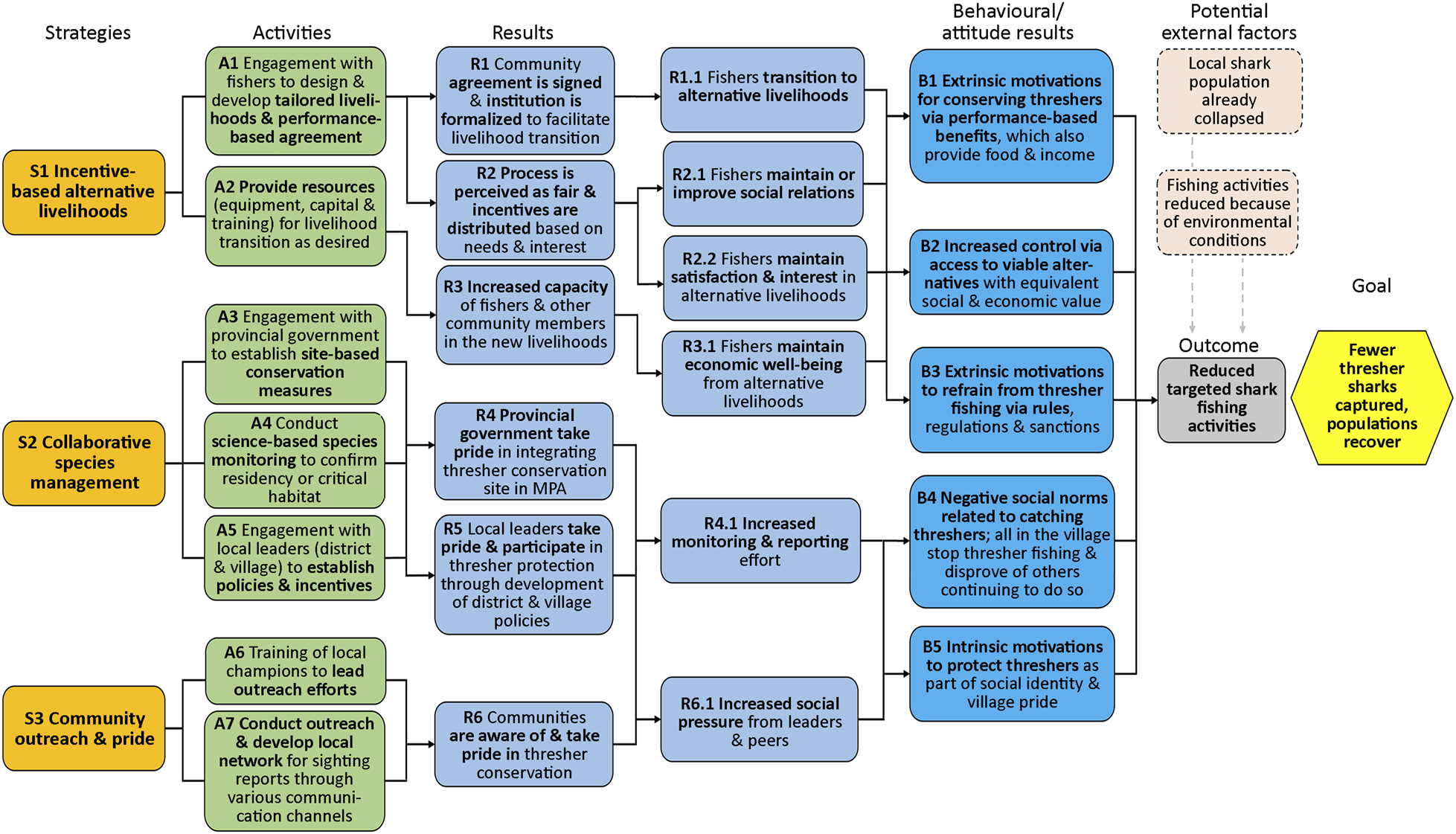
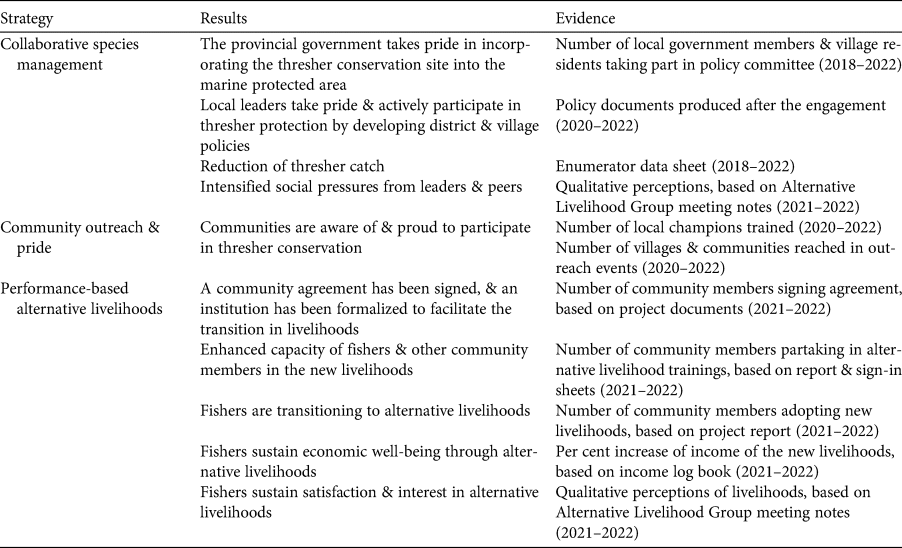
We used a theory-based method to demonstrate hypothesized causal links between project activities, intermediate results and conservation impacts, with the latter based on changes in thresher shark catches (a proxy for mortality; Rogers & Weiss, Reference Rogers and Weiss2007; White, Reference White2009; Booth et al., Reference Booth, Mardhiah, Siregar, Hunter, Giyanto and Putra2021). Our theory of change (Fig. 2) then offered a conservation hypothesis, which we evaluated using a mixed-methods approach. We assessed and triangulated empirical evidence at each stage of the hypothesized causal chain using the project data (Booth et al., Reference Booth, Mardhiah, Siregar, Hunter, Giyanto and Putra2021). Empirical support for the theory of change was derived from various project data sources (Table 1), including project reports and supplementary materials such as sign-up sheets, meeting minutes, photographs, policy documents, community agreements and income log sheets, to obtain information on results and objectives. To describe intermediate behavioural results, we analysed meeting minutes from monthly group monitoring with fishers who had adopted alternative livelihoods. We categorized perceptions in terms of attitudes, norms and perceived control based on the theory of planned behaviour (Ajzen, Reference Ajzen, Kuhl and Beckmann1985; St John et al., Reference St John, Edwards-Jones and Jones2010; Booth et al., Reference Booth, Ichsan, Hermansyah, Rohmah, Naira, Adrianto and Milner-Gulland2023). We coded and grouped the common themes and salient beliefs that emerged during the meetings, focusing on understanding the intentions of individuals (i.e. whether they were inclined to revert to thresher fishing) based on their behavioural and normative beliefs.
A simplified theory of change for the thresher shark conservation intervention, demonstrating the causal link between strategies, activities, results and outcomes. MPA, marine protected area.
Summary of evidence and direct link to the theory of change (Fig. 2) used in designing our livelihood intervention to support the conservation of the pelagic thresher shark Alopias pelagicus in Alor, Indonesia.
Statistical analysis
We collected pelagic thresher catch data, which served as a proxy for mortality, during March 2021–November 2023 to assess conservation outcomes. An independent enumerator trained by the project team was tasked with gathering these data with authorization from the village government and community members. However, we utilized only data collected after the intervention as we had insufficient pre-intervention data. We divided the data among three groups of fishers: (1) participant target group (n = 9), who voluntarily transitioned to alternative livelihoods, (2) non-participant target group (n = 2), who continued targeted thresher fishing and were not part of the intervention group, and (3) other non-target fishers (n = 16), who engaged in opportunistic thresher fishing for supplementary income. To test whether the livelihood-based intervention had a positive impact on thresher shark conservation, we conducted a simple t test to compare mean monthly shark catches after the intervention (August 2021–November 2023) across the groups, whereby the non-participants and other fishers were used as non-experimental quasi-control groups who did not receive the intervention (Supplementary Table 1). We used an F test to determine variance in monthly catch data across these groups for the t test (Supplementary Table 2).
We used self-reported monthly income to assess livelihood outputs. We were unable to collect income data for non-participants and other fishers; therefore we compared the reported income of participant fishers before and during the intervention to assess changes. We conducted a t test to assess whether these differences were statistically significant.
Results
Livelihoods-based intervention
The alternative livelihoods commenced in July 2021, with nine of the 27 thresher shark fishers voluntarily participating. Nine women formed a group to set up small and medium enterprises; some were the wives of the shark fishers. Leadership roles, rules and sanctions were formalized with the assistance of the project team. Group members signed agreements, witnessed by the village and community leaders, pledging to no longer catch thresher sharks in return for resources to support their livelihood transition: fishing boats, boat engines, fishing equipment and capital for starting new businesses. We did not directly provide cash; instead, the group agreed to receive capital in four instalments, with the project team closely monitoring the spending. These processes achieved the results of the formalization of the community agreement and constituted the fair process of incentive distribution (results R1 and R2, Fig. 2).
At least 200 people attended the oath and community declaration, comprising community members, government officials (Supplementary Table 3), police, army and non-government affiliates (tourism operators and journalists). Seven capacity-building activities were also delivered, comprising team leadership, financial management for cooperatives and families, responsible tuna fishing, safety at sea, value-added fish and non-fish products, and marketing. The government members co-facilitated and co-funded these training efforts and incentives. This constituted the achievement of increased capacity of fishers and community members in their new livelihoods and subsequent maintenance of their economic well-being (results R3 and R3.1, Fig. 2).
Changes in income
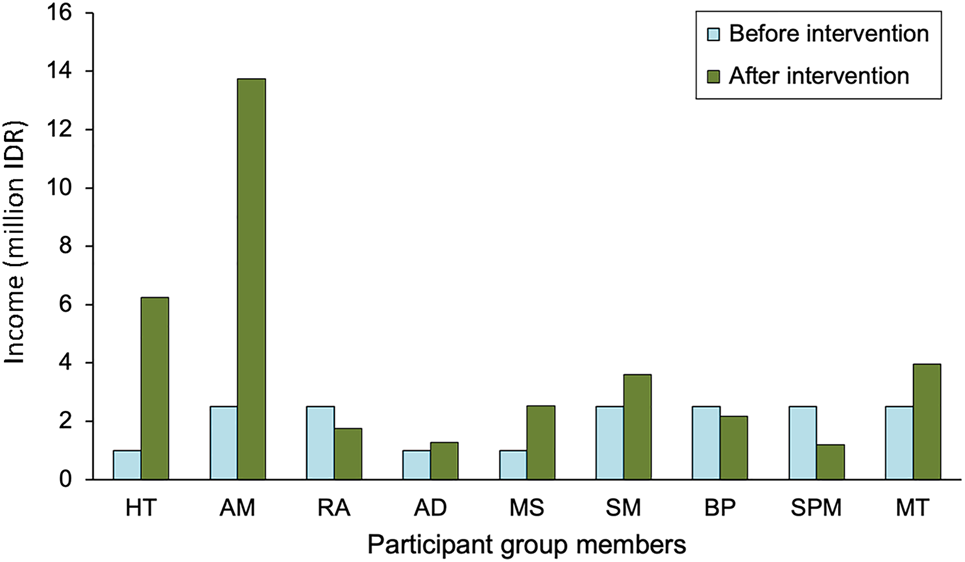
On average, the new livelihoods increased the monthly income of participating fishers (Fig. 3). Six of nine participating fishers experienced a substantial increase, with some increasing by up to 525% relative to pre-intervention levels (Fig. 3, Supplementary Table 4), providing evidence that fishers could maintain their economic well-being from the new livelihoods and that positive outputs for livelihoods were delivered (result R3.1, Fig. 2). Fishers who adopted these new livelihoods were also generally satisfied with their choices. However, three fishers reported decreased income post-transition (Fig. 3, Supplementary Table 4) because of personal reasons, including sickness and family problems that limited their ability to engage fully in their new livelihoods. The women's group also enjoyed economic benefits (Supplementary Table 5). Previously reliant on their husbands, they participated in independent economic activities. Through training and incentives, the group successfully crafted six types of products, with three gaining market approval from the local communities and tourists: tuna floss (shredded, dried fish product), granola and shark-themed woven textiles made with natural dyes. Their products also received halaal accreditation, a procedure assisted by the district government as part of the policy realization (Supplementary Table 3). These efforts provided additional financial rewards, with the group averaging a monthly income of IDR 2.4 million (USD 150), contributing to their household earnings, aligning with the accomplishment of increased capacity for the new livelihoods (result R3, Fig. 2).
Changes in income of participating fishers pre- and post-intervention. The income of HT and AM increased to more than 400% of their pre-intervention income. Their businesses (kiosk and chicken farm) are notably less risky/uncertain than those of the other participants who chose to keep fishing.
Collaborative species management
Political engagement led to the enactment of two regulations at the district and provincial levels, fostering local pride and participation in shark conservation through policy formations (results R4 and R5, Fig. 2). The district's decree was signed in December 2020, and although it does not ban shark fishing, it centres on improving fishers' individual and institutional capacity to decrease socio-economic reliance on threatened species, including scalloped hammerhead Sphyrna lewini, whale shark Rhincodon typus, green sea turtles Chelonia mydas, oceanic manta ray Mobula birostris, Napoleon wrasse Cheilinus undulatus and dugong Dugong dugon. A committee formed in January 2021 instigated a conservation action plan for implementation in Lewalu and Ampera from 2021 to 2023, endorsed by all government members (Supplementary Table 3).
In July 2022, the Governor's Instruction was established in the province to respond to district lobbying. The Instruction focused on prohibiting the capture and trading of thresher sharks and appointing government and non-government entities for co-management of sustainable use and non-extractive activities, including marine tourism. The Instruction corresponded with the revision of the Selat Pantar marine protected area, in which by 2023, stakeholders agreed to allocate an area of 16,977.94 ha for thresher shark conservation, which was drawn from a scientific study (Shidqi et al., Reference Shidqi, Erdmann, Setyawan, Lezama-Ochoa, Sari and Sianipar2024). The final document was pending at the time of writing but will serve as evidence and the guiding principle for marine protected area co-management for the period until 2043 (Dinas Kelautan dan Perikanan Provinsi Nusa Tenggara Timur, 2023).
Community outreach and pride
Thirty-six young champions (44% female and 56% male, aged 18–23) were selected from 15 Alor sub-districts and trained in two initiatives in 2021 and 2022. Some were the children of shark fishers recruited from Lewalu and Ampera. By the end of 2023, the champions had conducted outreach and awareness activities reaching 1,166 people across 24 villages via school visits, community meetings and awareness posters. They collaborated with a local radio station to deliver four broadcasting programmes, reaching at least 1,000 listeners. According to the champions, 100% of those reached stated that they had learnt about the importance of thresher sharks through the outreach activities, with some saying this was the first time they had heard about the species. Village leaders on Pura Island encouraged residents to safeguard thresher sharks and consider them as local assets, resulting in increased community awareness and pride in their conservation (R6, Fig. 2).
Behavioural results
During our meetings, we identified a range of beliefs and attitudes (Table 2) that shaped the fishers' behavioural intentions, particularly with respect to their commitment to thresher conservation.
Identified norms/attitudes, by their overall influence on thresher conservation, throughout the implementation of alternative livelihoods within the communities.
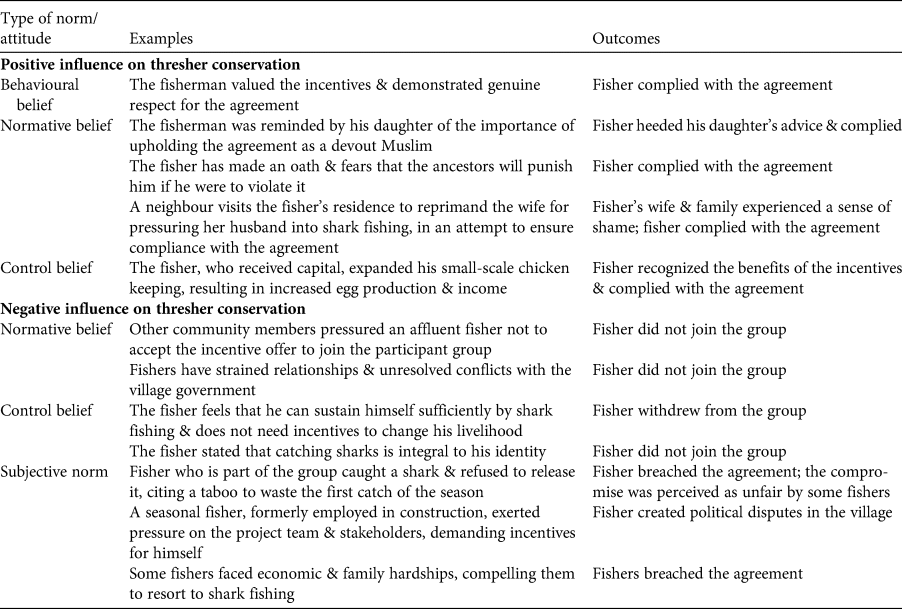
Positive attitudes were rooted in emotions such as appreciation and attention, with fishers expressing a sense of acknowledgment and fulfilment of their interests throughout the piloting process. Normative beliefs in the form of social pressure played a crucial role in preventing deviation from the agreement. For example, a fisher's wife persuaded him to fish for sharks during the season, but neighbours scolded them, causing feelings of shame and guilt. Another fisher was encouraged by his daughter, who was part of the youth champions initiative, to uphold his obligations as a Muslim. Additionally, a participant complied with the agreement because he feared punishment if he violated the ocean offering to the ancestors. This blend of individual behavioural beliefs and normative pressures exerted by community members contributed to behavioural changes, leading to general adherence to rules and sanctions (behavioural results B3, B4, B5, Fig. 2).
However, violations occurred in 2022 and 2023. One fisher caught a shark and refused to release it; he cited a taboo on releasing the season's first catch. This was disproved by other members and created a dispute. Others considered it unfair for the violator's behaviour to go unpunished, given their dedication to releasing sharks even when it meant they would return home empty-handed. The other two violators retained captured sharks because of economic burdens they faced. Special meetings were instigated to address conflicts, which led to two agreements: (1) violators agreed to follow the rules and face sanctions, and (2) an amendment of an agreement to add a mechanism to compensate for losses during economic adversities (e.g. an interest-free loan from the group).
Impact and outcomes
Thresher shark catch data showed that the participants caught significantly fewer thresher sharks than the non-participants after the intervention (Fig. 4). The t tests for unequal variances revealed significant differences (t test, P < 0.05) in mean monthly catches: c. six sharks per month for non-participant groups vs one shark per month for participants (Supplementary Table 1). There was a 91% difference between the total catches of participants vs non-participants, with participants contributing 29 of the overall 332 shark catches during August 2021–November 2023 (i.e. participants constituted 33% of the fishers but caught only 9% of the threshers during that period; Supplementary Table 6). Zero catches were recorded for participant fishers during the first 18 months; however, there was a resurgence during the final 8 months of the intervention, with fishers stating they were driven by economic hardship and socio-political pressures. For example, fishers were pressured by their peers or families to continue fishing for sharks.
Monthly thresher shark catches during August 2021–November 2023 (after the intervention) for the whole group. The mean catches post-intervention showed significant differences for participants vs non-participants and other fishers (P < 0.05); see also Supplementary Table 6.

Discussion
Our findings confirm that the intervention positively affected thresher conservation and local livelihoods, with decreased shark mortality and increased income for participating fishers. Yet challenges remained, with non-compliance amongst participating fishers continuing to contribute to thresher shark mortality. The lessons learnt regarding the factors that promoted and hindered success can be used to expand and improve shark conservation efforts in Alor. Our study also offers guidance for establishing similar interventions for other species and in different contexts.
Successes and challenges for behavioural change and positive impact
Our study adds to the body of evidence that livelihood interventions can create win–win situations for conservation and people, provided they are designed according to local needs, interests, institutions and the broader socio-economic context (Roe et al., Reference Roe, Booker, Day, Zhou, Allebone-Webb and Hill2015; Wicander & Coad, Reference Wicander and Coad2018; Avila-Forcada et al., Reference Avila-Forcada, Martinez-Cruz, Rodriguez-Ramirez and Sanjurjo-Rivera2020). Fishers' attitudes underscored the importance of the livelihood design process, with participants expressing appreciation for the consideration of their interests. This aligns with studies showing that participation and perceived legitimacy are key predictors of successful conservation interventions (Brooks et al., Reference Brooks, Waylen and Borgerhoff Mulder2012; Oyanedel et al., Reference Oyanedel, Gelcich and Milner-Gulland2020). Fishers also highlighted how social norms and pressures exerted by their families and peers positively and negatively affected participation and compliance (Perry et al., Reference Perry, Richardson, Harré, Hodges, Lyver and Maseyk2021).
In our case, the intervention was built on extensive individual and group engagements that facilitate trust-building, as participation is a continuous negotiation and decision-making process, recognizing that each participant has different motivations and can foster ownership and commitment (Reed, Reference Reed2008; Sterling et al., Reference Sterling, Betley, Sigouin, Gomez, Toomey and Cullman2017). True participation and engagement also help to prevent the imposition of ineffective top-down interventions, a common failure that leaves communities reliant on external aid (Haliim, Reference Haliim2020). Despite initial reluctance amongst some fishers, the formation of a self-governing group was vital in integrating leadership and democratic processes that facilitated continual learning and adaptation (Basurto et al., Reference Basurto, Bennett, Weaver, Dyck and Aceves-Bueno2013; Chuenpagdee & Jentoft, Reference Chuenpagdee and Jentoft2018). This mechanism also enabled violations to be addressed in a bottom-up manner by modifying agreement points in a way that accommodated the interests of all participants. Developing local institutions and capacity facilitates adaptive management of interventions, making them more resilient in the long term.
However, our findings also highlight socio-political complexities and pitfalls, particularly amongst non-participants continuing to act as a source of thresher shark mortality. Non-participant fishers were the oldest and most experienced shark fishers in the villages, and had been key contributors to the decline of the thresher shark. Although some initially intended to join the livelihood transition process, they withdrew because of unresolved conflicts with the village leader or other community members rather than a fundamental disagreement with shark conservation or the project process. This corroborates earlier research on human–wildlife conflict, demonstrating that conservation issues can often be manifestations of underlying conflicts between people (Redpath et al., Reference Redpath, Bhatia and Young2015). Understanding and resolving these underlying human–human conflicts would have enabled a more inclusive process, with substantial benefits to thresher shark conservation.
We also noted income variations post-intervention, with some fishers experiencing significant increases, whereas others earned less than from shark fishing (Fig. 3). Factors contributing to this disparity include the predictability of chosen livelihoods. For example, transitioning to land-based businesses proved more profitable and reliable than tuna and red snapper fisheries, which involve higher uncertainty and are subject to seasonal fluctuations (Merino et al., Reference Merino, Murua, Santiago, Arrizabalaga and Restrepo2020). Additionally, technical support is needed for the women's group engaged in independent production to address challenges such as navigating local governance, ensuring a consistent supply of raw materials and maintaining market access (Adeel & Safriel, Reference Adeel and Safriel2008; Patil et al., Reference Patil, Singh, Pawar, Maarse and Otte2009; Akpomuvie, Reference Akpomuvie2010). Continuous assistance for fishers and women's groups is essential during the early intervention phase. This support should continue until the capacity of group governance is established and the business develops sufficient capital and scale to become self-sustaining and resilient during inevitable downturns.
Benefits and pitfalls of policy change
On a broader scale, the enactment of district and provincial regulations signified a shift in the commitment of government authorities at higher levels, which had initially lacked knowledge regarding pelagic thresher sharks and their conservation. In regions such as East Nusa Tenggara, marine conservation faced challenges because immediate development concerns (e.g. malnutrition, poverty and malaria) were prioritized for government action (Roosihermiatie et al., Reference Roosihermiatie, Pratiwi, Rukmini and J.P.2015; Ferezagia, Reference Ferezagia2018; Djara & Jaya, Reference Djara and Jaya2021). Despite its significance for elasmobranchs, the Eastern Indonesia region, in which Alor is located, was overlooked and received little conservation attention (Fox et al., Reference Fox, Adhuri, Therik, Carnegie, Resosudarmo and Jotzo2009; Jaiteh et al., Reference Jaiteh, Hordyk, Braccini, Warren and Loneragan2017a). Our comprehensive strategy persuaded government members to apply regulatory measures and allocate conservation budgets (Supplementary Table 3). This was supported by a narrative on the potential of thresher sharks to contribute to the district's economic growth in non-extractive ways, if fishers targeting sharks could secure viable alternative livelihoods. An example of successful tourism focused on thresher sharks in Malapascua in the Philippines provided crucial motivation to explore this avenue (Cruz, Reference Cruz2016).
However, effective policy integration continued to pose challenges across the village, district and provincial levels. The limited coercive power of regulatory bodies and mechanisms, and the absence of national protection for pelagic threshers, hampered appropriate enforcement. Additionally, shark tourism, which provided the main impetus for regulation, failed to deliver an immediately viable alternative to shark fishing. This was exacerbated by the lack of financial support and by tourism shutdown during the Covid-19 pandemic (Arumsari & Yosintha, Reference Arumsari and Yosintha2021), highlighting the importance of integrated interventions and mixed approaches, with complementary regulations or legal sanctions bolstering livelihood-based interventions (Booth et al., Reference Booth, Mardhiah, Siregar, Hunter, Giyanto and Putra2021). The interplay of macro- and micro-economic factors and the role of complementary market forces are crucial for driving change at the local level.
Finally, in our case, policies became entangled with interpersonal socio-political issues, evolving into sensitive political matters that disrupted social dynamics in Lewalu and Ampera. The regulations were politicized, leading to community disputes manipulated by political actors seeking personal gain. This became particularly apparent during district and provincial elections. This highlights the necessity of considering comprehensive risk assessment and mitigation plans in the project design, such as analysing the political actors and their influence as means for strategic engagement. Moreover, the implementation of interventions should consider the political calendar and minimize activities during local elections, to avoid or mitigate potential political disputes and manipulation.
General lessons learnt for effective livelihood-based interventions
As demonstrated here, livelihood interventions are often complex, fraught with trade-offs and conflicts at different levels, and require extensive context-specific engagement and actions. Nonetheless, our findings and practical experiences highlight several general lessons.
Firstly, the success of our approach relied on the availability of a robust baseline knowledge on individual and group characteristics, including socio-political networks and social status (Booth et al., Reference Booth, Squires and Milner-Gulland2019). This baseline supported informed decision-making on how the opportunity to participate in the alternative livelihoods could be distributed, ensuring it could reach the most appropriate and deserving beneficiaries and avoid elite capture or corruption (Platteau, Reference Platteau2004; Roe et al., Reference Roe, Booker, Day, Zhou, Allebone-Webb and Hill2015; Fritz et al., Reference Fritz, McQuilken, Collins and Weldegiorgis2018). This information also helped us to create a clear communication strategy to prevent incorrect assumptions about the types of livelihood-based interventions that might work and, thus, the misinformed top-down imposition of any potential solution (Wright et al., Reference Wright, Hill, Roe, Rowcliffe, Kümpel and Day2016).
Secondly, conflicts eventually resulted in negative behavioural outcomes, but these were rooted in historical community rifts that became perspicuous throughout the project. Such conflicts are commonly observed in natural resources management sectors such as agriculture and forestry, resulting in strained relationships between communities, government and private entities (Wulan et al., Reference Wulan, Yasmi, Purba and Wollenberg2004; Nulhaqim et al., Reference Nulhaqim, Fedryansyah and Hidayat2019). Facilitating the resolution of these socio-political rifts is therefore imperative to avoid perpetuating a culture of conflict that hinders cooperation (Rastogi et al., Reference Rastogi, Hickey, Badola and Hussain2014; Colvin et al., Reference Colvin, Witt and Lacey2015).
In summary, our project demonstrated that livelihood-based interventions for shark conservation can succeed. However, as the ultimate goal of such interventions is to shift entrenched behaviour and practices of communities embedded in dynamic socio-ecological systems (Reddy et al., Reference Reddy, Montambault, Masuda, Keenan, Butler and Fisher2017; Booth et al., Reference Booth, Ichsan, Hermansyah, Rohmah, Naira, Adrianto and Milner-Gulland2023), they require substantial planning and local engagement from the outset, coupled with adaptive management and sustained, long-term investment (Hussein & Nelson, Reference Hussein and Nelson1998; Booth et al., Reference Booth, Mardhiah, Siregar, Hunter, Giyanto and Putra2021). This also requires developing and establishing structures that align with the diverse socio-cultural drivers of behaviour, such as religious or Indigenous cultural values, including ancestral beliefs and practices (Bhagwat et al., Reference Bhagwat, Ormsby and Rutte2011; Rim-Rukeh et al., Reference Rim-Rukeh, Irerhievwie and Agbozu2013; Mcleod & Palmer, Reference Mcleod and Palmer2015). Integrating these factors can foster equity, legitimacy, compliance and sustained motivation to follow new practices that achieve long-term conservation objectives and support the well-being of local communities.
Author contributions
Conceptualization and design: RAS, DRS, JA, PNSK, HB, ES; data collection, analysis and interpretation: RAS, DRS, JA, PNSK, YMB, IA; writing and revision: all authors.
Acknowledgements
We thank the Conservation Leadership Programme, Shark Conservation Fund, Ocean Blue Tree, MAC3 Impact Philanthropies, CEPF Wallacea II, Australia Awards Alumni Grant Scheme, The Darwin Initiative, East-West Center, Found at Sea Collective, Oceanmata, SEACoast at UC Santa Cruz, OASEA laboratories, Interdisciplinary Centre for Conservation Science (ICCS) at the University Oxford, Duke University, and Student Conference on Conservation Science (SCCS) at the University of Cambridge for funding; our partners, the Department of Fisheries and Marine of East Nusa Tenggara Province and the Government of Alor, for their support; Rahmad Zainuddin, Air Dive Alor, Ibu Paulina (Uli) Pandjaitan, Dr Mark Erdmann, Shawn Heinrichs, Sarah Lewis, Montse Amores, Ramon Estrada, Tom Sparke, Bestari Ghea Dwilo, Agustin Capriati, Eka Maya Kurniasih, Andrianus Sembiring and Ni Luh Astria Yusmalinda for their assistance in project mobilization; and Itsar Fuadi for creating the map. RAS acknowledges MAC3 Impact Philanthropies and WWF Russell E. Train Fellowship for funding his PhD studies at Marine Science and Conservation Program at Duke University. HB acknowledges the Darwin Initiative for funding her position at the University of Oxford (grant number 30-008).
Conflicts of interest
None.
Ethical standards
This research abided by the Oryx guidelines on ethical standards. Specifically, principal investigators RAS and DRS are Indonesian citizens with full rights to conduct research in their home country. All research processes adhered to ethical requirements, including obtaining free, prior and informed consent before interviews, and the freedom to withdraw from any intervention steps. The data of project participants are kept confidential. RAS initiated this project before enrolling in the PhD program at Duke University; Institutional Review Board approval was therefore not obligatory before commencing the research, and ethical clearance was not required. However, all processes followed appropriate ethical standards, including disclosure, voluntariness, understanding, competence and consent (Vilma, Reference Vilma2018), and mandatory research permits were obtained from the National and local governments. The field team members responsible for data collection, JA, PNSK, YMB, IA, are Indigenous to East Nusa Tenggara. The project operates under Thresher Shark Indonesia, a registered Indonesian non-profit organization (AHU-0019789.AH.01.04.Tahun 2020), ensuring compliance with national and local regulations and obtaining necessary permits for all project activities.
Data availability
The data on social surveys are not publicly available to protect the privacy of research participants.


 Open access

