


Introduction
Biodiversity has declined considerably in Vietnam, driven largely by unsustainable human demand (e.g. Davis et al., Reference Davis, Glikman, Crudge, Dang, Willemsen and Nguyen2019, Nguyen & Jones, Reference Nguyen and Jones2022, Shairp et al., Reference Shairp, Veríssimo, Fraser, Challender and MacMillan2016). It has been suggested that the Indochinese tiger Panthera tigris corbetti has been extirpated from the wild since 1997 (Goodrich et al., Reference Goodrich, Wibisono, Miquelle, Lynam, Sanderson and Chapman2022), although reports persisted into 2010 of tigers still extant in borderland regions (Lynam, Reference Lynam2010). One driver of the overall decline in biodiversity is wildlife farming, which is a persisting conservation challenge in Vietnam (Pham et al., Reference Pham, Tang, Nguyen, Dang, Van Nguyen and Nguyen2022a,Reference Pham, Tang, Nguyen, Dang, Van Nguyen and Nguyenb). Numerous species, including tigers, are farmed across the country, both legally and illegally (e.g. Brooks et al., Reference Brooks, Roberton and Bell2010, Crudge et al., Reference Crudge, Nguyen and Cao2020, Pham et al., Reference Pham, Tang, Nguyen, Dang, Van Nguyen and Nguyen2022a,Reference Pham, Tang, Nguyen, Dang, Van Nguyen and Nguyenb). Although farming of some wildlife species appears to be in decline in Vietnam (e.g. of bears Ursus thibetanus and Helarctos malayanus; Crudge et al., Reference Crudge, Nguyen and Cao2020), there are fears that farming of others, such as the tiger, is increasing (Davis et al., Reference Davis, Willemsen, Dang, O’Connor and Glikman2020, Dang Vu et al., Reference Dang Vu, Gadbert, Nielsen, Nielsen and Jacobsen2022). In tiger farming, the animals are raised for the purpose of slaughter for their meat and bones (EIA, 2017). Tiger farms can sometimes have multiple purposes; for example in the Tiger Temple in Thailand people can pet drugged tigers prior to their slaughter (Paddock & Mustard, Reference Paddock and Mustard2019), and in the safari parks in Vietnam people can view tigers prior to their slaughter (EIA, 2017). Tiger bones may be boiled to make tiger bone glue for medicine (Davis et al., Reference Davis, Willemsen, Dang, O’Connor and Glikman2020, EIA, 2017) or used to infuse alcohol (Coals et al., Reference Coals, Moorhouse, D’Cruze, Macdonald and Loveridge2020). No studies have to date investigated tiger meat consumption in Southeast Asia, but it is known to occur in Vietnam as a byproduct of tiger farming, whereby tiger farmers sell the meat directly to consumers or to middlemen (HQV, pers. obs.).
As of 2017, the greatest number of tiger farms were known to operate in China (5,000–6,000 tigers on farms), followed by Thailand (1,450–2,500 tigers), Laos (c. 380) and Vietnam (c. 199; EIA, 2017). Allegedly, the number of tiger farms has increased, with EIA (2023) reporting c. 100 more tigers on farms in Laos, and an increase of c. 200 tigers in Vietnam (totalling c. 400 tigers on farms in Vietnam). Tigers can be successfully bred on tiger farms (Liu et al., Reference Liu, Jiang, Li, Fang, Ping and Luo2015, Prisner-Levyne, Reference Prisner-Levyne2020), which fulfils one of the criteria for wildlife farming to be able to contribute to the conservation of a species (Tensen, Reference Tensen2016). However, tigers continue to be poached in the wild, which is a severe threat to a Critically Endangered and fragmented population (Goodrich et al., Reference Goodrich, Wibisono, Miquelle, Lynam, Sanderson and Chapman2022). Increasing the accessibility of tiger products through the establishment of tiger farms could also increase overall demand for tiger products, as suggested for the twinned proliferation of bear farms and bear consumers in Vietnam in the mid 2000s (Davis et al., Reference Davis, Veríssimo, Crudge, Sam, Cao and Ho2022).
Understanding the mechanics of tiger farming is therefore vital for determining where to focus conservation attention, and for predicting potential impacts on demand (Rieder et al., Reference Rieder, Larson, ‘t Sas-Rolfes and Kopainsky2021). In 2017 a report quantified the severity of the threat to wild tigers, noting that there were twice as many captive tigers bred for consumption than wild tigers (EIA, 2017). Although tiger farming is less common in Vietnam than elsewhere (EIA, 2017), there are concerns about the practice in Vietnam, as conservation practitioners and government officials continue to identify and shut down tiger farms (authors, pers. obs.). In this study, we focus on Nghe An province, in north-central Vietnam, known to have other active wildlife farms (e.g. for bears and civets; Forestry Protection Department of Nghe An, pers. comm.). Nghe An is also proximate to Laos, a known source site of wildlife for neighbouring countries (Davis & Glikman, Reference Davis and Glikman2020; Krishnasamy et al., Reference Krishnasamy, Shepherd and Or2018; Livingstone et al., Reference Livingstone, Gomez and Bouhuys2018). We focused our study on Nghe An in particular because a member of the project team had connections with former tiger farmers in the province. As tiger farming is a sensitive topic to discuss, we were constrained to this particular group as a result of our pre-existing connections.
In Vietnam, private tiger farming is illegal. However, corporations can establish tiger facilities that are allowed to operate legally under supervision by local governments, although the sale of wildlife products is always illegal (Decree 160/NDCP of 2013; Decree 64/NDCP of 2021; Decree 06/2019, Decree 06/NDCP of 2021, and Plan 54 of Nghe An Provincial People’s Committee). In Nghe An province, there are two tiger farms, with 60 tigers in total, of this type, managed by the Forestry Protection Department of Nghe An. However, there are other private tiger farms that are operating undetected. At a Tiger Conservation Conference in Vietnam in 2021, local NGOs estimated there were c. 300 tigers kept in Nghe An; however, the Forestry Protection Department does not have direct evidence for these figures (TDL, pers. obs.)
In this study with former tiger farmers in Vietnam, we examined their tiger farming practices and motivations, their understanding of tiger conservation in the wild, and why they stopped farming tigers. Our aim was to better understand tiger farming in Vietnam and to identify future areas of study that could help to inform conservation actions and support tiger conservation efforts globally (e.g. Rieder et al., Reference Rieder, Larson, ‘t Sas-Rolfes and Kopainsky2021). Our specific aim was to advise where funds and time would best be distributed for tiger conservation, depending on whether or not farming was found to be a popular or increasing practice in this area of Vietnam. If so, conservation resources should be focused on reducing farming, through behaviour change campaigns or increased enforcement of existing laws. If not, resources could be focused on other conservation actions that can benefit the global tiger population. In Vietnam, this could include actions to reduce demand for tiger bone glue, or collaborating with the government on a tiger reintroduction programme that considers the needs of communities living adjacent to forests.
Methods
Sampling and interview protocol
Respondents were recruited through snowball sampling: former tiger farmers known through personal connections to a member of the project team were asked to provide names of other individuals they knew had farmed tigers. Eight respondents were recruited through direct personal connection, and eight were referred by other interviewees. When no new names were offered, the sample was considered to be complete (n = 16). Interviews were conducted by an interviewer and note-taker from the project team, face-to-face and in Vietnamese, and later translated into English by bilingual members of the project team. Interviews were conducted during February–April 2024.
Questionnaire
A semi-structured questionnaire (Supplementary Material 1) was used, allowing us to capture complexity in responses and facilitate an informal conversation that could build trust. The questionnaire began with demographic questions regarding gender, age and education (Section A). Section B asked for details about tiger farming; e.g. when respondents began tiger farming, whether they had stopped, where they acquired tigers from and whether they bred their tigers. Section C investigated respondents’ beliefs; e.g. towards the statement ‘Wildlife farming is a source of zoonotic disease, such as coronaviruses’. Section D asked one additional question about tiger reintroduction in Vietnam, to assess whether respondents would support or oppose such an initiative. The questionnaire included a section for the interviewer and notetaker to write additional notes that could help in the interpretation of the interview.
Results
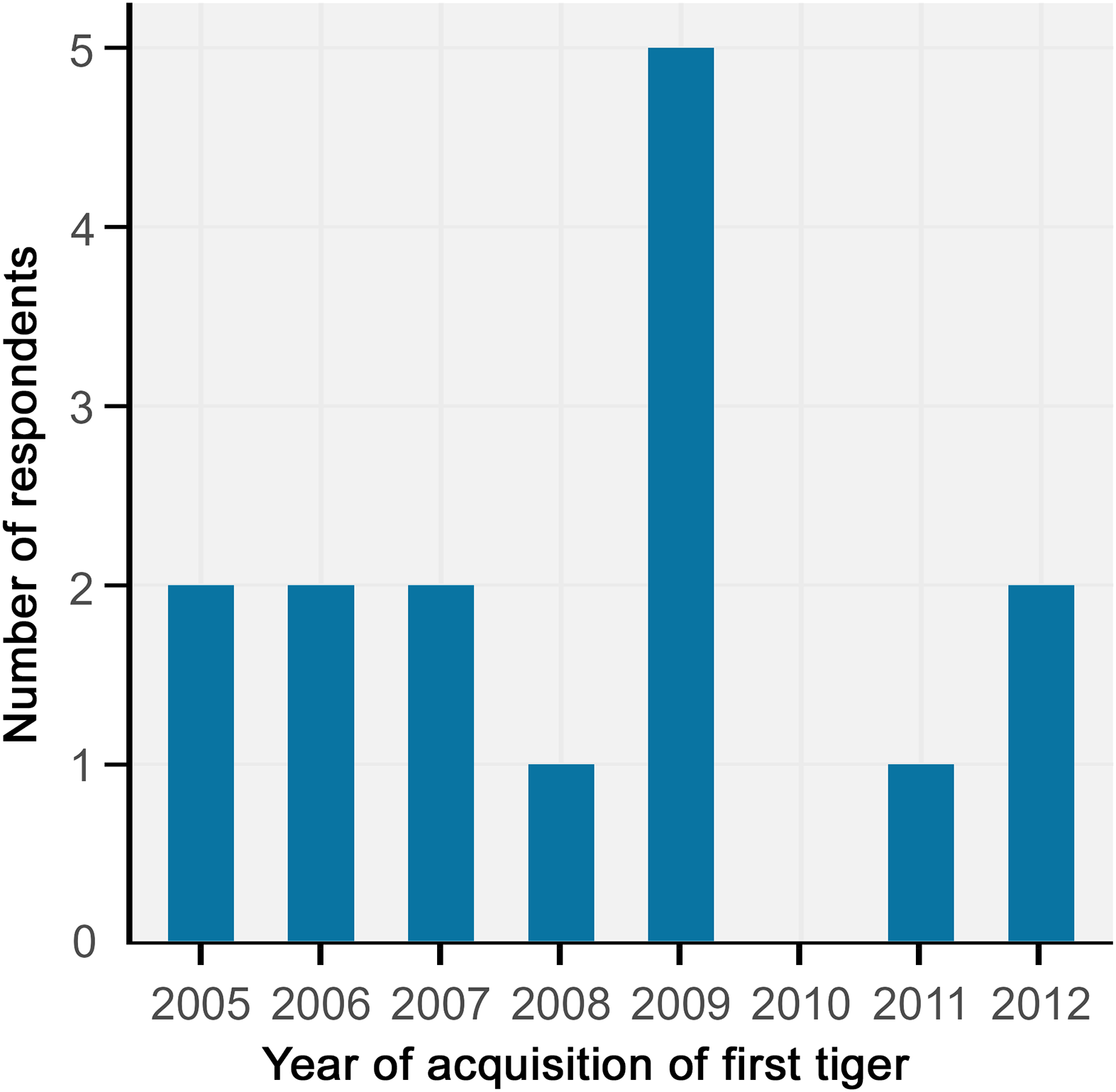
The 16 respondents were all men from Nghe An province in north-central Vietnam. All were Kinh (the majority ethnic group in Vietnam), with a mean age of 47 years. The majority (15 of 16) had high-school education. None of the respondents had a permit to keep tigers. All had first acquired tigers during 2005–2012, with one-third of respondents (5 of 16) obtaining their tigers in 2009 (Fig. 1).
Responses of the 15 respondents who answered the question as to when they first acquired tigers Panthera tigris. (We interviewed 16 former tiger farmers; one did not provide this information.)

All 16 respondents had stopped raising tigers, with over two-thirds (11 of 16) having stopped 6–10 years prior to the interview. None of the interviewees personally knew anyone in their community who still kept tigers. With respect to the reasons for having stopped, all respondents believed it likely or very likely they would get in trouble with the authorities if they were to keep tigers. Almost half (7 of 16) directly cited a government ban on tiger farming as their rationale for stopping, and four noted that other people in the area would report individuals known to farm tigers. The majority (12 of 16) cited fines and imprisonment as possible outcomes of raising tigers, with over half (7 of 12) noting they had heard of individuals being arrested for tiger farming in neighbouring areas.
Most respondents (12 of 16) stated to have bought their first tigers from Laos, or from traders from Laos. Perhaps because the respondents had to purchase tigers from individuals in Laos and Thailand, most (15 of 16) were aware that tigers are extinct in Vietnam. All respondents stated they used to purchase tiger cubs, with the intention of raising them to adulthood, and claimed they never bred tigers; the majority (15 of 16) stated they sold the adult tigers to traders for the production of tiger bone glue, for high profit. Only six gave any specific reasons for why they had not bred tigers, with four of these stating that breeding tigers increased the probability of being detected by authorities. One individual noted that breeding was ‘very difficult and risky’, and another said that he did not know how to breed them, so did not try. Although the respondents did not directly state how many tigers they kept at any one time, responses to the question ‘Please describe the location where you kept the tiger?’ suggested that two tigers was the maximum number that could be kept in a small cage in a house or enclosed garden: ‘Tigers are kept in closed areas (so that outsiders [can’t] see), the cage size depends on the number of tigers kept. The cage is 8–9 m2 for two tigers’. Nine of the 16 respondents stated a direct motivation to avoid detection, and four respondents stated that keeping tigers in smaller cages was better because tigers moved less and grew faster.
Most respondents (10 of 16) stated they began raising tigers because they saw others in their community doing so, and that keeping tigers was easy and resulted in high profits. Five of the 16 respondents solely mentioned the high profits and ease of keeping tigers. One individual noted: ‘Raising tigers generates high income, is not hard, anyone in the family can feed and take care of the tiger. Grown tigers are easy to sell because many people want to buy them. Tigers rarely get sick, only have diarrhoea but it is very easy to cure if detected early. Their selling price is very high.’
One individual stated they also followed what others were doing, but justified the practice by stating that ‘In previous years, the government had not yet banned this practice, so many households [were] raising tigers, some raising dozens of them’. In reality, private tiger farming has always been banned in Vietnam, but in the past was largely tolerated, with little penalty to farmers if they were caught (e.g. EIA, 2017).
Of the 14 respondents who admitted to selling their tigers, all agreed that raising tigers was economically viable. Reasons given were the low cost of food and building cages, and the high profit when selling a tiger, despite the initial investment needed to purchase the cubs (one individual estimated paying VND 50–100 million for one tiger cub (c. USD 2,000–4,000). However, seven of 14 stated that the economic benefit was no longer worth the risk of detection, as being caught could result in ‘losing everything’ and going to jail. The arrest of a family in the neighbouring commune was mentioned by one of these respondents as a demotivating factor.
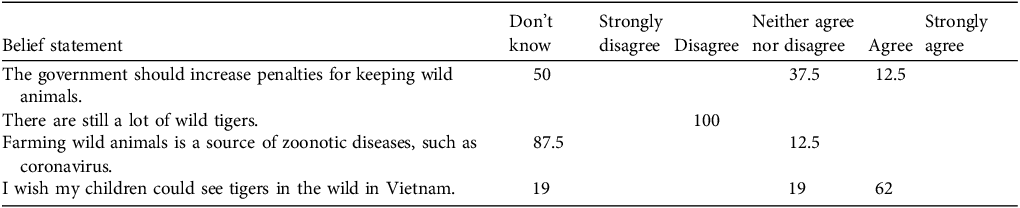
Respondents were presented with a series of statements relating to their opinions and knowledge about tiger farming and conservation, and asked to indicate their agreement on a five-point Likert scale (Table 1). All disagreed with the statement ‘There are still a lot of wild tigers’, and 14 of 16 did not know whether ‘Farming wild animals is a source of zoonotic diseases, such as coronavirus’.
Belief statements of 16 former tiger Panthera tigris farmers in Nghe An province, Vietnam, measured on a five-point Likert scale, indicated by per cent of the responses.

Table 1 Long description
A table showing belief statements of 16 former tiger farmers, measured on a five-point Likert scale, indicated by percent of the responses. The table has 4 rows and 6 columns. The columns are labeled as follows: Don’t know, Strongly disagree, Disagree, Neither agree nor disagree, Agree, Strongly agree. The rows are labeled with different belief statements. Row 1: The government should increase penalties for keeping wild animals. Values: Don’t know: 50, Strongly disagree: 0, Disagree: 37.5, Neither agree nor disagree: 0, Agree: 12.5, Strongly agree: 0. Row 2: There are still a lot of wild tigers. Values: Don’t know: 0, Strongly disagree: 0, Disagree: 100, Neither agree nor disagree: 0, Agree: 0, Strongly agree: 0. Row 3: Farming wild animals is a source of zoonotic diseases, such as coronavirus. Values: Don’t know: 87.5, Strongly disagree: 0, Disagree: 12.5, Neither agree nor disagree: 0, Agree: 0, Strongly agree: 0. Row 4: I wish my children could see tigers in the wild in Vietnam. Values: Don’t know: 19, Strongly disagree: 0, Disagree: 19, Neither agree nor disagree: 0, Agree: 62.5, Strongly agree: 0.
When asked about reintroduction, all 16 respondents were in support. Six said they supported it because it could help protect tigers from extinction. Four respondents stated that although they supported reintroduction in principle, they were concerned it would not be successful because of anthropogenic threats, particularly hunting. Three respondents said that because tigers are extinct in Vietnam, they would like to see them return, and two respondents specifically mentioned wanting their children to be able to see tigers in Vietnam.
Discussion
We show here that tiger farming, although lucrative, appears not to be as popular in Vietnam as other practices, such as bear farming. High penalties appear to have diminished the benefit, and it is possible that tiger farming is now dominated by organized criminal networks, as illustrated by the recent sentencing of a tiger trafficker operating in Nghe An (ENV, 2025). Private farmers are still alleged to be the dominant base of these trafficking networks (ENV, 2025), but based on the experiences of the respondents in our study, we suspect that private households currently farming are more embedded in criminal networks and are receiving sufficient benefits to overcome the barrier of possible criminalization.
The dominant, stated perception of our respondents was that they could be arrested and/or fined for tiger farming. These perceptions may be the result of a concerted campaign in 2021 in which 24 tigers were confiscated from private farms in Nghe An (TDL, pers. obs.). As these arrests happened after our respondents had stopped farming, this campaign could not be the direct cause of them stopping, but it clearly acts as a demotivator for these individuals to restart tiger farming. With respect to policy changes, our respondents believed the current policies are sufficient. This could be a result of the respondents’ perceptions of likely fines or arrest for tiger farming.
Although our results are specific to Nghe An Province and not broadly generalizable, they suggest an encouraging shift in the acceptability of farming large carnivores. Twenty years ago, bear farming in Nghe An was acceptable and open, despite its illegality, indicating limited government oversight and weak enforcement of environmental laws (Crudge et al., Reference Crudge, Nguyen and Cao2020). Respondents in our study perceived high enforcement, pointing to a change of social norms at the national, provincial and local government levels, as well as within the wider society in Nghe An. Rizzolo (Reference Rizzolo2020, Reference Rizzolo2021) noted that when wildlife farming laws are implemented and enforced, this can affect social norms by stigmatizing both the continuation of the practice and consumption of the products generated, such as tiger bone glue. Our results provide further evidence in support of this.
Our respondents had previously farmed tigers privately and at a small scale, raising cubs to maturity and selling them to middlemen. They had bought tigers primarily from Laos. However, as of 2019, tigers appear to be extinct in Laos (Rasphone et al., Reference Rasphone, Kéry, Kamler and Macdonald2019), so these tigers may have been some of the last individuals taken from the wild in that country, or they may have originated from farms operating in Laos, China or Thailand (e.g. EIA, 2017). Our respondents were unaware of disease risk associated with wildlife farming, which suggests an opportunity for the government and/or other concerned actors in Vietnam to increase awareness (e.g. Huong et al., Reference Huong, Nga, Long, Luu, Latinne and Pruvot2020; Pham et al., Reference Pham, Tang, Dang, Nguyen, Hoang and Tran2022b). This may be particularly pertinent for illegal tiger farming. Pham et al. (Reference Pham, Tang, Dang, Nguyen, Hoang and Tran2022b) noted that in Dong Nai province international organizations have trained legally operating wildlife farmers to test their wildlife for transmissible diseases; however, this kind of training has not been implemented for illegal and undocumented farms.
The majority of our respondents wanted their children to see tigers in Vietnam, which aligns with emerging research that has shown a growing desire in Vietnamese society to halt biodiversity loss and preserve natural heritage (Nguyen & Jones, Reference Nguyen and Jones2022). However, although there are some signs that certain types of wildlife use may be waning, any persisting demand could challenge reintroduction efforts. Enforcement within protected areas has generally been poor in Vietnam, and even areas with the best enforcement have recorded declines in wildlife (Nguyen et al., Reference Nguyen, Luu, Pham, Nguyen, Pham and Nguyen2024). Food insecurity in forest-adjacent communities, and the general acceptance of wildlife consumption within Vietnamese society (although waning, e.g. Nguyen & Jones, Reference Nguyen and Jones2022), could jeopardize wildlife reintroduction efforts (Davis et al., Reference Davis, Cao, Vu, Lê, Vo and Le2025). Demand for tiger products from neighbouring China could also affect tiger reintroduction efforts in Vietnam (USAID Wildlife Asia, Reference USAID2018).
We recommend further research in other areas of Vietnam recorded to have tiger farms, such Thanh Hoa, which borders Nghe An to the north (EIA, 2017). Research involving active farmers, individuals who were more recently involved in tiger farming, or those involved in the alleged trafficking networks within Nghe An (ENV, 2025) may be challenging given the increased sensitivity around tiger farming, but would be valuable for understanding what motivates continued farming.
From the broader perspective of tiger conservation, our results can inform discussions around legalization of farming and the possible impact on demand for tiger products. We have shown that in the Vietnamese context, stronger enforcement of the ban on tiger farming has decreased the proliferation of farming and, by extension, the accessibility of tiger products for consumers. Our study supports arguments that efforts to conserve tigers could be more successful if tiger farming were to be banned in China (Rizzolo, Reference Rizzolo2021), and illustrates the importance of government commitment to policy in driving conservation impact. We suggest that tiger conservation funds in Vietnam will be most effective if they are directed at safeguarding future tiger habitat and reducing demand for tiger products.
Supplementary material
The supplementary material for this article is available at doi.org/10.1017/S0030605325101750
Author contributions
Study design, data analysis, writing: EOD; fieldwork: HQV, DTTC; project supervision: TTC, CLTM; expert knowledge: TDL
Acknowledgements
We thank the respondents who kindly gave their time, and the Nghe An Provincial People’s Committee for granting permission for the research group’s activities. This research received no specific grant from any funding agency, or commercial or not-for-profit sectors.
Conflicts of interest
None.
Ethical standards
This research abided by the Oryx guidelines on ethical standards. Ethical approval was granted by the Ethical Review Board of Miami University of Ohio (# 04635e), the partner of San Diego Zoo Wildlife Alliance for institutional review of research projects involving human subjects. The Nghe An Provincial People’s Committee granted permission for the research under license number 1673/SNgV-LS.NVNONN. Respondents were informed about the aims of the interview and assured of their anonymity, with any personal data accessible only to core members of the project team. Respondents could withdraw from the interview at any time. This project was a collaboration between an in-country research and conservation practice institution, an in-country university and an international research organization. The results are shared equally between all three organizations.
Data availability
Because of the sensitive nature of the data, they are not publicly available. Data can be made available upon reasonable request to the corresponding author.


 Open access

