INTRODUCTION
Chronic obstructive pulmonary disease (COPD) is a common affliction, affecting approximately 210 million people worldwide, and it is the fifth most common cause of death (World Health Organization, 2007). The prevalence of COPD in 2012 in developed countries was cited as being up to 37%, with mortality rates reaching 111 deaths per 100,000 population (Fallon & Foley, Reference Fallon and Foley2012).
There is increasing interest in developing holistic models for the care of people with end-stage COPD (Lancet Editorial, 2017; Rush et al., Reference Rush, Hertz and Bond2017; Sorenson, Reference Sorenson2013; Vermylen et al., Reference Vermylen, Szmuilowicz and Kalhan2015) among peak bodies and professional societies—such as the Australian, New Zealand, and American Thoracic Societies—calling for greater attention to their palliative care needs (Global Initiative for Chronic Obstructive Lung Disease, 2017; Lanken et al., Reference Lanken, Terry and Delisser2008; Lung Foundation Australia, 2014).
Despite this recognized need, patients with COPD engage with palliative care services infrequently compared to those with malignant diseases (Beernaert et al., Reference Beernaert, Cohen and Delien2013; Partridge et al., Reference Partridge, Khatri and Sutton2009; Rosenwax et al., Reference Rosenwax, Spilsbury and McNamara2016). There are a number of reasons for this, including the difficulty in prognosticating for patients with COPD; the lack of appreciation by patients that COPD is an eventually fatal illness; difficulties around communicating changing treatment goals; and the fact that existing palliative care services are not seen as relevant or responsive to this patient population (Hardin et al., Reference Hardin, Meyers and Louie2008; Vermylen et al., Reference Vermylen, Szmuilowicz and Kalhan2015). Palliative care was developed to support the needs of patients with cancer through a model of care that does not readily accommodate the needs of people with COPD (Fallon & Foley, Reference Fallon and Foley2012; Hardin et al., Reference Hardin, Meyers and Louie2008). Current service delivery gaps mean that people with COPD frequently receive aggressive hospital intervention at the end of life (Faes et al., Reference Faes, De Frène and Cohen2016), and, at least in Australia, systematic identification of the needs of COPD patients and consideration of a palliative approach do not occur. Models of COPD care that specifically address the needs of people with end-stage COPD are required (Boland et al., Reference Boland, Martin and Wells2013; Disler et al., Reference Disler, Currow and Phillips2012).
Some approaches to providing palliative care to this population have been put forward. At one stand-alone palliative care clinic, COPD patients universally reported symptom concerns (100%) and widespread social issues (94%), and the rates of advance care planning increased from 0 to 61% as a result of clinic attendance (Schroedl et al., Reference Schroedl, Yount and Szmuilowicz2014). Others have suggested that pulmonary rehabilitation provides an opportunity to introduce palliative care concepts, particularly advance care planning (Janssen & McCormick, Reference Janssen and McCormick2014). Meanwhile, in Canada, provision of home-based palliative care services for patients with advanced COPD revealed high acceptability of palliative care, though symptom severity and quality of life did not change (Horton et al., Reference Horton, Rocker and Dale2013). These approaches are extensions of current palliative care systems historically established around care of those with cancer, with underlying cancer-related service structures. Another research endeavor undertaken in the United Kingdom tested the impact of a breathlessness intervention service developed to specifically target symptom relief in patients with refractory breathlessness delivered within an integrated framework of palliative and respiratory care (Farquar et al., Reference Farquar, Prevost and McCrone2016; Higginson et al., Reference Higginson, Bausewein and Reilly2014), where patients receiving the intervention, approximately half of whom suffered from COPD, reported significantly improved mastery of breathlessness, as well as improved confidence, function, and a sense of control. Such other outcomes as information provision, support of caregivers, and future planning were not reported.
A model of care that addresses all aspects of palliative care and is relevant and responsive to the needs of patients with COPD, their caregivers, and healthcare professionals (HCPs) still requires careful articulation. The aim of our current project was to develop recommendations for a clinical service delivery model of palliative care for people with COPD intended for integration into existing healthcare services. These recommendations are based on data emerging from a mixed-methods program of work undertaken examining the interface between palliative and COPD care. The program of work specifically for people with COPD sought to: (1) understand the needs and experiences of care, including service strengths and gaps according to patients, families, and HCPs; (2) explore healthcare utilization during the final six months of life; and (3) develop a model of palliative care service delivery that responds to these needs and to the deficiencies of current care models. While the focus of this manuscript is to report upon the recommended model of care, background data from previous studies supporting the model's components are presented in order to provide context.
METHODS
Design
In the program of our work, we undertook a mixed-methods sequential approach to examine the palliative care needs of patients with COPD and their family caregivers. Using the Medical Research Council framework for developing and evaluating complex interventions (Medical Research Council, 2006), development of our model was informed by three substudies (two qualitative and one epidemiological). The data from the substudies were then presented to an advisory group, integrated, and a series of recommendations for a model of care was developed.
The results of the substudies have been published elsewhere (Crawford et al., Reference Crawford, Brooksbank and Brown2013; Philip et al., Reference Philip, Gold and Brand2012a; Reference Philip, Gold and Brand2014; Reference Philip, Lowe and Gold2012b), and key findings are described here in brief to contextualize our recommendations.
Substudies
1. Two qualitative studies exploring the views of patients, current and bereaved family caregivers, and HCPs regarding the care of people with severe COPD conducted across two states in Australia: Victoria and South Australia.
2. An epidemiological study of the healthcare utilization of patients with COPD admitted to hospitals in Victoria, including use of the service at the end of life and place of death.
Settings
In Australia, Victoria and South Australia have populations of 5.6 and 1.65 million, respectively, with universal access to publicly funded medical care. People with COPD in both states are cared for largely in primary care settings. However, if hospitalization is required, most patients are managed by specialist respiratory or internal medicine services with follow-up in ambulatory hospital clinics after admission. Specialist palliative care services are organized into three main areas of service provision: (1) acute hospital consultancy services; (2) community palliative care services providing care in the patient's residence; and (3) specialist inpatient palliative care units. A patient may receive care from one or each of these areas of service, including concurrent acute care and palliative care, according to their needs and the course of their illness.
Substudy 1. Qualitative Study: Defining Needs and Experiences
Exploratory interviews studies were conducted by the authors in two Australian states in patients with severe COPD, current and bereaved family caregivers, and HCPs (Crawford et al., Reference Crawford, Brooksbank and Brown2013; Philip et al., Reference Philip, Gold and Brand2012a; Reference Philip, Gold and Brand2014). These studies explored the experiences of living and dying with COPD, with specific aims to understand the following: the experiences of the illness; the needs for care, including those related to communication; current service strengths and gaps; and ways to enhance palliative care. The methodology is detailed elsewhere (Crawford et al., Reference Crawford, Brooksbank and Brown2013; Philip et al., Reference Philip, Gold and Brand2012a; Reference Philip, Gold and Brand2014).
Substudy 2. Epidemiological Cohort Study: Describing Service Use
This cohort study utilized a longitudinal database of health service data to track patients with COPD over time, capturing all the hospitalizations, emergency department presentations, and deaths that occur in Victoria (Philip et al., Reference Philip, Lowe and Gold2012b).
Data Integration: Developing Recommendations for Practice Improvement
An advisory group, comprised of health professionals with expertise in caring for COPD patients, was established with the goal of integrating the data and developing recommendations for a clinical model of palliative care service delivery. Experts (n = 8) were invited to join the group, purposefully sampled from hospital and community settings and with representation sought from across various disciplines: respiratory medicine, internal medicine, general practice, palliative care, nursing, and physiotherapy. The group provided feedback on the results of the program studies, undertook an up-to-date literature review of published literature, and discussed opportunities for service development through a series of meetings and electronic communications. The scope of the tasks undertaken by this group included: review and interpretation of results, including published literature; discussion of the implications regarding applicability to clinical practice; the priorities of practice improvements; and issues of feasibility and sustainability. Consensus on the proposed COPD model of care was reached through a process of identification of the problems for consideration, canvassing potential responses, priority setting with the establishment of a series of principles to inform care, and developing recommendations for practice.
RESULTS
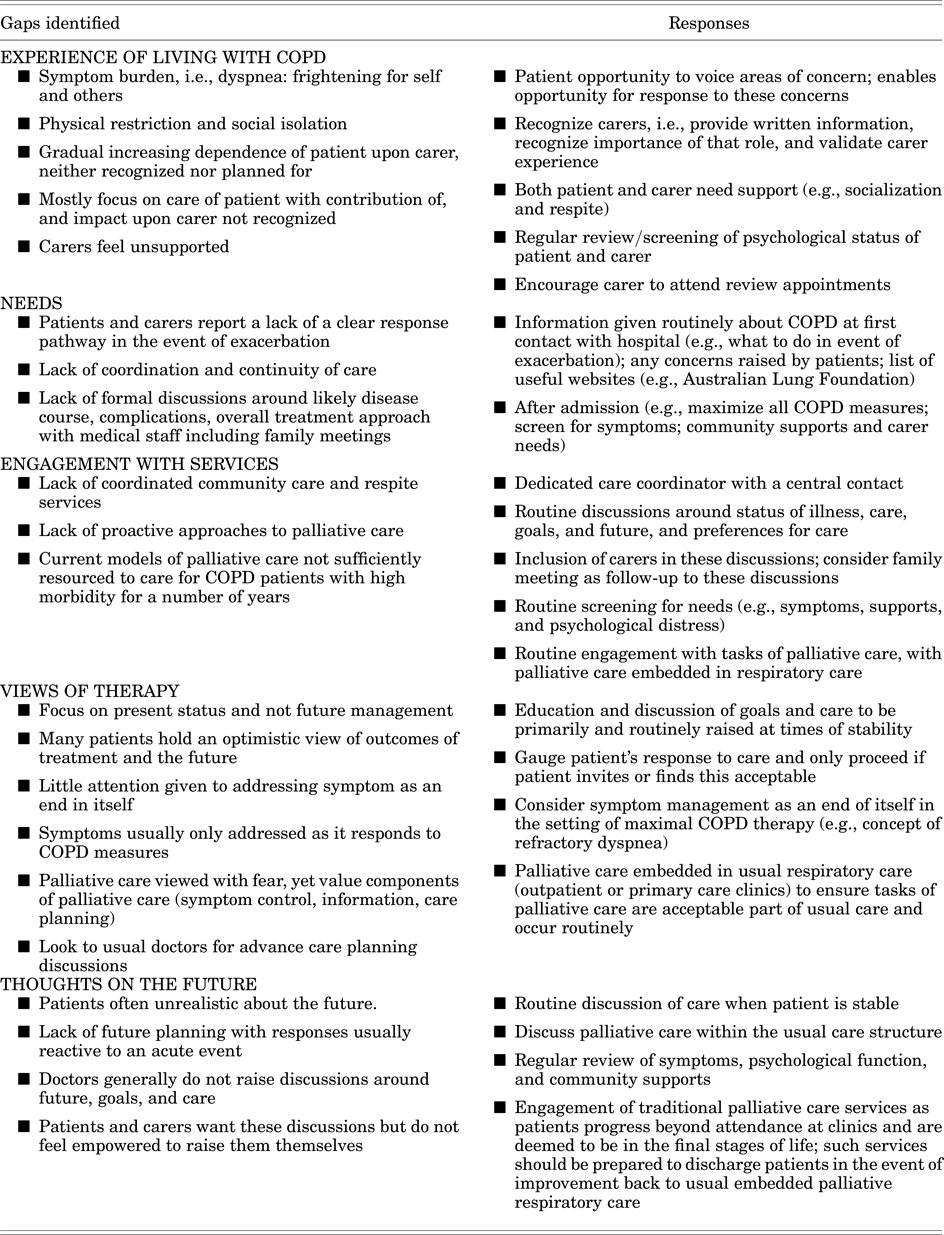
A summary of integrated results of the substudies is presented in Table 1.
Gaps identified and responses formulated from substudies 1 and 2

Substudy 1. Qualitative Study: Defining Needs and Experiences
In total, the views of 25 patients, 17 family caregivers, 10 bereaved caregivers, and 31 HCPs were sought. In brief, patients and family caregivers balanced hope, optimism, fluctuating disease course punctuated with treatment and recovery, as well as high needs of support, information, and future planning. Illness understanding and prognosis were often limited, and HCPs tended to concentrate on immediate concerns and disease-management strategies. Patients, family caregivers, and HCPs believed that information about the end of life should be offered routinely, but delivered in a manner that recognizes and is respectful of hope (Crawford et al., Reference Crawford, Brooksbank and Brown2013; Philip et al., Reference Philip, Gold and Brand2012a; Reference Philip, Gold and Brand2014).
Substudy 2: Epidemiological Cohort Study: Describing Service Use
In summary, 20,019 patients were admitted with a COPD-coded diagnosis during the 2-year sampling period (Philip et al., Reference Philip, Lowe and Gold2012b). Of these, 1,178 (5.4%) died during the admission period, a further 2,911 (13.2%) died within 6 months, and another 9,161 (41.6%) died within the follow-up period of 4–6 years. Most of those who died did so in hospital (6,570, 72.3%), and risk of death within 6 months was associated with older age, emergency admission, presence of particular comorbidities, previous hospitalizations, and a longer length of stay (more than 16 days).
Data Integration: Developing Recommendations for Practice Improvement
Following integration of data from substudies 1 and 2, a series of principles of care were developed to ensure that the model of palliative care for patients with COPD was relevant, responsive, and sustainable. These principles were that care must be: (1) focused on the patient and the family caregiver; (2) equitable, enabling access to components of palliative care for a group with significant and relevant needs; (3) accessible; and (4) less resource-intensive than expansion of usual palliative care service delivery.
MODEL OF CARE
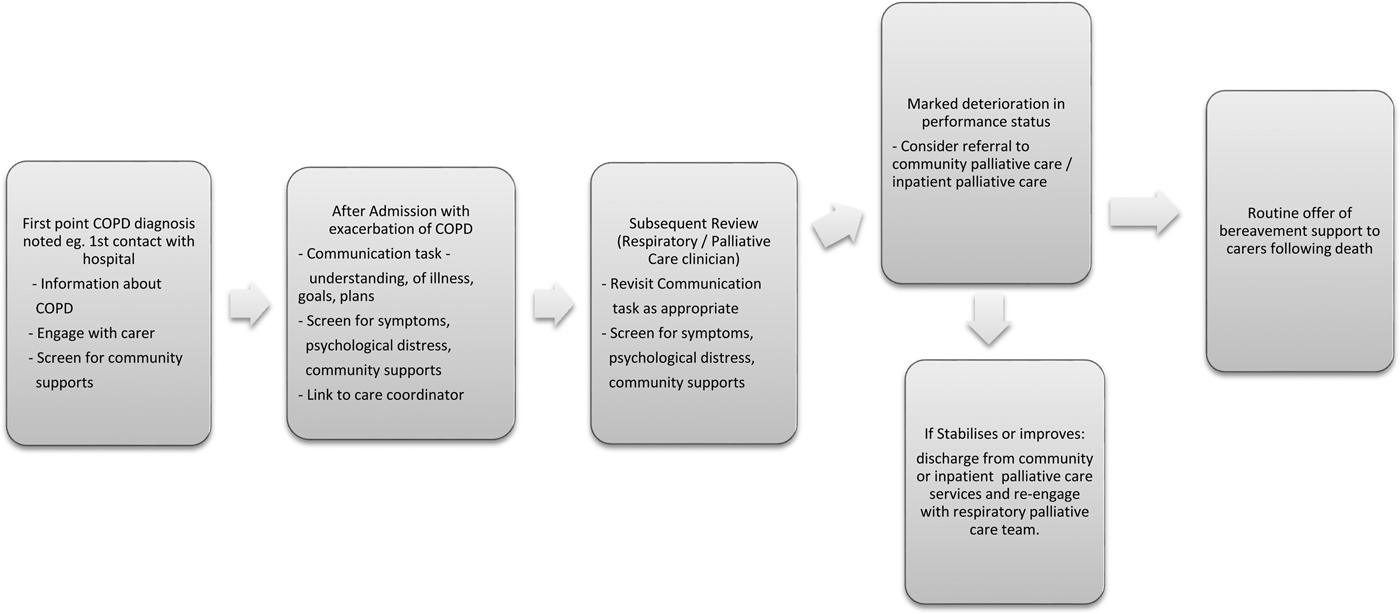
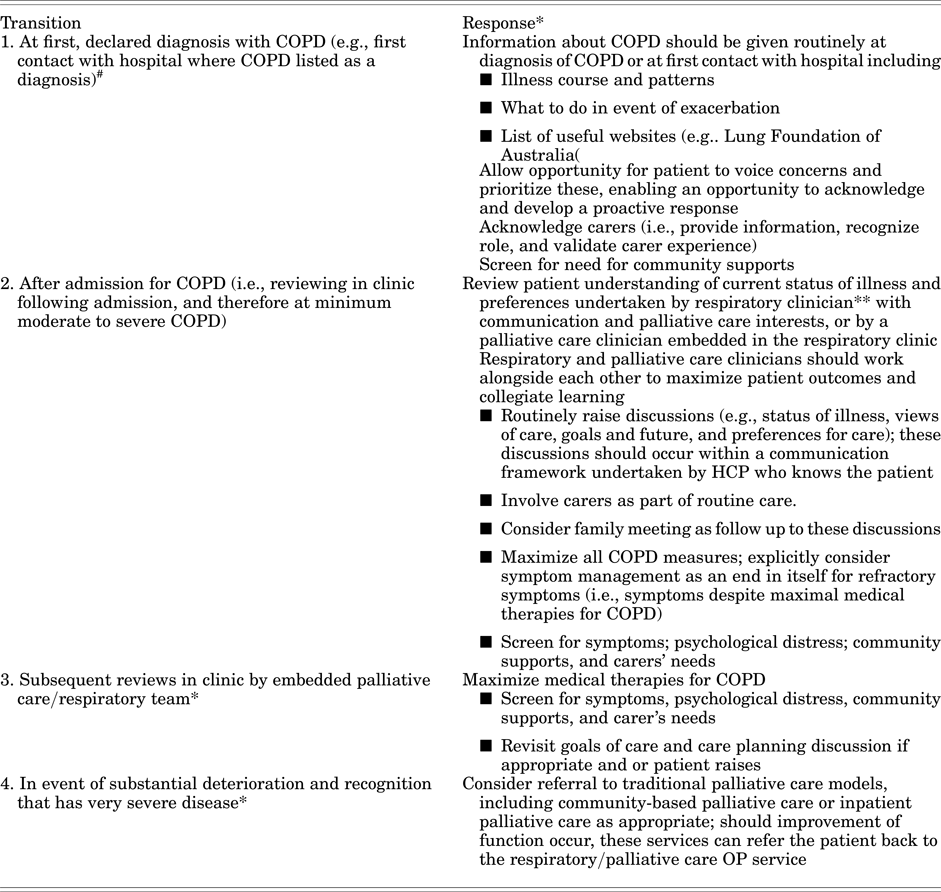
The structure of the proposed clinical model of palliative care for patients with COPD is presented in Figure 1, with the features detailed in Table 2.
Structure of proposed model of palliative care provision for patients with COPD and their family caregivers.

A model of palliative care provision for patient with COPD and their family caregivers

# Transition 1 would not routinely be considered the role of embedded palliative care.
* At all points, disease management strategies must be addressed as part of the consultation.
** Respiratory clinicians include respiratory medicine, internal medicine, primary care providers.
The recommendations informing the model are as follows:
Statement A
A model of palliative care for COPD patients should be triggered by clinical transitions in care, that is, an objective milestone in the progress of the illness. Clinical transitions are not related to the time since illness diagnosis, nor to symptoms, nor to prognosis, since our belief is that such parameters require clinicians to think in a mode that is different from the usual approaches to care. Rather, entry into this model is based on the occurrence of key clinical events, such as an episode of hospitalization, that can be captured irrespective of clinician alertness, and a where “flag” can be raised to herald those patients who are relevant to be considered for engagement with palliative care.
Statement B
Palliative care for COPD patients should be embedded in routine ambulatory respiratory care, whether that be in outpatient clinics or in association with primary care. This ensures that it is regarded as “usual” care by both patients and clinicians alike. This will circumvent perceptions that palliative care is something different or solely reserved for the last hours of life. Instead, this enables aspects of palliative care to be enacted without fanfare and without the challenges of handover of care. In addition, it is accessible for patients. This embedded approach also ensures cross-learning and mutual respect between palliative care and respiratory care services as relationships and trust are established.
Statement C
The tasks of this new clinical model of palliative care, embedded within routine respiratory care and implemented for those patients highlighted as at a transition point, should include to: screen for and address symptoms; screen for psychological, social, and community support for the patient and family caregiver; incorporate the family caregiver into care, including through providing support and information; and institute discussions around the goals of and preferences for care.
Statement D
The clinical model will facilitate the move into usual palliative care services as they become more relevant for a particular patient. This embedded model of palliative care will enable clinicians to successfully institute the components of palliative care, including for those who may have a lengthy or unpredictable prognosis. Furthermore, it will facilitate triage to usual palliative care services—for example, admission to inpatient palliative care for patients entering the final phase of life, since relationships with palliative care are already in place through the new clinical model.
DISCUSSION
We believe that the proposed embedded model of palliative care for patients with COPD represents a unique approach, developed by consensus, informed by the integration of qualitative and quantitative evidence, and addressing palliative care needs, patient expectations, and the specific disease and treatment parameters of this illness.
The evidence underpinning this model is consistent with the findings of others. Reports from patients with severe COPD and their family caregivers detail substantial morbidity and uncertainty, including significant symptoms of dyspnea, exhaustion, low mood, high levels of distress, and, at times, fear (Gardiner et al., Reference Gardiner, Gott and Payne2010; Vermylen et al., Reference Vermylen, Szmuilowicz and Kalhan2015). They are frequently isolated, and while many have adapted to their circumstances by developing strategies for negotiating difficulties, such adaptations are by no means universal (Seamark et al., Reference Seamark, Blake and Seamark2004). They have a need for information in order to negotiate the day-to-day stressors, respond to the acute exacerbations, and plan for the future (Gardiner et al., Reference Gardiner, Gott and Payne2010), yet many report gaps in their communications with HCPs (Gaspar et al., Reference Gaspar, Alfarroba and Telo2014; Vermylen et al., Reference Vermylen, Szmuilowicz and Kalhan2015). Of particular note is the paucity of information around prognosis, care planning, and preferences for future treatments, which has been revealed as being a concern internationally (Gardiner et al., Reference Gardiner, Gott and Payne2010). While these needs and concerns are fundamental components of palliative care provision, there appears some apprehension about engaging with palliative care services as they are currently configured. Preference was expressed for these needs to be addressed by their usual care team. An approach that embeds palliative care into usual respiratory care will facilitate engagement with the tasks of palliative care in a culturally appropriate manner for those with COPD and has been advocated elsewhere (Higginson et al., Reference Higginson, Bausewein and Reilly2014). It is envisaged that it will help negate the need to step outside usual services, and will simultaneously result in mutual up-skilling of the clinicians (both respiratory and palliative care) who work side by side in the clinic.
The proposed model of palliative care also addresses the other barrier to engagement with usual palliative care services—namely, the resource implications of caring for patients with nonmalignant disease. In Australia, HCPs have expressed concern that the very significant needs of COPD patients, often over many years, may require substantial resources for a protracted period in palliative care services that admit patients until formal discharge or death. And the potential number of such patients is very great. Therefore, some hesitation is expressed by palliative care professionals about engaging with such patients. This concern over resource implications is well-founded. In a study undertaken in the United Kingdom examining diagnoses and needs, a conservative estimate of the increased resources required for palliative care services to care for patients dying of nonmalignant disease was of the order of 77% (Addington-Hall et al., Reference Addington-Hall, Fakhoury and McCarthy1998). The conceptual model proposed in our study, while representing an increase over current services, is much less resource-intensive than attempting to address palliative care needs within current care models.
There are limitations within the claims that can be made for this clinical model of palliative care delivery. The qualitative data gathered, as consistent with the method, are not generalizable to other broader groups. Yet these data were sampled widely, across two institutions and two Australian states. The mixed-methods design and the opportunity to triangulate data in some areas strengthen the validity of the results achieved. The epidemiological study of health service use is now more than 10 years old. However, a recent single-institution cohort study of end-of-life COPD care undertaken in 2016 (n = 226) confirmed that the findings of the larger population study were still representative of current practices (unpublished data).
Perhaps, however, the most significant limitation of our study is that the proposed model is strictly conceptual and has not yet been subjected to rigorous testing. Phase 2 and 3 studies of feasibility and effectiveness, respectively, are required to establish responsiveness and rigor, and should be the subject of future work. Effectiveness measures in such studies should involve not just patient and health service outcomes, but also family caregiver-reported outcomes. The results of such studies are likely to have implications for developing palliative care approaches for patients suffering other advanced nonmalignant diseases that are punctuated by acute exacerbations—such as heart failure.
CONCLUSIONS
The proposed innovative model of palliative care for people with COPD developed in response to patients’, family caregivers’, and HCPs’ expressed needs and preferences is characterized by the provision of routine palliative care at times of clinical transition and delivered by a palliative care clinician embedded with the usual respiratory care setting. We believe that the strengths of the model proposed in our study are as follows: it specifically responds to and addresses the palliative care needs (namely, symptoms, and the need for information and social/community supports); it deals with the support and information needs of family caregivers; it recommends routine institution of advance care planning discussions; it is culturally appropriate for a group of patients who look to usual clinicians to provide end-of-life care; it provides mutual learning opportunities for clinicians; and it involves fewer resource implications than just catering to this patient group within usual care. Furthermore, this model ensures that palliative care is part of usual high-quality care and is therefore seen as more acceptable by patients and family caregivers.
DISCLOSURES
The authors hereby declare that they have no conflicts of interest to disclose.
ACKNOWLEDGMENTS
This work was supported by three separate grants from the Bethlehem Griffiths Research Foundation of Victoria, Australia, and the National Health and Medical Research Council.