





Introduction
Persons living with dementia (PLwD) are the fastest-growing group of hospice users (now accounting for over 50% of hospice enrollees in the United States) (De Vleminck et al. Reference De Vleminck, Morrison and Meier2018; Aldridge et al. Reference Aldridge, Hunt and Husain2022; Centers for Medicare & Medicaid Service 2025). Home hospice care is a model of treatment designed to provide physical, psychological, and emotional support to individuals with a life expectancy of 6 months or less, as certified by 2 physicians, and to their families (Bhatnagar et al. Reference Bhatnagar, Kempfer and Lagnese2023). Services are typically delivered in private residences, nursing homes, and assisted living facilities (Bhatnagar et al. Reference Bhatnagar, Kempfer and Lagnese2023). Hospice care for PLwD is increasingly characterized by lengthier hospice stays with more days of routine home care and additional home health aide visits (Frank et al. Reference Frank, Huessard and Broyles2025). PLwD often have limited capacity to advocate for their needs due to late-stage dementia symptoms (Hugo and Ganguli Reference Hugo and Ganguli2014), leaving family care partners (FCPs) responsible for making treatment decisions (Feinberg and Whitlatch Reference Feinberg and Whitlatch2002; Martin et al. Reference Martin, Shrestha and Burton2019). FCPs frequently turn to clinicians, most often social workers and registered nurses in hospice care, for knowledge and support when making these decisions.
End-of-life care for PLwD relies heavily on coordination between FCPs and clinicians. For FCPs, this can exacerbate caregiver distress (Brodaty and Donkin Reference Brodaty and Donkin2009) by increasing decision-making uncertainty (Sellars et al. Reference Sellars, Chung and Nolte2019), contributing to misunderstandings of clinical information (McWilliams et al. Reference McWilliams, Farrell and Keady2018), and reducing confidence in collaborative decision-making with clinicians (Sellars et al. Reference Sellars, Chung and Nolte2019). In tandem, clinicians caring for PLwD near the end of life face competing clinical demands such as balancing time with the patient and the family (Edberg et al. Reference Edberg, Bird and Richards2008) and communication challenges ascertaining the wishes of the patient with dementia who has limited communication abilities and relies on their FCPs to relay their wishes (Abrahamson et al. Reference Abrahamson, Jill Suitor and Pillemer2009; Albers et al. Reference Albers, Van Den Block and Vander Stichele2014), underscoring the need for interventions that enhance clinician confidence and skills in medically complex settings. Critically, both FCPs and clinicians have reported knowledge gaps in end-of-life care for PLwD (Todd et al. Reference Todd, Lawson and Grealish2021; McDarby et al. Reference McDarby, Russell and King2023, Reference McDarby, Russell and King2024). To better meet the needs of PLwD at the end of life, interventions are needed to better support FCPs and improve clinicians’ educational gaps.
Prior research on FCP interventions has focused on general hospice or palliative care education (Chi et al. Reference Chi, Demiris and Lewis2016). Notably, many caregiver interventions do not specifically target dementia-specific needs, with 1 systematic review (Chi et al. Reference Chi, Demiris and Lewis2016) finding only 1 study focused on caregivers to those with dementia (Reinhardt et al. Reference Reinhardt, Chichin and Posner2014). Similarly, interventions for clinicians have included palliative care training and educational modules (Anstey et al. Reference Anstey, Powell and Coles2016; Tjia et al. Reference Tjia, D’arcangelo and Carlston2023), but largely lack hospice- and dementia-specific information. Other interventions include structured curricula and training programs to improve the delivery of end-of-life care (Chi et al. Reference Chi, Demiris and Lewis2016). These interventions have ranged from psychosocial support to cognitive-behavioral approaches with mixed effectiveness and implementation results (Chi et al. Reference Chi, Demiris and Lewis2016). Review of these interventions found increased awareness and knowledge of end-of-life care, but limited use in clinical practice over time (Anstey et al. Reference Anstey, Powell and Coles2016; Lassell et al. Reference Lassell, Moreines and Luebke2022). Additionally, rarely have interventions implemented a dyadic approach between FCPs and clinicians.
Luth and colleagues developed the “Enhancing Dementia Instruction and Tool in Home Hospice Care” (EDITH-HC) intervention (Geisser et al. Reference Geisser, Amponsah and Vasquez2025; Tamer et al. Reference Tamer, Hoover and McDonald2025), a 2-pronged approach for clinicians and FCPs. The parent study (Geisser et al. Reference Geisser, Amponsah and Vasquez2025; Tamer et al. Reference Tamer, Hoover and McDonald2025) focused specifically on Black and White FCPs of PLwD in home hospice to allow a focused evaluation of these 2 populations, given the increased risk of poor hospice outcomes for Black PLwD (Luth et al. Reference Luth, Russell and Brody2020, Reference Luth, Brennan and Hurley2024) and limited research on Black–White racial differences in dementia caregiving burden (Black et al. Reference Black, Johnston and Rabins2013; Miranda-Castillo et al. Reference Miranda-Castillo, Woods and Orrell2013; Chi et al. Reference Chi, Demiris and Lewis2016). EDITH-HC includes educational modules for clinicians on dementia-specific end-of-life care and a structured worksheet for clinicians and FCPs to complete together to identify and address FCP stressors. The intervention aims to enhance dementia care quality in home hospice settings by tailoring support for FCPs.
Following stage 1B of the National Institutes of Health (NIH) Stage Model for Behavioral Intervention Development (Research Centers Collaborative Network 2025), this study evaluates the implementation and acceptability of the pilot randomized controlled trial of EDITH-HC. This study provides an overview of the strengths and limitations of this intervention and guidance on intervention adjustment for future evaluation.
Methods
Study design
This pilot randomized controlled trial employed a 2-arm design with repeated measures at baseline, up to 4 subsequent clinical visits, and a final survey at study completion to assess intervention implementation and acceptability outcomes. Participants completed surveys electronically via Research Electronic Data Capture (Harris et al. Reference Harris, Taylor and Thielke2009). For participants who did not complete the surveys online, trained study staff conducted follow-up data collection by telephone. The study utilized a non-blinded, adaptive randomization strategy to balance participant numbers across study arms. This protocol was approved by the VNS Health (1805421) and the Rutgers (Pro2021001817) Institutional Review Boards. This trial was registered on www.clinicaltrials.gov (NCT05719077).
Recruitment and participant eligibility
Participants were recruited from a New York City hospice agency between October 2023 and March 2025. The agency is a nonprofit healthcare program with an average daily census of 1,100 hospice patients. All participants provided oral informed consent before enrollment.
Eligible clinicians were hospice social workers or nurses providing home hospice care to PLwD. Eligible FCPs met the following criteria: 18 years or older; provided care to a family member, friend, or significant other with dementia enrolled in home hospice for at least 2 weeks; able to complete data collection in English; self-identified as Black or White to the study screener; provided at least 8 h of care per week for a minimum of 1 month; and scored 15 or higher on the Animal Naming Test, a validated cognitive screening measure assessing verbal fluency and cognitive function (Henry and Crawford Reference Henry and Crawford2004).
Intervention
Clinicians completed 5 educational modules delivered flexibly via videoconference in 30–60-min sessions to accommodate schedules. These modules included 4 videos addressing dementia-specific end-of-life care challenges: eating and feeding, pain assessment and management, documenting caregiver burden in the electronic health record (EHR), and instructions on using the Needs and Strategies Worksheet, a 1-page intervention worksheet. The worksheet employs problem-solving therapy (Nezu et al. Reference Nezu, Maguth Nezu and D’zurilla2013) strategies to systematically identify and address dementia-related stressors faced by FCPs, facilitating tailored support within diverse socioeconomic and cultural contexts. Clinicians used the worksheet during routine hospice visits to guide ongoing caregiver support.
Measure
Participants completed study-developed, self-reported questionnaires at baseline, after each educational module (for intervention clinicians only), after each visit (up to 4 times), and at the end of the study.
Sociodemographic information
We used structured questionnaires to collect sociodemographic data from clinicians and FCPs (e.g., age, gender, race, education). Clinicians were asked about their professional role. FCPs provided their relationship to the PLwD and the average number of hours spent providing care per week.
Implementation and acceptability
We assessed the acceptability of educational modules using a combination of Likert-scale (ranging in scores from 1 to 5 with higher values indicating more positive ratings), multiple-choice, and short-answer questions. Likert-scale items captured clinicians’ and FCP perceptions on the ease of use, helpfulness, satisfaction, and likelihood of continued use of the intervention components. Responses for the Likert scales ranged from “very difficult” to “not at all difficult,” “very unhelpful” to “very helpful,” or “very dissatisfied” to “very satisfied.” Multiple-choice questions on intervention implementation collected data on preferences, frequency of use, and settings. Some multiple-choice items permitted multiple responses to capture the full range of participant experiences and opinions. Open-ended, short-answer questions invited participants to provide qualitative feedback on the intervention, elaborating on helpful or challenging aspects and suggestions for improvement. An example of a quantitative question includes “How helpful was the video on the Needs and Strategies Worksheet to you?” while a short-answer item was “Please indicate what you found helpful about the video.” These varied question formats enabled a comprehensive quantitative and qualitative evaluation of implementation and acceptability.
Data analysis
Descriptive statistics summarized participant characteristics, implementation, and acceptability using SPSS version 31 (International Business Machines Corporation 2025). Free-text responses to acceptability items were examined and summarized to provide exemplar quotes.
Results
Participant characteristics
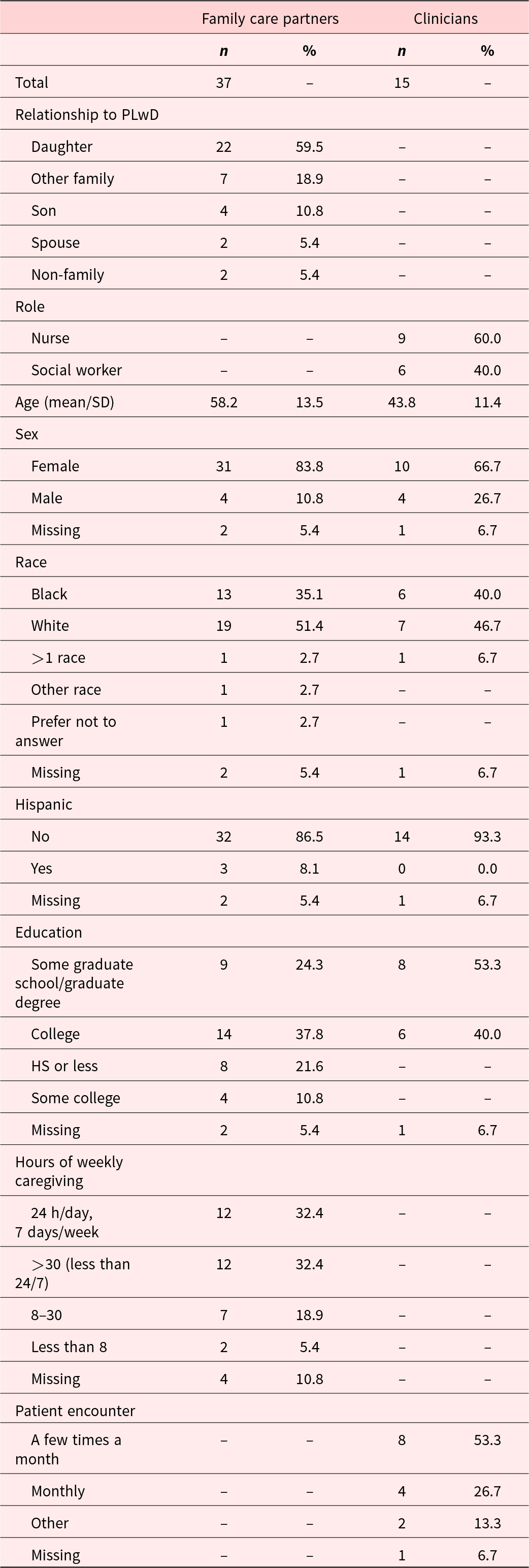
FCP average age was 58.2 years (SD = 13.5), and most identified as female (83.8%). About half of FCPs identified as White (51.4%), followed by Black/African American (35.1%). Most FCPs were daughters (59.5%) of the PLwD. Many of the FCPs reported spending 24 h a day, 7 days per week (32.4%) providing care to the PLwD. Table 1 presents the demographic data for all FCPs.
Participant characteristics for 37 family care partners and 15 clinicians

Table 1 Long description
Participant characteristics are summarized for 37 family care partners and 15 clinicians, reporting counts and percentages for categories plus mean age with standard deviation. Among care partners, relationships to the person living with dementia were most often daughter (22, 59.5 percent), followed by other family (7, 18.9 percent) and son (4, 10.8 percent); spouse and non-family were each 2 (5.4 percent). Clinicians were 9 nurses (60.0 percent) and 6 social workers (40.0 percent). Mean age was higher for care partners (58.2, SD 13.5) than clinicians (43.8, SD 11.4). Most participants were female, especially care partners (31, 83.8 percent) compared with clinicians (10, 66.7 percent), with small amounts of missing sex data. Race was primarily White (care partners 19, 51.4 percent; clinicians 7, 46.7 percent) or Black (care partners 13, 35.1 percent; clinicians 6, 40.0 percent), with a few reporting more than one race or other categories and some missing responses. Most were not Hispanic (care partners 32, 86.5 percent; clinicians 14, 93.3 percent), with some missing data. Education differed by group: clinicians were mostly college or graduate educated (graduate degree 8, 53.3 percent; college 6, 40.0 percent), while care partners were more mixed (college 14, 37.8 percent; graduate degree 9, 24.3 percent; high school or less 8, 21.6 percent). Caregiving intensity among care partners was often high, with 12 (32.4 percent) providing 24 hours a day, 7 days a week and another 12 (32.4 percent) providing more than 30 hours weekly but not continuously; 4 (10.8 percent) were missing. Clinician patient encounter frequency was most commonly a few times a month (8, 53.3 percent) or monthly (4, 26.7 percent), with 1 (6.7 percent) missing.
PLwD = persons living with dementia; SD = standard deviation; n = number.
Clinicians’ average age was 43.8 years (SD = 11.4), and most identified as female (66.7%). Most clinicians identified as White (46.7%), followed by Black/African American (40%). Half (53.3%) had graduate school education, 60% were nurses, and 40% were social workers. Half of clinicians visited the PLwD a few times a month (53.3%). Table 1 presents demographic data for all clinicians.
Enrollment and retention
FCPs: Thirty-seven FCPs enrolled in the intervention, of whom 28 (75.7%) completed the post-intervention survey; 3 did not receive the survey due to leaving the study, while the 6 other participants did not complete the survey after they were contacted. In post-visit assessments, 12 FCPs reported using the worksheet.
Clinicians: Fifteen clinicians enrolled in the intervention group. Two clinicians discontinued participation before completing the educational component. The remaining 13 clinicians completed each educational module and post-training survey. Of these 13, 12 matched with an FCP during this study. Of these 12, 8 clinicians (75%) completed the post-intervention survey. The remaining 4 clinicians could not be reached by the study team.
Implementation and acceptability for clinicians
Clinicians reported high levels of engagement and satisfaction across all 4 educational modules: Eating & Feeding Support, Pain, EHR, and Needs and Strategies Worksheet. Across modules, most clinicians watched the entire videos (Eating & Feeding: 92.9%, n = 13; Pain: 92.9%, n = 13; EHR: 100%, n = 14; Needs and Strategies Worksheet: 92.9%, n = 13) and reported minimal difficulty understanding the content (92.9–100% across modules).
Clinician evaluation of educational modules (Table 2)
Across all modules, clinicians reported high perceived helpfulness, strong likelihood of use in practice, and high satisfaction, with mean ratings in the range of 4.31–4.54 (helpfulness), 4.38–4.69 (likelihood of use), and 4.33–4.69 (satisfaction). The Eating & Feeding Support and EHR modules demonstrated the strongest overall ratings (≥92.9% acceptability across outcomes), while the Needs and Strategies Worksheet also showed consistently high acceptability (92.9% across domains). Although still favorable, the Pain module showed comparatively lower ratings, particularly for likelihood of use (78.6%) and satisfaction (85.7%). Short-answer feedback highlighted requests for additional detail, such as information on feeding tube interventions (Eating & Feeding), non-pharmacologic pain management strategies (Pain), ways to more specifically document concerns from FCPs (EHR), and more examples for using the worksheet during visits (Worksheet). Themes reflected both appreciation for the clarity of the materials and suggestions for expansion of content to support clinical practice.
Clinician evaluation of education modules: quantitative and qualitative integration

Table 2 Long description
Clinician ratings compare four education modules on helpfulness, satisfaction, and likelihood of use, each scored on a five-point scale, with sample sizes of 13 or 14 per module. Mean ratings are consistently high across modules, ranging from about 4.3 to 4.7. Eating and Feeding Support has the highest helpfulness and ties for the highest satisfaction and likelihood of use, all around the mid to high 4.6 range. The EHR module also scores very highly, with satisfaction and likelihood of use around the mid 4.6 range. Pain and the Needs and Strategies Worksheet score slightly lower overall but remain strong, generally around 4.3 to 4.5. Quotes emphasize practical, actionable guidance and improved confidence, while common suggestions request more examples and added detail, such as PEG tube care and pain management scenarios. Results reflect small module-specific samples and summarize average ratings alongside selected comments rather than all responses.
Helpfulness, satisfaction, and likelihood of use were measured on 5-point Likert scales (1 = very unhelpful/very dissatisfied/very unlikely, 5 = very helpful/very satisfied/very likely). Representative quotes were selected to illustrate common themes from short-answer responses.
Comparison of clinician responses from post-training to post-intervention (Table 3)
Clinicians reported similar levels of satisfaction across both surveys. There were slight decreases in levels of helpfulness, use in practice, and intent to use information after application in clinical visits.
Comparison of clinician post-training and post-intervention survey responses

Table 3 Long description
Clinician survey responses compare post-training expectations with post-intervention experiences for videos and a Needs and Strategies Worksheet. Post-training, most clinicians rated the materials highly helpful at 78.6 percent and reported high satisfaction with videos at 85.7 percent; post-intervention satisfaction remained high at 100 percent. Anticipated use was higher than reported use: post-training likelihood of using the videos and worksheet ranged from 78.6 to 92.9 percent, while post-intervention frequent use was 50 percent. Worksheet usability stayed relatively strong, shifting from 92.9 percent reporting no difficulty understanding it to 75 percent reporting it was not difficult to use. Perceived worksheet helpfulness declined from 92.9 percent helpful or very helpful post-training to 62.5 percent post-intervention. Intentions for continued worksheet use also fell, from 92.9 percent high likelihood anticipated post-training to 50 percent post-intervention. Sample sizes differ by item because some clinicians did not answer every question, so percentages are not always based on the same number of respondents.
Sample size varies across items due to item-level non-response:
a n = 13,
b n = 14,
c n = 8.
Likert-scale items were rated on 5-point scales, with higher scores indicating less difficulty or greater perceived helpfulness, as appropriate.
Implementation and acceptability for FCPs
Twenty-eight FCPs completed the post-intervention survey. The sample was split between FCPs who reported using the worksheet (n = 10) and FCPs who reported not using the worksheet (n = 18). Among FCPs who used the worksheet, 70% reported using it 2–4 times, found it moderately helpful (M = 3.20, SD = 0.919), and were moderately satisfied (M = 3.70, SD = 0.823). Most reported minimal difficulty using it. Short-answer responses indicated that guidance and steps were helpful. Next, FCPs who reported not seeing or using the worksheet (n = 18, 100%) indicated that they were unaware of the worksheet.
Comparison of post-intervention responses from clinicians and FCPs who used the worksheet (Table 4)
Completion of the Needs and Strategy Worksheet was evaluated for clinicians and FCPs from the post-intervention survey. All 8 clinicians who completed the post-intervention survey reported using the worksheet with at least 1 FCP during a visit. Ten (35.7%) FCPs reported using the worksheet with their clinicians. Both groups reported the worksheet as generally helpful, not difficult to use, and satisfactory, though clinicians rated helpfulness slightly higher (M = 3.88 vs. M = 3.70 for FCPs). Time to use the worksheet was longer for clinicians than for FCPs during initial use, but follow-up times were comparable. Short-answer responses showed that both groups valued the structured guidance and collaborative aspects of the worksheet.
Comparison of the post-intervention survey for clinicians and FCPs who used the worksheet

Table 4 Long description
Post-intervention survey results compare clinicians who used the educational videos and worksheet with family care partners (FCPs) who used the worksheet. Use frequency differed: half of clinicians reported frequent use, while most FCPs used the worksheet two to four times and the rest used it once. First-time completion time was commonly twenty to forty minutes for clinicians and split between about ten minutes and fifteen to forty-five minutes for FCPs; follow-up use was typically ten to thirty minutes for clinicians and five to fifteen minutes for most FCPs. Helpfulness ratings were higher among clinicians, with about two-thirds rating the materials helpful or very helpful, compared with four-fifths of FCPs rating the worksheet helpful but with a lower average helpfulness score reported for FCPs. Both groups generally found the worksheet not difficult and reported being satisfied at similar levels, around seven in ten or more. Open-ended comments suggest clinicians valued guidance and collaboration, while FCPs cited the whole worksheet, dual-aspect care, and steps to provide care. Suggested changes differed: clinicians more often wanted it incorporated into conversations or to provide discussion structure, whereas most FCPs suggested no changes, with a minority wanting different clinicians or expanded topics.
Helpfulness, satisfaction, and likelihood of use were measured on 5-point Likert scales (1 = very unhelpful/very dissatisfied/very unlikely, 5 = very helpful/very satisfied/very likely).
Discussion
Findings from this pilot randomized controlled trial of EDITH-HC among FCPs and clinicians found high acceptability and promising implementation outcomes. The results suggest the intervention may serve as a helpful tool for FCPs caring for PLwD and hospice social workers and nurses.
Clinicians consistently rated education modules highly regarding helpfulness, satisfaction, and usability following training and indicated that the information applied to clinical practice. Content was described as clear, practical, and relevant to patient care. These findings suggest that the education modules may enhance the perceived preparedness of clinicians supporting PLwD and their FCPs. This perceived utility is particularly important given that clinicians, specifically social workers and nurses in hospice, often have limited time to learn and implement new interventions (Abrahamson et al. Reference Abrahamson, Jill Suitor and Pillemer2009; Albers et al. Reference Albers, Van Den Block and Vander Stichele2014). Prior educational interventions for clinicians have not focused on dementia and end-of-life information (Anstey et al. Reference Anstey, Powell and Coles2016; Tjia et al. Reference Tjia, D’arcangelo and Carlston2023). Therefore, EDITH-HC may help address this gap by integrating these domains into an evidence-based training approach (Nezu et al. Reference Nezu, Maguth Nezu and D’zurilla2013; Geisser et al. Reference Geisser, Amponsah and Vasquez2025; Tamer et al. Reference Tamer, Hoover and McDonald2025).
Modules emphasizing direct clinical strategies (e.g., the Eating & Feeding Support and Pain modules) were particularly valued for their actionable content. Nutrition and pain are often challenging to manage in PLwD due to communication difficulties (Sachs et al. Reference Sachs, Shega and Cox-hayley2004; Tarter et al. Reference Tarter, Demiris and Pike2016; Fetherston et al. Reference Fetherston, Rowley and Allan2018). Clinicians providing evidence-informed guidance (Tarter et al. Reference Tarter, Demiris and Pike2016; Volkert et al. Reference Volkert, Beck and Faxén-irving2024) on these symptoms may lead to more effective symptom management for patients and potentially reduce caregiver strain. However, future research is needed to evaluate whether the EDITH-HC intervention leads to measurable improvements in patient and caregiver outcomes.
Clinicians reported that documentation and structured communication modules (e.g., EHR and Needs and Strategies Worksheet modules) supported workflow efficiency, standardization, and family engagement. Workflow efficiency is critical in high-demand settings such as hospice, where clinicians face significant time and workload constraints (Gesner et al. Reference Gesner, Dykes and Zhang2022; Jang et al. Reference Jang, Lim and Choi2024; Sloss et al. Reference Sloss, Abdul and Aboagyewah2024). These findings suggest that EDITH-HC may help streamline aspects of workflow, with potential downstream benefits (Sloss et al. Reference Sloss, Abdul and Aboagyewah2024) that warrant future research.
Despite high satisfaction with content and training, implementation in practice was variable. Retention in research with hospice and end-of-life participant groups is a documented challenge (Sherman et al. Reference Sherman, McSherry and Parkas2005; Wiegand et al. Reference Wiegand, Norton and Baggs2008; Fischer et al. Reference Fischer, Burgener and Kavanaugh2012). While this study retained 61% of the clinicians for the post-intervention survey, additional research is needed to understand and decrease study attrition. Among clinicians, half reported using the videos in clinical encounters, and 70% reported using the worksheet with 2–4 FCPs. While most of the clinicians used the worksheet at least once with the FCP, the clinicians reported that FCP engagement during visits and patient needs limited their ability to fully review the worksheet and evaluate FCP stressors. These findings align with prior literature highlighting limited clinician time (Hoffstädt et al. Reference Hoffstädt, Boogaard and Tam2023; Hughes et al. Reference Hughes, Noyes and Stringer2024; McAndrew et al. Reference McAndrew, Camarda and Fortney2025) and competing demands for caregivers (Bijnsdorp et al. Reference Bijnsdorp, Onwuteaka-philipsen and Boot2022; Sullivan et al. Reference Sullivan, De Rosa and Li2022) in hospice settings. Although the EDITH-HC intervention demonstrated strong acceptability with clinicians, these implementation challenges suggest the need for further refinement to enhance scalability. Clinicians may have integrated aspects of the intervention based on individual workflow and clinical priorities, as observed across behavioral health interventions (Kendall and Frank Reference Kendall and Frank2018; Bennett and Shafran Reference Bennett and Shafran2023). However, add-on training with hospice clinicians may be required to facilitate consistent use.
Additional refinement may also be needed to optimize engagement among FCPs. While many FCPs reported meaningful discussions, some FCPs did not fully engage in visits or complete the worksheet. Engaging FCPs in hospice care is inherently challenging due to caregiver stress (Wittenberg-Lyles et al. Reference Wittenberg-Lyles, Demiris and Oliver2011; Hughes et al. Reference Hughes, Noyes and Stringer2024) and time limitations (Sherman Reference Sherman2019; Thomas Hebdon et al. Reference Thomas Hebdon, Cloyes and Vega2023). These findings suggest that alternative or supplementary formats of intervention delivery for FCPs may require a different approach, such as audio-based materials (Thomas Hebdon et al. Reference Thomas Hebdon, Cloyes and Vega2023), to improve intervention implementation for caregivers.
Limitations and future directions
This study comes with limitations. First, this was a pilot randomized controlled trial designed to assess feasibility and acceptability. Therefore, conclusions about efficacy and effectiveness cannot be determined. Future powered randomized controlled trials should be conducted for further intervention evaluation. Next, participants reported variability in educational module and worksheet use in clinical settings, which may dilute implementation; additional training may be needed to improve implementation, especially worksheet use. This study encountered methodological limitations due to non-response among participants. While this provides important insights regarding study design, it may introduce response bias in the data and limit the interpretation of implementation outcomes. Future research should identify study retention barriers and incorporate strategies to improve response and engagement. This study recruited Black/African American and White participants from a large metropolitan hospice agency. Therefore, generalizability may be limited to participants from urban healthcare infrastructures. Future work should recruit from other hospice agencies, such as rural settings. Finally, this intervention was designed specifically for PLwD receiving hospice care. Not all PLwD have access to hospice care, and future research should consider community-based settings for additional intervention implementation assessment. Overall, future work should consider larger, adequately powered trials in diverse settings and populations to focus on efficacy and scalability outcomes to advance this intervention.
Conclusion
The present study constitutes a promising, practical educational intervention to better support hospice clinicians and FCP caring for PLwD. This study found preliminary evidence for the acceptability and implementation of the EDITH-HC intervention. Future studies are needed to enhance educational interventions that address the needs of clinicians and FCP caring for PLwD at the end of life.
Acknowledgments
The authors would like to thank the participating hospice agency for collaborating on this project. Additionally, the authors thank the clinicians and FCPs for their time and involvement in this study.
Funding
This work was supported by the National Institute on Aging under grant number: R00 AG065624 (PI: Elizabeth A Luth). The funders had no role in study design, data collection and analysis, decision to publish, or preparation of the manuscript.
Competing interests
The authors do not have any disclosures.


 Open access

