

INTRODUCTION
Approximately half a million people die in England each year, almost two thirds of them over 75 years of age (NEoLCIN, 2010). The majority of deaths follow a period of chronic illness such as heart disease, cancer, stroke, chronic respiratory disease, neurological disease, or dementia, and most (58%) occur in National Health Service (NHS) hospitals, with around 18% occurring at home, 17% in care homes, 4% in hospices, and 3% elsewhere (Department of Health [DH], 2008). While some people die in the place of their choice, many others do not, and although some receive excellent care in hospitals, hospices, care homes, and their own homes, many others do not. They experience unnecessary pain, are not treated with dignity and respect, and do not die where they would prefer to (DH, 2008; Marie Curie Palliative Care Institute Liverpool, 2009; Addicott and Dewar, Reference Addicott and Dewar2008). In a hospital setting, where the culture is often focused on “cure,” continuation of invasive procedures, investigations, and treatments is often pursued at the expense of patient comfort (Ellershaw & Ward, Reference Ellershaw and Ward2003). In addition, healthcare professionals are sometimes reluctant to “diagnose dying,” as they may not have had sufficient training to care for dying patients and may experience feelings of helplessness when faced with the complex demands involved in planning and delivering end-of-life care (Gibbins, Reference Gibbins, McCoubrie and Alexander2009; Lokker et al., Reference Lokker, van Zuylen and Veerbeek2012). One example of this is the practice of transferring a patient to a side room and withdrawing from contact with the patient and family (Bailey et al., Reference Bailey, Murphy and Porock2011a ; Ellershaw & Ward, Reference Ellershaw and Ward2003).
The National Health Service's End-of-Life Care Strategy (DH, 2008) was developed to provide a framework for improving this situation. It advocated a whole-systems solution and emphasized the importance of a care pathway approach both for commissioning services and for delivery of integrated care. This was also a central concern of three acute NHS trusts undergoing major programs of service redesign, and the introduction of care pathways was part of this redesign process focused on changing the way end-of-life (EoL) care was provided in the trusts. However, as Watts (Reference Watts2012) observed, there is minimal critical analysis and research evidence to inform their use. Our paper reports the results of an interview-based study undertaken to investigate the use of EoL care pathways in three acute trusts.
BACKGROUND AND RELATED LITERATURE
The provision of appropriate end-of-life care can make the process of dying more comfortable and reduce the distress of the patient and their family. However, evidence from the Picker Institute (2008) indicates that patients have limited involvement in care decisions. Such lack of involvement can lead to dissatisfaction and reduced quality of care. Collaborative care plans/pathways offer a means of increasing patient involvement in care decisions (Hockley, Reference Hockley2006). The Gold Standards Framework (GSF), Preferred Priorities for Care Plan (PPCP), the Supportive Care Pathway (SCP), and the Liverpool Care Pathway (LCP) provide frameworks for managing EoL care that are advocated by the End-of-Life Care Strategy (DH, Reference Degner and Gow2007; 2008; 2009; Twomey et al., Reference Twomey, McDowell and Corcoran2007).
It has been found that the LCP provides measurable outcomes of care and if implemented appropriately can result in patients dying in a hospital setting receiving care at a level almost comparable to those in a hospice setting (Ellershaw & Ward, Reference Ellershaw and Ward2003); however, Sleeman and Collis (Reference Sleeman and Collis2013) highlighted a lack of “strong evidence” for the benefits of the LCP. Despite this, the use of the LCP (or its equivalent) was a central policy recommendation focusing on effective organization of EoL care in acute settings (DH, 2008). This requires significant workforce developments to enable and support professionals in delivering improvement, particularly in identifying and discussing patients' needs and preferences in relation to EoL care (Addicott, Reference Addicott, Addicott and Ashton2009). Furthermore, provision of equitable and comprehensive EoL care requires the support of generalist and specialist service providers. The main driver for change is the recognition that there is still more to do in an acute setting with regard to improving the provision of EoL care (DH, 2010). The data reported here record the progress in this area in three NHS acute trusts.
The Context
The three trusts where this work was carried out were working in partnership with a team of researchers investigating service redesign at an organizational level. This was part of theme 1 of the Birmingham and Black Country Collaborations for Leadership in Applied Health Research and Care (CLAHRC), which was focused on investigating and comparing service changes. Nine CLAHRCs were established in England in 2008. and their purpose was to create a new, distributed model for the conduct and application of applied health research linking those who conduct applied health research with those who use it in the health community hosting the collaboration (NIHR, 2011). The first phase of the study involved the use of mixed methods to establish a “baseline” account of the trusts in terms of their culture, approaches to service redesign, and responses to external pressures (Shapiro et al., Reference Shapiro, Eastaugh and Gale2010). This was followed by a number of “tracer” studies to track the process of service redesign in specific clinical areas. An investigation of the changes made to EoL care through the introduction of care pathways was one of these tracer studies.
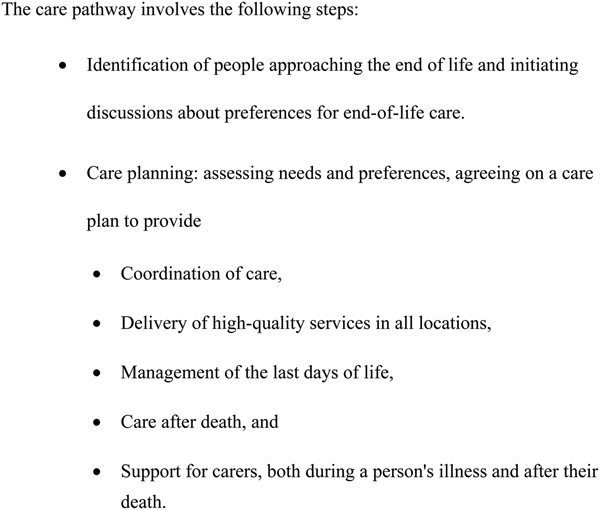
The aims of our study were to identify the facilitators of and barriers to the introduction, rollout, and sustained use of the EoL care pathway adopted at each trust as reported by the staff involved and to examine their accounts of the effectiveness of coordination of care across primary and secondary care. One of the trusts used the Liverpool Care Pathway and the other two developed the Supportive Care Pathway (SCP). The SCP was a pathway designed to shape delivery of EoL care over a longer period than the 72 hours covered by the LCP. The intention was that it be initiated as soon as a discussion of EoL had taken place with the patient and their family to support care planning over a sustained period leading up to death (see Figure 1).
Steps in the care pathway.

METHODOLOGY
The main study was informed by “realistic evaluation,” which focuses on the key issues of “what works, for whom, under what circumstances” (Pawson & Tilley, Reference Pawson and Tilley1997; Greenhalgh et al., Reference Greenhalgh, Humphrey and Hughes2009). As part of this, a case study design (Yin, Reference Yin2009 a; Reference Yin2009 b; Stake, Reference Stake, Denzin and Lincoln1998; Vallis & Tierney, Reference Vallis and Tierney2000) investigating service redesign in its real-life context using multiple sources of evidence (Robson, Reference Robson1993) was undertaken (Shapiro et al., Reference Shapiro, Eastaugh and Gale2010). This involved the use of a number of data collection methods (Eisenhardt, Reference Eisenhardt1999) to ensure that the design was robust and involved data triangulation (Sim & Wright, Reference Sim and Wright2000; Jick, Reference Jick1979). As part of the tracer study of EoL care in the trusts, interviews with key staff were undertaken to explore accounts of the introduction of EoL care pathways, and these are the data reported here. The CLAHRCBBC theme 1 study was designated as a major service evaluation project by the National Research Ethics Service (NPSA/NRES, 2009) and did not require further ethical approval. However, approval was obtained from a university research ethics committee (ERN_10-0034) and from each trust's research and development department.
METHODS
Qualitative Interviews
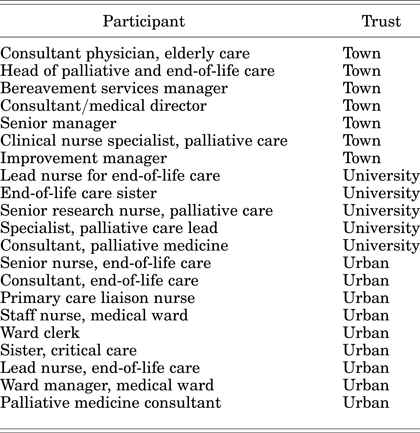
A series of semistructured interviews were conducted with the lead consultants, lead nurses, ward staff, and other key personnel (see Table 1) in order to build a picture of the introduction of the EoL care pathways. A total of 21 interviews were conducted between March of 2011 and February of 2012 that focused on: accounts of the plans to introduce the pathway and how it was implemented in the trust; the attitudes and experiences of key staff in relation to the EoL care pathway; and discussion of the facilitators of and barriers to service redesign in EoL care. Qualitative interviewing is valuable in health services research (King, Reference King, Cassell and Symon1994) because it is a good way to access the views of individuals in organizations (Seale, Reference Seale1998; Fontana & Frey, Reference Fontana, Frey, Denzin and Lincoln1994). The qualitative data collected were sufficient for saturation of themes (Pope et al., Reference Pope, Ziebland and Mays2000; Marshall, Reference Marshall1996) and were analyzed using the “framework method” (Gale et al., Reference Gale, Heath and Cameron2013, Ritchie & Lewis, Reference Ritchie and Lewis2003). The outcome of our analysis was the identification of five major themes that emerged with regard to the introduction of EoL care pathways in the three acute trusts. These are presented below, followed by a discussion of their implications for practice and research.
Participants and trusts

RESULTS
Leadership and Facilitation
The presence and involvement of a facilitator was crucial to the successful introduction of an EoL care pathway, as was effective leadership at all levels. The trusts initially had funding provided as part of a region-wide initiative to employ facilitators to support the introduction of EoL care pathways. These roles were undertaken by nurses who had some experience in specialist EoL care. In one trust, the medical wards adopted the SCP, while in other areas there was uncertainty about when, how, and why to use the SCP. The approach of the palliative care team was to teach staff how to use the SCP and to encourage them to become self-sufficient; however, this was difficult, particularly when the funding for the facilitator posts was withdrawn and at the time of the interviews only one of these posts remained:
The funding was given for facilitators for three years, and it was fine, and it was rolled across the trust for those three years, but once the facilitator's post no longer existed, there isn't that support there to go back in and do training because staff turnover, medical staff turnover, and also the areas that don't always have end-of-life care patients that are familiar with it, you know, they need ongoing support. (lead nurse for EoL care, University Trust)
In an effort to overcome this deficit, one trust identified specific personnel to maintain the momentum of the pathway rollout:
We've now changed the way that we, we've started training with the palliative care champions; it's like a link worker on the wards. (clinical nurse specialist, palliative care, Town Trust)
However, there was also a need for leadership from senior staff:
If you've got a local champion and you've got buy-in of the medical staff, the senior staff, the consultants, then they tend to carry on using it; it becomes part of what they do (. . .) There are a couple of consultants who are very keen, and so they would encourage their juniors to use it. (lead nurse for EoL care, University Trust)
It was acknowledged that this was not always a straightforward process:
I think the junior doctors see it, but I'm not sure the consultants necessarily. There's some who say, “Oh yes, yes—really good idea,” but they don't quite get what it's for, and (. . .) unless they really lead, it is not going to happen (. . .) I feel like I can talk to junior doctors until my throat runs dry and unless the consultants are saying “We need to do this and we need to do it properly, and you've not filled this [the care pathway] in; why haven't you filled this in?” it's not going to happen. (palliative medicine consultant, Urban Trust)
As well as “role modeling” the use of the pathway, and being an enthusiastic advocate for its use, leadership in this context also involved direct challenge and debate with staff:
Very often my role is that I have to go along and intervene and ask people, “What is it you're actually trying to achieve here?” and I always say, “There is nothing black and white about end-of-life care.” If you need to give somebody antibiotics at the end of life to improve their symptoms, do so, but really think about why it is that you're doing these things. If it's not going to make a difference to them, don't do it. Make sure it makes a difference to the patient. (EoL care lead nurse, Urban Trust)
This was necessary to ensure that staff recognized that the pathway was only a tool to assist them in caring for patients at the end of life. It provided a framework. Nevertheless, staff were still required to engage with patients and their families to negotiate what was best.
It was also recognized that, if the pathway was to be implemented and patient care to improve, then all staff needed to be involved:
Leadership should be developed at clinical areas, both from the nursing side as well as from the medical side. People driving it, I think if you don't get the drive from the consultants, it's very difficult to actually get that through to the junior staff. (consultant, elderly care, Town Trust)
The respondents also reported that education and training were essential if use of the pathway was to become part of routine practice.
Education and Training
Staff needed to be familiar with the pathway and its purpose, as well as being confident in meeting the complex needs patients have at the end of life:
I think the issue at the moment is not so much the document; the issue is still education and trying to educate people in how to use it and when to use it. That's the big issue for me and also the (. . .) ongoing somewhat mixed message, but I think it's been inherent in the pathway from the beginning. You were trying to get care in the last months of life right without really having started to get care in the actual dying phase right, and I think (. . .) general staff on the ward, and I understand entirely, still don't know when they should be using the document. (palliative medicine consultant, University Trust)
This was a significant undertaking in all the trusts. The rate of staff turnover and the number of staff who needed to receive education in EoL and the range of other training needs that had to be met was a concern:
You know, when you start to map it out, it's huge and even the mandatory training that we say is mandatory is hard enough to meet. So I think we've got to find other creative ways to actually deliver that workforce competency and support. (senior manager, Town Trust)
This involved using traditional lecture-based study days, development programs, and ward-based discussions. The potential of e-learning was also acknowledged:
The Department of Health have rolled out the e-learning e-packages for all e-learning packages, so we're piloting that with our champions as well, and asking them to then ask staff on the wards to just log on and do a module if they can, just to see, you know, how they get on, and that's working positively as well. (clinical nurse specialist, palliative care, Town Trust)
Yet there was still a need for continuing face-to-face contact to reinforce the principles and promote the use of the pathway to all staff involved in the care of patients:
I have to go and train on every single ward. If you don't train all of the staff on how to deliver end-of-life care, you might as well forget using the pathway. The training is the most essential part of it. (. . .) If people were going to ask my advice about how to do an end-of-life pathway, I would say, “Make sure you train everybody.” (EoL care lead nurse, Urban Trust)
When I teach junior doctors (. . .) I'm not necessarily going along and saying you must use the pathway. I'm trying to get them to actually recognize that someone might need to be started off, and that the values in it are important, that there is virtue in prescribing drugs in advance, that there is nothing to be lost from that, and that there is virtue in having a conversation with families about what is happening, and it does seem a shame that we need a pathway to get people to do it. (palliative medicine consultant, Urban Trust)
The need for training was particularly acute with regard to preparing staff for “having a conversation.” Indeed, preparing staff for these “difficult conversations” was central to the success of the pathway.
Difficult Conversations
One of the most challenging areas with regard to education and the introduction of a pathway was a reticence and anxiety on the part of staff with regard to engaging patients and their relatives in discussions about EoL care. The reluctance to participate in these “difficult conversations” was identified by the respondents as a potential barrier to successful use of the pathway:
I still come across nurses that won't go and talk to a patient who is dying because they're scared in case they ask them a question, and I think (. . .) it's not a scary conversation; sometimes it's a nice conversation; it's what a patient wants to hear (. . .) One lady in particular, she phoned me about her father who died, and he was terrified of dying, always terrified of dying, but the minute he was told “actually you've got days to live,” he relaxed. He chilled out because he was so relieved that somebody had said, “You've only got a couple of more days now, and you can stop worrying.” (ward sister, medical ward, Urban Trust)
However, it is necessary to have this sort of discussion with patients. Indeed, it is central to the operation of the pathway, and the respondents explained how using the words “death” and “dying” presented particular challenges:
I think it's communication and the language of communication and the language of death really, and the language that you use to break bad news, and I think that's the biggest barrier. (specialist palliative care lead nurse, University Trust)
There was also a recognition of the significance of these “conversations” in that having the conversation with a patient and family was the first stage of them being “placed” on the pathway, which in turn indicated they were now approaching the end of life:
Until we get over the hurdle of the difficulty of having difficult conversations and recognizing that a patient is at the end of life, then that's a whole bigger [issue], because the first question in the documents is around the conversation you've had with the patient and, if you've not had it, you can't do the documents; you can't put them on the pathway. (lead nurse for EoL care, University Trust)
One of the main “hurdles” in this respect was the uncertainty surrounding the process of deciding that someone was approaching the end of life. The illness trajectories of many long-term conditions fluctuate with repeated improvements and exacerbations (Murray et al., Reference Murray, Kendall and Boyd2005). Coming to a decision that the dying phase had been reached was difficult for staff who found “diagnosing dying” to be a major challenge in implementing the pathway.
Diagnosing Dying
It was recognized that the decision to place patients on the EoL care pathway had major implications and was a significant event for all concerned. This resulted in a level of anxiety among practitioners and revealed that there was uncertainty associated with the first step in the process with regard to the pathway:
There is an issue for clinicians about diagnosing dying. It's a very, very hard thing to teach. It's something that people are saying they want to know about. They want to know, and doctors like hard facts. They want to know “if this happens, this happens, this happens.” (palliative medicine consultant, Urban Trust)
This was rendered even more difficult because there were different perspectives within the clinical team. This often meant that staff relied on the experiential knowledge and judgment of an experienced nursing staff:
It is very difficult because there are so many clinicians involved, and their main aim is to actually cure and to get somebody discharged home. It's very difficult drawing the line there, and I think sometimes some clinicians do struggle and sometimes they are guided more by nursing staff saying “Actually, you know . . .” (EoL care sister, University Trust)
In many instances, however, despite there being different views, these decisions were shared, and teams worked together to address their concerns, often agreeing to decisions while on ward rounds:
Obviously, the trouble is, prognosis and recognizing dying I think is one of the hardest clinical skills, and inevitably there's going to be varying views amongst the team so it's often working together and communicating what we feel is going on and then trying to limit treatments and get end-of-life care (. . .) set up properly. (consultant, EoL care, Urban Trust)
This demonstrates the particular challenges involved when trying to introduce a pathway approach to guide the management of this area of care. The nature of EoL care presents a complex set of circumstances that staff have to confront and to which patients need to adjust—for example, discussions about when to withdraw active treatment, how to ensure that this would not result in all care ceasing, and managing the coordination of care with a range of services required to deliver a “good death.” It was acknowledged that the introduction of the pathway threw these issues into sharp relief and required staff to work in a different way:
Ward staff and consultants as well, was a new thing for them, and it was actually signing your name, black and white, on a piece of paper saying that you're diagnosing this patient as dying and that can be quite hard. (clinical nurse specialist, palliative care, Town Trust)
One of the key elements in ensuring that patients experienced a “good death” was coordination of primary and secondary services. However, this was often difficult because information systems and communication networks were incompatible and did not support care.
Communicating Across Boundaries
Effective liaison and communication to facilitate EoL care was reported. For example,
It takes four hours to get home oxygen, and as I say it's a phone call to the community team and they're in place. We had a patient discharged yesterday; she'd only been here a couple of days, so I think that's quite good compared to how it used to be. For me, they shouldn't be hitting the hospital in the first place really, but they are. (ward manager, medical ward, Urban Trust)
However, this relied on the efforts of individuals and their links with other staff rather than being supported by an integrated information system. Concerns were expressed that the problems with sharing and transferring information hampered EoL care:
I would say the IT system in relation to communicating information is a big blocker, and so if patients at home are having palliative care and then they come into hospital, we wouldn't know that. We wouldn't know anything that had gone on at home. (senior nurse, EoL care, Urban Trust)
The respondents had a clear idea of what they would like to see in place, yet felt it would take some years for it to materialize:
The perfect thing would be that the hospital people and the community people should just use the same system, but we all know that NHS IT has just nosedived, so if you ask me, I'm just going to do my best. (consultant palliative medicine, Urban Trust)
The trust itself is looking at a cross-boundary IT system, but that's obviously a longer plan, and I know it obviously integrated with social workers again on a different system. The physio[therapist]s, although they have access with us internally, a lot of it is manual recordkeeping as well. So it's how can we actually bring all that information together so we can incorporate it into a care plan? A cross-boundary care plan. (improvement manager, Town Trust)
Even in outlining a vision for the future, this respondent indicated how complex a task it is to integrate systems to support delivery of high-quality EoL care. Bringing community and hospital pathways together and ensuring that they contain all the necessary information and can be accessed by all who need to was acknowledged by all to be some way off, and it was recognized that this made it difficult to meet patients' needs:
At the minute everything is fragmented, you know? We don't share information that readily. We might do between specialist care teams, but actually between district nurses and GPs, I think we've got a long way to go to improve that information flow, you know, that communication, to avoid these situations. (lead nurse, EoL care, Urban Trust)
Achieving the aims in care that the EoL care pathways were introduced to support was difficult because of these significant communication barriers. The combination of factors impinging on the introduction and use of pathways goes some way to explaining why EoL care remains a particular challenge in healthcare. This is discussed further below.
DISCUSSION
It has been found that streamlined and high-quality EoL care for all patients can be delivered if service providers are supported to communicate and coordinate care (Addicott, Reference Addicott, Addicott and Ashton2009). However, in the three trusts where EoL care pathways had been introduced, systems were not in place to support this. In the acute setting, key organizational levers for change are essential if EoL care is to improve (Ellershaw, Reference Ellershaw, Addicott and Ashton2009), which includes strong leadership supported by an end-of-life care steering committee, with executive representation, to develop and implement an end-of-life care strategy for the hospital, along with mandatory training and education in EoL care for the workforce.
The progress made in the three trusts participating in our study with regard to these “levers” was mixed. In two of the trusts (University and Town) there had been a lapse in leadership when the allocation of external funding for employment of a facilitator came to an end. By way of contrast, there was consistent and continuing leadership at the Urban Trust that resulted in greater progress being achieved in terms of rollout of a pathway across the trust. The importance of leadership in any change initiative has been demonstrated in numerous settings (McSherry et al., Reference McSherry, Pearce and Grimwood2012; King's Fund, 2012), which suggests that leaders need to engage with a wide range of staff and encourage them to focus on the core activities of the organization. In NHS trusts, this can be difficult because of the scope of their activities and the number of staff involved. In order to address this, the trusts employed “champions” with the intention of maintaining momentum in the introduction of the pathways.
This was accompanied by an extensive program of education for staff. Although delivery of the program varied, it was recognized as a continuing process and was appropriate because education can have a direct and positive effect on professionals' attitudes toward EoL care (Brent et al., Reference Brent, Speece and Gates1991; Degner & Gow, Reference Degner and Gow1988; Durlak & Reisenberg, Reference Durlak and Reisenberg1991; Frommelt, Reference Frommelt1991; Kaye et al., Reference Kaye, Gracely and Loscalzo1994; Lev, Reference Lev1986). However, even with these measures in place, there remained concerns among staff about engaging with patients and their families to discuss EoL care planning.
Taking the first step in initiating a discussion about EoL care with patients and relatives was regarded as a “difficult conversation” and a crucial element in activating the pathway. The pathway should record patients' preferences for care and incorporate the views of family and friends (DH, 2008). However, as the data demonstrate, having this conversation in order to care for people at the end of their lives involves an investment of the self that can be emotionally intense (Williams, Reference Williams2013; Bailey et al., Reference Bailey, Murphy and Porock2011b ; Costello, Reference Costello2006) and may lead to staff avoiding such discussions. This suggests that, along with education, other forms of support may be needed to enable staff to feel confident with this aspect of their role. The reluctance of staff to approach patients to start the EoL care planning process was also due in part to the indeterminate nature of the diagnosis of dying. Healthcare is generally characterized as being founded on an ethos of problem solving whereby symptoms are identified and the appropriate treatment delivered (Shah & Mountain, Reference Shah and Mountain2007), yet at the end of life such a linear process is often not possible. This highlights how attempts to provide a structure for and level of predictability of care through the use of tools such as care pathways can only be part of the solution. The application of service redesign and service improvement principles (Langley et al., Reference Langley, Nolan and Nolan1996) are helpful in examining processes as a whole, but in this service redesign program some of the more fundamental issues could perhaps have been considered earlier before introduction of the pathway. As one of the respondents said, “This doesn't feel like service redesign to me at all” (consultant in palliative medicine, University Trust); there were more fundamental issues to address such as diagnosing dying, which has been found to be a barrier to EoL care planning (Ellershaw & Ward, Reference Ellershaw and Ward2003). More research is required to explore this area further given its centrality in decisions about care at the end of life.
Indeed, in one of the trusts a decision has been made to move away from the Supportive Care Pathway in favor of a more comprehensive program of communication training. The intention here is that all staff would become more confident in communicating with patients, and this would overcome some of the problems highlighted here. The other two are reviewing their position. These decisions may have been influenced by the recent negative publicity surrounding use of the Liverpool Care Pathway (McCartney, Reference McCartney2012). A number of cases where it had been misapplied or its use had been misreported resulted in a review conducted on behalf of the Department of Health (DH, 2013), which recommended that use of the Liverpool Care Pathway be replaced over the next 6 to 12 months by an EoL care plan designed for each individual patient, backed up by condition-specific good practice guidance, and that the term “pathway” be avoided altogether.
In view of this, despite a robust defense of the merits of the LCP in the form of a consensus statement from 20 organizations (Kmietowicz, Reference Kmietowicz2012), it would seem that the application of pathways for this element of care is unlikely to feature for much longer. The requirement now is for a strategic approach involving a coalition of regulatory and professional bodies, NHS England, and patient groups to set clear expectations for a high standard of care for dying patients, as well as their relatives and carers. This coalition could then lead the way in creating and delivering the knowledge base, the education training, and skills and the long-term commitment needed to make high-quality care for dying patients a reality (DH, 2013).
This demonstrates the continuing turbulence in the NHS (McMurray, Reference McMurray2010; Macfarlane et al., Reference Macfarlane, Exworthy and Wilmott2011) and the problems NHS trusts face when developing systems for patient care. In attempting to improve EoL care, investment and energy have been devoted to the introduction of pathways, only for them to become devalued largely through inappropriate application. The service redesign process must now start again focused on individualized care plans that incorporate condition-specific guidance (Sleeman and Collis, Reference Sleeman and Collis2013).
CONCLUSION
During one interview a respondent commented:
It's not prescriptive. It's a guideline. It's to guide care (. . .) so that leaves scope for differences, for different patients. It's not telling you what you've got to do. It's kind of supporting you to do what you need to do, and your clinical skills and expertise cannot be replaced by the tool, but hopefully the tool will support you bring out the best in yourself. (primary care liaison nurse, Urban Trust)
Although progress was being made in this respect in the trusts where our study was conducted, in the wider environment of the NHS there were problems and patients were not receiving appropriate EoL care. The hope is that the lessons learned from our study about what needs to be in place in trusts if effective EoL care is to be provided can contribute to more widespread improvement and inform the new approach based on care plans.
ACKNOWLEDGMENTS AND FUNDING
Pseudonyms are employed for the names of the trusts involved, and generic titles of staff included to indicate their roles. Some details have been changed to ensure anonymity of participants. All participants completed a consent form. This research was funded by the National Institute for Health Research (NIHR) Birmingham and Black Country Collaborations for Leadership in Applied Health Research and Care (CLAHRC BBC). The views expressed in this publication are those of the authors and not necessarily those of the NHS, the NIHR, or the Department of Health.