

INTRODUCTION
Fundamental knowledge of the RNA interference (RNAi) mechanism in the free living model nematode Caenorhabditis elegans and other eukaryotes continues to expand rapidly, and is frequently used to inform aspects of RNAi experimental design in parasitic helminths. However, the RNAi pathway of C. elegans does not well reflect that found in other nematodes (Dalzell et al. Reference Dalzell, McVeigh, Warnock, Mitreva, Bird, Abad, Fleming, Day, Mousley, Marks and Maule2011; Kikuchi et al. Reference Kikuchi, Cotton, Dalzell, Hasegawa, Kanzaki, McVeigh, Takanashi, Tsai, Assefa, Cock, Otto, Hunt, Reid, Sanchez-Flores, Tsuchihara, Larsson, Miwa, Maule, Sahashi, Jones and Berriman2011), and comparatively little is known of the RNAi pathway in trematodes (Krautz-Peterson et al. Reference Krautz-Peterson, Bhardwaj, Faghiri, Tararam and Skelly2010a).
In the case of parasitic nematodes, the literature reports variable efficacies between species (Viney and Thompson, Reference Viney and Thompson2006; Geldhof et al. Reference Geldhof, Visser, Clark, Saunders, Britton, Gilleard, Berriman and Knox2007; Knox et al. Reference Knox, Geldhof, Visser and Britton2007), within species (Geldhof et al. Reference Geldhof, Murray, Couthier, Gilleard, McLauchlan, Knox and Britton2006; Visser et al. Reference Visser, Geldhof, de Maere, Knox, Vercruysse and Claerebout2006), and some species are reported to be RNAi-recalcitrant (Louvet-Vallee et al. Reference Louvet-Vallee, Kolotuev, Podbilewicz and Felix2003; Pires-daSilva and Sommer, Reference Pires-daSilva and Sommer2004; Lendner et al. Reference Lendner, Doligalska, Lucius and Hartmann2008). RNAi is playing an increasingly important role in the analysis of gene function for parasitic trematodes (e.g. McGonigle et al. Reference McGonigle, Mousley, Marks, Brennan, Dalton, Spithill, Day and Maule2008; Krautz-Peterson et al. Reference Krautz-Peterson, Simoes, Faghiri, Ndegwa, Oliveira, Shoemaker and Skelly2010b), and also tentatively as a novel control method (Pereira et al. Reference Pereira, Pascoal, Marchesini, Maia, Magalhães, Zanotti-Magalhães and Lopes-Cendes2008). Notably, whilst published RNAi experimentation covers fewer parasitic trematode species than the respective nematode literature, there seems to be broad agreement regarding its efficacy and general applicability, notwithstanding some variation in efficiency and experimental design (e.g. Krautz-Peterson et al. Reference Krautz-Peterson, Simoes, Faghiri, Ndegwa, Oliveira, Shoemaker and Skelly2010b; Stefanic et al. Reference Stefanic, Dvorak, Horn, Braschi, Sojka, Ruelas, Suzuki, Lim, Hopkins, McKerrow and Caffrey2010). Nothing is known of the RNAi pathway in cestodes, however there have been two reports of successful RNAi indicating that a functional pathway exists in at least some species (Mizukami et al. Reference Mizukami, Spiliotis, Gottstein, Yagi, Katakura and Oku2010; Pierson et al. Reference Pierson, Mousley, Devine, Marks, Day and Maule2010). Clearly, better understanding of fundamental aspects of the RNAi pathway in parasitic helminths could prove useful in determining the cause of these variations, and may facilitate improved experimental design.
One of the most serious issues facing the parasitic helminth RNAi community, and indeed the entire RNAi field at large, is that of experimental control (see Nature Cell Biology, 2003, Vol. 5, 489–490; Huppi et al. Reference Huppi, Martin and Caplen2005). Without a thorough knowledge of the RNAi mechanism, it is impossible to devise and implement appropriate controls with absolute confidence. Indeed, confidence in the reliability of RNAi in C. elegans has been to the detriment of experimental stringency; much of the RNAi work in C. elegans does not routinely quantify transcript knockdown for target or non-target genes (indeed, phenotype alone is considered an acceptable RNAi endpoint in C. elegans experiments; see Ahringer, Reference Ahringer2006), and the implementation of experimental controls is commonly inadequate. In many cases, gene-specific knockout phenotypes do not correlate well with gene-specific RNAi phenotypes, which should be a serious cause for concern. By way of example, Pispa et al. (Reference Pispa, Palmen, Holmberg and Jantti2008) found that C. elegans mutants for a 26S proteome subunit gene dss-1 revealed a role in oogenesis, whereas an RNAi screen also resulted in embryonic lethality and larval arrest. Again, in the case of a C. elegans calreticulan (crt-1 is expressed in the pharynx, hypodermis, uterus and sperm; Park et al. Reference Park, Lee, Yu, Jung, Choi, Lee, Lee, Kim, Lee, Kwon, Lee, Singson, Song, Eom, Park, Kim, Bandyopadhyay and Ahnn2001; Xu et al. Reference Xu, Tavernarakis and Driscoll2001), crt-1 mutants exhibited reduced fertility (Park et al. Reference Park, Lee, Yu, Jung, Choi, Lee, Lee, Kim, Lee, Kwon, Lee, Singson, Song, Eom, Park, Kim, Bandyopadhyay and Ahnn2001), whereas silencing of crt-1 in a genome-wide RNAi screen led to abnormal locomotion (Kamath and Ahringer, Reference Kamath and Ahringer2003). Based on our current level of understanding, RNAi should not be used as a high throughput tool for any organism. Our handling of RNAi control issues in this review will reflect, in length and depth of discussion, what we consider to be the most serious considerations for RNAi experimentation in parasitic helminths. Unlike C. elegans for which gene knockouts are widely available as a comparator, adequate controls for RNAi in parasitic helminths are especially important as (in most cases) RNAi represents the only viable method for reverse genetics, and the only tool for functional validation.
The following amalgam addresses many of what we consider to be the most important aspects of RNAi experimental design in parasitic helminths, including culture/maintenance and dsRNA delivery strategies, transcript quantification issues, and experimental controls, amongst others. It is hoped that this will trigger further discussion and investigation within the field as a whole. We finish by offering a simple RNAi experiment workflow, and point out some of the potential pitfalls and solutions associated with various technical aspects.
RNAi EXPERIMENTAL DESIGN CONSIDERATIONS
Parasite culture
Parasite life-stage
Larval helminth life-stages are most frequently taken for RNAi experimentation. Often the free-living infective stage is used in the case of nematodes, as these stages are non-feeding, easier to maintain in the laboratory, relatively resistant to environmental changes and therefore more forgiving of in vitro culture conditions, in addition to being the most readily available in large numbers. Feeding helminth stages offer the advantage of an obvious dsRNA/siRNA entry route through ingestion, however there may also be disadvantages associated with starvation responses to in vitro culture. For example, Pierson et al. (Reference Pierson, Mousley, Devine, Marks, Day and Maule2010) reported that fully grown adults of the cestode Moniezia expansa could only be maintained viably in vitro for ∼12 hours. This presents serious challenges for RNAi investigation as delivery of the dsRNA, silencing of the gene, and phenotypic analysis must all occur within this timeframe.
Theoretically, developing or ‘activated’ parasitic helminths would represent the most RNAi-competent stages (Huang et al. Reference Huang, Chan, Smyth, Ball, Gounaris and Selkirk2010). Higher expression levels of certain RNAi effector genes during these phases have been observed and could impact on life-stage-specific sensitivity to exogenous RNAi in schistosomes (e.g. Krautz-Peterson and Skelly, Reference Krautz-Peterson and Skelly2008), and bioinformatic analyses indicate a propensity for developmentally associated autoregulation of RNAi pathway constituents in nematodes (Zisoulis et al. Reference Zisoulis, Lovci, Wilbert, Hutt, Liang, Pasquinelli and Yeo2010). Micro (mi)RNAs, which typically effect transcriptional and/or translational inhibition of target genes are fundamentally involved in developmental events, and use many of the pathway components common to exogenous RNAi pathways (Dalzell et al. Reference Dalzell, Warnock, Stevenson, Mousley, Fleming and Maule2010b). Often, miRNAs target gene transcripts in the 3′ untranslated region (UTR), and recent data indicate that at least some of the RNAi pathway genes in C. elegans display developmentally altered 3′UTRs (the argonaute alg-2; the dsRNA spreading rsd-6; Dicer-complex and RNA-induced silencing complex (RISC) components, tsn-1, ain-1; genes involved in the initiation and amplification of an RNAi response, smg-2, smg-6; the RNAi inhibitor adr-2; nuclear RNAi components, ekl-4, ekl-5; and general cofactors, cid-1, zfp-1), which may affect the availability of miRNA target sites, and represent a further mode of developmental sub-regulation (Dalzell et al. Reference Dalzell, McVeigh, Warnock, Mitreva, Bird, Abad, Fleming, Day, Mousley, Marks and Maule2011; Jan et al. Reference Jan, Friedman, Ruby and Bartel2011; Kikuchi et al. Reference Kikuchi, Cotton, Dalzell, Hasegawa, Kanzaki, McVeigh, Takanashi, Tsai, Assefa, Cock, Otto, Hunt, Reid, Sanchez-Flores, Tsuchihara, Larsson, Miwa, Maule, Sahashi, Jones and Berriman2011). Although data are sparse, it seems possible that for some species RNAi experiments should focus on the life-stage(s) most amenable to gene silencing, although predicting how changing expression levels of various pathway proteins will impact on functionality will likely prove difficult.
RNAi target gene selection
Many different criteria are used in the selection of RNAi target genes across various parasitic helminth species. Frequently, gene selection is limited by the biological question addressed. However, in general cases of selecting genes as potential control targets, or selecting on the basis of theoretical considerations for optimal RNAi, there are several proposed criteria in the literature.
Selection based on C. elegans or model organism knockout/RNAi lethality/aberration
Several groups have implicated lethality of orthologous genes in C. elegans and/or Drosophila melanogaster as an important criterion for target gene selection in RNAi screens of parasitic helminths (e.g. Yadav et al. Reference Yadav, Veluthambi and Subramaniam2006; Caffrey et al. Reference Caffrey, Rohwer, Oellien, Marhofer, Braschi, Oliveira, McKerrow and Selzer2009). This approach facilitates so-called ‘piggy-back’ drug discovery, in that existing validatory data derived for model species proteins that are targets in distinct clinical contexts can be exploited for parasite control. Whilst this approach has much appeal and has shown some success in schistosomes (Caffrey et al. Reference Caffrey, Rohwer, Oellien, Marhofer, Braschi, Oliveira, McKerrow and Selzer2009), there are some potential shortfalls: (1) the RNAi pathways of model organisms like C. elegans and D. melanogaster are appreciably different from parasitic nematodes (Dalzell et al. Reference Dalzell, McVeigh, Warnock, Mitreva, Bird, Abad, Fleming, Day, Mousley, Marks and Maule2011; Kikuchi et al. Reference Kikuchi, Cotton, Dalzell, Hasegawa, Kanzaki, McVeigh, Takanashi, Tsai, Assefa, Cock, Otto, Hunt, Reid, Sanchez-Flores, Tsuchihara, Larsson, Miwa, Maule, Sahashi, Jones and Berriman2011), and likely other parasitic helminths, which weakens the assumption of similar expected RNAi efficacies/phenotypes; (2) knockout phenotypes in model organisms such as C. elegans often do not phenocopy RNAi phenotypes; (3) in many cases, homologous genes are known to display different expression patterns between C. elegans and other parasitic nematodes (e.g. Kimber et al. Reference Kimber, Fleming, Prior, Jones, Halton and Maule2002; Nanda and Stretton, Reference Nanda and Stretton2010; Sithigorngul et al. Reference Sithigorngul, Jarecki and Stretton2011), weakening the a priori hypothesis of functional conservation; (4) using C. elegans, or another non-parasitic species as a selection model means that genes specifically involved in parasitism are automatically excluded, reducing scope; and, (5) neuronal gene RNAi refractoriness in wildtype C. elegans prevents datasets from this species informing neuronal gene target selection in parasites (Timmons et al. Reference Timmons, Court and Fire2001; Kamath et al. Reference Kamath, Fraser, Dong, Poulin, Durbin, Gotta, Kanapin, Le Bot, Moreno, Sohrmann, Welchman, Zipperlen and Ahringer2003).
Selection based on expression pattern
Samarasinghe et al. (Reference Samarasinghe, Knox and Britton2010) implicate expression pattern as an important consideration in RNAi efficacy of the animal parasitic nematode Haemonchus contortus; specifically genes expressed in the nematode intestine, amphids and excretory cells were robustly silenced. The authors hypothesise that transcripts expressed in tissues located in close apposition to the external environment are more readily silenced by simple soaking methods. This would suggest that secondary amplification, and/or spreading mechanisms of the RNAi pathway in H. contortus are limiting factors under those experimental conditions, but that uptake mechanisms are generally present and effective. A putative sid-1 orthologue has been identified in H. contortus (Geldhof et al. Reference Geldhof, Visser, Clark, Saunders, Britton, Gilleard, Berriman and Knox2007; Dalzell et al. Reference Dalzell, McVeigh, Warnock, Mitreva, Bird, Abad, Fleming, Day, Mousley, Marks and Maule2011), a channel known to be responsible for passive intercellular spread of dsRNA. Altered functionality and/or expression pattern of this gene relative to C. elegans could explain the observations of Samarasinghe et al. (Reference Samarasinghe, Knox and Britton2010). However, H. contortus encodes a higher number of putative dsRNA uptake and spreading proteins than other RNAi-competent parasitic nematode species (Dalzell et al. Reference Dalzell, McVeigh, Warnock, Mitreva, Bird, Abad, Fleming, Day, Mousley, Marks and Maule2011; Kikuchi et al. Reference Kikuchi, Cotton, Dalzell, Hasegawa, Kanzaki, McVeigh, Takanashi, Tsai, Assefa, Cock, Otto, Hunt, Reid, Sanchez-Flores, Tsuchihara, Larsson, Miwa, Maule, Sahashi, Jones and Berriman2011), and L3 stage H. contortus have been described elsewhere as non-feeding. This is due to a developmentally-regulated physical blockage of the buccal cavity, which breaks down following development to L4 (Sommerville, Reference Sommerville1966; Mapes, Reference Mapes1969) – observations recently supported by the work of Geldhof et al. (Reference Geldhof, Murray, Couthier, Gilleard, McLauchlan, Knox and Britton2006). This could challenge the notion of intestinal gene silencing being a factor of environmental exposure, which would necessitate entry of the RNAi trigger into the parasite gut. In addition, two of the five genes selected by Samarasinghe et al. (Reference Samarasinghe, Knox and Britton2010) as predicted to be expressed in environmentally-visible tissues could not be silenced.
In general terms however, transcript localisation may well be an important consideration, possibly in synergy with other factors. Certainly, in the case of C. elegans, we can see that neuronal genes only become broadly sensitive to RNAi when sid-1 is expressed specifically in the neurones (Calixto et al. Reference Calixto, Chelur, Topalidou, Chen and Chalfie2010). Transcript localisation seems to be a less important consideration for trematodes where efficacies seem to be broadly gene-specific. Although the absence of consistent knockdown of S. mansoni peptidylglycine alpha-amidating lyase (PAL; Sm-pal-1) (Atkinson et al. Reference Atkinson, McVeigh, Kimber, Marks, Eipper, Mains, Day and Maule2010) and yet consistent knockdown of the neuropeptide gene Sm-npp-1 transcript (McVeigh et al. Reference McVeigh, Mair, Novozhilova, Day, Zamanian, Marks, Kimber, Day and Maule2011) could equally indicate variable RNAi sensitivities across the nervous system. Further, Pierson et al. (Reference Pierson, Mousley, Devine, Marks, Day and Maule2010) reported the failure to knockdown the neuropeptide F gene (Mx-npf-1), leading the authors to speculate on neuronal gene RNAi refractoriness in adult M. expansa.
Selection based on expression level
Whilst highly expressed transcripts were readily silenced in adult M. expansa (Pierson et al. Reference Pierson, Mousley, Devine, Marks, Day and Maule2010), high expression level was not found to have a positive influence on RNAi efficacy in H. contortus (Samarasinghe et al. Reference Samarasinghe, Knox and Britton2010), or in S. mansoni sporocysts (Mourao et al. Reference Mourao, Dinguirard, Franco and Yoshino2009). Interestingly, we have found that targeting splice leader sequences which are found in a high percentage of mRNAs, with siRNA in plant parasitic nematodes (PPNs), does not induce aberrant phenotypes, which suggests that an upper level for RNAi efficacy exists in relation to target abundance (unpublished data). Whilst expression levels do not generally appear to be a significant determinant of efficacy in isolation, they may be an important factor in the context of location of expression.
General negative selection criteria
(1) Areas of complex secondary structure in mRNA transcripts can have a negative impact on RNAi efficacy (e.g. Schubert et al. Reference Schubert, Grünweller, Erdmann and Kurreck2005; Shao et al. Reference Shao, Chan, Maliyekkel, Lawrence, Roninson and Ding2007; Gredell et al. Reference Gredell, Berger and Walton2008) and should not be targeted; this can be checked using an RNA folding algorithm (e.g. Zuker, Reference Zuker2003). (2) Another problem surrounds multigene families in species which display transitive RNAi, in that other family members could also be silenced, potentially leading to false positive loss-of-function (LOF) phenotypes. Transitive RNAi is the phenomenon of de novo secondary siRNA synthesis to areas of the target transcript predominantly upstream of the initial target site through the action of RNA-dependent RNA polymerases (RdRPs) (i.e. the target site ‘moves’; see Alder et al. Reference Alder, Dames, Gaudet and Mango2003). The abundance of other gene family members should be analysed over a time-course to ascertain target suitability, and specificity of observed phenotypes. (3) Gene transcripts with splice variants (known or unknown) may prove difficult RNAi targets as a targeted area may not be present in a splice variant which retains wild type functionality, leading to false negative results.
General positive selection criteria
(1) Rationally, gene targets with short protein half-lives will likely prove more effective RNAi targets as phenotypes may present earlier, reducing the chance for off-target effects and the need for complex in vitro culture conditions for certain parasitic helminth life-stages. (2) Novel genes with little nucleotide sequence similarity to other genes would reduce the likelihood of non-target, or off-target effects, e.g. Huang et al. (Reference Huang, Allen, Davis, Baum and Hussey2006). (3) It has also been shown that rare codons and complex secondary structure in mRNA transcripts can cause slowing or pausing of ribosomes, and that this allows miRNA activity in transcript open reading frames (ORFs). miRNAs most frequently target UTR regions, likely because limited interactions between the miRNA seed region (generally nucleotides 2–8 of the miRNA; the most solute-exposed region of an Argonaute [AGO]-bound RNA) and the target is not strong enough to prevent dislodgement due to ribosomal activity. It seems logical to suggest that areas following rare codons, or complex secondary structure could also represent a more stable and accessible target site for dsRNA/siRNA (Gray and Hentze, Reference Gray and Hentze1994; Gu et al. 2009).
dsRNA versus siRNAs
Several factors should be considered in choosing between ‘long’ dsRNA and siRNA triggers: (1) it has been suggested in the literature that siRNA accumulates in certain tissues and systems more rapidly than longer dsRNA as a result of SID-1 size-dependent uptake (Feinberg and Hunter, Reference Feinberg and Hunter2003), although this phenomenon could be a factor of concentration rather than RNA size (Shih et al. Reference Shih, Fitzgerald, Sutherlin and Hunter2009); (2) undoubtedly, dsRNA is more stable than siRNA as single-stranded overhangs are significantly more susceptible to RNase digestion than double-stranded segments, with single strand-specific RNase being naturally abundant in the environment. Normally, dsRNA does not contain overhangs, whereas the recognition and loading of siRNA into the RISC is overhang-dependent; (3) dsRNA is significantly cheaper to synthesise than comparable amounts of siRNA, which may be a factor for larger scale screens; (4) siRNAs are likely to be more specific than longer dsRNAs in activity and function (with the caveat that this may be time dependent in species with RdRPs). Longer sequences create more diverse siRNAs which increase the chances of sequence-related off-target phenomena; (5) appropriately designed (non-Dicer substrate; see later section) siRNAs will avoid issues of long dsRNA Dicer complex saturation, e.g. Dalzell et al. (Reference Dalzell, McMaster, Johnston, Kerr, Fleming and Maule2009). Taking these considerations together, it seems that in many cases dsRNA makes most sense as a first recourse, especially where multiple closely-related gene transcripts are not a concern. Some issues associated with disparate specificities can be allayed through reducing the size of the dsRNA employed.
siRNA design/chemical modifications
siRNA structure and Dicer-substrate siRNA
siRNA screens in D. melanogaster embryo extracts revealed that 21mers (19mer duplexes with 3′ overhangs) were more potent than 20mers, or 23mers (18mer or 21mer duplexes with 3′ overhangs). 25mers (23mer duplexes with 3′ overhangs) were completely inactive, and those with 3′ overhangs were always found to be more potent than those with 5′ overhangs (Elbashir et al. Reference Elbashir, Martinez, Patkaniowska, Lendeckel and Tuschl2001). Similar optimisation studies have not yet been conducted for parasitic helminths, however we know that a variety of siRNA conformations are effective for certain species. The Patrick Skelly group demonstrate that 25mer duplex “Dicer-substrate” siRNAs with a single 2nt 3′ overhang on the antisense (guide) strand are effective against S. mansoni schistosomule (Krautz-Peterson et al. 2010a, b). The design of these Dicer-substrate siRNAs also incorporates thermodynamic asymmetry (Tomari et al. Reference Tomari, Matranga, Haley, Martinez and Zamore2004; Hutvagner, Reference Hutvagner2005) through introducing DNA bases in the sense (passenger) strand 3′. 25–30mer duplexes of RNA were shown to be more potent inducers of RNAi than standard 21mer siRNAs in mammalian cells (Kim et al. Reference Kim, Behlke, Rose, Chang, Choi and Rossi2005). The increased potency of longer duplexes was attributed to the efficiency of RISC loading by Dicer which cleaves duplexes that span its dual RNase III cleavage sites and shuttles mature siRNAs into the ribonucleoprotein complex (Kim et al. Reference Kim, Behlke, Rose, Chang, Choi and Rossi2005). However, in our hands blunt-ended 27mer RNAs are significantly less active than 21mers (19mer duplex with 3′ overhangs) in the root knot nematode Meloidogyne incognita for a range of target transcripts (unpublished data; Dalzell et al. Reference Dalzell, McMaster, Fleming and Maule2010a).
siRNA/dsRNA chemical modifications
Although we currently have little data on chemically modified dsRNA/siRNA efficacy in parasitic helminths (e.g. Krautz-Peterson et al. 2010b), modifications can be introduced to increase nuclease resistance (Ambardekar et al. Reference Ambardekar, Han, Varney, Vinogradov, Singh and Vetro2011), reduce off-target effects (Bramsen et al. Reference Bramsen, Pakula, Hansen, Bus, Langkjaer, Odadzic, Smicius, Wengel, Chattopadhyaya, Engels, Herdewijn, Wengel and Kjems2010), increase specificity (Krautz-Peterson et al. 2010a), and increase stability (Terrazas and Kool, Reference Terrazas and Kool2009). 5′ or 3′ nucleic acid modifications typically include carrier type molecules such as peptides, aptamers or other conjugates usually incorporated to increase half-life or to increase cellular uptake. For example, siRNAs have been successfully conjugated to antibodies for targeted delivery in other systems (e.g. Song et al. Reference Song, Zhu, Lee, Chowdhury, Kussman, Dykxhoorn, Feng, Palliser, Weiner, Shankar, Marasco and Lieberman2005). Potentially, helminth vaccines could be modified to include an RNAi trigger also, which may increase efficacy. Certainly, antibodies designed to bind targets in the helminth intestine could prove a novel method of targeted delivery in vivo.
RNAi trigger delivery methods and tissue sensitivity considerations
A variety of dsRNA/siRNA delivery methods have been used in nematodes and flatworms with variable success such that the optimal dsRNA/siRNA delivery strategies need to be established empirically for each species. Where they are effective, the simplest strategies such as soaking in dsRNA/siRNA-containing solutions would seem the most appealing as they avoid the potential for additional impacts on survival/phenotype through membrane disruption (through the use of microinjection, transfection reagents or electroporation) or bioactive chemicals that stimulate feeding (such as octopamine, resorcinol and serotonin). Obviously, where soaking alone does not facilitate robust trigger delivery, then alternative approaches need to be considered and tested.
Nematodes
The C. elegans-centric SID-2 intestinal uptake paradigm for dsRNA pervades the nematode RNAi literature and experimental design strategies in general. Whilst many groups assert that intestinal availability of dsRNA in parasitic nematodes is necessary for gene silencing (e.g. Urwin et al. Reference Urwin, Lilley and Atkinson2002), there are numerous exceptions (Lustigman et al. Reference Lustigman, Zhang, Liu, Oksov and Hashmi2004; Fanelli et al. Reference Fanelli, DiVito, Jones and DeGiorgi2005; Kotze and Bagnall, Reference Kotze and Bagnall2006; Kimber et al. Reference Kimber, McKinney, McMaster, Day, Fleming and Maule2007; Dalzell et al. Reference Dalzell, McMaster, Fleming and Maule2010a; Samarasinghe et al. Reference Samarasinghe, Knox and Britton2010), and recent screens for RNAi pathway protein orthologues across available genomic and transcriptomic nematode datasets revealed that proteins known to be responsible for dsRNA uptake and spread in C. elegans may not be well conserved across nematode species (Dalzell et al. Reference Dalzell, McVeigh, Warnock, Mitreva, Bird, Abad, Fleming, Day, Mousley, Marks and Maule2011; Kikuchi et al. Reference Kikuchi, Cotton, Dalzell, Hasegawa, Kanzaki, McVeigh, Takanashi, Tsai, Assefa, Cock, Otto, Hunt, Reid, Sanchez-Flores, Tsuchihara, Larsson, Miwa, Maule, Sahashi, Jones and Berriman2011). The fact that RNAi remains possible in pharyngeally-ligated, and orally-restricted H. contortus (Kotze and Bagnall, Reference Kotze and Bagnall2006; Samarasinghe et al. Reference Samarasinghe, Knox and Britton2010), and non-feeding J2 Globodera pallida and M. incognita (Dalzell et al. Reference Dalzell, McMaster, Fleming and Maule2010a), suggests that alternative entry routes exist. Indeed, an unusual role for the nematode amphid in environmental uptake has recently been established, and may be relevant to dsRNA/siRNA uptake (Lilley et al. Reference Lilley, Wang, Atkinson and Urwin2011). Also, Lustigman et al. (Reference Lustigman, Zhang, Liu, Oksov and Hashmi2004) showed that dsRNA was taken up through the cuticle and accumulated in the hypodermis of Brugia malayi, and Dubreuil et al. (Reference Dubreuil, Deleury, Magliano, Jaouannet, Abad and Rosso2011) demonstrate that a peroxiredoxin gene expressed in the hypodermis of M. incognita can be silenced within only one hour – much quicker than has been previously reported for any other gene. Such rapid silencing of the peroxiredoxin gene suggests a more direct route of delivery to the hypodermis than might be expected following ingestion of the dsRNA. Alternatively, this dichotomy in the literature could be an artefact of specific genes, or gene families.
Understanding the route of dsRNA uptake could facilitate improved experimental design. However, our own unpublished data show that fluorescently labelled dsRNA and siRNA are much less efficient RNAi triggers across several parasitic helminth species, and confocal scanning laser microscopy does not reveal a specific route of uptake in several species (unpublished data). As a result we are unable to determine if labelled dsRNA/siRNA is less effective because uptake is sterically hindered, or because of steric inhibition of the RNAi machinery following quite diffuse dsRNA/siRNA uptake. Encouragingly, the work of Tomoyasu et al. (Reference Tomoyasu, Miller, Tomita, Schoppmeier, Grossmann and Bucher2008) on the red flour beetle Tribolium castaneum shows that whilst it and C. elegans both exhibit robust systemic (spreading) RNAi effects, that the proteins involved in the uptake and spreading process are not the same (see Saleh et al. Reference Saleh, van Rij, Hekele, Gillis, Foley, O'Farrell and Andino2006; Ulvila et al. Reference Ulvila, Parikka, Kleino, Sormunen, Ezekowitz, Kocks and Ramet2006; Huvenne and Smagghe, Reference Huvenne and Smagghe2010; Terenius et al. Reference Terenius, Papanicolaou, Garbutt, Eleftherianos, Huvenne, Kanginakudru, Albrechtsen, An, Aymeric, Barthel, Bebas, Bitra, Bravo, Chevalier, Collinge, Crava, de Maagd, Duvic, Erlandson, Faye, Felfoldi, Fujiwara, Futahashi, Gandhe, Gatehouse, Gatehouse, Giebultowicz, Gomez, Grimmelikhuijzen, Groot, Hauser, Heckel, Hegedus, Hrycaj, Huang, Hull, Iatrou, Iga, Kanost, Kotwica, Li, Li, Liu, Lundmark, Matsumoto, Meyering-Vos, Millichap, Monteiro, Mrinal, Niimi, Nowara, Ohnishi, Oostra, Ozaki, Papakonstantinou, Popadic, Rajam, Saenko, Simpson, Soberon, Strand, Tomita, Toprak, Wang, Wee, Whyard, Zhang, Nagaraju, Ffrench-Constant, Herrero, Gordon, Swevers and Smagghe2011).
Unlike the model nematode C. elegans, which is normally refractory to neuronal RNAi, the PPNs G. pallida and M. incognita, in addition to the ruminant parasite H. contortus, display neuronal RNAi sensitivity (Kimber et al. Reference Kimber, McKinney, McMaster, Day, Fleming and Maule2007; Dalzell et al. Reference Dalzell, McMaster, Fleming and Maule2010a; Samarasinghe et al. Reference Samarasinghe, Knox and Britton2010). Other tissue types seem responsive to exogenously triggered RNAi, including transcripts localised to the hypodermis (Dubreuil et al. Reference Dubreuil, Deleury, Magliano, Jaouannet, Abad and Rosso2011), egg shell (Fanelli et al. Reference Fanelli, DiVito, Jones and DeGiorgi2005), gland cells (Bakhetia et al. Reference Bakhetia, Urwin and Atkinson2008), the intestine (Shingles et al. Reference Shingles, Lilley, Atkinson and Urwin2007), in addition to others (Rosso et al. Reference Rosso, Jones and Abad2009).
In the case of C. elegans, microinjection of dsRNA into the pseudocoelom seems to be the most effective delivery method, and has proven effective in parasitic nematodes where this has been attempted (Park et al. Reference Park, Lee, Lee, Oh, Jeong, Woo, Kim, Paik and Koo2008; unpublished data). Feeding dsRNA-producing bacteria to bacterial feeding L1–L2 stage parasitic nematodes has been variably effective for a limited number of targets (Issa et al. Reference Issa, Grant, Stasiuk and Shoemaker2005; Geldhof et al. Reference Geldhof, Murray, Couthier, Gilleard, McLauchlan, Knox and Britton2006; Lendner et al. Reference Lendner, Doligalska, Lucius and Hartmann2008); electroporation seems to improve uptake or efficacy of RNAi in some cases (e.g. Issa et al. Reference Issa, Grant, Stasiuk and Shoemaker2005), but not in others (Geldhof et al. Reference Geldhof, Murray, Couthier, Gilleard, McLauchlan, Knox and Britton2006; Lendner et al. 2006; unpublished data); and, liposome-based formulations offer modest improvements to some delivery strategies (Samarasinghe et al. Reference Samarasinghe, Knox and Britton2010). Host-borne in planta approaches have shown success in PPNs (e.g. Huang et al. Reference Huang, Allen, Davis, Baum and Hussey2006) and, recently, an elegant in vivo RNAi system has been developed for mosquito-borne stages of the filarial nematode B. malayi (Song et al. Reference Song, Gallup, Day, Bartholomay and Kimber2010).
Trematodes
In the case of S. mansoni schistosomule the literature seems divided on route of uptake and optimal delivery method. The gut appears to form a prominent route of dsRNA entry, and it seems that spreading of the RNAi trigger in vivo is effective and robust as target transcripts expressed in the gut, the tegument, and other transcripts expressed ubiquitously can all be silenced using simple soaking protocols (Stefanic et al. Reference Stefanic, Dvorak, Horn, Braschi, Sojka, Ruelas, Suzuki, Lim, Hopkins, McKerrow and Caffrey2010). However, as mentioned above, the efficacy of neuronal RNAi in S. mansoni seems variable (Atkinson et al. Reference Atkinson, McVeigh, Kimber, Marks, Eipper, Mains, Day and Maule2010; Stefanic et al. Reference Stefanic, Dvorak, Horn, Braschi, Sojka, Ruelas, Suzuki, Lim, Hopkins, McKerrow and Caffrey2010; McVeigh et al. Reference McVeigh, Mair, Novozhilova, Day, Zamanian, Marks, Kimber, Day and Maule2011). Interestingly, Cy3-linked dsRNA fluorescence was not detectable outside the schistosomule gut (Stefanic et al. Reference Stefanic, Dvorak, Horn, Braschi, Sojka, Ruelas, Suzuki, Lim, Hopkins, McKerrow and Caffrey2010).
When considering the robust nature of silencing for target transcripts expressed at sites other than the gut, this may suggest the action of secondary amplification mechanisms, possibly through the activity of RdRPs (Aoki et al. Reference Aoki, Moriguchi, Yoshioka, Okawa and Tabara2007; Sijen et al. Reference Sijen, Steiner, Thijssen and Plasterk2007). Recently, a non-canonical RdRP has been identified in D. melanogaster (Lipardi and Paterson, Reference Lipardi and Paterson2010), indicating that this aspect of RNAi functionality need not be met by close orthologues of the C. elegans RdRPs (see also Tomoyasu et al. Reference Tomoyasu, Miller, Tomita, Schoppmeier, Grossmann and Bucher2008). The robust nature and long time-course of gene silencing in schistosomes and Fasciola spp. in both the literature, and our own hands (unpublished data) seem to indicate that secondary amplification could be involved in flatworms. Conversely, it has been suggested that electroporation is necessary to trigger robust transcript knockdown in schistosomule, and results in a different route of uptake and distinct areas of fluorescein-labelled siRNA accumulation from that reported following soak-only protocols (Krautz-Peterson et al. Reference Krautz-Peterson, Radwanska, Ndegwa, Shoemaker and Skelly2007). However, whilst the same gene transcript has been compared by the two competing delivery methodologies, this variation in outcome could have arisen because of small differences in schistosomule handling and culture. Liposome preparations do not increase the efficacy of gene silencing in schistosomule, and in fact have been observed to trigger various toxic side effects (Krautz-Peterson et al. Reference Krautz-Peterson, Radwanska, Ndegwa, Shoemaker and Skelly2007). However, Nabhan et al. (Reference Nabhan, El-Shehabi, Patocka and Ribeiro2007) report the converse to be true, showing that transfection reagents are required for any appreciable siRNA uptake. Although not yet applied to helminth parasites, a recent study reports that the cationic polymer polyethyleneimine facilitated deliver of dsRNA and siRNA to the schistosome intermediate host snail, Biomphalaria glabrata (Knight et al. Reference Knight, Miller, Liu, Scaria, Woodle and Ittiprasert2011).
It has also been shown that a short hairpin RNA expression plasmid under the control of human Pol III promoter H1 can also trigger effective gene silencing in Schistosoma japonicum (Zhao et al. Reference Zhao, Lei, Liu, Zhu, Ren, Wang and Shen2008). Whilst short-hairpin RNA (shRNA) approaches to RNAi trigger delivery have not permeated the parasitic worm literature, their utility has been widely applied in other systems (see Li et al. 2007; Subramanya et al. Reference Subramanya, Kim, Manjunath and Shankar2010); of particular note is the efficacy of shRNAs in triggering transgenic RNAi in the female germline of Drosophila, a tissue known to be refractory to the long-hairpin RNAs commonly used to trigger RNAi in other tissue-types (Ni et al. 2011). Pereira et al. (Reference Pereira, Pascoal, Marchesini, Maia, Magalhães, Zanotti-Magalhães and Lopes-Cendes2008) have conducted an in vivo study of S. mansoni HGPRTase-specific siRNA following intravenous delivery to infected mice. Although the target gene transcript was effectively lowered by about 60%, there was only a small impact on infection. Animal serum is known to contain RNase which will quickly degrade dsRNA, and this likely had a negative impact on treatment efficacy.
RNAi experimental controls
Controlling RNAi experimentation on parasitic helminths remains a challenge as we have little fundamental knowledge of pathway mechanisms across species, and little agreement over experimental methodology in general. Indeed, the treatment of controls in the literature varies significantly, with some early papers omitting RNAi controls entirely. In the following sections we will consider some of the commonly used controls, and suggest a few novel controls, some more for theoretical rather than practical consideration (see Nature Cell Biology Editorial, 2003 for further discussion).
Non-helminth dsRNA/blunt siRNA
Non-helminth dsRNA is commonly used as a control for delivery method and concentration-dependent saturation of the Dicer complex (Nature Cell Biology Editorial, 2003; Dalzell et al. 2009). Whilst of some value in ruling out generic dsRNA/siRNA impacts, this type of control is weakened by the lack of sequence similarity to the target-specific dsRNA (i.e. it is not a control for off-target effects). In the case of controlling siRNA delivery, no-overhang (blunt) siRNA with the same sequence as the active 2 nt, 3′ overhang-containing siRNA can be used (unpublished observations). The 3′ overhangs of siRNA are features of RNase III-like cleavage, but are also required functionally for recognition, binding and loading of the siRNA guide strand into the RISC (Siomi and Siomi, Reference Siomi and Siomi2009; Gent et al. Reference Gent, Lamm, Pavelec, Maniar, Parameswaran, Tao, Kennedy and Fire2010). In order to use blunt siRNA as a delivery control, care must be taken to ensure that the length of active siRNA employed is the shortest necessary for biological activity. siRNAs long enough to span the dual RNase III-like domains in Dicer may be activated through cleavage, irrespective of initial structure and activity (i.e. this may not work for Dicer-substrate siRNA).
Scrambled/mismatched siRNA
For reasons similar to those stated above scrambled siRNAs are of limited value, however they will control for concentration-dependent saturation of the RISC, overall base content effects, and allow for optimisation of delivery method and experimental design. The cleavage-competent AGO proteins which constitute the central enzymatic effectors of target transcript cleavage in the RISC, cleave hybridised transcripts between nucleotides 10 and 11 of the 21mer (19mer duplex with 2 nt overhangs) siRNA guide strand (Nowotny et al. Reference Nowotny, Gaidamakov, Crouch and Yang2005). By introducing base mismatches at one or both of these positions in the antisense guide strand, target transcript cleavage may in some instances be prevented. However, this could have unexpected consequences through the gain of miRNA-like qualities, as central mismatches are thought to mediate AGO-loading and subsequent functional preferences in at least some cases (Ghildiyal et al. Reference Ghildiyal, Xu, Seitz, Weng and Zamore2010).
siRNA strand preference controls
Relative thermodynamic stability of siRNA 5′ ends is thought to influence strand selection and incorporation into the RISC, i.e. the strand with the lowest 5′ enthalpy is thought most likely to be loaded into RISC (Dalzell et al. Reference Dalzell, McMaster, Fleming and Maule2010a). Thermodynamic asymmetry should be taken into consideration when designing siRNA. However, a given siRNA could be manipulated through the introduction of base mismatches in and around the 3′ of each siRNA strand separately. This would reduce the enthalpy at the 5′ of the opposite siRNA strand, increasing the likelihood of incorporation of that strand into the RISC as the so-called guide strand. This would permit the investigation of siRNA strand-specific effects, at transcript, protein and phenotypic levels, and allow the investigator to take a more considered approach to assessing LOF phenotypes.
Targeted control dsRNA
Ideally, any RNAi experiment would include a targeted control dsRNA which actively silenced a gene localised to the exact same tissue and cell types as the experimental target. The literature reveals that RNAi pathway saturation events can have serious global consequences for an organism, through complete dysregulation of small non-coding (nc)RNA (siRNA, miRNA, piRNA etc.) activity (Grimm et al. Reference Grimm, Streetz, Jopling, Storm, Pandey, Davis, Marion, Salazar and Kay2006; Snove and Rossi, Reference Snove and Rossi2006; Dalzell et al. Reference Dalzell, McMaster, Johnston, Kerr, Fleming and Maule2009; Stefanic et al. Reference Stefanic, Dvorak, Horn, Braschi, Sojka, Ruelas, Suzuki, Lim, Hopkins, McKerrow and Caffrey2010). However, we are yet to consider how this might impact at the level of individual cells, and consequently how this might impact on the interpretation of RNAi results. It is well established in C. elegans at least, that the vast majority of target transcript silencing is affected by secondary siRNA synthesised by RdRPs (Aoki et al. Reference Aoki, Moriguchi, Yoshioka, Okawa and Tabara2007; Sijen et al. Reference Sijen, Steiner, Thijssen and Plasterk2007). Whilst we know that many other parasitic nematode species encode RdRP orthologues (Dalzell et al. Reference Dalzell, McVeigh, Warnock, Mitreva, Bird, Abad, Fleming, Day, Mousley, Marks and Maule2011; Kikuchi et al. Reference Kikuchi, Cotton, Dalzell, Hasegawa, Kanzaki, McVeigh, Takanashi, Tsai, Assefa, Cock, Otto, Hunt, Reid, Sanchez-Flores, Tsuchihara, Larsson, Miwa, Maule, Sahashi, Jones and Berriman2011), and that there may be atypical non-canonical RdRps in trematodes (unpublished data), we have no information about cestode pathway components.
We do not yet know if, or at what point, secondary siRNA populations in discrete cells start to outcompete endogenous small ncRNAs for elements of the RNAi pathway. As a result, it becomes difficult to separate a LOF gene-specific phenotype from an aberrant cell-specific or even tissue-specific phenotype. For example, RNAi of a gene expressed in the reproductive system may induce a reproductive LOF phenotype, appearing to validate the experiment. If secondary amplification events only occur in those cells expressing the target gene in the first place, and if the associated increase in siRNA concentration compromises normal cell biology through pathway saturation, then the reproductive LOF is not gene specific, but cell specific. This type of issue, if it occurs, is very difficult to control for and would demand the RNAi of gene transcripts with identical expression profiles but distinct LOF phenotypes. Caution should be exercised in the interpretation of results, especially where RNAi data do not correlate with data generated through alternative LOF methodologies (e.g. antisense technology/specific bioavailable chemical inhibitors of the target) or gene knockout data (where this is possible); or for example, if RNAi results more closely match data generated by specific cell ablation, rather than specific gene knockout.
Transcript and protein knockdown time-course
Conducting an accurate time-course of target transcript knockdown and target protein knockdown could form the basis of an additional experimental control. The time taken for target protein knockdown represents a factor of the transcript knockdown dynamics and the protein half-life, meaning that quantifiable protein knockdown will always occur subsequent to transcript knockdown (Bartlett and Davis, Reference Bartlett and Davis2006). Measuring various phenotypic/behavioural parameters following target transcript knockdown, yet before target protein knockdown, will reveal the influence of any non-target-specific impacts which may agonise or antagonise the true gene-specific LOF phenotype. Genuine LOF phenotypes will not present until target protein levels are affected.
Titration of the dsRNA
High concentrations of RNAi trigger are known to saturate elements of the RNAi pathway, most likely through the Dicer complex, or the RISC. Also, transitive effects mean that longer periods of exposure to the RNAi trigger may increase the likelihood of non-specific or off-target effects (Alder et al. Reference Alder, Dames, Gaudet and Mango2003). Titration of the dsRNA/siRNA to show a concentration-dependent reduction in gene silencing and phenotypic impact could increase confidence in RNAi data, controlling for non-specific culture condition or delivery method effects on target or non-target transcripts. This could form a fundamental RNAi control for parasitic helminths, although integration with a time-course profile may be needed to rule out the potential contribution of a secondary amplification response, especially where this is dominant.
Rescue/recovery
Rescue of an RNAi-mediated LOF phenotype is considered to be the most reliable form of experimental control (Nature Cell Biology Editorial, 2003). However this represents a significant challenge as many parasitic helminth species are not easily manipulated at the genetic level. In the case of parasitic helminths, a recovery control should be considered where possible. Although the analysis of various experimental parameters following the recovery of gene knockdown will not mask any permanent downstream impacts of specific gene knockdown, wild-type responses following the recovery of transcript and protein expression levels would add considerable confidence to LOF RNAi datasets.
dsRNA/siRNA multiplicity
One of the best and easiest forms of RNAi control is the replication of LOF phenotypes using multiple discrete RNAi triggers. Using at least two or more dsRNA/siRNA triggers with as little shared sequence identity as possible in separate experiments diminishes the likelihood of false positives and false negatives occurring solely as a result of RNAi trigger sequence identity. Multiple target siRNAs should be used as standard in parasitic helminth RNAi, especially important as the activity of discrete siRNAs can vary significantly, and in some cases are toxic (Fedorov et al. Reference Fedorov, Anderson, Birmingham, Reynolds, Karpilow, Robinson, Leake, Marshall and Khvorova2006). The use of multiple gene-specific siRNAs should not be limited to an analysis of variance at the level of target transcript knockdown. Demonstrating that LOF phenotypes match following treatment with discrete siRNAs forms a powerful, additional validation; many studies only consider discrete siRNA efficacy at the level of target transcript abundance, and some only forward the most active with regard to target transcript knockdown to phenotype screens. Surprisingly, the only study using long dsRNA triggers exclusively, to have conducted a multiplicity control was that of Kimber et al. (Reference Kimber, McKinney, McMaster, Day, Fleming and Maule2007) in the potato cyst nematode G. pallida. Here it was shown that of two non-overlapping target-specific dsRNA triggers, only one elicited target transcript knockdown and resulted in aberrant phenotypes. Importantly, a third long dsRNA created from an internal region of the active dsRNA, also triggered robust target knockdown, indicating that long dsRNA molecules can be reduced in size, without significant loss of activity. Smaller RNAi triggers will likely correlate with less off-target or non-specific effects. Morales et al. (Reference Morales, Rinaldi, Gobert, Kines, Tort and Brindley2008) employed multiple overlapping target-specific dsRNAs in a study of S. mansoni schistosomules. In this case matched LOF data cannot preclude the possibility that the gross RNAi impact may have resulted from the areas of dsRNA overlap (as in Kimber et al. Reference Kimber, McKinney, McMaster, Day, Fleming and Maule2007). Multiple non-overlapping target-specific dsRNA/siRNA triggers would provide useful additional validation across the parasitic helminth RNAi literature (see also Moffat et al. Reference Moffat, Reiling and Sabatini2007). Efforts should also be made to reduce the length of RNAi trigger, which will undoubtedly diminish the likelihood of off-target interaction and so increase confidence in results.
Further to using multiple discrete dsRNA/siRNA, biological replicates, using separate batches of dsRNA/siRNA should be considered to discount variation across individual batches.
Off-target controls
The occurrence of off-target RNAi effects seem widespread, and difficult to predict in many systems (Mourao et al. Reference Mourao, Dinguirard, Franco and Yoshino2009; Seinen et al. Reference Seinen, Burgerhof, Jansen and Sibon2010, Reference Seinen, Burgerhof, Jansen and Sibon2011; Schultz et al. Reference Schultz, Marenstein, De Angelis, Wang, Nelander, Jacobsen, Marks, Massague and Sander2011; Senthil-Kumar and Mysore, Reference Senthil-Kumar and Mysore2011). Recently, it has been shown in D. melanogaster that siRNAs are not generally excluded from the nucleus, and so off-target impacts are not isolated to mature mRNA transcripts (Seinen et al. Reference Seinen, Burgerhof, Jansen and Sibon2011). In the nematode C. elegans it is known that siRNAs are translocated into the nucleus by the AGO NRDE-3, which has not been found in any other parasitic nematode to date (Dalzell et al. Reference Dalzell, McVeigh, Warnock, Mitreva, Bird, Abad, Fleming, Day, Mousley, Marks and Maule2011; Kikuchi et al. Reference Kikuchi, Cotton, Dalzell, Hasegawa, Kanzaki, McVeigh, Takanashi, Tsai, Assefa, Cock, Otto, Hunt, Reid, Sanchez-Flores, Tsuchihara, Larsson, Miwa, Maule, Sahashi, Jones and Berriman2011). This does not discount the possibility of such nuclear translocation in parasites and other helminths. Mammalian and plant RNAi pathways are known to mediate aspects of transcriptional silencing through DNA methylation events (Muthusamy et al. Reference Muthusamy, Bosenberg and Wajapeyee2010), and it is intriguing to speculate that this may occur in parasitic helminths, especially as DNA methylation has recently been demonstrated for the first time in flatworms (Geyer et al. Reference Geyer, Rodriguez, Chalmers, Munshi, Truscott, Heald, Wilkinson and Hoffman2011). It is possible to control for these effects in studies of parasitic helminth species with available genomic data, where sodium bisulphite conversion and subsequent analysis of PCR amplicon melt curves or sequencing of genomic DNA segments can allow the discrimination between methylated and unmethylated DNA across treatments (Clark et al. Reference Clark, Statham, Stirzaker, Molloy and Frommer2006). Establishing a mode of DNA methylation as a consequence of RNAi in parasitic helminths could provide an important impetus to developing RNAi-based controls, as heterochromatin silencing can be heritable.
Off-target effects can also occur on non-target mRNA transcripts with areas of shared sequence identity to the dsRNA or siRNA trigger. Here, a suitable control would be to design primer sets to amplify the non-target gene transcript identified by BLASTn as sharing most contiguous similarity with the RNAi trigger. Although miRNAs are classically only thought to effect translational inhibition, potentially leading to the underestimation of miRNA-like off-targets in parasitic helminths, a growing literature suggests that they may also impact at the transcriptional level (Lim et al. Reference Lim, Lau, Garrett-Engele, Grimson, Schelter, Castle, Bartel, Linsley and Johnson2005; Arora et al. Reference Arora, Guduric-Fuchs, Harwood, Dellett, Cogliati and Simpson2010). Transcriptome sequencing or microarray analyses remain the only feasible methods for measuring global off-target effects.
Transitive off-target controls
RdRPs are known to promote a phenomenon of transitive RNAi, whereby secondary siRNAs are produced against areas of the target transcript 5′ or 3′ of the initial target site (Alder et al. Reference Alder, Dames, Gaudet and Mango2003; Aoki et al. 2007; Sijen et al. 2006). To control for off-targets resulting from transitive phenomena, or indeed, to establish the existence of transitive phenomena in helminth parasites, primer sets could be designed to measure the abundance of discrete gene transcripts sharing significant levels of similarity with areas 5′, or 3′ of the original transcript target site; for example, in highly similar multigene families. Silencing of these non-target genes would establish a transitive aspect to the RNAi pathway, would likely indicate the presence of functional RdRps, and would also highlight another potential source of false positives in RNAi experiments.
Target transcript quantification
PCR
One of the most obvious explanations for difficulties in the reproduction of published parasitic helminth RNAi data is a high level of false positives, both at the level of transcript knockdown and phenotype. To date no standard protocol exists for quantifying target transcript abundance, and this represents one potential hurdle for the replication and comparison of studies.
Endpoint reverse transcriptase (RT)-PCR analysis represents the prevalent methodology used for target transcript quantification in helminth RNAi studies. While a detailed account of endpoint RT-PCR use and misuse in the helminth RNAi literature might not be beneficial, we have found in our own hands that RT-PCR data for transcript abundance can be extremely variable and, on occasions, difficult to reproduce.
Real-time quantitative (q)PCR methodologies are preferable to endpoint detection, being considerably more sensitive, accurate, high-throughput, having a larger dynamic range of detection and not requiring post-PCR manipulation (Higuchi et al. Reference Higuchi, Fockler, Dollinger and Watson1993; Heid et al. Reference Heid, Stevens, Livak and Williams1996; Wong and Medrano, Reference Wong and Medrano2005). However, where qPCR facilities do not exist a ‘competitive RT-PCR’ may represent a useful alternative. This technique involves adding known amounts of a competitive PCR target which shares priming sites with the endogenous target, and amplifying both in the same reaction to yield differentially sized amplicons (e.g. Hamatake et al. Reference Hamatake, Nishizawa, Yamamoto, Kato and Sugiura2007). The amount of endogenous PCR target can then be determined accurately by multiplying the concentration of the exogenous standard by the ratio of endogenous-target amplicon to exogenous-target amplicon. Exogenous standards can be used either in RNA or DNA form. Adding an RNA competitor prior to reverse transcription is preferable as it will show any variability inherent in this step. See http://www.ambion.com/techlib/tb/tb_185.html for a discussion of the methodology.
Primer placement considerations
A target mRNA is cleaved by an siRNA-loaded RISC into 5′ and 3′ fragments, which are then subject to further degradation events. In the case of mammalian cell, D. melanogaster and plant RNAi, many reports indicate an asymmetric degradation of the 5′ and 3′ siRNA cleavage fragments of a targeted mRNA. Specifically, previous data indicate that the 3′ fragment of an siRNA-cleaved mRNA transcript is degraded more slowly than the corresponding 5′ mRNA fragment (Hahn et al. 2004; Souret et al. 2004; Orban and Izaurralde, 2005; Shepard et al. 2005; Holmes et al. 2010). Given the variable nature of transcript knockdown across and within parasitic nematode species, this may be an important consideration in experimental design, and one which could potentially lead to false negative RNAi screens. Our own unpublished data indicate that this phenomenon also represents an aspect of RNAi functionality in M. incognita, the porcine intestinal nematode A. suum, and the liver fluke Fasciola hepatica. The extent of the observed effect seems to be a factor of transcript length, and is also time-dependent, as the difference between 5′ and 3′ target fragment abundance diminishes over time. Given the well-known issues of triggering and/or reproducing RNAi results in some parasitic nematodes (see Samarasinghe et al. Reference Samarasinghe, Knox and Britton2010), this phenomenon of relative 3′ cleavage fragment stability could provide a source of variability which has not yet been taken into account.
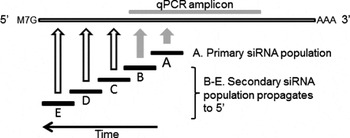
The implications of this asymmetric target mRNA degradation may be far reaching. In C. elegans we know that secondary amplification of the RNAi response, through RdRP polymerisation of target mRNA transcripts, propagates predominantly to the 5′. As the secondary population of siRNA propagates to the 5′ they will target the mRNA transcript at points progressively 5′ of the initial siRNA target site, creating a series of secondary cleavage sites from which further RNAi amplification events will occur, again spreading predominantly to the 5′ (Aoki et al. Reference Aoki, Moriguchi, Yoshioka, Okawa and Tabara2007). It is well established that the RNAi response in C. elegans is exerted primarily by the secondary population of siRNAs (Aoki et al. Reference Aoki, Moriguchi, Yoshioka, Okawa and Tabara2007; Pak and Fire, 2007; Sijen et al. Reference Sijen, Steiner, Thijssen and Plasterk2007; Gent et al. Reference Gent, Lamm, Pavelec, Maniar, Parameswaran, Tao, Kennedy and Fire2010). As secondary siRNAs cleave the target transcript progressively further 5′ over a time course this will effectively increase the size of the 3′ mRNA cleavage fragment – the cleavage fragment which is relatively more stable than the 5′ fragment of a single cleavage event (see Fig. 1). This means that qPCR amplicons placed to the 3′ of these secondary siRNA cleavage sites may contribute to an underestimate of transcript knockdown.
Schematic of secondary short interfering (si)RNA 5′ propagation impact on initial quantitative polymerase chain reaction (qPCR) amplicon placement over time. Primary siRNA population (A) and first secondary siRNA (B) trigger mRNA transcript cleavage (grey arrows) in region situated within qPCR amplicon illustrated. Over time, additional secondary siRNAs (C, D and E) proceed along mRNA transcript in a 5′ direction from the initial primary siRNA (A) annealing site such that the target transcript would eventually be cleaved (open arrows) at points 5′ to the qPCR amplicon (open arrows). Not drawn to scale.

This phenomenon could influence off-target RNAi as mentioned above; that is, the knockdown or modulation of mRNA transcripts which do not share significant sequence similarity with the initial RNAi trigger. The constant evolution of secondary siRNA sequences along a time-course promotes a situation in which it becomes progressively more difficult to control the specificity of RNAi; especially in cases of targeting individual members of a highly similar multigene family, where small areas of sequence dissimilarity may not trigger specific transcript knockdown before secondary siRNAs began to target other family members. This could necessitate a revised experimental model, where the conditions for RNAi of each individual target transcript are time-coursed, and behavioural/functional assays are conducted at the shortest treatment time required to trigger significant transcript knockdown which leads to an aberrant phenotype.
EXPERIMENTAL DESIGN WORK FLOW AND TROUBLE-SHOOTING
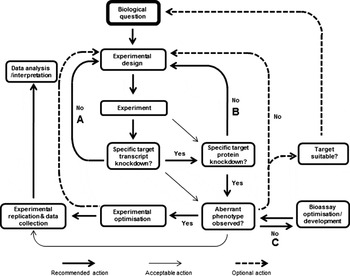
Here we provide a suggested RNAi experimental workflow to act as a general guide to those considering the use of RNAi in parasitic helminths (see Fig. 2).
Proposed RNA interference experimental workflow. Note that the letters (A, B and C) correlate with relevant sections of text.

The following sections, whilst not providing an exhaustive list of potential solutions to specific RNAi experimental problems in parasitic helminths, cover many of the most serious and obvious sources of error and variation. Considerations which have been discussed at length above will not be dealt with in detail here.
A. No target transcript knockdown – revise experimental design
Sampling error and reverse transcription
Large standard error of mean (SEM) values, or general variability associated with target transcript knockdown data can indicate that there is inadequate sampling of the experimental population, or that there is an additional downstream source of error. Issues with SEM can be remedied by (1) increasing experimental population size, (2) increasing the number of biological replicates (number of groups in each treatment regime), (3) optimizing the amount of input RNA into the RT reaction, or (4) through splitting RNA extracted from individual treatments into two or more RT reactions. The RT of experimentally extracted RNA represents an established source of variability (Bustin, Reference Bustin2000; Mannhalter et al. Reference Mannhalter, Koizar and Mitterbauer2000; Wong and Medrano, Reference Wong and Medrano2005); such that increasing RT replicates should reduce this error.
PCR optimisation
When using relative quantification techniques for the analysis of target transcript abundance, care should be taken to ensure that endogenous control gene expression levels are stable across treatments (Pfaffl, Reference Pfaffl2001; Wong and Medrano, Reference Wong and Medrano2005). Changes in endogenous control gene expression levels could agonise or antagonise changes in target transcript expression. Often a single control gene is used to normalise target expression levels between treatments and experiments. This can be subject to significant levels of error, especially when dealing with small experimental helminth populations, or limiting amounts of helminth tissue. One solution would be to use multiple endogenous control genes as references, and calculate relative expression using the geometric mean of the reference gene transcript levels. This approach will reduce error associated with control gene expression variance, and also buffer against potential off-target effects, both of which could constitute a source of false negative results (Vandesompele et al. Reference Vandesompele, De Preter, Pattyn, Poppe, Van Roy, De Paepe and Speleman2002; Wong and Medrano, Reference Wong and Medrano2005; Nordgard et al. Reference Nordgard, Kvaloy, Farmen and Heikkila2006; Dalzell et al. Reference Dalzell, McMaster, Fleming and Maule2010a). Other steps can be taken to reduce the likelihood of PCR error, for example, by avoiding reference genes likely to be subject to fluctuation, e.g. “stress-response” genes. Error may also be reduced in certain instances by increasing the number of technical PCR replicates for each experimental cDNA sample, and/or by using master mixes for all PCR reactions. Where endpoint RT-PCR detection must be used, a competitive RT-PCR assay will significantly increase accuracy and confidence in datasets where variability is a problem (see earlier section on PCR).
Primer placement and dsRNA/siRNA targeting considerations
In our hands, the positioning of PCR primer sets relative to target cleavage sites can have a highly significant impact on the accuracy of target transcript abundance measurements across various parasitic helminth species (unpublished observations). Efforts should be taken to ensure that primers are placed as far 5′ on the target transcript as possible. Additionally, target dsRNA/siRNA should be targeted as far 3′ on the target transcript ORF as possible. Many translation factors bind to elements of the 5′ and 3′ untranslated regions (UTRs) of mRNA (e.g. those involved in miRNA regulation), and this may impact on RISC accessibility to the target. By placing the RNAi trigger to the extreme 3′ of the target ORF, and the PCR primers to the extreme 5′ of the target mRNA, the time needed for the RNAi machinery to propagate secondary siRNAs to a position which will place the PCR amplicon in the slowly degrading 3′ transcript fragment following RISC cleavage will be maximised.
dsRNA/siRNA design
The specific target gene should be sequenced before an siRNA is used. Single nucleotide polymorphisms (SNPs) in certain areas of the target transcript could inhibit RISC activity, and significantly reduce knockdown efficacy. Genetic polymorphism is a widespread phenomenon in parasitic nematodes (Le Jambre, Reference Le Jambre1993; Grant, Reference Grant1994) and flatworms (Liu et al. Reference Liu, Lu, Hu, Wang, Cui, Chi, Yan, Wang, Song, Xu, Wang, Zhang, Zhang, Wang, Xue, Brindley, McManus, Yang, Feng, Chen and Han2006) which means that designing target siRNA against public ESTs is inadvisable. Longer dsRNA will not be affected to the same degree by SNPs as multiple siRNA will be generated by the dicer complex.
Similarly, aforementioned issues with target transcript splice variants could pose a problem if siRNA/dsRNA is targeted to an exon excluded from some splice variants, and PCR amplicons are selected from exons shared with multiple variants, some of which may not be targeted by the RNAi trigger – this would likely result in false negatives at the level of target transcript knockdown.
Time-course
The exonuclease ERI-1 is known to function as an RNAi inhibitor and occurs in parasitic helminths (Dalzell et al. Reference Dalzell, McVeigh, Warnock, Mitreva, Bird, Abad, Fleming, Day, Mousley, Marks and Maule2011). In mice, high concentrations of dsRNA in the bloodstream triggers increased expression of eri-1, which correlates with a decrease in target-specific siRNA and recovery of the target transcript (Grimm et al. Reference Grimm, Streetz, Jopling, Storm, Pandey, Davis, Marion, Salazar and Kay2006). Longer RNAi experiments could lead to a greater accumulation of dsRNA/siRNA in parasitic helminth tissues, which could lead to elevated eri-1 expression and rapid recovery of the target transcript. This may also occur as a result of RdRP activity and elevated secondary siRNA concentrations in vivo. Some authors have suggested that RNAi-induced transcript upregulation occurs as a result of non-specific effects (Geldhof et al. Reference Geldhof, Murray, Couthier, Gilleard, McLauchlan, Knox and Britton2006) or homeostatic rebound (Bakhetia et al. 2008). Experimental time-courses should, where possible, be reduced to minimise the likelihood of ERI-1 impact. Various other RNAi inhibitors have been identified through mutant screens of C. elegans as enhancers of RNAi (eri genes, primarily). Zhuang and Hunter (Reference Zhuang and Hunter2011) demonstrate that the expression and activity of some of these RNAi inhibitors are tissue-specific and orthologous genes can display different expression patterns in parasitic helminths relative to model organisms, making interpretation difficult. Defining inter-species differences (where they exist) in expression patterns of inhibitor orthologues may explain some RNAi susceptibility issues, which could then inform RNAi experimental design in parasites, perhaps by the co-silencing of inhibitors alongside target genes.
SID-1 transports dsRNA in a passive, concentration-dependent manner (Shih et al. Reference Shih, Fitzgerald, Sutherlin and Hunter2009; Shih and Hunter, Reference Shih and Hunter2011). Shih and Hunter (Reference Shih and Hunter2011) demonstrate the importance of coupling siRNA biogenesis through the Dicer complex with RISC loading, as SID-1 will transport uncoupled dsRNA down a concentration gradient, i.e. as available RISC components become saturated, excess siRNA is transported out of the cell. In species which express a SID-1 orthologue with similar functionality and which display secondary amplification processes, a shorter dsRNA/siRNA exposure period followed by a longer wash phase may decrease the chance of elevated dsRNA/siRNA concentrations in vivo, as excess non-RISC-coupled siRNA will likely be transported out of cells.
Experimental controls
On occasion, dsRNA or siRNA designated as a control can have profound effects on gene transcript expression levels (unpublished data). At this time, it is difficult to determine why this happens, but variables which can impact on control dsRNA or siRNA treatments include: concentration; sequence identity; purity of the dsRNA or siRNA; and, structural integrity of the control dsRNA or siRNA. All four of these variables can be assessed by electrophoretic and spectrophotometric analyses of dsRNA (which should be performed as standard), and should be controlled for as much as possible between treatments. Control dsRNA or siRNA which consistently trigger off-target or non-specific effects should be removed in favour of more benign controls. Consistent issues of this nature across various control dsRNA or siRNA likely indicate concentration-, and/or culture-dependent issues. Again, this highlights the importance of using multiple target-specific RNAi triggers to control for potential non-specific impacts of an individual target-specific siRNA.
Culture conditions
It is known that serum can rapidly and efficiently degrade dsRNA (Douthart and Burgett, Reference Douthart and Burgett1978; Surzhik et al. Reference Surzhik, Duks, Diatlova, Glazunov, Feldmane and Timkovskii1993; Krautz-Peterson et al. Reference Krautz-Peterson, Radwanska, Ndegwa, Shoemaker and Skelly2007; Hoerter et al. Reference Hoerter, Krishnan, Lionberger and Walter2011). Blood-borne or blood-feeding helminth RNAi soak-based protocols should consider: (1) significantly reducing, or removing, culture serum content during dsRNA exposure if helminth uptake is a limiting factor; (2) an electroporation-based protocol could be used in the presence of dsRNA to trigger rapid uptake of the dsRNA, the electroporated helminths could then be cultured in serum-supplemented media; (3) a liposome-based formulation could be used to encapsulate the dsRNA and protect it from serum RNase; or, (4) an RNase inhibitor could be added to the culture media. Whilst adding serum to the culture medium of blood-borne helminth stages increases their health and viability, it does not impact on the level of achievable target transcript knockdown by RNAi (see Stefanic et al. Reference Stefanic, Dvorak, Horn, Braschi, Sojka, Ruelas, Suzuki, Lim, Hopkins, McKerrow and Caffrey2010).
B. No protein knockdown detected
Here we assume that protein assays with adequate sensitivity are in place. Parasitic helminth RNAi studies often bypass the quantification of target protein levels and move straight to phenotype analysis. Whilst a significant, rational, LOF phenotype observed to be specific to target transcript knockdown can negate the need for protein quantification (providing adequate controls have been used), negative results for aberrant phenotypes could simply be a factor of inadequate target protein knockdown. Significant transcript diminution would be expected to impact protein levels in a time-dependent manner. Therefore, where significant transcript knockdown is achieved but protein knockdown is not detected, then extended time-courses should be used and will allow the detection of protein knockdown even when there is a significant delay in the latter. In cases where protein quantification will not be employed post-RNAi, treatment time-courses could be increased and phenotype screening continued to protect against false negatives due to a delayed drop in target protein concentration.
C. No aberrant phenotype observed – bioassay optimisation/development
Bioassay considerations peculiar to RNAi LOF gene studies include the time-dependency of transcript/protein knockdown, which in many cases varies from target to target. Unless the assay environment also includes the dsRNA/siRNA trigger, then it is effectively a wash stage also, which means that the worm is recovering. The time taken for full recovery of target transcript abundance is likely to be largely gene- and species-specific.
Phenotype detection methods will often and understandably vary from experiment to experiment. In a gene-function context, there is one key consideration in the planning, design and optimisation of phenotypic and/or behavioural assays for studying gene function: the less specific the assay is to the target gene, the less reliable the results. Assaying phenotypes or behaviours which result from numerous and diverse physiological inputs, decreases experimental stringency and reliability. It is important to, as far as possible, tailor phenotypic and behavioural assays to the likely function of a gene product if that assay is to give the best possible resolution of data.
One caveat to this with specific relevance here is the fact that such studies are often undertaken to determine therapeutic control target validity rather than to investigate gene function per se. In this situation, where aberrant phenotypes such as reduced locomotion, migration, alimentation, sensory capacity, reproduction or survival are enough to provide confidence in the potential of a particular target as a control option, then broader, less focussed assays are suitable. Indeed, if in vitro data reveal long-lived transcript knockdown in infective stage parasites, then the ideal assessment of target validity is to infect the host with RNAi-worms and monitor survival/ability to establish and maintain infection. A specific assay that illustrates reduced protein activity can inform function and experimental rigor but does not inform control target utility. The limitation to this approach is the persistence of the knockdown.
CONCLUSIONS
Arguably, the field of parasitic helminth RNAi should be making the transition from experimental development or isolated gene function studies to functional genomic/transcriptomic interrogation and large-scale target validation processes. However, this is clearly not the case for most species, where optimisation studies remain to be completed and/or expanded with a view to the development of robust reverse genetic platforms. Unsurprisingly, the absence of such data for most parasite species has contributed to the variable success/experimental outcomes of many RNAi experiments. Fundamental investigations of the RNAi pathways in disparate helminth species need to be conducted on a much larger and more in-depth scale. A more thorough understanding of this biological phenomenon will facilitate better exploitation of RNAi in the study and control of parasitic worms. Here we have discussed some of the fundamental issues with the use of RNAi as an experimental tool, and we hope that this will encourage a more considered approach towards the design and implementation of RNAi studies in parasitic helminths.
ACKNOWLEDGEMENTS
We are grateful to all of those who worked on RNAi as postgraduate students in our laboratories and generated datasets that aided our understanding of RNAi in parasites.
FINANCIAL SUPPORT
NJM, AM and AGM acknowledge support from The Department of Agricultural and Rural Development for Northern Ireland, The Department of Education and Learning for Northern Ireland, the Biotechnology and Biological Sciences Research Council (UK) and Merial Limited.