What is political psychology? The name is new, with its inception as a separate discipline sometime in the twentieth century, and the formation of an official society only in 1978.Footnote 1 Yet important scholars discussed the relationship between psychology and political processes as early as ancient Greece. Greek fables discuss both the sour grapes phenomenon, in which desires are adjusted in accordance with what we cannot have, and an alternative phenomenon in which we want what we cannot have. Machiavelli presents a complex and sophisticated manual for how the Prince should use psychology to gain political power. DeTocqueville makes the revolution of rising expectations and the concept of relative deprivation key to the fall of the old regime in France. Finally, the founding fathers built the American system of government on critical assumptions about human nature, setting up checks and balances to counter human tendencies toward domination. The practical political world is similarly filled with assumptions about how relations among people might be said to be inevitably linked with human psychology; appeals to character are a longstanding staple in democratic politics and every precinct committeeman understands the electoral importance of the bandwagon and the underdog effect.Footnote 2
Unlike economics, which locates its intellectual parentage in Adam Smith's Wealth of Nations, or sociology or anthropology, which can point to a cluster of works at a certain historical moment, political psychology has a more difficult time pinpointing its official birth date as an independent discipline. Its problem-driven lineage exists in Freud's work on civilization and its discontents and in the later mid-twentieth century American behavioral movement, which sought to apply scientific methods to explain critical political events.Footnote 3 Harold Lasswell's efforts to understand fascism and communism, and the interest of later scholars in explaining World War II and the Cold War, produced an explosion of work asking why people think and act as they do and how their thoughts and actions shape the course of politics.Footnote 4
It is now thus widely accepted that there are important psychological underpinnings, roots, and consequences of political behavior. Understanding political psychology is critical in explaining great historical events and movements and in clarifying aspects of smaller group and micropolitical behavior. But what exactly constitutes the essential nature of political psychology as a discipline? What are its best methods, approaches, theories, critical concepts, and main themes? Barring no one founding document, how can we best determine the field's central core, its preferred methodologies or theories, and the body of literature associated with political psychology as a field? It is possible to answer these questions in a variety of ways.Footnote 5 Instead of surveying the definitions others have given, accepting the textbook conceptualizations as our guide,Footnote 6 we here examine the various practices, methods, and practitioners that operate under the rubric of political psychology to find the core of the discipline. We thus begin by asking what is meant by those who use the term “political psychology.” We examine recurring concepts, themes, and topics addressed in articles and books and search for central assumptions that underlie choices made to deploy specific methodological approaches or to study particular issues. Finally, we ask whether favored practices of political psychology have changed over time and if so, why. Is change the result of intellectual stimuli derived from advances in technology or the import of findings and methods from cognate disciplines? Is it a reflection of political realities, or influential personalities in positions of power when decisions are made? What are the nodes in the structure of those who practice political psychology as manifest in print and member associations?
To answer these questions, we surveyed and assessed the disparate parts of political psychology as a discipline by examining the following:
• Type of articles appearing in the journal Political Psychology. For example, we examine the shifts over time and according to the editor(s) in terms of preferred topics and methodology.
• Winners of the Best Book Awards, the Robert Lane Award given by the American Political Science Association (hereafter APSA), or the Alexander George Award given by the International Society of Political Psychology (hereafter ISPP). Are there shifts at different points in time in the types of books winning these prizes? Do certain approaches enjoy a period of popularity and then either become incorporated into the canon or fade from popular usage? Is there a consistent canon? What do the prize-winning books have in common, if anything?
• Research of the presidents of the ISPP as reflected in their presidential addresses published in Political Psychology. We contrast these with the presidents of the APSA's organized section in political psychology to determine whether there are critical differences between political psychology as practiced in the US and in the international community. Does the type of work done by these officers reflect a central concern with particular topics? Are there political considerations that enter the choice?
• Programs in political psychology, in the United States and abroad.Footnote 7 We examined the various university centers that offer specialized degrees or certificates in political psychology to determine what courses, topics, and methodologies these programs have in common and where their critical differences may lie.
We hope this article will contribute to a greater understanding of political psychology by 1) collecting data in a more systematic way for the intellectual community, 2) sensitizing students to the extent to which any intellectual discipline is socially constructed and is a work in progress, 3) heightening awareness of the political aspects of intellectual life, 4) exposing readers to the wide variety of diverse approaches and methodologies used by political psychologists, and 5) suggesting the range of topics that political psychology can address successfully and the range of techniques it can utilize.
Research Methodology, Design and Data Collection
Determining the boundaries of political psychology as a discipline is daunting.Footnote 8 Rather than defining political psychology in the abstract, we drew on empirical observation to grasp a sense of the core endeavor. Conceptually, we believe any coherent discipline of political psychology should manifest itself in some sort of enduring practice. Our first step was to compile a database of indicators that would reasonably reflect the collective efforts of political psychologists. From this, we hoped to discern three key elements: who were the practitioners, about what did they research or theorize, and what methods did they use? To this end, we focused on the publications, book awards, and association officers to generate a master list, which we would thereafter code to enable systematic analysis.
When and where did political psychology begin? There are many forerunners who adumbrate the emergence of a field years before it can be reasonably said to exist. Theorists such as Plato, Aristotle, or Machiavelli clearly discuss questions of human nature relevant of political psychology, even though there was no discipline as such when these giants wrote. For our purposes, Harold Lasswell is perhaps the first important political psychologist. We regard Lasswell and psychologists who ventured into political inquiry—such as Melanie Klein and Erik Erikson—as singular figures in the period before our chosen start point.
For more practical purposes, we limited our inquiry to approximately the thirty years since the inception of the International Society of Political Psychology and its journal, Political Psychology. We looked at the journal's articles, the ISPP's presidents and their presidential addresses, the chairs of the APSA's organized section on political psychology, and the list of books awarded the section's Lane Best Book Award. Using this database, we then developed a coding scheme to analyze the data and answer some of the following questions. Are political psychologists primarily political scientists using psychological tools, techniques, and theories? Or are they psychologists applying these tools to political problems? Do we find shifts in the use of particular methods over times? Do these reflect trends in the field of social science or reflect more personal influence from the editors of a journal or officers of an association? Do political psychologists tend to use different methods than political scientists, or do both disciplines employ the same techniques? Do political scientists, for example, favor survey research, and psychologists favor experimentation? Would we see a clustering of topics or correlations between topic and editor or topic and methodology? After discussing these questions at length, we settled on the following coding topics.Footnote 9
Coding Articles
We coded articles in Political Psychology from its inception in 1979 through the first volume of 2008. As the eponymous journal of the discipline and the standard bearer of the International Society of Political Psychology, this journal should reflect the core oeuvre and trajectory of practicing political psychologists. This inductive approach produced a database of all substantive articles from which to develop a coding scheme for method used and topic examined. (We omitted book reviews and editorials.) We clustered articles into categories containing the following elements: original research, literature review, ISPP presidential address. and symposia for discussion. The database contains such information as year of publication, author, author's affiliation and department, article title and author-provided keywords. This produced 911 articles, an average of 32 articles published per year. With this list in hand, we then examined the titles and abstracts to get a feel for the universe of methods and topics, to generate a more concise list of major method and topic codes. As we read these articles and developed a coding system, our team met frequently to discuss philosophical, practical, and epistemological concerns.
We initially thought of articles as falling into three categories: quantitative, qualitative, or theoretical. Most articles fell easily into clearly distinct categories: surveys, experiments, literature reviews, interviews, and content analysis. The challenge was to account for articles that blended data types and orders of inquiry or involved theorizing or interpretation. How should we treat theories that blended partial literature reviews with the adducing of selective empiricism as, for example, in the case of psychoanalysis? How should we handle secondary sources, which provide the descriptive richness with which political psychological accounts often are constructed? As we coded, our team discussed the challenges in applying the initial set of codes to the data and made changes to our scheme if we encountered errors, omissions, or excess. We met multiple times to discuss issues elicited by particularly challenging articles. Thus our coding scheme can be seen as an on-going collaborative process designed to capture the broad elements of political psychology as a field.
Coding Articles by Research Methodology
We used the database of articles and keyed off the titles, keywords, and abstracts. We privileged author-designations to minimize the kind of inter-coder error that intermittently arises with subjective interpretation. When these author identifiers were insufficient, we read the entire article for clarification.Footnote 10 This process produced a methodology variable with eight values, covering the spectrum from abstract, conceptual modeling to experimentation and survey research. Coders used the one value that best fit the article. The possible values are:
1. Content Analyses: Examination of frequency of words, verbs, and patterns of terms used in speeches, writings, and other documents. Can be computational, automated, or manually derived analyses. Example: Dille Reference Dille2000.
2. Experiments: Manipulation of groups of subjects to test a hypothesis. Includes control and test groups and comparative analysis of subject populations. Often, but not necessarily use undergraduates, volunteers or graduate students. Example: Mitchell, Tetlock, Newman, and Lerner Reference Mitchell, Tetlock, Newman and Lerner2003.
3. Interviews: Direct interaction with subjects in an open-ended or semi-structured question-answer or narrative format, as distinguished from surveys, which are more structured and offer only a few possible response options. Example: Frank and Rivard Reference Frank and Rivard1986.
4. Literature Reviews: Analysis and description of previously published work. Often constitute the platform for incremental theorizing. Many theory articles have been coded as literature reviews unless they involve some aspect of formal modeling that derives from speculative logic. Example: Etzioni Reference Etzioni1983.
5. Modeling: Formal models that may at times be a blend of theory and empirical analysis. Start with brief overview of past findings but offer new models or insights based on the theorist's application of logic to imagining what-if possibilities. May use empirical research as a springboard for such brainstorming and differ from literature reviews for their explicit formal models. Example: Berejikian Reference Berejikian2002.
6. Psychoanalytic: Use of explicitly psychoanalytic frameworks to interpret individuals, often political leaders. Distinguished from literature review or secondary source articles by being a unique blend of narrative, empirical evidence, and theory. Personality assessments and profiles exemplify this type of work. We construe psychoanalysis broadly to encompass various schools seeking to illuminate the psyche and do not limit the application of this value to Freudian or classically constrained definitions. Example: Post Reference Post1986.
7. Secondary Sources: Typically, historical accounts that rely primarily on secondary data such as accounts, third person memoirs, and previous studies. May involve interpretation of memoirs, health records, and speeches, if they use high-level narrative rather than content analysis. Such studies may incorporate statistics, which are interpreted and used to give context to retrospective or reflective accounts of actions and events. Often used to explain historical figures or distant figures, i.e., contemporary political leaders to which researcher have no direct access. Examples include case studies, historical narratives, and other reports that do not conform to explicit social scientific standards of clear testability. Example: Winter, Hermann, Weintraub, and Walker Reference Winter, Hermann, Weintraub and Walker1991.
8. Surveys: Built on the use and analysis of close-ended questionnaires. No manipulation of test conditions. Examples include national, regional, local and target group. Articles typically provide various forms of advanced analysis beyond basic descriptive statistics. Example: Binning Reference Binning2007.
Coding Articles by Research Topic
To reduce literally hundreds of keywords into a more manageable superset of broad types, we derived twelve values from groupings of the most popular keywords as provided by the articles' authors. We coded for the best two issue areas that fit each article to give our metric increased range. This produced twelve values:
1. Cognition and Reasoning: Articles that examine cognitive style, perception, memory, decision-making, and all aspects of reasoning. How do people know and how do they decide what they do? Includes integrative complexity. Does not cover emotion. Example: Farnham Reference Farnham1990.
2. Emotion: Articles covering research into the role emotions play as part of decision-making. A recent focus of research that stands apart from cognition or values to the extent to which emotion itself is linked to action or behavior. Example: Small, Lerner, and Fischhoff Reference Small, Lerner and Fischhoff2006.
3. Identity: Reflections on roles, the idea of some self that is self-grounding and can stand alone as a platform for action. Examples include articles that examine race, gender, ethnicity, and national identity. Example: Kinnvall Reference Kinnvall2004.
4. International Relations and Intergroup Conflict: Articles with a broad range that generally examine issues related to international and domestic relations, foreign policy, war and peace. May include social phenomena between the state and a target group or between political groups within a sovereignty. Examples include interstate conflict and trans-national issues. Example: Blight Reference Blight1986.
5. Leaders and Leadership: Articles that focus on leaders as individuals, whether in formal institutions (e.g., government) or informal institutions (e.g., mass movements, ethnic groups). Also includes articles that study the subject of leadership as a discrete phenomenon. Example: Glad Reference Glad2002.
6. Mass Movements: Articles covering social and other consistently enduring large-scale collective movements including voting/electoral behavior and identity if the focus is on the ascriptively-defined group. At the same time, studies of mass movements also may treat identity as an equally weighted if separate research topic. Example: Stewart, Settles, and Winter Reference Stewart, Settles and Winter1998.
7. Organizations and Groups: Articles discussing political parties, organizations such as unions and other groups that stand as the level of analysis. Distinguished from identity if the groups are defined as ascriptive wholes rather than as agglomerations of individuals who express some identification process. For example, the Catholic Church and the Communist Party may each warrant this descriptor if the focus is on the group rather than on the process in which individuals reflect on their participation in that group. Example: Stein Reference Stein1990.
8. Personality: Articles that focus on the individual as a singular whole. May involve analysis of traits or types, studies that apply personality theory or create indicators of personality, such as Adorno et al.'s (Reference Adorno, Frenkel-Brunswik, Levinson and Sanford1950) authoritarianism. Distinguished from values and belief systems insofar as the level of analysis is the individual who possesses a whole basket of tendencies. (See category 12 below for works on belief systems and values.) Example: Caprara, Barbaranelli and Zimbardo Reference Caprara, Barbaranelli and Zimbardo1999.
9. Philosophy of Social Science and Epistemology: These articles address the philosophical and epistemological grounding of the practice of political psychology. Example: Pérez Reference Pérez2001.
10. Political Communication: Articles addressing media, framing, and/or propaganda. Looks at how people communicate and the manner in which such communication affects political issues or other politically relevant phenomena, such as identity or mass movements. Media is broadly construed as news, advertising, television, but also as leaders' speeches or political slogans. Example: Nelson and Garst Reference Nelson and Garst2005.
11. Political Culture and Socialization: Articles touching on issues associated with civic culture, political culture, values that exist at the group-level (á la Almond and Verba). Includes sociological arguments for culture and socialization, including civilization or social capital arguments. Phenomena under inquiry may be static or dynamic. Generally, these conceive of collective level phenomena as somewhat deterministic of behavior. Also includes the ambiguous idea of social capital. Example: Sevy Reference Sevy1983.
12. Values, Belief Systems, Ideology, and Attitudes: Articles that focus on conceptual targets such as a person's values, belief systems, and ideology. Different from cognition in that values and ideology are seen as implicit or perhaps subconscious phenomena. Distinguished from personality in that ideology and belief systems may be seen as discrete from personality as coherent wholes, which stand external to the person. May encompass religion for its ideational rather than identity aspects Example: Feldman Reference Feldman1996.
Coding Book Awards
We coded two book awards. Since 1994, the Robert E. Lane Book Award has been given by the Political Psychology section of the APSA for the “best book in political psychology published” that year. We coded the following data for each award-winning book: year issued, award winner(s), professional or departmental affiliation, institutional affiliation, title of the book, publisher, and general topic. Disciplinary affiliation and institutional affiliation were coded separately to determine the patterns of award winners (political scientists versus psychologists). We wished to determine whether certain universities or university systems were better represented in award recipients than others. Publisher was included to determine whether particular publishers dominated political psychology. A similar typology was applied to the Alexander George Award, awarded by the ISPP since 2004 to the book “that demonstrates the highest quality of thought and makes a major substantive book-length contribution to the field of political psychology, broadly defined.” Under general topics, we again classed the general subject of the book into one of the twelve broad topic categories utilized in coding articles from Political Psychology: cognition/reasoning, leaders and leadership, identity, international relations, mass movements, organizations and groups, personality, philosophy of social science and epistemology, political communication, political culture and socialization, values/belief systems/ideology/attitudes, and emotion.
Coding Officers and Editors
Officers: We listed APSA and ISPP presidents according to substantive focus of their work, methodologies employed, institutional affiliation, disciplinary field, and date in office. There have been a total of thirty-one ISPP presidents and sixteen APSA political psychology section chairs. Looking at gender, we find that women held the top ISPP office nine times (29 percent). Interestingly, women accounted for a near equal share of the APSA position, holding it seven times (44 percent).
Editors: In the interest of obtaining not only a longitudinal survey of major themes and favored methodologies in Political Psychology but also a structural indicator such as its leadership, we compared the temporal sequencing of article trends with one broken down by editor tenure. The editorship fell into roughly five periods. Initial editorship was held intermittently by a variety of individuals ranging from Joseph Adelson (1979) to Margaret Hermann (1980–1982), at a time when both the journal and its parent organization, the ISPP, were just beginning to establish their institutional infrastructure. Alfred Freedman (NY Medical College) assumed the editorship next, from Spring 1983 to Summer 1989, and during his six years managed to solidify the journal's format and focus. Stanley Renshon (CUNY) succeeded Freedman in Fall 1989 and steered the journal until Winter 1997, at which point a team from the University of Minnesota took charge. The Minnesota team, led by John Sullivan, edited the journal until the end of 2005. Finally, the first issue of 2006 marked the beginning of the fifth and current editorship, a team led by Stanley Feldman, Leonie Huddy, Charles Taber, and Howard Lavine at SUNY-Stony Brook.
For each issue we coded issue year and volume, editor(s)-in-chief, institutional affiliation, and disciplinary affiliation, where available. (Institutional affiliation refers to the editor's university employer; disciplinary affiliation identifies their profession as political scientist, psychologist, or other.) According to our poll of the editors, a time lag of three issues exists from the announced change in editor to a switch in control over actual journal output. We thus used a three-issue lag after formal announcement as the basis for segmenting the data by editorship.
Coding Discipline Affiliation
We coded disciplinary affiliations of the article authors, award winning books, and presidents ran as follows:
1. Political Science includes academic departments of political science, university departments or schools of government, international affairs, international relations, public affairs, and public administration, as well as nongovernmental institutions focused around these fields.
2. Psychology includes social psychology, educational psychology, experimental psychology, developmental psychology, and personality psychology, as well as moral development/reasoning, neuroscience, psychiatry, and institutions focused around these fields.
3. Other—a catch-all category including a variety of other disciplines, chief among which are sociology, health and medicine (excluding psychiatry), education, and communication.
In general, each individual was coded for one discipline. If an individual was affiliated with one of the two main disciplines as well as a discipline in “Other,” he or she was coded for the main discipline only. (For example, someone affiliated with both political science and sociology was coded as political science.) Beyond this, several individuals strongly involved in both the main disciplines were coded as both political science and psychology.
Findings
Publication Activity in Political Psychology
How actively have political psychologists published? Figure 1 reveals a striking consistency in numbers of articles published. Using our article coding criteria, an average of 31 articles were published per year, with a standard deviation of nine articles. (This figure does not include 1982, the sole year in which the journal was not published, or 2008, which produced only one issue at the time our data were compiled.) We also examined page counts and found the journal to be remarkably consistent, publishing an average 800 pages per year, distributed over four issues until 2004, when the journal moved to a six issue format.
Articles published, 1979–2008

Methods Political Psychologists Use
Frequency of Specific Methodological Approaches in Political Psychology Articles
What are the most popular methodological approaches and have they shifted over time? Figure 2 shows the overall proportion of methodology for our study. Surveys account for 29 percent, followed by literature reviews (23 percent), secondary sources (16 percent), and experimentation (12 percent). This snapshot does not, however, reveal significant shifts in the use of some methods at the expense of others. Throughout the period of our study, a variety of methods were used; over time, however, methodological diversity diminishes as experimentation and especially survey research begin to dominate. Figure 3 shows that at the start of the journal, surveys, literature review, and secondary sources were about equal in use, comprising 72 percent of all articles while psychoanalysis, modeling, interviews, and content analysis comprised the remainder.
Overall proportion of article methods, 1979–2008

Method use by decade

Sometime during 1994, however, quantitative work began to dominate, with survey usage rising at the apparent expense of secondary source publications (figure 3). From 1979–89, surveys accounted for just one-fifth (21 percent) of articles published. After 1989, they comprised nearly 27 percent and by 2000–08, had reached a dominant 40 percent of all articles published. In contrast, the other two methods decreased over time. From the first to last period, literature review dropped from 26 percent to 17 percent. Secondary sources tumbled even more dramatically, from a high of 25 percent in 1979–89 to less than 8 percent in 2000–08. Meanwhile, the only other method to gain traction was experimentation, which rose from a modest 5 percent of articles published in 1979–89 to a robust 20 percent in 2000–08. Indeed, experiments were second only to surveys in the most recent period, although they still only accounted for half of survey-based output.
While the other methods were less frequent, we do see a rise in the use of content analysis over time, perhaps due to the increased availability of technological tools that facilitate the use of such methods. Content analysis doubled, rising from 4.6 percent in 1979–89 to nearly 10 percent in 2000–08. On the other hand, psychoanalysis fell from about 8 percent in both 1979–89 and 1990–99 to less than one percent (one article out of 296) by 2000–08. Finally, interviews comprised less than 7 percent of output at its peak (1979–89) and only 3.4 percent between 2000–08. This may be surprising given that psychology, when practiced clinically, revolves heavily around an interview environment.
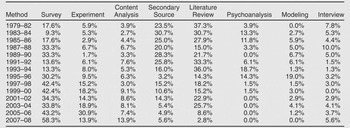
Intrigued by what the data suggest at this level, we delved into the details to learn what a biennial breakdown would reveal. Figure 4 offers clearer insight into the shifts in practice. For ease of comparison, the chart shows only the four most commonly used methods. The curves suggest the interplay between survey research and the other approaches. Surveys show a steep-pattern rise with a take-off in 1991–92. At the beginning, the journal published more literature review and secondary source articles. For the first three periods, literature reviews were published most frequently (table A in the appendix), accounting for about one-third of all articles. After 1987–88 we find a sharp rise in survey articles (33.3 percent). This rise correlates with a fall in literature reviews and secondary sources, a pattern that inverts itself by 1991–92. Indeed, literature reviews occur most frequently from 1989–94 while secondary source-based articles run a close second. Beginning in 1993–94, survey articles become increasingly popular, leading all types by a healthy margin. More telling, the frequency of survey-based articles has been escalating in recent years, reaching nearly six out of every ten articles published in the most recent period. In a rate-based approach, the rise of one method must come at the expense of another method. Here we find the patterns hinted at by the decade-level view.
Shifts in method use over time

Surveys are on a two-decade upswing that is accelerating. Conversely, literature reviews and secondary source articles are on a two-decade decline. While surveys now account for 58.3 percent of output, literature reviews and secondary source approaches comprise a meager 2.8 percent and 5.6 percent, respectively. Experimentation and content analysis appear to have absorbed a good portion of output. Experimentation was a consistent 5 percent to 7 percent from 1979–92 and began to rise thereafter, peaking at 30.9 percent in 2005–06 and holding steady at about 15 percent since 1995. Meanwhile, another quantitative approach, content analysis, has been used more frequently, rising from an average 5 percent per period from 1979–90 to about 9 percent since 1991. Modeling and interviews appeared regularly but each generally accounted for only 5 percent of articles published with no particular shift over time. The frequency of articles using psychoanalysis, however, has fallen off. From 1985–1996, about 10 percent of articles utilized this technique, peaking at 16.7 percent in 1994. Since 1996, only three psychoanalytic articles have been published.
Grouping survey, experimentation and content analysis into a quantitative group and literature review, secondary source, interview and psychoanalysis into a qualitative group, we find a rise in the former group at the expense of the latter (figure 5). At its peak in 1983–84, qualitative approaches accounted for 82.7 percent of articles published whereas by 2007–08, the opposite was true, with quantitative now accounting for 86.1 percent. Figure 5 notes this as a significant shift and speaks to a marked change in the field. The trends intersect in 1995–96, when the methods were split somewhat evenly.
Shift from qualitative to quantitative methods

Frequency of Methodological Approaches among Book Award Winners
The George Award has been given since 2004 (five recipients). Two books used surveys, two used secondary source methods, and one used content analysis. The Lane Award (given sixteen times) represents a diverse array of methodological approaches. One-quarter of the Lane recipients used surveys, 18 percent used theoretical approaches, and 18 percent content analysis. Unlike the coding methodology for articles, which eschews a specific value termed theoretical, the coding of books is made complicated by the fact that books are longer and allow authors to examine an issue from multiple methodological perspectives. In this light, books which examine cognition, decision-making, and other forms of reasoning within the rational choice literature or in apposition with the literature in cognate fields such as cognitive science, economics, and experimental psychology, are termed theoretical.
Figure 6 presents the breakout of individual approaches. Books coded as content analysis typically dealt with political communication, issue framing, and the media. Only two books relied upon interviews as their primary method, both by the same author. Does this reflect a certain preference by the Political Psychology section of APSA for quantitative rather than qualitative research? Or does this merely reflect preferred research methods by the authors who happened to be selected as award recipients in a given year? The data cannot answer this question.
Distribution of methods among Lane Award winners

Frequency of Articles Methodologies by Editorial Group
We note two strong trends over time: a rise in the share of quantitative methods and the concomitant decline in the share of qualitative methods. Since our data derive from a single journal, we were curious to see whether methods change as a result of editorial control. We examined publication dates carefully to note changes in editorial control. The journal has had five distinct editorships: 1) an initial group comprised of Joseph Adelson, Peg Hermann, and others, 2) Alfred Freedman, 3) Stanley Renshon, 4) a University of Minnesota team, and 5) a team from SUNY–Stony Brook. To distinguish periods in which the editor(s) exercised actual control, we looked for cut points based on the following: (a) published editorial farewell and notification that a new editor was incoming and (b) formal announcement by the new editorial team. Based on private correspondence from editors about structural delays inherent in the publication process, we lagged three issues from the point at which a “retirement” announcement was made, i.e., the issue containing the formal announcement plus two more issues. In cases where we had explicit information that contradicted this general rule, we adjusted our timing accordingly. Table 1 reveals that the first editorial group (Adelson et al.) accounted for only seventy-seven articles (8.5 percent) while Freedman (23 percent), Renshon (31 percent) and the University of Minnesota team (31 percent) accounted for 85 percent. The SUNY–Stony Brook team assumed editorial control in 2006: its short tenure explains why it accounts for only 6 percent of our dataset.Footnote 11
Editorship output as share of all articles, 1979–2008

We examined editor effects from two perspectives: what were the trends in method use as editors changed and how were methodologies distributed within each editorship? Figure 7 clearly reveals the rise in survey use by editor, a result hinted at in our discussion of longitudinal trends. Notice that both Freedman and Renshon published survey, literature review, and secondary source articles in roughly equal proportion. Beginning with the Minnesota team, survey research articles increased dramatically, as did experimentation articles, while literature review and secondary source articles fell dramatically. For example, while Freedman and Renshon each published survey articles at a 24 percent rate, the Minnesota team published survey research articles more than one-third of the time (38 percent), an increase of more than 58 percent. This trend appears to be accelerating. Extending the analysis to the current editorial group, we find that under SUNY–Stony Brook, survey research now accounts for 57 percent of all articles, an increase of another 50 percent. Similarly, articles employing experiments have gone from a 4 percent share under Adelson et al. to a high of 21 percent under Minnesota's aegis, and currently are the second most frequent approach under SUNY–Stony Brook at 17 percent. Finally, the last of the technical approaches we coded, content analysis, has also seen a rise in usage. Articles using content analysis have increased nearly twofold, from an average 4.7 percent share under each of the first three tenures to a 9 percent under the more recent two editorial groups.
Method trends by editorship

In contrast, qualitative research, literature reviews and secondary source approaches have sharply declined. Whereas literature reviews were the dominant approach in the first editorship (a 40 percent share), today they account for a record low 7.5 percent. Another notable trend is the remarkable decline in the publication of psychoanalytic articles. For Adelson (6.5 percent), Freedman (8 percent), and Renshon (9.8 percent), psychoanalytic articles comprised a small but consistent share of articles published. Freedman was a psychiatrist and Renshon is a trained psychoanalyst so the rate of such articles published under their respective tenures may not be surprising. What is striking is that once the Minnesota team assumed control, psychoanalytic articles were essentially not published, a pattern that persists today. Meanwhile, interview-based work continues to be published at a low rate of 3–4 percent per editorship, a trend started under Renshon. Under SUNY–Stony Brook, interviews comprise a 3.8 percent share, a decline of 40 percent from the earlier periods.
Figure 8 shows the distribution of methodological approaches during different editorial teams. The dominant method under Adelson was literature review (40 percent), followed by secondary source at 26 percent. Given the nascence of political psychology as a discipline and the likely challenge of attracting original research to a fledgling journal, the dependence on second-order work is not surprising. Freedman's editorship began in 1983 and lasted for approximately seven years. During this time, we find a balanced mix of approaches, with literature review, secondary source, and survey accounting for about 70 percent of the work published. We also find a robust, eclectic mix of the other methods represented during Freedman's tenure. This heterogeneous publication pattern continued under Renshon; this may be explained by the working relationship Renshon and Freedman established prior to the assumption of formal editorial control by Renshon in 1990. Under Renshon, literature reviews (27 percent) were the most common type of article, followed by surveys (24 percent).
Method distribution within editorship

With the arrival of the Minnesota team, a stark shift occurs. Surveys accounted for 38 percent of the publications, with a sharp reduction in literature review (falling 32 percent to 18 percent) and secondary sources (down 50 percent from 17.5 percent to 8.5 percent). In contrast, experiment-related articles rose 160 percent from 8.1 percent under Renshon to 21 percent under Minnesota. Content analysis articles nearly doubled in frequency as well. This emphasis on survey and experiment continued under SUNY–Stony Brook. Indeed, the graph shows a skewed relationship between surveys and all other methods. For the first time, under the SUNY–Stony Brook editors, a single methodological approach constitutes a clear majority of articles published. Given the small sample size of the SUNY–Stony Brook tenure (fifty-three articles under an editorship that began in 2006), we are not ready to characterize their tenure when other editorships lasted for many years and hundreds of articles. But if we take the Minnesota and SUNY–Stony Brook tenures together we find a pronounced emphasis on two approaches at the expense of all others.
Analyzing the data by year and by editor shows two dominant trends: the emergence of quantitative approaches and the decline of qualitative approaches. Moreover, the trend appears to be accelerating. What we do not know is why such patterns exist. Is it because quantitative articles account for the bulk of contemporary research and article submissions? Perhaps papers using these approaches tend to be of higher quality and therefore are published at a higher rate? Or do editors make a tangible difference due to some sort of institutional or professional selection process or bias? Perhaps the trends simply reflect a broader trend in political science, psychology, or social science research. This seems unlikely, since the Perestroika movement, agitating for greater methodological pluralism in political science, began in 2000Footnote 12 and the APSA qualitative methods section was established in 2003.Footnote 13 Both of these data points suggest tensions within political science, resulting in the rise in attention paid to qualitative methods. In this regard, political psychology is going against the tide in political science. The answer to such questions requires further work, perhaps by putting this study of political psychology in context with a similar study of key journals in disciplines which overlap or subsume ours. In any event, what stands out is that political psychology as a field is characterized by a diversity of methods that has, during the last two editorial teams, greatly diminished.
Research Topics
Frequency of Research Topics in Political Psychology Articles
Now that we have a picture of the preferred tools of political psychologists, we turn attention to examining whether research interests themselves have changed. Will we find consistent themes, recurring or shifting patterns? With this question in mind, we examined the breakdown of research topics across authors and over time. Table 2 and figure 9 present the total number of articles coded per topic.
Number and percentage of articles by topic, 1979–2008

Number of articles by topic, 1979–2008

Because each article was coded for up to two topics, percentages sum to more than one hundred. Values (encompassing belief systems, attitudes, and ideologies) took first place; overall, 28 percent of all the articles we surveyed were coded as values, narrowly edging out personality (27 percent) and international relations (26 percent). At the lower end of the frequency distribution were philosophy of social science, organizations, and political communication, with only 22 articles (2 percent) coded as emotion.
Also informative are the trends observed in the frequency of these topics over time. Figure 10 presents the percentage of articles coded as each topic out of the total number of articles published in each decade. Some general trends are evident. Values and identity have both sharply increased in 2000–2008 relative to the preceding two decades, with values characterizing roughly 40 percent of the articles since 2000, and identity over 25 percent. The concurrent rise of values as a research topic and surveys as a methodology is probably not coincidental; many articles in the past decade have relied on surveys as the most effective way to assess subjects' political attitudes and ideological commitments. Emotion as a major focus of research seems to have emerged only in the past decade; only one article was coded as emotion prior to 2000. Cognition, mass movements, and political communication also have increased moderately since 2000. On the other hand, international relations/intergroup conflict, which seems to have experienced its heyday in the 1980s while the Cold War was still ongoing, has decreased, despite a recent rise in the number of articles dealing with terrorism. Personality, political culture/political socialization, leaders/leadership, philosophy of social science, and organizations also have declined as a percentage of total articles.
Research topics by decade

Figures 11 through 14 generate a more in-depth picture of the trends that characterize four of the topics: values, identity, international relations/intergroup conflict, and political culture/political socialization. Although a popular topic in 1981, values declined to a low in the early 1990s, comprising less than 10 percent of the articles published in 1991 and 1992. Since then, the topic has shown a general upward trend, reaching an apex of more than 50 percent of the articles published in 2006. Identity evidences a similar pattern, with a low point in the early 1990s succeeded by an increase post-1995. Conversely, international relations/intergroup conflict seems to have climbed sharply in the first half of the 1980s, only to fall steadily after 1986. Finally, political culture/political socialization also has shown a steady decrease, despite a short-lived revival in the late 1990s.
Values as a percentage of articles published, 1979–2007

Identity as a percentage of articles published, 1979–2007

International relations as a percentage of articles published, 1979–2007

Political culture/socialization as a percentage of articles published, 1979–2007

Frequency of Research Topics among Book Award Winners
For the five George Award recipients, a relatively even balance in topical focus was struck between identity and international relations/intergroup conflict. The only additional topics covered by the book award winners were political communication and values, belief systems, and attitudes. One possible interpretation is that the ISPP's selection criteria for the George Award seems especially problem-driven in a real-world setting, dealing predominantly with issues such as race and prejudice, violence and conflict prevention, war and peace. One might speculate that the award reflects a particular institutional focus and concern of the ISPP itself.
When we consider the Lane recipients, we are struck by a wider variety of topics than those represented in the pool of George Award recipients. Notably, books devoted to cognition (19 percent) received the greatest share. These books often focused specifically on the information processing and decision-making of voters, institutional actors and politicians. Moreover, on closer examination, these books appear to be explorations situated within or in argument with the rational choice paradigm within political science itself. Books dealing with political communication, looking at media framing of issues, propaganda, and the attempts of viewers/voters to process both, also garnered a meaningful 13 percent share, as did books examining values, attitudes or belief systems.
Distribution of Topics of Lane Book Award Winners

Frequency of Research Topics among Editors and Officers
Editorships. Over its three decades, Political Psychology has seen a considerable variation in topic matter by editorship. To some extent, this variance may reflect the evolution of a new discipline as it found its core focus. However, the content of the articles published under each editorial team's tenure also may reflect changes in subject focus due to editor preference (figure 16). Under Adelson, Hermann, and then Freedman, the 1980s witnessed a heavy focus upon values, belief systems, ideology; the role of political leaders; key strategic episodes in international relations, particularly with the Soviet Union; and a ubiquitous concern with nuclear war. Under the Freeman editorship, the focus on personality and potential international crises found fitting expression, given that Freeman was a psychiatrist on the faculty of the New York Medical College. Under Renshon (1989–1997) and John Sullivan et al., a gradual but significant shift occurred in subject focus. Articles concerned with values, belief systems, and ideologies, as well as various processes of cognition (perception, memory, decision-making) that are readily captured by survey methodology, became much more numerous.
Article topics by editor(s)

Where once they were published at about the same rate as articles on other subjects, the share of articles using survey research grew dramatically over the 1990s and early 2000s. If congruence exists between editors, their institutions, and the methods associated with their professional training, then such a trend may indicate the gradual shift of editors to universities whose methodological approach revolves around surveys and experiments and whose research focuses heavily upon beliefs, opinions, and data that lend themselves to such methods. However, the coupling of editorial tenure with research focus is by no means clear in its implications. The salience of identity and emotion in the last decade, for example, cannot easily be assigned as the straightforward outcome of an editorship's executive decision. What is studied may reflect environmental changes in the world and the prioritization of new subjects as they emerge, such as terrorism, globalization, ethnic separatism, immigration, and affective or cognitive neuroscience.
The ISPP Presidents
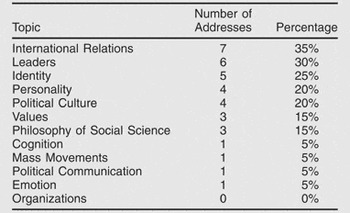
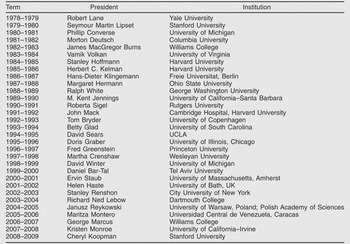
When we consider the list of all ISPP presidents from 1979 to the present (table B in the appendix), we find twenty of the thirty-one presidents have published presidential addresses in Political Psychology. We coded these for research topic using the coding scheme specified for the articles. Table 3 displays the breakdown of presidential addresses by topic. (Because each address was coded for up to two topics, the totals sum to more than 100 percent.) International relations and leadership were the two most popular topics for presidential addresses; both topics are overrepresented here relative to the breakdown of topics in the journal's regular articles. Conversely, values and personality, the two most frequent topics of the journal articles overall, are not as prominent here. One possible explanation for this discrepancy is that, similar to the book awards, presidents sought to make their addresses problem-driven, focused on pressing issues of public consequence and appealing to a wide range of scholars. Topics like war, peace, and conflict, as well as US and international leaders, may serve this function particularly well.
Number and share of presidential addresses by topic

APSA Section Chairs
We examined the list of APSA Political Psychology section chairs for patterns. From 1991–2008 there have been sixteen chairs, one less than expected due to there not being a chairperson for 1992–93. APSA membership is required to participate in the Political Psychology section so we expected—and found—that all section chairs work in political science departments. Being elected section chairperson reflects on the contributions an individual makes in scholarship and service, to political science in general, and political psychology in particular. As a result, we did not expect any professional psychologists to be chair and in fact, there have been none. In addition, given that section leadership is the reflection of an accumulated body of work, which may be diverse in methodological scope and research interest, we were hesitant to label a particular person as expressing a single favored methodological approach or area of study. Indeed, the only item of interest may be the slight overlap between section chair and the ISPP presidency. In comparing the two lists, we found four individuals—Crenshaw, Hermann, Marcus, and Monroe—have served as both APSA Political Psychology section chair and ISPP president.
Discipline Affiliations
Do political psychologists come equally from political science and psychology, or does one discipline dominate the field? We determined the departmental affiliations of 878 (96 percent) of the articles' first authors. These were recoded as political science, psychology, or other, using the coding procedure described under Methods. Figure 17, revealing the breakdown of article authors by discipline, shows that political science and psychology indeed are the dominant disciplines, with the next-largest single discipline—sociology—accounting for only about 4 percent of the articles. Political scientists account for a larger percentage of the articles (roughly 45 percent) than do psychologists (33 percent).
Article authors by discipline

The general predominance of political science over psychology is also evident when we examine trends over time (figure 18). Authors coded as both political science and psychology are counted as two data points. The years 1994 and 2004 stand out as having an especially high proportion of contributors from political science. This may be due to the topical focus of the journal in those years: 2004 included a special issue on prospect theory edited by University of California–Santa Barbara political scientist Rose McDermott, as well as a symposium on election campaigns, all of whose contributors were affiliated with political science. The 1994 volume included a special issue, “Political Psychology and the Work of Alexander L. George,” to which every contributor was affiliated with political science. Only in seven years were there more psychologists than political scientists. It is also interesting to note that of the authors whose affiliations could be determined in 1979, the very first year Political Psychology was published, none were coded as psychologists. A relatively high proportion of articles were coded as “other” during the first few years of the journal's existence, but this proportion declined after 1984 and has remained consistently below that for political science and psychology.
Total articles published per year by author's discipline

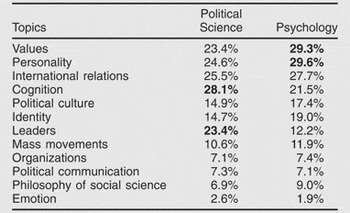
We also were interested in differences between political scientists and psychologists by method and topic. Do the articles published by political scientists tend to use different methodologies than those published by psychologists? No. Table 4 shows that the two disciplines use the same methods with the same frequencies, although psychologists are more likely to use surveys than are political scientists. Examining the research topics chosen by the two disciplines reveals several differences (table 5). Psychologists were more likely than political scientists to publish articles focused on values/beliefs/attitudes and personality. This may not be surprising given that these topics deal with individual-level psychological variables. Political scientists tended to publish more articles than psychologists about leadership. This is also not surprising, given the long political science interest in leadership. One less-expected finding is that more political scientists than psychologists have published articles about cognition.
Frequency of methods used by discipline

Research topics by discipline

(*bold figures denote large deltas)
Similar patterns are observed in the disciplines of the book award authors. Four of the five winners of the George Award are political scientists. The fifth is a social psychologist in a School of Education. The Lane Award also has winners predominantly from political science (14 out of 16 awards). The remaining two awards went to an attorney-historian and to a psychologist who teaches in both political science and business. While its greater number of recipients produces a clearer pattern than the George Award, the Lane Award is given by the APSA, and hence might be expected to be skewed toward political scientists.
Finally, we examined the relative prominence of the two disciplines by looking at the discipline affiliations of the ISPP presidents, coded the same way as we coded article authors. The breakdown generally reflects the distribution among the article authors (figure 19), except that there is a much smaller proportion of “other.” This, as well as the greater proportion of ISPP presidents affiliated with both political science and psychology, may reflect the fact that the ISPP is an organization explicitly devoted to political psychology and chooses officers whose chief interests and affiliations reflect its two main component disciplines.
Discipline affiliations among ISPP presidents

Discussion of Publication Patterns
Political psychology research occurs across disparate organizations, from academic departments at various universities to think tanks or NGOs. Each issue of Political Psychology offers a window into particular practices—as method, content and practitioner—at a specific time. Imagined as a flashlight effect the beam width and intensity correlates to the breadth and depth of discussion allotted to a particular subject. Does this spotlight move or stay in one place, according to editors? How much do editorial practices determine the boundaries of what is given public articulation? Examining trends across different editorial groups shows that some teams move the spotlight across a wide expanse of methods, content, and researchers, effectively revealing the broad horizon of political psychology as it is practiced. Other more recent editorial teams appear to delimit this range of motion, publishing consistently in select areas and methods while leaving other developments unmonitored, ignored, or rejected. We note this only as an observation; we leave the interpretation of this fact to the members of the field. Areas which once received a public forum may fail to do so under subsequent editorial regimes because they are no longer relevant to the field, because of personal preference on the part of the editors, or because author submission in such areas has fallen off. Here the question of norms ties into the construction of the acceptable research agenda. If a journal publishes from a subset, the reality is that the detached observer can compare that set with the full set. In this sense, the institutionalization of a political psychology deriving from its society (ISPP), its journal, and its awards serves only as a measure of what is accepted in the paradigmatic practices. If one could compare the ISPP and journal to trends in political science or social psychology, one would be better positioned to answer the question as to the degree of overlap between political psychology and its cognates. At the same time, the institutional mechanism of publication does determine the boundaries of what is acceptable or not. Here the evidence clearly reveals that statistical analyses are now predominantly favored over qualitative methods.
Centers of Political Psychology
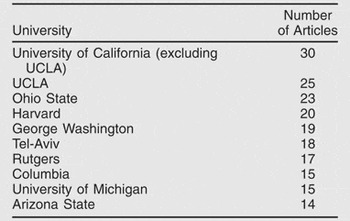
As a final component of our project, we considered the institutions where political psychology is taught and practiced. Did political psychologists cluster around certain universities? Overall, more than 300 universities and institutions were represented in our author database. They were scattered throughout the United States as well as a number of other countries, including Canada, Japan, Britain, Israel, Germany, Australia, and Poland. As anticipated, some institutions showed up repeatedly. Table 6 displays the top 10 universities by number of articles published. The centrality of these institutions is also evident when we consider that 13 (42%) of the ISPP presidents have been affiliated with one of these top 10 universities.
Number of articles by university, 1979–2008

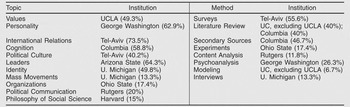
Do authors from these institutions differ in terms of their discipline affiliations, methodologies, or research topics? Examining the data reveals some distinct cleavages. First, there are differences in the proportion of articles from each university whose authors are affiliated with political science versus psychology. Arizona State and Columbia University contributed the greatest proportion of political scientists (93 percent and 80 percent of their articles, respectively, were authored by political scientists). On the other hand, 64 percent of the articles from UCLA had authors affiliated with psychology alone, and another 12 percent with both political science and psychology. Rutgers had the greatest proportion of authors in other disciplines (41 percent). There are also differences between the schools in terms of methodology and topic. Table 7 displays the top university for each research topic and for each method, as assessed by the percentage (given in parentheses) of that university's articles falling into each category.
Topics as share of articles published by institution

The longer history of the Lane Award enabled a more fine-grained analysis of both the schools the selected authors were drawn from and the frequency in which a particular school was represented (figure 20). A remarkable six out of the sixteen book award recipients were affiliated with the University of California system. The University of California is well-represented in the award winners as it accounts for more than one-third of the total awards given.
School affiliations of Book Award winner

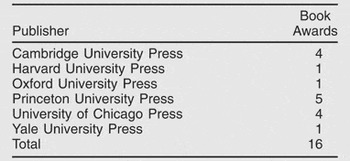
We also studied the Lane Awards to see if a similar pattern emerged by publishing house. Table 8 suggests award recipients were essentially divided three-ways among Cambridge, Princeton, and the University of Chicago Press. This contrasts sharply with the George Awards, where Cambridge published all five winners. In any event, our findings suggest the distinguished reputations of these three publishers is justified.
List of APSA's Lane Book Award by publisher

We searched for discernable patterns between school and preferred topic or methodological approach but no meaningful pattern emerged. Each award is a mutually exclusive event and reflects on the author, the subject, the array of competing books, the award committee and, in all likelhood, the timing of the award. Moreover, the awards are given to the authors of the books, not their affiliated schools, and in only two instances was the Lane award given as a repeat award. This therefore precludes generalizing about institutional preferences for certain kinds of research. Similarly, there was no correlation between publisher and preferred topic.
On the other hand, a study of publisher and methodological approach may reveal a slight trend. Cambridge University Press book award winners used survey methodology. Those from the University of Chicago Press were split evenly between theory (2 books) and content analysis (2 books). Princeton University Press's winners were slightly more varied in methodology. Whether these results reflects the focus or tastes of the publishers concerned or merely the coincidence of book selection, book methodology, and their given publisher cannot be determined.
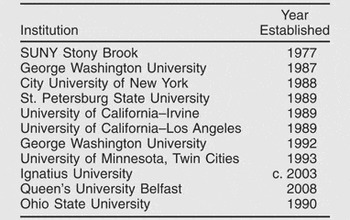
Finally, which universities currently offer graduate-level training in political psychology? Sears and Funk (Reference Sears and Funk1991) identified seven such programs offering a total of 56 graduate courses in political psychology. Since then, the very first graduate program in political psychology, begun at Yale in 1969, has been discontinued and several other programs have emerged. Table 9 lists the institutions that currently offer graduate programs in political psychology—defined as major or minor for a Ph.D. or Masters Degree, or a certificate or formal concentration—as well as the years in which they were established. In addition, while not offering comprehensive programs, a number of other universities do offer courses in political psychology at the graduate level, and/or opportunities for students to pursue political psychology as a field of study or individualized concentration within a political science degree program.
Schools offering graduate programs in political psychology

Discussion and Concluding Remarks
Is there a central core to political psychology, including common themes, concepts and methods of analysis? One answer to this question is found in the topics predominant in the journal Political Psychology over its thirty-year history. Values/belief systems, personality, and international relations appear most frequently, followed by cognition, political culture, identity, and leaders. In a similar vein, we find certain recurring controversies. Political psychology reflects the scientific state of many of its social science brethren in this regard. No definitive answers are given but the same questions will be revisited continuously, if with different emphasis. For example, how much of political behavior is individually driven and how much is group in origin? Some of this reflects the different intellectual origin of the analyst, with—for example—psychoanalysts stressing the maladaptive aspect of phenomenon such as anxiety whereas a neuroscientist will view emotions such as anxiety less in judgmental terms and more as a focusing mechanism for reason. When we look at the preferred methods of analysis we find a dramatic shift over time, with survey and experimental work pushing out the psychoanalytic work that was initially so important in the field. Whether this parallels trends in social science as a whole or is more the reflection of a behavioral and American emphasis among the last two editorial teams of the journal is unclear and cannot be resolved without more systematic comparison of analogous phenomena in other social scientific disciplines.
Who practices political psychology is far easier to answer. Despite on-going participation by scholars in sociology, journalism, and education, the dominant disciplines remain political science and psychology, with political scientists making a consistently slightly larger contribution. The discipline is female friendly, with the American society slightly more gender-friendly than the international society, although this may be a reflection of the more recent official birth of the APSA section. Within the ISPP itself, women appear more frequently in the presidency than on its list of award recipients. Whether this reflects some bias in assigning women to service rather than rewarding them with honorifics or is merely a time-lag phenomenon in which greater intellectual productivity catches up with increased opportunities for women cannot be determined. This pattern holds true for the APSA as well, where women have served as political psychology section heads nearly half the time but account for less than one-third of the Lane Award recipients. The data available on schools offering official programs in political psychology are fragmentary but even casual perusal of the articles published in the journal reveals the discipline's dominance by American scholars, with a heavy tilt to California. The field is robust, with the journal consistently publishing a constant number of articles. The limited data we could obtain on hiring, however, suggests the discipline remains a secondary one in terms of jobs. Few graduate programs are highly structured and only a handful of job advertisements specifically request a political psychologist, with social psychology and political theory being the major fields within which political psychologists seem to be recruited.
Can we use these these empirically-based observations to answer key questions concerning the nature of political psychology? Specifially, what is political psychology? What should political psychology focus on that it has not? What makes it distinct from political science and psychology? Political psychology resembles many disciplines in lacking a defining document or set of documents; yet because the field has grown to a point where we need to devote more discussion to the field's central core, we offer the following conceptual definition: Political psychology studies how people think about politics and how this cognitive process affects their political behavior. This conceptualization includes concerns with formal governmental institutions and with politics more broadly defined, to include power, influence, and the authoritative allocation of values, and thus encompassing the normative aspect of politics. This conceptualization includes interactive effects (such as the feedback among group influences) and the institutional and cultural influences on the individual psyche, insofar as these relate to behavior, thus allowing for important effects that occur between the individual psyche and the environment. This conceptualization accords with the empirical observations concerning the perennial topics favored by analysts as noted in our survey: values and attitudes, personality and international relations, all of which relate to broader questions that concern the psyche in relation to others.Footnote 14
This conceptualization further helps us understand some of the critical differences between political science and political psychology. Institutions are not as important in political psychology as they are in political science. Political science places a heavy emphasis on governmental institutions and mechanisms that flow from them. Indeed, political science has a longstanding tension between analysts arguing that the central topic for political analysis is institutional (Congress, electoral systems, the state, the family, city or state politics, etc.) versus those arguing for an orientation more focused on power, influence and the authoritative allocation of values.Footnote 15 A political science conceptualized institutionally is less inclusive than one conceptualized to focus on power and influence. Precisely because it is less focused on official governmental institutions, political psychology has a broader purview than does political science.
Is political psychology focusing on the appropriate targets and utilizing the most fitting methods? Should the field be focusing on something different than what it is? The recent tendency of the journal to privilege survey work over other kinds of methodologies constitutes a narrowing of the field since the use of conceptual and methodological paradigms limits and constrains the types of analyses produced. Increasing methodological pluralism could benefit political psychology—ironically—by returning it to its more diverse methodology and roots.Footnote 16 In this regard, political psychology resembles political science by being plagued by “a confusion of competing and divergent, if not incompatible, views of the appropriate questions to be asked and the proper methods to be used.”Footnote 17 The question is, Has political psychology “acquired a degree of self-awareness sufficient to permit it to set the outlines of what to do, if not altogether how to proceed”?Footnote 18 By privileging one type of method or one approach, political psychology risks crowding out other types of work, work that can reveal other facets on the complexity of the psychological forces influencing human political behavior. For example, while quantitative research using survey methodology allows us to gain insight into individuals' political behavior and belief systems and to answer certain types of questions, an exclusive focus on this methodology does limit the kind of questions that can be answered or posed. Political psychologists could profitably gain from complementing surveys with recent work in other fields, from qualitative work and neuroscience to behavioral economics and empirical biopolitics.Footnote 19 In the end, it is the results, not the methodologies, that make political psychology what it is, a vibrant field at the intersection of a wide variety of disciplines focused on the political importance of how people think.
Appendix
Share of article methods by 2-year periods, 1979–2008

ISPP presidents and affiliations by term

Supplementary Materials
Explanatory File http://journals.cambridge.org/pps2009001
Supporting Data http://journals.cambridge.org/pps2009002