


1. Introduction
Suppose that within a hypothetical population one finds the following probabilities:
1. the probability p(A 1) =
 $\frac{7}{8}$ of a citizen's causing a traffic accident, the probability p(B 1) =
$\frac{7}{8}$ of a citizen's suffering from advanced ulcer, the probability p(A 1 ∧ B 1) =
$\frac{13}{16}$ of a citizen having advanced ulcer and causing a traffic accident;
2. the probability p(A 2) =
$\frac{1}{8}$ of having a criminal record of domestic violence, the probability p(B 2) =
$\frac{1}{8}$ of a citizen having liver disease, the probability p(A 2 ∧ B 2) =
$\frac{1}{16}$ of a citizen having liver disease and abusing his/her spouse.


Can the positive correlations between having advanced ulcer and causing a traffic accident on one hand and between having a criminal record of domestic violence and liver disease on the other have the same cause, alcoholism, say? Clearly, this question cannot be answered before one has specified a notion of “cause” of a correlation. One such notion is Reichenbach's concept of the common-cause of a correlation (Definition 1). Saying that a Reichenbachian common-cause of a correlation “causes” a correlation means that one can explain the correlation in the sense of Hempel: by using the mathematical relations (2)–(5) that a Reichenbachian common-cause is required to possess, one can deduce the correlation from the assumption of a common-cause. Having Reichenbach's concept, one just has to check whether Reichenbach's conditions are satisfied for both correlations by the event “alcoholism” in the statistical ensemble of the population, and, if they are, the question is answered in the affirmative. But suppose Reichenbach's conditions are not satisfied for both correlations by the event “alcoholism”. Can one maintain nevertheless that the two correlations are explainable by the same common-cause, although not by alcoholism? To be more precise, the general problem we wish to raise and investigate in this paper is whether one can decide unambiguously and exclusively on the basis of the given probabilities whether the two correlations under consideration can possibly have the same (Reichenbachian common) cause—whatever that common-cause may be: any attribute in the population, or any attribute in any population extending that of our hypothetical population—assuming that the probabilities of the correlated events remain the same in the extended population.
In view of the generality of this question one may surmise that the answer to it is “yes”; that is to say, one may conjecture that given any two correlations there can always exist a Reichenbachian common-cause which is a common-cause for both correlations, since, one may reason, we just have to refine our picture of the world by adding more and more events to the original event structure in a consistent manner, and finally we shall find a single common-cause that explains both correlations. In this paper we prove that, appealing as this conjecture may appear on some grounds, it is false. We formulate a simple necessary condition for two correlations to have the same Reichenbachian common-cause and show that this condition can be violated. In particular, the numbers given above violate the condition; hence, there exists no single event whatsoever that could be the common-cause of both correlations.
The structure of the paper is as follows. First we recall Reichenbach's notion of the common-cause of a (positive) correlation (Definition 1); this is followed by a precise formulation of the problem of the existence of a common common-cause of two correlations (Problem). Proposition 4 gives a necessary condition for two correlations to have a common common-cause; Problem is then solved in the negative (Proposition 3) by showing that the necessary condition can easily be violated by correlations in simple probability spaces (Propositions 5 and 6). We discuss some refinements of the argument in Section 3 by considering a natural weakening of Reichenbach's definition of common-cause and by allowing negative correlations to enter the scene. It will be seen that the conclusion spelled out in Proposition 3 remains valid under the weakening of the definition of common-cause (Proposition 7), and is also turns out that the situation does not change if one of the correlations are allowed to be negative. We close by commenting in Section 4 on the philosophical significance of the fact that common-causes are very different from common common-causes.
2. Definitions of Common-Cause and of Common Common-Cause
Let ( , p) be a classical probability space, where
 is the Boolean algebra of random events and p is an additive probability measure on
 . If
 is a Boolean σ algebra then it is customary to require p to be σ-additive (although the assumption of σ-additivity is a controversial issue, see Gillies Reference Gillies2000 for review of some debates related to σ-additivity. From the point of view of the results presented in this paper σ-additivity is irrelevant: finite additivity of p is sufficient for the proof of all propositions presented here. Events A and B are said to be (positively) correlated if

According to Reichenbach (Reference Reichenbach1956, Section 19), a probabilistic common-cause type explanation of a correlation like (1) means finding an event C (common-cause) that satisfies the conditions specified in the next definition.
Definition 1 C is a common-cause of the correlation (1) if the following (independent) conditions hold:


where p(X| Y) = p(X ∧ Y)/ p(Y) denotes the conditional probability of X on condition Y, C ⊥ denotes the complement of C, and it is assumed that none of the probabilities p (X), (X = A, B, C, C ⊥) is equal to zero.
We shall occasionally refer to conditions (2)–(5) as “Reichenbach(ian) conditions”. To exclude trivial common-causes we call a common-cause C proper if it differs from both A and B by more than a measure zero event. In what follows “common-cause” will always mean a proper common-cause.
By saying that displaying a common-cause C for the correlation (1) one explains the correlation Reichenbach means that the following proposition holds.
Proposition 1
Let A, B, and C be three elements in the Boolean algebra S of the measure space ( , p), and assume that (2)–(5) hold. Then A, B are positively correlated.
The above proposition is based on the following observation: If (2) and (3) hold for A, B and C. Then we have

Next we define the extension of a probability space. Before giving the definition recall that the map h:  1 →
 2 between two Boolean algebras
 1 and
 2 is a Boolean algebra homomorphism if it preserves all lattice operations (including orthocomplementation). A Boolean algebra homomorphism h is an embedding if X ≠ Y implies h(X) ≠ h(Y).
Definition 2
The probability space ( ′, p′) is called an extension of (
 , p) if there exists a Boolean algebra embedding h of
 into
 ′ such that

As we indicated in Section 1, the problem we wish to investigate in this paper is whether two correlations Corr(A 1, B 1) > 0 and Corr(A 2, B 2) > 0 can have a common common-cause.
Definition 3
Given two correlations Corr(A 1, B 1) and Corr(A 2, B 2) in the same probability space ( , p), the element C ∊
 is called a common common-cause if C is a common-cause (in the sense of Definition 1) of both Corr(A 1, B 1) and Corr(A 2, B 2).
By this definition of common common-cause, the question of whether two correlations can have a common common-cause presupposes that the two correlations are in the same probability space ( , p). Given two correlations in a probability space it may very well happen, however, that one of the correlations does not have a common-cause in the given probability space (it is also possible that neither does). If this is the case then we call (
 , p) common-cause incomplete. Absence in (
 , p) of common-causes of the two correlations should not, however, be taken as reason enough to conclude that the two correlations cannot have a common common-cause, because common-cause incomplete probability spaces can always be enlarged so that the larger probability space contains a proper common-cause of the given correlation. To be more precise, Proposition 2 below is true. Before spelling out the proposition we need to formulate the notion of the type of a common-cause: the common-cause C of a correlation Corr(A, B) is said to have the type

if these five real numbers are equal to the probabilities indicated by their indices, i.e. if it holds that

Given a correlation Corr(A, B) > 0, a set of five real numbers (8) is called an admissible type if the assumption of a common-cause of Corr(A, B) > 0 having this type does not lead to contradiction.
Proposition 2
Given any finite set of correlations Corr(A i, B i) > 0 (i = 1, … , n) in a probability space ( , p) and given any set of types Type p(A i, B i, C i) (i = 1, 2 … n) such that Type p(A i, B i, C i) is admissible for Corr(A i, B i) for every i, there exists an extension (
 ′, p′) of (
 , p) such that each correlation Corr(A i, B i) (i = 1, 2 … n) has a common-cause C i∊
 ′ of Type p(A i, B i, C i).
(See Proposition 2 and its proof in Hofer-Szabó et al. Reference Hofer-Szabó Gábor and Szabó1999)
Note that what Proposition 2 says is not that there exists a common common-cause C of the whole set of correlations Corr(A i, B i) (i = 1, 2 … n); in fact, the common-causes C i constructed explicitly in the proof of Proposition 2 in Hofer-Szabó et al. Reference Hofer-Szabó Gábor and Szabó1999 are all different: C i ≠ C j(i ≠ j). In view of Proposition 2 we may always assume that a finite set of correlations in a given probability space is such that each correlation has a common-cause in the given probability space; hence, the general and precise formulation of our problem is the following.
Problem: Let ( , p) be a probability space and Corr(A i, B i) (i = 1, 2 … n) be a finite set of correlations in (
 , p). Does there exist an extension (
 ′, p′) of (
 , p) such that there exists a C ∊
 ′ which is a common common-cause of all the correlations Corr(A i, B i) (i = 1, 2 … n)?
We solve this problem by proving the following proposition.
Proposition 3
There exists a probability space ( , p) and two correlations


in ( , p) such that there cannot exist an extension (
 ′, p′) of (
 , p) that contains a common common-cause of these two correlations.
We prove the above proposition in two steps. First we give a necessary condition for two correlations to have a common common-cause, and then we show that the condition can be easily violated in a simple probability space.
Proposition 4
If two correlations (9)–(10) have a common common-cause in ( , p) then the following inequality holds.

where R 1, R 2, r 1, r 2 are the following real numbers


Proof: Let ( , p) be any probability space and Corr(A, B) = p(A ∧ B) − p(A)p(B) > 0 be a correlation in it. If we assume that there exists a common-cause C in (
 , p) of the given correlation then, using the theorem of total probability

we can write


((18) follows from (17) because of the screening off equations (2)–(3), while (19)–(20) is just (4)–(5)).
Consider the system of 3 equations (15)–(17) with t = p(A| C) and s = p(B| C) as parameters. One can then express p(C), p(A| C ⊥) and p(B| C ⊥) from equations (15)–(17) as follows.


One can verify by elementary algebraic calculations that for the conditions (15)–(20) to hold the two parameters t, s must be within the bounds


and, conversely, if t, s are within these bounds then the numbers p(C), p(A| C ⊥) and p(B| C ⊥) defined by the equations (21)–(23) are smaller than one and the conditions (15)–(20) hold. Consider now the function (t, s) ↦ p(C)(t, s) defined by

Elementary algebraic reasoning shows that if Corr(A, B) > 0 then the function (t, s) ↦ p(C) (t, s) is continuous and monotone decreasing in both t and s in the intervals specified by (24)–(25); therefore p(C) takes on its minimum (respectively maximum) value at (t = 1, s = 1) (respectively at (t = p(A| B), s = p(B| A))) and these minimum and maximum values are

So the numbers R i, r i(i = 1, 2) in (12)–(13) are just the maximum and minimum values of the possible probabilities of the common-causes C iof the correlations Corr(A i, B i); furthermore, the continuity of (t, s) ↦ p(C)(t, s) implies that any number in the interval [ r i, R i] can in principle be the probability of a common-cause C iof the correlation Corr(A i, B i) (i = 1, 2). It follows then that a necessary condition for the two correlations Corr(A 1, B 1) and Corr(A 2, B 2) to have a common common-cause is that the intersection of the two intervals [ r i, R i] (i = 1, 2) is nonempty. The inequality (11) is just an expression of this requirement. Thus Proposition 4 is proven. As a corollary we have
Proposition 5 If

(with R iand r idefined by (12)–(13)) then the correlations (9)–(10) cannot have a common common-cause in ( , p) or in any extension whatever (
 ′, p′) of (
 , p).
In view of this corollary, to prove Proposition 3 it suffices to display a probability space with two correlations Corr(A 1, B 1) and Corr(A 2, B 2) in it such that r 2 > R 1, where r 2 and R 1 are defined by (13) and (12). We claim that there exist two such correlations in the probability space ([0, 1], p), where p is the Lebesgue measure on the unit interval. Indeed, let Corr(A 2, B 2) be any correlation in ([0, 1], p), then r 2 > 0 is a fixed real number, and it is elementary to find a correlation Corr(A 1, B 1) in ([0, 1], p) such that
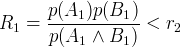 $R_{1}=\frac{p(A_{1}) p(B_{1}) }{p(A_{1}\wedge B_{1}) }< r_{2}$. Hence Proposition 3 is proved.
In fact, we have proved somewhat more than just Proposition 3, since the following statement is true:
Proposition 6
Given any probability space ( , v) and a correlation Corr(A 1, B 1) in it one can find an extension (
 ′, v′) of (
 , v) such that there is a correlation Corr(A 2, B 2) in the extension (
 ′, v′) and the two correlations Corr(A 1, B 1) and Corr(A 2, B 2) cannot have a common common-cause.
Proposition 6 follows since one can form the standard product probability space ( × [0, 1], v × p) which is an extension of both (
 , v) and ([0, 1], p), and for any correlation Corr(A 2, B 2) in (
 , v) with some r 2 we can find a correlation Corr(A 1, B 1) in ([0, 1], p) with R 1 < r 2, consequently these two correlations cannot have a common common-cause by Proposition 5.
3. Refinements
One can strengthen Proposition 3 slightly by weakening its assumptions; this can be done by weakening Reichenbach's definition of common-cause in the following way. While C and C ⊥ feature symmetrically in the equations (2)–(3) in Reichenbach's definition, this symmetry is broken by conditions (4)–(5): it is these conditions that specify C, rather than C ⊥, as the common-cause. Distinguishing C from C ⊥ may very well be justified on some intuitive grounds; however, from the perspective of explanatory power, interpreted as validity of Proposition 1, the asymmetry between C and C ⊥ is not needed: as equation (6) shows, Proposition 1 remains valid if both inequalities in (4)–(5) are reversed. Hence, one can, without losing the explanatory significance of the notion of common-cause, weaken Reichenbach's definition of common-cause of a (positive) correlation by requiring only that, in addition to the screening off conditions (2)–(3), the quantities [ p(A| C) − p(A| C ⊥)] and [ p(B| C) − p(B| C ⊥)] have the same sign. In view of equation (6), this weakened definition amounts to the demand that C is a common-cause of a positive correlation if (2) and (3) hold for C and C ⊥; in other words, if both C and C ⊥ screen off the correlation.
We claim that this weakening of Reichenbach's notion of common-cause does not change the validity of Proposition 3: it remains true that different correlations do not, in general, have a common common-cause even if the common-cause is taken in the weakened sense just described; however, in this case the necessary conditions for two correlations having a common common-cause become slightly weaker. One can follow exactly the same line of argument as in the proof of Proposition 3 with the only modification being the possible range of the common cause C i of the i − th correlation (i = 1, 2) is now represented not by the single interval I i = [ r i, R i] but by two intervals: I i and I
 $\stackrel{\prime }{i}$ = [ r
 $\stackrel{\prime }{i}$, R
 $\stackrel{\prime }{i}$] where


Consequently, the necessary condition for Corr(A 1, B 1) and Corr(A 2, B 2) to have a common common-cause in the weakened sense is that either I 1 or I
 $\stackrel{\prime }{1}$ intersect with either I 2 or I
 $\stackrel{\prime }{2}$; to put it concisely: the necessary condition is that

Elementary algebraic manipulations show that one can explicitly formulate this latter condition (30) in terms of the probabilities of the four events involved as follows


Let us summarize all this in the form of a proposition:
Proposition 7
The necessary condition for two correlations (9)–(10) to be such that there exists a C ∊  such that both C and C ⊥screen-off both correlations is that conditions (31)–(32) hold.
The above reasoning also shows that if instead of two correlations one is given a finite set Corr(A i, B i) > 0 (i = 1, 2, … N), then a necessary condition for the existence of a single C which is a common-cause, in the weak sense, of all the correlations Corr(A i, B i) > 0 is that

with I i and I
 $\stackrel{\prime }{i}$ defined by (12)–(13) and (28)–(29) by letting the index i run through 1, 2, … N. In the general case of N > 2 one can also give the explicit algebraic condition equivalent to (33) in terms of the probabilities of the events involved, this condition will be less and less transparent with the increase in N, however.
It should also be noted that condition (11) (respectively (30)) is not only a necessary but also a sufficient condition for a common common-cause of two correlations to exist in the sense of Reichenbach (respectively in the weakened sense of common cause). This can be seen from the following reasoning. Reichenbach's conditions do not completely determine the type of the common-cause of a correlation: as the proof of Proposition 2 in Hofer-Szabó et al. Reference Hofer-Szabó Gábor and Szabó1999 shows (and this can also be seen from the proof of Proposition 4) two numbers of the five in (8) (for instance r A|C= p(A| C) and r B|C = p(B| C) as in the proof of Proposition 4), are left unspecified by the Reichenbach's conditions. Therefore, if, given two correlations Corr(A 1, B 1) > 0 and Corr(A 2, B 2) > 0, one can choose C such that p(C) ∊ (I 1 ∪ I
 $\stackrel{\prime }{1}$) ∩ (I 2 ∪ I
 $\stackrel{\prime }{2}$), then one can choose freely the numbers p(A 1| C) and p(A 2| C), say, to fix two common-cause types, one for each of Corr(A 1, B 1) and Corr(A 2, B 2), and one can then apply Proposition 2 to conclude that there exists a C which is a common common-cause of the two correlations. If we have more than two correlations, then the situation changes and this argument is no longer valid because in the case of more than two correlations there may exist relations between the different correlations that entail additional constraints on the admissible types of the common-causes of the correlations, constraints that may not be satisfiable. We wish to emphasize that no conditions are known which in the case of more than two correlations are necessary and sufficient for the existence of a common common-cause of the correlations.
The definition of common-cause given in section 2 closely follows Reichenbach's, in particular, the definition specifies a common cause for a positive correlation. It is clear, however, that negative correlations might be in need of an explanation by a common-cause as could be positive ones. The only modification needed in Reichenbach's definition of common-cause to cover the case of negative correlations is reversing only one of the inequalities in (4) and (5). The resulting definition of common-cause yields a notion for which Proposition 3 remains valid because Proposition 7 remains valid with obvious modifications: If Corr(A 1, B 1) < 0, then Corr(A
 $\stackrel{\perp }{1}$, B 1) > 0 and Corr(A 1, B
 $\stackrel{\perp }{1}$) > 0, and both C and C ⊥ screen off the correlation between A 1 and B 1 if and only if they screen off the correlation between A
 $\stackrel{\perp }{1}$ and B 1, which is the case if and only if C and C ⊥ screen off the correlation between A 1 and B
 $\stackrel{\perp }{1}$; consequently, given two correlations, a negative Corr(A 1, B 1) < 0 and a positive one Corr(A 2, B 2) > 0, the necessary condition the existence of for C and C ⊥ which both screen off the correlation is that (31)–(32) hold with the substitution A 1 → A
 $\stackrel{\perp }{1}$, or equivalently, with the substitution B 1 → B
 $\stackrel{\perp }{1}$.
4. Closing Comments
Proposition 3 shows that Proposition 2 cannot be strengthened in the following sense: While it is true that, given a finite set of correlations in a common-cause incomplete probability space the probability space can always be enlarged so that the larger one contains a common-cause of each correlation in the given set, these common-causes differ from correlation to correlation, and, in general, there exists no enlargement that contains a common common-cause of even two of the correlations in the finite set. One conclusion that may be drawn from this is that the notions of common-cause and of common common-cause are radically different; that is to say, if two correlations have a common common-cause, then the random events involved stand in a probabilistic relation, the content of which is not exhausted by the individual relations of the common-causes to the correlations explained by them. Formulated differently: The assumption that two correlations have a common common-cause is much stronger than the assumption that each of the two correlations has its own common-cause, and, while Proposition 2 shows that one cannot conclude exclusively on the basis of knowing the probabilities of the events that common-causes of correlations do not exist, knowing the probabilities of the events involved one can exclude common common-causes.
We emphasize that the above conclusion is independent of whether one interprets the random events as event types or as token events; nor is it part of any of the claims spelling out the non-existence of common common-causes that common common-causes do not exist because certain possible common common-cause events should be rejected on the basis of their being too “gerrymandered” as events. One can be as permissive as one likes about what events qualify as acceptable events—as long as the events are assumed to form a Boolean algebra—common common-causes of certain correlations cannot exist because the mathematical-probabilistic relations of the correlated events prohibit the existence of such common common-cause events.
Being aware of this, one should be extremely cautious when requiring that an explanation of a set of correlations should be in terms of a common common-cause, such a requirement should always be carefully argued. It should be kept in mind in particular that Reichenbach's Common-Cause Principle, the metaphysical claim that if there is a correlation between events that cannot be due to a direct causal connection between the correlated events then there must exist a common-cause of the correlation, has nothing to do with multiple correlations and their (generally nonexistent) common common-causes. Hence from the fact that common common-causes of a given set of correlations do not exist one cannot conclude that Reichenbach's Common-Cause Principle is violated. In particular the fact that the notorious EPR correlations do not in general possess a common common-cause does not in and by itself entail that Reichenbach's Common-Cause Principle does not hold (For a discussion of the EPR correlations from the point of view of Reichenbach's Common-Cause Principle see Rédei Reference Miklós1997); Rédei Reference Miklós1998, Chapter 11; Hofer-Szabó et al. Reference Hofer-Szabó Gábor and Szabó1999, Reference Hofer-Szabó Gábor and Szabó2000a, Reference Hofer-Szabó Gábor and Szabó2000b; Szabó Reference Szabó2000; Placek Reference Placek2000a, Reference Placek2000b and Rédei Reference Miklós, Butterfield and Placekforthcoming). The spacelike correlations predicted by (relativistic) quantum field theory might also be explained by common-causes if these common-causes are not required to be common common-causes (see Rédei and Summers Reference Rédei and Summers2002 for an analysis of the status of Reichenbach's Common-Cause Principle in quantum field theory).
If one has the intuition, mentioned briefly in the introduction, that two correlations in a classical probability space should always have a common common-cause in a sufficiently rich random event structure, then another attitude one might take in view of Proposition 3 is that Reichenbach's notion of common-cause is inappropriate. The universal adequacy of Reichenbach's notion of common-cause has already been called into question, especially by Van Fraassen (Reference Van Frassen and McLaughlin1982) and by Cartwright (Reference Cartwright and Fetzer1987)—but on different grounds: their critique of Reichenbach's notion is not related to the issue of distinguishing between common-cause and common common-cause; rather, they see a problem with the applicability of Reichenbach's notion to the case of correlations that are due to a conserved quantity. This is not the place to delve into an analysis of Van Fraassen's and Cartwright's critique of Reichenbach's notion. We just wish to point out that it would be interesting to see how/whether the distinction between common-cause and common common-cause can be formulated in terms of the notion of common-cause proposed by Cartwright in (Reference Cartwright and Fetzer1987), and, if this can be done, whether results similar to the ones presented here can be established.


