1. Introduction
The concept of gene-environment interaction, or  $\mathrm{G}\,\times \mathrm{E}\,$, refers to cases in which different genetic groups phenotypically respond differently to the same array of environments. For example, Avshalom Caspi and his colleagues found a case of
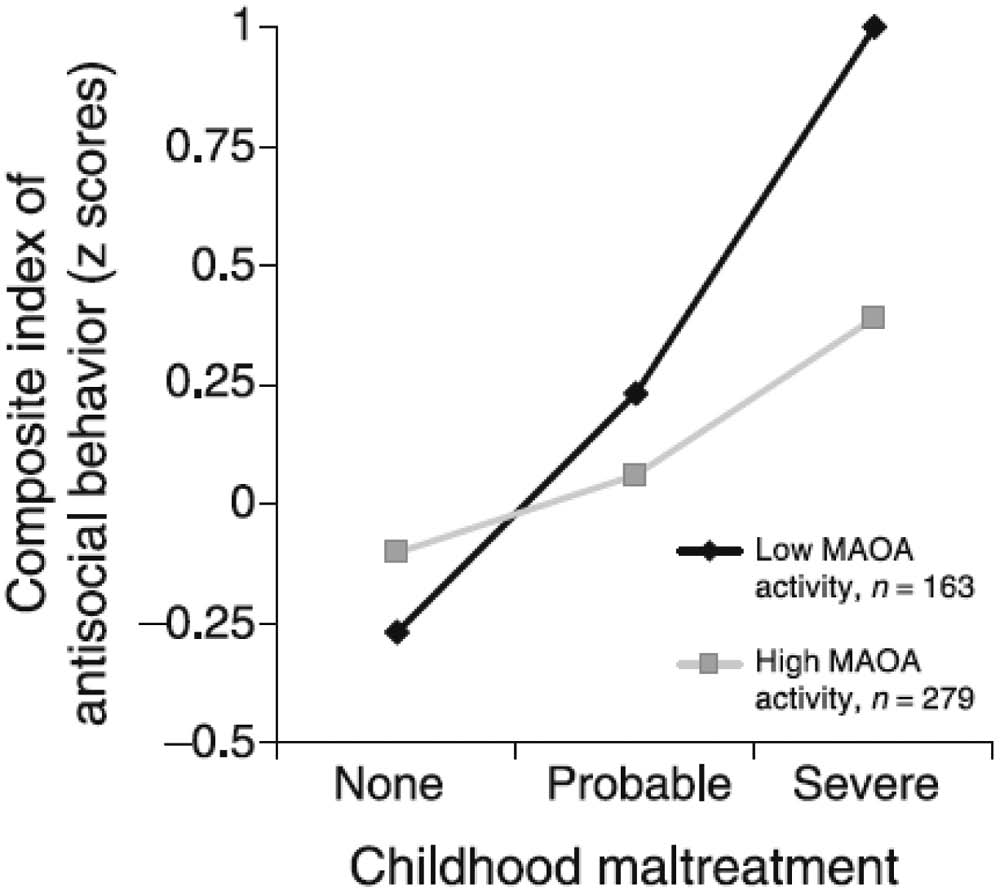
 $\mathrm{G}\,\times \mathrm{E}\,$ for a gene controlling neuroenzymatic activity (low vs. high monoamine oxidase-A [MAOA] activity), exposure to childhood maltreatment (none vs. probable vs. severe), and the development of antisocial personality disorder (ASPD; Caspi et al. Reference Caspi, McClay, Moffitt, Mill, Martin, Craig, Taylor and Poulton2002).Footnote 1 As illustrated in Figure 1, Caspi and his colleagues found that individuals with high-MAOA activity gradually increased their risk of developing ASPD as incidents of childhood maltreatment increased, whereas individuals with low-MAOA activity drastically increased their risk of developing ASPD as incidents of childhood maltreatment increased.
Reaction norm for low- versus high-MAOA (monoamine oxidase-A) activity, exposure to childhood maltreatment (x-axis), and antisocial behavior (y-axis). From Caspi et al. Reference Caspi, McClay, Moffitt, Mill, Martin, Craig, Taylor and Poulton2002, Figure 1; reproduced with the permission of the American Academy of Arts and Sciences.

The Caspi study results were instantly recognized by scientists, the popular press, and academic commentators as a landmark achievement in the history of human genetics. Behavioral geneticist Dean Hamer identified the Caspi study as paving the way for the future of behavioral genetics (Hamer Reference Hamer2002). The Economist hailed the results: “The first study has just been published showing how a particular gene and a particular environment interact to produce violent individuals” (Economist 2002, 71). And Erik Parens wrote, “It might not be an exaggeration to say that, if replicated, the Caspi-Moffitt MAOA study will turn out to have been a watershed event in the history of behavioral genetics” (Parens Reference Parens2004, S22).
It was the significance of the Caspi study's empirical results that received the wide attention. But what was just as significant, although less scrutinized, was the way in which those results were conceptualized. Individuals with low-MAOA activity were characterized as having a genetic predisposition to ASPD or, because of the correlation between ASPD and violent behavior, a genetic predisposition to violence. Robert Stone wrote, “The Caspi Study demonstrates that, in addition to free will, the difference between those who break the cycle of abuse and those who do not turns on the victim's genetic predisposition” (Stone Reference Stone2003, 1562). David Wasserman titled an article on the implications of the Caspi study “Is There Value in Identifying Individual Genetic Predispositions to Violence?” (Wasserman Reference Wasserman2004). And Paul Appelbaum, considering the possible implications of the Caspi study on the criminal justice system, asked, “Should genetic propensities mitigate punishment for criminal behavior?” (Appelbaum Reference Appelbaum2005, 26).
The thesis of this article will be that this concept of a genetic predisposition fundamentally misconstrues cases of  $\mathrm{G}\,\times \mathrm{E}\,$ such as that found in the Caspi study. I first diagnose this misconstrual in Section 2 and then, in Section 3, introduce a new concept—interactive predisposition—to appropriately capture such instances of
 $\mathrm{G}\,\times \mathrm{E}\,$. Finally, I explicate in Section 4 how recent debates over screening for individual predispositions are related to older debates about group differences between populations.
2. The Concept of a Genetic Predisposition and G × E
As described in the introduction, cases of  $\mathrm{G}\,\times \mathrm{E}\,$ are generally characterized in terms of a genetic predisposition to the trait under investigation. The goal of this section is to convey how this concept fundamentally misconstrues cases of
 $\mathrm{G}\,\times \mathrm{E}\,$. Understanding this misconstrual begins by recognizing the fact that cases of
 $\mathrm{G}\,\times \mathrm{E}\,$ come in two forms: those resulting in a change in scale and those resulting in a change in rank (Lynch and Walsh Reference Lynch and Walsh1997).
2.1. A Change in Scale
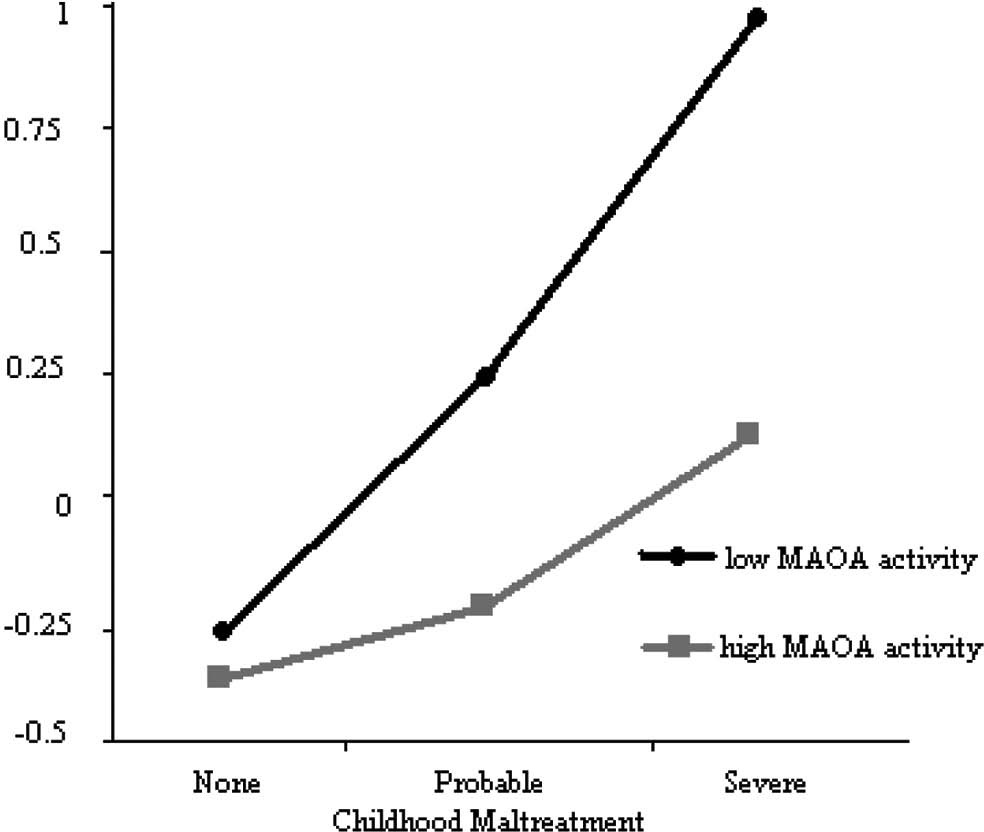
An instance of  $\mathrm{G}\,\times \mathrm{E}\,$ resulting only in a change of scale refers to cases in which different genetic groups respond differently to the same array of environments, but that difference in phenotypic response does not alter the fact that the higher-ranking group maintains that higher ranking across all tested environments (Lynch and Walsh Reference Lynch and Walsh1997). Consider Figure 2: this is a hypothetical, modified version of the original graph from the Caspi study. Everything in Figure 2 is identical to the original graph except that the high-MAOA group has been lowered by 0.25 on the antisocial behavior index for each environment. Now, the low-MAOA group maintains its higher ranking on the antisocial behavior index in each of the tested environments. This is still a case of
 $\mathrm{G}\,\times \mathrm{E}\,$ because the two groups do still respond to the array of environments differently, but all that has changed is the scale of the difference between the two groups in the different environments.
Hypothetical reaction norm for low- versus high-MAOA (monoamine oxidase-A) activity, exposure to childhood maltreatment (x-axis), and antisocial behavior (y-axis).

To begin evaluating the appropriateness of the concept of genetic predisposition as applied to cases of  $\mathrm{G}\,\times \mathrm{E}\,$, a definition of this concept must first be afforded.
Genetic Predisposition. The presence of a genetic difference between various groups consistently increases the probability of individuals from one group, in comparison to individuals from the other group(s), developing a particular phenotypic trait regardless of the tested environmental conditions.
Note the relational nature of this definition. Members of any group may be susceptible to developing the particular phenotypic trait under investigation if exposed to the environmental stressor. But attaching “genetic” to “predisposition” is only appropriate if it is a genetic difference that consistently increases the probability of individuals from one group developing the phenotypic trait relative to individuals from the other group(s). Also note the fact that the relative predisposition is only justifiably applicable within the tested environmental conditions. Under unknown or untested environmental conditions, the relationship between the groups might change quite drastically.
Cases of  $\mathrm{G}\,\times \mathrm{E}\,$ resulting in a change of scale may be appropriately characterized with the concept of a genetic predisposition as defined above. Consider the hypothetical Caspi case graphed in Figure 2: in every tested environment, individuals in the low-MAOA group maintained their relatively elevated risk for ASPD. What “genetic predisposition” implied in this case, then, was that the presence of the genetic difference between the two groups consistently put individuals from the low-MAOA group at an increased risk of developing ASPD relative to the individuals from the high-MAOA group.Footnote 2
2.2. A Change in Rank
But notice that the above account is decidedly not what occurs in the actual Caspi study. Caspi's MAOA study is instead an instance of  $\mathrm{G}\,\times \mathrm{E}\,$ resulting in a change of rank. An instance of
 $\mathrm{G}\,\times \mathrm{E}\,$ resulting in a change of rank refers to cases in which different genetic groups respond differently to the same array of environments, and that difference in phenotypic response is so extreme that the higher-ranking group in one environment becomes the lower-ranking group in a different environment (Lynch and Walsh Reference Lynch and Walsh1997). Notice that this is precisely what we find in the actual reaction norms for the Caspi study in Figure 1. In the environments with probable and severe childhood maltreatment, the low-MAOA group did in fact score higher on the antisocial behavior index than the high-MAOA group. However, in the environment with no childhood maltreatment, the low-MAOA group actually scored lower than the high-MAOA group on the index.Footnote 3
In the Caspi study the environmental conditions were crucial for assessing the relationship between the low-MAOA and the high-MAOA groups with regard to the risk of developing ASPD. Before an individual actually experiences childhood maltreatment, there is simply no way to assess whether an individual with low-MAOA activity will be more or less prone to developing ASPD than an individual with high-MAOA activity. The low-MAOA individual is less likely to develop ASPD in environments with no childhood maltreatment, while she or he is more likely to develop ASPD in environments with probable and severe childhood maltreatment. Employing the concept of a genetic predisposition to ASPD when the environmental conditions are unknown, we are forced incoherently to say that individuals in the low-MAOA group are simultaneously more prone to developing ASPD and less prone to developing ASPD. In short, the concept of a genetic predisposition fundamentally misconstrues these cases of  $\mathrm{G}\,\times \mathrm{E}\,$ resulting in a change of rank because it leads to this incoherent result.Footnote 4
3. The Concept of an Interactive Predisposition and G × E
Several philosophers have rightly stressed the need to promote conceptual clarity concerning  $\mathrm{G}\,\times \mathrm{E}\,$ research and behavioral genetic research more generally (Sharp Reference Sharp2001; Parens Reference Parens2004). Suggestions such as these should be heeded, for there is already an indication that
 $\mathrm{G}\,\times \mathrm{E}\,$ results can be quickly morphed into interpretations of ‘genes for’ complex behavioral traits, reverting to a naive genetic determinism. Parens has pointed to alarming distillations of the Caspi study in the popular press, writing, “the MAOA study was the subject of a piece in Popular Mechanics titled ‘Criminal Genes.’ The piece in Time about the MAOA study was entitled, ‘The Search for the Murder Gene’” (Parens Reference Parens2004, S8).
Should we really be surprised that the Caspi study has been morphed into a story about “criminal genes” when the concept of a genetic predisposition to violence has been used to characterize the results? With the concept of a genetic predisposition to violence, it is still the genetic difference that is associated with the difference in relative predisposition. It may be inappropriate to title articles in the popular press about the Caspi study “Criminal Genes” or “The Search for the Murder Gene,” but what about the more probabilistic “Criminal Susceptibility Genes” or “The Search for the Murder-Propensity Gene”? When, however, we realize that the Caspi study was a case of  $\mathrm{G}\,\times \mathrm{E}\,$ resulting in a change of rank, then we clearly see that even the nondeterministic alternative titles are misleading. Which variant of the gene associated with MAOA activity is the criminal susceptibility gene—low or high? Which variant of the gene associated with MAOA activity is the murder-propensity gene—low or high?
Conceptual clarity, as Parens and Sharp warn, is exactly what is needed to properly discuss instances of  $\mathrm{G}\,\times \mathrm{E}\,$. In this spirit, I suggest jettisoning the concept of a genetic predisposition from the discussions of
 $\mathrm{G}\,\times \mathrm{E}\,$ that result in a change of rank. A new concept is needed to capture the different, unique relationship among gene, environment, and phenotype found in these cases and to set this relationship apart from cases of genetic predisposition. I propose employing the concept of an interactive predisposition for such cases.
Interactive Predisposition. The presence of a genetic difference between various groups both increases and decreases the probability of individuals from one group, in comparison to individuals from the other group(s), developing a particular phenotypic trait depending on the tested environmental conditions.
A genetic predisposition is relational in one sense, whereas an interactive predisposition is relational in two senses. Like the concept of a genetic predisposition, the concept of an interactive predisposition is relational in the sense that the probability of individuals from one group developing the phenotypic trait under investigation is always considered in comparison to individuals from the other group(s). For a genetic predisposition, however, that relation between the groups maintains a consistency (between which is higher and which is lower ranking) across all tested environments. For an interactive predisposition, the relation between the groups is itself relative to the environmental conditions experienced during development. Importantly, interactive predispositions have now been discovered for a variety of complex human traits in addition to ASPD, such as asthma (Hoffjan et al. Reference Hoffjan, Nicolae, Ostrovnaya, Roberg, Evans, Mirel, Steiner, Walker, Shult, Gangnon, Gern, Martinez, Lemanske and Ober2005) and depression (Eley et al. Reference Eley, Sugden, Corsico, Gregory, Sham, McGuffin, Plomin and Craig2004).
4. Debating G × E: Past and Present
Many philosophers of science will be familiar with research on  $\mathrm{G}\,\times \mathrm{E}\,$, as well as with debates over that research. Cases of
 $\mathrm{G}\,\times \mathrm{E}\,$ have figured prominently in the history of the nature-nurture debate (Tabery Reference Tabery2007, Reference Tabery2008; Tabery and Griffiths, Reference Tabery, Griffiths, Hood, Halpern, Greenberg and Lernerforthcoming). For most of this history, cases of
 $\mathrm{G}\,\times \mathrm{E}\,$ figured into debates about the group differences between populations. With the onset of molecular genetics, however, cases of
 $\mathrm{G}\,\times \mathrm{E}\,$ are now figuring into debates about the predispositions of individuals. The purpose of this section is to examine the relationship between these two domains, drawing on the lessons of the former to shed light on the latter.
4.1. Group Differences and G × E
Quantitative behavioral geneticists traditionally investigate the causes of variation responsible for individual differences in a population; they are interested in the relative contributions of genetic differences and environmental differences to total phenotypic variation in a population. Statistical methodologies, such as ANOVA, are then employed in an attempt to partition the relative contributions of these factors. These quantitative studies have been undertaken for nearly a century now. For example, population geneticist R. A. Fisher (Reference Fisher1924), the creator of ANOVA, undertook these statistical studies in the early twentieth century in order to investigate the relative contributions of nature and nurture to physical traits such as stature as well as personality traits such as conscientiousness (Tabery Reference Tabery2008). And educational psychologist Arthur Jensen (Reference Jensen1969) undertook these statistical studies in the late twentieth century in order to investigate the relative contributions of nature and nurture to general intelligence (Tabery Reference Tabery2007). These studies were undertaken as a means to answer questions about the causes of group differences between populations. Fisher, a eugenicist, was interested in different social classes in the United Kingdom; Jensen was interested in different races in the United States (Kevles Reference Kevles1995). If phenotypic variation for a trait was largely the result of genetic differences, the inference went, then the differences in the trait between classes or races could largely be attributed to genetic differences rather than environmental differences.
This inference only held up, however, if genetic differences and environmental differences fully accounted for the total phenotypic variation in the trait under investigation. In statistical terms, the “main effects” of genotype and environment must be “additive.” If the genetic variation and the environmental variation were interdependent, then this additivity would break down;  $\mathrm{G}\,\times \mathrm{E}\,$ is precisely this interdependence in genetic variation and environmental variation. If the total phenotypic variation in a trait under investigation results, in part or in whole, from the interdependence of genetic variation and environmental variation—that is, from
 $\mathrm{G}\,\times \mathrm{E}\,$—then inferences made about group differences become suspect because total phenotypic variation can no longer be attributed to the separate actions of the main effects (Lynch and Walsh Reference Lynch and Walsh1997).
Not surprisingly, then, critics of quantitative behavioral genetics have often pointed to  $\mathrm{G}\,\times \mathrm{E}\,$ as a fundamental problem for those statistical methodologies. British statistician and experimental physiologist Lancelot Hogben (Reference Hogben1933) identified cases of
 $\mathrm{G}\,\times \mathrm{E}\,$ in order to attack Fisher's statistical techniques for partitioning variation and to undermine the eugenic conclusions about class differences (Tabery Reference Tabery2008). Forty years later, evolutionary geneticist Richard Lewontin (Reference Lewontin1974) emphasized the importance of
 $\mathrm{G}\,\times \mathrm{E}\,$ in order to attack Jensen's statistical techniques for partitioning variation and to undermine educational policy conclusions about race differences (Tabery Reference Tabery2007).
Hogben's and Lewontin's arguments were remarkably similar; they both pointed out that complex behavioral traits (such as conscientiousness or general intelligence) resulted from complicated developmental interactions between genes and the environment, and so variation due to  $\mathrm{G}\,\times \mathrm{E}\,$ should be expected. If variation in a complex behavioral trait was the result of
 $\mathrm{G}\,\times \mathrm{E}\,$, they argued, then inferences made about the causes of group differences between populations as being either genetic or environmental in origin were unfounded. They both were particularly interested in cases of
 $\mathrm{G}\,\times \mathrm{E}\,$ in which the reaction norms of different genotypic groups crossed each other, signifying the fact that the higher-ranking genotype in one environment could actually be the lower-ranking genotype in another environment. Inferences about group differences between populations in unknown or untested environments were extremely dangerous, for a higher-ranking genotype in current environments might actually become a lower-ranking genotype in other environments. This argument, especially as formulated and popularized by Lewontin in the confines of the IQ Controversy of the 1970s, left a lasting impression on philosophers of science (see, e.g., Block and Dworkin Reference Block, Dworkin, Block and Dworkin1976; Sarkar Reference Sarkar1998; Kaplan Reference Kaplan2000).
4.2. Individual Predispositions and G × E
With the advent of molecular genetics, debates about  $\mathrm{G}\,\times \mathrm{E}\,$ are no longer simply about group differences between populations; genetic screening technologies now lend themselves to debates about the predispositions of individuals (Tabery Reference Tabery2009). It turns out that Hogben's and Lewontin's critical discussions of group differences between populations are also applicable to the current debates over individual predispositions. The concept of an interactive predisposition introduced in the last section is meant to bring their points to bear on this new domain.
ASPD takes a significant toll on those who suffer from the disorder and on those who interact with those who suffer from the disorder. So it is not surprising that efforts are made to prevent the development of ASPD (McCord and Tremblay Reference McCord and Tremblay1992). These preventative strategies generally consist in the prediction of those individuals deemed at risk of developing ASPD and the intervention on those factors deemed pertinent to this development. For better or worse, the prediction of those who are at risk of developing ASPD is thoroughly probabilistic. There are no single genes that deterministically ensure the development of ASPD (Ridenour Reference Ridenour and Fishbein2000). Likewise, there are also no natural environments that deterministically ensure the development of ASPD (Reid, Patterson, and Snyder Reference Reid, Patterson and Snyder2002).
What made the study by Caspi and his colleagues so exciting, then, was the fact that they found a particular genetic variable and a particular environmental variable that, when joined, led to almost all individuals developing antisocial behavior. More specifically, Caspi and his colleagues found that 85% of the individuals in their sample who both had low-MAOA activity and experienced severe childhood maltreatment subsequently engaged in antisocial behavior. Moreover, while only 12% of the sample fell into this low/severe subgroup, they accounted for a full 44% of the violent convictions of the entire study population.
How might the findings of the Caspi study be incorporated into discussions of genetic screening for a complex behavioral trait? Commentators on the Caspi study have pointed to two potential venues for such a genetic test: (a) parents interested in screening either embryos or fetuses with an eye toward implantation or termination and (b) states interested in a policy of mandatory newborn screening with an eye toward prediction and early intervention.
Consider the first venue: Jonathan Moreno, in his discussion of the Caspi study, warns, “Prospective parents might therefore test embryos for the MAOA marker before implantation to avoid giving birth to a child with this particular potential for criminality” (Moreno Reference Moreno2003, 151). And David Wasserman introduces his article with a similar question. Since Caspi and his colleagues found that the 12% of their research participants who were both maltreated and carrying the gene for low-MAOA activity accounted for 44% of all convictions for violent crimes, Wasserman wonders, “What if we could identify some individuals in that 12% not only at birth, but in utero, or before implantation?” (Wasserman Reference Wasserman2004, 24).
The concerns raised by Moreno and Wasserman both assume that Caspi identified a genetic predisposition, wherein the low-MAOA genotype consistently raised the risk of developing ASPD.Footnote 5 But that was not at all what Caspi discovered. Instead, Caspi identified a case of an interactive predisposition. Thus, should parents want to screen their embryos or their fetuses for the gene controlling MAOA activity in order to identify and select against those embryos or fetuses with low-MAOA activity? Only if the parents are already intending to maltreat their children! That is, if the children are not likely to experience childhood maltreatment, then it is in fact the low-MAOA embryos or fetuses that are less likely than the high-MAOA embryos or fetuses to develop into adults with ASPD (Tabery Reference Tabery2009). This is the unique situation posed by cases of interactive predispositions, as a result of the change in rank highlighted long ago by Hogben and Lewontin.
Turning to the second proposed venue, the possibility of a mandatory screening program based on the results of the Caspi study has not escaped the notice of commentators. Ravenish Kumar, for instance, suggests that “although likely to be highly controversial, we may decide to identify ‘at-risk’ individuals prone to developing antisocial tendencies by screening for the MAOA functional polymorphism and recognizing those who harbour the ‘low-activity’ variant” (Kumar Reference Kumar2003, 183). Paul Appelbaum, discussing the Caspi study, warns that “the pressure to screen is likely to increase if intervention can be shown to actually reduce crime. If effective treatment becomes available, the pressure to identify [at-risk] individuals through screening at birth may be irresistible” (quoted in Moran Reference Moran2006).
Again, Hogben's and Lewontin's point about the importance of recognizing cases of  $\mathrm{G}\,\times \mathrm{E}\,$ that result in a change in rank is also relevant here. Cases of
 $\mathrm{G}\,\times \mathrm{E}\,$ reveal an interdependent causal relationship between the genetic variable and the environmental variable during the process of individual development. For ASPD, this developmental story starts early, manifesting itself first as childhood conduct disorder and transitioning later to ASPD. Not surprisingly then, a premium is placed on early intervention in discussions of ASPD treatment (McCord and Tremblay Reference McCord and Tremblay1992). The rationale is that, once the environmental stressors are experienced and the disorder has developed, there is little hope of effective treatment in adults, who generally do not respond well to standard psychotherapy and suffer a high rate of recidivism for crime (Hemphill et al. Reference Hemphill, Templeman, Wong, Hare, Cooke, Forth and Hare1998). So the promise of a pharmacological intervention that could be implemented early in this developmental process is naturally appealing. The thought is that increasing MAOA activity for the low-MAOA individuals (call it an “MAOA boost”), thereby making them high-MAOA individuals, could act to buffer them against the environmental stressors that cause ASPD. After the environmental stressors have already been experienced, then the damage may be irrevocably done, thereby rendering the MAOA boost ineffective. If, however, the MAOA boost comes early—say, starting at birth—then the individuals may have the neurochemical resources to withstand the stress, even at its earliest onset.
But notice that the warrant for this early intervention program requires ignoring the presence or absence of childhood maltreatment and treating all low-MAOA individuals at birth as if they are the at-risk population. For those low-MAOA individuals who experience childhood maltreatment, the potential advantage of early intervention is clear. An early intervention program that provided a pharmacological MAOA boost to the low-MAOA individuals from the Caspi study who experienced maltreatment might have prevented many of them from going on to engage in antisocial behavior. But if the early intervention program starts at birth and ignores the presence or absence of childhood maltreatment, then this means that the individuals in the environment without childhood maltreatment will also receive the pharmacological MAOA boost. Recalling Figure 1, note what will happen to the rate of ASPD for that population: it will increase. That is, the pharmacological intervention boosting all low-MAOA individuals to high-MAOA individuals will decrease the risk of developing ASPD for those individuals who experienced maltreatment, while simultaneously increasing the risk of developing ASPD for those individuals who do not experience maltreatment (Tabery Reference Tabery2009).
The two horns between which the advocate for the MAOA boost is caught should now be clear. On the one hand, the fact that ASPD is a developmental disorder with early onset militates for an early intervention program in order to provide a treatment before the environmental stressors take their toll. On the other hand, embracing this early intervention strategy necessitates treating all low-MAOA individuals from birth before knowledge of childhood maltreatment is known, thereby decreasing the risk of some while increasing the risk of others. The way past the second horn is to wait and see who does and does not experience childhood maltreatment and to intervene pharmacologically only once the presence of the environmental stressor can be confirmed. However, waiting pushes the advocate for intervention back on the first horn of the dilemma: wait until childhood maltreatment can be confirmed, and the damage may already be done.Footnote 6 Again, this is the unique situation posed by interactive predispositions due to their characteristic change in rank.