


1. Introduction.
Q. How do the natural numbers latch onto the world?
A. They don't—e.g., when we explicate ‘There are exactly 2 peas’ we mention peas but not numbers: that sentence, parsed as ‘
 $\exists _{2}xPx$’ with a numerically definite quantifier, is short for this, in normal logical notation:

Aside from the biological term, ‘P’, only logical terms appear here.
Carnap's full-blown (1931) logicist thesis about number theory (and the rest of mathematics) was a double-barrelled heavy logicism:
• Mathematical concepts are explicitly definable in logical terms.
• Mathematical theorems are then seen to be logical truths.
But Logicism Lite counts number-theoretical laws as logical for the same reason that physical laws are counted as empirical: because of the character of the data they are responsible to. A famous example is
Fermat's Last Theorem:
 $k^{n}+l^{n}\neq m^{n}$
for all
 $n=3,4,\,\ldots $ and
 $k,l,m=1,2,\,\ldots $.
Logicism Lite does not count this as shorthand for a logically valid formula, but as a statement deriving its status as logical from data like the invalidity of the following deduction schema, which establishes the falsity of the equation ‘
 $3^{3}+4^{3}=5^{3}$’:
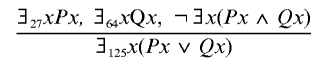
—together with the validity of deduction schemas establishing the truth of the basic equations ‘
 $3^{3}=27$’, ‘
 $4^{3}=64$’ and ‘
 $5^{3}=125$’. Here, for example, is a deduction schema (Maddy's) for the last of these:

In this schema, where the exponent 3 shows up as the number of arguments of the function f, the second premise says that
 $fxyz=fuvw$ only if
 $x=u$ and
 $y=v$ and
 $z=w$. The schema can be thought of as showing that 53 = the number of different 3-letter words you can form using a 5-letter alphabet.
2. How It Works.
First-order number theory is an interpreted language,  1, with identity, with function symbols ‘′’ ‘+’, ‘×’ and ‘⁁’ for successor, plus, times and exponentiation, and with a primitive name for zero. The numerals are ‘0’, ‘0′, ‘0″’, … (which we may also write as ‘0’, ‘1’, ‘2’, …). The basic equations are the results of substituting numerals for all variables in ‘
 $i=j$’, ‘
 $i+j=k$’, ‘
 $i\times j=k$’ and ‘
 $i\wedge j=k$’. (So the equation ‘
 $3^{3}+4^{3}=5^{3}$’ is not basic.)
Axiomatically, the truths of
 $\mathstrut{\cal N} _{1}$ can be characterized as the (not completely formalizable) set of first-order sentences in second-order number theory (“
 $\mathstrut{\cal N} _{2}$”) which are (first- or second-order) logical consequences of axioms (1)–(5) below, where the induction axiom, (1), is of second order.
(1)
 $\forall P\{ [ P0\wedge \forall n(Pn\rightarrow Pn\prime) ] \rightarrow \forall nPn\} $ (“Mathematical Induction”)
(2) (a)
$\forall nn\prime \neq 0$ (b)
$\forall m\forall n(m\neq n\rightarrow m\prime \neq n\prime) $(3) (a)
$\forall nn+0=n$ (b)
$\forall m\forall n[ m+n\prime =(m+n) \prime ] $(4) (a)
$\forall nn\times 0=0$ (b)
$\forall m\forall n[ m\times n\prime =(m\times n) +m] $(5) (a)
$\forall nn\wedge 0=1$ (b)
$\forall m\forall n[ m\wedge 0n\prime =(m\wedge n) \times m] $









As to the domain 0, 1, 2, … of  1, any ω-sequence will do, i.e., any model of axioms (1) and (2); all are isomorphic (see Bell, DiVidi and Solomon, Reference Bell John and Solomon2001 3.3). One that lies close to hand in the very syntax of
 1 is the sequence of numerals, in order of length. There is no harm in this conflation of use and mention, and no point in settling on this or any other ω-sequence as comprising the natural numbers.
Note that the premises and conclusions of deduction schemas for basic equations of  1 are not sentences of
 1 but of a schematic first-order language (“ℒ”) with identity, 1-place predicates ‘P’, ‘Q’, … , and function symbols ‘f’, … of various numbers of places. It is to the predicates of some such languages that natural numbers are to be attributed via numerically definite quantification (as in the initial, inane example of the two peas).
We have seen schematic deductions for certain basic equations of forms
 $i+j=k$ and
 $i\wedge j=k$. Here is the format (essentially, Ferreira's) for i × j = k, where ‘i’, ‘j’ and ‘k’ are not variables but place-holders for numerals:
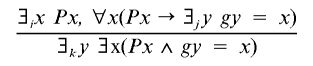
—where ‘g’ is a 1-place function symbol. (Think: k = the number of arrows in the graph of g that end in the i P's.) And for
 $i=j\thinspace{:}\thinspace $
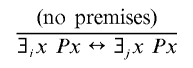
With numerals for ‘i’ and ‘j’, this means that i = j will be counted true or false depending on whether or not the numerals are identical, so that the two sides of the biconditional are expanded into identical sentences.
The truths of  1 can be characterized as the first-order sentences of
 2 that are logical consequences of axioms (1)–(5). But the same set can be characterized in terms of the set T (for “tribunal”) consisting of the basic equations with valid deduction schemas together with the denials of those with invalid ones. For since the numerals name all elements of the domain of
 1, universal and existential quantifiers can be treated as signs for denumerable conjunction and disjunction, so that all sentences of
 1 can be treated as (possibly messy, infinitary) truth-functional compounds of members of T.
How does Logicism Lite work? It quietly borrows some second-order power from the definition of logical validity as truth of the conclusion in all interpretations with non-empty domains in which all premises are true—in particular, then, with infinite domains in which all premises are true. Therefore there is no danger of having too few distinct P's in the domain to do the job of eliminating the numerically definite quantifier in ‘∃ixPx’ for large i's. That's the point of schematization: Logicism Lite is not bound to any particular objective language of form ℒ.
Declining this resort to theft over honest toil, Ferreira (1998–Reference Ferreira1999) follows a different, more demanding course.
For the record, here is an older, bolder venture into theft, from Jeffrey (Reference Jeffrey, Morton and Stich1996) and (Reference Jeffrey and Zilhão2002). The idea is to extend numerically definite quantifiers by allowing any variable-free number designator to be substituted for the blank in ‘∃_xPx’, so that falsity of equations like ‘33 + 43 = 53’ is established by invalidity of schemas like ‘
 $\exists _{3^{3}+4^{3}}$
Px ↔
 $\exists _{5^{3}}$
xPx’ via primitive recursive contextual definitions in the subscripts of numerically definite quantifiers, e.g., ‘
 $\exists _{i^{j^{\prime }}}$
xPx ↔
 $\exists _{i^{j}}$
×ixPx’ as in axiom (5b) above. Now any decision procedure for monadic first-order logic with identity delivers the data about particular sums, products and exponentiations to which Fermat's last theorem is answerable. In particular, the primitive recursive definitions reduce ‘
 $\exists _{3^{3}+4^{3}}$
Px ↔
 $\exists _{5^{3}}$xPx’ step by step to ‘∃91xPx ↔ ∃125xPx’, which is seen to be false since the expansions of the two sides of the biconditional into normal logical notation are not identical.
3. Conclusion.
Fermat's theorem is no logical truth: it is not true in every interpretation with non-empty domain. Nor are its instances, ‘33 + 43 ≠ 53’ and the rest, logical truths. But the data for the theorem, which are the deductions corresponding to all the basic equations of  1, are logically valid or invalid inferences. Logicism Lite counts the truth of the theorem as a logical matter in a sense like that in which the truth of a law of natural science would be counted as an empirical matter: because the data are testable logically, much as the data for physical laws are testable empirically. Indeed, in the case of number theory the data are clearly definable in a way in which the data for physics are not. Logicism Lite sees the logical data as forming a single, infinite tribunal which Fermat's theorem and all other candidates must face. But except in very special cases, we lack the power to convene either tribunal, logical or empirical, and hear its judgment.
Of course the eventual acceptance of Fermat's theorem stemmed neither from knowledge of all the data nor of all the data we now know, but from a long, complex, roundabout deductive proof, with  2 practically out of view, completed not long ago by Andrew Wiles (Reference Wiles1995).


