There is something fascinating about science. One gets such wholesale returns of conjecture out of such a trifling investment of fact.
(Mark Twain, Life on the Mississippi)The extensive philosophical literature devoted to “reduction to basic quantities” and “supervenience” generally trades on a tacit looseness with respect to basic logical issues. Specifically, working physics commonly traffics in quantities pegged to different length scales, whose interrelationships conceal a good deal of logical and structural complexity. So let us begin with a somewhat pedantic warning about the subtleties of scale-dependent location attributions. Let us presume—and this is an assumption we shall want to revisit later—that we are operating within a standard form of classical physics whose “basic entities” are point masses that act on one another through action-at-a-distance central forces. Such masses possess no lateral dimensions, and nearest neighbors will generally lie within an angstrom or so of each other. At each moment, we can unambiguously assign each point mass a definite coordinate locationmicro < x, y, z >. So far so good, but now let us now shift our tacit scale size up to everyday dimensions and consider the claim

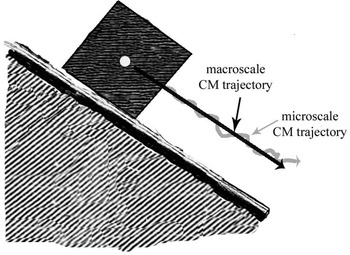
where α, β, γ capture B's Euler angle orientation with respect to S. What relationship does this locationmacro claim bear to the multitudinous locationmicro properties of the individual point masses that comprise our block B? The naive responses that immediately suggest themselves will not work. For example, the claim that “< a, b, c > captures the locationmicro of the center of mass (CM) of the point masses comprising B” will not suffice, for the true CM path will prove quite complicated because the masses within B jiggle back and forth as they bump along the rough molecular “surface” of S. At an everyday scale level, we generally presume that B's trajectorymacro can be adequately described as a fairly smooth curve, indeed, even as a straight line parallel to the allegedly flat “surfacemacro” we associate with the “plane” S. But there is no plausible arrangement within the true world of mass point physics that will allow the CM of any composite to genuinely follow such a nonjiggily curve. Plainly, we need to suppress a fair amount of microlevel detail as we replace B's true CM trajectorymicro with the smoother trajectorymacro attributed to the block at our scale length. At a minimum, this “smoothing” requires that we approach B's trajectorymacro in a standard approximation space manner as “the curve  belonging to some set of simple curves C that lies nearest to B's true CM trajectorymicro according to some evaluative norm such as least square deviation.”Footnote 1 A little thinking shows that selecting a viable class
 for this chore will not prove entirely trivial (especially if one wants the trajectorymacro to be unique), and our selection procedure must probably reflect the complexity of other macrocurves expected within the vicinitymacro of B (i.e., the smoothed “surfaces” with which B might come in “contact”; see fig. 1).
Figure 1.

I am certain that such fussing over precise definitional relationships strikes the reader as logical pettifoggery of a tediously contemptible sort. However, important structural shifts in explanatory structure can readily hide within scale shifts as innocuous as these. Specifically, explanatory prowess in science often demands that practitioners deftly sidestep huge amounts of otherwise problematic physical modeling. The skillful exploitation of data drawn from different scale lengths represents one of the most common recipes for executing such physics avoidance. The offhanded invocation of a macrolevel constraint such as “block B follows curve C on the surface S” can secretly serve as a means of evading microscopic considerations of a truly daunting complexity. As philosophers of science, we must learn to recognize the rather dramatic shifts in explanatory strategy that commonly accompany these everyday exercises in physics suppression. The usual literature on “reduction” and “supervenience” strikes me as oblivious to the fact that most explanation in physics operates from the beginning with quantities extracted from a variety of scale levels whose logical interrelationships can prove quite distantly drawn.
So much does “mixing scales” prove the working norm in physics that, in many cases (including “classical mechanics” properly understood), philosophical talk of “the basic quantities within the theory” often loses all operational significance whatsoever. And a variety of other salient consequences for debate within philosophy of science and metaphysics pile on top of that basic warning. However, it will require a closer examination of the typical physics suppression at issue to see why this is so.
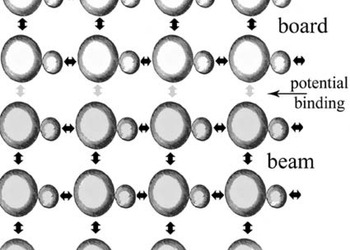
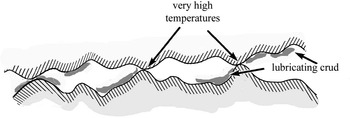
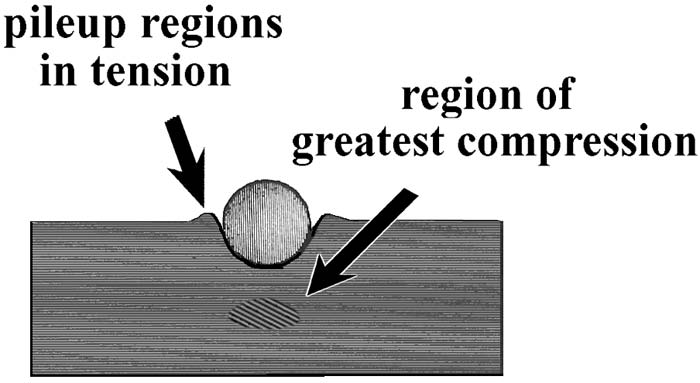
It is observed that the “simplest systems” discussed in a freshman physics text are rarely “simple systems,” when considered from the point of view of the book's putative foundations.Footnote 2 Thus, our primer may articulate Newton's laws in a manner appropriate to a point mass reading but almost immediately turn to blocks sliding down frictionless planes. It is easy to set up a differential equation for the latter situation, but what do “blocks” and “planes” represent from a point mass perspective? Clearly, they must both represent lattices of sites somehow bound together by unspecified central forces (see fig. 2). But—and this was a question that troubled me in high school physics—what if the block and plane are made of the same material (wood or steel, say)? Should the two materials not bind together as tightly across their interface as they do internally? How do we get them to slide across one another without palpable friction? In point of fact, real life blocks and planes will bind very tightly together if their surfaces are appropriately cleansed and polished; the only reason we normally see behaviors that approximate more closely to frictionless sliding is because very complicated physical processes are active within the region of interfacial contact. For example, normal surfaces are quite rough on a microscopic scale and contact each other only at widely separated asperities. These contact points interact with one another through softening at quite elevated local temperatures and through other chemical alterations that remain completely invisible on a macroscopic scale (see fig. 3).Footnote 3 Furthermore, the strengths of the bonding at the asperities are usually greatly diminished through atmospheric contaminants serving as a thin interfacial lubricant, and so on, through many unexpected complications. Accordingly, a very elaborate form of interfacial modeling is needed before one can realistically expect that blocks and planes assembled from mass point conglomerates will interact with one another in a manner that remotely resembles the block-and-plane behaviors invoked in our textbook exercises.
Figure 2.

Figure 3.

In fact, matters are worse than this because, insofar as we understand the mechanisms responsible for the fairly close to frictionless contacts witnessed in everyday experience, these accounts trade significantly on intrinsically quantum mechanical behaviors that are not readily imitated by any known classical arrangements (if such exist, they will surely require vastly more “particles” than the comparable quantum story demands). In short, the “simplest systems” we initially encounter within freshman physics texts cannot remotely qualify as “simple” according to the book's own foundational assumptions and may not prove even approximately realizable by those lights.
There are a wide variety of formalisms in physics that are inherently designed to operate from the beginning with so-called constraints and other mixed-level data of the general sort at play in our block-and-plane class.Footnote 4 The familiar Lagrangian and Hamiltonian formulations function in this manner, as well as the somewhat more general “virtual work” principles that engineers usually employ to set up the beam equation surveyed in the next section. It is common textbook practice to establish that such principles hold true for various point mass arrangements and then unblushingly presume that these same tenets will hold in circumstances that—if they prove amendable to point mass modeling at all—will almost certainly outstrip the range of models for which their validity has been “proved.” For example, considerations similar to the above indicate that the “effective forces” that hold our block on its plane must, at best, represent rather complicated stochastic averages as well. More sophisticated textbooks recognize that, properly speaking, new “force laws” should be established for constructions of this averaged ilk, although the usual results offered almost certainly fall short of rigorously justifying applications, even within situations as “basic” as our block-and-plane arrangements.
However, after a point, does this lack of strict foundations for practical classical mechanics really matter? As we will soon see, engineers generally shun the bottom-up modeling of everyday materials from molecular level structures if they possibly can, simply because the predictions supplied by such accounts are generally far riskier than those that can be obtained from techniques of an explicit mixed-level character. Practitioners would continue to firmly trust their well-tried mixed-level methods, even if it turns out that relatively few of those applications techniques admit of any supportive point mass modeling. This is because their faith in those methods stems strongly from downwardly projected inductions, not from the direct verification of accurate behaviors at the point mass level.Footnote 5
To illustrate what I have in mind, let us look at a popular approach to the modeling of construction beams—the so-called Bernoulli-Euler beam element. Although there is an old adage that “physics is simpler in the small,” this is not entirely true, for well-manufactured macroscopic materials often perform better in these respects than their smaller-scale components. For example, well-wrought steel is remarkably isotropic in its responses—if you push or pull on it in any direction, it will compress or stretch in the same manner (whereas wood is considerably easier to elongate along its grain than across it). And this nice behavior persists down to a fairly small scale, at which point the complex microscopic grain within the material manifests itself in the markedly anisotropic behavior typical of crystals (see fig. 4). Indeed, the manufacture of a fine steel requires very complex processes to instill an identically balanced distribution of randomly oriented and comparably sized grain throughout the material, whose nontrivial outcome is the “simple” behavior we witness on a visible length scale. We desire a modeling approach to our beam that can exploit this higher-level simplicity without needing to take account of the lower-scale structural complexity that produces it.
Figure 4.

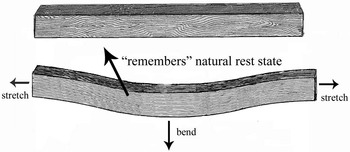
The trick is to exploit a remarkable “teleology” belonging to solid materials like steel: they possess equilibrium rest states to which they normally strive to return (unless they have been stretched past their “elastic limits”). We exploit this desire to return to a rest configuration quite freely in physics, without reflecting that fairly complicated molecular mechanisms are required to make it happen (see fig. 5). For example, the standard treatment of a vibrating string presumes that a stretched segment of string will be “smart enough” to remember where it came from on the X-axis (indeed, that it will always stay directly above that X-axis location no matter how it is stretched). But installing mechanisms on a molecular level capable of ensuring even a rough approximation of this behavior is not entirely easy: sometimes the molecules found at the home site after a stretching cannot be the same as were present before the distortion.
Figure 5.

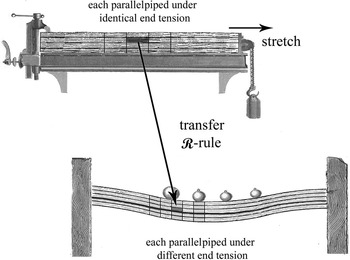
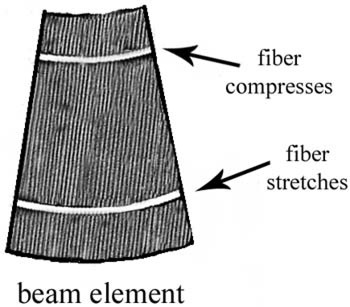
Despite the greater simplicity gained at longer scale lengths, the overall condition of a loaded steel beam will prove fairly complex because its sundry parts will be generally pushed and pulled by different local amounts under the loading. There are certain special conditions, however, in which all such parts will behave similarly, that is, when we stretch or compress an unloaded beam evenly across its end points on a testing table as shown (see fig. 6). In these particular circumstances, the beam's smallish parts must replicate the full beam's behavior within their local responses. We accordingly conclude that the force-to-stretching rule  we can measure in the laboratory must also apply to these minute parts, as long as they remain locally stretched or compressed in a fashion geometrically similar to the complete span's workbench testing. Accordingly, let us now decompose a beam in an arbitrary state of loading into elements and fibers as indicated, where an “element” consists in a short transverse section of beam, whereas a “fiber” slices the beam longitudinally. We can plausibly assume that, when loaded, each element will fan out in the manner indicated, in which the segments of fiber in the upper portion of the beam will contract under their endpoint pressures, while the lower fiber segments elongate. The Bernoulli-Euler modeling further presumes that these fiber endpoints will stay aligned as the element fans outward. Under these assumptions, each fiber-element segment, if viewed at a sufficiently small scale, must closely approximate the special conditions to which the full beam was subjected on the workbench (i.e., being stretched or compressed by its neighbors at its endpoints; see fig. 7). Hence, we safely shift our workbench rule
 down to the lowly fiber-element level. If
 supplies a simple Hookean relationship, we will have assembled all of the ingredients needed to set up a standard Bernoulli-Euler beam equation. In doing so, we first employ our downwardly transferred
 rule to compute the amount of resistive force that each little element fiber supplies in accordance with its displacement from its desired rest state. Standard least work balance principles will then fix the equational requirements needed to hold such an ensemble in a stable condition. Since each element's position is constrained by its neighbors, finding this optimally relaxed configuration represents a global minimization problem.
Figure 6.

Figure 7.

As we observed, at truly microscopic size scales, steel stops obeying the simple stretching rule  displayed at longer lengths. Nonetheless, we should still push our scale length Δx artificially to zero, in order to obtain a tractable differential equation (the beam's actual physics may not prove “simpler in the small,” but its downwardly induced mathematical representation very well might). But we should regard the resulting equation as nothing more than an infinitesimal generator for behaviors that manifest themselves only at longer scale lengths. In establishing such attractive results in our mixed-level manner, we have exploited the invariance across larger scale sizes captured in our
 rule as well as our macroscopic knowledge of the smoothed pathways that smallish units of steel follow in returning to their unloaded rest states.Footnote 6 So the equation's validity has been justified largely through downward-going inductive considerations and is not dependent on any sort of bottom-up modeling, properly speaking. By exploiting mixed-scale considerations in this clever manner, we evade the quite fearsome bogs of complex and unreliable modeling that we would otherwise confront if we foolishly attempted to approach our beam as a swarm of pointlike molecules (where no classical story of that ilk may prove viable at all).
Often this mixing of scales occurs in rather surprising patterns. For example, I recently examined a semiclassical modeling of frictional contact in which so-called Brinell hardness enters as a central parameter within a formula for the softening of asperity contacts under sliding (Stolarski Reference Belot1990, 25–26).Footnote 7 This appropriation of a Brinell parameter is rather startling from a logical point of view because such “hardness” has long been recognized to be a complex and thoroughly macroscopic phenomenon dependent on a wide range of factors, including frictional slippage around the ball (see fig. 8). So our modelers are actually transferring a material parameter that directly quantifies a complex macroscopic activity down to a much smaller-scale length at which it serves as a key component in one of the central behaviors that engender Brinell hardness on the laboratory scale. Well, here is a methodological how-de-do! In truth, the justification of this topsy-turvy “transfer” is fairly straightforward: Brinell hardness is easy to measure reliably, and its values manage to convey enough information (in slightly mixed-up form) to roughly distinguish one material's plastic response from another's, even at much lower size scales.
Figure 8.

So this is how deft “physics avoidance” often operates in practice: with a swift swipe of an innocent-looking mixed-level constraint, an incredible amount of difficult bottom-up physics can be suppressed. But the price of this descriptive convenience is that the background strategies that rationalize the resulting physics avoidance often become inherently complex (even if this sophistication usually passes unacknowledged in standard textbooks). Indeed, I have only begun to sketch some of the suppressive rationales at play within a standard Bernoulli-Euler modeling; a more complete inventory would require a number of further ingredients.
The chief moral from all of this is that an innocuous-seeming invocation of an mixed-level constraint can secretly shift the underlying explanatory structure in quite profound ways. As philosophers of science, we should not be misled by the typically offhanded appearance of such appeals in practice. Many of the great “controversies” within modern metaphysics trace to presumptions of the sort “Physics can only explain things in manner X, whereas human psychology, human action, social behavior, and so on, act differently.” But none of this strikes me as grounded in a close study of what physics actually does. Rather, our subject employs a widely diverse set of strategic schemes that, like all effective explanations everywhere, sidestep difficult and unreliable bogs of concern by cleverly exploiting data already known on any size scale available. Properly diagnosed, I see no reason to presume that physics’ parochial ranges of explanation type will prove more constricted than those used elsewhere.
In an allied vein, the usual philosopher's talk of the “kind predicates” or “basic quantities” of a discipline like physics strikes me as ill founded as well. The more that a subject has developed a wide variety of mixed-level tools of the sort under survey, the harder it can become to confidently ascertain what its basic quantities comprise. In the case of classical mechanics, we would first need to locate an unambiguous basic-level formulation for the entire subject. It is dubious that point mass mechanics can fulfill that role, and the other plausible contenders face allied setbacks as well (see Reference Bowden and TaborWilson 2009).
Indeed, dogmatically anticipating that classical mechanics must possess a “foundation” of the missing type reveals a profound lack of appreciation for the mixed-level manner in which standard classical techniques obtain their inductive credentials (which remain extremely strong and trustworthy at the macroscopic level to this day). The engineer trusts her Bernoulli-Euler beam modeling because of the downward-going scale considerations outlined above, not because she is aware of any classical molecular modeling that supports her techniques. Indeed, as remarked above, her faith in her procedures will not be the least bit fazed if she learns there is no microscopic modeling available within classical mechanics that supports her assumptions. “So what?” she retorts, “There are presumably quantum mechanical considerations that will ratify my procedures as sound modeling procedures to use at our scale size.” And such indifference to foundations is entirely appropriate here; the successes of standard classical technique do not require that they evidence the sorts of internal unification that philosophy students have been taught to anticipate within their logic classes. In a macroscopically grounded subject such as classical mechanics, a range of formalisms related merely through “family resemblance” can direct our attention to useful methods for exploiting large-length scale information, without those suggestions needing to harmonize perfectly in the logicians’ possess-common-foundations manner.
Indeed, it is usually a mistake to presume that, at virtually any stage in its career, any science will truly constrain its operations within the prescribed bounds of a specific formalism. In such purist directions lie too many swamps of intractable modeling. Instead, a broad variety of modeling techniques will typically be in play that can effectively suppress physical complexity through the skillful exploitation of scale-dependent data, while disguising the fact that unambiguous foundations may not have been fully established for the subject. Through not recognizing these common circumstances, philosophers sometimes trap themselves in unnecessary disputes. A rather subtle illustration of this situation (although I cannot fully develop the details here) can be found in a recent debate between Robert Batterman and Gordon Belot with respect to the status of traditional ray optics vis-à-vis Maxwellian electromagnetism (Reference FrischBatterman 2001; Reference StolarskiBelot 2003). Batterman, following the percepts of much modern work in optics, insists that ray optical ideas continue to play central roles within the subject, whereas Belot argues that these notions drawn from a “theory emeritus” (Reference StolarskiBelot 2003, 130) merely represent convenient shorthand for notions fully available within standard electromagnetism itself. But Belot's claim fails to observe that electromagnetism considered in terms of Maxwell's equations alone fails to provide a complete account of how the electromagnetic field interacts with matter (currents and sources represent ingredients within the equations, but their dynamics are nowhere fully specified). Indeed, it is notorious that there is no happy way of providing the missing details of matter-field interaction, while remaining within the orthodox bounds of classical thinking.Footnote 8 In practice, physicists work around these foundational impediments through various physics-avoidance stratagems that are so commonplace that their peculiar logical status generally passes unnoticed. For example, practitioners typically collapse the several layers of complex atomic physics within the complex “skin region” of a conductor or a glass-air interface into some two-dimensional “boundary or transmission condition.” They then employ Maxwell's equations to ascertain how the free electromagnetic field will arrange itself on each side of the collapsed dividing surface. But where do those boundary or transmission conditions come from? Quite commonly, a close inspection of their standard rationales reveals presuppositions drawn directly from ray optics. In truth, this is not surprising because, as workers in optics often emphasize, at our scale level “rays” and “caustics” represent the most evident forms of optical phenomena available. As long as they serve as such a mixed-level compliment to Maxwell's equations per se, it becomes difficult to fully endorse Belot's claims about the resources available within Maxwellian electrodynamics.