1. Introduction
Modeling is now widely recognized as a signature feature of the sciences—contemporary and past. A growing body of research in history and philosophy of science establishes that, in contrast to the standard image of scientific reasoning as hypothetico-deductive or logic based in nature, much reasoning is model based, that is, through and with models. This literature documents and analyzes various usages and functions of models/modeling in developing and using theories (Hesse Reference Hesse1963; Cartwright Reference Cartwright1983; Nersessian Reference Nersessian1984, Reference Nersessian and Giere1992, Reference Nersessian, Carruthers, Stich and Siegal2002a, Reference Nersessian and Malament2002b; Giere Reference Giere1988; Magnani, Nersessian, and Thagard Reference Magnani, Nersessian and Thagard1999; Morgan and Morrison Reference Morgan and Morrison1999). Further, studies of historical science provide evidence that although there are now new tools for enhancing and expanding these practices, since its inception creating and using models has been a standard part of problem solving in science. Given a priori philosophical notions that have equated reasoning with logic, countenancing it as a form of reasoning is problematic since it cannot be distilled into recipes, and even what can be deemed “good usage” can lead to erroneous conclusions or to no conclusions at all. However, investigations of scientific problem-solving practices lead to the conclusion that logic and argument are not the only forms of making inferences. Inferences can be made directly through model construction and manipulation. These inferences often provide candidate problem solutions that advance science, where “advancing science” need not be associated with “truth” but with considerations of “fertility” or “fruitfulness,” such as producing hypotheses that can be investigated experimentally.
Models can be qualitative, quantitative, and/or simulative. A model can be represented in diverse and multiple formats, including diagrams, drawings, physical constructions, equations, language, and gesture. Often multiple representational formats are used in a problem-solving episode. For example, in reasoning about the new conceptual system, “the electromagnetic field,” Faraday and Maxwell constructed visual representations of imaginary physical models, animated imaginatively, from which they derived mathematical representations, theoretical hypotheses, and experimental predictions. Model-based reasoning is practiced across the sciences, and various forms share features even when carried out in different domains. Analogical modeling in physics, for example, will function much the same as analogical modeling in biology. However, the kinds of modeling suited to a domain can be quite different, such as statistical modeling in psychology as compared with physical modeling in physics or in biology. Physical modeling in physics differs from mathematical or computational modeling in physics. In this paper I discuss physical modeling in biomedical engineering (BME) research laboratories. Given the brevity of this paper, I can only outline some of the ways and kinds of reasoning with models in the laboratories under study.
It is widely recognized in the science studies fields that scientific modeling takes place in rich social, cultural, and material environments. Contemporary science has focused attention on this because problem-solving episodes often involve many researchers, extend over temporal and spatial distances, and depend essentially on technological artifacts. But, on reflecting back from these insights, so too did past science, even if perhaps to a lesser extent. Modeling practices are developed in communities and make use of available technological resources. They have always made use of a wide variety of external representations, such as drawings or sketches, physical constructions, and, more recently, computational representations. Such resources in the environment are customarily cast as serving to aid a reasoning process that takes place internal to—in the mind of—the individual scientific thinker. This construal derives from the residue of a dualistic ontology that is now being challenged by philosophers of mind and cognitive scientists who argue that ‘cognition’ needs to be reconceived as situated in environments and not just in minds. This research in cognitive science provides the groundwork for thinking about how to understand scientific problem solving, in general, and model-based reasoning, in particular, as embedded in rich social, cultural, and material environments. In developing a framework for analyzing model-based reasoning practices in the BME laboratories, I draw upon cognitive science research to provide an integrative account of their cognitive and sociocultural dimensions.
2. Distributed Cognitive Systems
To set the stage for the integrative analysis of model-based reasoning in the BME laboratories, we need to take a brief excursion into the foundations of cognitive science. Traditional cognitive science research attempts to isolate aspects of cognition, such as memory or categorization, to control their investigation in experiments conducted mainly in psychological research laboratories. Although such traditional studies are still the mainstay of cognitive science, the last 20 years have seen a move toward investigations of cognition in authentic contexts of human activity such as learning and work. This new research can be characterized as attempting to account for the role of the environment (social, cultural, material) in shaping and participating in cognition. These accounts construe ‘cognition’ as embodied (see, e.g., Lakoff and Johnson Reference Lakoff and Johnson1998; Barsalou Reference Barsalou1999; Clark Reference Clark2003), enculturated (see, e.g., Donald Reference Donald1991; Shore Reference Shore1997; Tomasello Reference Tomasello1999), and situated (see, e.g., Greeno Reference Greeno1998; Lave Reference Lave1988). I call accounts within this emergent research area “environmental perspectives.”
In contrast to the standard construal that cognitive processes operate on representations “in the head,” environmental perspectives maintain that cognitive processes cannot be treated separately from the contexts and activities in which cognition occurs. As Lave contends, “‘[c]ognition’ observed in everyday practices is distributed—stretched over, not divided among—mind, body, activity, and culturally organized settings (which include other actors)” (Lave Reference Lave1988, 1). ‘Cognition’, thus, comprises a complex system, “stretched over” what have been thought of as “internal” and “external” representations and processes. Although the point amounts to much the same, changing the meaning of ‘cognition’ in this way leads to less confusion than the tactic of Clark and others of claiming that ‘mind’ extends into the environment. Minds are parts of distributed cognitive systems, integrated with bodies and integral to the system's cognitive capacities. But, as Dennett aptly notes, “[j]ust as you cannot do very much carpentry with your bare hands, there's not much thinking you can do with your bare mind” (Dennett Reference Dennett and Sperber2000, 17). Not much cognitive processing is done with “bare minds.” Cognition involves minds but extends beyond human biological capacities to encompass material artifacts and social interactions. Cognitive capacities such as memory, reasoning, and problem solving are, then, attributed to the system as a whole. Inferences, for example, are to be understood as being made by the system, even though making inferences might not be possible without a human agent somewhere in the system. The ascription of “mental” as opposed to “physical,” then, might better be construed as pertaining more to the property that inferences are generated than to a locus or medium of operation.
Granting that there is still much to be worked out with this construal of ‘cognition’ (as indeed remains with the traditional construal!), the environmental perspectives in cognitive science offer significant groundwork for rethinking the cognitive-sociocultural divide in science studies. The trick is to create accounts that are neither cognitive with culture tacked on nor the reverse, and this necessitates rethinking current interpretive categories. What is required is a shift in analytical approach from regarding cognitive and sociocultural factors as independent variables to regarding cognitive and sociocultural processes as integral to one another. One way of making the shift toward integration would be to reconceptualize ‘cognition’ by moving the boundaries of representation and processing beyond the individual so as to view scientific thinking as occurring within complex systems encompassing cognitive, social, cultural, and material aspects of practice. We are taking this approach in studying the model-based reasoning practices in the biomedical engineering research laboratories. We analyze problem-solving practices as situated in localized interactions among humans and among humans and technological artifacts and as distributed across systems of humans and artifacts.
3. The “Vascular Construct Model System.”
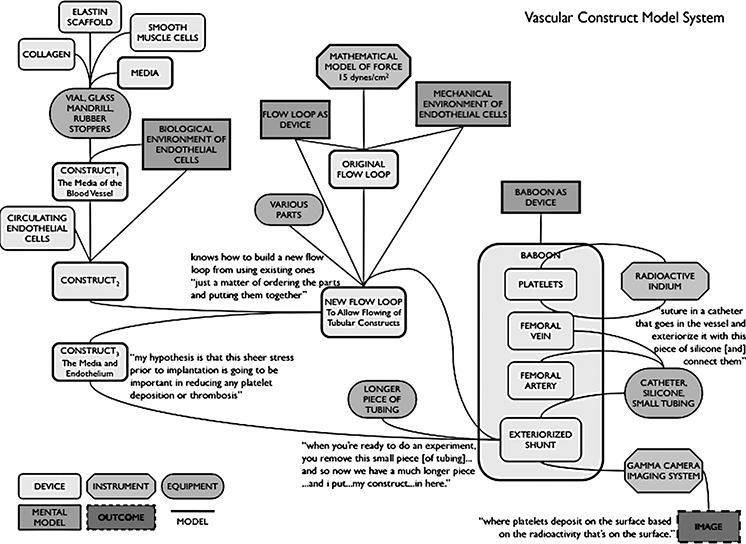
In this section I illustrate distributed model-based reasoning with physical simulation devices in a tissue engineering laboratory with one example diagrammed in Figure 1. “Lab A” has as its ultimate objective the development of artificial blood vessels (locally referred to as “constructs”). An in vivo/in vitro/ex vivo division is a significant component of the cognitive framework guiding practice in Lab A. The test bed environment for developing artificial blood vessels cannot be the human body in which they will ultimately be implanted, so the researchers have to design in vitro facsimiles of the in vivo environment and ex vivo implantation environments where experiments can occur. In this context, “ex vivo” refers to an animal that has been altered such that experimentation can take place external to its body. The biological mechanisms of the in vivo phenomena are known and understood both in biological and mechanical terms. The challenge is to bring together biological and engineered materials with the desired properties so as to perform properly in vivo where those mechanisms operate. The daily research is directed toward solving problems that are smaller pieces of that grand objective, such as proliferating endothelial cells within the constructs and creating constructs that can withstand the powerful mechanical forces of blood flow in vivo.
A proposed experiment with a vascular construct model system.

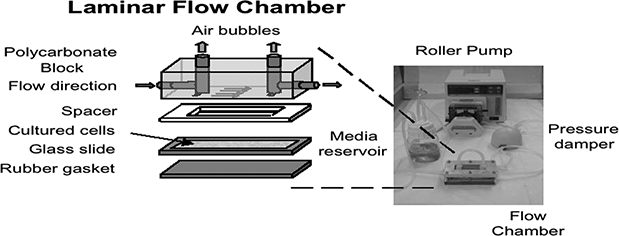
Researchers call the engineered facsimiles that serve as in vitro models and sites of simulation “devices.” The devices provide locally constructed sites of experimentation where in vitro models are used to screen and control specific aspects of the in vivo phenomena they want to examine. In BME the experimental contexts where engineered devices and biological materials come together are called “model systems.” The researchers in the laboratory aptly refer to the processes of constructing and manipulating these model systems as “putting a thought into the bench top and seeing whether it works or not.” The “bench top,” as one researcher explained, is not the flat table surface but comprises all the locales where experimentation takes place. These instantiated “thoughts” (or mental models) are physical models that constitute representations of what researchers deem to be salient dimensions of current understandings of properties and behaviors of biological systems. For example, the flow loop model (Figure 2) is constructed so that the behavior of the fluid is such as to create the kinds of mechanical stresses experienced within the vascular system. But these devices are also systems themselves, possessing engineering constraints that often require simplification and idealization not related to the biological system they are modeling.
Diagram and photograph of a flow loop model.

The flow loop represents a first order approximation of shear stresses during blood flow in the artery. In the process of simulation, it manipulates constructs which are tubular-shaped, bioengineered cell-seeded vascular grafts that function as models of blood vessel walls. In experiments with the current flow loop (Figure 2), the constructs need to be cut open to lie flat within the flow chamber as designed. Researchers argue that flowing forced liquid over these flat constructs will give them accurate enough data on the responses of the endothelial cells that line the arterial wall because the cells are so small with respect to the arterial wall that, to use their analogy, the cell's experience of the wall is as though it lives in a flat world.
The diagram in Figure 1 is a schematic representation of our analysis of the vascular construct model system for one proposed experiment aimed at solving the problem of platelet formation on constructs, and the resulting thrombosis. It traces the construction, manipulation, and propagation of models within this system. The proposed experiment is significant in the research because it is a first move in the direction of ex vivo research, which involves implantation in an “animal model,” that is, a living animal that has been modified in some way to make experimentation possible and that serves as a model for the human system. In this case an exteriorized shunt connecting the femoral vein and the femoral artery has been placed in a baboon (with no injury or discomfort to the animal) so that a small amount of blood flow can be diverted through a construct during an experiment. In Figure 1 the models involved are highlighted by thick lines. Each mental model is both an individual and a community achievement. Each physical model is constructed by this community to represent and perform as an aspect of the cardiovascular system. For example, media and constructs represent and perform as the biological environment of the blood vessel and the new and old flow loops represent and perform as shear stresses do on arterial walls. This experiment proposes the redesign of the flow loop to better approximate the in vivo model in that constructs would be flowed in tubular shape, which is necessary in order to implant them. Note, too, that models from mathematics and physics inform the construction of the flow loop.
The entire model system comprises interlocking physical and mental models within the distributed human-artifact system. The models in the system include at least the following:
• community models of in vivo phenomena (biological, mathematical, mechanical),
• engineered in vitro and ex vivo physical models of aspects under investigation,
• mental models of
• in vivo and in vitro phenomena,
• devices qua in vitro models, and
• devices qua engineered models.
4. The Nature of Reasoning in the Model System
There is insufficient space to work out the reasoning involved with each component of the model system. Instead, I will outline the kinds of reasoning that are and can be involved. A model, loosely characterized, is a representation of a system with interactive parts with representations of those interactions. What is required for something to be an instance of model-based reasoning is that (1) it involves the construction or retrieval of a model, (2) inferences are derived through manipulation of the model, and (3) inferences can be specific or generic, that is, they can apply either to the particular model or to the model understood as a model type, representing a class of models. A model is a conceptual system representing the physical system that is being reasoned about. As such it is an abstraction—idealized and schematic in nature—that represents a physical situation by having surrogate objects and properties, relations, behaviors, or functions of these. Models are interpretations of target phenomena (e.g., the human vascular system) constructed to satisfy constraints drawn from the domain of the target problem (e.g., the biology and physics of the vascular system) and, often, one or more source domain (e.g., the flow loop's material and engineering domains). Constraints can be spatial, temporal, topological, causal, material, categorical, logical, and mathematical. Simulating the model can lead to new constraints—or to recognizing previously unnoticed constraints. Inferences made with simulative models such as those in the vascular construct model system create new data that play a role in evaluating and adapting models to comply with constraints.
For physical systems such as I have been studying, models are structural, functional, or behavioral analogs of physical objects, processes, situations, or events. Such models represent demonstratively (as opposed to descriptively). The relationship between the physical model and what it represents is similarity or goodness of fit. The model is similar in degrees and respects to what it represents and is evaluated according to fit. Operations on these representations require transformations consistent with the constraints of the domain. To cast a model—physical or mental—as participating in reasoning describes its generative quality: that insight or inference is intended to flow from it. In model-based reasoning, problem solving takes place through constructing models of the same kind with respect to salient dimensions of target phenomena (often taking several iterations to achieve this objective). Inferences are derived through manipulations of the model. More than one instantiation or realization of a model is possible. Importantly, the kinds of reasoning processes include, although they are not limited to (not ordered):
• abstraction: limiting case, generic, idealization, generalization,
• simulation: inferring outcomes or new states via model manipulation (mental or physical),
• evaluation: goodness of fit, explanatory power, implications (empirical, mathematical), and
• adaptation: constraint satisfaction, coherence, other relevant considerations.
Among these, I highlight abstraction because that there are different kinds of abstractive reasoning is not often recognized and, customarily, generic abstraction is not distinguished from notions of idealization and logical generalization. “Generic abstraction” appears to play a central role in the model-based reasoning in science and engineering. What I mean by “generic” is that although an instance of a model is specific, in the reasoning process it and the inferences made from it are understood as applying to a class of phenomena and thus as lacking specificity along certain dimensions. For example, an inference made from a model of a specific spring can be understood as applying to the class of simple harmonic oscillators; thus features specific to springs, such as coils, would be eliminated. In idealization, by contrast, a feature can be extrapolated to the limit, but something still needs to be noted about it as a relevant factor. As a geometrical figure, the Euclidean equilateral triangle is an idealization, but the sides must be specified as equal, enclosing equal angles. The generic Euclidean triangle would represent those features that all kinds of triangles have in common; thus the abstractive inferences remove specificity of the lengths of the sides and of the degrees of the angles. The abstractive inferences to the generic polygon would further remove specificity of the number of sides and the number of angles. With logical generalization, on the other hand, the abstractive inferences concern what specifications to apply from one equilateral triangle to all equilateral triangles, that is, equality of length of sides and degree of angles, but not specific measures of these.
Even though in reasoning one often constructs a concrete representation or imagines one, the context provides the interpretation of the concrete representation, and the inferences made by means of it, as generic. Thus, the same concrete representation can be interpreted and understood as generic or specific depending on the demands of the reasoning context. In the experiment within the vascular construct model system, it is possible to identify inferences that are specific to the flow loop, and construct models and inferences made from them that are generic to in vivo vascular systems. The hypothesis of the experiment is that conditioning the constructs by first subjecting them to the kinds of forces experienced in vivo will prevent platelet formation (thus reducing the risk of thrombosis). Inferences about the responses of the endothelial cells (lining the construct) to the forces exerted on them by the fluid flowing in the flow loop are generic to a class of cardiovascular systems (to a first order approximation). But inferences about the strength of the construct based on the collagen scaffold are specific to that model.
5. Conclusion
In this brief exposition I have attempted to (1) argue for how model-based reasoning can be construed as occurring in distributed cognitive systems and (2) delineate the kinds of reasoning done with and through physical models. That the model-based reasoning occurs in a distributed cognitive system means that inference involves co-constructing and manipulating physical and mental models, and thus reasoning processes take place not just in the mind of a single researcher but across researchers and artifacts within the problem space of the laboratory. Adequately conveying the multiple dimensions of problem solving with the distributed cognitive systems of the BME laboratory is a difficult task and even more so in the confines of a brief illustration. Problem solving through simulation in model systems is an epistemic activity that enables inference through creating objects, situations, events, and processes that parallel or mimic those of interest in selective ways. It is also a sociocultural activity in that, even when considering reasoning activities, the models and the practices of using them are both cognitive and cultural achievements. So, although Figure 1 conveys only a pared-down representation, the model system and the proposed experiment are to be understood as embedded in a rich cognitive-cultural system distributed in space and time, itself designed to enable and support such experimentation. These devices and model systems are what sociocultural studies of science refer to as the “material culture” of the community, but they also function as what cognitive studies of science refer to as “cognitive artifacts” participating in the reasoning and representational processes of a distributed cognitive system. My point is that within the research of the laboratories, they are both, and it is not possible to fathom how they produce knowledge claims by focusing exclusively on one or the other aspect. They are representations of current understandings and thus play a role in model-based reasoning; they are central to initiation rites and social practices related to community membership; they are sites of learning; they provide ties that bind one generation of researchers (around 5 years) to another; they perform as cultural “ratchets” that enable one generation to build upon the results of the previous and thus move the problem solving forward. In sum, they are central in the cognitive-cultural fabric in which problem solving takes place in the laboratory.