1. The Semantic Conception of Theories: Structures and Representations
The semantic conception of scientific theories has had a long and distinguished history. It originates in the 1960s and replaced the older syntactic conception around 1980 as the central or received view of scientific theories. As is well known, in the syntactic conception, theories are identified with sets of statements in a particular language. By contrast, in the semantic conception, they are identified with sets of models, which are in principle expressible in any language. But this is a rather thin, minimal statement that leaves much still to be described. What exactly are those ‘models’ models of, and how may they be characterized independently of language? How can the conception’s account of “theory” as a set of models be reconciled with the apparent differences in scientific practice between theories and models? And how does its account of empirical adequacy differ from that within the syntactic conception? These and similar questions have occupied philosophers for decades now but are still to be conclusively resolved (see Suárez Reference Suárez2005; Halvorson Reference Halvorson2012, Reference Halvorson2013). A dominant view is that the semantic conception amounts to a form of structuralism—since it takes models to be set-theoretical structures of the sort famously defined by Suppes (Reference Suppes2002). But we believe things are much more nuanced and have moreover been moving fast in the last 2 decades. The semantic conception is meant to inform us about the nature of theory. But one has to pay attention to the different “identity claims” that have been made on its behalf.
The semantic conception at least in part developed as a response to the perceived failures of the syntactic account of theories defended by the logical empiricists. The logical empiricists were seen to endorse an identity claim roughly along the following lines: “a scientific theory is a consistent set of sentences in some mixed vocabulary L comprising both theoretical and observational terms.” The logical empiricists then supposedly for this reason focused their attention and energy on getting right the structure of the language of science—in particular, the form of its sentences, and the relation between theoretical and observational terms in what was known as the “mixed” vocabulary. Such efforts are seen to have failed for a very large number of reasons—among which stood out the inability to fully characterize the theoretical and empirical content of most scientific theories in any given language. The semantic conception was in the first instance a post-positivistic attempt to move away from such intricate issues regarding the form and logical syntax of theories and toward a characterization of scientific theories in nonlinguistic terms (van Fraassen Reference van Fraassen1980, chap. 3; Giere Reference Giere1988; Hughes Reference Hughes1992; Suppes Reference Suppes2002). It aimed at a wholesale rejection of the core identity claim of the syntactic view. The defenders of the semantic conception at least initially endorsed a different identity claim, according to which “a scientific theory is a set of models.” The new identity claim clearly signals a change in emphasis away from language, but the details must still be filled in and have given rise to some significant debate.
One possible way of filling in this new identity claim within the semantic conception is to appeal to a further straightforward identification of models with mathematical structures. If it is the case that “all scientific theories are sets of models” and it is also the case that “all models are mathematical structures,” then trivially it is the case that “all scientific theories are sets of mathematical structures.” During the 1980s and 1990s this looked like the definitive rendition of the semantic conception of theories, and several philosophers of science at one point or another during those years seemingly staked their intellectual efforts and professional careers on something like this identity claim. Especially the second claim regarding models as structures found favor within both the German and American “structuralism” schools (Sneed Reference Sneed and Humphreys1994; Moulines Reference Moulines, Balzer and Moulines1996). The mathematical structures in question would often come in one of three different kinds: (i) set-theoretical predicates, (ii) phase spaces, or (iii) state spaces. However, in all these cases, regardless of the details, the central idea is to identify a theory with a set domain D and a bunch of relations Ri defined on the elements of the domain. So, let us count any of these versions of the semantic conception as part of a more general ‘structuralist semantic conception’ of scientific theories. It is defined by its endorsement of the identification of scientific theories with mathematical structures.Footnote 1
More recently, van Fraassen (Reference van Fraassen2014) has suggested that the semantic conception of scientific theories has evolved contemporaneously into a more general “representational” view. He signals Hughes (Reference Hughes1997) as the turning point, an influential article advocating a pragmatic notion of representation in the spirit of Goodman (Reference Goodman1968). Hughes then explicitly linked scientific models to representations of just this type. Van Fraassen points out that Giere (Reference Giere, Magnani, Nersessian and Thagard1999) and Suárez (Reference Suárez, Magnani, Nersessian and Thagard1999) developed similar views at around the same time. And indeed, these three papers defend the claim that a scientific model is a representation, and they provide a suitably pragmatic understanding of this claim. The move has significant implications for the semantic conception. For—as we have seen—a structuralist version of the semantic conception necessarily fills in the identity claim structurally; that is, it understands a theory to be composed or constituted by structures. Yet, the ‘representational’ version, which van Fraassen takes to be the latest stage of the semantic view, fills in the identity claim very differently—in terms of representational models. These two conceptions are not identical since representations are not structures. What is more, on the pragmatic understanding that their proponents advance, representations are inconceivable as bare structures, since representations are essentially “targeted” toward their objects. Thus, Suárez (Reference Suárez, Magnani, Nersessian and Thagard1999) argues that a model cannot be understood as a ‘flat surface’, or bare structure, but must be understood as essentially pointing toward its target within its context of application and use. Giere (Reference Giere2004) develops a four-place account that is essentially agent centered, since it builds in agents’ purposes.
We may then refer to this representational version of the semantic conception as the ‘representational semantic conception’, or RSC. The RSC is not just distinct but incompatible with its structural predecessor. While the bare identity claim for theories that minimally characterizes the semantic view continues to hold (i.e., it is still defensible that “scientific theories are just sets of models”), the content of this claim is filled in very differently. On the older structuralist version, models are structures, and therefore the identity claim entails that “theories are just sets of structures.” By contrast, on the latest representational version—as characterized by van Fraassen and defended by Hughes, Giere, and Suárez—scientific theories are not structures but representations of target systems.
The fact that these versions of the semantic view are incompatible may suggest that the latest representational version has no room to accommodate mathematical structures at all, or, at any rate, it remains a mystery how it may do so. Attempts to bring together the structural and representational variants of the semantic conception invariably end up reducing the latter to the former. Bueno and Colyvan (Reference Bueno and Colyvan2011) and Pincock (Reference Pincock2012) are egregious cases of ultimate reduction. But even those, like Chakravartty (2010), who cannot be suspected to favor formal or structural renditions of scientific theories, theorizing, or their metaphysics end up conceding that “informational” accounts of representation are basic or constituent, and functional accounts are merely pragmatic. Thus, Chakravartty’s favorite informational account is not structural but similarity based, yet he concedes that informational accounts, whatever they may be, address “the issue of what representation is,” while functional accounts only address “the issue of how representations are used” (Reference Chakravartty2010, 212). In other words, the only way the RSC seems to be able to account for structural or mathematical modeling is by surrendering the position. This inability to account for structural or mathematical representation in its own terms would seem to be a defect of the RSC, since it is undeniable that mathematical structures do play a role—often a very significant role—in scientific theorizing, particularly in physics. It cannot be denied, for instance, that both pillars of twentieth-century physics (quantum mechanics and relativity) have leaned considerably on sophisticated mathematical structural representation. And the question then arises whether the RSC can do justice to the presence of structures in scientific theorizing.
One of our purposes in this article is to show that the assumption that the RSC cannot accommodate a role for mathematical structures in scientific theorizing is fallacious.Footnote 2 It depends on a conflation of the identity claim for theories with the additional thought that nothing that fails to constitute a theory can play a role within its development. In other words, it is another instance of a very common, yet fallacious, conflation of product and process (Suárez and Cartwright Reference Suárez and Cartwright2008). That a scientific theory is not constituted by a set of structures does not entail that there cannot be structures employed in its development and application.
2. Pragmatic Theories
Our other main purpose in this article is to argue that the RSC is as close as it gets to a pragmatist account of theories as tools—the view defended by Suárez and Cartwright (Reference Suárez and Cartwright2008) and characterized as a third “pragmatic view of theories,” beyond the syntactic and semantic views, in Winther’s excellent entry for the Stanford Encyclopedia (Winther Reference Winther and Zalta2016). Winther (Reference Winther and Zalta2016, 31) emphasizes five main theses or themes in this pragmatic view of theories: (1) limitations, (2) pluralism, (3) nonformal aspects, (4) functions, and (5) practice. Although Winther describes these theses as pertaining to the “structures-within-a-theory,” we prefer to think of them as the features of nonstructurally characterized theories. Thus, whereas Winther seeks a characterization of “theory-structure” that satisfies these five themes, we have no such hopes for structure. Instead we locate these themes in the nature of nonstructurally characterized scientific theories. Thus, on our account a structural characterization of theory, no matter how rich, will always be “too weak for the predictive and explanatory work … expected of it” (31). Similarly, on our account, theories are plural and complex precisely because they are not constituted by structures (cf. Winther’s very different claim that structures themselves must be complex and plural—a claim that we find hard to make mathematical sense of). Theories have nonformal aspects precisely because they are not solely constituted by structures (otherwise, on our view, they would certainly have fully formal characterizations). And so on.
In other words, whereas Winther looks to retain an essentially structural version of the semantic view, and then attempts to go pragmatist on the notion of structure, we remain conservative on the definition of mathematical structure and seek a more radical departure regarding the conception of theory. This is why our RSC severs any constitutional connection of theories with mathematical structures altogether. Yet, other than this critical difference our aim is similar in broad terms. Like Winther we are set on emphasizing pragmatic elements and themes involved in a more flexible and open-ended approach to scientific theory. We simply claim that the semantic conception in its bare minimal expression—which we will refer to as claim 1—is quite compatible with such an extension. In liberating the semantic conception from the shackles of structuralism, as we do, we open up the conceptual room required for a genuinely pragmatist understanding of theory.
Hence, we first argue that on the RSC scientific theories are not constituted by structures, because theories are representations, and representations are not constituted by structures. However, we do not deny that structures can often be the means for the application and development of representations, and hence they can also be the effective means for the application and development of theories. What is needed here is the appropriate account of representation. A suitably deflationary account of representation will accept that in some cases—in some contexts—the representational source is, or can be mapped uniquely onto, a mathematical structure; the representational target is, or can be mapped uniquely onto, another structure; and the relation between both that does the representational work in that very instance can also be characterized structurally as some kind of morphism. A deflationary conception is only committed to the denial that this structural relation as best described constitutes representation even in that particular case—that is, it will deny that it is the property in virtue of which the representation is such.
There is nothing we find in the history of the semantic conception to deny the pragmatic turn advocated by the RSC. As is well known, the semantic conception was introduced as a program of philosophical analysis of theories, comprising different formulations with a common core of assumptions. The first assumption concerns the aim of this program, which is to provide a format for scientific theories (van Fraassen Reference van Fraassen1987, 220–22), that is, a possible way to present a theory. The second assumption concerns the nature of the theory: while the format of theories may vary slightly according to the mathematics employed by the supporters of the view, theories are generally assumed to be extralinguistic and eminently set theoretical.Footnote 3
A nonexplicit assumption within the view, which is often overlooked in the secondary literature, is the modesty that has to characterize the formalization employed.Footnote 4 The sense in which the formalization is modest is twofold: it is not meant to be the only philosophical analysis available of the theories in question, nor is it meant to apply to all empirical sciences. Both points have been stressed by Suppes, who claims that “to argue that such formalization is one important method of clarification is not in any sense to claim that it is the only method of philosophical analysis” (Reference Suppes1968, 653). More recently, Suppes extensively argued against the idea that a philosophical analysis of theories could ever be universally applicable, that is, that it could apply to all scientific theories, claiming that the “severe limitations” of set theory as a possible framework to organize scientific theories should be recognized (see Sneed Reference Sneed and Humphreys1994, 214).
It is then possible to interpret appositely the claims made in the seminal paper by Suppes (Reference Suppes and Freudenthal1961) about the fundamental character of the Tarskian concept of models: the concept is fundamental in the sense that it can be employed as “technical meaning” shared by different sciences (empirical and mathematical), as well as in the sense that it can be employed to deal with different issues internal to a specific science. Despite a common apprehension to the contrary (even among sympathetic commentators such as Landry [Reference Landry2007]), Suppes is not in this article setting the basis for reducing all the different concepts of models to the Tarskian one.Footnote 5 In other words, the format of a theory given within the semantic view is never canonical (i.e., universal).
Neither can the semantic view be used to provide a demarcation criterion to figure out whether a theory is scientific. Suppe explicitly claims that the semantic view does provide a “defensible account of what is to be a theory,” and yet this status does not make it an “adequate account of what a scientific theory is” (Reference Suppe1989, 198–99). Given such strong restrictions on the applicability of its analysis, a legitimate question is whether the semantic view can be faithful to scientific practice. Suppe’s (Reference Suppe1977, 655) answer on behalf of “historically oriented philosophy of science” seems to us to still hold water. The method of a historically oriented philosopher of science is to abstract patterns of scientific reasoning from the history of science, to examine whether they are valid patterns for the purposes at hand, and in case they are, to extract the structure of the pattern and eventually formulate claims of the form “if any elements that ground this good pattern of reasoning feature in the theory, then the theory is likely to be successful.” In particular, for Suppe, at least three elements must hold for a good application of the semantic conception to any case of scientific theorizing. Roughly, (i) the historically informed philosopher of science notices a central use of the theory in relation to characterizing the changes in an isolated system’s behavior, (ii) further reflection on its historical role shows some invariant features of the use of the theory in actual practice that can thus be abstracted (such as a particular class of states used to characterize the behavior of systems, the dynamical laws employed to describe the changes, etc.), and (iii) a precise set theoretical analysis of these abstract descriptions of the central uses of a theory can then be provided. The adequacy of the analysis will very sensitively depend on the extent to which its characterization of the use of the theory in practice as a model of physical systems is adequate. It is clear that adequacy here will always come in degrees, and therefore any identity claim of a theory with a particular set-theoretical formalization will be correspondingly always open to debate and refinement.
Therefore, the core claim of any semantic view, which states that theories are sets of models, far from providing necessary and sufficient conditions for the identity of theories, opens them up to a very context-dependent consideration of the diverse inferential practices, or patterns of reasoning, that such models historically ground in actual representational practice. It is this practice of representation that must then be placed at the heart of a study of theory. In the next section we review discussions regarding representation within the semantic conception in its multiple guises. We defend a distinction between two questions referred to as the problems of constitution and means and review the inferential account of representation that will frame our views. In section 4, we defend that some of the means of scientific representation, particularly in the physical or mathematical sciences, are structural. We then show how to accommodate such means within the inferential conception of representation more generally—and hence how to accommodate them within the RSC. In section 5, we argue that structural accounts of the constituents of representation are wrong because they lay down impossible conditions on models that are not—and cannot—be met in practice. This forecloses any version of the semantic conception of theories that identifies them with structures. The upshot in the conclusion is that the RSC has no problem accommodating the use of structures in modeling the phenomena, so long as it does not identify them with representation itself.
3. Means and Constituents of Representation: The Inferential Account
Our argument must then be understood as support for the RSC identity claim that “scientific theories are sets of representations.” There are, however, some caveats or presuppositions that are best to present up front. First, our claim is conditional on a deflationary account of scientific representation—in particular, the type of inferential accounts that have been defended in recent years by several authors (Suárez Reference Suárez2004; De Donato-Rodríguez and Zamora-Bonilla Reference De Donato-Rodríguez and Zamora-Bonilla2009; Kuorikoski and Ylikoski Reference Kuorikoski and Ylikoski2015). We consequently use our terms (including “constituents” and “means”) in accordance with the technical definitions provided within such inferential conceptions. Second, the full identity claim of the RSC may yet turn out to be false—the semantic view even in its most sophisticated latest stage could be false—and it is important to realize that the Hughes-Giere-Suárez thesis regarding models as representations could nonetheless stand. In other words, the first identity claim that characterizes the RSC (claim 1: theories are sets of models) is logically independent from the second identity claim that informs the Hughes-Giere-Suárez thesis regarding models (claim 2: models are representations). It is only the conjunction of both claims (1 and 2) that yields the full claim that theories are sets of representations. We are committed to claim 2, which one of us has defended extensively in the past, and we are here also tentatively committing to claim 1. Therefore, we are tentatively committing to the conjunction. We argue, at any rate, that the conjunction of claims 1 and 2 has hitherto unexplored advantageous consequences for the semantic tradition. Indeed it may be that this conjunction of claims is the only way to make the semantic conception viable (at least we know of no other way of rendering it viable).
References to the semantic conception are ubiquitous in the recent literature about scientific representation. Even when they do not appear explicitly, they are often implicit. Thus, recent discussions regarding the applicability of mathematics, which are often a subterfuge by another name of the more general issue of representation by mathematical models, tacitly appeal to a structural account of representation supposedly necessitated by the semantic conception (Bueno and Colyvan Reference Bueno and Colyvan2011; Pincock Reference Pincock2012). As Nguyen and Frigg (Reference Nguyen and Frigg2017) aptly point out, the claim that mathematical models are explanatory tacitly involves an antecedent account of scientific representation, which is often understood in this context to be provided by the semantic view. It thus becomes easy to be misled into the thought that the semantic conception requires a particular structural account of representation (and indeed even critics like Frigg [Reference Frigg2006] seem to have been misled this way). Yet, historically, advocates of the semantic conception have typically kept quiet on the nature of representation, focusing instead on the formal structures that appear in mathematical models—all the way down from theory to data, as in Suppes’s (Reference Suppes, Nagel, Suppes and Tarski1962) now classic treatment of models of the phenomena. And indeed, detailed philosophical discussion of representation within the semantic conception is a very recent development—just 20 years old, since the pioneering contribution in Hughes (Reference Hughes1997). How are we to understand this apparent contradiction?
When it comes to the bearing of the semantic conception on representation, two distinct questions are at play, which it is important not to conflate or run together. First, one may want to ask questions about what the semantic conception actually entails regarding representation. We would like to suggest that the answer is this: surprisingly very little, if anything at all. Second, one may want to consider how it historically came about that the semantic conception is implicitly linked in the minds of so many authors to a particular structural conception of representation. It is logically perfectly possible that the answer to the first question is very thin, or inexistent, while the answer to the second is thickly informative. In fact, it stands to reason that if the semantic conception does not entail a structural account of representation, then some richly textured historical explanation should be forthcoming for why it has been understood by many to so entail it. There is plenty of historical and sociological detail that can shed light on why the ‘structural semantic conception’ was understood to be the only possible rendition of the view (Suppe Reference Suppe1977). Our concern in this article is theoretical, and we have to set such detailed historical considerations aside. The key minimal claim for our present purposes is that nothing in the history of the discipline requires a tight logical connection between the semantic view, minimally construed as the mere statement of its core claim 1, and any particular view of representation. The ‘structural semantic conception’ goes beyond the statement of claim 1: it adds an assimilation of models to structures that is not a core commitment of the semantic view.
Another way to make this point appeals to different problems one may address in relation to representation. On the one hand, there is what we will call the problem of means, or application, namely, the problem of studying how different representational sources relate to their target systems, within their particular contexts of application, where the relation minimally requires the possibility of surrogative reasoning from source to target (Swoyer Reference Swoyer1991) but can otherwise vary greatly. The diversity is so large in fact that one should properly speak of the “problems” of application or means—since the solution to this problem can differ maximally from case to case. On the other hand, there is the problem of constitution, which is the problem of defining the general conditions in virtue of which sources represent their targets across contexts. This requires a universal answer in all circumstances, so it is properly speaking just one very large and abstract problem. Now, there are, occasionally, structural answers to the first kind of problem: some mathematical models relate structurally to (an appropriately structural description of) their targets within the context of their application. But we argue that there is no structural answer to the second problem: there is no structural morphism between sources and targets in virtue of which representation in general obtains. Yet, the structuralist semantic conception has been taken by many, friends and foes alike, to implicitly carry a response to this problem of constitution, according to which representation is itself a structural relation and is constituted by some morphism or mapping (for paradigmatic examples, see van Fraassen 1980; Frigg Reference Frigg2006). But in fact, we argue, structuralism merely can answer the problem of application of mathematical models—it can only inform us as to what structural means are typically employed in particular instances of successful representation. And there is no confusing a means of mathematical representation, however typical, with the constitutive relation of representation in general.
Throughout this article we adopt the deflationary view that the constitution problem is unanswerable. The RSC that we favor thus carries no commitment to any particular substantive account of representation, and it is certainly not possible to sneak structuralism in through the back door, as it were. Yet, staying resolutely quiet on the problem of constitution does not prevent us from addressing the problem of application. And it does not prevent us from giving the appropriate structural rendition of the means of particular representations by mathematical models in any given context in which indeed that is appropriate.
In the burgeoning modeling literature of the last 2 decades or so, there is widespread acceptance and recognition of the fact, first stated by Swoyer (Reference Swoyer1991), that a main use—if not the main use—of scientific modeling is surrogative inference about diverse aspects of the model’s target (where the model’s target may be a real or an imaginary entity, system, or process). On this fact, to our knowledge, all commentators agree, even when they disagree about the explanation of this one fact (Hughes Reference Hughes1997; Chakravartty Reference Chakravartty2001; Giere Reference Giere2004; Frigg Reference Frigg2006; van Fraassen Reference van Fraassen2008). It may thus be said to be a platitude about scientific modeling and representation that all models are at least in principle able to license some inferences regarding their target. The main point of building a model is to allow such surrogative inferences, and it is such inference-drawing actions (Boesch Reference Boesch2017), if anything at all, that are constitutive of communal representing acts.Footnote 6
A substantive account of representation assumes that this fact about surrogative inference stands to be explained by ulterior facts regarding the nature of the representational relation between representational sources and targets. Thus, on similarity accounts of representation, the similarity between representational source and target is what explains the fact that surrogative inference is possible. On isomorphism accounts, the structural identity of the source model and its target explains the fact that inferences may be drawn from the source about the target. And so on. On such views, it is the facts about the nature of the deeper representational relation that explain its surface features. Yet, as is very well known by now, such substantive accounts run into a myriad of problems that make them entirely implausible, inappropriate, or unviable as accounts of the representational relation.Footnote 7
A deflationary account, by contrast, rejects any explanatory demand on any of the surface features of a representation, such as its surrogative inferential prowess. Deflationists do not require an explanation of the capacity of a scientific model source to license inferences about its target—particularly not so in virtue of any deeper features of the representational relation between source and target. Instead the inferential capacity of the model source toward its target is taken to be an unanalyzable component of the representation. Other aspects of the modeling relation (such as its faithfulness or the effectiveness of its means) are rather to be understood in terms of such surface features. On this view, there are no deeper facts about the representational relation that may illuminate such surface features; the latter stand on their own, requiring no explanation.
It is possible to gain a better grasp of the distinction between “surface” and “deep” features of a representation in practice by reference to a further philosophical distinction between “constituents” and “means.” In a representation of some objects, system, or process b by means of some model a, we have adopted the stipulation to refer to a as the “source” and b as the “target.”Footnote 8 We can then say that the relation R(a, b) constitutes the representation—or that it is the constituents of the representation—if and only if, for any (source, target) pair in any context, R(source, target) is the relation of representation. But, the relation R(a, b) is the means of the representation of b by a in a particular context of use if and only if R(a, b) is the one relational property of a and b that is actively employed by the agent who, in the particular context, uses the representation in order to draw or infer conclusions about b from a. More simply put, R(a, b) constitutes the representational relation if it is the general relational property of source and targets that defines it and happens to be instantiated in the context by a and b. But even if there is no constitutive general relation that it instantiates, it is still the case that R(a, b) as it obtains in the particular context, and only in that context, is the means by which a represents b.
If there can be means without constituents, there can be representation in a deflationary sense: it is permissible to say that a represents b because R(a, b) obtains even though there is no “deeper” constitutive relation that explains why this is so. The litmus case then against a substantive account of representation is the existence of representational means without constituents. We want to argue in what follows that the means of some scientific representations—typical in mathematical modeling that characterizes the physical sciences—are often structural. The relation R(a, b) that is employed in that particular context to carry out surrogate reasoning is a structural morphism. However, this does not mean that the particular morphism R(a, b) employed in that context is the constituent of the representational relation between a and b in any context. On the contrary, we argue that no morphism type constitutes representation. In the spirit of our deflationism, there is no need to postulate any constituents at all. In other words, our purpose in this article is to argue that even in those cases in which the means of representation are structural, it does not follow that representation per se is structural. We argue that if representation is to be identified with anything at all, even in those contexts in which the means of representation are structural, it should be identified with whatever inferential practice is enacted in such contexts by those structural means at hand (and therefore not be identified with the structural means themselves).
4. Structural Means and Surrogative Reasoning
The means of the representation of b by a at a given time t and context c may be any kind of relation R(a, b) that holds between them—as long as this is actively employed in surrogative inference from a to b in that context at that time. However, this leaves open whether a and b are themselves structured in terms of relations or properties of the different elements in their domain. Let us assume that this is so. That is, suppose that a and b either are both structures or can be described as such (perhaps because they are physical entities or processes that for the purposes of the representation at hand, in the right context, exemplify relevant structures). Then we can write Sa and Sb for the two structures that correspond to a and b, as follows:
 , Ri〉, and
 , Rj〉, where {Da}, {Db} are the domains of the structures, and {Ri}, {Rj} are the sets of relations defined over the elements of the domain.Footnote 9
We are likely to find structural means of representation in science whenever the relevant (source, target) pairs are structures themselves. Those structures may be presented as set-theoretical predicates, phase spaces, or state spaces or whatever mathematical equations these are defined by. We may consider any number of examples from theoretical physics. The Hilbert state space formalism for quantum systems is one. It assigns a state to a system and represents it as a vector or a ray (family of vectors) in a complex higher dimensional vector space. It then represents any of the system’s properties as one of a family of operators acting on the space. The commutativity property of the operators for a particular system then defines an equivalence class of isomorphic states: those that establish the same probability distribution over the eigenstates of the commuting operators. Alternative approaches to quantum mechanics in which the Hilbert space does not play such a representational role, such as Bohmian mechanics, provide further examples. A Bohmian system’s state (the position and velocity of its constituent particles) is at all times defined by its Hamiltonian, and the dynamical Schrödinger equation, and is thus represented in configuration space (where the configuration space of a n-particle system is a 3n-dimensional space). And the motion of a system of Bohmian particles is hence isomorphic to the motion of the universal Bohmian particle in configuration space.
These turn out to be complex examples, since the isomorphism is never to the intuitive physical three-dimensional space. But there are even simpler examples, such as the simple harmonic oscillator or Brownian motion in classical mechanics. Consider the simple harmonic oscillator in one direction with its motion governed by Hooke’s law:
 , where k is a constant of the system. The equation may be solved for the displacement of a point particle on a line, and it instantiates a phase space structure where the two variables of motion are the position of the point (x) and its momentum (m) or, for a particle of unit mass, its velocity (v). The dynamics of the motion on the phase space determines a structure of correlated points in time:
 , where each point is related to its successor by a succession rule that determines the particle’s trajectory. It is then possible to lay out a structural mapping between this structure in the model (the representational source) and the corresponding structure instantiated by the motion of an undamped oscillator or pendulum (the representational target). They pendulum’s trajectory in physical space is given by its one-dimensional coordinate in time, hence, by the values of the two variables (x, t). This again provides a structure
 , where each point in space is related to its successor in time by the succession rule imposed by the t coordinate. It is then relatively trivial to check that both structures are isomorphic to a degree, namely, the degree to which the trajectories of the pendulum in space and the point particle in phase space accurately correlate.
Nor are such cases confined to mathematical physics. In marine ecological biology, the Lotka-Volterra model of predator-prey populations in a competitive environment, for example, has been amply discussed in the philosophical literature (Weisberg Reference Weisberg2007; Boesch Reference Boesch2017; Knuuttila and Loettgers Reference Knuuttila and Loettgers2017). This is easy to understand in terms of isomorphisms operating between those relations holding among the quantities in the model source (which obey a couple of straightforward nonlinear equations and thus can easily put in a structural format) and the empirically observed ratios in actual populations of fish in the Adriatic sea (as reported by D’Ancona and which formed the empirical basis of the outcome-oriented model by Volterra, in particular; see Knuuttila and Loettgers Reference Knuuttila and Loettgers2017, 1027ff.).Footnote 10
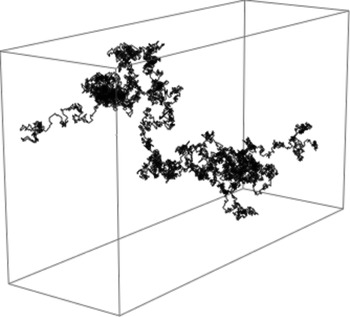
A computer simulation of Brownian motion provides yet another, more complex example. A dot moving randomly on a computer screen is the model for the motion of a particle floating in some fluid or gas (e.g., a spot of dust floating in a stream of vapor). This is easily generated by the computer implementation of the Wiener equation for Brownian motion. A Wiener process is a continuous in time stochastic process Wt that obeys the normal distribution, as follows (Grimmett and Stirzaker Reference Grimmett and Stirzaker1982/2001, 370ff.):
1.
 almost surely.
2. Wt has independent increments:
is independent of u (WS:
) for
.3. W has Gaussian increments (normally distributed):
N(O, u), where O is the mean and u is the variance.4. Wt is almost surely continuous in t.


The point is that such a process defines a motion of a dot on the state space, which accurately represents the motion of a dust particle floating in a fluid. The trajectory of a random Brownian walk is illustrated in figure 1 (courtesy of Juan Parrondo). This motion in mathematical space may be taken in turn to model the motion of a real physical dust particle in a fluid. But it must be stressed that since the mathematical motion is randomly generated, there is no guarantee that it will model the motion of any one particle perfectly. Rather, it models one ‘typical’ kind of motion of one such particle. At any rate the representational relation, if it obtains, takes a structural form. The motion in mathematical space is to some degree isomorphic to that of the physical particle. In set-theoretic terms, there is a structure S induced by the former motion that is reproduced as S′ in the motion of the latter particle, just as in the pendulum case (where the relations are once again due to the contiguity in time of the positions occupied by the dot/particle).
Brownian motion in three-dimensional space.

But there are in mathematical physics other examples of representational means that are not structural. One example is provided by the Quantum State Diffusion stochastic differential equation for the state of a free particle (see Percival Reference Percival1998, 50):

This equation describes the evolution of the quantum vector state of a particle subject to a diffusion process. It is important to understand the nested nature of the representations that play a role in this model. There is first of all the equation itself, which represents in a symbolic (nonstructural) form the motion of a vector in a vector space. It is of course possible to solve the equation to figure out what it entails for the motion of the state vector—in fact the equation has to be solved in order to determine uniquely the state vector motion—but it does not follow that the equation is structurally isomorphic to the motion. Now, this vector in turn represents the state of a physical quantum particle subject to diffusion. This last relationship is structural, but it is not a simple isomorphism. The graph (e.g., fig. 4.1 in Percival Reference Percival1998, 51) depicting the trajectory of the state on the Bloch sphere as prescribed by the equation is not itself a depiction of the movement of the particle in three-dimensional physical space, nor is it isomorphic to it. One has to apply Born’s probability postulate in order to derive any meaningful information regarding the actual particle position. There is no geometrical isomorphism even if both source and target have a mathematical form.
In other words, in physics and other mathematical sciences there are cases in which the representational source and target are both mathematical entities, which can be understood structurally, and indeed the means of the representation is some structural morphism between them. But there are other cases in which both source and target have a structural (or at least mathematical) form, and yet the representation of the one by the other is not structural—and certainly not a matter of structural morphism. The shape of the (source, target) pair is not an infallible guide to the type of representational means that are operative in the context at hand. On the contrary, one needs to inspect the context in detail to figure out just what guides the inference drawing from source to target.
5. The Structural Semantic Conception Revisited
We have established that when both source and target in a scientific representation can be given structural descriptions it becomes possible—although not necessary—for a kind of morphism to be the means of the representation. The relation between source and target that is employed in surrogative inference about the target is appropriately structural. This addresses the problem of means or application within RSC, which is thus shown to have the resources to handle such cases without any difficulty.
It may seem that a ‘structural semantic conception’ would achieve the same result automatically—for on such a version of the semantic view all means are necessarily structural. But this is not so. There is no single kind of morphism that is either the constituents of representation or even the universal means of structural representation. The reason why the constituents of representation cannot be structural is related to the inherent diversity of scientific modeling, which is ubiquitously idealization ridden. Scientific representations may idealize in at least three different ways (Pero and Suárez Reference Pero and Suárez2016): by abstracting, by pretending, or by simulating—where the third is a combination of the former two. No morphism can account for all these forms of idealization. The weakest proposal is Swoyer’s ‘Δ/Ψ-morphism’, but it imposes no genuine structural constraints: any structure holds the requisite relation with any other structure. In other words, there is no informative morphism that all representational means reduce to, even when the source and the target are structures or may be mapped uniquely onto structures.
Pero and Suárez (Reference Pero and Suárez2016, 77ff.) have shown that the two common types of idealizations in science pull in opposite directions when it comes to establishing a structural morphism between model and target. Roughly, ‘abstracting’ involves ignoring details in the target by suppressing any correlative features in the model, while ‘pretending’ involves adding features in the model that lack any correlate in the target. Suppose that we are in the lucky situation to have uniquely specified a structure for both source and target, as
 , and
 , where DS, DT are the domains of individuals of each of the structures S, T, and RS, RT are the relations defined over the respective domains. We then say that a model S abstracts some property in the target if and only if there exists some n-tuple:
 , such that there is a property or relation
 obtaining in the target and lacking in the source:
 , where
 is the correlative property over the corresponding elements of the domain in the target. And we say that the model pretends some property in the target if and only if there exists some n-tuple:
 , such that there is a property or relation
 obtaining in the source that is lacking in the target:
 . The range of the morphism function in the source is whatever n-tuple maps over f −1(b 1), f −1(b 2), …, f −1(bn), since we do not insist that the function f must be one to one and onto an isomorphism.
Most scientific models both abstract some properties in their target and pretend some other properties. The well-known example of the billiard ball model for a gas in the kinetic theory exemplifies both. A system of billiard balls models a system of gas molecules, with some provisos. First, billiard balls are shiny, opaque, and hard, and these are properties that the model can at best pretend are in the target system of gas molecules. Second, there are properties of the gas molecules that are ignored or denied in the billiard ball model, such as viscosity and thermal conductivity. These properties are abstracted away. Viscosity, for example, is a physical consequence of density and temperature of the whole gas. Yet, a system of billiard balls lacks the connection between density and temperature, on the one hand, and viscosity, on the other. Even if temperature and density were well-defined quantities in a system of billiard balls (which they are not), there would be no corresponding property of viscosity of billiard balls. It is not merely that the property is ignored—it is expressly denied for billiard balls. Similarly, there are properties of the system of gas molecules as a whole that the system of billiard balls as a whole does not possess, namely, free expansion. These are abstracted away not just from the molecules but from the system considered as a whole.
The question is what sort of morphism can accommodate such kinds of idealization. As it turns out, those morphisms that can accommodate abstraction cannot accommodate pretence and vice versa. Full or partial isomorphism accommodates neither. Homomorphism accommodates pretence but not abstraction. And homomorphism without the condition known as faithfulness (not a properly defined morphism; see Pero and Suárez Reference Pero and Suárez2016, 80) accommodates abstraction but not pretence. None of these can accommodate the combination of pretence and abstraction. And the question then remains whether there is a further weakening of homomorphism that could do this. Pero and Suárez (Reference Pero and Suárez2016) canvass the different options and answer negatively.
Indeed, the weakest proposal we are aware of is Swoyer’s ‘Δ/Ψ-morphism’. This is weaker than homomorphism since it does not require an injection from the range into the image (in technical language, this is not even a properly defined mapping). The idea here is to consider two subsets Λ and Ψ of the domain of the target (i.e.,
 ;
 ), such that f is a function such that f −1 takes every relation defined over Λ into relations defined over the corresponding elements in DS, and f takes every relation defined over the corresponding elements in DS to those in Ψ into relations defined over those elements in
 (i.e., f counterpreserves the relations defined over the elements in Ψ). Since this is not a bijection, it accommodates pretence: there are elements in DS that have no correlate in DT. And since the subsets Λ and Ψ need not overlap, it also may accommodate abstraction, since there may be elements in DT that are in Ψ but not in Λ). However, a Δ/Ψ-morphism is not really a mapping or any established morphism unless
 (in which case it boils down to a standard homomorphism). The selection of the subsets {Λ} and {Ψ} is arbitrary and specific to the case at hand; the only thing that the existence of such a mapping issues is a structural rendition of the source and the target. Nothing informative follows from the proof of the existence of a Δ/Ψ-morphism other than the knowledge that both source and target can be minimally given a structural formulation. And that was precisely our initial assumption.
In conclusion, we suggest that an inferential account of the means of structural representation—where applicable—should adopt a minimal concept of structure. A structure is then the internal partition into elements and relations that is ascribed by a competent agent to a target system via some model (epistemic structure ascription; see Pero Reference Pero2015). The internal structure of a model is in this sense a prerequisite for the inferential activity to take place, and, once it is fixed, the ‘inferential suitability’ of a model (the possibility to employ the model’s structure as an approximation of the target) with respect to its target is thus determined. Once again, the fact that one of the concrete properties a source of representation should display can be cast in structural terms does not imply any form of structuralism about the constituents of representation. In fact, this minimal concept of structure is deeply intertwined with the inferential practice that allows conclusions from model sources about their targets. Without any referral to agents’ inferential practice and the context enacting it, the work to be done by this concept of structure in any philosophical analysis of scientific representation would just fade out.
According to the RSC that we have defended here, this is indeed as it should be. Theorizing is infused with the rich textures of practice, and the results of theorizing (models) are similarly infused—to the point that no understanding of these models that reduce them to formal structures is at all viable. Instead RSC recommends accepting the practice up front, by considering modeling as an inherently outcome-driven normative practice. If scientific models and scientific theories reflect and embody their intended uses and aims essentially, this is only because the practice that gives rise to and generates them is essentially intentional (Boesch Reference Boesch2017). No account of theory in terms of modeling that denies such a fundamental lesson can succeed.
6. Conclusion
The semantic conception of theories has traditionally been understood in its structural version—as such it has been assumed that it carries a commitment to a specific structural rendition of the relation of representation. We argue that it is possible to free the semantic conception from its structuralist trappings. Two different identity claims regarding the nature of theories seem to be conflated all too often, yet the identification of models and structures is an additional commitment that is not required by the main or core claim of the semantic conception. We have argued that no informative structural rendition of the constituents of representation can provide for all the different kinds of structural mappings that occur in mathematical physics, where two varieties of idealization (abstraction and pretence) are ubiquitous. An alternative version of the semantic view (which we have referred to as RSC) appeals to a nonstructural conception of representation only. There is no need for any further identity commitment over and above its core claim to conceive of theories in terms of models and to link theorizing to modeling practice. Nonetheless, RSC has the necessary resources to explain the role of mathematical structures as the means of some remarkable instances of scientific modeling.