1. Introduction
We all have an intuitive idea of what mixtures are; air is primarily a mixture of nitrogen and oxygen, and a martini is a mixture of gin and vermouth. But what sort of mathematical structure best describes a mixture? Footnote 1 This question is an example of the well-known philosophical problem of determining the models that best represent the target physical system. In the case of mixtures, I identify two main candidates. The first, which I call the standard representation, is not a good representation of a mixture in spite of its widespread popularity. The second, which I call Gibbs’s representation, is less widely adopted Footnote 2 but is, I argue, a much better representation. My argument will turn on a particular philosophical perspective concerning the representational capacities of mathematical structures. I will show that once an adequate perspective on representation is adopted, Gibbs’s representation leads to a deflationary view of the notion of “partial pressure” and of some associated thermodynamic results, Dalton’s law concerning the pressure of a mixture, and Gibbs’s theorem concerning the entropy of a mixture.
The topic of this article is intimately linked with Gibbs’s paradox in thermodynamics, Footnote 3 which concerns the entropy increase of mixing different gases. Briefly, one version of the paradox is that the calculation of the entropy increase does not appear to depend on whether the gases are different or the same, and so we get a nonzero entropy increase even for identical gases. Another version is that there is a discontinuous change in the entropy from some positive value to zero as the gases “become indistinguishable.” Philosophical discussions of this paradox have taken place in the context of the philosophy of identity, usually focused on discerning the precise notion of indistinguishability at play in statements and solutions of the paradox. The discussion in this article focuses on an issue taken for granted in discussions of the paradox: the definition and representation of the mixture for which we are calculating the entropy increase. If we can purportedly derive a paradox by making certain assumptions about the model we use to represent mixtures, then the representation of mixtures is relevant and important to discussions of the paradox.
However, although I anticipate that the arguments in this article will have relevant consequences for Gibbs’s paradox, the paradox itself is not my main concern. Studying the representation of mixtures is philosophically interesting on a more general level because it highlights general principles of representation used to formulate our models for physical systems. In particular, there are two main philosophical payoffs of my argument:
-
1. The identification of ambiguity in how physicists model mixtures in thermodynamics and its resolution in a rigorous and philosophically well-motivated way
-
2. The explication of the interpretative consequences of each model and the commitments one makes in using them to represent mixtures
I begin in section 2.1 by setting out two philosophical principles I will use to adjudicate between the two candidate representations. In section 2.2, I set out a mathematically precise formulation of thermodynamics and a proposal for what it means to adequately represent physical systems as thermodynamic models. This will set the philosophical and formal background needed to compare the two candidate representations of a mixture. In section 3, I argue that adopting the standard representation involves rejecting the two philosophical principles from section 2.1. If we accept the principles and adopt Gibbs’s representation, then two objections need to be addressed: (1) the ubiquitous use of the notion of “partial pressure” in the context of mixtures, which appears to be absent in Gibbs’s representation, and (2) the absence of a representation of a mixing process based on Gibbs’s representation. I address these objections in sections 4 and 5.
2. Models of thermodynamics
2.1. Adequate representations in thermodynamics
When physicists study physical systems, they represent those systems using the formal mathematical structures of some theory. For example, when we study the hydrogen atom, we study its representation as a quantum mechanical model, and when we study the motion of the planets in the solar system, we often study its representation as a model of classical gravitation. The same goes for the present case: when we study mixtures, we represent them using thermodynamic models. We should therefore aim to formulate the concept of a thermodynamic model in a way that is appropriate for representing mixtures.
But what are thermodynamic models? Compare: a model of Hamiltonian mechanics is a symplectic manifold; a model of quantum mechanics is a Hilbert space with an algebra of observables; and a model of general relativity is a Lorentzian manifold
 $\left( {M,{g_{ab}}} \right)$
. The fact that there are mathematically rigorous formal models available to represent these physical systems ensures that we have an adequate grip on what the structures of those physical systems are like. By contrast, it is striking that the thermodynamics literature reveals precious few mathematical definitions of a thermodynamic model.
A thermodynamic system is sometimes vaguely characterized as a “portion of the universe” that we select for investigation (Adkins Reference Adkins1983; Sears and Salinger Reference Sears and Salinger1975). Textbooks on orthodox thermodynamics more commonly emphasize the distinction between a system and its environment. For example, Kondepudi and Prigogine (Reference Kondepudi and Prigogine1998, 4) write: “Thermodynamic description of natural processes usually begins by dividing the world into a ‘system’ and its ‘exterior’, which is the rest of the world.”
Other commentators in the thermodynamics literature achieve slightly more mathematical enlightenment on this issue. Callen (Reference Callen1960, 8) defines simple systems in thermodynamics as those that are “macroscopically homogeneous, isotropic, uncharged, and chemically inert, that are sufficiently large that surface effects can be neglected, and that are not acted on by electric, magnetic, or gravitational fields.” Callen’s definition introduces the property of being macroscopically homogeneous as an essential property of thermodynamic systems. This is certainly a step toward greater conceptual precision, but it is still not adequately formalized for our purposes.
In contrast, Tisza (Reference Tisza1961, 7) defines a thermodynamic simple system as “a finite region in space specified by a set of variables
 ${X_0},{X_1}, \ldots ,{X_k}$
.” In other words, the system is specified by the thermodynamic state, which in turn is specified by the variables
 ${X_i}$
for
 $i = 1, \ldots k$
. Lieb and Yngvason (Reference Lieb and Yngvason1999, 14) take a similar view: “From the mathematical point of view a system is just a collection of points called a state space.” In a similar way, Jaynes (Reference Jaynes, Ray Smith, Gary and Neudorfer1992, 5) may be read as defining a thermodynamic system by defining its states: “A thermodynamic state is defined by specifying a small number of macroscopic quantities … which are observed and/or controlled by the experimenter.” Jaynes’s definition may be seen as an extension of Tisza’s and Lieb and Yngavason’s in the sense that it is specified how the variables specifying the state are constrained. These definitions are a step in the right direction, but they do not include the homogeneity of the thermodynamic system, something Tisza himself emphasized elsewhere (Tisza Reference Tisza1961, 23).
Perhaps the most precise definition is to be found in the formulation of geometric thermodynamics using contact geometry. Footnote 4 This formulation’s definition is extremely rich and requires a detailed understanding of contact structure. We shall not delve into the intricate details of contact geometry because the full-blown machinery is not necessary for our purposes. The point of mentioning it is to demonstrate that it is possible to achieve a characterization of thermodynamic systems to the same degree of precision as our characterization of classical, quantum, or general relativistic systems. In order to have an adequate understanding of the structure of thermal systems, we should aspire to represent them by adopting a precise formal definition of a thermodynamic model. In section 2.2, I will give the necessary formal background to formulate a minimal mathematical definition of a thermodynamic model. The approach I will take is inspired by the precision achieved in contact geometry but is significantly easier to understand while still retaining its essential content.
Before we proceed, it is worth reflecting on why precise mathematical definitions of our theoretical models can be useful. Footnote 5 What physical or philosophical advantage does the existence of such formal models in classical, quantum, or gravitation physics give us over the candidates for thermodynamic models described in this section?
The first advantage afforded to us by formal models is their usefulness to us as modelers: the clear structure afforded to us by formal models allows us to see which aspects of the model represent particular aspects of the physical system. If a feature of a physical system is relevant in a particular context, then our model for it in that context had better be able to represent that physical feature. My point is better illustrated by the case I am concerned with in this article: representing a mixture as a thermodynamic model. At the very least, this will mean that the thermodynamic model ought to represent all properties of the mixture deemed thermodynamically relevant. It follows that if the thermodynamic model does not represent some thermodynamically relevant property, then it is not an adequate thermodynamic representation of that system. More concisely, a model is not an adequate representation of a target if it fails to represent a property of the target it “should’’ represent. Let us express this adequacy criterion more succinctly as follows:
Representational adequacy (RA). Model X adequately represents target T in context C if and only if X possesses a property
 ${X_i}$
that can be interpreted as representing some property
 ${T_i}$
of T, for all
 ${T_i}$
deemed relevant in context C.
I do not wish to commit to a more precise version of this criterion because doing so would involve adopting a particular (possibly controversial) account of scientific representation. I anticipate that most perspectives on representation will deem this criterion to be reasonable and that it can be formulated in whichever account of scientific representation one adopts. Footnote 6
As this principle is formulated, there is nothing to constrain what kind of thing the model X is; it may be a concrete scale model just as well as a mathematical structure. In my discussion, I am interested in the specific application of this principle where X is a mathematical structure. Such structures have clearly identifiable properties
 ${X_i}$
that can be used to represent relevant properties
 ${T_i}$
of the target. Looking ahead, I will show that the standard representation of mixtures violates this adequacy criterion because it does not represent a feature of mixtures that is thermodynamically relevant, namely, the volume of the mixture. Thus, if one accepts this criterion of representational adequacy and one thinks that the volume of the mixture is thermodynamically relevant, then one ought to reject the standard representation.
The second advantage afforded to us by formal models is their usefulness to us as philosophers. It is our responsibility as philosophers to contemplate the interpretations of our mathematically formulated physical theories. Part of this investigation is to answer questions concerning, for example, the kind of mathematical models we take to represent physical systems, as well as the appropriate standard of equivalence of those models. Recent literature in the general philosophy of science (e.g., the formal logic approach of Halvorson Halvorson [Reference Halvorson2019]), particularly in the context of the “hole argument” of general relativity (e.g., Weatherall Reference Weatherall2018; Fletcher Reference Fletcher2020; Roberts Reference Roberts2020), has illustrated how progress may be made on such questions if we first get clear on the mathematical structure lying at the foundations of a theory. Given the fruitfulness of this approach to philosophical problems in these areas, I would like to consider the extent to which such formal approaches may be fruitful in thermodynamics. Footnote 7 My view—and argument in this article—is that they can be. It is from this perspective that I approach the formalization of thermodynamics in this article.
One important step made in recent philosophical literature has been to draw attention to a principle concerning the capacity of mathematical models to represent physical situations. This principle was applied by Weatherall (Reference Weatherall2018) in the context of the hole argument:
[I]somorphic mathematical models in physics should be taken to have the same representational capacities. By this I mean that if a particular mathematical model may be used to represent a given physical situation, then any isomorphic model may be used to represent that situation equally well. Weatherall (Reference Weatherall2018,332)
Further discussion of this principle is undertaken by Fletcher (Reference Fletcher2020), who expresses it as follows:
Representational Equivalence by Mathematical Equivalence (REME). If two models of a physical theory are mathematically equivalent, then they have the same representational capacities. Fletcher (Reference Fletcher2020, 5)
Roughly speaking, the notion of the “representational capacities” of a scientific model is taken to mean “the states of affairs that that model may be used to represent well” (Fletcher Reference Fletcher2020, 3). Although this notion may seem intuitive, no precise definition of representational capacity exists, and its definition will surely depend on one’s account of scientific representation. Fletcher avoids giving such a definition, on the basis that structural questions about, for example, how the mathematical equivalence of models constrains their representational capacities are independent of one’s definition of capacities. It will be similarly unnecessary for me to give a precise definition of representational capacities because the example I am concerned with is stark enough that it should be accommodated by any definition.
I am not concerned with giving a defense of REME or related principles here. Footnote 8 Instead, I shall content myself with defending the following conditional claim: if one accepts REME, then one ought to reject the standard representation in favor of the Gibbs’s representation of mixtures.
In the following sections, I will set out what I take to be the formal structure of a thermodynamic model. I will then use this formalism to compare two candidate mixture representations against the same formal background. I will argue that the standard representation violates REME and the criterion for representational adequacy and that we should therefore seek another representation.
2.2. Formal background
I will now set out what I take to be the formal structure of a thermodynamic system, which is a simplified version of the geometric approach. Footnote 9 The assumptions we work with are the following:
-
1. The possible states of a thermodynamic system in equilibrium are represented by points in the
 $\left( {k + 1} \right)$
-dimensional smooth real manifold M with global coordinates (
${X_0}, \ldots ,{X_k}$
).
-
2. These variables are related by a smooth function f such that


 $${X_0} = f\left( {{X_1}, \ldots ,{X_k}} \right),$$
which is called the fundamental relation. This defines a k-dimensional surface in M.
-
3. f is a homogeneous first-order function of
${X_1}, \ldots ,{X_k}$
:

 $$f\left( {\lambda {X_1}, \ldots ,\lambda {X_k}} \right) = \lambda f\left( {{X_1}, \ldots ,{X_k}} \right)$$
for every positive real number
 $\lambda $
and for all
 ${X_1}, \ldots ,{X_k}$
.
The variables
 ${X_i}$
will be taken to represent thermodynamic properties, such as energy, entropy, volume, and mole number, and are known as the extensive variables. We will shortly demonstrate that the function f, when expressed in differential form, turns out to express what is known as the first law of thermodynamics.
Using these assumptions, I now propose the following minimal definition of a thermodynamic model. Footnote 10
Thermodynamic model. A thermodynamic model is a pair
 $\left( {M,f} \right)$
, where:
-
i. M is a
$\left( {k + 1} \right)$
-dimensional manifold with global coordinates
${X_0}, \ldots ,{X_k}$
. -
ii.
${X_0} = f\left( {{X_1}, \ldots ,{X_k}} \right)$
is the fundamental relation defining a k-dimensional surface in M, where f is first-order homogeneous.


Equivalently, we have a k-dimensional manifold N that is given coordinates
 ${Y_1}, \ldots ,{Y_k}$
and a function
 $f:N \to \mathbb{R}$
, where we can smoothly embed N into a
 $\left( {k + 1} \right)$
-dimensional manifold M via the map
 ${\rm{\Phi }}:N \to M$
. Then we can think of f as defining a k-dimensional surface in M whose coordinates are given by
 ${X_0},..,{X_k}$
, where
 ${X_i}\left( {{\rm{\Phi }}\left( p \right)} \right): = {Y_i}\left( p \right)$
for
 $i = 1, \ldots ,k$
and
 ${X_0}\left( {{\rm{\Phi }}\left( p \right)} \right): = f\left( p \right)$
.
This definition of a thermodynamic model is intended to be analogous to models in other theories that aim to represent physical systems. But my proposal for defining a thermodynamic model is not to be found in typical presentations of the thermodynamic formalism, so it is worth spending some time illustrating how this formalism gives rise to the more familiar expressions of thermodynamics using the simple case of the ideal gas. In this case, we assume the manifold has dimension
 $n = 4$
and coordinates that can be interpreted as S (the entropy), U (the internal energy), V (the volume), and N (the mole number). The fundamental relation in assumption 2 then takes the form
 $$S = f\left( {U,V,N} \right),$$
and the homogeneity in assumption 3 says that
 $$\lambda S = \lambda f\left( {U,V,N} \right) = f\left( {\lambda U,\lambda V,\lambda N} \right)$$
for all values of
 $U,V,N$
and for all positive values of
 $\lambda $
. Equation (2.4) is often interpreted as the claim that entropy is extensive, a term typically used to describe variables that scale with the “size” of the system.
Footnote 11
To make contact with a more familiar expression of thermodynamics, we write the fundamental relation in differential form as
 $$df = dS = {{\partial S} \over {\partial U}}dU + {{\partial S} \over {\partial V}}dV + {{\partial S} \over {\partial N}}dN.$$
Now adopt the following definitions to denote the partial derivatives occurring in this equation:
 $${{\partial f} \over {\partial U}} \equiv {1 \over T};\;\;\;{\kern 1pt} \;\;\;{\kern 1pt} \;\;\;{\kern 1pt} {{\partial f} \over {\partial V}} \equiv {p \over T};\;\;\;{\kern 1pt} \;\;\;{\kern 1pt} \;\;\;{\kern 1pt} {{\partial f} \over {\partial N}} \equiv - {\mu \over T},$$
where T, interpreted as the temperature; p, the pressure; and
 $\mu $
, the chemical potential, are known as the system’s intensive parameters.
Footnote 12
These intensive parameters are clearly functions of the extensive parameters
 $U,V,N$
. Relationships expressing the intensive parameters as functions of the extensive parameters are known as equations of state.
Footnote 13
Writing the fundamental relation in differential form, we now arrive at what is commonly referred to as the first law: Footnote 14
 $$dS = {1 \over T}dU + {p \over T}dV - {\mu \over T}dN.$$
It follows from Euler’s theorem on homogeneous functions that Footnote 15
 $$S = {1 \over T}U + {p \over T}V - {\mu \over T}N.$$
This equation is known as the Euler relation and may be used to find the entropy of the ideal gas as a function of the extensive parameters
 $U,V,N$
, provided we know
 $1/T$
,
 $p/T$
, and
 $\mu /T$
, each as a function of
 $U,V,N$
. From empirical investigations, we know the first two can be expressed in terms of a constant R, called the ideal gas constant, as
 $$1/T = 3NR/2U;\quad \quad \quad p/T = NR/V.$$
These are the familiar equations of state for the ideal gas. We can then work out an explicit expression for
 $\mu /T$
from equations (2.9) using the Gibbs–Duhem relation.
Footnote 16
By a simple combination of these three equations,
 $\mu /T$
is found to be
 $${\mu \over T} = R{\rm{ln}}\left[ {{{{N^{5/2}}} \over {{U^{3/2}}V}}} \right] + K,$$
where K is a constant. By substituting the expressions for the pressure, temperature, and chemical potential into the Euler relation, we now derive the fundamental relation of the ideal gas to be
 $$S = \left( {{3 \over 2}R{N \over U}} \right)U + \left( {{{NR} \over V}} \right)V - \left( {R{\rm{ln}}\left[ {{{{N^{5/2}}} \over {V{U^{3/2}}}}} \right] - K} \right)N.$$
This equation may be simplified, and substitutions of the equations of state may be made to express the entropy as a function of the other variables. This formulation has the merit of exhibiting the homogeneity of the fundamental relation and emphasizing the conceptual place of the equations of state as the derivatives of S with respect to U, V, and N. Note that the fundamental relation’s explicit form is given by the package consisting of the Euler relation and all the intensive parameters as a function of the extensive variables. In the rest of the article, I will present the two candidate representations of mixtures like this.
We now turn to using this formulation of thermodynamics and the associated definition of the thermodynamic model to discuss thermodynamic representations of gas mixtures.
3. Representing a mixture in thermodynamics
Intuitively, mixtures are made by combining two or more different substances in the very same volume without any chemical reaction happening. The challenge is to construct a mathematical representation of mixtures in thermodynamics so that we may model mixtures and their properties. In this section, I will discuss and compare two candidates for such a representation: the standard representation and Gibbs’s representation.
The standard representation is inspired by many discussions of thermodynamic mixtures, which all treat the “partial pressures” of the gases as proper thermodynamic intensive variables (i.e., as partial derivatives of the fundamental relation with respect to volume variables). Footnote 17 The existence of partial pressures in the model is necessary for a popular representation of the mixing process based on semipermeable membranes: each membrane feels the partial pressure from a gas to which it is impermeable. This allows the gases to “expand into each other” in the container. In contrast, Gibbs’s representation is, as its namesake suggests, based on a description of a mixture from Gibbs’s 1878 work, which does not make explicit use of partial pressures as thermodynamic variables.
In the following section, I describe how the two representation principles require that we reject the standard representation in favor of Gibbs’s representation. In short, my argument is this. If one thinks that the volume of the mixture is a relevant thermodynamic property that ought to be represented in the thermodynamic model, then, by RA, we should reject the standard representation in favor of Gibbs’s. On the other hand, one might think that the partial pressures ought to be represented in the thermodynamic model. In this case, by RA, we should reject Gibbs’s representation in favor of the standard representation. However, if we follow this path, we violate REME, and we may satisfy it by rejecting the standard representation in favor of Gibbs’s representation. Therefore, if one accepts both RA and REME, we arrive at Gibbs’s representation.
Sections 4 and 5 detail the consequences of accepting Gibbs’s representation for Dalton’s law, Gibbs’s theorem, and the mixing process. First, though, we will examine each representation in detail.
3.1. The standard representation
I will argue that if one accepts both of the adequacy principles for representation set out previously, then one ought to reject the standard representation.
For simplicity, let us consider an ideal gas mixture of two component gases, denoted 1 and 2. The standard representation of an ideal gas mixture is a thermodynamic system that I denote
 $\left( {{M_s},{f_s}} \right)$
, where
 ${M_s}$
can be given coordinates
 $\left( {U,{V_1},{V_2},{N_1},{N_2}} \right)$
and where the fundamental relation is
 $$S = {f_s}\left( {U,{V_1},{V_2},{N_1},{N_2}} \right) = {1 \over T}U + {{{p_1}} \over T}{V_1} + {{{p_2}} \over T}{V_2} - {{{\mu _1}} \over T}{N_1} - {{{\mu _2}} \over T}{N_2},$$
with
 $${1 \over T} = {3 \over 2}R{{{N_1} + {N_2}} \over U};\quad\quad{{{p_i}} \over T} = R{{{N_i}} \over {{V_i}}};\quad\quad{{{\mu _i}} \over T} = R{\rm{ln}}\left[ {{{{N_i}{{({N_1} + {N_2})}^{3/2}}} \over {{V_i}{U^{3/2}}}}} \right] + {K_i}.$$
The model
 $\left( {{M_s},{f_s}} \right)$
is used to represent a mixture when the variables are given the following interpretations: S and U are the entropy and energy, respectively;
 ${V_1}$
and
 ${V_2}$
are the volumes occupied, respectively, by gases 1 and 2; and
 ${N_1}$
and
 ${N_2}$
are the mole numbers of gases 1 and 2, respectively, in those volumes. However, with this interpretation, there are only coordinate variables for the individual gas volumes and not for the “volume of the mixture” as a whole. Similarly, although the variables
 ${p_1}$
and
 ${p_2}$
are often interpreted
Footnote 18
as the “partial pressures” of gases 1 and 2, there is no coordinate variable among the intensive variables of state space that represents the “total pressure.” If one adopts the view that the volume and total pressure of a mixture are key physical features of the system that merit representation in the model, then this model fails to do it. Hence,
 $\left( {{M_s},{f_s}} \right)$
violates the RA, and we ought to seek a model that does account for this key physical feature.
One response to this argument is to claim that it is the ‘’partial pressures” rather than the total volume that merit representation in the model. Then, by RA, we should reject Gibbs’s representation and accept the standard representation. This is a perfectly valid argument. However, I will now show that this position ends up violating our second representational principle, REME.
The key thing to realize is that
 $\left( {{M_s},{f_s}} \right)$
can only represent the volume of the mixture so long as we stipulate that
 ${V_1}$
and
 ${V_2}$
have the same value, say, V, and that they “overlap,” or refer to the very same place in physical space. Let me refer to this assumption as volume overlap. This view is often implicit in discussions of mixtures when the concepts of “volume of gas 1” or “volume of gas 2” are used in the context of describing mixtures as thermodynamic systems.
However, there is a problem with this view. Along with the interpretation of
 ${p_1}$
and
 ${p_2}$
as the partial pressures comes an interpretation of
 ${V_1}$
and
 ${V_2}$
as the “volume of the individual gases” because
 ${p_i}: = \partial f/\partial {V_i}$
. Therefore, it is perfectly possible to use
 $\left( {{M_s},{f_s}} \right)$
to represent the physical system consisting of two spatially separate, independent volumes
 ${V_1}$
and
 ${V_2}$
. As soon as one chooses not to model the volume of the mixture but rather the volumes of the individual gases, there is nothing about the mathematical model that makes it a representation of a mixture as opposed to a representation of a system with two spatially separate volumes. The formalism does allow us to assert that volumes
 ${V_1}$
and
 ${V_2}$
have the same value, but it does not have the capacity to represent volume overlap. What makes
 $\left( {{M_s},{f_s}} \right)$
a representation of a mixture as opposed to a representation of a physical system of two separate volumes is not any mathematical structure in the formal model but rather the informal volume-overlap assumption.
In sum, the model of a mixture is actually different from the model of two separate volumes; the model that represents the mixture is “
 $\left( {{M_s},{f_s}} \right)$
+ volume overlap,” and the model that represents the two separate volumes is just
 $\left( {{M_s},{f_s}} \right)$
. But if we are limited to the representational capacities of the thermodynamic formalism, the models are one and the same. We may understand the problem of representing mixtures as
 $\left( {{M_s},{f_s}} \right)$
+ volume overlap in a different light as a violation of REME.
If we let
 ${M_1} = \left( {{M_s},{f_s}} \right)$
+ volume overlap and
 ${M_2} = \left( {{M_s},{f_s}} \right)$
, then we have the situation where
 ${M_1}$
has the capacity to represent mixtures but
 ${M_2}$
does not. They are mathematically equivalent (in fact, they are identical) in thermodynamics because the volume-overlap assumption is not manifested formally in the model, but they have different representational capacities, in clear violation of REME. It follows that using
 ${M_1}$
violates this criterion for formal representation. Because
 ${M_1}$
and
 ${M_2}$
have different representational capacities, they had better not be mathematically equivalent.
To fix this problem and abide by REME, we can implement volume overlap formally as part of the mathematical model by simply having one volume variable, V. The ambiguity about where in space the gases are located is removed because there is only one place they can be, and there is no need to stipulate that the volumes of the gases both have the same value because there is only one volume variable “containing’’ the mole numbers
 ${N_1}$
and
 ${N_2}$
. This means we can now model something that we could not under
 $\left( {{M_s},{f_s}} \right)$
: we can model the key physical feature, the “volume of the mixture,” as V. Thinking this way leads us to the next candidate for the representation of a mixture: Gibbs’s representation.
3.2. Gibbs’s representation
The alternative representation of a mixture I would like to advocate adheres to REME and is able to represent the volume of the mixture directly. One might think of this as a formal implementation of volume overlap: we represent an ideal gas mixture of k components as the system
 $\left( {{M_G},{f_G}} \right)$
, where
 ${M_G}$
may be given coordinates
 $\left( {U,V,{N_1}, \ldots ,{N_k}} \right)$
, and the fundamental relation is
 $$S = {f_G}\left( {U,V,{N_i}, \ldots ,{N_k}} \right) = {1 \over T}U + {p \over T}V - \mathop \sum \limits_i^k ,{{{\mu _i}} \over T}{N_i},$$
where
 $${1 \over T} = {3 \over 2}R{{\left( {\mathop \sum \nolimits_i^k {N_i}} \right)} \over U};\quad \quad \quad {p \over T} = R{{\left( {\mathop \sum \nolimits_i^k {N_i}} \right)} \over V};\quad \quad \quad {{{\mu _i}} \over T} = R{\rm{ln}}\left[ {{{{N_i}{{\left( {\mathop \sum \nolimits_i^k {N_i}} \right)}^{3/2}}} \over {V{U^{3/2}}}}} \right] + {K_i}.$$
In this characterization, we must think of an ideal gas mixture as some number of different substances with mole numbers
 ${N_i}$
, all with the same temperature, occupying the very same volume V. This definition incorporates the previously informal volume overlap as an explicit formal structure in the model by simply having only one volume variable that we may easily interpret as the “volume of the mixture.”
This representation not only has intuitive appeal but also historical precedent: it is the same as that adopted by Gibbs. Although Gibbs did not yet have the formal tools to adopt the definition of a thermodynamic system I propose, it is clear that he takes
 $\left( {{M_G},{f_G}} \right)$
to be the definition of an ideal gas mixture. That is, he takes the extensive variables that describe the thermodynamic state of a mixture to be
Footnote 19
 $S,U,V,{N_1}, \ldots ,{N_k}$
for a mixture of k components:
[I]f we consider the matter in the mass as variable, and write
 ${N_1}, \ldots ,{N_k}$
for the quantities of the various substances
 $1, \ldots ,k$
of which the mass is composed, U will evidently be a function of S, V,
 ${N_1}, \ldots ,{N_k}$
and we shall have for the complete value of the differential of U
 $$dU = TdS - pdV + {\mu _1}d{N_1} + \ldots + {\mu _k}d{N_k}$$
 ${\mu _1}, \ldots ,{\mu _k}$
denoting the differential coefficients of U taken with respect to
 ${N_1}, \ldots ,{N_k}$
. (Gibbs Reference Gibbs1878, 116)
Thus, Gibbs takes the variables for a thermodynamic system of a homogeneous gas consisting of various substances of mole number
 ${N_i}$
to be described by the extensive variables,
 $S,U,V,{N_1}, \ldots ,{N_k}$
. This differs from the variables for a pure substance only in the number of variables
 ${N_i}$
denoting the quantities of the substances.
Having settled on his choice of variables, Gibbs begins his derivation of the fundamental relation of an ideal gas mixture by assuming the following principle:
The pressure in a mixture of different gases is equal to the sum of the pressures of the different gases as existing each by itself at the same temperature and with the same value of its [chemical] potential. Gibbs (Reference Gibbs1878, 215)
From this principle, Footnote 20 Gibbs is able to deduce that the pressure of an ideal mixture of n components is
 $$p = \mathop \sum \limits_i^n {C_i}{e^{{\mu _i}/T}}{T^{5/2}}.$$
That is, the pressure of the mixture is the sum of the individual pressures each of the gases would have if they were at temperature T and chemical potential
 ${\mu _i}$
.
Gibbs proposes that equation (3.7) can be viewed as the “fundamental equation” describing a mixture:
It will be legitimate to assume this equation provisionally as the fundamental equation defining the ideal gas mixture, and afterwards to justify the suitableness of such a definition by the properties which may be deduced from it. Gibbs (Reference Gibbs1878, 216)
As it is currently expressed, it is not a relation between the extensive variables and so does not fit the description of a fundamental relation in the sense in which it was introduced in section 2. But it is possible to show that equation (3.7) is a fundamental relation because it is the full Legendre transform of the fundamental relation between the extensive variables. To extract the explicit form of the fundamental relation
 ${f_G}$
, we first note that equation (3.7) implies
Footnote 21
 $$p = \mathop \sum \limits_i^k {{{N_i}T} \over V};$$
 $$S = \mathop \sum \limits_i^k \left( {{3 \over 2}{N_i}R{\rm{ln}}T - {N_i}R{\rm{ln}}{{{N_i}} \over V} + {N_i}{C_i}} \right).$$
We now substitute the expressions for
 $S/V$
,
 ${N_i}/V$
, and p into the Euler relation for the ideal gas mixture, equation (3.3), which yields
 $U = \left( {3/2} \right)R\left( {\mathop \sum \nolimits_i^k {N_i}} \right)T$
. Taking these three equations together, we have worked out all of the equations of state of the gas mixture:
 $${1 \over T} = \mathop \sum \limits_i^k {3 \over 2}R{{{N_i}} \over U};\quad \quad \quad {p \over T} = \mathop \sum \limits_i^k R{{{N_i}} \over V};\quad \quad \quad {{{\mu _i}} \over T} = R{\rm{ln}}\left[ {{{{N_i}\left( {\mathop \sum \nolimits_j^k {N_j}} \right)} \over {V{U^{3/2}}}}} \right] + {K_i}.$$
To see the fundamental relation (as a relation between the extensive variables) of the ideal gas mixture,
 ${f_G}$
, in its explicit form, we may substitute the equations of state into equation (3.3).
Thus, the thermodynamic representation of an ideal gas mixture may be derived from an empirical principle, and this is how all of its familiar thermodynamic properties are derived. This also concludes my argument that Gibbs’s representation adheres to both principles laid out in the last section and that the standard representation violates them both.
I am now going to consider two objections to my line of reasoning. The first appeals to the apparently ubiquitous use of the notion of “partial pressure” in discussions of mixtures and, in particular, to the statement of certain laws concerning mixtures: Dalton’s law about the pressure of a mixture and Gibbs’s theorem about the entropy of a mixture. I address this in section 4 by demonstrating that both laws are in fact consequences of Gibbs’s representation, where no notion of partial pressure appears. The second objection stems from the fact that a typical and popular representation of mixing based on semipermeable membranes depends on the notion of partial pressure, so Gibbs’s representation (without such a notion) cannot be the basis for a representation of mixing. I address this by providing a representation of mixing based on the Gibbs’s representation of a mixture.
4. Dalton’s law and Gibbs’s theorem
An attractive feature of the Gibbs’s representation of a mixture is that there is only one volume variable, V, and hence only one pressure, p. This may prompt an objection from those who see partial pressures and partial volumes as essential variables for characterizing a mixture: How can we describe mixtures without the concept of partial pressure? To see partial pressures and mixtures intimately associated with each other is forgivable: Dalton’s law for mixtures is sometimes stated in terms of partial pressures, Footnote 22 and Gibbs’s theorem for mixtures expresses an analogous principle with respect to entropy.
In fact, neither Dalton’s law nor Gibbs’s theorem depends on the concept of partial pressure. Indeed, equations (3.8) and (3.9), which are consequences of Gibbs’s representation, are statements of Dalton’s law and Gibbs’s theorem, respectively: they are both mathematical consequences of a fundamental relation that does not have partial pressure as an intensive variable. The purpose of this section, then, is to show how something that looks like partial pressures may appear, as well as to go on to explain how they should properly be interpreted. We begin with an examination of the mathematical origin of the laws.
Dalton’s law is the principle that “the pressure in a gas-mixture is equal to the sum of the pressures which the component gases would possess if existing separately with the same volume at the same temperature” (Gibbs Reference Gibbs1878, 217). Gibbs’s theorem states an entirely analogous principle with respect to entropy, which Adkins (Reference Adkins1983, 217) takes to be the fact that “the entropy of the mixture is the sum of the entropies that the component gases would have if present alone” and Callen (Reference Callen1960, 335) takes to be the fact that “the entropy of a mixture of ideal gases is equal to the sum of the entropies that each of the gases would have if it alone were to occupy the same volume at the same temperature.”
Let us understand in more depth why these propositions are true. We will just cover the case of Dalton’s law because a similar argument applies to entropy and Gibbs’s theorem. The pressure of a single pure ideal gas i as a function of volume and temperature is given by
 ${p_i} = {N_i}{T_i}/{V_i}$
. If we evaluate the pressures of the pure ideal gases at temperature value
 $\tilde T$
so that
 ${T_i} = \tilde T$
for all i and at volume value
 $\tilde V$
so that
 ${V_i} = \tilde V$
for all i, then the pressure of each gas is given by
 ${p_i} = {N_i}\tilde T/\tilde V$
. The pressure of a mixture evaluated at
 $V = \tilde V$
and
 $T = \tilde T$
is given by equation (3.8) as
 $p = \mathop \sum \nolimits_i {N_i}\tilde T/\tilde V$
. By comparing the values of the pressure of the pure ideal gases and the pressure of the mixture, it is clear that the pressure of the mixture evaluated at temperature and volume values
 $\tilde T$
and
 $\tilde V$
is equal to the sum of the pressures of the individual pure gases evaluated at the same temperature and pressure values. This coincidence of the values of the pressure of a mixture and the sum of the pressures of individual gases is Dalton’s law.
My rather pedestrian explication of Dalton’s law serves to highlight that the notion of “partial pressure” plays absolutely no role in Dalton’s law. The only thermodynamic pressure variables playing a role in this argument are the individual pressures of the separate ideal gases and the pressure of the mixture. Now, we could choose to define
 ${\tilde p_i}: = {N_i}\tilde T/\tilde V$
and call it the “partial pressure” so that the pressure of the mixture may now be written
 $p = \mathop \sum \nolimits_i \tilde p_i$
(i.e., the sum of the partial pressures). But this definition, at best, serves as nothing more than a mathematical fiction
Footnote 23
and, at worst, as a method of deceiving us into thinking that partial pressures are genuine thermodynamic variables. My point can be summarized more succinctly: partial pressures are not thermodynamic variables associated with any thermodynamic model featured in the argument establishing Dalton’s law; as a result, they lie strictly outside the representational capacity of that model. Partial pressures are, at best, extra-theoretic constructs that illustrate a coincidence in the values of the pressures of individual gases and of a mixture. It seems rather ironic that Dalton’s law, which seemingly makes unavoidable reference to the notion of partial pressure, is a derivable property of the thermodynamic system
 $\left( {{M_G},{f_G}} \right)$
, whose main difference from
 $\left( {{M_s},{f_s}} \right)$
is that it does not have partial pressures as thermodynamic variables!
5. Mixing and equilibration
A second objection to the Gibbs’s representation might go as follows: this representation of a mixture cannot be right because it does not allow one to say how a mixture is the result of mixing. How could this be possible without partial pressures and the standard representation? If we are to follow Gibbs in adopting the
 $\left( {{M_G},{f_G}} \right)$
representation and giving up the “partial pressures” as thermodynamic variables, we have to give up a popular and typical representation of the process of mixing based on
 $\left( {{M_s},{f_s}} \right)$
as each gas pushing on a semipermeable membrane with its corresponding partial pressure so that work may be extracted from the mixing.
Footnote 24
In this section, I will show how this representation is capable of representing mixing as equilibration in a conceptually clear way and indeed one that is more precise than many other accounts.
5.1. Gibbs’s representation of mixing
Mixing is typically described as the process where both samples of gas, each initially confined to their half of a container, finally come to occupy the full volume of the container when the partition dividing them is removed. Thus, Dieks writes that mixing occurs when the gases expand “into the same final volume” (Dieks Reference Dieks2018), and van Lith writes that we have a mixture when the gases are “spread out over the whole container” (van Lith Reference van Lith2018). These suffice for intuitive grasps of the concept, but the challenge now is to represent the process of mixing in the thermodynamic formalism. I will take the uncontroversial stance that the mixing process is an instance of equilibration: a thermodynamic system coming to equilibrium.
It is readily admitted that equilibrium thermodynamics has nothing to say about the process of mixing because it is obviously a nonequilibrium process. But it is possible to give an account of mixing as equilibration in equilibrium thermodynamics. Roughly, the strategy I will adopt will be the following: “Removing a partition between two thermodynamic systems” means more formally that we remove a constraint on the thermodynamic variables of a third system, which we call the “composite” of the original two. Informal heuristic expressions about the “nonequilibrium process” or the “flow” of extensive quantities between two systems can be viewed in the Gibbs’s representation of mixing as shorthand for the removal of this constraint. Before we tackle mixing specifically, however, we need to introduce equilibration in thermodynamics.
5.2. Equilibration in thermodynamics
Intuitive grasps of equilibrium and equilibration abound. Roughly characterized, a system is in equilibrium if and only if the macroscopic variables that define the thermodynamic state of the system do not change with time. Footnote 25 However, this characterization is problematic when it comes to saying precisely what it means in the formalism of orthodox equilibrium thermodynamics because there is no time parameter in thermodynamics with respect to which to express this constancy. Equilibration is characterized as the process of coming to equilibrium. This invites talk of the flow of energy or matter over time from one subsystem to another. For the same reason, this characterization poses challenges when formulating it in the concepts and formalism of equilibrium thermodynamics: describing processes mathematically requires changes of quantities with respect to time.
In fact, equilibrium thermodynamics is equipped with a precise definition of equilibrium that does not rely on any temporal notion.
Footnote 26
The key to understanding this is the idea of the composite system. Consider a thermodynamic system with extensive variables
 ${X_0}, \ldots ,{X_k}$
. We must imagine this system to be composed of subsystems such that the extensive quantities of the subsystems sum to the extensive quantities of the composite system:
 $\mathop \sum \nolimits_i X_K^{\left( i \right)} = {X_K}$
. This decomposition of the system into subsystems is sufficient for us to say what it means for the system to be in equilibrium.
K
-Equilibrium. Let
 $\left( {M,f} \right)$
be a thermodynamic system with variables
 ${X_0}, \ldots ,{X_k}$
that is composed of n subsystems
 $\left( {{M^{\left( i \right)}},{f^{\left( i \right)}}} \right)$
for
 $i = 1,\ldots,n$
such that
 $\mathop \sum \nolimits_i X_K^{\left( i \right)} = {X_K}$
for all
 $K = 0, \ldots ,k$
. Then we say that
 $\left( {M,f} \right)$
is in K-equilibrium if and only if the values of
 $X_K^{\left( i \right)}$
for all i are such that the entropy function
 $S\left( {X_0^{(1)},...,X_k^{\left( 1 \right)},...,X_0^{( n )},...,X_k^{\left( n \right)}} \right): = \mathop \sum \nolimits_i^n {S^{\left( i \right)}}\left( {X_0^{\left( i \right)},...,X_k^{\left( i \right)}} \right)$
is at an extremum.
Footnote 27
Essentially, equilibration is the transition to an equilibrium state. Equilibrium thermodynamics does not say anything about how it gets there, but it does tell us how to calculate the final equilibrium state: it is the extremum of the entropy function. The beauty of this formulation of equilibrium and equilibration is that it uses the notions of composite and subsystems to analyze a nonequilibrium concept in equilibrium terms. The composite system before mixing occurs is not in equilibrium, and so it cannot be assigned an equilibrium state, but each of the subsystems of which it is composed is in an equilibrium state. By the additivity of entropy, this means we can still assign an entropy to the composite system and determine the final equilibrium state by finding the values of the subsystems’ extensive variables that extremize the composite system’s entropy. We may imagine the extensive quantities “flowing” between the subsystems until the entropy is at an extremum.
Note that the definition is indexed to an extensive variable
 ${X_K}$
; we may choose to extremize the entropy with respect to any number of the extensive variables, each of which yields a particular kind of equilibrium. For example, if we choose to extremize the entropy with respect to U, we get a system in thermal equilibrium. Extremizing S with respect to V yields mechanical equilibrium, and extremizing with respect to N yields chemical equilibrium. In the special case where the system is in equilibrium with respect to all extensive variables, then we make the following definition:
Thermodynamic equilibrium. A system is in thermodynamic equilibrium if and only if the system is in K-equilibrium for all K.
Let us briefly illustrate how these definitions work by considering an ideal gas decomposed into two subsystems along the lines outlined previously. For the composite system to be in equilibrium, the values of the variables
 ${U^{\left( 1 \right)}},{V^{\left( 1 \right)}},{N^{\left( 1 \right)}}$
and
 ${U^{\left( 2 \right)}},{V^{\left( 2 \right)}},{N^{\left( 2 \right)}}$
must be such that they extremize the entropy of the composite system S, which is given by
 $S = {S^{\left( 1 \right)}} + {S^{\left( 2 \right)}}$
. Thus, we have that
 $$S = {S^{\left( 1 \right)}} + {S^{\left( 2 \right)}} = {1 \over {{T^{\left( 1 \right)}}}}{U^{\left( 1 \right)}} + {{{p^{\left( 1 \right)}}} \over {{T^{\left( 1 \right)}}}}{V^{\left( 1 \right)}} - {{{\mu ^{\left( 1 \right)}}} \over {{T^{\left( 1 \right)}}}}{N^{\left( 1 \right)}} + {1 \over {{T^{\left( 2 \right)}}}}{U^{\left( 2 \right)}} + {{{p^{\left( 2 \right)}}} \over {{T^{\left( 2 \right)}}}}{V^{\left( 2 \right)}} - {{{\mu ^{\left( 2 \right)}}} \over {{T^{\left( 2 \right)}}}}{N^{\left( 2 \right)}}.$$
To find the extremum of S, we differentiate and set
 $dS = 0$
. If we allow variation in all the extensive variables, then we have, for all
 $X = U,V,N$
,
 ${X^{\left( 1 \right)}} + {X^{\left( 2 \right)}} = X$
, where X is constant, implying
 $d{X^{\left( 2 \right)}} = - d{X^{\left( 1 \right)}}$
. Therefore, we find:
 $$0 = \left( {{1 \over {{T^{\left( 1 \right)}}}} - {1 \over {{T^{\left( 2 \right)}}}}} \right)d{U^{\left( 1 \right)}} + \left( {{{{p^{\left( 1 \right)}}} \over {{T^{\left( 1 \right)}}}} - {{{p^{\left( 2 \right)}}} \over {{T^{\left( 2 \right)}}}}} \right)d{V^{\left( 1 \right)}} - \left( {{{{\mu ^{\left( 1 \right)}}} \over {{T^{\left( 1 \right)}}}} - {{{\mu ^{\left( 2 \right)}}} \over {{T^{\left( 2 \right)}}}}} \right)d{N^{\left( 1 \right)}}.$$
dS must vanish for arbitrary values of
 $d{U^{\left( 1 \right)}}$
,
 $d{V^{\left( 1 \right)}}$
, and
 $d{N^{\left( 1 \right)}}$
, so we find the conditions for thermodynamic equilibrium to be
 $${1 \over {{T^{\left( 1 \right)}}}} = {1 \over {{T^{\left( 2 \right)}}}};\;\;\;{\kern 1pt} \;\;\;{\kern 1pt} \;\;\;{\kern 1pt} {{{p^{\left( 1 \right)}}} \over {{T^{\left( 1 \right)}}}} = {{{p^{\left( 2 \right)}}} \over {{T^{\left( 2 \right)}}}};\;\;\;{\kern 1pt} \;\;\;{\kern 1pt} \;\;\;{\kern 1pt} {{{\mu ^{\left( 1 \right)}}} \over {{T^{\left( 1 \right)}}}} = {{{\mu ^{\left( 2 \right)}}} \over {{T^{\left( 2 \right)}}}}.$$
Therefore, the ideal gas is at thermodynamic equilibrium when the subsystems have equal temperature, pressure, and chemical potential. These conditions allow us to calculate the equilibrium values of the subsystems’ extensive variables. For example, substituting the equation of state
 $U = \left( {3/2} \right)NRT$
into
 $1/{T^{\left( 1 \right)}} = 1/{T^{\left( 2 \right)}}$
yields
 ${U^{\left( 1 \right)}}/{N^{\left( 1 \right)}} = {U^{\left( 2 \right)}}/{N^{\left( 2 \right)}}$
. Because
 $U = {U^{\left( 1 \right)}} + {U^{\left( 2 \right)}}$
, it follows after some rearrangement that
 ${U^{\left( 1 \right)}}/{N^{\left( 1 \right)}} = {U^{\left( 2 \right)}}/{N^{\left( 2 \right)}} = U/N$
.
Having understood the definition and structure of equilibrium, we are now able to bring what we have learned to bear on mixing and, in particular, how to understand mixing based on the thermodynamic system
 $\left( {{M_G},{f_G}} \right)$
.
5.3. Mixing based on Gibbs’s representation
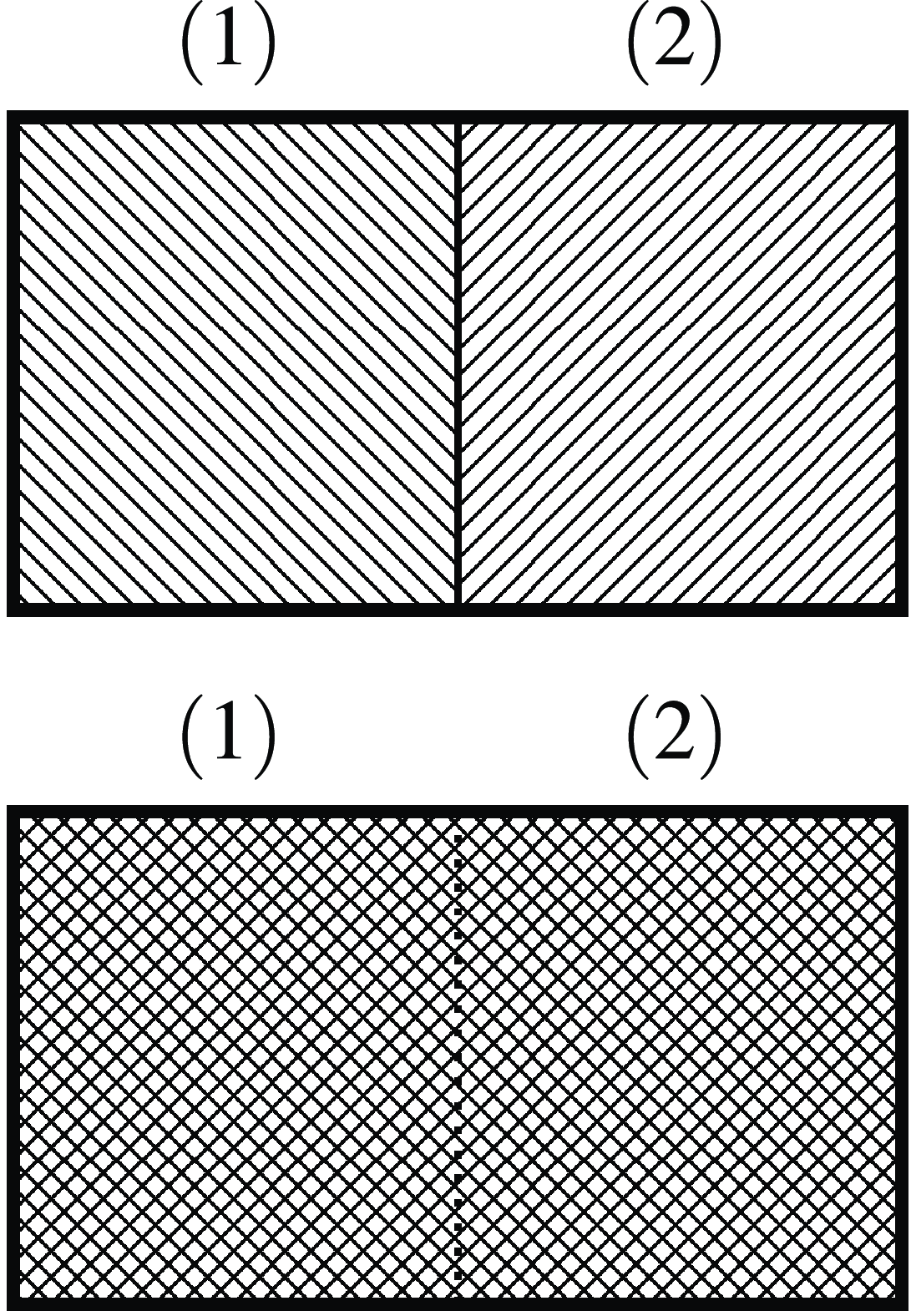
The alternative view I will present is the following: mixing is the transition from the unmixed state (where the values of the subsystems’ extensive variables do not extremize the entropy) to the mixed state (where they do) as a result of the removal of the constraint on the flow of the mole number of each gas between the subsystems.
It is assumed that the temperatures and pressures on each side of the partition are equal. This means that the system is already in mechanical and thermal equilibrium, leaving only the mole number constraints to be removed. In the context of
 $\left( {{M_G},{f_G}} \right)$
, the only equilibrium there is left to achieve is chemical equilibrium: removing the partition between the subsystems will allow the flow of the mole number quantity of each type of gas between the subsystems until the chemical potentials of each subsystem become equal (figure 1).
Depiction of the mixing process according to the Gibbs’s representation. The initial, unmixed system is depicted on top and the final, mixed system on the bottom.

The final equilibrium values of the mole number quantities are calculated by extremizing the entropy:
 $$0 = dS = \left( {{{\mu _1^{\left( 1 \right)}} \over T} - {{\mu _1^{\left( 2 \right)}} \over T}} \right)dN_1^{\left( 1 \right)} + \left( {{{\mu _2^{\left( 1 \right)}} \over T} - {{\mu _2^{\left( 2 \right)}} \over T}} \right)dN_2^{\left( 1 \right)},$$
concluding that the condition for equilibrium is
 $\mu _1^{\left( 1 \right)}/T = \mu _1^{\left( 2 \right)}/T$
and
 $\mu _2^{\left( 1 \right)}/T = \mu _2^{\left( 2 \right)}/T$
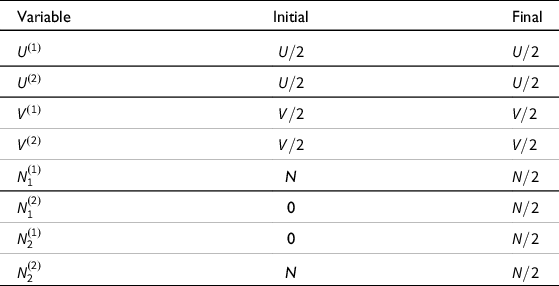
. Imposing this condition implies that the gases expand to fill the volume of the container, with final values as illustrated in table 1.
Table illustrating the initial and final values of the extensive variables of the subsystems before and after the removal of the constraint on the mole number
| Variable | Initial | Final |
|---|---|---|
 ${U^{\left( 1 \right)}}$ |
 $U/2$ |
 $U/2$ |
 ${U^{\left( 2 \right)}}$ |
 $U/2$ |
 $U/2$ |
 ${V^{\left( 1 \right)}}$ |
 $V/2$ |
 $V/2$ |
 ${V^{\left( 2 \right)}}$ |
 $V/2$ |
 $V/2$ |
 $N_1^{\left( 1 \right)}$ |
N |
 $N/2$ |
 $N_1^{\left( 2 \right)}$ |
0 |
 $N/2$ |
 $N_2^{\left( 1 \right)}$ |
0 |
 $N/2$ |
 $N_2^{\left( 2 \right)}$ |
N |
 $N/2$ |
This representation of mixing is rather different compared with the representation based on
 $\left( {{M_s},{f_s}} \right)$
and its associated semipermeable membranes. In the process based on
 $\left( {{M_s},{f_s}} \right)$
, mixing is initiated by allowing the “partial pressures” of each gas to push on each semipermeable membrane, expanding the volume that each gas occupies. In the process based on
 $\left( {{M_G},{f_G}} \right)$
, the pressures and temperatures of each subsystem are assumed to be equal, so mixing is initiated by removing the mole number constraint.
In the face of the problems described in section 3.1, and given that one can recover the standard numerical answer to the entropy increase on mixing on the basis of the Gibbs’s representation of a mixture,
 $\left( {{M_G},{f_G}} \right)$
, it seems reasonable to abandon the standard representation
 $\left( {{M_s},{f_s}} \right)$
+ volume overlap as a representation of a mixture and instead adopt
 $\left( {{M_G},{f_G}} \right)$
as the better representation.
6. Conclusion
This article has addressed the issue of the existence of two incompatible representations of mixtures in the thermodynamics literature. I adopted a simplified version of the geometric formulation of thermodynamics, including a mathematically precise definition of a thermodynamic system, to remove the ambiguity in the definition of a mixture and compare the two representations against the same formal background. I argued that the representation based on Gibbs’s description of mixtures is preferable to the standard representation, which takes partial pressures seriously. Abandoning the standard representation meant we also had to abandon the standard and popular representation of the mixing process based on semipermeable membranes, which makes explicit use of partial pressures. I presented an alternative representation of mixing based on the Gibbs’s representation of mixture and clarified the role of partial pressures in thermodynamics in the context of Dalton’s law. On a broader level, I hope my argument has shown that a judicious use of additional mathematical structure can help us make progress on foundational issues in physics and, in particular, thermodynamics. As philosophers, it is our duty to consider the extent to which different formulations of a theory may offer new insights into its structure.
There are two further philosophical avenues of research that stem from this work. The first avenue is to further examine the proposed representation of mixtures. A notable absence from the content of this article, and a closely related topic often discussed in the context of thermodynamic mixtures, is Gibbs’s paradox. This concerns how the entropy change due to mixing depends on the difference between the components of the mixture. But in what sense are the components different? And what is the relation of the “components” of the mixture to the mixture itself? In future work, I intend to examine how this new representation of mixtures leads to new foundational discussions of indistinguishability in thermodynamics.
The second, more general, avenue concerns my proposed definition of a thermodynamic model of a physical system and the associated alternative mathematical presentation of the science of thermodynamics. We may investigate which other physical systems may be represented as thermodynamic models and examine what this reveals about their structure.
Acknowledgments
Thanks to three referees whose input considerably improved this article and to Bryan Roberts for careful reading of this article and conversations on this topic.