1. Introduction
For many years it was the received view in philosophy of psychology, and in philosophy of science generally, that the multiple realization of special science kinds decisively refutes any hopes that they can be identified with or reduced to basic science kinds. The core example was always the reduction of sensation kinds to neuroscientific kinds (Putnam Reference Putnam1967; Block and Fodor Reference Block and Fodor1972). But the reasoning was readily applied to other classic cases such as economic kinds and physical kinds (Fodor Reference Fodor1974), and to genetic kinds and molecular biological kinds (Kitcher Reference Kitcher1982). Sometimes the claim of multiple realization was advanced as a consequence of the empirical observation of actual multiple realization (Putnam Reference Putnam1967; Block and Fodor Reference Block and Fodor1972; Kitcher Reference Kitcher1982). Other times the claim of multiple realizability was advanced as a claim about the proper or likely form of special science explanations, superseding actual empirical evidence of the contingent coextensiveness of kinds (Block and Fodor Reference Block and Fodor1972; Fodor Reference Fodor1974). Both claims have some appeal, and the antireductive consensus grew strong.
It is now evident that historical discussions of multiple realization were unclear in several ways. Recent discussion of multiple realization have aimed to increase clarity in order to better evaluate the evidence and arguments, both for and against multiple realization (Bickle Reference Bickle1998; Bechtel and Mundale Reference Bechtel and Mundale1999; Heil Reference Heil1999; Sober Reference Sober1999; Shapiro Reference Shapiro2000; Clapp Reference Clapp2001; Kim Reference Kim2002; Polger Reference Polger2002; Gillett Reference Gillett2003; Couch Reference Couch2004; Richardson Reference Richardson2008; Shapiro Reference Shapiro2008). In this article I suggest that current discussions of multiple realizability have nevertheless been hindered by two lingering confusions. The first is the failure to recognize that facts about multiple realization are always relative or relational facts. The second is the mistaken assumption that multiple realization is transitive. To illustrate my observations, I focus on the dispute between Lawrence Shapiro (Reference Shapiro2000, Reference Shapiro2004, 2008) and Carl Gillett (Reference Gillett2002, Reference Gillett2003; Aizawa and Gillett, Reference Aizawa and Gillettforthcoming).
2. Identity, Reduction, and the Multiple Realization Argument
The basic antireductive argument from multiple realizability is familiar. One presentation of the argument proceeds as follows.Footnote 1 Where S is a special science kind and the B's are base science kinds:
1. Reduction of kind S to a kind B requires a 1:1 relation between S and B.
2. S is (in fact) multiply realized or (in principle) multiply realizable.
3. If S is multiply realized or multiply realizable then there is a many:1 relation between S and the B's.
4. There is a many:1 relation between S and the B's.
5. S cannot be reduced to a B.
Now there were always holdouts against the antireductive consensus (Lewis Reference Lewis1969; Kim Reference Kim1972, Reference Kim1992; Richardson Reference Richardson1979; Richardson Reference Richardson1982; Enç Reference Enç1983). Yet the tide did not really begin to turn until the 1990s.
The most widespread criticism of the multiple realization argument attacks its first premise, arguing that reduction does not require a 1:1 relation between reduced and reducing kinds (e.g., Schaffner Reference Schaffner1967; Richardson Reference Richardson1979; Bickle Reference Bickle1998). Another line of objection claims that the multiple realization argument fails to establish that the multiply realized kinds do not share anything in common after all (Kim Reference Kim1972; Adams Reference Adams1979) or that reasons that favor multiple realization are reasons against taking them to be unified kinds at all (Lewis Reference Lewis1969; Kim Reference Kim1972). This latter objection draws premise (2) into question. And recently this second line of attack has been given renewed vigor by critics who argue that whether or not multiple realizability is in principle possible, the evidence in favor of it is much less compelling than its advocates suggest (Bickle Reference Bickle1998, Reference Bickle2003; Bechtel and Mundale Reference Bechtel and Mundale1999; Shapiro Reference Shapiro2000, Reference Shapiro2004; Sullivan Reference Sullivan2008).
This much is intended to give the flavor of the dispute. Now is not the time to review all of the arguments for or against the multiple realization argument. My interest herein will be in premises (2) and (3).
3. Shapiro's Recipe
Shapiro (Reference Shapiro2000) provides a recipe for determining when a special science kind is in fact multiply realized. Shapiro's is one of the lines of reasoning that aims to show that premise (2) is true for many fewer special science kinds than is often supposed, and this has brought him in for some criticism (Gillett Reference Gillett2003; Aizawa and Gillett, Reference Aizawa and Gillettforthcoming). The criticism is that Shapiro's recipe yields the wrong answer when applied to certain simple cases. I’ll argue that Shapiro's recipe is the right one and, furthermore, that his understanding of multiple realization reveals a problem with premise (3).
Shapiro (Reference Shapiro2000) is perplexed that so much discussion of multiple realization has proceeded without any explicit attention to the question of when two instances or realizations of a kind are the same or different—that is, to what makes realizations multiple or heterogeneous rather than unitary or homogenous. This is the lacuna he aims to fill. The simple answer is that multiple realization occurs when the various instances of special science kind S are cross-classified by the base science kinds, the B's. But that is only to push the question back a step. We must now ask, when is S correctly cross-classified by the B's? The answer is captured by Shapiro's slogan: Same but different. Multiple realization occurs when items of the same special science kind fall into different base science kinds. If special science kinds are often or always functionally individuated kinds per Fodor (Reference Fodor1974), which Shapiro does not dispute, then the recipe comes down to this: “To say that a kind is multiply realizable is to say that there are different ways to bring about the function that defines the kind” (Shapiro Reference Shapiro2000, 644).
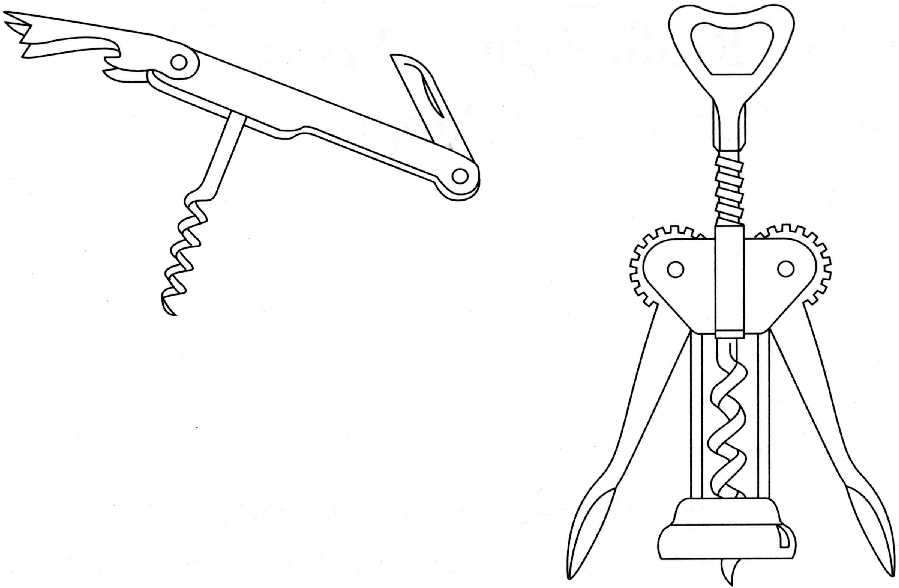
Shapiro illustrates the application of his recipe with two main cases: corkscrews and eyes. Are a waiter's corkscrew and a double-lever corkscrew different realizations of the kind corkscrew? Yes, answers Shapiro, because they each achieve the function of removing corks from bottles in different ways. This is evident from the fact that the respective explanations of how they each achieve their results will appeal to different mechanical principles (Figure 1). What about two waiter's corkscrews that differ only in color? No, answers Shapiro, because while they are physically different tokens they do not achieve their effect in different ways. They both remove corks from bottles in the same way. And what of two waiter's corkscrews that differ in physical composition, one made of aluminum and the other of steel? Here too Shapiro maintains that the properties of the pieces of aluminum and steel that are relevant to their capacities to function as levers in bottle opening mechanisms—their rigidity, for example—are shared by the two instances. Despite myriad superficial differences, the two devices nevertheless open bottles in the same way. To be sure, bits of aluminum and steel differ in countless ways, including (ultimately) in their particular forms of rigidity. But they do not differ in their rigidity in a way that makes a difference to their individuation as mechanical devices. The two pieces of metal contribute to bottle opening in the same way: each by being capable of acting as rigid levers.
Two different kinds of corkscrews: a waiter's corkscrew (left) and a double-lever corkscrew (right). From Shapiro Reference Shapiro2004, 2.

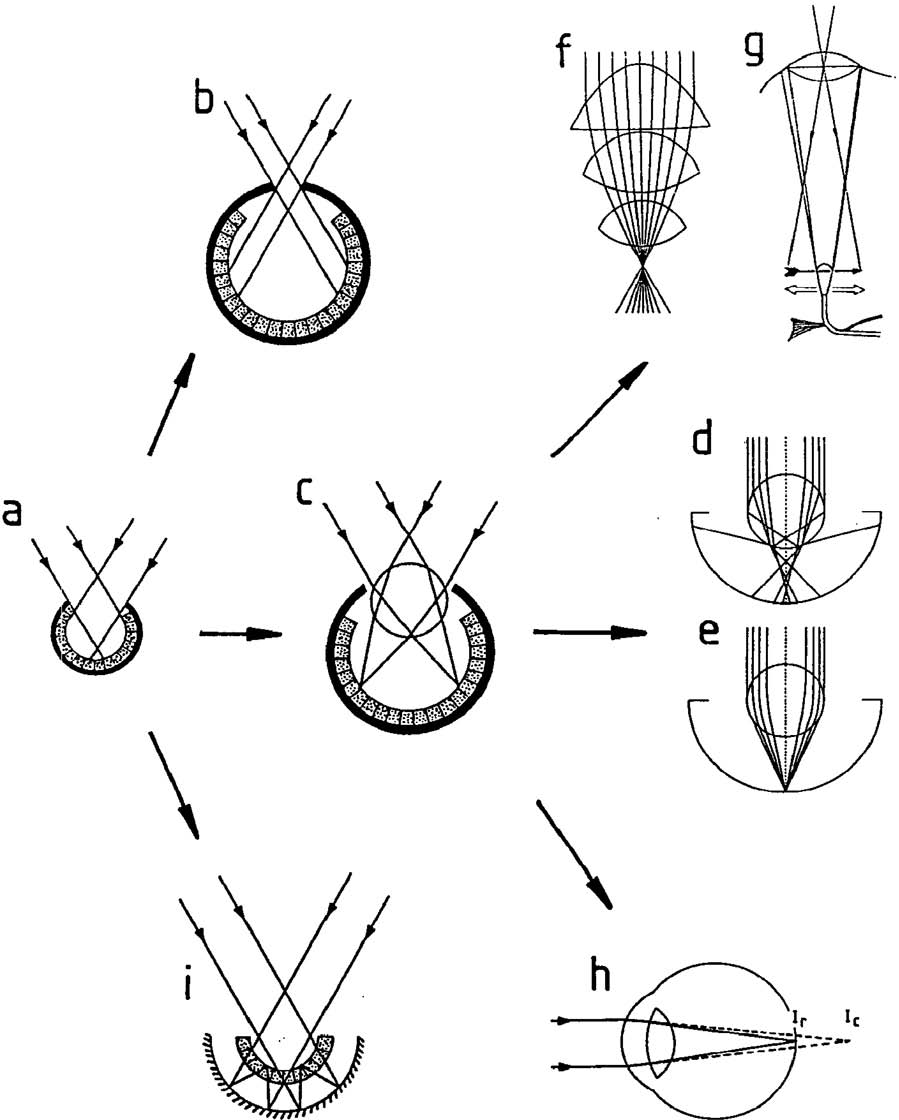
So too with the case of eyes. Numerous eye types are found in nature, and most have evolved more than once (Figure 2). These eye types are individuated by biological anthropologists and anatomists according to how they focus light onto photoreceptive cells (Land and Fernald Reference Land and Fernald1992). These are, all would agree, different ways of being an eye. If two eyes have the same optical characteristics, then Shapiro counts them as the same kind of eye. Does it also matter whether these optical characteristics are achieved by, say, different molecular structures? Shapiro argues that it does not. Concerning the octopus eye and mammalian eye, he writes:
Each eye has a single lens that causes an inverted image to fall on a retina, where light is then transformed into electrical signals. Because it is the lens and the retina that contribute to the ability of the eye to see, Putnam might shake off as irrelevant the information that the lens of the octopus's eye is composed of one kind of protein and the lens of the mammalian eye of another, or that the two eyes utilize different kinds of visual pigments. The processes that result in formation and analysis of an image screen off these facts about microcomposition. Block and Fodor, were they to deny that octopi and mammals have the same kind of eye, would apparently not regard these processes of image formation as physically interesting. For Block and Fodor, eyes would count as distinct whenever they differ in molecular composition. But if the line of argument I have pursued is correct, Block and Fodor would for similar reasons be committed to distinguishing between kinds of corkscrews simply on the basis of their color. (646)
Nine varieties of camera eyes. From Land and Fernald Reference Land and Fernald1992, 6. Varieties of eyes are more numerous than these; compound eyes (as commonly found in insects) are not illustrated here.

The implication of Shapiro's argument is that, since we all agreed that differently colored corkscrews do not ipso facto count as heterogenous realizations of corkscrew, by parity of reasoning we should deny that molecularly different single-lens camera eyes ipso facto count as heterogeneous realizations of eye. And this seems right.
But not everyone agrees that molecularly different single-lens camera eyes count as the same kind of realizers of the kind eye, nor that aluminum and steel waiter's corkscrews count as the same kind of realizers of the kind corkscrew. Carl Gillett (Reference Gillett2003) argues that Shapiro's recipe leads to the wrong results. More precisely, Gillett postulates an ambiguity in Shapiro's recipe of “same function, different ways.” One kind of variation among realizers occurs when a function is achieved by realizers of different kinds, such as when the kind corkscrew is realized by waiter's corkscrews and double-lever corkscrews. These are the cases on which Shapiro focuses. But according to Gillett, there is another sort of variation that can result in multiple realization. The second case occurs when a function is achieved by realizers that differ in their composition or in their own realizations. These examples are such as the realization of the kind corkscrew by two waiter's corkscrews, one of which is made of aluminum and the other of steel. Although, Gillett concedes, both realizers perform their function in virtue of their rigidity, it is the rigidity itself that is achieved in different ways—one is dependent on aluminum and the other on steel. So, according to Gillett, the aluminum and steel waiter's corkscrews satisfy Shapiro's recipe after all: Same function, different ways.Footnote 2
4. Same but Different, Redux
Both Shapiro and Gillett claim to accept the “same but different” recipe. But whereas Shapiro concludes that steel and aluminum waiter's corkscrews are not different realizers of the kind corkscrew, Gillett arrives at the contrary result. And whereas Gillett holds that molecularly different single-lens camera eyes are distinct realizers of the kind eye, Shapiro arrives at the contrary result. How can we decide between these two applications of Shapiro's recipe?
According to Gillett, we first settle on our account of realization and then see what results it yields for multiple realization. Gillett argues that his account, being more general in virtue of being more inclusive, is to be preferred (Reference Gillett2003). And he maintains that it is the account that was favored by empirically minded philosophers of science such as Block and Fodor (Reference Block and Fodor1972; Fodor Reference Fodor1974), in contrast to the less inclusive account favored by science fiction–oriented metaphysicians such as Putnam (Reference Putnam1967).Footnote 3
The basic problem with Gillett's proposal is that it is unmotivated. There is no need to postulate an ambiguity in the notion of “ways” and a corresponding distinction among models of realization, for there is a straightforward factor that Gillett has overlooked. He supposes that something may be uniquely realized or multiply realized tout court. But multiple realization is plainly relativized. We should not ask, Is kind x multiply realized? Instead, the question must always be, Is kind x multiply realized by kind y? Put another way, multiple realization is a two-place relation. In discussion we often suppress the second place because it is tacitly understood or shared background. For example, we understand that questions about the unique or multiple realization of mental states concern whether psychological kinds are multiple realized by brain state kinds. We understand that questions about the multiple realization of genes concern whether they can be individuated solely in terms of protein structures (Kitcher Reference Kitcher1982).
Once we recognize this implicit relativization, it is easy to see how Shapiro and Gillett arrive at different answers about corkscrews and eyes. Shapiro asks whether a waiter's corkscrew and a double-lever corkscrew count as multiple realizations of corkscrews. Here the kind S is corkscrew and the B kinds are waiter's corkscrew and double-lever corkscrew. The question, then, is whether a hypothetical science of corkscrews treats waiter's corkscrews and double-lever corkscrews as different in kind or not. And so too for steel and aluminum corkscrews and for corkscrews of different colors. Shapiro imagines that a science of corkscrews would differentiate its objects according to the mechanical principles by which they operate. Doing so, Shapiro follows Fodor (Reference Fodor1974) in supposing that special science kinds will generally be functional kinds.Footnote 4 If this is right, then we can expect that a science of corkscrews would differentiate between waiter's corkscrews and double-lever corkscrews—but not steel and aluminum corkscrews or red and black corkscrews, because they do not differ in the mechanical principles by which they open bottles. The question of multiple realization is thus tied—whether tacitly or explicitly—to an individuative regime, ideally provided by a well-established science. There may be a science that attends to the distinction between rigidity-instantiated-in-steel and rigidity-instantiated-in-aluminum, but corkscrew science (Shapiro bets) would not be that science.
Gillett's mistake is to suppose that if he can find a scientific taxonomy that attends to the steel/aluminum difference, then that will show that a steel waiter's corkscrew and an aluminum waiter's corkscrew are different realizations of corkscrew. But what he has shown is not that corkscrew science will distinguish these things, but only that some science would distinguish these things. In Shapiro's (Reference Shapiro2000) terminology, the difference between aluminum and steel composition is not treated as a relevant difference by corkscrew science, which pays attention to mechanical operation rather than material composition.
Returning now to the case of eyes, Shapiro applies the same principle. He supposes that from the point of view of a science that deals in the special science kind eye, eyes will be differentiated according to their mechanical operation, that is, their functional organization, rather than their composition. So camera eyes that differ only by which photosensitive pigments are in their cones will not count as different kinds of eyes, but camera eyes with different lenses—that is, that differ in the optical principles by which light is focused onto photoreceptive cells—will count as different kinds of eyes. Of course, there may well be another science that does attend to the differences in photosensitive pigments, and it may count the above situation as one in which we are dealing with different kind of cones, or different kinds of retinas, or some such. But difference in cone type does not automatically ramify into difference in eye type. If it did, the science of eyes would count normal variation in photoreceptors as showing that different humans have different eyes, rather than as having incidental variations among eyes of the same kind. But it does not.
5. All the Way Down
Making explicit the relative or relational component of multiple realization claims helps to explain Shapiro's (Reference Shapiro2000, 2008) idea that not just any differences count as multiple realizations. Only some differences among corkscrews are relevant to their typology by the science of corkscrews, and only some differences among eyes are relevant to vision scientists.Footnote 5 Shapiro does not deny that variation is the rule in nature. The point is only that not all such variation counts as multiple realization.
This observation is relevant to interpreting premise (3) of the multiple realization argument. It asserts:
3. If S is multiply realized or multiply realizable then there is a many:1 relation between S and the B's.
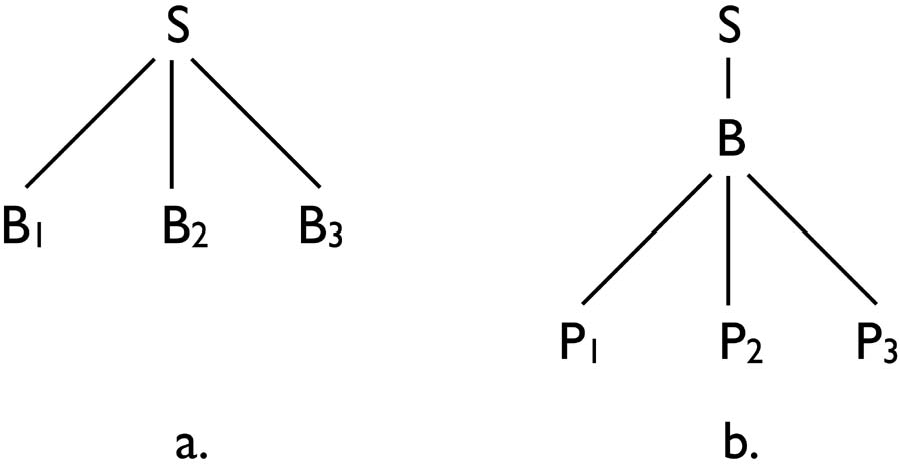
But (3) assumes that there is something like multiple realization tout court, such that if S is multiply realized then there is a many:1 relation between S and the B's. But if S is multiply realized by the physical kinds P 1–P n, say, then this may tell us nothing about the multiple realization of S by the B's. Consider again the case of the aluminum and steel corkscrews. Premise (3) would have us conclude from the fact that waiter's corkscrews can be made out of aluminum or steel that aluminum and steel waiter's corkscrews count as different realizations of the kind corkscrew. In short, (3) assumes that multiple realization is transitive: If S is realized by B's, and B's are multiply realized by P's, then S is multiply realized by B's. But the multiplicity of the P's qua physical kinds may be irrelevant to the multiplicity of the B's qua corkscrew kinds. B's may be multiply realized by P's, that is, the science of P's may cross-classify the B's (Figure 3b). But from that it does not follow that S is multiply realized by B's, that is, that the science of B's cross-classifies the S's (Figure 3a).
Multiple realization of S by B's requires variations in the B's that are relevant to their classification qua B's, not just qua P's.

To know whether the aluminum and steel waiter's corkscrews are different realizations of corkscrew, we need to know whether they differ not just in any way but whether they differ qua instances of the kind corkscrew. That is, we need to know whether aluminum and steel waiter's corkscrews are different relative to the taxonomic principles of a science of corkscrews.
So once we recognize that multiple realization is not absolute (tout court) but relative, we also find that it is not transitive. Premise 3 therefore requires revision. The correct principle is:
3*. If S is multiply realized or multiply realizable by B's then there is a many:1 relation between S and the B's.
This principle avoids the ambiguity in (3) that results from a failure to make explicit the relativization of multiple realization. But (3*) is also more demanding, for it says that multiple realization of S by the B's requires particular sorts of differences among the B's, and to find out which differences are relevant we must attend to the sciences that are in the business of classifying S's and B's, respectively. On the question of the multiple realization of mental states by brain states, Bechtel and Mundale (Reference Bechtel and Mundale1999) and Shapiro (Reference Shapiro2004) remind us that the taxonomic schemes of these sciences have coevolved, making it likely that the S-kinds of psychology are not wildly cross-classified by the B-kinds of the neurosciences, contrary to what many philosophers have supposed. While it may be disputed whether this interpretation accurately presents the relevant sciences (Kim Reference Kim2002; Richardson Reference Richardson2008; Aizawa, Reference Aizawaforthcoming), such challenges differ from those that simply look for any variation among realizers.
6. Conclusion
I have tried to draw out two confusions about multiple realization: that it is an absolute or tout court matter, and that it is transitive. These confusions are related, and their appeal stems from failing to keep track of the theoretical and empirical reasons for caring about multiple realization to begin with—namely, we are interested in whether some sciences cross-classify others. We often rely on simplified toy examples such as corkscrews, and even genuine examples such as eyes are often idealized and taken out of context. As a result, it is easy to forget that we are always interested in the explanatory and taxonomic regimes of sciences, even the hypothetical science of corkscrews.