1. Introduction.
In a recent article Laura Perini (Reference Perini2005) has investigated the extent to which the visual representations commonly employed in science can be said to ‘bear truth’. The motivation for this investigation is to establish that visual representationsFootnote 1 are capable of playing a ‘genuine’ role in the explanations and arguments of science. Perini appears to believe that the only way that visual representations could play such a role is by bearing truth, and so that her investigation is a necessary prerequisite for “an explanation of how figures function in [scientific] arguments” (Reference Perini2005, 283). In this paper, I will attempt to reconstruct and evaluate this line of reasoning. I will claim that visual representations may play a genuine role in the explanations and arguments of science without bearing truth, and thus that the general motivation for Perini's investigation has been undermined. Of course, it is compatible with my conclusion that there are some cases where visual representations are used as truth-bearers in scientific discourse and thus that Perini's investigation, or some variant of it, would be required for a comprehensive account of the role of visual representations in scientific arguments. I do not think, however, that this is how the role of the majority of visual representations in scientific discourse is most profitably understood. I will support this general intuition by investigating a paradigm case of visual representation in science, namely, the use of structural formulas in organic chemistry. I will argue that these representations play (at least) two distinct roles in organic chemistry, and in neither of these roles is it appropriate to think of these representations as bearing truth. During the course of my investigation, I hope to exemplify an approach to the question of the role of visual representation in science that is an alternative to the abstract argument by which Perini concludes that visual representations must play the role of truth bearers. I will conclude by suggesting that the role of many visual representations in science mirrors the sorts of roles played by structural formulas in organic chemistry.
Perini's paper begins by noting, quite correctly, that the arguments and explanations produced and published by scientists frequently make use of diagrams, pictures, and other sorts of visual representations. Furthermore, these figures are not mere decoration. They seem to play an important, if not essential, role in the effective presentation and defense of scientific claims. A quick perusal of a textbook in molecular biology or organic chemistry (and many other fields as well) will provide support for Perini's claim, and a course in either of these fields will make it difficult to imagine how these sciences could be taught without the use of figures, pictures, and diagrams. Any attempt to provide an account of scientific reasoning would presumably want to come to terms with this aspect of scientific practice. Indeed, Perini's project is motivated by the desire to make room for an account of scientific discourse that takes its visual aspects seriously. Rather than consigning such visual representations to a merely heuristic role, she wants to understand them as full-fledged components of scientific arguments, explanations and descriptions.
Worries arise when one tries to accommodate the empirical fact that visual representations play an important role in scientific practice within philosophical accounts of the nature of explanations and/or arguments. Arguments are—paradigmatically at least—sequences of claims. These sequences begin with premises independently acknowledged or argued for and then proceed by steps recognized, either explicitly or implicitly, as legitimate (e.g., truth preserving) to the conclusion of the argument. The components of such sequences are expressions capable of being true or false, or to use Perini's language, capable of ‘bearing truth’. Similarly, while scientific explanations have been analyzed in a variety of ways, they are also typically understood as claims or sequences of claims. For example, according to most nomological models of explanation a scientific explanation is an argument, while according to erotetic models an explanation is an assertion that answers a particular question. Either way, the components of scientific explanations seem to be claims. As a result, a philosophical account of these two central forms of scientific discourse would seem to require understanding this discourse as collections or sequences of claims. Given the prevalence of visual representations in scientific discourse, it begins to seem that if these visual representations are to be taken seriously as genuine parts of scientific discourse, they will have to be understood to express claims.
As philosophers, we tend to think of claims as expressed by utterances and/or sentences; that is, we think of claims as being conveyed by certain standard linguistic symbol systems. It is difficult to say what makes a symbol system linguistic, or whether there is anything essential about the role of linguistic systems in the expression of claims. Correspondingly, it is unclear whether, or under what conditions, symbol systems distinct from those that are standardly linguistic can be used to express claims. To simply define claims or propositions as that which is expressed by sentences or utterances would be to take an implausible (given American Sign Language for one) stand on both of these difficult questions. If this sort of dogmatic approach is avoided, then there seems to be a legitimate question as to whether symbol systems such as those employed in the visual representations of science can be used to express claims. Answering such a question would require both the classification of symbol systems and some way of deciding whether or not a particular system type could express a claim. In later parts of her paper, Perini provides both such a classification scheme and a criterion by which one could decide whether a particular symbol system is capable of ‘bearing truth’. She then proceeds to classify some of the symbolic systems used in scientific visual representation and to argue that they satisfy her criterion. If she is right, then she will have shown that it is possible for the sorts of visual representations used in science to bear truth, and thus that it is possible for these representations to play a genuine role in scientific discourse.
2. Perini's Argument.
Though I have reservations about both the classification scheme and the criterion that Perini provides for deciding whether a symbol system can ‘bear truth’, I will not investigate the cogency of this aspect of her project. Instead, I want to focus on the idea that the only way to understand visual representations as having a ‘genuine’ role in scientific discourse is by finding some way to understand these representations as capable of being true or false. This is a presupposition of Perini's project in that the only motivation that she provides for trying to understand visual representations as truth-bearers is that they play such a prominent role in scientific discourse. Here is the argument that she provides for this point: “The support that premises provide a conclusion is analyzed in terms of validity or strength, and soundness, so any representation that is an integral part of an argument must be one to which those features could be relevant. Validity, strength, and soundness are understood in terms of the truth conditions of premises and conclusions, so representations that contribute to arguments must have the capacity to bear truth” (Perini Reference Perini2005, 263).
I suppose that the idea here is that for any set of representations to be understood as an argument, those representations must be understood to be in logical or evidential relationships with one another. These sorts of relationships can hold only between truth-bearers, because the truth-values of the relata are essential to the definition of these sorts of relationships (e.g., A implies B if and only if whenever A is true, B is true). As a result, if two representations are in logical or evidential relationships with one another, then these representations must be capable of being true or false. Thus, if some representation is a component of an argument, that representation must be capable of being true or false. If this conclusion is joined with the empirical premise that visual representations are components of scientific arguments, then it seems to follow that these visual representations must be capable of being true or false.
But this cannot be right. By parallel reasoning, one could move from the empirical observation that numerals are important contributors to the explanations and arguments of mathematicians to the conclusion that numerals must be capable of being true of false. Numerals are, of course, signs for numbers. Neither a numeral nor the number that it expresses could be said to ‘bear truth’. This would be a category mistake. Numbers are objects, and objects cannot be either true or false. You can make claims about numbers, but a number is not a claim. Likewise, a numeral is a name, or more generally a denoting expression, and denoting expressions are not, by themselves, either true or false. You can make a claim using a name or denoting expression, but they are not claims. Similarly, it would not follow from the fact that mathematicians make frequent use of the less-than sign (<) that such signs or what they stand for are capable of being true or false. It is true that both numerals and less-than signs play an important role in expressing mathematical claims, but their role is not that of a truth bearer.Footnote 2
Suitably interpreted, the claim that ‘representations that contribute to arguments must have the capacity to bear truth’ is quite plausible. Likewise, there also seems to be strong support for the claim that ‘visual representations are important contributors to scientific arguments’. However, as we have seen, the conclusion that ‘visual representations must have the capacity to bear truth’ does not follow. The argument is fallacious because of an equivocation on the term ‘contribute to an argument’. When used in the first statement, a representation ‘contributes to an argument’ only by being in logical or evidential relationships with the other representations in the argument. If we consider an argument in written English, this would mean that complete sentences would be the only sort of representations that could contribute to an argument. Words, or subsentential expressions more generally, would not contribute to an argument in this sense. When used in the second statement, a representation can ‘contribute to an argument’ by simply being important to the expression of the argument. Returning to an argument in written English, not only complete sentences, but also words, subsentential expressions, and even punctuation marks would contribute to the argument in this second sense. Numerals and less-than signs clearly contribute to mathematical arguments in the second sense of this term—they are important tools for expressing mathematical claims. They do not contribute to mathematical arguments in the first sense of the term, however, because they do not (by themselves) express claims. As a result, it does not follow that numerals and less-than signs must have the capacity to bear truth.
In the case of visual representation in science, if one wants to establish that such representations must be capable of bearing truth, it is not enough to make the empirical observation that visual representations contribute to scientific arguments. Without establishing what kind of contribution these representations make—whether they contribute to arguments in the first or second sense—nothing follows, at least in virtue of Perini's argument, as to whether the representations must be understood to bear truth. In order to decide in which sense visual representation in science contribute to the arguments in which they occur, one would have to decide whether these representations are used like sentences to express claims, or whether they contribute to the arguments in which they occur in some other way. In the absence of any other general arguments, this would have to be done on a case-by-case basis. Perhaps some visual representations in science are used as truth-bearers and some are used as denoting expressions. In any individual case, one would have to decide in advance of applying Perini's argument whether the conclusion of that argument was true in the relevant case. As a result, Perini's argument can play no useful role in revealing the semantic, or explanatory, role of visual representations in science. Recognizing this does not mean that none of the visual representations in science play the role of truth-bearers, but it does undermine Perini's idea that there is a general need to provide an account of how visual representations can bear truth in order to allow that visual representations play a ‘genuine’ role in scientific discourse.
3. Structural Formulas in Organic Chemistry.
As I hope to have shown in the previous section, Perini has provided no general philosophical reason to suppose that the visual representations used in science must be understood to bear truth. Recognizing that such representations contribute to the scientific discourses in which they occur leaves open the question of how they contribute. Even if it is conceded that visual representations make a semantic contribution to scientific discourse, there is still a range of semantic roles that they might play. They might be more like numerals than like equations, or they might function more like objects, the referents of names, than they do like names themselves. Moreover, there is no reason to suppose that visual representations will play the same semantic role in all scientific contexts. In order to get a more concrete grip on how visual representations contribute to scientific discourse, I will briefly consider the roles that structural formulas play in the discourse of organic chemistry. I will investigate this question by considering what sorts of things are substitutable for structural formulas in their various roles. Insofar as the role of what is substitutable for a structural formula in organic chemistry is clear (or at least clearer than the role of structural formulas themselves), this approach should help to clarify how structural formulas contribute to the discourse of organic chemistry. As it turns out, I will argue that structural formulas contribute in (at least) two distinct ways, but in neither case is it appropriate to understand structural formulas to express claims.
By the end of the nineteenth century, Kekulé, Couper, and others had recognized that the connections between and (to a certain extent) the three-dimensional distribution of atoms in space were the characteristics that individuated chemical kinds (see Benfey Reference Benfey1964). As a consequence of this recognition, there was increased use of and significance attributed to structural formulas, particularly in organic chemistry. The uses and significance of structural formulas have evolved since the nineteenth century and as a result there are many varieties of structural formulas in contemporary organic chemistry. I think it is fair to say, however, that all varieties of structural formulas are visual representations and most are examples of what Perini calls a diagram (i.e., a visual representation with linguistic syntax; see Perini Reference Perini2005, 267–273). Structural formulas are built out of a fixed alphabet of signs (such as letters, dots and straight lines) and the spatial distribution of these signs is relevant to determining what the formula signifies. Letters are used as atomic symbols (either singly, e.g., ‘H’ for hydrogen, or together, e.g., ‘Si” for silicon), straight lines are used as signs for chemical bonds, and dots are used to indicate electrons. By distributing straight lines between the atomic symbols, the connectivity of atoms in a compound is represented. Various supplementary devices (such as dark and dashed lines) are used to indicate the relevant three-dimensional distribution of the atoms.
The most fundamental way that structural formulas are used in organic chemistry is as labels, or names, for chemical kinds. Since chemical kinds, or particular chemical compounds, are the fundamental entities whose properties and transformations are the objects of investigation in chemistry, it is important for the discipline to have unambiguous ways of denoting these compounds. Structural formulas fulfill this role because, at least in some varieties, they can be put into one-to-one correspondence with chemical compounds. This is to say that any two distinct chemical compounds can be assigned distinct structural formulas and any distinct structural formulas denote distinct (possible) chemical compounds.Footnote 3 As a result, one way to ensure that claims about chemical compounds are unambiguous is to use structural formulas to refer to chemical kinds. Structural formulas are not arbitrary names for chemical kinds (though of course there are conventions that are essential for interpreting what a structural formula signifies); instead, they pick out the compound they (purport to) refer to by a sort of description. The structural formula carries information about the composition, connectivity and (to a limited extent) three-dimensional arrangement of the compound it purports to denote.Footnote 4 In this sense, structural formulas are like descriptive names such as ‘the author of 1984’ or ‘√16’. Descriptive names pick out the object that they refer to by description (see Evans Reference Evans1982, 31) and structural formulas describe the composition, connectivity, and spatial arrangement that a compound would need to have in order to be appropriately named by the formula.
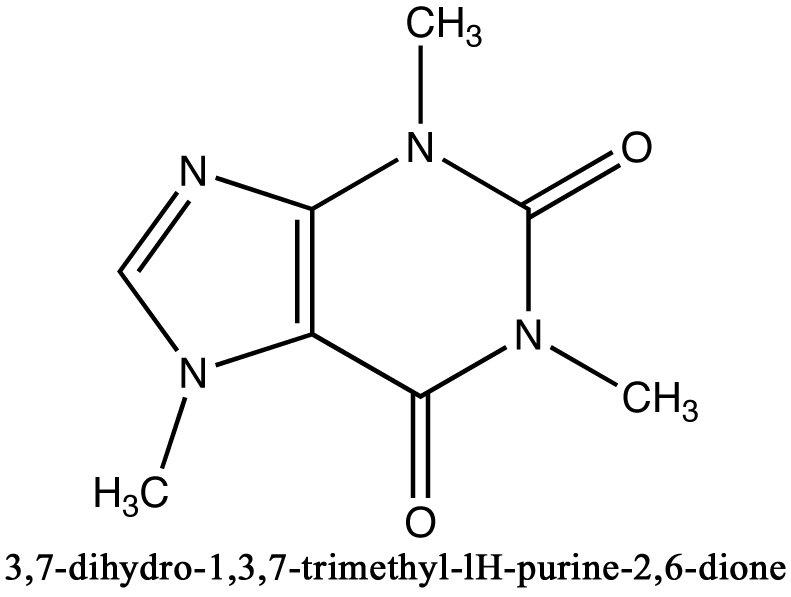
Further insight into, and support for, this account of the use of structural formula in organic chemistry can be obtained by considering what sort of representations are substitutable for this use of structural formulas within the discourse of the discipline. Early in the development of organic chemistry, the demands of scientific communication and information retrieval made it important for chemists to pay attention to their nomenclature. Through a series of international conventions (beginning in 1892), chemists have settled on a set of rules that constitute a systematic nomenclature. A systematic nomenclature is one in which, “each different compound may be assigned an unambiguous name” (Streitwieser and Heathcock Reference Streitwieser and Heathcock1981, 42). The IUPAC system, as these nomenclature rules are called, works by providing an algorithm for generating a descriptive name for each chemical compound. As a result, given a structural formula it is possible to assign to it a unique descriptive name using the IUPAC system (see Figure 1 for a sample structural formula and its corresponding systematic name). Similarly, the names generated by the IUPAC algorithm contain enough information about the composition, connectivity, and spatial arrangement of a compound that the structural formula of that compound can be generated from its name. In other words, the IUPAC system provides an effectively computable one-to-one mapping of structural formulas onto names. The choice between using an IUPAC name or a structural formula to denote a chemical compound on any particular occasion is one that is typically made on pragmatic grounds. So for instance, the reactants and products in a chemical equation can be denoted by either (or both) their structural formulas or their IUPAC names. In practice, both structural formulas and IUPAC names are often too cumbersome for frequent use, and so many chemistry texts produce a structural formula or systematic name the first time they refer to a compound and then use arbitrary labels (such as ‘compound A’ or ‘(1)’) to refer back to these descriptive names throughout the remainder of the text. The interchangeability of IUPAC names and structural formulas (in many, but not all, contexts) corroborates the suggestion that one important use of the structural formulas of organic chemistry is as something like a descriptive name. A descriptive name is not a claim; it is not capable of being true or false. Like a mathematical term such as ‘√16’, descriptive names can be used to help express a claim, but they do not ‘say’ anything until something is predicated of the object they denote.
Structural formula and its corresponding systematic name. This compound is otherwise known as caffeine.

Though systematic names can substitute for structural formulas when these formulas are being used as descriptive names, there are other uses of structural formulas in which systematic names are not capable of taking their place. In order to get a handle on this other major role that structural formulas play in organic chemistry, it will again be useful to consider what might stand in for structural formulas in this second sort of application. In introductory organic chemistry classes, students are often required to purchase model kits along with their textbooks. These kits are basically sets of balls and sticks. The balls and sticks can be put together to build physical models of organic molecules. These three-dimensional models of organic molecules can be extremely useful in learning how to produce and interpret structural formulas. Once a student has gotten the hang of it, it is possible to move back and forth between a physical model of an organic compound and a structural formula for that same compound. In some contexts, a structural formula can be thought of as a two-dimensional version of its corresponding physical model.Footnote 5 These physical models are not useful merely because they help the student learn how to use structural formulas; instead they often play an important role in understanding, or explaining, the physical and chemical properties of organic compounds. By manipulating a physical molecular model a chemist can explore the full range of three-dimensional configurations available to a particular compound. The possibility of arranging an organic compound into a particular configuration can often have a drastic impact on both the chemical and physical properties of the compound. In explaining configuration dependent properties, facts about the physical model, such as that it can be put into a certain configuration, can be used to infer certain facts about the organic compound for which it stands, such as that it can undergo a particular type of reaction. Inferences of this sort depend not only on substantial theoretical assumptions (about how structure is related to reactivity, say) but also on a host of conventions about how the model and the compound are related. The basic idea that underwrites this sort of case is that each spatial arrangement of the macroscopic model corresponds to a configuration that a molecule of the appropriate kind might adopt (see Giere Reference Giere2004 for a general attempt to explain how models represent reality through similarity relations). Of course, it is not possible to reproduce physical models of organic compounds on the printed page, and so structural formulas stand in for physical models in chemical discourse.Footnote 6 Systematic names are not capable of substituting for physical models in this role because none of the properties that they have as objects reflect the properties of the compounds that they denote. Names, even systematic descriptive ones, cannot be manipulated to reveal the possible spatial configurations of a compound. Structural formulas—supplemented with some additional conventions—are, on the other hand, objects whose characteristics can be used to infer properties of the compounds they denote.
4. An Example: Conformational Analysis and the Properties of 1,3-Dimethyl Cyclohexanes.
In order to flesh out the role of structural formulas as models, it will be useful to consider a concrete example. This example is intended to demonstrate how an investigation of the properties of structural formulas (and/or corresponding physical models) can support conclusions about the compounds they purport to denote. Furthermore, this example will make it evident how this use of structural formulas exploits features of these formulas that transcend the descriptive content implicit in their use as names, and thus why the use of structural formulas as models should be considered to be distinct from their use as names.
Though the basic idea of employing facts about structural formulas or physical models in order to explain the properties of chemical compounds has been around since the origins of structural organic chemistry,Footnote 7 conformational analysis emerged as a distinct subfield of organic chemistry in the 1940s and 1950s. The twist added by conformational analysis was to explain chemical and physical properties by investigating the three-dimensional arrangements of atoms in a molecule that are accessible by rotation around single bonds but which are otherwise compatible with the composition, connectivity, and optical asymmetries of the compound (these are known as the conformations of the compound). While it had long been recognized that rotation about double bonds involved breaking a bond and so was not ‘free’, it had generally been assumed (up until the 1920s at least) that there were no energetic barriers to rotation around single bonds. As a result, all conformations had been regarded as energetically indistinguishable variations of the same compound. Conformational analysis advanced organic chemistry by demonstrating that a lot of new and interesting chemistry could be explained by eliminating the assumption that rotation around single bonds was ‘free’ and thus by recognizing the possibility of important energetic differences between the conformations of a compound.Footnote 8 One consequence of this advance was that a systematic chemical name, or a structural formula used as a name (where, say, the arrangement of signs in the formula is not taken to reflect the three-dimensional arrangement of atoms in the compound it purports to denote), is unable to resolve the differences between conformations that are important in understanding the chemistry of some compounds.Footnote 9 In other words, while each distinct compound has its own systematic name, all of the conformations of a compound share the same systematic name, even though the differences between these conformations may be important to our understanding of the behavior of the compounds. However, by thinking of structural formulas as (roughly) two-dimensional projections of ball and stick molecular models, it is possible to regard (some of the) different arrangements of lines and signs on the page that constituted the same structural formula as corresponding to the various possible conformations of the compound the formula purports to denote. It is this additional correspondence that allows the structural formula to take on an additional role as a model of the compound in conformational analysis. Though compounds are individuated by the characteristics described in a systematic name or structural formula (when used as a name), understanding and/or explaining the properties of compounds may involve consideration of the conformations accessible to the relevant compound, and it is these conformations that can be investigated by using the structural formula as a model.
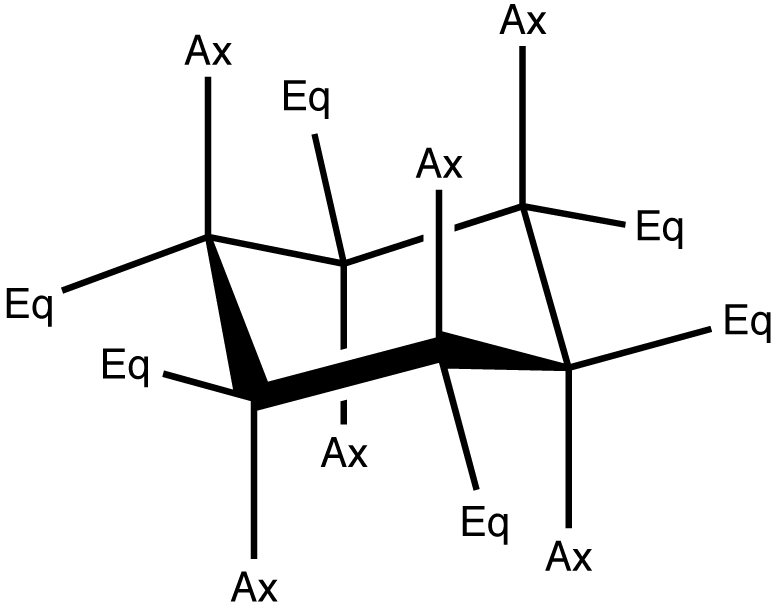
One of the early triumphs of conformational analysis was to explain some of the physical and chemical properties of cyclohexane and its variants. As its name suggests, cyclohexane is a saturated, cyclic hydrocarbon that contains six carbons bonded together into a ring. In addition to its neighbors in the ring, each carbon is bonded to two hydrogen atoms. Given that the bonds surrounding any particular carbon atom are ideally arranged such that they point to the vertices of a tetrahedron centered on the carbon nucleus (this corresponds to distributing the bonds so that they are as far away from one another as possible), the angle between any two bonds to one carbon atom should be about 110 degrees. If the carbon atoms of a cyclohexane molecule were arranged so that they correspond to the vertices of a regular hexagon, the angle between bonds in the ring would be 120 degrees. The difference between the ideal bond angle and the actual bond angle in a hexagonal configuration of cyclohexane results in a substantial amount of ‘angle strain’ (which is the destabilization of a molecule that results when its bond angles are not optimal) in the hexagonal configuration.Footnote 10 Because of this angle strain, the hexagonal configuration of cyclohexane is unstable, and the molecule spends most of its time in conformations that do not have any angle strain (because all of the bond angles are about 110 degrees). As an investigation of a molecular model will quickly reveal, there are actually several different possible conformations of cyclohexane that have no angle strain. These conformations can be further distinguished by the extent to which the hydrogen substituents on the ring carbons are kept away from one another (these are typically referred to as eclipsing interactions). The farther away from one another the hydrogens are, the less steric interaction there will be between the substituents and the more stable will be the corresponding conformation. The upshot is that there is a conformation of cyclohexane—called the ‘chair’ conformation (see Figure 2)—that is particularly stable and in which cyclohexane molecules spend the majority of their time (the higher the temperature the more time that is spent in less stable configurations).Footnote 11 I now want to go on to explain how recognizing that the chair form of cyclohexane is the most stable conformation, which was done by manipulation of models, allowed chemists to correct an initially plausible assignment of structural formulas to compounds isolated in the laboratory.
Chair form of cyclohexane, with substituents labeled “Ax” when in an axial position and “Eq” when in an equatorial position. In cyclohexane itself all the substituents would be hydrogen, while in a dimethyl cyclohexane two of them would be methyl groups (−CH3).

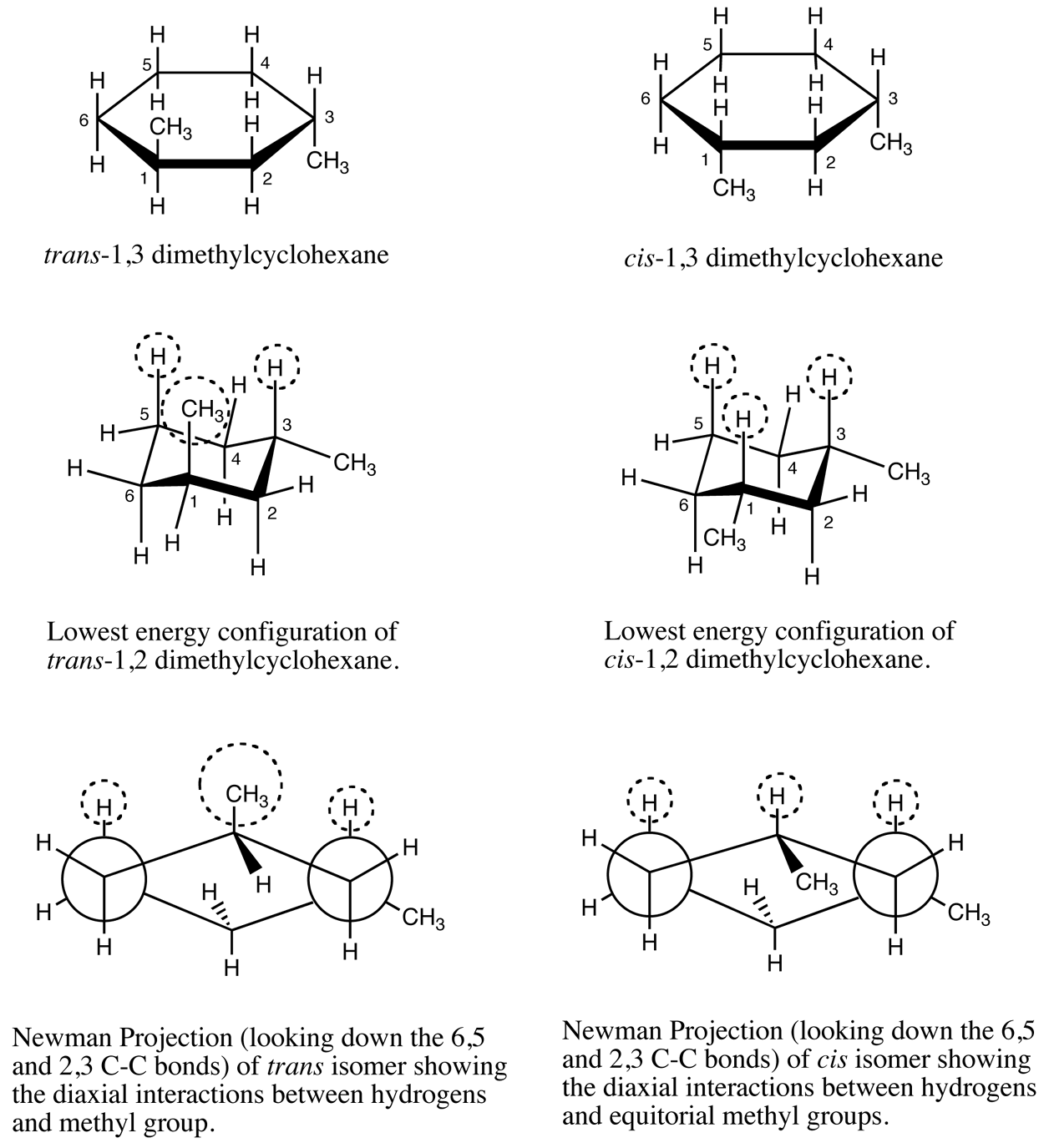
A variant of cyclohexane, 1,3-dimethyl cyclohexane is generated by replacing two of the hydrogens attached to the ring carbons with methyl groups (CH3-). The carbons on which these substitutions occur are, in this case, separated by one carbon that still has both of its original hydrogens. There are actually two distinct compounds that can be generated in this way. The first possible compound, in which both of the methyl groups are attached to the same side of the ring, is called cis-1,3-dimethyl cyclohexane, while the second possible compound, in which the methyl groups are attached to opposite sides of the ring, is called trans-1,3-dimethyl cyclohexane (see Figure 3). These two compounds do not differ in either their composition (in terms of numbers of atoms of various types) or in their connectivity (which atoms are connected to one another), but they do differ in the relative spatial arrangement of their atoms (this is what is indicated by the cis and trans modifiers in their names). As is typical with isomers of this sort, the compounds have different physical and chemical properties. One of the characteristic goals of organic chemistry is to explain these sorts of differences in chemical and physical properties in terms of differences in the structures of the two compounds. Of course, in this case, these differences must be explained in terms of the relative spatial arrangements of the atoms within these compounds.
Structural Formulas as Models. The top row shows the two distinct structural formulas for 1,3-dimethyl cyclohexane. These formulas reveal only the information contained in the systematic names, which are reproduced below the corresponding formula. The second and third rows contain structural formulas that bring out the steric differences between the lowest energy chair configurations of these distinct compounds. The assignment of boiling points based on structural formulas used as names—the first row—was incorrect. The correct assignment required recognizing and comparing the conformations available to these compounds as facilitated by the formulas in the second and third rows.

When cis- and trans- 1,3-dimethyl cyclohexane were first synthesized in 1922, they were made from a common precursor, which resulted in a mixture of the two compounds. After the compounds were separated and their physical properties (e.g., boiling points) measured, the compound with the lower boiling point was identified as the trans isomer, while the compound with the higher boiling point was identified as the cis isomer. This identification was based on both an empirical rule of thumb and an assumption, based on the descriptive content contained in the two names, about the relative energies of the two compounds. First, with isomers of this sort (they were then referred to as geometrical isomers), experiments had shown that the compound that is more energetically stable has the lower boiling point. This generalization is known as von Auwer's Rule. Because of this rule, if a good reason for thinking that one of these compounds was more energetically stable than the other could be provided, then it would be possible to decide which name and structural formula went with which experimentally isolated compound. Since trans isomers, by definition, have their substituents on opposite sides of the ring (or bond), it was expected that these geometrical isomers would be more energetically stable than their cis counterparts. This expectation was rationalized in terms of steric hindrance: trans isomers should be more stable because the bulky substituents are farther away from one another when they are on opposite sides of a ring or bond (rather than on the same side, as in cis compounds) and so are less apt to raise the energy of the compound by through repulsive interactions with one another. This sort of analysis had worked well with alkenes and cyclopentanes (where it had been found that trans isomers were lower in energy), and so it was extended in order to assign structures to the geometric isomers of 1,3-dimethyl cyclohexane. Thus, on the basis of descriptive information contained in the names of the two compounds—specifically that in the cis isomer the substituents were on the same side of the ring, while in the trans isomer the substituents were on the opposite sides of the ring—an assignment of formulas and systematic names to the physical compounds was made. This assignment, along with its corresponding rationalization, stood until 1947, when—after the birth of conformational analysis—it was realized that in fact the cis isomer of 1,3-dimethyl cyclohexane had less steric hindrance and was therefore more energetically stable than the trans isomer. Accordingly, following von Auwer's rule, the isomer with the lower boiling point was reassigned as the cis form of 1,3-dimethyl cyclohexane (see Rossini and Pitzer Reference Rossini and Pitzer1947).
The realization that cis 1,3-dimethyl cyclohexane should be expected to be more energetically stable than trans 1,3-dimethyl cyclohexane (and thus that the structural formulas had originally been misassigned) depended upon the conformational analysis of cyclohexane and its derivatives, and thus on the use of structural formulas as models. Recall that the ‘chair’ conformation of cyclohexane is a three-dimensional arrangement of the atoms and bonds that minimizes both the angle strain and the steric interactions (eclipsing interactions) in the molecule. The 12 hydrogens in chair cyclohexane can be divided into two groups (see Figure 2) according to whether their bonds to carbon are parallel to the ‘molecular axis’ (in which case they are known as ‘axial’ hydrogens) or perpendicular to the molecular axis (in which case they are known as ‘equatorial’ hydrogens). Substituted cyclohexanes also prefer chair configurations but, because of the substituents, there are often several possible chair configurations that differ in energetic stability. The principal sources of these differences in stability are steric interactions that result when substituents are in ‘axial’ positions. As can be discovered by investigating a molecular model, or a carefully drawn structural formula, the axial positions in the chair form of cyclohexane are relatively close to the axial positions on both of the carbons that are two vertices away from the original carbon in the cyclohexane ring. As a result, substituents that are in these axial positions are relatively close to, and have destabilizing steric interactions with, the hydrogens (or other substituents) in these neighboring axial positions (again, see Figure 3). Because of these destabilizing interactions, called 1,3 diaxial interactions (Vollhardt and Schore Reference Vollhardt and Schore1994, 118), the most stable configurations of substituted cyclohexanes are those chair configurations that have as many of the substituents in the equatorial positions as possible. As an investigation of the models (or the structural formulas being used as models) will show, it is possible to put cis-1,3-dimethylcyclohexane into a chair conformation such that both of the methyl substituents are in equatorial positions; however, it is not possible to do this with the trans isomer. All chair conformations of the trans isomer have one methyl group in an axial position and as a result the lowest energy conformation of the trans isomer is less energetically stable than the lowest energy conformation of the cis isomer. If these additional facts about the possible conformations of the isomers are taken into account, then von Auwer's Rule leads to the conclusion that, in fact, the cis-1,3-dimethylcyclohexane is the compound with the lower boiling point (and this was confirmed by other independent lines of evidence as well). By considering the full range of possible three-dimensional arrangements of the atoms in the 1,3-dimethyl cyclohexanes, it was possible to make an accurate prediction of the relative stabilities of these isomers. On the other hand, the prediction based just on the descriptive information contained in their names led to the wrong conclusion. The information contained in the systematic names, or in structural formulas used as names (e.g., the first row of formulas in Figure 3), is simply insufficient to evaluate the relative energies of these compounds. Sometimes cis isomers are more energetically stable than their trans counterparts, and so there is no straightforward way to infer which geometrical isomer will be more stable simply based upon its descriptive name. Instead, the detailed geometries of the possible conformations of the isomers must be compared, and in order to do this one must either build physical molecular models of the isomers, or compare the range of structural formulas possible for them, where these formulas are now used as models of the compounds.
When structural formulas are used as models of compounds rather than as descriptive names of them, they are objects that stand in for the compounds that they, in other contexts, would purport to name (see Giere Reference Giere, Magnani, Nersessian and Thagard1999 for a general account of a related representational use of the term ‘model’). Because a model is an object, you can manipulate it and discover that it has certain properties. For instance, one might find that it is not possible to put a particular, physical molecular model into a chair conformation with both of its substituents being equatorial. This fact about the possible arrangements of the physical model is not included in the descriptive information that the corresponding structural formula uses to pick out the compound it purports to denote, and so is not included in the systematic name of the compound either. Of course, not all of the properties that a model has will be relevant to the part of the world that it stands in for, but at least some of the characteristics of the model can be used to infer facts about the relevant part of the world. So by finding that a model cannot be arranged into a chair configuration with both of the substituents equatorial, one can deduce that a particular isomer has more substantial steric destabilization and thus the higher of two boiling points. Similarly, once the rules for producing, manipulating, and interpreting the appropriate sorts of structural formulas have been mastered, facts about which particular formulas can be generated by these rules may be used to support the same conclusion. The sorts of facts that can be discovered by manipulating a structural formula transcend the information contained in its corresponding systematic name, since this name is systematically ambiguous over all conformations of the compound, and this is why such names are not substitutable for structural formulas in these contexts. A systematic name can be unpacked to reveal the basic connectivity and three-dimensional distribution of the atoms in a compound, but structural formulas when used as models can be manipulated and investigated so as to reveal much more information about the compounds they denote. It is this further information available by investigating structural formulas as models that makes them so useful in the arguments and explanations of organic chemistry (see Goodwin Reference Goodwin2003 for more on explanations in organic chemistry). When used as a model it is facts that are true of, or in, the structural formula that make it so useful in the discourse of organic chemistry. So when a structural formula is used as a model, it is not true or false. Rather, certain claims are true or false in virtue of the structural formula, and these claims license conclusions, perhaps by way of assumed similarity relations that obtain between the relevant objects, about the chemical compounds that it denotes. The role of structural formulas in this context is therefore that of truth maker, not that of truth bearer.
5. Conclusion.
I will conclude by suggesting that the sorts of roles played by structural formulas in organic chemistry are fairly typical of the contributions of visual representations to scientific discourse more generally. The structural formulas of organic chemistry do not standardly express claims; they are not the sorts of things that can be regarded as true or false all by themselves. Still we have seen two distinct ways that these visual representations can contribute to scientific discourse—as something like descriptive names and as models. When used as a descriptive name, things can be said about the denoted compound using the structural formula. When used as a model, claims are made about the structural formula from which other claims about the compounds that they purport to denote may be inferred. Previous authors have brought out both of the roles for diagrams that were found in the particular case of structural formulas in organic chemistry, though they have tended to emphasize one or the other of these roles. For example, Nelson Goodman (Reference Goodman1976) characterizes the general conditions for diagrams to be components of notational systems, which are paradigmatically devices for uniquely classifying or naming objects. Ronald Giere (Reference Giere, Magnani, Nersessian and Thagard1999), on the other hand, considers diagrams to be one among many different forms of representational model and he thinks of models as the principle objects by which scientific theories represent reality. The case of structural formulas in organic chemistry suggests that Goodman and Giere are both right; in some contexts diagrams can act like part of a notation system, while in others they may act as models.Footnote 12 In considering the role of diagrams in science more generally, we should not be surprised to find that in many cases they will turn out to play a role in scientific discourse much like one of the roles emphasized by Giere or Goodman. Furthermore, there is some work that suggests that the broader class of visual representations (pictures, for example) might also be understood to play these two sorts of roles. Gary Malinas (Reference Malinas1991) has proposed a semantics for pictures that purports to account for the two sorts of semantic roles that we ‘intuitively’ attribute to pictures—that they refer to or denote objects in the world and that certain things are true in, or depicted by, them. Just as in the case of diagrams and structural formulas, in neither role are pictures properly understood to express a claim, or to be true or false full stop.
I hope, then, to have brought out why it is misguided to approach the question of how visual representations contribute to scientific discourse by assuming that such visual representations must be understood as potential bearers of truth. The abstract philosophical argument that motivates this approach rests on an equivocation. Furthermore, the much more local approach pursued in this paper—examining the explanations and arguments of a discipline in the hopes of finding what sort of entities or processes might be substitutable for its visual representations—has revealed that the paradigmatic visual representations used in organic chemistry do not play the role of truth bearers. Instead, as suggested by other philosophers who have thought about the functions of visual representations, structural formulas seem to play at least two roles—as descriptive names and as models.