1 Introduction
The goal of this paper is to offer a comprehensive account of the conditions under which labial harmony occurs in Turkic, Tungusic and Mongolic languages. Working within the framework of Radical CV Phonology (van der Hulst Reference Hulst, Carr, Durand and Ewen2005, Reference Hulst, Botma and Noske2012), I argue that labial harmony is often subject to two types of further requirements, stated in terms of licensing relations. Radical CV Phonology uses a limited set of elements that can be involved in such licensing, resulting in a restricted typology of labial harmony. I also propose a difference between lexically invariable elements, which are always visible, and elements derived through harmony, which become visible in cycles. Crucially, elements derived through labial harmony do not have access to elements derived through tongue-root harmony, accounting for the lack of labial harmony in high vowels in tongue-root harmony systems.
The structure of the paper is as follows. In §2, I introduce the Turkic, Tungusic and Mongolic harmony patterns that are the main focus of the paper.Footnote 1 §3 introduces Radical CV Phonology, and shows how vowel harmony is modelled in the framework. In §4, I analyse data from Turkic, introducing the two types of licensing relations that labial harmony is often subject to: bridge licensing and asymmetric licensing. I also discuss the restricted typology of labial harmony that follows from the theoretical assumptions adopted in this paper. In §5, I introduce the architecture of the model, whereby vowel harmony occurs in cycles within a segment, making a crucial distinction between lexically invariable elements and elements derived through harmony, and show how this accounts for the observation that labial harmony in Tungusic languages is only seen when both trigger and target are low. In §6, this architecture is further supported by data from Mongolic, where the transparency of /i/ and /ɪ/ to labial harmony finds a natural explanation if we assume cycles within a segment. Specifically, drawing on the different behaviour of epenthetic vowels in Tungusic and Mongolic, I argue that in Tungusic every vowel is present in the structure prior to vowel harmony, but that in Mongolic vowels are inserted into the structure at various points, thus allowing for their transparency to labial harmony. §7 summarises and concludes.
2 Labial harmony
Across the Turkic languages there is a great deal of variation with regard to the restrictions that govern labial harmony. They can be organised into the eight types in (1), which can be identified on the basis of the conditions under which labial harmony occurs.
(1)

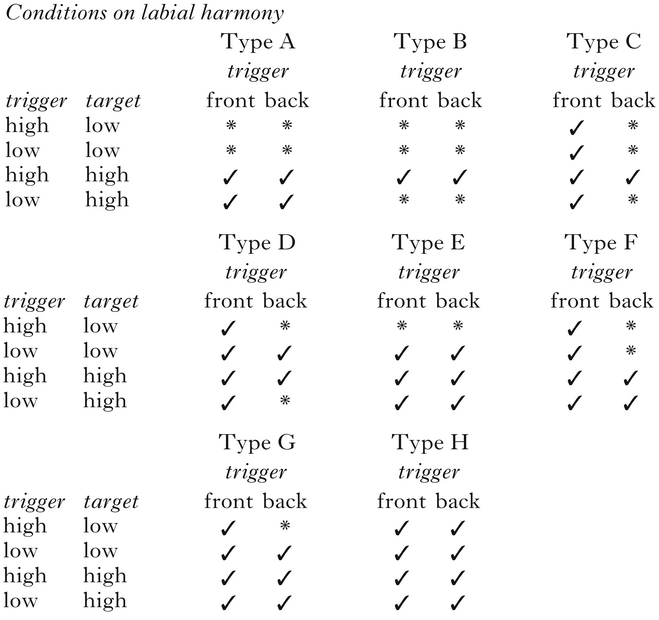
Descriptively, three trends emerge: first, high targets are preferred; second, labial harmony occurs when trigger and target share the same height feature; third, labial harmony occurs when trigger and target are both front. In (2), I give data from a representative language for each type.Footnote 2
(2)

It is important to note that Turkic languages also display palatal harmony, where affix vowels harmonise with root vowels on the front–back dimension. In contrast to labial harmony, palatal harmony in Turkic is not subject to any additional restrictions. That is, an affix vowel will always have the same value for frontness/backness as the root vowel.
In the first pattern, Type A, we see in (2a) that labial harmony is only observed when the affix vowel is high, regardless of the backness of the root vowel. This is captured in (1), where all non-high vowels are conflated into the category ‘low’. Type B is characterised by a very restricted occurrence of labial harmony; it is exclusively observed when both trigger and target are high vowels, irrespective of the front–back dimension. Type C has unrestricted labial harmony when trigger and target are front, but when trigger and target are back, labial harmony is only observed when both vowels are high.
Type D shows unrestricted labial harmony when trigger and target are front, but when both are back they must agree in height for labial harmony to occur. Type E displays labial harmony when the target is high (like Type A), but also when both trigger and target are low, irrespective of backness; labial harmony only fails when the trigger is high and the target is low.
In Type F labial harmony occurs when trigger and target are both front, irrespective of height. When trigger and target are back, labial harmony is observed when the target is high, but does not occur when the target is low. Type G shows labial harmony in most configurations; the only configurations in which it fails is when trigger and target are back, and the trigger vowel is high and the target vowel is low. Finally, Type H is a case of optional unrestricted labial harmony, where labial harmony is not subject to additional constraints.
In contrast, Tungusic and Mongolic languages show much less variation: the overwhelming pattern is that labial harmony only occurs when both trigger and target are low. In addition, whilst in Turkic languages we observed (unrestricted) palatal harmony, most Tungusic and Mongolic languages show advanced tongue root or retracted tongue root harmony, in which trigger and target have the same value for either [ATR] or [RTR] (Li Reference Li1996, Zhang Reference Zhang1996). For the purpose of this paper, I conflate these as ‘tongue-root harmony’ (cf. Zhang Reference Zhang1996, Dresher & Zhang Reference Dresher and Zhang2005). Mongolic languages behave by and large in the same way as Tungusic with regard to vowel harmony, the significant difference being that the high front vowels /i ɪ/ in Tungusic block labial harmony, whilst in Mongolic they are ignored in labial harmony (see §6).
The main pattern in Tungusic and Mongolic is Type I, in (3), where, in order for labial harmony to occur, both trigger and target must be low (where ‘low’ stands in opposition to ‘high’, and refers to any non-high vowel).
(3)
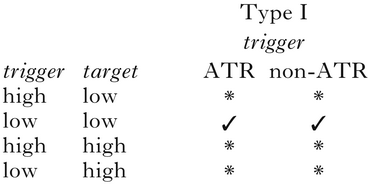
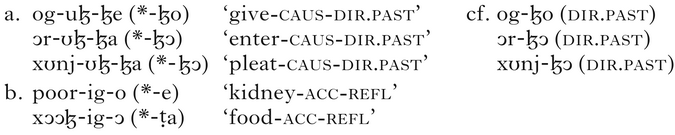
Li (Reference Li1996) clearly states that high target vowels never alternate for labiality, but does not offer examples of all configurations. Rather, suffixes divide into two categories: those that are inherently round (e.g. the derivational suffix [-ruk]/[-rʊk]) and those that are inherently unrounded (e.g. the derivational suffix [-xi]/[-xɪ]). (4a) gives examples from Baiyinna Orochen.
(4)

The remaining Tungusic labial harmony pattern is attested in Sibe and Sanjiazi Manchu. It should be noted that vowel harmony is marginal in these languages, with only a handful of suffixes involved in harmonic alternations. For instance, the non-self-perceived immediate past tense suffix in Sibe alternates between a round vowel [u] and an unrounded vowel [ɨ] (Li Reference Li1996: 202), depending on whether the final root vowel is round or not. For low target vowels, Li (Reference Li1996: 200) states that ‘vowels other than /u/ and /ɨ/ do not alternate’, but again does not offer examples of all configurations. The pattern, shown in (4b), is similar to that of Turkish: a high target undergoes labial harmony, irrespective of the height of the trigger vowel.
On the basis of the nine types we have identified in Turkic and Tungusic, there are two configurations which seem to facilitate labial harmony (cf. Kaun Reference Kaun1995). Firstly, it often occurs when trigger and target have something in common, such as both being high, or both being front. Secondly, it often occurs when the target vowel is high (without the trigger being necessarily high as well). It should be noted that these two observations are theory-independent, and can be implemented in various frameworks. In the next section I introduce the model adopted here, which crucially incorporates two properties: (i) a minimal number of monovalent phonological primes, (ii) which, depending on the language, have varying phonetic interpretations. These two characteristics lead to a restricted typology of labial harmony; I argue that they are crucial ingredients in a cross-linguistic analysis of labial harmony.
3 Radical CV Phonology
The framework adopted here is that of Radical CV Phonology (RCVP; van der Hulst Reference Hulst, Carr, Durand and Ewen2005, Reference Hulst, Botma and Noske2012), which has much in common with Dependency Phonology (Anderson & Ewen Reference Anderson and Ewen1987) and Government Phonology (Kaye et al. Reference Kaye, Lowenstamm and Vergnaud1985). Segments are composed of smaller atoms, called elements; these are organised into a feature geometry involving three class nodes (tone, aperture and colour), each of which dominates exactly two elements, as in (5).
(5)
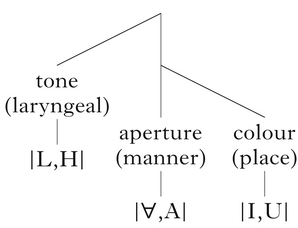
The use of this feature geometry has parallels in Odden (Reference Odden1991), which has a single Height node dominating the features [low], [ATR] and [high] (corresponding to aperture), and a Back-Round node (corresponding to colour) (see also Goad Reference Goad1993).
The four elements that are relevant to the composition of vowels are |∀| ‘high or ATR’, |A| ‘low or retracted’, |I| ‘front’ and |U| ‘round’. As is characteristic of all models that employ elements, these melodic primes are single-valued, in that the property they represent can be present or absent, rather than a value. Though Dependency/Government Phonology differentiates between elements occurring as heads or dependents, this distinction is not fundamental to the discussion in this paper, and I abstract away from it (see van der Hulst Reference Hulst, Botma and Noske2012 for headedness in RCVP). With regard to the element make-up of vowel inventories, I assume that vowels are fully specified. Specifically, I assume that if an element is ‘identifiable’ with a segment, it is present in the lexical representation of that segment. An element is identifiable with a segment when its properties match those of the phonetics of the vowel.
To illustrate this, consider the three-vowel system containing /a i u/ in (6) (here and below the representations are shorthand for the feature geometry in (5)).
(6)
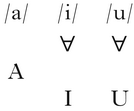
/a/ is low, and as such it is identifiable with the (low) element |A|. Similarly, /i/ is high (and ATR) and front, and /u/ is high (and ATR) and round.
Finally, it should be noted that most work in Dependency and Government Phonology (e.g. Polgárdi Reference Polgárdi1998, Pöchtrager Reference Pöchtrager2010, Backley Reference Backley2011, Smith & Botma Reference Smith and Botma2011) employs just three elements: |A I U|. In Moskal (Reference Moskal2012), I consider empirical issues that arise for a theory which makes use of only three elements.
3.1 Vowel harmony in Radical CV Phonology
Before turning to labial harmony, I discuss the more straightforward case of palatal harmony in Turkish, in order to show how vowel harmony can be modelled. Recall that affixes in Turkish agree in frontness with their roots; for instance, the Turkish plural suffix in (7) alternates between front [-ljer] and back [-lar], but the non-high vowel in the morpheme is invariant (Clements & Sezer Reference Clements, Sezer, van der Hulst and Smith1982: 216).
(7)
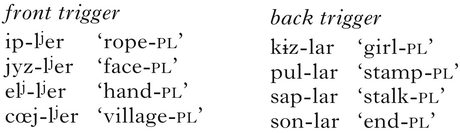
In RCVP, invariable occurrences of vowels are encoded in the phonological representation as simply containing the relevant element(s) in the lexicon. In contrast, alternations (i.e. harmony) are represented by having unspecified elements at the level of the lexicon (cf. Steriade Reference Steriade1981). The alternation (harmony) is represented by a variable element ‘|(X)|’, which is encoded in the phonological representation of lexical items. The parentheses indicate that the element is variable, and that it can be ‘laterally licensed’, as in (8) (van der Hulst Reference Hulst, Bendjaballah, Faust, Lahrouchi and Lampitelli2014, Reference Hulst, Raimy and Cairns2015).
(8)

When a variable element is licensed, it effectively has the same status as an invariable element which is lexically present, and will be phonetically interpreted and realised. In contrast, when a variable element is not licensed, it is invisible and remains unexpressed phonetically. The Turkish plural morpheme in (7) is represented by a single underlying representation; its surface realisation as front or back depends on whether the variable front element |I| is licensed. Specifically, its vowel invariably contains the element |A|, indicating that it is a non-high vowel, and contains the variable front element |I|, as in (9).Footnote 8
(9)

In (10), we see the derivation of palatal harmony in [ip-ljer]. In (10a), the root vowel is composed of the high element |∀| and the front element |I|; the suffix has the representation in (9). By (8), the variable front element in the suffix is licensed by the front element in the root; this is represented by ‘≫’ in (10b). The licensing of the variable front element leads to the phonetic interpretation of this element, so that the morpheme is realised with a front vowel, as in (10c).
(10)
In contrast, in [kɨz-lar], the input is a high back root vowel, which does not contain |I|, as in (11a). Consequently, the suffix vowel is not laterally licensed (indicated by ‘‖’ in (11b)), so that the variable element is rendered invisible and remains uninterpreted phonetically, giving the back realisation in (11c).
(11)

In what follows, successful lateral licensing will be represented as in (10b), whereas unsuccessful lateral licensing will be represented as in (11b).
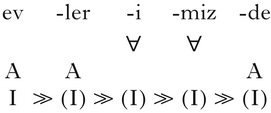
Finally, the current account requires trigger and target to be adjacent at the vocalic tier (contra e.g. Nevins Reference Nevins2010, Kimper Reference Kimper2011). Licensing relations in RCVP are absolutely local, and cannot apply across a root node (cf. van der Hulst & Smith Reference Hulst, Smith, Bogers, van der Hulst and Mous1986, who adopt absolute locality for spreading). In a word such as [ev-ler-imiz-de] ‘house-pl-1pl.poss-loc’ in (12), the front element in the root licenses the variable front element in the first suffix, which, once licensed, in turn licenses the variable front element in the next suffix, and so on. Here I argue that absolute locality should be retained, but that it is defined in terms of melodic content rather than a root node: that is, locality is computed over elements within a root node (see also §6).
(12)
An apparent violation of locality should be noted; ‘neutral’ vowels are seemingly invisible to harmony, and have thus been claimed to allow for non-local harmony. For instance, Finnish displays palatal harmony, but /i e/ do not seem to participate in it; consider the essive suffix, which alternates between [-nɑ] and [-næ] (Ringen Reference Ringen1975, Ringen & Heinämäki Reference Ringen and Heinämäki1999), as shown in (13).
(13)
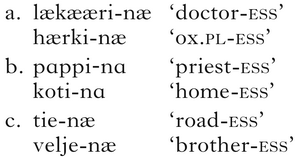
In (13), all stem vowels are front, as is the suffix vowel. However, in (b), we see a back suffix, [-nɑ], which, though harmonic with the prefinal stem vowel, is disharmonic with front /i/. Finally, in (c), we see that in stems composed purely of front vowels, a front vowel suffix surfaces.
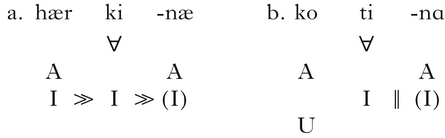
To account for Finnish, we have to impose a restriction that only stem-initial vowels can initiate a harmonic wave (i.e. spreading).Footnote 9 This means that in (13a, c) it is the first front vowel that starts the harmonic wave, as in [hærkinæ] in (14a). Crucially /i/ and /e/ are not neutral in the approach adopted here, but participate in vowel harmony, and play a vital role in maintaining locality, whereby no melodic content in a root node can be skipped in the harmonic wave. In (13b), the stem-initial vowel does not contain |I|, and no harmonic wave is initiated, so that the back variant [-nɑ] surfaces in (14b).
(14)
In §6, I return to locality, and discuss data from Mongolic languages which appear at first sight to violate strict locality.
4 Turkic languages
In this section, I offer an RCVP analysis of the various patterns under which labial harmony is attested in Turkic languages (see §2).
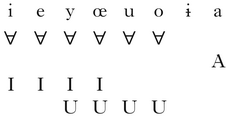
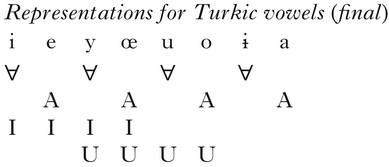
The vowel inventory of Turkic languages is fairly uniform, consisting of /i e y œ u o ɨ a/, and holds for all the Turkic languages discussed here. If we base the element make-up of the vowel inventory exclusively on whether a vowel contains the relevant phonetic correlate of a given element as defined above, then we would have the representations in (15).
(15)

With regard to aperture, the high vowels /i y u ɨ/ contain |∀|, and the low vowel /a/ contains |A|. With regard to colour, the front vowels /i e y œ/ contain |I|, and the round vowels /y œ u o/ contain |U|. However, the mid vowels, being neither high nor low, are not directly associated with an aperture element. Though phonological behaviour does not necessarily reflect phonetic properties (e.g. Dresher Reference Dresher2009), this still creates the somewhat unintuitive situation where a vowel that contains only the front element |I| is realised as /e/. Focusing here exclusively on Turkic languages, I propose that all vowels are required to have an aperture element. We can formalise this as an inventory constraint which applies to the aperture node of vowels in the Turkic languages (cf. van der Hulst Reference Hulst, Botma and Noske2012). Recall from (5) that aperture is the head class node, and this constraint would then be an instance where a head cannot remain empty in Turkic languages, forcing the aperture node to dominate |A| or |∀|, depending on the compatibility between segment and element.
The representations of the mid vowels in (15) do not conform to the aperture constraint, and require a repair. There are three possibilities: (i) since the mid vowels are not incompatible with high/ATR, they contain |∀| (16a), (ii) since they are not incompatible with low, they contain |A| (16b), and (iii) they contain both |∀| and |A| (16c).
(16)

The representations in (16a) are problematic, since they conflate the mid vowels with their high counterparts: for example, the representation of /e/ is identical to that of /i/ in (15). This leaves us with the representations in (b) and (c). The crucial difference between the two is that (b) has the natural classes of the aperture elements in (17a), whilst (c) has the classes in (17b).
(17)

I suggest that (16b) is the preferred option, since the phonological behaviour of vowel harmony in Turkic languages makes the class containing |∀| in (17a) better than (17b) (cf. Dresher Reference Dresher2009, van der Hulst Reference Hulst, Bendjaballah, Faust, Lahrouchi and Lampitelli2014).Footnote 10 Another reason to favour (17a) over (17b) is economy, since in (a) one element is introduced, but in (b) two. Thus we arrive at the representations of vowels in Turkic languages in (18).Footnote 11
(18)
4.1 Labial harmony in Turkic languages
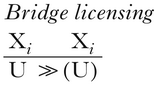
The configuration where trigger and target agree for some element X, facilitating labial harmony, is referred to here as bridge licensing, following Charette & Göksel (Reference Charette and Göksel1994, Reference Charette, Göksel and Cyran1998) (cf. Steriade Reference Steriade1981 on ‘homogeneous’ rounding harmony, as well as parasitic harmony; see also Cole & Trigo Reference Cole, Trigo, van der Hulst and Smith1988 and Kaun Reference Kaun, Hayes, Kirchner and Steriade2004, among others, for phonetic considerations favouring equal height harmony). In the theory adopted in the current paper, this insight is implemented as the lateral licensing relation of the variable labial element |U| being facilitated by trigger and target sharing some element X (other than |U|), as shown in (19).
(19)
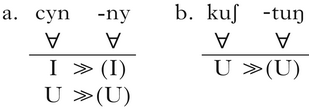
Consider now Type B languages, in which labial harmony is exclusively observed when trigger and target are both high, as in Kachin Khakas [cyn-ny] and [kuʃ-tuŋ]. In (20a), the lexical representation of the root vowel /y/ contains |∀|, |I| and |U|, whilst the suffix contains |∀| lexically, and |I| and |U| as variables, since the suffix potentially undergoes both palatal harmony and labial harmony. As mentioned above, palatal harmony in Turkic languages is unrestricted, so that |(I)| is licensed by a preceding occurrence of |I|. In contrast, since labial harmony is only observed when trigger and target are both high, labial harmony in Type B is not unrestricted, and is subject to the additional constraint that it must be licensed by a bridge, specifically an |∀|-bridge. Here, crucially, we need the fourth element |∀| in order to capture labial harmony when trigger and target are high (Moskal Reference Moskal2012, van der Hulst & Moskal Reference Hulst and Moskal2013). Similarly, in (20b), labial harmony is licensed by trigger and target both containing |∀| (there is no palatal harmony).
(20)
When trigger and target are not both high, labial harmony fails in Type B languages. Palatal harmony is observed in [ʧœr-ɟen] in (21), but variable |U| remains unlicensed, since the additional requirement of an |∀|-bridge is not met (indicated by ‘|’ on the labial element line).
(21)

Similarly, in Type C, labial harmony is observed when trigger and target are both high, but, in contrast to Type B, also when they are both front. In the Kyzyl Khakas forms in (22), we see the same |∀|-bridge as in Type B in (a), but (b) also has an |I|-bridge which licenses labial harmony (cf. (21), in which labial harmony is not licensed by an |I|-bridge).
(22)
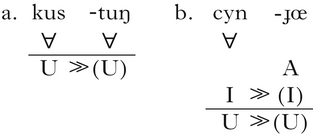
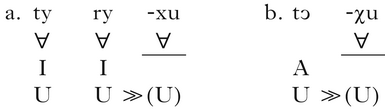
In Type D, labial harmony is observed when trigger and target are both high (|∀|-bridge), both front (|I|-bridge) or both low (|A|-bridge). The only two configurations where labial harmony is not observed in Shor-A are (i) when the trigger vowel is back and high and the target vowel is back and low (23a), and (ii) when the trigger vowel is back and low and the target vowel is back and high (23b), exactly the two configurations in which no bridge is possible, since trigger and target have no elements in common.
(23)
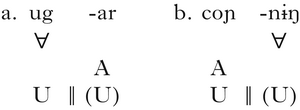
In Type A, however, labial harmony cannot (only) be licensed by a bridge configuration; crucially, the fact that a high back affix undergoes labial harmony when the trigger vowel is back and low, as in Turkish [son-un], shows that labial harmony cannot exclusively stem from bridge licensing, as trigger and target have no element in common that could serve as a bridge, as shown in (24).
(24)
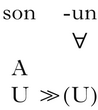
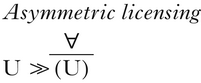
Rather, what we observe here is the preference for high targets to undergo labial harmony (e.g. Kaun Reference Kaun1995, Reference Kaun, Hayes, Kirchner and Steriade2004). At this stage, I propose the asymmetric licensing constraint in (25), which stipulates that an |∀|-element in the target licenses labial harmony (indicated by a horizontal line).Footnote 12
(25)
In Type A, then, when a trigger vowel is low, labial harmony is still found if the target vowel is high, and thus contains |∀|, which, as a result of (25), facilitates labial harmony, as (26).Footnote 13
(26)
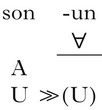
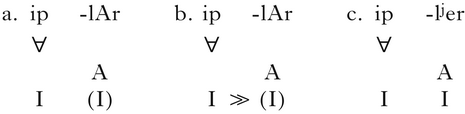
Asymmetric licensing facilitates labial harmony, but does not license the variable directly: when the trigger does not contain |U|, labial harmony is not observed, as in Turkish [kɨz-ɨn] ‘girl-gen’ in (27a). When the target vowel is low in Type A, labial harmony also fails, irrespective of whether trigger and target share any other elements, such as |A| (27b) or |I| (27c).
(27)

Languages are subject to cross-linguistic variation in whether bridge licensing and/or asymmetric licensing are active, and in the case of bridge licensing, which element serves as a bridge. Types B, C and D exclusively make use of bridge licensing, while Type A only shows asymmetric licensing. The remaining patterns in §2 employ a combination of the two types of licensing. In Type E, we see labial harmony when (i) trigger and target are both low, or when (ii) the target vowel is high, i.e. labial harmony is licensed by an |A|-bridge or by asymmetric licensing. In Type F, labial harmony occurs when (i) trigger and target are both front, or when (ii) the target vowel is high, i.e. labial harmony is licensed by an |I|-bridge or by asymmetric licensing. In Type G, labial harmony is observed when both trigger and target are front (|I|-bridge), when both are low (|A|-bridge) or when the target vowel is high (asymmetric licensing). Finally, in Type H, labial harmony is observed in all configurations; i.e. labial harmony is unrestricted.
4.2 Discussion
I have proposed that we can account for the variation in labial harmony in Turkic languages through a combination of bridge licensing and asymmetric licensing. I now turn to further discussion of the stipulative nature of asymmetric licensing. Kaun (Reference Kaun1995, Reference Kaun, Hayes, Kirchner and Steriade2004) argues on articulatory and perceptual grounds that high targets are better than non-high targets, and non-high triggers are better than high triggers (see also Suomi Reference Suomi1983, Walker Reference Walker2005, Finley Reference Finley2008). Following Kaun, I assume that phonetic principles can be encoded as phonological conditions, such as asymmetric licensing.Footnote 14 Specifically, Kaun argues that high targets are better than non-high targets, because rounded high vowels are articulatorily more rounded and perceptually more salient, and therefore maximise the recoverability of rounding on a given vowel. The fact that high vowels are better targets is then captured by the asymmetric licensing condition in (25), by which high targets facilitate labial harmony. If we equate non-high with low, this raises the question of why there is no additional licensing condition such as (28), whereby non-high (low) vowel triggers facilitate labial harmony. This condition would capture the phonetic preference for non-high (low) triggers over high triggers.
(28)
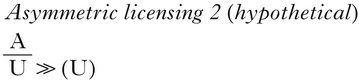
However, Kaun's conclusion that non-high vowels are better triggers than high vowels rests on the reasoning that high round vowels, because of their labial saliency, are at no risk of being misidentified; in contrast, labial harmony triggered by non-high vowels performs ‘a more critical function’, since roundedness in non-high vowels is not as salient (Kaun Reference Kaun, Hayes, Kirchner and Steriade2004: 96). Crucially, non-high round vowels lack some phonetic property that makes them good triggers; in other words, the labiality of high round vowels is already phonetically enhanced, making them less likely to require labial harmony for further enhancement. This means that the fact that non-high round vowels are good triggers is an epiphenomenon: given an even distribution, since high round vowels are less likely to be labial harmony triggers, non-high round vowels are more likely to be labial harmony triggers. Importantly, on this reasoning the burden of being a good or bad trigger always lies with high round vowels, which means that the hypothetical licensing statement in (28) is not derived from any phonetic principles. Note that we might predict that a high trigger could ‘prohibit’ labial harmony; however, given that the current theory does not incorporate any restrictions, I assume this could not be encoded as a phonological condition.
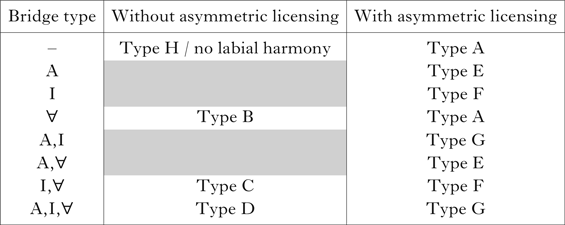
The mechanisms of bridge licensing and asymmetric licensing result in the predicted patterns in Table I, given that a bridge for labial harmony can consist of any (combination of) elements other than |U|.Footnote 15 The left column indicates the kind of bridge (the combinations are disjunctive rather than conjunctive), the middle column shows which types fall in this category and the right column shows types that make use of the relevant bridge combined with asymmetric licensing. The first cell (no bridge, no asymmetric licensing) means no restrictions hold: as such, this could mean unrestricted harmony (Type H) or unrestricted ‘non-harmony’ (no labial harmony). Note that the combination of an |∀|-bridge and asymmetric licensing is indistinguishable from asymmetric licensing only, since an |∀|-bridge is a subset of asymmetric licensing, hence some patterns occur in more than one cell.Footnote 16
Labial harmony licensing conditions in Turkic languages.

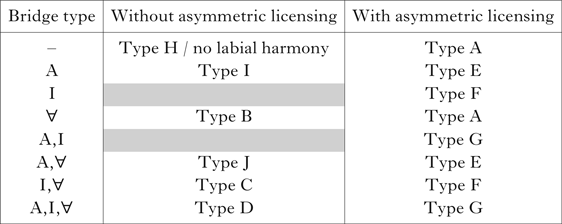
Two of the four patterns unattested in Turkic languages occur in other languages. An |A|-bridge without asymmetric licensing (Type I) is observed in many Tungusic and Mongolic languages, and will be discussed in §5. Yowlumne Yokuts may be an instance of Type J in (29), in which labial harmony is licensed by an |A|-bridge or an |∀|-bridge; note that the language does not have front round vowels.
(29)
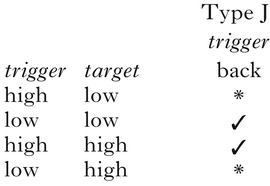
The vowel inventory consists of high vowels /i u/ and non-high vowels /a o/, and labial harmony is observed when trigger and target have the same height (Kenstowicz & Kisseberth Reference Kenstowicz and Kisseberth1979), as in (30). Here I take the non-high vowels to contain |A| (in a way similar to the representation of vowels in Turkic; see (18) above), and thus to pattern phonologically as ‘low’ vowels.
(30)
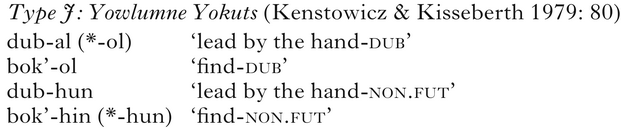
There are two configurations that are unattested, as shown in Table II. Though these gaps could be accidental, all the attested patterns except for Type I involve licensing by |∀|. Whilst unsurprising in systems that make use of asymmetric licensing, it is striking that |∀| is always involved in systems that are exclusively triggered by bridges. As mentioned above, asymmetric licensing stands in a superset relation to an |∀|-bridge, so that all attested patterns of labial harmony licensing, bar Type I, include at least an |∀|-bridge. This makes sense, given the two configurations that facilitate labial harmony: (i) bridge licensing and (ii) asymmetric licensing. In terms of the relations between trigger and target aperture elements, we can state the implicational hierarchy in (31).
(31)

Attested labial harmony licensing conditions.

|∀|–|∀| is the best configuration for labial harmony, given that both bridge licensing and asymmetric licensing are satisfied; |A|–|A| and |A|–|∀| each satisfy one generalisation, bridge licensing and asymmetric licensing respectively; |∀|–|A| fares the worst, given that neither is satisfied. One way to capture the generalisation in (31) is to introduce a minimal requirement for labial harmony: labial harmony in a language must be licensed by an |∀|-bridge. Note that this requirement holds at the level of labial harmony licensing in a language, not at the level of a specific configuration; that is, in order for a language to have labial harmony, it is necessary that an |∀|-bridge must be used within that language.
This correctly rules out the existence of the two unattested patterns in Table II, but Type I is also ruled out, contrary to fact. In the next section I discuss Type I in detail, and argue that in these languages |∀| is unavailable to function as a licensor in either bridge or asymmetric licensing, which leads to labial harmony having to be licensed by a different type of bridge. I state the requirement on labial harmony in (32), where ‘optimal’ is defined by the hierarchy in (31).
(32)

5 Tungusic languages
The vowel inventories of Tungusic languages are fairly uniform. I take Baiyinna Orochen, with /i ɪ u ʊ o ɔ ə a/ (Li Reference Li1996), as a representative example (note the absence of mid front vowels). This inventory leads to the two possible element configurations in (33), where |∀| is correlated either with high (a) or with ATR (b).
(33)

Both configurations are problematic, since some segments have identical representations; e.g. /i/ and /ɪ/ in (a), and /u/ and /o/ in (b). We cannot resolve (33a), since both /i/ and /ɪ/ are incompatible with the two elements they are not associated with (|A| and |U|). In contrast, (33b) can be resolved by adding |A| to the mid-vowel representations, resulting in (34), in which all segments are distinct, and is the representation I assume for Tungusic languages.
(34)

As mentioned in §2, Turkic languages have palatal harmony as well as labial harmony, but Tungusic (and Mongolic) languages display tongue-root harmony.Footnote 17 Vowels are not categorised for frontness, but as ATR or non-ATR; in (35), the words in the left column all contain ATR vowels, and the ones in the right non-ATR vowels.
(35)

Just like palatal harmony in Turkic, tongue-root harmony in Tungusic languages is unrestricted. Whilst palatal harmony was encoded with variable |I|, tongue-root harmony is encoded with variable |∀|; for example, the derivational suffix [-xi]/[-xɪ] contains invariable |I|, but variable |∀|. When this suffix combines with a root which contains invariable |∀|, its variable element is licensed, giving [-xi] in (36a); when the suffix combines with a root which does not contain |∀|, its variable element is not licensed, and it is realised as [-xɪ] in (36b).
(36)

Returning to labial harmony, Type I was characterised by labial harmony failing in any configuration involving high vowels; note, though, that due to the ambiguity of aperture elements, |∀| represents high vowels in Turkic, but ATR vowels in Tungusic (and Mongolic). Thus the descriptively high vowels do not form a natural class in (34), and in the current analysis there is no possibility of stating that labial harmony is licensed by all descriptively high triggers or all descriptively high targets. Rather, in light of the Minimal Requirement Hypothesis in (32), the question that emerges is why, in tongue-root harmony languages, we never observe asymmetric licensing or an |∀|-bridge, where |∀| represents ATR. Instead, only an |A|-bridge can license labial harmony. In the next section, I argue that, given that |∀| is variable in tongue-root harmony systems, it cannot function as a licensor for labial harmony (cf. Moskal Reference Moskal2013). Furthermore, in §5.2 we will see that the Tungusic language Sibe does not display tongue-root harmony, and has invariable |∀|; in accordance with the Minimal Requirement Hypothesis, Sibe has |∀|-licensed labial harmony.
5.1 Labial harmony in Tungusic languages
As we have seen, Type I is characterised by labial harmony occurring when trigger and target are low. For instance, as a result of tongue-root harmony and labial harmony, derivational suffixes in Baiyinna Orochen can have four realisations, for example the nominalising suffix [-mo, -mɔ, -mə, -ma], which thus contains variable |∀| and |U|. When this suffix combines with the root /oloo/, with invariable |∀|, |A| and |U|, as in (37a), both variables are licensed, since tongue-root harmony is not subject to further restrictions, and the additional restriction that labial harmony must be licensed by an |A|-bridge is met. In (37b), the root /sɔŋɔ/ licenses |U| in the suffix, but not |∀|.
(37)
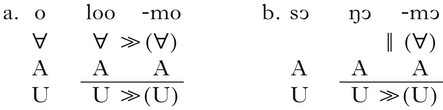
In contrast to low vowels, high vowels in Baiyinna Orochen are either prespecified as lacking |U|, leading to disharmonic forms such as [dɔlbɔ-xɪ] ‘to spend night’ and [ɔlɔ-ŋɪ] ‘fish-poss’, or as containing invariable |U|, giving disharmonic forms such as [bɪra-dʊ] ‘river-dat’ and [urə-du] ‘mountain-dat’ (Li Reference Li1996). The surface realisation of [bɪra-dʊ] shows that the suffix is specified as labial, as none of the root vowels contains |U|; cf. (38).
(38)

High vowels are opaque and block harmony: in (39) the vowel immediately preceding a suffixal low vowel is high, and labial harmony fails (Li Reference Li1996: 132).
(39)

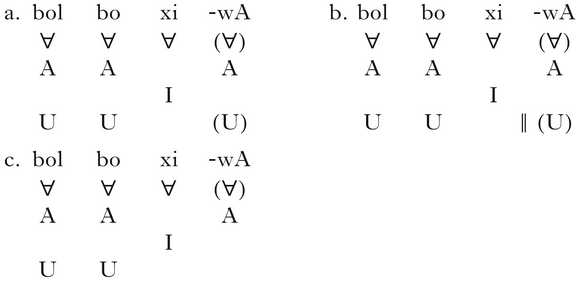
Here we see an instance of labial harmony being subject to locality (cf. §3.1). In the case of the front high vowel blockers in (39a, b), even though tongue-root harmony is observed, suffixal |U| in [bolboxi-wə] in (40) remains unlicensed, and the suffix is realised as unrounded [-wə].
(40)
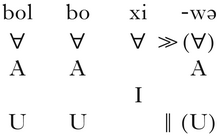
If licensing relations are computed over melodic content in root nodes, we predict that /i ɪ/ will block labial harmony, since it fails to fulfil two locality conditions. Recall that two types of licensing are involved in labial harmony: (i) lateral licensing of variable |U|, and (ii) additional licensing constraints, here an |A|-bridge; neither of these are local in (40).
For the back high blockers in (39c, d), although locality of lateral licensing is satisfied in (41a), locality of |A|-bridge licensing is not. This account of locality then predicts that blockers that contain a harmonic element can only be opaque when that harmony is subject to additional licensing requirements of the type argued here to hold for labial harmony.
(41)

As mentioned, the uniform character of labial harmony in Tungusic languages contrasts sharply with the variety of conditions that it is subject to in Turkic languages (see Table I above). Labial harmony cannot be licensed by an |I|-bridge, since Type I languages do not contain labial front vowels. However, we have seen that |A| functions as a bridge, and there is no a priori reason to exclude a language in which labial harmony would be licensed by an |∀|-bridge or asymmetric licensing. Indeed, given the Minimal Requirement Hypothesis in (32), we would expect such a language to exist. Imagine a language Baiyinna Orochen-B, in which labial harmony was subject to |∀|-bridge licensing: only ATR vowels would undergo labial harmony. That is, a form such as (39c) would incorrectly surface as [owon-duloo], as in (41b) (and a form such as [sɔŋɔ-mɔ] in (37b) would surface as [sɔŋɔ-ma]).
However, this situation is unattested cross-linguistically. I argue that we can derive this in the following way: since the primary vowel harmony of Tungusic languages involves the variable element |∀|, this element is not accessible as an anchor to form a bridge. Recall that variable elements encoded in lexical representations signify the potential presence of these elements (§3.1); their actual presence depends on whether or not the elements are laterally licensed. In tongue-root harmony systems, when not yet licensed, variable |∀| has not been ‘approved’ to be present in the representation, and is, as such, invisible. Here, I put forward the hypothesis in (42), which entails that the lateral licensing of elements proceeds serially.
(42)

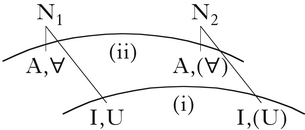
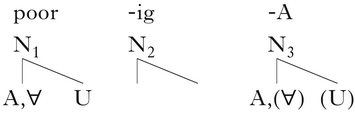
Thus, at the point at which labial harmony requires licensing, variable |∀| is not yet licensed, and is inaccessible. Crucially, this ordering relation only applies to elements derived through harmony; invariable elements, which are not subject to harmony, remain accessible at all times. This is schematised in (43) in the feature geometry of RCVP (cf. (5)). N1 and N2 represent two adjacent nuclei, where in N1 all elements are invariable, but in N2 |∀| and |U| are variable (characterising tongue-root harmony and labial harmony respectively). |U|-licensing (labial harmony) occurs first (i), while |∀|-licensing (tongue-root harmony) applies afterwards (ii).
(43)
Consider the derivation of Baiyinna Orochen [oloo-mo] in light of the Harmony Ordering Hypothesis. Its lexical element structure is given in (44).
(44)
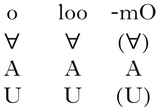
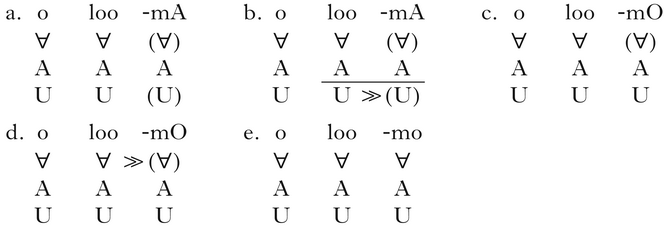
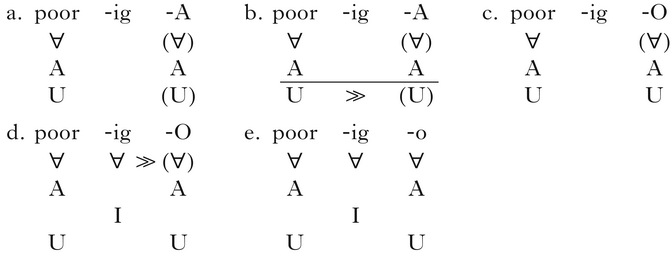
According to the Harmony Ordering Hypothesis, we first license |U|; at this stage, variable |∀| has not been licensed, and is invisible (45a). Nonetheless, an |A|-bridge is established and labial harmony is licensed (45b), which results in variable |U| being interpreted and realised (45c). On the next cycle, |∀|, which is not subject to any restrictions, is licensed (45d), resulting in the final representation in (45e).
(45)
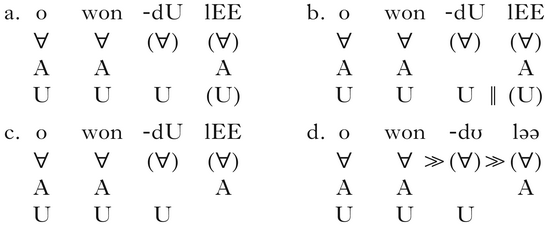
Consider now a case where labial harmony fails, [owon-duləə], which has the lexical representation in (46).
(46)
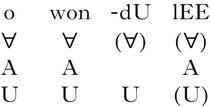
The relevant stages of the derivation are given in (47). Crucially, when labial harmony applies (47a), the variable aperture element is invisible, and cannot license labial harmony (47b), leading to an unrounded final vowel in (47c). In the final step (47d), tongue-root harmony is successful, giving [-dʊləə].
(47)
Returning to the Minimal Requirement Hypothesis in (32), which requires labial harmony to be licensed at least by an |∀|-bridge, we see that the Harmony Ordering Hypothesis has an effect on the availability of aperture elements to license colour elements. The Minimal Requirement Hypothesis states that labial harmony must at a minimum be licensed by the optimal available aperture configuration, where optimal is defined by the hierarchy in (31). However, in tongue-root harmony languages, |∀|–|∀| and |A|–|∀| are unavailable to license labial harmony, since they require the presence of |∀| in the target – a configuration which is not met, as |∀| is variable at that point. This leaves us with the configurations |A|–|A| and |∀|–|A|, of which the former, the |A|-bridge, is better on the hierarchy.
In Turkic languages the full hierarchy is available, since no aperture elements are involved in a harmony process of their own, and the hierarchy is as in (31). In Tungusic languages, |∀| is unavailable to be a licensor on the target, since this element is involved in a harmony of its own, and |∀|–|∀| and |A|–|∀| are excluded from consideration.
5.2 Discussion
A word is in order here on how the cyclic architecture interacts with palatal harmony. The Harmony Ordering Hypothesis in (42) is stated with respect to the colour and aperture nodes, rather than individual elements. Thus |I| and |U| are within the same cycle, and |I| is visible to license labial harmony; the derivation of Kyzyl Khakas [cyn-ɟœ] remains as in (22b). Also, it is worth stressing that only derived |∀| is not accessible. In Turkic languages that rely on an |∀|-bridge or asymmetric licensing, |∀| is accessible at all stages of the derivation.
What we do not expect is a language with a colour harmony which is subject to additional restrictions, where these restrictions rely on an aperture element involved in harmony. In contrast, since colour harmony precedes aperture harmony, we predict that a colour element could function as a licensor for aperture harmony. Although I have not found any instance of an aperture harmony being dependent on a colour element derived through harmony, there is an ‘exceptionally alternating suffix’ in Classical Manchu, shown in (48), which is dependent on invariable |U| (Li Reference Li1996: 172). In general, Classical Manchu is a regular Type I Tungusic language, where labial harmony is licensed by an |A|-bridge, but this particular derivational suffix displays tongue-root harmony and height harmony.
(48)

The adjectivising suffix alternates between [-xun], [-χʊn] and [-χɔn], and has the representation in (49).
(49)
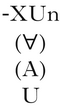
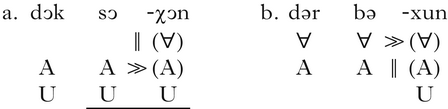
Crucially, the non-high realisation of the suffix is only observed when the trigger contains a rounded non-high vowel, as in (50a). In contrast, when the root does not contain a labial element, |A| remains unlicensed, as in (50b).
(50)
Other languages that seem to show a harmonic aperture element being reliant on an |U|-bridge are Kisa (Hyman Reference Hyman, Hombert and Hyman1999) and Shona (Fortune Reference Fortune1981), where vowels only agree for height when both trigger and target are round.
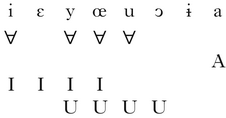
Not all suffixes in Tungusic languages alternate, which allows for an interesting prediction. If an [+ATR] suffix does not show tongue-root harmony, then it contains invariable |∀|, which should be a potential licensor of labial harmony. Unfortunately, most of the Tungusic affixes that do not show tongue-root harmony reported in Li (Reference Li1996) are low, and thus uninformative. However, Li mentions that Sibe and Sanjiazi Manchu have high vowels that alternate harmonically. The vowel inventory for Sibe is /i ε y œ u ɔ ɨ a/ (Li Reference Li1996: 189). Li classifies /i y ɨ u/ as high, and argues that tongue-root specifications are not phonologically relevant in Sibe, meaning that |∀| identifies the high vowels as a class.Footnote 18 This leads to the representations in (51).
(51)

As Li (Reference Li1996) observes, the vowel inventory of Sibe is the result of a series of vowel changes, which has led to a vowel-harmony pattern that is uncharacteristic of Tungusic languages. Tongue-root harmony is no longer found, and the only remaining harmony pattern is that a number of suffixes undergo labial harmony. As noted in §2, certain suffixes with high targets show labial harmony (Type A).Footnote 19 The vocalic structure of the non-self-perceived immediate past tense suffix is given in (52).
(52)

The variable element is laterally licensed, irrespective of the aperture values of the trigger, as shown in (53). Thus, in Sibe |∀| is present as a constant, rather than as a variable, on the target, and, in line with the Minimal Requirement Hypothesis in (32), labial harmony is asymmetrically licensed by |∀|.Footnote 20
(53)
6 Mongolic languages
Svantesson (Reference Svantesson1985) and Svantesson et al. (Reference Svantesson, Tsendina, Karlsson and Franzén2005) argue that the most common vowel-harmony system in Mongolic languages involves an alternation between non-pharyngeal and pharyngeal vowels. Following Dresher & Zhang (Reference Dresher and Zhang2005) and Nevins (Reference Nevins2010), I characterise this distinction in terms of tongue-root harmony. Curiously, in Khalkha Mongolian and Shuluun Höh, /i/ is transparent to labial harmony, violating the locality requirement on vowel harmony adopted here (§3.1). To account for this, I argue that the element make-up for /i/ is inserted into the structure only after labial harmony has applied. This seemingly ad hoc proposal of late element insertion is supported by the different behaviour of epenthetic vowels in Tungusic and Mongolic, as shown in §6.2.
6.1 Transparency
The vowel inventory of Khalkha Mongolian is /i e u ʊ o ɔ a/ (Svantesson et al. Reference Svantesson, Tsendina, Karlsson and Franzén2005: 46). As in Tungusic languages, |∀| is correlated with ATR, in order to ensure that all vowels can be distinguished. That is, if |∀| correlated with high, /u/ and /ʊ/ would have the same representations, and could not be distinguished by any other elements. In contrast, if |∀| stands for ATR, then |A| is inserted in all vowels that are not incompatible with it. Importantly, in the spirit of van der Hulst & Smith (Reference Hulst, Smith, Hulk and Coopmans1988), there is a well-formedness requirement particular to Khalkha Mongolian, according to which /i/ and /e/ lack |I| in their lexical representation, which is inserted later to ensure their front character (see below).Footnote 21 This leads to the representations in (54).
(54)

Regular tongue-root harmony is observed, and labial harmony is licensed by an |A|-bridge; /u ʊ/, unsurprisingly, block labial harmony, as shown in (55a) (Svantesson et al. Reference Svantesson, Tsendina, Karlsson and Franzén2005: 51).
(55)
I assume the same analysis as for Tungusic languages: since |∀| is involved in harmony, it cannot license labial harmony. However, /i/ behaves differently in Khalkha Mongolian: rather than blocking labial harmony, it is transparent to it, as shown in (55b) (Svantesson et al. Reference Svantesson, Tsendina, Karlsson and Franzén2005: 50). On the assumptions in this paper, /i/ should block labial harmony, since it violates the locality requirement.Footnote 22 I argue that the vocalic node which surfaces as /i/ in Mongolic is not specified for any element when labial harmony applies. Although its element make-up is unspecified, it does contain a root node, and thus crucially differs from ‘true’ epenthetic vowels (see §6.2 below). The lexical specification for [poor-ig-o] is as in (56).
(56)
Furthermore, I propose that locality of vowel harmony is computed with respect to elements rather than (vocalic) root nodes. Following the Harmony Ordering Hypothesis, the colour harmonies apply prior to the aperture tier, and when labial harmony applies on the first cycle there is no segmental material in the second nucleus, locality is not violated and variable |U| in the suffix is licensed by bridge licensing (57b).Footnote 23 On the second cycle, when aperture harmonies apply, the elements of /i/ enter the derivation (57d). At this point they are visible to and participate in tongue-root harmony, resulting in [poor-ig-o] (57e).
(57)
It is worth briefly contrasting the derivation in (57) to the corresponding derivation for the Baiyinna Orochen data in (39). Crucially, in Tungusic languages, /i/ is specified from the beginning of the derivation, and when labial harmony applies it acts as an intervener, as shown in (58).
(58)
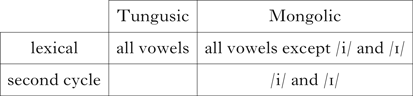
Thus Tungusic vowels are specified at the lexical level, but in Mongolic the elements of the front high vowel are inserted on the second cycle. Finally, although Khalkha Mongolian lacks an ATR contrast in high front vowels, the related language Shuluun Höh (Dao Bu Reference Bu1983, cited in Svantesson Reference Svantesson1985 and Svantesson et al. Reference Svantesson, Tsendina, Karlsson and Franzén2005) does distinguish /i/ and /ɪ/. In other respects it behaves like Khalkha Mongolian: /u ʊ/ are opaque, and labial harmony is triggered by an |A|-bridge. Svantesson (Reference Svantesson1985: 318) notes that, as in Khalkha Mongolian, ‘non-open non-velar vowels (/i/ and /ɪ/) are neutral and may intervene without interrupting rounding harmony’, as in e.g. [gɔt-ɪːxɔː] ‘town-gen.refl’ and [tomr-iːxoː] ‘iron-gen.refl’. The only difference is that in Shuluun Höh |∀| is inserted as a variable element. This is summarised in Table III.
Tungusic and Mongolic (non-epenthetic) vowels.

6.2 Epenthetic vowels
Intriguingly, the somewhat ad hoc move to insert |∀| on the second cycle in Mongolic high front vowels is supported by evidence from epenthetic vowels, in particular how their behaviour differs from epenthetic vowels in Tungusic. Epenthetic vowels (indicated by underlining in (59)) in Tungusic Baiyinna Orochen are phonotactically driven, and participate in tongue-root harmony; the labiality of the epenthetic vowel is determined by the preceding consonant: as shown in (59a), if the consonant is labial the vowel surfaces as [u/ʊ]; if it is non-labial it is [i/ɪ], (Li Reference Li1996: 137). Furthermore, epenthetic vowels are always high, and block labial harmony, as shown in (59b).
(59)
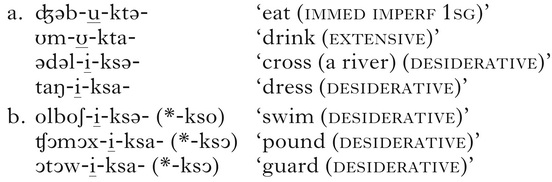
Since epenthetic high vowels block labial harmony in exactly the same way as lexical high vowels, they must be fully specified when labial harmony applies: back high vowels violate the bridge condition and front high vowels incur an additional violation of strict locality (see §5.1). Crucially, epenthetic vowels in Baiyinna Orochen are inserted prior to (any kind of) vowel harmony.
In contrast, Khalkha Mongolian epenthetic vowels seem to be of a different nature. Svantesson et al. (Reference Svantesson, Tsendina, Karlsson and Franzén2005: 1–7) transcribe them as [ə], but, based on their acoustic measurements, these epenthetic vowels are reduced forms/central variants of the (full) vowels that precede them. They show that the insertion of epenthetic schwa is determined on the basis of a syllabification rule, combined with the morphological composition of words (for details, see Svantesson et al. Reference Svantesson, Tsendina, Karlsson and Franzén2005: ch. 6). Epenthetic vowels in Khalkha differ crucially from those in Baiyinna Orochen, in that they do not interact with any type of vowel harmony. In (60), we see that they are entirely transparent to labial harmony (Svantesson et al. Reference Svantesson, Tsendina, Karlsson and Franzén2005: 73).
(60)

Since they do not participate in any harmony, epenthetic vowels in Khalkha Mongolian must be incorporated into the structure relatively late. We can account for this in the following way. Suppose that Mongolic epenthetic vowels contain a root node but, since they take on a reduced quality of the full vowel that precedes them, are unspecified for element material. This is exactly the configuration argued for /i/ and /ɪ/ (see (56)). At the lexical level, then, this configuration is ‘reserved’ for high front vowels. On the second cycle, the representation lacking element specifications is repaired by introducing variable or non-variable |∀|, and unavailable for segments other than /i/ or /ɪ/. In order to be distinguishable from /i/ and /ɪ/, epenthetic vowels must be inserted after the second cycle. Thus the late incorporation of epenthetic vowels into the structure is derived from the hypothesis that in Mongolic high front vowels the locus of insertion of variable or non-variable |∀| is the second cycle.
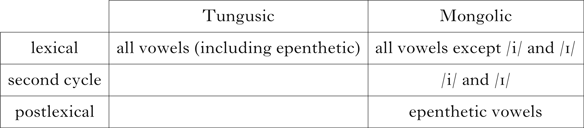
In Tungusic languages, there is no need for epenthetic vowels to enter the derivation late. There are no vowels that are empty, and there is no restriction on when they can be inserted in the derivation. Their participation in tongue-root harmony and the blocking of labial harmony shows they must be elementally specified at the lexical level, crucially before labial harmony occurs. Table IV summarises the various stages at which vowels are inserted in Tungusic and Mongolic languages.
Tungusic and Mongolic vowels.

In sum, the hypothesis of two cycles within segments allows for an account in which variable or non-variable |∀| is inserted late (on the second cycle) in Mongolic languages. This difference between Tungusic and Mongolic coincides with the different behaviour of their epenthetic vowels, which can again be accounted for by positing a difference in the point of insertion, lining up with early (lexical) insertion in Tungusic and late insertion in Mongolic languages.
7 Conclusions
In this paper, I have focused on the conditions governing labial harmony in Turkic, Tungusic and Mongolic languages. To account for the diversity of conditions on labial harmony in Turkic languages I have assumed four elements, and two conditions that facilitate labial harmony: asymmetric licensing and bridge licensing. It was proposed that asymmetric licensing has a phonetic basis, but in many languages has been grammaticalised and encoded in the grammar as a constraint licensing labial harmony. Regarding bridge licensing, as mentioned above, it has been acknowledged that harmony can be sensitive to requirements of identity on trigger and target. Indeed, most approaches to labial harmony refer to this identity requirement as a given (e.g. Vaux Reference Vaux1993, Dresher Reference Dresher2009, Nevins Reference Nevins2010). In endorsing bridge licensing as an operation licensing labial harmony, this paper is not at odds with any of these theories. Combined with the four monovalent primes, bridge licensing and asymmetric licensing lead to the minimal typology in Table II, given that one of the primes, |U|, is involved in the lateral licensing of labial harmony and as such cannot be an additional licensor. An approach within RCVP is particularly suitable, not only because of the number of primes it employs, but also because it is unique in collapsing ‘ATR’ and ‘high’ into a single category, |∀|, which enables a uniform account of conditions on labial harmony across the languages investigated here, whilst maintaining a minimal typology. Standard feature theory would not consider [ATR] and [high] to be the same feature, thus creating more than four primes. Standard Dependency/Government Phonology assumes only three elements, |A|, |I| and |U|, but has no prime corresponding to ‘high’; this is problematic in the light of Types B, C and D, since these are crucially triggered by an |∀|-bridge.
To exclude the two unattested labial harmony patterns in Table II, I proposed the Minimal Requirement Hypothesis, which states that labial harmony is minimally licensed by an optimal aperture configuration. This led to the prima facie exclusion of attested labial harmony in many Tungusic and Mongolic languages, which is exclusively conditioned by a low trigger and low target. In order to account for these languages, I proposed an ordering of vowel-harmony processes: the Harmony Ordering Hypothesis. Specifically, the data discussed in this paper warrant the following ordering relations: (i) tongue-root harmony must follow labial harmony, and (ii) palatal harmony cannot follow labial harmony. The first ordering accounts for the non-occurrence of |∀|-licensing in tongue-root harmony languages; in contrast, when such languages do not display tongue-root harmony, the element becomes available again as a potential licensor of labial harmony. The second ordering relation accounts for the observation that in Turkic languages labial harmony can be triggered by an |I|-bridge, whilst these |I|-elements are the result of palatal harmony.
In his analysis of Khalkha Mongolian, Godfrey (Reference Godfrey2012) also argues for the ordering of vowel-harmony processes. Assuming Dresher's (Reference Dresher2009) Successive Division Algorithm and Contrastivist Hypothesis, together with Visibility Theory as implemented in Nevins (Reference Nevins2010), he argues for the opposite order: tongue-root harmony preceding labial harmony. Godfrey's ordering crucially relies on the invisibility of the high front vowel /i/ to labial harmony. Following the Successive Division Algorithm, he accounts for the invisibility of /i/ by drawing on the fact that Khalkha Mongolian /i/ is not contrastive for ATR, since it has no tongue-root counterpart. This allows /i/ to be skipped in tongue-root harmony, and, assuming that labial harmony proceeds where tongue-root harmony leaves off, /i/ is also skipped in labial harmony, as shown in (61) (adapted from Godfrey Reference Godfrey2012: 10).
(61)
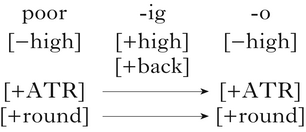
Although this is an elegant solution, it does not hold for Mongolic languages in general. The related language Shuluun Höh (see §6.1) has both /i/ and /ɪ/; front high vowels are thus contrastive for ATR, yet invisible for labial harmony, showing that Godfrey's account does not generalise to other Mongolic languages. In the current framework, the invisibility of front high vowels to labial harmony in Mongolic languages is accounted for by assuming that high front vowels are not present in the structure at the point of labial harmony. As such, recourse to the reverse order of tongue-root harmony preceding labial harmony in Khalkha Mongolian is not warranted, and we thus see evidence for the strong hypothesis, in which aperture harmonies always apply before colour harmonies.
I have also argued that locality should be defined in terms of melodic content rather than root nodes. Nonetheless, it is strictly local (contra e.g. Kimper Reference Kimper2011) and cannot be relativised, as in for example Visibility Theory (Nevins Reference Nevins2010, following Calabrese Reference Calabrese1995).Footnote 24 Drawing on work by Calabrese, Nevins assumes that there are three options for a target vowel to search for an appropriate trigger (‘donor’) to receive a value: (i) all values of F are considered, (ii) only contrastive values of F are considered or (iii) only marked values of F are considered. By relativising the visibility of triggers, he accounts for the behaviour of neutral vowels, which on his account are ‘invisible’. Here, two types of non-blocking vowels are distinguished: neutral and transparent. Vowels that are neutral contain the harmonic element, and as such are compatible with the harmonic wave. Regarding transparent vowels, I have argued that, within the segment, there are two possible points in the derivation at which elements can be inserted. The elements making up transparent vowels (Mongolic /i ɪ/) are absent in the structure at the point that labial harmony applies. Rather, since locality is not relativised to the type of prime but to the presence of any prime at all, any elementally non-empty vowel that is not compatible with the harmonic wave is predicted to be opaque. In addition, given that labial harmony requires additional licensing, segments that are compatible with the harmonic wave, but fail to meet the additional licensing requirement (Tungusic and Mongolic high round vowels), cause a violation of locality of licensing harmony and, as such, must also be opaque. In other words, the only source of opacity is a locality violation.
It is an empirical question whether the generalisations identified here can be maintained beyond labial harmony in Turkic, Tungusic and Mongolic languages. The claims made here need to be tested against a larger sample of languages, including those that involve vowel-harmony processes other than labial harmony. Finally, the hypothesis that there is a crucial difference between lexical and derived elements is relevant to processes other than vowel harmony, and it remains to be investigated whether additional support for this architecture can be found.