





1. Introduction
Umlaut is generally seen as the assimilation of a vowel to a following vowel, often analysed as feature-spreading. Metaphony is also so seen, but now the term usually applies to particular contexts, often with prosodic conditions. However, particularly in Romance languages, there are other analyses. In this article, we shall cast both processes in an Element Theory framework, where Romance metaphony appears as the result of licensing a ‘low’ feature, not spreading a ‘high’ feature. We then apply this formalism in the very different context of ǃXóõ.
ǃXóõ, ǃXoon or Taa is a language of the Tuu (formerly Southern Khoisan) family,Footnote 1 famous for its world-beating array of click sounds. It displays a complex assimilation of the first vowel  in a root to the second vowel and adjacent consonants. The primary published sources for ǃXóõ are a phonological study (Traill Reference Traill1985) and a dictionary (Traill Reference Traill1994). Traill analyses this process as a raising assimilation to the second vowel, partially or fully blocked by certain consonants.
There are several other analyses of this phenomenon and of similar processes in other Khoisan languages (Nakagawa Reference Nakagawa2010; Miller Reference Miller2011; Bradfield Reference Bradfield2014). The most recent for ǃXóõ is by Lionnet (Reference Lionnet2018), who conducts a very thorough examination of the sources, drawing out the extremely complex pattern exemplified in (1).

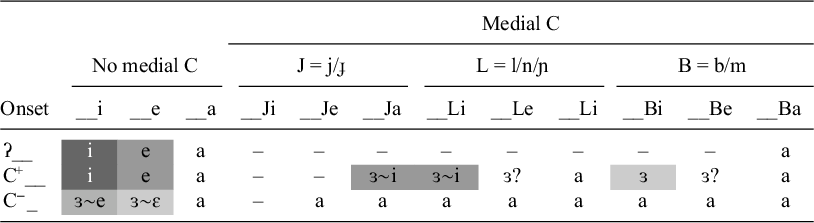
Lionnet (Reference Lionnet2018: 82) summarises his review of the data as in Table 1, where darker greys indicate more raising of /a/. The details are explained in §3.3.
Lionnet concludes that the pattern is probabilistic and gradient, reflecting the various triggering contexts involved in the raising. In his analysis, multiple triggering environments ‘gang up’ in ‘phonological teamwork’ to produce the pattern. For other proposed ‘teamwork’ phenomena, see Jäger & Rosenbach (Reference Jäger and Rosenbach2006), Lionnet (Reference Lionnet2017), Breiss (Reference Breiss2020), and a precursor to the question in Flemming (Reference Flemming2001).
In this study, we will unpick these conditions and show that the process of raising in ǃXóõ is categorical and analysable as the combination of two processes, one umlaut-like and another metaphony-like. There are several interlocking factors: the combination of umlaut and metaphony, the language-specific natural classes of clicks and other consonants, the potential for blocking by certain consonants, and the syllable structure placement of nasals. These conspire to produce a gradient-looking pattern, which can nonetheless be broken down to individual co-articulatory, spreading and licensing conditions.
Summary of ǃXóõ /a/-raising patterns (Lionnet Reference Lionnet2018: 82).

Table 1 Long description
The table is organized by Onset types in the first column and Medial C (consonant) categories across the top.
Headers:
* Medial C is divided into four main categories: No medial C, J (j or ɟ), L (l, n, or ɲ), and B (b or m).
* Sub-headers for each category specify the following vowel environment: i, e, or a (e.g., __Ji, __Je, __Ja).
Data Rows:
1. Onset ʔ__: Shows vowels i, e, and a for ‘No medial C’. All other cells are empty except for ‘a’ under the __Ba environment.
2. Onset C super plus__: Shows vowels i, e, and a for ‘No medial C’. Under Medial J, __Ja results in reversed epsilon tilde i. Under Medial L, __Li results in reversed epsilon tilde i, __Le results in reversed epsilon question mark, and __La results in a. Under Medial B, __Bi results in reversed epsilon, __Be results in reversed epsilon question mark, and __Ba results in a.
3. Onset C super minus__: Under ‘No medial C’, results are reversed epsilon tilde e, reversed epsilon tilde open e, and a. For all Medial C categories (J, L, and B), the result is consistently a, with the exception of the __Ji cell which is empty.
In §2, we outline the distinction between what we call umlaut-type and metaphony-type processes and explain the featural framework of the article. In §3, we outline ǃXóõ phonology and give the data we analyse. §4 lays out how we describe ǃXóõ in Element Theory (ET). §5 presents the analysis of A-raising, including some perhaps unexpected correct predictions of our analysis, followed by a discussion of issues in §6. In §7, we analyse the usually ignored case of rounded first vowels: we correctly predict the raising, and also predict a hitherto overlooked unrounding assimilation. §8 discusses more general applications of our framework.
2. Metaphony and Element Theory
2.1. Metaphony
Metaphony covers a wide range of assimilatory phenomena that raise vowels in Romance languages (Calabrese Reference Calabrese1985, Reference Calabrese1998). Some consider it a morphophonological process or even deny that it is a phonological process at all (Pöchtrager & Kaye Reference Pöchtrager and Kaye2014). Others, however, situate it firmly in phonology (D’Alessandro & van Oostendorp Reference D’Alessandro and van Oostendorp2016), even when the triggers are opaque or invisible (analysed as floating; Mascaró & Torres-Tamarit Reference Mascaró and Torres-Tamarit2022).
A comparatively simple example of metaphony is shown in (2), where mid vowels are raised by following high vowels.

In the majority view that it is a phonological process, the aspects distinguishing metaphony from general vowel harmony vary between authors, as do the representational choices underlying the process. Some authors use [ATR] – although this is neither phonetically nor phonologically identical to the familiar African [ATR], they argue that there is phonetic grounding for this choice (Calabrese Reference Calabrese2011: 2). For example, Calabrese (Reference Calabrese1998) finds metaphony distinctive in that [ ] targets are either diphthongised or tensed to [
 ] or raised, or both, depending on the variety in question.
More traditionally, Walker (Reference Walker2005) primarily uses the feature [ ], and the distinctive property of metaphony is the stressed target vowel and its unstressed trigger. Her model is based on positional licensing and is driven by the motivation for the harmonic feature to sit in a prominent, that is stressed, position. She ties this together with stress-conditioned harmony in Servigliano (Le Marche) and stress-vowel delimited harmony in Ascrea (Lazio; Walker Reference Walker2005: 918).
Canalis et al. (Reference Canalis, Jiménez, Lloret and Renwick2024: 873) define metaphony as an ‘umbrella term’ for a group of related vowel-height-assimilatory processes such that: (a) the trigger is a word-final unstressed high vowel (typically a morphological marker); (b) the target is a vowel carrying word stress; and (c) stressed vowels, typically mid vowels, are raised. This formally treats metaphony as a type of vowel harmony with some coincidental shared characteristics. It then becomes a matter of judgement whether specific cases of vowel harmony are metaphony or not, such as when stress does not determine the target, as in Camuno (Cresci Reference Cresci2014: 63). Since this otherwise involves the same sets of alternations such an exclusion seems unsatisfactory.Footnote 2
Mascaró (Reference Mascaró2016) limits his definition of metaphony as ‘stress dependent harmony’, either in the triggers or the targets.
Accepting the insight of this previous work, there is a more fundamental distinction between metaphony as a formal process and vowel harmony in general. This is particularly evident if we adopt an ET (Harris & Lindsey Reference Harris, Lindsey, Durand and Katamba1995) approach to vocalic representation. ET is a non-articulatory, privative system of features. Currently, it is most distinctive of Government/Strict CV approaches to phonology (Backley Reference Backley2011), but it has important precursors in Dependency Phonology (Anderson & Jones Reference Anderson and Jones1974; Anderson & Ewen Reference Anderson and Ewen1987), Natural Phonology (Donegan Reference Donegan1978) and Particle Theory (Schane Reference Schane1984).
Given our adoption of ET, we group vowel harmonies based on the vowel quality of the alternations (triggers and targets). This leads us to a more restrictive and formal definition of metaphony, characterised by the loss of unlicensed features. This contrasts it sharply with other types of harmony via feature spreading. Those include umlaut, which has much in common with metaphony: it involves raising, and it typically proceeds from an unstressed high vowel trigger to a stressed vowel target, and it is often a morphological marker. However, the phonological mechanism underlying it is still one of feature spreading/sharing. Indeed, there are decades-old analyses which treat umlaut as the phonological exponent of a syntactic head in the form of a floating feature (see Hansson & Wiese Reference Hansson and Wiese2024 for an overview).
2.2. Element Theory
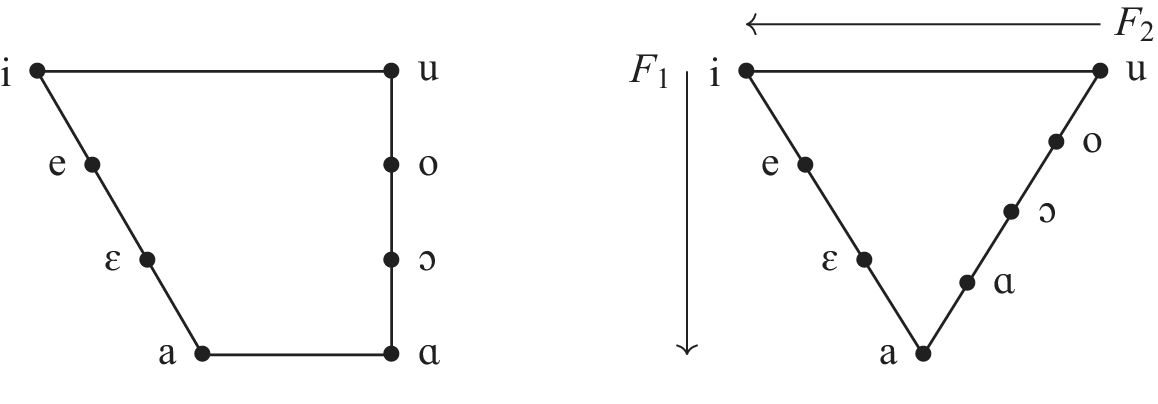
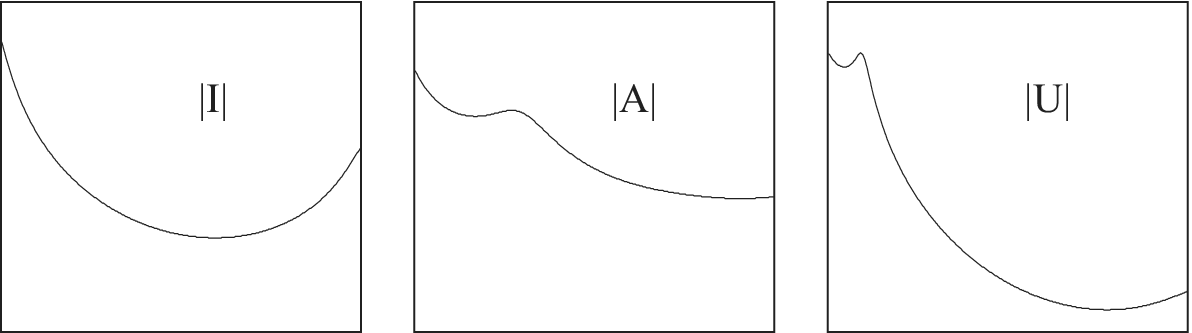
ET recognises that the traditional vowel quadrilateral is perceptually more of a triangle (Lindsey Reference Lindsey, Lindsey and Nevins2017), as illustrated in Figure 1. The corners of the vowel triangle are characterised by distinctive spectral shapes (Harris & Lindsey Reference Harris, Lindsey, Durand and Katamba1995) shown in Figure 2.Footnote 3 Each shape has an ‘autonomous interpretation’  , but detailed acoustics is left to phonetic interpretation. (See Zahorian & Jagharghi Reference Zahorian and Jagharghi1993 for experimental evidence for spectral shape as a better cue than formants for vowel quality.) Thus each element has an associated prototypical speech sound, while features may be abstract, articulatory or acoustic, and acoustic features such as
 describe broad characteristics, not actual sounds.
Vowel quadrilateral vs. triangle.

Corner vowel spectra.

Unlike standard feature theory where mid vowels are all [−high, −low] and distinguished by other articulatory features, in ET (and all the precursors listed above), mid vowels are an amalgam of the corner spectral shapes, a combination of these primitive elements: |A.I| =  and |A.U| =
 , where |A.I| means |A| + |I|. Further subdivisions can be made by headedness, a stronger presence of one of the elements, marked by underlining; for example, |A.I| =
 , |A.I| =
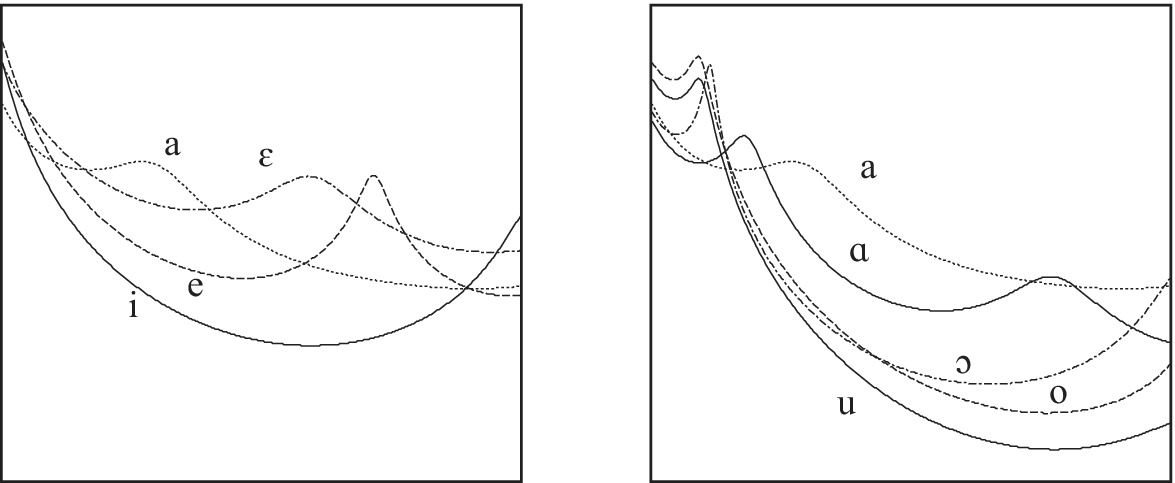
 . This is illustrated in Figure 3: in the left chart, we see the gradual deepening of the curve (roughly, decreasing
$\mathit {F}_1$
 ) and rightwards movement of the peak (increasing
$\mathit {F}_2$
 ) as we interpolate between
 and
 (the peak for
 is off-chart). The right chart shows the interpolation between
 and
 .
Vowel spectra.

Figure 3 Long description
The figure consists of two side-by-side panels containing spectral envelopes.
In the left panel, four curves are shown. The curve labeled ‘a’ is a dotted line with a prominent peak in the upper-left quadrant. The curve labeled epsilon is a dashed line with a peak in the center-right. The curve labeled ‘e’ is a dash-dot line descending to a trough at center-left then with a sharp peak at right. The curve labeled ‘i’ is a solid line forming a deep U-shaped trough at the bottom of the graph.
In the right panel, five curves are shown. At the top, a dotted line labeled ‘a’ shows a broad, high-amplitude peak. Below it, a solid line labeled alpha descends into a shallow trough. Further down, a dash-dot line labeled open o and a dashed line labeled ‘o’ follow similar descending paths with minor fluctuations. At the bottom, a solid line labeled ‘u’ forms a deep, wide U-shaped curve similar to the ‘i’ curve in the first panel.
The phonetic interpretation of these element combinations is relatively free and language-specific, allowing, for example, the light-diphthong interpretation of certain vowels (perhaps only in computed forms; Kula Reference Kula2008). Segments represented by an empty set may also have a language-specific phonetic interpretation, such as neutral vowels or schwas (Kaye Reference Kaye1990; Charette Reference Charette1991). Some examples of such interpretations are shown in (3).

The final elaboration of ET we employ is the floating element, or variable element (van der Hulst Reference van der Hulst, Petrosino, Cerrone and Hulst2018). A floating element, which we mark by grey shading as in | |, is present in the underlying representation, but does not surface unless licensed by a phonological rule, for example, by a similar full element in an adjacent segment. Floating elements allow an apparently negative process (suppression of an |A| or [+low]) to be viewed as a positive process (licensing of the |A| in the unsuppressed case), as we demonstrate shortly.
2.3. Metaphony and umlaut in ET
Although the term metaphony was originally coined (as French métaphonie) as a translation of German Umlaut,Footnote 4 which ostensibly also involves raising of vowels in similar contexts, for example,  /
 ‘man/manly’,
 /
 ‘cow sg/pl’ (Lowenstamm Reference Lowenstamm2012), the formal mechanisms which describe umlaut and metaphony are very different in ET.Footnote 5
Its own particularities aside, umlaut is straightforward vowel harmony by feature spreading, or in ET by spreading of element |I|, which has the effect of fronting and raising target vowels.
However, in the dialects of Italy, the trigger of metaphony can be either  or
 , and either of these can raise either or both of
 and
 , depending on the pattern. In ET, metaphony is analysed as the suppression of underlying features/elements where they are not licensed (Maiden Reference Maiden1991; Carvalho & Russo Reference Carvalho, Russo, Hathout and Montermini2007a,Reference Carvalho, Russo and Trotterb; Russo Reference Russo2007, Reference Russo2014; D’Alessandro & van Oostendorp Reference D’Alessandro and van Oostendorp2016; van der Hulst Reference van der Hulst, Petrosino, Cerrone and Hulst2018). For example, for the data from (2), the surface element content is shown in (4) for the first vowel.

From these forms, one can analyse metaphony as A-licensing: |A| is underlyingly present in all forms, but only appears when licensed by an |A| in the final vowel.Footnote 6 Formally, the underlying form has floating | |, which needs a licence to attach to a skeletal slot and be realised. The rule is shown diagrammatically in (5a), together with its application in (5b) and non-application in (5c). The notations are standard: the top row is the skeleton of C and V slots; the second row notes the segments associated with each slot; and the final row shows the elements associated. Solid association lines are underlying, while dashed associations are the result of phonological rules. Arrows indicate licensing relations.

This models the contrastive presence of |A| in these nuclei, but also the alternation with its non-appearance in the metaphonic forms.
The Foggia example shows a simple example of the mechanism. Metaphonic systems show a dazzling array of complexity: interaction with morphology, opacity of the triggers, and possible interpretation with floating features (Mascaró & Torres-Tamarit Reference Mascaró and Torres-Tamarit2022), or the role of stress in defining the locality of targets of metaphony (Walker Reference Walker2011), or the non-application of metaphony to either lexical exceptions or where the process is restricted to close-mid vowels (e.g., Grado; Walker Reference Walker2005). Space precludes going into these in any depth.
Directly relevant to us is Reference CalabreseCalabrese’s (Reference Calabrese2011) claim that a weakness of the ET approach to metaphony, such as Maiden’s (Reference Maiden1991) A-demotion account, is the diphthongal output of the metaphony rules. Maiden (Reference Maiden1991) proposes a special ‘resolution’. More recent ET developments improve on the understanding of this phonology-to-phonetics mapping; and moreover, they open a space for the diphthongal outcome of metaphony, while providing an elegant account of its cross-linguistic variation and the trickiest aspect of its analysis, its chain-shifting nature.
In the Calvello examples in (6), we see a contrast between close and open mid vowels, which behave differently in metaphony. The outcome is also hard to model because of the distorted chain-shift  →
 ,
 → [u].

In ET, the open-mid vowels are usually interpreted as A-headed:  = |A.I|. However, as with the close-mid, we posit that in Calvello even the headed A is floating: |
 .I|. The licensing rule is extended so that an unlicensed headed floating element still surfaces unheaded, and the head is transferred to the other element in the segment, as shown in (7) together with the application of the rule. (7b) and (7c) are the same as in Foggia, while in (7d), a floating headed |
 | is licensed by the following |A|, and in (7e), a floating headed |
 | ‘self-licenses’ unheaded |A| while also heading the other element |U|.

Systems like Calvello are quite phonetically transparent in reflecting the phonological shapes. The high-vowel element as the head is interpreted as the onset of a light diphthong.
However, ET is not rigidly grounded, and has ‘slack’ in the phonetic implementation of linguistic structure (Scheer Reference Scheer2019). This is accepted even in more standard theories. For instance, Calabrese (Reference Calabrese2011) acknowledges that the exact implementation of the diphthongisation is variable:  and
 (among others). Also, phonetic contours need not be phonological contours: light diphthongs and affricates are often single segments, as in Calvello
 or English
 .
This slack in the phonetic implementation of phonological structures allows interpretative space for language variation, even when the phonological pattern is otherwise uniform. Thus a single phonological structure, such as |U.A|, may be interpreted differently in different languages, for example, as  or
 .
Variation in the possible interpretation of headed structures is what makes other metaphonic systems so confounding. Take, for instance, the chain shift of Servigliano in (8).

This can be interpreted just as Calvello, the only difference being the phonetic implementation of the non-A-headed structures, as shown in (9). The  from
 in verde is representationally distinct from the
 derived from
 of pedi. Likewise, we will see that the same phonetic surface vowel in ǃXóõ can appear as the result of two different elemental forms. (Although in ǃXóõ, there may indeed be a subtle phonetic difference.)

More complicated cases involve the nature of the A-loss, in what combinations it is allowed, what is the phonetic outcome of the derived structure and so on. The details are found in the specific studies.
To summarise, vowel harmony may be the result of the additive process of spreading, or the subtractive process of (non-)licensing, as schematised in (10).

The pattern from ǃXóõ that we re-analyse in this article is complicated precisely because it involves both types of vowel harmony, which together give the appearance of a single complex gradient pattern of vowel raising (Lionnet Reference Lionnet2018). We argue that part of this pattern is attributable to the same formal mechanism as metaphony in Romance.
3. ǃXóõ phonology
ǃXóõ is the endonym of some dialects of a Khoisan language, the sole living member of the Tuu family, studied by Traill (Reference Traill1985). Traill studied mainly a dialect from Lone Tree now called East ǃXoon, with occasional reference to other dialects. Nowadays, the whole dialect cluster is generally called Taa (‘person’ in all dialects), and a pan-dialectal survey and dictionary is in progress by Christfried Naumann and colleagues, concentrating mainly on ‘West ǃXoon’. ǃXóõ is now usually spelt ǃXoon in the introduced orthography, but we retain the spelling of our primary sources. Further information on the language phylogeny may be found in Naumann (Reference Naumann, Güldemann and Fehn2014).
3.1. ǃXóõ phonemes
We summarise the phonemic inventory of ǃXóõ, and refer the reader to Bradfield (Reference Bradfield2014) for a full review of evidence and analyses up to 2014, and to Naumann (Reference Naumann, Vossen and Haacke2016) for a detailed phonetic study of the Western ǃXóõ inventory. We shall use phonemic notation in ‹guillemets› when citing ǃXóõ forms, and reserve phoneme  for explicitly phonemic discussion. We adopt Bradfield’s symbol
 for a generic click.
The published primary sources are Traill (Reference Traill1985) and Traill (Reference Traill1994). We have been given, most generously, access to some of the ongoing dictionary of the Taa Documentation Project by Christfried Naumann et al. at the DOBES archive, and we cite this as TDP.
Lemmas for content words mostly have the bimoraic form C1V1(C2)V2. Here, C1 is a pulmonic consonant, a simplex click, complex click–obstruent cluster or even an obstruent–obstruent cluster.
Prima facie, V1 is usually  , with
 arising (with a few exceptions) from the raising process that is our topic. V1 can be further specified for breathiness, pharyngealisation and glottalisation. Current accounts favour describing V1 as underspecified vowels
 (or [−round], [+round]; originally proposed for ǀGui by Nakagawa Reference Nakagawa2006, Reference Nakagawa2010; extended across Khoisan by Güldemann & Nakagawa Reference Güldemann and Nakagawa2018); we follow this, with a slight modification.
C2 is  . V2 is
 with possible nasalisation; or
 , in which case C2 is empty.
Function words and affixes are typically CV, with C simplex.
ǃXóõ is not considered to have lexical stress, but impressionistically the first syllable is usually stronger than the second, and distributional analyses analyse the prosodic accent on the initial CV (Lionnet & Hyman Reference Lionnet and Hyman2018: 655–658). Thus the typical prosodic word is a heavy monosyllable CVV, a trochee CVCV or a dactyl CVCV-CV, a structure generally found in the Khoisan languages (Nakagawa et al. Reference Nakagawa, Witzlack-Makarevich, Auer, Fehn, Gerlach, Güldemann, Job, Lionnet, Naumann, Ono and Pratchett2023), and one typical of Romance metaphony. The language is tonal, with high or low tones on each mora in the current analysis, and complex grammatical tonal concord rules; we mark tone, but it plays no role in this article.
There are five basic clicks:  . Clicks may carry manners such as
 aspiration, nasality, ejectivity, etc. Clicks also occur followed by glottal stop, glottal fricative or uvular stop, perhaps with ejectivity, aspiration or affrication. For example, in the East ǃXóõ dialect of Traill (Reference Traill1985), the lemma for ‘gnaw meat off a bone’ is
 in modern cross-Khoisan orthography): the initial dental click is prevoiced, and the posterior uvular closure is held and then released ejectively with affrication, followed by a creaky vowel. There has been a long debate about whether these sounds are clusters or single phonemes: see Bradfield (Reference Bradfield2014) and Bennett (Reference Bennett and Sands2020) for reviews. Most Khoisanists now prefer the cluster analysis; we adopt a compromise, having two root nodes attached to a single skeletal slot (cf. Bradfield Reference Bradfield2014, Reference Bradfield2018; Polgárdi Reference Polgárdi2014).
Pulmonic C1 also ranges widely, with stops in five places of articulation  , with voicing, aspiration and/or ejectivity, and (for coronal and labial stops) combined with the same uvulars that can follow clicks; also fricatives
 . For simplicity, the dental
 will just be written
 .
3.2. The back vowel constraint
Khoisan languages all have some form of phonetic ‘back vowel constraint’ (BVC; Traill Reference Traill1985; Miller-Ockhuizen Reference Miller-Ockhuizen, Fujimura, Joseph and Palek2000; Nakagawa Reference Nakagawa2006), informally expressed as: a back consonant is not followed by a front vowel  . The definition of ‘back’ varies somewhat between languages, as does the strength of the constraint, from a tendency to a strict rule. In ǃXóõ as described by Traill, the back consonants are the clicks
 and the velar and uvular non-clicks. For example, the form
 is licit, but *
 is not.
3.3. ‘A-raising’
The phenomenon we here discuss is traditionally known as ‘A-raising’. It was introduced by Traill (Reference Traill1985) in the process of promoting the BVC from a phonetic constraint to a phonological constraint in ǃXóõ. He observes that not only is  licit, but *
 is not found; moreover, V1 =
 is only found before the same V2. Traill (Reference Traill1985: 90–91) thus proposes that V1 is always underlyingly
 after any click, and when it surfaces as
 , it does so by assimilation of
 to V2.
Contrariwise, Miller (Reference Miller2011) on Juǀ’hoansi (a Kx’a language, so unrelated, but with a similar phenomenon) argues that instead underlying  is lowered to
 before low V2. Nakagawa (Reference Nakagawa2010) on Gǀui (of a third unrelated family, Khoe–Kwadi) suggests the intermediate view that V1 is one of two archiphonemes
 , specified only for rounding, and filling in its other features from V2. As remarked, this analysis is popular now among Khoisanists, and we adopt it, except that we use
 rather than
 , as we analyse both back and front V1 to have a default low height rather than a completely unspecified height.
Regardless of the analysis, what makes this process particularly interesting in ǃXóõ is the detail of when the assimilation or in-filling happens. The description in Traill (Reference Traill1994) is as in (11):Footnote 7

In a more detailed account, Traill (Reference Traill1985) describes the raised  as varying over
 . We use
 for all of these; the first author’s observations from audio data suggest the variation is fairly free.
Traill does not discuss the case of V2 =  , but in the dictionary entries themselves he notes
 becoming
 in raising contexts.
In Traill’s surviving recordings, the  in (11c) is hard to distinguish from the raising described in (11a), and is predicted to be the same by the analysis of Bradfield (Reference Bradfield2014). We will not rely on it, but it turns out that our analysis can account for it as an automatic side-effect; see example (22).
Lionnet (Reference Lionnet2018) undertook a meticulous examination of Traill (Reference Traill1994), and observes that some words with explicit uvulars (namely  ) are marked with full raising, contrary to (11b). However, since he wrote, the long-awaited revised dictionary (Traill Reference Traill2018) has been posthumously published, and therein the first three words have been reassigned to the corresponding non-uvular segments
 . Moreover, the first author’s examination of audio data for relevant words from TDP supports the original statement. The problem of
 ‘Nama person’ remains; this word also appears as
 in TDP, but unfortunately we do not have the audio. We stand by (11b) as stated, and suspect that
 may actually have been partially raised
 .
Finally, (11a) does not list the alveolars as raising consonants. Like Lionnet (Reference Lionnet2018), we shall add these.Footnote 8
Taking these observations into account, we restate ‘A-raising’ for the purposes of this article in (12), where (and henceforth) we write C+ when C is either a click involving  or a dental/alveolar pulmonic, and C
$^{-}$
 otherwise. (Lionnet Reference Lionnet2018 writes C[+], C[−].) We write Cq to mean C has an explicit uvular, as
 have, and C
 for C with no explicit uvular.

We shall see that even this description is probably not entirely accurate, according to Traill’s own data – because he did not consider the archiphonemic idea, he did not consider that  should never appear as underlying V1.
4. Elements for ǃXóõ
We aim to show that A-raising involves metaphony according to the formal ET analysis sketched in §2. We therefore require an element analysis for ǃXóõ.
There have been two ET presentations of ǃXóõ. Bradfield (Reference Bradfield2018), who was mainly concerned with extending the ‘concurrent’ analysis of Bradfield (Reference Bradfield2014) to ET, assumes a rich set of elements. The main idea we adopt from there is the unusual suggestion, justified by both phonology and allomorphy, that the consonants we designate C+ (thus including  and
 ) carry the |I| element, just as Bradfield (Reference Bradfield2014) posits that they carry the feature [+high]. Complex onsets such as
 are handled by having two place nodes. Polgárdi (Reference Polgárdi2014) also takes that approach, but differs in the details. We do the same.
4.1. Skeletal tier
We adopt a framework that distinguishes consonants and vowels by C or V slots at the skeletal tier. We are not here concerned with arguments about Strict CV phonology (Lowenstamm Reference Lowenstamm, Durand and Laks1996; Scheer Reference Scheer2004), but will interpret complex onsets ( etc.) as attached to a single C slot, and mark C2 in the skeleton even when empty.
Each slot has one or two place nodes and a manner node, each containing elements. We are generally not concerned with the manner nodes, so we elide them from our representations.
4.2. Elements for consonants
We adopt a headed version of ET with few elements, mostly following Backley (Reference Backley2011). Sounds can contain multiple sets of place elements, used for example in English long vowels and diphthongs; we use the same technique for click consonants. We assign elements for places of articulation of simple consonants as in (13).

Here, |U| is found in both labials and velars, but is headed in labials. Similarly, |I| is found headed in palatals, but also occurs in coronals that pattern with palatals. ǃXóõ is a little unusual in that its dental/alveolar stops pattern with palatals.Footnote 9 Additional evidence for |I| in dentals is that the particle  has a concordial form that should be
 , but is often realised as
 , by assimilation to |I|. Velars per Backley (Reference Backley2011) are just |U|, but for reasons that will be clear from analysis to follow (see also §6.1.2), in ǃXóõ they contain |A|; uvulars are distinguished by heading the |A|. (See Bellem Reference Bellem2008 for other approaches to uvulars in ET.)
If C1 always occupies one C-slot, we must represent clicks, click–obstruent clusters (e.g.,  ) and obstruent–obstruent clusters (e.g.,
 ) in a single slot. Adapting ideas from Bradfield (Reference Bradfield2018) and Polgárdi (Reference Polgárdi2014), we assume that clicks and clusters have two place nodes, notated as, for example, |A;I|. Clicks are distinguished by velarity |U| in the first slot. The clusters have the click or first obstruent elements in the first slot, and the second obstruent elements in the second. The plain click first nodes contain either |I| for the raising clicks or |A| for the non-raising clicks, with headedness employed as for pulmonics.
The simplex clicks have |U| in the second place node, corresponding to the velarity of the posterior closure release, as in (14).

The clicks with uvular accompaniments have |U.A| in the second node, corresponding to the uvular obstruent.
The  clicks have an empty second place node: for example,
 is |I.U;
$\varnothing $
 |. The rationale is that these clicks do not have an audible posterior release transition: the click is followed in
 by a short silence before the glottal release, and in
 by crescendo aspiration (and, according to Ladefoged & Traill Reference Ladefoged and Traill1984, even has ingressive nasal airflow to ensure there is no air pressure to make an audible release).
Elements for manner, shown in (15), are mostly standard in the style of Backley (Reference Backley2011). The voiced versions have an additional |L|.

Thus, for example,  has place nodes |I.U;U.A| and manner node |ʔ.H|.
4.3. Elements for full vowels
The basic five vowels  that occur in V2 position and in monomoraic words are represented standardly as |I|, |A.I|, |A|, |A.U|, |U|, with the use of headed elements allowing lower allophones to be represented unheaded. Manner for breathy and creaky vowels is also standard: add |H| and |ʔ|.
ǃXóõ also has pharyngealised vowels, and ‘strident’ (epiglottalised) vowels. The latter are arguably phonologically breathy pharyngealised. There is no agreed representation in ET; since we operate with distinct place and manner nodes, we can stipulate that |A| in a manner node represents pharyngealisation (for more on A and pharyngealisation, see Bellem Reference Bellem2008 and Faust Reference Faust2017).
Our analysis entails that the sound  is sometimes a phonetic realisation of an empty V-slot and alternates with
 , following Reference LionnetLionnet’s (Reference Lionnet2018) observation of when
 has
 as an allophone. However, in other forms and contexts,
 is an allophone of a V-slot containing |A.I|, and it alternates with
 and even
 . Hence, we stipulate that the empty vowel |
$\varnothing $
 | is realised as
 .
The moraic nasals  occupy V2 position and (according to Traill) both trigger raising after C+
1.
 is dental, and so should be |I.L.ʔ|. However, Traill (Reference Traill1985) records that unlike the other dentals, it has an apical rather than laminal articulation, and auditorily it has ‘A-resonance’ with an
 -like quality rather than
 -like. We suggest that it is rather |I.A.L.ʔ|.
 is simply |U.L.ʔ|.
4.4. Elements for V1
As described in §3.1, a popular and attractive analysis of V1 in Khoisan is as an underspecified vowel  carrying only a rounding value, or in ET terms presence or absence of |U|. Since the height of V1 in bimoraic words is predictable from context, ascribing any other features than rounding to its underlying form is necessarily stipulative. However,
 is by far the most common vowel in the language, with around half the lexicon having V1 =
 . We choose on sprachgefühlig grounds to specify
 with floating |
 | to acknowledge this, and so allow our metaphonic analysis of ‘back’ consonants enabling the underlying
 quality. According we specify
 as |
 .U|.
5. Analysis
We present a sequence of licensing rules which, when combined, account for the A-raising rule, and then illustrate them on examples.
5.1. Rules
The first rule, in (16), licenses the floating | | in V1 if there is |A| in either C1 or V2. (There is no C2 containing |A|.) This rule is parallel to the formal description of metaphony in §2, with the addition of A-licensing from C1. As in many instances of metaphony, V1 corresponds to the head of the foot, and its |A| can be licensed by the foot dependent, if we accept the idea of ǃXóõ as a basically trochaic language (§3.1).

The second rule, in (17), describes spreading of (headed or unheaded) |I| from V2, that is, the ‘raising’. The licensing element may be headed, and then heads its licensee. However, in our analysis, this only applies when there is no intervening C2.Footnote 10 This rule parallels our definition of umlaut in (10a).

The final rule, in (18), deals with the particular case of palatal C2, which allows raising even when V2 is  .Footnote 11 It is best seen as a ‘plateau effect’, where C1 and C2 form an assimilatory domain for the element I, affecting the interpolated V1. This rule only applies when the rightwards element is headed.Footnote 12

Plateau effects are seen in both tonal and segmental phonological processes, though they are commoner in tonal ones (Hyman Reference Hyman, Goldsmith, Riggle and Yu2011: 500–501). The ban on HLH and H
$\varnothing $
 H is a constraint found in several languages (Cahill Reference Cahill2007, reported in Hyman Reference Hyman, Goldsmith, Riggle and Yu2011), so much so that Yip (Reference Yip2002: 137) gives it a constraint *Trough.
Plateau effects are also reported in vowel harmony. Hyman (Reference Hyman, Goldsmith, Riggle and Yu2011: 218–219) highlights Yaka, which lowers  exclusively when bounded by mid vowels on both sides: e/o…i…e/o → e/o…e…e/o. And in Woleaian (Howard Reference Howard1972; Nevins Reference Nevins2010), an underspecified vowel
 only raises to
 when surrounded by a [+high] donor on each side; for example,
 . This example shows a plateau effect for the same feature |I| as we propose for ǃXóõ.
5.2. Examples
We present examples discussed by Lionnet (Reference Lionnet2018) and given in (1), which are all drawn from Traill’s dictionary or text. The underlying form is on the left, and the form computed by the rules in §5.1 on the right. Unassociated floating elements are not realised in the surface form. As a notational convention, a double line represents a bundle of association lines from the slot to all the elements listed, while a single line links only to the specific element it is aimed at. Recall that the notation |A.U;U| represents a complex consonant with two place nodes.
No rules operate in (19), so V1 surfaces with an empty place node, resulting in  :

In (20), I-spreading operates, but the | | remains unlicensed, resulting in a fully raised
 :

In (21), I-spreading and A-licensing both operate, giving |A.I|  for V1:

(22) is similar, but here | | is licensed by the initial back click; the heading of the licensor transfers to the licensee, giving |A.I|, a more peripheral
 , accounting for the
 from Traill’s rule in (11c). This also covers the case of front clicks with uvular accompaniments.

In (23), the initial back click licenses |A|, but there is no I-spreading, so  is realised as its default form
 :

5.3. Moraic nasals
Recall that ǃXóõ has moraic, tone-bearing nasals  , which can take V2 position (and in fact also V1 in a couple of very common grammatical words). In §4.3, we argued for ascribing the elements |A.I| to
 , making it phonologically a blend of dental and alveolar. We can now reveal the real motivation:
 acts as a raising vowel like
 , but does not produce full raising as
 does. If it has |A.I|, then the following example from Traill (Reference Traill1985) is correctly predicted:

In (24), the |A| of the moraic nasal licenses the floating | | in V1 by (16), but also the |I| spreads left by (17), so V1 surfaces as |A.I|, with a
 realisation. There is also unshown A-licensing from C1, so the |A| in
 is not actually required; but in words such as
 ‘white bauhinia shrub’, it is.
Moraic  also induces partial raising according to (11). However, Lionnet (Reference Lionnet2018) observes that in such words as
 ‘sour taste’, Traill (Reference Traill1994) does not notate raising. The first author’s inspection of data from TDP shows no sign of raising in
 words. We predict partial raising, as the vowel remains empty; the simplest modification to block this would be to posit that moraic
 , unusually, also contains |A|, for similar reasons as
 . (Lionnet tentatively suggests that moraic nasals raise by some other mechanism.)
5.4. Pharyngealised V1
Traill’s rule in (11) says that A-raising does not apply to pharyngealised V1 at all, and we have not so far addressed this. There is a natural rule that a manner |A| (if that is how we represent pharyngealisation) licenses | | in the place node, which blocks full raising, and indeed strengthens it by spreading to |A|, which reduces further any raising from I-spreading – doubly linked elements tend to show special strength in phonology (Honeybone Reference Honeybone, Carr, Durand and Ewen2005).
There is very limited audio data from Traill. However, in the data from TDP, it does appear that  words display some raising, to near
 .
We therefore suggest that there is no need to block partial raising for  , and that the reduced raising can be left to phonetic implementation.
6. Remaining issues
6.1. Apparent exceptions
6.1.1. Initial labials
The oral labials  are marginal, occurring in C1 position almost only in loanwords (whereas
 is a common C2 sound). They are not mentioned as ‘front’ consonants in rule (11), and so we did not mention them in rule (12).
Normal phonology need not apply to loanwords, but if it does, then (12) predicts  as
 , whereas our analysis, which explains partial raising in C1V1i words as active A-licensing from C1, predicts
 – that is, in our analysis, labials are C+ consonants, not C
$^{-}$
 .
Happily, Traill (Reference Traill1994) records words  ,
 and even a native word
 ‘[verb]’. There is no word recorded as
 – but there is the loanword
 ‘bible’. The latter also displays anomalous full raising, also found in the loanword
 ‘pill’.
It is thus at least as consistent with the data to say that labials are raising consonants as to say that they are not, and probably more so.
6.1.2. Initial velars
The initial velar consonants  would normally be considered ‘back’. However, our analysis in ET uses |A| as the active element, which corresponds more to lowness than to backness, and velars are arguably not low (and also not high). Indeed, the involvement of velars in the BVC varies across Khoisan languages. In the case of Eastern ǃXóõ, rule (12) says they are C
$^{-}$
 sounds, and thus we claimed they contain |A|.
However, while words  and
 are noted in Traill (Reference Traill1994), there is also a relative pronoun
 (and a monomoraic particle
 ) which takes any of the forms
 depending on concord. Traill (Reference Traill1985) notes that the
 form is often replaced by
 . He suggests that the ambivalence of velars in the BVC is because they are the only ‘back’ consonants without pharyngeal narrowing.
In the Western dialect in TDP, the same ambivalence applies:  words do not show
 (though they do sometimes sound
 -like, as described in (11c), which might be a weak raising), but words in
 exist.
It might be better to treat pulmonic velars as C+ consonants with just |U|, and deal with the missing raising as exceptions, than (as above) to treat them as C
$^{-}$
 with exceptional raising.
6.2. /A/ with back rounded V2
So far, we have addressed only the realisation of V1 =  when it is followed by unrounded central/front
 . What happens when it is followed by back rounded
 ?
The element assignments and rules (16) and (17) give that after C+,  is
 before
 and
 before
 , while after C
$^{-}$
 it is
 in both cases.
Reference TraillTraill’s (Reference Traill1994) description says nothing about  , but does say that
 is raised and rounded to mid central rounded
 before
 – and gives an example with a back click,
 ‘salt pan’ →
 . In Traill’s published recordings, there are only two examples of such words:
 , which appears to be spoken with
 , as we predict; and
 ‘lie horizontally [inflected]’, which indeed appears with something like
 , though the rounding is light.
In TDP,  words appear with a range of realisations.
 ‘salt pan’ is perhaps
 , and
 is perhaps similar (the words are too quickly spoken to be well analysed by spectrogram). The most strikingly affected word is (unsurprisingly)
 , which appears as
 or even fronter. On the other hand,
 has roughly
 with little rounding, while
 starts
 .
TDP has two examples of  words, namely
 and
 . The centralisation of
 is slight, a little more in the latter.
Thus, our rules predict raising more or less in accord with the data. However, there is also some spreading back of |U| in CVV words. This could be modelled in phonology by positing that |U| (unheaded) is realised as a rounded schwa (as Backley Reference Backley2011 does for the reduced  of more conservative English RP); or it could be left to phonetics.
7. O-raising
So far, we have talked about A-raising, but our analysis has rules that apply equally well to /O/, so what of O-raising?
Previous work on A-raising has paid little or no attention to the case V1 =  (in the underspecified analysis). The little published information on assimilation of rounded V1 is again from Traill (Reference Traill1985, Reference Traill1994). It is interesting that Traill treats it completely separately from A-raising, and indeed describes it as
 -lowering. Recall that he does not have the underspecified vowel idea, and so for him
 are potentially contrastive in V1.
Traill (Reference Traill1994: 41) describes rounded V1 thus:
u > o/__ {a, e} The high back vowel is lowered to a mid close back vowel when followed by a [sic]; the effect of this rule is to neutralise the contrast between the vowels u, o. For example, ǀua is pronounced  and ǃgue [
 in our notation] is pronounced as
 . The lowering of u is somewhat more general than this rule suggests, but it appears to be restricted to a few arbitrary cases.
This suggests that  and
 do exist contrastively in V1 before V2 =
 , which would be incompatible with the underspecified analysis. In Traill (Reference Traill1994), there are 36 lexemes with
 , and only 2 with
 (
 ‘[name of salt pan]’ and
 ‘bad, ugly’. These both have the uvular fricative accompaniment, and the lowering may be phonetic, given the widespread tendency of uvulars to lower vowels. There are lexemes entered as, for example,
 ‘hunting dog’, so perhaps Traill was recording variation. In the revised dictionary (Traill Reference Traill2018), the entry
 is still included by the editors, but so is a new entry
 ‘[name of a pan]’ – it seems more likely that
 was intended to correct
 than that a contrast
 is uniquely demonstrated in the names of salt pans.
Turning to words of the form  , we find both recorded, with about three times as many
 words as
 . Some words are recorded with both forms (sometimes different tones:
 and
 ‘kneecap’,
 and
 ‘spoil’. Many, but not all, of the
 words have uvular C1 or pharyngealised V1. There are no minimal pairs. The data seem consistent with the claim that there is no
 contrast, and what Traill recorded may have been free phonetic variation.
Even though Traill’s rule says that the  contrast is neutralised before
 , he does record lexemes under both
 and
 . A striking entry is
 ‘find’, where the concordial form
 is noted as being pronounced
 , raising
 !
Finally, there are four entries notated  , along with many
 words. These
 are all in uvular context, and one (
 ) is a variant of the corresponding
 form. They might be phonetic lowering, or, as a reviewer suggests, they could be misanalysed

 forms.
We conclude that indeed there is no contrast between  and
 in V1 position, consistent with the underspecified vowel hypothesis. A possible objection is that Christfried Naumann writes in TDP (quoted with permission):
There is a morphophonological tendency to vowel height assimilation, such as  ‘know-1’ vs.
 ‘ostriches’. Contrasting pairs, however, exist, such as in
 ‘yesterday’ vs.
 ‘take-2sg’ or
 ‘to write’ vs.
 ‘scratch-2sg’.
However, Naumann (p.c.) informs us that this is a preliminary and uncertain observation. Even if supported by other data, it could be a quasi-phonemic difference (Scobbie & Stuart-Smith Reference Scobbie, Stuart-Smith, Avery, Dresher and Rice2008) rather than a true contrast, owing to the assimilation being reduced in dimorphemic words.
Does our analysis predict the correct behaviour? If rounding (the presence of |U|) is orthogonal to other features/elements, so that the  is |U.
 |, then A-licensing in (16) correctly predicts the value of
 before
 and
 before
 .Footnote 13
It also predicts  after lowering initials (C
$^{-}$
 , Cq). As we have seen above, Traill’s transcription varies, and he writes
 more often in lowering contexts. This is borne out by the audio data of TDP, where words notated with
 have a mid
 or even
 in lowering contexts.
A complexity arises with the element |I|. The I-spreading rule in (17) predicts that in  , the
 should become |U.I| – what is this? ET always struggles a little with large vowel spaces, and back unrounded vowels are rarely mentioned. However, in our ET, with a standard small set of elements plus heading, it is natural to posit that |I.U| is
 and |U.I| is
 . This predicts that
 should be pronounced more like
 . This is not mentioned by Traill. However, the couple of examples in TDP of
 words (e.g.,
 ‘intestine’,
 ‘be blue/pale’,
 ‘be yellow’) are partly unrounded; and the first author has observed, in work in progress, clear unrounding of
 in recently published audio files of West ǃXóõ. We thus claim a successful prediction of our rules.
8. Discussion
The phenomena of ǃXóõ A-raising and similar processes in other Khoisan languages have attracted various descriptions. Traill (Reference Traill1985) describes the process informally, but though he develops a feature theory of ǃXóõ, and extends it to a feature-geometric account in Traill (Reference Traill and Staden1993), he never presented a more formal description than (11). Nakagawa (Reference Nakagawa2010), as mentioned, posits  specified only for rounding (and pharyngealisation), and states, without further analysis, that the remaining features are determined by the surrounding segments (according to the empirical description in Nakagawa Reference Nakagawa2006). Miller-Ockhuizen (Reference Miller-Ockhuizen2003) argues for Juǀ’hoansi that front vowels can be underlyingly present after (what we have called) C+ clicks, back vowels elsewhere, and that C
$^{-}$
 clicks are [
 ], triggering a constraint against adjacent front [
 ] vowels – that is, a phonotactic constraint rather than an assimilation. Miller (Reference Miller, Fuchs, Toda and Żygis2010) phrases it informally as assimilation of front vowels to adjacent [RTR].
The most formally developed account is that of Bradfield (Reference Bradfield2014). He introduces an extension of an SPE-style theory with concurrent composition of segments, treating the pure click and accompaniment as phonemes in their own right. As with the use of multiple place nodes, this effectively allows features to occur twice in complex clicks, and his formal rule encapsulates (12) in terms of [±high] in click, accompaniment, and vowel. This is a gang effect, but makes no claims of gradience. Then Lionnet (Reference Lionnet2018), as we have discussed, argues that Bradfield’s account is too simple and misses problems with the data, and Lionnet posits a more gradient approach, but without a formalisation. (As noted earlier, Traill Reference Traill2018 removes most of the problems he noted.) He also considers it ‘too complicated’ to include  in his analysis, and suggests an independent raising mechanism, whereas we include it without complication.
These analyses all rely on somewhat idiosyncratic variations of processes such as assimilation. In our analysis, however, various independent, and elsewhere attested, phonological assimilations join to generate the pattern of gradient raising in ǃXóõ. There is an umlaut-like operation of featural spreading of |I|, and there is a metaphony-like operation of featural licensing of |A|. The apparent gradience comes from the different phonological environments that trigger one or both of these operations.
This puts ǃXóõ in a typological class of languages that regulate the presence of ‘lowness’, or the element |A|, in their grammar. Such conditions are language-specific, in their rules and specific phonetic interpretations, but are still under the umbrella of |A|-licensing. This account of metaphony allows a connection to an opposite effect, the process of low-vowel dissimilation, as seen in some Oceanic languages such as Alamblak (Bruce Reference Bruce1984; Blevins Reference Blevins2009; Blevins & Pawley Reference Blevins and Pawley2010). In Alamblak, consecutive  vowels are banned, and depending on their position one of a sequence of
 s ‘raises’ to
 . In our account, this is effectively the opposite of metaphony, but it can use the same mechanism: ‘lowness’ cannot be licensed by another ‘low’. So, instead of forming an association line between the V-slot and |A| under |A|-licensing, here we remove it, as in (25a) and (25b). As we see in (25c),
 is allowed to surface only if it is not licensed by
 (Blevins Reference Blevins2009: 479).Footnote 14

Connecting metaphony to this dissimilatory process via the reversal of the same mechanism is impossible for the traditional account of metaphony as vowel harmony that spreads [+high] (e.g., Walker Reference Walker2005).
In a further similarity with the ǃXóõ data, in some varieties of Southern Russian there is a high, and not-so-high, vowel raising caused by low-vowel dissimilation (Blevins Reference Blevins2009). As with other Slavic languages, mid vowels undergo simplification. For instance,  becomes
 in unstressed position, as in (26a), while if the ensuing vowel is
 the stem’s
 ‘raises’ to schwa, as in (26b). If, however, the
 follows a palatalised consonant, it raises all the way to
 , as in (26c).

This could be taken as a simple gradient vowel dissimilation and raising. However, in our account, it is just the non-licensing of  by another
 , like the Alamblak – the opposite of metaphony – in combination with the harmonic spreading of |I| from C to V.
Our definition of metaphony as a form of low licensing, acting potentially in concert with assimilations, opens the door to research into all of the possible iterations of low licensing that can exist across languages.
9. Conclusion
We have examined the process of metaphony and cast it in an Element-Theoretic framework, whereby metaphony is clearly distinguished from the apparently similar phenomenon of umlaut that it indeed originally translated (§2.3). We have then applied this analysis to what has previously appeared to be an extremely complex assimilation phenomenon in a language already famed for its phonological complexity. Bradfield (Reference Bradfield2014) argued that much of the phonological complexity was overstated, saying that rather ǃXóõ simply makes more extensive use of a ‘concurrent’ segment composition technique than other languages. Here, by analysing ǃXóõ in the framework of ET, we have shown that the complex assimilation is a combination of two phenomena well known from even European languages, namely umlaut and metaphony.
These assimilatory and licensing phenomena are also made more complex by a larger set of conditions on what triggers licensing and blocks spreading. There is a further complication in the way that ǃXóõ allows nasals to sit in vowel slots. Our analysis handles all these factors. Moreover, the analysis provides for free a good description of the usually overlooked O-raising aspect of ǃXóõ vowel harmony (as other analyses could too with a little tweaking), and predicts a novel aspect, O-unrounding, that is indeed found.
Acknowledgements
We thank the participants of the 20th Old World Conference in Phonology for questions and suggestions, the reviewers and editor for their careful reading and helpful suggestions, and Christfried Naumann and the DoBeS project for access to their materials.
Competing interests
The authors declare none.
 . Sounds were analysed and drawn with Praat (Boersma & Weenink
 | licensed by final position.
 series as ‘laminal alveolar affricates’, which would not normally be ‘back’. Moreover, there are fully raised words such as
 ‘be raised up’,
 ‘boil’,
 ‘[name]’,
 ‘iron’. Traill would have viewed these as having underlying V1 =
 , whereas the underspecified V1 approach requires them to be the result of raising. Thus we consider alveolars to be raising. However,
 is noted with full raising
 , which is not predicted by (
 can be heard as
 .
 ‘to work metal’, which appears to show the otherwise unrecorded sequence
 as a realisation of
 . Explaining this would require another rule to block A-licensing, which would be an optional rule. One entry with no other support is perhaps rather weak to be worth the effort here.
 before
 , which is not found, whereas the combination of A-licensing and headed I-spreading works.
 is non-lexical.

 Open access

