1 Introduction
Many languages impose minimality restrictions on the size of prosodic words (McCarthy & Prince Reference McCarthy, Prince and Beckman1995). For example, the smallest prosodic word in Chickasaw (Munro & Willmond Reference Munro and Willmond1994) is CVV. Thus monosyllabic words of the shape CVV (1a) are found in Chickasaw, as are disyllabic words (1b). Monosyllables of the form CVC (1c) and CV (1d) are prohibited, however.
(1)


This paper explores word-minimality effects in Kabardian, a Northwest Caucasian language spoken primarily in the Kabardino-Balkar republic of Russia and in Turkey. Kabardian is of interest from a minimality perspective, due to the scalar nature of its minimal word requirement. The prosodically worst-formed words consist simply of a single consonant, i.e. C. Slightly better are CV words, while optimal words are at least bimoraic, i.e. CVC, CVV or CVCV. The resulting hierarchy of well-formedness is Cμμ>Cμ>C. This minimality scale is evinced by two alternations that conspire to improve the standing of words within the hierarchy. First, the prosodic fusion of CV roots to an immediately preceding root under certain prosodic and morphosyntactic conditions indicates that CVC and larger (i.e. CVV or disyllabic) prosodic words are preferable to CV words. Thus, the roots /ˈwənɐ/ ‘house’ and /ˈʃ'ɐ/ ‘new’ merge to form a single prosodic word [wəˈnɐʃ'ɐ] ‘new house’, in order to beef up the CV root /ˈʃ'ɐ/. An epenthetic schwa is inserted between the roots in the fused form if the first root ends in a consonant: /ʃəd+ʃ'ɐ/ ‘donkey+new’→[ʃəˈdəʃ'ɐ] ‘new donkey’.
The second minimality-induced alternation shows that a CV prosodic word is preferable to one consisting of only a consonant. Roots which can be analysed as underlyingly consisting only of a consonant, and which surface as such in fused forms, are realised with a final schwa, i.e. as CV, when conditions on prosodic fusion are not satisfied. For example, the noun meaning ‘horse’ has two realisations: [ʃə] in isolation or when it occurs in a phrasal context that does not allow for fusion, and [ʃ] in a position where fusion is allowed, e.g. [zəʃ] ‘one horse’ (= /zə+ʃ/ ‘one+horse’).
The phenomenon of minimality in Kabardian is of relevance to several phonological issues. First, the scalar nature of Kabardian minimality necessitates an analysis appealing to a more complex interaction between prosodic constraints than those driving the cross-linguistically more common binary minimality conditions. In particular, the Kabardian data argues for a fine-grained series of foot well-formedness constraints. A constraint requiring that feet be binary drives prosodic fusion, while a higher-ranked constraint requiring feet to be minimally monomoraic ensures that all words surface with at least one vowel. Crucially, foot-binarity is more stringently enforced for feet carrying phrasal stress than those carrying word-level stress. Furthermore, the phenomenon of epenthesis that accompanies fusion provides evidence for a distinction between a relatively highly ranked anti-epenthesis constraint holding within roots and a lower-ranked generic anti-epenthesis constraint.
The structure of the paper is as follows. §2 presents background information on the Kabardian phoneme inventory. §3 examines the structure of prosodic words and phenomena that are diagnostic for them. §4 introduces the process of prosodic fusion, while §5 presents an optimality-theoretic analysis of fusion. The process of vowel epenthesis in fusion and non-fusion contexts is examined in §6. §7 situates the minimality effects in Kabardian within the broader typology of minimal word requirements. Finally, §8 summarises the results of the paper.
2 Background on Kabardian
Kabardian is a Northwest Caucasian language spoken by approximately 647,000 people (Gordon Reference Gordon2005). While the statistical majority of speakers of Kabardian reside in the Kabardino-Balkar republic of Russia, nearly one-third of the speakers live in Turkey, owing to a mass migration from Russia in the 19th century. The present paper focuses on the variety of Kabardian spoken in Turkey. The data on prosodic fusion discussed in this paper are primarily based on fieldwork conducted with twelve speakers during three trips to Turkey between 2005 and 2007. The basic phenomenon of fusion in Kabardian is described in several published descriptions of the language that are based on Kabardian as spoken in Russia, including Turchaninov & Tsagov (Reference Turchaninov and Tsagov1940), Jakovlev (Reference Jakovlev1948), Kardanov & Bichoev (Reference Kardanov and Bichoev1955), Abitov et al. (Reference Abitov, Balkarov, Desheriev, Rogava, El'berdov, Kardanov and Kuasheva1957), Kuipers (Reference Kuipers1960) and Colarusso (Reference Colarusso1992, Reference Colarusso2006). Forms presented in the paper are from fieldnotes, with the exception of data accompanied by a reference to published materials. In the latter case, cited forms were checked with native speakers. In addition to offering a theoretical account of prosodic fusion, this paper builds on these published works by describing additional complications in the pattern and relating fusion to prosodic constituency in Kabardian.
2.1 Consonants
Like other languages of the Caucasus, Kabardian is characterised by a large consonant inventory and a small vowel system. The consonants of Turkish Kabardian are given in (2).Footnote 1
(2)
2.2 Vowels
There is considerable controversy about the number of vowel phonemes in Kabardian. Most sources (e.g. Jakovlev Reference Jakovlev1930, Reference Jakovlev1948, Turchaninov & Tsagov Reference Turchaninov and Tsagov1940, Catford Reference Catford1942, Reference Catford, Higgs and Thelwall1984, Abitov et al. Reference Abitov, Balkarov, Desheriev, Rogava, El'berdov, Kardanov and Kuasheva1957, Bagov et al. Reference Bagov, Balkarov, Kuasheva, Kumaxov and Rogava1970) assume two short central vowels differing in height /ə ɐ/, as well as a longer and qualitatively lower vowel /aː/.Footnote 2 The long /aː/ is joined on the surface by four other long vowels [iː eː oː uː], which are typically regarded as deriving from underlying sequences of short vowel+glide: [iː]=/əj/, [eː]=/ɐj/, [oː]=/ɐw/, [uː]=/əw/. The short vowels also have many different surface variants, depending on surrounding consonants, e.g. rounded allophones adjacent to labialised consonants, retracted allophones next to uvulars and pharyngeals, etc. (see Colarusso Reference Colarusso1992, Reference Colarusso2006 for description and Choi Reference Choi1991 for phonetic data).
3 The word in Kabardian
Words in Kabardian consist of a root and optional prefixes and suffixes. The combination of root+bound affixes will henceforth be termed the ‘grammatical word’, in contrast to the ‘prosodic word’, which excludes certain suffixes (see §4.2 on the relationship between affixes and the prosodic word). Diagnostics for the prosodic word are considered in §3.2.
3.1 Distribution of schwa
A prosodic word may end either in a consonant or a vowel.Footnote 3 Any of the surface long vowels (underlyingly short vowel+glide sequences) may occur in word-final position. However, while short /ɐ/ may occur in final position of both monosyllabic and polysyllabic words (3a), final schwa is restricted to monosyllabic prosodic words (3b). The restriction of schwa to monosyllables, a distribution noted by Kuipers (Reference Kuipers1960) and Colarusso (Reference Colarusso1992, Reference Colarusso2006), will play a central role in the analysis of prosodic fusion.
(3)
The ban on final schwa in polysyllabic words leads to allomorphic variation in the shape of monosyllabic roots, which end in schwa in isolation, but lack final schwa when prefixed (4).
(4)
Alternations between final schwa and zero underlie the long-standing controversy surrounding the status of schwa in Kabardian. While most analyses (e.g. Jakovlev Reference Jakovlev1930, Reference Jakovlev1948, Turchaninov & Tsagov Reference Turchaninov and Tsagov1940, Catford Reference Catford1942, Reference Catford, Higgs and Thelwall1984, Abitov et al. Reference Abitov, Balkarov, Desheriev, Rogava, El'berdov, Kardanov and Kuasheva1957, Bagov et al. Reference Bagov, Balkarov, Kuasheva, Kumaxov and Rogava1970) treat the unaffixed form as underlying and thus assume that schwa is present lexically, Kuipers (Reference Kuipers1960) and Peterson (Reference Peterson2007) treat the schwa-less allomorph as basic, and derive the schwa found in the bare root by epenthesis. In the representations given in this paper, the schwa will arbitrarily be treated as underlying, for the sake of expository clarity. As will become apparent, however, this decision is not crucial for the proposed analysis, which appeals to surface well-formedness constraints rather than input–output faithfulness to account for the alternation between root-final schwa and zero.
The failure of final schwa to surface is a pervasive pattern in Kabardian that is also observed in the cases of prosodic fusion that are the focus of the paper. Prosodic fusion and the behaviour of schwa are discussed in detail in §4. First, however, §3.2 presents several diagnostics for the prosodic word besides the ban on final schwa.
3.2 Diagnostics for the prosodic word
Before examining the process of prosodic fusion that is the focus of the paper, we consider evidence for the prosodic word, which plays a crucial role in characterising fusion. §§3.2.1–3 present diagnostics for the prosodic word that can be applied to words resulting from prosodic fusion as well as to words in which fusion does not take place.
3.2.1 Stress in Kabardian
The prosodic word is the domain of stress assignment in Kabardian. Stress is phonologically predictable (Abitov et al. Reference Abitov, Balkarov, Desheriev, Rogava, El'berdov, Kardanov and Kuasheva1957, Colarusso Reference Colarusso1992, Reference Colarusso2006), falling on a final heavy syllable (CVV, CVC), otherwise on the penult (5).
(5)
Kabardian also has phrase-level prominence, which will turn out to be a useful diagnostic for determining when two roots within the same phrase do not belong to the same prosodic word (§4.1). The distinction between phrasal stress and word-level stress is diagnosed through a combination of pitch, duration and intensity, and also by the pattern of pitch-accent placement. The pitch accent (H*) within a phrase falls on the primary stressed syllable of the phrase (Applebaum & Gordon Reference Applebaum, Gordon, Trouvain and Barry2007). In a phrase consisting of multiple prosodic words, both words have a stressed syllable, and the stressed syllable of the rightmost word characteristically carries the phrasal pitch accent. For example, the first syllable of both words in the phrase [ˈfəzˈˈdaːçɐ] ‘beautiful woman’ has word-level stress, with the stress on the second word carrying the phrasal pitch accent (6).
(6)
3.2.2 Vowel colouring
The phenomenon of vowel colouring provides further evidence for the prosodic word. The quality of vowels is substantially influenced by neighbouring consonants in Kabardian, with a stronger effect exerted by a following consonant than by a preceding consonant and a stronger influence on short vowels than on long vowels (see Catford Reference Catford1942, Reference Catford, Higgs and Thelwall1984, Choi Reference Choi1991, Colarusso Reference Colarusso1992, Reference Colarusso2006 for details). Vowels are rounded next to rounded consonants, while the place of articulation of consonants conditions the backness and height of neighbouring vowels. While the effects of vowel colouring are either absent or only observed at rapid speech rates (depending on the speaker) across prosodic words, it applies consistently and saliently when the trigger and target are in separate grammatical words that have fused. Examples of coarticulatory rounding, the perceptually most salient of the colouring effects, are given in (7).
(7)
The failure of vowel colouring to apply across prosodic words is illustrated in (8).
(8)
3.2.3 Stop voicing
A final diagnostic for the prosodic word is provided by the phonetic realisation of the stop series traditionally classified as phonemic voiced stops. These ‘voiced’ stops are usually realised as voiced stops in intervocalic and final position of a prosodic word, but as voiceless unaspirated stops in initial position (9).
(9)
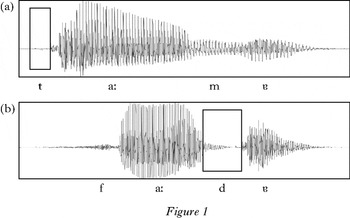
Figure 1 depicts waveforms illustrating the realisation of phonemic voiced stops as phonetically voiceless unaspirated word-initially (a) and as voiced stops intervocalically (b).
Unaspirated voiceless stop (a) and voiced stop (b) realisations of phonemic voiced stops in the words [taːmɐ] ‘wing’ and [faːdɐ] ‘drink’.

4 Prosodic fusion
Thus far, all the prosodic words considered have contained a single root. The process of prosodic fusion creates prosodic words consisting of multiple roots. Prosodic fusion applies most pervasively within noun phrases (see §4.1.1 for more on morphosyntactic constraints on fusion), and involves the combination of a head noun with another root within the same noun phrase. Such cases include noun+adjective sequences (10a), compounds consisting of two nouns (10b) and sequences of numeral+noun (10c). Adjectives and numerals appear after the noun they modify, except for /zə/ ‘one’, which occurs before the noun. The numeral suffix [-iː] (/əj/) intervenes between a noun and a following number. Note that all the morphemes (with the exception of the numeral suffix [-iː], which is a bound morpheme) in their free-standing form are given in (10) to the left of the arrow.
(10)
As the examples in (10) show, schwa at the end of the second root fails to surface, parallel to the situation observed in polysyllabic prosodic words containing a single prefixed root (see §3.1).
Parallel to prosodic words consisting of a single root, final /ɐ/ at the end of a noun phrase consisting of more than one root is characteristically not deleted (11).Footnote 4
(11)
The loss of final schwa in the forms in (10) and the preservation of final /ɐ/ in (11) follows if one assumes that the roots in both sets of forms have fused to form a single prosodic word. The other diagnostics for prosodic word status presented in §3.2 confirm this analysis.
In all forms displaying fusion, stress follows the predictable Kabardian pattern (§3.2.1), according to which the final syllable is stressed if heavy, otherwise the penult is stressed (12).
(12)
If the prosodic word corresponded to the grammatical word, we would expect each grammatical word to have a stress. Furthermore, we would also expect stress to fall on the syllable preceding the one it actually falls on in cases involving fusion of a word to a preceding polysyllabic word, i.e. *[ˈwənɐf'] instead of [wəˈnɐf'] and *[ˈçɐmɐł'] instead of [çɐˈmɐł'].
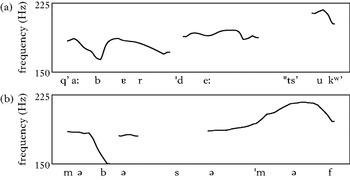
Figure 2 compares a pitch trace (taken from the speech of a female speaker) illustrating the stress pattern characteristic of a prosodic word resulting from fusion (b) with the typical pitch pattern found in a phrase consisting of two prosodic words (a). In the phrase consisting of the prosodic words /q'aːbɐrˈdəj/ ‘Kabardian’ and /ts'əkw'/ ‘little’, the highest pitch peak, associated with the phrasal H* pitch accent (§3.2.1), falls on the second word, with a clear secondary peak representing word-level stress falling on the final syllable of the first word. In the single prosodic word resulting from fusion of the prefixed noun /məbəsəm/ ‘this host’ and the adjective /f'ə/ ‘good’, there is a single pitch peak on the final syllable. Note that the schwa occurring between the two roots is due to a regular process of epenthesis occurring in fused forms that would otherwise have a consonant cluster at the boundary between the two roots (see §6 for discussion of epenthesis).
Pitch patterns in (a) the prosodic phrase [q'aːbɐrˈdəːˈˈts'ukw'] ‘the little Kabardian’ and (b) the prosodic word [məbəsəˈməf] ‘this good host’.

Vowel colouring (§3.2.2) also occurs across grammatical words that have fused. For example, the fused form [ʃuχw] ‘stallion’ (= /ʃə+χwə/ ‘horse+male’) (Colarusso Reference Colarusso1992: 47) is realised with a rounded vowel, owing to the labialised consonant in the second root. The rounding in this form can be compared with the lack of rounding in noun phrases in which fusion has not taken place, [ˈʃəˈˈxwaːbɐ], *[ʃuˈxwaːbɐ] ‘warm horse’, [məʔɐˈɾəsɐˈˈxwaː], *[məʔɐˈɾəsɔˈxwaː] ‘ripe apple’.
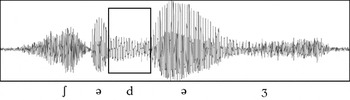
Finally, in forms involving fusion, an intervocalic voiced stop or stop phase of an affricate is obligatorily realised as a voiced stop, parallel to the realisation of voiced stops in prosodic words consisting of a single root (§3.2.3), e.g. /ʃə+tsɐ/ ‘horse+tooth’→[ˈʃədzɐ]. In contrast, in phrases comprised of multiple prosodic words, intervocalic voicing of stops across word boundaries is limited to fast speech rates. Figure 3 depicts a waveform illustrating voicing in a stop that comes to stand in intervocalic position due to prosodic fusion of the root /ʃəd/ ‘donkey’ with the adjective /Ӡə/ ‘new’.
Intervocalic voiced stop in the fused form [ʃədəӠ] ‘old donkey’.

In summary, phonologically fused roots pattern as prosodic words, parallel to grammatical words consisting of a single root. Diagnostics that indicate the prosodic word status of fused forms include deletion of final schwa, stress assignment, vowel colouring and the distribution of voicing in stops.
4.1 Restrictions on fusion
Prosodic fusion is subject to certain restrictions, both morphosyntactic and phonological, which are discussed in §§4.1.1 and 4.1.2 respectively.
4.1.1 Morphosyntactic restrictions on fusion
Fusion is limited to noun and adjective phrases and can only involve constituents (with one exception to be discussed later). These conditions limit fusion to sequences of noun+adjective (13a), noun+numeral (13b), numeral+noun (13c), noun+noun compounds (13d) and adverb+adjective sequences (13e). It precludes fusion between nouns and other syntactic classes, even if they are constituents and satisfy phonological conditions for fusion, for example, a CV noun and a verb belonging to the same verb phrase, e.g. /ʃəʃçə/ ‘eat a horse!’.
(13)
The constituency requirement also precludes fusion between two adjectives to the exclusion of a noun (14a), or between a noun and a preceding modifier such as a numeral or a possessive prefix to the exclusion of a modifier following the noun (14b).
(14)
It does, however, allow, for the possibility of recursive fusion involving a noun+two adjectives (15a), a noun+adjective sequence following a numeral (15b), a compound followed by one or more adjectives (15c) or other combinations of words eligible for fusion within the noun phrase. Examples (15a) and (15b) are the grammatical versions of their ungrammatical counterparts in (14a) and (14b) respectively.
(15)
The attested form in (15b) differs minimally from its ungrammatical counterpart in (14b) in having its second schwa before the final consonant rather than after it, i.e. [zəˈʃəf'] vs. *[ˈzəʃˈˈf'ə]. The grammatical form in (15a) differs from its unattested counterpart in (14a) in displaying rounding of the vowel preceding the initial [χw] of the second root, i.e. [ʃuˈχwuf'] vs. *[ˈʃəˈˈχwuf']. In addition, the unattested forms in (14a) and (14b) have a stress on each of the prosodic words, with the stress on the second word being stronger (§3.2.1). In contrast, the grammatical forms in (15) have a single stress.
There is one circumstance in which fusion can apply between words that are not constituents. If an adjective that is too large to fuse to a preceding noun (16a) or an already fused form is followed by a numeral (16b), the numeral fuses to the preceding element.
(16)
4.1.2 Phonological restrictions on fusion
Fusion is also subject to a phonological restriction: the second element must consist of a single light syllable, i.e. (C)CV. This light syllable may have either /ɐ/ as its nucleus or may be a monosyllabic root that ends in schwa in its bare form. The number of onset consonants in the second root is irrelevant. Fusion does not take place if the second root is either polysyllabic or consists of a single heavy syllable, i.e. (C)CVV or (C)CVC. In such cases, both roots are stressed, with a stronger (phrasal) stress falling on the second element (17).
(17)
Further evidence for the lack of fusion where the second root is larger than CV comes from vowel colouring. As we have seen (§3.1.2), vowel colouring is observed in noun phrases involving fusion: /ʃə+χwə/→[ʃuχw] ‘stallion’, /nɐ+gwə/→[nogw] ‘face’. Vowel colouring is not observed, however, when there is no fusion.
(18)
Furthermore, stops at the beginning of a morphological word that has not undergone fusion are realised (except at fast speech rates) as voiceless unaspirated, rather than as voiced, as one would expect if fusion had taken place (§3.1.3): /q'aːlɐ+daːçɐ/ ‘city+beautiful’→[ˈq'aːlɐˈˈtaːçɐ] (cf. /ʃəd+ʃ'ɐ/ ‘donkey+new’→[ʃəˈdəʃ'ɐ]).
A final piece of evidence for a lack of fusion when the second root is polysyllabic or heavy comes from the non-application of schwa epenthesis, which inserts a schwa after a consonant-final root that fuses to a following root. This process is discussed in §6.
4.2 Extraprosodicity and fusion
Thus far we have only considered cases in which the right edge of the prosodic word is aligned with the right edge of the grammatical word. In fact, all of the examples presented thus far have ended in a bare root. Kabardian makes extensive use of suffixes in both nouns and verbs. Stress patterns suggest a division between nominal and verbal suffixes in terms of their relationship to the prosodic word. Colarusso (Reference Colarusso1992) observes that nominal suffixes and those that can attach to either nouns or verbs fail to attract stress, suggesting that they fall outside the prosodic word. On other hand, suffixes that are strictly verbal fall within the domain of stress, indicating that they lie within the prosodic word. The forms in (19a) contain suffixes that potentially attract stress if phonological conditions are met, while those in (19b) contain suffixes that fall outside the domain of stress. Note that the declarative suffix /-s/, which can attach to both nouns and verbs, fails to attract stress; this means that the verb forms in (19a) containing this suffix have final stress because of the long vowel in the preceding (strictly verbal) suffix and not because of the declarative suffix. It should also be noted that the deletion of the root-final schwa before the past tense suffix in the third form in (19a) is due to a regular phonological rule deleting a short vowel before a long vowel. (Note that prosodic words are enclosed in { }ѡ.)
(19)
In the forms in (19b), addition of a suffix to a CVCV root fails to pull stress to the right of its original location in the unsuffixed form. The fact that the suffixes in (19b) fails to receive any stress suggests that they are outside the prosodic word and do not initiate a new prosodic word.
In keeping with the rejection of stress by the nominal and hybrid nominal/verbal suffixes in (19b), these suffixes also fail to ensure that roots containing a final schwa in isolation have this schwa when suffixed, as the forms in (20) show. The failure of schwa to surface in these examples falls out from the general ban on prosodic word-final schwa in polysyllabic (but not monosyllabic) words under the assumption that nominal and nominal/verbal suffixes fall outside the prosodic word.Footnote 8
(20)
Further evidence for the extraprosodic status of nominal suffixes is provided by the behaviour of laryngeal features in obstruent clusters. In most positions, Kabardian does not allow obstruent clusters in which the two members have different laryngeal features. Thus ejectives can only be adjacent to ejectives,Footnote 9 voiced obstruents can only occur next to voiced obstruents and voiceless obstruents can only be adjacent to voiceless obstruents. In most cases, this restriction holds as a static constraint on roots. However, consonant-final verbal prefixes have different allomorphs, depending on the initial consonant of the root (21).
(21)
Obstruent clusters containing a suffixal consonant fail to obey the voicing-agreement restriction (22), indicating that the suffix lies outside the prosodic word.
(22)
Since verbal suffixes fall within the prosodic word, we would expect root-final schwa to be preserved before a consonant-initial verbal suffix, as schwa is only deleted in final position of the prosodic word. This prediction is borne out by the data. Consonant-initial verbal suffixes may follow verb roots that end in a schwa in isolation, in which case the schwa also surfaces before the suffix.Footnote 10
(23)
4.3 Fusion: a summary
In summary, several phonological diagnostics support the generalisation that Kabardian observes a ban on schwa in final position of a prosodic word. Prosodic words may consist of a single root or may contain multiple roots within noun or adjective phrases that have undergone prosodic fusion. In order to be eligible for fusion, certain morphological and phonological conditions must be met. First, only constituents within noun (or adjectival) phrases are eligible to join together to form a single prosodic word. Furthermore, the second root must consist of a single light (CV) syllable in order to be fused to the preceding root. Apparent cases of final schwa unexpectedly failing to surface before suffixes turn out upon closer inspection to be attributable to the extraprosodic status of these suffixes.
5 An OT analysis of prosodic fusion
We propose that prosodic fusion in Kabardian is driven by a minimality condition requiring that prosodic words be at least as large as CVC. In moraic terms, the minimality constraint thus amounts to a requirement that feet be binary, under the assumption consistent with the stress facts (§3.2.1) that codas are moraic in Kabardian. This foot-binarity restriction, in conjunction with other prosodic constraints, ensures that subminimal words, i.e. monosyllables containing neither a long vowel nor a coda consonant, prosodically attach to the immediately preceding word within noun and adjectival phrases if the constituency requirement on fusion is satisfied.
We further suggest that the surfacing of schwa in open monosyllables that would otherwise lack a vowel and are ineligible for fusion for morphosyntactic reasons is due to an overarching ban on words containing no vowels; such a hypothetical word would not only fail to constitute a bimoraic foot but would also lack even a single mora. For this reason, schwa must surface in open monosyllables constituting a prosodic word that would otherwise not have a vowel. Crucially, whether the schwa in such words is assumed to be underlying or not does not influence the outcome of the two minimality conditions, which result from markedness constraints rather than input–output faithfulness.
An optimality-theoretic analysis of Kabardian minimality effects was developed and checked using OTSoft (Hayes et al. Reference Hayes, Tesar and Zuraw2003). Several constraints are at work to yield the minimality effects in Kabardian. First, we must simultaneously account for fusion where the second element is (C)CV, but block fusion where it is prosodically larger. A constraint based on the constraint requiring feet to be binary at either the moraic or syllabic level, FtBin (Prince Reference Prince1980, Broselow Reference Broselow1982, Prince & Smolensky Reference Prince and Smolensky1993, Hayes Reference Hayes1995, McCarthy & Prince Reference McCarthy and Prince1996), ranked above GramWd=PrWd (Prince & Smolensky Reference Prince and Smolensky1993), produces the desired effect. The relevant FtBin constraint, however, must refer to the main, i.e. primary stressed, foot of the phrase, since only the size of the second word, the phrasally stressed one, is relevant for determining whether fusion takes place or not: compare /wənɐ+ʃ'ɐ/→[wə(ˈˈnɐʃ'ɐ)] ‘new house’, with fusion, and [(ˈqwɐ)(ˈˈdaçɐ)] ‘beautiful pig’, without fusion. The relevant constraint to produce this asymmetry is FtBin(ˈˈΦ); it is defined in (24).Footnote 11
(24)
The ranking of FtBin(ˈˈΦ) above GramWd=PrWd is exemplified in (25). Prosodic words are enclosed in {}ѡ and prosodic phrases in 〚〛φ.
(25)
The first candidate violates GramWd=PrWd, since the two grammatical words fail to constitute independent prosodic words, as required by the constraint. The second candidate commits a fatal violation of higher-ranked FtBin(ˈˈΦ), however, because its phrasal stressed foot is monomoraic.
If the second word is larger than (C)CV and can thus be parsed into a canonical foot, fusion is blocked by GramWd=PrWd. GramWd=PrWd thus outranks the generic FtBin constraint banning monosyllabic feet.
(26)
The second candidate is parsed as a single prosodic word in which the first grammatical word is part of the same prosodic word as the second grammatical word, thereby violating GramWd=PrWd.Footnote 12
FtBin(ˈˈΦ) is violated in phrases consisting of a word with a single (C)CV syllable. This demonstrates that all prosodic words must be parsed into prosodic phrases, in keeping with the general principle of the prosodic hierarchy (Selkirk Reference Selkirk1984, Nespor & Vogel Reference Nespor and Vogel1986, Hayes Reference Hayes, Kiparsky and Youmans1989) requiring that lower constituents in the hierarchy belong to higher constituents. The constraint capturing this requirement is Parse(PrWd).
(27)
The ranking of Parse(PrWd) over FtBin(ˈˈΦ) is shown in (28). The losing candidate is parsed into a prosodic word, but not a prosodic phrase, as indicated by the lack of phrasal stress.
(28)
Thus far, we have accounted for cases of fusion but have not tackled the allomorphy involving final schwa. First, let us consider allomorphs lacking final schwa. The constraint responsible for the absence of final schwa in Kabardian reflects a cross-linguistically common type of restriction observed, for example, in Yupik (Reed et al. Reference Reed, Miyaoka, Jacobson, Afcan and Krauss1977), Chukchi (Kenstowicz Reference Kenstowicz, Davison, Maier, Silva and Yan1994), Moroccan Arabic (Dell & Elmedlaoui Reference Dell and Elmedlaoui2002) and Javanese (Horne Reference Horne1974). In these other languages, the ban on final schwa is bounded by the word. In Kabardian, this restriction must be must be narrowed to phrase-final position, for reasons that are discussed in §6. The constraint against phrase-final schwa is formulated in (29).
(29)
One strategy for honouring the constraint against final schwa is to change schwa vowels to another vowel quality in final position, as in Yupik (Reed et al. Reference Reed, Miyaoka, Jacobson, Afcan and Krauss1977), which displays an alternation between schwa and the low vowel [a] whereby schwa in non-final position alternates with [a] in final position. Rather than changing the quality of word-final schwa, Kabardian instead opts to delete it. This means that Ident-IO is ranked above Max-IO, as illustrated in (30).
(30)
*Final-ə is violated in phrases consisting of a monosyllabic root ending in schwa. This is due to the overriding requirements (not formulated here) that each foot have a head, i.e. at least one syllable, and that each syllable have a head, i.e. a nucleus (see also Peterson's Reference Peterson2007 account of Kabardian, which follows Kuipers Reference Kuipers1960 in assuming that schwa is not present underlyingly).
It may be noted that the distribution of schwa in both monosyllables and polysyllables is correctly produced whether schwa is assumed to be underlying, as in most analyses of Kabardian, or not, as in Kuipers' (Reference Kuipers1960) approach. In the case of polysyllabic prosodic words, a highly ranked *Final-ə will ensure that final schwa fails to surface. In monosyllabic words, the foot- and syllable-headedness constraints ensure that schwa surfaces in final position.
The fact that a light phrase-final root fuses to a preceding root indicates that Kabardian elects not to beef up the second root through root-internal augmentation processes that would obviate the need for fusion. Thus the vowel in the second root fails to lengthen, indicating that Dep-IO(μ) is ranked above GramWd=PrWd. Nor does the vowel lengthen in a CV root constituting an independent phrase, demonstrating that Dep-IO(μ) outranks FtBin(ˈˈΦ). Both of these rankings are shown in (31).
(31)
A final possibility to exclude is the addition of an epenthetic consonant without a mora, in order to shield a schwa from the right edge of the word. The ranking of Dep-IO(C) over *Final-ə effectively eliminates this option (32).
(32)
6 Epenthesis and prosodic fusion
A further complication arising in fusion contexts is that a schwa is inserted between the two roots undergoing fusion if the first root ends in a consonant (Colarusso Reference Colarusso1992).
(33)
Final schwa deletion and epenthesis can co-occur in the same fused forms (34).
(34)
The fused forms displaying epenthesis are clearly single prosodic words, parallel to those not involving epenthesis. Stress patterns, vowel colouring and stop voicing all indicate the prosodic word status of these forms. The epenthetic schwa is stressed if it stands in a penult preceding a light final syllable: [gjəˈdəfɐ] ‘chicken skin’. The epenthetic vowel assimilates to a following consonant: [gjəˈduχw] ‘male chicken’. A stop preceding an epenthetic schwa is voiced: [ʃəˈdəʃ'ɐ] ‘new donkey’ (cf. Fig. 3 above). Schwa epenthesis also provides a diagnostic for the lack of fusion when either morphosyntactic or phonological conditions on fusion are not met. For example, there is no epenthetic schwa between the roots comprising the phrase [ˈӠɐmˈˈbeː] ‘rich cattle’, because the second root, /ˈbeː/ ‘rich’, is heavy.
As it turns out, epenthesis reflects one strategy to satisfy a more wide-reaching constraint against coda consonants. This constraint, *Coda, bans coda consonants within the prosodic word (35).
(35)
Coda consonants within the prosodic word are limited to four contexts. First, they are found root-finally, either followed by a suffix (36a) or not (36b). Second, they are found root-medially (36c). Finally, they arise when the ergative prefixes, which consist of a single consonant, come into contact with a following root (36d).
(36)
Although verbal suffixes fall within the prosodic word, the structure of verb roots and verbal suffixes preclude examination of the applicability of the anti-coda constraint in suffixed verbs. Verb roots end in a vowel and there are no verbal suffixes either in isolation or in combination with one another that create closed syllables that are not in final position of the prosodic word.
The failure of epenthesis to apply following root-final consonants falls out from the ranking of the constraint against final schwa above the anti-coda constraint (37). (Prosodic bracketing is omitted from (37) and subsequent tableaux where candidates do not differ in their constituency.)
(37)
Consonants also fail to delete, in order to honour the anti-coda constraint, indicating that Max-IO is ranked above *Coda (38).
(38)
The absence of root-medial epenthesis finds a natural explanation in terms of the tendency for faithfulness to be stronger in roots than in affixes (McCarthy & Prince Reference McCarthy, Prince and Beckman1995). In the case of Kabardian, a contiguity constraint referring to the root (cf. Kenstowicz Reference Kenstowicz, Davison, Maier, Silva and Yan1994 for a similar analysis of Chukchi) ensures that contiguous segments in the input remain contiguous on the surface. This constraint, Contiguity-IORt (Contig-IO), militates against the insertion of epenthetic material within the root.
(39)
Contig-IO is ranked above *Coda, as indicated by the failure of epenthesis to apply within roots (40).
(40)
In the case of the ergative prefix, inserting an epenthetic vowel is not an attractive option to eliminate the coda consonant, since the ergative prefixes are contrasted with the absolutive prefixes on the basis of the occurrence or non-occurrence of schwa. The ergative prefixes consist of simply a consonant, while the absolutive prefixes corresponding in person and number consist of the same consonant+schwa. This difference yields transitive vs. intransitive minimal pairs differing in whether they have a schwa or not, as noted by Catford (Reference Catford, Higgs and Thelwall1984) : /stçaːs/ ‘I wrote (trans)’ vs. /səˈtçaːs/ ‘I wrote (intrans)’. The blocking of epenthesis following the ergative prefix thus reflects an overriding morphological anti-homophony constraint (not formulated here, but see Crosswhite Reference Crosswhite1999, Kenstowicz Reference Kenstowicz2002, Albright Reference Albright2003, Gessner & Hansson Reference Gessner and Hansson2004, Ichimura Reference Ichimura2006 and Łubowicz Reference Łubowicz and Anna2007 for anti-homophony constraints in OT). Other than the ergative prefix, all other prefixes in Kabardian (the 17 cited in Abitov et al. Reference Abitov, Balkarov, Desheriev, Rogava, El'berdov, Kardanov and Kuasheva1957) have the shape CV, reflecting the general dispreference for codas outside of the root.
In light of the general avoidance of clusters within prosodic words except for the contexts just discussed, the insertion of schwa between roots in prosodically fused forms may be viewed as a case of the emergence of the unmarked (McCarthy & Prince Reference McCarthy and Prince1994). *Coda is ranked above Dep-IO(μ), thereby accounting for the inter-root epenthesis observed in fused forms.Footnote 13
(41)
Another failed candidate opts to delete one of the consonants comprising the cluster instead of inserting a vowel to break up the cluster. The fact that epenthesis rather than deletion is employed to avoid coda indicates that Max-IO is ranked above Dep-IO(μ).
(42)
*Coda is also ranked above GramWd=PrWd, as forms undergoing epenthesis also undergo fusion (43).
(43)
At first glance, it might seem as if FtBin(ˈˈΦ) would successfully rule out the losing candidate in the above tableau. However, FtBin(ˈˈΦ) is ranked below Dep-IO(μ), as evidenced by the failure of vowels to lengthen in monosyllabic phrasally stressed feet, i.e. 〚{(ˈˈʃə)}ѡ〛φ, not *〚{(ˈˈʃəː)}ѡ〛φ. It thus must be a constraint ranked above Dep-IO(μ), namely *Coda, that is responsible for the downfall of the losing candidate in (43).
*Coda is ranked below certain markedness constraints. The fact that the deletion of final schwa in polysyllabic forms creates a coda consonant means that the ban on final schwa is ranked above *Coda. Furthermore, the failure of final schwa to change to a different vowel indicates that *Coda is ranked below Ident-IO. Both of these rankings are illustrated in (44).
(44)
Consideration of an additional challenger to the winner in (44) reveals a further crucial ranking that only emerges after the constraint rankings required to produce the correct epenthesis patterns are integrated into the analysis of forms involving schwa deletion without epenthesis. This candidate, 〚{(ˈqwɐ)}ѡ{(ˈˈf'ə)}ѡ〛φ, in which the schwa in the second root is preserved and the two roots are parsed as separate prosodic words, would appear to be eliminated by the ranking of FtBin(ˈˈΦ) over GramWd=PrWd. However, the winning candidate violates two constraints ranked above FtBin(ˈˈΦ) which the failed candidate does not violate: Max-IO and *Coda, thereby precluding the possibility that FtBin(ˈˈΦ) is the constraint that blocks 〚{(ˈqwɐ)}ѡ{(ˈˈf'ə)}ѡ〛φ. We now consider why Max-IO and *Coda are ranked above FtBin(ˈˈΦ). The ranking of *Coda, and thus Max-IO, above FtBin(ˈˈΦ) is the result of a series of transitivity relations, as follows. We have already seen that Max-IO outranks *Coda (see (38)). *Coda is ranked above Dep-IO(μ) (see (41)), which, in turn, is superordinate to FtBin(ˈˈΦ), as evidenced by the failure of vowels to lengthen in phrasally stressed CV feet, i.e. 〚{(ˈˈʃə)}ѡ〛φ, not *〚{(ˈˈʃəː)}ѡ〛φ. This means that the constraint that knocks out the non-fused challenger 〚{(ˈqwɐ)} ѡ{(ˈˈf'ə)}ѡ〛φ must be ranked above both Max-IO and *Coda. The correct constraint is *Final-ə, which is violated by the challenger but not the winner, as shown in (45).
(45)
The ranking of *Final-ə over GramWd=PrWd has implications for the characterisation of the prosodic domain referenced by *Final-ə, which bans phrase-final schwa (see Flack Reference Flack2009 on markedness constraints bounded by different prosodic domains). If *Final-ə were bounded by the word rather than the phrase, there would be no way to ensure that a final schwa in a word followed by a word larger than CV within the same phrase is not deleted. For example, the phrase 〚{(ˈł'ə)}ѡ{(ˈˈʁwuɾ)}ѡ〛φ ‘skinny man’ would be incorrectly predicted to undergo fusion and surface as *〚{(ˈˈł'ʁwuɾ)}ѡ〛φ, given the ranking of *Final-ə over GramWd=PrWd. By constraining *Final-ə to refer to phrase-final position, the schwa at the end of the first word in 〚{(ˈł'ə)}ѡ{(ˈˈʁwuɾ)}ѡ〛φ is allowed to surface, and fusion is correctly blocked.
The final constraint rankings are summarised in (46).
(46)
7 Kabardian and the typology of minimality effects
Kabardian minimality effects differ in two ways from those observed in other languages. First, the minimality requirement in Kabardian is scalar. Words consisting only of consonants are completely banned, while monomoraic words are avoided wherever there is the possibility of fusion to a preceding word. This process of fusion ensures that words consist minimally of a single heavy syllable where the necessary prosodic and morphosyntactic conditions for fusion are present. The scalar nature of minimality in Kabardian has been attributed here to a combination of a foot-binarity constraint operating over phrasally stressed feet coupled with a higher-ranked foot-monomoraicity constraint requiring that feet contain at least one mora.
This latter constraint is likely universally inviolable, as a violation of it would entail the existence of a word consisting of a single non-syllabic consonant. Although there are languages in which certain words may consist of only consonants, e.g. Berber (Dell & Elmedlaoui Reference Dell and Elmedlaoui1985, Reference Dell and Elmedlaoui2002) and Bella Coola (Bagemihl Reference Bagemihl1991), words in these languages invariably contain a consonant that functions as a syllable nucleus, thereby honouring the requirement on foot monomoraicity.
7.1 Kabardian and the typology of minimality
Languages differ in their minimal word requirements. For example, whereas the smallest prosodic word in Chickasaw (Munro & Willmond Reference Munro and Willmond1994) is CVV, in Mongolian (Hangin Reference Hangin1986) both CVV and CVC monosyllables are well-formed (as are disyllables). In Lardil (Hale Reference Hale and Sebeok1973, Wilkinson Reference Wilkinson1988), on the other hand, words are minimally disyllabic. When conflated across languages, the minimality hierarchy in (47) emerges (Garrett Reference Garrett1999), in which the existence of prosodic words of a given shape implies the occurrence of prosodic words to the left within the hierarchy, assuming that independent restrictions, e.g. a ban on closed syllables, the absence of long vowels, etc., do not preclude any of the permitted templates.
(47)
Minimal word requirements may either exist as static restrictions on the lexicon, as in Chickasaw and Mongolian, or may induce phonological processes that conspire to ensure that words meet the minimality requirement. For example, glottal stop is inserted to ensure that underlying CV words meet the CVC-minimality requirement in Cupeño (Crowhurst Reference Crowhurst1994), as in (48).
(48)
The strategy taken to bolster words to meet the binarity requirement in Kabardian is typologically unusual compared to that observed in Cupeño. In most languages, the requirement that a word consist minimally of a bimoraic foot is satisfied either through syntagmatic constraints on the lexicon or through active word-internal phonological processes. Three types of processes for satisfying minimality at the word level are observed depending on the stringency of the minimal word requirement. One strategy exemplified by Cupeño is epenthesis of a consonant if both CVV and CVC are minimal words. In some languages, a vowel may be lengthened in monosyllables in order to satisfy a minimality requirement. Thus, in Northern Sámi (Nielsen Reference Nielsen1926), short vowels in monosyllabic function words lengthen if they stand as independent prosodic words rather than prosodically adjoining to an adjacent word.
In other languages imposing a more stringent disyllabic minimality requirement, vowel epenthesis is employed to repair words that would otherwise be monosyllabic. For example, the disyllabic minimality restriction holding of verbs in Minto (Hargus & Tuttle Reference Hargus and Tuttle1997) is satisfied by insertion of a pleonastic schwa in otherwise unprefixed monosyllabic verbs (49).
(49)
In other languages with a disyllabic minimality requirement, an otherwise regular process of vowel deletion may be suspended if it would create a subminimal monosyllabic word. For example, a process of final vowel deletion (Hale Reference Hale and Sebeok1973, Wilkinson Reference Wilkinson1988) is blocked in Lardil in disyllables, so that they do not become monosyllabic.
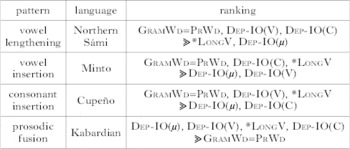
All of these strategies for satisfying minimality requirements ensure that a grammatical word retains its prosodic independence. In constraint-ranking terms, these strategies all entail a highly ranked foot-binarity constraint as well as a highly ranked GramWd=PrWd, which ensures that the mapping between grammatical words and prosodic words is one-to-one. The foot-binarity constraint can be operative at either the moraic or syllabic level, depending on whether the language allows words consisting of a single heavy syllable or requires that words be minimally two syllables. These languages differ in the faithfulness constraint that is violated by the repair operation employed to satisfy minimality. In all languages that do not employ fusion to satisfy minimality, Dep-IO(μ) is ranked low and GramWd=PrWd is ranked high. These languages differ in the ranking of three other constraints: a constraint against long vowels, *LongV, a constraint against vowel insertion, Dep-IO(V), and a constraint against consonant insertion, Dep-IO(C). In languages that insert an epenthetic consonant, e.g. Cupeño, Dep-IO(C) is low-ranked. In languages adding an epenthetic vowel, e.g. Minto, Dep-IO(V) joins Dep-IO(μ) at the bottom tier of the constraint hierarchy. Languages such as Northern Sámi, which employ vowel lengthening to honour minimality, rank *LongV and Dep-IO(μ) low in the constraint hierarchy.Footnote 14 Finally, the Kabardian response to employ fusion as a means to satisfy minimality results from ranking GramWd=PrWd below the other four pertinent constraints. The various language-specific strategies for satisfying minimality and the rankings they instantiate are summarised in Table I.
Typology of repair stategies for satisfying prosodic minimality.

7.2 Kabardian prosodic fusion in relation to other word-formation processes
Interestingly, the Kabardian minimality-driven process of fusion superficially resembles some other word-formation processes, notably cliticisation and compounding, though it differs from these phenomena in certain important respects. We briefly consider these other processes and their relation to fusion here.
7.2.1 Fusion as cliticisation
Kabardian prosodic fusion is similar in certain respects to cliticisation, a process involving attachment of a function word, e.g. a pronoun, to a content word that functions as a prosodic host. For example, pronouns in Spanish cliticise to verbs: dá me lo ‘give me it’ (give+me+it) (see Miller & Monachesi Reference Miller, Monachesi and Godard2003 for an overview of clitics in Spanish and other Romance languages). Similarly, the latching of unstressed prepositions, articles and pronouns onto open class lexical items in English may be viewed as another type of cliticisation: on cars, an axe, read it!
Clitic attachment is a cross-linguistically common phenomenon that shares with Kabardian fusion its grouping together of multiple grammatical words into a single prosodic word. Cliticisation characteristically differs, however, from fusion in certain respects. First, the fused forms in Kabardian display stress patterns that conform to the regular word-level stress rules holding of non-fused forms. This means that roots surfacing as a single consonant that has undergone fusion to a preceding root fall in a stressed syllable, e.g. [wəˈnɐ-Ӡ] ‘new house’. Typically, though not without exception (see Klavans Reference Klavans1985), clitics are unstressed. For example, monosyllabic function words in English often prosodically attach to an adjacent content word (Zwicky Reference Zwicky1970, Selkirk Reference Selkirk1984, Reference Selkirk and Beckman1995, Kaisse Reference Kaisse1985). Thus, the article an in the sentence He saw an ˈant is unstressed, as evidenced by its reduced vowel [ə], even though a comparable disyllabic noun ending in a C+coronal cluster (Hammond Reference Hammond1999) would be expected to have penultimate stress, e.g. ˈforest, ˈlegend. Similarly, in the Spanish form vénde me lo ‘sell it to me’ (sell+me+it) containing two postverbal clitics, stress falls on the first syllable of the verb root, the pre-antepenultimate syllable of the entire clitic group, even though stress in Spanish is typically restricted to one of the final three syllables of a word (Harris Reference Harris1983).
A further feature of Kabardian fusion that differs from the prototypical case of cliticisation is the fact that the words that undergo fusion in Kabardian are full-fledged content words. In contrast, cliticised elements are characteristically function words that do not occur prosodically independent of their hosts. There is, however, at least one other language that displays cliticisation of content words as in Kabardian. In Macedonian (Franks Reference Franks1989),Footnote 15 there are a few morphosyntactic constructions in which a content word adjoins to a preceding word to form a single expanded domain of stress, which in other circumstances is bounded by the word. Stress falls on the antepenultimate syllable of words with at least three syllables and on the first syllable of shorter words. Multi-word constructions that constitute a single stress domain include modifier+noun sequences, numerous preposition+noun sequences and negation/interrogative+optional clitic clusters+verb sequences. For example, in the adjective+noun construction suˈvo grozje ‘raisins’ (dry+grapes) and the preposition+noun combination preˈku glava ‘over (one's) head’ (Franks Reference Franks1989: 555), stress skips over the second word entirely, and instead falls on the antepenultimate syllable of the phrase. The rejection of stress by the second element in phrases like suˈvo grozje (*ˈsuvo ˈgrozje) and preˈku glava (*ˈpreku ˈglava) bears close resemblance to Kabardian fused forms, which also end in an unstressed root. Another point of similarity between the two processes is the restriction of both phenomena to particular morphosyntactic contexts.Footnote 16
7.2.2 Fusion as compounding
One other process with which Kabardian fusion shares certain properties is compounding. Like fusion and unlike cliticisation, compounding often involves the combination of two open class lexical items, e.g. blackboard, steamship, football. The similarity between the two processes, however, ends there. Unlike fusion, compound words may display phonological properties that are anomalous for non-compounds. Thus, compounds in many, though not all, languages stress both members of the compound, as in English, which usually places a stronger stress on the left element of the compound and a secondary stress on the right member, e.g. ˈblackˌboard, ˈsteamˌship, ˈfootˌball. Furthermore, it is common for phonotactic restrictions holding of non-compounds to be violated in compounds. For example, the /kb/ cluster in blackboard and the /tb/ cluster in football are unattested in monomorphemic words in English. In contrast, fused forms in Kabardian are phonologically indistinguishable from non-fused forms on the surface. The only difference between fused and non-fused forms is the epenthesis of schwa between the two roots comprising fused forms, a process that is unattested in non-fused forms. Perhaps the most salient difference, however, between Kabardian prosodic fusion and compounding is the motivation behind the two phenomena: whereas compounding is morphologically driven, prosodic fusion serves a clearly phonological goal in avoiding subminimal words.
In summary, prosodic fusion in Kabardian shares certain properties with the word-formation processes of cliticisation and compounding. However, it differs from prototypical instantiations of both these processes in certain respects. The phenomenon to which it appears to bear closest resemblance is the formation of multi-word stress domains in Macedonian, although it is unclear whether the extended stress domains of Macedonian are prosodically identical to single words with respect to properties other than stress.
8 Conclusions
The process of prosodic fusion in Kabardian expands the typology of strategies employed to satisfy prosodic minimality, but in a way predicted by the mechanism of constraint re-ranking intrinsic to OT. By demoting the requirement that grammatical words map to prosodic words in one-to-one fashion below faithfulness constraints banning insertion of moras and segments, subminimal words are free to combine in order to honour a constraint on foot-binarity. Interestingly, the relevant binarity constraint in Kabardian is specific to phrasal stress, which accounts for the unidirectional nature of fusion whereby a subminimal word can fuse to a word to its left but not to its right.