1 Introduction
There are many processes on either side of the phonetics–phonology interface which resemble one another. In both coarticulation and assimilation, for example, the qualities of one speech sound alter those of another sound. Of course, assimilation differs from coarticulation in that it has the potential to neutralise contrast, but the resemblance is otherwise striking. Vowel reduction, closed syllable vowel shortening and postnasal voicing are just a handful of the many additional processes that also have counterparts on either side of the interface, differing only in their neutralisation potential (Flemming Reference Flemming2001; see also Ohala Reference Ohala, Kingston and Beckman1990, Blevins & Garrett Reference Blevins and Garrett1998, Steriade Reference Steriade1999, Reference Steriade, Hume and Johnson2001, Blevins Reference Blevins2004, Barnes Reference Barnes2006 and many others). These resemblances have led many researchers to argue that the most parsimonious theory of phonology is a unified theory, whereby phonological processes derive directly from phonetic ones. Once we truly understand the physical events of speech – that is, articulatory gestures and/or acoustic outcomes – which give rise to phonetic processes, the argument goes, we will also understand their phonological counterparts (Browman & Goldstein Reference Browman, Goldstein, Kingston and Beckman1990, Flemming Reference Flemming2001, Steriade Reference Steriade, Hume and Johnson2001, Gafos Reference Gafos2002).
The unified theory presents a compelling case in part because many phonological processes are local: that is, they affect constituents which are adjacent to one another in time. For example, most cases of consonant assimilation involve one speech sound altering the quality of an adjacent sound, not a non-adjacent sound (e.g. Cho Reference Cho1990). Any theory must capture this locality generalisation, and a theory based on the physical events of speech captures it for free, because such events occur sequentially in continuous time. Crucially, a given event cannot skip time: it can affect another event that occurs immediately before or after it, but no others. So, for example, if we analyse assimilation as a process by which one articulatory gesture affects another, we capture the locality generalisation without further stipulation, because a gesture can only affect immediately preceding or following gestures, not non-adjacent gestures.
Despite their appeal, physical events are certainly not the only way to capture locality generalisations in phonology. Abstract constituents can do so also. The theory of autosegmental phonology (Goldsmith Reference Goldsmith1976, Clements & Keyser Reference Clements and Keyser1983), for example, employs the abstract constituent of the segment. A segment divides the speech stream into discrete representations, such as C or V, which abstract away from inherent differences in their physical implementation. In the theory, features such as [place] associate to segments via association lines. So we can analyse assimilation as a process by which the features associated to one segment spread to another segment, subject to the constraint that association lines cannot cross. This constraint captures the locality generalisation rather elegantly, but unlike the physical theory, it does not do so for free. This is because no built-in characteristic prevents association lines from crossing; only a stipulation does.
For a process like assimilation, then, one could argue that physical and abstract theories differ in terms of parsimony. A physical theory captures locality by virtue of its built-in characteristics, while an abstract theory captures it with a stipulation. The problem, however, is that the two kinds of theories do not necessarily differ in terms of predictions. As we have seen, both predict that assimilation should be overwhelmingly local. As another example, both theories can predict that assimilation should target certain speech sounds over others. In physical theories, inherent physical differences among e.g. labial, alveolar and velar gestures make such predictions; in abstract theories, constraints on markedness between labial, alveolar and velar segments can make similar predictions (e.g. de Lacy Reference de Lacy2006). Because the predictions of physical vs. abstract theories do not always differ, their relative merits are sometimes assessed on philosophical, rather than empirical grounds.
In this paper, I use speech-production data to investigate physical vs. abstract theories for a particular case in which they make clearly different predictions: gemination restrictions. Geminates are long speech sounds that contrast with short ones, and many languages with geminates impose restrictions on where they can occur (on gemination, see Kenstowicz Reference Kenstowicz1982, Hyman Reference Hyman1985, Hayes Reference Hayes1986a, Reference Hayesb, McCarthy Reference McCarthy1986, Schein & Steriade Reference Schein and Steriade1986, Inkelas & Cho Reference Inkelas and Cho1993, Rose Reference Rose2000, Ham Reference Ham2001, Muller Reference Muller2001). In Hungarian, the focus of the current study, the restrictions on gemination are of particular interest, because, like assimilation, they can be aptly formulated in either physical or abstract terms. As reported in the literature, the restriction is that a singleton consonant cannot change to a geminate when flanked by another consonant on either the left or the right (Vago Reference Vago1980: 41–43, Dressler & Siptár Reference Dressler and Siptár1989: 33–35, Nádasdy Reference Nádasdy and Szende1989, Kenesei et al. Reference Kenesei, Vago and Fenyvesi1998: 448, Siptár & Törkenczy Reference Siptár and Törkenczy2000: 286–293). For example, suffixes that normally trigger gemination of a root-final consonant, such as the instrumental case suffix, fail to do so just when another consonant is present on the left (Nádasdy Reference Nádasdy and Szende1989: 105).
(1)


(In this and subsequent examples, the presence of /C/ in the underlying representation indicates a timing slot that triggers gemination, while /A/ and /O/ indicate an underspecified vowel whose features are filled by harmony. /A/ is realised as [ɔ] or [∊]; /O/ as [ɔ], [∊] or [ø].) Similar restrictions hold when another consonant is present on the right. Underlying geminates can occur word-finally before pause, but shorten obligatorily before another consonant: hall [hɔlː] ‘he hears’, but hallva [hɔlvɔ] ‘hearing’ (Nádasdy Reference Nádasdy and Szende1989: 104).
The restriction in Hungarian, as we will see in subsequent sections, is a highly local one which makes no reference to abstract constituents such as syllables or words. It is an open question, however, whether the restriction makes reference to the abstract constituent of the segment. As formulated in published descriptions of Hungarian phonology (Vago Reference Vago1980: 41–43, Dressler & Siptár Reference Dressler and Siptár1989: 33–35, Nádasdy Reference Nádasdy and Szende1989, Kenesei et al. Reference Kenesei, Vago and Fenyvesi1998: 448, Siptár & Törkenczy Reference Siptár and Törkenczy2000: 286–293), the restriction does refer to segments, along the lines in (2).
(2) Abstract formulation
A consonant (C) may become or remain geminate (CC) only when it is flanked by vowels (V) on both sides, or by a vowel (V) on the left and pause on the right.
But it is also possible to formulate the restriction in physical terms, as in (3).
(3) Physical formulation
Areas of narrow constriction may lengthen or remain long only when flanked by areas of wide constriction.
The physical formulation makes reference to areas of the speech stream according to how they are articulated, either with a narrow opening in the vocal tract (‘narrow constriction’, associated with consonants) or with a wide one (‘wide constriction’, associated with vowels) (for related ideas see Smith Reference Smith, Connell and Arvaniti1995, Kirchner Reference Kirchner2000, Gafos Reference Gafos2002). There are plausible reasons to think that flanking constrictions could affect the implementation of long narrow constrictions, in which case the physical formulation offers a reasonably parsimonious account.Footnote 1 The physical formulation also unifies the concepts of vowel and pause, either of which can flank a geminate on the right (cf. hall [hɔlː]). In the abstract formulation, each of these environments must be listed separately, but in the physical formulation, both can arguably be subsumed under the rubric of a ‘wide’ constriction.
Parsimony aside, the formulations make different predictions. While both predict no change in overall duration of a target consonant (or area of narrow constriction), they differ crucially in the predictions they make for relative changes within the target consonant. Specifically, the abstract formulation predicts that relative changes within the target consonant can occur, while the physical formulation predicts that they cannot.
We can see this most clearly by considering consonants that have complex internal structures, such as affricates. Affricates consist of two portions, a stop closure followed by frication (for phonetic analyses of affricates, see Repp et al. Reference Repp, Liberman, Eccardt and Pesetsky1978, Dorman et al. Reference Dorman, Raphael and Isenberg1980, Howell & Rosen Reference Howell and Rosen1983, Tarnóczy Reference Tarnóczy, Channon and Shockey1987, Miller-Ockhuizen & Zec Reference Miller-Ockhuizen and Zec2002; for phonological analyses, see Hualde Reference Hualde1988, Lombardi Reference Lombardi1990, Rubach Reference Rubach1994, Clements Reference Clements, Fujimura, Joseph and Palek1999). For example, the Hungarian word kincs [kinʧ] ‘treasure’ contains a word-final affricate preceded by a nasal. When a geminating suffix such as the instrumental is added to the word, the affricate becomes a target for gemination, but [n] restricts this process: /kinʧ-CAl/→[kinʧel] ‘treasure-instr’, *[kintːʃel]. Under the abstract formulation of the restriction, there is a single C target under consideration, namely [ʧ]. This C cannot geminate, because it is preceded by another C – in other words, the restriction holds on the timing tier but not the feature tier.
(4)
Nothing, however, prevents a reorganisation of the relative duration of [t] and [ʃ] within the C. Indeed, the representation C freely permits such a reorganisation precisely because it abstracts away from it. In other words, under the abstract formulation, reorganisation of the affricate can occur even when gemination cannot.
For the physical restriction, on the other hand, the concept of a segment is not operative. For example, in a word such as kinccsel [kinʧel], the affricate is not a segment, but a sequence of two different target articulations, an oral stop closure followed by frication. Each of these articulations has narrow constriction. In addition, each articulation is crucially flanked on the left by another articulation of narrow constriction – the stop closure is flanked by the nasal, while the frication is in turn flanked by the stop.
(5)
Under the physical formulation, then, the stop closure and the frication are each independently restricted from lengthening in the temporal domain, because each is a narrow constriction preceded by a narrow constriction. As a consequence, no reorganisation of the relative durations of stop and frication is permitted, because any such reorganisation would violate the physical restriction at least once, if not twice.
In sum, then, for a target affricate with stop closure and frication components, the abstract formulation permits changes in the ratio of stop closure to overall duration (T/TS) while the physical formulation predicts no change.
(6)
The physical formulation also makes a further prediction that distinguishes it from the abstract one, which is that the restriction should apply to any type of lengthening, not just gemination. As is well established, diverse processes can increase the duration of some portion of the speech stream, including gemination, but also, as documented for English and various other languages, phrase-final or phrase-initial position (Klatt Reference Klatt1976, Fougeron & Keating Reference Fougeron and Keating1997, Byrd et al. Reference Byrd, Kaun, Narayanan, Saltzman, Broe and Pierrehumbert2000, Cho & Keating Reference Cho and Keating2001, Byrd & Saltzman Reference Byrd and Saltzman2003, Cho Reference Cho2005, Reference Cho, Goldstein, Whalen and Best2006, Turk & Shattuck-Hufnagel Reference Turk and Shattuck-Hufnagel2007), stress (Summers Reference Summers1987, Turk & Shattuck-Hufnagel Reference Turk and Shattuck-Hufnagel2000, Reference Turk and Shattuck-Hufnagel2007), focus (De Jong & Zawaydeh Reference De Jong and Zawaydeh2002), rate (Miller Reference Miller, Eimas and Miller1981), clear speech (Smiljanic & Bradlow Reference Smiljanic and Bradlow2007) and voicelessness (Summers Reference Summers1987). Among these, gemination is typically considered special because it has the potential to neutralise contrast, whereas the other processes do not. An abstract theory of gemination models this special status using the C representation. Thus, a gemination rule takes the basic form C→CC; other lengthening processes do not make reference to C representations and fall outside the domain of the theory. A physical theory of gemination, however, does not employ the notion of C at all. Without C, gemination ceases to be a special process distinct from other processes that increase duration. Furthermore, any restriction on gemination is physically based, and should therefore apply to other types of lengthening as well. That is, any narrow constriction should fail to increase its duration when it is preceded or followed by another narrow constriction, regardless of the lengthening process involved.
This paper presents the results of two Hungarian speech-production studies that test the differing predictions of abstract and physical formulations of the gemination restriction. As we have seen, these formulations differ chiefly in the predictions they make for relative changes within the target consonant, which are demonstrated most clearly by segments with complex internal structures, such as affricates. Therefore, the production studies reported here place affricates in target positions, and compare the ratio of stop closure to total duration (T/TS) in restricted gemination environments to that found in comparable singleton environments. In addition, the abstract and physical formulations differ in the predictions they make for gemination relative to other lengthening processes. Therefore, the production studies also compare gemination with another process that increases duration, phrase-final lengthening (for related work on Hungarian segmental duration, see Kassai Reference Kassai1979, Reference Kassai and Bolla1982, Olaszy Reference Olaszy1994, Reference Olaszy2000, Reference Olaszy2002, Hockey & Fagyal Reference Hockey and Fagyal1999, Gósy Reference Gósy2001 and the papers in Gósy Reference Gósy1991).
The results of these studies demonstrate that gemination restrictions in Hungarian require the abstract constituent of the segment, and therefore cannot be adequately modelled with a purely physical formulation. They also demonstrate that the restriction does not apply to phrase-final lengthening, suggesting that gemination is a lengthening process distinct from others. At the same time, however, the results indicate that gemination in Hungarian exhibits some unexpected sensitivity to the inherent durations of segments, of the kind that abstract theories presumably abstract away from. This suggests that it is a compromise position which best captures the data. That is, the abstract representation of the segment, while still necessary in order to adequately describe phonological processes, can benefit from the addition of at least some internal temporal landmarks.
2 Restrictions on gemination in Hungarian
This section motivates the focus on gemination restrictions by describing them in more detail. In Hungarian, as in many other languages, geminates may be ‘true’ or ‘fake’. The restriction that concerns us applies without exception to true geminates, and it is straightforward to demonstrate that the restriction does not refer to relatively high-level constituents, such as syllables and words, but only (if at all) to relatively low-level constituents, such as segments. Interestingly, however, the restriction applies in a more graded fashion to fake geminates, which may surface when flanked by another consonant of relatively high sonority. Although the current study focuses on only one type of true geminate, consideration of the full range of geminates and their concomitant restrictions helps to place both the abstract and physical formulations in a broader context.
2.1 Sources of geminates: true and fake
In Hungarian, all singleton consonants have geminate counterparts (Kenesei et al. Reference Kenesei, Vago and Fenyvesi1998: 425), and these may occur word-medially and word-finally, but not word-initially. In both attested positions, geminates are phonemically contrastive with singletons, as shown by the examples in (7) (Nádasdy Reference Nádasdy and Szende1989: 104).
(7)
In addition to phonemic geminates, Hungarian also has derived geminates. Derived geminates come from two sources, and correspondingly exhibit two different sets of behaviours in restricted environments. The first source of derived geminates is active phonological alternations, of which there are many. Some examples are given in (8) (Nádasdy Reference Nádasdy and Szende1989: 105, Kenesei et al. Reference Kenesei, Vago and Fenyvesi1998: 440, Siptár & Törkenczy Reference Siptár and Törkenczy2000: 193).
(8)
Other active alternations can also create surface geminates if the conditions are right. Regressive voicing assimilation, for example, applies generally in CC clusters. If the two consonants already share other features, a geminate results. The same goes for optional regressive place assimilation between sibilants (Kenesei et al. Reference Kenesei, Vago and Fenyvesi1998: 441, 444–446).
(9)
In the literature, phonemic geminates and geminates derived from active phonological processes are generally considered to be ‘true’ geminates (see especially Kenstowicz Reference Kenstowicz1982 and Hayes Reference Hayes1986b); essentially, this means that their behaviour is distinct from that of consonant clusters.
The second source of derived geminates is the juxtaposition of identical singletons. These are referred to as ‘fake’ geminates, meaning that their behaviour is similar to that of consonant clusters. These are also attested in Hungarian, as shown in (10) (Kenesei et al. Reference Kenesei, Vago and Fenyvesi1998: 196, Rounds Reference Rounds2001: 60, 103, 107). In this and subsequent examples, the hyphens indicate morpheme boundaries.
(10)
2.2 Restrictions on true geminates
In Hungarian, true geminates are subject to strict restrictions: they may not occur when flanked on either the left or right side by another consonant. For phonemic geminates, this restriction triggers degemination: [hɔlː], but [hɔlvɔ] (Nádasdy Reference Nádasdy and Szende1989: 104). For derived geminates, it is an open question whether this restriction triggers degemination or prevents gemination from occurring in the first place, but the surface requirement for a singleton is the same in either scenario. The restriction on gemination is demonstrated in the following examples, where a singleton consonant that would undergo gemination in an unrestricted environment fails to do so because of the presence of a restricting consonant on the left (Vago Reference Vago1980: 42, Nádasdy Reference Nádasdy and Szende1989: 105, Siptár & Törkenczy Reference Siptár and Törkenczy2000: 293). Note that in many cases, the orthography continues to represent gemination by the doubling of consonant symbols, even in restricted environments.Footnote 2
(11)
According to the literature, true gemination is also prevented by the presence of a restricting consonant on the right side, but concrete examples are scarce. We have already seen one example with underlying geminates, [hɔlː], but [hɔlvɔ]. Vago (Reference Vago1980: 42) gives another example with regressive sibilant place assimilation, /huːs ʃkoːt/→húsz skót [huːʃkoːt] ‘twenty Scotsmen’, *[huːʃːkoːt]. However, a reviewer observes that [huːʃːkoːt] is actually a possible surface form, because the process of sibilant place assimilation is optional, and that even when it does occur, degemination of the resulting form is also optional. This issue clearly needs more investigation, but does not affect the design or conclusions of the current study.
2.3 Locality of restrictions on true geminates
The restrictions on true geminates in Hungarian do not originate from independent restrictions on syllable or word structure, but are dependent upon the linear order of elements in a string. As an example, consider the root /ɔkt/ ‘nude (n)’, where the target is /t/ and the flanking consonant on its left is /k/. The sources on Hungarian phonology agree that word-internal geminates syllabify as sequences of coda+onset (Kenesei et al. Reference Kenesei, Vago and Fenyvesi1998: 414). So if gemination of /t/ were to occur, triggered for example by the addition of the instrumental suffix, the resulting syllabification would be *[ɔkt.tɔl] ‘with a nude’, with a complex coda at the end of the initial syllable.
Yet there is no general prohibition in Hungarian against such forms. Sequences of CCC which do not contain a geminate are freely permitted across morpheme boundaries: kard-ból ‘from the sword’, vers-ről ‘about the poem’, elv-telen ‘without principles’ (Siptár & Törkenczy Reference Siptár and Törkenczy2000: 101), paraszt-nak ‘peasant-dat’ (Kenesei et al. Reference Kenesei, Vago and Fenyvesi1998: 408), Budapest-re ‘Budapest-sublat’ (Rounds Reference Rounds2001: 94). Furthermore, such sequences are syllabified as CC.C, i.e. with a complex coda at the end of the initial syllable, regardless of the relative sonority of the consonants. The following quotation makes this explicit:
heteromorphemic VCCCV sequences can only yield a single consonant in onset position, even when a given cluster is permissible syllable-initially. Accordingly, Budapest-re ‘Budapest-sub’ can only be syllabified as /bu.dɔ.p∊št.r∊/, even though both /tr/ and /štr/ are licit syllable-initial clusters (Kenesei et al. Reference Kenesei, Vago and Fenyvesi1998: 415).
Thus, the prohibition of forms like *[ɔkt.tɔl] is specific to geminates, and cannot be explained by general constraints on CCC sequences or complex codas. In fact, the failure of gemination to occur in restricted environments has the effect of destroying the perfect correspondence between syllable boundaries and morpheme boundaries that would obtain in a hypothetical form such as *[ɔkt.tɔl]; instead, the attested form [ɔk.tɔl] has a boundary that splits the root morpheme into two separate syllables.
Because neither syllable- nor word-structure constraints play a role, the only way to state the gemination restriction is in terms of immediately neighbouring segments (if we adopt the abstract formulation of the restriction) or in terms of physical events of speech (if we adopt the physical formulation).
2.4 Graded restrictions on fake geminates
Interestingly, the restriction as stated holds only for phonemic geminates and for geminates derived from active processes of lengthening and assimilation. For geminates derived from processes of ‘passive’ lengthening − that is, for fake geminates derived from the juxtaposition of two singletons − the restriction may be waived, a situation which we turn to next.
The tightness of the restrictions placed on fake geminates varies with the sonority of the flanking consonant. When fake geminates are flanked on either the left or right by an obstruent, degemination occurs obligatorily (Nádasdy Reference Nádasdy and Szende1989: 105–106, Siptár & Törkenczy Reference Siptár and Törkenczy2000: 291).
(12)
When fake geminates are flanked by a nasal, however, degemination can optionally occur (Nádasdy Reference Nádasdy and Szende1989: 106, Siptár & Törkenczy Reference Siptár and Törkenczy2000: 292).
(13)
Finally, when fake geminates are flanked by a liquid or glide, degemination does not occur at all (Nádasdy Reference Nádasdy and Szende1989: 105–106, Siptár & Törkenczy Reference Siptár and Törkenczy2000: 292).
(14)
The data on fake geminates, while not under direct consideration in the current studies, nevertheless shed some additional light on the appropriateness (or not) of the physical formulation of the gemination restriction. As a reviewer points out, true and fake geminates in Hungarian are not distinguishable on the surface. This suggests that the articulatory gestures which produce true and fake geminates are the same, in which case the restriction should apply in the same manner to both, but we have seen that this is not the case. It is possible, however, that articulatory research could reveal that the gestures which produce true and fake geminates do in fact differ despite their indistinguishable acoustic outputs, in which case their differing behaviour with regard to restrictions is not a problem (on the articulation of geminates, see Smith Reference Smith, Connell and Arvaniti1995 and Gafos Reference Gafos2002; on differing articulatory strategies underlying the same surface outcome, see Fukaya & Byrd Reference Fukaya and Byrd2005).
The physical formulation of the gemination restriction is also interesting with regard to the sonority facts. As stated in this article, the physical formulation refers to areas of narrow vs. wide constriction in the speech stream. But of course this is an oversimplification, particularly for a theory based on the physical events of speech, which can unfold in continuous space just as they do in continuous time. A physical theory would in fact capture degrees of constriction that are intermediate between narrow and wide. This offers a potentially insightful way to capture the difference between flanking obstruents, which prohibit fake geminates, and flanking liquids and glides, which permit them, as well as the areas of optionality in between.
A reviewer states that the facts of Hungarian are even more complex and interesting than suggested by published descriptions. The reviewer suggests that the restriction operates along a scale, whereby underlying geminates obey the restriction most categorically, geminates created by total assimilation and those created by assimilation of a single feature exhibit optionality in certain cases and fake geminates obey the restriction, as described above.
These issues, while interesting, fall outside the scope of the current study. The key points for our concerns are (a) that the restriction applies without exception to true geminates, and (b) that it is highly local, requiring no reference to syllable or word structure.
3 Experiment 1
The primary goal of Experiment 1 is to examine the effect of a restricted gemination environment on the relative durations inside a target consonant and, in particular, on the relative durations of T and S within an affricate TS. The physical formulation of the gemination restriction predicts no change in the relative durations, while the abstract formulation permits changes in T duration. A secondary goal is to determine whether the restriction that holds of gemination also holds for another type of lengthening. The physical formulation predicts that the restriction should hold for essentially any process which increases duration, while the abstract formulation predicts that the restriction is special to gemination.
As mentioned earlier, there are a number of processes besides gemination which have the effect of increasing duration, and which could therefore be compared with it. In this study, we compare gemination with phrase-final lengthening. This is a well-studied phenomenon, previously attested in Hungarian (Hockey & Fagyal Reference Hockey and Fagyal1999, Pycha Reference Pycha2009) as well as many other languages, in which the areas of the speech stream preceding a phrase-boundary increase in duration. As an example, consider the sentence When teenagers drive, quickly they get tickets. The [v] at the end of drive precedes a phrase boundary, and will therefore exhibit increased duration compared to when it does not precede a boundary, as in When teenagers drive quickly, they get tickets (sentences from Byrd & Saltzman Reference Byrd and Saltzman2003).
A crucial characteristic of phrase-final lengthening is that it relies upon the linear order of elements in time. That is, the relative position of a phrase boundary in time determines which segments (or gestures) lengthen, as well as the degree to which they lengthen. This is important because the Hungarian gemination restriction, under either the abstract or physical formulation, is also crucially dependent upon the linear order of elements in time, regardless of whether these elements are modelled as segments or articulatory gestures. A lengthening process which also exhibits such a dependency would seem most likely to be affected by the restriction and therefore to make the best candidate for comparison.
Lengthening triggered by inherent properties such as voicelessness (e.g. [t] has greater duration than [d]) does not meet this criterion, because there is no sense in which the lengthening trigger, namely voicelessness, occupies a position in time relative to the lengthened segment. The same can be said of lengthening triggered by stress and emphasis, which are properties of particular syllables, and of clear speech, which is a style of talking.
Of course, previous work has demonstrated that phrasal lengthening, in addition to exhibiting sensitivity to linear order, also exhibits sensitivity to higher-order phrasal structures (Fougeron & Keating Reference Fougeron and Keating1997) and possibly to stressed syllables as well (Turk & Shattuck-Hufnagel Reference Turk and Shattuck-Hufnagel2007; see also Turk & Shattuck-Hufnagel Reference Turk and Shattuck-Hufnagel2000). But this does not diminish the robust finding that, within the local area surrounding a phrase boundary, lengthening effects are closely tied to that boundary and dissipate rapidly with increasing distance from it (Byrd & Saltzman Reference Byrd and Saltzman2003, Byrd et al. Reference Byrd, Lee, Riggs and Adams2005, Byrd et al. Reference Byrd, Krivokapić and Lee2006, Byrd & Riggs Reference Byrd and Riggs2008).
Experiment 1 was thus designed to compare singleton and geminate affricates in unrestricted vs. restricted positions, and furthermore to compare phrase-medial and phrase-final affricates, again in unrestricted vs. restricted positions.
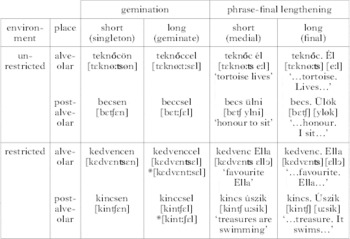
Stimuli. Stimuli, some of which overlap with those used in Pycha (Reference Pycha2009), were constructed using four Hungarian roots that ended in affricates: teknőc [t∊knøːʦ] ‘tortoise’, kedvenc [k∊dv∊nʦ] ‘favourite’, becs [b∊ʧ] ‘honour’ and kincs [kinʧ] ‘treasure’. This set of four cross-cuts two factors, namely the environment of the target affricate (unrestricted vs. restricted) and its place of articulation (alveolar vs. postalveolar). In the unrestricted environments, the target affricates were flanked on the left by a vowel: [t∊knøːʦ] with an alveolar affricate and [b∊ʧ] with a postalveolar affricate. In restricted environments, the targets were flanked on the left by [n]: [k∊dv∊nʦ] with an alveolar affricate and [kinʧ] with a postalveolar affricate.
Each root was embedded in four contexts which cross-cut two additional factors, namely the lengthening type (gemination vs. phrase-final lengthening) and the length context of the target consonant (short vs. long). For gemination, the short (singleton) context was created with the addition of the superessive suffix /-On/ and the long (geminate) context was created with the addition of the instrumental suffix /-CAl/. For phrase-final lengthening, the short (phrase-medial) context was created by embedding the stand-alone root in the middle of a sentence, while the long (phrase-final) context was created by embedding it at the end of a sentence.
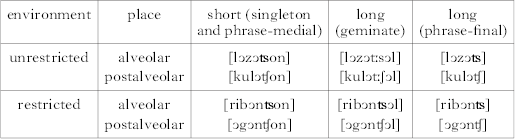
In sum, four factors were cross-cut to yield a total of sixteen stimuli: Environment (unrestricted vs. restricted)×Place (alveolar vs. postalveolar) ×LengthType (gemination vs. phrase-final lengthening)×Length (short vs. long). These are displayed in Table I.
Stimuli for Experiment 1.

The gemination condition uses words with the superessive and instrumental case suffixes. The superessive, which has the possible surface forms -en, -ön, -on and -n, adds a meaning ‘on’ or ‘on top of’ (Kenesei et al. Reference Kenesei, Vago and Fenyvesi1998: 235ff). This suffix, like most suffixes of the Hungarian nominal paradigm, combines with the root without triggering gemination. The instrumental, which has the possible surface forms -el, -al, -vel and -val, adds a meaning ‘with’ (Kenesei et al. Reference Kenesei, Vago and Fenyvesi1998: 210). This suffix conditions gemination of the root-final consonant: cf. vassal ‘iron-instr’, bajjal ‘trouble-instr’, ketreccel ‘cage-instr’ (Kenesei et al. Reference Kenesei, Vago and Fenyvesi1998: 437). Gemination is represented in Hungarian orthography by ccs for the postalveolar affricate and cc for the alveolar affricate, even in restricted environments.
The phrase-final lengthening condition uses complete sentences. For simplicity, Table I displays only the key fragments of the sentences – i.e. fragments which show the comparison between phrase-medial and phrase-final positions. The complete stimuli are given in Appendix A. So for example, in the short condition, the root teknőc occurs in the middle of a sentence: Nagyon sok teknőc él ebben a tóban. ‘There are very many tortoises living in this lake’. In the long condition, it occurs at the end of a sentence: Errefelé a leggyakrabban előforduló állat a teknőc. Él még itt krokodil is. ‘The most frequent animal here is the tortoise. Crocodiles also live here.’
Because one goal of the study was to investigate potentially subtle differences in T/TS ratio between singleton and geminate affricates in restricted environments, stimuli in the geminate condition were isolated words. The advantage of this design is that any difference between singletons and geminates can be attributed to gemination alone, and not to potentially interfering factors such as position within a phrase or utterance. The disadvantage is that a direct comparison between the gemination and phrase-final conditions (which used complete sentences) will be tenuous, because any differences could be attributable either to inherent differences in the processes themselves or to differences between affricates in isolated words on the one hand and complete sentences on the other. Since our primary intention is not to distinguish between these two processes, but rather to determine the appropriateness of abstract vs. physical formulations of a particular phonological process, the lack of direct analogues between the gemination and phrase-final lengthening should not a priori affect our conclusions adversely.
Procedure. A list of sentences was prepared, containing five repetitions of each target sentence (5×8=40), additional target sentences (not analysed here) which placed affricates in word-initial position (=40) and filler sentences (=28). Following the sentences was a list of words, which contained four repetitions of each of the eight target words (becsen, beccsel, teknőcön, teknőccel, kincsen, kinccsel, kedvencen, kedvenccel) (4×8=32) and fillers (=17). The order of the 108 sentences was randomised, although adjustments were then made to ensure that filler sentences, and not stimulus sentences, occupied the first and last item of every printed page. The order of the 49 words was similarly randomised.
Subjects were asked to familiarise themselves with the sentences and words, and to read each one aloud for practice before recording began. During recording, which used a Marantz digital recorder and head-mounted microphone, subjects were asked to read the sentences and words at a natural pace. When they mispronounced a word or sentence, they were asked to repeat the stimulus item from the beginning. Ten subjects were recorded in a soundproof booth; the remaining four were recorded in a quiet room in their homes.
Subjects. Subjects were adult native speakers of Hungarian (n=14), twelve of whom live in the Bay Area of California. The remaining two live in Hungary, but visited California during the study. They were paid for their participation. Eight were female, and six were male. Their ages ranged from 18 to approximately 50. The length of residence of those who lived in the United States ranged from two months to eleven years. They came from various locations in Hungary and Romania.
Duration measurements. The duration of each portion of each target affricate was measured using waveforms and spectrograms produced by Praat (Boersma & Weenink Reference Boersma and Weenink2007), using the following procedure. The closure (T) portion began when the preceding vowel displayed no more periodicity, and ended just before the release burst, if any. The frication portion (S) began at the onset of aperiodic energy, and ended at the cessation of aperiodic energy. In those cases where the stop portion of an affricate displayed a release burst, the burst was included in the following frication portion.
Analyses. Subjects produced four repetitions of each item in the gemination condition, and five repetitions of each item in the phrase-final lengthening condition. In order to maintain balanced numbers across conditions, as required by the statistical analysis, one repetition of each item in the phrase-final condition was discarded at random. One subject mispronounced three tokens during the session. These tokens were excluded from the dataset; again, in order to maintain balanced numbers across conditions, a fourth additional token for this subject was discarded. Another subject accidentally skipped one token during the session; the missing data was replaced with the mean for that cell. This yielded a total of 892 tokens for analysis (2 environments×2 places of articulation×2 length types×2 lengths×4 repetitions×14 speakers=896, minus four tokens which were discarded).
3.1 Results
Results, discussed in detail in the sections that follow, reveal two basic findings, as well as a third, unexpected finding. First, an analysis of the T/TS ratio shows that a small change in the internal duration structure does occur for affricates in restricted gemination environments. This change occurs in a particular direction, such that the relative amount of duration occupied by the closure portion of the affricate increases. Second, an analysis of total duration shows that the process of phrase-final lengthening is not subject to the same restriction as gemination. That is, target affricates in phrase-final positions exhibited significant overall duration increases compared to their counterparts in phrase-medial positions, even in supposedly restricted positions. A third and unexpected finding is that alveolar and postalveolar affricates possess different T/TS ratios, and this difference is maintained under gemination.
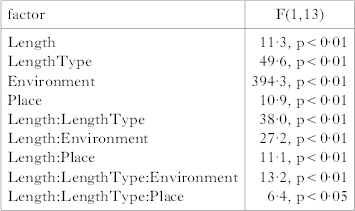
Analysis of the T/TS ratio. A repeated-measures Analysis of Variance (ANOVA), with subject as the error term and T/TS ratio of the target affricate as the dependent variable, revealed the significant effects in Table II.
ANOVA results for T/TS outcome variable in Experiment 1.
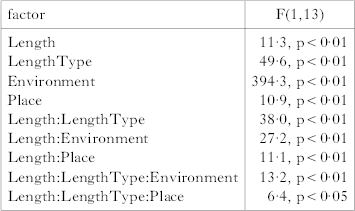
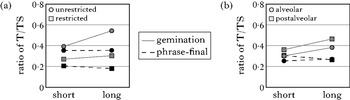
Figure 1a shows a three-way interaction between Length, LengthType and Environment. For gemination, a change from short to long conditions increases the T/TS ratio by a relatively large amount in the unrestricted environment, from 0·39 to 0·54, but by a smaller amount in the restricted environment, from 0·27 to 0·30. For phrase-final lengthening, a change from short to long has a negligible effect in the unrestricted environment, but decreases the T/TS ratio a little in the restricted environment, from 0·21 to 0·18. Post hoc analysis of restricted environments reveals that the interaction between Length and LengthType is significant here (F(1, 13)=6·1, p<0·05), indicating that ratios changed in significantly different ways for gemination vs. phrase-final lengthening. However, the change from short to long in the restricted gemination condition is not significant by itself, and neither is the change from short to long in the phrase-final condition.
Mean ratio of closure duration to total duration (T/TS) in target affricates in Experiment 1, according to experimental condition.

There was also a three-way interaction between Length, LengthType and Place, which can be seen in Fig. 1b. For gemination, a change from short to long conditions affects both places of articulation in a similar fashion, increasing the T/TS ratio from 0·30 to 0·38 for alveolar affricates and from 0·36 to 0·47 for postalveolar affricates. For phrase-final lengthening, on the other hand, a change from short to long conditions has a different effect, and this effect is different for the two places of articulation. The T/TS ratio decreases for postalveolar affricates, from 0·31 to 0·26, but increases slightly for alveolar affricates, from 0·25 to 0·27. Post hoc analysis confined to phrase-final lengthening indicates that the interaction between Length and Place is significant here (F(1, 13)=7·1, p<0·05).
In addition to the interaction effects, there were main effects of Length, LengthType, Environment and Place. For Length the T/TS ratio is greater overall in long conditions (0·35) than in short ones (0·31). For LengthType the ratio is greater overall in gemination conditions (0·38) than in phrase-final conditions (0·27), for Environment the ratio is greater overall in unrestricted environments (0·41) than in restricted environments (0·24) and for Place the ratio is greater overall in postalveolar affricates (0·35) than in alveolar affricates (0·30).
Analysis of total duration. A repeated-measures ANOVA, with subject as the error term and total duration of the target affricate as the dependent variable, revealed a four-way interaction between Length, LengthType, Environment and Place (F(1, 13)=10·5, p<0·05), several two-way interactions and main effects of Length, LengthType and Environment.
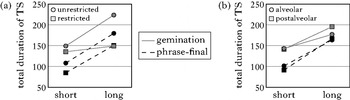
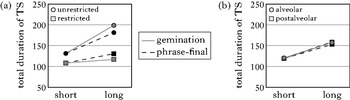
Fig. 2a shows the total duration of affricates in unrestricted vs. restricted conditions, analogous to the ratios plotted in Fig. 1a. For gemination, a change from short to long conditions increases total duration by a comparatively large amount in the unrestricted environment, from 149·3 to 223·6 ms, but by a much smaller amount in the restricted environment, from 135·5 to 149·1 ms. For phrase-final lengthening, a change from short to long conditions increases total duration in a similar fashion in unrestricted environments, from 108·4 to 179·7 ms, and in restricted ones, from 85·0 to 150·6 ms. Post hoc analysis indicates that the duration increase for restricted gemination is significant (F(1, 13)=24·6, p<0·01), as it is for phrase-final lengthening (F(1, 13)=69·8, p<0·01).
Mean total duration (TS) of target affricates in Experiment 1, according to experimental condition.

Fig. 2b shows the overall duration in alveolar vs. postalveolar conditions, analogous to the ratios plotted in Fig. 1b. For gemination, a change from short to long conditions increases total duration by a comparatively small amount in alveolar affricates, from 143·2 to 177·1 ms, but by a larger amount in postalveolar affricates, from 141·6 to 195·6 ms. For phrase-final lengthening, a change from short to long conditions increases total duration by similar amounts in alveolar affricates, from 101·7 to 163·7 ms, and in postalveolar affricates, from 91·7 to 166·6 ms.
3.2 Summary of Experiment 1
A primary goal of Experiment 1 was to determine whether the internal duration structure of affricates changes in restricted gemination environments in Hungarian. Results reveal that a small change does occur. Furthermore, this change occurs in a particular direction, such that the relative amount of duration occupied by the closure portion of the affricate increases. This increase differs significantly from the decrease in closure proportion that we see in a different kind of lengthening process, namely phrase-final lengthening. The attested changes in relative durations within the affricate provide support for the role of the segment, rather than individual articulatory gestures, in the formulation of the gemination restriction in Hungarian, and therefore suggest that the restriction cannot be formulated in physical terms.
This finding should be interpreted with caution, however. The increases in closure proportion triggered by restricted gemination are not significant on their own, but only in comparison to the decreases triggered by phrase-final lengthening. As we have discussed, gemination and phrase-final lengthening are not directly comparable in this experiment, and so this interaction effect could be due to real differences between the processes or to differences between stimuli using isolated words vs. sentences. In addition, somewhat surprisingly, the increases in closure proportion are accompanied by very small (13·6 ms) but significant increases in the overall duration of the affricate. This finding contradicts the predictions of both the physical and abstract formulations of the restriction, and suggests the need for eventual investigation into the full range of degemination effects in Hungarian.Footnote 3
A secondary goal of Experiment 1 was to determine whether lengthening processes other than gemination obey the restriction. Results indicate that phrase-final lengthening does not. Target consonants in phrase-final positions exhibited significant overall duration increases compared to their counterparts in phrase-medial positions. This finding runs counter to the predictions of the physical formulation of the gemination restriction, whereby gemination is modelled as a series of physical events and is therefore essentially akin to other lengthening processes. Again, however, this result should be interpreted with caution. The sentences used in the phrase-final lengthening condition were diverse, and the number of syllables per utterance was not balanced across medial and final conditions. Because this factor was not controlled for, we cannot be sure whether the duration increases are due to phrasal position, number of syllables per utterance or a combination of these factors.
An additional finding from Experiment 1, unexpected from our initial hypotheses, is that alveolar and postalveolar affricates possess inherently different internal duration structures: for postalveolar affricates, the closure occupies a greater proportion of the segment than it does for alveolar affricates. Interestingly, the process of gemination affects closure proportion in a similar fashion for both places of articulation and, as a consequence, the inherent difference between the two affricates is maintained in the long (geminate) condition. Phrase-final lengthening, on the other hand, does not change closure proportion in the same way for both places of articulation. Instead, it decreases the ratio significantly more for postalveolars and as a consequence, the inherent difference between the two affricates is essentially neutralised.
This finding must also be qualified. While the number of tokens in Experiment 1 is reasonably large, the number of experimental items is small and contains heterogeneous items. The size and composition of this set was originally constrained by the requirements of an additional speech-production study not reported here, but the upshot is that for the current study any difference in the behaviour of postalveolar vs. alveolar affricates could be attributable not just to place, but also to number of syllables, vowel length or position relative to stress (which is always initial in Hungarian), or some combination of these factors. Given previous work on these issues, however, such differences are not expected to be large. For vowel length, in most instances Hungarian permits sequences of a long vowel followed by a geminate consonant (see Kenesei et al. Reference Kenesei, Vago and Fenyvesi1998: 419), so there should be no restriction on the lengthening of a consonant after a long vowel, as in [t∊knøːʦ]. For position relative to stress, it is usually the consonant in pre-stressed position that undergoes the most change in duration (Klatt Reference Klatt1976, Lavoie Reference Lavoie2001). Consonants in post-stressed position, such as the affricate in [b∊ʧ], are not known to change markedly, suggesting they may be reasonably compared with consonants in non-post-stressed position, such as the affricate in [t∊knøːʦ].
In sum, Experiment 1 offers cautious support for the predictions of the abstract formulation of the Hungarian gemination restriction. The relative durations of target affricates can change, as permitted by an abstract formulation that refers to segments and not physical events. Other lengthening types do not observe the restriction, as predicted by an abstract formulation that treats gemination as special. These findings are tempered by certain shortcomings in the design of Experiment 1, which are addressed in Experiment 2.
4 Experiment 2
As with Experiment 1, the primary goal of Experiment 2 is to examine the effect of a restricted gemination environment on the relative durations inside a target consonant. A secondary goal is to determine whether the restriction that holds of gemination also holds for phrase-final lengthening. In Experiment 2, however, the gemination and phrase-final conditions are more directly comparable than they were in Experiment 1. The stimulus items are also more numerous, and they are balanced for vowel length and syllable count.
Stimuli. Stimuli, some of which overlap with those used in Pycha (Reference Pycha, Trouvain and Barry2007), were constructed using 28 Hungarian roots ending in affricates, selected from Papp (Reference Papp1969). The list of roots was balanced for vowel length and syllable count. 13 of the roots had a short vowel preceding the target affricate, and 15 had a long vowel preceding it. 13 of the roots were monosyllabic and 15 were bisyllabic.
As in Experiment 1, the set of roots cross-cuts two factors: the environment of the target affricate (unrestricted vs. restricted) and its place of articulation (alveolar vs. postalveolar). In the unrestricted environments, the target affricates were flanked on the left by a vowel: e.g. lazac [lɔzɔʦ] ‘salmon’, with an alveolar affricate, and kulacs [kulɔʧ] ‘gourd’, with a postalveolar affricate. In restricted environments, the targets were flanked on the left by [n]: ribanc [ribɔnʦ] ‘harlot’, with an alveolar affricate, and agancs [ɔgɔnʧ] ‘antler’, with a postalveolar affricate.
Each root was embedded in three contexts, one short and two long. The short (singleton and phrase-medial) context was created by adding the superessive suffix /-On/ to the root. The first long context (geminate and phrase-medial) was created by adding the instrumental suffix /-CAl/. The second long context (singleton and phrase-final) was created by leaving the root without suffixes, so that the individual word was also a complete phrase.
In sum, three factors were cross-cut to yield a total of twelve contexts: Environment (unrestricted vs. restricted)×Place (alveolar vs. postalveolar)×Length (short vs. long geminate vs. long phrase-final). These are displayed in Table III.
Stimuli for Experiment 2.
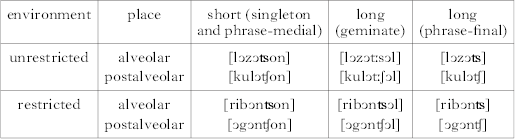
For each context, there were seven roots, yielding 84 stimulus items. The complete list of roots is given in Appendix B.
Method. Each word was embedded in a quoted phrase within a carrier sentence Marika azt mondta hogy — gyorsan [mɔrikɔ ɔst montɔ hoɟ — ɟorʃɔn] ‘Marika said — quickly’. Additional sentences with roots ending in simple stops and fricatives, not analysed here, were included in the list. The order of sentences was randomised, and fillers interspersed throughout. Three native speakers of Hungarian (two female, one male) read each list. They were instructed to pronounce the sentences in a casual manner. Recording took place using a head-mounted microphone and Marantz digital recorder.
Duration measurements. The duration of each portion of each target affricate was measured using the same procedure as in Experiment 1.
Analyses. A total of 252 tokens were analysed (7 roots×2 environments×2 places of articulation×3 length contexts×1 repetition×3 speakers).
4.1 Results
Results, discussed in detail in the sections that follow, are similar to those from Experiment 1. First, an analysis of T/TS ratio shows that a change in the internal duration structure does occur for affricates in restricted gemination environments, taking the form of an increase in the relative amount of duration occupied by the stop closure. Second, an analysis of total duration shows that the process of phrase-final lengthening is not subject to the same restriction as gemination. Target affricates in phrase-final positions exhibited significant overall duration increases compared to their counterparts in phrase-medial positions, even in supposedly restricted positions. Finally, the differences between alveolar and postalveolar affricates which were apparent in Experiment 1 exhibit the same trend in Experiment 2, although results do not reach significance.
4.1.1 Analysis of T/TS ratio
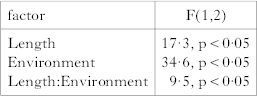
A repeated-measures ANOVA, with subject as the error term and T/TS ratio of the target affricate as the dependent variable, revealed the significant effects in Table IV.
ANOVA results for T/TS outcome variable in Experiment 1.
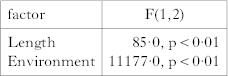
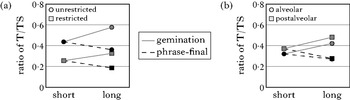
Figure 3a summarises the results. There is a main effect of Length. The T/TS ratio is intermediate in the short condition, but increases in the long gemination condition, and decreases in the long phrase-final condition. Length does not interact with any other factor. For the restricted gemination condition on its own, a change from short to long condition produces an increase in T/TS ratio from 0·26 to 0·33, which post hoc analyses confirm is significant (F(1, 2)=40·4, p<0·05). There is also a main effect of Environment, such that the T/TS ratio is overall greater in the unrestricted environment than in the restricted environment. Environment does not interact with any other factor.
Mean ratio of closure duration to total duration (T/TS) in target affricates in Experiment 2, according to experimental condition.

Figure 3b displays results for Place with other factors, analogous to Fig. 1b for Experiment 1. Although the graph looks similar to that for Experiment 1, this interaction did not reach significance for Experiment 2. This may be due to lack of power in a repeated-measures ANOVA with only three subjects. Individual subject analyses show that two of three subjects in Experiment 2 do exhibit the same interaction that was robustly attested in Experiment 1 (Subject 1: F(1, 2)=5·4, p<0·01; Subject 2: not significant; Subject 3: F(1, 2)=3·9, p<0·05).
4.1.2 Total duration
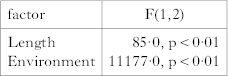
A repeated-measures ANOVA, with subject as the error term and total duration of the target affricate as the dependent variable, revealed the significant effects in Table V.
ANOVA results for total duration outcome variable in Experiment 2.
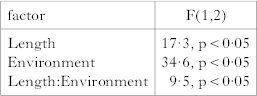
There is a significant interaction between Length and Environment, which can be seen in Fig. 4a. In unrestricted environments, durations increased by a relatively large amount from the short condition (131·4 ms) to the long geminate condition (198·9 ms) and the long phrase-final condition (181·4 ms). In restricted environments, durations increased by smaller amounts from the short condition (108·3 ms) to the long geminate condition (117·1 ms) and the long phrase-final condition (130·7 ms). For the restricted gemination condition on its own, post hoc analyses reveal that the change in duration (from 108·3 to 117·1 ms) is not significant.
Mean total duration (TS) of target affricates in Experiment 2, according to experimental condition.

Length is a main effect. Durations are smallest in the short condition (119·9 ms), and larger in the long geminate (158·0 ms) and long phrase-final conditions (156·1 ms). Environment is also a main effect. Durations are greater in unrestricted environments (170·6 ms) than in restricted environments (118·7 ms).
Place did not reach significance as a main effect or interact with other factors. Fig. 4b is provided for purposes of comparison with Experiment 1.
4.2 Summary
As with Experiment 1, our primary goal in Experiment 2 was to determine whether the internal duration structure of affricates changes in restricted environments in Hungarian. Results reveal that a change does occur and that it occurs in a particular direction, such that the relative amount of duration occupied by the closure portion of the affricate increases. Unlike in Experiment 1, this increase reached significance on its own and, interestingly, did not differ significantly from the increase that occurred in unrestricted environments. Also, unlike in Experiment 1, this increase was not accompanied by significant increases in the overall duration of the affricate. The fact that these results for relative duration reached significance, even with the low power provided by three subjects, offers strong support for the role of the segment, rather than individual articulatory gestures, in the proper description of the gemination restriction in Hungarian. An abstract, rather than a physical, formulation of the restriction appears to be necessary.
A secondary goal of Experiment 2 was to determine whether lengthening processes besides gemination obeyed the restriction. Results reveal that phrase-final lengthening does not obey it; despite the presence of a flanking consonant, target consonants in phrase-final positions exhibited significant duration increases compared to their counterparts in phrase-medial positions. This finding runs counter to the predictions of the physical formulation, whereby gemination is no different from other lengthening processes. Unlike in Experiment 1, the total number of syllables per utterance in phrase-medial vs. phrase-final positions in Experiment 2 differed by just one, suggesting that this effect can most likely be attributed to phrasal position, rather than syllable count.
For place of articulation, results from Experiment 2 showed the same pattern as those from Experiment 1, namely that gemination maintains inherent differences between different places of articulation, while phrase-final lengthening essentially neutralises them. In Experiment 2, these results were only a trend, not a significant pattern. But individual subject analyses for Experiment 2 indicate that two out of three subjects do reach significance for this interaction, suggesting that the results from Experiment 1 may generalise.
4.3 Summary of Experiments 1 and 2
The two experiments reported in this paper present reasonably similar portraits of lengthening in Hungarian, with three key findings. First, in both experiments, ratio increases occurred in gemination, even in restricted environments. Second, in both experiments, phrase-final lengthening avoided the restriction altogether, exhibiting increases in overall duration. Finally, in both experiments, sensitivity to place of articulation occurred in both gemination and phrase-final lengthening, although this was a significant result in one experiment and only a trend in the other.
5 Discussion
We began this study by asking whether phonological processes should be modelled directly on physical events of speech, and we pursued an answer by comparing the different predictions of a physical theory based on gestures with an abstract theory based on segments. We focused on the gemination restriction in Hungarian because both the abstract and physical theories offered potentially apt formulations which nevertheless differed in their predictions, specifically in their predictions for the internal structure of segments. To recap, the abstract formulation predicts that the internal structure of e.g. an affricate can change, because the gemination restriction applies to segments, not individual articulatory gestures. By contrast, the physical formulation predicts that the internal structure of an affricate cannot change, because the gemination restriction applies to each articulatory gesture individually. The speech-production results reported here demonstrate that the physical formulation cannot be the correct one, because the internal structure of affricates does change in the restricted gemination. That is, the restriction fails to apply individually to the closure and frication portions of an affricate, as shown by the increases in relative duration of the closure that were evident in restricted gemination contexts. In addition, the physical formulation predicts that the same restrictions should apply to all lengthening processes, not just to gemination. Again the results demonstrate that this cannot be correct, because the overall duration of affricates changes in phrase-final lengthening.Footnote 4
Of course, the experiments reported here examined only one type of gemination in Hungarian, namely gemination triggered by the addition of a particular suffix, the instrumental. As we saw in §2, however, the language has many other types of geminates, both underlying and derived, and these geminates differ in the extent to which they obey the restriction. It is certainly possible, then, that other types of geminates produce different results than those reported here. Furthermore, the experiments compared gemination to only one other lengthening process, phrase-final lengthening, and only in a very specific context. While we have shown that phrase-final lengthening does not obey the abstract formulation of the gemination restriction, this does not mean that phrase-final lengthening obeys no abstract formulation – previous work indicates that it probably does (e.g. Fougeron & Keating Reference Fougeron and Keating1997). Furthermore, other lengthening processes could conceivably exhibit sensitivity to the restriction in the same way that gemination does.
Within the confines of the current study, however, the evidence primarily supports an abstract theory based on segments. That is, the formulation of gemination restrictions in Hungarian seems to require segments, which divide the speech stream into units that act as a unified whole. This suggests that phonological processes cannot always be modelled on the physical events of speech. We also found evidence that gemination behaves differently from phrase-final lengthening. Again, this suggests the need for a real distinction between processes even when they exhibit resemblances to one another, with some processes characterised as abstract and others characterised as physical.
At the same time, however, some of the evidence we have examined suggests that an entirely abstract theory of phonological processes – that is, one which does away with inherent differences between segments altogether – is not appropriate either. As we have seen, the supposedly abstract process of gemination preserves inherent differences between Hungarian affricates at different places of articulation, rather than ignoring them. A theory based on the segment, which purposely abstracts away from such inherent differences, cannot capture this behaviour. Thus while the physical theory seems to be too physical to handle the facts, the abstract theory also seems to be too abstract. A potential compromise, as I will suggest, would be to maintain the abstract status of the segment while endowing it with a limited set of internal temporal landmarks.
The finding that gemination preserves inherent differences between Hungarian affricates has two potential explanations: either these differences are inevitable consequences of articulatory implementation, or they are a fundamental part of the segment representation. The first explanation is the one most commonly put forth to explain inherent differences between segments: these differences are the direct and inevitable consequence of the articulatory implementation of a particular segment. As a result, we will observe these differences whenever we compare the segments in positions that are otherwise identical. An often cited example is that the voiced velar stop [g] has shorter duration in intervocalic position than labial [b] or alveolar [d]. We can attribute this to articulatory implementation. To produce voicing, speakers must maintain a pressure differential across the glottis. In articulations with a closure at the back of the vocal tract, such as velar stops, the cavity formed above the glottis is so small that the pressure differential disappears rapidly and voicing can be maintained for only a short time. In articulations with closure towards the front of the vocal tract, such as labials and alveolars, the cavity formed is bigger, and voicing can be maintained for a longer period of time (Ohala Reference Ohala1997).
But an explanation along these lines seems unlikely for the current data. As we have seen, gemination does not just lengthen affricates, but changes their internal structure. Thus, whatever the articulatory strategy that Hungarian speakers use to produce singletons, which have a relatively small closure proportion, it seems unlikely to be replicated in the production of geminates, which have a much larger closure proportion. The pattern found across singleton and geminate contexts must therefore arise from another source. Furthermore, we have seen evidence that speakers can and do obliterate inherent differences between affricates in certain cases. Specifically, in phrase-final position, alveolar and postalveolar affricates exhibited identical closure proportions. Even if an explanation based on articulatory implementation were tenable for the other word and phrasal positions examined in this study, then, it would not be tenable here.
The other potential explanation is that at least some inherent duration differences are actually a fundamental part of the segmental representation, rather than something to abstract away from. That is, even abstract segments need to include temporal landmarks. Of course, we have already seen evidence that a theory which includes a multitude of temporal landmarks – a fully physical theory – is not adequate for the data. The proposal that I would like to suggest here, following Steriade (Reference Steriade, Huffman and Krakow1993, Reference Steriade, Cole and Kisseberth1994) is therefore different and significantly more abstract: segments, specifically stops, are bipositional. That is, while stops do not consist of a series of temporal landmarks unfolding in a continuous time dimension, they do consist of at least two temporal landmarks, closure and release, which are ordered relative to one another. Closure and release, represented abstractly as Clo and Rel, are both subsumed under an overarching segment constituent, but each nevertheless acts as an independent skeletal position to which features can associate. For the specific case of affricates, Clo associates to [t] features, while Rel associates to [s] or [ʃ] features. For the more general case of stops, Clo and Rel can associate to a wider range of features, including glottalisation and nasality. Steriade offers evidence that such a representation can capture glottalisation patterns in Mazateco onsets (1993) and pre- and postnasalisation patterns in Bantu stops (1994).
While the details remain to be worked out, the inherent duration differences that we have seen in the current study could be potentially captured if Clo and Rel associate not just to features, as proposed by Steriade, but also to subsegmental units of timing. For example, in Hungarian alveolar affricates, the Clo position would associate to a [t] as well as a single subsegmental timing unit, and Rel would associate to an [s] as well as a single subsegmental timing unit. In Hungarian postalveolar affricates, on the other hand, the Clo position would associate to [t] and two timing units, and Rel would associate to [ʃ] and one timing unit. Crucially, any subsegmental timing units must remain distinct from the more familiar segmental timing units, such as C. We know this because the inherent durational differences between Hungarian affricates remain intact even under gemination, when an additional C is inserted.
Some previous research on gemination supports the idea that this ‘truly minimal’ set of temporal landmarks – i.e. the set of Clo and Rel – is all that is needed. In speech-production studies of Hungarian and three other languages, Ham (Reference Ham2001, summarised in Cohn Reference Cohn2003) found that while singleton consonants exhibited robust overall duration differences based on their place of articulation (e.g. [p] vs. [t] vs. [k]) or their voicing (e.g. [t] vs. [d]), geminate consonants exhibited much more modest differences based upon these factors, although these differences were still evident. This runs counter to the finding of the current study, in which inherent durational differences are not attenuated but maintained under gemination. But there could be a good reason why. In a bipositional segment, of the kind I am suggesting here, only durational differences between positions in the segment are represented, because only the subconstituents of Clo and Rel can independently associate to timing units. Any other durational differences, such as those conditioned by place and voicing, are still abstracted away from in the representation, and we therefore do not expect them to be maintained under gemination. The bipositional proposal differs in this respect from a physical theory of multiple landmarks in continuous time, which can represent all kinds of durational differences as articulatory implementations, and therefore predicts that durational differences should be maintained under gemination.
One final point about the results of the current study bears mentioning. It is noteworthy that the T/TS ratio in restricted gemination exhibited not just random change, but a consistent increase. On its own, an abstract formulation of restricted gemination merely permits change. That is, it predicts that the internal structure of an affricate can change precisely because it is subsumed under the C representation. On this view, there is nothing special about affricates in restricted gemination positions; they should exhibit variation just like any other singleton affricate.
Previous speech-production research (Pycha Reference Pycha, Trouvain and Barry2007, Reference Pycha2009), however, has shown that affricate gemination in Hungarian has two distinct correlates, or ‘signatures’: an overall duration increase, which we can refer to as the degree of lengthening, and an increase in T/TS ratio, which we can refer to as the type of lengthening. On this view, there is indeed something special about affricates placed in restricted gemination positions, because these affricates can potentially satisfy the demands of the restriction and of gemination at the same time. For example, forms such as /kinʧ-CAl/ can satisfy gemination by increasing the internal T/TS ratio. But they can also satisfy the restriction by failing to lengthen overall. The current study shows that for the most part this is exactly what happens, although small increases in overall durations are still evident. In other words, changes in affricate structure reflect not random variation, but the principled use of an alternative signature for gemination, namely an increase in T/TS ratio. The finding that different correlates of lengthening can occur largely independently of one another strengthens the argument for the existence of different types of processes, and suggests that an accurate characterisation of the phonetics–phonology interface requires focusing not on how cognate processes differ in degree, but how they differ in type.
Appendix A: Phrase-final lengthening stimuli for Experiment 1


Appendix B: Roots used in the construction of stimuli for Experiment 2