1 Introduction
This paper describes and analyses the word-level prosody of contemporary Samoan, an Austronesian language from the Independent State of Samoa and the United States Territory of American Samoa, with about 370,000 speakers in all countries (Gordon Reference Gordon2005). We focus on stress placement and vowel length.
Samoan presents a case where morpheme boundaries disrupt a word's prosody, and monosyllabic and disyllabic suffixes behave differently. Monosyllabic suffixes join the stem's footing domain, while prefixes and certain disyllabic suffixes do not. We also show that cyclicity alone does not suffice to explain stress in affixed words, and argue for Align constraints requiring morphemes to initiate prosodic domains. In these respects, Samoan resembles some languages that have been analysed previously (see §2), but we draw evidence not only from typical sequences of CV syllables, but also from the rich inventory of licit vowel sequences in Samoan.
These vowel sequences complicate patterns of stress assignment in Samoan. We show that some sequences disrupt the normal stress pattern, requiring constraints on the association of sonority prominence and metrical prominence. These constraints must be sensitive both to the degree of prominence mismatch and to whether the mismatch is over a pair or a triplet of adjacent vowels. Three-vowel sequences further require an unexpected morpheme-specific prosodic constraint, whose effects are observable only in a small set of words.
A further point of interest concerns length alternations characterisable as trochaic shortening. For our consultants, there is an inviolable restriction against long vowel penults if the ultima is light. This restriction triggers length alternations, as well as avoidance of one affix. But alternations that require positing an underlying form different from the unaffixed surface form appear less productive, suggesting that they are less learnable. Finally, we find sensitivity in loanwords to features not normally contrastive in Samoan, in secondary stress and in vowel/glide distribution.
In §2, we review four previous theoretical approaches that have been taken to explain similar effects in other languages; the one we adopt uses alignment constraints within Optimality Theory (Prince & Smolensky Reference Prince and Smolensky1993) to generate Prosodic Word structure. §3 provides background information on Samoan and our data-collection methods. In §4, we present stress in monomorphemic words, including its phonetic realisation. In §5 we treat stress under compounding, suffixation, prefixation and reduplication. We then turn to complications in the basic stress system and what they tell us about footing domains: §6 and §7 deal with trochaic shortening and restrictions on long vowels or sequences of identical vowels, and §8 deals with the special stress behaviour of some vowel sequences (including an unexpected stress requirement for certain suffixes). §5–§8 show that affix-size differences cannot be accounted for by cyclicity alone; rather, Align constraints are needed. Samoan therefore not only constitutes unambiguous evidence for suffix-size/stress interactions in an Austronesian language, but provides further evidence for existing approaches to stress assignment. In §9 we present speculative description of glide formation and insertion, and §10 summarises and concludes.
2 Previous approaches to morphological effects on word prosody
2.1 Boundaries as disruptors of word prosody
In the theory of prosodic domains of Selkirk (Reference Selkirk, Aronoff and Kean1980, Reference Selkirk and Fretheim1981) and Nespor & Vogel (Reference Nespor and Vogel1986), among others, morphological and syntactic structure project prosodic structure, which affects phonological rule application. For example, a rule might insert a Prosodic Word (PWd) boundary at the beginning of every lexical word, resulting in schematic prosodic structures such as in (1). We assume that one Prosodic Word can dominate another (Ito & Mester Reference Ito, Mester, Honma, Okazaki, Tabata and Tanaka2003).
(1)

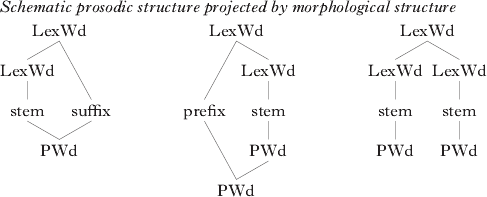
Adaptations of this approach in Optimality Theory, such as Peperkamp (Reference Peperkamp1997), use Align constraints (McCarthy & Prince Reference McCarthy and Prince1993) to derive these prosodic structures. For example, Align(LexWd, L; PWd, L) requires the left boundary of every lexical word to coincide with the left boundary of some Prosodic Word.
The Prosodic Word is generally assumed to be the domain of footing. Therefore, PWd boundaries disrupt the footing pattern. For the structures in (1), a disruption will occur between prefix and stem, and inside a compound. A stem and suffix, on the other hand, will have the same footing as a monomorphemic word. It is also possible for morphological boundaries to project feet directly, instead of via PWd structure, as assumed in Kager (Reference Kager1997) for Sibutu Sama. Finally, some authors have argued for multiple domain types that are approximately word-sized, including Rice (Reference Rice1992), who argues that three labels are required to account for the domains of various phonological processes found in Slave (Rice Reference Rice1989) and some other Athapaskan languages.
An alternative to prosodic domains is offered in Lexical Phonology, which cyclically interleaves affixation and stress rules (Siegel Reference Siegel1974, Kiparsky Reference Kiparsky and Ingemann1983). For the example in (1), the footing difference would be due to the order suffixation, footing, prefixation, compounding. This interleaved approach allows further distinctions between, say, early and late suffixes. Hargus (Reference Hargus1988), for example, argues for a rich system of levels in Sekani (Tsek'ene). A related approach to interleaving uses optimality-theoretic output–output correspondence constraints (Kenstowicz Reference Kenstowicz1995, Benua Reference Benua1997, Burzio Reference Burzio, Dekkers, Leeuw and de Weijer2000, among others): different affixes are subject to higher- or lower-ranking faithfulness to the base's prosody.
A third major approach to explaining morphological effects on prosody has been the use of different boundary types. Chomsky & Halle (Reference Chomsky and Halle1968) (who do not use feet) treat English -(i)an as having a + boundary, and -ism a # boundary. If prefixes have a # boundary, and suffixes a + boundary, then stress rules can ignore + but be sensitive to #. Selkirk (Reference Selkirk, Aronoff and Kean1980) argues that this theory is excessively powerful, because it does not enforce a hierarchical relationship between + and #.
Prosodic domains, morphology/phonology interleaving, output–output correspondence and boundary types are not inherently in conflict – Inkelas (Reference Inkelas1989), for example, develops a theory that employs the first two – but these approaches usually provide competing explanations of the same facts. §10.2 compares our account of Samoan word prosody using prosodic domains to the alternatives.
2.2 Affix-size differences
As will be seen in §5.2 and §5.3, in Samoan the size of a suffix is crucial for whether it disrupts word prosody. Reports of a prosodic distinction between mono- and disyllabic suffixes or enclitics abound, although the distinction does not always imply that either type of suffixation is treated differently from a monomorphemic word. For example, Anderson & Otsuka (Reference Anderson and Otsuka2006) treat the monosyllabic demonstratives of Tongan (Churchward Reference Churchward1953) as enclitics, because they shift stress to the right ([ˈmoko] ‘gecko’, [moˈko-ni] ‘this gecko’), and the disyllabic demonstratives as separate words ([ˌmokoˈeni] ‘this gecko’). However, the stress data are also consistent with right-to-left footing of the noun+demonstrative sequence: [mo(ˈko-ni)], [(ˌmoko)-(ˈeni)] – in both cases, the stress pattern is the same as in a monomorphemic word. Suffixation in Fijian follows the same pattern (Scott Reference Scott1948: 744, Dixon Reference Dixon1988: 24–31). Similarly, in Rotuman (Austronesian; closely related to Polynesian), Hale et al. (Reference Hale, Kissock and Reiss1998) leave open the question of whether disyllabic suffixes form a separate domain of footing or merely a separate foot, as they would in the absence of a morpheme boundary. McCarthy (Reference McCarthy2000) analyses the distinction between monosyllabic and disyllabic suffixes in Rotuman in PWd terms by having an Align constraint that prefers the stem and suffix to form separate Prosodic Words, overridden by the higher-ranked requirement of foot binarity, so that monosyllabic suffixes join the stem's Prosodic Word.
In several Australian languages, however, there is a clearer stress distinction between mono- and disyllabic suffixes, such as in Warlpiri (Nash Reference Nash1980), Yidiny (Dixon Reference Dixon1977a, Reference Dixonb), Diyari (Austin Reference Austin1981), Dyirbal (Dixon Reference Dixon1972) and Ngalakgan (Baker & Harvey Reference Baker and Harvey2003, Baker Reference Baker2008). In Ngalakgan a disyllabic suffix (underlined in (2)) restarts the left-to-right footing pattern. As shown in (2), the stress patterns of suffixed words are different from those of monomorphemes, and also different from what would be expected if every suffix initiated a new footing domain.
(2)
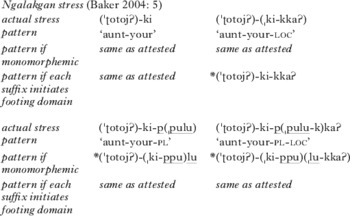
Most accounts employed to explain such affix-size differences are domain-based. As Baker (Reference Baker and Mushin2005) discusses, merely interleaving suffixation and stress assignment wrongly predicts that after [(ˈʈotojʔ)-ki] is suffixed with [-ppulu], there is enough material to form a new foot, left-to-right as usual, yielding *[(ˈʈotojʔ)-(ˌki-ppu)lu]. He instead uses domains: every morpheme prefers to be a separate foot, but not at the expense of creating a subminimal foot. When two monosyllabic suffixes are adjacent, Parse-σ (Prince & Smolensky Reference Prince and Smolensky1993) breaks the tie and foots the two syllables together.
McCarthy & Prince (Reference McCarthy and Prince1994) also use domains to treat similar facts in Diyari. In Diyari, a monosyllabic suffix can't initiate a foot even if another monosyllabic suffix follows: [(ˈmada)-la-ntu] ‘hill-characteristic-proprietive’. McCarthy & Prince adopt the footings of Poser's (Reference Poser1989) rule-based analysis, but use Align constraints to establish the domain of footing (1994: A6). The end of every stem closes off a Prosodic Word, [[[mada]PWd-la]PWd-ntu]PWd, preventing footing of subminimal [-la] or [-ntu]. This has similar effects to Poser's (Reference Poser1989) analysis, which foots each affix independently, then removes monosyllabic feet. Alderete (Reference Alderete and Parker2009) extends the Align-based analysis to Dyirbal, Warlpiri and Pintupi, giving further arguments for the recursive PWd structure.
Crowhurst (Reference Crowhurst1994) analyses Diyari in terms of direct morpheme-to-foot alignment constraints. Align(Morpheme, L; Ft, L) instructs every morpheme to initiate a foot, though not at the cost of subminimal feet (*[(ˈmada)-(ˌla)-(ˌntu)]) or of a foot that contains a morpheme boundary (*[(ˈmada)-(ˌla-ntu)]). Crowhurst shows that Dyirbal (Dixon Reference Dixon1972), by contrast, allows a foot to span a morpheme boundary, so two successive monosyllabic suffixes are footed together. (Kager Reference Kager1997 analyses Dyirbal in terms of PWd structure: the root ends with a PWd boundary, but there are no PWd boundaries within the sequence of suffixes, so the suffixes form a single footing domain.) Crowhurst further contrasts Gooniyandi (McGregor Reference McGregor1990), where a root plus any number of monosyllabic suffixes behaves as though monomorphemic (whereas a disyllabic suffix always initiates a new foot). Kenstowicz (Reference Kenstowicz, Miglio and Morén1997b) analyses Diyari, Dyirbal and other related languages in terms of violable paradigm uniformity: *[(ˈmada)-(ˌla-ntu)] is ruled out in Diyari because the grammar prefers the suffix to have the same (unstressed) realisation everywhere.
In summary, accounts of affix-size differences have largely used Align constraints either to place foot boundaries at morpheme boundaries directly or to establish the Prosodic Word as a domain of footing; the size differences themselves emerge from interactions with minimum foot-size requirements. Some of the data are not explainable with cyclicity alone, though the literature generally does not fully explore all the analytic possibilities.
Affix-size differences in Samoan will be treated in §5–§8. The basic stress data are compatible with multiple analyses, but we will conclude from words with two suffixes that cyclicity alone is inadequate and Align constraints are needed.
3 Language background and data collection
3.1 Language background
All data in this paper are from the tautala lelei register of speech (which preserves more segmental contrasts than the other register, tautala leaga), described in most other work on Samoan. The phoneme inventory is shown in (3). The symbols have their IPA (IPA Handbook 1999) values, except that /t/ is usually heavily affricated ([tˢ]). The phonemes in parentheses are restricted to loanwords.
(3)
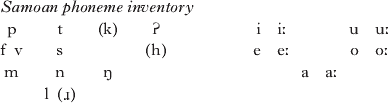
Samoan phonotactics require every consonant to be followed by a vowel, yielding syllables like [(C)V], [(C)Vː] and possibly [(C)VV], but not *[(C)VC]. We assume that [(C)Vː] and [(C)VV] are bimoraic. (We generally write long vowels as [Vː], but are agnostic as to whether they should be treated as single segments or sequences of identical segments. §5 considers both possibilities for input structure.)
3.2 Data collection
All transcriptions in this paper are of our consultants’ speech. Data were collected in one- to two-hour sessions from September 2007 to November 2008 with one main consultant, age 19, who was born and raised in Upolu and had moved to the Los Angeles area four years previously. Elicitation items were often found using Mosel & Hovdhaugen (Reference Mosel and Hovdhaugen1992) or Milner (Reference Milner1993). The consultant was given the Samoan written form and asked to confirm that he was familiar with the word, to pronounce the word a few times and to check the gloss. All words were elicited in isolation, where the stress patterns were the clearest to our ears (see §4.2 and §4.5), though some morphologically complex words, such as inflected verbs, were first elicited in sentences.
Critical items were also elicited and recorded from six consultants in Apia, Samoa in November 2011, and from our primary consultant, again in Los Angeles. Recordings were made with a head-mounted microphone (Shure SM10A). The consultants in Samoa included four men and two women, ranging in age from 18 to 39 (mean 27), from the capital city of Apia, and other areas of Upolu and Savai'i. All of them spoke primarily Samoan in daily life and were literate in Samoan, but also spoke English as a second language with some fluency. English was used as the contact language. In these sessions, each Samoan word was presented to the consultant on a slide on the computer screen, usually with a picture representing the meaning. For some morphologically complex words, such as verbs with the ergative /-a/ suffix in the Appendix, we sometimes presented both a base and derived form, and elicited the word in a sentence frame.
The consultant was asked to confirm familiarity with the word, and was recorded pronouncing the words and sentences. To elicit judgements about stress patterns other than the one originally pronounced by the consultant, the investigator uttered a pronunciation with an alternate stress pattern and asked if the alternate pronunciation was acceptable. The consultant was then asked to pronounce it him/herself and to confirm that it indeed sounded acceptable/unacceptable. Consultants often volunteered pronunciations with alternate stress patterns. We did not ask consultants to abstract stress patterns away from the pronunciation of the word, such as by hand-tapping on the stressed syllable.
4 Stress in monomorphemes
In this section we describe the stress pattern in monomorphemic words, not including underlying long vowels in penults (see §6) and certain vowel sequences (see §8). We look at primary stress and secondary stress, including their phonetic realisation, and give an analysis in Optimality Theory (Prince & Smolensky Reference Prince and Smolensky1993).
4.1 Primary stress in monomorphemes
The basic primary stress pattern of Samoan is simple: a moraic trochee at the right edge of the word (Homer Reference Homer2007a). Stress is on the final vowel if long, and otherwise on the penultimate. Examples are given in (4), with parentheses enclosing presumed feet.Footnote 1
(4)
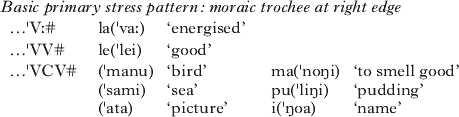
Samoan primary stress is similar to Fijian (Schütz Reference Schütz and Schütz1978, Reference Schütz1985, Dixon Reference Dixon1988), where, in Hayes' (Reference Hayes1995) analysis, a word ends with a moraic trochee. In both Fijian and Samoan, there are no surface forms with a short final vowel and a long penultimate vowel (e.g. *[ˈmaːnu]) – see §6. We will see a systematic set of exceptions to the basic pattern in §8.
4.2 Phonetic realisation of primary stress
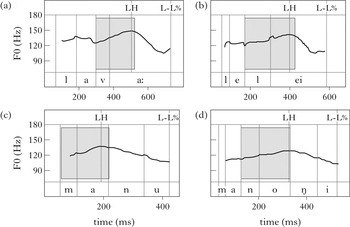
Three primary acoustic features appear to be involved in the realisation of Samoan primary stress: amplitude, duration and fundamental frequency (F0). Amplitude and duration were not investigated systematically; all else being equal, stressed syllables seem louder than unstressed, and the consonant after the stressed vowel may be lengthened (see note 1). We have investigated F0 systematically elsewhere (Orfitelli & Yu Reference Orfitelli and Yu2009): F0 rises on the stressed mora, shown in the pitch tracks in Fig. 1. We label this rise as an LH pitch accent, without notating tonal association (i.e. L*+H or L+H*), since we have no evidence for a difference in stability of tonal alignment of the L or H target, nor for a meaning contrast based on tonal alignment (Pierrehumbert & Steele Reference Pierrehumbert and Steele1989, Arvaniti et al. Reference Arvaniti, Ladd, Mennen, Broe and Pierrehumbert2000). The shaded boxes in Fig. 1 highlight the stressed mora (and preceding consonant) and its F0 rise, which is followed by an utterance-final fall. The F0 rise of a stressed long vowel, e.g. [la(ˈvaː)], is over its first half.
Pitch tracks for items in (4): (a) [la(ˈvaː)] ‘energised’; (b) [le(ˈlei)] ‘good’; (c) [(ˈmanu)] ‘bird’; (d) [ma(ˈnoŋi)] ‘to smell good’.

4.3 Analysis of basic primary stress
Our analysis of primary stress is straightforward: a bimoraic foot is required at the end of the word. This can be captured in Optimality Theory with Prince & Smolensky's constraints Edgemost, FootBinarity and RhythmType (1993: 35, 50, 56). The definitions we assume are given in (5).
(5)
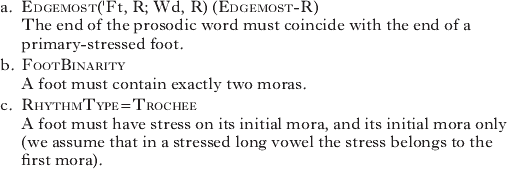
(The constraints Edgemost-L and RhythmType=Iamb are ranked too low to be active.)
(6) illustrates the pattern with a tableau for /iŋoa/ ‘name’.
(6)
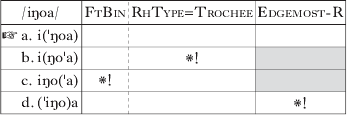
While the data presented thus far support don't support any ranking arguments for these three constraints, we will see in §8 that Edgemost-R is dominated.
4.4 Secondary stress in monomorphemic loans
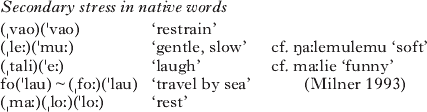
It's difficult to find convincingly monomorphemic native words with four or more moras. Some examples are given in (7), but, as is typical, they seem to be reduplicated (if not productively), contain a sequence that can be an affix, such as [maː-], or possibly have undergone vowel lengthening (as suggested by the related forms given for ‘gentle, slow’ and ‘laugh’, and the variation for ‘travel by sea’).
(7)
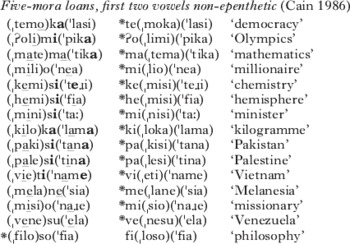
Long monomorphemes tend to be English loans. In five-mora loans where neither of the first two vowels is epenthetic (as compared to the English original), secondary stress falls on the first mora (8). In Prince's (Reference Prince1983) terms, Samoan displays an initial dactyl effect. In (8), vowels with stressed English correspondents are underlined, and those with no English correspondent are bold. Even when the first vowel does not correspond to a stressed English vowel (‘democracy’, ‘Olympics’), it bears stress. The sole exception is ‘philosophy’ (no underlining, because final [ia] makes the source language unclear).
(8)
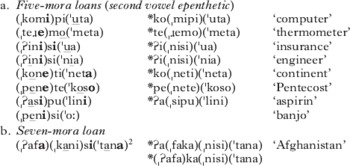
Unsurprisingly, when the second vowel is epenthetic, secondary stress remains on the first vowel.
(9)
When the first vowel is epenthetic, stress usually falls on the second, as shown in (10).
(10)
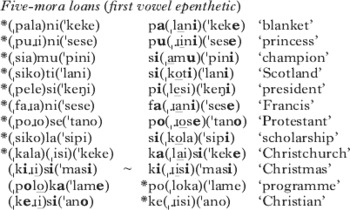
Similar avoidance of stress on epenthetic vowels in loans has been discussed for Fijian (Schütz Reference Schütz and Schütz1978, Reference Schütz1999, Hayes Reference Hayes1995, Kenstowicz Reference Kenstowicz2007) and Selayarese (Broselow Reference Broselow1999, Reference Broselow, Vaux and Nevins2008). When the footing requires it, it is possible for epenthetic vowels to bear secondary or even primary stress (11).
(11)
4.5 Phonetic correlates of secondary stress
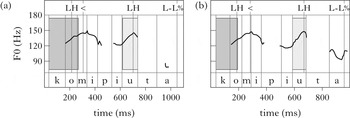
Phonetic correlates of secondary stress are similar to those for primary stress, but less stable. In a sentence context, there is often no pitch event marking secondary stress, only interpolation between surrounding events. In citation form, a pitch rise (LH) on the secondary-stressed syllable is often smaller than the pitch rise for the primary stress. In Fig. 2 we show two pitch tracks for ‘computer’ (with considerable peak delay for the first rise). On the left, pitch rises are similar on both stressed moras; on the right, the primary-stress rise is sharper.
Variation in relative size of pitch rise between secondary and primary stress in two realisations of [(ˌkomi)pi(ˈuta)] ‘computer’. There is considerable peak delay for the first rise, indicated by ‘<’.

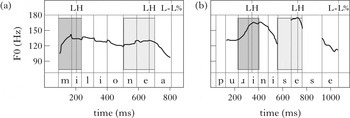
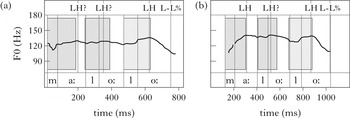
In Fig. 3 one can see the difference between initial and peninitial secondary stress, while Fig. 4 shows two tokens of [(ˌmaː)(ˌloː)(ˈloː)]. In Fig. 4a, we see little pitch rise for either of the putative secondary stresses; in Fig. 4b we see a clear rise for the first stress, but not the second.
Initial vs. peninitial secondary stress: (a) [(ˌmili)o(ˈnea)] ‘millionaire’; (b) [pu(ˌɹini)(ˈsese)] ‘princess’.

Examples of minimal pitch rises for secondary stresses in [(ˌmaː)(ˌloː)(ˈloː)] ‘rest’. In (a) there is little pitch rise for either of the putative secondary stresses (indicated by ‘?’; in (b) there is a clear rise for the first stress.

Our transcriptions of secondary stress are typically based on eliciting multiple tokens of a word in citation form until we were confident of the transcription. In some of the items below, we note that we were unsure of secondary stress – it may well have been present phonologically, but its phonetic realisation was not clear enough for us to confidently locate it. In some cases, we include foot boundaries predicted by our analysis, but no secondary stress mark.
4.6 Analysis of secondary stress
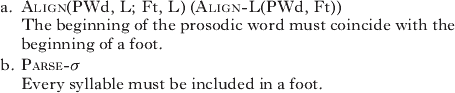
Although the evidence for the initial dactyl effect is limited to loans, we will tentatively assume that Samoan prefers words to begin with a foot, using the constraint definitions in (12), from McCarthy & Prince (Reference McCarthy and Prince1993b).
(12)
This is illustrated in (13) for /temokalasi/ (cf. English [diˈmɒkɹəsi]).
(13)
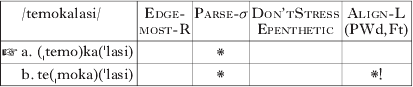
We lack data on longer words to confirm how medial feet align – the only good example is [(ˌʔafa)(ˌk ni)si(ˈtna)] in (9).
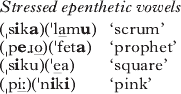
As mentioned above, stress is avoided on epenthetic vowels ([pa(ˌlani)(ˈkeke)] ‘blanket’ vs. *[(ˌpala)ni(ˈkeke)]), unless the alternative increases the number of unparsed syllables ([(ˌsika)(ˈlamu)] vs. *[sika(ˈlamu)] ‘scrum’, [(ˌpiː)(ˈniki)] vs. *[(ˈpiː)niki] ‘pink’). If we take this to be a synchronic pattern, we have the ranking Parse-σ≫Don'tStressEpenthetic≫Align-L(PWd, Ft). We leave open whether Don'tStressEpenthetic is synchronically active or applies only to initial loan adaptations.Footnote 3
5 Stress in complex words
This section examines compounding, suffixation, prefixation and reduplication. In general, we find that the left edge of a morpheme initiates a footing domain, subject to minimality. In §8 we will see that the situation is a bit more complex when certain vowel–vowel sequences are involved.
Stress in compounds
In compounds of two roots, the first ends with a foot, indicating a PWd boundary between the two roots. The examples in (14) illustrate how two compounds with the same number of syllables can have different stress patterns.
(14)

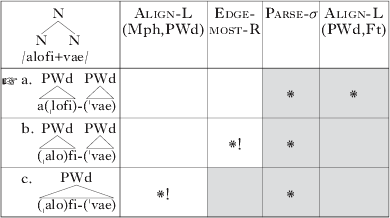
We adopt Peperkamp's (Reference Peperkamp1997) Align-based approach, and propose that Samoan has high-ranking Align(Morpheme, L; PWd, L) (Align-L(Morpheme, PWd)): every morpheme must initiate a prosodic word. As we will see starting in (20), this constraint is violable, and when we turn to disyllabic suffixes, we will see that the constraint should indeed refer to morphemes in general rather than only to lexical words. Because Edgemost-R and Align-L(PWd, Ft) refer to the Prosodic Word, Align-L(Morpheme, PWd) indirectly determines footing. The tableau in (15) illustrates this for /alofi+vae/. We leave open the question of whether the two Prosodic Words in (a) combine to form a larger Prosodic Word, or attach directly to the next level up, such as a Phonological Phrase.Footnote 4
(15)
We have not found prosodic differences among subtypes of compounds. As Mosel & Hovdhaugen (Reference Mosel and Hovdhaugen1992: 240) discuss, it is difficult to distinguish between phrases and compounds without a clear sign of compoundhood (e.g. opaque meaning, a bound root or a compounding affix such as /-ŋaː/). Compounds can be noun+noun or adjective+noun (14), or noun+verb ([ˈave-pasi] (drive+bus) ‘drive a bus, bus driver’).
5.2 Stress with suffixes
5.2.1 Stress with monomoraic suffixes
There are several monomoraic suffixes in Samoan, and they attract stress to the right (16): the domain that must end in a moraic trochee includes these suffixes. In longer items we see that secondary stress can be added when suffixation brings a word up to four moras, but secondary stress does not move after suffixation, whether because of faithfulness to the unsuffixed form or due to preference for an initial foot.Footnote 5
(16)

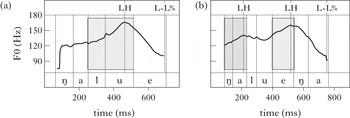
The pitch tracks in Fig. 5 clearly illustrate the stress shift, for ‘work’. The unsuffixed form has a single pitch rise on [lu], and the suffixed word has an added initial rise for the secondary stress, and a larger rise for the primary stress, now on [e].
Pitch tracks for stress shift under suffixation: (a) [ŋa(ˈlue)] ‘work (vb)’; (b) [(ˌŋalu)(ˈe-ŋa)] ‘work (n)’.

In (17) we see that the denominal suffix /-a/ (‘abounding in N, having N’) behaves in the same way.
(17)
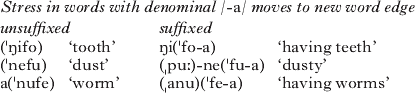
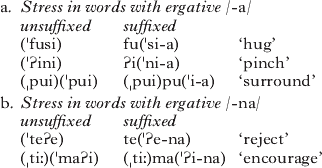
A homophonous suffix /-a/, with the same stress behaviour, is shown in (18a). The suffix is one of the many forms of a family of verb suffixes often called ergative (productive /-a/ and /-ina/; unproductive /-Cia/, where C can be any consonant; /-na/ (18b)). Chung (Reference Chung1978) and Homer (Reference Homer2007b) find that these occur when an ergative subject moves over the verb, and possibly in other contexts.
(18)
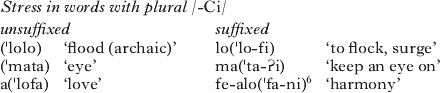
The final monomoraic suffix we examine is the fairly unproductive /-Ci/, where C can be any consonant, including zero. When accompanied by /fe-/, it usually creates plural verb forms. Alone, its semantic contribution is unpredictable. Adding /-Ci/ also shifts stress to the right.
(19)
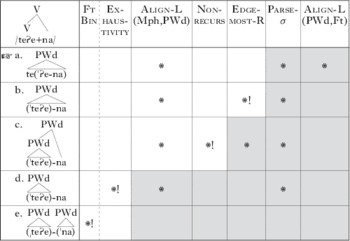
We conclude that these suffixes belong to the same Prosodic Word as the stem, and so are footed together with it. This violates our constraint Align-L(Morpheme, PWd), which would require the suffix to initiate a new Prosodic Word. We assume however, that, as a requirement of either Gen or a high-ranking constraint, every Prosodic Word must contain a foot. And feet, by FootBinarity, must be bimoraic. Therefore, FootBinarity must outrank the Align constraint, as shown in (20) for /teʔe+na/ ‘reject’. We assume that strict layering is favoured by violable constraints (Ito & Mester Reference Ito, Mester, Honma, Okazaki, Tabata and Tanaka2003), Selkirk's (Reference Selkirk and Beckman1995) Non-recursivity (in this case, a PWd should not dominate another PWd) and Exhaustivity (in this case, a syllable shouldn't be left to attach directly to the Phonological Phrase, but should instead belong to a Prosodic Word).
(20)
5.2.2 Stress with bimoraic suffixes
We now turn to bimoraic suffixes, which our analysis so far predicts should form their own Prosodic Word, since they are long enough to support a binary foot. As expected, regardless of PWd structure, primary stress falls on the suffix's penultimate mora, as illustrated in (21a) for the regular /-ina/ form of the ergative suffix, and in (21b) for the unproductive /-Cia/ form.
(21)

Other bimoraic suffixes show similar stress patterns, including /-Caʔi/ (22a), which Milner (Reference Milner1993) calls a reciprocal suffix, and /-Caŋa/ (22b), an unproductive variant of nominalising /-ŋa/ (16).
(22)
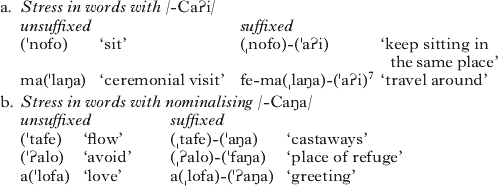
From primary stress assignment alone, we cannot determine whether the stem and suffix form a single Prosodic Word, or if the suffix forms its own Prosodic Word. However, the secondary stress pattern suggests that the stem does form its own Prosodic Word (and therefore that the suffix does too). For example, if the string [iloa-ina] formed a single Prosodic Word, we would expect an initial dactyl, *[(ˌilo)a-(ˈina)] (cf. (8)); instead, the stem's footing is right-aligned, as in the unsuffixed form. The same lack of secondary stress shift is also seen for /-Caʔi/ and /-Caŋa/ (we have found no trimoraic stems with /-Cia/).
An alternative is to claim that partial faithfulness to the unsuffixed form is at work, as has been claimed for distantly related Indonesian. (In Indonesian, suffixes are part of the footing domain. A foot is formed at the right edge of a word, so when a word is suffixed, its primary stress shifts. Secondary stress, however, does not (Cohn Reference Cohn1989, Cohn & McCarthy Reference Cohn and McCarthy1998).)
The data in this section are consistent with either footing domains or output–output faithfulness. However, in §6 and §8, we will see clearer evidence that /-ina/ and some of the other bimoraic suffixes do form a separate prosodic domain.
5.2.3 Stress with two suffixes
It is possible for a word to end with two suffixes. The most common combination is /-Caʔi-ŋa/. Examples of /-Caʔi-ŋa/ and other sequences of a bimoraic suffix followed by a monomoraic suffix are shown in (23). The stem (underlined) ends with a foot, consistent with a PWd boundary at the end of the stem. The three suffix syllables are treated as a single Prosodic Word, with penultimate stress (unlike in some of the Australian languages discussed in §2.2). (See §5.3 for discussion of the prefixes.)
(23)
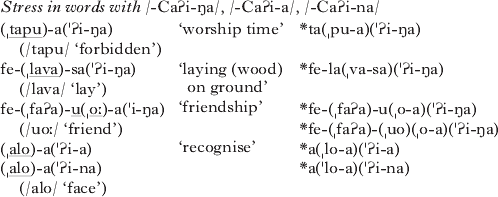
We found one example of two monomoraic suffixes /-na/ and /-ŋa/ combining, shown in (24).
(24)

There are a few other combinations of affixes possible. But because they all produce vowel sequences with special stress behaviour, we postpone their discussion to §8.
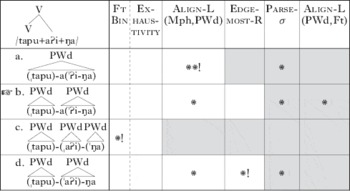
As the tableau in (25) shows, the constraint ranking developed so far requires that the two suffixes together form a Prosodic Word, separate from the stem, and is thus consistent with the data.
(25)
5.3 Stress with prefixes
Samoan has few productive prefixes. There is one bimoraic prefix, the extremely common /faʔa-/. We usually hear its stress as [ˌfaʔa-], and never *[faˌʔa-], though this is hard to verify acoustically because both syllables tend to be short and the glottal stop disrupts the pitch; /faʔa-/ is often realised as simply [faː]. Examples are given in (26). The prefix /faʔa-/ is typically described as, roughly, causative.
(26)
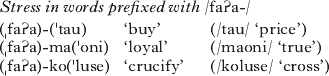
Our constraint grammar so far predicts that /faʔa-/ forms its own Prosodic Word, because Align-L(Morpheme, PWd) requires /faʔa-/ and the root morpheme to each initiate a Prosodic Word. The data in (26) are consistent with /faʔa-/ forming its own Prosodic Word, though they are also what we expect if the whole word is a single Prosodic Word, because of the initial dactyl effect.
There is also a monomoraic prefix /fe-/, used in plural forms of many verbs and illustrated in (27). It is usually accompanied by a suffix.
(27)

The grammar predicts that /fe-/ should be adjoined to the root's Prosodic Word ([fe-[root]PWd ]PWd), because it is not big enough to form a Prosodic Word of its own. This means that /fe-/ should not receive secondary stress, even if the root is longer than two syllables. We found very few examples where the root was long enough for /fe-/ to potentially be stressed, and were unable to confidently transcribe secondary stress.
(28)

The prefixes /fe-/ and /faʔa-/ can combine. The grammar predicts that /fe-/ is adjoined to /faʔa-/'s Prosodic Word ([fe-[faʔa]PWd ]PWd [root]PWd), yielding the secondary stress pattern [fe-(ˌfaʔa)-…]. Though we have few examples, they match this prediction, as shown in (29), although the pattern is also consistent with the two prefixes forming a single Prosodic Word. If the prefixes were inside the root's Prosodic Word, we would expect *[(ˌfe-fa)ʔa-…]. The stress in [fe-faʔa] is thus weak evidence for a PWd boundary between [faʔa] and the root; we will see stronger evidence in §7 (49) and §8.2 (64).
(29)

We also have a few examples of /faʔa-/ followed by /fe-/. The grammar predicts a separate Prosodic Word for /faʔa-/, with /fe-/ adjoined to the root's Prosodic Word: [faʔa]PWd [fe-[root]PWd ]PWd. The predicted stress pattern is [(ˌfaʔa)-fe…]. As shown in (30), this is what we find, not *[fa(ˌʔa-fe-)…], which we would expect if the two prefixes form a single Prosodic Word.
(30)

We return to the prosodification of prefixes in §8.2.
5.4 Stress with reduplication
Reduplication in Samoan occurs mostly in verbs. There are two types of reduplication: CV reduplication, typically for plural agreement, and two-mora reduplication, typically with a pluractional, frequentative or intensified meaning. Both types of reduplication can occur with the same root.
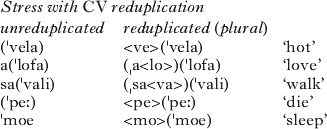
CV reduplication doubles the initial CV of the primary-stressed foot.Footnote 8 As shown in (31), the resulting stress pattern looks the same as for a monomorpheme, suggesting that the reduplicant is integrated into the root's Prosodic Word. (In §6, however, we examine some more complex cases.) The CV reduplicant often sounds shorter than a typical unstressed syllable, as Mosel & Hovdhaugen (Reference Mosel and Hovdhaugen1992: 34) note, but still counts as moraic, since it allows a preceding mora to bear secondary stress.
(31)
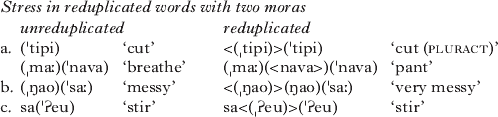
Two-mora reduplication typically copies the primary-stressed foot. In this case, we perceive no particular shortening, so the choice of which copy to designate as the reduplicant is arbitrary. Typical examples are shown in (32a), along with an example, (32b), in which a non-final foot is copied (this is less common, and unpredictable). When the root is trimoraic (32c), secondary stress does not fall on the initial syllable, as would be expected under an initial-dactyl preference (*[(ˌsa<ʔe)u>(ˈʔeu]), but instead falls on the reduplicant ([sa<(ˌʔeu)>(ˈʔeu)]), suggesting a PWd break after the reduplicant, though there are few examples.Footnote 9
(32)
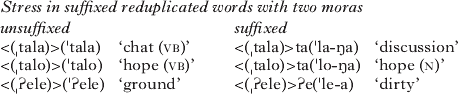
When a monomoraic suffix is added, the footing of the second copy changes, but that of the first copy does not, as illustrated in (33). This is again consistent with a PWd boundary between the two copies, though also with a preference for initial dactyls (we found no examples where the root was trimoraic), or partial faithfulness to the unsuffixed form. Further evidence that the reduplicant forms its own Prosodic Word is discussed in §6.Footnote 10
(33)
5.5 Summary of stress in complex words
In this section we have shown that suffixes shift primary stress to the right; in the case of monomoraic suffixes, this means that the stem and suffix must be in the same Prosodic Word. We found evidence for a PWd boundary between prefix and stem, between certain prefixes, between reduplicant and base, and between stems in a compound. We found evidence against a PWd boundary between a stem and a monomoraic suffix, with the status of bimoraic suffixes remaining open so far.
We now turn to other diagnostics of footing domains, which will give us additional evidence about the prosodic structure of morphologically complex words.
6 Trochaic shortening
In the previous sections, we used stress shift and vowel length to show that monosyllable suffixes are part of the same Prosodic Word as the stem, while disyllabic suffixes form a separate Prosodic Word. We will show now that this analysis is reinforced by the behaviour of long vowels that are in the ‘wrong’ place underlyingly.
Samoan appears to avoid feet consisting of a long-vowel syllable plus a light syllable, by shortening the long vowel. This phenomenon, called trochaic shortening, is described in detail in Hayes (Reference Hayes1995), and is also found in other trochaic languages, including ones closely related to Samoan. For example, given an input /maːbi/, such a language would ban *[(ˈmaː.bi)] and unaligned *[(ˈmaː)bi], and would instead shorten the first vowel, yielding the light–light foot [(ˈma.bi)]. Samoan also avoids heavy–light feet through shortening and other means, at least when the heavy syllable contains a long vowel (for heavy syllables containing two vowels, see §8).
Although Milner (Reference Milner1993) lists many words with a long vowel in the penult and a short final vowel, our consultants produced them all (if known) with a short penult instead. Examples are given in (34), with the last two examples being loans. In Milner's spellings, the macron indicates a long vowel, and g is [ŋ].
(34)
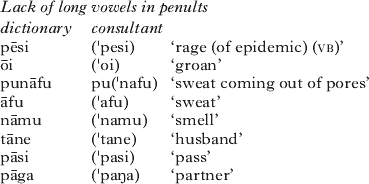
The language is presumably undergoing a change from what was recorded in Milner's dictionary, which was compiled in the 1960s; our consultants, whose ages range from 18 to 39, are at the more innovative end of the change. Mosel & Hovdhaugen, writing in 1992, seem to observe an intermediate stage: they note that /(C)Vː(C)V/ words are rare, but that those that exist are pronounced with a long vowel, with stress on the first half in ordinary speech ([ˈtaane]) and optionally on the second half in very careful speech ([taˈane]) (1992: 30). We found the same mismatch between pronunciations and Milner's spellings in two-mora reduplicated words (35a) and in compounds (35b). In addition to the evidence discussed in §5.4, these shortenings suggest that the reduplicant does form its own Prosodic Word: if both copies belonged to a single Prosodic Word, *[(ˌpoː)le(ˈpole)] would be well footed.
(35)

The second piece of evidence for avoidance of heavy–light feet comes from length alternations. When a monomoraic suffix that shifts stress is added to a stem, the stem's penult vowel that was short in the unsuffixed form sometimes becomes long. We can analyse the difference between the words in (36a), with no length change, and those in (36b), with a length change, as a difference in underlying form, surfacing only under suffixation. The underlyingly short /u/ of /fusi/ remains short under suffixation, but the /uː/ of /tuːsi/ must shorten if there is no suffix. All suffixed forms with long penult vowels in (36) are spelled as such in Milner (Reference Milner1993), and none of the corresponding roots are spelled with long penults – Milner lists roots that always have a short vowel (like fusi, fusi-a), roots that alternate (like tusi, tūsi-a), and words that always have a long vowel (like pāsi, pāsi-a), but our consultants lack this third type.
(36)

Because these alternations are also found in earlier descriptions that report long penults as possible (Mosel & Hovdhaugen Reference Mosel and Hovdhaugen1992, Milner Reference Milner1993), we conjecture that even when long penults were permitted in some unsuffixed words, they had been shortened in many others.
The tableaux below illustrate the analysis. We are agnostic as to whether the long vowels are really a single segment associated to two moras or a sequence of two identical segments (see Taumoefolau Reference Taumoefolau2003 for this issue in Tongan). For the sake of Richness of the Base, we show in (38) that whether the input is /tuːsi/ or /tuusi/, the output will be [(ˈtusi)]. FootBinarity, together with the requirement of right-aligned main stress (Edgemost-R), rules out a long or double vowel in the penult (38c.ii, d.iii); NoBreaking, defined in (37), rules out stressing the second half of a double vowel (38d.v) – cf. related Tongan, where this candidate is the winner (Churchward Reference Churchward1953, Poser Reference Poser1985).Footnote 12
(37)

Because shortening is preferred to lengthening (candidate (c.i) vs. (c.v)), we split faithfulness to length into two constraints, Don'tShorten and Don'tLengthen. (We assume that the winning output for /tuusi/ is [ˈtu1,2si], with fusion, penalised by McCarthy & Prince's (Reference McCarthy, Prince and Beckman1995) Uniformity, rather than [ˈtu1si], with deletion, because data discussed in §8 show that MaxV is ranked high.)
(38)

In addition to roots like /fusi/, whose penult is always short, and those like /tuːsi/, which alternates predictably, there are those with both a long and a short /-ŋa/ form (Mosel & Hovdhaugen Reference Mosel and Hovdhaugen1992: 195–196). In almost every case given by Mosel & Hovdhaugen, it seems that the lengthened noun has a more opaque meaning.Footnote 13 We speculate that the lengthened noun is a fossilised derivative of a root whose vowel is now underlyingly short (and thus whose productive derivatives show a short vowel). Samples of Mosel & Hovdhaugen's doublets are given in (39).
(39)
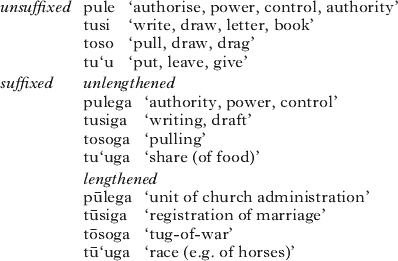
These doublets suggest that the mere existence of an alternating pair such as [ˈtoso]–[ˌtoːˈso-ŋa] is not sufficient to guarantee that speakers learn to derive both from an underlying form /toːso/. It is unknown, however, whether it was semantic change that severed the tie between the bare and affixed forms, or a separate lexical entry for the suffixed form that allowed the semantic drift. There are unpredictable or morphological length alternations in Samoan, which might encourage learners to treat length alternations as not reflecting underlying length of a shared root morpheme. See the forms in (40), from Mosel & Hovdhaugen (Reference Mosel and Hovdhaugen1992: 78, 221, 239).
(40)

The doublets are also expected if Samoan learners treat the unaffixed surface form as the ‘base’ in Albright's (Reference Albright2002) sense, so that both alternating and non-alternating words are listed as having short penults, and lengthening under suffixation is an exceptional property of some paradigms.
Although Fijian is probably the most discussed case of trochaic shortening, the evidence is far less clear than it is in Samoan. Word-final long vowels are reported to shorten in Fijian when a monomoraic pronominal or transitive suffix is added (Schütz Reference Schütz1985: 528, Dixon Reference Dixon1988: 26; see Hayes Reference Hayes1995 for discussion), as in [ðaa] ‘bad’ vs. [ða-ta] ‘consider bad’. The four such verbs listed by Dixon are all monosyllabic, so, as he discusses, a possible counteranalysis is that the underlying vowel is short (/ða/), and it lengthens to satisfy a bimoraic word minimum.Footnote 14 As for nouns, Dixon's mini-dictionary lists 20 with final long vowels, of which only six clearly involve a root of more than one syllable, e.g. [ʔolii] ‘dog’. Pronominal suffixes seem to be quite productive, so presumably these words do undergo shortening when suffixed, yielding a few clear cases of trochaic shortening.
‘Undoing’ of shortening under suffixation seems to be weak in Fijian. Dixon's mini-dictionary lists only one example: [sißi] ‘pass, exceed’ vs. [siißi-ta] ‘pass, exceed (trans)’, forming a minimal pair with [sißi] ‘carve, craft in wood’, [sißi-ta] ‘carve, craft in wood (trans)’. Scott (Reference Scott1948: 743, n. 1) identifies ‘three unusual cases’, two where the suffixed form optionally has a long vowel and one where it obligatorily has a long vowel: [ndonu] and [ndoonu-ja]∼[ndonu-ja], [leße] and [leeße-a]∼[leße-a], [ndraßu] and [ndraaßu-ja] (Scott does not include glosses). We speculate that these alternations are at least as variable or lexicalised as in Samoan.
Our analysis of Samoan lengthening, or rather prevention of shortening under suffixation, depends on the suffix's belonging to the stem's Prosodic Word. What about disyllabic suffixes? As shown in (50), we have one example of lengthening under /-Caʔi/ suffixation, suggesting that /-Caʔi/ can belong to the stem's Prosodic Word; by contrast, for /-Caŋa/ and /-Cia/-suffixed forms that Milner (Reference Milner1993) lists as lengthened, our consultant did not produce lengthening.
(41)

Similarly, Mosel & Hovdhaugen (Reference Mosel and Hovdhaugen1992: 202) report no length alternation under suffixation with /-ina/, /-Cia/ or /-Caŋa/, even when another suffixed form indicates an underlying long vowel (<fa>(ˈfaŋu) ‘wake’, (ˌfaː)(ˈŋu-a) and (ˌfaŋu)-(ˈina), rather than *(ˌfaː)ŋu-(ˈina)). They find that the only bimoraic suffix that allows length alternation is /-Caʔi/. All of this suggests that while most bimoraic suffixes form a separate Prosodic Word, /-Caʔi/ merely forms a foot, the same as if it were part of the root morpheme.
Our third piece of evidence for avoidance of heavy–light feet comes from the converse alternation: when a root ending in a long vowel acquires a monomoraic suffix, the root-final vowel is now in the penult and therefore can't be long. There are two possible repairs. One is shortening, and the other is what has been called ‘breaking’ in Tongan (Poser Reference Poser1985): stress falls on the second half of the long vowel. In (42) we give all the cases we could find. Some repair always occurs; sometimes our primary consultant accepted both shortening and breaking, and sometimes he accepted only one option.
(42)

Transcriptions like [(ˌpele)(ˈe-ŋa)] are not meant to imply a phonetic break between the [e]'s – we observe no medial dip in amplitude or change in formants – merely that the pitch rise is on the second half of the long [eː]. This requires us to place the two halves of the /eː/ in separate feet.
We saw in (38) that NoBreaking≫Don'tShorten, explaining the absence of sequences like [aˈa] within the Prosodic Word. To accommodate the one type of exception that we've just seen, we must assume a constraint variably ranked with NoBreaking that applies only under suffixation. Here we are forced to depart from our reliance on PWd structure alone, and adopt an output–output correspondence constraint (43) against shortening under suffixation (level ordering would also be possible).
(43)

The jagged line between the two crucial constraints in the tableau in (44) for /peleː+ŋa/ (base [pe(ˈleː)]) indicates their variable ranking.Footnote 17 (A constraint against shortening a root-final vowel would also work.)
(44)
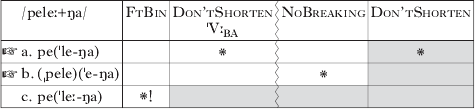
There are no doublets here – no related pairs like [ˈpele] and [peˈleː]. This supports the idea that vowel length in unaffixed forms is reliably learned, unlike ‘lengthening’ under suffixation.
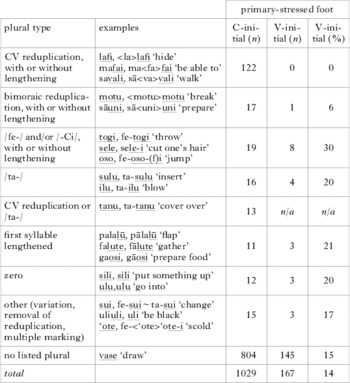
Patterns of plural marking in Milner's (1993) dictionary. Examples are given in orthography with morpheme boundaries indicated; the presumed primary-stressed foot is underlined.

Our fourth and final piece of evidence for the avoidance of word-final heavy+light is that when the penult begins with a vowel, CV reduplication cannot be used to mark the plural (Mosel & Hovdhaugen Reference Mosel and Hovdhaugen1992: 220). The 248 verbs in Milner (Reference Milner1993) with both a freestanding plain form and a listed plural form use various types of morphology, illustrated in Table I. The most common plural type involves CV reduplication, but never if the primary-stressed foot is V-initial. If CV reduplication did apply to a verb like /oso/, the result would be *[o(ˈoso)] (violating NoBreaking) or *[(ˈoo)so]/*[(ˈoː)so] (violating Edgemost-R), so one of the less common plural morphologies is used instead.
The next section examines cases where morpheme concatenation creates a sequence of identical vowels, yielding evidence about the prosodic effects of various morpheme boundaries.
7 Sequences of identical vowels
§6 showed that within a morpheme, heterosyllabic Vi.Vi sequences are not allowed (except for suffixed forms of certain stems with final long vowels). In this section, we show that heterosyllabic Vi.Vi sequences are possible across a morpheme boundary. These provide evidence for the disruption of footing domains.
When a ViVi sequence is created across a compound boundary, it does not attract stress as long vowels in monomorphemes do, nor undergo trochaic shortening, at least in careful speech.Footnote 18 Examples are shown in (45).
(45)

Why are vowels at the compound boundary exempt from NoBreaking, which prohibits identical adjacent vowels from being separated by a foot boundary? We propose that each part of the compound forms a separate Prosodic Word (§5.1), and that the domain of NoBreaking is the Prosodic Word.
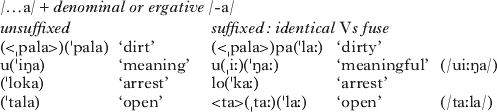
When /-a/ is added to a stem ending in /a/, the result is a stressed long vowel (46), consistent with our previous arguments that a monomoraic suffix belongs to the stem's Prosodic Word. We have no phonetic diagnosis for whether the correct analysis is monosyllabic [ˈaː] or disyllabic [ˈa.a] – either way, the pitch rise will be on the first half of the sequence. We observed no phonetic difference between the ends of these words and the ends of monomorphemes ending in presumed /aː/. (/uiːŋa/ and /taːla/ undergo trochaic shortening when not suffixed.)
(46)
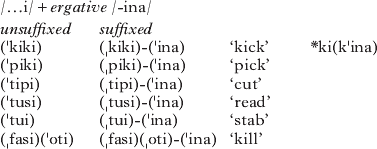
In §5.2.2 we had only weak evidence that the ergative suffix /-ina/ forms a separate Prosodic Word. However, when /-ina/ is suffixed to an /i/-final stem, no fusion or shortening occurs; the /i/'s remain in separate feet, in violation of NoBreaking, as shown in (47). A sequence of a stem+/-ina/ behaves like a compound, supporting a separate Prosodic Word for /-ina/, as predicted by Align-L(Morpheme, PWd) when foot-binarity is not at issue. As we will see in §8.3, unproductive suffixes seem to be exempt from Align-L(Morpheme, PWd); perhaps they are not recognised as morphemes.
(47)
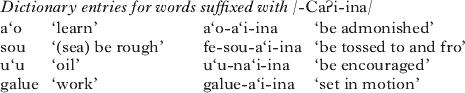
A ViVi sequence can also be created across a suffix–suffix boundary if /-Caʔi/ is followed by /-ina/. We failed to elicit any such words, but a few are listed in Milner (Reference Milner1993), and all are spelled with the sequence ii, Milner's notation for a long vowel or ViVi sequence stressed on the second half, again supporting a PWd boundary before /-ina/. Some of Milner's examples are given in (48).
(48)
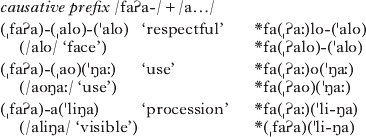
A ViVi sequence occurs across a prefix–stem boundary when the causative prefix /faʔa/-attaches to an /a/-initial stem. As shown in (49), no stress shift or shortening occurs across this boundary, further strengthening evidence in §5.3 for a PWd boundary between /faʔa-/ and its stem. (We found no examples of plural /fe-/ attaching to an /e/-initial stem.)
(49)
ViVi data also further strengthen evidence from §5.4 that there is a PWd boundary between the two copies in two-mora reduplication (though we found few relevant cases – the primary-stressed foot of the root must be vowel-initial, and its two vowels must have the same quality).
(50)

8 VV and VVV sequences
This section builds on our understanding of the stress domain, by describing how stress assignment is affected by two-vowel (VV) and three-vowel (VVV) sequences. Certain VV sequences produce stress on the antepenultimate rather than penultimate mora: [ˈmaile] ‘dog’ rather than *[maˈile] (§8.1). We refer to this phenomenon as diphthong formation, following earlier authors, but are agnostic as to what ‘diphthong’ means – that is, whether the [ai] in [maile] counts as a single segment, two segments in the same syllable or segments in separate syllables. Diphthong formation provides more evidence for PWd boundaries before each stem in a compound and before ergative /-ina/ (§8.2). §8.3 turns to VVV sequences, especially /VVa/, where the diphthong-forming inventory broadens, and where the ergative and denominal /-a/ suffixes seem to have an idiosyncratic stress requirement.
8.1 Basic diphthong formation
Certain VV sequences disrupt the normal stress pattern, as in [ˈmaile]. Unlike in Fijian (Schütz Reference Schütz and Schütz1978, Reference Schütz1985, Dixon Reference Dixon1988, Hayes Reference Hayes1995), Samoan sequences like the [ai] in [ˈmaile] do not sound shortened.
The stress disruption occurs when the first vowel is non-high and the second is high. Of the twenty possible sequences of non-identical vowels, diphthong formation occurs (in monomorphemic words) for [ai au ei ou], and not for [ae ao ea eo oa ia ie iu ua uo].Footnote 19
(51)

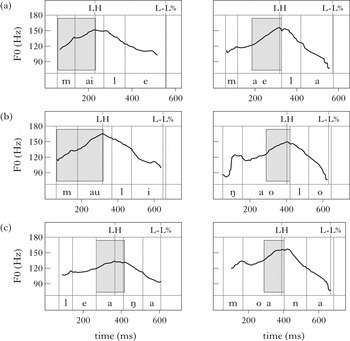
We illustrate near-minimal sets with pitch tracks in Fig. 6. In the words on the left (e.g. [ˈmaile]), the rise is over the first half of the VV sequence, whereas on the right (e.g. [maˈela]), the rise is over the second half.
Pitch tracks for (a) and (b) near-minimal pairs of diphthong-forming and non-diphthong-forming sequences ((a) [(ˈmai)le] ‘dog’ and [ma(ˈela)] ‘hollow’; (b) [(ˈmau)li] ‘heart’ and [ŋa(ˈolo)] ‘rattle, abound’); (c) two non-diphthong-forming sequences ([le(ˈaŋa)] ‘bad’ and [mo(ˈana)] ‘fish (sp.)’).

We propose a penalty on prominence mismatches: if the first vowel in a VV sequence is more prominent in sonority, it should also be more prominent metrically (e.g. Hayes Reference Hayes1995, Anttila Reference Anttila, Hinskens, van Hout and Wetzels1997, Kenstowicz Reference Kenstowicz1997a, Crosswhite Reference Crosswhite2001). Our constraint is limited to cases where the second vowel is high.Footnote 21
(52)

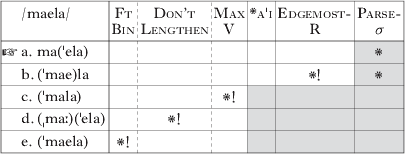
Tableau (53) shows the default pattern, when *aˈI is not relevant.
(53)
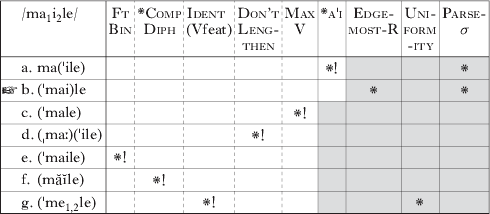
As shown in (54), *aˈI can force a violation of Edgemost-R (or FootBinarity, if we take (e) to be the winning candidate). The constraint *CompressedDiphthong rules out shortening the /ai/ sequence to count as monomoraic. We proposed in §6 that Uniformity is violable in Samoan, allowing the rich-base input /tu1u2si/ to map to fused [tu1,2si], so it is not fusion itself that rules out candidate (g), but rather the fusion of non-identical vowels, in violation of Ident(Vfeatures) (which abbreviates Ident[high], Ident[front], etc.). For underlying long vowels, /tuːsi/, a right-aligned binary foot can be achieved by violating only Don'tShorten. But for /maile/, higher-ranked faithfulness constraints are at stake: *CompressedDiphthong, Ident(Vfeatures) and MaxV. The result is a faithful outcome, with a non-aligned foot.
(54)
In words ending in /…VːVCV/, primary stress is on the penultimate mora as usual, as in (55).
(55)
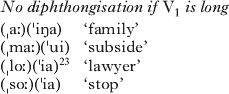
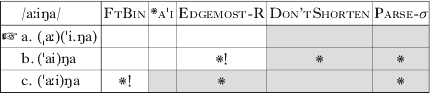
There is no need to violate Edgemost-R, because both vowels are stressed, satisfying *aˈI (56).
(56)
8.2 VV sequences at morpheme boundaries
We have seen that a monomoraic suffix is included in the Prosodic Word and normally shifts stress (§5.2.1). When a monomoraic suffix is added to a stem ending in [ai], [au] or [ei], stress fails to shift, as shown in (57)–(59). This is expected under the PWd structures developed above: a stem ending in [ai], [au] or [ei] followed by a monomoraic suffix simply behaves like a monomorphemic word (cf. [ˈmaile]), because it forms a single Prosodic Word.
(57)

There is one example with ergative /-na/, and one with a different suffix /-na/; both behave as expected.
(58)

We have two examples for the suffix /-Ci/. The stress is as in a monomorpheme, shifting to penultimate for /ao/ but not for /au/.
(59)

As expected, when a stem's penult appears as long under suffixation, there is no diphthongisation, because both vowels in the VV sequence now bear stress, and *aˈI is not violated.
(60)

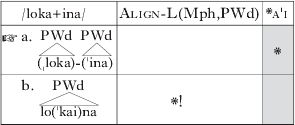
In §7 we argued that the ergative suffix /-ina/ forms a separate Prosodic Word. Diphthongisation offers further support: just as the sequence /i+i/ does not shorten when the second /i/ belongs to /-ina/, there is also no diphthongisation in /a+i/ or /e+i/ when the /i/ belongs to /-ina/.
(61)
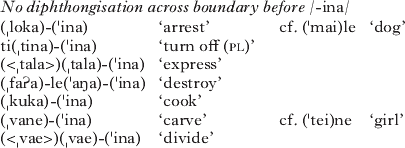
Diphthongisation is also blocked when /-ina/ attaches after another suffix that ends in /a/.
(62)
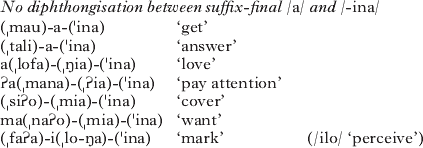
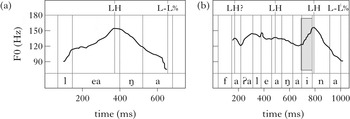
The pitch track in Fig. 7b shows a clear pitch rise on the [i] of [-ina], instead of on the preceding [a].
Pitch tracks for (a) [le(ˈaŋa)] ‘bad’ and (b) [(ˌfaʔa)-le(ˌaŋa)-(ˈina)] ‘destroy’, showing pitch rise on [i] in the separately footed suffix /-ina/, instead of on the preceding [a].

The lack of diphthongisation with /-ina/ is expected under our analysis, so long as *aˈI is ranked lower than the Align constraints governing PWd formation, as shown in the tableau in (63). (We assume that feet can't straddle PWd boundaries, either as a property of Gen or because of a high-ranking constraint.)
(63)
In §5.3 and §7 we argued that a prefix is not part of the stem's Prosodic Word – it forms its own Prosodic Word or is adjoined to the stem's. Here we see stronger support for this prosodification: diphthong formation is blocked across a productive prefix–stem boundary.Footnote 22 This is illustrated in (64) for [au ai ei].
(64)
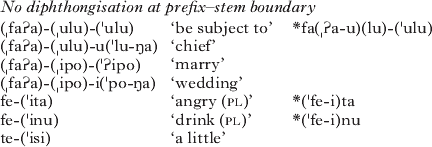
Once again, if we assume that a foot can't straddle a PWd boundary, this is expected.
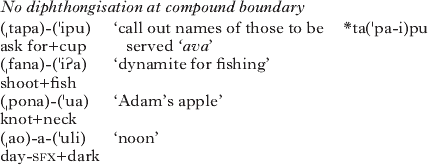
Diphthong formation is blocked across compound boundaries, consistent with the evidence in §5.1 and §7 for a PWd boundary between the two stems.
(65)
There is one morphological pattern that behaves a little differently. When the C in semi-productive /-Ci/ is zero, the preceding vowel is non-high and another suffix follows, the conditions for diphthongisation are in place. We find that stress does fall on the antepenultimate vowel in these cases, just as if the string were monomorphemic.
(66)
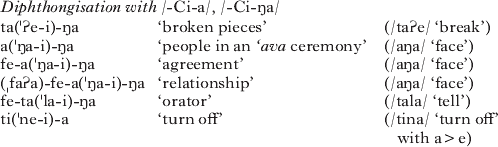
This is to be expected if the stem+suffix+suffix forms a single Prosodic Word. However, our grammar predicts that the two suffixes should form their own Prosodic Word, to satisfy Align-L(Morpheme, PWd) at least partially (see (23)). We conclude that only productive morphemes are subject to Align-L(Morpheme, PWd), perhaps because the grammar doesn't treat unproductive affixes such as /-Ci/ as real morphemes. (See the end of §8.3 for a VVV example.)
8.3 Final VVV sequences
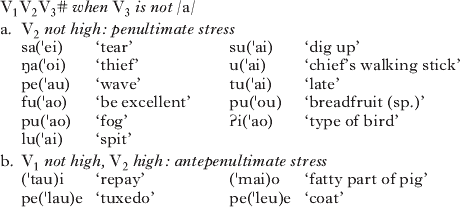
In words ending V1V2V3, when V3 is not /a/, the diphthongisation behaviour of V1V2 is as before: stress is penultimate as usual, unless V1 is non-high and V2 is high.
(67)
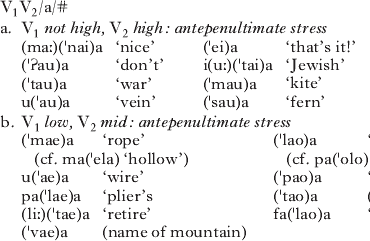
However, if V3 is /a/, we see diphthongisation even when V1 is low and V2 is mid.
(68)
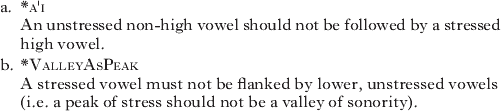
To account for the [ˈaea] and [ˈaoa] patterns, we propose an additional prominence-matching constraint. While *aˈI (repeated in (69a)) penalises a prominence mismatch of a certain size, *ValleyAsPeak (69b) penalises a mismatch of any size, if it occurs on both sides of the vowel in question (*ValleyAsPeak is therefore applicable only to VVV sequences).
(69)
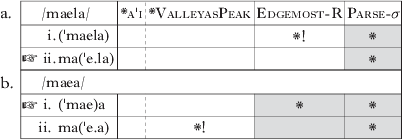
The tableaux in (70) illustrate how diphthongisation of low–mid sequences is possible only if the sequence is /VVa/.
(70)
The sonority–stress mismatch constraints in (69) resemble those in previous analyses of sonority-driven stress, such as Kenstowicz's (Reference Kenstowicz1997a: 162) *Peak/i,u and de Lacy's (Reference de Lacy2002: 15) *ΔFoot/{ə,i/u} (e.g. ‘don't stress a high vowel’) or the SonorityPeak constraint of Clements (Reference Clements and Roca1997) and Dell & Elmedlaoui (Reference Dell and Elmedlaoui2002) (‘a sonority peak within a syllabification domain must be a nucleus’). Neither of these approaches entirely captures the Samoan data. If ranked correctly in relation to Edgemost-R, ‘don't stress [i u]’ and ‘don't stress [e o]’ can capture [(ˈmai)le] and [ma(ˈela)], but some additional mechanism is needed to account for the difference between [maˈela], where mid-vowel stress is tolerated, and [ˈmaea], where it is not. And while a stress version of SonorityPeak could work for sequences like /aia/ and /aea/, in /maile/ the /i/ is not a sonority minimum, because it is followed by even less sonorous /l/. An additional mechanism would be needed to prefer [ˈmaile] over [maˈile].
What do /VVa/ sequences tell us about PWd structure? The first relevant case occurs when the final /a/ is a suffix. In §5.2.1 we saw that the ergative /-a/ and denominal /-a/ suffixes both shift stress rightward, putting them in the same Prosodic Word as the stem. Thus, we expect /VV-a/ to behave the same as monomorphemic /VVa/.
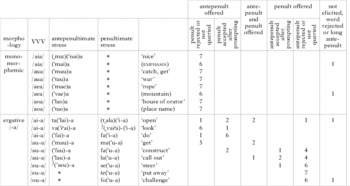
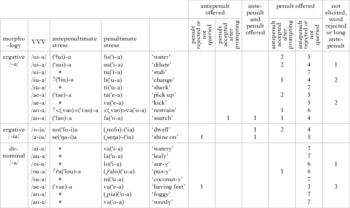
Elicitations with our primary consultant yielded variable data, so we elicited and recorded representative words from six additional consultants in Samoa. Full results are shown in the Appendix: for each word, we show how many consultants had each pattern. The data confirm that stress is consistently antepenultimate for tautomorphemic /aia aua aea aoa/. When the final /-a/ is the ergative suffix, we see variation for /aua aia/, and for /aea aoa/ variation with a tendency towards penultimate stress. When final /-a/ is the denominal suffix, we see a strong tendency towards penultimate stress for /aua aia aea aoa/.
(71) schematises the /VVa/ results, with parentheses round a less common variant.Footnote 23
(71)

The suffixed cases with penultimate stress are very surprising. If the ergative and denominal suffixes are treated as part of the root's prosodic domain, stress should be the same as in monomorphemes – antepenultimate. If they are treated as outside the domain, stress should remain where it was in the unsuffixed form – yielding, again, antepenultimate stress: [ˈaV-a]. The puzzle persists if we employ ordering, as in Lexical Phonology and Morphology: if the suffixes are added before stress is assigned, stress should be the same as in monomorphemes. If the suffixes are added after stress is assigned, stress should remain on the root's penult: either way, [ˈaV-a]. Likewise, output–output faithfulness to the unsuffixed form can't explain the [aˈV-a] pattern.
The vast majority of data that a Samoan learner encounters for these suffixes is from stems that end in CV (and even among stems that end in VV, most don't end in the crucial sequences, e.g. /ai/). We have assumed that the grammar explains the stress shift in these cases by putting the root and suffix in the same Prosodic Word. But learners could also learn stress shift as a (redundant) property of each suffix, conflicting with stress constraints only for the crucial VV-final roots.
We sketch a way to capture these suffix-specific stress shifts, using a proposal from Buckley's (Reference Buckley1998) analysis of similarly problematic stress data in distantly related Manam. Buckley appeals to low-ranked AlignHD, requiring the end of any Prosodic Word to be the end of the main-stressed foot, and high-ranked AlignHD{suf}, which applies only to the ends of suffixes. For Samoan, we need constraints that are even more specific, referring to just these two suffixes, although we do not need to refer to the main-stressed foot specifically.
(72)
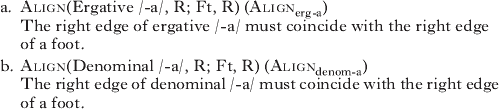
The difference between ergative and denominal /-a/ is in the conflict between each suffix's Align constraint and the prominence-matching constraints *aˈI and *ValleyAsPeak: denominal /-a/'s alignment requirement is ranked high, but ergative /-a/'s is optionally outranked by *aˈi, so that we see variation for /ai-aerg, au-aerg/, but hardly ever for /ai-adenom, au-adenom/. We have no explanation for why the difference between the two morphemes should be in this direction rather than the opposite.
We saw at the end of §8.2 that the semi-productive suffix /-Ci/ does not initiate a Prosodic Word, even when another suffix follows, allowing FootBinarity to be satisfied. The unproductive /-ia/ ergative suffix provides a similar example for VVV sequences. We were able to gather several examples with /a/- or /o/-final stems. As shown in (73), the /…a-ia/ data, with one variable exception (‘shine on’), indicate that /-ia/ is included in the stem's Prosodic Word, because it does not bear its own stress, but rather stress falls on the antepenult. This is in contrast with the behaviour observed for productive /-ina/, which does bear stress even after stem-final /a/. Once again, it seems that unproductive suffixes are not subject to Align-L(Morpheme, PWd). (See the Appendix for full elicitation results.)
(73)
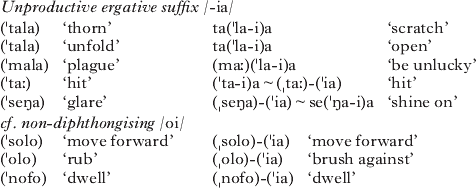
Although we have no other data on the diphthongisability of /oi/, the /-ia/ data in (73) suggest that /oi/ does not pattern with /ai/.
To summarise this section, we have seen that prominence mismatches cause stress to deviate from its normal penultimate position, but not at the cost of a foot straddling a PWd boundary. Under this analysis, we have additional evidence that the productive ergative suffix /-ina/ forms its own Prosodic Word, and for a PWd boundary inside a compound. We also saw that a strong prominence mismatch is required to shift stress in /…VVCV#/ sequences, but even a weak prominence mismatch shifts stress in /…VVV#/. The ergative and denominal /-a/ suffixes seem to have developed an idiosyncratic pre-stressing requirement, which we capture by requiring them to be foot-final; this requirement is normally redundant, since it doesn't conflict with the stress pattern otherwise expected, but in /…VV-a#/ cases the suffix-specific constraints prevail.
9 Speculations on glide formation
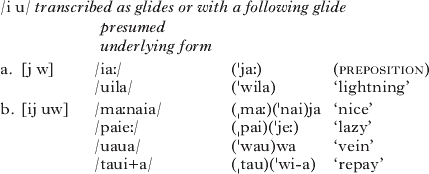
Before concluding the paper, we mention one area of Samoan word prosody where our findings are more tentative. In our narrow transcriptions, we have often transcribed /i u/ as the glides [j w], or as [ij uw]. Mosel & Hovdhaugen also note these allophones (1992: 25–26). The environments in (74) are typical ones where we have transcribed [j w] (unstressed, followed by a vowel, and not preceded by a consonant) or [ij uw] (between [ˈVi ˈVu] and a vowel).
(74)
By contrast, as shown in (75), we have typically not transcribed /i u/ as glides when stressed, preceded by a consonant or not followed by a vowel.
(75)
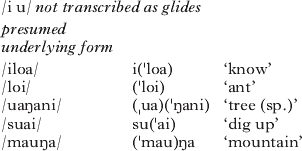
It is difficult to establish objective criteria for classifying a sound as [i u] or [j w]. In some tokens, the transcription of a glide seems justified by a sharp dip in amplitude, but others lack such evidence.Footnote 24 We therefore do not attempt a full analysis, but note two tendencies. First, many vowel-to-glide changes provide an onset to a foot-initial syllable, as in [a(wˈeː)] vs. *[(ˈau)(ˈeː)]. Second, glide insertion occurs mainly after [ˈVi] or [ˈVu] sequences ([(ˈmau)wa]). This may be akin to the partial lengthening that we have (unreliably but saliently) observed after stressed vowels, as in [ˈfusˑi], and may also maintain contrast between /ai au/ and /ae ao/: /maua/→[(ˈmau)wa] vs. /paoa/→[(ˈpao)a].
We also note two observations suggesting that gliding cannot be simply postlexical. The first observation concerns reduplication. Given only a broad transcription, the reduplications in (76) would be puzzling, because three moras are copied rather than the usual two. But the narrow transcriptions make more sense: /u/ has become an onset glide, so it copies along with the following long vowel.
(76)
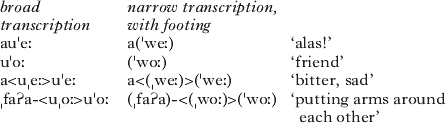
Gliding must precede reduplication (literally or through output–output correspondence) or occur in parallel with it, and therefore can't be postlexical.
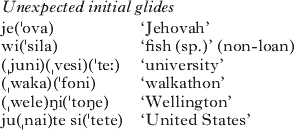
The second observation concerns loanwords. In the native word data above, it appeared that stress bleeds gliding: applying stress yields [(ˌua)(ˈŋani)], preventing (potentially post-lexical) gliding to *[wa(ˈŋani)]. In some loans (and one native word), however, glides occur in positions where we would have expected stress to fall (77). We surmise that even though the distinction between high vowels and glides is not normally contrastive in Samoan, a glide in the foreign form should correspond to a glide in the Samoan form (or at least repel stress, as in [ku(ˌini)si(ˈlani)] ‘Queensland’, instead of *[(ˌkui)(ˌnisi)(ˈlani)]). Thus, again, gliding cannot be purely postlexical.
(77)
10 Summary and conclusion
10.1 Summary
This paper has covered several aspects of the word-level prosody of Samoan. The Hasse diagram in (78), made with OTSoft (Hayes et al. Reference Hayes, Tesar and Zuraw2003), shows the constraint rankings required in our analysis.
(78)

In (78), solid lines indicate crucial constraint rankings, for example, FootBinarity≫Align-L(Morpheme, PWd). The jagged line between Don'tShortenˈVːBA and NoBreaking indicates a variable ranking: if Don'tShortenˈVːBA≫NoBreaking, final long vowels break when suffixation makes them penultimate, and if NoBreaking≫Don'tShortenˈVːBA, they shorten (see §6). The line between Edgemost-R and NoBreaking is dashed to indicate that although that ranking is required for the breaking variant, it is irrelevant for the shortening variant; the rankings Edgemost-R≫Don'tShorten and Edgemost-R≫Uniformity are required for either variant, either directly or by transitivity.
The two jagged lines connected to Alignerg-a in (78) also indicate variable ranking. If Alignerg-a≫*aˈI, *ValleyAsPeak, then the ergative suffix /-a/ is foot-final, and thus preceded by stress: [fa(ˈi-a)], [va(ˈe-a)] (see §8.3). Under the less frequent ranking *ValleyAsPeak≫Alignerg-a, regardless of the ranking of *aˈI, words with the ergative suffix /-a/ are stressed the same as monomorphemes: [(ˈfai)-a] ‘do’, [(ˈvae)-a] ‘kick’. And if *aˈI≫Alignerg-a≫*ValleyAsPeak, then stress in these words depends on the height of the stem-final vowel: [(ˈfai)-a], [va(ˈe-a)].
We have seen that in monomorphemic words there is a final moraic trochee bearing primary stress, and possibly a preference for a word-initial trochee bearing secondary stress if the word is long enough. Long vowels or sequences of identical vowels are not allowed in penultimate position if the final vowel is short, and we see alternations reflecting trochaic shortening. Stem-final long vowels also shorten or break when suffixation makes them penultimate. When monomoraic reduplication would create a long vowel in the penult, different morphology is used.
We have also proposed that the beginning of a lexical word projects the beginning of a Prosodic Word. Based on stress, monomoraic suffixes are included in the domain of footing, or Prosodic Word – that is, they shift stress to the right. The diagnostic that the penult of the Prosodic Word is the position where a long vowel is not allowed also supports the inclusion of monomoraic suffixes in the domain of footing, and suggests that there is a PWd boundary between the following: (i) stems and /-ina/, (ii) prefixes and stems, (iii) stems in a compound and (iv) a bimoraic reduplicant and its base.
Finally, certain vowel sequences disrupt the normal stress pattern. We propose that a prominence-matching constraint prohibits an unstressed non-high vowel followed by a stressed high vowel: *aˈI. Such sequences are allowed across PWd boundaries, however, because a foot can't straddle a PWd boundary. Notably, the evidence from these sequences supports the PWd boundaries proposed. Another prominence-matching constraint applies to three-vowel sequences: there, even if the middle vowel is only mid, rather than high, it can't be stressed if surrounded by unstressed, low vowels (i.e. [ˈaea ˈaoa], not *[aˈea aˈoa]): *ValleyAsPeak.
10.2 Comparison to other approaches
In §2 we reviewed existing approaches to phenomena similar to those observed in Samoan. The approach we have pursued throughout the paper uses Align constraints to impose prosodic-word boundaries, with the Prosodic Word as the domain of footing. Here we consider how other approaches fare.
A close cousin to the approach taken here is one in which Align constraints place feet directly at morpheme boundaries, without the Prosodic Word as an intermediary (Crowhurst Reference Crowhurst1994). The main challenge we see for applying this approach to Samoan involves words with monomoraic suffixes. In /lolo+fi/ (19), for example, as shown in (79), the incorrect footing *[(ˈlolo)-fi] is if anything preferred by direct morpheme–foot alignment constraints, because at least the stem morpheme begins with a foot. Some constraint is needed to prefer [lo(ˈlo-fi)], such as a preference for the word to end in a foot – in which case we still need a Prosodic Word, though perhaps a simpler one.
(79)

On the other hand, an advantage of morpheme–foot alignment is that morpheme-specific Align constraints can capture the idiosyncratic behaviour of certain morphemes: we analysed the pre-stressing behaviour of denominal /-a/ and, to a lesser extent, ergative /-a/ (§8.3) with constraints like Aligndenom-a, which requires a foot boundary after denominal /-a/ – an even more specific version of Buckley's (Reference Buckley1998) AlignHd{suf}.
Output–output faithfulness can handle some aspects of the Samoan data. Some form of output–output faithfulness is needed to deal with the different treatment of underlying penultimate long vowels in unsuffixed vs. suffixed words, as discussed in §6: in unsuffixed forms a long penult obligatorily shortens, whereas in suffixed forms there is variation between shortening and breaking, which we attributed to variable faithfulness to the unsuffixed form ([pe(ˈle-ŋa)]∼[(ˌpele)(ˈe-ŋa)], from [pe(ˈleː)]). Moreover, the lack of secondary stress shift under suffixation (§5.2) could be attributed to faithfulness to the unsuffixed form. The lack of diphthongisation (§8.2) and vowel coalescence (§7) before /-ina/ could also have been attributed to high-ranking faithfulness of /-ina/-suffixed forms to their base words: non-diphthongised [(ˌloka)-(ˈina)] is more faithful to its base [(ˈloka)] than is *[lo(ˈka-i)na]; non-coalesced [(ˌkiki)-(ˈina)] is more faithful to [(ˈkiki)] than is *[ki(k-ˈina)] or *[ki(ˈki-na)]. Similarly, the lack of length alternation with /-ina/ and other bimoraic suffixes (except /-Caʔi/) (§6) could have been explained by subjecting these suffixations to stronger output–output faithfulness constraints on vowel length. However, the fact that suffixes divide into two faithfulness groups almost entirely along prosodic lines (monomoraic suffixes and /-Caʔi/ vs. other bimoraic suffixes) would be accidental.
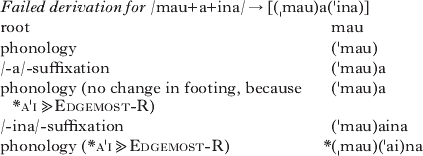
Interleaving affixation and phonological operations, as in Lexical Phonology, can also handle some of the data. Suppose that /loka/ is prosodified before being suffixed, as [(ˈloka)]. If faithfulness to existing footing outranks *aˈI, suffixing /-ina/ will just add a foot, [(ˌloka)-(ˈina)]. Monomoraic suffixes can still shift stress if Edgemost-R outranks faithfulness to existing feet: [(ˈlolo)], after being suffixed with /-fi/, changes to [lo(ˈlo-fi)]. The problem that this approach faces for Samoan is similar to the one that Baker (Reference Baker and Mushin2005) points out for Ngalakgan: suffixing [(ˈmau)-a] ‘get’ with /-ina/ should provide enough unfooted material to yield *[(ˌmau)-(ˈa-i)na], but the result is instead [(ˌmau)-a-(ˈina)] (62), with a new foot initiated by /-ina/, in violation of *aˈI. The failed derivation in (80) illustrates this.
(80)
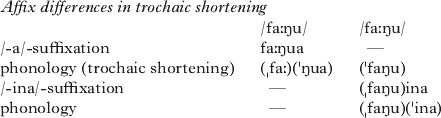
To deal with trochaic shortening in Lexical Phonology, it would be necessary to group suffixes into levels. Those that can bleed trochaic shortening (monomoraic suffixes and /-Caʔi/) would be attached before shortening, and those that counterbleed it (the other bimoraic suffixes) would be attached afterward, and the fact that the partitioning of suffixes into levels is almost entirely determined by suffix size would be accidental.
(81)
Neither Lexical Phonology nor output–output faithfulness provides a natural solution to the problem of prestressed denominal /-a/ (and to a lesser extent ergative /-a/) (§8.3). Suffixed [va(ˈi-a)] is not faithful to its base or earlier derivational stage [(ˈvai)]; nor does ordering suffixation before prosodification help, since the result should be the same prosody as a monomorpheme, *[(ˈvai)-a]. As in our Align approach, an additional stipulation is required for these suffixes.
Finally, we consider an approach based on boundary symbols. As with output–output faithfulness or Lexical Phonology, the lexical entries of affixes must specify which of two groups they belong to. The monomoraic suffixes and /-Caʔi/ would be preceded by the boundary +, and the other bimoraic suffixes by #. Footing rules or constraints would ignore + boundaries. For example, /#loka#ina#/ would be footed as [#(ˌloka)#(ˈina)#], with a foot preceding each non-initial #, but /#lolo+fi#/ as [#lo(ˈlo+fi)#], with a single foot preceding the single non-initial #. All prefixes would bear #, to prevent diphthongisation or vowel coalescence: [#fe#(ˈita)#] (assuming that footing rules/constraints prevent a foot from taking material from both sides of a # boundary).
Given that a difference in prosodic behaviour between monomoraic and bimoraic affixes exists in many other language (see §2.2 for examples), we believe it is an advantage of the two Align approaches that this difference is captured in the grammar rather than being an accidental property of affixes’ lexical entries, as in the output–output, Lexical Phonology and boundary-symbol approaches.
10.3 Conclusions
We have provided a description of Samoan word prosody and an analysis supported by evidence from stress and vowel length that uses morphology-sensitive Align constraints to impose Prosodic Words, which are the domain of footing. The alternative of Align constraints that bypass the Prosodic Word and impose feet at morpheme boundaries would require an additional mechanism to handle our data. Simple cyclicity cannot account for all of the data, and Lexical Phonology, output–output correspondence and boundary-symbol approaches miss the correlation between affix size and behaviour. Additional points of interest include asymmetrical productivity in length alternations (§6), length restrictions affecting affix choice (§6), sonority/prominence-matching constraints sensitive to degree of mismatch and vowel sequence length (§8), morpheme-specific stress/footing constraints in a small number of words (§8.3) and marginal contrasts that emerge only in loans, for secondary stress (§4.4) and glide/vowel distribution (§9).
Appendix: Elicitation results for VV /a/# words