From its inception, chant scholarship has been concerned with melodic transmission.Footnote 1 Melodic variants can bear witness to local or regional ways of singing, to connections between institutions and to the relationships between different chant traditions. Aside from the responsory verse tones, however, comparative analysis of Old Hispanic (or ‘Mozarabic’) chant melodies has rarely been undertaken. In the Old Hispanic repertory, the subject of Michel Huglo's first article, such comparison demands new methods, because of the paucity of surviving manuscripts, the limited sharing of repertoire between them and the nature of the notation. Despite these challenges, the melodic transmission of Old Hispanic chant attests to the presence of melodic sub-traditions and a complex network of relationships between manuscripts. Comparing the choices of scribes in certain opening and cadential contexts across many manuscripts allows us to extend and refine earlier conclusions about regional traditions beyond formulaic verse tones, examined by Don M. Randel, and into the main body of Old Hispanic chant.Footnote 2 In these locations in the chant, cantors chose from a system of interchangeable melodic shapes that vary by manuscript. Furthermore, the openings permit us to pinpoint some neume patterns that are strikingly similar in appearance, but have distinctly different meanings.
Because the Visigothic notation that preserves Old Hispanic chant does not show pitch, the Old Hispanic melodies have often been thought to be impervious to analysis. Scholarly work on small parts of the repertory, however, has shown that the neumes have much to tell about the melodies. Louis Brou, Randel, Susana Zapke, Nils Nadeau, David Hiley, and Hornby and Maloy, for example, have identified standard melodic elements used in multiple chants, as well as other aspects of melodic structure.Footnote 3 To date, however, only one study has engaged directly with the regional melodic traditions of the Old Hispanic chant corpus. Don Randel's work on the responsory verse tones identified four Old Hispanic melodic traditions. Two of these are found in sources generally thought to be from the northern Christian kingdoms, copied between the ninth and eleventh centuries; Randel associated the manuscripts with the regions of León and the Rioja, respectively. The other two verse tone traditions appear in the later manuscripts, most of which are ascribed to Toledo. However, colophons definitively linking the manuscripts’ copying to particular scribes, times, or places are rare.Footnote 4 For most other manuscripts, scholars have not been able to establish secure dates and origins on the basis of musical and textual palaeography. For example, the two notational styles, known as ‘vertical’ and ‘horizontal’, respectively, have generally been used to assert the northern or southern origins of manuscripts. More recent work suggests that, instead, the notation shifted from vertical to horizontal over the course of the later eleventh and twelfth centuries, with some examples of vertical notation being used in the south of the peninsula before the reconquest.Footnote 5
In the responsory verse tones, Randel defined a melodic tradition particular to L8, Sal and Sant. (For a list of sigla, see Appendix.Footnote 6) The latter two sources are closely associated with the royal court of León, as confirmed by their colophons. As some have suggested, this melodic tradition could have originated outside the kingdom of León, even if the manuscripts were copied there.Footnote 7 Another group of manuscripts comprises a second melodic tradition, termed ‘Rioja’ in Randel's work.Footnote 8 Few manuscripts in this group are securely attributed, although places of origin have been suggested for many of them, with greater and lesser degrees of certainty.Footnote 9 Although our findings confirm that these sources share melodic traits that distinguish them from L8, they are far from uniform in the material we examine.
The later sources, copied between the twelfth and fourteenth centuries, seem to represent the continuation of the Old Hispanic rite in a few Toledan parishes after it had been suppressed elsewhere.Footnote 10 From both musical and liturgical standpoints, these sources represent two traditions, often called A and B. Randel showed that their responsory verse formulas are distinct from one another and from the León and ‘Rioja’ traditions. Some of the tradition A sources were owned by and used at the Toledan parish of Santa Eulalia.Footnote 11 Tradition B is witnessed in only two full manuscripts (T5 and BN10) and the fragment MSC, all dating from the thirteenth and fourteenth centuries. These sources share many chants with tradition A, but often with different liturgical assignments.Footnote 12 Their choices and assignments of readings and prayers also differ greatly from tradition A. Because the tradition B sources were copied at such a late date, we cannot know whether tradition B represents a pre-1085 branch of the Old Hispanic rite whose earlier sources have been lost, or whether its differences are attributable to changes that occurred after the rite had largely been suppressed (i.e., between 1085 and the thirteenth century).Footnote 13
Zapke has recently proposed a different classification of the Old Hispanic manuscripts, using geographical and political criteria. She defines five ‘geopolitical spaces’: Catalonia, Aragon, León-Castile, Navarre and Toledo.Footnote 14 Although there are Catalonian fragments using Visigothic notation, no extant manuscripts from Catalonia or Aragon preserve the Old Hispanic rite, making these areas irrelevant for the present discussion.Footnote 15 All the manuscripts classified by Randel as preserving the ‘Rioja’ melodic tradition are generally attributed to either León-Castile or Navarre.Footnote 16 The León tradition seems to connect closely to the area around León itself; and the single ‘geopolitical space’ of Toledo encompasses two chant traditions.
It remains an open question whether Randel's four melodic traditions extend beyond the formulaic responsory verse melodies, or whether a geopolitical categorisation such as Zapke's might be reflected in distinct melodic dialects. The central challenge in answering these questions is the survival patterns of the Old Hispanic manuscripts. Some extant sources are fragmentary. Others, while complete, each preserve only a limited portion of the liturgical year or a limited subset of the repertory.Footnote 17 Many surviving chants are found in only one manuscript, and it is exceptional for a chant to appear in four or more manuscripts.Footnote 18 This makes it difficult to explore regional melodic traditions by making direct comparisons between different versions of chants. Randel solved this problem by investigating the strictly formulaic melodies of the responsory verse tones. He was able to identify four distinct approaches to the shaping of the tones even when direct comparisons between individual chants were impossible.
To explore the validity of Randel's four melodic traditions beyond the responsory verse tones, we investigate selected melodic material that is used at cadences and other material that appears at chant openings, across the Old Hispanic tradition. In each of these contexts, the cantors use the same constellations of melodic material in multiple chants, although they do not comprise a formulaic set of chants. By focusing on specific formal, verbal and melodic contexts rather than on individual melodies, it is possible to compare the melodic tendencies of manuscripts that do not have a single chant in common.
The opening and cadential strategies examined here employ a variety of functionally equivalent melodic gestures. Most of these contours occur at least once in each manuscript, suggesting that they constitute a range of options available to the scribes and cantors; some manuscripts exhibit a strong preference for one option over the others. Although the differences at these cadences and openings are small, minor variants have cumulative importance. As the Solesmes work on melodic variants demonstrates, particular choices within a certain melodic context can be shown to be characteristic of manuscripts from one region.Footnote 19 Some have used analysis of minor variants to explore possible oral processes within the transmission of liturgical chant,Footnote 20 or to demonstrate the stability of the tradition.Footnote 21 Others have instead looked at the constellations of minor variants in order to identify institutional, local and region chant traditions.Footnote 22 Such an approach has not previously been taken across the broad corpus of Old Hispanic chant. As we shall see, sometimes the melodic variants run in parallel with the geographical and institutional attributions suggested by other scholars; at other times they invite us to reassess those attributions.
Part 1 comprises a comprehensive survey of a particular cadence type as it appears in one genre, the sacrificium (offertory), which demonstrates regional patterns in the treatment of that cadence. In part 2, over 700 chant openings are surveyed; each opening involves a unison gesture. Although our results are congruent with Randel's findings in a general sense, not all manuscripts fit securely into one of four distinct melodic traditions with absolute consistency. The different blend of elements found in each manuscript enables us to examine the intersections between the four melodic traditions.
Part 1: cadences
A definition of Old Hispanic cadences begins with the observation that the cantors employ a limited number of neume patterns at points that must be cadential: the ends of chants. Within sections of the chant, breaks in the verbal syntax often coincide with the same neume patterns, suggesting that these can also be identified as cadences. In the cadence types considered here, the cadential material is distributed over the last three or four syllables of the verbal clause; we refer to these as ‘three-syllable’ and ‘four-syllable’ cadences. In each case, the last two syllables have distinctive and characteristic patterns, preceded by material that draws on a large but bounded set of possibilities.
In L8, the last two syllables of the cadential patterns discussed here most commonly have a three-note or a two-note ascent (NHH or NH) on the penultimate syllable,Footnote 23 followed by a two-note ascent (NH) or single note (N) on the final syllable. Other manuscripts, however, show a preference for material other than NH or NHH on the penultimate syllable. In fact, the treatment of the penultimate syllable in these cadences emerges as an important marker of melodic dialect. In the repertory of 116 sacrificia, the manuscripts show clear regional preferences on the penultimate syllable of this cadence type, both in the shapes chosen and in the contexts in which they are used. The tenth- and eleventh-century manuscripts are largely congruent in the final sacrificia cadences, but variety prevails in the internal cadences.
Final cadences
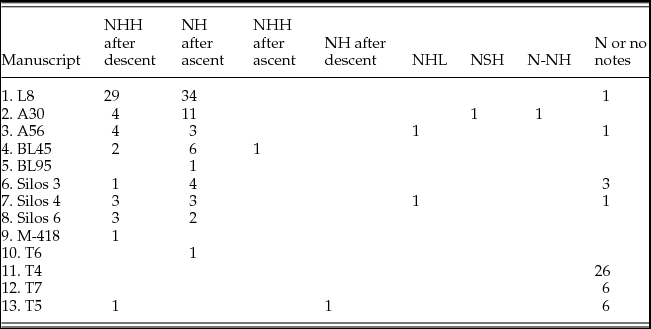
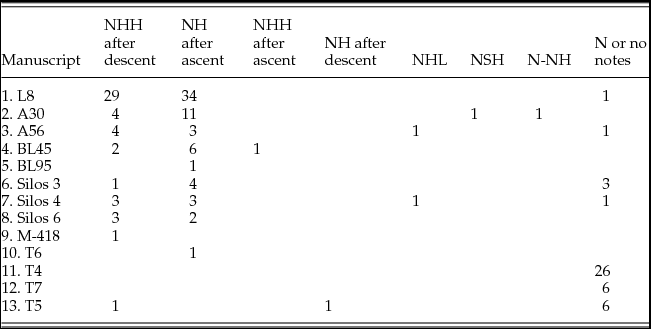
Table 1 summarises the melodic gestures on the penultimate syllable of final three-syllable cadences in each manuscript containing sacrificia. (See the online Appendix 2a for a full presentation of the data, listing each sacrificium.Footnote 24) Outside Lent, most sacrificia close with the word ‘alleluia’, which usually has a three-syllable cadence. In the tenth- and eleventh-century sources, ‘-luia’ is accommodated with either NHH or NH on the penultimate syllable, followed by a single note on the final syllable. The antepenultimate syllable often has a melisma that ends with a standard pre-cadential figure: the same melisma or melisma ending is often shared by more than one sacrificium, as illustrated in Figure 1.
Number of times each neume occurs on the penultimate syllable of final three-syllable cadences in sacrificia.
Common endings of final cadential melismas in sacrificia in L8.

In final three-syllable cadences, the choice of neume on the penultimate syllable is strongly correlated with the contour of the preceding melisma: the penultimate syllable has NHH if the melisma on the antepenultimate syllable ends with a downward gesture; it has NH if the melisma ends with an upward gesture, as shown in Figure 2. In L8, the earliest source for the sacrificia, this ‘contour rule’ is followed in all final cadences that use NH or NHH, and there is only one exception among the other tenth- and eleventh-century sources (see Table 1, rows 1–9).
‘Contour rule’ in final sacrificia cadences of L8.
The ninth- to eleventh-century sources from the ‘Rioja’ tradition (Table 1, rows 2–9), preserving smaller parts of the repertory, show a less marked preference for the same final cadences: a gesture other than NH or NHH is used nine times. The twelfth- to fourteenth-century sources (Table 1, rows 11–13) show a entirely different preference: nearly all have a single note (or no note) on the penultimate syllable of the final three-syllable cadences, in both traditions A and B.Footnote 25 While the late date of these sources makes it impossible to determine whether this preference is geographical or chronological, this version of the final cadence was acceptable, albeit rare, in the tenth and eleventh centuries: it is found among the sacrificia once in L8 and three times in Silos 3.Footnote 26
Internal cadences
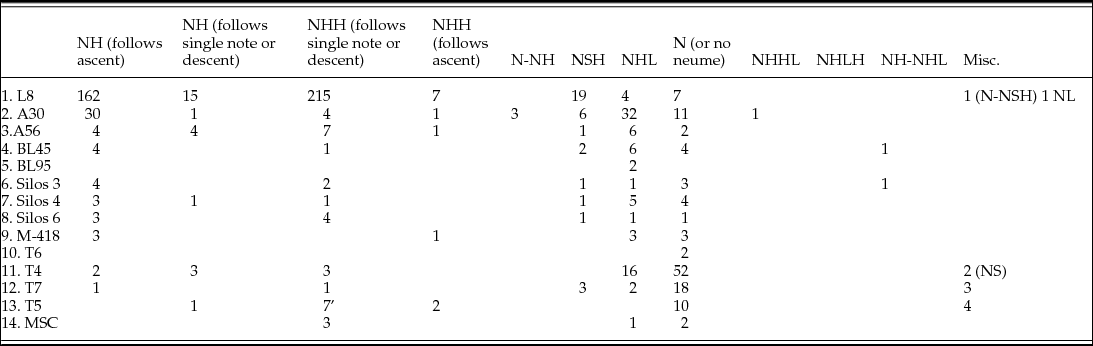
Similar tendencies are in evidence at internal three-syllable sacrificia cadences. Here, however, we find a much wider range of possibilities for accommodating the penultimate syllable, with clear regional tendencies (see Table 2). A complete presentation of the data appears online in Appendix 2b.Footnote 27
Number of times each neume occurs on the penultimate syllable of internal three-syllable cadences in sacrificia.
In L8, the scribes tend to treat internal three-syllable cadences like the final ones: the penultimate syllable has NH or NHH 93 per cent of the time (399/430). With a few exceptions, moreover, the L8 scribes follow the same contour rule that applies at final cadences: NHH follows a descent or single note (215/222 times), whereas NH follows an ascent (162/177 times; see Table 2, row 1, columns 2–5). Although the sources in Randel's ‘Rioja’ grouping (Table 2, rows 2–9) are very similar to L8 in their treatment of final cadences (as noted previously), they differ from L8, to varying degrees, in their treatment of internal cadences. Following an ascending contour, they tend to use NH, just as L8 does. After a descent or single note, however, some of these sources trend strongly towards NHL or N, in contrast to L8’s NHH. This trend is especially evident in A30 (row 2). Though its sampling is small, BL45 (row 4) also shows a strong preference for NHL in the sacrificia it preserves. Two manuscripts in this group mix traits associated with both traditions: in descending or single-note contexts, A56 (row 3) uses NHH slightly more often than NHL; and Silos 6 (row 8) shows a preference for NHH (four times) rather than NHL or N (once each). As Randel showed, correspondence to the León tradition is evident in the responsory verse tones of Silos 6 as well, especially those written by one particular scribe.Footnote 28 The treatment of three-syllable cadences in Silos 6 is further evidence for this connection and distinguishes Silos 6 from ‘Rioja’ manuscripts: in 4/6 descending or single-note contexts, Silos 6 has NHH.
As at final three-syllable cadences, the twelfth- to fourteenth-century sources representing liturgical tradition A (Table 2, rows 11–12) show a strong preference for a single note on the penultimate syllable of internal three-syllable cadences. T4 and T7 have a single note in the majority of their cadences of this type (52/78 in T4; 18/28 in T7). The single note on the penultimate syllable, however, is not limited to the twelfth- to fourteenth-century manuscripts. It is preferred in the handful of sacrificia contained in T6, and it is also present in other sources, albeit far less frequently. In A30, for example, a single note occurs in 11/89 cadences of this type, 4/18 in BL45, and 4/15 in Silos 4. In 16/78 cases, T4 employs the NHL figure associated with the ‘Rioja’ manuscripts (particularly A30), whereas it uses León's preference, NHH, only three times. This pattern suggests that the Toledo A versions are more closely connected to the ‘Rioja’ ones than to L8.
As was the case for the responsory tones, the two sources preserving ‘Toledo B’ differ melodically from the contemporaneous sources representing ‘Toledo A’. In contrast to the very strong preference for the single note in Toledo A manuscripts, T5 uses a single note less than half the time (10/24). In ten other cases, it has NH or NHH, which is the preference of L8 (though T5 only follows the ‘contour rule’ outlined above 7/10 times).
Although all the sources draw on a shared melodic vocabulary, the correlation of particular choices for the penultimate syllable with the preceding melodic material is stronger in some traditions than in others. As we have seen, NHH in both L8 and the ‘Rioja’ manuscripts is almost always preceded by a single note or descent. In the ‘Rioja’ sources (Table 2, rows 2–9), the single note also usually follows a single note or descent.Footnote 29 In the seven cases where L8 has a single note, however, it is not preceded by a particular melodic contour. Furthermore, the twelfth- to fourteenth-century sources use the single note frequently in all melodic contexts. In the ‘Rioja’ sources, NHL is also bound with a particular melodic context: without exception, it follows a single note or descent in A30, A56, Silos 3, Silos 4, Silos 6 and M-418. NHL also consistently follows a single note or descending contour in T4 and T7. In contrast to these sources, NHL is not bound to a particular melodic context in L8; it occurs only four times, two of which follow an ascent. The manuscripts thus differ not only in their preferences for particular shapes, but also in the contexts in which the shapes tend to be used.
Accent and proparoxytone adaptation in three-syllable sacrificium cadences
Perhaps the best example of this variation in the ‘cadential grammar’ of the sacrificia is the way that each manuscript responds to accent pattern at the end of a clause. In L8 and the ‘Rioja’ manuscripts, the choice of melodic figure on the penultimate syllable correlates with accent: NH is strongly associated with paroxytones, whereas NHH (L8) or NHL (‘Rioja’) is associated either with paroxytones or proparoxytones.Footnote 30 In all manuscripts, however, the material that precedes the penultimate syllable often takes an alternative form when the final word of the clause is a proparoxytone. In the sacrificia, the sources show different tendencies in how they adapt to the changing accent pattern. In L8, the pre-cadential material that would normally fall on the antepenultimate syllable sometimes falls instead on the fourth syllable from the end, as in Figure 3. A single note is placed on the accented antepenultimate syllable, resulting in a four-syllable cadence. In L8’s sacrificia, however, this type of proparoxytone adaptation occurs only when the pre-cadential element ends with an upward gesture.Footnote 31 When the pre-cadential material ends with a downward gesture, there are two options. In some phrases, there is no proparoxytone adaptation: this form of the cadence is identical each time, regardless of accent, as shown in Figure 4.
Proparoxytone four-syllable adaptation of three-syllable cadences in L8.
Stans sacerdos, internal cadences, L8 f. 39v.
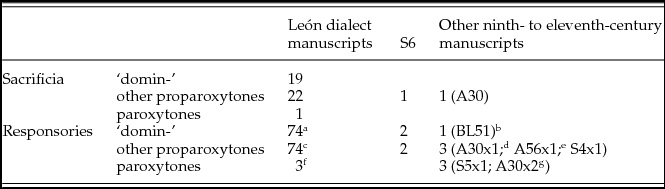
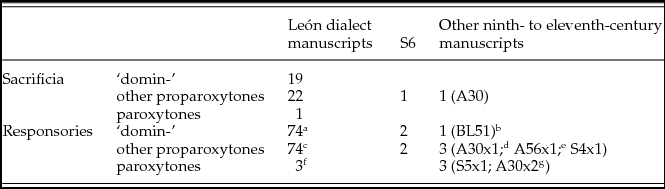
In other cases, however, L8 uses an alternative cadence that is strongly associated with proparoxytones: NH+NL+N(H) (see Fig. 5). This cadence occurs forty-two times in L8’s sacrificia. All but one of these occur on a proparoxytone, and nearly half (nineteen) fall on the word ‘domin-’ (see Table 3). These cadences are typically preceded by a downward gesture on the fourth syllable from the end.
NH+NL+N(H) cadences in L8.
Frequency of use of the NH+NL+N(H) cadence.
Notes:
a Two of these end NSH.
b Ends NSH.
c Two of these end NSH.
d Ends NSH.
e This chant has heightened Aquitanian neumes. This cadence moves by step, with the direction NH+HL+S.
f Two of these end NSH; both are in L8.
g One of the cadences in A30 ends NSH.
This special cadence NH+NL+N(H) underlines the peculiarity of L8’s dialect: among the sacrificia, it is found in only one other manuscript in the sampling, S6, reinforcing the impression of a connection between these sources.Footnote 32 In their corresponding versions of these melodies, the other sources from the ‘Rioja’ tradition use the first type of proparoxytone adaptation, a four-syllable cadence with a single note on the antepenultimate syllable, as in Figure 6.Footnote 33 The ‘Rioja’ sources use this cadence following either an ascent or a descent, with NHL on the penultimate syllable (their preferred choice following a single note, as mentioned above). The prevalence of the NH+NL+N(H) cadence in the León dialect and its association with proparoxytones is strengthened by a survey of its occurrence in the responsories of L8 (see Table 3), where it occurs 148 times on proparoxytones, half on the word ‘domin-’, and just three times on paroxytones. In the responsories, it is found four times in Silos 6 and just seven in all other ‘Rioja’ manuscripts.
Proparoxytone adaptation in A30.
A vestige of the ‘Rioja’ proparoxytone adaptation (but not NH+NL+N(H), as found in L8) is discernable in the twelfth- and thirteenth-century Toledo A manuscripts. As noted above, T4 has sixteen cadences where NHL is used on the penultimate syllable. This material has an association with proparoxytones (12/16 times). In eight of these cases, the proparoxtone has exactly the same form of the cadence that we find in A30: the last three syllables have the pattern N+NHL+N (see Fig. 7).Footnote 34 The use of NHL in this context ties T4 especially to the melodic dialect found in A30, where the cadential preference for NHL following a single note is very strong. T7, preserving a far more limited repertory, has this pattern once.Footnote 35
Internal cadence in Omnis populus, T4 f. 21v.
Sant and Sal as witnesses to the León tradition
In his work on the responsory tones, Randel established that Sant and Sal belong to the León melodic tradition. Because Sant and Sal lack sacrificia, it was not possible to incorporate them into the data set considered above. Examination of the three-syllable cadences in these manuscripts, however, reveals that they indeed preserve the same dialect as L8 in their treatment of these cadences (see online Appendix 3a for a full presentation of the dataFootnote 36). In the sacrificia of L8, NH or NHH occurs on the penultimate syllable 93 per cent of the time. Among the office chants found in Sant and/or Sal, this preference is even stronger. These chants have fifty-three cadences of this type, and all except three have NH or NHH on the penultimate syllable (N, NL and NSH occur once each).
The ‘Rioja’ source BL51 has many of the same chants as Sant and Sal, with forty-one of the same cadence points. Not surprisingly, this manuscript has a greater variety of shapes on the penultimate syllable. In all three manuscripts, NH is the preferred shape following an ascending gesture. In all contexts where Sant and/or Sal has NH, BL51 does as well, consistent with the patterns found in the sacrificia between L8 and the ‘Rioja’ manuscripts. Variants occur in cadences where Sant and Sal have NHH. In these manuscripts, as in L8’s sacrificia, NHH nearly always follows a descending gesture or single note. (The exceptions, primarily in the clamores genre, are shown in boldface in online Appendix 3a.Footnote 37) At cadences following a descent or a single note, BL51 has NHH seven times, NHL seven times, and N five times. This variety is reminiscent of that found in the sacrificium cadences of Silos 6, A30, and M-418. Only five of the Sant/Sal three-syllable cadences are also preserved in L8; the three manuscripts share the same reading in each case. An important difference between L8's sacrificia and the repertory preserved in Sant/Sal, however, is in the gesture that precedes NH. In L8’s sacrificia, we showed that NH is almost always preceded by an ascending gesture, and this is true in the responsories preserved in Sant and Sal. In the clamores and antiphons, however, NH is often preceded by a descending gesture, which suggests that some of these conventions are genre specific.Footnote 38
Sant, Sal and L8 also share the special cadence that is strongly associated with proparoxytones in L8, NH+NL+N(H) (see Fig. 5). In the sacrificia, this cadence occurs forty-two times in L8 and only once in another manuscript (Silos 6). In Sant and/or Sal, this cadence occurs eight times, five of which have parallel passages in BL51 (See online Appendix 3b.Footnote 39) In one of these five instances, BL51 has NH+NL+N(H); in three others, however, it uses the proparoxytone adaptation that is more typical of the ‘Rioja’ tradition: the normal three-syllable cadence is expanded to four syllables, with a single note on the accented antepenultimate syllable.Footnote 40 NH+NL+N(H) is also found in the single cognate preserved in Silos 6 and Silos 3. Thus, NH+NL+N(H) was known outside the León melodic tradition, but was used much less frequently. On the whole, the three-syllable cadences confirm Randel's evidence that the eleventh-century Sant and Sal are part of the same melodic dialect as L8.
Summary
In the set of cadences we have examined, the existence of melodic dialects is evident both in the selection of melodic material and in how these choices correlate with melodic context and accent. To some degree, these findings are congruent with Randel's. L8’s distinctiveness is attested both by its consistent preference for NHH and by its use of NH+NL+N(H), traits shared outside the sacrificia by Sant and Sal. The sources in the ‘Rioja’ group, however, do not present a unified picture: A30’s cadential dialect is distinct from L8’s, whereas Silos 6 and A56 show elements of both melodic dialects. Randel defined Silos 6 as a hybrid source in its responsory verse tones: earlier scribes conform to the León tradition, whereas the third scribe sought to bring it in line with the ‘Rioja’ tradition.Footnote 41 In three- and four-syllable cadences in the sacrificia, Silos 6 concords with León in its inclination towards NHH and its use, once, of NH+NL+N(H). The cadential evidence in the sacrificia also bears out the presence of two melodic traditions in Toledo. The tradition B manuscripts have a stronger preference for NHH or NH, like the León tradition. The Toledo A sources, by contrast, connect more often to the ‘Rioja’ manuscripts, particularly A30, in their use of the pattern N+NHL+N in proparoxytone contexts. This type of proparoxytone adaptation is not found in Toledo B.
Part 2: openings
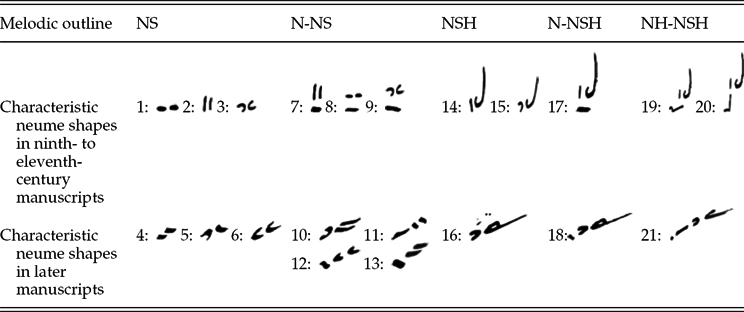
In the following discussion, a series of five distinctive unison shapes that occur at chant openings is examined. The data set comprises over 700 Old Hispanic chants in which one or more versions begin with one of these shapes (see Table 4), usually on the first or second syllable of the chant.Footnote 42 This large data set reveals further patterns in melodic sub-traditions of the Old Hispanic repertory. (A full summary of the data may be found in online Appendix 4.Footnote 43)
Neume shapes involving unisons, used at chant openings.
Interpretation of the neumes in Table 4, nos. 1 and 2 as unisons is unproblematic in the scholarship.Footnote 44 The later manuscripts present these unison pairs in a slope or directly above each other (Table 4, nos. 4 and 6); the absence of a virga above (in which case one would interpret the set of notes as a rising figure), and their routine appearance at points where cognate manuscripts have a unison supports their interpretation also as unisons. The rounded neume (Table 4, nos. 3 and 5), used in both earlier and later manuscripts, is also a unison in this context.Footnote 45 In Table 4, nos. 7–9 and 17 have a unison pair appearing above a horizontal line in the ninth- to eleventh-century manuscripts, and (nos. 10–13 and 18) above a virga, gravis, or stropha in the later manuscripts. Zapke interprets this horizontal line as signalling a lengthening of the unison rather than indicating a note itself.Footnote 46 Its routine presence in the later manuscripts, however, suggests strongly that it was a neume rather than a performance nuance: the notation in those later manuscripts is insufficiently subtle to indicate such nuances; and the virga and stropha that often precede the unison in those manuscripts are graphically distinct from the horizontal lines of the earlier manuscripts.
Groups of manuscripts show strong tendencies to choose particular melodic shapes in each of the five opening contexts scrutinised here, across the repertory. Each unison opening has specific patterns of distribution and variance, and a limited set of melodic gestures occurs as alternatives in other manuscripts. These alternatives often vary by a single note (e.g., NH in some manuscripts and NSH in others). Taken in isolation, such variants can easily be dismissed as ‘insignificant’ within a generally compatible melodic outline. When many of them are considered in combination, however, they emerge as important points of melodic distinction between the different Old Hispanic melodic dialects. Furthermore, the size of the data set allows us to assert with confidence that some of the unison opening shapes are associated primarily with accented or with unaccented syllables in some manuscripts. This, together with the different patterns of variation surrounding each of the opening unison shapes, confirms that melodic gestures whose graphic differentiation has previously been minimised as a rhythmic variation (such as Table 4, nos. 1 and 8, or nos. 14 and 17) had significantly different connotations in Old Hispanic chant. In the remainder of this section, we introduce the five unison shapes and outline the patterns of variants in their use.
Set (1): chants that have NS as the unison shape at the opening
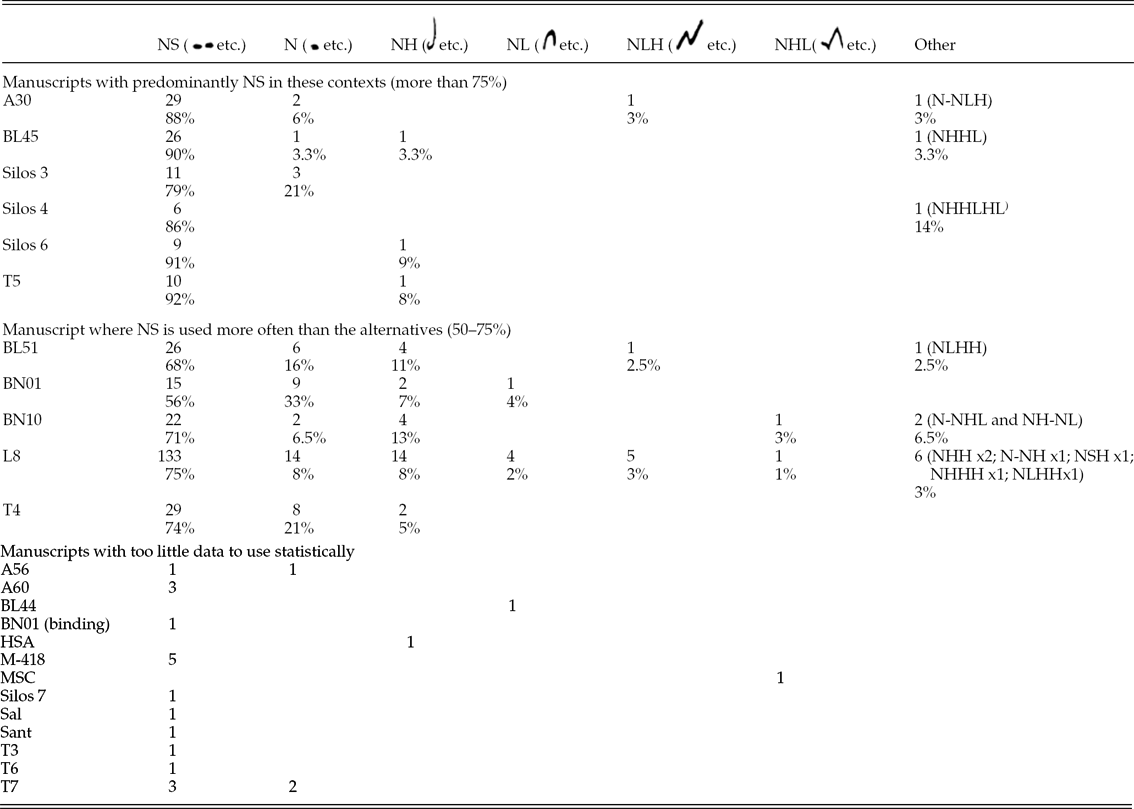
Chants are assigned to set 1 based on two criteria. First, these chants have the shape NS at the opening in at least one manuscript. Second, alternative readings in other manuscripts never have a unison shape; instead, they have other shapes such as N or NH, or, in rare cases, NL, NLH, or NHL. One group of manuscripts predominantly uses NS rather than one of the non-unison variants (see Table 5); these are all from the ‘Rioja’ group, apart from the tradition B manuscript, T5, which strongly shares the same tendency. The other later manuscripts (BN01, T4 and BN10) have NS rather less frequently in these contexts, as do BL51 and L8.
Number of occurrences of each variant type in set 1 (chants where the unison shape is NS).
Most of the cases where the tradition B manuscript BN10 has NS are unica. The chants with NS openings in tradition A manuscripts almost never have NS in BN10’s cognate version. The variants in BN10, however, are drawn from the same set of options as in other manuscripts, confirming the presence of an underlying common melodic language. In this set of chants, T5 shares the NS preference of the other manuscripts much more often than BN10 does.
In the discussion so far, the different neume shapes associated with unison openings have been treated as interchangeable. Looking more closely, the late Toledo manuscripts associated with Santa Eulalia (BN01, T4 and T7) use rounded shapes (Table 4, nos. 5 and 6) in preference to the straight shape (Table 4, no. 4);Footnote 47 the tradition B manuscripts (BN10 and T5) strongly prefer the straight shape (Table 4, no. 4).Footnote 48 The shapes indicating NS in the twelfth- to fourteenth-century manuscripts are used on accents at openings 72 per cent of the time (92/128 instances). In the ninth- to eleventh-century manuscripts, the rounded shape (Table 4, no. 3) is used only 24 per cent of the time on an accented syllable (8/34 instances). The straight shapes (Table 4, nos. 1 and 2) are used on accents 61 per cent of the time (146/241 instances). By the time the twelfth- to fourteenth-century manuscripts were copied, the choice between the rounded and straight NS had become a matter of scribal preference rather than having a different accent sensitivity.
Set (2): chants that have N-NS as the unison shape at the opening
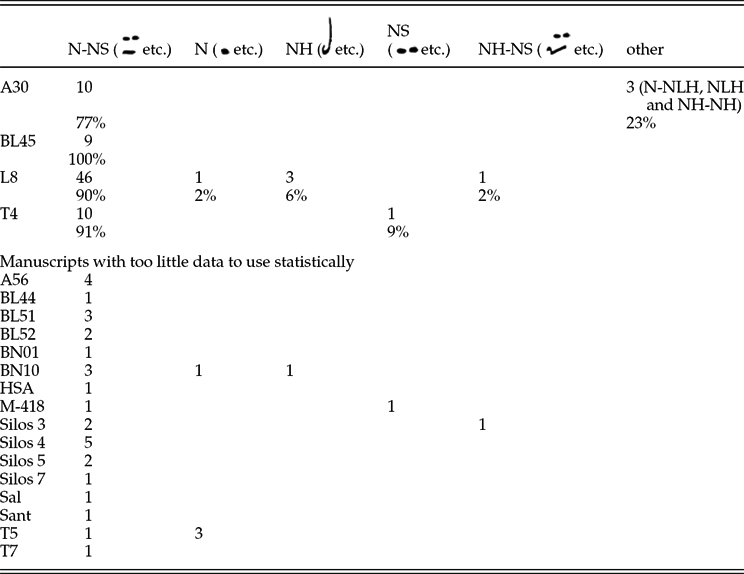
In the second set of chants to be considered here, N-NS appears at the opening in at least one manuscript. The only two shapes involving a unison that appear as variants in this set are NS (twice) and NH-NS (twice) (see Table 6). The almost complete lack of interchangeability between N-NS and NS as variant openings of the same chants confirms that they were understood as fundamentally distinct. N-NS is somewhat accent sensitive: it is used on an accented syllable 64 per cent of the time (94/148 instances).
Number of occurrences of each variant type in set 2 (chants where the unison shape is predominantly N-NS).
Set (3): chants that have NSH as the unison shape at the opening, with some manuscripts routinely using NS instead
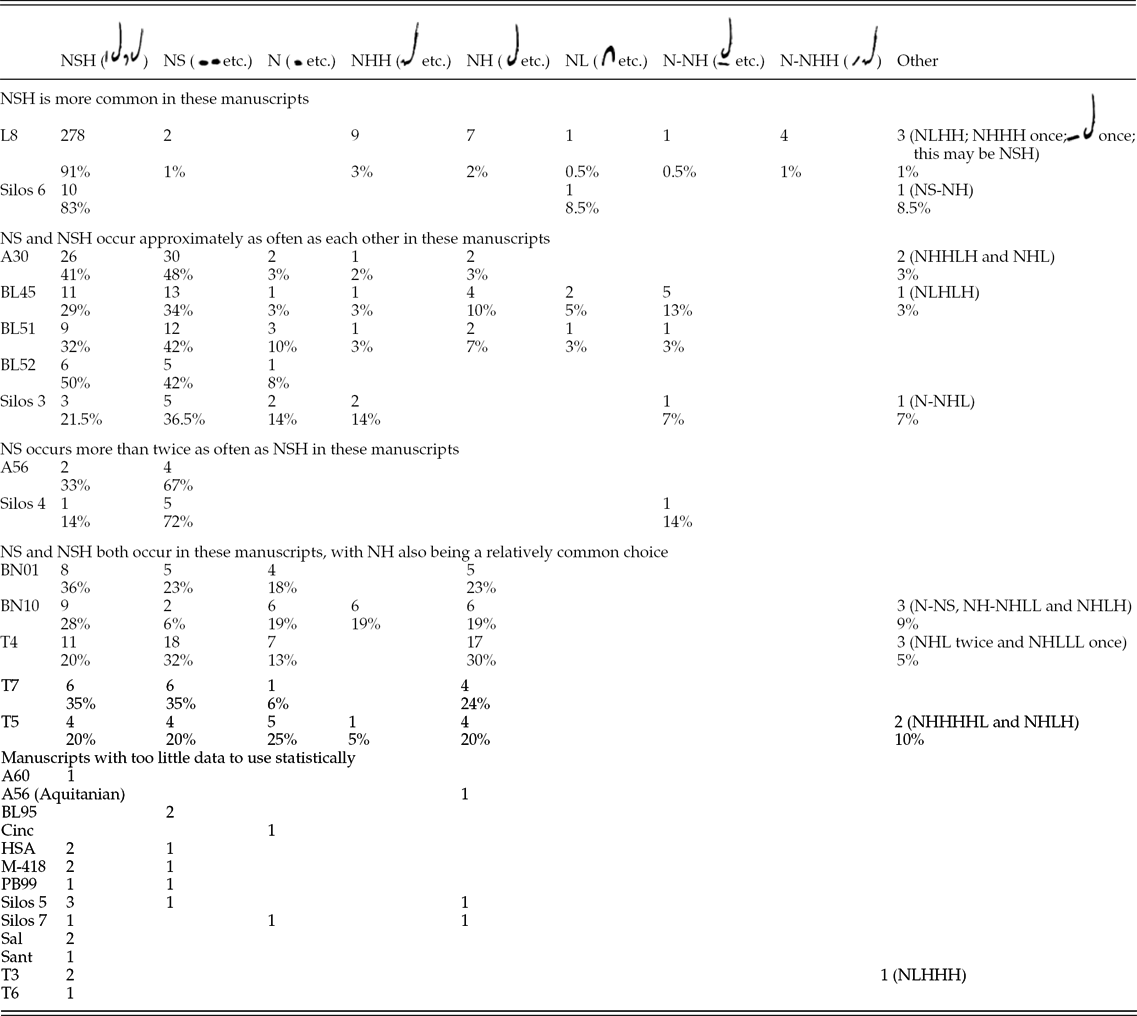
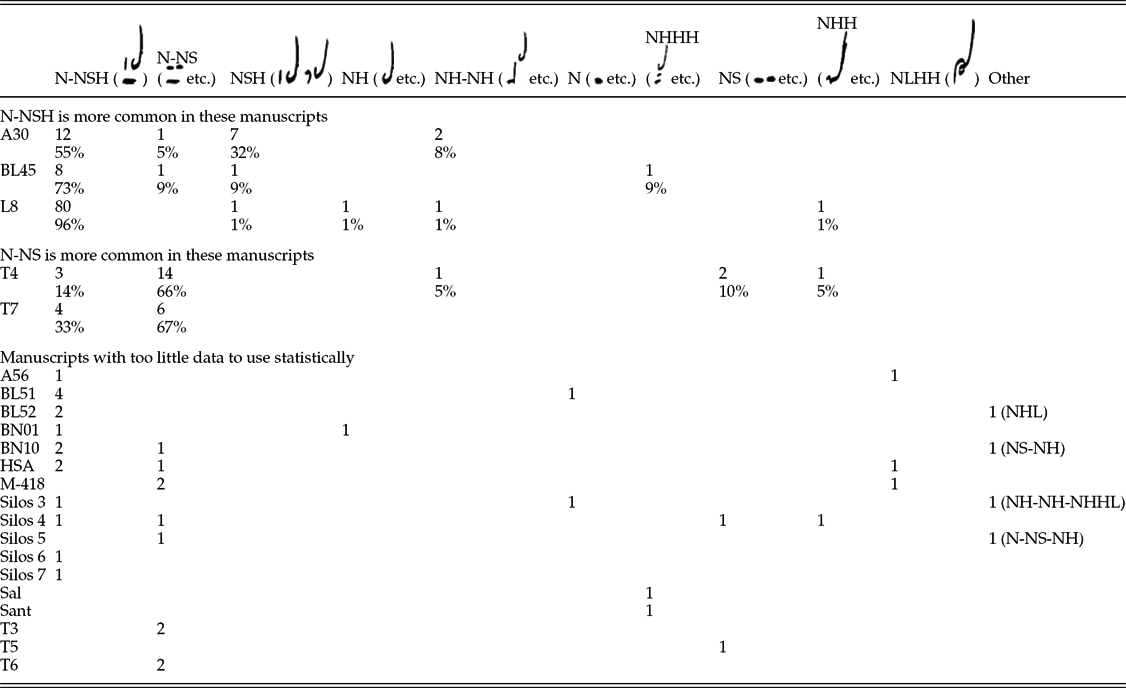
Set 3 consists of chants that have NSH as the unison shape at the opening, with some manuscripts routinely using NS instead. Gonzalez Barrionuevo interprets Table 4, no. 14 as indicating sometimes NSH and sometimes NHH, based on study of London, British Library, Add. 30850, a Franco-Roman manuscript using Visigothic neumes.Footnote 49 Within the Old Hispanic repertory, it is not possible to differentiate between melodies using this shape as NSH and melodies using it as NHH, but the interchangeability of NSH and NS in this third set of chant openings supports a unison interpretation in these cases. Gonzalez Barrionuevo interprets the rounded neume in Table 4, no. 15 as (unproblematically) meaning NSH. Openings that involve NSH in at least one manuscript are very common in the Old Hispanic liturgy, with over 270 examples in L8 alone (see Table 7). In this set of chants, the manuscripts are divided into three groups: L8 and Silos 6 show a preference for NSH in these contexts; the other ninth- to eleventh-century manuscripts are equally likely to have NSH or NS (with NS being much more likely in A56 and Silos 4); and in the later manuscripts, these openings divide fairly evenly between NSH, NS, NH and N, with NHH also being relatively common in BN10.
Number of occurrences of each variant type in set 3 (chants where the unison shape is NSH in at least one manuscript, with NS as a frequent variant).
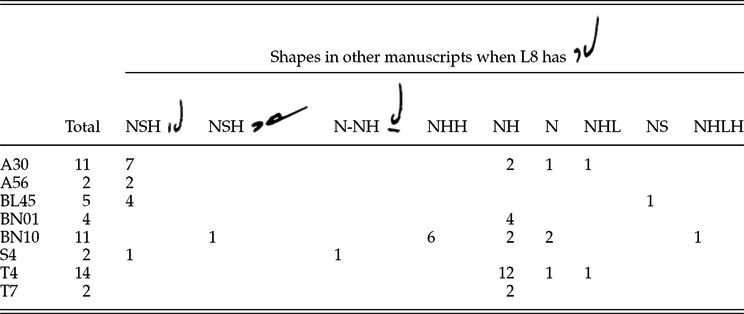
The notational form of NSH also varies. Some manuscripts have only the rounded shape (Table 4, nos. 15 and 16); others only have the straight shape (Table 4, no. 14). Some manuscripts, including L8, use both forms and differentiate between them. The patterns of distribution suggest that these different forms had different melodic functions. When L8 uses rounded NSH, there are clear trends in the choices found in other manuscripts. Three manuscripts sometimes share the rounded preference with L8: Silos 3;Footnote 50 Silos 5;Footnote 51 and especially Silos 6.Footnote 52 When L8 has straight NSH, A30, A56, BL45 and Silos 4 are equally likely to have either NS or the same straight NSH. However, when L8 has rounded NSH, they have straight NSH in the majority of cases (see Table 8). There is a shared understanding in these manuscripts that straight NSH is a suitable notation in the melodic context(s) that the L8 scribes considered best represented by rounded NSH. As may be seen in Table 8, BN01, T4 and T7 usually have NH when L8 has rounded NSH, and BN10 tends to have NHH. The melodic contexts represented by the two NSH shapes were treated as melodically distinct in each of these Old Hispanic manuscripts, with different melodic tendencies in different manuscripts.
Shapes in other manuscripts when L8 has the curved NSH.
The twelfth- to fourteenth-century manuscripts use only the rounded NSH. It appears on an accent at a chant opening 62 per cent of the time (23/37 instances). In the ninth- to eleventh-century manuscripts, however, rounded NSH is used with an accent at a chant opening 90 per cent of the time (81/90 instances), while straight NSH is used on an accent at a chant opening only 55 per cent of the time (155/280 instances). Thus rounded NSH is strongly accent sensitive at chant openings in the ninth- to eleventh-century manuscripts and less strongly so in the later manuscripts, and straight NSH does not appear to be accent sensitive.
Set (4): chants that have N-NSH as the unison shape at the opening, with some manuscripts routinely using N-NS instead
The fourth set of chants considered here comprises those where one or more manuscripts have N-NSH as the unison at the opening, and where some manuscripts routinely use N-NS instead (see Table 9). NS appears as a variant a very few times (four chants in three manuscripts across the sample). NSH is a rare variant in this set of chants except in A30, where it is used in a third of the chants of this type. This manuscript diverges from the usual melodic outlines found in this set of chants.
Number of occurrences of each variant type in set 4 (chants where the unison shape is N-NSH in some manuscripts, with N-NS as a frequent variant)
BL45 and L8 tend to have N-NSH in this set of chants. This shared preference is in contrast to the third set of chants, where BL45 is more likely to have NS and L8 to have NSH. T4 and T7 have a preference for N-NS in this set of chants. This is a direct parallel to the preference in the third set of chants for NS in both T4 and T7 when other manuscripts have straight NSH (that is, the final H tends not to be present in these manuscripts in either set of chants).
At chant openings, this neume shape coincides with an accent 87 per cent of the time (118/136 instances). This is in striking contrast to straight NSH (and rounded NSH in the twelfth- to fourteenth-century manuscripts), which do not have an association with accented syllables in this way, and it suggests that there is a significant distinction in meaning between straight NSH and the similar shape with a horizontal line underneath it (Table 4, no. 17).
Set (5): chants which have NH-NSH as the unison shape at the opening
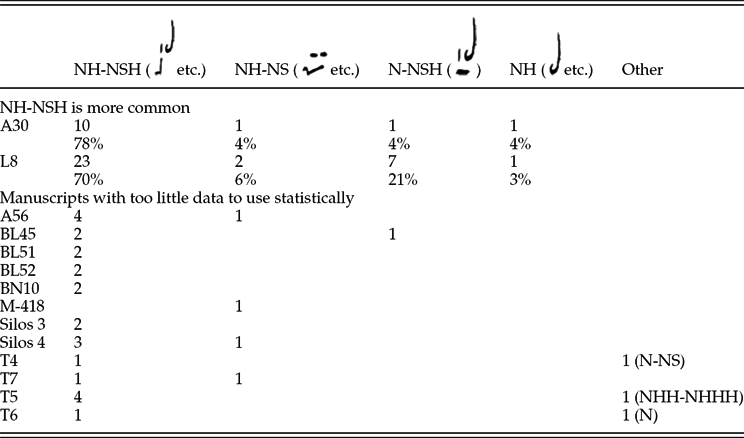
The fifth set includes all chants that begin with NH-NSH in at least one manuscript (see Table 10). In this set of chants, NH-NSH is the most common shape in most manuscripts, with NH-NS and N-NSH being the most common variants.Footnote 53 As with the N-NSH shape, NH-NSH is strongly associated with accents at the openings of chants. It appears with an accent 87 per cent of the time (48/55 instances).
Number of occurrences of each variant type in set 5 (chants where at least one manuscript opens NH-NSH).
Summary
As this discussion has illustrated, the five unison openings were understood as distinct from each other in the majority of cases, with two exceptions. NS and NSH are somewhat interchangeable, but only in the set 3 melodic context, where NS appears 10 per cent of the time (56/542 instances), and NSH appears 74 per cent of the time (399/542 instances). Similarly, N-NS and N-NSH are somewhat interchangeable in the set 4 melodic context. Here, N-NSH appears 65 per cent of the time (123/189 instances) and N-NS appears 17 per cent of the time (32/189 instances). Of these thirty-two instances, twenty-five are in twelfth- to fourteenth-century manuscripts, suggesting a chronological or perhaps geographical shift in the understanding of this melodic gesture. Otherwise, two different unison shapes appear as alternative readings in the same chant only thirty-eight times across the whole sample of 1,380 instances (3%). This figure is heavily influenced by just a few manuscripts: seven of the nine instances where NSH appears as a variant for N-NSH in set 4 are in A30; seven of the nine instances where N-NSH appears as a variant for NH-NSH in set 5 are in L8. This does suggest that, by and large, the unison openings were perceived as melodically distinct, with identifiable idiosyncracies in that understanding in particular manuscripts (A30 and L8), a particular group of manuscripts (NS/NSH in ‘Rioja’), or a chronological context (N-NSH/N-NS in the twelfth- to fourteenth-century manuscripts). In general, however, the unison openings were not regularly exchanged across the five sets of chants, as would be expected in the case of ‘trivial’ variants.
BN01, T4 and T7, used at (and maybe also written for) the parish of Santa Eulalia, Toledo, have a shared preference in set 1 (both notationally and melodically), set 3 (in their preference for NH over the rounded NSH) and set 4. This coincides with Randel's Toledo A dialect (although T3 and Cinc have too little data to confirm their alignment). The Toledo B manuscripts generally share the Toledo A dialect within set 3. Toledo A and B, however, are distinct in their notational choices for the NS openings. In the cadence evidence considered above, T5 connected more closely to the León tradition than to the Rioja; in some of the opening material it is the other way around. In general, though, BN10 is more distinct from the other manuscripts than T5 is.
In the openings, the León dialect cannot be confirmed beyond L8, because Sant and Sal lack sufficient data. L8 is distinct from the ‘Rioja’ manuscripts in set 1 (with BL51). In set 3, it shares its preferences with Silos 6; this kinship was seen both in the responsory tones examined by Randel and in the cadences explored above. A56 and S4 are distinct from other ‘Rioja’ manuscripts in set 3; and A30 is distinct in set 4.
These findings are usefully nuanced by a consideration of the chants that are common to pairs of manuscripts. We have calculated the number of unison openings having identical readings in a pair of manuscripts, drawing conclusions only from manuscript pairs with six or more points of comparison. The Toledo B manuscripts (BN10 and T5) share the same reading 83 per cent of the time, but rarely share the same melodic outlines with any other manuscripts at unison openings; they are distinct from other sub-traditions here as in the cadences explored above. The Toledo A manuscripts (BN01, T4 and T7) share the same reading as an earlier manuscript less than half the time, with one exception: T4 shares 56 per cent of its readings (6/9) with Silos 3; none of the Toledo A manuscripts have enough chants in common to support a direct comparison of the openings, but their sharing of the same melodic dialect was established earlier. Within the León tradition, Sant and Sal have a very close relationship: they always share the same reading in cognate unison-opening chants. L8 has no chants with unison openings in common with Sant and Sal, so this data set cannot be used to confirm the level of relationship established in the responsory tones and in the cadences. L8 is most closely connected with Silos 6 (75% of unison openings share the same reading). This is consonant with Randel's finding, and with the cadence evidence presented above, that Silos 6 presents a ‘mixed’ tradition, with some connections with the León dialect as well as with the ‘Rioja’ manuscripts. Indeed, the connections between Silos 6 and the ‘Rioja’ manuscripts are not strikingly close in the openings. It shares the same openings more than 50 per cent of the time only with Silos 3, a small enough percentage to be possibly the result of coincidence; Silos 6 and Silos 3 are not closely connected in the cadence material discussed above.
The ‘Rioja’ manuscripts do share readings with L8, again confirming Randel's identification of the two traditions as being distinct but related; the relationship is relatively distant (there are never more than 53% of chants with the same unison opening in L8 and a ‘Rioja’ manuscript). Among the ‘Rioja’ manuscripts, however, most pairs of manuscripts have a very close coincidence of readings, suggesting a clearly defined melodic dialect. Pairs with more than 80 per cent of cognate openings sharing the same reading are: A30+BL51; A30+M-418; A30+Silos 3; and A56+Silos 4 (these last two are particularly close in set 3 of the openings as well). It is also possible to posit quite close connections between BL45+Silos 3 (73%), A30+BL45 (70%), BL51+ BL45 (67%), BL51+Silos 3 (64%) and HSA+Silos 5 (63%). Only Silos 3 and Silos 4 are less closely related, with only 57 per cent of shared unison-opening chants having the same reading. T4 connected with the ‘Rioja’ manuscripts in cadential vocabulary, but this is not in evidence among the direct cognates in the unison openings.
Conclusions
This examination of certain melodic contexts in the Old Hispanic chant has shown that different manuscripts draw on a shared menu of strategies in the unison openings and the three-syllable cadences, with particular preferences shared by groups of manuscripts. Our findings confirm and nuance the presence of Randel's four melodic dialects: there are overlapping strategies between different dialects, in complex networks of influence that would reward further investigation.
These findings confirm the importance of considering manuscript transmission from multiple perspectives. S3, S6 and S, for example, are tentatively attributed to the cathedral of Santa María la Real de Nájera by Ruiz Asencio.Footnote 54 While his palaeographical evidence will require close scrutiny on a future occasion, our melodic evidence casts doubt on the theory that S3 and S6 were copied in the same institution. The origin of T6 has also been debated. Because of its vertical notation, most have linked the manuscript to northern Iberia,Footnote 55 whereas Mundo thought that the text hand was from central Iberia, perhaps Toledo itself.Footnote 56 While the manuscript contains relatively few examples of the cadences and openings under consideration here, its cadential preference (for N on the penultimate syllable) aligns it with the Toledo A manuscripts, as does its preference for N-NS rather than N-NSH in the fourth set of openings. A fuller survey of T6’s melodic substance might permit confirmation of these findings, which tentatively support Mundo's palaeographical argument.
Our findings suggest that Zapke's three geopolitical regions (Toledo, León-Castile and Navarre) are not applicable to the Old Hispanic melodic dialects.Footnote 57 As noted above, ‘Toledo’ encompasses two distinct liturgical and melodic traditions, and our preliminary investigation also suggests a differentiated approach towards notational detail (different preferences around the rounded and straight unisons, for example). This observation requires further palaeographical study. León-Castile does not withstand closer scrutiny as a region encompassing a particular melodic dialect, either. L8, Sant and Sal share a close relationship, but (apart from Silos 6) other manuscripts from León-Castile and Navarre are differentiated from them in their melodic tendencies. In our data sets, S3, S6 and S7, which Zapke attributes on notational grounds to Navarre, are not clearly differentiated melodically from her Castile-León manuscripts. Indeed, it is not always clear whether a manuscript is from Castile or Navarre, given the difficulty of locating manuscripts’ origins and dates, and given the fluidity of the borders in the tenth and eleventh centuries. It has also not yet been established whether changes in affiliation to particular kingdoms or dynasties affected liturgical practice within the areas where Old Hispanic liturgy was in use.
Our findings demonstrate that we cannot build a full understanding of the Old Hispanic melodic language based on individual chants, because they circulate in so few manuscripts. A comprehensive picture of the melodic shapes that were acceptable choices in a particular melodic context can shed light on the ontology of the melodic language as a whole, beyond the versions we see in particular manuscripts. This language is one in which certain melodic details were consistent across traditions, whereas others were subject to choice from a set of options. Without knowing at what melodic points such optional choices were available and whether particular constraints governed the choices, we risk misinterpreting the meaning of the variants.
Finally, this study has methodological implications for plainsong research. Although the types of variants we have examined may appear ‘insignificant’ in the comparison of individual chants, seemingly minor melodic and notational differences emerge as significant markers of melodic dialects in the comparison of large data sets. Different versions of individual chants are thus most effectively studied in the context of a broader understanding of melodic dialects and their tendencies. Our method provides a powerful framework for understanding the functional equivalence of some gesturally differentiated melodic material within and between manuscripts.
Appendix: manuscript sigla, dating and provenanceFootnote 58