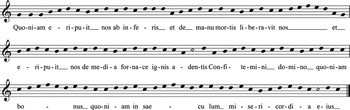
The purpose of this article is to establish the compositional principles of the Milanese cantus, and to consider how each of the chants expresses and (on occasion) transcends the generic norms.Footnote 1 ‘Cantus’ is a term used quite widely within the Milanese chant repertoire for both responsorial and in directum chants. The in directum cantus form a melodic family, with whose melodic norms and aesthetic I am concerned here.Footnote 2 The formulaic nature of these chants has long been recognised, with Terence Bailey observing that particular phrases appear first, second, third and last in each verse, and that some melodic patterns are consistently associated either with accented or unaccented syllables.Footnote 3 I use the phrase labels O (Opening the verse), M (leading to the Middle of the verse), S (beginning the Second half of the verse) and E (verse Ending) to express the genre's melodic grammar. The standard outline of a cantus verse is O–M–S–E, with cadences on G–F–G–G.
While Bailey's phrase analysis is a useful starting point, one may carry the inquiry further by considering possible motivations behind the use of certain phrase shapes. The present analysis draws on recent trends in exploring the rhetorical potential of chant melody, and the way in which the extant melodic state of a particular chant may have led liturgical participants on a particular devotional journey.
A fundamental difference between the present analysis and Bailey's is that he sees the chants as having been composed systematically and then, at a later stage, ‘normalized’,Footnote 4 a process in which previously individual phrases have become identical, or nearly so. Bailey judged some irregular phrases as being the result of ‘damage’ or ‘later retouching’. His criteria for differentiating between authentically individual and corrupted individual phrases, and between coherently formulaic and latterly normalised ones, are unclear. Further, Bailey saw the melodies as elaborations of an underlying psalm tone recitation, and omissions of elements of that recitation are seen as problems to be explained. As I have argued previously, the reduction of complex formulaic chants to an underlying psalmic model runs the risk of failing to engage with the chants in their preserved state, instead projecting beyond the written record to a supposedly very different melodic state that preceded it.Footnote 5 While trying to avoid breathless enthusiasm about medieval cantors possessing unparalleled memory skills, I prefer to assume that they competently and purposefully transmitted and notated the repertoire in its essence, as they saw it, rather than that the surviving manuscripts preserve a haphazard and decadent musical heritage.
I have used the twelfth-century Milanese antiphoner London, British Library, Add. 34209 (henceforth L) as the source of the examples here. This manuscript is readily available in a Paléographie Musicale facsimile.Footnote 6 Bailey's edition of four other manuscripts has been used as a control.Footnote 7 To use an edition rather than the manuscripts themselves is sufficient for my purposes, since the analysis is primarily concerned with formulaic structure rather than with the precise details of the melodic outline. Notation of B flat and B natural was often haphazard in the Middle Ages. Manuscript L has later markings of B flat; like Bailey, I have ignored these, but I have included in brackets the notated B flats and B naturals of manuscript MUh.Footnote 8 These are not exhaustive, nor in any way authoritative for the tradition as a whole, but they give a flavour of the contexts in which B flat and B natural are grammatically possible within the idiom. Liquescents are shown in the examples by use of empty note heads.
I begin by identifying the contexts within which each version of the four standard cantus phrases appears. Some phrase types are associated primarily with either Benedictus es or Cantemus. Some are associated with the single-verse cantus, with the two-verse cantus, or with the four three-verse cantus sung on Lenten Sundays. This makes possible a close reading of each chant in the second section of the article. Textual and rhetorical considerations make it possible in many cases to account for the use of non-standard phrases.
Phrase O (verse opening)
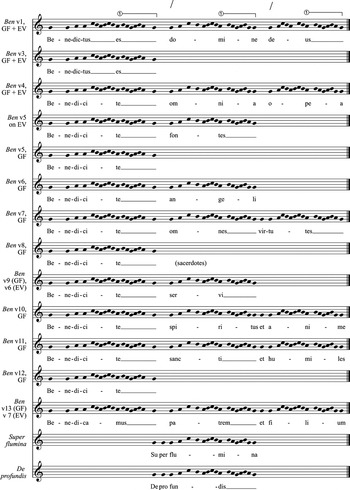
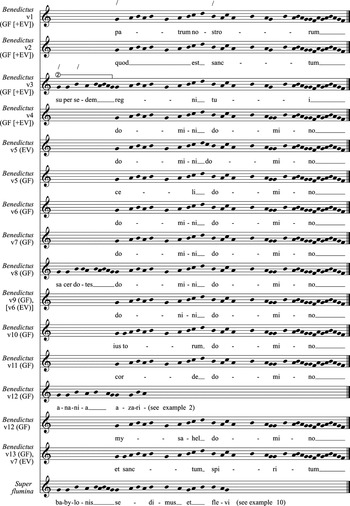
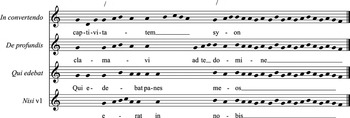
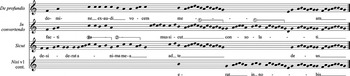
Phrase O1 is the label I have given to the various shapes associated primarily with the first verse of a cantus. The opening phrase of a cantus is the least tightly formulaic part of the genre. This is easy to rationalise: within an oral tradition, the openings of the chants are the most likely moments to be securely remembered as individual melodic shapes and later phrases are more likely to become more formulaic over time, in a process of progressive stereotyping.Footnote 9 Three shapes appear at the beginning of multiple cantus: O1a, O1b and O1c. Phrase O1a begins Super flumina, De profundis and Benedictus es (and, indeed, almost every other Benedictus es verse).Footnote 10 The phrase is usually repeated when there is sufficient text to need more than two phrases in the first verse half (see Ex. 1; for details about the text division, see the discussion of Benedictus es below). The phrase ends baG on its first appearance in a Benedictus es verse; apart from this, the phrase ends baG in paroxytonic phrases and bG+G in proparoxytonic phrases.
Phrase O1a.

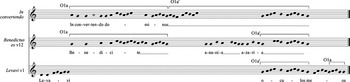
In convertendo’s opening is related to phrase O1a but, instead of cadencing G on ‘-nus’, there is an extensive cadential melisma (see Ex. 2). I have labelled this phrase O1a’. The cadential shape is also found in the Good Friday Benedictus es v12 in manuscripts Vh and L, after a complete phrase O1a.Footnote 11 The O1a’ shape is also used mid-phrase in Levavi verse 1.
Phrase O1a’.

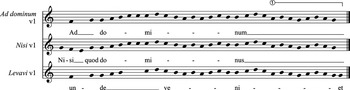
Phrase O1b is used three times. It shares the same cadence as phrase O1a (see 1 in Exx. 1 and 3).
Phrase O1b.

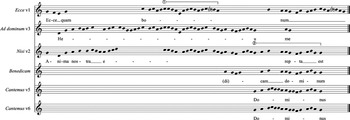
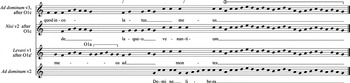
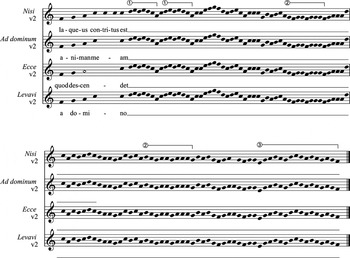
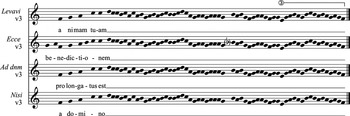
Phrase O1c is found in part in Ecce verse 1 (see 1 in Ex. 4), Benedicam, and Cantemus verses 5 and 6 (the last three sharing ‘domin-’ texts, on which, see below). The complete phrase is used in Nisi verse 2 and, without the cadential material, in Ad dominum verse 3.
Phrase O1c.Footnote 12

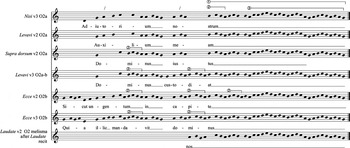
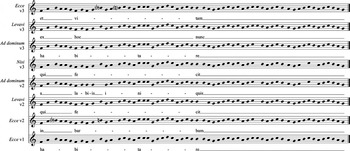
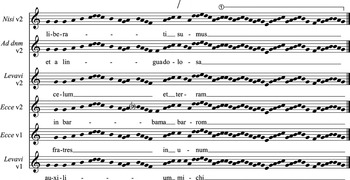
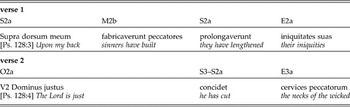
Phrase O2 is associated with second and third verses (see Ex. 5). Phrase O2a is associated with paroxytones, and phrase O2b with proparoxytones; as Example 5 shows, they are very closely related. Ecce verse 3 is close to being a straight re-texting of Ecce verse 2 rather than being accent sensitive. One would expect to encounter phrase O2b in the proparoxytonic Levavi verse 3. Instead, it opens with O2a shapes, as in Supra dorsum, which also starts ‘dominus’.
Phrases O2a and O2b.Footnote 13

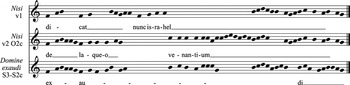
Phrase O2c is usually found after a verse-opening phrase, with a further phrase to follow in the verse half.Footnote 14 The phrase O2c melisma is the same as the closing portion of the O2a and O2b melisma (see 3 in Exx. 5 and 6). The first phrase of Ad dominum verse 2 uses the O2c melisma rather than the expected phrase O2b. The opening rise Gc on ‘Do-’ is the same as the opening of ‘Dominum’ in Supra dorsum verse 2 and Levavi verse 3 (see Ex. 5), but the melodic parallel does not continue through the rest of the phrase. Possibly, use of phrase O2c in Nisi verse 2 has prompted use of the same cadence at the opening of Ad dominum verse 2, sung the following week: these chants were sung (and notated) in close proximity.Footnote 15 In Levavi verse 1 the beginning of the O2c material is integrated into the previous phrase, with the O1a cadence interpolated on ‘meos’.
Phrase O2c.

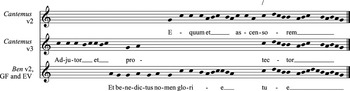
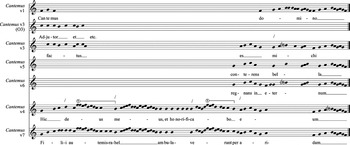
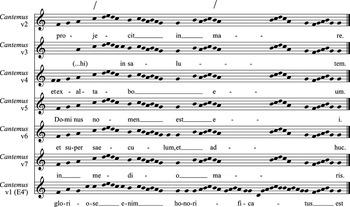
Phrase O3 is used in Benedictus es verse 2 and Cantemus verses 2 and 3 (see Ex. 7).Footnote 16 This phrase may be primarily associated with verse 2 of these very long chants, a function shared by the Franco-Roman second-mode tract phrase 1c.Footnote 17
Phrase O3.Footnote 18

Phrase O: tonality
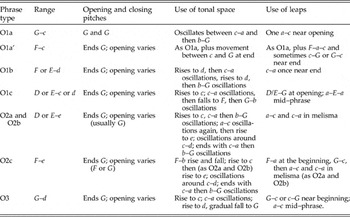
There are similarities between some of the shapes used at the beginnings of verses, although the later parts of the phrases are very different. For example, In convertendo and Benedictus es verse 2 both begin a G G a G (compare Exx. 2 and 3); and Nisi verse 1 and Ecce verse 1 begin G FE G (compare Exx. 3 and 4). Each version of phrase O has distinctive range, tonal space and use of tonal space (see Table 1). Each phrase type has different leaps (notable for their rarity). In phrases M, S and E, the different versions of each phrase similarly have different trajectories and different points of emphasis. They are not simply rearrangements of functionally equivalent patterns. Space does not permit a detailed treatment here.
Summary characteristics of phrase O

Phrase M (for Middle)
I have identified four versions of phrase M. Phrases M1 and M4 are primarily associated with Benedictus es and Cantemus, respectively. Phrase M3 is used for the second and third verses of the multi-verse cantus, and phrase M2 for the first verses of these chants as well as for the single verse cantus.
Phrase M1 has an extra opening recitation, used when there are seven or more syllables (see 2 in Ex. 8).
Phrase M1.Footnote 19

Phrase M2 is used in first verses. Phrases M2a and M2b share their last seven notes (see Exx. 9 and 10) and some further gestures on isolated occasions.Footnote 20 The second phrase of Super flumina begins like phrase M1, as noted above, but has an M2b cadence.
Phrase M2a.Footnote 21

Phrase M2b.

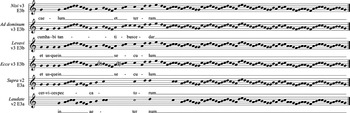
Phrase M3 is used in the four Lenten Sunday cantus: M3a is associated with verse 2 (see Ex. 11) and M3b with verse 3 (see Ex. 12). The cadence is the same in both (see 3 in Exx. 11 and 12). Bailey considers that phrase M3a exemplifies a ‘late development by means of successive repetition’,Footnote 22 which he likens to the techniques used in Milanese alleluias. See 1 in Ex. 11 for an internal repetition; 2 in the same example shows a sequence-like treatment. However, repetitive figures can arise and be sustained at any point within an oral tradition, and need not be taken as evidence of late composition.
Phrase M3a.Footnote 23

Phrase M3b.Footnote 24

Phrase M4 is used in Cantemus. Bailey sees the unsystematic patterns here as suggesting ‘damage’ and a ‘momentary failure of the oral transmission’,Footnote 25 supposing that one (early) version of the chant was more uniform (and therefore better) than the later (preserved) versions. However, Bailey does not establish that a melodically uniform chant will be superior to or, indeed, earlier than one incorporating variety. Variety is certainly in evidence here (for details, see the discussion of Cantemus below).
Phrase M4.

Phrase S (second half)
Phrase S begins the second half of the verse, and appears in three versions. Phrase S1 is used in all the Benedictus es verses. Phrase S2 is associated with first verses, and phrase S3 with the second and third verses of the four Lenten Sunday cantus.
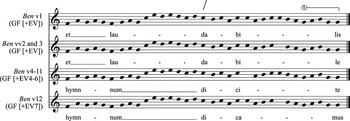
In Benedictus es, phrase S1 is written out in full four times, with the four different texts of the second half of the verse. The opening figures and the high ededc are distinctive to this phrase shape. The cadence is the same as the O1a cadence (see 1 in Ex. 14). Treatment of the single proparoxytonic phrase ending (verse 12) is not accent sensitive.
Phrase S1.

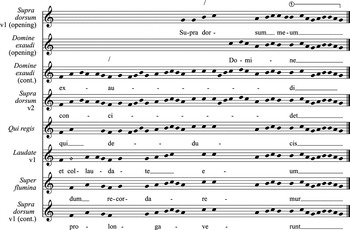
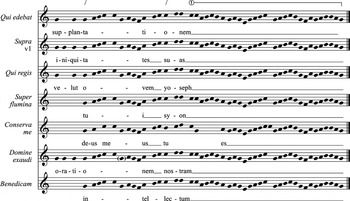
Phrase S2 is associated with the one- and two-verse cantus. It appears in two versions. Phrase S2a (Ex. 15) and phrase S2b (Ex. 16) are the usual versions for paroxytones and proparoxytones, respectively. They usually share the opening FaG FG pattern. Both Domine exaudi and Supra begin with S2a material, although one might have expected these chants to begin with phrase O material. Phrase S2b has an internal near-repetition with leaps up to c (see 2 in Ex. 16). Qui edebat cadences like phrase S1 (see 1 in Exs. 14 and 16).
Phrase S2a.Footnote 26

Phrase S2b.

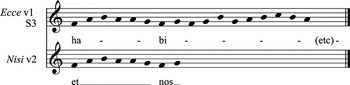
Phrase S3 is found in the second and third verses of the four Lenten Sunday chants, with very uniform shapes (see Ex. 17). The text ‘habitare’ in Ad dominum verse 3 may have prompted use of the phrase in Ecce verse 1. Nisi verse 3 and Levavi verse 2 share textual and musical identity.
Phrase S3.Footnote 27

Phrase E (ending)
Phrase E ends the verse. Phrase E1 is used in Benedictus es and phrase E4 in Cantemus. Phrase E2 is used in all but the final verses of the multi-verse chants, which use phrase E3.
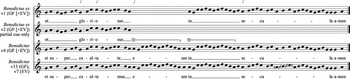
Phrase E1 is rarely notated, since the refrain is indicated by incipit in most Benedictus es verses (verses in which all or part of the phrase is written out are shown in Ex. 18). There is more text from verse 4 onwards, and these verses have an internal repetition (see 1 in Ex. 18); such internal repetition of material is familiar from earlier in the chant.
Phrase E1.

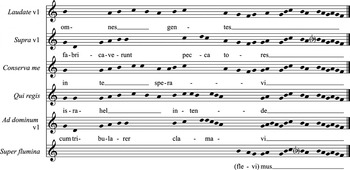
Phrase E2a is associated with first verses. Conserva me has a variant, perhaps a result of ending with two monosyllables (see Ex. 19). While Bailey sees this as possibly a survival ‘from a time before the process [he calls] “normalization” took place’,Footnote 28 it might equally be a valid response to the accent pattern within the norms of the genre as preserved.
Phrase E2a.Footnote 29

Phrase E2b is used in one-verse chants with a single phrase in the verse half. It is viewed by Bailey as being a phrase S without a cadence, followed by a phrase E cadence.Footnote 30 The initial rise to c is similar to phrase M3 (except in Sicut). In convertendo has an internal repetition, perhaps to accommodate the amount of text (see 1 in Ex. 20).
Phrase E2b.Footnote 31

Phrase E2c is proper to the Lenten Sunday cantus. It ends with much of the same melisma as E2a (see 1 in Exx. 19 and 21).
Phrase E2c.Footnote 32

Phrase E3 is associated with the final verse of a two- or three-verse chant (see Ex. 22). In the two-verse chants, phrase E3 opens in the same way as phrase E2a; in the three-verse chants, it opens in the same way as phrase E2c. In each context, therefore, phrase E3 might be considered as a decoration and expansion of a phrase previously encountered in the same chant. Levavi verse 2 ‘celum et terram’ has the formally expected phrase E2c, and Nisi verse 3 ‘celum et terram’ has the formally expected phrase E3b: formal considerations have overridden any response to the textual similarity on this occasion.
Phrases E3a and E3b.Footnote 33

Phrase E4 is used in every verse of Cantemus, with a different shape (after the standard opening) in the first verse (E4’), discussed below. Bailey sees phrase E4 as two phrases: S and E.Footnote 34 There are indeed elements here of the phrase S contour, but it is not gesturally the same. Further, to consider this material as comprising two phrases is inconsistent with the syntax in verse 5 and, in verses 3, 4 and 7, the material for the verse half is elided into one unit.
Phrase E4.

Analyses of each Milanese cantus
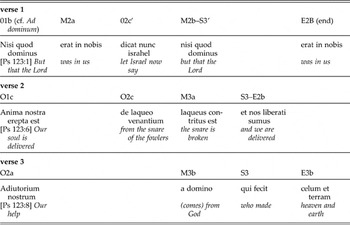
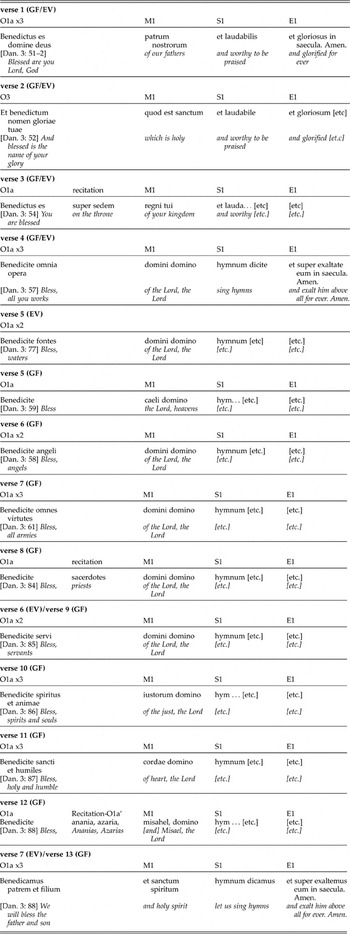
As in most Western chant, cantus phrase divisions are usually compatible with the textual syntax. Musical phrase divisions usually coincide with the end of a sentence, a clause, or a smaller textual unit (such as a prepositional phrase). Occasions when this is not the case are discussed below. In the following section, a summary table precedes the discussion of each chant. In each table, the text and translation of each verse is given horizontally across the page, with the phrase choices signalled above the text. One can compare the formal structure of each verse in a given chant by reading vertically down each column.
The presence of the same (or closely related) texts in different contexts is quite often associated with the same melody on both occasions. Texts beginning ‘domin-’ seem to be particularly prone to clustering melodically in this way.Footnote 35 This melodic identity, whether it greatly predates the notated record or occurred only shortly before it, will have been stabilised by the textual similarity.Footnote 36Pace Bailey, the operation and retention of a text cue need not imply a ‘failure of the oral tradition’.Footnote 37
Seven Lenten cantus are derived from a set of psalms known as the gradual psalms. These psalms (119–133) formed a central part of medieval Christian initiation, which culminated in baptism at the Easter Vigil.Footnote 38 All four of the Sunday cantus, two of the five ferial cantus, and Supra dorsum on Good Friday are drawn from this part of the psalter. One function of the cantus, then, may be to provide a liturgical opportunity for meditation on these initiation texts.
The four Lenten Sunday chants each have three verses. The second verse is invariably structured (after the first phrase) M3a S3 E2c, and the third verse has (after the first phrase) M3b S3 E3b. The first verse, and the first phrase of each subsequent verse, is less standardised.
Nisi (Sunday 2 in Quadragesima)

Nisi verse 1 opens G FE, like the opening of Ecce; it continues with phrase O1b, textually and musically paralleling Ad dominum verse 1, sung the following Sunday. In Nisi verse 1, ‘dicat nunc israhel’ has ‘a simple elaboration of the usual [phrase S cadence]’ according to Bailey.Footnote 39 However, a connection with phrase O2c is apparent in the double rise from F (Fab then FG), and the cadence of Nisi verse 1 is much closer to phrase O2c than to that of phrase S; I have thus labelled the phrase O2c’ (see Ex. 24).
Nisi verse 1 and related phrases.

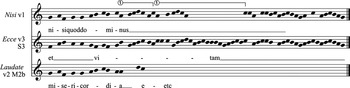
While cantus verses usually consist of phrases O–M–S–E, this verse continues to use material associated with the first half of the verse through to the restatement of the opening text ‘nisi quod dominus’. This opens like phrase M2b/M3b before having a repeated figure characteristic of phrase S3 (see 1 in Ex. 25) and then the S3 cadence. The melodic treatment of the second half of the verse as a complete cantus verse strongly emphasises the repeated text ‘nisi quod dominus’.
Nisi verse 1 and phrases M2b/M3b and S3.Footnote 40

The second verse opens O1c O2c, like Ad dominum verse 3. The liturgical proximity of the two chants may have cued use of similar material on both occasions. The use of phrase O material for whole sentence (‘Anima nostra erepta est de laqueo venantium’) tightly ties it together. One might have expected to encounter phrase M on ‘de laqueo venantium’, with the half-way cadence dividing this sentence from the one that follows. The phrase divisions instead mean that the text is heard in a particularly pointed way. By use of phrase M3a on ‘laqueus contritus est’, both statements of ‘laqueus’ (‘snare’) are connected within the first verse half.Footnote 41 The (limited) remaining text is divided between the phrase S3 opening gesture and phrase E2c (compare Exx. 26 and 21).
Phrase S3 opening in Nisi verse 2.

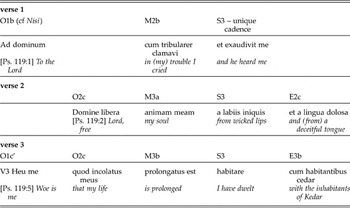
Ad dominum (Sunday 3 in Quadragesima)

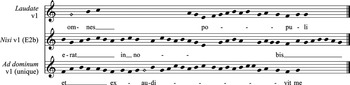
There is insufficient text to use four phrases in Ad dominum verse 1. The short second clause is used for the second half of the verse (‘et exaudivit me’). This material begins like phrase S3; the abccGaGF pattern is found at the beginning of phrases E2a and E3a (see Ex. 27). Syllabic cadences (as on ‘-vit me’) are not characteristic of the cantus; the only other example is in Laudate verse 1. In both cases, the cadence is approached from below, unlike any other cantus phrases. Because of this idiosyncrasy, Bailey considers the latter part of the melody to have been ‘lost’.Footnote 42 It is also possible (particularly given the uniformity of the written transmission) that the melodic state is purposeful: to have the syllabic ‘-vit me’ at the end of the phrase with a final G approached from below is a tonal and textural contrast to the usually melismatic idiom, perhaps emphasising the personal nature of the psalm.
Ad dominum verse 1 and phrases S3 and E.Footnote 43

In Ad dominum verse 2, use of O2c (rather than the formally expected O2b) may be prompted by the liturgical proximity of Nisi,Footnote 44 or by the use of the same phrase in Ad dominum verse 3. In Ad dominum verse 3, the expostulation ‘Heu me’ has a rare and decorated melisma, perhaps emphatic in quality;Footnote 45 its use in Nisi verse 2 is further evidence of the intertwined relationship between the two chants. The incomplete cadence ending ‘Heu me’ gives heightened tension to the silence of the in-breath before the following phrase O2c.Footnote 46
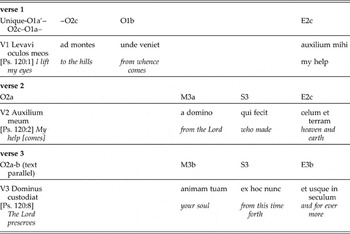
Levavi oculos meos (Sunday 4 in Quadragesima)

Levavi verse 1 consists almost entirely of phrase O material. The O1a’ cadence on ‘oculos’ is left incomplete (see 1 in Ex. 28), and ‘meos ad montes’ uses phrase O2c (see 2 and 4 in Ex. 28). Completing the sense of ‘Levavi oculos meos’, ‘meos’ interpolates the O1a cadence (see 3 in Ex. 28) before phrase O2c continues. There is thus a tension-filled break after ‘meos’, since phrase O2c is, at that point, incomplete; ‘ad montes’ is more closely connected conceptually to ‘oculos meos’ than it would be with two entirely independent phrases.
Phrase O material in Levavi verse 1.

The verse continues with phrase O1b. Since it otherwise opens Nisi and Ad dominum, it strongly connotes continuation of the chant opening. ‘I lift my eyes to the hills from whence comes’ therefore builds up a considerable amount of tension, released with emphasis on ‘my help’.
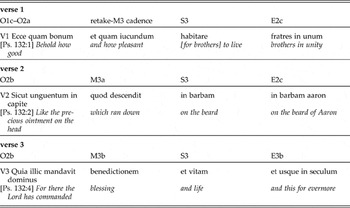
Ecce (Sunday 5 in Quadragesima)

Ecce verse 1 has two strong connections to the later verses of the same chant – the O2 and M3 cadences – although this is not what one would expect formally. The chant starts with a fall to G FE, already encountered in Nisi verse 1. The following O1c melisma is also found in Ad dominum verse 3 and Nisi verse 2 (see Ex. 4, above). ‘Ecce quam bonum’ and the following ‘et quam iucundum’ both begin G FEG, connecting them together (see Ex. 29). There are similarities of shape as the phrase progresses; the ‘extensively elaborated’Footnote 47 phrase on ‘et quam iucundum’ may well be a rhetorical response to the anaphoric text.
Anaphoric text and melody in Ecce verse 1.Footnote 48

The two-verse chants
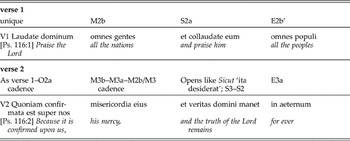
Laudate (Saturday of Quadragesima 5)

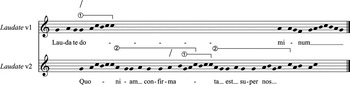
Laudate's opening is related to the first melisma in phrase O1a. This shape (see 1 in Ex. 30) is repeated twice in verse 2, which has further internal repetition (see 2 in Ex. 30).
Repetition in Laudate verse openings.

Laudate verse 1 ends with a unique phrase (E2b’) (see Ex. 31). Bailey sees the syllabic ending as a sign of ‘damage’.Footnote 49 However, the cadential parallel with Ad dominum verse 1 (discussed above) suggests that the strategy was not alien to the idiom.
Laudate verse 1 ending.

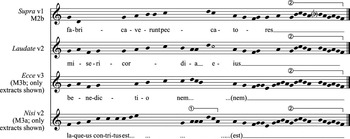
In verse 2, ‘misericordia eius’ opens rather like Ecce verse 3 (M3b), which is also a final verse (see Ex. 32). The pattern shown under 1 in Example 33 appears otherwise only in the M3a melisma. The cadence is compatible with M3a/b (continuing the parallel), or with M2b, as in Laudate verse 1 (see 2 in Ex. 32).
Phrase M in Laudate verse 2.Footnote 50

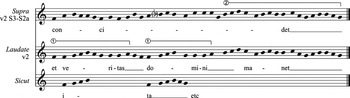
The following phrase ends like the phrases S3–S2 (see 1 in Ex. 33), but starts with material reminiscent only of Sicut in phrase E2b. There is an internal repetition (see 1 in Ex. 33).
Laudate, end of verse 2.

Supra dorsum (Good Friday)

Phrase S2a is usually a mid-verse phrase, but is found as a cantus opening in Supra dorsum and Domine exaudi. The same cadence is found on ‘prolongaverunt’, melodically connecting the ideas found in the two halves of the verse. Bailey sees Supra verse 1 as ‘rather too similar’Footnote 51 to Super flumina and thus as a late composition. However, the phrases which the two cantus have in common are formally and textually expected for the context; there is no particular reason to suppose that one was modelled on the other. Instead, both simply have similar proportions and thus the same formulaic phrases within the same genre.
The one-verse cantus
There are nine cantus with a single verse. Three are found at vigils (Qui regis at the Christmas Vigil, Super flumina at the Epiphany Vigil and Sicut cervus at the Easter Vigil), one is used on Maundy Thursday (Qui edebat), and five are used at ferial masses in Lent (Conserva me on Mondays, In convertendo on Tuesdays, De profundis on Wednesdays, Domine exaudi on Thursdays and Benedicam on Saturdays).
The Vigil chants: Qui regis, Super flumina and Sicut
Qui regis (Christmas Vigil)

Sicut (Easter Vigil)

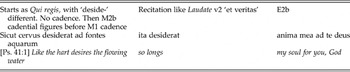
Sicut and Qui regis begin in the same way and have internal repetition (see Ex. 34).
Sicut/Qui regis openings.

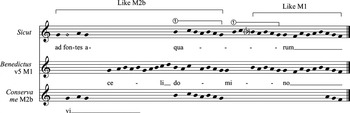
There is no cadential G in either chant at the end of ‘israhel’/‘desiderat’ before continuing with phrase M material. Qui regis uses, again, the Gabcba figure before the cadence (see Ex. 10); Sicut uses M2b–M1 with internal repetition (see Ex. 35). Benedictus es, also sung at the Easter Vigil, uses phrase M1 many times: its proximity may have cued use of M1 here.
M2b and M1 material in Sicut.

In Sicut, the material on ‘ita desiderat’ is like that on ‘et veritas’ in Laudate verse 2 (see Ex. 33). There are two long phrases in Sicut rather than the more usual four, balancing the ‘as x, so y’ clauses against each other in a pair.
Super flumina (Epiphany Vigil)

Super flumina begins with the same phrase as De profundis, the only other cantus with a water-related text. While one might expect to encounter phrase O1a twice on ‘Super flumina’ and ‘babylonis’, with the move to M material after the end of the prepositional phrase, ‘babylonis’ instead has the recitation that sometimes precedes phrase M1 (see Ex. 36). The unexpected melody might make the theologically important word ‘babylonis’ stand out in performance.
Phrase M in Super flumina.

Lenten ferial chants
Domine exaudi (Lenten Thursdays)

Domine exaudi begins with two closely related phrases, linking ‘Domine’ and ‘exaudi’, as well as emphasising ‘Domine’ since it does not have the formally expected phrase O. The second half of De profundis (Lenten Wednesdays) is ‘domine exaudi vocem meam’. This may have cued melodic treatment of ‘Domine exaudi orationem nostram’ as a second verse half, even though it comprises the entire chant.
Conserva me domine (Lenten Mondays)

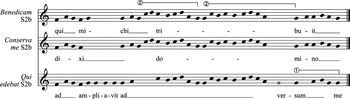
Conserva me starts like phrase O1a (see 1 in Ex. 37). Instead of cadencing in the usual manner, it shares Laudate's first cadence (also on ‘domin-’). This is followed in Conserva me (see 2 in Ex. 37) by a complete phrase O1a on ‘quoniam’. This divides the conjunction ‘because’ from the prepositional phrase. A rhetorically charged pause on ‘quoniam’ is also characteristic of the Old Hispanic Lenten psalmi.Footnote 52
Phrase O in Conserva me.Footnote 53

Benedicam (Lenten Saturdays)

In Benedicam, the combination of O2c and O1c is an individual treatment of the standard tonal space (see Ex. 38).
Phrase O in Benedicam. Footnote 54

In convertendo (Lenten Tuesdays)

The extended O1a’ cadence of In convertendo may add emphasis to ‘dominus’, and there is also a small flourish at the end of ‘captivatem’ (see Ex. 9).
De profundis (Lenten Wednesdays)

As well as having similar text structures, De profundis and In convertendo are sung on consecutive days each week; their proximity may have enhanced their melodic similarity.
Maundy Thursday
Qui edebat (Maundy Thursday)

Uniquely, this chant begins with phrase M.
Summary: one-verse cantus
The one-verse cantus do not form a single set in the way that the three-verse chants do. While three phrases is the norm, the material used is not consistent. When the first verse half is short, O and M can be combined (Qui regis), M can be omitted (Benedicam),Footnote 55 or O can be omitted (Qui edebat).Footnote 56 Both M and O are omitted in Domine exaudi, discussed above. Phrase S is omitted in In convertendo and De profundis, where the second verse half is short. There are four phrases in Conserva me and Super flumina, where there is plenty of text. As this shows, these chants are not constructed from a three-phrase structure. Instead, six of the nine single-verse cantus have sufficiently short texts that they use a varying selection from the four phrase types to articulate their varying text structures.
The Easter Vigil chant Sicut stands apart from the others formally, having only two phrases. Although the first verse half is related to the first verse half of Qui regis and it uses the same concluding phrase as De profundis and In convertendo, there is a long unique melisma in the first verse half and the opening recitation of the second verse half is individual in its formulation. This chant has a more individual profile than any of the other one-verse chants. It also uses formulaic material in a non-standard way, with the M2b cadential figures being used syllabically and not cadentially. Despite this, there are sufficient melodic and formal connections with the other chants that the generic label ‘cantus’ makes sense.
Cantemus domino (Easter Vigil)
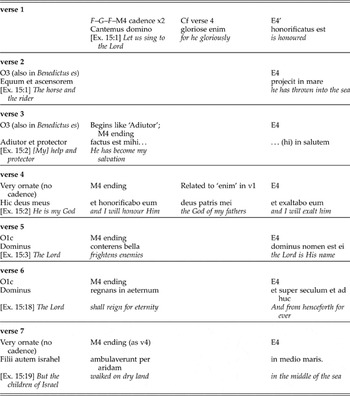
The introductory verse has an elaborate recitation rather than using formulaic cantus phrases. ‘Cantemus domino’, according to Bailey, continues with this recitation.Footnote 57 I prefer to interpret ‘domi-’ as an anticipation of the M4 cadence (see 1 in Ex. 39), connecting together ‘Cantemus domino’ and integrated into the melodic language of the cantus.
Cantemus introduction.

The same recitation melody returns at the end of the chant for ‘Sumpsit autem Maria’, followed by a repetition of the verse ‘Cantemus domino’, with the same melody as before. This musical and textual repetition is suggested by the dialogic biblical text. In the wider European context, to have an introductory verse with differentiated melody is a familiar Easter Vigil canticle strategy.Footnote 58
Cantemus

The second half of each Cantemus verse has no direct melodic parallels elsewhere in the cantus repertoire. The varying shapes in the first half of the verse always end with the M4 cadence. The only melodic parallels elsewhere in the cantus repertoire are of phrases O3 (see discussion of Ex. 7) and O1c (see Ex. 4). The second (and final) phrase of Cantemus verse 1 has a variant cadence, preceded by unique material. It is noteworthy that verse 1 of the chant proper is less melodically uniform than subsequent verses; this has parallels in other European Easter Vigil canticle practices.Footnote 59
Verse 2 does not use phrase M4, perhaps mirroring the formal structure of Benedictus es verse 2, sung in the same Easter Vigil rite. Cantemus verse 3 uses O3, perhaps cued by use of the same phrase in the previous verse. The following phrase begins c–b–c like the O3 which precedes it, lending melodic continuity to the verse half despite it comprising two phrases. MUh and D have the expected phrase division between ‘mihi’ and ‘in salutem’, but the phrases are elided in Vh and L. It may be, as Bailey posits, that the chant in L reflects a corrupted understanding of the genre.Footnote 60 However, it is also possible – especially when the phrase functions are otherwise apparently well understood – that such moments are purposeful and rhetorically charged.
Bailey sees the opening phrase of Cantemus verse 4 (see Ex. 13, above) as a ‘substitution of extraneous melody’. This material (on ‘Hic deus meus’) may emphasise the text ‘He is my God’ through its high range. Although, according to Bailey, ‘there is … nothing obvious about the texts that would explain this special treatment’,Footnote 61 an explicit avowal of belonging to God might be considered a theologically crucial moment within the context of the Easter Vigil's baptismal preparations. It is followed by a ‘foreign interpolation’Footnote 62 on ‘deus patris mei’. This is in fact related to ‘enim’ in Cantemus verse 1 (see 1 in Ex. 40) rather than being ‘foreign’.
Ex. 40.

Cantemus verse 4 ends with phrase E4 but, unlike all other verses of this chant, bcbabaG is elided with the Gbabc usually found on the next syllable. Because cdedc is associated with the accent (‘-ta-’) there are only three syllables for the remainder of the phrase. In all other verses (except verse 3, discussed above), there are four or five syllables remaining after the accent. Bailey sees this elision as ‘awkward’ and outlines the ‘proper procedure’,Footnote 63 but it is explicable within the grammar of the chant when one considers the accent pattern and number of syllables available.
Cantemus verse 7 begins with the same ornate material as verse 4. It is possible that this was motivated by melodic considerations (verses 2 and 3 begin the same way, as do verses 5 and 6; for verses 4 and 7 to do so as well lends the chant a musical symmetry). Whatever the reason that the melodic shape came about, the ornate material serves to emphasise ‘the children of Israel’.
As this discussion shows, Cantemus is distinct from the other cantus not only in melodic detail, but also in formal outline. Its use of two phrases in most verses is shared among the cantus only by Sicut, also sung at the Easter Vigil. The repetitive use of phrases M4 and E4 is not mirrored in the two- or three-verse cantus, where different melodic shapes are associated with different verses. While Bailey considers Cantemus to be a ‘different and earlier form of the cantus’, I am unconvinced that the distinction need have chronological implications. It is certainly a ‘different form’, participating only peripherally in the generic norms, but it has no inherently ‘earlier’ characteristics.
Benedictus es (Easter Vigil and Good Friday)
Like Cantemus, Benedictus es is preceded by an ornamented reciting tone for the introduction (see Ex. 41). Suñol listed Tunc hi tres with the psalmelli, with which it shares melodic characteristics.Footnote 64 For Bailey, Tunc hi tres and Tunc cantabit (at the beginning of Cantemus) are related, but at a different pitch level.
Introductory recitation.

The canticle proper is followed by a further ornate recitation tone, whose kinship with Tunc hi tres is evident (see Ex. 42).
Recitation after the Benedictus es canticle.

To have an ornate recitation tone for these portions of text, differentiated from the main body of the canticle, is familiar in other European Easter Vigil traditions.Footnote 65
Benedictus es Footnote 66

Unlike the other Milanese cantus, each Benedictus es verse ends with a G+a ‘Amen’, giving it a different tonal structure. The repetitions within the biblical text give the chant a refrain structure. Also, from the cd on the antepenultimate syllable, S1 and E1 have the same melodic material, and repetition also occurs within phrases O1a and E1.
Phrase O1a is quite strongly associated with the weekday chants as well as with the Daniel canticle. Phrase O3 is used in the second verse of Cantemus and the second verse of Benedictus es, perhaps a result of the liturgical proximity of the two chants. Phrase M1 is found in every verse of Benedictus es and otherwise only in Super flumina. However, phrase S1 is found only in Benedictus es, as is phrase E1. Unlike Cantemus, there are some melodic connections between Benedictus es and the other cantus, although it is still an idiosyncratic chant.
Conclusions
A pattern-matching analysis of the Milanese cantus reveals that the chants are not merely the result of a mechanical application of formulaic phrases to biblical texts. While it is possible that non-standard phrases reflect a corrupted and poorly remembered repertoire, it is equally plausible that they emphasise the portions of text with which they are associated. The openings of the chants are the most individual moments, with the greatest degree of independence in the phrase shapes; it is possible that these remained more individually crafted – being the easiest part of the melodies to remember – while the genre became more formulaic, but it is not possible to come to conclusions about when this might have happened.
The coincidence of textual parallels with melodic parallels (especially around ‘domin-’) is a fascinating facet of the genre's extant state, which is mirrored in other chant traditions.Footnote 67 Chants with similar functions (Lenten Sundays, for example) have more melodic connections with each other than with those whose liturgical function is more disparate; such clustering, again, may be found in other medieval chant traditions.Footnote 68 Despite the relatively late date of the Milanese manuscripts, then, the melodies participate in strategies found in other medieval formulaic genres whose origins lie in a pre-written tradition, including the possible rhetorical impact in performance of melodies that push beyond generic norms.
The four Lenten Sunday chants, the two-verse chants and the one-verse mass chants form three subgroups within the genre of the cantus, although they are clearly all part of the same melodic genre. Different groups of singers seem to have understood the genre in different ways: the idiosyncratic Benedictus es and Cantemus were sung by boys and by four of the men, respectively; the Vigil cantus were sung by one of the lectors (reflected in the close relationship between Qui regis and Sicut); and the Mass cantus were mostly sung by a senior boy.Footnote 69 Different melodic preferences can be linked to different groups of singers within an institution, and within a single formulaic genre.