Introduction
A collaborative approach to large-scale public outreach and education is essential for an international and multidisciplinary scientific project. The Green Edge research project studies the impact of climate change on the dynamics of spring phytoplankton blooms and their role in the Arctic Ocean. Climate change has triggered significant modifications in marine ecosystems in the Arctic Ocean. The decrease in the extent of pack ice during the summer has led to a 20% increase in pan-Arctic primary production over the past decade (Arrigo & van Dijken, Reference Arrigo and van Dijken2011). Primary production is generally associated with the transfer of energy to higher trophic levels in the marine environment, and this process has important cultural, health and economic implications for human populations in the Arctic (Wenzel, Reference Wenzel2011).
In this study, spring phytoplankton blooms were monitored in Baffin Bay (North Atlantic Ocean) between 2015 and 2017. Data were collected aboard the research vessel Amundsen (CCGS – Canadian Coast Guard Ship) during the spring and summer of 2016 from an ice camp near the community of Qikiqtarjuaq (Canada) and from three Inuit communities: Qikiqtarjuaq, Pangnirtung and Clyde River.
As the impact of climate change becomes more prevalent in daily life, it is now broadly recognised that scientists need to prioritise outreach education (Baron, Reference Baron2010). Programmes such as the United Nations Decade of Education for Sustainable Development have made worldwide requests to develop educational activities focused on climate change (Bybee, McCrae, & Laurie, Reference Bybee, McCrae and Laurie2009). Initiatives such as card/board games, for example, Arctic Saga (de Luna & Vicari, Reference de Luna and Vicari2014); educational programmes, for example, Schools on Board (Barber, Reference Barber2009) or documentaries, for example, Frozen planet – BBC Documentaries (Attenborough, Reference Attenborough2016) are now starting to emerge. There is still a demand, however, for additional ways to engage diverse audiences in global change, especially in the Arctic (Wu & Lee, Reference Wu and Lee2015). Scientists are more engaged in science communication beyond peer-reviewed publications (Liang et al., Reference Liang, Su, Yeo, Scheufele, Brossard, Xenos and Corley2014) for various reasons, ranging from an interest in public engagement to grant requirements (Poliakoff & Webb, Reference Poliakoff and Webb2007). Their presence as active participants provides a guarantee of authenticity in the communication process (Cooke et al., Reference Cooke, Gallagher, Sopinka, Nguyen, Skubel, Hammerschlag and Danylchuk2017). Moreover, co-construction of the project with targeted groups such as students is an excellent and recognised approach (Fischhoff, Reference Fischhoff2013; Rowe & Frewer, Reference Rowe and Frewer2005). Furthermore, to effectively share experiences and results with the public, scientists, educators and communicators, as well as targeted groups, must approach science projects as a team (Triese & Weigold, Reference Treise and Weigold2002) and make outreach objectives a part of the overall research strategy (Provencher et al., Reference Provencher, Baeseman, Carlson, Badhe, Bellman, Hik and Zicus2011; Weigold, Reference Weigold2001).
Science communicators must also select and use appropriate and varied channels to make information more likely to be noticed and taken up by the intended diversified audience (Longnecker, Reference Longnecker2016). Our objective here is to present an original multi-targeted, multidisciplinary and international outreach project, with an emphasis on fieldwork and connections with local Inuit communities. We present the collaborative ‘Green Edge Outreach Project’, which developed different communication approaches and tools (websites, an educational multimedia platform, 52-minute documentary, infographics, photo exhibition, school activities, events, live videos and social media). Finally, we present the ongoing dissemination of our innovative and diversified materials.
Material and methods
To disseminate knowledge and information about the expeditions and project results, we implemented a collaborative and bilingual platform to showcase the major scientific initiatives. The strategy was to establish a communication plan with realistic goals. To do this, we first performed a situation analysis: scientific leaders brainstormed with communication staff and conducted focus groups and surveys to evaluate which relevant information we needed to gather about the Green Edge Project. Then, we defined our overall communication objectives and target audiences: What were the results we wanted to achieve, and to whom did we want to deliver our message? Implementing this communication plan, over a 3-year period, our goal was to develop a collaborative outreach and educational approach that would target different audiences as outlined in the next sentence but that would appeal to, and be accessible to, any interested member of the public. Our specific objectives were to (i) involve scientists as active participants in the communication process, (ii) engage the target audience (peers, general public/secondary schools, funding organisations, decision makers) as much as possible to ensure that the communication strategy was appropriate and (iii) select paths and outreach support to promote better understanding. In addition, we decided which media channels would be the most effective for delivering our message to our target audiences (websites, TV/cinema, activities in schools or for the general public, social media). Finally, we quantified our results to verify whether or not we had achieved our objectives (by using Google analytics, popularity on social media, evaluation forms in schools, publication on other official related websites, event visits).
The consortium was composed of a multidisciplinary team: videographers (Parafilms, http://parafilms.com/fr/), multimedia developers (KNGFU, http://kngfu.com/), designers (Criterium, http://criteriumdesign.com/), photographers (Éclats de lumière, http://www.eclatsdelumiere.com/) and scientists (Takuvik http://www.takuvik.ulaval.ca/ and Green Edge scientists), as well as educators from different primary and secondary schools. Other students and professionals from the research team took photos and videos, wrote texts and contributed to the outreach project. We used tools from the Adobe Creative Suite to create our outreach support materials (Photoshop, Illustrator, InDesign, Dreamweaver, Premiere Pro, After Effects).
Results and discussion
Websites
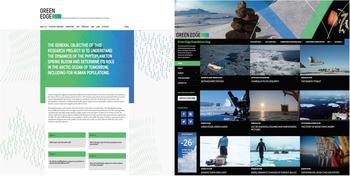
We developed several different websites (Fig. 1). The Green Edge Project website presents the scientific and academic aspects of the project, while the blogs offer insight into day-to-day life during both the 2015 and 2016 expeditions (more than 100 000 visits).
Academic website (left) – http://www.greenedgeproject.info/, and expedition blog (right) – http://greenedge-expeditions.com/, developed as part of the Green Edge Outreach Project.

The academic website http://www.greenedgeproject.info/ contains nine sections related to science and presents the consortium members, scientific issues developed within the framework of the project, descriptions of the different expeditions, proposals to share open data, funding and employment opportunities and a summary of outreach activities and recent news.
In writing the blogs on http://greenedge-expeditions.com/, we actively involved the scientists, professionals and students who were doing the fieldwork (ice camp or icebreaker), as research by Liang et al. (Reference Liang, Su, Yeo, Scheufele, Brossard, Xenos and Corley2014) and Cooke et al. (Reference Cooke, Gallagher, Sopinka, Nguyen, Skubel, Hammerschlag and Danylchuk2017) suggests that a scientist’s engagement improves the credibility of the communication method. Individuals posted comments and shared their scientific and everyday life on the interactive platforms. Visitors to the website could discover highly technical scientific posts (for example, glider deployment in the Arctic Ocean or satellite-based science), as well as accounts describing the scientists’ hobbies (for example, dancing on ice or baking the cake of the day). In addition to the researchers’ contributions, the blogs included interactive widgets such as the weather forecast for Qikiqtarjuaq (Nunavut), newsletters about specific science projects (for example, ARGO profiling floats), details on the ice-camp and oceanographic expeditions, the video trailer for the 52-minute documentary (see the ‘A 52-minute documentary’ section), a map to follow the icebreaker’s route in real time, a Twitter feed and links to the academic website and social media platforms. The blog was very successful, as the number of views reached 117 021.
Educational multimedia platform
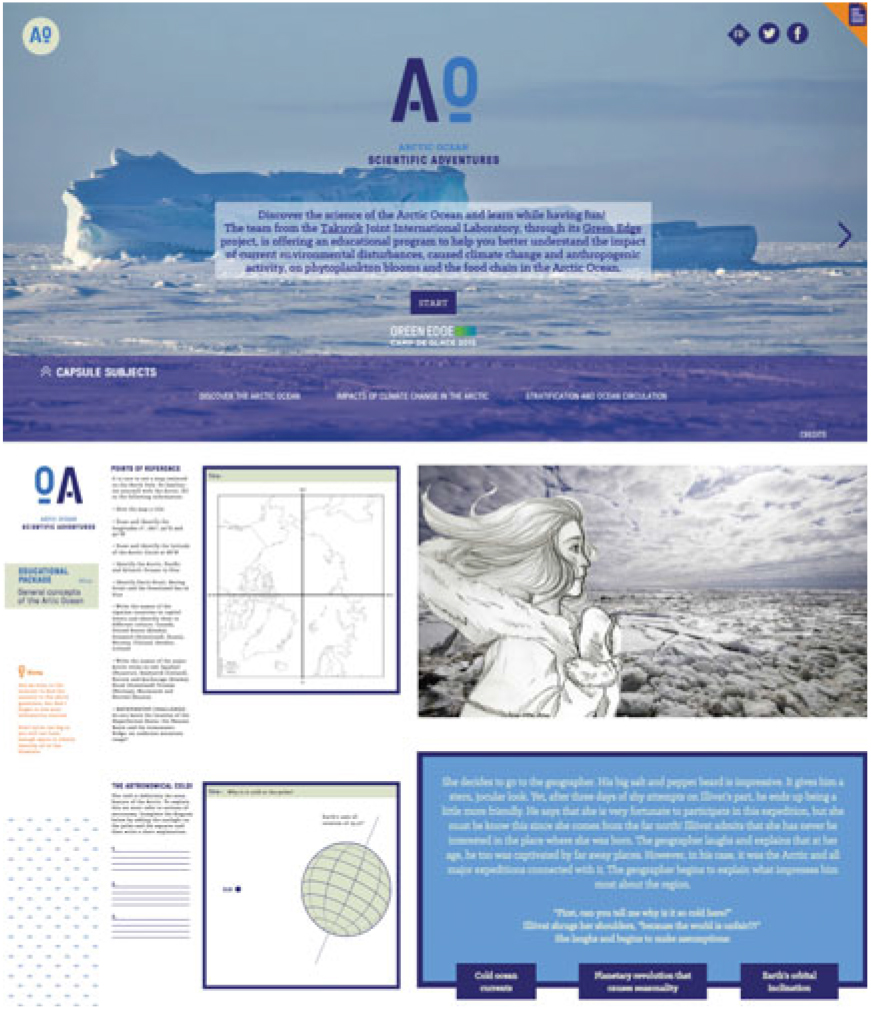
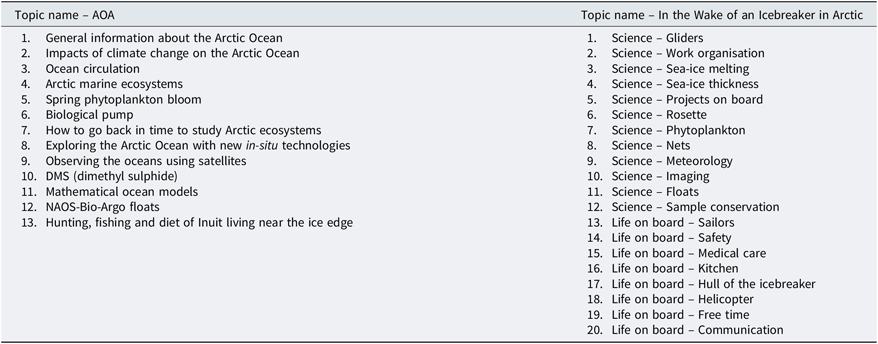
We created an educational multimedia platform, called ‘AOA Arctic Ocean Arctique’, for 11–16-year-old students. The platform contains 13 capsules (web documentaries) of 3–5 minutes in length, each of which is associated with educational modules (photos, infographics, interactive activities, pedagogical files), as illustrated in Fig. 2. Interactive activities in the story allow the student to make choices within a scenario that portrays an Inuit girl, Illiivat, a stowaway on the icebreaker. As the voyage progresses, the 14-year-old girl meets scientists and sailors, and makes discoveries and tests her newfound knowledge. Pedagogical files enable the teacher to evaluate the information disseminated to the students through different media. The web capsules and pedagogical activities cover the topics listed in Table 1. This AOA website was broadly disseminated, and we identified email addresses and created a mailing list to contact educative structures. Then, we contacted 2585 and 5373 schools and 24 and 80 museums or educational organisations in Canada and France, respectively.
AOA website – http://www.aoa.education/ with two main educational modules (Illiivat interactive scenario, pedagogical files).

Topics of web-capsules and pedagogical activities developed in the AOA education website (www.aoa.education), in which ‘In the wake of an Icebreaker in the Arctic’ project was included

A 52-minute documentary
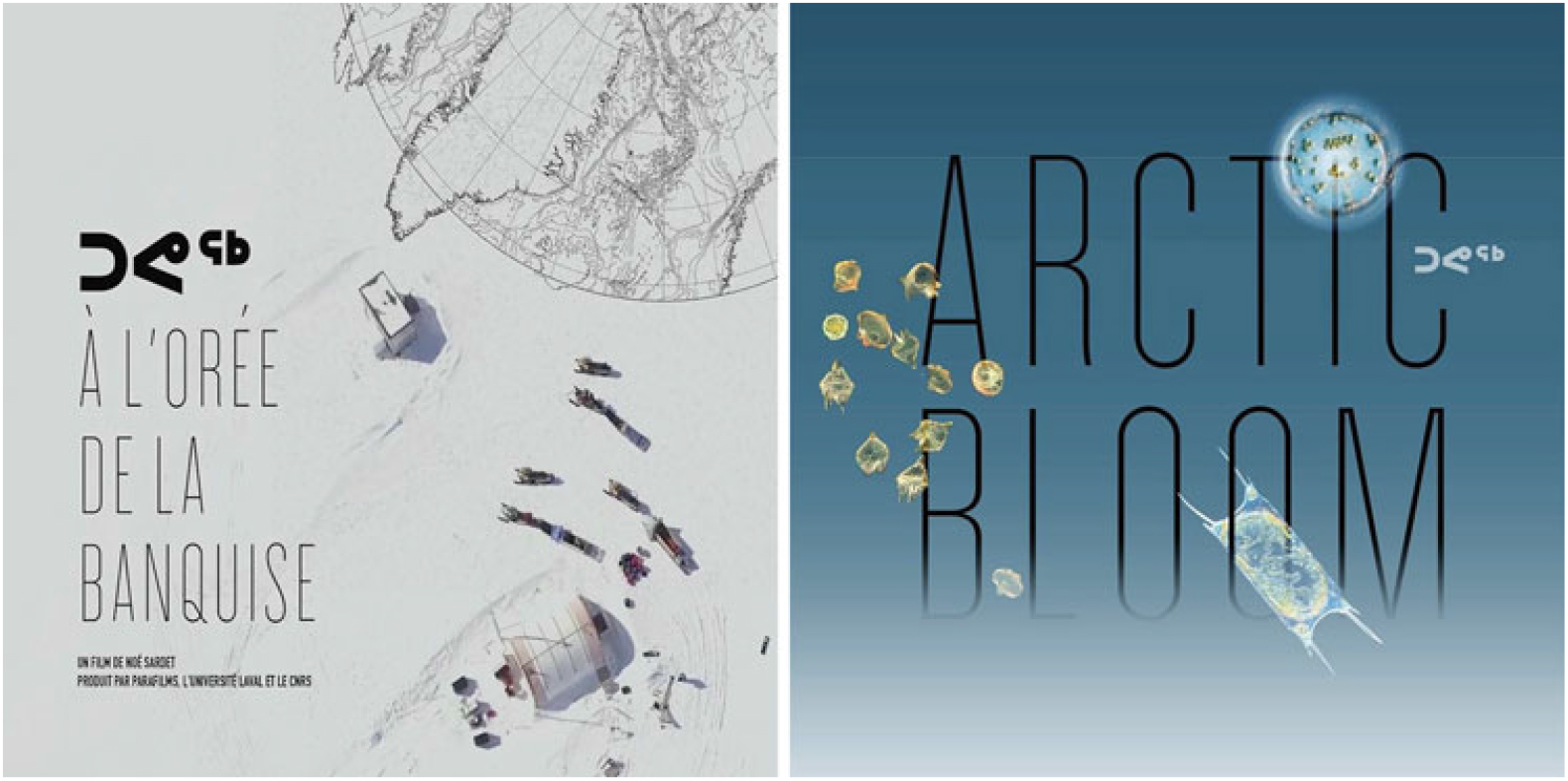
We produced a 52-minute documentary (Arctic Bloom in the English version and À l’Orée de la banquise in the French version), which communicates the goals, methodology and the impact of the Green Edge Project. The film was presented on Planete+ channel (France) in May 2018 and was shown on the movie was finally delayed to late 2019. CBC in Canada as a 26-minute movie in late 2018. The trailer can be viewed via the following link (https://vimeo.com/163206186). The bilingual posters are shown in Fig. 3.
Illustrations from the posters for the documentary film (French version – left and English version – right).

One of the objectives of the documentary is to convey the importance of research to the general public and to reveal what motivates scientists to go beyond the frontiers of knowledge. A second aim is to encourage young people to pursue a career in science. This documentary describes the dedication required to carry out a voyage in the Arctic and the complexity of the logistics involved in this type of fieldwork. The film is an opportunity to tell a scientific story that takes place in an isolated, hostile environment. The story demonstrates that research leads to a better understanding of the Arctic Ocean, its ecosystems and its future. The project also presents the point of view of the aboriginal inhabitants of the region, the Inuit. How do they view changes in their natural environment? What are the consequences for their hunting and fishing practices? How do they perceive research conducted in the Arctic Ocean ecosystems? The ongoing open dialogue between northern populations and researchers is both fruitful and mutually beneficial.
Infographics
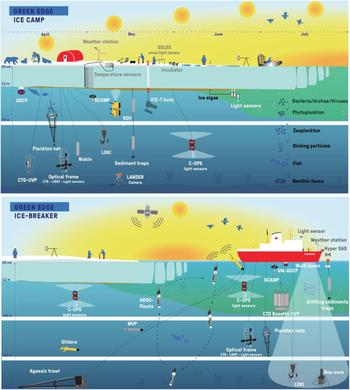
On the one hand, infographics created as part of the outreach programme are being used by scientists in both peer-reviewed papers and presentations to explain how individual experiments fit within the context of the icebreaker and ice-camp expeditions (Fig. 4). We adapt each infographic to the research projects of individual scientists. Moreover, our infographics impart scientific concepts more efficiently than words for any audience. In addition, visuals that are created for a non-specialist audience interested in polar science can help make scientific findings more widely accessible. By removing barriers (for example, technical terminology related to oceanography) and providing a context (in this case, the ice-camp and the oceanographic expedition), the information is presented in an immediately intuitive and engaging manner.
Infographics developed to illustrate the ice-camp (top) and icebreaker (down) expeditions as part of the Green Edge Outreach Project.

Photo exhibition
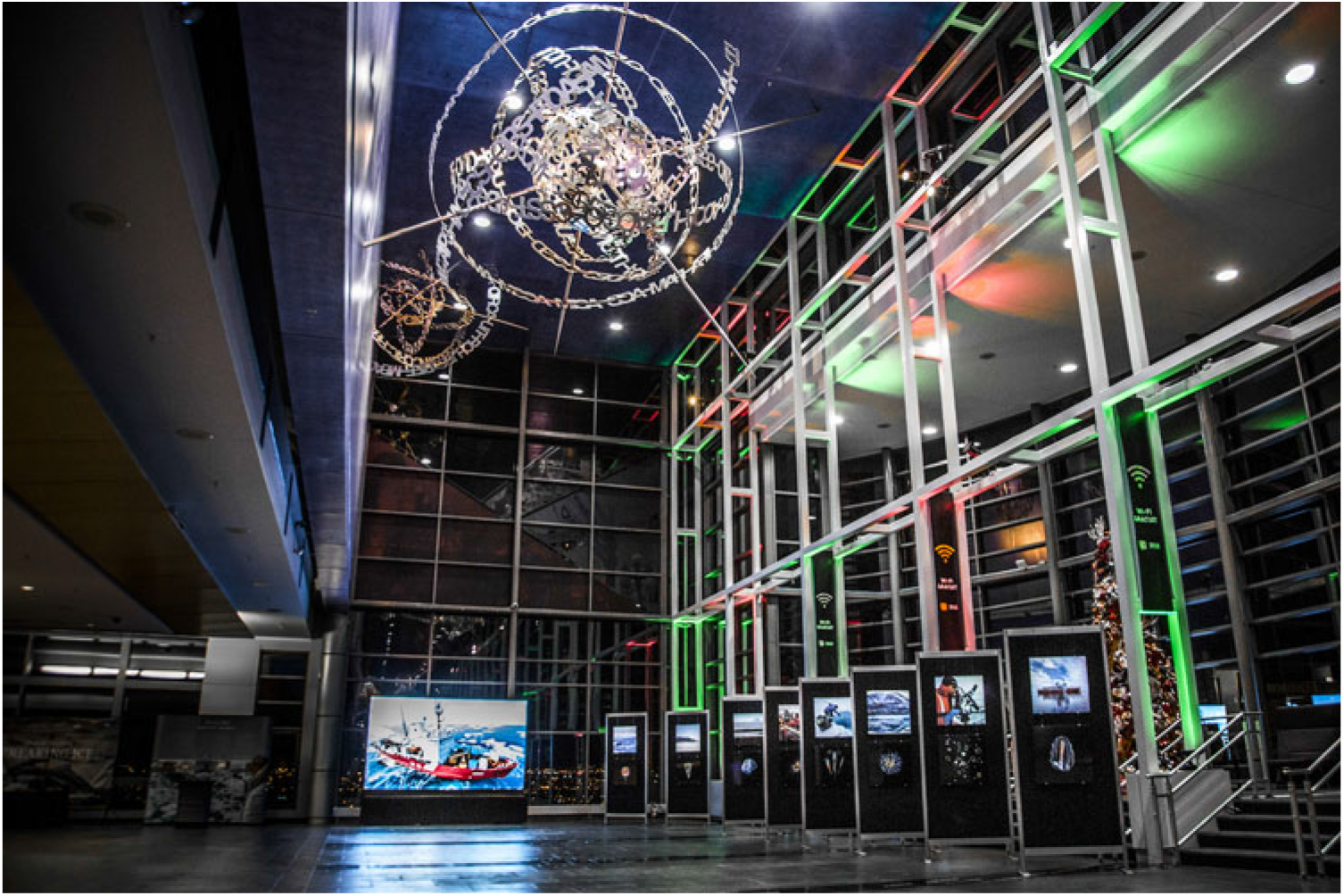
Our photo exhibition called Let the Arctic Green Flow! showcased the Green Edge Project fieldwork and the 80 scientists working to understand how climate change has triggered fundamental modifications in the Arctic. In particular, photos illustrated how plankton was monitored at the ice edge, in Baffin Bay (2015, 2016), aboard the research icebreaker Amundsen and from the ice camps near Qikiqtarjuaq, NU. The exhibition was composed of 10 pictures of fieldwork and laboratory operations and 10 pictures of microscopic plankton. The 24″ × 24″ photographs were printed on dibond (polythene-aluminium laminate). The exhibition was launched at the International Arctic Change 2017 Conference (http://www.arcticnetmeetings.ca/ac2017/) at the Québec City Convention Centre, Québec, Canada from 11 December to 15 December 2017 (Fig. 5), and will be displayed at various schools and museums in the city.
Let the Arctic Green Flow! photo exhibition at the International Arctic Change 2017 Conference.

Live videos
‘In the Wake of an Icebreaker in the Arctic’, an interactive educational project launched in the Ⓘle de France region, enabled primary school-age students to ask questions directly of scientists and the crew working on the icebreaker. Green Edge scientists were aboard the CCGS Amundsen for 6 weeks between 3 June and 14 July 2016. As recommended by Rowe and Frewer (Reference Rowe and Frewer2005), Fischhoff (Reference Fischhoff2013) and Gewin (Reference Gewin2015), the communication team set up an original and innovative teaching device targeted at primary school students (8–10 years), which enabled them to discover the Arctic (environment and population), the scientific and non-scientific crews of the Amundsen and the challenges of undertaking research in the area. The educational project was carried out in several stages: (i) The educative facilitator, who took part in the oceanographic expedition, met with five classes from partner schools in the Ⓘle-de-France region to present the scientific findings. The students worked in groups to identify a battery of questions regarding an interrelated set of themes (science, environment, life on board, icebreaker, and so on). The choice of topics was in line with the state education programme. The students communicated their expectations with respect to the responses to their queries and were recorded asking the selected questions. They also contributed to the video and sound recordings. (ii) Short films of one to two minutes in length were produced aboard the research icebreaker Amundsen in direct response to each identified question asked by the students. Twenty different people were interviewed on board to answer the students’ questions: scientists, the doctor, coast guard crew members and even the captain. During the voyage, teleconferences were organised with the five partner classes, enabling them to interact directly with the team members, live from the Arctic. The videos of the question-and-answer sessions are accessible via the AOA website and YouTube, and the topics are listed in Table 1. (iii) During the 2016 Festival of Science week in France, a researcher who participated in the expedition as a marine biologist came to Paris to present the expedition outcomes. While the 5 classes who participated in the project were present at the conference, 48 other schools followed the conference online and asked their questions via Twitter using the hashtag #ConfGreenEdge. This was an amazing opportunity for young students to interact directly with one of the scientists. Thanks to the 20 short videos, more students will be able to discover the scientific expedition in an entertaining way in a classroom setting.
Social media and YouTube channel
In the internet age, social media tools offer a powerful way for scientists to act as a public voice for science (Bik & Goldstein, Reference Bik and Goldstein2013). Our social media sites (Facebook, Instagram, YouTube, Twitter) aim to reach diverse groups of people. Facebook and Twitter were the most widely used social media platforms and targeted different audiences. These forms of social media are useful for making real-time conversations, customising news streams and building and maintaining communities. Instagram is a showcase for visual information or a chance to view the Arctic expeditions through the scientists’ eyes. YouTube provides an opportunity to compile videos on an unique digital platform and is a flexible and multipurpose showcase for Green Edge expeditions.
An overview of the impact shows that (i) the Facebook page gathered 464 faithful subscribers, with the last post reaching 1848 people and attracting 273 likes; (ii) the YouTube page was viewed 3739 times; and (iii) Instagram and Twitter are together furnished with 212 posts, published by the host.
Drawing
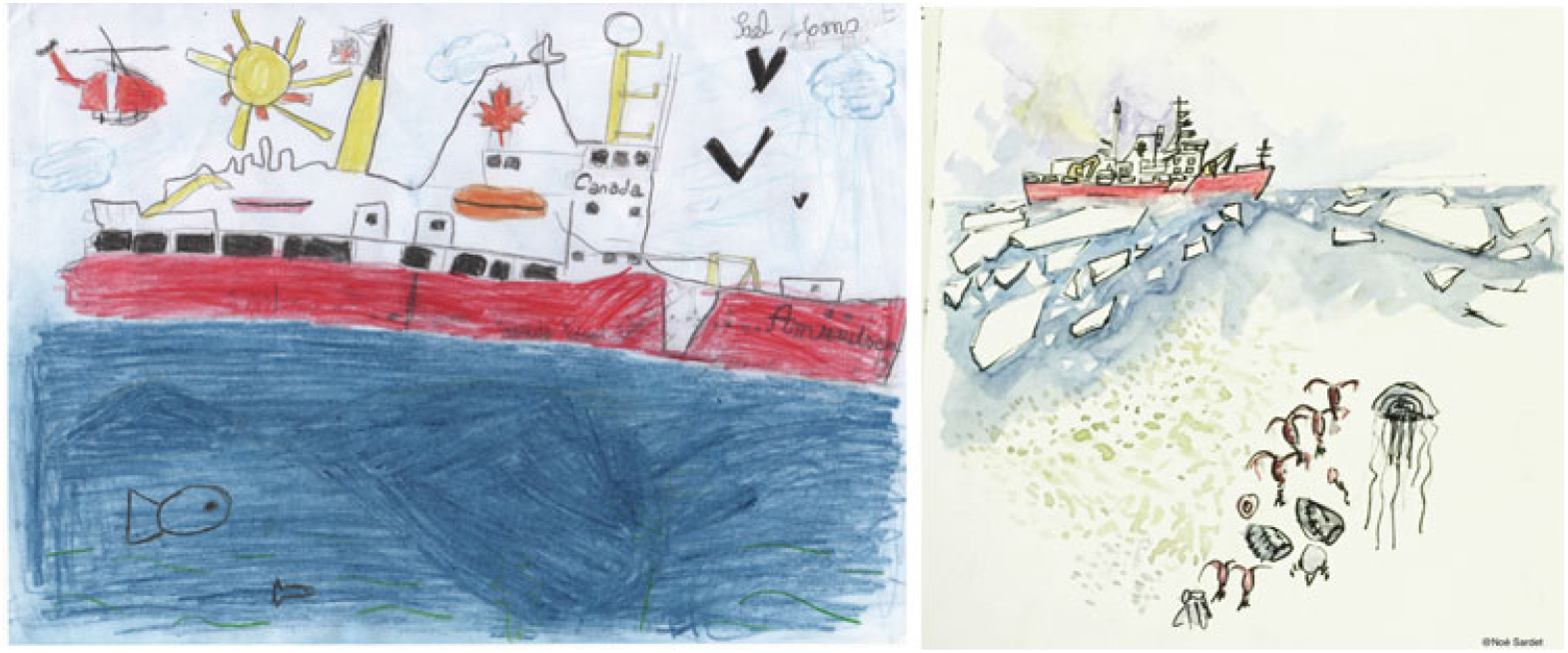
The use of illustrations in science education is gaining popularity. Ainsworth, Prain and Tytler (Reference Ainsworth, Prain and Tytler2011) explained that the act of drawing requires students and scientists to observe, integrate knowledge, compare and reason, thus enhancing one’s ability to think about and discuss scientific concepts. Throughout the Green Edge Outreach Project and especially during the Arctic expeditions in the Arctic, students and professionals exhibited their drawing skills. Examples of watercolours and sketches are shown in Fig. 6. Art provides people with an outlet to express their knowledge in a different format and to articulate scientific information and empowers them to communicate with each other despite their initial differences in learning styles.
Watercolour and drawing of the icebreaker CCGS Amundsen used during the Green Edge expedition in 2016 from Sael Giraud (6 years old) on the left, showing the icebreaker Amundsen and Noé Sardet (40 years old) on the right, showing ice and marine ecosystems.

School activities and events
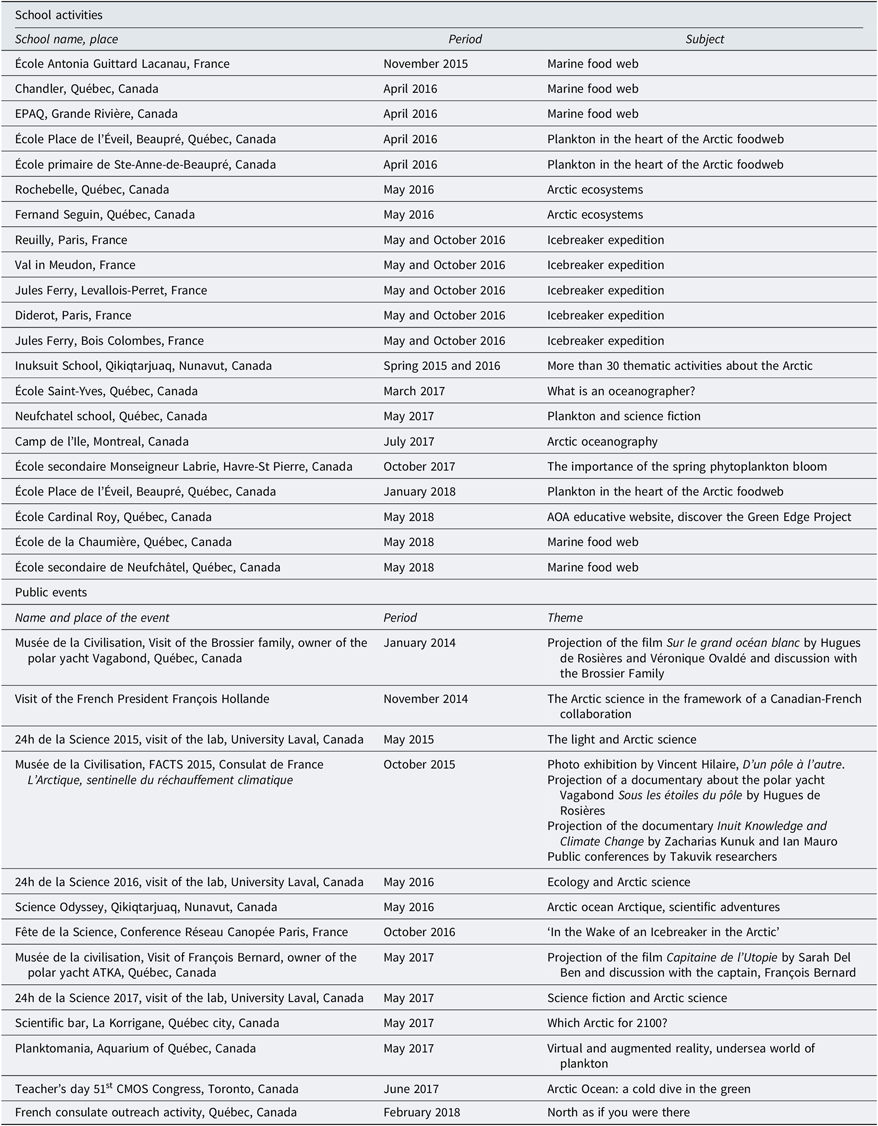
We organised different activities in schools (primary and secondary levels) as well as various events for the general public in museums and public organisations, in both France and Canada, to present aspects of our outreach and educational programmes. They are listed in Table 2.
School activities and public events organised during the period of the Green Edge Outreach Project

Conclusion
Selecting different, yet interconnected, methods and tools to promote an improved understanding of the science involved in the Green Edge Project contributed to the success of the education and outreach outputs of the 3-year international multidisciplinary project. Involving scientists as active participants in the communication process (for example, expedition, blog or infographics) enabled the consortium team to better reach other scientists: researchers could accurately explain scientific phenomena and, in collaboration with the outreach team, highlight the results in a format that was accessible to the general public and funding organisations. Engaging target audiences, such as primary and secondary students, in the co-construction of the project (for example, live videos from the icebreaker, AOA website or drawings) guaranteed that the outreach plan met their needs, which was confirmed by the participation of several dozen schools in the communication and educational project. We aimed our outreach ideas (for example, 52-minute documentary, project website, photo exhibition) at the general public and anyone involved in the process of designing, directing or implementing research, including decision makers and other end users. Our social media sites were developed to reach a diverse groups of people and were effective platforms for breaking down boundaries between scientists and the general public. Finally, ongoing strategic dissemination and evaluation of our pioneering materials is a precursor to success; we are organising activities in schools and museums, as well as public and private organisations. We also participate in conferences at local, regional, national and international levels. Our methodology shows that a collaborative and diversified approach to large-scale public outreach is vital for promoting innovation and education in scientific fields.
Acknowledgements
This project would not have been possible without the support of the Hamlet of Qikiqtarjuaq and the members of the community, as well as the Inuksuit School, and every school mentioned in this Research Note. The project was conducted under the scientific coordination of the Canada Excellence Research Chair on Remote Sensing of Canada’s New Arctic Frontier and the CNRS & Université Laval Takuvik Joint International laboratory (UMI3376), led by M. Babin. The field campaign and outreach activities were successful thanks to the contribution of J. Ferland, G. Bécu, C. Marec, J. Lagunas, F. Bruyant, J. Larivière, E. Rehm, S. Lambert-Girard, C. Aubry, C. Lalande, A. LeBaron, C. Marty, D. Christiansen-Stowe, A. Wells, M. Benoît-Gagné, E. Devred and M.-H. Forget from the Takuvik laboratory, C. J. Mundy and V. Galindo from the University of Manitoba & F. Pinczon du Sel and E. Brossier from Vagabond. We also thank the CCGS Amundsen and the Polar Continental Shelf Program for their in-kind contribution of polar logistic and scientific equipment.
Financial support
The Green Edge Outreach Project was funded by the following French and Canadian programmes and agencies: ArcticNet, Canada Excellence Research Chair on Remote Sensing, Canadian Spatial Agency, Promosciences (NSERC, grant number 453466-2013), CNRS Images, Airbus Foundation, Albert de Foundation Monaco, Total Foundation (grant reference BIO_2015_140) and Région Ⓘle de France.