


1. Introduction
In economies open to trade, consumers are exposed to imports on a regular basis. How do individuals respond to foreign brands in the marketplace? We might expect people, even free trade skeptics, to become more supportive of trade as they experience the benefits of lower prices and greater product variety. However, these benefits are not easily observed by the average consumer because domestic producers match prices and adopt successful brand innovations from abroad. Take the U.S. sport utility vehicle (SUV) market as an example. The consumer observes brands such as Ford, Volkswagen, and Toyota, which can be identified as foreign or domestic by name, but these companies offer very similar products at nearly identical prices. The U.S. consumer does not observe (or even consider) the counterfactual marketplace in which only Ford SUVs are available.
Another possibility is that repeated exposure to foreign brands triggers and reinforces preexisting attitudes toward trade. Rather than moderating extreme anti-trade attitudes, exposure to foreign brands may exacerbate them and consequently contribute to social and political polarization over the international economy.
After decades of research, there is an emerging consensus that individual attitudes toward trade are highly malleable, subject to framing and priming effects, and driven more by cultural attachment, nationalism, and ethnocentrism than by material self-interest (Scheve and Slaughter, Reference Scheve and Slaughter2001; O’Rourke and Sinnott, Reference O’Rourke and Sinnott2001; Hainmueller and Hiscox, Reference Hainmueller and Hiscox2006; Mansfield and Mutz, Reference Mansfield and Mutz2009; Margalit, Reference Margalit2012; Naoi and Kume, Reference Naoi and Kume2015; Mutz and Kim, Reference Mutz and Kim2017; Ballard-Rosa et al., Reference Ballard-Rosa, Goldstein and Rudra2024). Previous experimental research has examined mainly the influence of elite rhetoric in shaping individuals’ perspectives. However, people may also update their beliefs based on their trade-related personal consumption experiences. These experiences, in turn, may influence which elite frames resonate with the broader public. We argue that exposure to foreign brands yields heterogeneous effects depending on whether individuals hold nationalist or cosmopolitan attitudes. Nationalism, distinct from simple patriotic pride, entails an expectation that leaders prioritize national interests even at the expense of international cooperation, whereas cosmopolitans embrace global identities and favor openness.
To evaluate this argument, we designed a survey experiment to test whether subtle consumer cues—specifically, exposure to foreign versus domestic brands—activate these contrasting identities and produce divergent political responses. Participants were asked to evaluate and consider purchasing SUVs, with the brand sets randomly assigned to be domestic, European, or Asian. Our design is novel in two respects. First, it embeds the treatment in a realistic shopping task, simulating consumption experiences with well-known brands. Second, it moves beyond individual home bias (e.g., Feng et al., Reference Feng, Kerner and Sumner2021; Bankert et al., Reference Bankert, Powers and Sheagley2023) to test whether exposure to foreign brands reinforces nationalists’ preferences for neomercantilist policies and leaders who espouse them. In doing so, we shift attention from elite rhetoric to everyday consumer experiences as a source of polarization over the international economy (e.g., Mutz, Reference Mutz2021; Ballard-Rosa et al., Reference Ballard-Rosa, Goldstein and Rudra2024).
Turning to the evidence, our analysis yields three main insights. First, pre-treatment nationalists exposed to foreign SUVs expressed more negative evaluations of trade, greater support for restrictive immigration policies, and increased willingness to endorse Donald Trump for president compared to nationalists exposed to domestic SUVs. Second, cosmopolitans showed either the opposite pattern or no response at all. Third, these heterogeneous effects are not fully reducible to partisanship: our results reveal a nationalist–cosmopolitan divide within the Republican Party and among Democrats and Independents. Together, the findings demonstrate that subtle encounters with foreign brands can activate identity-based predispositions and contribute to political polarization.
Our study extends Autor et al.’s (Reference Autor, Dorn, Hanson and Majlesi2020) account of “importing political polarization” by showing that trade-related consumption experiences, not just labor market shocks or elite frames, can fuel grassroots polarization. We shift the focus from top-down rhetoric to bottom-up consumer cues, demonstrating that brand origin shapes political attitudes through identity-conditioned responses. In doing so, we highlight an important channel linking nationalism and cosmopolitanism to support for neomercantilist and nativist policies. These results suggest that the politics of globalization may be shaped as much by consumer encounters as by labor market shocks or elite discourse.
The remainder of the article situates our study within the literature on the populist backlash against economic globalization, develops our theoretical framework, and presents the experimental design and results. We conclude by reflecting on the broader significance of our findings.
2. Economic globalization and the populist backlash
If free trade maximizes national welfare, why do governments impose tariffs? This puzzle has animated political–economic research for decades. The conventional answer is that trade produces both winners and losers; although the aggregate gains may outweigh the losses, politically powerful losers can mobilize to restrict trade. More recently, scholars have extended this framework to explain the rise and electoral success of right-wing populist parties and candidates worldwide (Colantone and Stanig, Reference Colantone and Stanig2018; Ballard-Rosa et al., Reference Ballard-Rosa, Scheve and Jensen2022; Gonzalez-Rostani, Reference Gonzalez-Rostani2026a). Opposition to free trade—and economic nationalism more broadly—is a core element of right-wing populist platforms. Individuals and regions harmed by import competition may therefore gravitate toward the neomercantilist foreign economic policy positions of these actors.
In comparative politics, the rise of right-wing populist parties is often interpreted as part of a broader realignment in advanced democracies. Häusermann et al. (Reference Häusermann, Bornschier, Zollinger and Steenbergen2025) describe this shift in terms of a universalism–particularism cleavage, while Zakaria (Reference Zakaria2024) characterizes it as an open–closed divide. We use the language of cosmopolitanism and nationalism, which captures the same underlying dimension: cosmopolitans (or universalists) support openness, international cooperation, and cultural diversity, while nationalists (or particularists) prioritize closure, sovereignty, and cultural homogeneity. The growing electoral strength of nationalist, right-wing populist parties—whose platforms emphasize economic protectionism, immigration restriction, and cultural closure—has restructured political conflict over globalization and identity alongside the traditional left–right dimension. In international relations, the ascent of these parties, and their more protectionist and nativist policy stances, is widely seen as a direct challenge to the post–World War II liberal international economic order (Lake et al., Reference Lake, Martin and Risse2021).
Do trade losers tend to favor right-wing populist parties and candidates? Evidence indicates that regions experiencing significant import shocks show increased aggregate support for these parties and candidates, yet the evidence at the individual level is less compelling (Colantone and Stanig, Reference Colantone and Stanig2019). An alternative hypothesis, which has garnered significant attention, suggests that people’s political responses to trade shocks are more sociotropic—concerned with society at large—rather than egocentric, focusing on personal impact (Mansfield and Mutz, Reference Mansfield and Mutz2009). Nonetheless, support for this sociotropic explanation remains limited. For example, Hays et al. (Reference Hays, Lim and Spoon2019) find that individuals living in regions that experience large import shocks are more optimistic about the overall state of the economy than others.
A comprehensive body of research in both political science and economics has traditionally highlighted the negative effects of imports on domestic economic production, especially employment, while taking the consumption benefits of trade—such as lower prices and a broader range of products—for granted. These advantages are extensively discussed in seminal works by Krugman (Reference Krugman1979, Reference Krugman1980), which introduce general equilibrium trade models based on monopolistic competition. These models underscore the importance of product variety in international trade. Krugman argues that countries benefit from trade by importing new varieties of goods, attributing this gain to consumers’ “love of variety.” This perspective was bolstered by Broda and Weinstein (Reference Broda and Weinstein2004), who empirically show how an increase in global product varieties, primarily attributed to the introduction of new imported goods, has significantly enhanced welfare at the country level.
Building on this perspective, Baker (Reference Baker2005) finds that individuals who heavily consume imported goods tend to be more supportive of trade. Related experimental research suggests that these identities are malleable. In a survey experiment conducted in Japan, Naoi and Kume (Reference Naoi and Kume2011) present evidence of “producer projection”: respondents exposed to visual cues emphasizing production—pictures of a white-collar office, car factory, and rice field—were more likely to support restrictions on agricultural imports, irrespective of their own industry of employment, especially when job insecurity was high. Similarly, Naoi and Kume (Reference Naoi and Kume2015) demonstrate that priming individuals with consumer-related cues increases their support for free trade. Yet more recent large-scale evidence from economics finds little to no effect of consumer-focused primes and strong sensitivity to employment-loss frames: in 18 Latin American countries, positive framing that stresses lower prices and greater variety leaves support for trade unchanged, while negative framing about job losses sharply lowers it (Rodríguez Chatruc et al., Reference Rodriguez Chatruc, Stein and Vlaicu2021). In the United States, prompting respondents to think of themselves as consumers has little effect, whereas priming them to consider their own job risk reduces support (Stantcheva, Reference Stantcheva2023). This pattern extends beyond personal job risk: considering layoffs more broadly also reduces workers’ support for trade (Gonzalez-Rostani, Reference Gonzalez-Rostani2026b).
This debate leaves three questions unresolved. First, do voters consistently evaluate trade more positively when thinking as consumers rather than as producers, or are these identities weak cues compared to labor-market concerns? Second, how malleable are consumer and producer identities in practice, given the mixed evidence across contexts? Third, and most importantly for our purposes, how do deeper predispositions such as nationalism and cosmopolitanism condition these responses? We argue that individuals interpret even everyday marketplace experiences through the lens of national identity. This perspective motivates our analysis of how exposure to foreign brands interacts with nationalism to polarize trade and political attitudes.
3. The argument: trade, nationalism, and foreign brands
Existing research shows that nationalism conditions how individuals respond to trade. For example, Carnegie and Gaikwad (Reference Carnegie and Gaikwad2022) and Mansfield and Pevehouse (Reference Mansfield and Pevehouse2022) demonstrate that trade agreement effects depend on whether publics and governments are nationalist or populist, while Guisinger (Reference Guisinger2017) and Margalit (Reference Margalit2012) show that national identity and cultural concerns moderate responses to trade. Mutz and Kim (Reference Mutz and Kim2017) interpret such heterogeneity as evidence of in-group favoritism, and Feng et al. (Reference Feng, Kerner and Sumner2021) find that support for domestic investment is strongest among those high in nationalism. What remains underexplored, however, is whether these moderating effects extend beyond explicitly political or economic primes. Prior studies rely on cues such as ally–adversary frames, relative gains, cultural threat primes, or investment origin. Our approach shifts the focus to consumer experiences, asking whether exposure to foreign brands in a realistic shopping context can activate nationalist versus cosmopolitan identities and, in turn, polarize attitudes toward trade and international economic policy. This matters because if subtle, nonpolitical stimuli, including product choices that do not name a country of origin, can elicit neomercantilist reactions, then greater global market integration may widen social divides and intensify polarization.
Marketing research provides complementary evidence. The literature on consumer ethnocentrism—a construct closely related to nationalism and patriotism—shows that ethnocentric consumers are less willing to purchase foreign products (Herche, Reference Herche1994; Zeugner-Roth et al., Reference Zeugner-Roth, Žabkar and Diamantopoulos2015). Moreover, such predispositions manifest not only in self-reported preferences but also in the neural processing of brand stimuli: individuals high in consumer ethnocentrism exhibit brain activation patterns consistent with risk aversion when evaluating foreign brands (Huang et al., Reference Huang, Wan, Peng and Sui2020; Casado-Aranda et al., Reference Casado-Aranda, Sánchez-Fernández, Ibáñez-Zapata and Liébana-Cabanillas2020). Yet marketing studies stop at the point of purchase, leaving unexplored whether these consumer reactions generalize into the political domain. Our study addresses this gap by embedding foreign brand exposure in a realistic shopping task and assessing downstream political consequences.
Political behavior research shows how seemingly nonpolitical cues can shape political attitudes when they activate underlying identities. For example, Rhodes-Purdy et al. (Reference Rhodes-Purdy, Navarre and Utych2021) demonstrate that economic crises can elicit anger that translates into populist political attitudes, while Gonzalez-Rostani (Reference Gonzalez-Rostani2026b) shows that exposure to automation risks triggers nostalgia, with implications for political preferences. Underlying predispositions condition these effects: Taber and Lodge (Reference Taber and Lodge2006) and Utych et al. (Reference Utych, Navarre and Rhodes-Purdy2022) show that strong prior attitudes filter new information, ensuring that external stimuli reinforce rather than overturn identity-congruent evaluations. We extend this logic to the nationalist–cosmopolitan divide.
We argue that nationalists and cosmopolitans hold different conceptions of “foreignness.” Foreignness functions as an organized knowledge structure with affective and cognitive elements that guides attention, interpretation, and recall—what cognitive psychologists refer to as schemas (Bartlett, Reference Bartlett1932; Rumelhart, Reference Rumelhart, Spiro, Bruce and Brewer1980; Markman and Gentner, Reference Markman and Gentner2001). Once activated, such schemas bias information processing toward identity-congruent evaluations (Forgas, Reference Forgas2008), promote recall of supporting information, and shape interpretations in ways that reinforce prior attitudes. Because schemas are portable across domains, an identity triggered in one setting (e.g., shopping) can influence responses in another (e.g., politics). We theorize that foreign brands operate as symbolic primes that activate these schemas.
For nationalists, the schema is typically threat-laden, evoking cultural, material, and intergroup threats and generating negative affect that spills over into trade and immigration attitudes.Footnote 1 For cosmopolitans, the schema is generally benefit-laden, linking foreignness to enrichment, diversity, and opportunity. Activation here parallels the logic of intergroup contact, where exposure—even symbolic—reduces threat and encourages openness (Allport, Reference Allport1954; Pettigrew and Tropp, Reference Pettigrew and Tropp2006).
Our framework yields two predictions:
Hypothesis 1. (Nationalists)
Nationalists exposed to foreign brands will be more likely to support neomercantilist and nativist policies, as well as right-wing populist candidates, compared to those exposed to domestic brands.
Hypothesis 2. (Cosmopolitans)
Cosmopolitans exposed to foreign brands will be less (or no more) likely to support neomercantilist and nativist policies, as well as right-wing populist candidates, compared to those exposed to domestic brands.
In short, prior studies demonstrate that nationalism moderates responses to political and economic cues about globalization. We extend this logic to the consumer domain, showing that even subtle marketplace encounters can activate schemas of foreignness and polarize political attitudes. This perspective identifies a novel, bottom-up channel through which globalization in the marketplace fuels political polarization.
4. Experimental design and procedures
Our experimental design combines political science aims with methods from marketing and consumer behavior research. Unlike typical political science experiments that rely on explicit informational cues about trade, national identity, or politics, we embedded our treatment in a realistic consumer task. Drawing inspiration from audit studies and research on consumer ethnocentrism, participants engaged in an online shopping simulation for SUVs with well-known brands, without any mention of brand origin.Footnote 2 This design enhanced ecological validity, maximized realism, and minimized demand characteristics: participants believed the study was about shopping, thanks to a carefully constructed cover story and filler tasks.Footnote 3
We conducted our survey in the United States using CloudResearch. The survey involved 3299 U.S. adults and was carried out in October–November 2022.Footnote 4 All participants were told the study examined “big-ticket purchase decisions and online shopping habits.” This cover story provided a plausible context for the tasks to follow and helped mask the true experimental intent. Respondents were unaware that they were participating in an experiment until they were debriefed at the end of the survey. Incomplete disclosure about the study’s purpose was used to prevent biasing the results. Figure 1 presents the survey flow.
Experimental flow: car shopping task and follow-up.

One potential concern is that our introductory statement, which framed the study as a marketing survey, may have drawn a connection between brands and politics. Importantly, all respondents received the same introduction, so this cannot account for any treatment–control differences that we observe. Rather, it reflects a tradeoff between realism and priming. We prioritized ecological validity by embedding the treatment in an active consumer task with a plausible cover story, which better mirrors how individuals encounter brands in real life. At the same time, we minimized priming by never explicitly labeling the brands as foreign or domestic.
We focused on automobiles due to their significant role in both domestic production and imports. Automobiles are economically salient and symbolically charged goods—with broad consumer interest and visibility—making them an ideal domain. Because trade in automobiles delivers lower prices and greater diversity, love of variety is likely to be especially pronounced, which makes this a hard test for our argument.Footnote 5 Participants were randomly assigned to one of the following brand-origin conditions:
• American Brands (Control): Participants in this condition viewed three American SUV models—specifically, the Ford Explorer, Chevrolet Traverse (Chevy Traverse LS), and GMC Acadia.
• European Brands (Treated): Participants viewed three European SUV models—the Mercedes-Benz GLA 250, Volkswagen Atlas, and Volvo XC40.
• Asian Brands (Treated): Participants viewed three Asian (East Asian) SUV models—the Hyundai Palisade, Toyota Highlander, and Mazda CX-9.
Models were comparable in type (mid-size crossover/SUV), base price (about $34–$38k), and overall quality/features. We did not flag brand origin in any way. The American set of SUVs provides a domestic baseline, and the Asian and European sets provide exposure to foreign brands. We did not include a pure no-shopping control group—asking people nothing at all about products—because that would break the cover story and provide no meaningful point of comparison given our interests.
Respondents were asked to consider purchasing an SUV. For each assigned model, the survey displayed the make and model and linked to the official website in a new tab; click-throughs were recorded. Participants were asked to review all three pages in their set. Figure 2 displays screenshots of these SUV webpages. Each site had a similar layout and content, ensuring a consistent user experience across conditions. The key here is that participants were actively engaging in a realistic consumer choice exercise—comparing product options—rather than passively reading a prompt. This task kept the participants immersed in a consumer mindset rather than a political one.
Screenshots of the websites when the experiment was fielded.

We collected pre-treatment demographic data (age, gender, occupation, employment status, income band, ZIP code), as well as measures of partisanship and ideology. Because we are interested in the heterogeneous effects of nationalism, we also included pre-treatment questions on nationalist attitudes. These items asked about the importance of being born in the United States, pride in the country, and preference for U.S. citizenship over any other, among others. We then constructed a nationalism index from five Likert-scale items used in prior work (see Appendix for internal validity checks and index construction details, subsection A.7). Respondents were categorized into low, medium, or high levels of nationalism, with those in the lower two categories (below the 66th percentile) labeled as “cosmopolitan.”
After viewing the three SUVs, participants chose the one they would prefer to buy and indicated their reasons (price, fuel economy, safety, etc.), with multiple options provided and a text box for any reasons not listed. These questions served two purposes: (i) to gather data on any perceived differences in the cars by condition and (ii) to act as filler tasks supporting the cover story (so that the survey genuinely felt like it was about consumer preferences). At this stage, respondents were still thinking in terms of product attributes and personal taste, with no mention of politics whatsoever.
We then asked a series of policy and political questions, presented as part of the “customer profile” section of the survey to maintain the consumer-task cover story. Immigration preferences were measured on a 5-point Likert scale, asking whether the federal government should increase or decrease the number of immigrants allowed into the United States. Trade attitudes were assessed both on a 5-point Likert scale, capturing whether imports should be expanded or restricted, and on a 100-point favorability battery evaluating whether trade has benefited various groups, including the American economy, workers, companies, consumers, and “you and your family.” To capture foreign policy nationalism beyond economic policy, we asked whether respondents support higher military spending and whether they support U.S. participation in the Paris Agreement on climate change, with the latter reverse-coded as opposition to international cooperation. We also asked respondents whether they would support Donald Trump in the 2024 presidential election. Economic ethnocentrism was measured using established scales (Shimp and Sharma, Reference Shimp and Sharma1987; Aljukhadar et al., Reference Aljukhadar, Boeuf and Senecal2021), including items on consumer ethnocentrism (preferences for purchasing American-made or American-branded products) and producer ethnocentrism (belief that American companies should always manufacture products domestically). Our main interest is whether exposure to foreign brands produces heterogeneous effects on these outcomes when comparing nationalists and cosmopolitans, as defined by our pre-treatment nationalism index.
The survey incorporated attention and manipulation checks to ensure data quality. Early in the survey, respondents completed an attention check requiring them to select a specific response option. At the end, they were asked to identify the product under study, with nearly all correctly selecting SUVs (Table A.3). Recognition of brand nationality was also high: between 90% and 98% of respondents correctly classified the assigned brands as either foreign or domestic (Table A.4). We also recorded whether participants clicked through to the brand websites. We use this information to define compliers as those who both visited the SUV websites and correctly identified the brands’ foreign or domestic origin.Footnote 6 Additional items measured brand familiarity (Table A.9) and perceived attributes such as luxuriousness, power, safety, and reliability (Table A.10). To mask the survey’s focus on foreignness, respondents also answered domestic policy questions on taxation and health care.
In sum, the design tests whether brief exposure to foreign-brand products during a routine consumer task can activate nationalist dispositions and shift downstream policy views—without relying on explicit political cues. Drawing on methods from marketing research and embedding the treatment in a realistic shopping scenario, we sought to make respondents’ experience as authentic as possible. At no point were participants directly primed with political or nationalistic rhetoric; any change in political attitudes had to stem from their implicit recognition of the products’ foreignness within an ordinary consumption task. This approach moves beyond conventional political science experiments by enhancing ecological validity and reducing demand characteristics in the study of trade and identity.
5. Evidence about the effects of foreign brands on politics
5.1. Unconditional effects of exposure to foreign brands
We begin with simple ordinary least squares (OLS) estimates of the effect of foreign-brand exposure on policy attitudes and candidate support. In the baseline unconditional specification (Table 1, Model 1 [OLS]; columns 1, 3, and 5), the treatment status indicators are not statistically significant for anti-immigration attitudes, anti-trade attitudes, or support for Trump. Point estimates are close to zero and statistically indistinguishable from zero at conventional levels. These null results align with our prior expectations, which anticipated heterogeneous effects by respondents’ level of nationalism.
Unconditional treatment effect of exposure to foreign brands

Table 1 Long description
Six regression columns report outcomes for Anti Immigration, Anti Trade, and Support Trump, each with an OLS column and an 2SLS column labeled with model numbers 1 through 6. For the row, Treated, Foreign, OLS coefficients are 0.0245 for Anti Immigration, 0.00839 for Anti Trade, and 0.0198 for Support Trump, with standard errors 0.0169, 0.0171, and 0.0162 shown beneath. In the 2SLS columns, Treated, Foreign coefficients are 0.0439 with double asterisks for Anti Immigration, 0.0562 with double asterisks for Anti Trade, and 0.0463 with double asterisks for Support Trump, with standard errors 0.0220, 0.0227, and 0.0213 beneath. Baseline Mean values are 0.274 with three asterisks for Anti Immigration in OLS and 0.0640 in 2SLS, 0.299 with three asterisks for Anti Trade in OLS and 0.949 in 2SLS, and 0.242 with three asterisks for Support Trump in OLS and 0.0825 in 2SLS, with standard errors listed below each baseline mean. The Controls row is blank for all OLS columns and shows a checkmark for all 2SLS columns. The sample size N is 3257 in every column.
Notes: All variables are binary (0–1), with 1 indicating stronger support for the statement questions. Nationalism clusters are defined as follows: “high” includes respondents in the top third (top 33rd percentile) of the nationalism index, while “middle” and “low” categories are combined (bottom 66th percentile). The 2SLS model includes controls for age, gender, education, income, and state fixed effects and incorporates weights.*p < 0.10;
** p < 0.05;
*** p< 0.001.
Keep in mind that the OLS results based on the raw experimental data have several important limitations. First, our convenience sample is not nationally representative. Second, the analysis does not adjust for noncompliance. Finally, although random assignment ensures balance across treatment and control groups in expectation with respect to both observable and unobservable confounds, we can improve the efficiency of our estimated treatment effects by conditioning on observed covariates.
We address these concerns with a second specification estimated using two-stage least squares (2SLS; Table 1 columns 2, 4, and 6 [2SLS]). To address noncompliance, we estimate local average treatment effects using random assignment as an instrument for actual exposure to our foreign brands treatment. We define compliers as respondents who both clicked through to the brands’ websites and correctly recognized the brands’ origin as foreign or domestic. These 2SLS models, include the same pre-treatment controls and raked weights (constructed using the ACS benchmark on race/ethnicity, age, sex, education, the education-by-race interaction, and partisanship distribution).Footnote 7
The 2SLS estimates indicate modest but statistically significant effects on all three outcomes: among compliers, foreign-brand exposure increases anti-immigration responses by about 4.4 pp, anti-trade responses by 5.6 pp, and Trump support by 4.6 pp relative to the domestic-brand condition. The fact that all three effects are of similar magnitude suggests a broad, general backlash against globalization. At the same time, these average effects may conceal important heterogeneity across identity groups, a possibility we investigate next.
5.2. Heterogeneous effects of foreign brand exposure among nationalists and cosmopolitans
To test whether responses vary systematically by identity, we interact the foreign-brand treatment with an indicator for cosmopolitans (respondents in the bottom two-thirds of the nationalism distribution; nationalists are the reference group). The results in Table 2 reveal sharp differences between the two groups. The OLS estimates (Model 1; cols. 1, 3, 5) show that nationalists exposed to foreign brands become significantly more exclusionary and populist, shifting by about 8.3 pp on restrictive immigration policy, 5.6 pp on anti-trade attitudes, and 8.5 pp on Trump support. Cosmopolitans, by contrast, show slightly negative but substantively small and statistically insignificant effects. The 2SLS estimates (Model 2; cols. 2, 4, 6) amplify this divergence: among compliers, nationalists increase by roughly 13 pp on immigration, 8 pp on trade, and 13.8 pp on Trump, while cosmopolitans remain essentially unchanged. The bottom rows of Table 2 clarify this pattern. They report, first, the estimated treatment effects within each subgroup, showing that nationalists move significantly toward more restrictive positions while cosmopolitans do not. They also report statistical tests of the interaction terms, which confirm that the nationalist–cosmopolitan difference is significant.
Treatment effect of exposure to foreign brands by nationalism level

Table 2 Long description
Six regression columns report coefficients for three outcomes, anti immigration, anti trade, and support Trump, each shown for OLS and 2SLS models numbered 1 through 6. For Treated equals Foreign, coefficients are 0.0828 with standard error 0.0279 and 0.127 with 0.0347 for anti immigration; 0.0561 with 0.0299 and 0.0829 with 0.0376 for anti trade; and 0.0853 with 0.0263 and 0.138 with 0.0336 for support Trump, with significance stars shown next to each coefficient. For Treated interaction with Cosmopolitan, coefficients are negative: minus 0.0833 with 0.0338 and minus 0.146 with 0.0438 for anti immigration; minus 0.0692 with 0.0363 and minus 0.0466 with 0.0475 for anti trade; and minus 0.0936 with 0.0320 and minus 0.161 with 0.0424 for support Trump, with stars shown on all except the anti trade 2SLS column. The Cosmopolitan row is negative in all six columns: minus 0.285 with 0.0276 and minus 0.220 with 0.0283 for anti immigration; minus 0.0844 with 0.0296 and minus 0.0653 with 0.0307 for anti trade; and minus 0.299 with 0.0261 and minus 0.235 with 0.0274 for support Trump, each with stars shown. Controls are marked with a checkmark in the 2SLS columns 2, 4, and 6, and blank in columns 1, 3, and 5. Sample size N is 3257 in every column. A lower panel lists High Nationalism values matching the Treated equals Foreign coefficients in each column, a Cosmopolitan row with values minus 0.000, minus 0.019, minus 0.013, 0.036, minus 0.008, and minus 0.023, and an Interaction Test: Nationalism row with 6.059, 11.097, 3.632, 0.962, 8.575, and 14.429, each with stars shown as printed.
Notes: All variables are binary (0–1), with 1 indicating stronger support for the statement questions. Nationalism clusters are defined as follows: “high” includes respondents in the top third (top 33rd percentile) of the nationalism index, while “middle” and “low” categories are combined (bottom 66th percentile).
* p < 0.10;
** p < 0.05;
*** p< 0.001.
In short, the null average effects in Table 1 mask polarization: foreign-brand exposure pushes nationalists toward restrictionist positions, while cosmopolitans remain stable or slightly more open. These findings are consistent with Hypotheses 1 and 2: ordinary consumer cues, such as foreign-brand products, can activate nationalist sentiment and shift preferences, primarily among those already inclined toward nationalism.
5.3. Nationalism versus partisanship: a potential confound
Because nationalist attitudes and partisan identity are closely intertwined in contemporary U.S. politics, it is important to distinguish their independent roles in shaping responses to foreign-brand exposure (Taber and Lodge, Reference Taber and Lodge2006; Utych et al., Reference Utych, Navarre and Rhodes-Purdy2022). To do so, we estimate a series of models that (i) add party identification as a control, (ii) omit nationalism and instead interact the treatment with party, and (iii) fully interact the treatment with both nationalism and party.
We split the sample into Republicans and a combined group of Democrats and Independents. Adding partisanship as a control leaves the nationalist effects intact (see Appendix Table A.20). When nationalism is excluded altogether (Table 3, Model 1; cols. 1, 4, 7), the treatment-by-party interactions are near zero and statistically insignificant. Thus, the observed heterogeneity cannot be explained by partisanship alone. This provides further evidence that nationalism—rather than party—is the key moderator.
5.4. Heterogeneous effects by nationalism and partisanship
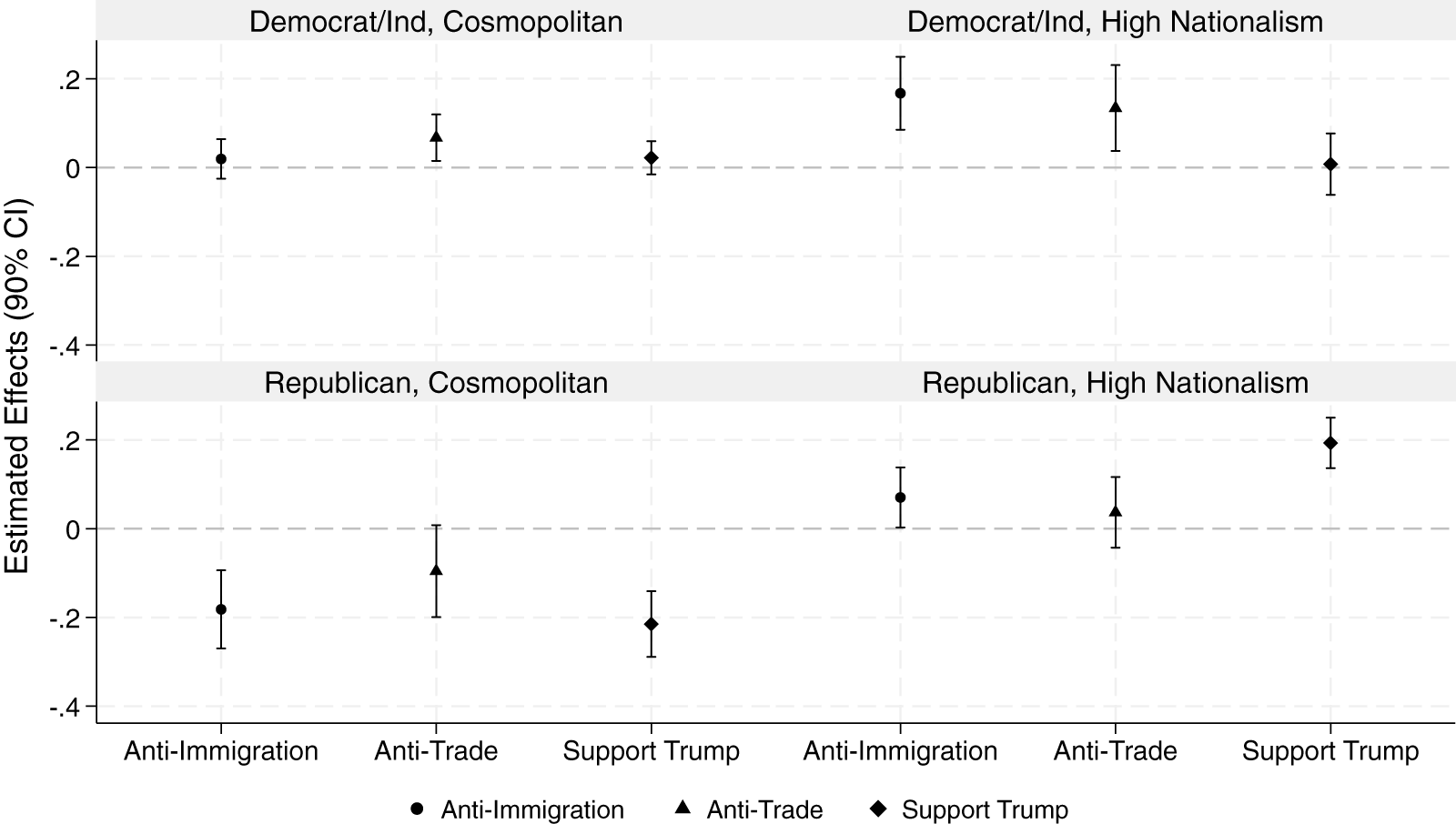
To probe the relationship between nationalism and partisanship more directly, models in Table 3 (Models 2–3, 5–6, and 8–9), and the corresponding estimates in Figure 3, fully interact the treatment with both variables, yielding four groups defined by the cross-classification of worldview (nationalist vs. cosmopolitan) and partisan identity (Republican vs. Democrat/Independent).
Treatment effect of exposure to foreign brands by nationalism level and partisanship

Table 3 Long description
Nine regression columns report coefficients and standard errors for three outcomes: Anti Immigration, Anti Trade, and Support Trump, each shown for OLS models 1 and 2 and an 2SLS model 3, repeated as models 4 to 6 and 7 to 9. For Treated equals Foreign, coefficients are 0.0216, 0.0571 with one star, and 0.0705 with one star for Anti Immigration; 0.0219, 0.0791 with two stars, and 0.0369 for Anti Trade; and 0.0109, 0.0781 with three stars, and 0.193 with three stars for Support Trump, with standard errors listed beneath each estimate. For Treated times Democrat or Ind, coefficients are minus 0.00966, minus 0.00765, and 0.0968 for Anti Immigration; minus 0.0244, minus 0.0784, and 0.0971 for Anti Trade; and minus 0.00524, minus 0.0853 with two stars, and minus 0.186 with three stars for Support Trump. Democrat or Ind main effects are negative across all outcomes and models, including minus 0.488 with three stars to minus 0.502 with three stars for Anti Immigration, minus 0.172 with three stars to minus 0.204 with three stars for Anti Trade, and minus 0.645 with three stars to minus 0.549 with three stars for Support Trump. Cosmopolitan interaction rows appear only in models 2 and 3, 5 and 6, and 8 and 9, including Treated times Cosmopolitan values such as minus 0.101 with one star and minus 0.252 with three stars for Anti Immigration, minus 0.151 with two stars and minus 0.133 with one star for Anti Trade, and minus 0.182 with three stars and minus 0.408 with three stars for Support Trump. Controls are marked with a check in 2SLS models 3, 6, and 9, and N is 3257 in every column. The bottom panel lists subgroup rows for Rep High Nationalism, Dem or Ind High Nationalism, Rep Cosmopolitan, and Dem or Ind Cosmopolitan, plus interaction tests for Partisanship and Nationalism, with values shown for each outcome and model.
Notes: All variables are binary (0–1), with 1 indicating stronger support for the statement questions. The 2SLS model includes controls for age, gender, education, income, and state fixed effects and incorporates weights.
* p < 0.10;
** p < 0.05;
*** < 0.001.
The results reinforce the primacy of nationalism while revealing nuanced partisan patterns. Nationalists in both partisan camps respond similarly: nationalist Republicans exposed to foreign brands become more anti-immigration (7 pp), more anti-trade (8 pp),Footnote 8 and more supportive of Trump (19 pp), while nationalist Democrats and Independents exhibit comparable increases in anti-immigration (17 pp) and anti-trade sentiment (13 pp).
Importantly, the anti-trade effect also extends to cosmopolitan Democrats and Independents. Although smaller in magnitude than among nationalist Democrats and Independents, this group still becomes significantly more anti-trade (7 pp). Thus, within the group of Democrats and Independents, both nationalist and cosmopolitan respondents move in the same (more trade-skeptical) direction, with nationalism amplifying rather than reversing the treatment effect.
This pattern is noteworthy because cosmopolitan Democrats and Independents generally express high internationalism and strong support for globalization in the pre-treatment data. That even this subgroup becomes more skeptical of trade suggests that the treatment may be activating a values-based critique of globalization rather than nationalist protectionism. One possibility is that foreign-brand exposure cues concerns about labor standards, human rights, or the distributional consequences of global supply chains—an interpretation consistent with arguments that opposition to trade can stem from fairness-oriented, ethical considerations rather than inward-looking economic nationalism (Ehrlich, Reference Ehrlich2018). In this sense, the response among cosmopolitan Democrats and Independents can be understood as a conditional and potentially regulatory form of trade skepticism, in which opposition reflects moral or institutional concerns about how globalization operates rather than cultural threat, producing a milder but still substantively meaningful shift in trade attitudes.
Cosmopolitans diverge more sharply within the Republican Party. Cosmopolitan Republicans move strongly in the opposite direction on two outcomes, becoming 18 pp less likely to favor restrictive immigration and 21 pp less likely to support Trump, while their trade attitudes remain flat or slightly negative but not significant. Cosmopolitan Democrats and Independents, by contrast, are distinctive in shifting only on trade: they remain essentially unchanged on immigration and Trump but become modestly more skeptical of trade when exposed to foreign brands.
Treatment effect of exposure to foreign brands by nationalism level and partisanship.

Figure 3 Long description
Four small plots arranged in a two by two grid. The top left plot title reads, Democrat slash Ind, Cosmopolitan. The top right plot title reads, Democrat slash Ind, High Nationalism. The bottom left plot title reads, Republican, Cosmopolitan. The bottom right plot title reads, Republican, High Nationalism. The vertical axis label reads, Estimated Effects left parenthesis 90 percent CI right parenthesis. The vertical axis shows tick labels at negative 0.4, negative 0.2, 0 and 0.2. A horizontal reference line is drawn at 0. The horizontal axis shows three category labels: Anti Immigration, Anti Trade, Support Trump. Each plot contains three point estimates with vertical confidence intervals, using three marker shapes that match the legend. The legend at the bottom shows: Anti Immigration with a filled circle marker, Anti Trade with a filled triangle marker, Support Trump with a filled diamond marker. Top left plot, Democrat slash Ind, Cosmopolitan: Anti Immigration point is slightly above 0. Anti Trade point is above 0. Support Trump point is slightly above 0. Top right plot, Democrat slash Ind, High Nationalism: Anti Immigration point is between 0.1 and 0.2. Anti Trade point is between 0.1 and 0.2. Support Trump point is at about 0. Bottom left plot, Republican, Cosmopolitan: Anti Immigration point is between negative 0.2 and negative 0.1. Anti Trade point is between negative 0.2 and 0. Support Trump point is between negative 0.3 and negative 0.2. Bottom right plot, Republican, High Nationalism: Anti Immigration point is between 0 and 0.1. Anti Trade point is slightly above 0. Support Trump point is near 0.2.
Joint Wald tests confirm that nationalism significantly moderates the effects of foreign-brand exposure on immigration and Trump support, with weaker but still meaningful evidence for trade. The bottom rows of Table 3 report these joint Wald test statistics, indicating whether treatment effects differ significantly across subgroups defined by nationalism and party. Party differences matter most within the cosmopolitan subgroup, producing the striking reversal for cosmopolitan Republicans and the finding that, among Democrats and Independents, both nationalist and cosmopolitan respondents exhibit positive treatment effects on trade, albeit of markedly different magnitudes.
Taken together, these results show that unconditional average effects are misleading: the null in Table 1 masks substantial polarization in Tables 2 and 3. Nationalists in both parties generally move toward more exclusionary, protectionist, and pro-Trump positions when exposed to foreign brands. Cosmopolitans, by contrast, may diverge by party: Republicans appear to shift in the opposite direction on immigration and Trump, while Democrats and Independents remain largely stable on those outcomes but exhibit a modest, potentially values-based increase in trade skepticism.
6. Conclusion
This article asks a straightforward but overlooked question: how do everyday encounters with foreign brands shape political attitudes toward globalization? Using a subtle and ecologically valid shopping experiment, we find null or modest effects in the pooled sample. Yet these averages conceal sharp heterogeneity. Once we account for nationalism, clear patterns begin to emerge: nationalists exposed to foreign SUVs become more supportive of neomercantilist and nativist policies, and more supportive of the populist right-wing candidate Donald Trump—while cosmopolitans remain largely stable or, if anything, move modestly in the opposite direction. These dynamics are not reducible to partisanship. Indeed, the sharpest divergence appears to occur within parties: high-nationalist Republicans and Democrats and Independents exhibit similarly exclusionary responses, while cosmopolitan Republicans move in the opposite direction by lowering support for restrictive immigration and Trump. Cosmopolitan Democrats and Independents, by contrast, shift modestly toward greater trade skepticism, though less strongly than their nationalist co-partisans.
These findings challenge the assumption that consumer framings alone can mitigate backlash against globalization (Naoi and Kume, Reference Naoi and Kume2011; Reference Naoi and Kume2015). Trade is not interpreted solely through producer or consumer identities. For nationalists, the economic benefits of trade—lower prices and greater product variety—are often overshadowed by identity-based concerns. Cosmopolitans, by contrast, may be more receptive to globalization’s consumption gains and sometimes respond by softening exclusionary stances, though not necessarily by increasing support for trade. Our results align with recent economic studies showing that consumption frames rarely boost support for trade, while employment-loss frames sharply reduce it (Rodríguez Chatruc et al., Reference Rodriguez Chatruc, Stein and Vlaicu2021; Stantcheva, Reference Stantcheva2023). We extend this work by showing that average null effects mask these divergent, identity-conditioned responses.
The implications are nonetheless important: even routine interactions with foreign products can activate nationalist schemas and spill over into exclusionary policy preferences. Everyday exposure to foreign goods may thus reinforce support for right-wing populists and deepen polarization over globalization. Cosmopolitans, by contrast, tend to remain stable on exclusionary outcomes or respond with modest openness, while in some cases exhibiting conditional trade skepticism. Our study complements elite-centric accounts of backlash (e.g., Mutz, Reference Mutz2021; Ballard-Rosa et al., Reference Ballard-Rosa, Goldstein and Rudra2024) by identifying a bottom-up mechanism: individual consumption experiences may also shape political preferences and contribute to polarization.
For policymakers, these results highlight the limits of emphasizing economic benefits alone. Messages about lower prices or greater variety may resonate with cosmopolitans but appear to do little for nationalists. Addressing nationalist resistance may instead require framing trade in terms of national strength, fairness, or reciprocity, rather than cosmopolitan openness. In short, persuasion strategies are likely to be identity-sensitive: what reassures cosmopolitans may harden nationalist opposition.
At the same time, our findings raise important scope conditions. Foreign-brand effects are likely to vary across contexts, product categories, and periods in which national identity is more or less salient. Extending this design to goods with different symbolic content, to industries tied to national security, and across multiple countries would help clarify when consumer cues are most politically consequential. Future research could also test mechanisms more directly—for example, by manipulating xenophobic or egocentric beliefs through double randomization—and refine consumption framings to ensure that only the intended treatment cue (brand origin) is activated, thereby avoiding inadvertent priming of unrelated identities or attitudes.
Finally, this study advances methodological debates by embedding experimental treatments in realistic consumer tasks. Our approach illustrates how designs that mimic everyday experiences can uncover subtle but politically consequential effects of globalization. By linking foreign-brand exposure to downstream attitudes, we highlight a potential channel through which international economic integration may reshape domestic politics—not only through labor markets or elite discourse but also through the everyday choices people make as consumers.
Acknowledgements
The authors acknowledge the use of AI tools limited to basic proofreading tasks.
Data availability statement
Replication data and code will be found in Harvard Dataverse upon publication.
Declaration of interests
The authors declare none.
Ethics and consents
The research meets all ethical guidelines. IRB approval at the University of Pittsburgh was obtained on August 12, 2022.
Funding statement
The authors have no funding to declare.
Supplementary material
The supplementary material for this article can be found at https://doi.org/10.1017/psrm.2026.10127.





 Open access

