


1. Introduction
The democratic peace theory, which posits that democratic nations are much less likely to wage war against other democracies, is one of the most prominent theories in international relations. While there are controversies and disagreements surrounding its veracity and the mechanism behind it, Tomz and Weeks (Reference Tomz and Weeks2013) found that this expectation also operates at the level of individual citizens, which, in turn, can constrain decision-making by liberal institutions. Recently, Rathbun et al. (Reference Rathbun, Parker and Pomeroy2024) delved into the motivations behind the public’s reluctance, hypothesizing that the concept of democracy is “racialized” and is associated with whiteness, and that this assumption drives the observed peace owing to a shared sense of racial and ethnocentric superiority. To support their hypothesis, the authors performed surveys, computational studies, and meta-analysis to test the degree to which the public associates democracies with whiteness.
The computational study of RPP (Rathbun Parker and Pomeroy, Reference Rathbun, Parker and Pomeroy2024) was unusual in the use of GloVe (Pennington Socher and Manning, Reference Pennington, Socher and Manning2014). Word vector techniques like word2vec (Mikolov et al., Reference Mikolov, Chen, Corrado and Dean2013) and GloVe transform words into vectors in a high-dimensional space that represent their semantics. Intuitively, in this vector space, embeddings of semantically similar words are located closer to each other than those that are not. Word embeddings have been widely applied to tasks like visualizing clusters of texts, searching for code snippets that fit a description, solving multiple-choice questions, and selecting similar words (Neelakantan et al., Reference Neelakantan, Tao, Puri, Radford, Han, Tworek, Yuan, Tezak, Kim, Hallacy, Heidecke, Shyam, Power, Nekoul, Sastry, Krueger, Schnurr, Such, Hsu, Thompson, Khan, Sherbakov, Jang, Welinder and Weng2022; Müller-Hansen Repke et al., Reference Müller-Hansen, Repke, Baum, Brutschin, Callaghan, Debnath, Lamb, Low, Lück, Roberts, Sovacool and Minx2023).
The implication of word embeddings in digital humanities and social science is that certain theories, provided they are not driven by a priori principles but instead pertain to human nature, may be empirically validated by quantifying the meaning of words. The implicit assumption is that the training corpus reflects the human patterns being studied. An obvious example of this includes revealing various types of cultural associations (including biases and stereotypes) in everyday or specialized texts—already extensively explored by prior works (Caliskan et al., Reference Aylin, Bryson and Narayanan2017; Garg et al., Reference Garg, Schiebinger, Jurafsky and Zou2018; Kozlowski et al., Reference Kozlowski, Taddy and Evans2019; Matthews et al., Reference Matthews, Hudzina and Sepehr2022; Sevim et al., Reference Sevim, Sahinuc and Koc2023)—which also fits the particular use case explored by RPP: Uncovering racial biases in democratic terms and their effect on the democratic peace.
In this replication paper, I scrutinize RPP’s embedding analysis and reveal numerous interpretability and statistical issues in their approach. Following up, I propose a new, improved study design in order to address most of the points I bring up. As an additional change, I use third-party foundational embedding models instead of GloVe. The architecture of embedding models, which consists of up to billions of parameters, is based on the designs of large language models (LLMs), which have seen a meteoric rise in relevance and popularity in recent days. Whereas traditional word vector techniques use small contexts and simple neural networks, LLM-based models use attention and thus are capable of modeling complex long-range word dependencies. With the advent of embedding models, traditional word vector techniques have become outdated in all practicality, as the newer models are much more powerful, sensitive, and sophisticated. This adds timeliness to my contribution, as RPP relied on the now-superseded GloVe word vectors in their embedding analysis.
My results support RPP’s hypothesis, which further reinforces their argument that the democratic public implicitly associates democracies with whiteness, which, in turn, underlies the observed peace effect. In my analysis of the results, I conduct ablation studies, comparing my method to RPP’s and that of Tomz and Weeks (Reference Tomz and Weeks2026), who replicated RPP’s results with alternative word lists and found contradictory results. In the process, I uncover several insights and pitfalls in the use of embedding analysis, which can benefit researchers interested in incorporating this technique in their toolkit.
2. Embedding analysis of Rathbun, Parker, and Pomeroy (2024)
The core intuition behind RPP’s embedding analysis is that, if racialization drives the democratic peace effect, the relationship between democracy and peace should diminish when democracy is associated with non-whiteness, and the opposite should be true for whiteness. The relations between the constructs are quantified using the cosine similarity between their vector estimates, which, in turn, are averages of related word vectors. In an approach reminiscent of the word embedding association test (WEAT) (Caliskan et al., Reference Aylin, Bryson and Narayanan2017), they defined four word lists to represent the constructs for democracy ( $\mathbf D$), peace (
 $\mathbf P$), white (
 $\mathbf W$), and non-white (
 $\overline{\mathbf W}$):
 \begin{align*}
& \mathbf D = \{\text{democracy},\ \text{democratic},\ \text{democratically},\ \text{elect},\ \text{elections},\ \text{elected}\}, \nonumber \\
& \mathbf P = \{\text{peace},\ \text{harmony},\ \text{agreement},\ \text{diplomacy}\}, \nonumber \\
& \mathbf W = \{\text{white},\ \text{western},\ \text{caucasian},\ \text{european}\}, \nonumber \\
& \overline{\mathbf W} = \{\text{non-white},\ \text{non-western},\ \text{non-caucasian},\ \text{non-european}\}. \nonumber
\end{align*}
RPP defines the “[t]otal similarity” between democratic and peace terms to be
 \begin{equation*}
s_d = \operatorname{sim}\left(\frac{\sum_{d \in \mathbf D}\operatorname{emb}(d)}{|\mathbf D|}, \frac{\sum_{p \in \mathbf P}\operatorname{emb}(p)}{|\mathbf P|}\right),
\end{equation*}
where  $\operatorname{sim}$ is the similarity function and
 $\operatorname{emb}$ is the embedding function. The “[s]imilarity fixing white” is defined as
 \begin{equation*}
s_w = \operatorname{sim}\left(\frac{\frac{\sum_{d \in \mathbf D}\operatorname{emb}(d)}{|\mathbf D|} + \frac{\sum_{w \in \mathbf W}\operatorname{emb}(w)}{|\mathbf W|}}2, \frac{\sum_{p \in \mathbf P}\operatorname{emb}(p)}{|\mathbf P|}\right).
\end{equation*}
Here, whiteness is “fixed” onto the democracy estimate by obtaining the mean of the two estimate vectors. The corresponding value for non-whiteness ( $s_{\bar w}$) is calculated by using
 $\overline{\mathbf W}$ instead of
 $\mathbf W$.
RPP calculated and plotted the three similarity values  $s_d$,
 $s_w$,
 $s_{\bar w}$, along with 90% and 95% confidence intervals. Compared to the baseline similarity between democracy and peace, a small increase in the similarity value (
 $+0.06$) was observed when the democracy estimate was fixed with whiteness, whereas a more notable decrease in the similarity value (
 $-0.17$) was observed when non-whiteness was fixed, in line with their expectations.
Now, several outstanding issues with RPP’s methodology are explored.
2.1. Nonlinearity of the word vector space
Word vector techniques represent a word as a vector in a high-dimensional vector space. Word vectors tend to exhibit locally linear substructures (Pennington Socher and Manning, Reference Pennington, Socher and Manning2014); however, by the manifold hypothesis, “an important perspective on representation learning,” complex real-world data is theorized to concentrate near “strongly nonlinear” lower-dimensional manifolds in their respective vector spaces (Bengio et al., Reference Bengio, Courville and Vincent2013). Jakubowski et al. (Reference Jakubowski, Gasic and Zibrowius2020) even suggest an alternate shape of a “pinched manifold” for word vectors. As a consequence of this global nonlinearity, the embedding distribution may twist or curve in space. This property presents a problem in RPP’s methodology, namely, in the averaging of word vectors.
In RPP’s study, the word vectors were averaged for two reasons. First, in order to generate a vector that estimates a particular construct, they averaged the word vectors of related words. For example, in order to obtain a reasonable estimate for “democracy,” they averaged the word vectors of “[d]emocracy terms: democracy, democratic, democratically, elect, elections, elected.” In a similar manner, the authors generated such vectors for “peace,” “white,” and “non-white” constructs. Second, to observe an in/deflation of the similarity between democracy and peace when racialized, they averaged the estimates for “white” and “democracy” to represent “white democracy.” The representation of “non-white democracy” was obtained identically. They are not the only ones to take this approach: the same was done by Garg et al. (Reference Garg, Schiebinger, Jurafsky and Zou2018) and Kozlowski et al. (Reference Kozlowski, Taddy and Evans2019), albeit for different purposes.
This is equivalent to sampling vectors from a distribution and averaging them (Figure 1 visualizes this process). If the manifold on which these vectors lie is linear, then the mean, regardless of what vectors are sampled, is guaranteed to lie on the same manifold by the definition of linearity. However, if the manifold is nonlinear, taking the average risks producing an out-of-distribution point. Traditional word vectors are not designed to be averaged for the mean vector to be interpreted as a word that holds some meaning. Indeed, it is unclear how one should interpret the semantics of a point that is located outside the word-vector distribution. One interpretation is that such an out-of-distribution vector has no coherent meaning that pertains to reality, whereas an in-distribution value is more likely to hold tangible semantics. Of course, out-of-distribution points could still be sound enough to allow embedding analysis to be properly conducted.
On the left, the mean of the sampled points lies on the original line (note that the line is a 1-dimensional manifold), whereas on the right, it does not.

That said, their methodology can be modified to avoid averaging entirely. Instead of averaging the word vectors and calculating similarities between these estimates, i.e.,
 \begin{equation*}
s' = \operatorname{sim}\left(\frac{\sum_{x \in \mathbf X}\operatorname{emb}(x)}{|\mathbf X|}, \frac{\sum_{y \in \mathbf Y}\operatorname{emb}(y)}{|\mathbf Y|}\right),
\end{equation*}
where  $\mathbf X,\mathbf Y$ are word lists, one can average the similarities from all pairwise combinations of terms related to two different constructs, i.e.,
 \begin{equation}
s = \frac{\sum_{(x, y) \in \mathbf X \times \mathbf Y}\operatorname{sim}(\operatorname{emb}(x), \operatorname{emb}(y))}{|\mathbf X||\mathbf Y|}.
\end{equation}
This avoids producing an out-of-distribution embedding, akin to the methodology of Caliskan et al. (Reference Aylin, Bryson and Narayanan2017).
Additionally, one advantage of embedding models is that any text—characters, words, phrases, sentences, paragraphs, and documents—can be projected as an embedding, whereas word vector techniques can only transform a single word to a vector. Using LLM-based embedding models, vector embeddings for a phrase like “white democracy” can be directly obtained instead of having to average estimates for “white” and “democracy.” Using the newly proposed methodology, the degree of association between “white democracy” and “peace” can be calculated simply by averaging the pairwise similarities of “white democracy” embeddings and “peace” embeddings. The same can be done to gauge the attenuation of peace tendencies for “non-white democracy.”
2.2. Static nature of word vectors
Traditional word vector techniques transform tokens into a static point. The term “static” in this context refers to the fact that each word is assigned to a single vector instead of multiple vectors for different contexts. Therefore, a word vector represents an amalgam of meanings over all of the contexts in which the word appears in the training set. For example, the word “white” could refer to white as in the color “white,” a “white” lie, or the “white” race. This concern prevented Kozlowski et al. (Reference Kozlowski, Taddy and Evans2019) from obtaining a cultural dimension on race, as words “white” and “black” carry a myriad of meanings, including those unrelated to race. To circumvent this, some prior works used common last names for different ethnicities (Caliskan et al., Reference Aylin, Bryson and Narayanan2017; Garg et al., Reference Garg, Schiebinger, Jurafsky and Zou2018; Matthews et al., Reference Matthews, Hudzina and Sepehr2022).
RPP handled polysemy largely in two ways. First, they used a corpus of political speeches to train the word vectors instead of a broader multidisciplinary collection of documents. As the vectors were trained on a politically themed dataset, the words’ usage would have been mostly limited to political contexts. With this restriction, it is reasonable to expect that the words’ vector representations hold a sharper and more focused meaning as it applies in politics. Additionally, RPP created a word list consisting of similar words and averaged their word vectors. Ignoring the interpretability issues with averaging, it is reasonable to expect the mean vector to contain a strong signal for the shared definition.
However, Tomz and Weeks (Reference Tomz and Weeks2026) found RPP’s word lists to be problematic, characterizing them as being “unofficial,” “ad hoc,” and unjustified. Instead, they proposed alternative word lists based on the United States government’s federal reporting guidelines,Footnote 1 and replicated their analysis, where the new word lists led to results that contradict RPP. In this paper, I perform observational studies using both sets of word lists to resolve this tension.
Additionally, as mentioned, RPP calculated an estimate of “(non-)white democracy” by averaging the estimates for “(non-)white” and “democracy.” This may not give rise to an acceptable representation of “(non-)white democracy” since it is possible that the “white” estimate is more similar to “peace” than the “non-white” estimate is to begin with, and this difference simply carries over even when they are averaged with the “democracy” estimate. If true, this possibility has the potential to invalidate the RPP results. In my ablation studies, I find weak evidence showing that this is the case.
The use of LLM-based embedding models provides a simple and convincing solution to all of these issues. The embedding for the phrase “(non-)white democracy” is a static vector that represents the entire phrase (not just the mean of each word in isolation). Also, instead of averaging the embeddings of terms related to “(non-)white democracy,” by averaging the similarities of all pairs of “(non-)white democracy” terms and “peace” terms, as suggested in my alternate methodology, the ambiguity introduced by averaging different words can be circumvented.
2.3. Bootstrapped confidence intervals
In obtaining the confidence intervals of the results, RPP performed evaluations over a thousand dictionary permutations, as done by Garg et al. (Reference Garg, Schiebinger, Jurafsky and Zou2018). Vallebueno et al. (Reference Andrea, Handan-Nader, Manning and Daniel2024) criticize that this approach is “computationally intractable on large datasets” and only “address[es] uncertainty from document or lexicon selection, even though embeddings are parameters of a data-generating process on word co-occurrences, not on collections of documents or sets of words.” Aside from their criticisms, the number of RPP’s terms for each construct of interest ranges from 4 to 6, which is too small to produce a sufficiently rich set of bootstrap samples. The word lists proposed by Tomz and Weeks (Reference Tomz and Weeks2026) do not add new democratic and peace terms, so the argument about the insufficient richness of bootstrap samples still holds. The same consideration also prevents one from conducting WEAT-style tests. (Caliskan et al., Reference Aylin, Bryson and Narayanan2017)
One way to address this is to use GloVe-V (Vallebueno et al., Reference Andrea, Handan-Nader, Manning and Daniel2024), which, aiming to directly address this challenge, integrates statistical uncertainty into the model, allowing error variance estimation and hence sounder confidence interval calculation. Unfortunately, the use of different LLM-based embedding models in this replication does not address this issue. That said, demonstrating that the same directional shifts occur consistently across most of the tested models would still serve as a strong empirical evidence in support of the hypothesis.
3. New methodology
In our observational study, the same base “white,” “non-white,” “democracy,” and “peace” terms used by RPP are used. However, “white” and “non-white” terms are never directly converted into embeddings, but instead are combined with the “democracy” terms to fix white or non-white information prior to encoding. The sets of terms considered in this analysis are shown below:
 \begin{align*}
& \mathbf D = \{\text{democracy},\ \text{democratic},\ \text{democratically},\ \text{elect},\ \text{elections},\ \text{elected}\}, \nonumber \\
& \mathbf P = \{\text{peace},\ \text{harmony},\ \text{agreement},\ \text{diplomacy}\}, \nonumber \\
& \mathbf W = \{\text{white},\ \text{western},\ \text{caucasian},\ \text{european}\} \times \mathbf D, \nonumber \\
& \overline{\mathbf W} = \{\text{non-white},\ \text{non-western},\ \text{non-caucasian},\ \text{non-european}\} \times \mathbf D. \nonumber
\end{align*}
Here,  $\mathbf D$,
 $\mathbf P$,
 $\mathbf W$, and
 $\overline{\mathbf W}$ are the set of democracy, peace, white-democracy, and non-white-democracy terms, respectively. Note that
 $\mathbf W$ and
 $\overline{\mathbf W}$ are the Cartesian products of (non-)white terms and democracy terms. For example, “western democracy” is a member of
 $\mathbf W$. I also repeated the analysis using the alternative set of word listsFootnote 2 from Tomz and Weeks (Reference Tomz and Weeks2026):
 \begin{equation*}
\mathbf W = \{\text{white}, \text{english}, \dots, \text{scottish}\} \times \mathbf D, \qquad
\overline{\mathbf W} = \{\text{asian}, \text{chinese}, \dots, \text{mayan}\} \times \mathbf D.
\end{equation*}
The average semantic similarity between democracy terms and peace terms is
 \begin{equation*}
s_d = \frac{\sum_{(d, p) \in \mathbf D \times \mathbf P}\operatorname{sim}(\operatorname{emb}(d), \operatorname{emb}(p))}{|\mathbf D||\mathbf P|}.
\end{equation*}
Here, all pairwise similarity values are calculated, which are then averaged to yield a single average semantic similarity value. The average similarity between white-democracy and peace terms ( $s_w$) and that between non-white-democracy and peace terms (
 $s_{\bar w}$) is calculated identically except that
 $\mathbf W$ and
 $\overline{\mathbf W}$ are used, respectively, instead of
 $\mathbf D$. Assuming that the similarity values are independent (which may not be safe), I also conducted the one-sided Welch’s t-test for the means of cosine similarities between white-democracy and peace embeddings (
 $s_w$) and their non-white counterparts (
 $s_{\bar w}$), and these results are relegated to the supplementary.
Embedding models are often tailored to different similarity functions, which can have different score scales. If they were to be plotted together, there is a need to “normalize” each value so they are of roughly equal magnitude. Before plotting, each average similarity was normalized as
 \begin{equation*}
s^*_w = \frac{s_w - s_d}{s_d}.
\end{equation*}
The corresponding value for non-white democracy  $s^*_{\bar w}$ is calculated by replacing
 $s_w$ with
 $s_{\bar w}$.
In the selection of third-party foundational embedding models, I aimed to curate a balanced mix of open-source and proprietary options. I selected all models offered by Google Gemini and OpenAI, as well as every recommended model from the SentenceTransformers library. The complete list of models is available in Table 1.
Average semantic similarities between peace and (non-)white democratic terms (curated by RPP) in foundational embedding models

Table 1 Long description
Semantic similarity scores are listed for 18 embedding models across three term sets: No race, White, and Non-white. In most models, the No race column is highest and the Non-white column is lowest, indicating lower similarity for Non-white democracy terms relative to the other two sets. Examples include all-mpnet-base-v2 (0.245, 0.206, 0.144), all-distilroberta-v1 (0.235, 0.195, 0.155), and multi-qa-distilbert-cos-v1 (0.195, 0.110, 0.100). OpenAI text-embedding-ada-002 shows high values across all three sets (0.800, 0.770, 0.764), while multi-qa-mpnet-base-dot-v1 is much larger than all other models (17.091, 15.988, 14.449) but follows the same ordering (this is because it uses a different similarity score). A few models deviate slightly, such as paraphrase-multilingual-mpnet-base-v2 where White (0.286) is marginally above No race (0.284), and paraphrase-albert-small-v2 where Non-white (0.216) is slightly above White (0.212). Within each model, the smallest value occurs most often in the Non-white column, but the absolute scale differs by model, so comparisons are most meaningful within a row rather than across different model families.
Note: The minimum value for each model is bolded.
Foundational embedding models used in this analysis are typically fitted from a general-purpose dataset across many subjects in both formal and informal contexts, with some in multilingual settings. This approach differs from the one RPP took, where a specialized corpus of English political speeches was used instead of pre-trained GloVe embeddings. Past works investigating the use of embedding analysis in political settings found that it is not necessary to specialize a model to yield sound results. Indeed, Rodriguez and Spirling (Reference Rodriguez and Spirling2022) found that pre-trained, unspecialized models frequently match the performance of or even outperform specialized models in several politically themed case studies. The fact that the goal of this study is to quantify the general public’s perception of democracies further justifies the choice of using pre-trained foundational models—certainly trained on everyday conversations during pre-training—instead of transfer learning.
4. New results
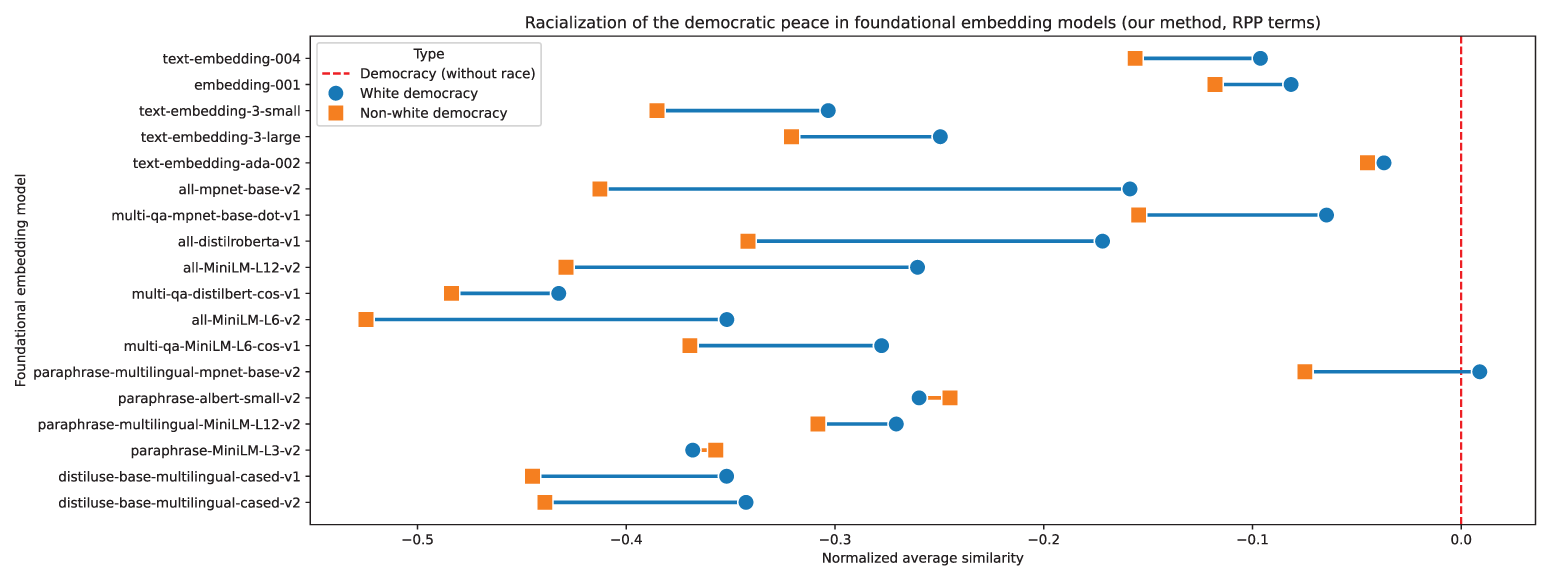
The average semantic similarities between peace and (non-)white democratic terms given by RPP are tabulated in Table 1, and their normalized values are plotted in Figure 2. In the plot, blue circles represent the normalized average semantic similarities between white-democracy and peace terms, while orange squares represent their non-white counterparts. The lines between them are colored blue for models in which white-democracy terms are more semantically similar to peace terms than non-white-democracy terms are. Otherwise, the lines are colored orange. The dotted red vertical line represents the base semantic similarity of peace and democracy terms. If a point lies to the left of the line, it means that the corresponding terms are, on average, less similar to peace terms than democracy terms are, and vice versa.
Normalized average semantic similarities between peace and white and non-white democratic terms, curated by RPP.

Figure 2 Long description
Racialization of the democratic peace in foundational embedding models (our method, RPP terms). Horizontal axis label: Normalized average similarity. Tick labels shown: negative 0.5, negative 0.4, negative 0.3, negative 0.2, negative 0.1, 0.0. A vertical dashed reference line is drawn at 0.0. Vertical axis label: Foundational embedding model. Model labels shown: text-embedding-004; embedding-001; text-embedding-3-small; text-embedding-3-large; text-embedding-ada-002; all-mpnet-base-v2; multi-qa-mpnet-base-dot-v1; all-distilroberta-v1; all-MiniLM-L12-v2; multi-qa-distilbert-cos-v1; all-MiniLM-L6-v2; multi-qa-MiniLM-L6-cos-v1; paraphrase-multilingual-mpnet-base-v2; paraphrase-albert-small-v2; paraphrase-multilingual-MiniLM-L12-v2; paraphrase-MiniLM-L3-v2; distiluse-base-multilingual-cased-v1; distiluse-base-multilingual-cased-v2. Legend title: Type. Legend entries: Democracy (without race); White democracy; Non-white democracy. White democracy is marked with circles. Non-white democracy is marked with squares. Each model row shows a circle and a square connected by a horizontal line segment. Most plotted points lie between negative 0.5 and negative 0.1 on the horizontal axis, with many points clustered around negative 0.4 to negative 0.2. Several points lie close to 0.0, including a circle slightly to the right of 0.0 for paraphrase-multilingual-mpnet-base-v2. Across many model rows, the circle is positioned to the right of the square on the same row. Several rows show the circle and square close together, while other rows show a wider horizontal separation. The widest separations are visible for all-mpnet-base-v2 and multi-qa-mpnet-base-dot-v1, where the circle is far to the right of the square. A small number of rows show the square positioned to the right of the circle, including paraphrase-albert-small-v2. Numeric values are not printed next to individual points.
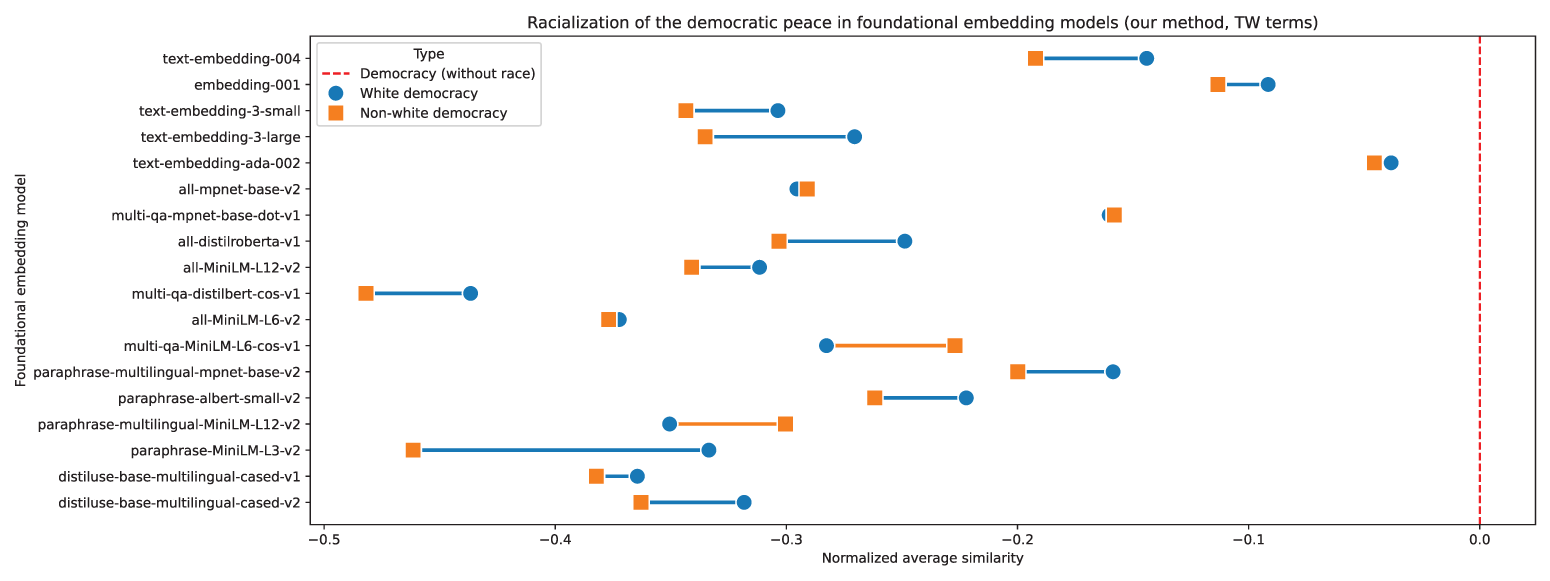
Sixteen out of 18 models exhibited the directional trend expected of the racialization of democratic peace, and the differences ranged from noticeably large to marginal. I repeated the study using the alternative set of word lists from Tomz and Weeks (Reference Tomz and Weeks2026), the normalized results of which are plotted in Figure 3. Here, 14 out of the 18 models exhibited the directional trend expected of the racialization of democratic peace, although the differences between white and non-white democratic terms were less than before.
Normalized average semantic similarities between peace and white and non-white democratic terms, curated by Tomz and Weeks (Reference Tomz and Weeks2026).

Figure 3 Long description
The scatter plot titled ′Racialization of the democratic peace in foundational embedding models (our method, TW terms)′ displays normalized average similarity on the horizontal axis, ranging from negative 0.5 to 0.0. The vertical axis lists various foundational embedding models, such as text-embedding-004 and text-embedding-ada-002. The plot includes three categories: Democracy (without race), White democracy and Non-white democracy, represented by different markers. Generally, White democracy points are closer to zero, indicating less negative similarity, while Non-white democracy points are more negative. Most values cluster between negative 0.35 and negative 0.15, with fewer points near the extremes. Notable models include text-embedding-004, which is closer to zero and multi-qa-mpnet-base-dot-v1, which is near negative 0.5. The legend explains the marker types for each category and a vertical dashed line at 0.0 serves as a reference point.
To summarize, using my methodology, a general directional trend that strongly supports RPP’s hypothesis is observed regardless of which word lists are used. Thus, my results agree with RPP but contradict Tomz and Weeks (Reference Tomz and Weeks2026). This introduces a new tension between my results and those of Tomz and Weeks, which I seek to resolve by ablating on my methodology.
4.1. Is averaging word embeddings wrong?
The two differences between my methodology and that of RPP are that a) I did not take the average of embeddings and b) I used embedding models instead of GloVe. To identify if taking the average gave rise to the aforesaid tension, I replicated RPP’s methodology with both sets of word lists while using foundational embedding models.
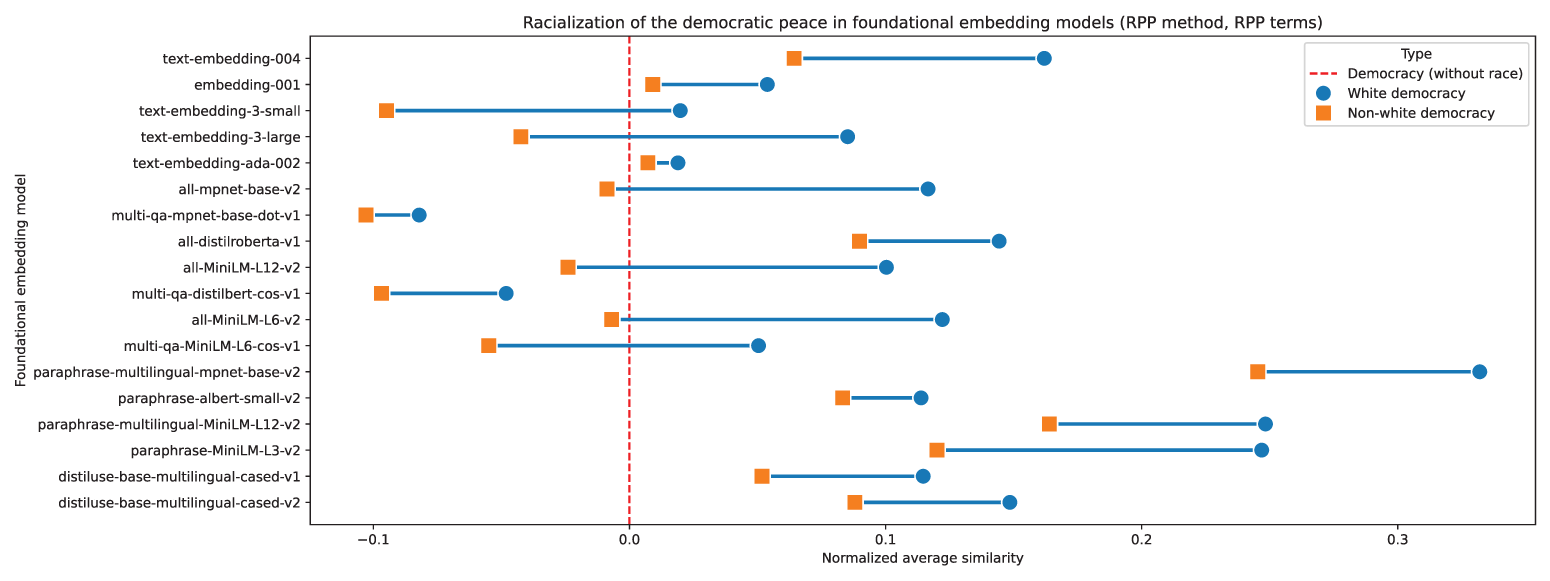
The normalized results with the original word lists and methodology from RPP are plotted in Figure 4. While the general directional trend is preserved, it is somewhat surprising to observe the general horizontal shift in the normalized similarity values. This suggests that interpreting the absolute similarity values when performing embedding analysis carries risks of making overreaching interpretations, as small changes in the methodology can give rise to wide shifts in the values. However, the offsets between the white and non-white scores are well-preserved despite this shift, which suggests that, when performing embedding analysis, it is much more advisable to make interpretations by comparing similarities relative to others.
Normalized semantic similarities between mean peace and white and non-white democratic embeddings, following the established method of RPP and their word lists.

Figure 4 Long description
The scatter plot titled ′Racialization of the democratic peace in foundational embedding models (RPP method, RPP terms)′ displays normalized average similarity on the horizontal axis, ranging from negative 0.1 to 0.3. The vertical axis lists foundational embedding models, including text-embedding-004, embedding-001, text-embedding-3-small, text-embedding-3-large, text-embedding-ada-002, all-mpnet-base-v2, multi-qa-mpnet-base-dot-v1, all-distilroberta-v1, all-MiniLM-L12-v2, multi-qa-distilbert-cos-v1, all-MiniLM-L6-v2, multi-qa-MiniLM-L6-cos-v1, paraphrase-multilingual-mpnet-base-v2, paraphrase-albert-small-v2, paraphrase-multilingual-MiniLM-L12-v2, paraphrase-MiniLM-L3-v2, distiluse-base-multilingual-cased-v1 and distiluse-base-multilingual-cased-v2. The plot includes data points for white democracy represented by blue circles and non-white democracy represented by orange squares, with a dashed red line indicating democracy without race. Most models show normalized average similarity values near zero, with white democracy generally exhibiting higher similarity than non-white democracy. Notable outliers include models with higher similarity values exceeding 0.3. The plot illustrates the racialization effect in embedding models, highlighting differences in similarity scores between white and non-white democracy.
Similarly, the results using the word lists from Tomz and Weeks (Reference Tomz and Weeks2026) and the methodology of RPP are plotted in Figure 5. The new plot showcases a result that is remarkably different from those in the previous plots: Whereas a clear directional trend was observable in all three previous plots, the directional trend in Figure 5 is mixed. Clearly, when the alternative word lists and RPP’s original methodology are used, the result does not seem to support RPP’s hypothesis, which aligns with the finding of Tomz and Weeks!
Normalized semantic similarities between mean peace and white and non-white democratic embeddings, following the established method of RPP, while using the word lists from Tomz and Weeks (Reference Tomz and Weeks2026).

Figure 5 Long description
Racialization of the democratic peace in foundational embedding models (RPP method, TW terms) Horizontal dot and line plot with a legend titled Type. Legend entries are Democracy (without race), White democracy and Non-white democracy. The y-axis is labeled Foundational embedding model. The listed categories, top to bottom, are: text-embedding-004; embedding-001; text-embedding-3-small; text-embedding-3-large; text-embedding-ada-002; all-mpnet-base-v2; multi-qa-mpnet-base-dot-v1; all-distilroberta-v1; all-MiniLM-L12-v2; multi-qa-distilbert-cos-v1; all-MiniLM-L6-v2; multi-qa-MiniLM-L6-cos-v1; paraphrase-multilingual-mpnet-base-v2; paraphrase-albert-small-v2; paraphrase-multilingual-MiniLM-L12-v2; paraphrase-MiniLM-L3-v2; distiluse-base-multilingual-cased-v1; distiluse-base-multilingual-cased-v2. The x-axis is labeled Normalized average similarity. The axis shows tick labels at minus 0.1, 0.0, 0.1, 0.2 and 0.3. A vertical dashed reference line is drawn at 0.0. For each model row, two markers are shown: one for White democracy and one for Non-white democracy. All rows include a horizontal line segment connecting the two markers, most of which lie between 0.1 and 0.3. Unlike in the previous plots, the general directional trend between white democracy and non-white democracy cannot be observed.
Thus, the source of the tension between my finding and Tomz and Weeks seems to be in the averaging of word embeddings, not in the use of foundational embedding models. If I establish that RPP’s original methodology is flawed, I would be able to resolve the tension between my result and that of Tomz and Weeks. In the next subsection, I establish this condition by demonstrating weak evidence that averaging word embeddings is an unsound practice.
4.2. Ignoring democratic terms
In order to gain more insight, I performed another ablation study, following RPP’s methodology, while ignoring the democracy estimate entirely. I simply calculated the similarity score between the peace estimate and the (non-)white estimates. The new values are plotted in Figure 6.
Normalized semantic similarities between mean peace and white and non-white embeddings (no democracy terms involved), following RPP’s established method.

Figure 6 Long description
The scatter plot titled ′Racialization of the democratic peace in foundational embedding models (RPP method, no democracy terms)′ displays normalized average similarity on the horizontal axis, ranging from negative 0.6 to 0.2. The vertical axis lists various embedding models, such as ′text-embedding-004′ and ′multi-qa-mpnet-base-dot-v1′. Data points are marked for ′White′ and ′Non-white′ categories, represented by circles and squares, respectively. A red dashed line at 0.0 indicates ′Democracy (without race)′. Most models show ′White′ points closer to zero, while ′Non-white′ points tend to be more negative, indicating a general trend of lower similarity for ′Non-white′. Notable separations are observed in models like ′all-MiniLM-L12-v2′, where the gap is significant. Clusters are visible in the negative similarity range, with few points near zero. The legend explains the symbols used for each category.
The new plot reveals a novel insight into the orientation of the estimates. The white and non-white estimates are, in general, no more similar to the peace estimate than the democracy estimate is. However, Figure 4 shows that, when the mean is taken between the (non-)white estimate and the democracy estimate, it yields a new vector that is much more similar to the peace estimate than both of its constituent vectors. This reveals that the vectors for (non-)white, democracy, and peace estimates are roughly coplanar and the peace estimate is an approximate angle bisector between the other two.
The new results also confirm one of the previous concerns: The white estimate is more similar to the peace estimate than the non-white estimate is, and this feature may have propagated to the estimate for “(non-)white democracy,” thus unduly influencing the RPP result. The results from this ablation study serve as weak evidence that generating an estimate by taking the average of word embeddings is flawed.
5. Discussion
When interpreting results from embedding analysis, there is a risk of making overreaching interpretations. As these models are trained on real-world data, which contains existing biases and stereotypes, the output word vectors may also encode such prejudice. This is especially true for multilingual models, which may encode stereotypes from different cultures that can leak to English word vectors, owing to the remarkable ability of LLMs to generalize. AI firms offering third-party embedding models often lack transparency about their training set, further making it challenging to judge the potential biases of their outputs. It is therefore important to be mindful of this shortcoming and acknowledge the black-box nature of embedding models.
Additionally, it is important to be careful not to invoke “self-fulfilling prophecies.” Certain theories may be extremely well-known to the extent that there are extensive discussions about them. When trained on data containing these discussions, the resulting embeddings may encode information about the hypothesis as latent features, which can give the impression that the pattern is truly reflected in the data.
6. Conclusions
In this paper, I analyzed the embedding analysis of Rathbun et al. (Reference Rathbun, Parker and Pomeroy2024) as part of their investigation on whether ethnocentrism underpins the peace effect in the democratic peace theory. I offered a systematic critique of their methodology and proposed a new modernized methodology addressing some of its issues. Overall, my replication supports RPP’s hypothesis on the racialization of the democratic peace and uncovers novel insights about the theory and practice of embedding analysis. It remains to be seen what other theories in political science can be supported by new computational tools like embedding analysis.
Supplementary material
The supplementary material for this article can be found at https://doi.org/10.1017/psrm.2026.10121.
Funding statement
The author has no relevant funding statement to declare.
Competing interests
The author has no relevant competing interests to declare.




 Open access

