


Introduction
Efforts to increase women’s political representation have increasingly moved beyond traditional gender quotas, usually formulated as minimum thresholds for women’s inclusion, toward the principle of gender parity, which aims for equal representation of women and men. As legislatures around the world adopt gender parity laws, including in France as well as several Latin American (Piscopo Reference Piscopo2016) and African countries (Tøraasen Reference Tøraasen2019), new questions arise about whether numerical gains translate into equal authority, especially regarding whose knowledge and perspectives are treated as legitimate within parliamentary deliberation. Reflecting a broader global movement for gender parity, recent scholarship argues that equality in politics must be understood not only in terms of access to political office, but also in terms of power, diversity, and influence once elected (Erikson and Josefsson Reference Erikson and Josefsson2022; Krook Reference Krook2026; Muriaas and Stavenes Reference Muriaas and Stavenes2024; Muriaas and Tøraasen Reference Muriaas and Tøraasen2026). Holding office is not sufficient for effective representation; representatives must also possess epistemic authority, that is, the recognized legitimacy to contribute knowledge, judgments, and perspectives to political decision-making. When some actors’ contributions are systematically discounted or confined to particular domains, formal inclusion may coexist with enduring inequalities in political influence. Earlier research on legislative institutions has shown that gaining access to elected office does not necessarily secure equal standing within political deliberation, as institutional practices may continue to silence, marginalize, or challenge the authority of historically underrepresented representatives (Hawkesworth Reference Hawkesworth2003).
Parity measures aim to balance representation by mandating a 50/50 gender split in decision-making bodies. They promise to reconfigure institutional cultures, aligning with republican ideals of depersonalized representation in which gender is embedded but not determinative. Still, while parity marks a clear shift in approaches to representation (Coffé, Saha, and Weeks Reference Coffé, Saha and Weeks2025), legislatures operating under parity regimes are not necessarily free from systemic patterns of exclusion or subtle constraints on whose experiences shape institutional norms and decision-making. The question remains whether parity reforms are sufficient to transform the institutional conditions under which political authority is recognized and exercised. Legacies of male-centered norms continue to structure expectations of political legitimacy, while persistent assumptions about how women should “act for women” reinforce role expectations that are difficult to transcend.
As the birthplace of parity legislation, France offers a critical lens on the tensions that emerge under conditions of institutionalized parity.Footnote 1 Rooted in a republican tradition that rejects group-based claims in favor of a singular, indivisible notion of citizenship, France’s approach to gender parity was advanced not in the name of diversity, but in the name of universalism itself (Bereni and Lépinard Reference Bereni and Lépinard2004; Krook, Lovenduski, and Squires Reference Krook, Lovenduski and Squires2009; Murray Reference Murray2013; Scott Reference Scott2019). France’s parity law was adopted in 2000, but its effects unfolded gradually and unevenly across election cycles. The 2017 legislative elections marked a significant breakthrough toward achieving gender balance. Women won 38.7% of the seats, a result enabled by three converging factors: stricter financial penalties for noncompliance, a new law limiting dual mandates, and the electoral success of Emmanuel Macron’s La République En Marche. En Marche had the most gender-balanced parliamentary group, with 48% women, and one of the youngest, with an average age of 46.2 years. Combined with a large influx of political newcomers, these developments resulted in 72% of the National Assembly being composed of first-time deputies and led to the replacement of many male incumbents by newly elected women (Achin et al. Reference Achin, Lévêque, Durovic, Lépinard, Mazur, Muriaas, Wang and Murray2019; Mazur et al. Reference Mazur, Lépinard, Durovic, Achin and Lévêque2020; Muriaas, Mazur, and Hoard Reference Muriaas, Mazur and Hoard2022; Ollion Reference Ollion2024).
France thus provides a valuable setting for examining how parity reforms reshape institutional norms, role expectations, and the distribution of political authority. While its republican tradition is distinctive, similar questions increasingly arise across legislatures shaped by parity reforms, making France a useful case for exploring broader dynamics of authority and inclusion. We ask: What role expectations do women deputies encounter when they assume office following a substantial increase in women’s numerical presence, especially in political contexts shaped by ideals of universalism and civic duty? We argue that women deputies confront an epistemic double bind: they are expected simultaneously to conform to universalist norms that downplay gender and to act as representatives of women’s experiences.
Research on parliamentary roles has long shown that representatives’ behavior is shaped by socialization and experience (Eulau et al. Reference Eulau, Wahlke, Buchanan and Ferguson1959; Searing Reference Searing1994). Studies of the French National Assembly further show that deputies often navigate between multiple and overlapping understandings of what it means to be a representative, which may shape their legislative priorities and strategies (Converse and Pierce Reference Converse and Pierce1979; Costa and Kerrouche Reference Costa and Kerrouche2009). While these studies provide important insights into the formation and enactment of representative roles, they tend to treat role adaptation as gender-neutral, thereby overlooking how gender conditions both the internalization and performance of these roles.
Building on debates about gender and political representation, this article brings four literatures into conversation. First, it engages feminist institutionalist scholarship on how institutional norms, practices, and cultures shape gendered experiences of political office (Chappell and Waylen Reference Chappell and Waylen2013; Erikson and Verge Reference Erikson and Verge2022; Krook and Mackay Reference Krook and Mackay2011; Mackay Reference Mackay2014). Second, it speaks to scholarship on republican universalism and gender in the French context (Achin et al. Reference Achin, Lévêque, Durovic, Lépinard, Mazur, Muriaas, Wang and Murray2019; Bereni and Lépinard Reference Bereni and Lépinard2004; Murray Reference Murray2013; Scott Reference Scott2019). Third, it contributes to research on epistemic authority and epistemic inequality in political institutions (Alcoff Reference Alcoff2010; Catala Reference Catala2025; Celis and Lovenduski Reference Celis and Lovenduski2018; Fricker Reference Fricker2007; Hawkesworth Reference Hawkesworth2003; Medina Reference Medina2013). Finally, it engages emerging work on gender parity that shifts attention beyond women’s access to office to questions of power, authority, and inclusion within political institutions once elected (Krook Reference Krook2026; Muriaas and Tøraasen Reference Muriaas and Tøraasen2026; Murray Reference Murray2026). Bringing these literatures together allows us to examine how institutionalized parity shapes not only descriptive and substantive representation but also the epistemic foundations of political legitimacy. By questioning the assumption that greater gender balance automatically translates into equal authority, the article demonstrates that parity reforms transform not only who is present in political institutions, but also how legitimacy, expertise, and political voice may be distributed within them.
Our analysis is explicitly theory-building rather than hypothesis-testing, using qualitative interview material to generate conceptual insights into representation under institutionalized parity. Empirically, the article draws on interviews with deputies elected after France’s 2017 elections. These accounts reveal how women deputies actively negotiate tensions between enduring republican universalism — which implicitly demands conformity to male-coded norms — and pluralist expectations that confine their authority to “women’s issues.” To analyze these patterned responses, we develop a typology of role expectations and strategic actions, capturing how deputies assert themselves and claim epistemic legitimacy while navigating conflicting demands of institutional legitimacy and gendered role assignment in a formally egalitarian setting. These dynamics reveal the epistemic double bind identified in this article, in which women must either suppress their gender to gain credibility or embrace it in ways that limit their authority to narrowly defined domains. This double bind constrains and reshapes women deputies’ representational strategies, revealing how parity regimes may reproduce exclusion in more subtle and institutionally embedded forms.
Our study extends feminist institutionalist work on gendered norms and informal hierarchies by showing how struggles over epistemic authority persist even in contexts marked by substantial advances in women’s descriptive representation. By foregrounding the epistemic dimension of representation — whose knowledge counts and under what conditions — we show that institutional cultures can sustain hierarchies even amid formal equality. At the same time, we argue that the aspiration of modern republicanism to embed gender in universal representation without making it determinative offers a valuable normative ideal. Though difficult to realize, it offers a compelling vision of inclusive authority that moves beyond the double bind: one where gender is embedded, yet neither erased nor essentialized.
Epistemic Authority in Parity Representation: A Theoretical Framework
Epistemic Authority and Representation
As outlined in the introduction, effective political representation depends not only on formal inclusion but also on epistemic authority: the recognition of representatives as legitimate contributors to political judgment and decision-making. Our focus here is on the social mechanisms through which epistemic authority is distributed unequally within representative institutions.
We draw on scholarship on epistemic injustice to examine how credibility and authority are shaped by social identities and institutional norms (Fricker Reference Fricker2007; Medina Reference Medina2013; Snoek Hauan and Anker Reference Snoek Hauan, Anker and von der Lippe2021). A central mechanism is testimonial injustice, which occurs when a speaker’s contributions are assigned less credibility because of identity-based assumptions rather than their actual competence or expertise. In political institutions, this can affect whose interventions are taken seriously, whose perspectives are sought out, and whose knowledge shapes collective decisions.
At the same time, marginalization is not the only way epistemic authority is structured. Catala’s (Reference Catala2025) concept of epistemic privilege highlights how members of historically marginalized groups may be granted authority in areas associated with their perceived identity. In parliamentary settings, women representatives may thus be expected to contribute particular expertise on issues concerning gender equality, care, families, or social policy. While such expectations can create opportunities for influence, they may also narrow the range of issues on which women are recognized as legitimate political actors. Epistemic privilege may also contribute to a gendered division of representative labor: when women are present in larger numbers, male legislators may defer to them as the more credible advocates of women’s interests and correspondingly reduce their own substantive engagement with feminist issues (Höhmann Reference Höhmann2020).
This perspective shifts attention from representation as numerical presence to representation as a question of authority. In this sense, epistemic authority concerns not only who is present within political institutions, but whose knowledge and perspectives are treated as legitimate in processes of representation (Celis and Lovenduski Reference Celis and Lovenduski2018). Even where women gain access to elected office in significant numbers, inequalities may persist in whose knowledge is considered relevant, credible, and politically consequential. The challenge of parity, therefore, is not only to increase women’s numerical presence but also to transform the epistemic hierarchies through which political authority is recognized and exercised.
Gendered Institutions and the Persistence of Authority Hierarchies
Feminist institutionalist scholarship provides important insights into why inequalities may persist under conditions of formal equality. Political institutions are not simply arenas in which actors compete under neutral rules; they are shaped by informal norms, organizational cultures, and historical legacies that privilege particular ways of behaving, speaking, and exercising authority (Chappell and Waylen Reference Chappell and Waylen2013; Krook and Mackay Reference Krook and Mackay2011; Mackay Reference Mackay2014).
From this perspective, parity reforms may alter the composition of political institutions without fully transforming the informal practices through which authority is allocated and recognized. Political institutions do not merely constrain behavior; they also socialize representatives into prevailing understandings of appropriate conduct and legitimate authority (Lowndes Reference Lowndes2020). Institutions reproduce expectations about what competent leadership looks like, how political authority should be performed, and whose contributions are considered authoritative. As a result, political competence often continues to be measured against an implicit image of the “ideal politician” associated with traditionally masculine forms of leadership and authority (Bjarnegård and Murray Reference Bjarnegård and Murray2018). Because these norms developed in contexts where political power was overwhelmingly held by men, they frequently retain a masculinized character even after women’s representation increases substantially.
Research on political institutions consistently finds that women continue to encounter expectations associated with masculine ideals of leadership and credibility (Bjarnegård and Murray Reference Bjarnegård and Murray2018; Lovenduski Reference Lovenduski2005; Rai and Spary Reference Rai and Spary2018). Women may therefore be formally included while remaining disadvantaged in struggles over recognition, influence, and legitimacy. This helps explain why substantial gains in descriptive representation do not automatically produce equal standing within parliamentary life.
While feminist institutionalism has generated extensive knowledge about participation, recruitment, and institutional change, questions of epistemic authority have received comparatively less attention. Recent work has begun to address this gap by examining women’s discursive agency within political institutions (Kostovicova and Popovski Reference Kostovicova and Popovski2023) and the processes through which certain issues and forms of experiential knowledge become recognized as politically legitimate (Erikson and Josefsson Reference Erikson and Josefsson2019; Kroeber et al. Reference Kroeber, Stephan, Dingler and Montero2026). These studies draw attention to important epistemic dimensions of representation, including whose perspectives are treated as credible and whose contributions are granted authority. Building on these insights, we examine how credibility, expertise, and legitimacy are negotiated under conditions of institutionalized parity, where numerical inclusion may coexist with continuing struggles over recognition and authority.
Republican Universalism, Pluralism, and the Epistemic Double Bind
To understand these dynamics in the French National Assembly, it is necessary to consider the competing normative traditions that shape expectations of political representation.
The first is republican universalism, a tradition that conceives representatives as acting on behalf of the nation as a whole rather than representing particular social groups. In this view, political legitimacy rests on the ability to transcend particular identities and pursue the general will. French parity reform was largely justified within this framework: women’s exclusion from political office was interpreted not as a problem of insufficient diversity, but as evidence that the Republic had failed to fulfill its universalist commitment to equal citizenship (Bereni and Lépinard Reference Bereni and Lépinard2004; Scott Reference Scott2019). Proponents of parity argued that democratic representation could not legitimately claim to speak for the nation while excluding half of its citizens from elected office. Parity was therefore presented as a means of restoring the universalist promise of citizenship rather than advancing a group-based claim (Bereni and Lépinard Reference Bereni and Lépinard2004; Scott Reference Scott2019).
This framing was also politically strategic. Earlier efforts to introduce gender quotas had been criticized as incompatible with the constitutional principles of republican universalism, leading parity advocates to argue that reform constituted a fulfillment rather than a rejection of republican ideals (Bereni and Lépinard Reference Bereni and Lépinard2004; Scott Reference Scott2019). Women’s exclusion was thus taken as evidence that the supposedly universal representative had, in practice, been implicitly male. Parity sought to correct this democratic inconsistency while preserving the ideal of a common political community in which women and men participated equally in representing the nation (Murray Reference Murray2013).
The second is a pluralist understanding of representation associated with scholars such as Young (Reference Young1989), Phillips (Reference Phillips1998), and Mansbridge (Reference Mansbridge1999). This perspective argues that social groups occupy different positions in society and therefore possess distinct experiences and forms of knowledge. Inclusion matters not only because it broadens access to office but also because it expands the range of perspectives represented in political decision-making. Yet parity’s institutionalization did not resolve the tension between these two traditions. As women’s presence in elected office increased, the question remained whether representatives should be recognized as gender-neutral citizens or as carriers of distinct social experiences.
These traditions imply different expectations regarding gender and political authority. Republican universalism encourages representatives to downplay identity-based distinctions and embody a universal political role. Yet critics have long noted that republican claims to neutrality have often rested on implicitly masculinized norms of political authority (Scott Reference Scott2019; Sénac Reference Sénac2015). Historically, political competence and public authority were associated with male experience, while women were assigned a complementary role outside the political sphere (Bergès Reference Bergès2019). As a result, standards of political competence that appear neutral often reflect masculine experiences and modes of authority. Women may therefore be expected to embody universalism while simultaneously being judged against norms that emerged in institutions from which they were historically excluded (Puwar Reference Puwar2004).
Pluralist approaches place greater value on representatives’ ability to articulate experiences rooted in social position, including gender. We argue that women deputies in parity systems may find themselves frequently located at the intersection of these competing expectations. On the one hand, they are encouraged to demonstrate neutrality and universality in order to be recognized as full representatives. On the other hand, they are often expected to contribute specifically gendered perspectives and to act as representatives of women as a social category. This raises the question of whether a more inclusive form of republican representation is possible, one in which gender remains politically relevant without becoming the defining basis of authority.
To capture this tension, we develop the concept of the epistemic double bind. The epistemic double bind refers to a structural condition in which women deputies must simultaneously conform to universalist expectations that render gender irrelevant and to pluralist expectations that make gender politically salient. Neither position fully resolves the problem of authority. Suppressing gender may facilitate recognition within existing institutional norms but can require conformity to historically masculinized standards of legitimacy. Conversely, emphasizing gendered experience may generate authority precisely because women are assumed to possess distinctive knowledge derived from their social position. Yet such recognition can confine them to a narrower range of policy areas and representative functions. Women deputies may thus gain authority as representatives of women while finding it more difficult to be recognized as authoritative representatives in general.
The concept of the epistemic double bind therefore provides a framework for understanding how authority is negotiated in institutionalized parity institutions. Rather than assuming that parity automatically produces epistemic equality, it directs attention to the contradictory expectations through which women seek legitimacy, recognition, and influence within formally inclusive political settings. In doing so, it highlights how institutionalized parity may transform patterns of exclusion without necessarily eliminating them, generating new tensions around who is recognized as a legitimate knower and representative within democratic institutions.
Data and Methods
This study adopts an abductive, theory-building design in which empirical material and existing theory are brought into iterative dialogue (Timmermans and Tavory Reference Timmermans and Tavory2012). Rather than testing predetermined hypotheses, the analysis seeks to develop conceptual insights into representation under conditions of institutionalized parity. The analytical framework (presented in the next section) was therefore not specified in advance as a deductive model, nor was it derived solely inductively from the interview material. Instead, we moved back and forth between theory and data throughout the research process. Concepts from feminist institutionalism, republicanism, political representation, and epistemic injustice informed our initial reading of the interviews, while recurring patterns in deputies’ accounts prompted us to refine these concepts and develop new analytical categories.
The empirical material was collected by both authors during an extended research stay in Paris, culminating in qualitative fieldwork in the French National Assembly. Between January and March 2024, we conducted in-depth interviews with 24 current and former deputies, including 19 women and 5 men. The sample spans the political spectrum and includes representatives at different stages of their parliamentary careers, ranging from first-time deputies to long-serving members. To capture perceptions of institutional change over time, we also interviewed former deputies who served both before and after the implementation of parity reforms.
The French National Assembly provides a particularly relevant setting for studying representation under institutionalized parity. Following the 2017 legislative elections, women occupied 38.7% of seats, marking the most substantial increase in women’s representation since the adoption of the parity law in 2000. Combined with an unprecedented influx of parliamentary newcomers, these developments created a context in which established norms and role expectations were increasingly contested and renegotiated.
Interviews were conducted primarily in French, then anonymized and translated into English. Current deputies were contacted through their official parliamentary email addresses. Former deputies were recruited through public contact information, party networks, and snowball sampling. Interviews were semistructured and ranged from 30 to 190 minutes in length. Topics included parliamentary roles, institutional culture, gender equality, experiences of authority and influence, and strategies for political advancement and retention (see Appendix 1 for the interview guide).
The interview material was coded in NVivo using a combination of deductive and inductive coding procedures (Kantola et al. Reference Kantola, Elomäki, Gaweda, Miller, Ahrens and Berthet2023). Initial coding categories were informed by existing literature on representation, institutions, and gender, while additional themes emerged through repeated engagement with the data. Throughout the analysis, particular attention was paid to how deputies described legitimacy, credibility, expertise, and role expectations within parliamentary life.
Analytical Framework: Navigating the Epistemic Double Bind
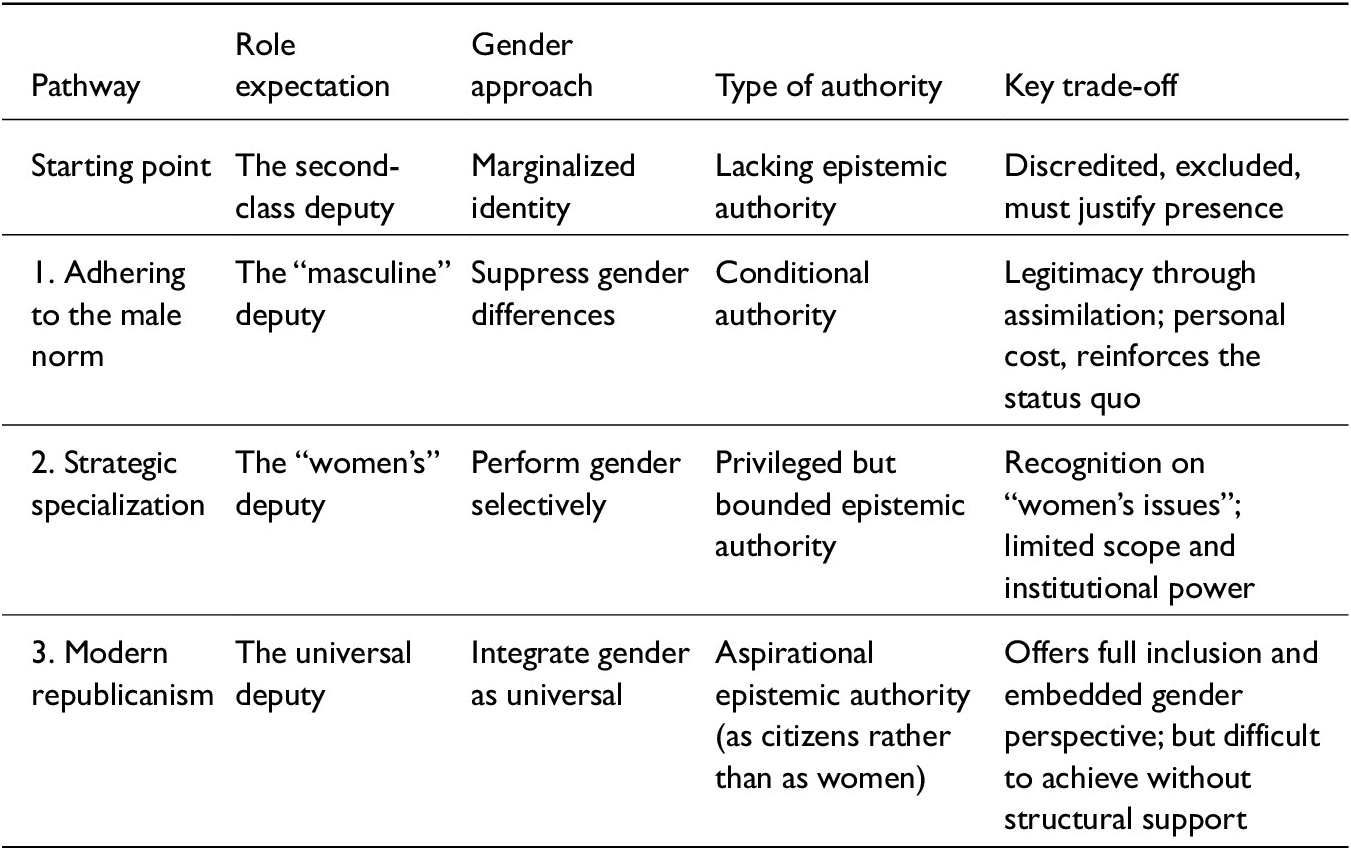
These patterns informed the development of an analytical framework consisting of an initial condition or starting point (the second-class deputy), and three ideal-typical pathways through which women deputies seek recognition and authority: adhering to the male norm (the masculine deputy), strategic specialization (the women’s deputy), and modern republicanism (the universal deputy). Together, these categories illuminate how women navigate the epistemic double bind within parliamentary institutions. The framework begins from the observation that formal inclusion does not necessarily confer equal epistemic standing: representatives may enter office on equal formal terms yet encounter unequal expectations concerning competence, legitimacy, and the range of issues on which they are recognized as authoritative.
The starting point of the second-class deputy refers to a situation in which representatives experience diminished epistemic authority and encounter difficulties gaining recognition as fully legitimate political actors in a traditionally male-dominated institution. In this position, authority is uncertain, contributions may be discounted, and deputies may feel compelled to justify their presence and competence to a greater extent than their male colleagues. From this starting point, deputies may pursue three broad pathways for establishing authority.
The first pathway, adhering to the male norm, corresponds closely to traditional expectations embedded within historically masculinized political institutions. Here, authority is sought through conformity to established norms of political behavior and leadership. Gender differences are downplayed in favor of appearing as a neutral and universal representative. While this pathway may facilitate institutional acceptance, the authority it provides remains conditional on successful assimilation to existing standards.
The second pathway, strategic specialization, involves embracing gendered experiences and perspectives as a source of political legitimacy. In this pathway, deputies draw upon forms of epistemic privilege associated with women’s representation, positioning themselves as particularly authoritative on issues connected to gender equality or women’s lives. This strategy can provide visibility and influence but may simultaneously narrow the range of issues on which deputies are recognized as legitimate political actors.
The third pathway, modern republicanism, reflects the normative promise often associated with parity reforms themselves. Rather than suppressing gender or strategically emphasizing it, this pathway seeks to integrate gender into a broader understanding of universal representation. Authority derives neither from conformity to male-coded norms nor from exclusive claims to gender-based expertise, but from recognition as a representative whose perspectives are legitimate across policy domains regardless of gender. In this model, gender matters politically without becoming the defining basis of authority.
These pathways should not be understood as mutually exclusive or as stable identities. Deputies may move between them over time, combine elements of different strategies, or confront contradictory expectations simultaneously. The framework therefore captures recurring patterns of institutional negotiation rather than discrete categories of representatives. As illustrated in Table 1, it provides a lens for analyzing how authority may be pursued, recognized, and constrained, and how women deputies navigate the epistemic double bind under conditions of institutionalized parity.
Strategic pathway model: Navigating role expectations and epistemic authority

Table 1. Long description
The table consists of five columns: Pathway, Role expectation, Gender approach, Type of authority, and Key trade-off.
* Starting point: Role expectation is The second-class deputy. Gender approach is Marginalized identity. Type of authority is Lacking epistemic authority. Key trade-off is Discredited, excluded, and must justify presence.
* 1. Adhering to the male norm: Role expectation is The masculine deputy. Gender approach is Suppress gender differences. Type of authority is Conditional authority. Key trade-off is Legitimacy through assimilation, personal cost, and reinforces the status quo.
* 2. Strategic specialization: Role expectation is The women’s deputy. Gender approach is Perform gender selectively. Type of authority is Privileged but bounded epistemic authority. Key trade-off is Recognition on women’s issues, limited scope, and institutional power.
* 3. Modern republicanism: Role expectation is The universal deputy. Gender approach is Integrate gender as universal. Type of authority is Aspirational epistemic authority as citizens rather than as women. Key trade-off is Offers full inclusion and embedded gender perspective, but difficult to achieve without structural support.
Findings: Gender and Epistemic Authority in the National Assembly
The interview material suggests that increased numerical representation has not automatically translated into equal epistemic standing within the National Assembly. Many women deputies described having to prove their competence and legitimacy in ways their male colleagues did not. Their accounts illuminate how the epistemic double bind is experienced and negotiated in everyday parliamentary life. We begin with the condition of the second-class deputy before turning to three recurring responses identified in the data.
From Inclusion to Marginalization: The Second-Class Deputy
Empirically, the “default” second-class deputy role was expressed through recurring experiences of exclusion from influential networks, limited access to informal arenas of power, and a persistent need to establish credibility and legitimacy. These experiences were reported across parties and levels of seniority, although their intensity and expression varied between deputies, suggesting that formal inclusion through parity does not automatically translate into epistemic authority.
Women we interviewed reported exclusion from informal spaces where real influence is exercised. One newly elected deputy described enduring “networks of cronyism,” where “contracts are signed and political proposals are made … from which we women are excluded” (Female Deputy, Left #20). Such exclusionary networks confer homosocial capital to men while sidelining women (Bjarnegård Reference Bjarnegård2013).
Such marginalization is reinforced by outdated parliamentary informal rules, which continue to reflect a male-dominated political culture. One deputy observed:
There are 37% women … But the political space is still very masculine, despite more women in more political groups. [It is] still old [informal] rules that exist … There are no rules for how women shall dress, because it is traditionally a space for men … The rules represent the old France. It lacks to take up what France is today … France is turning more modern, but the Assembly is still a museum … (Female Deputy, Left #21)
Many deputies described a persistent need to “justify” their presence and noted how disagreement could trigger gendered attacks. “As soon as people don’t agree with you,” one senior deputy said, “they very quickly slip into misogynistic attacks” (Female Deputy, Right #1). These dynamics reflect testimonial injustice, whereby women’s credibility is questioned and their contributions are accorded less authority (Catala Reference Catala2025). Even deputies in senior positions described the culture as “sexist,” “masculine,” and at times “brutal.” One newcomer summed it up: “[There is] a lot of sexism in the National Assembly, a lot of aggression, which is very visible … Even though some women reach some important positions, it is still very masculine and ‘rough’ and not very open to women” (Female Deputy, Left #14).
This questioning of credibility extended beyond the Assembly. Women of color described intersectional exclusion, facing both racism and sexism in the form of public harassment and threats. One deputy recounted receiving racist letters while working on immigration policy: “So the fact of being a woman, of being black … In fact, sometimes it is complicated.” She also recalled getting a lot of “insults” when making interventions in the hemicycle that criticize the far-right party Rassemblement National (Female Deputy, Centre #08). Such experiences underscore the intersectional nature of political exclusion. As Puwar (Reference Puwar2004) argues, women of color may represent a “double threat” to the traditional white, male norm — making them especially visible targets and more likely to fall into the role expectation of the second-class deputy within gendered institutions.
A gendered distribution of leadership roles further illustrates the power hierarchy in the National Assembly. While symbolic breakthroughs like Yaël Braun-Pivet’s election as the first woman president of the National Assembly in 2022 were celebrated, many women remain concentrated in lower-prestige roles. While they have attained positions of authority in large numbers, these positions tend to have less influence and visibility, such as vice-presidencies (compared to presidencies) and secretarial posts, which, although leadership positions within the Assembly Bureau rather than clerical roles, remain less visible than the institution’s most prestigious offices.Footnote 2 Their leadership is more common in committees focused on social affairs or gender, rather than high-status areas like Finance, which has never had a woman president (Assemblee-nationale.fr). This pattern reinforces the perception that women’s expertise belongs in “feminine” policy domains, limiting their broader authority and career advancement (Murray and Sénac Reference Murray and Sénac2018).
Still, some experienced deputies described a gradual change in their status. Senior women recalled being interrupted more often early in their careers and encountering more blatant sexism in the 1990s. They noted some improvement over time, particularly in the visibility of women’s issues and increased recognition of women’s presence. One deputy noted that the gendered dimensions of parliamentary life were more visible and more frequently discussed than in the past (Female Deputy, Right #24). While some of the observed change may be attributed to women’s presence becoming normalized, and to women’s active resistance against discriminatory practices, it may also reflect the improved individual experiences of senior women, whose longer tenure may have earned them greater expertise, respect, and confidence. This may have limited some of the challenges and discriminatory practices often encountered by less experienced and younger women deputies (Erikson and Josefsson Reference Erikson and Josefsson2022). In fact, several newcomers expressed frustration at navigating institutions not built with them in mind, and some had already considered leaving politics. Others, by contrast, managed to avoid the second-class role by aligning with dominant norms, claiming epistemic privilege, or embodying a more modern version of the republican deputy. These alternative roles — and their costs and opportunities — are explored in the sections that follow.
Legitimacy Through Conformity: Adhering to the Male Norm
Many interviewees described adapting to established parliamentary norms as a way of gaining legitimacy and recognition. Rather than being excluded outright, they sought acceptance by demonstrating that they could meet institutional expectations of what a competent deputy should be. In practice, this often meant embracing norms rooted in a historically masculine political culture (Itzkovitch-Malka and Oshri Reference Itzkovitch-Malka and Oshri2024; Murray Reference Murray2026).
These expectations were particularly visible in interviewees’ descriptions of parliamentary work, which reflected long-standing informal rules about what it means to be a “real” deputy. In the National Assembly, this meant treating the role not as a job but as a lifestyle — marked by constant availability, personal sacrifice, and dual presence both in Paris and in the constituency. Deputies recounted how they must be visible, accessible, and present — at all hours and across all domains. During interviews, we observed fold-out beds in parliamentary offices, while deputies complained of a lack of childcare and limited parental leave. These are not just logistical challenges; they are institutional signals that success depends on subordinating personal life to political life.
The strain on family life was widely acknowledged. Both men and women spoke of the deputy role’s incompatibility with caregiving, but the cost was higher for women, who still carry the greater share of domestic responsibilities in France. Coping strategies varied: some postponed careers until children were older, others relied on a supportive spouse, and some chose not to have children at all. “You must sacrifice your family” or “You must be able to leave your life behind,” as quite a few deputies stated (Male Deputy, Right #22; Male Deputy, Right #10; Female Deputy, Left #18). As another noted, “Taking care of the family is a ‘profession’ for women, but we don’t talk about that” (Female Deputy, Left #18). One male deputy talking about his colleague simply said: “She manages because her husband and the grandparents are there to back her up. But the demands of the job—what I do as an MP—make me wonder if a woman with family responsibilities could handle it in quite the same way” (Male Deputy, Left #12).
Adapting to the male norm may help women deputies survive politically but often requires downplaying gendered knowledge and experiences. While most senior deputies highlighted the need for developing expertise in a given topic to become an indispensable resource in the National Assembly, it was argued that this area of expertise should not be on women’s rights. Several senior women deputies warned against focusing too much on such topics, noting that doing so could hinder rather than help a political career. A male parliamentary assistant remarked, “I do not think that, unfortunately, dealing with gender equality is a competitive advantage for MPs” (Male parliamentary assistant, Centre #19). These issues were frequently dismissed as “niche” or disconnected from voters’ priorities (Female Deputy, Right #1), making them less attractive for deputies aiming to build influence and longevity in the Assembly.
While downplaying women’s gendered knowledge, some women deputies were seen as actively “acting like men” in order to prosper in parliament. As stated by one woman deputy: “… I think there are many women who do politics the way men do, in order to be co-opted, to be accepted into that masculine world. And it works very well for them; they get excellent positions…” (Female Deputy, Right #1).
This strategic assimilation can foster survival and even influence, but it reinforces rather than transforms existing power structures. Deputies may gain credibility, but only by disavowing or downplaying gendered knowledge, and by internalizing a model of political endurance that continues to marginalize caregiving and other “non-normative” life paths. The pathway offers epistemic authority — but on highly constrained terms.
Privileged but Bounded: Performing Gendered Expertise
The role expectation of strategic specialization was evident in interviewees’ accounts of issue ownership and political responsibility. Deputies frequently described a strong obligation to advocate for women and advance gender equality, even within a political system that officially rejects identity-based representation. Many women, along with one male colleague, emphasized that promoting gender equality was a core part of their work. As one deputy put it, “As long as we haven’t achieved equality, until everyone is finally at the same level, we must continue the fight.” Deputies identified abortion, gender-based violence, and parental leave as central concerns, but noted that these topics are still typically raised by women alone.
The expectation of epistemic privilege (see Catala Reference Catala2025) can enhance voice in certain areas, but it also marks those issues as peripheral to the political core. Interviewees repeatedly said that women deputies were the ones who raised these issues. “Unfortunately, the vision about gender equality wouldn’t be there without women and that is sad” (Female Deputy, Centre #11). Another deputy observed:
When I arrived (in 2017), I thought that these (gender) issues were discussed. However, the reality is that even in political group meetings, if certain women don’t put the issues forward, they aren’t discussed. And that’s why it’s important, I believe, to first have parity and to put forward these issues… I have the impression that men aren’t very interested. I have the impression that you have to force them. (Female Deputy, Left #20)
These accounts point to a gendered specialization of representative labor. As women come to be seen as the most credible and authoritative voices on gender equality, responsibility for these issues increasingly falls to them. Rather than expressing overt opposition, male deputies may defer to their female colleagues rather than engage with feminist concerns themselves, a dynamic also observed in the German Bundestag (Höhmann Reference Höhmann2020). In this sense, epistemic privilege can produce a specialization mechanism: the very recognition of women’s expertise strengthens expectations that such issues belong primarily within women’s representative domain. As one male MP commented: “Women bring their own specificity. Of course, women are often much more concrete and close to things and people. Look at men sometimes, they’re not… very nice. And so I think it would be good if there were women” (Male MP, Right #10).
At the same time, several deputies emphasized that women’s lived experiences had brought previously neglected concerns onto the legislative agenda. One recalled:
I think there are topics that maybe wouldn’t have emerged if there hadn’t been so many women MPs … At a time when it was taboo, when we didn’t talk about it, it was just like that, we got over it. And now, we’re legislating on this kind of subject too. Because, well, women are taking it up because, well, they’ve experienced it. (Female Deputy, Right #1)
The recognition of women’s experiences represents significant progress by bringing long-neglected issues such as abortion and gender-based violence into the institutional agenda. This acknowledgment challenges previous patterns of exclusion and contributes to meaningful shifts in legislative priorities. Nevertheless, there is a risk that women’s authority becomes confined to these gendered policy domains, thereby limiting their broader epistemic influence within political institutions.
As noted earlier, these issues are rarely viewed as prestigious or conducive to political career advancement. This marginalization is institutionalized in committee hierarchies, where gender and family policy committees are among the least influential (Murray and Sénac Reference Murray and Sénac2018). Female deputies who focus on these areas risk being permanently confined to them. As one warned, “you don’t want to make this element the only campaign topic” (Female Deputy, Centre #11). Although many female deputies viewed the promotion of gender equality as an important responsibility, they often emphasized that their role was not to act as delegates for women alone. As one deputy stated: “… If we’re only fighting for women, forgetting the society that goes with it, we’re lost. If it’s a societal project in which everyone has a role to play, well, I think that’s something that’s expected” (Female Deputy, Centre #02).
The epistemic privilege associated with this pathway is therefore highly conditional, which many female deputies were aware of. While deputies may gain credibility on gender-marked issues, they simultaneously risk being pigeonholed as single-issue actors. This tension exemplifies the epistemic double bind: asserting authority through gendered expertise grants some recognition but constrains broader legitimacy and influence. Ultimately, this strategy reinforces a hierarchical division of expertise in which women gain authority on gender equality while remaining less likely to be recognized as authoritative across the full range of parliamentary concerns. They are thus positioned as representatives of the particular rather than the universal.
Toward Embedded Equality: Enacting Modern Republicanism
The modern republican deputy emerged less as a description of existing parliamentary practice than as an aspirational model of representation articulated by a smaller group of interviewees. Rather than viewing authority as dependent on conformity to established norms or on claims to gender-specific expertise, these deputies described a form of representation in which gender remains politically relevant but does not determine the scope or legitimacy of one’s authority. Particularly among women elected after the 2017 parity-driven turnover, several interviewees envisioned a more inclusive form of republican representation in which deputies are recognized as legitimate contributors across policy domains regardless of gender.
From these accounts, we identify three normative principles that characterize this vision. First, acknowledging inequality without essentializing identity: while republicanism treats identity as formally irrelevant, institutions must recognize how gender continues to shape access, participation, and credibility. Universal representation therefore requires confronting unequal starting points. Second, supporting difference without reducing individuals to it: deputies should be able to bring their full experiences into political life without being defined or confined by particular social identities. Third, rejecting policy segmentation: no domain of governance should be coded as masculine or feminine, and all deputies should be regarded as legitimate participants across policy areas. Together, these principles point toward a modern republicanism that incorporates difference into shared democratic institutions without making it the defining basis of political authority. As one deputy explained: “I do politics in relation to who I am. I am a woman, a mother who lives in a difficult suburb […] I come with all that. There is no way I am becoming a man” (Female Deputy, Left #20).
This claim to both authenticity and universality challenges long-standing assumptions about political neutrality. It affirms that representing the nation need not require the erasure of gender, background, or lived experience. One senior woman put it this way: “I didn’t see being a woman as an argument in itself … It’s just part of who I am” (Female Deputy, Right #1). Her account underscores how gender may be ever-present without being defined.
Deputies pursuing this path often sought to broaden the scope of epistemic authority, taking leadership on issues such as finance, digital policy, and public safety, but not by setting aside their lived experiences. In doing so, they challenged dominant hierarchies of credibility and expanded the institutional boundaries of who is seen as a legitimate knower and what knowledge gets attention. Gender awareness, for many, was not siloed into specific topics but integrated into broader portfolios. One deputy, for instance, used agrarian politics as an example for why it is important to gender-decode knowledge:
A lot of women work in the countryside, but people think about it as a sphere for males. There are many women, but they are invisible (…). Unfortunately, this is a tendency all over the world—not just in France—that women in rural areas are invisible and disadvantaged. (Female Deputy, Left #14)
Another deputy illustrated the importance of gender decoding by pointing to deepfake regulation, arguing that the gendered consequences of emerging technologies can easily remain invisible when policymaking proceeds from ostensibly neutral assumptions. The broader point advanced by these respondents was that many policy questions contain gendered dimensions, making a gender perspective relevant across a wide range of political domains. From this perspective, masculinist gatekeeping fails to represent the general will because it excludes experiences and forms of knowledge that are necessary for understanding social reality in its entirety. Yet realizing this modern republican vision requires that men as well as women assume responsibility for gender-conscious representation. Otherwise, the burden of institutional transformation remains unequally distributed and difficult to sustain.
This model envisions embedded epistemic equality: a political space where women do not need to perform masculinity to be taken seriously, nor limit themselves to gender-marked issues to be heard. Instead, gender is a naturalized dimension of democratic representation. It is present but not determinative. Deputies’ authority flows from their contributions, not from how closely they conform to a historically masculinized norm. Crucially, embedded equality also requires that men share responsibility for all domains of policy, including those traditionally coded as “women’s issues.” Topics such as childcare, reproductive rights, or gender-based violence are not peripheral concerns, but core challenges of national governance. A truly universalist assembly must recognize these issues as matters of public interest, demanding the engagement and accountability of all representatives, regardless of gender.
Yet despite its transformative promise, the modern republican pathway appeared primarily as a normative aspiration rather than a fully institutionalized mode of authority. Deputies themselves acknowledged the absence of a shared blueprint for how to “do” this role. Institutional practices still reflect masculine legacies, and women continue to be marked as deviations from a presumed norm. This role, then, is best understood as a normative horizon and a model toward which democratic institutions might evolve, rather than one fully enacted in the present. Its emergence in deputies’ narratives suggests that parity has expanded the imaginative terrain of representation, even if formal inclusion alone cannot achieve epistemic equality. Realizing embedded parity demands not only individual strategies but structural transformation — and a redefinition of what counts as universal in the first place.
Nor was this emerging model of authority described as developing uniformly across the institution. Deputies pointed particularly to tensions between more experienced and recently elected members, alongside growing party-political divisions associated with the increased presence of the far right — and sometimes far left. These tensions were not simply generational: while age sometimes overlapped with parliamentary experience, deputies primarily described a divide between those familiar with established institutional norms and those less socialized in them. Some of the deputies representing the established parties were concerned about the destabilizing effect on republican values stemming from the electoral success of both the Renaissance and the far right and left. As one deputy put it, the “New World” positioned itself against the “Old World,” but while the latter was “grounded in history—in a solid historical track record, including within the National Assembly,” the former “believed everything had to be swept away” (Male Deputy, Left #12). This suggests that the emerging modern republican pathway is shaped not only by changing gender relations, but also by broader struggles over the sources of legitimate authority within the institution.
Still, while the tensions between more established and newer ways of exercising parliamentary authority could be negotiated within the institution, party-political divisions between the far right and the others appeared more difficult to bridge. This was particularly evident in deputies’ accounts of the far right’s engagement with gender equality. A member of the Delegation for Women’s Rights described working relations with the far right in the following way:
It hasn’t affected the working relationship because, fundamentally, they are largely absent—especially during key decision-making moments. (…) When the report [on preparation of the constitutionalization of abortion rights] was presented to the delegation and put to a vote—it was adopted—the National Rally MPs were not there. No presence, no speaking, no voting. (Male Deputy, Centre #15)
These tensions illustrate the fragility of institutional change and the challenge of the modern republican pathway; new norms have to survive both resistance from established insiders and discontinuity across parliamentary terms.
Concluding Discussion
As gender parity reforms continue to spread across democracies around the world, scholarly attention is increasingly shifting from questions of access to questions of power, authority, and inclusion once women enter political institutions in substantial numbers. This article has argued that achieving parity in numbers does not necessarily produce parity in authority. Through the case of the French National Assembly, we have shown that increased descriptive representation does not automatically translate into the equal recognition of women’s knowledge, expertise, and political judgment. While parity reforms transformed the composition of the Assembly, they did not dismantle the informal norms and hierarchical expectations that continue to shape political authority along gendered lines. Instead, these reforms have reconfigured the terrain on which legitimacy is negotiated, generating new constraints alongside new possibilities.
Drawing on feminist institutionalism and theories of epistemic injustice, we developed the concept of the epistemic double bind to describe how women deputies face contradictory pressures: they are expected either to downplay their gender to gain general authority or to highlight it in ways that limit their legitimacy to gender-marked domains. We showed how deputies navigate this tension through distinct role expectations, including assimilation into male-coded norms, strategic specialization in “women’s issues,” and efforts to enact a more inclusive vision of modern republicanism — one that embeds gender without making it determinative.
Our typology of representative strategies reveals how women deputies adapt and resist institutional pressures. While some conform to dominant norms or strategically deploy gendered expertise, others attempt to reshape institutional expectations from within. Yet even the most transformative efforts remain constrained by persistent informal norms, gender-coded hierarchies, and insufficient structural support.
Although developed through the French case, the concept of the epistemic double bind speaks to a broader challenge facing parity reforms globally. As countries across Latin America, Africa, Europe, and elsewhere adopt parity measures, increasing women’s numerical presence does not automatically translate into equal authority, influence, or recognition as legitimate political actors, a challenge that may accompany parity reforms even in contexts with very different institutional traditions. The tensions identified here may therefore emerge wherever women enter legislatures in larger numbers while continuing to navigate competing expectations concerning neutrality, difference, expertise, and representation. By shifting attention from access to authority, the concept offers a framework for examining how parity reforms reshape the conditions under which political legitimacy, expertise, and influence are recognized, without necessarily resolving enduring inequalities in representation.
More broadly, our findings speak to ongoing debates about what genuinely inclusive political institutions should look like. As Green (Reference Green1995) observed, although many feminists agree on the persistence of patriarchy, there is little consensus on what nonpatriarchal institutions should look like. Our findings suggest that women deputies draw inspiration from republican ideals, yet contest and reinterpret them in practice, challenging the assumption that neutrality requires sameness and that gender consciousness is incompatible with universal representation.
Crucially, our analysis underscores the need to move beyond individualized strategies of resilience. Institutional transformation requires a fundamental rethinking of the norms, routines, and expectations that structure political authority. Reforms embedding gender-conscious practices across all areas of parliamentary life, rather than confining them to “women’s issues,” are essential to advancing genuine epistemic equality.
Achieving parity in presence is only the beginning. As recent scholarship on parity has emphasized, equal representation cannot be reduced to access alone; it also requires attention to how power, authority, and legitimacy are distributed within political institutions. Without equal epistemic authority, meaning the recognized legitimacy to contribute knowledge and shape deliberation, representation remains partial, and power unevenly distributed. Women deputies’ increased numbers create important opportunities to challenge long-standing exclusions, but their influence depends on whether their voices are taken seriously across all policy areas. Deepening epistemic equality requires institutional change that values diverse experiences and perspectives not as exceptions but as integral to how politics is made. Only by expanding who is recognized as an authoritative political actor can democratic representation truly live up to its universalist ideals.
Supplementary material
The supplementary material for this article can be found at http://doi.org/10.1017/S1743923X26101135.
Acknowledgments
We are very grateful to the anonymous reviewers for their careful reading and valuable comments, which greatly improved the manuscript. The paper was presented at the European Consortium for Political Research (ECPR) Joint Sessions in Prague in June 2025, and we thank Josefina Erikson, Liza Mügge, Sandra Håkanson, Lena Stephan, Francesca Feo, Torill Stavenes, Serena Nilsson Rabia, Ida-Elise Seppola Asplund and the other workshop participants for their helpful feedback. We would also like to thank Lina Snoek Hauan, whose PhD work on epistemic injustice provided valuable inspiration for the development of our argument.
Funding statement
This study is supported by the European Research Council (ERC) under the European Union’s Horizon 2020 research and innovation program (grant number 101002248, SUCCESS).


 Open access

