


Introduction
The relationship between religion, the state, and development is a longstanding theoretical issue in the social sciences. As early as the 1960s, sociologists predicted an erosion of religious relevance in individual and social life contingent upon societal development (Berger, Reference Berger1967; Huft and Hekmatpour, Reference Huft and Hekmatpour2025; Luckmann, Reference Luckmann1967; Parsons, Reference Parsons1966). However, one prominent proponent of this secularization ideology, Peter Berger, conceded to the failure of his prophecy, claiming that the modern world is experiencing religious revival often described as the “revenge of God,” “de-secularisation,” “re-spiritualisation,” or de-privatisation” (Berger, Reference Berger and Pfadenhauer1999; Brown, Reference Brown2019; Jasiński, Reference Jasiński2020; Pollack, Reference Pollack2008). Consequently, the religious market model emerged in the 1980s, assuming a fixed demand for religion and focusing instead on the determinants of religious supply (Breault, Reference Breault1989; Finke and Stark, Reference Finke and Stark1988; Stark and Finke, Reference Stark and Finke2000). Grim and Finke (Reference Grim and Finke2010) trace this school of thought from Francois Arouet (Voltaire), Adam Smith, and David Hume, who offered a combination of lived experiences and theoretical perspectives about the coexistence of religious faith relying on government’s letting “them all alone” and obliging religions to “let alone one another.” Thus, religious market scholars contend that the absence of state control of religion is critical for fostering religious pluralism, allowing religious organizations to exert more effort in innovations that provide greater benefits and fulfillment as niche markets serve adherents with their specific religious needs (Chaves and Cann, Reference Chaves and Cann1992; Finke, Reference Finke1990; Finke and Stark, Reference Finke and Stark1998; Gill, Reference Gill1999; Stark and Iannaccone, Reference Stark and Iannaccone1994; Szendro, Reference Szendro2025). Nevertheless, the secularization doctrine along with the religious market still matters today due to continued empirical support (Bruce, Reference Bruce2002; Haynes, Reference Haynesn.d.; Norris and Inglehart, Reference Norris and Inglehart2004; Storm, Reference Storm2017) and the prospect of offering insights into the nature and underpinnings of state religion policy (Fox, Reference Fox2019).
Instead of carrying the secularization theory to the graveyard of failed theories (Stark and Finke Reference Stark and Finke2000:79), few scholars have attempted to analyze the secularization thesis, sometimes together with the religious market model as two sides of the same coin (Dhima and Golder, Reference Dhima and Golder2021; Gaskins et al. Reference Gaskins, Golder and Siegel2013b, Reference Gaskins, Golder and Siegel2013a; McCleary and Barro, Reference McCleary and Barro2006). However, these studies typically treat them as a background condition, often implicitly that forms of religious authority, organization, and communication are fundamentally territorially situated and mediated by relatively stable organizational structures. We find these assumptions untenable in the age of the digital revolution. In practice, this assumption appears in the literature’s emphasis on state regulation of religious institutions, national-level market structure, and individual religious indicators, without modeling infrastructures as a dimension that can potentially alter the mechanisms themselves. Understanding the meaning of new media and communication infrastructures in people’s lives is critical as the convergence of media and social lives increases (Lomborg and Ytre-Arne, Reference Lomborg and Ytre-Arne2021). The global proliferation of mobile technologies, internet, and digital media has profoundly transformed accessibility, understanding and practice of religious content, social construction of collective identities, and the way people take part in religious activities (Zhang, Reference Zhang2025). It is not far-fetched, therefore, that empirical examinations of the demand for religion in the developed world only show fluctuations or otherwise periods of decline followed by rebirth (Brown, Reference Brown2019; Szendrő, Reference Szendrő2025), suggesting that religion is undergoing a structural reconfiguration that simultaneously modifies the conditions of its demand and supply.
Many scholars, from Norris and Inglehart (Reference Norris and Inglehart2004) to McCleary and Barro (Reference McCleary and Barro2006) and Gaskin et al. (Reference Gaskins, Golder and Siegel2013a, Reference Gaskins, Golder and Siegel2013b), provide evidence for the secularization thesis using the World Values Surveys (WVS) religious indicators and GDP per capita or the human development index (HDI) as measures of development. Their argument that societal development and individual religious engagement deteriorate due to existential insecurity mirrors the demand-side account of religion. In contrast, we argue in this study that digital connectivity, as an outcome of societal development, expands the supply of religious or sacred goods by lowering the barriers to entry, diversifying religious offerings, and enabling individualized forms of participation. Thus, from the supply-side perspective (Stark and Finke, Reference Stark and Finke2000), digital religion may therefore counteract or reshape the secularizing effect of economic development.
Against this background, the current study seeks to expand the debate between the two models in light of the digital infrastructural revolution. Specifically, it proposes expanding the theoretical and empirical application of what Szendrő (Reference Szendrő2025) referred to as the GGS framework, derived from Gasking, Golder, and Siegel (Reference Gaskins, Golder and Siegel2013a, Reference Gaskins, Golder and Siegel2013b) research, which integrates demand-side (human development) and supply-side (state religious market intervention) determinants of religiosity using cross-national survey data. On our part, we employ digital connectivity as a mediator of the relationship between aggregate religious practices, human development and political institutions. Like the GGS model, the study uses a global sample of 78 countries from the integrated World Values Survey (WVS). Our findings reveal that state control substantially reduces religiosity, while the decline is partial with development. However, we show evidence that digital connectivity positively mediates the influence of development and state regulation on religiosity.
The rest of the article is organized as follows: Following this introduction, we provide an overview of theoretical perspectives on digital connectivity as a conduit for both the demand for and the supply of religion, as well as prior research on the secularization thesis and the religious market theory. Section Thereafter, we present the data and methods, which we then analyze and discuss in the “Results and discussion” section. Lastly, the section “Conclusion” concludes the research.
Theory and background
Digital religion
Bourdieu (Reference Bourdieu1984) and O’Leary (Reference O’Leary1996) are among the earliest works to conceptualize new media or digital connectivity as a potential sacred space for religious practices, as well as its capacity to strengthen social networks. Since then, empirical research has demonstrated optimism that internet functionalities in the religious discourse would revolutionary transform the way people interact with religion, such as questioning the traditional religious authorities and changing religious expectations about adherents’ mobilization and networking and how it conditions people’s view of reality (Brasher, Reference Brasher2001; Dawson and Cowan, Reference Dawson and Cowan2013; O’Leary, Reference O’Leary1996; Turkle, Reference Turkle1995, Reference Turkle2011). Ongoing research on religion online shows that digital connectivity is altering how people understand and practice religious rituals and prayer life, both positively and negatively.
From a supply-side perspective, new media can be understood as a mechanism that reduces barriers to entry for new religious sects in the religious market economy, thereby enhancing pluralism and competition. As McClure (Reference McClure2017) suggests, online religious spaces enable “religious exclusivism” by allowing individuals to curate their religious experiences and engage selectively with beliefs and practices. This line of thought is in tandem with the broader religious economy framework (Finke and Stark, Reference Finke and Stark1992; Stark and Finke, Reference Stark and Finke2000), in which increased competition among suppliers of sacred goods is expected to enhance the efficiency of adherents’ mobilization and virtual engagement with religious practices (Radde-Antweiler, Reference Radde-Antweiler2008). Digital platforms facilitate this process by enabling religious organizations to expand outreach, diversify offerings, and mobilize followers more easily than in offline spaces(Campbell and Zachary, Reference Campbell, Zachary, heidi and Ruth2022).
While the new media reshapes the nature of religious authority and community, traditional hierarchical structures are increasingly challenged as individuals gain direct access to diverse theological interpretations and religious content (Dawson and Cowan, Reference Dawson and Cowan2013). There are a myriad of challenges, including theological, ethical, practical, and technological questions and problems associated with digital religion (Cooper et al., Reference Cooper, Laato, Nenonen, Pope, Tjiharuka and Sutinen2021). For example, the decentralization of power from the clergy to adherents, through the ease of obtaining theological interpretations, eliminates the sacred information asymmetry that has existed for decades, in which only the clergy were believed to discern information from a deity or God. Thus, exposure to diverse worldviews and theological interpretations not only empowers adherents but also facilitates the formation of a more fragmented and individualized religious landscape (Müller and Friemel, Reference Müller and Friemel2024). As Lövheim (Reference Lövheim2004) contends, digital environments facilitate the flexible construction of religious identity, enabling individuals to blend elements from multiple traditions or engage with religion in more personalized ways.
In addition, digital connectivity may result in the privatization and individualization of belief, thereby supporting patterns of the secularization thesis. As individuals tinker with religious beliefs, curating their own spiritual paths, becoming detached from institutional structures as they blend traditions or adopt a spiritual-but-not-religious stance, their belief in a deity may become more subjective and less anchored in shared doctrine (Marseden, Reference Marseden2000; Roof, Reference Roof2000). This can weaken collective religious identity and reduce the social authority of religious institutions.
Furthermore, religious pluralism and the abundance of digital religion may promote information overload and relativism, in which religious faith interprets religious information differently, thereby undermining certainty and doctrinal coherence (Turkle, Reference Turkle2011). Believers are constantly confronted with content that contradicts their prior beliefs, thereby challenging a religious user’s faith (Ferguson et al., Reference Ferguson, Ecklund and Rothschild2021). Consumption of multiple forms of digital religious content can, therefore, lead individuals to doubt their beliefs, trigger uncertainty in their faith, or lead to skepticism about religion or selective adherence. This argument aligns with arguments that increased choice in religious markets can, under certain conditions, dilute commitment rather than enhance it (Müller and Friemel, Reference Müller and Friemel2024).
Existing research suggests that digital connectivity has dual implications for religiosity. It expands religious supply and participation opportunities while simultaneously exposing individuals to competing worldviews that may weaken doctrinal commitment. This duality provides the basis for reinterpreting the relationship between development, religiosity, and the state in the digital era.
The secularization theory
The secularization theory predicts that as societies modernize or otherwise develop, the impact of religion in the secular sphere diminishes, not only by reducing belief and participation but also by displacing religious institutions from central roles in social regulation, political authority, and economic life (Berger, Reference Berger1967; Casanova Reference Casanova2006; Huft and Hekmatpour Reference Huft and Hekmatpour2025; Luckmann, Reference Luckmann1967; Parsons, Reference Parsons1966). The theory was founded on the works of classical sociologists such as Max Weber, Karl Marx, Émile Durkheim, August Comte, Herbert Spencer, and Sigmund Freud (Norris and Inglehart, Reference Norris and Inglehart2004). Durkheim saw religion as central to social cohesion, but expected modern differentiation to diminish its traditional role. Weber introduced the idea of rationalization and bureaucratization as spiritual elements of religion through disenchantment. Marx perceived religion as the “opium of the people,” a channel of social control that would decline with the rise of class consciousness (Ede and Kalu, Reference Ede and Kalu2024). Some scholars redefined these expectations by viewing secularization not as predetermined; instead, they argue that the influence of religion may remain enduring even if belief and participation fade (Berger, Reference Berger and Pfadenhauer1999; Requena and Stanek, Reference Requena and Stanek2014).
Regarding studies that conceptualize secularization as a decrease in individual religiosity typically identify three key dimensions: (1) decline of religious beliefs and practices, (2) privatization of religion, whereby religious commitment increasingly becomes a matter of personal choice rather than collective or institutional authority, and (3) differentiation of the secular sphere, referring to the growing autonomy of nonreligious institutions from doctrinal guidance, prominently the state, economy, and education (Casanova, 2006; Fox, Reference Fox2019; van Ingen and Moor, Reference van Ingen and Moor2015; Jiang, Reference Jiang2022; Storm, Reference Storm2017). A large pool of comparative panel studies confirms that religious practices such as attendance and belief in a deity decline as societies develop economically, as measured by indicators such as GDP per capita (Barro and McCleary, Reference Barro and McCleary2003; McCleary and Barro, Reference McCleary and Barro2006; Norris and Inglehart, Reference Norris and Inglehart2004) and human development indicators (Gaskin et al., Reference Gaskins, Golder and Siegel2013a, Reference Gaskins, Golder and Siegel2013b; Norris and Inglehart, Reference Norris and Inglehart2004). These studies generally conceptualize secularization in terms of aggregate trends in individuals’ religious lives. Related studies show that stable economies and those with robust welfare provisions tend to have weaker religiosity, providing an account of existential security (Norris and Inglehart, Reference Norris and Inglehart2004; Storm, Reference Storm2017; van Ingen and Moor, Reference van Ingen and Moor2015). Research also consistently shows an increase in the number of people who do not identify with religious sects, especially in high-income countries, and yet these trends are strongly correlated with education, political liberalization, and generational replacement (Schwadel, Reference Schwadel2018; Strawn, Reference Strawn2019).
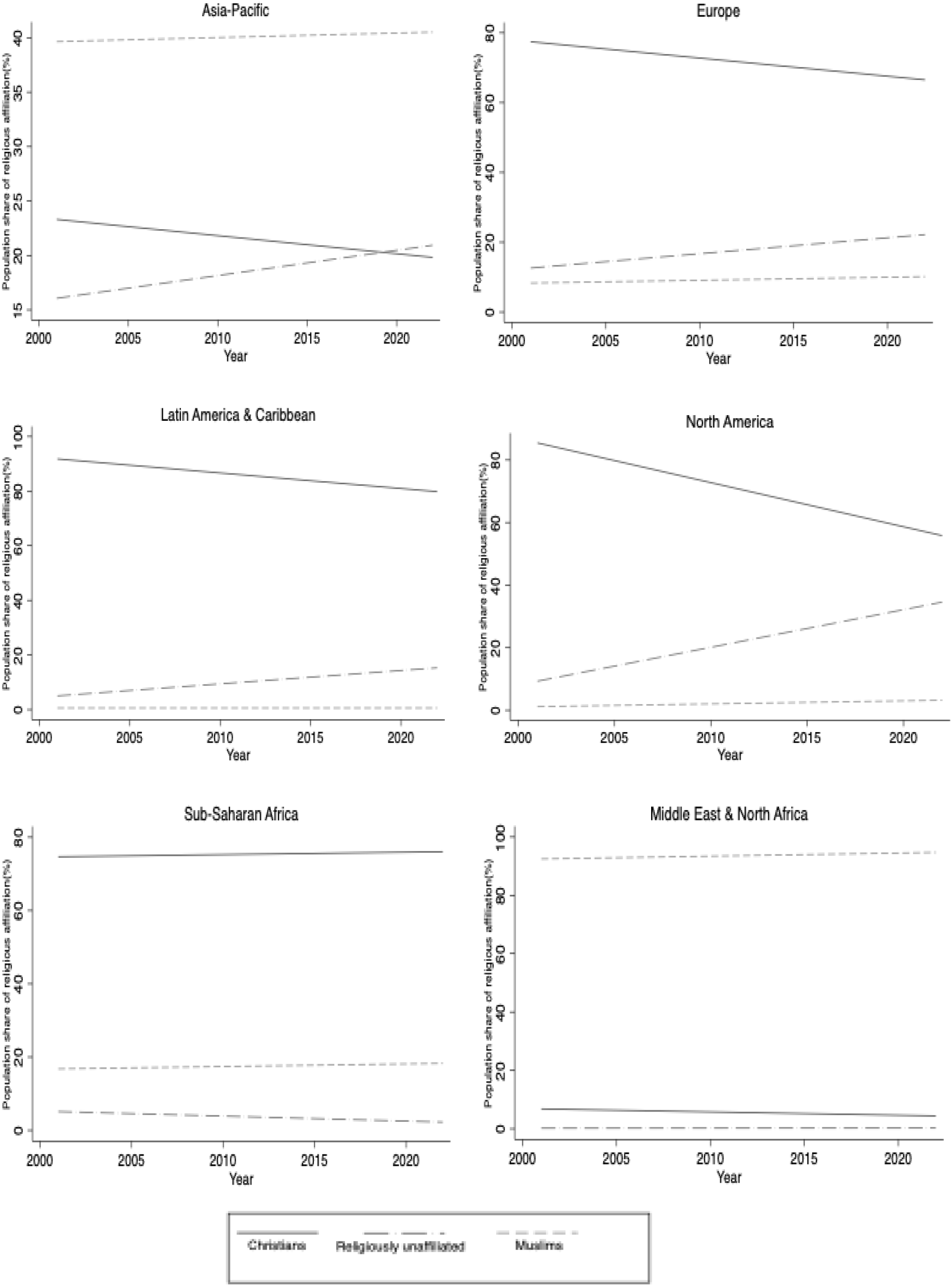
Figure 1 below presents regional trends in religious composition across the sample using the Pew Research Centre (2025) data. Overall, the patterns reveal both global similarities and region-specific dynamics. In most regions, the share of Christians shows a gradual decline over time, particularly in Europe, Latin America, the Caribbean, and North America. This trend is accompanied by a modest increase in the proportion of individuals reporting no religious affiliation, most notably in Europe and North America, consistent with broader narratives of secularization in advanced economies. In contrast, Sub-Saharan Africa exhibits a relatively stable Christian majority alongside a gradual increase in the share of the Muslim population. The Middle East and North Africa region remains overwhelmingly Muslim throughout the period, with minimal variation in other religious categories. Asia Pacific displays a comparatively mixed composition but also shows a gradual rise in religious non-affiliation. To sum, these descriptive trends suggest that while religious change occurs across regions, its magnitude and direction vary depending on regional religious structures and historical contexts.
Trends in global religious composition, 2000–2022.
Source: Authors’ analysis of the Pew Research Center (2025) data.
Note: Values represent the average percentage of the regional population identifying as Christian, Muslim, or religiously unaffiliated. MENA = Middle East and North Africa, Latin Am. & Carib. = Latin America and Carribean, Asia Pacific = Asia & the Pacific.

Figure 1. Long description
Panel A: A line graph depicts the population share of religious affiliations in the Asia-Pacific region from 2000 to 2022. The y-axis represents the population share in percent, ranging from 0 to 40 percent. The x-axis represents the year. Three lines represent Christians, religiously unaffiliated, and Muslims. The share of Christians decreases slightly, while the share of religiously unaffiliated increases. The share of Muslims shows a slight increase. Panel B: A line graph depicts the population share of religious affiliations in Europe from 2000 to 2022. The y-axis represents the population share in percent, ranging from 0 to 80 percent. The x-axis represents the year. Three lines represent Christians, religiously unaffiliated, and Muslims. The share of Christians decreases significantly, while the share of religiously unaffiliated increases. The share of Muslims shows a slight increase. Panel C: A line graph depicts the population share of religious affiliations in Latin America & Caribbean from 2000 to 2022. The y-axis represents the population share in percent, ranging from 0 to 100 percent. The x-axis represents the year. Three lines represent Christians, religiously unaffiliated, and Muslims. The share of Christians decreases, while the share of religiously unaffiliated increases. The share of Muslims shows a slight increase. Panel D: A line graph depicts the population share of religious affiliations in North America from 2000 to 2022. The y-axis represents the population share in percent, ranging from 0 to 80 percent. The x-axis represents the year. Three lines represent Christians, religiously unaffiliated, and Muslims. The share of Christians decreases significantly, while the share of religiously unaffiliated increases. The share of Muslims shows a slight increase. Panel E: A line graph depicts the population share of religious affiliations in Sub-Saharan Africa from 2000 to 2022. The y-axis represents the population share in percent, ranging from 0 to 80 percent. The x-axis represents the year. Three lines represent Christians, religiously unaffiliated, and Muslims. The share of Christians remains relatively stable, while the share of religiously unaffiliated remains low. The share of Muslims shows a slight increase. Panel F: A line graph depicts the population share of religious affiliations in the Middle East & North Africa from 2000 to 2022. The y-axis represents the population share in percent, ranging from 0 to 100 percent. The x-axis represents the year. Three lines represent Christians, religiously unaffiliated, and Muslims. The share of Christians remains relatively stable, while the share of religiously unaffiliated remains low. The share of Muslims remains high and stable.
The religious market model
The idea that governments should let religious organizations alone, while they themselves let each other alone, dates back to the 1700s, when Thomas Jefferson conducted an experiment that supported the hypothesis (Grim and Finke, Reference Grim and Finke2010). This did not immediately produce the religious market theory as a direct challenge to the secularization theory until Stark, Rodney, and William Baibridge’s book, “The Future of Religion: Secularisation, Revival and Cult Formation.” In this book, Stark and Bainbridge (Reference Stark, Bainbridge and Hammond1985) considered the vision of the death of religion to be an unfashionable illusion. Importantly, they did not downplay the growing trend of secularization, but argued that it was not a modern phenomenon; it had already endured for ages and hence could not presage the demise of religion (p. 2). In this regard, they saw secularization as a component of the religious market economy, where it produces two countervailing processes. First, secularization leads to revival, which occurs when the worldly transition of traditional religious organizations gives rise to breakaway sects that seek to reinforce vigorous otherworldliness within a conventional faith. Second, secularization generates innovation through the formation of religious groups that appear to accommodate people’s changing needs, lifestyles, or beliefs arising from modernity, when traditional laws or moral values are deemed outdated.
Religious market theory argues that state regulation restricts religious supply by raising barriers to entry, reducing competition, and limiting organizational incentives for mobilization. In contrast, religious pluralism encourages innovation and participation by increasing the responsiveness of religious suppliers to adherents’ preferences (Finke and Stark, Reference Finke and Stark1992; Stark and Finke, Reference Stark and Finke2000). Stark and Finke (Reference Stark and Finke2000) present a major theoretical and empirical consolidation of the religious market theory by shifting the analytical concentration away from demand to supply mechanisms. Primarily, they maintain that religious change is influenced not only by consumer choices but also by the sophistication of the religious market and the behavior of religious suppliers competing for believers. Put differently, they reconstruct the religious economy as a market of potential adherents and religious institutions that provide sacred goods and compete for followers, just as PepsiCo and Coca-Cola compete for customers. The central hypothesis remains that competitive or pluralistic religious economies promote adherents’ participation in religious activities. Stark and Finke test the claim across multiple countries using cross-national and historical data, measuring religious competition with the Herfindahl Index of denomination concentration and comparing it with weekly church attendance. Regression results demonstrated a positive association between church attendance and religious pluralism, arguing that religious pluralism is important because it widens the range of religious rewards and forces suppliers to be more responsive and efficient (p. 202).
While the religious market theory focused on religious competition or pluralism and initially measured it using the Herfindahl Index, a contradiction emerged when Chaves and Cann (Reference Chaves and Cann1992) replicated Iannaccone’s (Reference Iannaccone1991) study of 12 Protestant countries and added 6 Catholic countries, showing no association between pluralism and participation. Thus, they stressed that the Herfindahl–Hirschman Index of religious concentration was not a good measure of religious regulation and devised a six-point scale measuring the degree of religious regulation: measuring whether or not (i) there is a single, officially designated state church; (ii) there is official state recognition of some religious denominations and not others; (iii) the state appoints or approves the appointment of church leaders; (iv) the state directly pays church personnel salaries; (v) there is a system of ecclesiastical tax collection; and (vi) the state directly subsidizes, beyond mere tax breaks, various church expenses. They tested the index, and the statistical findings supported the initial hypotheses of the religious market theory that state regulation impedes religious participation. Drawing on Cann’s Index, Barro and McCleary reached similar conclusions: religious regulation decreases participation, but, oddly, they found a positive association between state religion and participation.
Norris and Inglehart (Reference Norris and Inglehart2004) further tested the deregulation hypothesis across 21 countries, adding 14 measures to the six developed by Chaves and Cann, and concluded that there is no association between religious deregulation and average religious attendance. Although used only as instrumental variables in the regression, Barro and McCleary (Reference Barro and McCleary2002, 40) and McCleary and Barro (Reference McCleary and Barro2006, 171) also found that state religion positively increases religiosity (participation and belief) due to favoritism flowing to the established religions. They also found that regulation reduces religiosity. Stark and Finke (Reference Stark and Finke2000) reconciled these mixed findings by arguing that deregulation of the religious market does not immediately increase participation, but rather leads to a general increase in individual religious commitment and to more religious institutions gaining free access to the market (p. 200). Consequently, Aarts et al. (Reference Aarts, Need, Te Grotenhuis and De Graaf2010) examined two dimensions of the deregulation hypothesis: (i) differences in adherents’ religious involvement between and within countries with different degrees of regulation and (ii) the time taken to see a change in religious involvement since the state deregulated religion. Using four waves of the European and World Values Surveys, the results showed that deregulation increases religious participation but not its duration.
Gaskins et al. (Reference Gaskins, Golder and Siegel2013b, Reference Gaskins, Golder and Siegel2013a) re-examined the religious market model along with the secularization thesis in the same manner as McCleary and Barro (Reference McCleary and Barro2006), but using the United Nations Development Program’s (UNDP) HDI instead of the Worldwide Development Indicators of gross domestic product (GDP) per capita. Regarding the supply side, Gaskins et al. (Reference Gaskins, Golder and Siegel2013a) found that religious regulation and the favoritism index from the International Religious Freedom (IRF) consistently exhibited a negative relationship with religious attendance across all models. On the other hand, Gaskins et al. (Reference Gaskins, Golder and Siegel2013b) showed that government regulation negatively affects religious participation, while social regulation exhibited a positive, though statistically insignificant, relationship at both the aggregate and individual levels.
Beyond focusing on government intervention measures, Voicu (Reference Voicu2019) directly examined the effect of increased supply on religious attendance in Romania. Using various surveys,Footnote 1 the study provided evidence that an increase in church attendance has its roots in the rate of increase in the number of places of worship. These findings are consistent with those of Barro and McCleary (Reference Barro and McCleary2002); Chaves and Cann (Reference Chaves and Cann1992); McCleary and Barro (Reference McCleary and Barro2006) and Norris and Inglehart (Reference Norris and Inglehart2004), which state that support through subsidies does not impede but rather increases participation. The phenomenon occurs because the increase in the number of places of worship in Romania was a result of state and local authority support flowing to the Romanian Orthodox Church, which enabled the institution to rapidly expand its parishes across the country, making Romania have the highest rate of religious-related construction in Europe since the end of the Cold War in 1989 (Andreescu, Reference Andreescu2007).
A reinterpretation
Despite optimism about religion online, driven by improvements in digital connectivity, secularization-religious market research largely presumes—often implicitly—that forms of religious communication, organization, and authority are fundamentally territorially bounded and mediated by stable organizational structures. The debate remains on the theoretical antagonism, often describing the two perspectives as mutually exclusive processes. In essence, they both account for some variations in religiosity—religious attendance and belief. Various scholars have validated the secularization thesis that aggregate income or human development tends to erode an individual’s existential and institutional reliance on supernatural powers (Chang et al., Reference Chang, Lee and Weng2009; Storm, Reference Storm2017; van Ingenand Moor, Reference van Ingen and Moor2015), while government intervention in religious plurality reduces the vitality of religious offerings (Barro and McCleary, Reference Barro and McCleary2003; Gaskins et al., Reference Gaskins, Golder and Siegel2013b, Reference Gaskins, Golder and Siegel2013a; McCleary and Barro, Reference McCleary and Barro2006). However, this literature is profoundly devoid of a systematic reflection on the conditions necessary for the operation of the two strands of determinants of religiosity. That is, there is a need to fill the gap by understanding the channels through which individuals and organizations interact with religion, especially in the digital era, which has seen remarkable reconfigurations in how people engage and conduct daily business.
The inexorable rise in digital connectivity has significantly shaped the channels through which people interact with religion. Digitalization, as both an enabler and an outcome of human development, brings about very heterogeneous societies and a quantum leap in intercultural communication (Campbell, Reference Campbell2012; Kassam and Banda, Reference Kassam and Banda2023; Madon and Masiero, Reference Madon and Masiero2025), thereby weakening the theological interpretive monopoly of the clergy (Berger, Reference Berger and Pfadenhauer1999; McClure, Reference McClure2017).
Since the COVID-19 era, evidence suggests that religion is increasingly less dependent on spatial communities and rapidly mediated by transnational communication networks, resulting in more fluid, less hierarchical, and diminishing self-censored forms of identity (Isetti et al., Reference Isetti, Stawinoga and Pechlaner2021), which shifts the way adherents relate to institutions, rituals, and power. Regarding individuals’ demand for religion, the distinction between “belonging” and “believing” proposed by Barro and McCleary (Reference Barro and McCleary2003) becomes particularly important. They demonstrate that development, as measured by GDP per capita, is positively correlated with religious beliefs but negatively correlated with religious attendance. Digital connectivity presents a channel that can accentuate this separation: it makes it easier for people to maintain beliefs and engage in spiritual practices without needing traditional brick-and-mortar halls and to participate symbolically without institutional belonging (Ishaque et al., Reference Ishaque, Mahmudulhassan and Abuzar2023), thus reconfiguring the nexus of religion, the individual, and development.
On the supply of religion, digital connectivity lowers barriers to entry into the religious market. Minority religious suppliers who previously struggled to obtain institutional recognition, material resources, and territorial access can now mobilize adherents via digital channels, reaching transnational audiences and partially escaping state regulation, at least where state cyberspace control and persecution are minimal or absent. This is where we find digital connectivity as a powerful mechanism that strengthens religious market theory (Finke and Iannaccone, Reference Finke and Iannaccone1993; Iannaccone, Reference Iannaccone1991; Stark and Iannaccone, Reference Stark and Iannaccone1994), by expanding religious activities to contexts previously characterized by monopolies or strong regulation (Berger, Reference Berger and Pfadenhauer1999; Opfinger, Reference Opfinger2011; Zhang, Reference Zhang2025).
The consequence of this digital infrastructural revolution is not simply an acceleration of religiosity but also greater symbolic, doctrinal, and political competition. Religion becomes more visible in public space, easing adherents’ mobilization constraints and allowing it to permeate political dynamics. As scholars demonstrate, religion serves as an identity-building and mobilizing resource in political conflicts and cooperation; it generally constitutes accepted directives for moral behavior at both the individual and community levels (Maoz and Henderson, Reference Maoz and Henderson2020; Phiri et al., Reference Phiri, Magombo and Banda2026). The revolution in digital infrastructure implies this function, allowing a monotonic, decentralized mobilization that is often exercised outside the strict control of traditional religious clergies. These occurrences are evident worldwide and take particular importance in societies characterized by high levels of religiosity, competitive pluralism, and rapid technological diffusion. Studies such as Jatau and Maza (Reference Jatau and Maza2023) and Jeffery-Schwikkard (Reference Jeffery-Schwikkard2024) show how religion continues to play a central role in political legitimacy, mobilization, and conflict, while digitalization changes its forms and channels of expression.
Thus, we conceptualize digital connectivity as a condition that transforms the structural preconditions for the occurrence of secularization and religious market mechanisms. Regarding demand for religion, a key implicit condition is that religious authority and participation are contingent on territorially bounded institutions whose influence declines as society develops through existential security and access to secular goods. With adherents’ weakening attachment to religious institutions, religious practices are expected to decline. Regarding the supply of religion, a central condition is that competition occurs within territorially bounded regulatory environments, where state intervention determines entry barriers, pluralism, and organizational vitality. Religious practices, therefore, are conditioned by the regulatory structure of national religious markets. We argue, however, that digital connectivity simultaneously shifts the institutions of religious supply, the nature of demand for religion, and the association between religion and the state. Neither do we dispute classical hypotheses, but we caution that they must be interpreted as descriptions of mechanisms now operating in the digital era, a profoundly different infrastructural environment than previously existed. The core thesis of this research, therefore, is that religion in the digital era should not be understood either as a simple remnant of the past or as a pure response to market incentives, but rather as an institutionally and scientifically mediated phenomenon, primarily through communications infrastructures that shape its form, function, and meaning (Turkle, Reference Turkle1995, Reference Turkle2011).
Overall, digital connectivity modifies both sets of conditions. For instance, it reduces spatial dependence by enabling religious mobilization, exposure, and participation beyond physical institutions; lowers entry barriers for minority or new religious suppliers; and facilitates hybrid online–offline forms of religious engagement that are less tightly constrained by territorial market structures. In this sense, digital infrastructure does not simply act as another explanatory variable but reshapes the institutional ecology within which both demand and supply mechanisms unfold.
Based on the foregoing discussion, we derive four expectations. First, human development should reduce religious attendance and belief (H1). Second, state intervention in religious markets should reduce religiosity (H2). Third, digital connectivity should mediate the relationship between development and religiosity by increasing participation while weakening belief (H3). Finally, digital connectivity is not expected to fully offset the constraining effects of state intervention (H4).
Data and methods
Variables and sources
To evaluate these hypotheses, we used several measures. We use two indicators of religiosity, namely, religious attendance and religious belief, as dependent variables. The former is a measure of the average level of religious attendance in a country, measured on a scale of 1–8, with extremes representing “never attends” and “attends at least once a week,” respectively. On the other hand, religious belief is a cognitive, inherent feature of individuals that reflects whether they believe in a deity (God). The variable is measured on a scale of 0–1, with 0 representing “never” and 1 representing a “sense of belief”. For this purpose, we use panel data from the integrated World Values Survey (WVS) dataset (aggregated EVS/WVS 1981–2022 data) (Haerpfer et al., Reference Haerpfer, Inglehart, Moreno, Welzel, kizilova, Diez-Medrano, Lagos, Norris, Ponarin and Puraneni2022; WVS, 2024). Following Gaskins et al. (Reference Gaskins, Golder and Siegel2013b), we include countries with at least two observations during the study period, resulting in a panel of 78 countries covering 2001–2022.
Regarding government intervention in the religious market economy, we use the Government Regulation Index (GRI_IRF) and Government Favouritism Index (GFI_IRF), obtained from the Association of Religion Data Archives and based on the coding framework developed by Grim and Finke (Reference Grim and Finke2006) from the Internation Religious Freedom (IRF) Reports compiled by each U.S embassy since 1998 and subsequent updates (Finke and Grim, Reference Finke and Grim2019; Grim et al., Reference Grim, Harris, Martin and Finke2019). These indices are measured on a 0–10 scale, with higher values indicating greater levels of state restriction or favoritism toward religion. The available IRF data began in 2001 when a comprehensive format was developed by the U.S. State Department (Grim and Finke, Reference Grim and Finke2006), and the current series at the time of writing this research is the 2022 dataset.
The single source of information for the IRF religious indicators received criticism from Fox (2006), who then developed the Religion and State (RAS) Policy data based on the Religion and State project at Bar-Ilan University (Fox and Breslawski, Reference Fox and Breslawski2023), archived by the Association of Religion Data Archives. The dataset provides alternative measures of government restriction (RRI_RAS) and government support of religion (SRI_RAS). According to Jonathan Fox, the RAS dataset represents an improvement over earlier religion datasets in that it provides annual data from 1990 to 2014 and incorporates multiple indicators, thereby reducing bias (Fox, Reference Fox2011: 35). The RAS wave 3 dataset covers the period 1990–2014 and is widely used in the literature on religious regulation and state–religion relations (see, Fox, Reference Fox2015, Reference Fox2019; Fox and Breslawski, Reference Fox and Breslawski2023; Jeffery-Schwikkard, Reference Jeffery-Schwikkard2024). Government restriction refers to state actions that constrain religious practice through laws, policies, or administrative barriers, while government support captures preferential treatment toward specific religious groups. Consistent with Grim and Finke (Reference Grim and Finke2010), the supply-side framework posits that both forms of state intervention represent mechanisms of state control that may shape religious participation and belief.
This study conducts a panel data analysis for the years ranging from 2001 to 2022. The starting year of analysis is determined by the starting year of the IRF–based regulatory indicators used to capture supply-side dynamics. The terminal year of the analysis is determined by the most recent WVS wave and the IRF, ensuring maximum temporal alignment between the dependent variables and the regulatory indicators. Importantly, the religion-related datasets are not released annually, so some religious indicators have missing values for certain country-years. Accordingly, the datasets are aligned using year-based matching, where corresponding observations across datasets are unavailable for a given year, these are retained as missing. To address missing data, the models are estimated within a structural equation modeling (SEM) framework using full information maximum likelihood. This estimation approach utilizes all available information and avoids listwise deletion, thereby retaining partially observed country–year observations and reducing potential bias associated with ad hoc imputation methods.
On the demand side of religion, we use the HDI as an independent variable, as commonly employed by previous studies, given its superior focus on human well-being relative to GDP per capita’s focus on income alone (Gaskins et al., Reference Gaskins, Golder and Siegel2013b). Besides income per capita or the standard of living, the HDI is a composite index that also captures education and health as enablers of people’s productive potential to earn a secular income (Yusufu et al., Reference Yusufu, Bangara and Banda2026). Data for the HDI are obtained from the United Nations Development Programme and are measured on a scale of 0 to 1 (low to high).
Digital connectivity, on the other hand, refers to the proportion of individuals using the internet either through a fixed or a mobile network. The variable is measured by the mobile connectivity index (MCI), which assesses countries’ performance across key enablers of mobile internet adoption, including infrastructure, affordability, consumer readiness, and content and services (GSMA, 2025).
Estimation strategy
Unlike pioneer studies of the secularization and religious market models that tended to use ordinary least squares and feasible generalized least squares (Dhima and Golder, Reference Dhima and Golder2021; Gaskins et al., Reference Gaskins, Golder and Siegel2013b, Reference Gaskins, Golder and Siegel2013a; Norris and Inglehart, Reference Norris and Inglehart2004), instrumental variables (IV) (McCleary and Barro, Reference McCleary and Barro2006), and logit models (Gaskins et al., Reference Gaskins, Golder and Siegel2013a; Norris and Inglehart, Reference Norris and Inglehart2004), we use the structural equation modelling (SEM). Due to the high number of free parameters and the multifaceted nature of measuring religiosity, whether through religious participation or belief in God, these previous studies separately conducted multiple regressions. Thus, using SEM is advantageous because it allows simultaneous execution of multiple regressions. Second, concomitant with missing data common in religious datasets (McCleary and Barro, Reference McCleary and Barro2006), the maximum likelihood method in SEM optimally handles missing data while producing parameter estimates that are desirably asymptomatic: unbiased, consistent, and efficient (Allison, Reference Allison2003; Jia and Wu, Reference Jia and Wu2019).
To reduce the risk of spurious associations arising from common trends, variables were log-transformed and detrended prior to estimation. This detrending technique isolates variation around long-term trajectories and minimizes the risk of confounding and spurious correlations resulting from trending behavior (Falkenström et al., Reference Falkenström, Solomonov and Rubel2023). Our variables were therefore log transformed and detrended such that we interpret our estimates as associations among deviations from each county’s long-run trajectory,and not differences in cross-sectional level.
Results and discussion
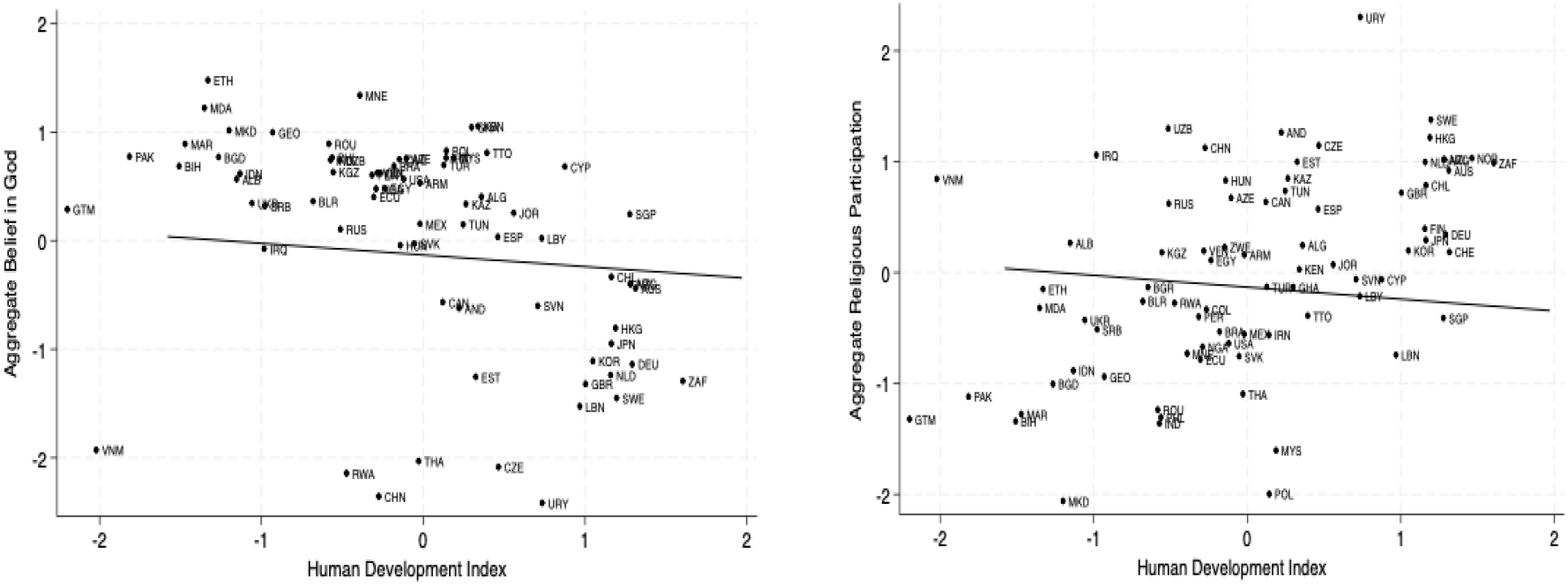
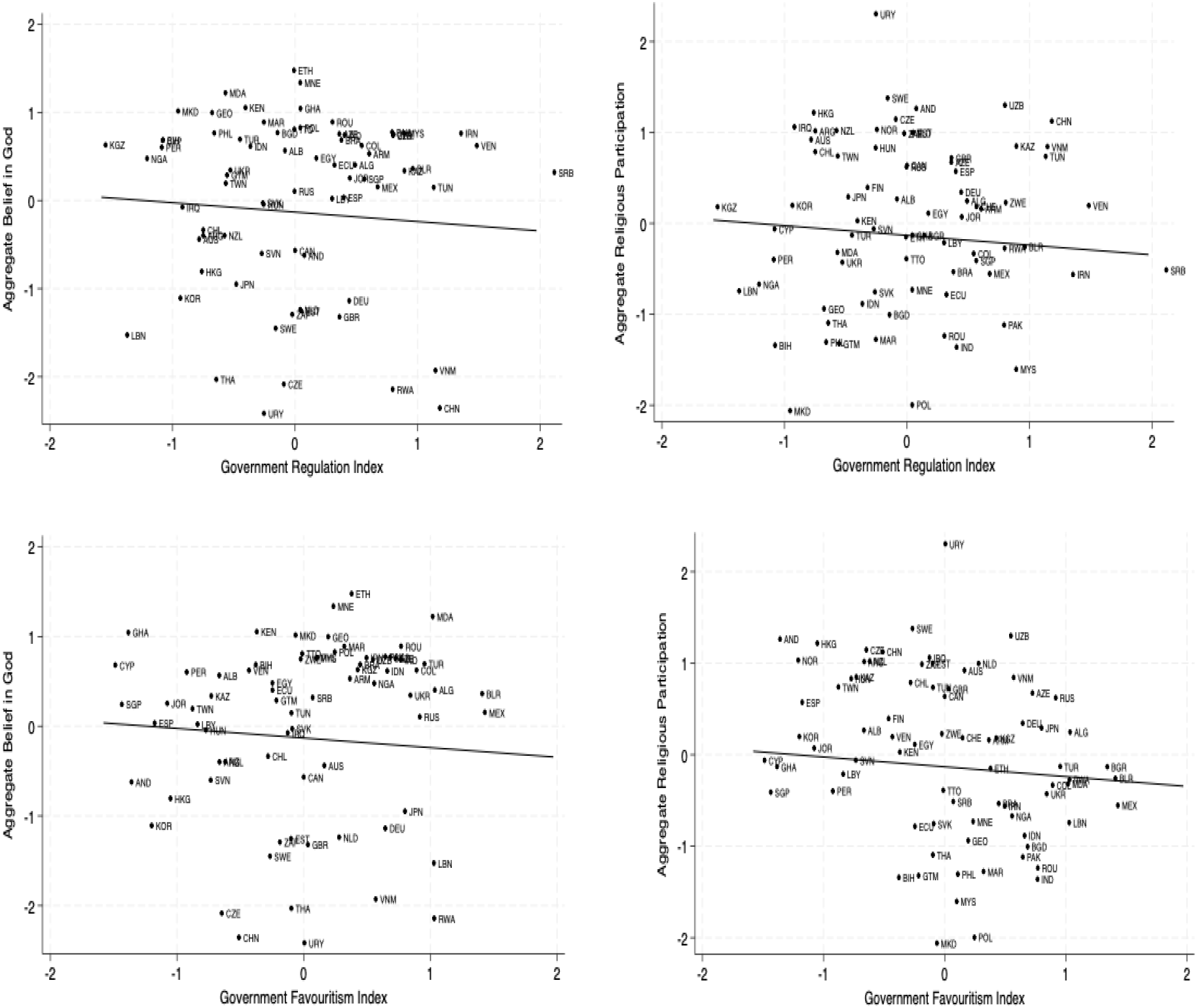
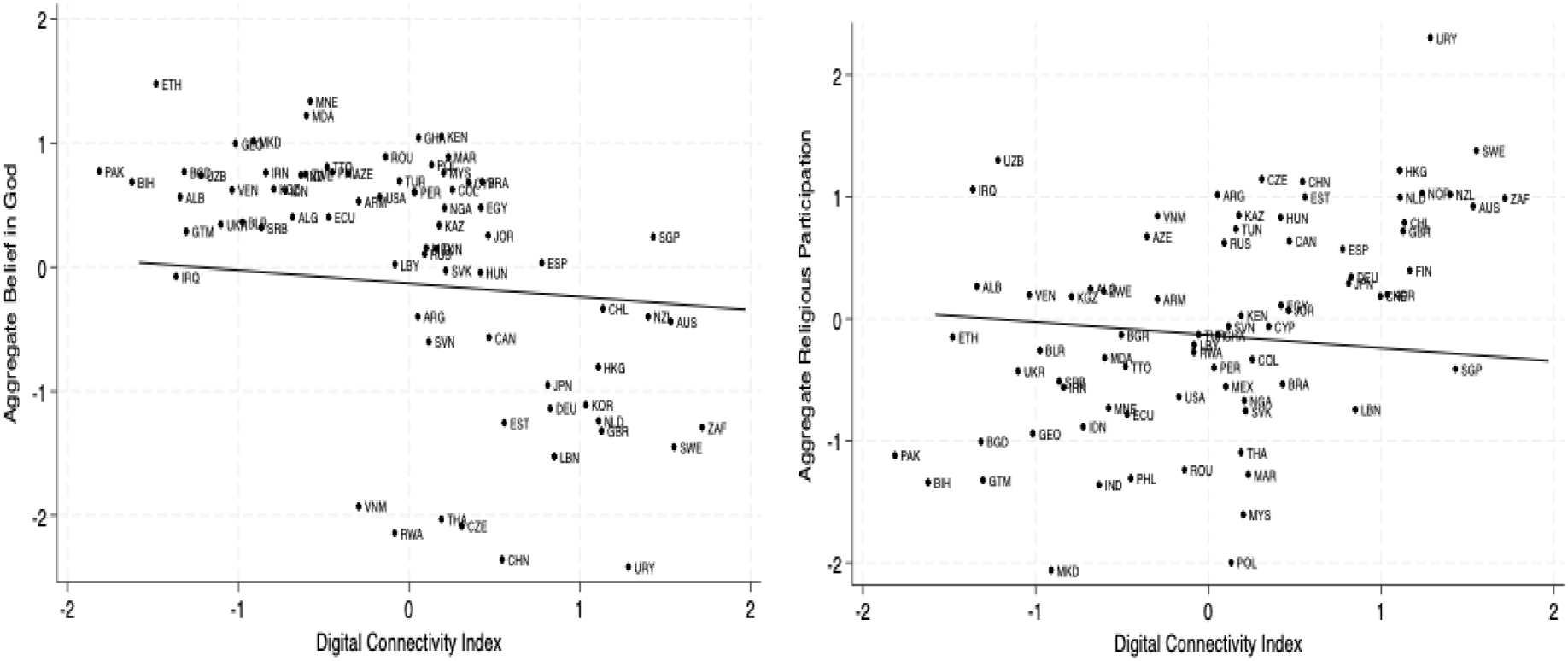
Figures 2–4 present descriptive bivariate relationships between religiosity, development, state intervention, and digital connectivity. The lines shown in FiguresFootnote 2 2 to 4 represent fitted bivariate linear associations and are presented for descriptive purposes only. Although the associations generally align with theoretical expectations, substantial cross-national variation necessitates advanced analyses.
Standardised human development and aggregate religiosity in a country.

Standardized state interventions and aggregate religiosity in a country.

Standardised digital connectivity and aggregate religiosity in a country.

Figure 4. Long description
Panel A: A scatter plot shows the relationship between the Digital Connectivity Index and Aggregate Belief in God. The x-axis represents the Digital Connectivity Index, ranging from -2 to 2, and the y-axis represents Aggregate Belief in God, ranging from -2 to 2. Each point represents a country, with labels indicating specific countries. A trend line is present, showing a slight negative correlation. Panel B: Another scatter plot illustrates the relationship between the Digital Connectivity Index and Aggregate Religious Participation. The x-axis represents the Digital Connectivity Index, ranging from -2 to 2, and the y-axis represents Aggregate Religious Participation, ranging from -2 to 2. Each point represents a country, with labels indicating specific countries. A trend line is present, showing a slight negative correlation.
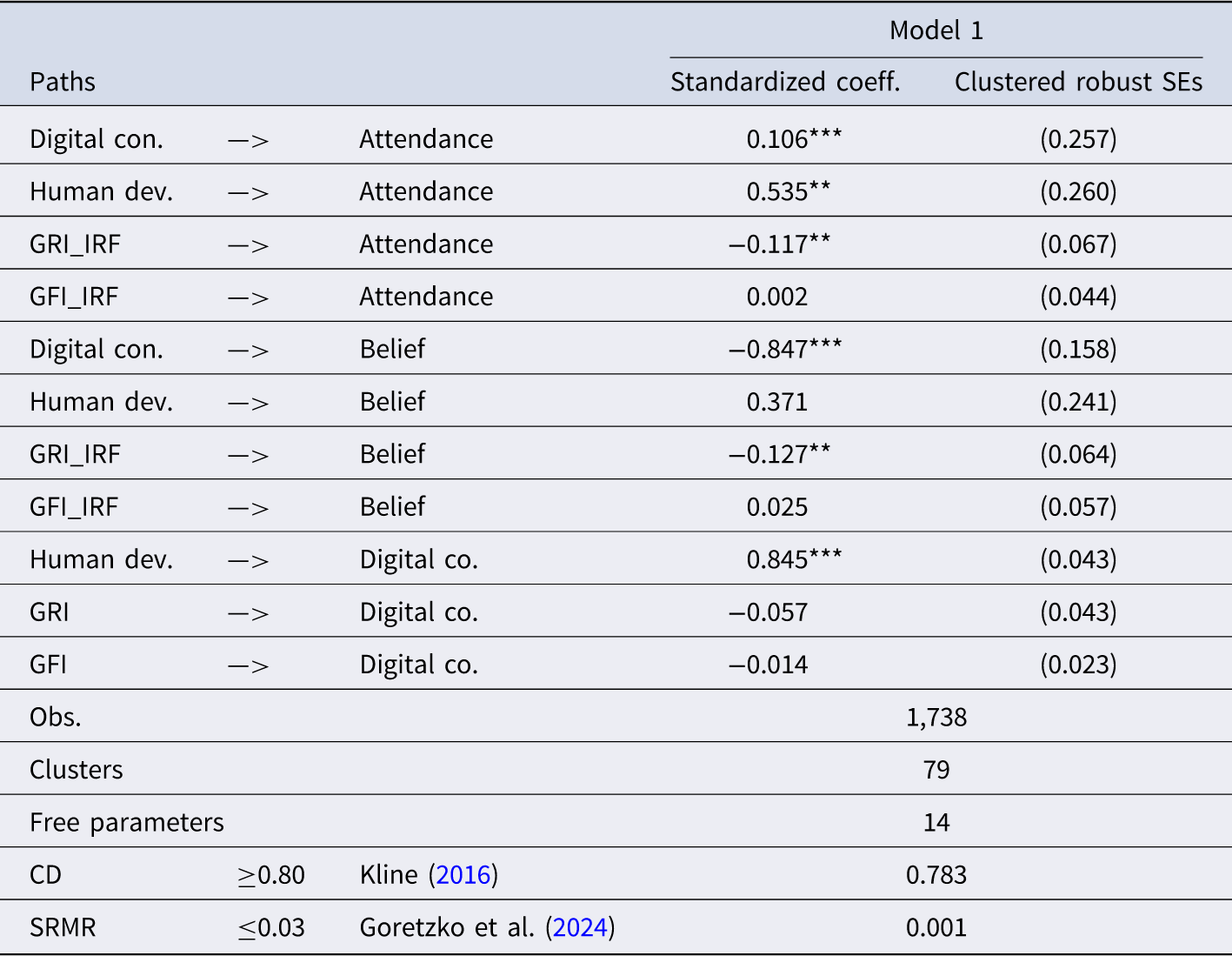
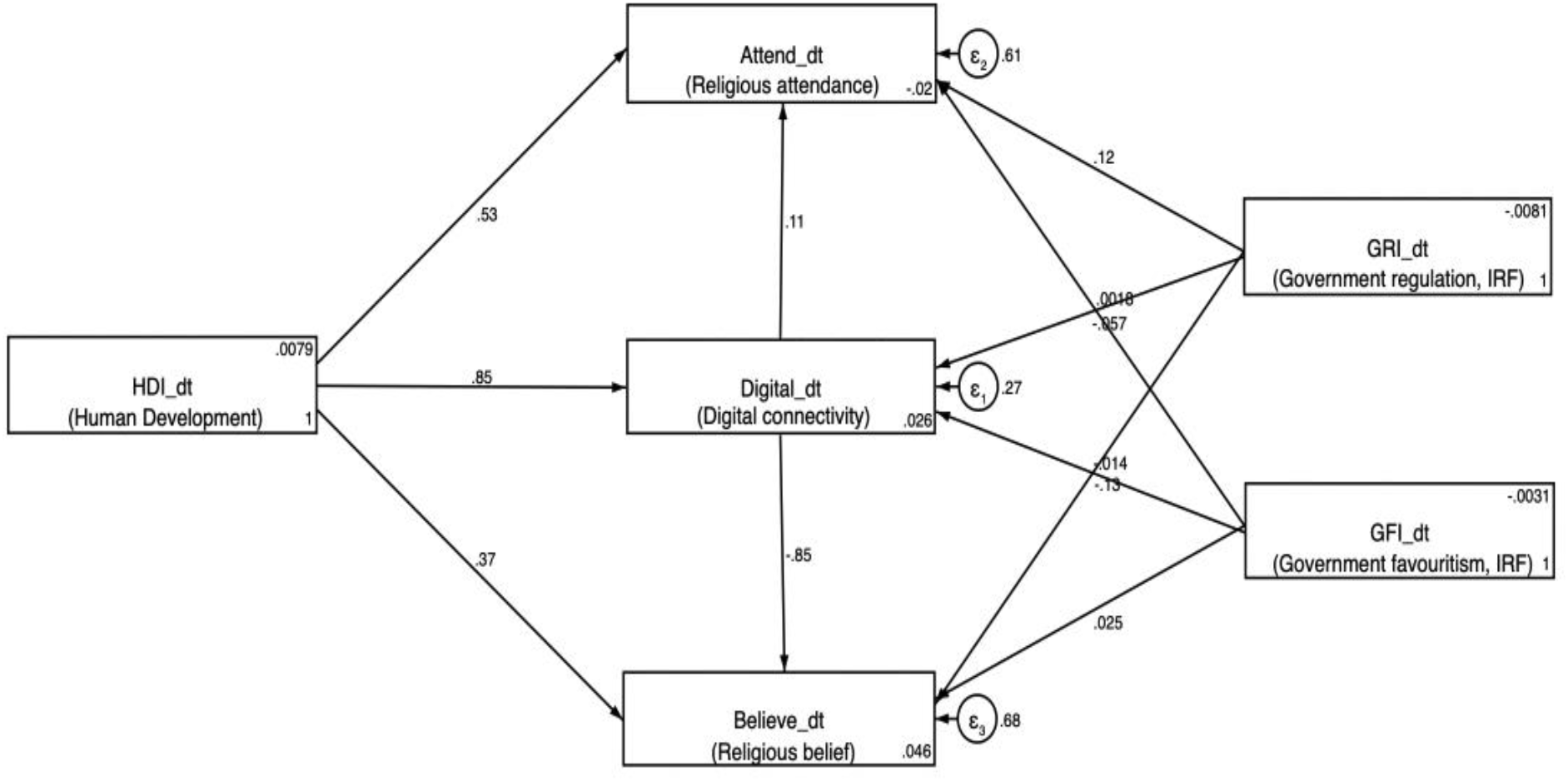
Figure 5 presents the standardized coefficient estimates from Model 1, with heteroskedasticity-robust standard errors clustered at the country level to account for within-country serial correlation and unobserved country-specific heterogeneity in the panel data, as an extended examination of the secularization-religious market framework by jointly computing the demand for and supply of religion, while introducing digitalization as a mediating reconfiguration of how human development and state intervention translate into religiosity. Our findings contradict the secularization thesis: human development exhibits a positive, statistically significant (at the 1% level) direct association with religious attendance (β = 0.535), but the direct association with belief is positive (β = 0.371) and not statistically significant. A previous study by Dhima and Golder (Reference Dhima and Golder2021), using a global sample from the WVS, found the exact associations, partially contradicting the canonical prediction that improvements in education, living standards, and life expectancy reduce religious attendance rather than belief. On the other hand, Storm (Reference Storm2017), using European Social Survey data, found that improvements in human well-being led to a decline in both religious attendance and belief in Europe. Table 1 presents an expanded version of these results, including standard errors and fit indices.
Determinants of religiosity: Human development vs state intervention

Table 1. Long description
A table with 10 rows and 4 columns. The columns are labeled Paths, Standardized coeff., and Clustered robust SEs. The rows list different paths and their corresponding standardized coefficients and clustered robust standard errors. The paths include Digital con. to Attendance, Human dev. to Attendance, GRI_IRF to Attendance, GFI_IRF to Attendance, Digital con. to Belief, Human dev. to Belief, GRI_IRF to Belief, GFI_IRF to Belief, Human dev. to Digital co., GRI to Digital co., and GFI to Digital co. The table also includes fit indices such as Observations, Clusters, Free parameters, CD, and SRMR with their respective values.
Source: Author’s analysis.
Note: Free parameters = 11(paths) + 3(var) = 14; * = 10%, ** = 5%, *** = 1%.
Model 1—SEM results of the demand for and supply of religion model.
Note: Free parameters = 11(paths) + 3(var) = 14.

Figure 5. Long description
A diagram representing the relationships between human development, religious attendance, digital connectivity, religious belief, and government regulation. The diagram includes labeled boxes and arrows indicating the direction and strength of relationships. Key components include Human Development (HDI_dt), Religious Attendance (Attend_dt), Digital Connectivity (Digital_dt), Religious Belief (Believe_dt), Government Regulation (GRI_dt), and Government Favoritism (GFI_dt). Arrows connect these components, showing the flow and interaction between them. For example, Human Development influences both Religious Attendance and Digital Connectivity, which in turn affect Religious Belief and government-related factors.
Model 1 also shows that human development directly and positively correlates with digital connectivity (β = 0.845), and in turn, digital connectivity is positively associated with religious attendance (β = 0.106). It therefore indicates that the mediating role of digital connectivity on the relationship between human development and religious attendance is positive (β = 0.845 × 0.106 = 0.089). This is an important finding that sheds new light on a departure from the traditional “closed” secularization interpretation, which posits that human development directly reduces religious attendance. While digital connectivity is an enabler of development (Madon and Masiero, Reference Madon and Masiero2025), it is also an outcome of societal development (Kassam and Banda, Reference Kassam and Banda2023), which should therefore reduce the demand for religion. Our findings, however, show that development through digital technologies does not lead to a decline in religious attendance but rather reproduces mechanisms that enable modes of religious exposure, community mobilization, and interaction that do not depend solely on traditional physical mechanisms. It implies that development broadens the technological mediation of religious supply and accessibility, thereby yielding a countervailing pathway that classical theories have hardly conceptualized.
Our findings, however, show a negative and statistically significant association between digital connectivity and religious belief (β = −0.847). Since human development is positively associated with digital connectivity (β = 0.845), it implies that the mediating role of digital connectivity on the association between human development and religious belief is negative (β = 0.845 × −0.847 = −0.716). These results are not far-fetched, given that digital connectivity is expected to expose individuals to a wider array of secular ideologies and alternative worldviews that attenuate doctrinal belief, potentially weakening traditional religious institutions and practices (Unnithan and Naidu, Reference Unnithan and Naidu2025). Social media platforms, which are aided by the internet and, in particular, smartphone use, have become a contested space where religious and secular ideas compete for attention and where religious authority is often challenged by new forms of media influence (Andok, Reference Andok2024; Campbell, Reference Campbell2007; Turner, Reference Turner2007). Granted that digital media present several alternative solutions to social problems, Singer and Beans (Reference Singer and Benassi1981) had long raised an alarm about how people will maintain their religious beliefs in the face of conflicting scientific content.
Our findings that digitally mediated development increases religious attendance and reduces religious belief warrant careful interpretation. Why would one maintain participation when they do not believe in or depend on sacred solutions to social problems? A sociological study using the Baylor Religion Survey data showed that digital connectivity urges individuals to “tinker” with their religious identification and beliefs, questioning and rethinking religious norms and values without compromising their participation in religious activities (McClure, Reference McClure2017). Indeed, Campbell (Reference Campbell2012) conceptualizes religions’ use of the internet as digital religion, a networked channel through which individuals experience community and access sacred information. In turn, the new media exposes people to a wider range of beliefs and scientific content, thereby decentralizing the interpretive monopoly of the clergy. The phenomenon potentially reduces formal religious belief but orchestrates increased engagement with religious groups and activities in hybrid virtual-physical channels (Campbell, Reference Campbell2012).
Regarding the supply side of religion, Model 1 indicates that government regulation reduces both religious attendance (β = −0.117) and belief (β = −0.127). On the other hand, government favoritism is not associated with changes in religious participation and belief. The decrease in religious participation and attendance due to regulation is concomitant with the supply-side prediction that government intervention limits religious suppliers and reduces mobilization capacity. According to Stark and Finke (Reference Stark and Finke2000) and Stark and Iannaccone (Reference Stark and Iannaccone1994), like in a market of goods and services, highly regulated religious markets tend to be less pluralistic, which eliminates the innovative efforts of religious firms that provide greater benefits and fulfillment. Consequently, religious markets are served with their monistic religious products, thereby reducing both attendance and belief in a deity.
Importantly, the results show that even with advancements in digital connectivity, there is no countervailing effect on the negative impact of government regulation on religious attendance because the path from government regulation to digital connectivity is not statistically significant. The supply-side results are the same for both government regulation and favoritism, thus making the religious market model valid, even in the face of digital connectivity. We argue, therefore, that unlike in the 1930s when political persecution forced churches and adherents into other forms of engagement, such as informal networks or the perilous underground existence of evangelicals (Solomon, Reference Solomon2019), recent advancement in digital media will easily expose such secrets making it hard or otherwise impossible for long term secretive worship: cementing our confirmation of the religious market hypothesis. We suggest that state regulation of religion or favoritism of some faiths over others can involve cyberspace monitoring and persecution compounding regulations such as curfews, which inhibit religious pluralism and impede innovation as religious suppliers are caught up in organizational slack, or otherwise x-inefficiency, leading to adherents’ dissatisfaction (Finke and Stark, Reference Finke and Stark1998).
However, holding government intervention constant, we discussed the positive mediation role of digital connectivity on the association between development and religious participation. Thus, without government regulation and control, such as internet shutdown and cyberspace control, religious suppliers combine physical and online operations to circumvent temporal and spatial constraints. Indeed, Banda (Reference Banda2023a) contends that new religious faiths have adopted religious pluralism and continually utilize information and communication technologies. In particular, embracing rudimentary internet functionalities in their digital worship, evangelism, mentorship, and discipleship approaches has led to new dynamics of religion rather than displacement (Kiamu and Musa, Reference Kiamu and Musa2021).
Overall, the study establishes that digital connectivity should not be seen merely as a new covariate in the secularization-religious market framework, but rather as a structural modifier of demand for and supply of religion. From a demand perspective, digital connectivity challenges the prediction that religiosity reduces with development. This is because our conceptualization implies that human development translates into technological advancements and decreases religious exclusivism (Campbell, Reference Campbell2012) or other forms of religious monopolistic behavior. In turn, an increase in religious supply lowers the cost of religious content through digital innovations, hence lowering secular opportunity costs and increasing supernatural explanations. In the absence of state cyberspace control, digitalization alters the traditional image of the “religious market structure” by empowering religious suppliers to compete, specialize, and mobilize more easily through target markets in hybrid spaces that are hardly constrained by state control.
The results align with emerging evidence that internet connectivity drives religious and spiritual involvement, and can operate as a mechanism through which broader social and economic outcomes, as well as well-being, are contingent upon religion (Muralidharan et al., Reference Muralidharan, La Ferle and Roth-Cohen2023). Similarly, Ding et al. (Reference Ding, Zhu and Peng2024) rejected the notion that China is faithless, based on empirical findings that digital connectivity ensures the continuation of religious practice beyond offline spaces. The key deduction from this study, therefore, is theoretical. That is, while previous studies in the secularization-religious market framework postulate, often explicitly, an offline intersection between development, the state and religiosity, our findings show that modeling the mediation role of digital connectivity produces an infrastructure that allows development and state forces to produce dual effects, simultaneously decreasing traditional means of religiosity and fostering religious persistence, adaptation and innovative means through which suppliers mobilize adherents.
Robustness checks
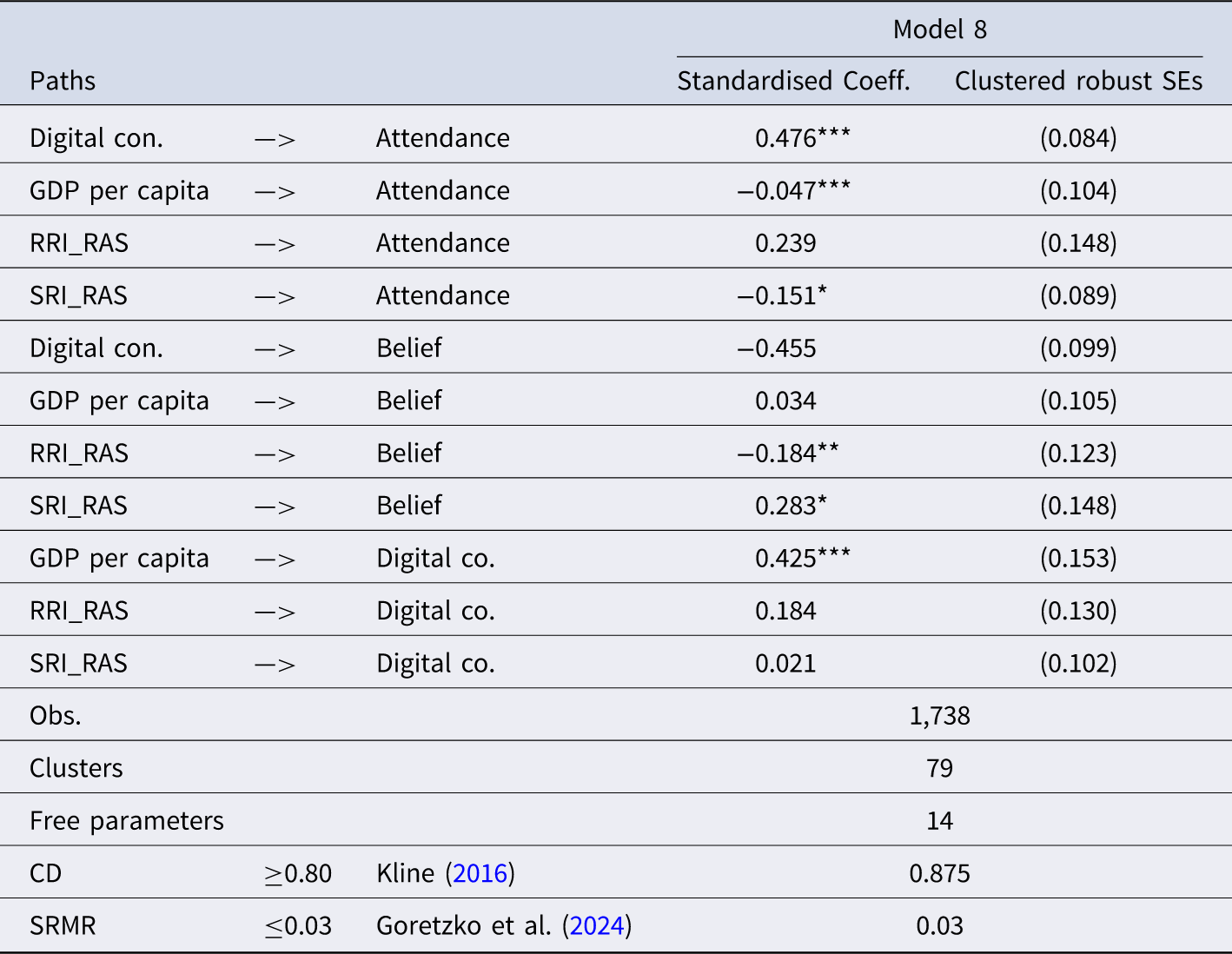
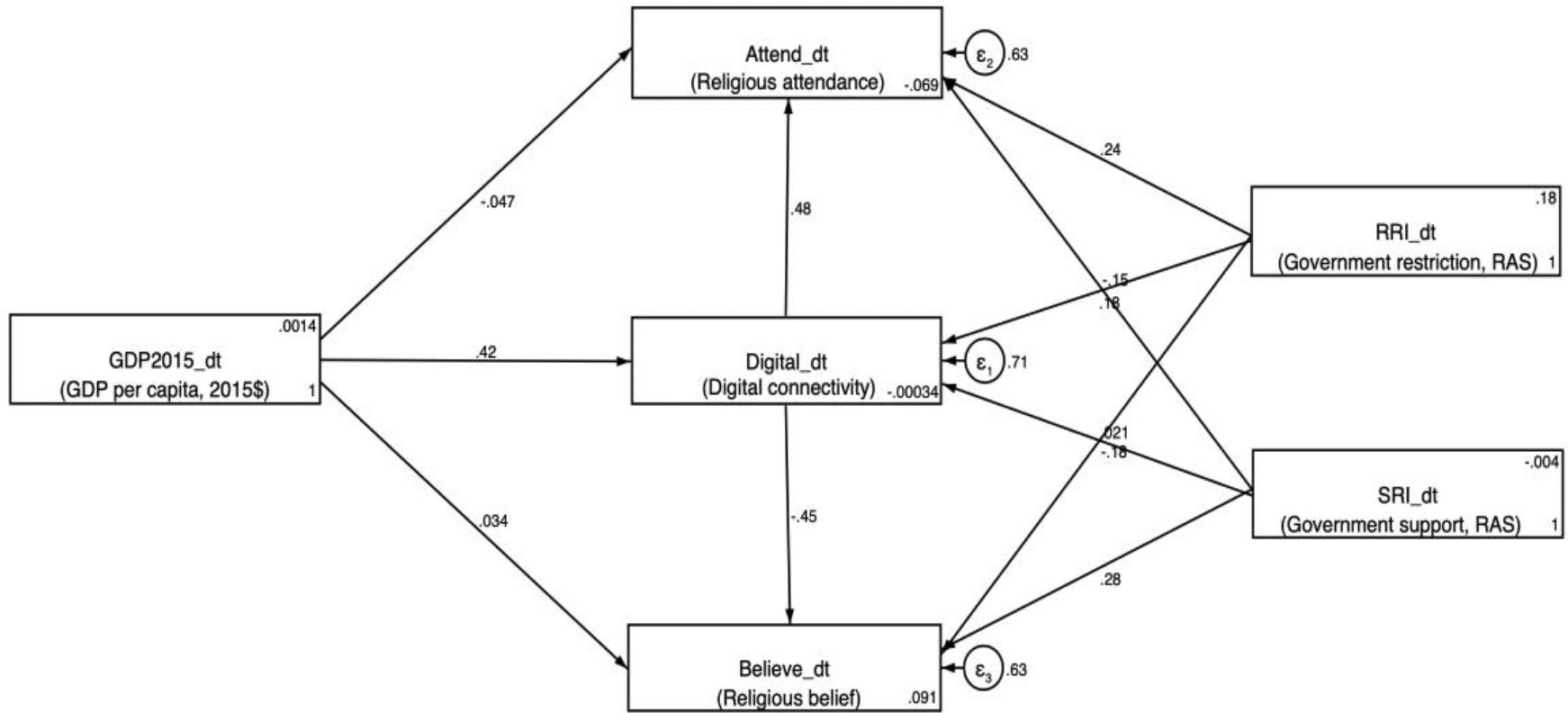
For robustness checks, we present the results of Model 2 in Figure A1 (Appendix), with the independent variables on both sides of the framework modified. On the demand side, the human development index was replaced by GDP per capita measured at 2015 dollar prices. On the supply side of the framework, we substituted government regulation and favoritism indices sourced from the IRF database with the Restriction of Religion (RRI_RAS) and Support of Religion Index (SRI_RAS) from the Religion and State Project (RAS) database (Fox, Reference Fox2019). The results on the demand-side of the framework show that GDP per capita is a negatively associated with religious attendance, thereby partially confirming the secularization thesis. This aligns with empirical evidence from McCleary and Barro (Reference McCleary and Barro2006), who also used GDP per capita. This is not far-fetched considering that GDP is a narrower measure of development (Gaskins et al., Reference Gaskins, Golder and Siegel2013b), which does not capture crucial aspects of life, such as education and standards of living (Banda, Reference Banda2023). GDP is an aggregate measure of average income and is best suited to measure the trade-off between sacred and secular goods but should not be conceptualized as the overarching development that is prophesied to erode religiosity. This trade-off between income as a secular good and sacred goods is not evident when people experience fulfillment in their health and well-being.
We also find that GDP per capita is positively associated with digital connectivity, which, in turn, positively affects attendance. Thus, aggregate national output, like human development in Model 1, produces digital connectivity, reproducing mechanisms by which people participate in religious activities via digital channels, providing a countervailing effect to the secularization thesis.
On the supply side, we find that state support of religion is negatively associated with attendance (β = −0.151), while state restriction of religion is negatively associated with belief (β = −0.184). Similar to Model 1, we find that under the constraint of state restrictions on religion, digital connectivity hardly counteracts the decrease in religiosity, thereby providing support for the religious market hypothesis. While digital connectivity in itself is positively associated with religious attendance (β = 0.478), it weakens when state control involves the support of specific religious faiths and the inhibition of public observance of religious services, festivals, and holidays, including the Sabbath, which are likely to involve internet shutdowns or cyberspace monitoring and persecution. Indeed, it has long been noted that the initial optimism on digital connectivity poses grave risks for religious groups as authoritarian governments are shaping media platforms by allowing violent persecutors to coordinate and spread disinformation through surveillance technology (Open Doors, Reference Doors2022). Our theoretical expansion of the secularization-religious market framework, therefore, is not conclusive but rather serves as a preamble to more rigorous research on the modifying role of digital connectivity in the interaction between development, the state, and religiosity. Table A2 (Appendix) presents an expanded version of Model 2 estimation.
Importantly, we estimated our models using heteroskedastic-robust standard errors at the cross-section level, which does not yield likelihood-based fit indices (CMIN, CFI, TLI, and RMSEA). In cluster-robust circumstances, model fit is best assessed using the residual-based statistics: Standardized root mean squared residual (SRMR) and the coefficient of determination (R 2), which are valid for all our estimations. Even though Goretzko et al. (Reference Goretzko, Siemund and Sterner2024) stress that a nearer-zero SRMR value (≤0.05) indicates an excellent model fit, Hu and Bentler (Reference Hu and Bentler1999) consider values up to 0.08 as acceptable. On the other hand, CD is acceptable at any value above 0.5, while the model is said to have a strong explanatory power for values above 0.8 (Bentler and Raykov, Reference Bentler and Raykov2000; Kiine, Reference Kiine2016).
In addition, we asked the question, “Does the core digital-religiosity relationship change when we account for the COVID-19 pandemic?” In this respect, we estimated two-way fixed-effects panel regression models including country and year fixed effects and interacted digital connectivity with a post-2020 indicator (2020–2022). Country fixed effects control for time-invariant national characteristics such as institutional history, religious composition, and cultural traditions, while year fixed effects absorb common global shocks affecting all countries in a given year. Standard errors are clustered at the country level to account for serial correlation and heteroskedasticity within countries over time. The models are estimated using high-dimensional fixed-effects techniques, which partial out the fixed effects prior to estimation.Footnote 3 Controlling for science and technology and religious composition (percentage of Muslims, Christians, and non-religious affiliates) results in Table A3 (Appendix) show that digital connectivity remains negatively associated with religious attendance in the pre-COVID period (β = − 0.663, p < 0.05). The interaction between digital connectivity and the COVID period is small and statistically insignificant (β = − 0.087, p > 0.05.), indicating no evidence that the association between digital connectivity and attendance strengthened during the pandemic. Similarly, no statistically significant moderation is observed for religious belief. These findings suggest that the structural relationship between digital infrastructure and religiosity remained stable during the COVID-19 period rather than undergoing a temporary pandemic-induced transformation.
Conclusion
For many decades, the secularization thesis with its concentration on the demand side of religion has received strong criticism, with unconvinced scholars petitioning for its eternal rest among failed theories. Unsurprisingly, religious market models, which focus on the conditions under which religious suppliers operate in relation to the state, are widely considered a dominant theory in recent religious studies. However, Fox (Reference Fox2019) provides three reasons why the secularization doctrine still matters today, including its continued empirical support and suggestion that it can offer insights into the nature and underpinnings of state religion policy. Prior to that, Gaskins et al. (Reference Gaskins, Golder and Siegel2013b, Reference Gaskins, Golder and Siegel2013a) and McCleary and Barro (Reference McCleary and Barro2006) attempted to artificially combine demand-side and supply-side factors, yet there is limited follow-up empirical research. Thus, the current study contributes to the ongoing determination of simultaneity in religiosity by introducing digital connectivity at the intersection of development, religion, and the state.
Our findings that human development alone increases religious attendance contradict Gaskins et al. (Reference Gaskins, Golder and Siegel2013b) and Norris and Inglehart (Reference Norris and Inglehart2004), who provided support for the secularization doctrine. We demonstrate that development with digital connectivity as its outcome further enhances religious attendance but risks a decline in religious belief. We attribute the phenomenon to people’s exposure to alternative worldviews and solutions to social problems that reduce their reliance on sacred powers. Our global sample shows that state intervention negatively affects religiosity; even with digital connectivity, it suggests that state control may involve cyberspace monitoring and persecution, further inhibiting suppliers’ innovative ideas from reaching adherents. However, an important finding that casts a new light and departure from a “closed” secularization and religious pluralism is that we show that human development positively correlates with digital channels, which in turn positively correlates with religiosity (attendance) by enabling new modes of religious exposure, community mobilization, and interaction that do not solely depend on traditional physical mechanisms. Put differently, the results suggest that human development broadens the technological mediation of religious supply and accessibility, which could yield a countervailing pathway that classical theories have hardly conceptualized. Therefore, we conclude that as long as human development leads to increased scientific innovation, such as in communication technologies, the prophecy of the death of religion is unlikely to be fulfilled in the foreseeable future.
Rather than accelerating secularization in a uniform manner, digital connectivity appears to restructure religiosity by sustaining participation while weakening belief. This divergence challenges simple secularization narratives and suggests that digital modernity transforms the institutional ecology of religion rather than eliminating it. The future of religion, therefore, may not lie in its decline but in its digital reconfiguration.
This research contributes theoretically to the expansion of the secularization-religious market models of demand for and supply of religion. We establish that the digital era should not be understood as a mere remnant of the past or a pure response to market incentives, but rather as an institutionally and scientifically mediated phenomenon, primarily through communication infrastructures that shape the form, function, and meaning of various aspects of society. In addition to its theoretical contribution, the research findings offer important implications for suppliers of religious services. The findings, especially the finding that development with digital connectivity as its outcome threatens religious beliefs, imply that online presence alone is not enough to sustain demand for religion. Religious suppliers, therefore, should adopt innovations in religious practice, such as those adopted during the COVID-19 era, keeping their digital platforms curated, engaging, and adaptable to the changing needs of adherents. In addition, where state intervention involves control of cyberspace and persecution, religious suppliers may face a trade-off between navigating competition and managing regulatory and information risks.
While these findings provide evidence consistent with the argument that digital connectivity reshapes the relationship between development, state intervention, and religiosity, they should be interpreted with appropriate caution. Although the SEM framework allows simultaneous estimation of these relationships, the observational nature of the data does not permit definitive causal identification. Reverse causality and omitted-variable bias remain possible, particularly regarding the relationship between digital connectivity and religiosity. Future research could build on these findings using instrumental-variable approaches, quasi-experimental designs, or other causal identification strategies to further examine the mechanisms linking digital connectivity and religious change.
Acknowledgements
The authors gratefully acknowledge the financial support of the British Academy, provided through a travel grant that enabled their participation in the conference held at the Victoria Hotel in Blantyre, Malawi. They extend their sincere thanks to Emma Wild-Wood (University of Edinburgh), Dr. Dorothy Tembo, and Jimmy Kainja (University of Malawi) for coordinating the year-long early-career mentorship programme before and after the in-person conference. We also greatly appreciate the thoughtful and constructive comments from the editor and the two anonymous reviewers.
Financial support
None.
Competing interests
The authors, Lloyd G. Banda and Kenneth R. Ross, declare no conflict of interest.
Appendix A
Study sample

Table A1. Long description
A table listing countries grouped by regions. The table has six columns labeled Asia-Pacific, Europe, Lat. Amer. & Carib., MENA, North America, and SSA. Each column lists countries within that region. Row 1: Armenia, Albania, Argentina, Algeria, Canada, Ethiopia. Row 2: Australia, Andorra, Brazil, Egypt, United States, Ghana. Row 3: Azerbaijan, Balarus, Chile, Iraq,, Kenya. Row 4: Bangladesh, Bosnia and Herzegovina, Colombia, Jordan,, Nigeria. Row 5: China, Bulgaria, Ecuador, Lebanon,, Rwanda. Row 6: Cyprus, Czechia, Guatemala, Libya,, South Africa. Row 7: Hong Kong, Estonia, Mexico, Morocco,, Zimbabwe. Row 8: India, Finland, Peru, Tunisia,, . Row 9: Indonesia, Georgia, Trinidad and Tobago,, , . Row 10: Iran, Germany, Tunisia,, , . Row 11: Japan, Hungary, Venezuela,, , . Row 12: Kazakhstan, Moldova,, , , . Row 13: Kyrgyzstan, Montenegro,, , , . Row 14: Malaysia, Netherlands,, , , . Row 15: New Zealand, North Macedonia,, , , . Row 16: Pakistan, Norway,, , , . Row 17: Philippines, Poland,, , , . Row 18: Singapore, Romania,, , , . Row 19: South Korea, Russia,, , , . Row 20: Thailand, Serbia,, , , . Row 21: Turkey, Slovakia,, , , . Row 22: Uzbekistan, Slovenia,, , , . Row 23: Viet Nam, Spain,, , , . Row 24:, Sweden,, , , . Row 25:, Switzerland,, , , . Row 26:, Ukraine,, , , . Row 27:, United Kingdom,, , , .
Source: Pew Research Center (2025).
Determinants of religiosity: GDP/capita vs RAS state control indices

Table A2. Long description
The table presents data on the determinants of religiosity, focusing on GDP per capita and RAS state control indices. It has 12 rows and 3 columns. The columns are labeled ‘Paths’, ‘Standardised Coeff.’, and ‘Clustered robust SEs’. The rows list different paths such as ‘Digital con. –> Attendance’, ‘GDP per capita –> Attendance’, ‘RRI_RAS –> Attendance’, ‘SRI_RAS –> Attendance’, ‘Digital con. –> Belief’, ‘GDP per capita –> Belief’, ‘RRI_RAS –> Belief’, ‘SRI_RAS –> Belief’, ‘GDP per capita –> Digital co.’, ‘RRI_RAS –> Digital co.’, ‘SRI_RAS –> Digital co.’, and additional rows for ‘Obs.’, ‘Clusters’, ‘Free parameters’, ‘CD’, and ‘SRMR’. Each row provides specific values for the standardized coefficients and clustered robust standard errors. Notable trends include the positive coefficient for ‘Digital con. –> Attendance’ and the negative coefficient for ‘SRI_RAS –> Attendance’.
Source: Author’s analysis.
Note: Free parameters = 11(paths) + 3(var) = 14; * = 10%, ** = 5%, *** = 1%.
Digital connectivity and religiosity during the COVID-19 period

Table A3. Long description
A table comparing the impact of digital connectivity on religiosity during the COVID-19 period. The table has 21 rows and 4 columns. Column headers are Independent variables, Model 1, and Model 2. Row labels include Demand-side, Supply-side, COVID effect, and Controls. Row 1: lnHDI, -1.4959 (1.2478), 0.1343 (0.1608). Row 2: lnGRI, -0.2319 (0.1596), -0.0103 (0.0221). Row 3: lnGFI, 0.0685 (0.0644), 0.0179 (0.0124). Row 4: lnDigital, -0.6634 (0.3371), 0.0646 (0.0675). Row 5: COVID_dummy, 0 (omitted), 0 (omitted). Row 6: COVID#c.lnDigital COVID period (2020-2022), -0.0866 (0.0705), -0.0174 (0.0199). Row 7: lnScietech, 0.5749 (0.4492), -0.0398 (0.0255). Row 8: lnGINI, -1.4518 (0.7908), -0.0645 (0.0694). Row 9: lnChristian, 0.0544 (0.0463), 0.0133 (0.0168). Row 10: lnMuslims, -0.0357 (0.0355), -0.0108 (0.0061). Row 11: lnNonreligious, -0.03565 (0.0355), -0.0129 (0.0121). Row 12: Constant, 8.5953 (3.7742), 0.6144 (0.5953). Row 13: Country fixed effects, Yes, Yes. Row 14: Year fixed effects, Yes, Yes. Row 15: Observations, 1,046, 865. Row 16: Countries, 49, 43. Row 17: R2, 0.7997, 0.9771. Note: Cells show coefficients with robust standard errors clustered by country in parentheses. In Model 1 and 2, the dependent variable is the average level of religious attendance and religious belief, respectively. Control variables include scient and technology (lnScietech) from WVS, percentage of Christians (lnChristian), Muslims (lnMuslims), non-religiously affiliated persons (lnNonreligious) whose data is obtained from the Pew Research Center (2025).
Note: Cells show coefficients with robust standard errors clustered by country in parentheses. In Model 1 and 2, the dependent variable is the average level of religious attendance and religious belief, respectively. Control variables include scient and technology (lnScietech) from WVS, percentage of Christians (lnChristian), Muslims (lnMuslims), non-religiously affiliated persons (lnNonreligious) wgose data is obtained from the Pew Research Center (2025).
See Figure A1.
Model 2—Modified SEM results of the demand for and supply of religion Model.

Figure A1. Long description
A diagram representing the relationships between various factors related to religion and development. The diagram includes labeled boxes and arrows indicating the direction and strength of relationships. Key components include GDP per capita, religious attendance, digital connectivity, religious belief, government restrictions, and government support. Arrows connect these components, showing how they influence each other. For example, GDP per capita affects digital connectivity, which in turn influences religious attendance and belief. Government restrictions and support are also shown to interact with these factors. The diagram uses numerical values to indicate the strength of these relationships, with positive and negative values showing the direction of influence.
Lloyd George Banda was a Ph.D. candidate at Stellenbosch University’s Department of Political Science in South Africa and a Guest researcher at the Institute for Economics, University of Freiburg, in Germany at the time of writing this research. His broad areas of research expertise include public policy, political economy of development, comparative politics, and political behavior. His previous work appears in journals such as Frontiers, Taylor & Francis, World Scientific, and Springer.
Kenneth R. Ross is Professor of Theology and Dean of Postgraduate Studies at Zomba Theological University in Malawi. He is also Extraordinary Professor at the University of Pretoria, Honorary Professorial Fellow at Edinburgh University School of Divinity, Senior Research Associate at Gordon-Conwell Theological Seminary, Boston, USA, and Series Editor of the Edinburgh Companions to Global Christianity (Edinburgh University Press). He has published extensively on politics and religion in Malawi, including God, People and Power in Malawi: Democratization in Theological Perspective (CLAIM-Kachere, 1996), Democratization in Malawi: A Stocktaking, co-edited with Kings M. Phiri (CLAIM-Kachere, 1998); and Beyond Impunity: New Directions for Governance in Malawi, co-edited with Asiyati Lorraine Chiweza and Wapulumuka O. Mulwafu (University of Cape Town Press and Mzuni Press, 2022).



 Open access

