


Introduction
Populism and cosmopolitanism are typically framed in opposition to one another. In much of the existing literature, populism, especially right-wing populism, is understood as the mobilization of a morally pure “people” against a “corrupt elite” and dangerous “others” categories of people informed by exclusionary nationalism and cultural protectionism (see Inglehart and Norris, Reference Inglehart and Norris2017; Mudde, Reference Mudde2004; Yilmaz and Morieson, Reference Yilmaz and Morieson2022). Cosmopolitanism, on the other hand, is presented as a universalizing, secular, and in these ways inclusive idea that implies pluralism and global interconnectedness (Beck, Reference Beck2006; Delanty, Reference Delanty2009). Furthermore, studies of right-wing populism in Europe and North America emphasize how right-wing populist movements reject cosmopolitan norms as “elite’’ impositions on “the people’’ that threaten national identities and state sovereignty (Brubaker, Reference Brubaker2017; Taguieff, Reference Taguieff1995).
Right-wing populists in North America and Europe have used religious identity, especially Christianity, to demonize cosmopolitan elites and immigrant communities, especially Muslims (Brubaker, Reference Brubaker2017; Marzouki et al., Reference Marzouki, McDonnell and Roy2016). These studies demonstrate that populism often combines with religious and civilizational narratives to produce exclusionary forms of belonging. Research on religious populism also finds that faith can serve as a legitimating frame for nationalist and anti-cosmopolitan projects across many regions (Beuter et al., Reference Beuter, Kortmann, Nette and Rucktäschel2023).
Existing scholarship portrays Islamic populist movements as exclusionary projects defined by anti-Western rhetoric, religious majoritarianism, and appeals to Islamic identity, the unity of the Ummah, and the moral superiority of Islam (Barton et al., Reference Barton, Yilmaz and Morieson2021; Hadiz, Reference Hadiz2018; Yilmaz and Morieson, Reference Yilmaz and Morieson2023a). This framing suggests that Islamic populism is a variant of widespread backlash against cosmopolitanism. There are reasons to doubt this. Ingram (Reference Ingram and Kaltwasser2017), for example, observes that populist movements frequently reshape cosmopolitan ideals such as equality and solidarity within their own moral orders, producing conditional cosmopolitanisms.
Moreover, much of the literature overlooks how the supporters of populist movements engage with cosmopolitan discourses themselves. This raises an important question, which we address in our paper: does Islamic populism wholly reject cosmopolitanism, or does it articulate an alternative form of cosmopolitanism?
Drawing on 105 qualitative interviews with supporters of Turkey’s Justice and Development Party (AKP) and Pakistan’s Tehreek-e-Insaf (PTI), we argue that Islamic populist supporters do not entirely reject cosmopolitanism. Rather, they articulate a conditional, hierarchical cosmopolitanism. Participants appropriate cosmopolitan language, often speaking of the importance of tolerance, diversity, and praising historical pluralism inherent in historical polities such as the Ottoman Empire. Yet they reframe these ideals within contemporary Islamic social hierarchies, nationalism, and nostalgia for golden ages of Islamic civilization. In this Islamic-nationalist framework, cosmopolitanism at times helps justify Sunni Muslim cultural and politics dominance.
Our article first reviews scholarship on cosmopolitanism and populism, including Talal Asad’s critique of Western secular cosmopolitanism. It then situates Islamic populism in Turkey and Pakistan within debates on anti-cosmopolitanism and alternative cosmopolitanisms, outlines the research design and interview methodology, and presents findings across three themes: conditional cosmopolitanism, anti-cosmopolitanism and Islamic moralism, and civilizational nostalgia and national rejuvenation. The conclusion reflects on what these findings suggest about the relationship between populism and cosmopolitanism in Islamic religious contexts.
Cosmopolitanism as normative ideal, populism and anti-cosmopolitanism
Cosmopolitanism is most widely understood as the political position that, based on a shared status of citizens of the world (kosmopolitês), all human beings are equal. As Nussbaum (Reference Nussbaum1994) explains, cosmopolitanism promotes universal citizenship in contrast to patriotism, which often expresses a narrowly self-interested nationalism (Lawrence, Reference Lawrence, Ernst and Martin2012, 305). Cosmopolitanism is an ethos of encounter, in which people meet across cultures, religions, and languages (Lawrence, Reference Lawrence, Ernst and Martin2012, 305). It is usually presented as a liberal and secular moral–political project grounded in universal principles of equality, global citizenship, and openness (Beck, Reference Beck2006; Delanty, Reference Delanty2009; Held, Reference Held1995). Its ideals rest on inclusive diversity and a rejection of parochial nationalisms in favor of a global moral community. Appiah (Reference Appiah2006) and Beck (Reference Beck2006) view cosmopolitanism as a normative alternative to exclusive identity politics, providing an ethical basis for cooperation and intercultural understanding. This vision has shaped much of both normative political theory and empirical analyses of globalization and transnationalism.
Asad (Reference Asad1993, Reference Asad2003) offers a critical rejoinder. He argues that cosmopolitanism is not a neutral or universally inclusive project but one embedded in specific historical and cultural conditions. The secular–liberal underpinnings of Western cosmopolitanism, he argues, establish implicit moral boundaries that often exclude religious identities and nonliberal forms of life (Asad, Reference Asad1993, Reference Asad2003). Cosmopolitanism, when understood in this manner, is always a conditional ideal. Following Asad, scholars such as Cheah (Reference Cheah2006) and Delanty (Reference Delanty2009, Reference Delanty2012) have examined how alternative cosmopolitanisms can arise from non-Western or religious traditions, each articulating distinctive frameworks of inclusion and diversity.
This theoretical intervention opens space to examine whether cosmopolitan discourses can be appropriated and reconfigured by nonliberal and/or nonsecular political movements, including many right-wing populist movements.
In much of the existing literature, populism and cosmopolitanism are treated as fundamentally opposed projects. Populism is conceptualized as the mobilization of a morally pure “people” against a corrupt elite and threatening outsiders, often coupled with exclusionary nationalism and cultural protectionism (Mudde, Reference Mudde2019). Inglehart and Norris (Reference Inglehart and Norris2017) similarly frame populist movements as reactions against the cosmopolitan values of liberal elites, identifying populism as a defensive response to cultural globalization and multiculturalism. Brubaker (Reference Brubaker2017) and Taguieff (Reference Taguieff1995) for example show how populist identity constructions are designed to oppose the universalist inclusivity of cosmopolitanism.
There is evidence that opposition to cosmopolitanism, in its most widely accepted definition, is shared by supporters of right-wing populist parties across Europe and North America (Langman, Reference Langman, Cicchelli and Mesure2020; Otjes, Reference Otjes2021). The end of the Cold War and increasing globalization of economy and culture have had profound effects of democratic politics globally, especially insofar as it has led to a “virulent clash of identities” between two key groups: the “better-educated, urban cosmopolitans” who have embraced “cosmopolitan values and post-national identities” via globalized “mass media and social media” (Langman, Reference Langman, Cicchelli and Mesure2020, 339–340), and the “more traditional rural or ex-urban groups who embrace reactionary populisms” to defend their once “privileged’’ values and lifestyles (Langman, Reference Langman, Cicchelli and Mesure2020, 339–340). According to Hochschild (Reference Hochschild2016), those “left behind” or the cultural and economic “losers of globalization”feel afraid, angry, anxious, nostalgic for a past golden age, and resentful toward the “winners” of society, emotions that often lead to support for “powerful leaders and political parties with anti-democratic agendas that promise restoration of a ‘more glorious’ past that was typically more mythical than actual” (Langman, Reference Langman, Cicchelli and Mesure2020).
Evidence suggests that there are significant numbers of people globally who feel antipathetic toward cosmopolitanism, who believe that their views are underrepresented in mainstream politics, and who may vote for populist parties that promise to overthrow “elites and return power to the people (Morieson, Reference Morieson2021). Beyond the West, in several countries such as Israel, Turkey, and India religious populists show significant similarities to their European counterparts (Tepe and Chekirova Reference Tepe and Chekirova2022). For example, in Israel, religious populists demarcate “not only Jews from non-Jews but also “authentic” Jews from allegedly “cosmopolitan elites” (Porat and Filc, Reference Porat and Filc2022, 61).
Broader attitudinal data studies also suggest the presence of exclusionary social boundaries in both Pakistan and Turkey, although such indicators should be interpreted cautiously. In the World Values Survey Wave 7, substantial proportions of respondents in both countries expressed reluctance to have as neighbors, immigrants or foreign workers, people of another religion, and homosexuals (Haerpfer et al., Reference Haerpfer, Inglehart, Moreno, Welzel, Kizilova, Diez-Medrano, Lagos, Norris, Ponarin and Puranen2022). Although these survey results do not measure populist discourse directly, they do suggest that exclusionary attitudes toward religious, cultural, and sexual minorities remain widespread in the broader social context. This suggests that exclusionary reactions to cosmopolitanism are not confined to Western cases and are evident in Muslim majority contexts.
The literature, then, mostly assumes that populism rejects cosmopolitanism outright. However, recent research, largely focused on Western contexts, has begun to show that right-wing populists may selectively appropriate certain cosmopolitan idioms while continuing to reject liberal cosmopolitan norms (Mudde and Kaltwasser, Reference Mudde and Kaltwasser2017). Much less attention has been paid to how non-Western populist movements, particularly Islamic populisms, engage with cosmopolitan forms. This is the gap to which the following section turns.
Islamic populism and cosmopolitanism
Across democratic Muslim-majority societies, right-wing populism frequently takes Islamic forms. In Turkey and Pakistan, Islamic populist parties—the AKP and PTI, respectively—have won national elections. In Indonesia, where populism spans the political spectrum (Hadiz, Reference Hadiz2016, Reference Hadiz2018; Widian et al., Reference Widian, Satya and Yazid2023), the populist Islamic Defenders Front (FPI) has influenced national politics through mass rallies and religious rulings (fatwas) (Bamualim, Reference Bamualim2011; Barton et al., Reference Barton, Yilmaz and Morieson2021). Islamic populism is closely linked to Islamism. Turkey’s AKP emerged from banned Islamist parties opposing Kemalist secularism, whereas Pakistan’s PTI adopted Islamist rhetoric in the 2010s to court conservative Muslims. In Indonesia, Bourchier (Reference Bourchier2019) shows that Islamic populism is characterized by religious majoritarianism, antipluralist rhetoric, and the moralization, via religious rulings, of political conflict. The FPI, for example, presents Islam as both a moral system and a solution to national problems, drawing on the Islamic concept of the Ummah to advocate unity against secularization and Westernization (Hadiz, Reference Hadiz2018).
In Pakistan, scholarship on populism remains limited, yet studies identify Imran Khan’s use of religion as central to his populist appeal (Batool, Reference Batool2023; Shakil and Yilmaz, Reference Shakil and Yilmaz2021). Batool (Reference Batool2023) contrasts Pakistani populism with Western cases, noting that right-wing populists in Pakistan define elites by religious, not national, identity. Batool (Reference Batool2023) argues that Khan’s use of religious identity, rather than economic grievances, was key to defining the “people’’ and their enemies, making him a successful Islamic populist.
Hadiz (Reference Hadiz2014) situates Islamic populism within global populist responses to neoliberal capitalism and social transformations in Muslim societies. Islamic populism, he argues, represents a cross-class Muslim coalition seeking power and resources by constructing the ummah as a homogeneous, victimized community located within the nation–state. This national framing of the ummah reveals tensions within Islamic populism, as leaders alternate between presenting the ummah as a transnational body and a national one (Morieson and Yilmaz, Reference Morieson, Yilmaz and Jeffrey2026). A similar tension arises when Islamic populists use premodern, nonnationalist Islamic polities as examples of ideal government, or when they criticize Western nations for discriminating against Muslims.
Turkey’s AKP exemplifies this tension. Initially committed to liberal reforms and the EU accession, the party shifted toward authoritarianism, Islamist populism, and nationalism after 2013 (Yilmaz, Reference Yilmaz2018, Reference Yilmaz2021; Yilmaz and Morieson, Reference Yilmaz and Morieson2023a). Erdogan responded to domestic protests by accusing dissenters of serving Western powers, framing Turkey’s struggle as a war against imperialism (Taş, Reference Taş2018). Foreign policy shifted accordingly, with support for Islamist movements abroad framed as restoring Ottoman-era influence (Taş, Reference Taş2022). Erdogan contrasts the peaceful Ottoman Empire against the “racist” and “colonialist” and violent West, contending that the Ottomans ruled with “justice,” “toleration” of religious and ethnic minorities, and with “compassion” for all including animals (Hazir, Reference Hazır2022). However, although Erdogan praises Ottoman pluralism, he simultaneously demonizes Alevis, Kurds, and secularists. Like Khan, Erdogan invokes cosmopolitan ideals selectively, using the same Ottoman restoration and Islamist discourse to legitimize authoritarianism and a social hierarchy that places Turkish Sunni Muslims at the top and others (Yilmaz and Morieson, 2023).
Overall, anticosmopolitanism and conditional praise of Islamic pluralism characterize Islamic populist leadership discourse. However, it remains unclear whether supporters of Islamic populist movements and ordinary voters share these anticosmopolitan views. Existing studies focus on elite rhetoric, not demand-side perspectives. Little is known about whether supporters embrace transnational Ummah solidarity or prioritize national identities, or how they view Islamic historical models of pluralism. This paper addresses this gap by examining how supporters of Turkey’s AKP and Pakistan’s PTI conceptualize cosmopolitanism, pluralism, and national belonging.
Drawing on qualitative interviews, we explore how participants appropriate cosmopolitan language, invoke historical examples of tolerance, and situate these within moral and political hierarchies that reflect their own value systems. In doing so, we show that populist supporters do not necessarily reject cosmopolitanism outright; rather, they adapt it in ways that affirm the boundaries and priorities of their core in-group. By analyzing this process, our study advances theoretical understanding of the relationship between populism and cosmopolitanism, demonstrating that cosmopolitanism can be selectively appropriated and redeployed within exclusionary populist projects.
Method
This paper draws on research from two Australian Research Council-funded Discovery Projects (DP230100257 and DP220100829) that examine the role of religion in populism in under-studied Muslim-majority contexts. Our research focused on two parties: PTI, and Turkey’s AKP, which have helped mainstream populist discourse and intensify polarization. To help us understand how Islamic populism conceives of cosmopolitanism, we conducted semistructured interviews in 2023 with 52 AKP and 53 PTI supporters, primarily in party strongholds Istanbul and Lahore, respectively. Participants were recruited via snowball sampling, beginning with existing local contacts in the communities, help of local research assistants, public advertisements and extending through referrals. Interview guides included 60–70 questions, tailored slightly across cases. Key themes included religious and national identity, citizenship, marginalization, trust in institutions, party loyalty, secularism, and perceived threats, both foreign and domestic.
Turkey and Pakistan were chosen because they are Muslim-majority democracies where populist movements have achieved long-term electoral success through explicit appeals to Islamic morality and civilizational identity. Both combine religious and nationalist rhetoric while operating within competitive democratic systems, which allows meaningful comparison across differing institutional and historical contexts. Turkey’s experience of secular modernization and Pakistan’s foundation as an Islamic republic make them ideal contrasts for examining how populist movements reinterpret cosmopolitan ideas within Islamic frameworks. Together, the two cases provide analytical leverage for identifying broader mechanisms that link religious populism with conditional forms of cosmopolitanism.
Demographic diversity was ensured. Among AKP respondents, 23 were women; PTI respondents included 25 women, two transgender women, and one respondent who declined to specify a gender. Participants ranged in age from 18 to over 65, although findings are not disaggregated by age.
Interviews were conducted in native languages (i.e. Urdu and Turkish, with some Pakistani interviews in English). Translations were done by native-speaking research assistants and reviewed by country experts to preserve both accuracy and emotional nuance. Interview questions explored attitudes toward equality, minority inclusion, threats to cultural identity, and the appropriate limits of pluralism. This enabled identification of both anticosmopolitan expressions (e.g. xenophobia, religious exclusivity, anti-LGBT sentiment) and articulations of pan-Islamic and national solidarity.
Our approach is rooted in a relational, performative epistemology that treats political subjectivities as discursively constructed (Ostiguy and Moffitt, Reference Pierre, Benjamin, Ostiguy and Moffitt2021). As Marttila (Reference Marttila2016) argues, populist discourse functions less as a rigid ideological system than a flexible grammar through which identity and grievance are expressed. We focus not on ideological coherence, but emotional resonance, and how individuals become affectively invested in populist narratives (Bliuc et al., Reference Bliuc, Yilmaz, Norrie, De Groot Heupner, Morieson and Belanger2026).
The research team included both theorists and area experts, with diverse linguistic and cultural knowledge. Rather than neutralizing these differences, we treated them as interpretive resources, especially during the design of interview instruments and translation protocols.
We employed a hybrid discourse-thematic method that draws on Braun and Clarke’s (Reference Braun and Clarke2006, Reference Braun and Clarke2014) approach, integrated with discourse theory. Although thematic and discourse analysis are often treated as distinct, we argue they are compatible in populism research. Supporters are incorporated in discursive frames, and thematic analysis allows us to trace how they articulate and emotionally invest in these structures. Our analysis assumes populist identification and relies on an ambiguous “us,’’ a dichotomous “them,’’ and a moral-emotional investment in this division (Palonen and Sunnercranz, Reference Palonen, Sunnercranz, Koivunen, Ojala and Holmén2021; Vulovic and Palonen, Reference Vulović and Palonen2023).
Interview transcripts were translated and reviewed before coding. Cultural tropes and idiomatic expressions were carefully evaluated. Particular attention was given to emotionally expressive language, where translation risks obscuring meaning. Code structures were collaboratively developed, combining theoretical rigor with contextual sensitivity.
Coding was conducted by researchers fluent in both local contexts and populism theory. Key semantic distinctions (e.g., “people,’’ “nation,’’ “Ummah’’) required close theoretical and linguistic attention. Intercoder agreement was established, and transcripts were analyzed in NVivo for recurring themes and affective markers. Divergent interpretations were treated as analytically productive.
Themes were reviewed for coherence at both participant and thematic levels. We moved between micro (individual) and macro (collective) readings, ensuring that the thematic map retained narrative integrity. Although limitations of cross-cultural translation remain, the findings provide insight into how Islamic populist movements discursively define “the people,’’ delineate boundaries of inclusion and exclusion, and navigate tensions between nationalism and pan-Islamism.
Findings
Three key themes emerge from the data, each illustrating a dimension of participants’ conceptions of cosmopolitanism.
Theme 1: conditional cosmopolitanism
Across both Turkey and Pakistan, participants consistently expressed positive attitudes toward national diversity, praising the coexistence of ethnic and religious groups within their countries. However, such support was consistently conditional. Diversity was valued only insofar as it remained subordinate to Sunni Muslim hegemony and did not challenge existing moral or political hierarchies.
In both cases, respondents framed minorities (ethnic, religious, and sexual) as legitimate members of the nation, yet subject to constraints. Minorities were expected to be loyal to the state, deferential to Sunni values, and politically invisible. Historical precedents were invoked as justifications; participants cited Medina, the Ottoman Empire, and early Islamic governance as plural but ordered societies, wherein non-Muslims lived under not only the protection, but also the authority, of the Muslim majority.
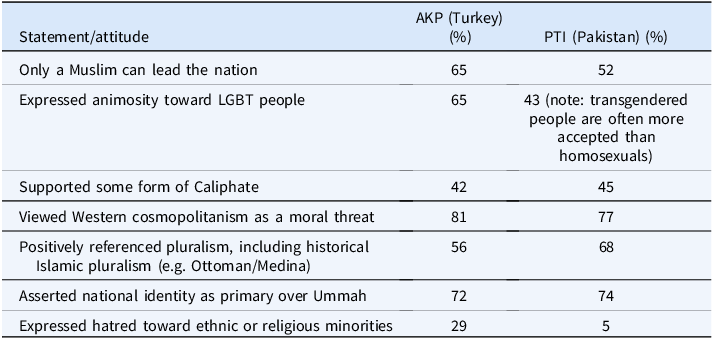
Crucially, restrictions on political leadership revealed the limits of this inclusion. A significant majority of participants (65% of AKP supporters; 52% of PTI supporters) insisted that only Muslims could lead their respective nations. As AKP14 asserted, “If the majority of your country is Muslim, the ruler of this country must be Muslim.” Similarly, PTI33 argued that “It is very important that [the leader] be Muslim… a non-Muslim cannot protect us.” These statements reflect a broader pattern; leadership was viewed not as a secular administrative role but as a moral office requiring Islamic authenticity.
Participants sought to portray these exclusionary views as compatible with tolerance. Turkish respondents frequently invoked Ottoman cosmopolitanism as proof of their openness, yet this was consistently framed as hierarchical inclusion. Sixteen AKP participants explicitly claimed to love diversity and desire equal rights for all Turkish citizens regardless of ethnicity or religion. A further nine expressed the view that minorities belonged in Turkey and should be tolerated, provided they did not challenge Sunni Turkish dominance. For example, AKP12 replied, “The history, the people, all kinds of cultural structures, religious beliefs, living together. All of them are very beautiful.” AKP10 similarly said, “We have lived as brothers and sisters for many years … Kurds, Laz, Circassians, Alevis, Sunnis, we live under one flag in the Republic of Turkey. We are Turks, we are the Republic of Turkey, and no one can be our friend except us.”
Pakistani respondents similarly referred to Medina and the Ottomans as examples of ordered diversity that justified minority subordination. When asked if non-Muslims enjoyed equal rights with Muslims, PTI34 argued that they do not, but praised the state for protecting Shia people during their religious pilgrimages, using this as an example of how the state ought to protect other minorities. Indeed, Imran Khan sought to support both Sikh and Shia communities in their aim to restore pilgrimage paths and sites. PTI19 argues that minority groups ought to enjoy equal rights with all other Pakistanis, merely because they are citizens of Pakistan. PTI44, when asked whether all groups have the same rights and protections, quibbled with the questioner and argued that minority groups should not have the same rights as others, but rather specific rights that will benefit them. However, they agreed that minorities should be protected, as they are by the rights granted to them by “Islam” and the “constitution”. PTI supporting participants’ professed a belief in the importance of protecting minorities and permitting them to practice their faith and culture. However, participants’ tolerance of minorities and the roles they are permitted to play in public life have limits.
Overall, these findings reveal that supporters of Islamic populist movements articulate a form of instrumental pluralism. Diversity is tolerated and even celebrated rhetorically, but only insofar as it reinforces Sunni Muslim dominance. Pluralism, in this context, functions less as an ethical commitment than as a controlled resource used to bolster national and religious hierarchies.
Theme 2: anti-cosmopolitanism and Islamic moralism: the moral limits of pluralism
Beneath participants’ rhetorical endorsements of diversity, we found pervasive anticosmopolitan attitudes, shaped primarily by Islamic moral frameworks and fears of cultural corruption. Both AKP and PTI supporters consistently framed Western culture not just as politically problematic but as a moral threat to Muslim societies, and this positioned Western style cosmopolitanism as foreign and immoral.
In Turkey, AKP supporters identified secularism, lesbian, gay, bisexual, transsexual (LGBT) visibility, and feminism as foreign influences undermining Islamic and Turkish values. AKP10 claimed that Turkish Muslims must “rid themselves of their desire to Westernize,” lamenting that “men are not like men, girls are not like girls. LGBTs came out…” Similarly, AKP21 described LGBT identity as “destroying the structure of the whole world society.” Conspiratorial thinking was common: AKP38 invoked Nazi Germany to argue that “Jews are a danger,” linking Jewish conspiracies to the moral decay of Turkish society.
Domestic minorities were often framed as agents of this foreign corruption. AKP36 asserted that “there are always traitors in [Turkey],” accusing Alevis and Kurds of “selling themselves for a dollar” to external enemies. Thirty-seven AKP-supporting participants expressed antiforeigner attitudes. Some claimed that there were too many foreigners in Turkey, especially Syrians fleeing a war partly fueled by Turkish foreign policy (see Aktürk, Reference Aktürk2017), and more than half professed a belief that foreigners are conspiring with minorities in Turkey to bring the country low, or that foreign powers (particularly Zionist powers USA and Israel) are forever plotting against Turkey (see Guida, Reference Guida2008, for an explanation of the Turkish “siege mentality’’ or “Sèvres syndrome’’ ultimately caused by trauma from the dismembering of the Ottoman Empire but encouraged by successive Turkish governments). Furthermore, 16 participants expressed dismay at Westernization of youth and wished to remove most or all Western influence.
Interestingly, AKP38 refers to the politics of Nazi Germany to reason that “Jews are a danger,” which, in correspondence with a subsequent statement, “I think those who rule the world are poisoning people,” implies Jews control the hegemonic, Western order that threatens Turkish sovereignty, national culture, and Islamic legitimacy. Although most participants have a neutral stance toward Jews when explicitly asked, based on their answers on who should lead the nation it can be inferred they believe Jews are morally inferior to ethnic Turkish Muslims. Unsurprisingly, the conversion of the Hagia Sophia from a secular museum into a mosque is almost unanimously celebrated by AKP supporters, including by participants who praise the diversity and equality of all Turkish citizens. This suggests that they believe the public sphere should be dominated by Sunni Muslim culture and symbols.
In Pakistan, moral anxieties centered less on ethnic minorities and more on Western moral intrusion. PTI31 described LGBT rights as a conspiracy “to harm society,” while PTI44 argued that without Shariah, Pakistani society would become “grotesque in its immorality.” Indeed, 23 PTI-supporting participants expressed a strong dislike of and/or desire to ban LGBT behavior. Most also said that transexuals were more to be pitied and helped out of begging and into employment than repressed. PTI45 is representative of many PTI supporters when they describe Khawaja Sara (essentially intersex and transgender people) as “human” and deserving of equal treatment but expressed hatred for and total intolerance of homosexuals. Like Turkish respondents, PTI supporters also viewed Western culture as both materially seductive and spiritually corrosive. As PTI11 explained, “People go to the West for money. But then they forget their prayers.”
Participants often coupled claims of tolerance with strict moral boundaries. AKP10, after claiming to “respect everyone’s sexual identity,” clarified that in “an Islamic country” LGBT people should remain invisible. Similarly, PTI33 stated that non-Muslims “live freely” in Pakistan but only Muslims could lead, as “only a Muslim leader can protect us.” Indeed, 28 PTI-supporting participants were explicit that only a Muslim should lead Pakistan. This number reflects only those who answered affirmatively, and not those who merely pointed out that the law prevents a non-Muslims from becoming President, those who did not answer the question, and those whose answers were unclear. For example, PTI33 claimed that “It is very important” that the leader of Pakistan be a devout Muslim insofar as “he cannot do anything bad to the public.” PTI33 also claimed that non-Muslims live “freely and practice their religions as per their choice,” but at the same time argued that “only a Muslim leader can protect … Muslims,” suggesting that although Pakistani Muslims can protect non-Muslims, non-Muslims can never “understand us” or protect Muslims. This is strongly indicative of a conditional pluralism in which minorities can never rise above a certain social status.
PTI37 agrees that Muslims will only be safe under a Muslim leader because “non-Muslims are trying to sabotage us” and argues that Pakistan “was made in the name of Islam”—referring to Pakistan’s raison d’’etre as a safe haven for the Muslim minority in then British India—therefore requires a Muslim leader. On the other hand, PTI18, while acknowledging that it is legally impossible for a non-Muslim to lead Pakistan, argues that honesty is a more important quality in a leader than the professing of Islam, and when asked if Muslims can only be safe under Muslim rule asserts that the notion is “rubbish.” However, their view is unusual among participants. PTI19, whose view is more representative of PTI supporters, argues that non-Muslims are “honest” people who can protect the Muslims they rule and also claims that only a devout Muslim should be allowed to lead Pakistan.
These responses demonstrate that pluralism was tolerated only within moral limits. Minorities could exist, but not assert alternative moralities or public visibility. Western cosmopolitanism, with its liberal rights discourse, was consistently rejected as a form of cultural imperialism undermining Islamic moral authority. AKP supporters were more likely to express hatred toward ethnic and religious minorities. This contrast might reflect different conceptions of national identity, with Turkish respondents more likely to equate national loyalty with ethnic and religious identity (i.e., ethnic Turkish Sunni Muslim), whereas Pakistani respondents framed non-Muslims as protected but subordinate citizens and were mostly not interested in citizens’ ethnic background.
Thus, anticosmopolitanism in both contexts was often less about nationalism per se, and more about moral boundary setting. Cosmopolitan ideals were rejected when they threatened Sunni Islamic norms, which defined the moral order of both nation and society.
Theme 3: civilizational nostalgia and national rejuvenation
Participants in both Turkey and Pakistan drew on historical Islamic polities, especially the Ottoman Empire and Medina, as idealized models of plural yet hierarchical societies. These references were not calls for egalitarian pluralism but justifications for contemporary Sunni dominance.
In Turkey, Ottoman nostalgia served primarily to reinforce Turkish national supremacy. Many AKP supporters invoked the Ottoman Empire as a period when minorities lived peacefully under Turkish Muslim rule. For example, AKP16 described the conversion of Hagia Sophia into a mosque as Turkish Muslims’’ rightful “sword right” as conquerors of Constantinople. Calls for a new Ottoman-style Caliphate often served as veiled assertions of Turkish leadership within the Muslim world.
In Pakistan, participants referenced Medina and the Ottomans more frequently than the Mughals, viewing these models as morally superior. PTI16 praised Imran Khan’s desire to model Pakistan on Medina, asserting that “whatever Imran Khan has said about the state of Medina is absolutely right.” PTI24 viewed the Ottoman Empire as the apex of Muslim civilization, calling for its restoration as a symbol of global Muslim unity.
However, such calls for Muslim unity were typically symbolic. Participants favored maintaining national sovereignty while imagining pan-Islamic solidarity as a source of moral and political strength. Even those advocating for a Caliphate envisioned hierarchical systems where non-Muslims had limited rights. As PTI44 argued, “the system of caliphate will come,” but minorities would remain under Islamic legal frameworks.
Support for the Caliphate was not necessarily associated with antidemocratic feeling, or a hatred of minorities, or a desire to dissolve the nation-state. Furthermore, supporters of democracy also expressed a belief that non-Muslims should not be able to lead Muslim societies, and people who desired a Caliphate often had a democratic model in mind and claimed that secular democracy had failed and that a sharia system would benefit Muslims and non-Muslims alike (i.e., as it supposedly had during the Ottoman period).
Civilizational nostalgia helps inform Islamic populists’’ political ideal in which diversity is possible, at times welcome, but only when subdued by Sunni Muslim political and cultural hegemony.
Ultimately, in both cases, appeals to historical Islamic cosmopolitanism served to reconcile participants’ professed love of diversity with their rejection of liberal pluralism. Hierarchical inclusion, justified through civilizational nostalgia, became the mechanism through which pluralism could be rhetorically embraced when practically restricted.
These three themes reveal a consistent discourse across both Turkey and Pakistan. Islamic populist supporters in both cases articulate a conditional, hierarchical cosmopolitanism, in which pluralism is reframed within Islamic moral boundaries and nationalistic frameworks. Diversity is tolerated as long as it reinforces Sunni Muslim dominance. Anticosmopolitanism, expressed through moral rejection of Western norms and conspiratorial thinking, further narrows the limits of acceptable inclusion, and historical Islamic polities are re-imagined as models for contemporary hierarchical order.
Prevalence of key discursive attitudes among Islamic populist supporters (% of participants). 1

Table 1. Long description
A table comparing the prevalence of key discursive attitudes among Islamic populist supporters in Turkey and Pakistan. The table has 7 rows and 3 columns. The columns are labeled Statement/attitude, AKP (Turkey) (%), and PTI (Pakistan) (%). Row 1: Only a Muslim can lead the nation, AKP (Turkey) (%), 65, PTI (Pakistan) (%), 52. Row 2: Expressed animosity toward LGBT people, AKP (Turkey) (%), 65, PTI (Pakistan) (%), 43 (note: transgendered people are often more accepted than homosexuals). Row 3: Supported some form of Caliphate, AKP (Turkey) (%), 42, PTI (Pakistan) (%), 45. Row 4: Viewed Western cosmopolitanism as a moral threat, AKP (Turkey) (%), 81, PTI (Pakistan) (%), 77. Row 5: Positively referenced pluralism, including historical Islamic pluralism (e.g. Ottoman/Medina), AKP (Turkey) (%), 56, PTI (Pakistan) (%), 68. Row 6: Asserted national identity as primary over Ummah, AKP (Turkey) (%), 72, PTI (Pakistan) (%), 74. Row 7: Expressed hatred toward ethnic or religious minorities, AKP (Turkey) (%), 29, PTI (Pakistan) (%), 5.
1 Percentages presented in Table 1 reflect the proportion of participants expressing a given statement during interviews, based on thematic coding of qualitative responses. These are intended as indicative frequencies, not statistical measurements. Although this study adopts a qualitative design, selected response frequencies are presented to illustrate the relative prevalence of core themes. These percentages reflect coded patterns across the 105 interviews and are intended to support, not substitute, interpretive analysis.
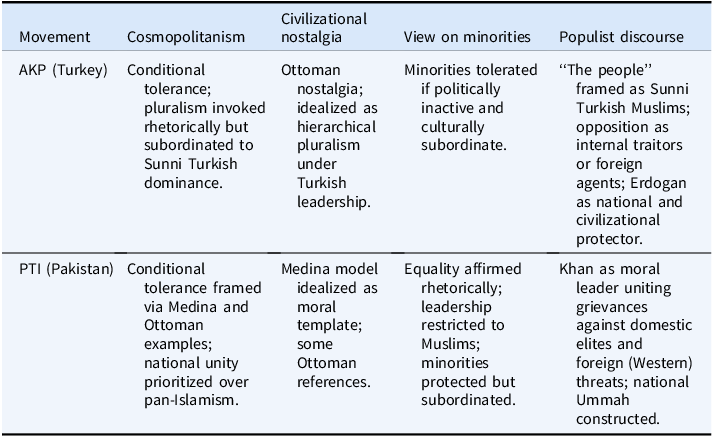
Comparative summary of Islamic populist discourses in Turkey and Pakistan. 2

Table 2. Long description
A table comparing Islamic populist discourses in Turkey and Pakistan. The table has four rows and four columns. The columns are labeled Movement, Cosmopolitanism, Civilizational nostalgia, View on minorities, and Populist discourse. The rows are labeled AKP (Turkey) and PTI (Pakistan). Row 1: AKP (Turkey), Conditional tolerance; pluralism invoked rhetorically but subordinated to Sunni Turkish dominance, Ottoman nostalgia; idealized as hierarchical pluralism under Turkish leadership, Minorities tolerated if politically inactive and culturally subordinate, The people framed as Sunni Turkish Muslims; opposition as internal traitors or foreign agents; Erdogan as national and civilizational protector. Row 2: PTI (Pakistan), Conditional tolerance framed via Medina and Ottoman examples; national unity prioritized over pan-Islamism, Medina model idealized as moral template; some Ottoman references, Equality affirmed rhetorically; leadership restricted to Muslims; minorities protected but subordinated, Khan as moral leader uniting grievances against domestic elites and foreign (Western) threats; national Ummah constructed.
2 Table 2 shows a comparative summary of how the AKP and PTI articulate conditional cosmopolitanism, civilizational nostalgia, and populist identity construction, showing similarities and differences.
Although the Turkish and Pakistani cases reveal a broadly similar pattern of conditional cosmopolitanism, there are notable differences in emphasis. Among AKP supporters, pluralism is filtered through ethnic nationalism and Ottoman nostalgia, which reinforce Turkish leadership within the Muslim world. Among PTI supporters, moral and religious hierarchy plays a stronger role, with less concern for ethnicity and greater focus on Islamic authenticity. These variations reflect how different political and historical settings shape the moral vocabulary of inclusion, even as both movements translate cosmopolitan ideals into hierarchical and exclusionary terms.
Discussion
This study examined whether Islamic populist supporters in Turkey and Pakistan are primarily anticosmopolitan or whether they articulate an alternative form of cosmopolitanism rooted in Islamic history, morality, and civilizational identity. We expected that (1) participants would express anticosmopolitanism and strong nationalism; (2) that tensions would be evident between populist solidarity with a global Ummah and the respective national Ummah, but nationalism and solidarity with the Ummah within the nation would be stronger; (3) that Islamic populists would construct their “people’’ shared economic, social, and moral grievances, Islamic identity and majority group status, and unify this group via populist-Islamist solutions such as blaming elites, minorities, and foreign people, religions, civilizations, nations, and ideas for preventing national flourishing, and by encouraging solidarity with the Ummah—within the nation and globally; and (4) that participants would embrace majoritarian populist democracy, supporting Sunni Muslim hegemony.
We found, however, that participants often claim to value diversity and equality, yet impose limits on pluralism, especially regarding leadership, public visibility of minorities, and moral norms. In other words, they showed evidence of support for a conditional cosmopolitanism.
We found widespread support for nationalism, and also mainly symbolic commitment to the global Ummah, particularly in opposition to Western power, and a strong desire to see Muslims unite globally, but without abolishing state sovereignty. We also found that participants praise Islamic empires and city-states (e.g. Ottoman Empire, Medina) as cosmopolitan models, but reframe them in hierarchical terms that legitimize Sunni dominance.
Our findings complicate the common assumption that Islamic populism entirely rejects cosmopolitanism. Instead, we find that supporters of these movements articulate a distinct form of conditional, hierarchical cosmopolitanism, wherein diversity is rhetorically embraced yet ultimately precluded by Sunni Muslim moral and political supremacy.
This challenges the dichotomous framing of populism and cosmopolitanism as inherently antagonistic. In the case of Islamic populism, cosmopolitan discourse is not entirely rejected but selectively redeployed as a discursive resource that helps populists construct “people’’ and define their key characteristics.
Our findings reveal that while participants often assert their solidarity with the global Muslim Ummah, national loyalty is ultimately most important to them. Appeals to transnational Muslim solidarity appear to serve a symbolic purpose, or may be a form of genuine feeling of belonging to a global community. Either way, this transnational solidarity is subordinated to the primacy of the nation–state. This points to a structural tension within Islamic populism, in which the ideal of pan-Islamic unity coexists with, but is consistently undermined by, nationalism and national belonging. The Ummah, in this discourse, exists primarily within the borders of the nation–state.
Our analysis therefore advances Talal Asad’s critique of secular cosmopolitanism. Just as Western liberal cosmopolitanism excludes certain religious or ideological others, Islamic populist cosmopolitanism constructs its own boundaries, defined by Islamic moral frameworks and historical imaginaries. Both forms of cosmopolitanism, then, are revealed as conditional and hierarchical, rather than universal and inclusive. However, Islamic populist cosmopolitanism is arguably more explicitly moralized and hierarchical than liberal democratic forms of cosmopolitanism.
Additionally, this research suggests that populism itself may predispose movements to conditional inclusion. Populism’s discourses, which pit “the people’’ against “elites’’ and “others,’’ inherently demand the construction of “peoples.” Islamic populism instrumentalizes this discourse through religious and moral frameworks, but the underlying discourse may encourage the exclusionary tendencies observed in populisms globally.
Furthermore, unlike Western populisms that invoke Judeo-Christian- or “Western civilization’’-based identity to define the limits of pluralism, Islamic populism frames pluralism through civilizational nostalgia and Islamic moral supremacy. The pluralism of past Islamic empires is invoked rhetorically to legitimize contemporary Sunni dominance, yet without rejecting diversity itself. This demonstrates that Islamic populism need not be entirely anticosmopolitan, but rather shows that its cosmopolitanism is conditional and hierarchical in explicitly Islamic ways.
The findings also reveal the flexibility of Islamic populist discourse. Participants express both anti-Western hostility and admiration for Islamic historical cosmopolitanism, enabling them to differentiate their society from the secular West while asserting a morally superior, Islamic model of pluralism. This rhetorical strategy allows for simultaneous rejection and appropriation of cosmopolitan ideals.
Our study, then, demonstrates that Islamic populist supporters in Turkey and Pakistan use cosmopolitan language as part of a broader populist discourse intended to construct a hierarchical order. In this order, pluralism is tolerated as a form of moral inclusion under Sunni dominance, not as an ethical commitment to universal equality, and transnational solidarity with the global Ummah remains constrained by nationalism. As a result, populism’s moral binaries and Islam’s civilizational imaginaries intersect with nationalism to produce a conditional, hierarchical cosmopolitanism that not only mirrors, but also differs from, Western right-wing populist conditionalities.
This analysis not only deepens our understanding of Islamic populism but also prompts reflection on the nature of cosmopolitanism itself. Far from being the exclusive domain of liberal or secular actors, cosmopolitanism emerges here as a contested discursive resource, appropriated, and reframed within diverse ideological projects, including exclusionary populisms grounded in religious and civilizational identity.
These findings align with, but complicate, scholarship on right-wing populism in Western contexts. Like their European and North American counterparts, Islamic populist supporters in Turkey and Pakistan articulate a conditional cosmopolitanism, although with boundaries created by Sunni Islamic moral and civilizational hierarchies instead of Judeo-Christian heritage, Western civilization, or secular-humanism (Brubaker, Reference Brubaker2017; Morieson, Reference Morieson2021).
As a result, unlike many Western populisms that use cultural or ethno-nationalist framings, Islamic populism fuses religion, nationalism, and morality to construct the “people’’ explicitly in religious terms. Although Western populists draw on culturalized, often secularized religion (Marzouki et al., Reference Marzouki, McDonnell and Roy2016), Islamic populists appeal directly to religious law and historical polities (e.g., Medina, the Ottoman Empire), blending national and transnational (Ummah-based) imaginaries more overtly (Hadiz, Reference Hadiz2014, Reference Hadiz2016).
Finally, where Western right-wing populisms frame globalization as a cultural threat, Islamic populists view it as a moral and civilizational threat, demanding moral regulation and civilizational revival rather than just protectionism. This suggests that cosmopolitanism’s articulation within populist movements is shaped not only by national context but also by civilizational and religious imaginaries. Indeed, although this finding is here based on our empirical work on Islamic populist movements, it is likely that other non-Western populists and Western populisms that reject liberalism will place similar conditions and hierarchies around the cosmopolitan arrangements they and their supporters endorse.
Conclusion
We examined how supporters of Islamic populist movements in Turkey and Pakistan mobilize conditional and selective cosmopolitan discourses, framing the Ummah as both a moral community and a bounded national people. While participants in these two parties respectively present themselves as defenders of a transnational Muslim solidarity and as critics of Western culture and imperialism, their populist logics often constrain their transnationalism and desire for pluralism and diversity. They instead embrace cosmopolitan ideals rhetorically, but filtered through majoritarian claims and ethnoreligious hierarchies.
However, rather than dismissing participants’ words as a failure to embrace normative cosmopolitanism, we might instead see them as examples of movements in which cosmopolitanism is reconfigured in accordance with Islamic populism and its categorizations of peoples and moral boundaries.
It is difficult to tell whether Islamic populism’s supporters are more or less likely to support cosmopolitan than other people in their respective countries. Instead, it may be that cosmopolitanism, far from being the exclusive property of liberal-secular actors, remains a contested discursive resource across ideological and religious lines. In the cases we examined, populism tends to hollow out the possibility of even Islamic (e.g., Ottoman) style cosmopolitanism and instead establish a populist nationalism that categorizes individuals and groups according to whether they belong to the Ummah, elites, or dangerous “others.’’ For scholars of populism, this raises questions about whether a truly inclusive and egalitarian “people’’ can be constructed within Islamic populism.
At the same time, this analysis resonates with Asad’s (Reference Asad1993, Reference Asad2003) critique of Western secular cosmopolitanism, which he argues is not a neutral or universal ideal but a historically contingent formation with its own embedded norms and social hierarchies. Asad reminds us that liberal cosmopolitanism often excludes those who do not internalize its particular conception of reason, tolerance, and individual autonomy. The Islamic populist discourses examined here, then, do not simply fall short of “true’’ cosmopolitanism. Rather, they construct an alternative cosmopolitanism framed in religious and civilizational terms. Our study, then, complicates the normative assumption that cosmopolitanism is inherently inclusive or emancipatory and suggests that it is always articulated within discursive formations, in this case within Islamic populist discourses. Like secular cosmopolitanism, Islamic populism uses a particular framework to decide who belongs and who does not belong. In their case, Islamic religious and civilizational frameworks delineate who can belong, and on what terms. However, although both forms of cosmopolitanism are conditional and culturally situated, our findings suggest that Islamic populism is likely more conditional.
The patterns observed in Turkey and Pakistan suggest that Islamic populism participates in a wider global movement linking religion and right-wing populism. This mechanism, wherein religion transforms cosmopolitan ideals into systems of conditional belonging, illustrates how moral frameworks universalize inequality within populist movements. This finding resonates with comparative research on religious populisms worldwide (Beuter et al., Reference Beuter, Kortmann, Nette and Rucktäschel2023; Brubaker, Reference Brubaker2017; Ingram, Reference Ingram and Kaltwasser2017; Marzouki et al., Reference Marzouki, McDonnell and Roy2016), which collectively demonstrate that religious morality provides a shared vocabulary for conditional inclusion across traditions. Similar dynamics appear in Christian nationalist populisms in the United States and parts of Europe (Haynes, Reference Haynes2020), in Hindu populism in India (Saleem, Reference Saleem2021), and in Jewish religious populism in Israel (Porat and Filc, Reference Porat and Filc2022; Yilmaz and Morieson, Reference Yilmaz and Morieson2023b). In each of these settings, religious morality provides a vocabulary for conditional inclusion that re-interprets cosmopolitan ideals through local hierarchies of belonging. The Turkish and Pakistani cases point to a broader pattern in which religious populist movements turn universal ideas of equality into moral or religion based social and political hierarchies.
Our findings suggest that the relationship between populism and cosmopolitanism is more complex than simple opposition. Populist movements, even when exclusionary, may appropriate cosmopolitan ideals and translate them in ways that affirm in-group dominance and hierarchies that favor majority religious and ethnic groups. Similar discourses may also appear in other non-Western populisms, and in Western populisms that reject liberal norms.
Financial support
This research was supported by the Australian Research Council under the Discovery Project “Religious Populism, Emotions and Political Mobilisation” (DP220100829), 2022–2025, and Discovery Project “Civilisationist Mobilization, Digital Technologies and Social Cohesion” (DP230100257) 2023–2025.
Competing interests
The authors report no conflict of interest.
Ethical standards
This study received ethics approval from the Human Research Ethics Committee (DUHREC) at Deakin University, Melbourne. All participants provided written informed consent prior to participation. Participants were fully informed that they were taking part in social science research, the nature and purpose of the study, and how their data would be used. Participation was voluntary, and as such participants could withdraw at any time. No participants are identified, nor could they be reasonably identified, in this article. All data are reported in anonymized form in accordance with the terms of the ethics approval and the consent provided. As no identifying information is included, consent to publish identifiable material was not required, and therefore participants were not shown the article prior to publication.

 Open access

