


Introduction
A wide consensus has emerged that religion contributes to conflict and peacemaking, making religion a “double-edged” sword (Appleby, Reference Appleby2000). In addition, conflicts that involve religious issues or sacred values are more resistant to traditional forms of political compromise (Atran et al., Reference Atran, Axelrod and Davis2007; Atran and Ginges, Reference Atran and Ginges2012; Hassner, Reference Hassner2003; Walter, Reference Walter2017).Footnote 1 For example, Ginges et al. (Reference Ginges, Atran, Medin and Shikaki2007) use a series of experiments to show that symbolic concessions to the long-standing Israeli-Palestinian conflict were viewed more favorably by religious actors on both sides, relative to material concessions.Footnote 2 Thus, to the extent that people base their political choices on their religious beliefs, there is an important role for elites who can speak to these symbolic values. This includes religious leaders, who are often seen as moral authorities and have the ability to influence the opinions of their followers in a way that other politicians cannot (Blair et al., Reference Blair, Littman, Nugent, Wolfe, Bukar, Crisman, Etim, Hazlett and Kim2021).
Indeed, religious actors have played a valuable role in promoting political alternatives to conflict worldwide. Notable examples include Nigeria, Northern Macedonia, and Ireland (Blair et al., Reference Blair, Littman, Nugent, Wolfe, Bukar, Crisman, Etim, Hazlett and Kim2021; Smock, Reference Smock2008). Scholarship has also highlighted the potential role for religion to contribute to conflict resolution through its moral authority to harness and (re)interpret religious teachings (Appleby, Reference Appleby2000; Gopin, Reference Gopin2002; Haynes, Reference Haynes2016; Johnston and Sampson, Reference Johnston and Sampson1995; Toft et al., Reference Toft, Philpott and Shah2011).Footnote 3 In addition, religious leaders can be effective in promoting political compromise as they have the authority to advise their followers on a variety of topics. Yet, there are also many instances of failed religious peacemaking (Gopin, Reference Gopin2002). Thus, it is unclear why some religious leaders seem to be effective in promoting political compromise, while other religious leaders have little impact.
Our paper focuses exclusively on Jewish religious leadership in Israel, examining how different types of authority affect religious leaders’ ability to promote political compromise. We acknowledge that this represents one specific context within the broader landscape of religious peacemaking, and our findings may not generalize directly to other religious traditions or political contexts. With that, the Israeli case provides a valuable testing ground due to the complex intersection of religious and political authority in a democratic society where religious issues are central to ongoing political conflicts.
To examine this question, we develop a theory of religious leader authority that builds on literature in conflict resolution and political psychology. We argue that religious leaders possess two distinct but potentially complementary types of authority: (1) religious authority and (2) political credibility. Religious authority refers to the perceived legitimacy and expertise a religious leader possesses in interpreting religious texts, traditions, and values. This authority stems from religious knowledge, reputation for piety, institutional position, and the ability to provide compelling religious justifications for political positions (Sandal, Reference Sandal2011, Reference Sandal2017). Religious authority is unique to religious leaders and provides them with the capacity to reframe political issues in religious terms and offer religiously grounded justifications for political compromise. Political credibility refers to the perceived trustworthiness and expertise of any political actor—including religious leaders—when they engage with political issues. Drawing on research showing that political credibility often comes from unexpected or “unlikely” sources (Berinsky, Reference Berinsky2017), we argue that religious leaders may gain political credibility when their political positions contradict their previous stances or when they demonstrate a willingness to break with conventional religious-political alignments. This type of credibility is not unique to religious leaders but may be particularly important when religious leaders venture into political territory.
We hypothesize that the combination of religious authority and political credibility allows religious leaders to promote political compromises on sensitive issues involving sacred values, including territorial conflict. Neither form of authority alone may be sufficient; rather, their interaction may be crucial for effective religious peacemaking. We test our hypothesis using an experimental design in Israel, where conflict involving religious issues is prevalent. This includes conflict between groups in Israel (religion and state) and foreign policy issues (such as giving up land for peace with the Palestinians). Furthermore, individuals see religion as a source of shared identity and nationhood while also being strongly divided over religious involvement in politics. In the experiments, we present respondents with a conciliatory peace message and vary the religious authority and political credibility of a Jewish religious leader.Footnote 4
Our findings suggest more modest effects than often assumed in the religious peacemaking literature. While we find some evidence that religious and political authority can work together to promote support for political compromise, these effects are limited in magnitude and concentrated primarily among already-religious respondents. This suggests that religious leaders may be better positioned to reinforce than to transform political attitudes, highlighting practical limitations on leveraging religious leadership for conflict resolution.
Our research makes important contributions to two bodies of research. First, it contributes to the growing literature on the political influence of religious leaders. While work has focused on the varied effect of religious messages (McCauley, Reference McCauley2014; McClendon and Riedl, Reference McClendon and Riedl2015; Warner et al., Reference Warner, Kilinç, Hale, Cohen and Johnson2015), it remains unclear how important different types of religious leader authority are for promoting political compromise. Second, prominent literature argues that negotiations over sacred values lead to political hardening and backlash (Ginges et al., Reference Ginges, Atran, Medin and Shikaki2007). Overall, our work identifies important scope conditions for religious leaders’ influence, highlighting how authority type and audience characteristics condition their effectiveness. Moreover, they suggest practical limitations on leveraging religious leadership for conflict resolution.
Religious leader authority
The relationship between religion and politics is complex. Some posit that religion and politics are two separate realms, while others believe that the demarcation between religion and politics is superficial. In this paper, we follow recent evidence which suggests that large parts of the public do not view political activity by religious leaders favorably (in Islam or Christianity) and that religious leaders who engage in political activity will hurt their religious authority (Williamson et al., Reference Williamson, Yildirim, Grewal and Kuenkler2023). In turn, this suggests that overt efforts by religious leaders to engage in political issues will most likely fail since the involvement is not viewed as religiously credible (or binding) by their communities. In contrast, more covert efforts are more successful (Gryzmala-Busse, Reference Gryzmala-Busse2015, Reference Grzymala-Busse2016).
Given this setting, how do religious leaders gain religious authority to help promote political compromise? To examine this question, we adopt the political economy of religion framework, which theorizes the existence of a competitive religious marketplace, where religious leaders compete for followers (Gill, Reference Gill2001). While there are some religious systems where leaders are chosen in “elections” (such as the Pope), the majority of religious leaders rely on their charisma and tradition for their religious authority, and their concomitant ability to attract followers (Nielsen, Reference Nielsen2020; Ziegler, Reference Ziegler2024).Footnote 5 In this marketplace, its tempting for religious leaders to focus exclusively on religious issues and not engage in politics. However, many times religious leaders inevitably engage with politics as political issues are frequently conflated with religious issues (Margolis, Reference Margolis2018a). Prominent political issues at dispute include climate change (Buckley, Reference Buckley2022; Djupe and Burge, Reference Djupe and Burge2023; Djupe and Calfano, Reference Djupe and Calfano2013), immigration (Ben-Nun Bloom et al., Reference Ben-Nun Bloom, Arikan and Courtemanche2015; Margolis, Reference Margolis2018b), sacred territory (Hassner, Reference Hassner2017), and female political leadership in the Middle East (Masoud et al., Reference Masoud, Jamal and Nugent2016; Nielsen, Reference Nielsen2020). In turn, religious texts will be interpreted in a more politically liberal or conservative manner by different leaders (Iyer, Reference Iyer2016). Assuming religious leaders and communities organize along similar interests, this leads to religious traditions that are multivocal, where religious communities adopt different attitudes towards the state, democracy, and support for political violence (Grzymala-Busse, Reference Grzymala-Busse2012; Philpott, Reference Philpott2007; Stepan, Reference Stepan2000).
When deciding between competing religious and political messages in this marketplace, individuals will inevitably side with some religious leaders and not others. Generally, they will tend to side with religious leaders who enjoy greater moral authority, which lies in the combination of their perceived religious authority and (informal) political credibility. However, it is also likely that some of the public prefer clerics who engage in politics. Thus, market segmentation allows for multiple equilibriums in which both politically engaged and disengaged leaders can maintain followings. We discuss these two types of authority below.
Religious authority
In this subsection, we argue that religious leaders differ in their religious authority and that the religious public is more likely to side with more religiously authoritative leaders. This is especially pertinent for highly contested political issues where it is prime facie unclear whether and how to apply religious or sacred values. In this case, religious authority acts as an important signal for the integrity of an interpretation made by a particular religious leader.
How does a religious leader gain and maintain religious authority, even when engaging in politics? The structure of religious authority differs among religious traditions. For instance, in a centralized religious system (such as Catholicism) authority is institutional and can be formally acquired by moving up the religious leadership hierarchy. In a less centralized religious system, such as Sunni Islam or Judaism, authority can be gained through a combination of personal charisma, reputation for piety, and knowledge of religious texts.
In this paper, we adopt the framework of religious authority proposed by Sandal (Reference Sandal2011, Reference Sandal2017), when theorizing about the process by which religious leaders influence policies regarding peacemaking in divided societies (specifically Ireland and South Africa). Sandal holds that religious knowledge (i.e., epistemology) is the key aspect of religious authority. Specifically, the ability to interpret, or reinterpret, religious teachings—that is, to employ hermeneutics—is crucial for religious authority in general, and in the domain of peacemaking more particularly. Thus, epistemic religious actors with the skills to develop theologies about important facets of the conflict may be uniquely positioned to affect inclusive and peaceful (or exclusive and racist) public policies. Thus, while some religious leaders moralize certain political issues, such as gay marriage or abortion (Grzymala-Busse, Reference Grzymala-Busse2012), this process can also be reversed (Ben-Nun Bloom et al., Reference Ben-Nun Bloom, Arikan and Courtemanche2015). One historical example is religious attitudes towards slavery, where public attitudes became demoralized after religious leaders argued that there was no religious justification for slavery (McKivigan and Snay, Reference McKivigan and Snay1998). More recent contested examples include debates between religious leaders over whether it is permissible to hurt innocents during religiously motivated conflict (Hegghammer, Reference Hegghammer2013) and religious obligations towards refugees/immigrants (Ben-Nun Bloom et al., Reference Ben-Nun Bloom, Arikan and Courtemanche2015).Footnote 6
During these debates, religious leaders can signal their religious knowledge in several ways when they engage with political issues. For instance, religious leaders may highlight certain religious passages in Scripture (Masoud et al., Reference Masoud, Jamal and Nugent2016), emphasize certain religious values (Ben-Nun Bloom et al., Reference Ben-Nun Bloom, Arikan and Courtemanche2015), or appeal to secular values such as self-efficacy (McClendon and Riedl, Reference McClendon and Riedl2015).Footnote 7
Political credibility
Religious authority alone may be insufficient for effective political influence. When religious leaders venture into political territory, they must establish political credibility, which is the perceived trustworthiness and expertise to address political issues competently. This creates a fundamental tension: the very political engagement that might enhance a religious leader’s policy influence may undermine their religious authority, and vice versa.
Gryzmala-Busse (Reference Gryzmala-Busse2015) argues that religious leaders must carefully maintain their moral authority when engaging in political advocacy, as overt political involvement can damage their religious standing. This creates a strategic dilemma: religious leaders who become too explicitly political risk losing the religious authority that makes them distinctive political actors in the first place.
This tension suggests that effective religious peacemaking requires indirect approaches that preserve religious legitimacy while building political credibility. Religious leaders interested in peacemaking may prefer informal engagement over explicit political advocacy because informal diplomacy allows for ambiguity and flexibility (Lehrs, Reference Lehrs2022). Traditional diplomacy involves explicit position-taking on contentious political issues, which can be risky when a religious leader’s community opposes political compromise. Informal engagement allows religious leaders to explore peace themes such as interfaith dialogue or shared values without committing to specific political outcomes. Moreover, indirect engagement appears more authentic and less calculating than formal political involvement. Religious leaders who engage in grassroots peacemaking may be seen as responding to moral imperatives rather than political incentives, helping to preserve their religious authority while building political credibility.
However, even indirect political engagement requires credibility to be effective. Research in political psychology demonstrates that source credibility is crucial for persuasion, with expertise and trustworthiness as key components (Pornpitakpan, Reference Pornpitakpan2004). Recent work reveals that political credibility often comes from unexpected or “unlikely” sources with actors whose political messages contradict audience expectations based on previous positions or apparent interests (Berinsky, Reference Berinsky2017).
For religious leaders, this “unlikely source” dynamic may be particularly important. Religious communities often have predictable political alignments, making certain political positions “expected” from religious leaders. When religious leaders break with these conventional alignments, their political messages may gain credibility precisely because they appear costly or unexpected. The dynamics of credibility vary significantly across different types of religious peace advocates. Consistently dovish religious leaders may have high religious authority but limited political credibility on peace issues because their positions are predictable and potentially self-serving, simply confirming pre-existing beliefs. In contrast, former hawks who become peace advocates may gain significant political credibility because their position change suggests genuine conviction rather than ideological consistency. Their advocacy appears costly because it contradicts their previous stance and potentially alienates former supporters. This “unlikely source” credibility mechanism helps explain why some religious peace efforts succeed while others fail. It also aligns with broader research showing that “hawks are better at making peace” (Mattes and Weeks, Reference Mattes and Weeks2019; Schultz, Reference Schultz2005) and why political actors who contradict group expectations often gain influence (Cammett and Luong, Reference Cammett and Luong2014; Walter, Reference Walter2017).
Theoretical implications
This framework suggests that the most politically credible religious peace advocates may be those who combine religious expertise with unexpected political positioning. Such leaders can leverage their religious authority to frame political issues in moral and sacred terms while gaining political credibility through costly signaling when their peace advocacy contradicts previous positions or community expectations. They can maintain authenticity by grounding political positions in religious principles rather than partisan calculation.
However, this combination is difficult to achieve and maintain. The same position changes that enhance political credibility may raise questions about consistency and reliability. Religious leaders must navigate these tensions carefully to maintain influence across both domains. Moreover, the effectiveness of this approach likely depends on audience characteristics. Religious audiences may be most responsive to religious authority, while politically engaged audiences may weight political credibility more heavily. The interaction between religious authority and political credibility should be strongest among audiences who value both religious guidance and political competence, primarily religious individuals who are also politically engaged. Overall, this suggests the following hypothesis:
H1: Religious leaders with political credibility, alongside religious authority, are more likely to successfully promote political compromise.
Religious leaders and peacemaking in Israel
We explored our hypothesis in Israel. This case provides a valuable contribution as Jewish identity in Israel is complex, infused with religious, ethnic, and nationalist meaning. In addition, Israel’s different social groups vary in their support for religion and nationalism, which has a large impact on a host of political issues such as support for the settlements in the West Bank. This variation may also impact their readiness to make political compromises when exposed to conciliatory religious messages by religious leaders.
Another advantage of examining Israel is that it provides a setting where there is sharp disagreement among different social groups regarding the influence that religion should have on politics (Freedman, Reference Freedman2020). According to a recent Pew Research Center report (2016),Footnote 8 while the majority of Jewish Israelis believe religion should be kept separate from government policies, there is a sharp divide among the four main social groups in Israel.Footnote 9 Moreover, this debate is not merely ideological. There are strong disagreements over actual religious policies such as whether to allow public transportation on the Sabbath, whether Ultra-Orthodox Jews should serve in the army, and whether non-Orthodox Rabbis should be allowed to conduct marriages in Israel. Furthermore, attitudes towards peace are highly shaped by religious values such as whether sacred land can be divided (Manekin et al., Reference Manekin, Grossman and Mitts2019). While most religious leaders (and the religious public) hold hawkish views on the peace process, several prominent religious leaders have taken liberal stances (such as Rabbis Ovadiah Yosef, Menachem Froman, and Yehuda Amital). However, it is unclear what impact these conciliatory messages have on the public.Footnote 10
In addition, large parts of the population are exposed to religious teachings. The competition between religious elites has led to the creation of alternative forms of religious media which contain many political messages by prominent religious elites, such as the popular weekly Sabbath pamphlet (Alonei Shabbat). While the majority of texts discourage political compromise,Footnote 11 others use rhetorical devices to justify political compromise (Freedman, Reference Freedman2019).
Experiment I
We conducted two survey experiments in Israel, where IRB approval was obtained from MIT and Hebrew University.
Participants
Experiment I was an online sample collected in two waves (August 2018 and January 2019) by IPanel, an Israeli firm who specializes in administering online samples (n = 265).Footnote 12 Using quota sampling, we oversampled the religious population in Israel since this is the most relevant population for the survey. Respondents were randomly assigned to the different treatment conditions. The appendix contains the transcript of the survey questionnaires and the treatment conditions.
Design and procedure
In line with the hypothesis, in Study 1 we varied the relative levels of political credibility and religious authority of the religious leader. We had two possible experimental protocols whereby individuals were randomly assigned to one experimental condition. In the first condition (control), the religious leader possesses political credibility versus the second condition (treatment) where the religious leader has political credibility and relatively more religious authority. This allows us to assess to what extent higher levels of religious authority play a role for religious leaders, holding constant political credibility.
To signal religious authority in Study 1, we framed the political discussion around a religion and state issue that is relatively esoteric, as we wanted the issue to be chiefly about religious practice and contain no political implications. For this purpose, we chose the topic of eruv, a Jewish law governing the ability to carry items outside of the household on the Sabbath. We randomly assigned two variations: in one variation, the Rabbi takes a strict view on the topic, forbidding the carrying of items on the Sabbath, and in the other variation, the view is more lenient, permitting this action. While it is common for religious leaders to state political opinions, typically only religious legal experts take stances on purely legal issues in Jewish law. As well, this mimics the common practice in more conservative circles to juxtapose rulings on both political and legal issues, whereas discussing political issues exclusively is rarer.Footnote 13
We signaled political credibility by noting the religious leader’s past participation in protests against the peace process. Since most of the religious public holds right-wing views on the conflict, liberal positions taken by former hardline leaders are seen as more politically credible by the public than consistent dovish positions.
Both conditions contained a conciliatory message about peace with the Palestinians. The conciliatory message stated that it was permissible to give away land for peace when doing so would save Israeli lives. Notably, this religious message frames Palestinians as a threat, and compromise for peace as being in Israel’s self-interest. We chose this message, as it is based on actual legal religious opinions made by prominent religious leaders in Israel, giving the design more internal validity.Footnote 14
Measures
The main outcome variable measured readiness to make political compromises in other conflict areas such as the Israeli-Palestinian conflict using questions on political compromise used by other scholars (Atran and Ginges, Reference Atran and Ginges2012). One example included the following:
In exchange for a permanent peace agreement, would you be prepared for the Arab neighborhoods in East Jerusalem to serve as the capital of the Palestinian state?
Responses to these prompts were recorded on a 7-point scale that ranged from “completely favor” to “completely oppose.”
It should be noted that respondents may be reluctant to state a willingness to make compromises on politically sensitive topics in response to direct questions. In order to account for this potential form of social desirability bias, we also included alternative measures that were less sensitive. One such measure included feeling thermometers, a standard tool used in many surveys (such as the ANES) for measuring feelings towards different social groups (Nelson, Reference Nelson2008), including questions that asked about Palestinian victimization (Čehajić-Clancy et al., Reference Čehajić-Clancy, Effron, Halperin, Liberman and Ross2011). When possible, we also used question wordings from previously run surveys such as the 2016 Pew Report and the Guttman religion surveys.Footnote 15
Summary statistics
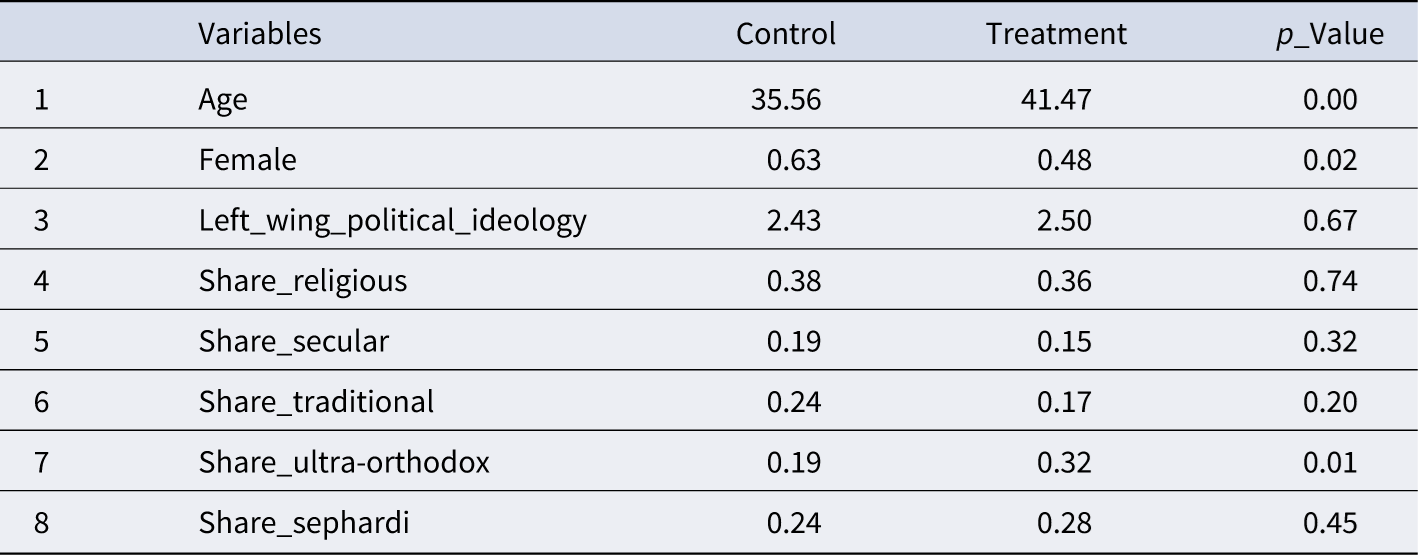
In Table 1, we assess the balance of the sample by showing the summary statistics. The Table shows balance on political ideology and the share of secular, traditional, and religious. However, the Table also implies there is some demographic imbalance between the control (political credibility only) and treatment (political credibility and religious authority) groups. Specifically, there was a higher share of females in the control group, and a higher share of Ultra-Orthodox in the treatment groups. To help account for this imbalance, our main results below include demographic controls.
Balance table for experiment I

Table 1. Long description
A table comparing summary statistics between control and treatment groups. The table has 8 rows and 4 columns. The columns are labeled Variables, Control, Treatment, and p_Value. The rows are labeled with different variables: Age, Female, Left_wing_political_ideology, Share_religious, Share_secular, Share_traditional, Share_ultra-orthodox, and Share_sephardi. Each row provides values for the control and treatment groups, along with a p_value indicating the statistical significance of the differences. Row 1: Age, Control 35.56, Treatment 41.47, p_Value 0.00. Row 2: Female, Control 0.63, Treatment 0.48, p_Value 0.02. Row 3: Left_wing_political_ideology, Control 2.43, Treatment 2.50, p_Value 0.67. Row 4: Share_religious, Control 0.38, Treatment 0.36, p_Value 0.74. Row 5: Share_secular, Control 0.19, Treatment 0.15, p_Value 0.32. Row 6: Share_traditional, Control 0.24, Treatment 0.17, p_Value 0.20. Row 7: Share_ultra-orthodox, Control 0.19, Treatment 0.32, p_Value 0.01. Row 8: Share_sephardi, Control 0.24, Treatment 0.28, p_Value 0.45.
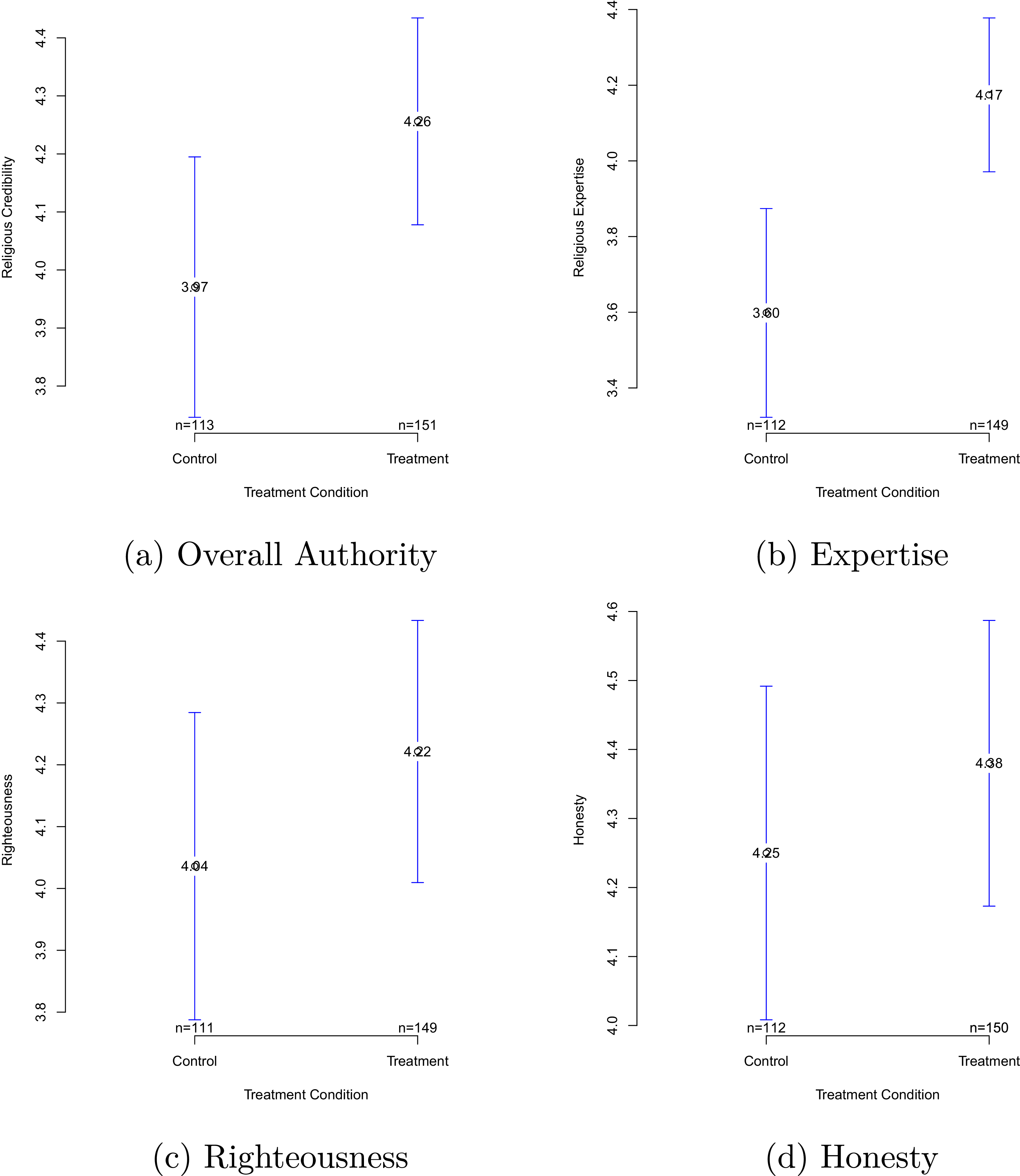
In Figure 1, we assess the effect of our treatment on the perceived authority of the religious leader (manipulation check). Specifically, we consider how respondents ranked the religious leader’s expertise, honesty, and righteousness (on a scale of 1–6). The figure indicates that when the discussion of political issues is accompanied by a legal discussion of other religious issues, respondents ranked the religious leader as more of a religious expert, more righteous, and more honest.
Religious leader authority by treatment group.
Note: Figures displays the means and 95 % confidence intervals for overall religious leader authority and its sub-component parts: expertise, righteousness, and honesty. The control condition manipulates political credibility only while the treatment condition manipulates political credibility and religious authority.

Interestingly, these results were the largest for perceptions of religious leader expertise (4.17 versus 3.60) and smaller for righteousness and honesty. These results provide support that our instrument increased the perceived authority of the religious leader (see also Figure A1).
Main results
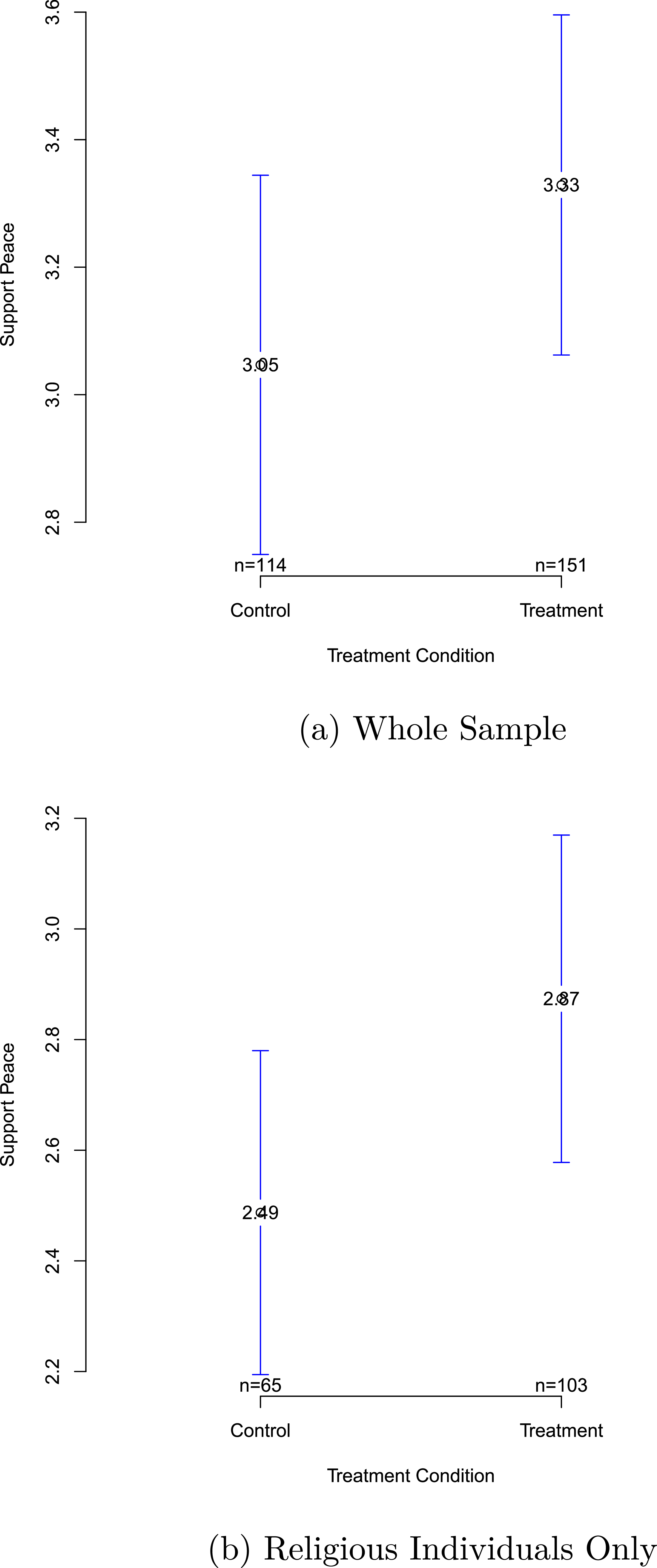
To assess the impact of our treatment on political compromise, we first plot the difference of means between the control and treatment group in Figure 2. The figure indicates that there was slightly more support for peace in the treatment condition relative to the control group (3.33 versus 3.05) and that these results were slightly larger for religious respondents (2.87 versus 2.49). This is consistent with our theoretical expectation that conciliatory messages by a religious leader with religious authority (together with political credibility) will somewhat increase support for political compromise, relative to a religious leader with just political credibility (see also Figures A3 and A4).
Effect of religious leader authority on support for peace.
Note: Support for peace is the average value of responses regarding support for negotiations, support for dividing Jerusalem, and support for exchanging land for peace.

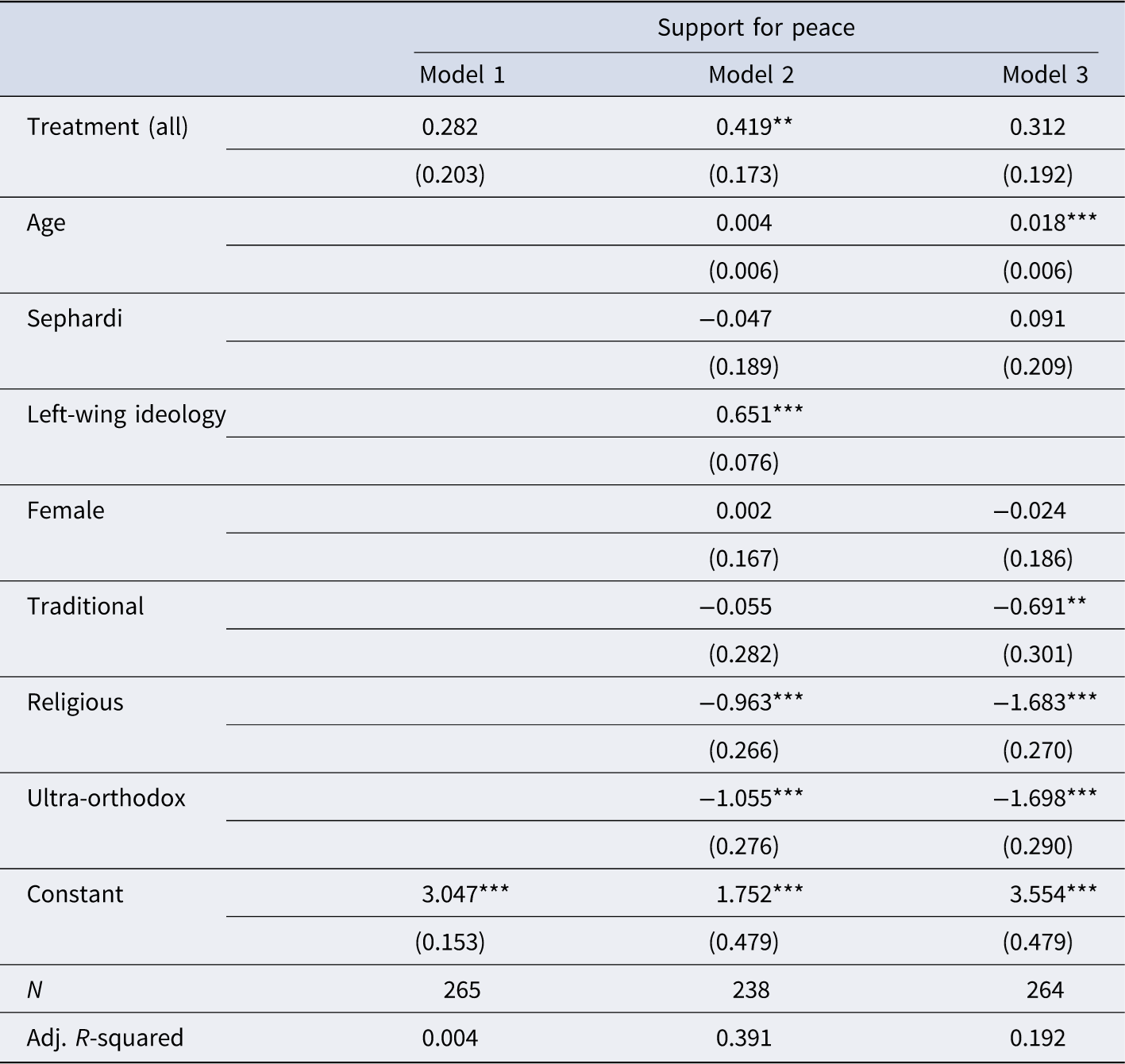
To assess whether these differences are statistically significant, we used an OLS regression in Table 2. Column 1, with no controls, suggests that treatment has a moderate positive effect, although the effect is not statistically significant. In Column 2, we introduce demographic controls which account for some covariate imbalance between the treatment and control groups. Column 2 suggests that treatment increased support for peace by 0.43, which represents a modest effect of about a quarter of a standard deviation, and this result is statistically significant at the 95% level. However, Column 3 indicates that the results are weakened when one does not control for political ideology (which we removed due to concerns of post-treatment bias). This suggests that the results are only significant for some specifications.
Impact of treatment on support for peace

Table 2. Long description
A table with three columns and eleven rows, showing the impact of treatment on support for peace across different models. The columns are labeled Model 1, Model 2, and Model 3. Each row represents a different variable or control. Row 1: Treatment (all), with values 0.282, 0.419, and 0.312. Row 2: Age, with values 0.004 and 0.018. Row 3: Sephardi, with values -0.047 and 0.091. Row 4: Left-wing ideology, with a value of 0.651. Row 5: Female, with values 0.002 and -0.024. Row 6: Traditional, with values -0.055 and -0.691. Row 7: Religious, with values -0.963 and -1.683. Row 8: Ultra-orthodox, with values -1.055 and -1.698. Row 9: Constant, with values 3.047, 1.752, and 3.554. Row 10: N, with values 265, 238, and 264. Row 11: Adj. R-squared, with values 0.004, 0.391, and 0.192. The table includes standard errors in parentheses and indicates statistical significance with asterisks.
Note: Standard errors are reported in parentheses.
*p < 0.10, **p < 0.05, ***p < 0.01.
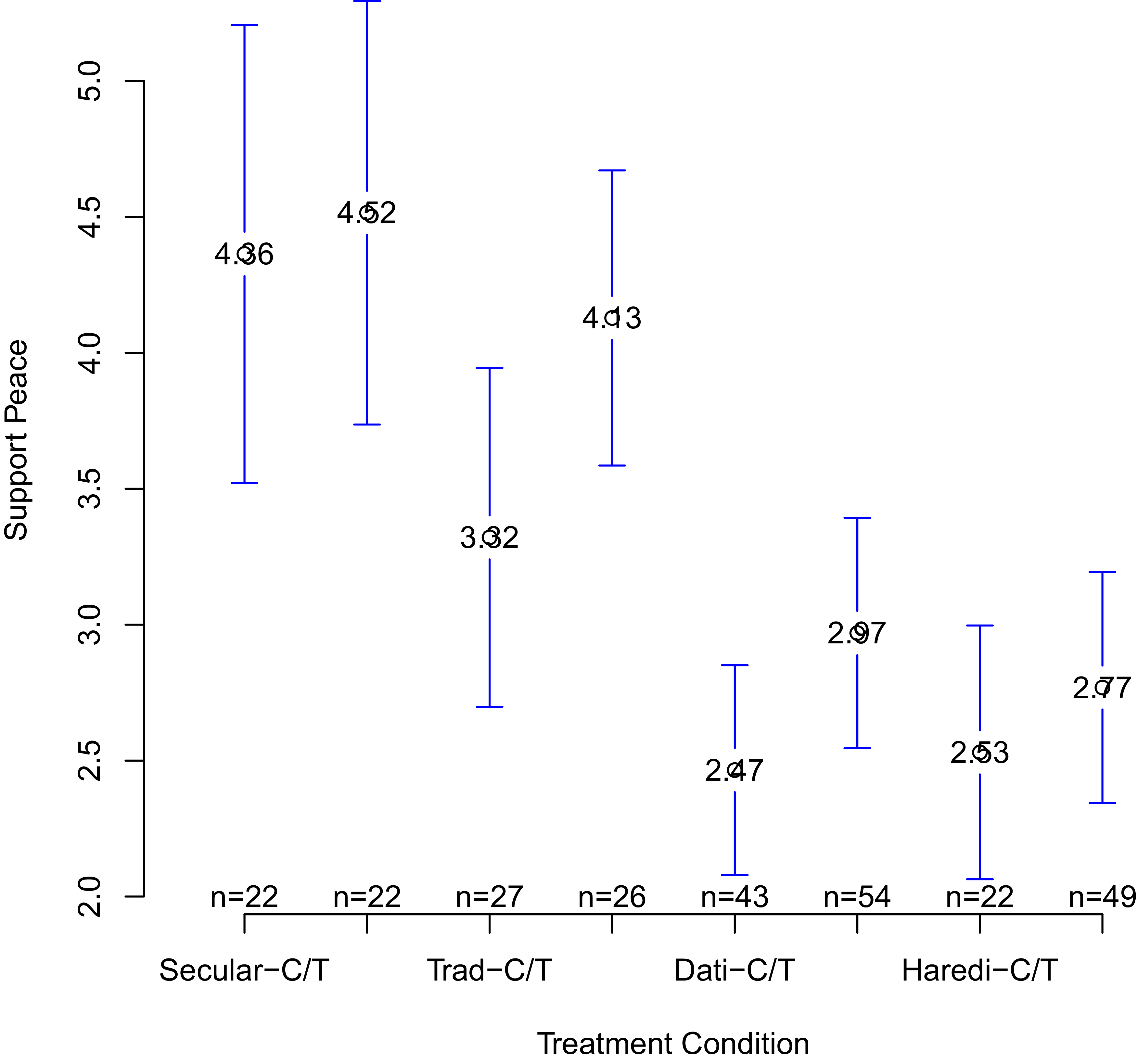
We also examined to what extent our treatment had heterogeneous effects based on religiosity. As shown in Figure 3, we find that the effects are the largest among religious and traditional respondents, while the effects are weakest among secular respondents.Footnote 16 This is consistent with other work which finds that individuals who are less knowledgeable about their religion are the most susceptible to religious arguments (Fair et al., Reference Fair, Goldstein and Hamza2017; Wiktorowicz, Reference Wiktorowicz2005). This is also consistent with previous work that indicates that secular people are unlikely to be persuaded by more authoritative religious leaders since they do not value religious authority (Djupe and Calfano, Reference Djupe and Calfano2013).
Heterogeneous effects of treatment on support for peace, by religiosity.
Note: See Figure 2.

Discussion and design of experiment II
The results from Study 1 suggested that religious leaders with more religious authority and political credibility were slightly more effective at promoting political compromise, relative to religious leaders with political credibility and lower levels of religious authority. However, the study did not allow us to disentangle the independent effects of religious authority and political credibility. In addition, the overall results were mixed and were sensitive to different specifications. Finally, it was unclear from Study 1 how unique religious leaders are to other types of peace entrepreneurs, who can be viewed as one type of peacemakers among others (Lehrs, Reference Lehrs2016).
In Study 2, we made several modifications to the treatment conditions. To examine the independent effects of political credibility and religious authority, we had four survey conditions: (1) religious leader with no stated authority (control), (2) religious leader with political credibility, (3) religious leader with religious authority, and a fourth condition with a pro-peace statement made by an army General.Footnote 17 This comparison enables us to compare religious leaders with the “secular version” of a peace-maker in Israel, who has built-in political credibility due to their army background. We also modified our instrument for religious authority by having the religious leaders attribute one’s views to an established religious authority (Rabbi Ovadiah Yosef).
We collected the online survey in May 2019 using IPanel, during a period of renewed violence with Hamas in Gaza.Footnote 18 Our sample size was 289 respondents, distributed equally among the religious spectrum of Israel’s Jewish population (secular, traditional, religious, Ultra-Orthodox).
Summary statistics
In Table 3, we assess the balance of the sample by showing the summary statistics. The Table shows some imbalance between the different treatment groups. Like before, to help account for this imbalance, our main results below include demographic controls.
Balance table for experiment II

Table 3. Long description
A table comparing summary statistics across different treatment groups. The table has 12 rows and 3 columns. The columns are labeled ‘Group’, ‘Mean’, and ‘SD’. The rows are grouped by different variables: Share female, Age, Share_secular, Share_traditional, Share_religious, Share_ultra_orthodox, and Political_ideology. Each variable is divided into four groups. The values in the ‘Mean’ and ‘SD’ columns vary for each group and variable. For example, for ‘Share female’, the mean values range from 0.35 to 0.53, and the SD values are all 0.50. For ‘Age’, the mean values range from 39.20 to 42.07, and the SD values range from 15.52 to 16.29. Similar variations are seen for the other variables.
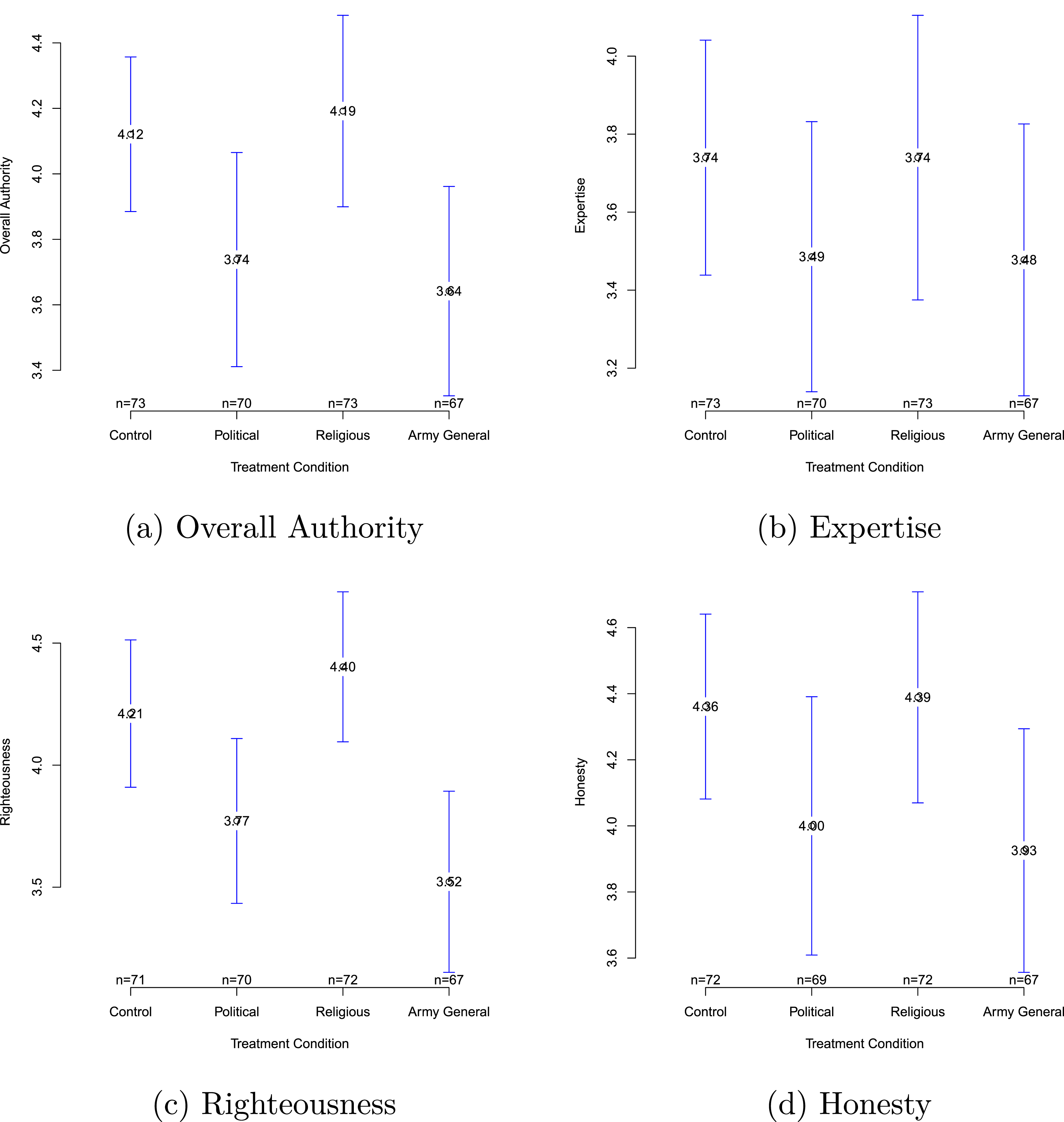
As an initial manipulation check, Figure 4 indicates that religious leaders in the religious authority condition were viewed as more credible, relative to the other conditions. Interestingly, religious leaders in the political credibility condition (and army generals) were viewed as less credible, relative to control. This highlights the fact that for many respondents, religious leader credibility is composed primarily of religious sources (see also Figure A2).
Perceived leader authority by treatment group, study 2.
Note: Figures displays the means and 95 % confidence intervals for different aspects of leader authority: expertise, righteousness, and honesty.

Figure 4. Long description
The image contains four bar graphs labeled as Panel A, Panel B, Panel C, and Panel D. Each panel represents different aspects of perceived leader authority across various treatment conditions: Control, Political, Religious, and Army General. Panel A: This bar graph shows Overall Authority. The y-axis ranges from 3.4 to 4.4, and the x-axis lists the treatment conditions with sample sizes (n=73, n=70, n=73, n=67). The Control condition has an average authority of 4.22, Political 3.74, Religious 4.19, and Army General 3.84. Panel B: This bar graph depicts Expertise. The y-axis ranges from 3.2 to 4.0, and the x-axis lists the same treatment conditions with sample sizes (n=73, n=70, n=73, n=67). The Control condition shows an expertise value of 3.84, Political 3.49, Religious 3.49, and Army General 3.48. Panel C: This bar graph illustrates Righteousness. The y-axis ranges from 3.5 to 4.5, and the x-axis lists the treatment conditions with sample sizes (n=71, n=70, n=72, n=67). The Control condition has a righteousness value of 4.21, Political 3.87, Religious 4.10, and Army General 3.62. Panel D: This bar graph represents Honesty. The y-axis ranges from 3.6 to 4.6, and the x-axis lists the treatment conditions with sample sizes (n=72, n=69, n=72, n=67). The Control condition shows an honesty value of 4.36, Political 4.00, Religious 4.39, and Army General 3.93.
Main results
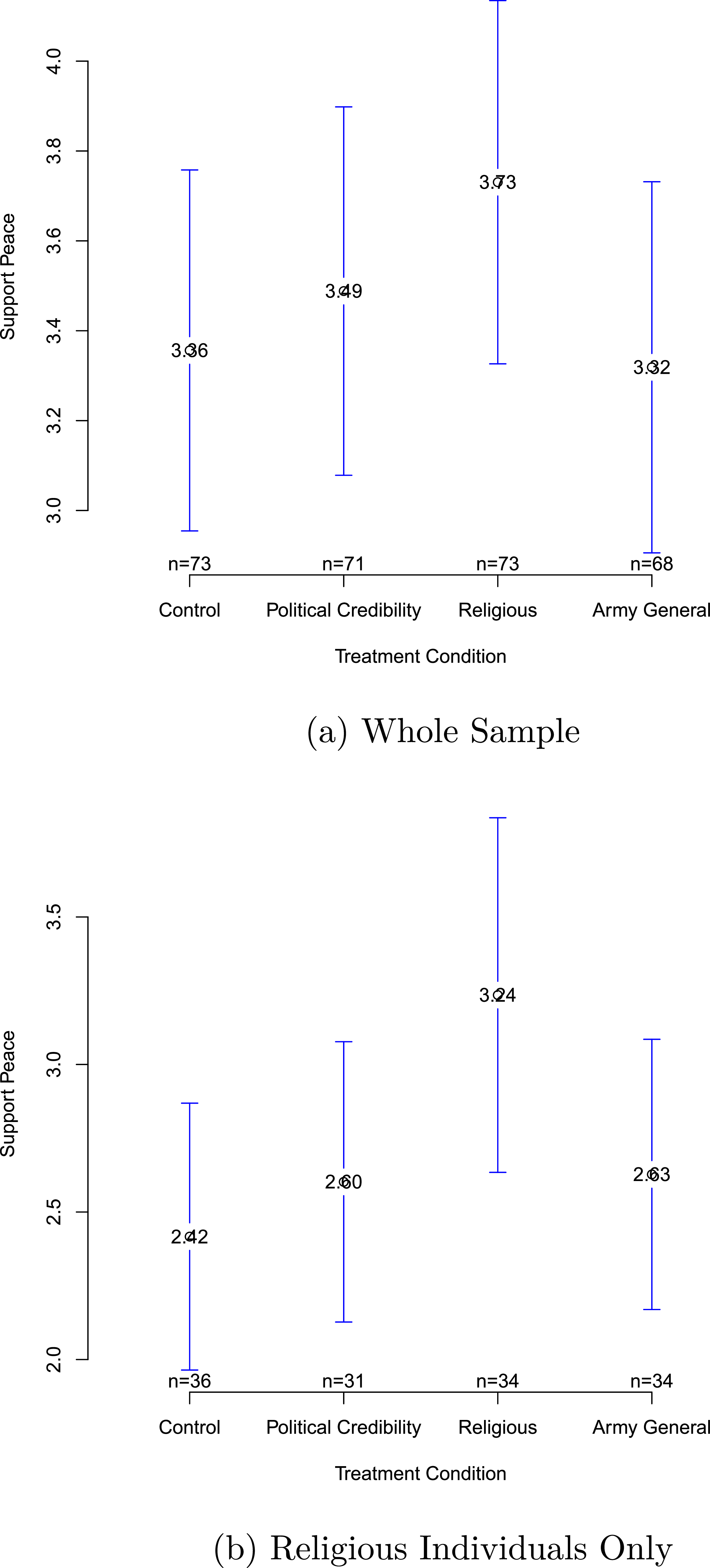
In Figure 5, we assess to what extent greater religious authority or political credibility led to a greater willingness to make political compromises (see also Figure A5). As indicated in the figure, greater political credibility had no impact on the support for political compromise. In contrast, greater religious authority was associated with higher support for peace (3.73 versus 3.36).
Effect of religious leader authority on support for peace, study 2.
Note: Support for peace is the average value of responses regarding support for negotiations, support for dividing Jerusalem, and support for exchanging land for peace.

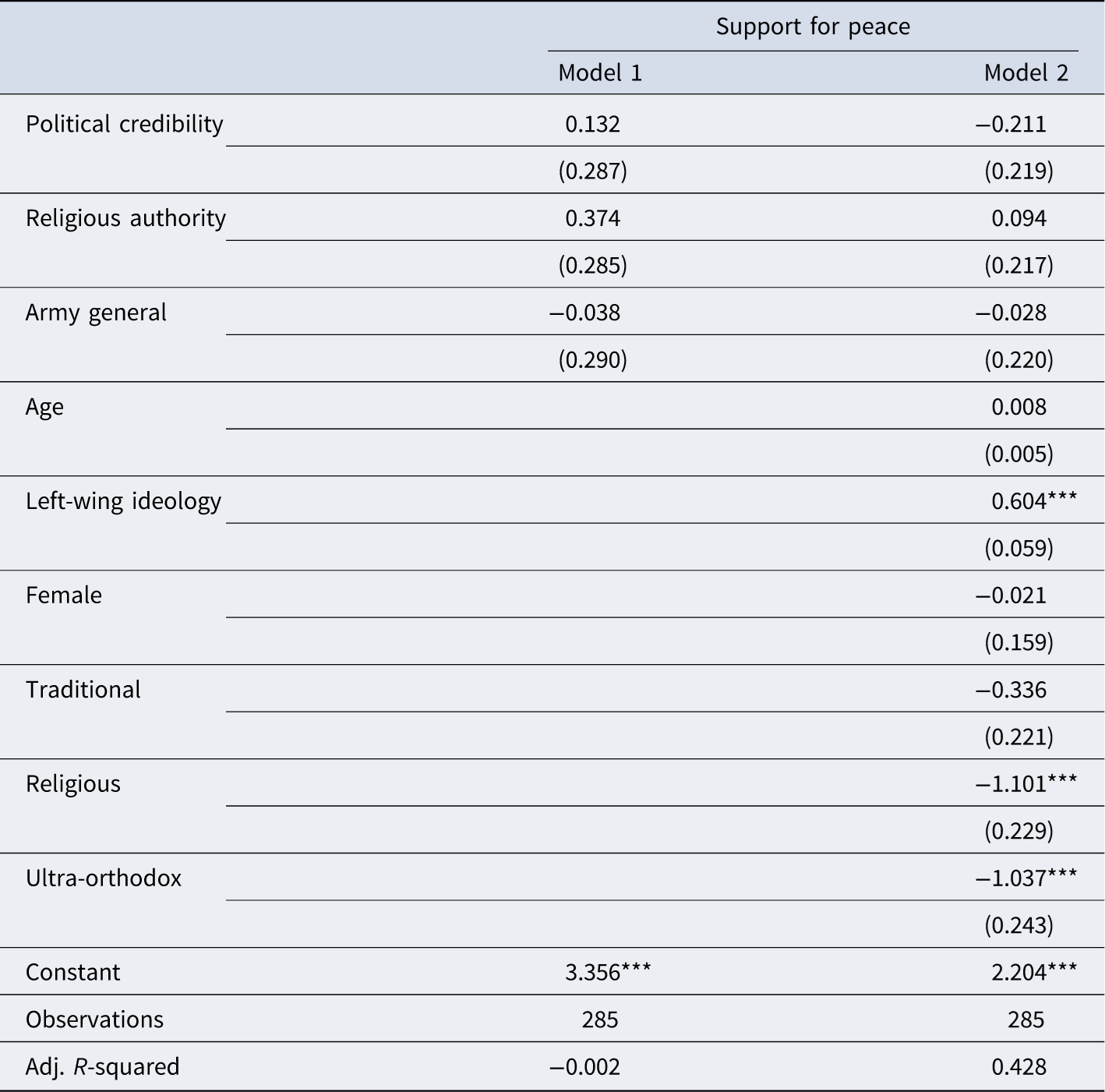
To assess whether these differences are statistically significant, we used an OLS regression in Table 4. Column 1, without controls, indicates that religious leaders with religious authority had a slightly positive impact on political compromise, but this effect was not statistically significant. Column 2, with controls, indicates that greater religious authority or political credibility is not associated with greater willingness to support political compromise. Together with Study 1, this suggests that neither religious authority nor political credibility alone is enough to have a meaningful impact on public support for peace.
Impact of treatment on support for peace, study 2

Table 4. Long description
A table with 12 rows and 4 columns comparing factors influencing support for peace across two models. The columns are labeled ‘Support for peace’, ‘Model 1’, and ‘Model 2’. The row labels include Political credibility, Religious authority, Army general, Age, Left-wing ideology, Female, Traditional, Religious, Ultra-orthodox, Constant, Observations, and Adj. R-squared. Each row contains values for the factors under Model 1 and Model 2. Notable values include 0.604 for Left-wing ideology under Model 2, -1.101 for Religious under Model 2, and -1.037 for Ultra-orthodox under Model 2. The table also includes standard errors in parentheses for each value. The Adj. R-squared values are -0.002 for Model 1 and 0.428 for Model 2.
Note: Standard errors are reported in parentheses.
*p < 0.10, **p < 0.05, ***p < 0.01.
With that, we cannot rule out other potential explanations such as the possibility that the effects of Experiment II were weaker due to the relatively small sample size. Another potential concern was the timing of the survey, which was administered during a time of active violence. However, our results in Table A1 suggest that mean support for peace was not lower for Study 2, indicating that the timing of the survey may not have contributed to the null findings.
Discussion and conclusion
Our experiments examining religious leader authority in Israel yield important findings about the conditions under which religious leaders can promote political compromise. Most significantly, we find that religious leader influence on political attitudes is more limited and conditional than often assumed in the religious peacemaking literature.
Across two studies, we find modest evidence that religious leaders with both religious authority and political credibility may be somewhat more effective at promoting support for political compromise than those with only one source of authority or neither. However, these effects are small in magnitude, sensitive to analytical choices, and concentrated primarily among already-religious audiences. Neither religious authority nor political credibility alone appears sufficient to substantially shift political attitudes, and even their combination produces only limited influence. These findings suggest that religious leaders may be better positioned to reinforce existing inclinations toward compromise among receptive audiences than to fundamentally transform political attitudes across broader populations. This has important implications both for theoretical understanding of religious authority and for practical efforts at religious peacemaking.
While our study focuses specifically on Jewish religious leadership in Israel, the theoretical dynamics we examine are likely present in other democratic societies where religious and political authority intersect. However, the specific manifestations of these dynamics will vary significantly based on institutional arrangements, religious market structures, and political culture.
The competitive religious marketplace in Israel, where religious leaders must build and maintain followings without strong institutional hierarchy, creates particular dynamics for religious authority. In more hierarchical religious systems such as Catholicism, religious authority may operate quite differently. Catholic contexts feature more institutionalized religious authority, potentially making religious leaders’ political statements more automatically authoritative but also more constrained by official doctrine. In Sunni Islam, decentralized authority structures resemble the Jewish case, but different textual traditions and interpretive methods may create distinct pathways to religious authority.
The democratic context of our study is also crucial for interpreting our findings. Religious leaders must be free to articulate political positions without state interference for our theoretical mechanisms to function. The “unlikely source” credibility dynamic requires that political position-taking be meaningful and potentially costly, which may not occur in non-competitive political systems. In non-democratic contexts, religious leaders’ political influence may operate through entirely different mechanisms.
Our focus on territorial conflict involving sacred values may limit generalizability to other issue areas. Religious authority may be more relevant for conflicts explicitly involving sacred values than for purely material disputes. However, the basic tension between religious and political credibility should appear across contexts where religious leaders engage with political issues, even if the specific manifestations vary.
Our findings have important implications for both theoretical understanding of religious authority and practical religious peacemaking efforts. Most importantly, our results suggest that religious leaders face significant constraints in their ability to transform political attitudes, even under favorable conditions. The modest effects we observe indicate that religious peacemaking may work best as part of broader coalitions rather than as a standalone strategy.
Our findings also highlight a fundamental dilemma for religious leaders engaged in peacemaking: the very political engagement that might enhance their political credibility may undermine their religious authority and vice versa. Religious leaders must carefully balance religious and political considerations to maintain credibility in both domains. Different audiences may value religious versus political authority differently, creating challenges for religious leaders seeking broad influence.
Effective religious peacemaking may require institutional support to overcome the inherent limitations of individual religious leader influence. Religious leaders may be most effective when working alongside secular peace advocates and civil society organizations, focusing on audiences already disposed toward religious guidance, and pursuing gradual attitude reinforcement rather than rapid transformation.
Future research should test our theoretical framework across different religious traditions and political contexts. Priority areas include examining how different religious institutional structures affect religious leaders’ political influence, conducting longitudinal studies to assess whether religious leaders’ influence accumulates over time, and investigating the psychological mechanisms through which religious authority operates. Cross-national replication in Catholic, Islamic, Protestant, and Buddhist contexts would help establish the broader applicability of our findings.
In conclusion, religious leaders face inherent tensions when engaging in political advocacy, and our findings suggest that these tensions significantly constrain their influence even under favorable conditions. The modest effects we observe indicate that religious peacemaking is likely to be a gradual process of attitude reinforcement rather than rapid transformation.
With that, these findings do not negate the importance of religious peacemaking but rather point toward more realistic expectations and strategic approaches. Religious leaders may contribute most effectively to peace processes when they work as part of broader coalitions, focus on receptive audiences, and coordinate their efforts with political and civil society actors. The challenge for both scholars and practitioners is to harness the unique moral authority that religious leaders possess while acknowledging the structural constraints they face.
Supplementary material
The supplementary material for this article can be found at https://doi.org/10.1017/S1755048326100480.
Acknowledgements
Michael Freedman’s research focuses on religion, conflict, and citizen-state interactions in Israel and the Muslim world, combining big data approaches with experiments and in-depth interviews. He can be reached at mrfreed@poli.haifa.ac.il. Pazit Ben-Nun Bloom specializes in comparative political behavior and political psychology. Her research looks at how religiosity, morality, and values both hinder and enhance democratic norms, such as support for democracy, tolerance, human rights, and good governance.



 Open access

