Talking About Old Records Workshops – three vignettes
… a teenage girl guides the movements of a 77-year-old woman wearing headphones as she tentatively cues up a crackly vinyl compilation on an industry-standard DJ record deck, while nearby another older woman chats about her favourite easy-listening music to an attentive schoolboy …
… two silver-haired women begin to waltz slowly together as a nervous-seeming lad looks on, perhaps worried that they are going to ask him to dance. Like many a man before him, he escapes the awkwardness of relations with the opposite sex by burying himself in a record collection, turning away to flick intently through a box of 78s and 45s brought in by a rock ’n’ roll enthusiast who was about his age when they first came off the press some 55 years earlier …
… a rock fan in his seventies badgers a 13-year-old wannabe DJ to turn up the Black Sabbath LP spinning on the Technics at an intergenerational disco, while the local Baptist minister bobs his head indulgently to the Satanic beat as he chats about Christian rock music to a project worker, keen to refute the notion that the Devil has all the best tunes …
Introduction
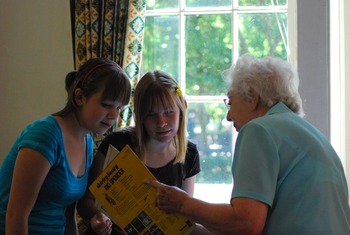
This paper explores ethnographic findings gathered during my work as a DJ and academic, particularly in relation to a community arts project called Talking About Old Records (TAOR). TAOR brings together teenagers and older people through a range of workshops, recalling the music of ‘yesteryear’ through a collaborative process of learning to perform using DJ technology and old records. The project, a partnership between Nottingham Trent University and Charity Shop DJ Productions, gives participants the chance to share conversations about what music means to them.
Talking about an old record (photograph by Sarah Gadd © Nottingham Trent University).

While the project is intergenerational, this paper puts the emphasis on the musical identities of older people, although of course in important respects generational identity relies on a process of comparison with other age groups. The notion of interaction between – and specific identities of – ‘younger’ and ‘older’ people is complicated by the presence of up to four generations at TAOR events: (1) teenagers; (2) the project organisers, youth and older people's social workers and carers (thirties to fifties; I am 45); (3) ‘younger older people’ (fifties to sixties); (4) ‘older older people’ (seventies to eighties). Furthermore, as will become clearer, distinctions between the oldest and youngest members of this last group actually seem to be quite significant.
The multi-generational nature of the participants in TAOR intersects with a series of vexing questions about the appropriate terminology to use regarding people in the later stages of human life. The emerging consensus is clearest about what terms are no longer acceptable, with ‘old people’ and ‘the elderly’ both now being generally avoided by academics and government agencies. More acceptable usage includes the terms ‘older people’, ‘seniors’ and ‘elders’. I use all three of these in various contexts, making most use of the first. One group with whom I worked called themselves a ‘Seniors Forum’ and I use the term ‘seniors’ when discussing these informants. Another group referred to themselves as ‘African-Caribbean Elders’, and I use the term ‘elders’ when discussing them.
When these various terminologies are considered alongside certain sociological critiques of dominant conceptualisations of ageing, the picture becomes even more complex. For example, a paper by Mike Featherstone and Mike Hepworth (Reference Featherstone, Hepworth, Featherstone, Hepworth and Turner1991), ‘The mask of aging and the postmodern life course’, suggests that the old notion of fixed stages of life which are meant to correspond to particular age groups is being eroded by contemporary forms of life which articulate an experience ‘of the aging process as a mask or disguise concealing the essentially youthful self beneath’ (Featherstone and Hepworth Reference Featherstone, Hepworth, Featherstone, Hepworth and Turner1991, p. 379). Additionally, they show how a historical awareness of changing generational identities over time has to be brought to bear in order to successfully consider what it might mean to belong to one age group as opposed to another at any given point in history.
These considerations are all pertinent here, as I articulate various insights into the role of music and music technology in the construction of generational identity, as it unfolds through an inter-relation with a changing social milieu. The range of attitudes and opinions expressed over the course of the TAOR project certainly counsels against any notion that the musical identities of different age groups are homogeneous. Each generation seems well aware of this with regard to people their own age, but less aware of it with regard to other age groups. Put another way, older and younger people may stereotype each other while resisting stereotypes of themselves. Furthermore, these stereotypes contribute to the construction of generational identities through a mutual ‘othering’ of the generations, which maintains the identity of each through the conception of a distinction which is a variable combination of realistically appraised and consciously lived differences, along with more unconscious stereotypes generated by processes of projection and repression.
This mutual othering can be somewhat undercut by shared experience, which may reveal the variations and dichotomies within the musical commitments and identity formations of each generation, allowing for processes of identification across the ages: ‘Old man look at my life, I'm a lot like you were’ (Neil Young, ‘Old Man’, Reference Young1972. Young is a Canadian singer-songwriter producing rock with folk and country roots). Through discussions of the leisure activities surrounding swing, rock ’n’ roll and ska, it became clear that some of the older people had been enthusiastic participants in ‘dance music’ long before electro, grime and dubstep. Insights for the teenagers included a realisation that rock ’n’ roll really did rock, and that they had not invented ‘youth culture’. As one 13-year-old wrote on an evaluation form, ‘I now know that the other generation doesn't just listen to slow songs’ (2010). For the older people, the opportunity for a transmission of their musical tastes and expertise to the younger participants nurtured communicative experiences that they considered valuable. Also in evidence were moments of nostalgia and mourning for musical things past, and of course many generational stereotypes remained recalcitrant, not least because they are not pure phantasms, but are distorted representations of social realities which determine a complex intertwining of lived experiences of generational difference and similarity. Nevertheless, many of the younger and older people involved in the project seemingly began, in a modest way, to perceive each other more as individuals and less as members of an age group.
Methods and sources
The majority of data drawn upon in this paper arose in the context of TAOR sessions between 2007 and 2010. Over four years, four TAOR projects in the English Midlands have introduced teenagers (aged 12–18) to members of various older people's groups (with ages spanning 50+ to 80+). A similar format was used for each iteration of the project. Firstly, suitable groups of older and younger people were identified, often via local government agencies. Then, around four sessions (each of two to three hours' duration) were run for each version of the project, with initial briefing sessions being carried out with the younger and older people on their own at one of their group meetings, in order to explain the project, to get input into it from the participants, and to introduce them to DJ equipment and the idea of talking about records. Then two or more subsequent intergenerational music workshops were held with both groups together, using boxes of old records and DJ equipment to facilitate interaction and discussion about music. The records were an eclectic mixture of vinyl, generally rescued from charity shops,Footnote 1 ranging from old recordings of wartime ballads, swing and rock ’n’ roll, to more recent compilations of rock and pop of various types. Sometimes, participants brought along their own recordings. One of these intergenerational sessions was always an event, such as a performance or disco, with refreshments provided. I have given an impressionistic sense of what these sessions were like at the start of this paper. In detail, the four projects which generated most of the data for this paper were as follows:
1. In July, August and December of 2007 we brought approximately 20 members of a Derbyshire Seniors Forum (aged from mid-fifties to 80) together with three young people from a music project in the same area (aged 13, 13 and 17). Their region is an ex-coalfields community classified as being high on measures of social deprivation. There were four sessions overall, with the last one being a Christmas party at which two of the young people DJed.
2. In July and September of 2008 we brought seven teenagers (aged 12–14) from an inner-city secondary school in Derby together with five older people (aged from mid-fifties to 77), drawn from two local seniors' coffee clubs. The initial project involved four sessions, with the last one being a public performance at a youth festival in Nottingham. Subsequently, some of the younger and older people from this project met again at two more events, in November 2008 and June 2009.
3. In June and July of 2010 we brought seven secondary pupils from a Nottinghamshire school (all aged 13) together with eight people from a Baptist Church group in the same area (aged from 50+ to 80+). There were four sessions overall, with the last one being a disco at which both the older and younger participants DJed, and to which friends and relations were invited.
4. In July of 2010 we ran a project involving 12 young people (aged 16–18) from a Nottinghamshire youth project (whose members are defined as being ‘not in education, employment or training’ or ‘NEET’) and approximately 15 members of a nearby African-Caribbean Elders' group (aged from 50+ to 80+). There were four sessions overall, with the last one being a Caribbean meal at which some of the younger people DJed.
Material gathered at these TAOR workshops has been supplemented by data gathered from various other informants during the course of relevant events at which I have DJed over the same period (a Christmas party at a care home for older people, a 70th birthday party, several weddings, exhibitions), and also from conversations with older relatives and strangers. As work on this paper proceeded, I found myself talking about music with older people I came across in my daily life, and I have drawn on all these conversations here.
At the beginning of the TAOR project in 2007, I attempted to record my conversations with participants, and produced transcripts of some of these interactions, which took the form of free conversations and round-table discussions, as well as some more structured interviews. However, it rapidly became clear that the presence of a recording device often had a distracting or inhibiting effect, and furthermore during the whirl of running workshop activities it was very hard to use the device consistently. Additionally, problems with the ambient noise of the musical workshops rendered some of the recordings unusable. So, as the project continued over subsequent years, I instead relied mostly on a combination of some brief notes taken at the time and simple recollection (although recordings were still made occasionally). The early transcribed conversation is the most reliable in terms of precise accuracy, but this has to be played off against its possible distortion by the relative artificiality of the recording situation. The recollected conversation may be less reliable in textual terms, but results from much more natural conversational contexts.Footnote 2
Jane's ‘hurumph’
At a briefing for an older people's group, I used a slide show of photographs taken at an earlier project, set to North American jazz singer Chet Baker's haunting version of ‘My Funny Valentine’ (Reference Baker1954). I had previously used this slide show and music when briefing prospective clients and funders, and the effect had been palpably moving, with beautiful shots of younger and older people together rendered poignant by the musical framing of Baker's melancholic vocal. Expecting the older people themselves to resonate similarly to this choice of music, I was pulled up short by a loud ‘hurumph’ from Jane, whom I had only just met. As an ‘Older People's Consultation Officer’ looked on embarrassed, and one or two of the other group members shot me sympathetic glances, Jane pointedly talked over the slide show and music: ‘put us to sleep why don't you’, she said (R 2008), giving me a challenging look. With its euthanasia subtext, her statement clearly rejected a certain sorrowful spin that the song put on the images, acting as a salutary reminder not to put older people in a box, or in this case, she was perhaps suggesting, a coffin.
The irony is that the project proposes that the exploration of musical taste can break down stereotypic generational perceptions, and yet here I was, clearly bringing my own prejudices to bear. The disparate identities of the older people and their large range of musical tastes were a constant reminder of this tendency to form projective stereotypes, which is a methodological complication when seeking to reflect academically on experiences such as these. Over and over again, talking to older people shows how long standing and cyclical are the generational conflicts and identities surrounding debates about musical tastes and commitments – conflicts, identities and debates which younger people may think of as somehow being their own unique experience. Lizzie, aged 14, summed up the challenge to her perspective: ‘before, I just thought that, oh, they would probably just sit around drinking tea and going to bingo and stuff, but now that's really changed’ (T 2008).
‘Switch that bloody rubbish off!’
The parental ‘shout up the stairs’ has a very long history, with Hillel Schwartz suggesting ‘each generation believes that the sounds beloved of the next generation are too loud, raucous, dissonant or disruptive to qualify as music. This pattern of generational argument goes back to at least the 1580s’ (Schwartz Reference Schwartz, Bull and Back2003, p. 497). Susan McClary's paper ‘Same as it ever was’ reaches into the past much further than Schwartz, citing Plato's famous fear that musical innovations threaten the socio-political order (McClary Reference McClary, Ross and Rose1994, p. 29). Although none of our participants had a memory that long, several of them were part of what can be considered the first generation of teenagers, and many of their musical identities were closely bound up with the music of the 1950s. This period led to the defining modern development of a distinct youth culture,Footnote 3 a culture whose emphasis on cars, the opposite sex and having fun was portrayed as ‘scandalous’Footnote 4 in much mainstream media of that time. Other participants had resisted, and still resist, identification with this new culture. A few interviewees were old enough to recall the period before these developments fully took hold. Ethel, in her eighties, who had been a keen participant at swing dances in the late 1940s, summed up her view of more modern popular music like this: ‘I don't like that “bang bang bang”, does your head in’ (R 2010).
Andy Bennett (Reference Bennett2001, pp. 7–23) summarises the shifts of this period, considering the socio-economic and technological-productive factors that came together after World War II. Such accounts of the new earning power of young people and the mass production of records and gramophones were clearly at first most relevant to North America, with the memories of my older white British respondents instead emphasising an atmosphere of post-war austerity. Their cultural identification with the exciting new sounds emerging from across the Atlantic was not always immediately matched by an ability to go out and purchase them, and the influence of radio was of key importance.
Interestingly, these seniors' recollections of their parents' reception of the emerging style of rock ’n’ roll parallels their own contemporary reception of rap music and modern R&B. In both cases, the youth music was/is perceived to be too beat-driven and consumed for too long at too high a volume. One couple in their seventies were clearly conscious of the cyclical nature of such complaints:
[…] we've got a 16-year-old granddaughter living with us and you know, as soon as she gets up in the morning, her system's on upstairs, and if she comes downstairs, she turns it up so she can hear it more. (Christine: T 2007)
[…] of course, as a teenager I, I'm just like my grandchild, I always played music all the time, and […] my Dad used to [shout] ‘switch that bloody rubbish off, it's thump-bang, thump-bang’. And I said that now to my grandchild you know. (James, whose record collection begins with skiffle and then traces the emergence of rock ’n’ roll proper through 78s, 45s and LPs: T 2007)
A series of interchanges between two members of another group of older people drew attention to the same cyclical intergenerational dynamic, as well as to the very different attitudes to be found among the older people. Paul had resolute and penetratingly critical views on modern popular music and listening practices, views which were gently challenged by Alfred, a rock fan in his seventies. Alfred recalled the excitement of the media panic surrounding the arrival of the films Blackboard Jungle (Reference Brooks1955) and Rock Around the Clock (Reference Sears1956), and of seeing the North American rock ’n’ roll band Bill Haley and the Comets. When Paul said that modern music was played too loud – the reason he recently walked out of a concert – Alfred said that rock music had to be played loud to be properly experienced. Paul complained that the words of pop music were incomprehensible, and Alfred countered with ‘is it always important to hear the words?’ (N 2010). Paul's final charge – a Platonic view that modern music is a form of mind control and social destructiveness – was countered with a smile that said ‘but’ and the statement ‘our parents thought rock ’n’ roll and the Beatles were going to destroy the world' (N 2010). At other TAOR workshops, such debates were duplicated in reactions to more contemporary genres of popular music.
‘A lot of it I am going to say is immoral, start from that angle’
Some discussions of rap music ensued at a TAOR workshop with white participants from a Seniors' Forum. Asked by a teenager ‘what would you think rapping is?’ (T 2007), Raymond immediately voiced the main concern: ‘a lot of it I am going to say is immoral, start from that angle’ (T 2007). This was clearly a deep-set unease, and was accompanied by fears about violence and gangs. The other oft-voiced concern was that the lyrical content was impossible to understand: ‘I don't like rapping […] you can't really tell what they're saying you know’ (Christine: T 2007). The attack that ‘rap’ (by which these seniors meant hip hop and R&B in general) was often incomprehensible, immoral and violent prompted the teenager's spirited defence of rap as a modern form of poetry. This forced certain concessions from the seniors, who seemed to feel they had to approve of poetry, perhaps because they had themselves been using the term to illuminate the lyrical appeal of certain songs. Reframing rap as poetry may not be a very accurate interpretation of the form, but I suspect the teenager was consciously, and successfully, deploying a rhetorical strategy by picking up the notion from the seniors' own previous usage.
Mary, (in her late fifties) made a few interesting remarks when reflecting on Raymond's concerns about rap. On the one hand, she noted that lewd or profane songs were nothing new, and on the other she changed the direction of the conversation in a manner that made it clear that she knew it was a mistake to reduce rap to profanity: ‘if you sit and listen to rap properly you can hear the underlying message of “don't go out on the streets with guns, put ’em down”’ (T 2007). Mary also showed an appreciation of the vocal style of rap: ‘rap sort of talks and half sings […] and I'm quite into that’ (T 2007).
Conversely, Anne confessed ‘quite frankly I've never really listened to rap, that's the problem’ (T 2007). She also perceptively suggested that what her generation perhaps failed to realise was that rap addresses the concerns of youth in a world different to the milieu of her own childhood: ‘the thing is it's helping that generation because you know, it's a different world now isn't it?’ (T 2007). A few months later, Anne told me that she'd been inspired to listen carefully to some rap on the radio – and admitted to ‘actually quite liking some of it’ (R 2007). Subsequent conversation suggested to me that what she had found herself liking was more commercial R&B than any of the harder styles of rap proper, but nevertheless she reported this with an air of excitement, a feeling that she had learnt to partake in a cultural form that before she had simply switched off from automatically. In a sort of reverse movement, one 13-year-old girl from the same workshop had found her taste evolving in the other direction, announcing ‘I don't like any rapping or aught like that; nowadays I prefer like older stuff that's like real music really’ (T 2007). It's worth noting in passing here that this notion of authenticity (‘real music’) reproduces a (problematic) notion of rap that we might perhaps have expected to emerge from one of the seniors, once more confounding any hasty assumptions we might make about age and musical taste.
Older people's remarks on rap music generally cut in two directions, both of which became during this project familiar tropes regarding generational identity and intergenerational tension: ‘things have always been the same’ vs. ‘things are very different now’. Rather than being a naked contradiction, these antithetical impulses simultaneously expressed seem more properly dialectical – they are the flip sides of an attempt to articulate an acceleration of social and generational change within an epoch – late capitalismFootnote 5 – that remains paradigmatic, notions of postmodernity notwithstanding. Things intergenerational really are variations on an existing pattern, even as the entrenchment of various social contradictions makes things different in terms of intensity. Ethel talked of dances she attended as a girl in the now-demolished dance hall of her small Derbyshire town being sometimes spoilt by ‘lads from Derby turning up with knuckle-dusters’ (R 2010). She could maybe recognise some of the themes of gangsta rap or grime even if knuckle-dusters and the city–county regional tension sound rather quaint when compared with today's talk of Glocks, Uzis and postcode murders (in which a gang from one postal area attacks those from another).Footnote 6
A further angle on the shifting psychology surrounding perceptions of the immorality of popular music was raised by middle-aged workshop participants who, during the discussions of rap, wanted the older people to critically consider the shock surrounding Elvis Presley's gyrations. When the North American rock ’n’ roll sensation began appearing on television shows in 1956 and 1957, his dancing, especially his sensuous pelvic rotations, caused a media outcry. Since Elvis often (though not universally) emerged as an important positive figure in the regard of white seniors involved in TAOR, subsequent conversation about the moral panic surrounding Elvis's palpable sexuality did provide a counterpoint to these seniors' critique of rap. The discussion recalled, with laughter, that for one TV show it was allegedly agreed that Elvis should only be filmed from the waist up (see Bennett Reference Bennett2001, pp. 14–15). But, as proved sadly typical, the process by which Elvis was transformed from shock sexpotFootnote 7 to a more cosy and uncontroversial figure remained mysterious even to those who had lived through it.
I did privately wonder what race might have to do with these seniors' perspectives on rap. But whatever the element of truth in the superficially tempting but ultimately too-easy conclusion that cultural difference or even latent racism might lie behind some of the negativity regularly expressed by my older white respondents on the topic of rap music, later conversations with a different community group identifying themselves as ‘African-Caribbean Elders’ made it clear that this cannot be the whole story, because these black elders actually expressed identical concerns, sharing a lot of ground with Raymond: they suggested that rap is often incomprehensible and that its content, when it can be made out, is lewd and antisocial.
Furthermore, the opaque shift in the white seniors' now comfortable regard for the once-shocking Elvis was mirrored in a similar discourse among the black elders regarding the emergence of reggae in the 1960s and 1970s. Bob Marley, the legendary Jamaican reggae star, was frequently cited by them,Footnote 8 but it was clear from a conversation with women in this group that their attitudes to Marley and reggae had changed over time, and I was keen to explore this change in relation to their negative views of rap music. Marsha did concede that much underground and dancehall reggae had similar ‘rough’ (R 2010) lyrical content, and this, like rap, was regarded by her with much less favour than the Biblical content of roots reggae, especially Marley's music. Ornella, who now saw Marley as a great artist, said that she had actually forbidden his music in her house when it first came out.
These women contrasted contemporary veneration of Marley with attitudes to Rastafarianism extant in Jamaica when they were young in the 1950s and 1960s. They painted a vivid picture of themselves as well-behaved young women in fashionable full skirts, whose parents would be horrified if they were caught talking to Rastas. Rastas were clearly stigmatised as typical ‘folk devils’ (Cohen Reference Cohen1972) in mainstream Jamaican life, with fears about the smoking of ganjaFootnote 9 making up one surface component of that stigma, alongside a deeper social anxiety about the critical-revolutionary component of Rasta identity. These women seemingly had mixed feelings about the movement. Marsha explained sympathetically that some of the Rastas were disaffected well-educated types who could not get work commensurate with their educational level. She saw their growing of dreadlocks, their reading of the Bible, their ‘running off to the hills’, even their ‘having a puff’ (R 2010) as a comprehensible rejection of conservative island life and white oppression alike, even if such a reaction was distant from her own politics and inclinations. She recalled an incident in which she had no change to give a begging Rasta the shilling he was asking for. He convinced her to hand over a ten-shilling banknote, promising to return with the change. She waited, starting to doubt the wisdom of her action – if he failed to return, she would have no bus fare home and would be in serious trouble. He did return, and she never forgot his honesty. In this type of manner, these older West Indian women with quite mainstream identities evinced respect for Rastafarians' spirituality, integrity and commitment to the political philosophy of Marcus Garvey's Africanism, and yet there was nevertheless a surprisingly strong frisson of distaste in some of their discussions of the Rastas themselves, with mention, accompanied by a grimace and palpable shudder, of a visceral horror at the sight of dreadlocks.
Without implying the existence of anything as strong as anti-Semitism here, it does strike me that this intense reaction could perhaps be related to Adorno's discussion of the ‘instinctual’ bodily revulsion felt by some at the sight of Jews (Adorno and Horkheimer Reference Adorno, Horkheimer and Cumming1986, pp. 179–86; Adorno Reference Adorno and Crook1994, p. 148). An exploration of the complex relationships between Rastafarianism, Christianity, Judaism and Zionism could provide an interesting starting point for such a consideration, especially as the Rasta practice of growing dreadlocks is apparently related to the same Biblical tracts as the ancient Jewish tradition, characteristic of some Orthodox sects, of wearing long hair and beards or sideburns.
It certainly seems as though here there are some generational distinctions at play. While, for some more traditional and assimilative early West Indian immigrants to Britain who found themselves up against prejudice and segregation, Rastafarianism was something to be kept away from, other younger and/or marginalised black individuals later gravitated towards the identity resources associated with Rastafarianism, taking from it a ‘selective appropriation’ (Hebdige Reference Hebdige1979, p. 43) which seemed to them to be a logical response to the socio-cultural crisis of their situation in Britain.
As these appropriations from Rastafarianism became more widespread, some older West Indians apparently positively reframed their perceptions of it, even if this process remained opaque and partial. Just like the white seniors considering changes in the perception of Elvis, my black informants Marsha and Ornella were unable to clarify what underlay the cultural shift from a fear of Rastafarians to an almost universal respect for Bob Marley. They understood my interest in relating this to their own somewhat negative views of rap, and saw that a similar change might occur regarding attitudes to this contemporary form. Yet at the level of feeling, I would say that most of the older black women were not yet really making this shift themselves, despite taking as a mark of respect the way contemporary music uses contributions from older forms of black music, and remarking that the project had increased their appreciation of different types of music.
‘It's different now though, isn't it?’
These discourses around rock ’n’ roll and reggae confirm the commonplace notion that aspects of that which was once shocking retrospectively become respectable, partially through a perception that contemporary transgressions are more shocking than historical ones. Some of the historically shocking moments eventually take on a romantic wholesomeness, almost a sense of innocence. The previous discussion of Elvis is one example of this; in the face of the more graphic sexualisation of contemporary pop music culture, retrospective perceptions of Elvis can easily fail to register the degree to which he was perceived as sexually scandalous, and older people critical of modern popular culture may forget the extent to which their own youthful pursuits and affiliations fell outside the norms of their parent culture, even as they nostalgically recall their own sense of racy rebellion.
Some reflections on drug-taking serve as a further illustration. Margaret, a woman in her seventies born in Liverpool of half-Irish extraction, described attending jazz, skiffle and rock ’n’ roll sessions at The Cavern Club in the late 1950s and early 1960s, using the ancient expedient of lying to her parents that she was going to a friend's house. I asked her if any drug-taking was involved. ‘No’, she said.Footnote 10 I persisted, asking ‘not even pep pills or slimming pills?’ She replied ‘well yes, people sometimes took those’, including herself, and was somewhat taken aback to be informed that those pharmaceuticals were amphetamines or related stimulants which would today be classified as Class B illegal drugs under UK law. So, although drugs were a part of her musical scene – according to her, being commonly available from certain men (she did not use the term ‘dealer’) at the big clubs and ballrooms in 1950s Liverpool (The Locarno and The Grafton as well as the (now) more famous Cavern) – Margaret's retrospective memory of that scene somewhat sanitises it, although it is important to note that many such venues did not serve alcohol due to the strict licensing laws of the time.
Seen through the eyes of this young white Catholic Liverpudlian in the mid–late 1950s, there was no discernible drug subculture as such: the pills were around, some people took them, some people left them, and no one was really thinking about it that hard. Certainly there was for her, neither at the time nor looking back at it now, absolutely no self-concept of ‘drug user’ and no identification at all with later 1960s and 1970s counter-cultural attitudes towards drugs. Subsequent social developments involving drugs and the discourses around them were perceived by Margaret as a negative trend – ‘it's different now though, isn't it?’, she said. And yet her teenage explorations of youth culture certainly looked like a step on the road to ruin to her grandmother, who saw through the tales of quiet times at a friend's house: ‘I know where you're going’, she would hiss, ‘you're going to that Devil's den to listen to music.’ And that was without any mention of the pills, because no one was asking. ‘Where have you been?’ and ‘who have you been with?’ were certainly already part of the standard formula for intergenerational interrogations around youth leisure activities, but ‘what have you been taking?’ was not yet a general parental concern, even though a pattern of social anxieties and media constructions about drugs dates back to well before the 1950s (on the ‘flapper’ scene of the 1920s, see Kohn Reference Kohn, Redhead, Wynne and O'Connor1997).
An older Northern Soul enthusiast suggested that the use of stimulants was common at all-nighters in the late 1960s and 1970s, but was for most purely an instrumental means to stay awake, rather than being central in terms of emotional focus, which was his perception of contemporary drug culture in which, he felt, intoxication as such is privileged. He recalled turning down pills offered from a large bag of mixed tablets that had clearly been stolen from a chemist. Sandra, in her late sixties, described a still-vivid incident illustrating the results such consumption could lead to: her son returned from a Northern Soul all-nighter in a paranoid, delusional and highly agitated state. She nursed him through it in a fairly straightforward way, and it was only years later that he talked to her about the drug-taking involved in such events. Now, Sandra suspects that he was experiencing what a psychiatrist might describe as an episode of amphetamine psychosis. It is perhaps significant that this was discussed with me at a meeting some time after the TAOR workshops, and was not something that she had discussed with the younger people.
Conversely, beyond a very few cautious mentions of ‘weed’, no younger people at these workshops have ever spoken to me – or as far as I know, to any of the older people – in any depth about drug-taking, presumably because we are to them establishment figures. On one evaluation form, I could see that a teenager had begun to mention cannabis, but then heavily scribbled out the comment. I perhaps exacerbated this reticence by not asking the young people directly about drugs – aware that they were with their teachers or youth workers, I felt this would be pressuring or exposing, and felt freer with some of the older people.Footnote 11 Similarly, an older rocker's tales of hard drinking and fighting were confined to an adult group at a TAOR event. So it seemed that a mutual inhibition on the taboo topic of drink and drugs, a topic that lies behind many moral panics about youth music, distorted the potential for a free-flowing intergenerational discourse here. The illegal nature of recreational drug use is of course one factor in the taboo – people are often reticent about misdemeanours past or present. But it is notable that the taboo extends to legal intoxicants such as alcohol and tobacco, so illegality is not the sole issue here. A final observation along these lines would be to remark that at TAOR events of one kind or another, both older and younger participants have been caught sneaking a crafty cigarette but, intriguingly, they were often careful to do it out of each other's sight. The projective mutual othering process is hard to break down, and each side of the generational divide is rather touchingly keen to maintain the innocence of the other. So immorality and innocence are a binary that twists and turns back and forth between the age groups, colouring generational perceptions of musical and cultural taste in quite complex ways.
‘Elvis killed my piano’
The funding of intergenerational work often has as one rationale the urge to erode older people's fears of the young. These fears of course exist, and can sometimes be so eroded, but several conversations indicated that such fears may be for the young, not of them. In the TAOR context, this was expressed as a perception of a series of musical losses, which can be summarised as a fear that there has been a decline in musical socialityFootnote 12 and participation, a decline which impoverishes the young. This, some older people felt, is a decline connected to a social uncoupling of the generations which is one context for mutual intergenerational suspicion.
Don Letts, a British DJ of Jamaican descent, suggests that ‘in the Caucasian world, music is something that kids do, but where we come from it's part of people's daily lives’ (Letts Reference Letts2010, p. 8). Something very similar was said to me by a female West Indian elder, but the sentiment about music's once central role in daily life was also voiced by a white Baptist of Welsh origin in her eighties. Several older people, both white and black – especially those with a church background – wanted to know if young people sang. The answer was a qualified yes, but the younger people spoke of quite informal or small group experiences of singing, such as fooling about to an iPod or mobile phone or, for a few music students, more serious involvement in a band. For the older people, especially the oldest, this represented a pale shadow of what music had been for them when they were young – a part of the wider fabric of their social life, where singing in chapel or church on Sunday was only an institutionalised variant of a communal musicality which suffused their lifeworld.
Although the small number of much older participants in TAOR means that great care must be exercised, some tentative differentiations can be advanced. In regard to these discussions of sociality, there seemed to be quite a difference in the perspective of the very oldest handful of participants in their eighties from those in their sixties or early seventies. The latter generally seemed much more contemporary in terms of musical identity than the very oldest, and it seems probable that this is an indication of crucial historical changes through the 1940s leading to the ‘birth of the teenager’ in the 1950s and the early emergence of ‘youth culture’ per se. There seems to be a huge shift in terms of the emergence of a consumerist social milieu and a concomitant foregrounding of specific genre or artist-based popular musical commitments as an important aspect of identity, with a clear element of uncoupling from the tastes of their elders in some of those born in the 1930s and 1940s not to be found in the very oldest individuals, born in the 1920s.
One important economic and technological factor here was that for the oldest participants in their eighties, but also for ‘younger older people’ who came from poorer backgrounds, ownership of a private music system had been far from universal. Those born in the 1930s and especially 1940s were much more likely to recall the presence of a gramophone in the family home, or to report their personal ownership of one – often the famous Dansette. Generating great interest, one of the older women brought along her family's wind-up 78 player, and the consensus was that this had been an expensive and reasonably uncommon item in the 1930s and 1940s – at least in the past milieu of those present on this occasion. The oldest participants' recollections of childhood suggested that ownership of a gramophone and records was seen as quite ‘posh’ until well into the 1960s in many areas of Britain. It is hard to know whether or not this is an idiosyncratic feature of my respondents, but I would tentatively suggest that dominant accounts of musical mass consumption in the 1950s and 1960s perhaps exhibit something of a North American or middle-class bias. However, a few committed fans of music, including those of working-class backgrounds, described saving up over a long period of time for their first record player in the late 1950s, and one woman mentioned her brother receiving one as a 21st birthday present at around that time.
For the oldest participants, rather than the gramophone it was radio – or ‘wireless’ as they tended to call it – that was the most ubiquitous listening technology, and the importance of public juke boxes was also discussed by one black elder: ‘Put a shillin’ in, see what come out' (R 2010). She said that what came out in the late 1950s in Jamaica was mostly North American artists like jazz singer Nat King Cole, country singer Jimmy Reeves and rock ’n’ rollers such as Fats Domino. For the oldest age group, singing along to the wireless as a family group, alongside participation in church music and choirs, was crucial as an avenue of intergenerational musical sharing and socialisation. These older people mourned what they saw as the decline of such activities, and with these concerns around singing and communal musicality we see an articulation in musical terms of their much wider perception of a general loss of community and sociability.
Considering such perceptions, we can draw on two rather different lines of theory. Firstly, we could endorse them through reference to some general features of modernity critiqued by German social theorist Jürgen Habermas. His notion of a ‘colonisation of the lifeworld’ identifies the way in which ‘traditional forms of life’ are destroyed by commercialised and individualising practices and technologies (Habermas Reference Habermas and McCarthy1987, p. 322). This may encourage what Conrad Lodziak has called a withdrawal into ‘self-maintaining privatism’ (Lodziak Reference Lodziak1995, p. 75), with a corresponding decline in social sensibilities of precisely the type mourned by these older people in their perception that private and commercialised listening technologies and practices eclipse communal musical experience.
Secondly, we can draw on the work of Paul Filmer (Reference Filmer, Bull and Back2003), who provides a rich range of considerations which illuminate the older people's perceptions of these processes in a more equivocal way. Given my Welsh participant's articulation of the importance of singing in daily life, of particular relevance here is Filmer's mention of the ‘mythopoetic’ notion of Wales as a ‘land of song’ (Filmer Reference Filmer, Bull and Back2003, p. 106) and the decline in the Welsh choral tradition. It is possible that such an analysis could also apply to the Caribbean, but my sense is that there, the church traditions of choral singing perhaps remain stronger. More generally, Filmer identifies changes in the ‘manner of intergenerational, social transmission of music’ (Filmer Reference Filmer, Bull and Back2003, p. 101). Perceptions of such change focus on the rise of mechanical and then electronic technology and an apparent decline in amateur musical practices that generates nostalgia. Filmer's analysis suggests that the decline may be more apparent than real, examining the persistence and evolution of a range of hidden forms of social musicality, including the rise of various popular forms and practices. He cites Ruth Finnegan, who notes that ‘any perceived changes in musical practice … can be feared as entailing almost cosmic results … until new groups or new practices are redefined as after all acceptable ones’ (Finnegan, in Filmer Reference Filmer, Bull and Back2003, p. 101).
Examples of such redefinitions can be identified in recollections from Raymond and Alfred which highlight the initial novelty of individually owned musical systems, and also serve to show how these new technologies might generate new forms of musical sociality even as they occlude older ones. Raymond had been active in the practice of ‘music appreciation’ while working for the YMCA in the English West Country in the 1960s. This involved his travelling with records and a Dansette gramophone to run sessions in libraries and community halls where he would play music, usually classical, and groups of people would discuss the experience. Raymond drew a parallel between this and our TAOR activities. Alfred similarly highlighted the importance of local halls as foci for social circulation: as a teenager in the late 1950s he raised money for records by hiring a church hall and charging entry for other young people to come and listen to him playing his existing record collection. Both these men were effectively early DJs without themselves framing it in those terms, and were at the forefront of the legitimation of new technological trends in musical sociality.
While interested in the modern DJ technology, most of the older people were not especially impressed by it (as some of the younger people clearly were). Native vinyl users (Figure 2), they generally regarded the Dansette machines of the 1950s and 1960s, with their multi-play facility in which a stack of records could be automatically played in turn, as a practical match for my pair of industry-standard Technics 1210 DJ turntables. The older people were intrigued about the story of British DJ Jimmy Savile inventing dual-turntable use for live DJing in 1946 (Brewster and Broughton Reference Brewster and Broughton2000, p. 52), but he was clearly ahead of his time, since for my informants recalling the 1950s in the UK, ‘record dances’ were the exception not the rule. Small local events might use records, but amplification and speaker technology was not yet good enough, explained Ethel: records were too quiet once the crowd rose above a certain size, and live performance was still the key to going out dancing.
Enjoying an old format (photograph by Sarah Gadd © Nottingham Trent University).

Whether or not they generated new forms of social interaction, the increasing ubiquity of personal listening technologies was clearly part of the start of a new dynamic, a dynamic featuring counter-cultural youth music trends in which the expression of generational hostilities became one dominant theme, with the growing idea of youth escaping the fences put about it by age in a defensive withdrawal into its own space. Bennett talks of ‘youth's realization of itself as a “culture”’, beginning in the late 1950s and taking on explicitly counter-cultural forms in the 1960s (Bennett Reference Bennett2001, pp. 22 and 25–7). Although the technological element of this trend began with the spread of radio and gramophone ownership among young people, older people who had enjoyed such ownership are now in their own way worried or concerned about what they perceive as the antisocial isolation inherent in listening to an iPod or mobile phone on headphones, as well as evincing a (wholly realistic) worry that the volume of modern musical technologies represents a threat to hearing. Whatever elements of musical escapism characterised their youth movements, these older people now see music – and those movements – in terms of communication, whereas for the younger people the notion of escape often seems more central. However, some misperception of the younger by the older people is occurring here; for example, they did not show much awareness of the way groups of young people might listen together to music played on a mobile phone, or share the ear-buds of an mp3 player. Here Filmer's caution (Reference Filmer, Bull and Back2003, pp. 101 and 107–8) regarding narratives of decline about musical sociality and amateur musical practices should be kept in mind, although it does seem that the practices evolving around new electronic technologies from the 1950s onwards did for some, as Filmer (Reference Filmer, Bull and Back2003, p. 102) is well aware, mark a move away from formal musical training and performance. Margaret neatly summed up the impact her new enthusiasm for consuming rock ’n’ roll had on her own musical practice: ‘Elvis killed my piano’ (R 2010). Listening to Elvis for her became more compelling than practising Chopin.
Conclusion
Although intergenerational conflicts over music have taken on a repetitive pattern for a very long time, we can surmise that various periods and locations have been characterised by a more pervasive generational continuity, and some of the oldest TAOR respondents do seem to recall such a phase. Socialisation was perhaps less fractured and contested, involving less intergenerational conflict. Of course, the question of when in recent times this may have changed is a difficult thing to work out, and in truth such differentiations are complicated by discontinuities and contrasts of, for example, class, race and region. It is also possible that the retrospective construction by the oldest TAOR informants of a time of continuity and a more predominant musical sociality may already be a sort of fiction, a mythological prelapsarian fantasy of an undisrupted cultural continuity underpinned ultimately by faith traditions.
Yet certainly, the 1950s unsurprisingly do seem to mark a paradigmatic shift. The intergenerational pattern we see repeated since is a diminished echo of this shift. Among people alive today in Britain, the most marked generational divide is seemingly that between those in, approximately, their late sixties to early seventies and those in their late seventies to eighties upwards, rather than the dichotomies existing between today's children and their parents, whose generational musical identities are actually much closer than the wider gulf between these children's grandparents and great-grandparents. It was notable that, when asked to bring along music they liked, some of a group of 13-year-olds who brought in memory sticks with mp3s of contemporary grunge and emoFootnote 13 also brought in vinyl LPs of pop and rock belonging to their parents. These parents often no longer possessed a turntable to play the records, and the young people knew the music via other formats. The increasing availability of older music in downloadable form (music which in the age of vinyl would have been deleted and often commercially unavailable) is, I think, contributing to a greater interest in older music among some younger people.
One founding purpose of the TAOR project was to facilitate open intergenerational encounters through an application of the notion that, although the music loved by people of different ages might be different, the love of music itself is the same. Yet one of the more striking findings so far is that actually, for older people aged around 70-something or less, many of their tastes are not so far away from those of today's teenagers as initial stereotyping might suggest. This is one reason that the shared experience of the workshops could generate a degree of rapport and partially undercut the tendency to mutual othering that dogs intergenerational relationships. The following statement about older people was expressed by a 13-year-old boy on an evaluation form: ‘they are better at rocking out than I thought!’ (2010). A girl of the same age said ‘[when] we started talking about music we realised a lot of today's music is in the same style as older music’ (T 2008). Insights like this might indicate a slow return to the situation of generational continuity in musical taste, as recalled by the oldest TAOR participants from the era before rock ’n’ roll really took hold. This tendency towards increased continuity could accelerate when more of the ‘rave generation’ become grandparents, since the hard beats of contemporary dance music were still the focus of dichotomous viewpoints between our younger and older participants, reminding us that it is important not to overdo the notion that sharing a few tunes at a workshop can teach the generations to sing in perfect harmony. Yet the hard beats of dance music divide young people too, and similarly, several of the older people who were teenagers during the 1950s didn't like rock ’n’ roll and preferred classical music or jazz. This is the type of awareness that can drop out of sight when age is put at the forefront of considerations of musical taste: the mutual othering process takes over, producing homogenising mythologies of generational identity.
An alternative to my tentative notion that we might be returning to a period of generational continuity in musical identity is the possibility that the spread of online digital culture could work against it. The rise of amalgamations of production and consumption which blur the boundaries of production and usage in amateur musical practices such as remixing and mash-ups might act as a new technological divide between what we could term the ‘analogue’ and ‘digital’ musical generations. Such ‘produsage’, as it is termed in the work of Axel Bruns (Reference Bruns2008, p. 2), does, however, also mark the development of a form of digital sociality that may be a contemporary networked equivalent of the old forms of musical sociality whose decline is mourned by the oldest participants in TAOR, and furthermore we have to be careful about assuming that such activity is exclusively the purview of the young. One of our older respondents had been a computer engineer, and he was sceptical about the assumed digital literacy of younger people. Bruns himself notes that the ‘Generation C’ identified as the ‘produsers’ of new online content, including audio content, ‘should not be misunderstood as a strictly generationally bounded grouping’ (Bruns Reference Bruns2008, p. 4).
Considering such complexities and ambiguities, we face the limits both of attempts to read the future, and of existing conceptions of the relationship between age, identity formation and musical affiliations or practices. We need more research aimed towards ‘the elaboration and expression of a public vocabulary of ageing in direct opposition to the traditional static model with which we have until recent times been more familiar’ (Featherstone and Hepworth Reference Featherstone, Hepworth, Featherstone, Hepworth and Turner1991, p. 387). To help in the development of such a new vocabulary of ageing through an understanding of recent manifestations of intergenerational differentiation, we should learn while we still can from those who were the first of our era to begin to define themselves through musical choices made in sharp distinction to the identities of their own elders. Watching a group of older people jive to Bill Haley's ‘Rock Around the Clock’ (Reference Haley1954), feeling anxious because I knew that one of the men had had a heart bypass operation, it struck me forcibly that if researchers are to learn more about the crucial rock ’n’ roll period directly from those who took part in it, time is limited. Even more pressing is the task of learning from the much smaller group who still remember something different.
Acknowledgements
The author would like to thank all those individuals and organisations who took part in this research, especially Charity Shop DJ Productions. Thanks are also due to the editors of this special issue of Popular Music for their comments on earlier versions of this article.