I. INTRODUCTION
Mn4C has a cubic perovskite-type crystal structure, with Mn atoms at the corners and the face centers and a C atom at the body center (Tagawa and Motizuki, Reference Tagawa and Motizuki1991; Si et al., Reference Si, Qian, Ge, Park and Choi2018a, Reference Si, Wang, Ge, Qian, Park, Yang, Li and Choi2018b). It is difficult to prepare Mn4C because it is unstable. A γC solid solution with a composition that seemed to be about Mn4C was produced via a peritectoid reaction (Isobe, Reference Isobe1951). However, the composition of the carbide Mn4C was thought to be more accurately represented by the formula Mn23C6 (Kosolapova, Reference Kosolapova1971). Morgan found that an induction melted alloy with a nominal composition of Mn4C was weakly ferromagnetic after water quenching. About 70% was separated with a magnet and the products were considered to be Mn4C (Morgan, Reference Morgan1954). However, the Mn4C reported by Morgan was soon suggested to be Mn4(C, O) (Kuo and Persson, Reference Kuo and Persson1954; Benz et al., Reference Benz, Elliott and Chipman1973). Moreover, the similar water quenching of Mn-C alloys with varied compositions invariably gave a mixture of Mn23C6 and Mn (Karen et al., Reference Karen, Fjellvag, Kjekshus and Andresen1991). Most later researchers have tended to believe that Mn4C is unstable at room temperature and difficult to prepare. The constitutional binary phase-diagram of Mn-C contains three stoichiometric carbides (Mn23C6, Mn5C2, Mn7C3) at room temperature and two carbides (Mn3C and hexagonal close-packed ε-Mn4C1−x) at high temperatures (Tang et al., Reference Tang, Bogdanovski, Bajenova, Khvan, Dronskowski and Hallstedt2018). We recently successfully obtained cubic Mn4C powder at room temperature (Si et al., Reference Si, Qian, Ge, Park and Choi2018a, Reference Si, Wang, Ge, Qian, Park, Yang, Li and Choi2018b, Yao et al., Reference Yao, Si, Ge, Qian and Choi2019). The Mn4C powder shows unconventional thermo-enhanced magnetic properties at temperatures up to 590 K (Si et al., Reference Si, Qian, Ge, Park and Choi2018a, Reference Si, Wang, Ge, Qian, Park, Yang, Li and Choi2018b). In this work, the X-ray diffraction data for the Mn4C powder at room temperature were collected in detail.
II. EXPERIMENTAL
A. Synthesis
Commercial Mn and graphite in a nominal composition of Mn4.23C were melted using argon plasma. The high vapor pressure of Mn may result in Mn loss during melting at high temperatures. Excess Mn was added to compensate for Mn evaporation during the melting process. The products were ground into powder followed by repeated magnetic separation using a magnet.
B. Powder data collection and processing
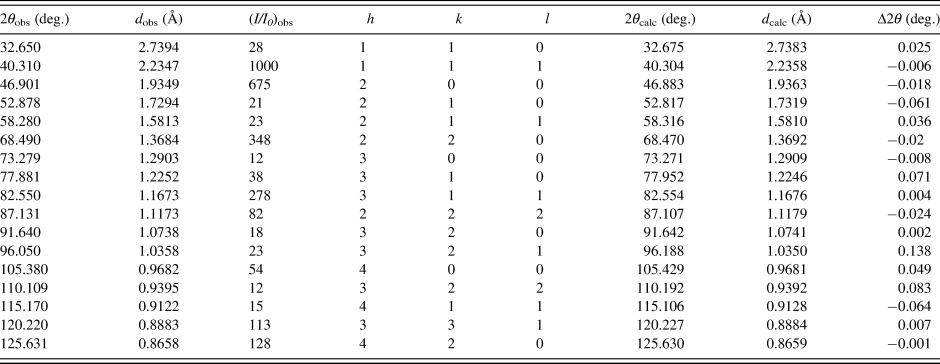
A small amount of the powder collected using the magnet was mounted on a glass specimen holder. The X-ray powder diffraction patterns were recorded with a Rigaku D/max 2500 diffractometer equipped with a Cu-target X-ray tube (40 kV and 30 mA). A divergence slit of 5 mm was used. The scan range was 2θ = 25°–130° with a step size of 0.01° and a scan speed of 5° min−1. The data were collected at room temperature (~300 K). MDI JADE 6.5 software was used to eliminate the Kα 2 component. The top of the peaks was used to determine the peak positions and intensities of the diffraction peaks (Table I). The d-values were calculated using CuKα 1 radiation (λ = 1.5406 Å). Rietveld refinements were performed with the FULLPROF package (Rodriguez-Carvajal, Reference Rodriguez-Carvajal2001).
X-ray powder diffraction data for Mn4C, which shows a lattice parameter a = 3.8726 Å, unit-cell volume V = 58.1 Å3, and space group  $ Pm { \bar {\it 3}} m$.

Only the peaks in the range of 2θ = 25°–130° are presented. The d-values were calculated using CuK α1 radiation (λ = 1.5406 Å).
III. RESULTS AND DISCUSSION
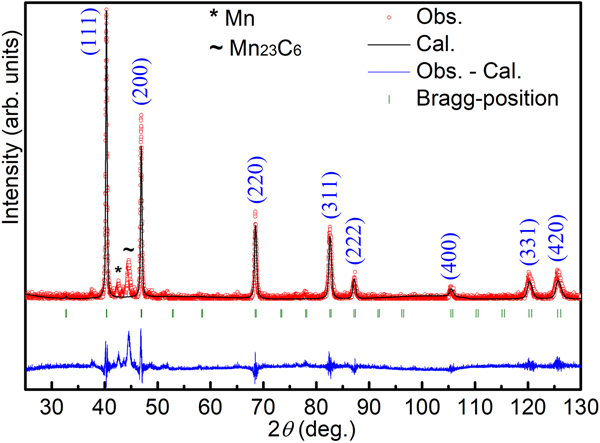
The X-ray powder diffraction patterns of the Mn4C powder are shown in Figure 1, which are quite similar to the powder diffraction patterns of Mn4N, as seen in PDF 01-089-4804 (ICDD, 2010), indicating similar structure of Mn4C to that of Mn4N. Therefore, most of the reflection peaks could be indexed with cubic perovskite-type Mn4C with lattice parameters of a = 3.8726 Å, unit-cell volume V = 58.1 Å3, and space group  $ Pm { \bar {\it 3}} m$ (No. 221). The lattice parameter of one Mn4C sample has been estimated to be 3.8682 Å in our previous work (Si et al., Reference Si, Qian, Ge, Park and Choi2018a). We speculate that the stoichiometry of Mn/C may to some extent have an effect on the exact lattice parameters. The Mn:C ratio of the precursor in this work is 4.23:1, which is slightly larger than that of our previous work (Si et al., Reference Si, Qian, Ge, Park and Choi2018a, Reference Si, Wang, Ge, Qian, Park, Yang, Li and Choi2018b). It seems the precursor stoichiometry has an effect on the stoichiometry of Mn4C and thus the lattice parameters. Of course, the evaporation loss variation of Mn during high-temperature melting would affect the stoichiometry of the final product Mn4C. Several weak diffraction peaks were indexed with Mn (PDF 32-0637) and Mn23C6 (PDF 28-0646) impurities (ICDD, 2010), which are more stable than Mn4C and are difficult to remove completely by magnetic separation. The presence of these impurities has also been observed in our previous work. The X-ray powder diffraction data for the compound are given in Table I.
(Color online) X-ray powder diffraction patterns of Mn4C using CuKα radiation.

SUPPLEMENTARY MATERIAL
The supplementary material for this article can be found at https://doi.org/10.1017/S0885715619000265
ACKNOWLEDGEMENTS
The authors thank the Future Materials Discovery Program through the National Research Foundation of Korea (NRF) funded by the Ministry of Science, ICT, and Future Planning (2016M3D1A1027835), and the National Natural Science Foundation of China (Nos. 11074227, 51671177). The authors appreciate Cheng Dong in Institute of Physics, CAS for his helpful suggestions.
CONFLICTS OF INTEREST
The authors have no conflicts of interest to declare.