I. INTRODUCTION
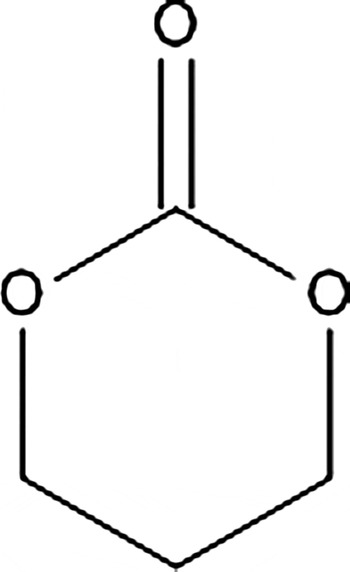
Trimethylene carbonate, systematic name 1,3-dioxane-2-one, shortly TMC (Figure 1), is an important monomer for synthesis of biocompatible polymers – poly(trimethylene carbonate) and poly(ester carbonates), most importantly copolymers of TMC with l-lactide, glycolide or ɛ-caprolactone (Nair and Laurencin, Reference Nair and Laurencin2007). These polymers are very useful materials for application in orthopedics and in soft tissue engineering. Depending on the copolymer structure they are used as flexible suture materials, orthopaedic tacks and screws, and they are good candidates for elastic scaffold materials, e.g. for production of vascular grafts and other hollow smooth muscle organs.
Structural formula of TMC.

The crystal structure of TMC was solved by Kataeva et al. (Reference Kataeva, Litvinov and Naumov1988).
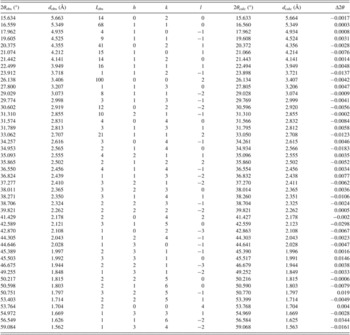
Indexed X-ray powder diffraction data of TMC, C4H6O3. Only the peaks with I rel of 1 or greater are presented reported [a = 6.145(1) Å, b = 11.328(3) Å, c = 6.900(2) Å, β = 99.067(4)°, unit-cell volume V = 474.33 Å3, Z = 4 and space group P21/n]. All measured lines were indexed and are consistent with the P21/n space group. The d-values were calculated using CuK α 1 radiation (λ = 1.5406 Å).

II. EXPERIMENTAL
A. Sample preparation
TMC was obtained as a gift from Labso Chimie Fine, France. It was sublimated at 40 °C and 700 Pa. TMC was characterized by DSC using DSC Q100 instrument (TA Instruments) at a heating rate 5 °C min−1 and nitrogen purge 50 cm3 min−1. The sublimated TMC exhibited two melting endotherms at 38 and 51 °C with corresponding heats of fusion 11 and 100 J g−1.
B. Diffraction data collection and reduction
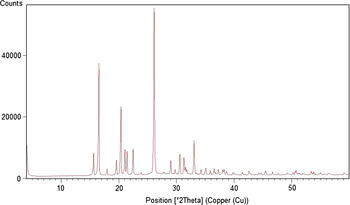
The diffraction pattern of TMC was collected at room temperature using an X'Pert PRO θ-θ powder diffractometer with parafocusing Bragg–Brentano geometry and CuKα 1 radiation (λ = 1.5406 Å, generator setting: 40 kV, 30 mA). An ultrafast X'Celerator detector was employed to collect XRD data over the angular range from 4 to 60° 2θ with a step size of 0.017° 2θ and a counting time of 20.32 s per step. The experimental powder diffraction pattern is depicted in Figure 2. The software package HighScore Plus V 3.0d (PANalytical, Almelo, Netherlands) was used to smooth the data, to fit the background and to eliminate the Kα 2 component. The top of the smoothed peak method was used to determine the peak positions and intensities of the diffraction peaks.
X-ray powder diffraction pattern of TMC using CuKα 1 radiation (λ = 1.5406 Å).

Automatic indexing of the experimental XRD pattern was performed using DICVOL04 (Boultif and Louër, Reference Boultif and Louër2004).
III. RESULTS
Automatic indexing results obtained by DICVOL04 show that TMC is monoclinic with space group P21/n and unit-cell parameters: a = 6.145(1) Å, b = 11.328(3) Å, c = 6.900(2) Å, β = 99.067(4)°, unit-cell volume V = 474.33 Å3 and Z = 4. The figures of merits are F 20 = 117.6(0.0036, 47) (Smith and Snyder, Reference Smith and Snyder1979) and M 20 = 69.8 (de Wolf, Reference de Wolff1968). All lines were indexed and are consistent with the P21 space group.
A comparison of unit cell parameters from powder data at 293 K (this article) and from single crystal data at 113 K (Kataeva et al., Reference Kataeva, Litvinov and Naumov1988) displays a significant shortening of all unit cell parameters at 113 K with the most profound effect on c parameter and even more substantial increase in the monoclinic angle from 99 to 102.6°. The unit-cell volume contracts to 441.7 Å3.
ACKNOWLEDGEMENT
This work was supported by the Grant Agency of the Czech Republic (grant no. GAČR 104/09/1497).