


%20--%3e%3c!DOCTYPE%20svg%20PUBLIC%20'-//W3C//DTD%20SVG%201.0//EN'%20'http://www.w3.org/TR/2001/REC-SVG-20010904/DTD/svg10.dtd'%3e%3csvg%20version='1.0'%20id='Layer_1'%20xmlns='http://www.w3.org/2000/svg'%20xmlns:xlink='http://www.w3.org/1999/xlink'%20x='0px'%20y='0px'%20width='64px'%20height='64px'%20viewBox='5.5%20-3.5%2064%2064'%20enable-background='new%205.5%20-3.5%2064%2064'%20xml:space='preserve'%3e%3cg%3e%3ccircle%20fill='%23FFFFFF'%20fill-opacity='0'%20cx='37.785'%20cy='28.501'%20r='28.836'/%3e%3cpath%20fill='%23595959'%20d='M37.441-3.5c8.951,0,16.572,3.125,22.857,9.372c3.008,3.009,5.295,6.448,6.857,10.314%20c1.561,3.867,2.344,7.971,2.344,12.314c0,4.381-0.773,8.486-2.314,12.313c-1.543,3.828-3.82,7.21-6.828,10.143%20c-3.123,3.085-6.666,5.448-10.629,7.086c-3.961,1.638-8.057,2.457-12.285,2.457s-8.276-0.808-12.143-2.429%20c-3.866-1.618-7.333-3.961-10.4-7.027c-3.067-3.066-5.4-6.524-7-10.372S5.5,32.767,5.5,28.5c0-4.229,0.809-8.295,2.428-12.2%20c1.619-3.905,3.972-7.4,7.057-10.486C21.08-0.394,28.565-3.5,37.441-3.5z%20M37.557,2.272c-7.314,0-13.467,2.553-18.458,7.657%20c-2.515,2.553-4.448,5.419-5.8,8.6c-1.354,3.181-2.029,6.505-2.029,9.972c0,3.429,0.675,6.734,2.029,9.913%20c1.353,3.183,3.285,6.021,5.8,8.516c2.514,2.496,5.351,4.399,8.515,5.715c3.161,1.314,6.476,1.971,9.943,1.971%20c3.428,0,6.75-0.665,9.973-1.999c3.219-1.335,6.121-3.257,8.713-5.771c4.99-4.876,7.484-10.99,7.484-18.344%20c0-3.543-0.648-6.895-1.943-10.057c-1.293-3.162-3.18-5.98-5.654-8.458C50.984,4.844,44.795,2.272,37.557,2.272z%20M37.156,23.187%20l-4.287,2.229c-0.458-0.951-1.019-1.619-1.685-2c-0.667-0.38-1.286-0.571-1.858-0.571c-2.856,0-4.286,1.885-4.286,5.657%20c0,1.714,0.362,3.084,1.085,4.113c0.724,1.029,1.791,1.544,3.201,1.544c1.867,0,3.181-0.915,3.944-2.743l3.942,2%20c-0.838,1.563-2,2.791-3.486,3.686c-1.484,0.896-3.123,1.343-4.914,1.343c-2.857,0-5.163-0.875-6.915-2.629%20c-1.752-1.752-2.628-4.19-2.628-7.313c0-3.048,0.886-5.466,2.657-7.257c1.771-1.79,4.009-2.686,6.715-2.686%20C32.604,18.558,35.441,20.101,37.156,23.187z%20M55.613,23.187l-4.229,2.229c-0.457-0.951-1.02-1.619-1.686-2%20c-0.668-0.38-1.307-0.571-1.914-0.571c-2.857,0-4.287,1.885-4.287,5.657c0,1.714,0.363,3.084,1.086,4.113%20c0.723,1.029,1.789,1.544,3.201,1.544c1.865,0,3.18-0.915,3.941-2.743l4,2c-0.875,1.563-2.057,2.791-3.541,3.686%20c-1.486,0.896-3.105,1.343-4.857,1.343c-2.896,0-5.209-0.875-6.941-2.629c-1.736-1.752-2.602-4.19-2.602-7.313%20c0-3.048,0.885-5.466,2.658-7.257c1.77-1.79,4.008-2.686,6.713-2.686C51.117,18.558,53.938,20.101,55.613,23.187z'/%3e%3c/g%3e%3c/svg%3e)
%20--%3e%3c!DOCTYPE%20svg%20PUBLIC%20'-//W3C//DTD%20SVG%201.0//EN'%20'http://www.w3.org/TR/2001/REC-SVG-20010904/DTD/svg10.dtd'%3e%3csvg%20version='1.0'%20id='Layer_1'%20xmlns='http://www.w3.org/2000/svg'%20xmlns:xlink='http://www.w3.org/1999/xlink'%20x='0px'%20y='0px'%20width='64px'%20height='64px'%20viewBox='5.5%20-3.5%2064%2064'%20enable-background='new%205.5%20-3.5%2064%2064'%20xml:space='preserve'%3e%3cg%3e%3ccircle%20fill='%23FFFFFF'%20fill-opacity='0'%20cx='37.637'%20cy='28.806'%20r='28.276'/%3e%3cg%3e%3cpath%20fill='%23595959'%20d='M37.443-3.5c8.988,0,16.57,3.085,22.742,9.257C66.393,11.967,69.5,19.548,69.5,28.5c0,8.991-3.049,16.476-9.145,22.456%20C53.879,57.319,46.242,60.5,37.443,60.5c-8.649,0-16.153-3.144-22.514-9.43C8.644,44.784,5.5,37.262,5.5,28.5%20c0-8.761,3.144-16.342,9.429-22.742C21.101-0.415,28.604-3.5,37.443-3.5z%20M37.557,2.272c-7.276,0-13.428,2.553-18.457,7.657%20c-5.22,5.334-7.829,11.525-7.829,18.572c0,7.086,2.59,13.22,7.77,18.398c5.181,5.182,11.352,7.771,18.514,7.771%20c7.123,0,13.334-2.607,18.629-7.828c5.029-4.838,7.543-10.952,7.543-18.343c0-7.276-2.553-13.465-7.656-18.571%20C50.967,4.824,44.795,2.272,37.557,2.272z%20M46.129,20.557v13.085h-3.656v15.542h-9.944V33.643h-3.656V20.557%20c0-0.572,0.2-1.057,0.599-1.457c0.401-0.399,0.887-0.6,1.457-0.6h13.144c0.533,0,1.01,0.2,1.428,0.6%20C45.918,19.5,46.129,19.986,46.129,20.557z%20M33.042,12.329c0-3.008,1.485-4.514,4.458-4.514s4.457,1.504,4.457,4.514%20c0,2.971-1.486,4.457-4.457,4.457S33.042,15.3,33.042,12.329z'/%3e%3c/g%3e%3c/g%3e%3c/svg%3e)
%20--%3e%3c!DOCTYPE%20svg%20PUBLIC%20'-//W3C//DTD%20SVG%201.0//EN'%20'http://www.w3.org/TR/2001/REC-SVG-20010904/DTD/svg10.dtd'%3e%3csvg%20version='1.0'%20id='Layer_1'%20xmlns='http://www.w3.org/2000/svg'%20xmlns:xlink='http://www.w3.org/1999/xlink'%20x='0px'%20y='0px'%20width='64px'%20height='64px'%20viewBox='5.5%20-3.5%2064%2064'%20enable-background='new%205.5%20-3.5%2064%2064'%20xml:space='preserve'%3e%3cg%3e%3ccircle%20fill='%23FFFFFF'%20fill-opacity='0'%20cx='36.924'%20cy='28.403'%20r='28.895'/%3e%3cpath%20fill='%23595959'%20d='M37.442-3.5c8.99,0,16.571,3.085,22.743,9.256C66.393,11.928,69.5,19.509,69.5,28.5c0,8.992-3.048,16.476-9.145,22.458%20C53.88,57.32,46.241,60.5,37.442,60.5c-8.686,0-16.19-3.162-22.513-9.485C8.644,44.728,5.5,37.225,5.5,28.5%20c0-8.762,3.144-16.343,9.429-22.743C21.1-0.414,28.604-3.5,37.442-3.5z%20M12.7,19.872c-0.952,2.628-1.429,5.505-1.429,8.629%20c0,7.086,2.59,13.22,7.77,18.4c5.219,5.144,11.391,7.715,18.514,7.715c7.201,0,13.409-2.608,18.63-7.829%20c1.867-1.79,3.332-3.657,4.398-5.602l-12.056-5.371c-0.421,2.02-1.439,3.667-3.057,4.942c-1.622,1.276-3.535,2.011-5.744,2.2%20v4.915h-3.714v-4.915c-3.543-0.036-6.782-1.312-9.714-3.827l4.4-4.457c2.094,1.942,4.476,2.913,7.143,2.913%20c1.104,0,2.048-0.246,2.83-0.743c0.78-0.494,1.172-1.312,1.172-2.457c0-0.801-0.287-1.448-0.858-1.943l-3.085-1.315l-3.771-1.715%20l-5.086-2.229L12.7,19.872z%20M37.557,2.214c-7.276,0-13.428,2.571-18.457,7.714c-1.258,1.258-2.439,2.686-3.543,4.287L27.786,19.7%20c0.533-1.676,1.542-3.019,3.029-4.028c1.484-1.009,3.218-1.571,5.2-1.686V9.071h3.715v4.915c2.934,0.153,5.6,1.143,8,2.971%20l-4.172,4.286c-1.793-1.257-3.619-1.885-5.486-1.885c-0.991,0-1.876,0.191-2.656,0.571c-0.781,0.381-1.172,1.029-1.172,1.943%20c0,0.267,0.095,0.533,0.285,0.8l4.057,1.83l2.8,1.257l5.144,2.285l16.397,7.314c0.535-2.248,0.801-4.533,0.801-6.857%20c0-7.353-2.552-13.543-7.656-18.573C51.005,4.785,44.831,2.214,37.557,2.214z'/%3e%3c/g%3e%3c/svg%3e)
%20--%3e%3c!DOCTYPE%20svg%20PUBLIC%20'-//W3C//DTD%20SVG%201.1//EN'%20'http://www.w3.org/Graphics/SVG/1.1/DTD/svg11.dtd'%3e%3csvg%20version='1.1'%20id='Layer_1'%20xmlns='http://www.w3.org/2000/svg'%20xmlns:xlink='http://www.w3.org/1999/xlink'%20x='0px'%20y='0px'%20width='64.000977px'%20height='64px'%20viewBox='0%200%2064.000977%2064'%20enable-background='new%200%200%2064.000977%2064'%20xml:space='preserve'%3e%3cg%3e%3ccircle%20fill='%23FFFFFF'%20fill-opacity='0'%20cx='32.064453'%20cy='31.788086'%20r='29.012695'/%3e%3cg%3e%3cpath%20fill='%23595959'%20d='M31.943848,0C40.896484,0,48.476562,3.105469,54.6875,9.314453C60.894531,15.486328,64.000977,23.045898,64.000977,32%20s-3.048828,16.457031-9.145508,22.513672C48.417969,60.837891,40.779297,64,31.942871,64%20c-8.648926,0-16.152832-3.142578-22.513672-9.429688C3.144043,48.286133,0,40.761719,0,32.000977%20c0-8.723633,3.144043-16.285156,9.429199-22.68457C15.640137,3.105469,23.14502,0,31.943848,0z%20M32.060547,5.771484%20c-7.275391,0-13.429688,2.570312-18.458496,7.714844C8.381836,18.783203,5.772949,24.954102,5.772949,32%20c0,7.125,2.589844,13.256836,7.77002,18.400391c5.181152,5.181641,11.352051,7.770508,18.515625,7.770508%20c7.123047,0,13.332031-2.608398,18.626953-7.828125C55.713867,45.466797,58.228516,39.353516,58.228516,32%20c0-7.3125-2.553711-13.484375-7.65625-18.513672C45.504883,8.341797,39.333984,5.771484,32.060547,5.771484z%20M44.117188,24.456055%20v5.485352H20.859863v-5.485352H44.117188z%20M44.117188,34.743164v5.481445H20.859863v-5.481445H44.117188z'/%3e%3c/g%3e%3c/g%3e%3c/svg%3e)
1. Decayability—material affordances in the nonhuman world
The rise of advanced manufacturing in industrial design has led to widespread misconceptions about material sustainability, particularly regarding bioplastics. Polylactic Acid (PLA), for instance—a material commonly used in Fused Deposition Modelling (FDM) 3D printing—is often promoted for its biological origins and biodegradability. However, its chemical composition limits efficient breakdown in soil and water, despite being derived from natural sugars (Reference Ali, Ali, Gillani, Zinck and SouissiAli et al., 2023; Reference Bagheri, Laforsch, Greiner and AgarwalBagheri et al., 2017; Reference Narancic, Verstichel, Reddy Chaganti, Morales-Gamez, Kenny, De Wilde, Babu Padamati and O’ConnorNarancic et al., 2018; Reference Pinto, Ramos, Alves, Xavier, Tavares, Moreira and GuedesPinto et al., 2015). This disconnect between PLA’s marketed sustainability and environmental persistence is particularly concerning, as bio-PLA production is projected to reach 6.45 million tons by 2030 (Mordor Intelligence, n.d.).
PLA can degrade in industrial composting facilities, where temperatures exceed 58°C under controlled conditions (Reference Chamas, Moon, Zheng, Qiu, Tabassum, Jang, Abu-Omar, Scott and SuhChamas et al., 2020; Reference Mikula, Skrzypczak, Izydorczyk, Warchoł, Moustakas, Chojnacka and Witek-KrowiakMikula et al., 2021; Reference O’NeillO’Neill, 2024). However, such conditions are rare in everyday environments. A study by CNC Kitchen (CNC Kitchen, 2022) confirmed this limitation, showing minimal PLA decomposition in garden compost over six months. In natural settings—soil, freshwater, marine, and home composting environments—PLA primarily fragments into microplastics, persisting for years without meaningful breakdown and accumulating in sediments (Reference Lott, Stemmer-Rau and WeberLott et al., 2024). This raises a critical question: Can we design 3D-printable biomaterials that naturally reintegrate into soil ecosystems? Addressing this challenge offers a major opportunity in industrial design—developing materials that work for, rather than against soil ecologies.
At the core of this challenge is how materials communicate their properties. Gibson’s affordance theory (Reference GibsonGibson, 1986) provides a valuable framework for understanding how objects signal their potential through inherent properties and context. Building on Gibson’s work, Reference Ben-ZeevBen-Zeev (1981), Reference GaverGaver (1991) and Norman (1999, 2013) categorized affordances into three types:
-
Perceptible affordances—features that clearly suggest usage (e.g., a doorbell protrudes, inviting a press).
-
Hidden affordances—properties that are not immediately obvious (e.g., a doorbell with a concealed camera).
-
And false affordances—features that imply an interaction that does not actually exist (e.g., a silent doorbell).
Karana and Camera’s material potential framework (2018) later extended affordance theory from products to materials, emphasizing that materials, like objects, afford interactions to both humans and nonhumans. This ecological extension is crucial in material design: truly sustainable materials should communicate effectively with both human users and the nonhuman communities involved in their decomposition.
Despite these advances, industrial composting remains a controlled process, whereas everyday disposal environments vary significantly in temperature, moisture, and microbial diversity (Reference ArrietaArrieta, 2021; Reference Ruggero, Gori and LubelloRuggero et al., 2019). These natural variations often hinder the breakdown of supposedly biodegradable materials, revealing a gap between standardized degradation and real-world performance. To bridge this gap, there is a need to reconceptualize biodegradability as a responsive design process that adapts dynamically to environmental and ecological conditions. PLA exemplifies this duality. Its perceptible affordances (color, texture) and hidden affordances (heat reactivity during printing) are clear to designers. However, its biodegradability claims act as a false affordance—while marketed as environmentally friendly, PLA resists breakdown in natural composting conditions, requiring controlled conditions to effectively reintegrate to ecosystems.
Our research introduces “decayability” [decay-ability] as a novel concept to understand material affordances, one that explicitly accounts for multispecies relationships in determining material capabilities. Unlike traditional biodegradability, decayability considers how materials interact with soil ecologies in real-world environments. Where biodegradability relies on specific temperature, moisture, and microbial conditions, decayability embraces natural variability, enabling the design of materials that decompose effectively in home composting systems. This reframes decomposition from a passive material property to an active ecological relationship. A decayable material does not just break down—it fosters nonhuman activity and nourishes decomposer organisms.
By integrating soil science methods to industrial design processes, this study highlights the crucial role of soil organisms in designing truly decayable 3D-printable filaments. It also advances new methodological directions for sustainable material development. Specifically, it leverages affordance theory to explore how prioritizing decomposer organisms reshapes our understanding of material lifecycles—shifting the narrative from passive material breakdown to active ecological engagement.
2. Material design, printing, and decayability studies
Inspired by Karana et al.’s Material-Driven Design methodology (2015), our transdisciplinary approach followed three key phases: (1) the design and optimization of PLA polymer blends for FDM 3D printing, (2) the printing of test specimens for decayability studies, and (3), the assessment of their decayability through a controlled composting experiment.
2.1. Material design
To enhance the decayability of PLA, we blended this bioplastic with other biomaterials. Our selection process favored additives with proven potential for biological reintegration. Poly(3-hydroxybutyrate-co-3-hydroxyvalerate) (PHBV) was chosen as the primary blending agent due to its microbial origin and certified biodegradability in both soil and marine environments (Reference Mehrpouya, Vahabi, Barletta, Laheurte and LangloisMehrpouya et al., 2021). Its amorphous chemical structure particularly supports reintegration into soil ecosystems (Reference Weng, Wang, Wang and WangWeng et al., 2010). The material was sourced in pellet form under the commercial name ENMAT Y31000P from Helian Polymers and blended with additive-free PLA granules from Aurarum; or additive-free PLA granules supplemented by a bioactive filler (see below).
PLA/PHBV blends were systematically tested in 25% increments using a desktop filament extruder (Felfil Evo Extruder). Processing parameters were optimized for extrusion temperature (175-185°C), cooling rate (hardening in ambient conditions), and filament diameter consistency (1.75 ± 0.05mm).
Comprehensive testing of mechanical properties and print consistency resulted in five viable formulations:
-
75% PLA/25% PHBV blend
-
50% PLA/50% PHBV blend (i.e. base polymer)
-
50% PLA/50% PHBV blend with 5% spirulina powder as a bioactive filler
-
50% PLA/50% PHBV blend with 5% turmeric powder as a bioactive filler
-
50% PLA/50% PHBV blend with 5% eucalyptus oil as a bioactive filler
Our material selection was guided by two factors: technical compatibility with desktop-scale 3D printers and potential for ecological interaction. In addition, all selected additives (such as turmeric) featured particle sizes below 0.3mm, ensuring compatibility with standard 3D printer nozzles (0.4mm) while remaining perceivable to decomposer organisms.
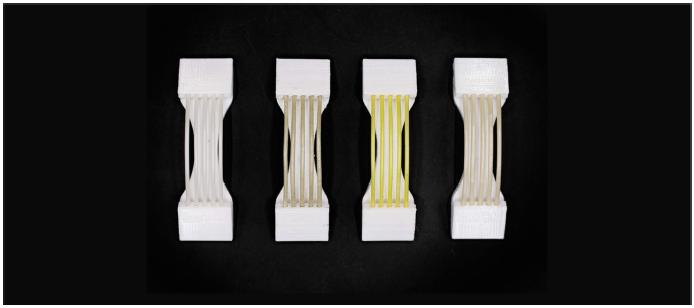
Material palette for FDM 3D printing showing experimental biofilaments: base polymer blend (50% PLA/50% PHBV) and its variants with 5% spirulina powder, turmeric powder, and eucalyptus oil (left to right)

This material palette demonstrates that meaningful advances in sustainable material development do not require highly specialized laboratories. Instead, these experiments can be replicated and expanded using widely available equipment and materials, enabling broader adoption of decayable 3D-printable material alternatives in design.
2.2. Specimen design and print
Following Reference Rynk, Schwarz, Richard, Cotton, Halbach, Siebert and RynkRynk et al. (2022), we designed our test specimens based on key composting principles: moisture retention, low density, high porosity, and extended surface area. These parameters were translated into 3D-printable forms optimized for decayability studies.
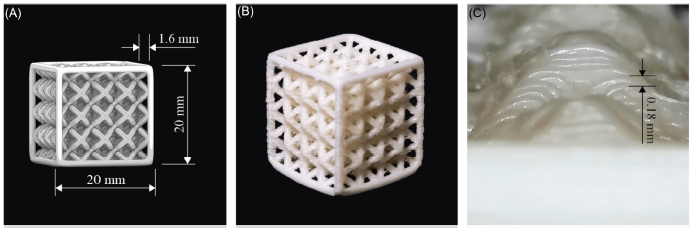
The final design—a 20mm cubic lattice structure with 1.6mm thick struts, printed in triplicate for each formulation using a Creality Ender 5 3D printer—was chosen to: maximize surface area for microbial interaction, maintain structural integrity for handling and retrieval from various home composting systems, and balance ecological accessibility with the practical need to monitor decomposition over time.
Lattice structure (20mm cube with 1.6mm struts) designed for composting experiments: CAD model (A), printed specimen (B), and microscopic detail of the printed struts showing 0.18mm layer heights (C). This geometry maximizes surface area for microbial interaction while maintaining structural integrity for retrieval from composting ecosystems

2.3. Decayability studies
To assess decayability as a material affordance for nonhuman organisms, we conducted composting respiration experiments using a Picarro G2301 Cavity Ring Down Spectrometer to measure carbon dioxide emissions (CO2). Our experimental design included 30 one-liter mason jars, each containing: test specimens (latticed cubes, 2.5g each), mature compost at a 1:4 w/w ratio (2.5g specimen per 10g compost), and consistent humidity, maintained through water columns. To ensure statistical validity, we tested: five material formulations, two temperature conditions, and three replicates per formulation.
To isolate formulation effects, we also included three control groups: empty jars for measuring ambient CO2 levels, compost-only samples for establishing baseline microbial activity, and 100% PLA specimens to assess PLA’s decomposition behavior. This methodological approach, adapted from Reference Gómez, Lima and FerrerGómez et al. (2006), allowed us to systematically quantify how different material compositions influence microbial metabolic activity.
Bacterial activity was monitored through twice-weekly CO2 measurements across two experimental phases: a room temperature exposure (130 days at 22°C) and an accelerated assessment at higher temperature (65 days at 40°C). These temperatures represent typical home-composting conditions (22°C), and accelerated composting conditions used in some industrial composting settings (40°C), as recommended by the Environmental Protection Authority of Victoria (2017).
CO2 measurements followed a standardized protocol to ensure methodological rigor and replicability. Each mason jar was sealed for at least 48 hours prior to measurement to allow gas concentration stabilization. The Picarro G2301 analyzer was connected to each jar via a closed-loop system with a flow rate of <0.4 slm. Each measurement cycle lasted 2 minutes per sample, with the final 30 seconds of stabilized readings used for analysis. All measurements were conducted in a temperature-controlled environment to minimize ambient variations, with baseline corrections applied using the empty jar control readings. This methodology enables precise quantification of microbial respiratory activity, allowing for meaningful comparison between different material formulations under controlled conditions.
3. Material performance and nonhuman responses
Analysis of CO2 emissions revealed distinct microbial responses to different material formulations under varying temperature conditions.
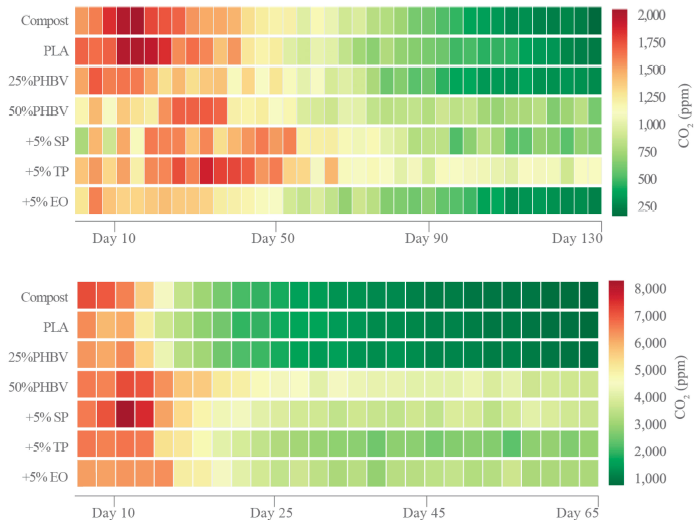
At 22°C (Figure 3, top panel), several key trends emerged. All formulations exhibited an initial 30-day phase of relatively high microbial activity, followed by varying patterns of sustained or declining emissions. Formulations containing spirulina and turmeric fillers consistently maintained higher CO2 emissions, particularly between days 60-130, indicating prolonged microbial engagement. The 50% PLA/50% PHBV samples showed moderate initial activity but declined faster than their filler-enhanced counterparts, except for the specimens containing eucalyptus oil. The 100% PLA samples exhibited emission patterns similar to the compost-only control, suggesting limited microbial recognition of PLA as a resource.
In contrast, the 40°C experiment (Figure 3, bottom panel) revealed a notably different pattern of microbial engagement. The 50% PLA/50% PHBV formulation sustained the highest microbial activity throughout the experiment. Organic filler formulations showed lower CO2 emissions, suggesting they were either less effective or inhibitory at higher temperatures. Control samples remained consistently lower than all material formulations, indicating that reduced or absent PHBV content correlates with decreased microbial activity under elevated temperatures.
CO2 emissions (ppm) from composting ecologies exposed to different material formulations: room temperature experiment at 22°C for 130 days (top panel, n=3) and elevated temperature experiment at 40°C for 65 days (bottom panel, n=3)

These findings demonstrate that material affordances vary across species and environmental conditions. At 22°C, organic fillers can act as perceptible affordances to decomposer organisms, making the material more recognizable as a resource. At 40°C, the 50% PLA/50% PHBV base polymer blend becomes more accessible to microbes, with PHBV concentration emerging as the primary driver of microbial activity. In both experiments, 100% PLA samples mirrored the compost-only control, confirming that PLA alone is largely imperceptible or inaccessible to microbial communities under the tested conditions.
These temperature-dependent microbial patterns reinforce the idea that decayability is not an intrinsic material property, but a designed affordance. By strategically engineering material compositions, designers can enhance ecological reintegration across different environmental contexts.
Additionally, PHBV and organic fillers introduced perceptible affordances for humans—such as distinct textures, colors, and scents (these aspects were not formally documented in this study). These sensory properties can serve as tangible indicators of biological components, bridging the gap between human perception and ecological potential.
4. Cross-species affordances: from laboratory to compost
Beyond CO2 emissions, we conducted microscopic analysis to explore the interplay between material composition, environmental conditions, and microbial activity, challenging conventional understanding of biodegradability in material design.
Microscopic images of microbial communities colonizing different material formulations: 50% PLA/50% PHBV (A, E), with 5% spirulina (B, F), 5% turmeric (C, G), and 5% eucalyptus oil (D, H). Top row (A-D) shows diverse fungal-bacterial communities at 22°C, while the bottom row (E-H) predominantly features bacterial colonies at 40°C

At 22°C, bioactive-filled materials sustained higher CO2 emissions (Figure 3, top panel). Microscopic analysis (Figure 4, top row) supported these findings, revealing diverse microbial communities that responded uniquely to each formulation. Spirulina samples (B), for example, exhibited the most diverse ecosystem, including actinomycetes and multiple fungal morphologies, whereas turmeric samples (C) developed dense, filamentous fungal networks with visible hyphal structures. In contrast, at 40°C, CO2 emissions were more uniform across all samples (Figure 3, bottom panel), suggesting less diverse but more specialized microbial activity. Microscopic observations (Figure 4, bottom row) confirmed this shift, showing more uniform microbial populations mainly composed of bacteria, with far fewer fungal species compared to the 22°C samples.
This striking contrast in microbial diversity across temperatures confirms that environmental conditions influence which materials are “perceptible” to microbes. At 22°C, organic fillers like turmeric served as primary microbial interaction points, while at 40°C, the base biopolymer matrix became the dominant substrate for microbial activity, reducing the influence of organic additives.
These findings call for a new approach to material and product end-of-life. Rather than seeing decomposition as a passive process, materials should be designed to actively support microbial ecosystems within specific environmental contexts. The success of these context-specific, microorganism-perceptible fillers further demonstrates the potential for designing materials with cross-species affordances—serving both human use and nonhuman decomposition processes.
It is important to note that while our latticed structure was optimized for experimental observation, real-world product geometries will significantly impact decayability. Product thickness creates a gradient of microbial accessibility. Consequently, solid geometries with a high volume-to-surface ratio are likely to decompose more slowly than thin-walled or highly porous structures, potentially requiring different material formulations optimized for specific geometric constraints.
5. Beyond biodegradability: decayability as an affordance spectrum
This study reveals two critical insights for industrial design practice. First, our findings suggest that decayability operates as a dynamic affordance that manifests in multiple ways across species:
-
As a perceptible affordance to microbial communities, varying with environmental conditions
-
As a hidden affordance to humans, beyond our perceptual capabilities
-
As a false affordance to humans when marketed without ecological context
The second insight concerns the contextual nature of material affordances. The 18°C temperature difference in our experiments altered which materials were perceptible and desirable to different microbial communities. This supports Gibson’s (1986) theory, which states that affordances are shaped by socio-environmental context—here, an environmental factor shaping affordance perception. While Gibson’s theory centers on the relationship between human perceivers and their surroundings, our study demonstrates that these relationships can be intentionally designed across species boundaries. Accordingly, our findings extend affordance theory beyond human perception into more-than-human design considerations.
Overall, our study reframes biodegradability as a spectrum of designed affordances rather than a simple binary (biodegradable vs. non-biodegradable). This nuanced understanding challenges designers to move beyond asking “Can a material biodegrade?” to considering “How does this material engage with specific environments and decomposing ecologies?”
This perspective also invites a broader discussion on sustainability and circular transitions. By positioning decayability within circular economy frameworks, we argue that material sustainability should be evaluated beyond traditional metrics. While conventional approaches prioritize durability and recyclability, decayability introduces ecological integration as a complementary strategy that acknowledges the inevitable end-of-life leakage from “closed-loop” systems. This shift bridges material circularity with ecosystem regeneration, fostering a more comprehensive model for sustainable design (Reference CotsaftisCotsaftis, 2023; Reference Dhiman, Kaur, Narang, Mukherjee, Thakur, Kaur and TripathiDhiman et al., 2024; Reference Mubayi, Ahern, Calusinska and O’MalleyMubayi et al., 2024).
6. Limitations, implications, and future directions in industrial biodesign
A key contribution of this study is the introduction of compost respiration analysis as a novel evaluation method in material design. Unlike traditional biodegradability assessments that focus on physical properties and controlled industrial conditions, this method provides direct insight into how biological organisms interact with materials over time. By monitoring CO2 emissions—an indicator of metabolic activity—designers can “listen” to microbial feedback, bridging the gap between intended material properties and actual ecological integration.
This perspective encourages a shift in how we view biodegradability—not as a fixed material property but as an active, complex ecological interaction shaped by material composition and environmental factors (Figure 5). It also reframes material development by integrating living systems as active stakeholders in a more-than-human design process (Reference Cianfanelli, Claudia Coppola and TufarelliCianfanelli et al., 2022; Reference Cotsaftis, Williams, Chyon, Sadar, Va Pesaran, Wines and NaardenCotsaftis et al., 2023; Reference VeselovaVeselova, 2019). In doing so, it broadens the scope of material design beyond human convenience, fostering an approach where biodegradation is not simply an endpoint but a designed ecological relationship that sustains regenerative cycles.
50% PLA/50% PHBV samples: before composting (left) and after composting at 40°C for 65 days (right, triplicate samples). The composted samples display varying degrees of decomposition, reflecting the heterogeneous nature of microbial colonization

While our research focuses on home-compostable materials for FDM 3D printing, we acknowledge that the materials we developed primarily yield CO2 and H2O, offering limited ecosystem value compared to more complex organic waste. Different end-of-life scenarios present trade-offs: incineration captures energy but releases greenhouse gases; recycling preserves material value but is susceptible to contamination and performance issues; and composting reduces pollution but may come with minimal ecosystem return. Optimal material design likely requires targeting specific disposal contexts rather than pursuing universal solutions.
Based on our findings, we propose the following key guidelines for sustainable material design:
-
Consider disposal environments and ecologies early in material selection—home composting, industrial composting, and landfill conditions demand different material properties.
-
Prioritize organic additives for their microbial affordances rather than their biodegradable status—different fillers create distinct ecological niches that support diverse microbial communities.
-
Validate materials through real-world testing for ecological integration—standardized biodegradability tests often fail to capture the complexity of natural composting dynamics, while field testing ensures materials integrate effectively within ecosystems.
-
Unlike with conventional PLA, set realistic decomposition expectations for users—decayability depends not just on material properties but also on environmental and ecological conditions, making consumer education essential for informed sustainability choices.
These guidelines challenge prevailing sustainability narratives, urging designers to move beyond simple material substitution and toward intentional ecological design that considers the nonhuman communities that ultimately process these materials.
Despite its contributions, this study has several limitations. The experimental design focused on specific temperature conditions and a limited range of additives, with a constrained timeframe that restricted long-term microbial observations. Additionally, potential toxicity from degradation byproducts was not explored. The latticed test structure was optimized for experimental observation, but in real-world applications, thicker geometries would likely decompose more slowly than surface areas. Scaling from lab experiments to industrial production also presents challenges in maintaining material consistency and processing standards.
Ultimately, this integration of industrial design and soil science illustrates the potential of transdisciplinary research in addressing complex ecological challenges. This approach broadens both the conceptual framework and practical toolkit of designers, emphasizing that sustainable design should go beyond minimizing harm to actively fostering multispecies ecological relationships (Reference Fletcher, St. Pierre and ThamFletcher et al., 2019; Reference Groutars, Kim and KaranaGroutars et al., 2024). By framing decayability as a designed affordance rather than an intrinsic material trait, this study lays the groundwork for the next generation of sustainable materials—ones that mediate interactions between materials, humans, and the more-than-human world.


 Open access

