


%20--%3e%3c!DOCTYPE%20svg%20PUBLIC%20'-//W3C//DTD%20SVG%201.0//EN'%20'http://www.w3.org/TR/2001/REC-SVG-20010904/DTD/svg10.dtd'%3e%3csvg%20version='1.0'%20id='Layer_1'%20xmlns='http://www.w3.org/2000/svg'%20xmlns:xlink='http://www.w3.org/1999/xlink'%20x='0px'%20y='0px'%20width='64px'%20height='64px'%20viewBox='5.5%20-3.5%2064%2064'%20enable-background='new%205.5%20-3.5%2064%2064'%20xml:space='preserve'%3e%3cg%3e%3ccircle%20fill='%23FFFFFF'%20fill-opacity='0'%20cx='37.785'%20cy='28.501'%20r='28.836'/%3e%3cpath%20fill='%23595959'%20d='M37.441-3.5c8.951,0,16.572,3.125,22.857,9.372c3.008,3.009,5.295,6.448,6.857,10.314%20c1.561,3.867,2.344,7.971,2.344,12.314c0,4.381-0.773,8.486-2.314,12.313c-1.543,3.828-3.82,7.21-6.828,10.143%20c-3.123,3.085-6.666,5.448-10.629,7.086c-3.961,1.638-8.057,2.457-12.285,2.457s-8.276-0.808-12.143-2.429%20c-3.866-1.618-7.333-3.961-10.4-7.027c-3.067-3.066-5.4-6.524-7-10.372S5.5,32.767,5.5,28.5c0-4.229,0.809-8.295,2.428-12.2%20c1.619-3.905,3.972-7.4,7.057-10.486C21.08-0.394,28.565-3.5,37.441-3.5z%20M37.557,2.272c-7.314,0-13.467,2.553-18.458,7.657%20c-2.515,2.553-4.448,5.419-5.8,8.6c-1.354,3.181-2.029,6.505-2.029,9.972c0,3.429,0.675,6.734,2.029,9.913%20c1.353,3.183,3.285,6.021,5.8,8.516c2.514,2.496,5.351,4.399,8.515,5.715c3.161,1.314,6.476,1.971,9.943,1.971%20c3.428,0,6.75-0.665,9.973-1.999c3.219-1.335,6.121-3.257,8.713-5.771c4.99-4.876,7.484-10.99,7.484-18.344%20c0-3.543-0.648-6.895-1.943-10.057c-1.293-3.162-3.18-5.98-5.654-8.458C50.984,4.844,44.795,2.272,37.557,2.272z%20M37.156,23.187%20l-4.287,2.229c-0.458-0.951-1.019-1.619-1.685-2c-0.667-0.38-1.286-0.571-1.858-0.571c-2.856,0-4.286,1.885-4.286,5.657%20c0,1.714,0.362,3.084,1.085,4.113c0.724,1.029,1.791,1.544,3.201,1.544c1.867,0,3.181-0.915,3.944-2.743l3.942,2%20c-0.838,1.563-2,2.791-3.486,3.686c-1.484,0.896-3.123,1.343-4.914,1.343c-2.857,0-5.163-0.875-6.915-2.629%20c-1.752-1.752-2.628-4.19-2.628-7.313c0-3.048,0.886-5.466,2.657-7.257c1.771-1.79,4.009-2.686,6.715-2.686%20C32.604,18.558,35.441,20.101,37.156,23.187z%20M55.613,23.187l-4.229,2.229c-0.457-0.951-1.02-1.619-1.686-2%20c-0.668-0.38-1.307-0.571-1.914-0.571c-2.857,0-4.287,1.885-4.287,5.657c0,1.714,0.363,3.084,1.086,4.113%20c0.723,1.029,1.789,1.544,3.201,1.544c1.865,0,3.18-0.915,3.941-2.743l4,2c-0.875,1.563-2.057,2.791-3.541,3.686%20c-1.486,0.896-3.105,1.343-4.857,1.343c-2.896,0-5.209-0.875-6.941-2.629c-1.736-1.752-2.602-4.19-2.602-7.313%20c0-3.048,0.885-5.466,2.658-7.257c1.77-1.79,4.008-2.686,6.713-2.686C51.117,18.558,53.938,20.101,55.613,23.187z'/%3e%3c/g%3e%3c/svg%3e)
%20--%3e%3c!DOCTYPE%20svg%20PUBLIC%20'-//W3C//DTD%20SVG%201.0//EN'%20'http://www.w3.org/TR/2001/REC-SVG-20010904/DTD/svg10.dtd'%3e%3csvg%20version='1.0'%20id='Layer_1'%20xmlns='http://www.w3.org/2000/svg'%20xmlns:xlink='http://www.w3.org/1999/xlink'%20x='0px'%20y='0px'%20width='64px'%20height='64px'%20viewBox='5.5%20-3.5%2064%2064'%20enable-background='new%205.5%20-3.5%2064%2064'%20xml:space='preserve'%3e%3cg%3e%3ccircle%20fill='%23FFFFFF'%20fill-opacity='0'%20cx='37.637'%20cy='28.806'%20r='28.276'/%3e%3cg%3e%3cpath%20fill='%23595959'%20d='M37.443-3.5c8.988,0,16.57,3.085,22.742,9.257C66.393,11.967,69.5,19.548,69.5,28.5c0,8.991-3.049,16.476-9.145,22.456%20C53.879,57.319,46.242,60.5,37.443,60.5c-8.649,0-16.153-3.144-22.514-9.43C8.644,44.784,5.5,37.262,5.5,28.5%20c0-8.761,3.144-16.342,9.429-22.742C21.101-0.415,28.604-3.5,37.443-3.5z%20M37.557,2.272c-7.276,0-13.428,2.553-18.457,7.657%20c-5.22,5.334-7.829,11.525-7.829,18.572c0,7.086,2.59,13.22,7.77,18.398c5.181,5.182,11.352,7.771,18.514,7.771%20c7.123,0,13.334-2.607,18.629-7.828c5.029-4.838,7.543-10.952,7.543-18.343c0-7.276-2.553-13.465-7.656-18.571%20C50.967,4.824,44.795,2.272,37.557,2.272z%20M46.129,20.557v13.085h-3.656v15.542h-9.944V33.643h-3.656V20.557%20c0-0.572,0.2-1.057,0.599-1.457c0.401-0.399,0.887-0.6,1.457-0.6h13.144c0.533,0,1.01,0.2,1.428,0.6%20C45.918,19.5,46.129,19.986,46.129,20.557z%20M33.042,12.329c0-3.008,1.485-4.514,4.458-4.514s4.457,1.504,4.457,4.514%20c0,2.971-1.486,4.457-4.457,4.457S33.042,15.3,33.042,12.329z'/%3e%3c/g%3e%3c/g%3e%3c/svg%3e)
%20--%3e%3c!DOCTYPE%20svg%20PUBLIC%20'-//W3C//DTD%20SVG%201.0//EN'%20'http://www.w3.org/TR/2001/REC-SVG-20010904/DTD/svg10.dtd'%3e%3csvg%20version='1.0'%20id='Layer_1'%20xmlns='http://www.w3.org/2000/svg'%20xmlns:xlink='http://www.w3.org/1999/xlink'%20x='0px'%20y='0px'%20width='64px'%20height='64px'%20viewBox='5.5%20-3.5%2064%2064'%20enable-background='new%205.5%20-3.5%2064%2064'%20xml:space='preserve'%3e%3cg%3e%3ccircle%20fill='%23FFFFFF'%20fill-opacity='0'%20cx='36.924'%20cy='28.403'%20r='28.895'/%3e%3cpath%20fill='%23595959'%20d='M37.442-3.5c8.99,0,16.571,3.085,22.743,9.256C66.393,11.928,69.5,19.509,69.5,28.5c0,8.992-3.048,16.476-9.145,22.458%20C53.88,57.32,46.241,60.5,37.442,60.5c-8.686,0-16.19-3.162-22.513-9.485C8.644,44.728,5.5,37.225,5.5,28.5%20c0-8.762,3.144-16.343,9.429-22.743C21.1-0.414,28.604-3.5,37.442-3.5z%20M12.7,19.872c-0.952,2.628-1.429,5.505-1.429,8.629%20c0,7.086,2.59,13.22,7.77,18.4c5.219,5.144,11.391,7.715,18.514,7.715c7.201,0,13.409-2.608,18.63-7.829%20c1.867-1.79,3.332-3.657,4.398-5.602l-12.056-5.371c-0.421,2.02-1.439,3.667-3.057,4.942c-1.622,1.276-3.535,2.011-5.744,2.2%20v4.915h-3.714v-4.915c-3.543-0.036-6.782-1.312-9.714-3.827l4.4-4.457c2.094,1.942,4.476,2.913,7.143,2.913%20c1.104,0,2.048-0.246,2.83-0.743c0.78-0.494,1.172-1.312,1.172-2.457c0-0.801-0.287-1.448-0.858-1.943l-3.085-1.315l-3.771-1.715%20l-5.086-2.229L12.7,19.872z%20M37.557,2.214c-7.276,0-13.428,2.571-18.457,7.714c-1.258,1.258-2.439,2.686-3.543,4.287L27.786,19.7%20c0.533-1.676,1.542-3.019,3.029-4.028c1.484-1.009,3.218-1.571,5.2-1.686V9.071h3.715v4.915c2.934,0.153,5.6,1.143,8,2.971%20l-4.172,4.286c-1.793-1.257-3.619-1.885-5.486-1.885c-0.991,0-1.876,0.191-2.656,0.571c-0.781,0.381-1.172,1.029-1.172,1.943%20c0,0.267,0.095,0.533,0.285,0.8l4.057,1.83l2.8,1.257l5.144,2.285l16.397,7.314c0.535-2.248,0.801-4.533,0.801-6.857%20c0-7.353-2.552-13.543-7.656-18.573C51.005,4.785,44.831,2.214,37.557,2.214z'/%3e%3c/g%3e%3c/svg%3e)
%20--%3e%3c!DOCTYPE%20svg%20PUBLIC%20'-//W3C//DTD%20SVG%201.1//EN'%20'http://www.w3.org/Graphics/SVG/1.1/DTD/svg11.dtd'%3e%3csvg%20version='1.1'%20id='Layer_1'%20xmlns='http://www.w3.org/2000/svg'%20xmlns:xlink='http://www.w3.org/1999/xlink'%20x='0px'%20y='0px'%20width='64.000977px'%20height='64px'%20viewBox='0%200%2064.000977%2064'%20enable-background='new%200%200%2064.000977%2064'%20xml:space='preserve'%3e%3cg%3e%3ccircle%20fill='%23FFFFFF'%20fill-opacity='0'%20cx='32.064453'%20cy='31.788086'%20r='29.012695'/%3e%3cg%3e%3cpath%20fill='%23595959'%20d='M31.943848,0C40.896484,0,48.476562,3.105469,54.6875,9.314453C60.894531,15.486328,64.000977,23.045898,64.000977,32%20s-3.048828,16.457031-9.145508,22.513672C48.417969,60.837891,40.779297,64,31.942871,64%20c-8.648926,0-16.152832-3.142578-22.513672-9.429688C3.144043,48.286133,0,40.761719,0,32.000977%20c0-8.723633,3.144043-16.285156,9.429199-22.68457C15.640137,3.105469,23.14502,0,31.943848,0z%20M32.060547,5.771484%20c-7.275391,0-13.429688,2.570312-18.458496,7.714844C8.381836,18.783203,5.772949,24.954102,5.772949,32%20c0,7.125,2.589844,13.256836,7.77002,18.400391c5.181152,5.181641,11.352051,7.770508,18.515625,7.770508%20c7.123047,0,13.332031-2.608398,18.626953-7.828125C55.713867,45.466797,58.228516,39.353516,58.228516,32%20c0-7.3125-2.553711-13.484375-7.65625-18.513672C45.504883,8.341797,39.333984,5.771484,32.060547,5.771484z%20M44.117188,24.456055%20v5.485352H20.859863v-5.485352H44.117188z%20M44.117188,34.743164v5.481445H20.859863v-5.481445H44.117188z'/%3e%3c/g%3e%3c/g%3e%3c/svg%3e)
1. Introduction
Large-scale infrastructure projects, such as those in the European railway sector, are characterized by complexity, uncertainty, and a diversity of stakeholder interests. In multi-national, multi-stakeholder environments, project misalignments, manifesting as misunderstandings, conflicting priorities, and breakdowns in collaboration, are not only common but often deeply embedded in the project structure. These misalignments can significantly hinder progress and reduce the effectiveness of collaborative efforts (Reference Dolan, James and SmithDolan et al., 2025).
Complexity theory offers a valuable lens for understanding the dynamic and interconnected nature of such environments. It emphasizes non-linearity, emergence, and adaptation, concepts particularly relevant in settings where rigid planning fails to accommodate evolving needs and perspectives. In these contexts, collaboration is not a static agreement but a continuously negotiated process shaped by sensemaking and relational governance (Reference Lessard, Sakhrani and MillerLessard et al., 2014; Reference Rönndahl, Bosch-Sijtsema, Rempling and KarlssonRönndahl et al., 2025).
While the literature has extensively documented the types and sources of misalignments, far less attention has been given to how stakeholders can effectively respond to them once they emerge. As a result, practice often stops at identification, leaving project managers with limited guidance on actionable strategies, which allows misalignments to persist and escalate into delays, inefficiencies, and strained collaboration. This challenge is amplified in complex, multi-stakeholder environments where priorities shift, and collaboration is a continuous negotiation rather than a fixed agreement. Addressing misalignment, therefore, requires approaches that go beyond diagnosis, approaches that are inclusive, dialogic, and adaptive to changing conditions, enabling stakeholders to move from recognizing problems to engaging in constructive, context-sensitive resolution (Reference Winch and LeiringerWinch & Leiringer, 2016).
In this paper, we use misalignment in its established meaning within stakeholder and organizational literature, referring to divergences in interpretations, goals, or practices that hinder coordination (Reference Corsaro and SnehotaCorsaro & Snehota, 2011). While related to shared understanding (Reference Mathieu, Heffner, Goodwin, Salas and Cannon-BowersMathieu et al., 2000) and sensemaking (Reference Weick and WeickWeick, 1995), misalignment can take on different forms and captures the specific points where these processes break down. We therefore treat the concepts as complementary: for instance, cognitive misalignments signal where renewed sensemaking and shared understanding are needed in dynamic project environments. Whereas practice misalignment can be achieved through clearer role assignment (Reference Corsaro and SnehotaCorsaro & Snehota, 2011).
In this context, co-design offers a promising approach. As a participatory methodology, co-design involves stakeholders directly in the design process, fostering shared ownership, mutual understanding, and collaborative problem-solving (Reference Vargas, Zorbas, Longworth, Ugalde, Needham, Sunil, Venegas Hargous, Bennett, Forrester-Bowling and Cardoso RichterVargas et al., 2025). It is particularly well-suited to complex environments where solutions must emerge through negotiation and iteration rather than prescription. Co-design enables stakeholders to reflect on their assumptions, explore alternative perspectives, and co-create strategies that are responsive to the realities of their work (Reference Zamenopoulos and AlexiouZamenopoulos & Alexiou, 2018).
This paper examines co-design as a targeted approach for enabling stakeholders to collaboratively reflect on and respond to misalignments in complex infrastructure projects. Rather than serving as a generic co-design exercise, the workshop functions as a DSR-based response artifact, building on earlier diagnostic phases that identified the root causes of misalignments. Co-design supports joint sensemaking, strategy development, and cross-stakeholder communication, offering an adaptive mechanism for addressing misalignments that persist in dynamic, multi-stakeholder environments where issues cannot always be “designed out” due to shifting priorities and diverse organizational agendas.
The structure of the paper is as follows: First, the theoretical background outlines key concepts related to stakeholder misalignment, complexity theory, and co-design as a collaborative response. Next, the methodology and data collection section describes the mixed-method approach used to evaluate the workshop, including surveys and facilitator observations. This is followed by a detailed account of the workshop design and implementation, highlighting the participatory structure, tools, and facilitation strategies. Finally, the results are discussed, focusing on changes in participant confidence and insights into collaborative engagement in complex project settings.
2. Theoretical background
The theoretical underpinnings of this study are rooted in alignment and misalignment theory, which examines how divergences in stakeholder goals, practices, and interpretations affect collaboration in complex projects (Reference Corsaro and SnehotaCorsaro & Snehota, 2011). To address these challenges, the workshop applied co-design principles, which promote participatory, inclusive approaches that foster shared ownership and collaborative strategy development, critical for adaptive responses in complex environments (Reference Zamenopoulos and AlexiouZamenopoulos & Alexiou, 2018).
2.1. Misalignment in complex projects
Misalignment literature highlights that these discrepancies are not only common but often persistent, influencing decision-making and project outcomes. Building on this foundation, complexity theory provides a lens for understanding why such misalignments emerge and evolve in large-scale, multi-stakeholder environments. It emphasizes non-linearity, emergence, and adaptation, concepts particularly relevant for exploring alignment and misalignment as dynamic processes rather than static conditions (Reference Roblek and DimovskiRoblek & Dimovski, 2024; Reference Wallace and MichopoulouWallace & Michopoulou, 2023).
Misalignment, as a concept, has been explored across multiple domains, including strategic management, organizational theory, and business-to-business relationships. It is commonly understood as a divergence in stakeholder perceptions, goals, or practices, which can hinder coordination and collaborative decision-making (Reference Corsaro and SnehotaCorsaro & Snehota, 2011). Misalignment in stakeholder collaboration has emerged as a critical challenge in complex project environments, particularly in infrastructure and innovation-driven sectors. While alignment is often viewed as a desirable state that facilitates coordination, shared understanding, and effective decision-making, misalignment is increasingly recognized as a nuanced and dynamic phenomenon with both obstructive and generative potential (Reference Corsaro and SnehotaCorsaro & Snehota, 2011; Reference Tessitore, Corsini and IraldoTessitore et al., 2023).
From a relational perspective, misalignment arises when stakeholders hold divergent interpretations of problems, goals, or practices. These divergences may stem from differences in cognitive frames, organizational priorities, or resource constraints. Reference Corsaro and SnehotaCorsaro and Snehota (2011) identify three distinct types of misalignment that are central to understanding stakeholder dynamics: cognitive misalignment, referring to differences in how actors perceive and interpret the context; goal misalignment, involving conflicting objectives or priorities; and practice misalignment, which emerges when stakeholders’ actions, routines, or operational approaches are incompatible. These misalignments can lead to serious consequences, cognitive gaps often result in misunderstandings and poor communication, goal conflicts can derail strategic decisions and create tension, and practice misalignments frequently cause inefficiencies and delays in execution. Misalignment is not merely a failure of coordination but a reflection of the complexity inherent in business relationships, where actors continuously negotiate meanings and expectations. In such settings, misalignment is expected to emerge, making it essential to engage in adaptive responses rather than assuming it can be fully prevented through upfront planning (Reference Corsaro and SnehotaCorsaro & Snehota, 2011).
2.2. Management responses to misalignments
Current literature largely focuses on identifying misalignments, offering limited guidance on how to respond effectively. This gap underscores the need for approaches that move beyond diagnosis toward actionable strategies. Management and coordination theory provides valuable insights here, framing coordination not as a passive background process but as a strategic mechanism for managing interdependencies and fostering alignment across organizational boundaries (Reference ElknerElkner, 2025; Reference Winch and LeiringerWinch & Leiringer, 2016).
Within this framing, complexity theory provides a lens to understand the dynamic, non-linear, and emergent nature of stakeholder interactions. It highlights the limitations of rigid planning structures and underscores the need for flexible, iterative coordination in environments marked by uncertainty and interdependence (Reference Rönndahl, Bosch-Sijtsema, Rempling and KarlssonRönndahl et al., 2025; Reference San Cristóbal, Carral, Diaz, Fraguela and IglesiasSan Cristóbal et al., 2018). In this context, coordination can be seen as a form of response to misalignment, one that enables stakeholders to navigate evolving relationships and co-develop adaptive strategies. This perspective also aligns with the view that misalignment is not inherently negative; under certain conditions, it can stimulate reflection, innovation, and strategic adaptation (Reference Wallace and MichopoulouWallace & Michopoulou, 2023).
2.3. Co-designing management responses
Co-design provides tools for engaging stakeholders meaningfully throughout the process, fostering shared ownership, mutual understanding, and collaborative strategy development (Reference Zamenopoulos and AlexiouZamenopoulos & Alexiou, 2018). This participatory orientation aligns with the need for adaptive responses to misalignment in complex environments, where solutions must emerge through negotiation and iteration rather than prescription.
In complex project environments, co-design supports structured collaborative processes that help stakeholders surface and address cognitive, goal-oriented, and practice-based misalignments. These misalignments are often persistent and evolve as stakeholder perspectives shift, making inclusive dialogue and iterative learning essential for reducing ambiguity and negotiating shared strategies (Reference Maier, Eckert and ClarksonMaier et al., 2021; Reference Zamenopoulos and AlexiouZamenopoulos & Alexiou, 2018).
Rather than providing an exhaustive review of co-design literature, this study focuses on the elements most relevant to misalignment response, shared sensemaking, cross-boundary communication, and the development of context-sensitive strategies. Co-design enables stakeholders to jointly explore alternative perspectives, negotiate meanings, and co-develop adaptive approaches suited to dynamic project environments (Reference Vargas, Zorbas, Longworth, Ugalde, Needham, Sunil, Venegas Hargous, Bennett, Forrester-Bowling and Cardoso RichterVargas et al., 2025; Reference Wacnik, Daly and VermaWacnik et al., 2025).
Facilitation also plays a critical role in supporting inclusive participation and maintaining constructive dynamics during co-design activities, particularly in multi-stakeholder environments where preferences and interaction styles vary (Reference Honey-Rosés, Canessa, Daitch, Gomes, Muñoz-Blanco García, Xavier and ZapataHoney-Rosés et al., 2020; Reference Zheng, Mejía and HenriksenZheng et al., 2025; Reference Dahl and SharmaDahl & Sharma, 2022). By integrating flexible facilitation with participatory methods, co-design offers a structured yet adaptable response mechanism in large-scale infrastructure projects, where misalignments cannot always be resolved through early-phase planning alone.
3. Methodology
The workshop is designed as a DSR artifact supporting stakeholders in responding to misalignments that remain despite ongoing negotiation. It complements early-phase co-creation rather than replacing it, offering a context-sensitive, mid-course alignment mechanism suited to complex, multi-stakeholder project environments. This study applies a Design Science Research approach to develop and evaluate a workshop artifact that supports stakeholders in responding to project misalignments. The methodology outlines how the workshop was designed based on insights from earlier diagnostic phases and how mixed-method data, surveys, and facilitator observations were used to assess its effectiveness in a complex, multi-stakeholder environment.
3.1. Design Science Research (DSR)
DSR is a problem-solving research paradigm that focuses on the creation and evaluation of artifacts intended to improve practice. In engineering and infrastructure contexts, DSR enables researchers to iteratively design interventions that are both theoretically grounded and practically relevant. The workshop described in this paper is conceptualized as a DSR artifact, an intervention designed to address stakeholder misalignments through structured collaboration. DSR emphasizes the dual generation of knowledge: about the artifact itself and the process used to create it (Reference Carstensen and BernhardCarstensen & Bernhard, 2015; Reference Peffers, Tuunanen, Rothenberger and ChatterjeePeffers et al., 2007; Reference Tuunanen, Winter and BrockeTuunanen et al., 2024). The Design Science Research process is demonstrated in Figure 1.
Design Science Research process, emended from (Reference Peffers, Tuunanen, Rothenberger and ChatterjeePeffers et al., 2007) and (Reference Van Aken and RommeVan Aken & Romme, 2009)

3.2. Data collection & analysis
To assess the effectiveness of the workshop, we conducted a mixed-method evaluation using pre- and post-workshop surveys and qualitative feedback, and observations. The goal was to measure changes in participants’ confidence in identifying and managing project misalignments, as well as to capture emergent insights from the co-design process.
To assess the impact of the workshop on participants’ confidence, a brief survey was administered before and after the session. The survey included Likert-scale items designed to measure participants’ confidence in addressing stakeholder misalignments, as well as self-assessments of their collaboration and communication skills. Facilitator observations were used to complement the survey data by capturing interaction dynamics, engagement levels, and group responses to the workshop activities. This data was collected through in-session observations and a reflection session with facilitators. By comparing pre- and post-workshop responses and triangulating them with observational insights, the evaluation aimed to capture shifts in participants’ awareness, confidence, and readiness to deal with misalignments.
4. Workshop design and implementation
4.1. Design rationale
Earlier research within the same project identified several design principles for addressing stakeholder misalignment in complex infrastructure settings. For this workshop, we focused on two principles: “Learning by Doing and Iteration,” (Reference Romme and ReymenRomme & Reymen, 2018) which emphasizes continuous interaction and adaptive learning, and “Engagement in Joint Alignment Practices (Even if Misalignment Persists),”(Reference March and SmithMarch & Smith, 1995; Reference Romme and ReymenRomme & Reymen, 2018) which highlights the value of collaborative efforts even when full alignment cannot be achieved. These principles guided the workshop structure by embedding opportunities for reflection, dialogue, and co-creation to support context-sensitive strategies.
4.2. Objectives of the workshop
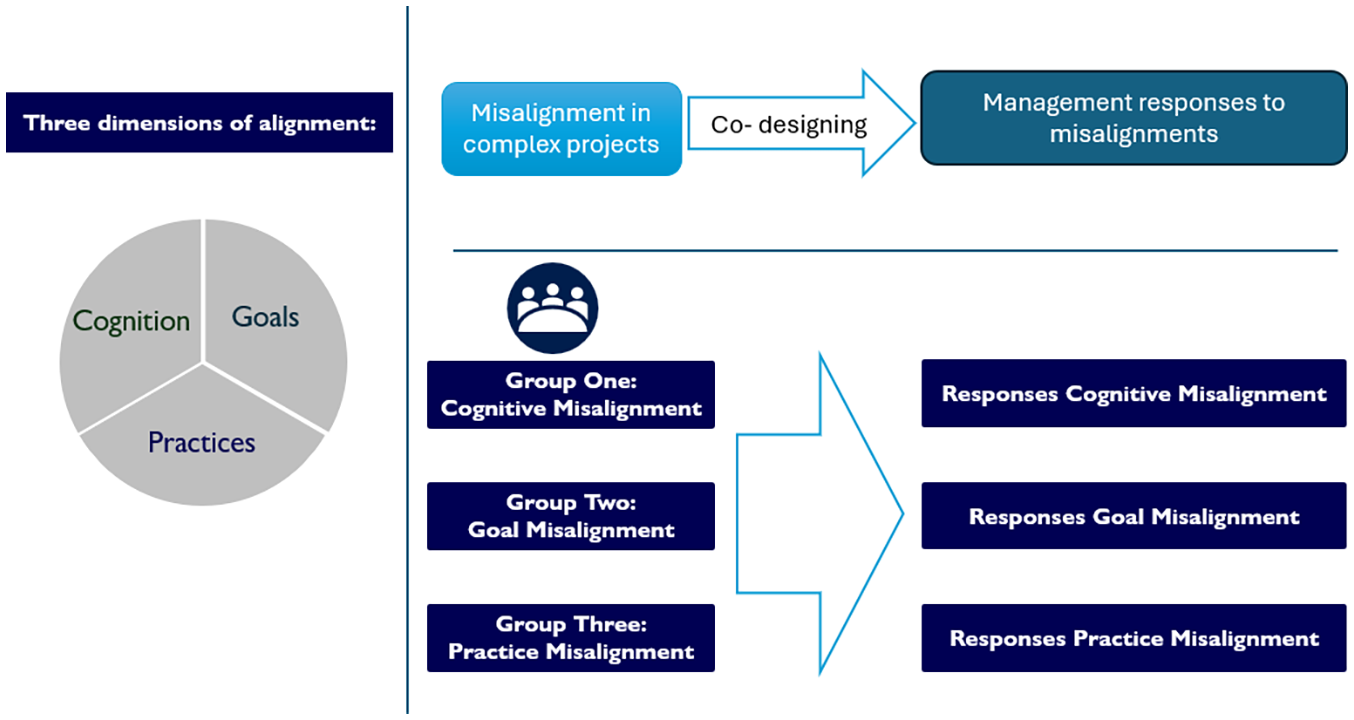
The workshop aimed to facilitate collaborative reflection and strategy development among professionals from both industry and academia. To support this, the design incorporated participatory methods that encouraged dialogue across stakeholder boundaries. Activities were organized around three thematic categories of misalignment, derived from the interview data: cognitive, goal-oriented, and practice-based. These categories served as focal points for group discussions and co-creation exercises, structured across three layers of engagement: “understanding” the nature of misalignments, “reducing” their complexity through shared dialogue, and “responding” with collaboratively developed strategies.
The workshop was designed with three primary objectives. First, it aimed to foster a shared understanding of the challenges related to stakeholder misalignments within complex project environments. By bringing together participants from diverse roles and backgrounds, the workshop sought to surface differing perspectives and interpretations of misalignment phenomena.
Second, the workshop facilitated collaborative inquiry into the underlying causes of these misalignments. Through structured group discussions and thematic exploration, participants were encouraged to critically examine the systemic, organizational, and interpersonal factors contributing to misalignment.
Third, the workshop provided a platform for co-developing actionable strategies to enhance stakeholder alignment and communication. Drawing on principles of co-design and participatory engagement, the workshop enabled stakeholders to collectively generate context-sensitive solutions tailored to the realities of their professional environments.
The structure of the workshop was intentionally designed to support these objectives. It is demonstrated in Figure 2.
The Designed Workshop, addressing three types of misalignment

4.3. Implementation approach
The implementation approach emphasized flexibility and responsiveness to group dynamics. Participants were divided into diverse subgroups to ensure a mix of perspectives, and facilitation strategies were adapted to accommodate different preferences for engagement, ranging from individual reflection to open group dialogue. The workshop began with a plenary session, which included a presentation followed by a Q&A session. Participants were then divided into three groups, each focusing on one of the identified themes. Group composition was intentionally diverse to ensure representation from various stakeholder roles.
Operational considerations also shaped the workshop format. For instance, one group operated in a hybrid mode, combining in-person and online participants, which required tailored facilitation techniques to ensure equitable participation. Additionally, groups exhibited different preferences for engagement. For example, one group requested to begin with individual reflection before transitioning to discussion, while another initiated dialogue immediately. Facilitators adapted to these preferences to foster a comfortable and inclusive environment.
After the group sessions, participants reconvened for a plenary discussion. Each group presented a summary of their findings, which were then discussed collectively. This final phase enabled cross-group reflection and synthesis, contributing to a deeper collective understanding of stakeholder perspectives on alignment and misalignment and potential responses.
4.3.1. Participants
The workshop convened a diverse group of professionals representing both industry and academia. Participants included project managers, technical managers, researchers, and team leaders. This intentional diversity reflected the multi-stakeholder nature of railway projects and underscored the importance of fostering cross-boundary dialogue. By engaging individuals from varied professional backgrounds, the workshop aimed to capture a broad spectrum of perspectives and experiences, thereby enriching the collaborative exploration of alignment challenges and solutions.
4.3.2. Facilitation approaches
Activities were intentionally designed to be flexible, allowing participants to shape the process based on emerging insights and the evolving nature of discussions. This approach supported the co-creation of knowledge and fostered a sense of ownership among participants.
Facilitators played a critical role in creating a supportive and participatory environment. Rather than directing the process, they acted as enablers, guiding conversations, encouraging reflection, and ensuring that all voices were heard. This included adapting to the preferences of each group, such as accommodating requests for individual reflection prior to group discussion or facilitating hybrid participation with both in-person and remote attendees.
5. Evaluation and findings
5.1. Results: facilitator observations and approaches
The qualitative data were collected through in-session observations and a reflection session with facilitators, revealing several key themes that illuminate the experiential impact of the workshop. The facilitation strategy involved real-time adjustments to maintain engagement and inclusivity. For example, facilitators monitored group energy levels and interaction patterns, intervening when necessary to prompt deeper inquiry or redistribute participation. This responsive facilitation style was essential for navigating the complexity of stakeholder perspectives and ensuring that the workshop remained aligned with its collaborative and exploratory goals. The results present key insights into the facilitation styles used by three facilitators during a co-design workshop addressing stakeholder misalignments in a European railway project. The analysis integrates facilitator reflections with academic literature.
The three groups engaged with misalignment types in different ways. Cognitive misalignments were quickly clarified through dialogue, gains for goal-oriented misalignments were smaller, indicating that strategic alignment may require more than a single co-design session, and in practice-based misalignments, when it comes to different ways of working or different interpretations, responses on how to resolve these challenges are easier found and agreed upon than when differences in organizational goals or agendas are at stake. These differences show that through co-design each misalignment type can be addressed in distinct ways.
5.1.1. Facilitation approaches and styles
Facilitator A adopted a structured and directive style, emphasizing a clear three-step process: understanding, reduction, and response. This mirrors the “directing” dimension described in facilitation literature, where facilitators guide participants through phases to achieve specific outputs, maintaining control over the structure of the discourse (Reference Honey-Rosés, Canessa, Daitch, Gomes, Muñoz-Blanco García, Xavier and ZapataHoney-Rosés et al., 2020; Reference Zheng, Mejía and HenriksenZheng et al., 2025).
Facilitator B demonstrated an adaptive and supportive style. This aligns with the “collaborating/suggesting” facilitation modes in co-design literature, which advocate for responsiveness and shared control (Reference Zheng, Mejía and HenriksenZheng et al., 2025). This flexibility fostered sustained dialogue, enabling participants to remain engaged without being hindered by administrative tasks.
Facilitator C used a participatory and inclusive format, initiating with individual reflection before group discussion. This approach is affirmed in participatory design facilitation research, emphasizing the facilitator’s role as an enabler of inclusion and equity. The facilitator acts to encourage quieter voices and balance dynamics (Reference Dahl and SharmaDahl & Sharma, 2022; Reference Zheng, Mejía and HenriksenZheng et al., 2025).
5.1.2. Common observations across the workshop sessions
Across all workshop sessions, facilitators observed high levels of engagement, with participants actively contributing and aligning on examples, consistent with participatory design principles (Reference Zheng, Mejía and HenriksenZheng et al., 2025). However, in the hybrid format, online participants struggled to contribute meaningfully, highlighting the limitations of hybrid facilitation without optimal technical support.
The emotional tone of discussions remained largely rational and reflective, with misalignments not perceived as personal issues: “There was not a lot of emotion attached… they were not seen as something personal.” Despite this, some conceptual confusion emerged, particularly in distinguishing between the “reduction” and “response” phases, which required facilitator clarification.
Finally, the retrospective timing and conducting the workshop at a later project stage may have reduced emotional tension and increased consensus. Some participants suggested the activity would have been more impactful earlier in the project lifecycle.
5.2. Results: pre/post survey
Preliminary analysis of the survey data suggests that the workshop contributed to increased confidence in navigating misalignments and enhanced appreciation for collaborative approaches to stakeholder engagement. The answer to the question on participants’ confidence in responding to different types of misalignment, cognitive, goal-oriented, and practice-based, revealed a clear and positive shift after the workshop. This improvement indicates that the co-design approach not only facilitated collaborative dialogue but also strengthened participants’ perceived ability to manage misalignments effectively. The results show a clear and noticeable positive shift in confidence levels, as demonstrated in Figure 3. Survey results showed varied gains across misalignment types: the strongest improvements were in addressing cognitive misalignments, followed by practice-based ones where participants developed concrete adjustments. Gains for goal-oriented misalignments were smaller, indicating that strategic alignment may require more than a single co-design session.
Preliminary analysis also indicates that participants generally felt more confident in dealing with cognitive-related misalignments, which suggests that the workshop was particularly effective in helping participants understand and interpret differing perspectives. This may be because cognitive misalignments are often addressed through dialogue and shared sensemaking, which were central to the workshop activities. In contrast, the co-design practice appeared especially effective in addressing practice-based misalignments, where participants collaboratively developed actionable strategies to align operational approaches. While improvements were also observed for goal-oriented misalignments, these were less pronounced, indicating that aligning strategic priorities may require additional interventions beyond a single workshop. These findings highlight the nuanced impact of co-design: it not only builds confidence but also demonstrates differential effectiveness across misalignment types, reinforcing its value as a flexible and context-sensitive approach in multi-stakeholder environments.
Result from pre/post survey, illustrating changes in participants’ confidence

Figure 3 Long description
Panel A: Pre-survey bar graph. The horizontal axis lists identified misalignments numbered 1 to 20, categorized into cognitive, goal, and practice. The vertical axis represents levels of confidence: Not confident at all, Slightly confident, Moderately confident, Confident, and Very confident. Each misalignment has a set of horizontal bars in different colors representing the level of confidence. Panel B: Post-survey bar graph. The horizontal axis lists the same identified misalignments numbered 1 to 20, categorized into cognitive, goal, and practice. The vertical axis represents levels of confidence: Not confident at all, Slightly confident, Moderately confident, Confident, and Very confident. Each misalignment has a set of horizontal bars in different colors representing the level of confidence. The color scheme includes orange for Not confident at all, light orange for Slightly confident, gray for Moderately confident, light blue for Confident, and dark blue for Very confident. The graph shows changes in participants' confidence levels before and after the survey.
6. Discussion
One of the most prominent themes was the development of a shared vocabulary around the concept of misalignment. As having a common language facilitated clearer communication and reduced ambiguity across stakeholder groups. This aligns with research emphasizing the importance of shared language in transdisciplinary collaboration, where mutual learning and problem-solving are contingent on linguistic convergence (Reference Whitehouse, Rahm, Wozniak, Breunig, De Nardi, Dionne, Fujio, Graf, Matic and McKennaWhitehouse et al., 2021). These outcomes underscore the importance of fostering team collaboration and communication as a strategic response to misalignment, particularly in settings where diverse stakeholder groups must negotiate shared understanding. As Reference Maier, Eckert and ClarksonMaier et al. (2021) highlight, clear communication regarding task sequencing and shared goals is foundational to effective collaborative design, and breakdowns in communication often reflect deeper organizational misalignments, supporting our workshop’s emphasis on structured team dialogue (Reference Maier, Eckert and ClarksonMaier et al., 2021).
These findings align with broader research on participatory design and interdisciplinary collaboration. Reference White, Deevy, Casey, Patocs and RainaWhite et al. (2023) emphasize that such participatory formats enhance interdisciplinary collaboration by fostering mutual respect and clarity in team interactions. Their work highlights how structured co-design environments support the development of shared understanding and inclusive engagement, both of which are essential for navigating stakeholder misalignments. These insights resonate with our observation that the workshop facilitated the emergence of a shared language and increased participants’ confidence in addressing misalignments. Together, these outcomes are strong indicators of strengthened team collaboration and communication, reinforcing the value of co-design as both a methodological and strategic response in complex project settings (Reference Whitehouse, Rahm, Wozniak, Breunig, De Nardi, Dionne, Fujio, Graf, Matic and McKennaWhitehouse et al., 2021).
The co-design activities encouraged participants to engage in perspective-taking, allowing them to better understand the constraints, priorities, and viewpoints of other stakeholder groups. This process fostered empathy and contributed to a more nuanced appreciation of the challenges faced by others. Empathy is recognized as a foundational element in co-design, enabling respectful dialogue and deeper engagement with diverse user experiences (Reference Smeenk, Sturm and EggenSmeenk et al., 2019; Reference Yuan and DongYuan & Dong, 2014).
On the other hand, rather than converging on fixed solutions, participants co-created adaptive strategies tailored to their specific contexts. These emergent approaches reflect the iterative and flexible nature of participatory design, where solutions evolve through stakeholder engagement and contextual responsiveness (Reference Wacnik, Daly and VermaWacnik et al., 2025).
These qualitative insights highlight the workshop’s effectiveness in fostering reflective dialogue, mutual understanding, and context-sensitive strategy development. They also reinforce the theoretical foundations of co-design and complexity-informed collaboration as valuable frameworks for addressing stakeholder misalignments in large-scale projects.
About facilitation approaches, design literature recommends phased or hybrid facilitation strategies that combine structured scaffolding with adaptive techniques to balance focus and creativity. Such approaches align with hybrid facilitation models that flexibly integrate directive, collaborative, and suggestive modes in response to participant needs (Reference Dahl and SharmaDahl & Sharma, 2022; Reference Zheng, Mejía and HenriksenZheng et al., 2025). Observations during the workshop confirmed the importance of this flexibility, as groups exhibited varying preferences for interaction styles, ranging from individual reflection to open dialogue. This underscores the need for context-sensitive facilitation in co-design settings, particularly when addressing complex, multi-stakeholder challenges.
These findings address the gap identified in the introduction: while prior literature has documented the sources of misalignment, limited guidance exists on how practitioners can identify appropriate responses. The results suggest that co-design may serve as a promising approach for supporting this process by enhancing participants’ confidence and fostering adaptive strategies. However, these conclusions are preliminary and based primarily on self-reported survey data rather than direct evidence of reduced misalignment. Further empirical research is required to validate these insights and examine their long-term implications for practice.
For practitioners, these results highlight the importance of integrating co-design into project management practices, not only as a problem-solving tool but as a confidence-building mechanism. Flexible facilitation and structured approaches should be prioritized to enable stakeholders to collaboratively navigate complexity and develop actionable strategies. Taken together, these findings extend existing co-design research by demonstrating how a co-design intervention functions as a structured, adaptive response to different misalignment types within the context of a large, multi-stakeholder infrastructure project.
7. Conclusion, limitations, and future research
To address the challenges of stakeholder misalignment in complex infrastructure projects, we developed and tested a framework grounded in Design Science Research (DSR) and co-design principles. DSR provided a structured methodology for designing and evaluating an intervention that is both theoretically informed and practically relevant. Co-design, meanwhile, enabled inclusive participation and joint problem-solving, making it particularly suitable for environments characterized by uncertainty and diverse stakeholder demands.
The resulting workshop brought together stakeholders from industry and academia to reflect on misalignment challenges and collaboratively develop strategies for improvement. It was motivated by design principles established in earlier research phases and tailored to the specific characteristics of the project environment.
Evaluation combined pre- and post-workshop surveys and facilitator observations. Survey results demonstrated a clear increase in participants’ confidence to handle misalignments, while observations highlighted active engagement and constructive dialogue across stakeholder boundaries. These findings suggest that co-design, when embedded in a DSR framework and informed by complexity theory, can effectively support collaborative problem-solving in large-scale infrastructure projects. This study contributes a clearer understanding of how co-design supports different misalignment types within complex, multi-stakeholder project environments, highlighting its role as an adaptive response mechanism rather than a general collaborative tool.
This study is exploratory in nature and limited by its relatively small sample size and single-case context. As with many studies situated in large, complex infrastructure projects, the small sample and single-case context limit generalizability. While the mixed-method evaluation provided valuable insights, the results should be interpreted as indicative rather than definitive. Future research could expand the scope by involving multiple workshops across different sectors and cultural contexts to validate and refine the framework. Additionally, a follow-up phase involving in-depth interviews and reflective sessions with participants would offer richer insights into the long-term impact of co-design on stakeholder confidence and alignment practices. Future work should explore this co-design response across projects of varying scales and settings, and examine the longer-term effects of alignment practices.
Acknowledgement
The authors would like to thank the consortium members of the project (R2DATO-W32) for their contributions in this study, especially the value added by their participation and contribution in the workshop.
This study was funded by the European Union. Views and opinions expressed are, however, those of the author(s) only and do not necessarily reflect those of the European Union or the Europe’s Rail Joint Undertaking. Neither the European Union nor the granting authority can be held responsible for them. The project FP-R2DATO is supported by the Europe’s Rail Joint Undertaking and its members.
The authors acknowledge the use of Grammarly and ChatGPT for language editing and writing style improvement.



 Open access

