


%20--%3e%3c!DOCTYPE%20svg%20PUBLIC%20'-//W3C//DTD%20SVG%201.0//EN'%20'http://www.w3.org/TR/2001/REC-SVG-20010904/DTD/svg10.dtd'%3e%3csvg%20version='1.0'%20id='Layer_1'%20xmlns='http://www.w3.org/2000/svg'%20xmlns:xlink='http://www.w3.org/1999/xlink'%20x='0px'%20y='0px'%20width='64px'%20height='64px'%20viewBox='5.5%20-3.5%2064%2064'%20enable-background='new%205.5%20-3.5%2064%2064'%20xml:space='preserve'%3e%3cg%3e%3ccircle%20fill='%23FFFFFF'%20fill-opacity='0'%20cx='37.785'%20cy='28.501'%20r='28.836'/%3e%3cpath%20fill='%23595959'%20d='M37.441-3.5c8.951,0,16.572,3.125,22.857,9.372c3.008,3.009,5.295,6.448,6.857,10.314%20c1.561,3.867,2.344,7.971,2.344,12.314c0,4.381-0.773,8.486-2.314,12.313c-1.543,3.828-3.82,7.21-6.828,10.143%20c-3.123,3.085-6.666,5.448-10.629,7.086c-3.961,1.638-8.057,2.457-12.285,2.457s-8.276-0.808-12.143-2.429%20c-3.866-1.618-7.333-3.961-10.4-7.027c-3.067-3.066-5.4-6.524-7-10.372S5.5,32.767,5.5,28.5c0-4.229,0.809-8.295,2.428-12.2%20c1.619-3.905,3.972-7.4,7.057-10.486C21.08-0.394,28.565-3.5,37.441-3.5z%20M37.557,2.272c-7.314,0-13.467,2.553-18.458,7.657%20c-2.515,2.553-4.448,5.419-5.8,8.6c-1.354,3.181-2.029,6.505-2.029,9.972c0,3.429,0.675,6.734,2.029,9.913%20c1.353,3.183,3.285,6.021,5.8,8.516c2.514,2.496,5.351,4.399,8.515,5.715c3.161,1.314,6.476,1.971,9.943,1.971%20c3.428,0,6.75-0.665,9.973-1.999c3.219-1.335,6.121-3.257,8.713-5.771c4.99-4.876,7.484-10.99,7.484-18.344%20c0-3.543-0.648-6.895-1.943-10.057c-1.293-3.162-3.18-5.98-5.654-8.458C50.984,4.844,44.795,2.272,37.557,2.272z%20M37.156,23.187%20l-4.287,2.229c-0.458-0.951-1.019-1.619-1.685-2c-0.667-0.38-1.286-0.571-1.858-0.571c-2.856,0-4.286,1.885-4.286,5.657%20c0,1.714,0.362,3.084,1.085,4.113c0.724,1.029,1.791,1.544,3.201,1.544c1.867,0,3.181-0.915,3.944-2.743l3.942,2%20c-0.838,1.563-2,2.791-3.486,3.686c-1.484,0.896-3.123,1.343-4.914,1.343c-2.857,0-5.163-0.875-6.915-2.629%20c-1.752-1.752-2.628-4.19-2.628-7.313c0-3.048,0.886-5.466,2.657-7.257c1.771-1.79,4.009-2.686,6.715-2.686%20C32.604,18.558,35.441,20.101,37.156,23.187z%20M55.613,23.187l-4.229,2.229c-0.457-0.951-1.02-1.619-1.686-2%20c-0.668-0.38-1.307-0.571-1.914-0.571c-2.857,0-4.287,1.885-4.287,5.657c0,1.714,0.363,3.084,1.086,4.113%20c0.723,1.029,1.789,1.544,3.201,1.544c1.865,0,3.18-0.915,3.941-2.743l4,2c-0.875,1.563-2.057,2.791-3.541,3.686%20c-1.486,0.896-3.105,1.343-4.857,1.343c-2.896,0-5.209-0.875-6.941-2.629c-1.736-1.752-2.602-4.19-2.602-7.313%20c0-3.048,0.885-5.466,2.658-7.257c1.77-1.79,4.008-2.686,6.713-2.686C51.117,18.558,53.938,20.101,55.613,23.187z'/%3e%3c/g%3e%3c/svg%3e)
%20--%3e%3c!DOCTYPE%20svg%20PUBLIC%20'-//W3C//DTD%20SVG%201.0//EN'%20'http://www.w3.org/TR/2001/REC-SVG-20010904/DTD/svg10.dtd'%3e%3csvg%20version='1.0'%20id='Layer_1'%20xmlns='http://www.w3.org/2000/svg'%20xmlns:xlink='http://www.w3.org/1999/xlink'%20x='0px'%20y='0px'%20width='64px'%20height='64px'%20viewBox='5.5%20-3.5%2064%2064'%20enable-background='new%205.5%20-3.5%2064%2064'%20xml:space='preserve'%3e%3cg%3e%3ccircle%20fill='%23FFFFFF'%20fill-opacity='0'%20cx='37.637'%20cy='28.806'%20r='28.276'/%3e%3cg%3e%3cpath%20fill='%23595959'%20d='M37.443-3.5c8.988,0,16.57,3.085,22.742,9.257C66.393,11.967,69.5,19.548,69.5,28.5c0,8.991-3.049,16.476-9.145,22.456%20C53.879,57.319,46.242,60.5,37.443,60.5c-8.649,0-16.153-3.144-22.514-9.43C8.644,44.784,5.5,37.262,5.5,28.5%20c0-8.761,3.144-16.342,9.429-22.742C21.101-0.415,28.604-3.5,37.443-3.5z%20M37.557,2.272c-7.276,0-13.428,2.553-18.457,7.657%20c-5.22,5.334-7.829,11.525-7.829,18.572c0,7.086,2.59,13.22,7.77,18.398c5.181,5.182,11.352,7.771,18.514,7.771%20c7.123,0,13.334-2.607,18.629-7.828c5.029-4.838,7.543-10.952,7.543-18.343c0-7.276-2.553-13.465-7.656-18.571%20C50.967,4.824,44.795,2.272,37.557,2.272z%20M46.129,20.557v13.085h-3.656v15.542h-9.944V33.643h-3.656V20.557%20c0-0.572,0.2-1.057,0.599-1.457c0.401-0.399,0.887-0.6,1.457-0.6h13.144c0.533,0,1.01,0.2,1.428,0.6%20C45.918,19.5,46.129,19.986,46.129,20.557z%20M33.042,12.329c0-3.008,1.485-4.514,4.458-4.514s4.457,1.504,4.457,4.514%20c0,2.971-1.486,4.457-4.457,4.457S33.042,15.3,33.042,12.329z'/%3e%3c/g%3e%3c/g%3e%3c/svg%3e)
%20--%3e%3c!DOCTYPE%20svg%20PUBLIC%20'-//W3C//DTD%20SVG%201.0//EN'%20'http://www.w3.org/TR/2001/REC-SVG-20010904/DTD/svg10.dtd'%3e%3csvg%20version='1.0'%20id='Layer_1'%20xmlns='http://www.w3.org/2000/svg'%20xmlns:xlink='http://www.w3.org/1999/xlink'%20x='0px'%20y='0px'%20width='64px'%20height='64px'%20viewBox='5.5%20-3.5%2064%2064'%20enable-background='new%205.5%20-3.5%2064%2064'%20xml:space='preserve'%3e%3cg%3e%3ccircle%20fill='%23FFFFFF'%20fill-opacity='0'%20cx='36.924'%20cy='28.403'%20r='28.895'/%3e%3cpath%20fill='%23595959'%20d='M37.442-3.5c8.99,0,16.571,3.085,22.743,9.256C66.393,11.928,69.5,19.509,69.5,28.5c0,8.992-3.048,16.476-9.145,22.458%20C53.88,57.32,46.241,60.5,37.442,60.5c-8.686,0-16.19-3.162-22.513-9.485C8.644,44.728,5.5,37.225,5.5,28.5%20c0-8.762,3.144-16.343,9.429-22.743C21.1-0.414,28.604-3.5,37.442-3.5z%20M12.7,19.872c-0.952,2.628-1.429,5.505-1.429,8.629%20c0,7.086,2.59,13.22,7.77,18.4c5.219,5.144,11.391,7.715,18.514,7.715c7.201,0,13.409-2.608,18.63-7.829%20c1.867-1.79,3.332-3.657,4.398-5.602l-12.056-5.371c-0.421,2.02-1.439,3.667-3.057,4.942c-1.622,1.276-3.535,2.011-5.744,2.2%20v4.915h-3.714v-4.915c-3.543-0.036-6.782-1.312-9.714-3.827l4.4-4.457c2.094,1.942,4.476,2.913,7.143,2.913%20c1.104,0,2.048-0.246,2.83-0.743c0.78-0.494,1.172-1.312,1.172-2.457c0-0.801-0.287-1.448-0.858-1.943l-3.085-1.315l-3.771-1.715%20l-5.086-2.229L12.7,19.872z%20M37.557,2.214c-7.276,0-13.428,2.571-18.457,7.714c-1.258,1.258-2.439,2.686-3.543,4.287L27.786,19.7%20c0.533-1.676,1.542-3.019,3.029-4.028c1.484-1.009,3.218-1.571,5.2-1.686V9.071h3.715v4.915c2.934,0.153,5.6,1.143,8,2.971%20l-4.172,4.286c-1.793-1.257-3.619-1.885-5.486-1.885c-0.991,0-1.876,0.191-2.656,0.571c-0.781,0.381-1.172,1.029-1.172,1.943%20c0,0.267,0.095,0.533,0.285,0.8l4.057,1.83l2.8,1.257l5.144,2.285l16.397,7.314c0.535-2.248,0.801-4.533,0.801-6.857%20c0-7.353-2.552-13.543-7.656-18.573C51.005,4.785,44.831,2.214,37.557,2.214z'/%3e%3c/g%3e%3c/svg%3e)
%20--%3e%3c!DOCTYPE%20svg%20PUBLIC%20'-//W3C//DTD%20SVG%201.1//EN'%20'http://www.w3.org/Graphics/SVG/1.1/DTD/svg11.dtd'%3e%3csvg%20version='1.1'%20id='Layer_1'%20xmlns='http://www.w3.org/2000/svg'%20xmlns:xlink='http://www.w3.org/1999/xlink'%20x='0px'%20y='0px'%20width='64.000977px'%20height='64px'%20viewBox='0%200%2064.000977%2064'%20enable-background='new%200%200%2064.000977%2064'%20xml:space='preserve'%3e%3cg%3e%3ccircle%20fill='%23FFFFFF'%20fill-opacity='0'%20cx='32.064453'%20cy='31.788086'%20r='29.012695'/%3e%3cg%3e%3cpath%20fill='%23595959'%20d='M31.943848,0C40.896484,0,48.476562,3.105469,54.6875,9.314453C60.894531,15.486328,64.000977,23.045898,64.000977,32%20s-3.048828,16.457031-9.145508,22.513672C48.417969,60.837891,40.779297,64,31.942871,64%20c-8.648926,0-16.152832-3.142578-22.513672-9.429688C3.144043,48.286133,0,40.761719,0,32.000977%20c0-8.723633,3.144043-16.285156,9.429199-22.68457C15.640137,3.105469,23.14502,0,31.943848,0z%20M32.060547,5.771484%20c-7.275391,0-13.429688,2.570312-18.458496,7.714844C8.381836,18.783203,5.772949,24.954102,5.772949,32%20c0,7.125,2.589844,13.256836,7.77002,18.400391c5.181152,5.181641,11.352051,7.770508,18.515625,7.770508%20c7.123047,0,13.332031-2.608398,18.626953-7.828125C55.713867,45.466797,58.228516,39.353516,58.228516,32%20c0-7.3125-2.553711-13.484375-7.65625-18.513672C45.504883,8.341797,39.333984,5.771484,32.060547,5.771484z%20M44.117188,24.456055%20v5.485352H20.859863v-5.485352H44.117188z%20M44.117188,34.743164v5.481445H20.859863v-5.481445H44.117188z'/%3e%3c/g%3e%3c/g%3e%3c/svg%3e)
1. Introduction
Mass Customization (MC) refers to a production paradigm where high-volume products are configurable from predefined components or parameterized modules (Reference Ogunsakin, Marin and MehandjievOgunsakin et al., 2021). MC allows customers to customize standard products by choosing variations—such as color, size, or specific design elements—within boundaries defined by manufacturers. In contrast, Mass Personalization (MP) emphasizes tailoring products directly to an individual’s unique data, preferences, or usage requirements, often captured via advanced data acquisition or real-time user input (Reference Berry, Wang and HuBerry et al, 2013). Instead of selecting from predetermined modules, MP leverages adaptive designs to produce highly personalized outputs. In healthcare applications, for example, MP ensures patient-specific anatomical or functional requirements directly shape the product’s geometry and materials (Reference Xia and HeXia & He, 2020). Consequently, MP fundamentally redefines product architecture to closely match each user’s physiological, ergonomic, or aesthetic needs. The transition from MC to MP involves sophisticated digital workflows under the methodology termed Design for Mass Personalization (DfMP). Parametric design systems enable significant adaptation of product geometry by embedding constraints, optimization objectives, and individual user data into the design process. DfMP begins by directly gathering customer feedback and inputs, identifying specific preferences and requirements that are subsequently translated into parameters within a parametric model. Parametric models serve as foundational templates (seed designs), simplifying personalization by allowing variations in dimensions, shapes, and materials without altering core structures (Reference Ozdemir, Verlinden and CasciniOzdemir & Cascini, 2020). However, manually adjusting intricate parametric designs can be challenging, slow, and error-prone—particularly when end-users are involved in the process (Reference Anattasakul, Slama and DemirelAnattasakul et al., 2023). In response, generative design (GD) builds upon the adaptability of parametric models by systematically exploring and optimizing design variations. Through iterative algorithms, GD enables the rapid generation, evaluation, and refinement of solutions tailored to individual needs. By leveraging computational power to handle complex design spaces, GD has the potential to extend the capabilities of DfMP, offering a scalable and efficient pathway to high levels of personalization (Reference Papallo, Martorelli, Lamonaca and GloriaPapallo et al., 2023) .
This paper aims to explore the potential of GD in advancing MP, with a particular focus on enhancing design workflows for MP. To achieve this, the study conducts an analysis of an industrial case: the design of a custom dental abutment from the dental prosthetics industry. GD will be applied and compared against conventional abutment design tools and procedures through established MP characteristics.
2. Related work
Early approaches to Mass Personalization (MP) centered on modularity—assembling products from predefined components to generate various configurations efficiently (Reference Berry, Wang and HuBerry et al., 2013). However, modularity inherently limits adaptability, prompting the move toward parametric design methods that allow continuous adjustments in product geometry (Reference Ozdemir, Verlinden and CasciniOzdemir et al., 2022). Parametric tools ensure that modifications to one parameter propagate consistently across all related features, minimizing errors and preserving design integrity. Critically, these approaches rely on advanced computer-aided design (CAD) systems that define constraints, manage interdependencies, and automate updates to handle complex personalization requirements (Reference Li, Ploumpis, Zafeiriou and MyantS. Li et al., 2020). Nonetheless, CAD solutions must evolve further to address the full range of MP characteristics, which can be grouped into four categories (Reference Kosec, Gulin and ŠkecKosec et al., 2024) : design generation, design manipulation, design validation and design iteration.
Design generation involves creating an initial parametric model and managing constraints—selecting or defining non-customizable and customizable segments of the design, generating designs automatically from input data, or reusing prior models to improve efficiency (Reference Bai, Huerta, Unver, Allen, Clayton and ParametricBai et al., 2021). Design manipulation focuses on refining and adjusting models, using parametric manipulation to modify key parameters under predefined constraints, and advanced geometric manipulation tools (e.g., control points or free-form shaping) to accommodate specialized personalization needs (Reference Micevska and KandikjanMicevska & Kandikjan, 2016). Design validation ensures the evolving design remains functionally and aesthetically viable, particularly under multi-constraint conditions (Reference Li, Ye, Zhang, Yu and ZhuH. Li et al., 2024). Finally, design iteration supports continuous refinement through incremental updates and structured workflows, enabling co-creation with end users and seamlessly incorporating their feedback (Reference Zheng, Yu, Wang, Zhong and XuZheng et al., 2017). Although parametric design streamlines certain personalization tasks and iteration, it can struggle with unconventional geometries or multiple simultaneous objectives (Reference Maruo, Itani, Hasome, Yamazaki and IgarashiMaruo et al., 2023). Various design approaches can streamline iterative workflows and reduce manual overhead of design tasks—from knowledge-based engineering (Reference Li, Ye, Zhang, Yu and ZhuH. Li et al., 2024) and rule-based parametric systems (Reference Costa, Jorge and DuarteCosta et al., 2019) to graph-based modelling (Reference Harding and ShepherdHarding & Shepherd, 2017), shape grammars (Reference Barros, Duarte and ChaparroAzadi & Nourian, 2021; Barros et al., 2015) and generative design (GD)—all aimed at reducing manual effort and accelerating design exploration (Reference KrishKrish, 2011). GD stands out by using optimization algorithms to navigate extensive solution spaces. Rather than relying solely on preset rules, GD iteratively refines candidate designs against multiple functional, aesthetic, and user-specific targets (Reference Kim, Kim, Kang and LeeClay et al., 2024; Kim et al., Reference Clay, Li, Goldstein, Demirel, Zabelina, Xie and Sha2014). Its multi-objective optimization capability is particularly well-suited to the requirements of MP (Reference TrautmannTrautmann, 2021), where diverse individual needs must be accommodated without sacrificing feasibility By systematically evaluating and refining design variations, GD enriches traditional parametric approaches, offering more adaptive and tailored outcomes.
Generative design methods typically fall into two broad categories: implicit and explicit (Reference Jiang, Wen, Han, Tang and XiongJiang et al., 2022). Implicit methods, often used in topology optimization or morphological transformations, rely on iterative shape or density updates without a predefined parametric structure, resulting in highly optimized but sometimes harder-to-control geometries (Reference KrishKrish, 2011). Explicit methods, by contrast, define geometry and constraints through deterministic parametric relationships before applying generative algorithms, producing more predictable outputs while preserving functional requirements (Reference Kim, Kim, Kang and LeeKim et al., 2014). The general procedure of using explicit generative design methods starts by creating an initial design model with starting values for key dimensions (Reference JanssenJanssen, 2006) where maximum and minimum ranges for these dimensions are also defined. Together, the initial model and the defined design space form the genotype. The generative design tool then generates random values within the solution space, producing new phenotypes. Each phenotype is evaluated against predefined criteria - objective, leading to the selection of solutions for further refinement through iterative generative design or manual optimization using parametric design (Reference Harding and ShepherdHarding & Shepherd, 2017) .
Building on the principles of parametric design and seed design used in MP, generative design integrates advanced computational techniques to enhance flexibility and efficiency in creating personalized solutions. The connection between generative design and seed design lies in their shared focus on establishing adaptable frameworks that serve as starting points for customization. While parametric seed designs define a structured design space with adjustable parameters, generative design expands this approach with the exploration of a broader solution space. In MP, the initial seed design provides a foundation for generating variations that align with individual customer requirements (Reference Ozdemir, Verlinden and CasciniOzdemir et al., 2022). Generative design leverages this adaptable framework to navigate complex, multi-objective constraints. By incorporating explicit generative design methods, where parameters and constraints are predefined, the process ensures controlled and predictable outcomes. Instead of requiring designers or end-users to manually adjust parameters or interpret intricate constraints, the system autonomously explores and optimizes solutions within the predefined design space Thus, by lowering the expertise barrier, generative design democratizes access to advanced customization techniques, enabling broader adoption across industries. GD has been applied to personalized products across multiple domains, leveraging its ability to optimize designs for individual needs. In the medical field, generative design has been used to create customized orthoses and prosthetics. For instance, Cirello et al. (Reference Cirello, Ingrassia, Marannano, Mirulla, Nigrelli, Petrucci, Ricotta and New2024) developed a workflow integrating generative design with additive manufacturing to produce custom wrist orthoses tailored to patient anatomy. GD has enabled architects to design personalized spaces or components, such as parametric facades and adaptive furniture. Costa et al. (Reference Costa, Jorge and Duarte2019) demonstrated the use of GD in creating tableware collections, translating design rules into parametric models for unique, personalized products. However, many GD applications focus on algorithmic capabilities or specialized tools rather than holistic MP scenarios (Reference TrautmannTrautmann, 2021). This paper aims to address that gap by examining how GD can advance MP workflows, with particular attention to the design complexities of personalized products. A custom dental abutment case study illustrates the benefits and challenges of applying explicit generative design to high-precision, user-specific domains.
3. Methods
The primary objective of this study is to evaluate the suitability of generative design for mass personalization workflows, with a focus on its application in designing custom dental implant abutments (further in text: abutment). By leveraging generative algorithms, the study aims to evaluate whether this approach can meet the functional and morphological requirements of the product and whether this approach adheres to the characteristics of MP. The research was conducted on a specific case involving a patient requiring an abutment. An abutment is a dental implant component that connects the implant embedded in the jawbone to the visible prosthetic restoration, such as a crown, bridge, or denture. The abutment is composed of three segments, each having unique requirements: the implant connection segment, the transgingival segment, and the prosthesis connection segment (Figure 1). The implant connection segment is designed to align precisely with the implant geometry, ensuring stability and a primary sealing surface, often referred to as “passive fit.” The transgingival segment adapts to the surrounding oral tissue, replicating the natural emergence profile of a tooth, ensuring secondary sealing surface. The prosthesis connection segment is customized to match the specific shape and size of a tooth, distance to opposite jaw and distance to neighbouring teeth.
The parametric model of the abutment was developed using Rhino3D and Grasshopper, chosen for their ability to design models using NURBS curves and due to their visual programming capabilities. The use of NURBS curves enables creation of complex geometries, while the visual programming capabilities of Grasshopper streamline the design process by enabling rapid adjustments to parameters and real-time visualization of changes. The initial parameter ranges and model geometry were informed by a baseline design created in Exocad Rijeka 3.1, a widely used commercial dental CAD tool, performed by dental technician. This baseline provided a practical reference for evaluating the performance and accuracy of the generative design approach, ensuring alignment with industry standards and real-world application requirements.
While forming the structure of a parametric model the abutment was divided into previously mentioned functional segments to address specific anatomical and prosthetic requirements. Therefore, the parametric model was structured into three segments: one non-customizable segment and two customizable segments. The non-customizable segment included the implant connection interface, while customizable segments comprised the transgingival segment and the prosthetic connection (Figure 1). As design input (alongside with baseline design), a high-resolution 3D scan of the patient’s jaw was used. The scanned data captured critical anatomical features, such as surrounding implant tissue and implant positioning. Following design parameters found in Exocad, 9 design parameters were extracted. These parameters included the diameter of the implant connection segment (ICD), the positional coordinates of the mesial (M), distal (D), buccal (B), and oral (O) control points for the gingival profile, the width of the crown-fit shoulder (SW), and the height (CH), taper (CT), and angulation (CA) of the prosthetic connection segment (Figure 1).
Custom dental implant abutment

These parameters were defined to allow precise control over the customizable segments and ensure that adjustments adhered to the functional constraints of the abutment. To establish a robust and adaptable parametric model, the interdependencies between the design parameters were analysed using a design structure matrix (DSM). This analysis provided a detailed understanding of the relationships between parameters, enabling the identification of groups of parameters that could be iterated or optimized during the GD process. By embedding dependencies and constraints into the model, parameter adjustments were ensured to propagate consistently throughout the design without compromising geometrical coherence or functional integrity. For the customizable segments of the dental abutment, modifiable parameters were implemented to facilitate patient-specific customization. These parameters, coupled with constraints derived from the DSM analysis, enabled the model to handle iterative modifications effectively during GD. The resulting parametric model incorporated adjustable parameters and provided a clear visualization of design interdependencies, ensuring a robust foundation for the GD process. This preparation allowed the GD algorithm to explore and refine design variations efficiently, maintaining alignment with both functional requirements and specific needs of a customer. GD was implemented using Grasshopper, enhanced with the Wallacei plugin for multi-objective optimization. To set up the GD process with the Wallacei plugin, key components such as input parameters, objectives, and algorithmic settings (including generation size and generation count) were defined to enable effective exploration and optimization of the design space. The previously identified input parameters were utilized as the basis for generative design in both the transgingival and prosthetic connection segments (Figure 1). Additionally, a range of possible values was assigned to each parameter to guide the algorithm’s exploration and ensure the generation of viable design variations tailored to the specific requirements of each segment. Initially, ranges were set at ±3mm from a baseline design value. The objectives were then tailored to meet patient-specific requirements and ensure the functional and aesthetic suitability of the dental abutment. These included:
-
Minimizing the distances between 4 gingival profile points: The algorithm aimed to minimize the discrepancy between four key points on the gingival profile and their corresponding points on the patient’s 3D scan, while keeping the gingival profile 1,5mm below the tissue to comply with the aesthetic requirements
-
Occlusal contact compliance: aim is to meet occlusal contact requirements, meaning minimal distance from the opposing jaw is 1,5mm
-
Prosthetic connections segment positioning: the goal is to position the prosthetic segment between adjacent teeth to secure enough space for the prosthetic crown
-
Minimizing crown shoulder width: the algorithm aimed to minimize the shoulder width to increase prosthetic connection surface
Regarding the algorithm settings, the generation size and generation count were initially set to 50, resulting in a total of 2500 iterations. This configuration was chosen to balance computational efficiency and the time required to reach a solution. The selected settings aim to minimize the time needed for the algorithm to converge while maintaining sufficient exploration of the design space. However, these values are expected to change and will be adjusted as part of the design procedure depending on the complexity of the case, the number of input parameters, and the defined objectives.
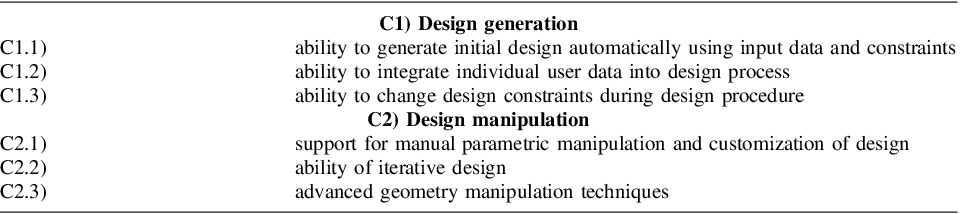
This GD workflow and design output was then evaluated against criteria established in previous research and explained in section 2 (Related Work). Due to the page limitation of this paper the evaluation was focused on design generation and design manipulation criteria only (Table 1). Additionally, the GD procedure was compared to the conventional design process and the capabilities of the Exocad.
Evaluation criteria

4. Results
In the initial attempt, the generative design process was conducted by simultaneously optimizing all parameters and objectives across both segments—the transgingival and the prosthetic connection. This setup included 7 objectives and 9 input parameters, run simultaneously. With initially set parameters (parameter range ±3mm, 50 generation size and 50 generation count) the algorithm failed to converge to a viable solution.
Extending the iterations to 400,000 resulted in partial convergence (Figure 2, A), with only distal gingival profile point converging to the objective. However, this approach proved inefficient, as the solution generation process alone required 45 minutes. To address this issue, the generative design was divided into two separate workflows—one for the transgingival segment and another for the prosthetic connection segment. This segmentation significantly improved the algorithm’s performance, with convergence achieved for both segments within 2,500 iterations and in less than 5 minutes (Figure 2, B). Initially, the parameter ranges were set broadly, with a range of ±3 mm. Under these conditions, convergence occurred after 4 minutes, but not all objectives were fully satisfied. While transgingival profile was adapted according to the scan, the profile was not fully submerged under the tissue level, as set by the objective. Since the goal was to increase efficiency, subsequently, the parameter ranges were narrowed to ±2 mm from the baseline design, maintaining the same number of generations. This adjustment improved the results, achieving better alignment with the defined objectives. A final reduction in parameter ranges was then implemented to ±1,5 mm, further enhancing the objective outcomes. By narrowing the range, the algorithm was able to achieve convergence within 2 minutes and with greater accuracy, meeting all design requirements within the set constraints (Figure 3). These findings underscore the importance of carefully calibrating parameter ranges and segmenting objectives to optimize the generative design workflow.
Generated outputs

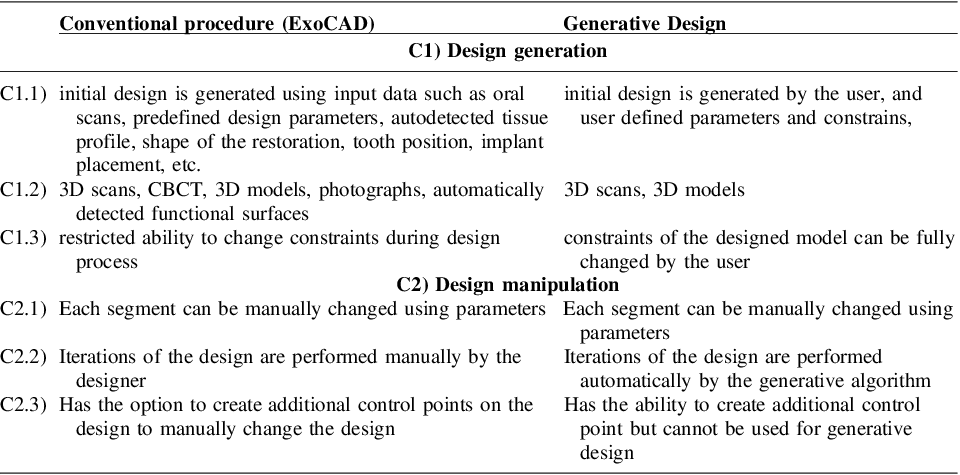
The table below provides a detailed comparison of the two design approaches based on the previously established evaluation criteria, offering insights into their performance and alignment with MP principles. Additionally, Figure 3 illustrates the final abutments generated using both approaches, highlighting the differences in design outcomes and showcasing the effectiveness of each method.
Results of evaluation

In comparing the final geometries (Figure 3), the generative design (GD) approach generated an abutment very similar to one designed by the conventional ExoCAD workflow, particularly in terms of tissue adaptation, occlusal clearance, and functional fit. While each method starts with a parametric model, GD’s automated iteration ultimately arrived at solutions closely mirroring ExoCAD’s manually refined outputs.
Final abutment designed in industrial CAD tool - Exocad (left) and using generative design (right)

5. Discussion
During the initial design generation, several differences become apparent between the conventional design approach using industrial design tools and the GD approach, particularly in the steps involving the definition of the basic shape and constraints. In the conventional design approach, the initial abutment design is performed using predefined parametric options integrated into the software. Input data, such as jaw scans, auto-detected tissue profiles, and the shape of the intended prosthetics, are used to define the abutment’s initial design. This indicates that the tool incorporates built-in algorithms that partially automate the design process, although the exact mechanisms remain unclear due to a lack of detailed documentation from the manufacturer. The goal of this automation is to accelerate the design process and minimize the need for designer intervention to enable co-design requirement —aligning with the principles of MP (Reference Ozdemir, Verlinden and CasciniOzdemir et al., 2022) —it is effective only under ideal conditions, such as optimal implant placement, clearly defined tissue boundaries, and sufficient space for the prosthetic connection segment. In less-than-ideal scenarios, the auto-generated initial model often fails to meet the contextual requirements, necessitating manual adjustments by the designer. Furthermore, the parameters available to the user are predefined and rigid, limiting the extent to which the design can be customized or controlled. Once the design process begins, the user cannot modify the parameter definitions or ranges, meaning that required design changes often necessitate a complete reset of the initial parametric model. This process undermines efficiency, particularly in cases requiring significant iterations or adaptations (Reference Cirello, Ingrassia, Marannano, Mirulla, Nigrelli, Petrucci, Ricotta and NewCirello et al., 2024). In contrast, the GD approach demands that the initial model be fully defined by the designer, granting complete oversight of the parameter definition process. The designer determines which parameters will be adjustable and has the flexibility to expand the parameter set as needed. This “open” approach allows for greater adaptability, enabling the model to accommodate a wider range of scenarios and requirements. However, it also places a higher demand on the designer’s skills, requiring expertise in defining interdependencies between parameters, interpreting requirements, and translating them into a parametric framework. Despite its complexity, this approach provides significant advantages. The GD model can be continuously improved, with its parameters and constraints refined to better address specific use cases. This adaptability ensures that the model remains relevant and effective across diverse applications, ultimately aligning more closely with the goals of MP by allowing greater customization and precision in the design process.
Another distinction between the conventional MP approach and GD lies in how constraints are handled. In conventional DfMP approach, parametric models often encompass a broad range of constraints to accommodate a wide variety of use cases (Reference Bai, Huerta, Unver, Allen, Clayton and ParametricBai et al., 2021). The designer is responsible for ensuring that any changes made within these ranges align with the specific context for which the design is intended. This flexibility allows the designer to adapt the model to different scenarios manually. However, in GD, this approach is reversed. Generative algorithms require a narrower range of parameter values to achieve faster convergence toward optimal solutions. Broad parameter ranges can slow down the algorithm or lead to less precise results (Figure 2, A, B, C). Thus, in GD, it becomes critical for the designer to narrow down these ranges and define tighter constraints before initiating the algorithm (Figure 2, D). Furthermore, the designer must enable flexibility in modifying constraints at the start of the generative process, as this step requires careful calibration to balance exploration with precision.
Regarding the design manipulation criteria, it is evident that both approaches involve dividing the design into several segments. Two primary reasons justify this segmentation. The first stems from the principles of MP, which emphasize dividing the design into distinct segments to enable designers to focus on each part independently. Functionally, each segment has specific requirements: the gingival segment must align precisely with patient tissue contours to ensure comfort and health, while the prosthetic segment must support the crown and maintain occlusal compatibility. This separation ensures that the unique functional demands of each segment are addressed effectively (Reference Ozdemir and CasciniOzdemir & Cascini, 2020). In the context of GD, segmentation serves an additional purpose: addressing the current technical limitations of generative algorithms. Although generative algorithms are capable of managing multiple objectives, their efficiency decreases as the number of objectives increases (Reference KrishKrish, 2011). Managing a smaller set of objectives enables the algorithm to perform more robustly, ensuring faster convergence to acceptable results as can be seen by the results. For this reason, in this study, GD was applied separately to the gingival segment and the prosthetic segment. The gingival segment was prioritized because of its critical role in maintaining patient health, ensuring a proper fit with the tissue, and influencing the overall functionality of the abutment and the shape of the prosthetic connection segment directly depends on the gingival segment. Segmenting and focusing on individual design components allowed the algorithm to achieve efficient and functionally viable results while maintaining the flexibility necessary for efficient personalization. This approach demonstrated how segmentation not only facilitates adherence to MP principles but also optimizes the performance of GD in complex design scenarios.
Within design manipulation, the design iteration criteria highlight the key differences between the conventional approach and GD. In the conventional method, designers manually adapt and refine models by adjusting parameters and control points iteratively. This process requires significant time and effort, with every adjustment demanding the designer return to previous steps to modify parameters and refine the design. GD, on the other hand, automates much of this iterative process. Once the designer defines the initial rules, constraints, and parameter ranges, the algorithm takes over, exploring and refining the design independently within the defined objectives and parameter ranges. This automation streamlines the design process by significantly reducing the manual workload and ensuring faster convergence toward viable solutions (Reference Kim, Kim, Kang and LeeKim et al., 2014). While GD automates iterations, it does not exclude user input. Manual parameter adjustments made by the user can serve as new phenotypes, further accelerating the algorithm’s convergence toward improved solutions. Unlike traditional workflows, GD dynamically adapts to changes in objectives. For instance, if reference points on a digital scan are modified—such as adjusting the emergence profile or redefining contact points with the opposing jaw—the algorithm generates new iterations to align with the updated objectives. This integration of validation criteria within the iterative process enhances the workflow’s reliability. By embedding checks for constraint violations, realistic placement simulations, and user-specific requirements, GD ensures that the final product meets both functional demands and user preferences (Reference TrautmannTrautmann, 2021). This iterative and validation-driven approach enables the creation of highly accurate and personalized designs efficiently, aligning seamlessly with the principles of MP.
This study highlighted one technical challenge in applying explicit GD methods to personalized products. Specifically, limitations arise from the algorithm’s ability to handle large number of objectives effectively. Documentation of the algorithm used, a maximum of three objectives is recommended for optimal performance (Reference KrishBelluomo et al., 2024; Reference Kim, Kim, Kang and LeeKim et al., 2014; Reference Belluomo, Trovato, Bici, Cicconi and CampanaKrish, 2011). This constraint directly impacts the manipulation of the model’s geometry, leading to significant simplifications compared to conventional design approaches used in dental CAD tools or in general engineering parametric CAD tools. In conventional dental CAD workflows, tools allow the addition of numerous control points to define features such as the gingival profile. This capability is essential for addressing the unique anatomy of individual patients. However, in the context of GD, such flexibility is constrained. Explicit GD methods require a fixed number of controllable parameters (in this case, control points for the curve describing the gingival profile and prosthetic segment), resulting in reduced adaptability to irregular anatomical shapes (Reference Li, Ploumpis, Zafeiriou and MyantH. Li et al., 2020). For instance, in this study, the prosthetic segment’s shape had to be simplified significantly compared to what is achievable in dental CAD tools (Figure 3). Conventional dental CAD tools allow independent shaping of the prosthetic segment, enabling the addition of control points as needed. They also offer advanced features, such as manual free forming of the apex of the prosthetic segment to the opposing tooth or with the occlusal surface of the opposing jaw. While it is technically possible to add additional control points to the model after the GD process, these points or design features cannot be utilized within the generative algorithm itself. Instead, they would require manual user intervention, as the generative algorithm does not automatically reprocess inputs and objectives to accommodate newly introduced parameters (Reference Starodubcev, Nikitin, Andronova, Gavaza, Sidorenko and KalyuzhnayaStarodubcev et al., 2023). This limitation reduces the flexibility of explicit GD methods in handling complex geometries, which is a crucial requirement in personalized product design.
6. Conclusion
This study underscores the potential and limitations of explicit GD methods in MP. While the proposed approach effectively automates the iterative design process and balances multiple objectives, it struggles to accommodate the high level of customization required for personalized products, such as dental abutments. GD, in its current form implemented in this study, cannot fully replace conventional parametric design approaches for MP but serves as a valuable tool for automating and streamlining specific aspects of the design process. To enhance the applicability of GD in MP, future research should focus on further refining the design parameters and rules within features. By defining more robust interdependencies and constraints, the adaptability and precision of generative algorithms can be improved, enabling them to better address the diverse requirements of personalized products. A critical question that arose from this research is whether explicit GD is the right approach for MP. Given that the objectives in such contexts are often well-defined, the exploratory nature of GD may seem redundant. However, GD’s ability to manage multiple objectives and self-validate geometry makes it valuable for optimizing solutions that satisfy all constraints simultaneously. This capability is particularly beneficial for ensuring that all functional, aesthetic, and manufacturing requirements are met in an integrated manner. Based on the findings of this study, GD should not be viewed as a standalone solution for MP. Instead, it should be integrated as a mechanism to automate specific aspects of the design process, such as iterative refinement and multi-objective optimization.
Acknowledgements
This research was funded by the project NPOO.C3.2.R3-I1.04.0121: Generative Design for Mass Personalization of Dental Implantoprosthetic Abutments (GENKON).




 Open access

