


%20--%3e%3c!DOCTYPE%20svg%20PUBLIC%20'-//W3C//DTD%20SVG%201.0//EN'%20'http://www.w3.org/TR/2001/REC-SVG-20010904/DTD/svg10.dtd'%3e%3csvg%20version='1.0'%20id='Layer_1'%20xmlns='http://www.w3.org/2000/svg'%20xmlns:xlink='http://www.w3.org/1999/xlink'%20x='0px'%20y='0px'%20width='64px'%20height='64px'%20viewBox='5.5%20-3.5%2064%2064'%20enable-background='new%205.5%20-3.5%2064%2064'%20xml:space='preserve'%3e%3cg%3e%3ccircle%20fill='%23FFFFFF'%20fill-opacity='0'%20cx='37.785'%20cy='28.501'%20r='28.836'/%3e%3cpath%20fill='%23595959'%20d='M37.441-3.5c8.951,0,16.572,3.125,22.857,9.372c3.008,3.009,5.295,6.448,6.857,10.314%20c1.561,3.867,2.344,7.971,2.344,12.314c0,4.381-0.773,8.486-2.314,12.313c-1.543,3.828-3.82,7.21-6.828,10.143%20c-3.123,3.085-6.666,5.448-10.629,7.086c-3.961,1.638-8.057,2.457-12.285,2.457s-8.276-0.808-12.143-2.429%20c-3.866-1.618-7.333-3.961-10.4-7.027c-3.067-3.066-5.4-6.524-7-10.372S5.5,32.767,5.5,28.5c0-4.229,0.809-8.295,2.428-12.2%20c1.619-3.905,3.972-7.4,7.057-10.486C21.08-0.394,28.565-3.5,37.441-3.5z%20M37.557,2.272c-7.314,0-13.467,2.553-18.458,7.657%20c-2.515,2.553-4.448,5.419-5.8,8.6c-1.354,3.181-2.029,6.505-2.029,9.972c0,3.429,0.675,6.734,2.029,9.913%20c1.353,3.183,3.285,6.021,5.8,8.516c2.514,2.496,5.351,4.399,8.515,5.715c3.161,1.314,6.476,1.971,9.943,1.971%20c3.428,0,6.75-0.665,9.973-1.999c3.219-1.335,6.121-3.257,8.713-5.771c4.99-4.876,7.484-10.99,7.484-18.344%20c0-3.543-0.648-6.895-1.943-10.057c-1.293-3.162-3.18-5.98-5.654-8.458C50.984,4.844,44.795,2.272,37.557,2.272z%20M37.156,23.187%20l-4.287,2.229c-0.458-0.951-1.019-1.619-1.685-2c-0.667-0.38-1.286-0.571-1.858-0.571c-2.856,0-4.286,1.885-4.286,5.657%20c0,1.714,0.362,3.084,1.085,4.113c0.724,1.029,1.791,1.544,3.201,1.544c1.867,0,3.181-0.915,3.944-2.743l3.942,2%20c-0.838,1.563-2,2.791-3.486,3.686c-1.484,0.896-3.123,1.343-4.914,1.343c-2.857,0-5.163-0.875-6.915-2.629%20c-1.752-1.752-2.628-4.19-2.628-7.313c0-3.048,0.886-5.466,2.657-7.257c1.771-1.79,4.009-2.686,6.715-2.686%20C32.604,18.558,35.441,20.101,37.156,23.187z%20M55.613,23.187l-4.229,2.229c-0.457-0.951-1.02-1.619-1.686-2%20c-0.668-0.38-1.307-0.571-1.914-0.571c-2.857,0-4.287,1.885-4.287,5.657c0,1.714,0.363,3.084,1.086,4.113%20c0.723,1.029,1.789,1.544,3.201,1.544c1.865,0,3.18-0.915,3.941-2.743l4,2c-0.875,1.563-2.057,2.791-3.541,3.686%20c-1.486,0.896-3.105,1.343-4.857,1.343c-2.896,0-5.209-0.875-6.941-2.629c-1.736-1.752-2.602-4.19-2.602-7.313%20c0-3.048,0.885-5.466,2.658-7.257c1.77-1.79,4.008-2.686,6.713-2.686C51.117,18.558,53.938,20.101,55.613,23.187z'/%3e%3c/g%3e%3c/svg%3e)
%20--%3e%3c!DOCTYPE%20svg%20PUBLIC%20'-//W3C//DTD%20SVG%201.0//EN'%20'http://www.w3.org/TR/2001/REC-SVG-20010904/DTD/svg10.dtd'%3e%3csvg%20version='1.0'%20id='Layer_1'%20xmlns='http://www.w3.org/2000/svg'%20xmlns:xlink='http://www.w3.org/1999/xlink'%20x='0px'%20y='0px'%20width='64px'%20height='64px'%20viewBox='5.5%20-3.5%2064%2064'%20enable-background='new%205.5%20-3.5%2064%2064'%20xml:space='preserve'%3e%3cg%3e%3ccircle%20fill='%23FFFFFF'%20fill-opacity='0'%20cx='37.637'%20cy='28.806'%20r='28.276'/%3e%3cg%3e%3cpath%20fill='%23595959'%20d='M37.443-3.5c8.988,0,16.57,3.085,22.742,9.257C66.393,11.967,69.5,19.548,69.5,28.5c0,8.991-3.049,16.476-9.145,22.456%20C53.879,57.319,46.242,60.5,37.443,60.5c-8.649,0-16.153-3.144-22.514-9.43C8.644,44.784,5.5,37.262,5.5,28.5%20c0-8.761,3.144-16.342,9.429-22.742C21.101-0.415,28.604-3.5,37.443-3.5z%20M37.557,2.272c-7.276,0-13.428,2.553-18.457,7.657%20c-5.22,5.334-7.829,11.525-7.829,18.572c0,7.086,2.59,13.22,7.77,18.398c5.181,5.182,11.352,7.771,18.514,7.771%20c7.123,0,13.334-2.607,18.629-7.828c5.029-4.838,7.543-10.952,7.543-18.343c0-7.276-2.553-13.465-7.656-18.571%20C50.967,4.824,44.795,2.272,37.557,2.272z%20M46.129,20.557v13.085h-3.656v15.542h-9.944V33.643h-3.656V20.557%20c0-0.572,0.2-1.057,0.599-1.457c0.401-0.399,0.887-0.6,1.457-0.6h13.144c0.533,0,1.01,0.2,1.428,0.6%20C45.918,19.5,46.129,19.986,46.129,20.557z%20M33.042,12.329c0-3.008,1.485-4.514,4.458-4.514s4.457,1.504,4.457,4.514%20c0,2.971-1.486,4.457-4.457,4.457S33.042,15.3,33.042,12.329z'/%3e%3c/g%3e%3c/g%3e%3c/svg%3e)
%20--%3e%3c!DOCTYPE%20svg%20PUBLIC%20'-//W3C//DTD%20SVG%201.0//EN'%20'http://www.w3.org/TR/2001/REC-SVG-20010904/DTD/svg10.dtd'%3e%3csvg%20version='1.0'%20id='Layer_1'%20xmlns='http://www.w3.org/2000/svg'%20xmlns:xlink='http://www.w3.org/1999/xlink'%20x='0px'%20y='0px'%20width='64px'%20height='64px'%20viewBox='5.5%20-3.5%2064%2064'%20enable-background='new%205.5%20-3.5%2064%2064'%20xml:space='preserve'%3e%3cg%3e%3ccircle%20fill='%23FFFFFF'%20fill-opacity='0'%20cx='36.924'%20cy='28.403'%20r='28.895'/%3e%3cpath%20fill='%23595959'%20d='M37.442-3.5c8.99,0,16.571,3.085,22.743,9.256C66.393,11.928,69.5,19.509,69.5,28.5c0,8.992-3.048,16.476-9.145,22.458%20C53.88,57.32,46.241,60.5,37.442,60.5c-8.686,0-16.19-3.162-22.513-9.485C8.644,44.728,5.5,37.225,5.5,28.5%20c0-8.762,3.144-16.343,9.429-22.743C21.1-0.414,28.604-3.5,37.442-3.5z%20M12.7,19.872c-0.952,2.628-1.429,5.505-1.429,8.629%20c0,7.086,2.59,13.22,7.77,18.4c5.219,5.144,11.391,7.715,18.514,7.715c7.201,0,13.409-2.608,18.63-7.829%20c1.867-1.79,3.332-3.657,4.398-5.602l-12.056-5.371c-0.421,2.02-1.439,3.667-3.057,4.942c-1.622,1.276-3.535,2.011-5.744,2.2%20v4.915h-3.714v-4.915c-3.543-0.036-6.782-1.312-9.714-3.827l4.4-4.457c2.094,1.942,4.476,2.913,7.143,2.913%20c1.104,0,2.048-0.246,2.83-0.743c0.78-0.494,1.172-1.312,1.172-2.457c0-0.801-0.287-1.448-0.858-1.943l-3.085-1.315l-3.771-1.715%20l-5.086-2.229L12.7,19.872z%20M37.557,2.214c-7.276,0-13.428,2.571-18.457,7.714c-1.258,1.258-2.439,2.686-3.543,4.287L27.786,19.7%20c0.533-1.676,1.542-3.019,3.029-4.028c1.484-1.009,3.218-1.571,5.2-1.686V9.071h3.715v4.915c2.934,0.153,5.6,1.143,8,2.971%20l-4.172,4.286c-1.793-1.257-3.619-1.885-5.486-1.885c-0.991,0-1.876,0.191-2.656,0.571c-0.781,0.381-1.172,1.029-1.172,1.943%20c0,0.267,0.095,0.533,0.285,0.8l4.057,1.83l2.8,1.257l5.144,2.285l16.397,7.314c0.535-2.248,0.801-4.533,0.801-6.857%20c0-7.353-2.552-13.543-7.656-18.573C51.005,4.785,44.831,2.214,37.557,2.214z'/%3e%3c/g%3e%3c/svg%3e)
%20--%3e%3c!DOCTYPE%20svg%20PUBLIC%20'-//W3C//DTD%20SVG%201.1//EN'%20'http://www.w3.org/Graphics/SVG/1.1/DTD/svg11.dtd'%3e%3csvg%20version='1.1'%20id='Layer_1'%20xmlns='http://www.w3.org/2000/svg'%20xmlns:xlink='http://www.w3.org/1999/xlink'%20x='0px'%20y='0px'%20width='64.000977px'%20height='64px'%20viewBox='0%200%2064.000977%2064'%20enable-background='new%200%200%2064.000977%2064'%20xml:space='preserve'%3e%3cg%3e%3ccircle%20fill='%23FFFFFF'%20fill-opacity='0'%20cx='32.064453'%20cy='31.788086'%20r='29.012695'/%3e%3cg%3e%3cpath%20fill='%23595959'%20d='M31.943848,0C40.896484,0,48.476562,3.105469,54.6875,9.314453C60.894531,15.486328,64.000977,23.045898,64.000977,32%20s-3.048828,16.457031-9.145508,22.513672C48.417969,60.837891,40.779297,64,31.942871,64%20c-8.648926,0-16.152832-3.142578-22.513672-9.429688C3.144043,48.286133,0,40.761719,0,32.000977%20c0-8.723633,3.144043-16.285156,9.429199-22.68457C15.640137,3.105469,23.14502,0,31.943848,0z%20M32.060547,5.771484%20c-7.275391,0-13.429688,2.570312-18.458496,7.714844C8.381836,18.783203,5.772949,24.954102,5.772949,32%20c0,7.125,2.589844,13.256836,7.77002,18.400391c5.181152,5.181641,11.352051,7.770508,18.515625,7.770508%20c7.123047,0,13.332031-2.608398,18.626953-7.828125C55.713867,45.466797,58.228516,39.353516,58.228516,32%20c0-7.3125-2.553711-13.484375-7.65625-18.513672C45.504883,8.341797,39.333984,5.771484,32.060547,5.771484z%20M44.117188,24.456055%20v5.485352H20.859863v-5.485352H44.117188z%20M44.117188,34.743164v5.481445H20.859863v-5.481445H44.117188z'/%3e%3c/g%3e%3c/g%3e%3c/svg%3e)
1. Introduction
Generative artificial intelligence (GenAI) tools such as ChatGPT, Copilot, and Gemini are transforming the field of engineering design. Through generating and summarizing explanations for complex topics, assisting with programming, and providing personalized feedback, these tools have become a significant part of educational practices across all disciplines (Reference Kasneci, Sessler, Küchemann, Bannert, Dementieva, Fischer, Gasser, Groh, Günnemann, Hüllermeier, Krusche, Kutyniok, Michaeli, Nerdel, Pfeffer, Poquet, Sailer, Schmidt, Seidel and KasneciKasneci et al., 2023). This scenario raises the importance of how students are engaging with it and what shapes their usage behaviors (Reference Owoseni, Kolade and EgbetokunOwoseni et al., 2024).
Recent studies point towards trends in how students use GenAI, the types of academic tasks for which they use GenAI, and the tools they prefer. These studies provide a basis for understanding students’ GenAI usage patterns (Reference SallamSallam, 2023). However, the factors shaping students’ choice and use of GenAI remain unexplored, even though studies show some use GenAI to better understand, while others use it mainly to complete assignments quickly and save time (Reference Das, Moratti, Gasper and MorkosDas et al., 2025). These differences suggest that GenAI adoption is shaped by individual learning behaviors, motivations, and beliefs to be understood to support long-term skill development (Reference Hmoud, Swaity, Hamad, Karram and DaherHmoud et al., 2024).
The Technology Acceptance Model (TAM) provides a useful framework for explaining why students adopt or reject new technologies. According to TAM, two main beliefs shape technology use: perceived usefulness and perceived ease of use. These beliefs influence a user’s attitude toward technology and their intention to use it (Reference Kanont, Pingmuang, Simasathien, Wisnuwong, Wiwatsiripong, Poonpirome, Songkram and KhlaisangKanont et al., 2024). Recent studies have applied TAM to understand Gen-AI adoption in education and found that students are more likely to use Gen-AI when they believe it improves efficiency, supports learning, and is easy to interact with. However, much of this prior work estimates “average” TAM effects across the full student sample (often via regression or Partial Least Squares Structural Equation Modeling [PLS-SEM]), implicitly treating students as a relatively homogeneous group (Reference Koteczki and BalassaKoteczki & Balassa, 2025). This approach can mask meaningful differences in how subgroups evaluate the usefulness, ease of use, and learning value of GenAI.
Without overlooking differences in students’ beliefs and motivations in AI usage, a user segmentation approach using cluster analysis can be adopted to reveal hidden patterns of engagement that are not visible through traditional survey analysis (Reference TariganTarigan, 2025). Such an approach offers practical value in educational settings, as it allows instructors and institutions to design targeted support strategies for different learner types, such as students who use GenAI productively versus those at risk of over-reliance or disengagement. However, GenAI adoption research in engineering education has rarely applied theory-guided clustering, and limited studies have combined TAM constructs with learning-oriented behavioral factors in a single segmentation model, leaving an important gap in the literature.
To address this gap, this study investigates patterns of GenAI engagement among undergraduate engineering students by identifying latent user clusters based on their motivations, learning behaviors, and technology perceptions. Building on TAM, we collected data via a survey based on students’ demographic and academic background, perceived benefits and usage behaviors, and psychological attitudes toward GenAI. In this paper, we address the research questions (RQ): How can students be clustered into distinct user profiles based on their background, behaviors, and attitudes toward generative AI adoption?
To explore the RQ, we use cluster analysis and discriminant analysis, and identify grouping accuracy by considering correlations between variables when identifying similarities among students. This approach makes it possible to uncover distinctive GenAI user profiles. By identifying these profiles, this study contributes new insight into how GenAI can be better integrated into engineering education.
2. Theoretical background
2.1. Technology Acceptance Model (TAM)
The core components of TAM include two key perceived variables: Perceived Usefulness (PU) and Perceived Ease of Use (PEOU). The former refers to the extent to which an individual believes that using a certain technology can enhance work or learning performance. The latter refers to the extent to which an individual believes using the system will require minimal effort. The systematic review by Reference Granić and MarangunićGranic and Maranguni (2019) indicates that TAM has become the dominant theoretical framework for explaining the acceptance of educational technology. Reference Chahal and RaniChahal and Rani (2022) also pointed out that PU and PEOU have a significant positive predictive effect on the intention to use learning platforms. However, scholars also point out that the original version of TAM mainly focused on the functional factors of technology, ignoring the complex influences of individual differences, social contexts, and emotional factors (Reference Chahal and RaniChahal & Rani, 2022). As a result, various extended models have emerged.
2.2. Application of TAM in educational technology and artificial intelligence
Students’ perception of the usefulness and ease of use of technology is a leading factor influencing their acceptance of learning technology (Reference Chahal and RaniChahal & Rani, 2022). PU is usually reflected in the improvement of learning efficiency and the quality of outcomes. PEOU reflects the simplicity of operation and the reduction of learning costs (Reference Shao, Nah, Makady and McNealyShao et al., 2024).
With the rapid popularization of GenAI tools, TAM models have been reapplied to examine students’ perceptions and usage behaviors. Reference Sharma, Pareek, Noor and DeySharma et al. (2025) found that students believe ChatGPT can help them complete their homework faster, improve text quality and academic expression ability, and thus its perceived usefulness significantly positively predicts usage intention. Similarly, Reference Shao, Nah, Makady and McNealyShao et al. (2024) extended this framework by integrating self-efficacy and ethical variables, showing that perceived ease of use and positive attitudes mediate the relationship between behavioral intention and continuous use. Furthermore, some studies have combined TAM with other social theories to adapt to the complex application scenarios of AI technology in education. For instance, Reference Aldraiweesh and AlturkiAldraiweesh and Alturki (2025) applied the Social Support Theory and reported that educational and emotional support positively influence perceived usefulness and adoption intention, which addressed the moderating role of social factors in AI acceptance. These findings collectively emphasize that both individual cognitive factors and social-environmental influences are significant in shaping students’ engagement with educational AI tools.
2.3. Beyond TAM: key extension variables in the adoption of generative AI
Building on prior TAM research, recent studies have also highlighted the ethical and psychological dimensions that influence students’ adoption of GenAI in education. As AI-generated content becomes more common in academic writing and learning assistance, students express concerns about the ethics and credibility, and overreliance on AI. Reference Frenkenberg and HochmanFrenkenberg and Hochman (2025) pointed out that anxiety over “excessive reliance” on AI has become a significant psychological barrier. Although there is awareness of AI’s biases and misinformation, students often still use it for practical benefits like improved learning efficiency (Reference Aldreabi, Dahdoul, Alhur, Alzboun and AlsalhiAldreabi et al., 2025), showing a balance between functional motivation and ethical risk in AI acceptance.
Furthermore, individual traits such as autonomy and digital self-efficacy have also been proposed as important extensions to TAM. According to Bandura’s social cognitive theory (Reference Bandura1997), self-efficacy reflects a learner’s confidence in using technology. Higher self-efficacy fosters more proactive and confident engagement with GenAI tools.
Additionally, social and environmental contexts influence adoption. Reference Chahal and RaniChahal and Rani (2022) and Reference Shao, Nah, Makady and McNealyShao et al. (2024) suggest that family and socioeconomic conditions affect adoption indirectly by shaping resource access and exposure to technology.
3. Research method
The research method used in this paper involves two steps: i) a survey of engineering students to collect data regarding GenAI adoption, and ii) the subsequent data analysis. These steps are detailed below.
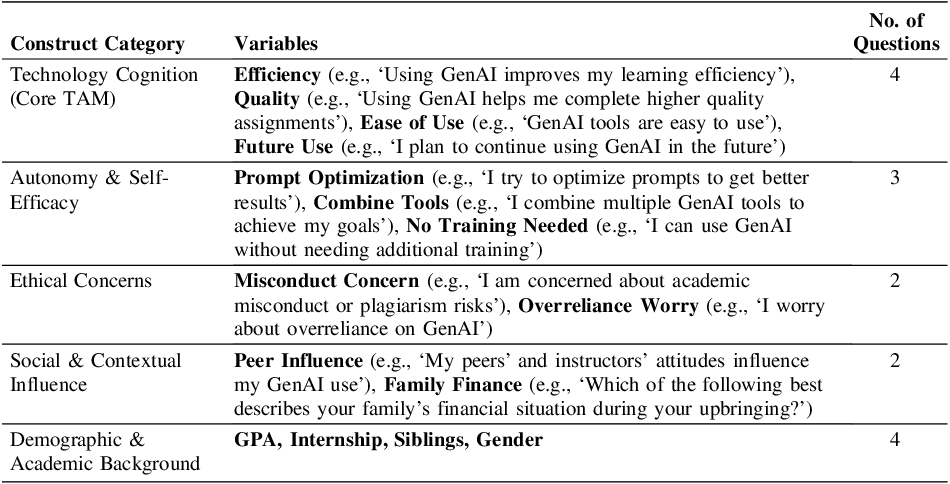
Key construct categories and associated variables considered in the survey

3.1. Survey design and data collection
We developed an online survey through an iterative process involving reviews by experts in STEM education and AI in education. The survey is theoretically grounded in the TAM and its extended constructs (Reference Kanont, Pingmuang, Simasathien, Wisnuwong, Wiwatsiripong, Poonpirome, Songkram and KhlaisangKanont et al., 2024). The survey involves fifteen questions designed to collect information regarding 5 different categories of constructs that potentially influence GenAI adoption. The construct categories are: i) Technology Cognition (Reference Şimşek, Cengiz and BalŞimşek et al., 2025), ii) Ethical Concerns (Reference Ovi, Fierro and SmithOvi et al., 2025), iii) Autonomy & Self-Efficacy (Reference Hunsu, Olaogun, Oje, Carnell and MorkosHunsu et al., 2023), iv) Social & Contextual Influence (Reference Kanont, Pingmuang, Simasathien, Wisnuwong, Wiwatsiripong, Poonpirome, Songkram and KhlaisangKanont et al., 2024), and v) Demographic and Academic background of participants. The 5 categories and 15 associated variables (see Table 1) are chosen to comprehensively capture cognitive, affective, and contextual factors influencing the adoption of GenAI tools by students. Excluding demographic & academic background and family finance status, the 10 core items across the constructs were measured using a 5-point Likert scale ranging from 1 (Strongly Disagree) to 5 (Strongly Agree). Data collection was conducted within the College of Engineering at a large public university in the southeastern United States. The survey was administered to undergraduate students enrolled in the Engineering Thermodynamics course. Institutional Review Board (IRB) approval was obtained, and informed consent was ensured before data collection. Participants were recruited during regular classroom sessions and invited to voluntarily complete the anonymous questionnaire. A total of 210 responses were collected. After screening for completeness and inconsistency, 192 valid responses were part of the final dataset that is subject to data analysis, as discussed in Section 4.
3.2. Data analysis
A multi-step analysis procedure was performed using IBM SPSS Statistics software to identify different student types and uncover the latent characteristics underlying GenAI adoption behavior among undergraduate students in each type (Reference TariganTarigan, 2025). First, the optimal number of clusters of student types was determined using the Elbow method and Silhouette scores (Reference Kar and KushwahaKar & Kushwaha, 2023) followed by classification of students into clusters (Reference Fazelpour, Joshi, Mocko, Morkos, Mozaffar, Murphy, Patel, Ramnath, Renu, Righter, Sen, Gill and SummersFazelpour et al., 2025; Reference TariganTarigan, 2025) using K-means clustering. Next, to validate whether the clusters were statistically distinct, one-way ANOVA was applied. Additionally, to visualize how well the clusters separated from each other, a 3D plot was created based on the results of a Linear Discriminant Analysis (LDA). The mean scores for each of the 15 variables were then compared across the clusters to build detailed student profiles, representing different GenAI adoption behaviors.
4. Results
The results of the data analysis discussed above are presented in this section. The results reveal the importance of core TAM variables along with other critical factors beyond the traditional model, justifying its extension for studying GenAI.
4.1. Clustering results
To determine the different patterns of GenAI adopted by undergraduate engineering students, we used a cluster analysis considering all 15 variables of the survey. As shown in the elbow diagram in Figure 1, the sum of squares within clusters (WCSS) shows a reduction as the number of clusters increases, with the curve beginning to flatten around k = 4. This means adding more clusters would not substantially improve homogeneity within groups. Meanwhile, the Silhouette score in Figure 1 indicates that although the peaks occur at k = 2, the value at k = 4 remains quite high compared to neighboring values. Taken together, these two support the choice of a four-cluster solution as a balanced trade-off. In addition, given the exploratory nature of this research, using k = 2 would likely miss nuanced differences in user behavior by combining smaller groups into broader groups - ‘high’ and ‘low’ adopters. k = 4, in contrast, reveals a more detailed and interpretable user profile, which is more suitable for the goal of this study, capturing the diversity of students’ behavior and attitudinal patterns toward GenAI. Consequently, K-means clustering with k = 4 was implemented to partition the 192 students into four stable and interpretable clusters. Each produced cluster is analyzed to construct a profile that captures the defining traits of its members.
Elbow and Silhouette scores for selecting the number of clusters in K-means clustering

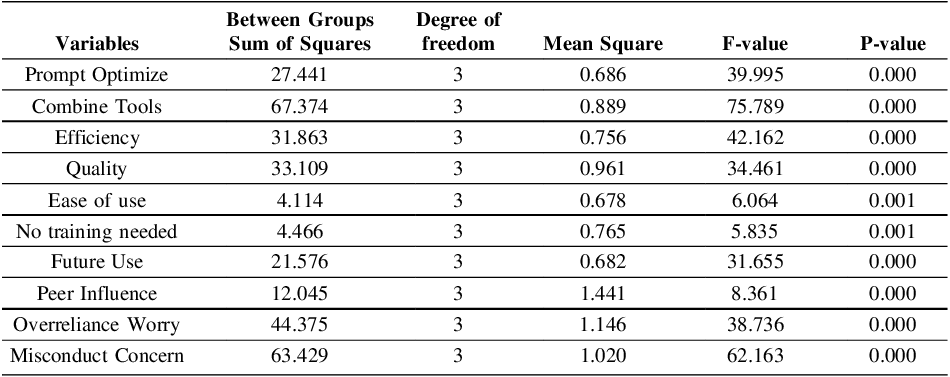
To verify the robustness of the clustering, a one-way ANOVA is conducted across the four groups. Table 2 lists variables where significant differences between the four clusters are observed (p <.001), confirming that the clusters were statistically distinct.
In addition, a 3D plot of the LDA-derived dimensionally reduced space (see Figure 2) shows clear visual separation of clusters, enhancing the confidence of the classification results. The findings indicate that the four clusters effectively balance statistical quality and behavioral interpretability, providing a solid foundation for subsequent analyses.
One-Way ANOVA results for cluster validation. Note: each row represents a specific variable measured in the survey. The statistics (F-value and P-value) indicate the significance of the differences between the identified clusters for each variable

3D Plot of the LDA-derived dimensionally reduced space showing clear cluster differentiation

Figure 2 Long description
A 3D scatter plot representing the LDA-derived dimensionally reduced space. The plot features four distinct clusters of data points, each represented by a different color: blue, orange, green, and red. The horizontal axis is labeled Dis1 1, the vertical axis is labeled Dis2 1, and the depth axis is labeled Dis3 1. Each cluster is enclosed by a convex hull, highlighting the spatial separation between the groups. The data points within each cluster are densely packed, indicating clear differentiation among the clusters. The plot does not include any regression or trend lines.
4.2. Profile construction
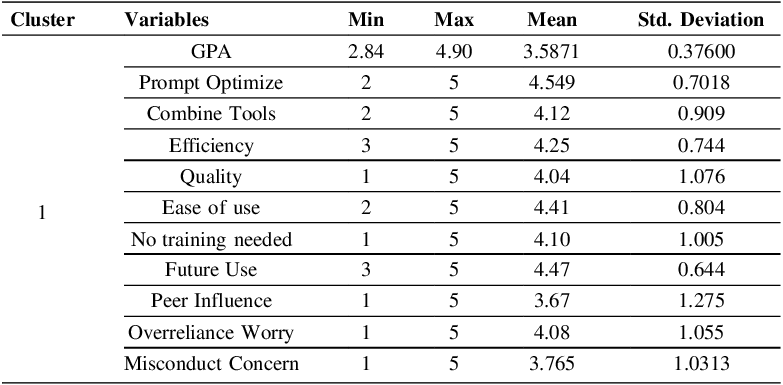
The first cluster, Profile 1 - The Empowered Optimizers (number of students in the cluster, n = 51), represents a group of students who have not only adopted GenAI but also mastered it. According to the mean values of variables in Table 3, they are academically strong (mean GPA = 3.59), skilled prompt engineers (mean = 4.55), and they often combine multiple GenAI tools in their workflow (mean = 4.12), suggesting a clear plan to get the most out of the technology. Most of them are male students (74.5%) with internship experience (74.5%) from upper-income backgrounds (20%) with siblings (90.2%), which brings more tech-savvy social networks and plenty of experimental resources. They see GenAI as highly useful and find it easy to use. Notably, these students operate with a strong sense of independence. They are confident in their ability to use these tools without formal training (mean = 4.10) and plan to continue using them in the future (mean = 4.47), see Table 3. But their enthusiasm is not blind. They still have a thoughtful awareness of risks, expressing clear concerns about overreliance (mean = 4.08) and academic misconduct (mean = 3.765). The interpretation of this profile suggests that these students are not just power users but also potential candidates for responsible and advanced AI adoption in educational settings, characterized by a combination of high skill, high confidence, and ethical mindfulness.
Variable profiles of cluster 1 (Profile 1) identified via K-means clustering

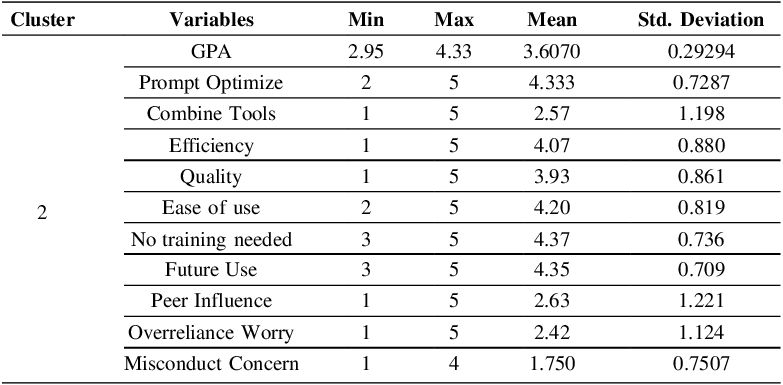
Variable profiles of cluster 2 (Profile 2) identified via K-means clustering

The second cluster, Profile 2 - The Mainstream Pragmatists (n = 60), is the silent majority you’d find in any engineering classroom. They are those who’ve figured out how to make GenAI work for them without making a big deal about it. They reported solid academic performance (mean GPA = 3.61), but they use GenAI more like a reliable calculator than for exploration. Demographically, most of them are males (81.7%) from middle-income families (58%), with internship experience (86.7%). As per mean variable values in Table 4, these students are competent users, because they reported a relatively high mean score for prompt formulation (mean = 4.33) and found GenAI both efficient (mean = 4.07) and easy to use (mean = 4.20). Yet they rarely combine different tools (mean = 2.57), suggesting they’ve developed a comfortable and practical working method that can efficiently finish tasks without requiring extra complex procedures. The characteristic of the Pragmatist lies in their direct connect with GenAI. They are highly confident in using it without formal training (mean = 4.37) and fully intend to continue (mean = 4.35). At the same time, they show notably low levels of ethical concern (overreliance mean = 2.42 and misconduct mean = 1.75). These students view GenAI as a practical aid rather than a transformative or ethically questioning technology. They are not opposed to further exploration, but they feel no need to go beyond the currently effective and proven methods at present.
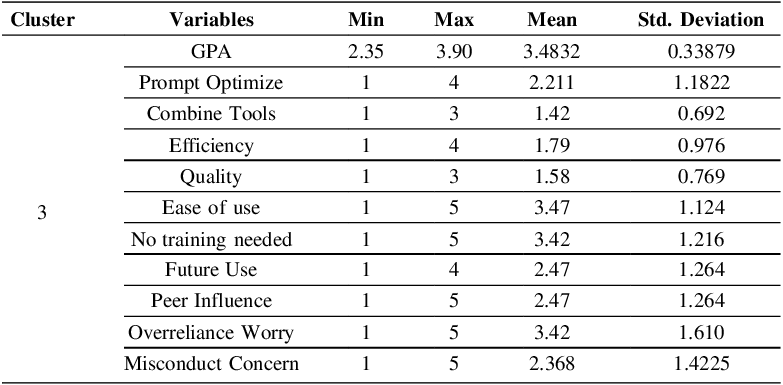
The third cluster, Profile 3 - The Skeptical Minimalists (n = 19), stands out in our study. They were the students who had tried GenAI but remained deeply disappointed. Although their academic performance is respectable (mean GPA = 3.48), they consider that GenAI tools were not suitable for them. This cluster is predominantly male (68.4%), most have siblings (84.2%), and a majority have internship experience (84.2%). Financially, they come from diverse socioeconomic backgrounds. This unique combination of having extensive professional experience while maintaining a persistent skeptical attitude indicates that their cautiousness is not due to a lack of opportunities but stems from true dissatisfaction with the practicality of GenAI. As opposed to the optimizers who see more possibilities, the minimalists see all limitations. As per mean variable values in Table 5, most do not optimize prompts (mean = 2.21), they rarely combine tools (mean = 1.42), and they provide low ratings on both efficiency (mean = 1.79) and quality (mean = 1.58) of GenAI outputs. This does not imply that they cannot use this technology; they think it has no particular usefulness. They are ambivalent about needing training (mean = 3.42) and lack enthusiasm for future use (mean = 2.47). Interestingly, although they are not heavy users, they still have moderate concerns about overreliance (mean = 3.42) and misconduct (mean = 2.37), indicating that their concerns extend beyond functionality to encompass the broader role of GenAI in education. These students believe GenAI does not align with how they learn or work. Possible barriers include low digital confidence, preference for traditional methods, lack of training or guidance, or insufficient exposure to the benefits of GenAI tools.
Variable profiles of cluster 3 (Profile 3) identified via K-means clustering

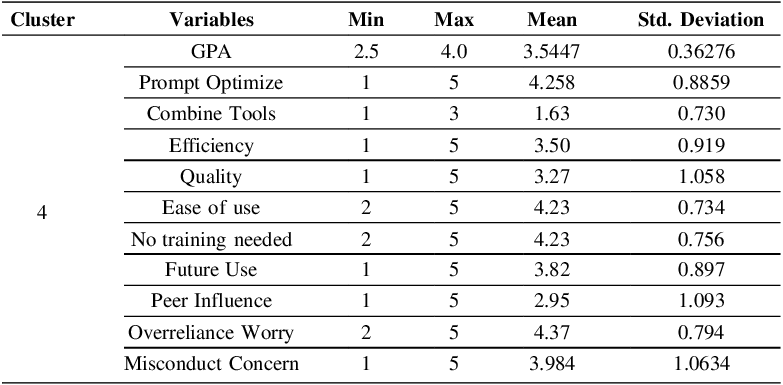
Variable profiles of cluster 4 (Profile 4) identified via K-means clustering

Finally, the fourth cluster, Profile 4 - The Ethical Achievers (n = 62) in our study, presents a highly attractive contrast phenomenon. They are a group of students clearly capable of effectively using GenAI, but they consciously choose to refrain from using such technology. Academically solid with a mean GPA of 3.54, these students demonstrate both technical competence and ethical restraint in their use of GenAI. This cluster has the highest proportion of female students (24.2%) among the profiles, and they mostly come from families that “were generally able to cover essentials, but luxuries were limited”. Therefore, they constitute a pragmatic middle group. Most of them have internship experience (80.6%) and siblings (96.8%), indicating that they have practical work experience and a potential family support network. As per mean variable values in Table 6, they are technically skilled at prompt optimization (mean = 4.26) and find GenAI easy to use (mean = 4.23). However, they deliberately limited their engagement, rarely using multiple tools (mean = 1.63), and showed only moderate enthusiasm for future use (mean = 3.82). It seems that they have mastered the basic skills, but ultimately decided not to go further. What truly defines this group is their ethical concerns. Although they possess specific technical capabilities, they express the strongest concerns about overreliance (mean = 4.37) and misconduct (mean = 3.98) across all profiles. This pattern suggests that these students come from backgrounds where resources were carefully managed, and new technologies are approached with caution and consideration of long-term consequences. Their moderate family financial background may lead to a balanced perspective, as they have learned to make deliberate choices in resource allocation and are now applying the same level of caution to the use of GenAI. This combination of technical expertise and moral awareness makes them valuable voices in discussions about the responsible integration of AI in education.
5. Discussion
5.1. Interpreting the student profiles through an extended TAM perspective
The results of the analysis of the clusters indicate that engineering students do not adopt GenAI identically. This means that we cannot treat students as a homogeneous group, but it reveals four distinct profiles of GenAI adoption. These profiles help expand the original Technology Acceptance Model (TAM) by connecting behavior to psychological factors.
The Empowered Optimizers are a clear example of classical TAM. Their high engagement with GenAI indicates their strong perceptions of usefulness (efficiency, quality) and ease of use. Similar findings were reported by Reference Balaskas, Tsiantos, Chatzifotiou and RigouBalaskas et al.(2025), who confirmed that efficiency gains and usability perceptions remain the most consistent predictors of student engagement with GenAI tools. This profile reflects the perfect early adopter within design teams, who can use GenAI to tackle complex problems effectively. The Mainstream Pragmatists align with the core TAM but reveal its boundaries. They find GenAI helpful and simple to use, but they don’t explore its full potential. This group uses GenAI mostly for practical reasons, like saving time or improving basic tasks. However, their lower level of advanced usage suggests that usefulness and ease alone may not be enough to encourage deeper engagement. The Ethical Achievers constitute the most critical extension to TAM in an educational design setting. Even though they think GenAI is useful and easy to use, they don’t rely on it heavily. Their strong ethical concerns-fear of overreliance or academic misconduct seem to hold them back. This cluster demonstrates that ethical risk perception is not a principal issue but a core determinant that can override the positive drivers of the classic TAM, which should be included in models of GenAI adoption. The Skeptical Minimalists challenge the model from the opposite direction. Their limited engagement might come from low confidence, past negative experiences, or general distrust in AI tools. This suggests that we may need to include emotional and trust-related variables, beyond what TAM covers, to understand why some students reject GenAI. It is worth noting that most demographic variables showed limited influence on cluster formation, likely due to the homogeneity of the engineering sample. However, gender presented a notable exception, particularly in the Ethical Achievers profile, which featured a distinctly higher proportion of female students compared to other clusters.
5.2. Implications for design education and practice
The identified student profiles extend beyond a simple taxonomy for personalized instruction. They act as early-stage examples for future designer-AI collaboration, offering a framework to expect the integration of AI into core design processes.
Within design practice, these profiles suggest collaborative roles that are vital for a mature design team. Empowered Optimizers can function as “AI-Augmented Innovators,” using multiple GenAI tools to speed up both early-stage ideation and late-stage optimization. Mainstream Pragmatists may serve as “AI-Efficient Executors,” utilizing familiar tools to improve efficiency in modeling and technical analysis. In contrast, Skeptical Minimalists, with their cautious approach, may serve as “Critical Validators,” responsible for human-in-the-loop review and feasibility assessment to maintain high standards. Ethical Achievers would be “Guardians of Responsible Design,” leading efforts to manage intellectual property and reduce bias during project planning and decision-making.
In design education, these profiles imply moving one-size-fits-all AI literacy toward targeted Designer-AI Co-creation Competencies and more actionable course design. For Optimizers, pedagogy should emphasize AI Workflow Management, encouraging them to integrate multiple tools for complex design. For Pragmatists, the focus should be on Task-AI Matching, teaching workflow automation to enhance efficiency in engineering documentation and analysis. For Minimalists, educational interventions should emphasize Critical Evaluation, using explainable AI interfaces and comparison methods to build trust in hybrid workflows. Meanwhile, for Achievers, instruction can emphasize AI Ethics Governance by embedding responsible-use requirements into deliverables, such as an Intellectual Property and bias checklist.
These profiles also support differentiated prompt and assignment scaffolding in senior capstone or project-based design courses. Optimizers may receive exploration-oriented prompts with explicit constraints and reporting requirements. Pragmatists can be assigned bounded prompts linked to clear evaluation criteria. Minimalists can receive critique-first prompts that require identifying failure modes and proposing tests. Achievers can receive governance prompts focused on stakeholder impacts and compliance considerations. Leveraging these profiles in this manner enhances the practical value of clustering by translating results into concrete instructional supports and role-aligned contributions that more accurately reflect AI-influenced design practice.
6. Conclusion
The results of the research presented in this paper show that all engineering students don’t use GenAI identically. Instead, their usage can be shaped by distinct, psychologically coherent profiles. Empowered Optimizers, Mainstream Pragmatists, Ethical Achievers, and Skeptical Minimalists collectively reflect a multifaceted interaction between the traditional (TAM) constructs, significantly influenced by individuals’ perceptions of ethical risk and their tendencies toward autonomous learning. These findings echo emerging research showing that ethical awareness and AI self-efficacy play a crucial role in shaping GenAI adoption behaviors among students. Our findings challenge the notion of universal models for technology adoption. To assist a greater number of students in utilizing GenAI tools effectively, it is essential to offer varied support tailored to diverse learner needs. A one-size-fits-all approach is insufficient. Instead, educators should develop learning activities that consider students’ beliefs, concerns, and levels of confidence.
Looking ahead, future research should build on this typological approach. Longitudinal studies are needed to track the stability of these profiles and their impact on learning outcomes. This will help build a deeper and more realistic understanding of how students interact with AI in education.
Acknowledgement
We would like to thank the gracious student participants who volunteered to contribute to this study.



 Open access

