



%20--%3e%3c!DOCTYPE%20svg%20PUBLIC%20'-//W3C//DTD%20SVG%201.0//EN'%20'http://www.w3.org/TR/2001/REC-SVG-20010904/DTD/svg10.dtd'%3e%3csvg%20version='1.0'%20id='Layer_1'%20xmlns='http://www.w3.org/2000/svg'%20xmlns:xlink='http://www.w3.org/1999/xlink'%20x='0px'%20y='0px'%20width='64px'%20height='64px'%20viewBox='5.5%20-3.5%2064%2064'%20enable-background='new%205.5%20-3.5%2064%2064'%20xml:space='preserve'%3e%3cg%3e%3ccircle%20fill='%23FFFFFF'%20fill-opacity='0'%20cx='37.785'%20cy='28.501'%20r='28.836'/%3e%3cpath%20fill='%23595959'%20d='M37.441-3.5c8.951,0,16.572,3.125,22.857,9.372c3.008,3.009,5.295,6.448,6.857,10.314%20c1.561,3.867,2.344,7.971,2.344,12.314c0,4.381-0.773,8.486-2.314,12.313c-1.543,3.828-3.82,7.21-6.828,10.143%20c-3.123,3.085-6.666,5.448-10.629,7.086c-3.961,1.638-8.057,2.457-12.285,2.457s-8.276-0.808-12.143-2.429%20c-3.866-1.618-7.333-3.961-10.4-7.027c-3.067-3.066-5.4-6.524-7-10.372S5.5,32.767,5.5,28.5c0-4.229,0.809-8.295,2.428-12.2%20c1.619-3.905,3.972-7.4,7.057-10.486C21.08-0.394,28.565-3.5,37.441-3.5z%20M37.557,2.272c-7.314,0-13.467,2.553-18.458,7.657%20c-2.515,2.553-4.448,5.419-5.8,8.6c-1.354,3.181-2.029,6.505-2.029,9.972c0,3.429,0.675,6.734,2.029,9.913%20c1.353,3.183,3.285,6.021,5.8,8.516c2.514,2.496,5.351,4.399,8.515,5.715c3.161,1.314,6.476,1.971,9.943,1.971%20c3.428,0,6.75-0.665,9.973-1.999c3.219-1.335,6.121-3.257,8.713-5.771c4.99-4.876,7.484-10.99,7.484-18.344%20c0-3.543-0.648-6.895-1.943-10.057c-1.293-3.162-3.18-5.98-5.654-8.458C50.984,4.844,44.795,2.272,37.557,2.272z%20M37.156,23.187%20l-4.287,2.229c-0.458-0.951-1.019-1.619-1.685-2c-0.667-0.38-1.286-0.571-1.858-0.571c-2.856,0-4.286,1.885-4.286,5.657%20c0,1.714,0.362,3.084,1.085,4.113c0.724,1.029,1.791,1.544,3.201,1.544c1.867,0,3.181-0.915,3.944-2.743l3.942,2%20c-0.838,1.563-2,2.791-3.486,3.686c-1.484,0.896-3.123,1.343-4.914,1.343c-2.857,0-5.163-0.875-6.915-2.629%20c-1.752-1.752-2.628-4.19-2.628-7.313c0-3.048,0.886-5.466,2.657-7.257c1.771-1.79,4.009-2.686,6.715-2.686%20C32.604,18.558,35.441,20.101,37.156,23.187z%20M55.613,23.187l-4.229,2.229c-0.457-0.951-1.02-1.619-1.686-2%20c-0.668-0.38-1.307-0.571-1.914-0.571c-2.857,0-4.287,1.885-4.287,5.657c0,1.714,0.363,3.084,1.086,4.113%20c0.723,1.029,1.789,1.544,3.201,1.544c1.865,0,3.18-0.915,3.941-2.743l4,2c-0.875,1.563-2.057,2.791-3.541,3.686%20c-1.486,0.896-3.105,1.343-4.857,1.343c-2.896,0-5.209-0.875-6.941-2.629c-1.736-1.752-2.602-4.19-2.602-7.313%20c0-3.048,0.885-5.466,2.658-7.257c1.77-1.79,4.008-2.686,6.713-2.686C51.117,18.558,53.938,20.101,55.613,23.187z'/%3e%3c/g%3e%3c/svg%3e)
%20--%3e%3c!DOCTYPE%20svg%20PUBLIC%20'-//W3C//DTD%20SVG%201.0//EN'%20'http://www.w3.org/TR/2001/REC-SVG-20010904/DTD/svg10.dtd'%3e%3csvg%20version='1.0'%20id='Layer_1'%20xmlns='http://www.w3.org/2000/svg'%20xmlns:xlink='http://www.w3.org/1999/xlink'%20x='0px'%20y='0px'%20width='64px'%20height='64px'%20viewBox='5.5%20-3.5%2064%2064'%20enable-background='new%205.5%20-3.5%2064%2064'%20xml:space='preserve'%3e%3cg%3e%3ccircle%20fill='%23FFFFFF'%20fill-opacity='0'%20cx='37.637'%20cy='28.806'%20r='28.276'/%3e%3cg%3e%3cpath%20fill='%23595959'%20d='M37.443-3.5c8.988,0,16.57,3.085,22.742,9.257C66.393,11.967,69.5,19.548,69.5,28.5c0,8.991-3.049,16.476-9.145,22.456%20C53.879,57.319,46.242,60.5,37.443,60.5c-8.649,0-16.153-3.144-22.514-9.43C8.644,44.784,5.5,37.262,5.5,28.5%20c0-8.761,3.144-16.342,9.429-22.742C21.101-0.415,28.604-3.5,37.443-3.5z%20M37.557,2.272c-7.276,0-13.428,2.553-18.457,7.657%20c-5.22,5.334-7.829,11.525-7.829,18.572c0,7.086,2.59,13.22,7.77,18.398c5.181,5.182,11.352,7.771,18.514,7.771%20c7.123,0,13.334-2.607,18.629-7.828c5.029-4.838,7.543-10.952,7.543-18.343c0-7.276-2.553-13.465-7.656-18.571%20C50.967,4.824,44.795,2.272,37.557,2.272z%20M46.129,20.557v13.085h-3.656v15.542h-9.944V33.643h-3.656V20.557%20c0-0.572,0.2-1.057,0.599-1.457c0.401-0.399,0.887-0.6,1.457-0.6h13.144c0.533,0,1.01,0.2,1.428,0.6%20C45.918,19.5,46.129,19.986,46.129,20.557z%20M33.042,12.329c0-3.008,1.485-4.514,4.458-4.514s4.457,1.504,4.457,4.514%20c0,2.971-1.486,4.457-4.457,4.457S33.042,15.3,33.042,12.329z'/%3e%3c/g%3e%3c/g%3e%3c/svg%3e)
Co-design practices
Co-design is an active collaborative approach that involves stakeholders, including community members, in creating new knowledge and solutions(Reference Vargas, Whelan and Brimblecombe1). Co-design aligns with traditional participatory action research by involving stakeholders in a reflective inquiry process to generate actionable knowledge(Reference Jagosh, Macaulay and Pluye2). However, it goes further by enabling recipients to achieve practical outcomes, such as designing and implementing interventions. A recent scoping review led by Meloncelli and colleagues on the use and extent of co-design in nutrition interventions with consumers(Reference Meloncelli, Young and Christoffersen3) identified co-design as aligning with the ‘collaborate’ and ‘empower’ levels on the spectrum defined by The International Association of Public Participation(4). Co-design operates on the principles of valuing the expertise and lived experiences of all participants, fostering equal and reciprocal relationships(Reference Masterson, Areskoug Josefsson and Robert5). These principles emphasise shared decision-making, where stakeholders actively contribute to identifying issues, analysing needs, defining priorities and designing and implementing interventions. This process aims to promote power-sharing, trust and mutual dependence, ensuring that interventions are contextually relevant, culturally sensitive and sustainable.
By involving stakeholders to identify issues, co-design facilitates the creation of solutions aligned with the community’s unique needs and values(Reference Singh, Sah and Simkhada6). This participatory approach has been heralded in the research and health communities as a valuable approach, especially for priority populations, such as rural communities, where interventions must consider local knowledge, social dynamics and available resources(Reference Singh, Sah and Simkhada6). While co-design for nutrition interventions has become more prevalent in recent years, genuine partnerships with consumers across all stages of nutrition intervention research remain uncommon(Reference Meloncelli, Young and Christoffersen3).
Aim
The aim of this review was to examine notable examples of interventions to improve diets in rural settings that have been co-designed by rural communities.
Diets in rural communities
Populations who live outside major cities and urban areas, such as rural communities experience, unequal health when compared to their urban/metropolitan counterparts, with many examples around the world(Reference Alston, Allender and Peterson7–10). For example, remoteness influences CVD mortality above and beyond the impact of socio-economic status for those outside of major cities in Australia(Reference Jacobs, Peterson and Allender11).
Minimal progress has been made in addressing rural health inequities, despite calls for action(Reference Porter, Charlton and Tapsell12,Reference Wilson and Rourke13) , and a focus on rural communities as priority populations in countries such asAustralia, Canada and New Zealand(Reference Wilson and Rourke13–15). Although the factors leading to these health inequities are complex, such as inadequate access to health care, nutrition and food environments have been shown to play a role in disparities in chronic disease in rural areas(Reference Wilson and Rourke13,Reference Alston, Jacobs and Allender16,Reference Melaku, Renzaho and Gill17) . Of concern, nutrition research has been under-funded and under-valued, translating into a lack of knowledge around potential approaches to improve nutrition in rural areas(Reference Alston, Raeside and Jia8). Urgent action is needed to understand potential solutions, with involvement of rural communities(Reference Alston, Heaney and Kent18), to prevent rural health disparities from continuing to widen.
Addressing nutrition issues such as access to healthy foods in addition to individualised nutrition care, provides a key opportunity to progress health in rural communities for present and future generations(Reference Alston, Nichols and Allender19). Evidence suggests that interventions addressing rural nutrition do not often include co-design or involve local community members in the implementation of interventions(Reference Osborne, Alston and Bolton20).
Co-design of dietary interventions
Community-based interventions
Growth in community-based interventions reflects a paradigm shift away from individual-focused interventions to those that emphasis the merits of addressing the complex and dynamic drivers of unhealthy behaviours(Reference Swinburn, Sacks and Hall21). Community-based interventions take a systems approach by employing multiple interventions addressing both systemic, social and environmental drivers of behaviour in an effort to improve health of the community(22). The potential effectiveness of community-based interventions on supporting healthy weight(Reference Strugnell, Orellana and Crooks23,24) and improving dietary outcome measures(Reference Hassen, Sisay and Van Geertruyden25) through the use of various strategies (e.g. health promotion, education, community engagement and structural changes) has been demonstrated. Emphasis has been placed on the importance of community-based interventions being context-specific(Reference Hassen, Sisay and Van Geertruyden25) with research incorporating participatory approaches to co-design strategies that meet the specific needs, preferences and challenges faced by the community(Reference Dhanjani, Allen and Varman26). In rural communities the need for context specific multicomponent community-based interventions is profound given the unique challenges these communities face in relation to the availability, adequacy and accessibility of foods that can support a healthy diet(Reference Whelan, Millar and Bell27,Reference Marjanovic, Kent and Morrison28) . Co-design of dietary interventions could assist in addressing the interconnected public health concerns in populations undergoing a nutrition transition by developing programs that support overall well-being by taking an indigenous worldview(Reference Bersamin, Izumi and Nu29).
Digital health interventions
Digital health interventions leverage a variety of information and communication technologies to reach people outside of traditional healthcare pathways. Increasingly ubiquitous ownership or access to these technologies allows delivery of flexible, accessible and personalised support to communities in almost any location(Reference Kelly, Reidlinger and Hoffmann30). While digital health interventions should not replace in-person care, they can play important complementary roles by addressing unmet needs of people who cannot access in-person interventions and providing additional support between or beyond in-person visits(Reference Rawstorn, Gant and Direito31). Potential to improve dietary outcomes has been demonstrated by a meta-analysis that showed digital dietary interventions improved diet quality and fruit and vegetable intake among people with chronic health conditions including CVD, diabetes mellitus and/or renal disease; moreover, there was some evidence that higher frequency interventions were more effective(Reference Kelly, Reidlinger and Hoffmann30). While digital dietary interventions show promise, it is important to consider how their design and use may contribute to health inequalities. Some evidence suggests digital interventions can help to improve dietary behaviours and knowledge among disadvantaged populations(Reference Karimi, Opie and Crawford32); however, mechanisms underlying digital health adoption, engagement and effectiveness are not well understood(Reference König, Krukowski and Kuntsche33). Capability, opportunity and motivation for people living in rural areas to use digital health interventions may be influenced by factors such as varied broadband coverage, digital literacy and reduced access to healthcare professionals as a source of advice about digital health interventions(Reference König, Krukowski and Kuntsche33). Co-designing with people living in rural areas could help to ensure interventions are socially as well as geographically accessible, although this has not been common to date(Reference Livingstone, Rawstorn and Partridge34).
Overview of selected interventions
This review includes selected examples of community-based and digitally delivered interventions conducted in Australia, New Zealand, Canada and the USA. These countries were selected as they are high-income countries with distinct geographic distributions of population groups, such as indigenous peoples, that impact on diet and heath inequities. This review defines community-based interventions as those delivered primarily face-to-face and digital interventions as those delivered primarily online via digital devices.
Community-based interventions
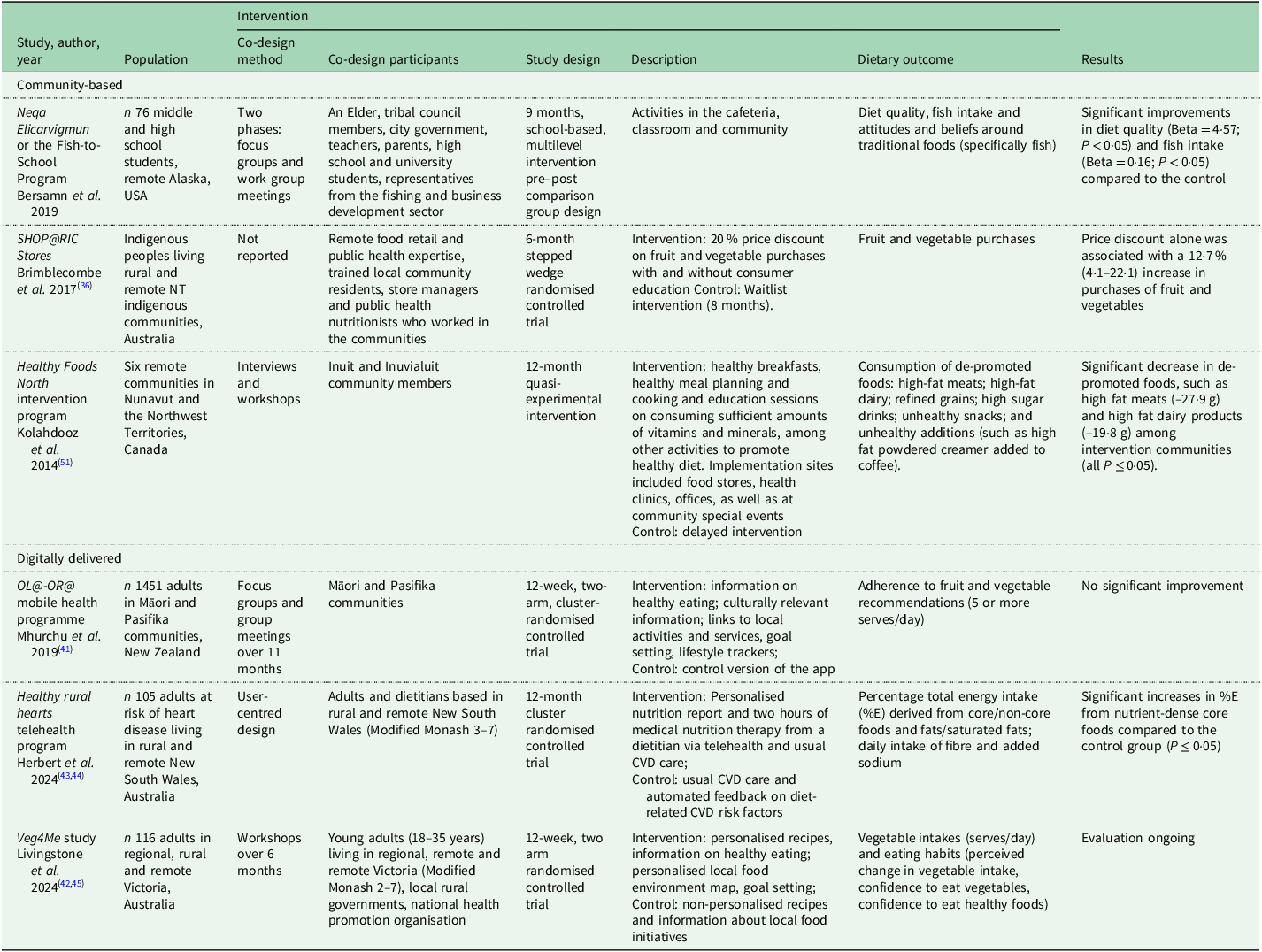
Three studies(Reference Bersamin, Izumi and Nu29,Reference Kolahdooz, Pakseresht and Mead35,Reference Brimblecombe, Ferguson and Chatfield36) have explored the effectiveness of community-based interventions aimed at improving dietary behaviours in underserved populations, including Inuit and Inuvialuit populations in Canada and remote communities in the USA and Australia (Table 1).
Examples of co-designed community-based and digitally delivered interventions in rural communities to improve dietary intakes

In Canada, Kolahdooz and colleagues(Reference Kolahdooz, Pakseresht and Mead35) evaluated the 12-month Healthy Foods North intervention program tailored to the Inuit and Inuvialuit populations (Canadian Indigenous populations) in remote and semi-remote areas in Nunavut and Northwest Territories to reduce risk of chronic disease. The intervention participants had access to healthy breakfasts, healthy meal planning and cooking and education sessions, while the control received delayed access to the intervention. The multicomponent intervention was developed through community participatory approaches including extensive stakeholder collaboration enabling the development of a culturally appropriate program(Reference Gittelsohn, Roache and Kratzmann37). Key elements of Healthy Foods North included promotion of healthier food preparation methods and the benefits of traditional foods and point of purchase activities to increase the availability, accessibility and visibility of healthiness foods in stores(Reference Kolahdooz, Pakseresht and Mead35). In this quasi-experimental intervention evaluation four communities (two each from Nunavut and Healthy Foods North) received the intervention and two comparison control communities (one from each Nunavut and Northwest Territories) received the delayed intervention following data collection. Pre and post food frequency questionnaires measured consumption patterns and Adult Impact Questionnaires determined food acquisition and preparation behaviours and sociodemographic factors (both using validated surveys)(Reference Kolahdooz, Pakseresht and Mead35). A significant decrease in the consumption of high-fat meat and high-fat dairy, unhealthy drinks and refined grain products and an increase in healthier food preparation was observed in the intervention group compared to the control. Control groups had a significant increase in refined grain product and unhealthy drink consumption; increase in frequency of unhealthy additions intake was reported across both groups(Reference Kolahdooz, Pakseresht and Mead35). The predominantly female sample (80–82 %), lower response rates from some communities, temporal factors that relate to data collection and limited data of potential confounders may have limited the strength of findings(Reference Kolahdooz, Pakseresht and Mead35).
In a stepped-wedge trial, Brimblecombe and colleagues(Reference Brimblecombe, Ferguson and Chatfield36) tested the effect of price discount of 20% on purchasing of fruit, vegetables, bottled water and artificially sweetened drinks with and without a consumer education strategy. The intervention was applied at the population level in remote Indigenous communities in Australia across twenty stores (n 20) located 20 km or more from any other food outlet in communities of concentrated socioeconomic disadvantage. Using a 6-month stepped wedged randomised controlled trial, the intervention group received 20 % price discount on fruit and vegetable purchases with and without consumer education, while the control group received a waitlist intervention (8 months). Following the 24-week intervention results (objectively measured store sales 24 weeks pre/during and post intervention) indicated discount alone stores resulted ina 12·7 % (95 % CI 4·1, 22·1) increase in fruit (mostly) and vegetable purchasing(Reference Brimblecombe, Ferguson and Chatfield36). There were inconsistencies in the delivery of the consumer education across combined (discount and education) intervention stores, but a small benefit was observed (7·6 %; 95 % CI –3·6, 20·2) on vegetable purchasing(Reference Brimblecombe, Ferguson and Chatfield36). Following (24 weeks post) the removal of the discount the increased purchasing of fruit and vegetables persisted somewhat. Findings also indicated an increase in bottled water purchasing because of the discount (no difference between stores) but not diet soft drinks. Total food and drink sales, total energy of foods and sodium and increased during the intervention period (discount alone) and after.
Bersamin and colleagues(Reference Bersamin, Izumi and Nu29) reported on a multi-level school-based (middle and high) intervention (Fish-to-School Program) in two remote Alaska Native communities in southwestern Alaska, USA. The intervention was designed via participatory approach(Reference Nu and Bersamin38) and included activities delivered in the classroom (lessons demonstrating the environmental, nutrition and economic impacts of local and non-local supply chain usage), community (intergenerational cooking competition) and cafeteria. ‘Farm-to-schools’(Reference Joshi and Ratcliffe39) is an approach used in North America to reconnect adolescents with local agriculture by integrating locally grown foods into the school cafeteria to improve diet. Through the participatory intervention design salmon was selected as a focus due to it being an important traditional Yup’ik food and a commercial local product that is caught and processed by Native and independently owned and operated local fish business and could be served in the school cafeteria lunches weekly(Reference Bersamin, Izumi and Nu29). Being a centralised service, all schools received the cafeteria intervention and only the indirect effects of the classroom and community components were examined between baseline and 4 months (time 1) and between 4 months and 9 months (time 2 and end of intervention). Diet measured from students (intervention n 38 and comparison n 38) through a single 24 hr recall and a validated biomarker of fish and marine mammal intake indicated improved overall diet quality of the intervention participants (after time 2) with a decline in diet quality among comparison participants. The extent to which the students were engaging with the traditional norms and values (i.e. enculturation)(Reference Bersamin, Zidenberg-Cherr and Stern40) was measured via 15 item-survey with outcomes indicating an increase in positive believes in the benefits of salmon and Yup’ik food amongst other aspects of traditional life.
Across these three studies moderate benefits of community-based interventions are demonstrated from short-term (24 weeks to 12 months) interventions(Reference Bersamin, Izumi and Nu29,Reference Kolahdooz, Pakseresht and Mead35,Reference Brimblecombe, Ferguson and Chatfield36) . All interventions involved participatory approaches in the design phase which may have contributed to their success(Reference Bersamin, Izumi and Nu29,Reference Kolahdooz, Pakseresht and Mead35,Reference Brimblecombe, Ferguson and Chatfield36) . Of interest across two of the studies was the decline in dietary health of the control group(Reference Bersamin, Izumi and Nu29,Reference Kolahdooz, Pakseresht and Mead35) . One study suggested that the findings may reflect a trend in people eating less healthy in general it is possible that intervention may serve to keep intervention group’s diets from getting unhealthier(Reference Kolahdooz, Pakseresht and Mead35). Given this insight the longer-term impact and sustainability of interventions such as these would be of interest to policymakers internationally.
Digital interventions
Three recent studies(Reference Ni Mhurchu, Te Morenga and Tupai-Firestone41–Reference Herbert, Schumacher and Brown43) have explored the effectiveness of digital interventions aimed at improving dietary behaviours in underserved populations, specifically focusing on Māori and Pasifika communities in New Zealand and rural populations in Australia (Table 1). These studies leveraged digital platforms to deliver personalised nutrition advice, with varying nutrition and feasibility outcomes(Reference Ni Mhurchu, Te Morenga and Tupai-Firestone41–Reference Herbert, Schumacher and Brown43).
The OL@-OR@ mobile health (mHealth) programme was designed to support healthy behaviours among Māori and Pasifika communities in New Zealand(Reference Ni Mhurchu, Te Morenga and Tupai-Firestone41). This 12-week, cluster-randomised controlled trial provided co-designed culturally relevant health information, goal-setting tools and lifestyle trackers via a mobile app and website. Although this intervention was not exclusively conducted in rural areas, a large proportion of participants were rural-dwelling. Adherence to health-related guidelines, measured using a composite health behaviour score which included fruit and vegetable intake, improved over time, however, it was not significantly different to the control group, who received a control version of the app that collected baseline and outcome data only(Reference Ni Mhurchu, Te Morenga and Tupai-Firestone41). A notable feature of this smartphone intervention was personalised health behaviour goal setting and action planning. Adherence to health-related guidelines was higher among those who engaged with the goal-setting feature (meaning they set at least one behaviour change goal); however this only represented 26 % of participants. This highlights a key challenge for multi-component mHealth interventions – even if the technology is accessible, use of individual features can vary and this may impact programme effectiveness.
The Healthy Rural Hearts telehealth program, implemented in rural New South Wales, Australia, used telehealth to deliver personalised medical nutrition therapy to individuals at risk of CVD(Reference Herbert, Schumacher and Brown43,Reference Herbert, Schumacher and Brown44) . The 12-month cluster randomised controlled trial tested whether a personalised nutrition report and two hours of medical nutrition therapy from a dietitian via telehealth led to changes in diet compared with usual CVD care. This intervention demonstrated the potential of digital health in improving dietary behaviours in rural populations. Participants received five telehealth consultations from Accredited Practising Dietitians over a 6-month period, with dietary intake and progress tracked using digital tools such as the Australian Eating Survey Heart version. The intervention showed significant improvements in the percentage of energy intake from nutrient-dense core foods compared to the control group. The high attendance rate (around 90 %) for telehealth consultations and positive acceptability ratings (mean score of 9·5/10) suggest this was a feasible and well-accepted model for delivering nutrition care in rural settings. However, intentions to use telehealth consultations outside the study, if available, were lower (6·0/10). This study shows the potential of digital health interventions to improve access to personalised nutrition support in remote communities but raises concerns about long-term adherence and translation into practice.
The Veg4Me study focused on increasing vegetable intake among young adults in rural Victoria, Australia, using a personalised web app that was co-designed with rural community members(Reference Livingstone, Rawstorn and Partridge42,Reference Livingstone, Rawstorn and Alston45) . A 12-week randomised controlled trial was conducted from August 2023 until April 2024 to determine the feasibility of the intervention. Participants in the intervention group received personalised content including tailored National Heart Foundation of Australia recipe suggestions, goal-setting features and information on local food environments (e.g. farmers markets; community gardens), while the control group received non-personalised versions. This study highlights the importance of co-design in digital health interventions, ensuring the technology is relevant and engaging for users. The personalised features, such as goal setting and behaviour change support, were tailored to individual preferences, which has been shown to be an important component of effective digital interventions(Reference Livingstone, Rawstorn and Partridge34). However, the effectiveness and engagement rates are yet to be fully evaluated, as the data analysis for the study is ongoing.
Across these studies(Reference Ni Mhurchu, Te Morenga and Tupai-Firestone41–Reference Herbert, Schumacher and Brown43), the digital elements, including mobile apps, telehealth or personalised web platforms played a central role in delivering health interventions. These studies illustrate the potential for digital health tools to provide accessible, tailored support in rural and underserved populations, though challenges with user engagement and effectiveness remain. Co-designing interventions and ensuring they are personalised to meet the preferences of the specific population may improve both engagement and health outcomes. As preferences may vary within specific populations, use of individual intervention features may also vary. Digital health interventions offer a promising way to address dietary health issues but continued evaluation and iteration are necessary to optimise their impact. Understanding how varying preferences among sub-groups of rural populations can influence intervention usage may provide context to better understand how engagement impacts on effectiveness.
Recommendations for research, policy and practice
This review highlights that utilising both community-based and digital interventions will undoubtedly be key to improving the health of rural communities into the future, with each study showing improvements in rural nutritional intakes. Small changes in rural diets can have a big impact(Reference Alston, Peterson and Jacobs46), and given the limited funding resources available to fund nutrition interventions(Reference Alston, Raeside and Jia8) researchers must maximise every opportunity to engage with rural communities through co-design.
Although this review highlights the promise of community-based and digital nutrition interventions in rural areas, limited reporting on co-design makes it challenging to understand the best ways this can be done with and for rural communities. Only three out of these six key examples, provided detailed and replicable descriptions of the co-design processed utilised in their target rural communities(Reference Bersamin, Izumi and Nu29,Reference Ni Mhurchu, Te Morenga and Tupai-Firestone41,Reference Livingstone, Rawstorn and Alston45) . In line with the literature, reporting on co-design has been highlighted as being inconsistent outside the context of nutrition intervention research, and broadly across health studies(Reference Vargas, Whelan and Brimblecombe47).
Nutrition researchers must take steps to ensure co-design methods are systematically reported, to enable learnings and replication of methodologies across communities. Transparent and detailed reporting will also assist with upscaling and sustainability of nutrition interventions in future. This review highlights the limited evidence to guide intervention co-design and delivery in the context of rural communities. Examples in this review focused mainly on indigenous populations and although these populations are of the highest priority due to disproportionate health disparities, it still leaves much unanswered about rural communities more broadly, and the best ways to engage them. Reporting on co-design methods and community participation at all stages of the research process is of clear importance when working with indigenous communities; to ensure researchers minimise any ongoing harms of colonisation and maximise the health benefits of research in these areas. However, evidence suggests that there are still large inadequacies in engagement by researchers with indigenous communities broadly across all stages of research including co-design(Reference Burchill, Kotevski and Duke48). This must be a key consideration for future nutrition research in rural areas, and researchers have an ethical responsibility to undertake and transparently report their progress with engagement.
Finally, rural health bodies and experts have called for place-based research and the involvement of local community members and nutrition professionals in all stages of research to ensure successful outcomes(Reference Alston, Heaney and Kent18,Reference Hooker, Burgemeister and Mills49) . Rural communities have intricate social fabrics, passionate health professionals and community members that can promote ideal conditions for impactful research(Reference Richman, Pearson and Beasley50); but this must be harnessed by researchers to ensure the greatest impact. Although this can be challenging for researchers in the context of low funding resources, it is the ethical responsibility of researchers to ensure they engage with the rural community resources on the ground. Based on this review we recommend researchers consider reporting on both co-design methods, engagement outcomes and the effectiveness of the overall intervention to enable the highest impact and empowerment of rural communities. This will ensure that every opportunity is maximised through co-design with rural communities, with promising and much needed health impacts to follow suit.
Conclusions
While interventions discussed in this review show promise for improving diets in these under-served communities, it’s widely recognised that there is a lack of dietary interventions co-designed with and for rural communities and clear reporting on co-design methods. Future research should build on these studies to co-design dietary interventions that integrate the benefits of both community-based and digitally delivered interventions.
Acknowledgment
The authors would like to thank the organisers of the 2024 UK Nutrition Society Conference for their invitation to prepare this review.
Authorship
Substantial conception and contribution to the design of this work was made by K.M.L. and C.N. K.M.L., C.N., S.R.P., L.A. and J.C.R. drafted the manuscript with all co-authors contributing critical review to drafts of the manuscript. All authors approved the final manuscript.
Financial support
KML is supported by a National Health and Medical Research Council (NHMRC) Emerging Leadership Fellowship (APP1173803).
Competing interests
The authors declare none.
Ethical statement
Not Applicable.

 Open access

