Media are not politically neutral and political cartoons are no exception. Political viewpoints can be made clear through explicit argumentation, and through the more implicit use of visual elements. One prominent example that unites argumentation with the visual to produce political persuasion is America's first political cartoon, created by Benjamin Franklin in 1754, which frames the socio-political climate of the time with an image urging the British colonies to “Join, or Die” (Katz 2004, 44). The themes of political cartoons, despite technological progress, remain unaltered by way of their continual incorporation of “domestic politics, social themes and foreign affairs” (Kemnitz 1973, 83). While members of the academic community, such as Lester C. Olson (1987), support this connection between cartooning and persuasive rhetoric, there is much we don't know about how the persuasive arguments within political cartoons work.
Literary critic Kenneth Burke offers a framework that can elucidate how political cartoons persuade. Burke's four master tropes of metaphor, irony, synecdoche, and metonymy serve to structure messages, as “attending to arguments as tropes and tropes of arguments allows [individuals] to examine possibilities for audience response” (Birdsell 1993, 179). Applying Burke's tropes to political cartoons narrows the gap between audience understanding and argument structure. To demonstrate how understanding Burke is useful to understanding cartoons, I chose the Washington Post's Tom Toles' politically and socially astute cartoons involving Hurricane Katrina (September 1–October 25, 2005).
Bridging the Gap between Burke and Toles
Burke's four master tropes serve as organizing principles that help readers grasp the concept of specific persuasive arguments within political cartoons (Bostdorff 1987, 57). Burke asserts that the audience has a responsibility in terms of interpreting the text, meaning that individual readers respond to messages in different ways.
Political cartoonists, like all writers, aspire to impact their readers. In terms of persuasive impact, many cartoonists employ the art of rhetoric. For Burke, “wherever there is persuasion, there is rhetoric. And wherever there is ‘meaning’ there is ‘persuasion’ ” (Olson and Olson 2004, 26). In assigning and creating meaning, persuaders often rely on binary choices, offering, for example, judgments rooted in notions of good and evil. Persuasion therefore becomes the ability to persuade an individual in a positive or negative direction. Logical and succinct argument presentation certainly increases the likelihood of reader comprehension and potential influence. As tropes serve to condense arguments, their involvement in the political cartooning process is necessary and apparent.
Political cartoonists aim “at a purposeful condensation of sometimes complex meanings into a single striking image” (Bostdorff 1987, 44). The ability for tropes to serve as “bundle[s] of judgments as to how things were, how they are and how they may be,” help to guide [audience] perception and action (Bostdorff 1987, 44). Burke endorses this function of tropes to form arguments, viewing “form to be ultimately grounded in audience psychology rather than adherence to formalistic rules governing construction of arguments” (Fritch and Leeper 1993, 188). Without master tropes, the potential to persuade audiences greatly decreases. An examination of Burke's four master tropes reinforces their relevancy in terms of gaining insight into the world of political cartooning.
Argument Analysis
Metaphor
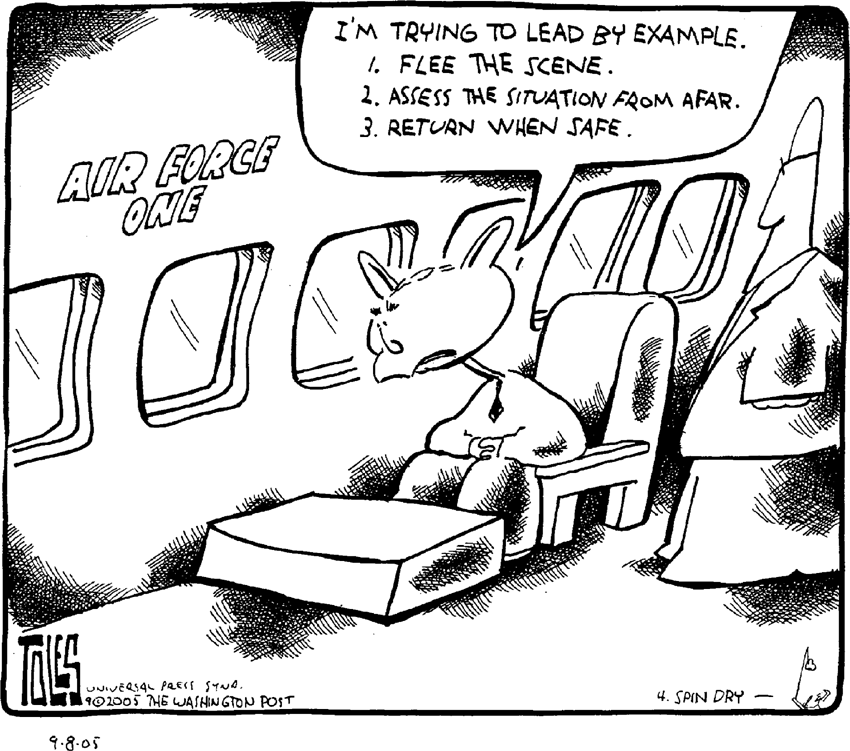
Burkean theorist David Tell (2004) notes that metaphor is Burke's foundational trope. As a base trope, metaphors allow the audience to “see something in terms of something else” by the interaction of both graphic and discursive elements (Bostdorff 1987, 48). One example is Toles's cartoon of September 8, 2005 (see Figure 1).1
See also his cartoons for September 20, October 10, and October 25, 2005.

Metaphor. Toles © 2005 The Washington Post. Reprinted by permission of Universal Press Syndicate. All rights reserved.
Irony
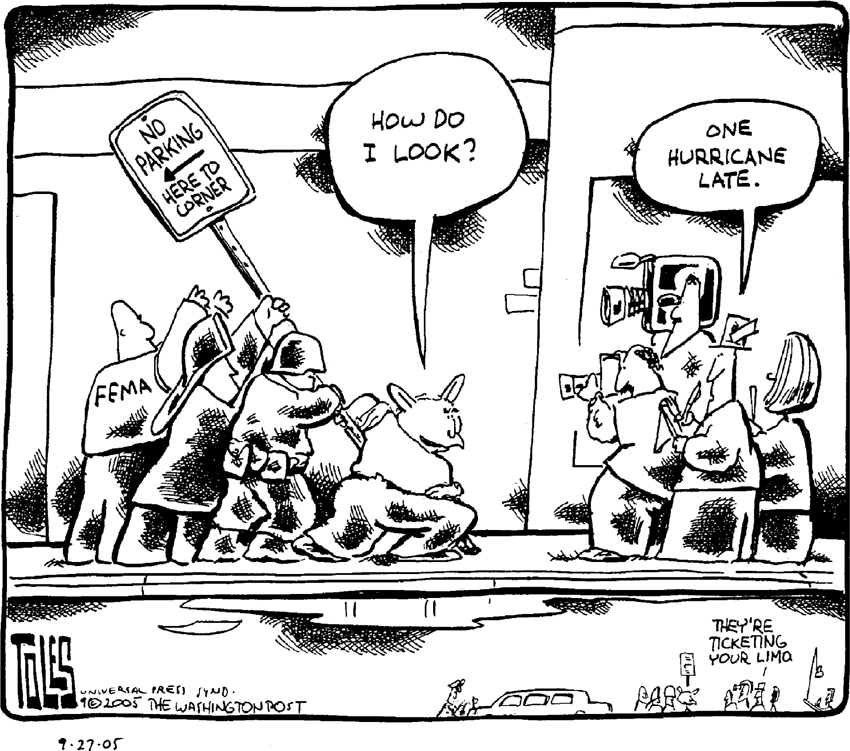
Effective formatting extends to the trope of irony. Burke notes that when an individual employs irony, “he must realize that he also needs this particular foolish character as one of the necessary modifiers” (Tell 2004, 48). This relationship between character and creator is essential to the function of irony, as its use demands “a fundamental kinship with the enemy” (Tell 2004, 48). Irony is commonplace in editorial cartoons, as most frames focus on political and social issues. Editorial cartoons present “images that are frequently juxtapose with those of threatening political figures, resulting in a transcendent meaning or irony” (Bostdorff 1987, 50). This symbolic or rhetorical association creates a connection that positively/negatively links an act to an actor. Both verbal and situational irony achieve this connection, noted through Toles's cartoon of September 27, 2005 (see Figure 2).2
See also his cartoons of September 2, 18, 25, and 29, 2005.

Irony. Toles © 2005 The Washington Post. Reprinted by permission of Universal Press Syndicate. All rights reserved.
Synecdoche
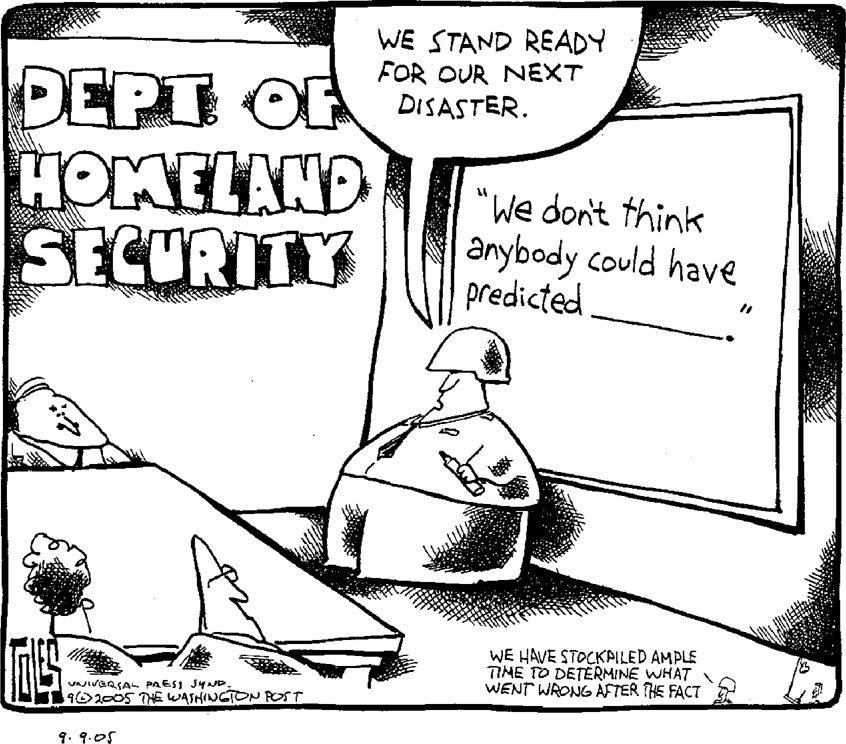
It is possible to connect with an audience through the trope of synecdoche, which formulates an argument as a relationship between the part and the whole (Bostdorff 1987, 52). Synecdoche achieves its purpose by incorporating “signs drawn from the everyday actions and objects that surround public figures” (Bostdorff 1987, 52). This relates to the inclusion of popular social and political issues that appeal to audiences. Exemplifying synecdoche is Toles's cartoon of September 9, 2005 (see Figure 3)3
See also his cartoons of September 14, 15 and October 9, 2005.

Synecdoche. Toles © 2005 The Washington Post. Reprinted by permission of Universal Press Syndicate. All rights reserved.
Metonymy
Burke's trope of metonymy, an organizational principle that fulfills the function of reduction, is the final form for constructing arguments and messages (Bostdorff 1987, 55). This means that a large concept or idea can be effectively conveyed through a reduced single image. Metonymy parallels synecdoche through the ability to assert a message within a single frame. This reinforces Phillip Arrington's assertion that, “tropes are inescapable; they operate consciously or unconsciously, even in our discourse about discourse” (Arrington 1986, 325). Arrington's claim accentuates the pervasive and interchangeable nature of tropes that make them important tools for structuring arguments. Within the context of political cartooning, the use of metonymy serves to direct “the activities of the writer's mind into images of the corporeal and tangible” (Arrington 1986, 328). This proves a challenge for political cartoonists, as they must concisely formulate and articulate their thoughts into a single cartoon.
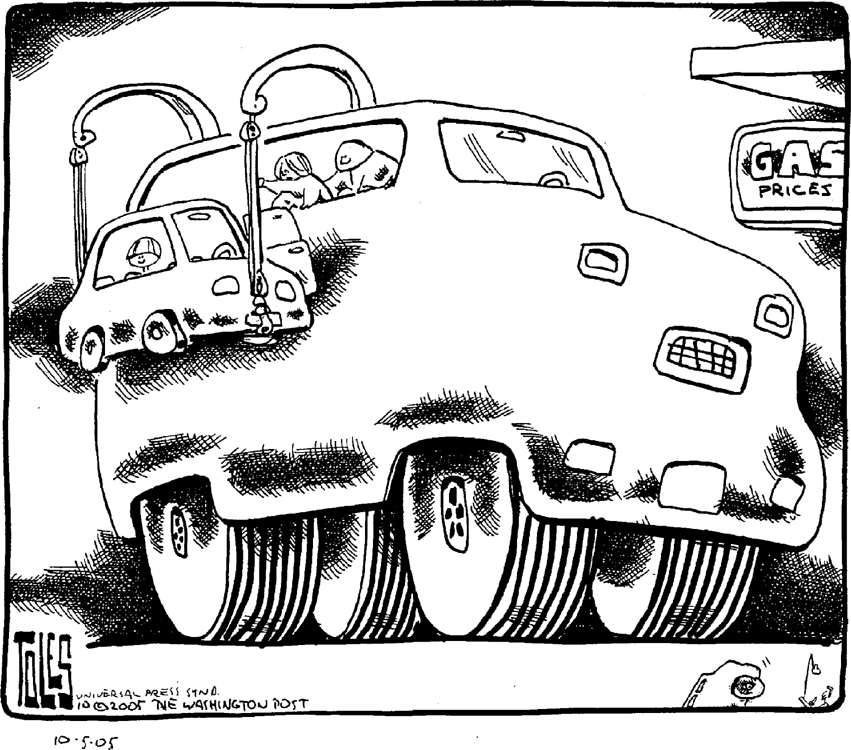
In the case of Toles's Hurricane Katrina cartoons, the theme of metonymy is apparent in his cartoon of October 5, 2005 (see Figure 4).4
See also his cartoons of September 4 and October 3, 2005.

Metonymy. Toles © 2005 The Washington Post. Reprinted by permission of Universal Press Syndicate. All rights reserved.
Conclusion
Kenneth Burke's four master tropes provide a useful approach to understanding the persuasive impact of political cartoons. The application of Burke's tropes to the selected images creates a new perspective for tackling the often intricate and convoluted arena of political cartoons. Of course, it is not simply a matter of demystifying the world of political cartooning, but rather an opportunity to revisit and redistribute the available resources within academia. Therefore, in trying to understand political persuasion, it can be useful to use theories and perspectives from outside of political science.