




No CrossRef data available.
Executive Director's Report, 2004
Published online by Cambridge University Press: 01 October 2004
Extract
The executive director's report each year represents APSA's annual report and provides an opportunity to comment on current issues facing the Association and the discipline. This year's report touches on activities in all of our major program areas. In this preface, I'd like to mention several priority areas in which the Association took new steps in the last year. This should be acknowledged in the context of our substantial on-going agenda to meet the basic responsibilities of the Association by advancing the discipline of political science through our highly pro ductive Annual Meeting, three strong journals, broad com munity building activities through or ganized sections, status committees, special projects, and much more.
Information
- Type
- Association News
- Information
- Copyright
- © 2004 by the American Political Science Association
The executive director's report each year represents APSA's annual report and provides an opportunity to comment on current issues facing the Association and the discipline. This year's report touches on activities in all of our major program areas. In this preface, I'd like to mention several priority areas in which the Association took new steps in the last year. This should be acknowledged in the context of our substantial on-going agenda to meet the basic responsibilities of the Association by advancing the discipline of political science through our highly pro ductive Annual Meeting, three strong journals, broad com munity building activities through or ganized sections, status committees, special projects, and much more.
Operationally, the Association remains very strong. Basic indicators—membership, meeting attendance, section size—all remain healthy. We have faced several key staffing changes in the last year in the leadership of the membership and meetings departments as senior staff who grew into those positions at APSA have moved on to pursue leadership positions elsewhere. We've filled these roles internally, providing promotion opportunities for other APSA staff, and allowing us to use the remaining staff openings to meet new organizational needs. Perhaps the most dramatic initiative affecting operations in the current year was the purchase of a second building bordering our headquarters in Washington, D.C. The newly acquired building shares a back lot line allowing coordinated activities in the two buildings, as opportunities evolve. In the immediate term the building is being managed as an investment opportunity. All costs and revenues are carried within our investment accounts—so that the operating costs of the building are not competing with funds for program operations.
Salient program areas for the last year cover several areas: teaching and learning, public presence, the Centennial Center, international initiatives, and governance. There has been significant progress toward long-term impact in each of these areas.
Teaching and Learning
In Washington D.C in the spring of 2004, APSA held its first conference on teaching and learning in political science. As a result of its success, plans are underway to develop a larger conference in 2005 to accommodate 200 faculty and graduate students, and to institutionalize the conference as an annual APSA program. The objectives for the conference are simple—to provide a sustained and structured environment for political scientists to address pedagogy, new teaching technologies, and the marriage of political science content and presentation.
Public Presence
For several years, APSA has sponsored Task Forces to promote dissemination of political science research on prominent public themes to a wide non-academic audience. These Task Forces speak in the voice of the individual task force members with the sponsorship of the Association. Two have recently completed their work—those on Inequality and American Democracy and on Civic Engagement and Public Policy. Another, on Inequality and Difference in the Devel oping World, is underway.
In the past year, the Association has responded to a broader set of questions regarding dissemination of political science knowledge to the public by focusing its press relations in three areas—through the Task Forces, in response to prominent public issues, and in reaction to press inquiries. A full program is underway to com pile press materials on the U.S. presidential election; an earlier effort focused on the Canadian elections. The Association solicited summaries of election issues likely to draw press interest from individual scholars, then combined these with references to current discovery research in political science on those topics and names of experts from the discipline. This initiative is housed on the new APSA media web site, www.politicalsciencenews.org.
Centennial Center
The Center, housed in the APSA building, has truly reached its stride, with an almost full house of scholars for the last year. The summer months have brought over a dozen visiting scholars at different times; seven will be in residence during the fall, including scholars from British, Spanish, Danish, and Irish institutions as well as from a broad range of U.S. colleges and universities.
International Initiatives
The APSA International Committee pre pared a forward-looking position paper addressing the Association's international focus. Responding to a charge from APSA President Susanne Rudolph to explore how the Association can achieve closer in teraction between American and non-American political scientists and a greater cross-fertilization of their substantive and methodological concerns, the Committee has articulated both a rationale for greater internationalization of the Association and strategy to move forward. The approach includes greater support for international travel grants, greater international rep resentation in APSA appointments, improved access to scholarly materials for international members, new membership options, and so forth. The APSA Council has received this report favorably, and discussions on ways to implement specific steps highlighted in the report are un derway.1
The report can be viewed at http://www.apsanet.org/about/international/2004statement.cfm.
Governance
In the winter of 2003, President Susanne Rudolph, with Council advice and con sent, named a committee, chaired by Kirstie McClure, “to inquire into how contested elections might be rendered consonant with the representation of the Association's many dimensions of diversity.” The impetus for the Committee followed from two considerations—the potential impact for the composition of Association leadership if contested elections were to emerge with some regularity under existing election rules; and how diversity goals might be addressed under alternative configurations of offices and procedures. This ini tiative follows a continuing discussion within the Association about governance models and modes for selection of nominees for elected office, reflected in, among many things, the occurrence in 2003 of APSA's first contested election in many years. The 2003 election was APSA's first online election, with a total voter turnout of 4,348, or 30.1% of all eligible voters.

Continuing Agenda
In the meantime, of course, our activities continue across the board. In the remainder of this report, I will identify the core clusters that make up a modern scholarly society and some of the current developments that relate to the broad components of an academic discipline and scholarly enterprise.2
Some clusters relate to our program objectives and some relate to the operational capacity needed to achieve them. The programmatic clusters are: Advancing scholarship through publications and meetings; Promoting education and teaching in political science; Enhancing the public presence of political science; Building the professional community of political scientists; Providing support for institutional components of the field including academic departments and research funding; and Further international linkages. The operational ones are: Meetings management; Services and technology; Business services; Development; and Association administration and governance.
Scholarship, Publications, and Meetings Cluster
Since APSA is foremost a learned society, the direct advancement of knowledge is at the core of APSA activities. These activities include supporting publication of the American Politi cal Science Review, Perspectives on Politics, and PS: Political Science and Politics, and the conduct of the Annual Meeting. All of these efforts are healthy and at the forefront of the field.
APSR
The report of the editor of the American Political Science Review is published in PS and can also be obtained from the APSA offices and on the web site. An external committee named by the Council to review the performance of Lee Sigelman's editorship strongly recommend his reappointment for a second term, a recommendation the Council enthusiastically adopted this spring.3
Barbara Geddes, University of California, Los Angeles (chair), Stephen D. Krasner, Stanford University, Walter R. Mebane, Jr., Cornell University, and Marion Smiley, Brandeis University served on the review committee.
Perspectives on Politics
APSA's newest journal, Perspectives on Politics, also con tinues to receive high acclaim, broadly succeeding in its aim to “publish articles that clarify the political significance of ac cumulated research regarding a particular area of the world, an important policy problem, a deep normative conflict, or a significant institution or process.” Jennifer Hochschild, the inaugural Perspectives editor, signaled that she would not renew her term of editorship. Susanne Rudolph, in consort with President-Elect Margaret Levi and the Council, has named a search committee to recommend a new editor. The book reviews, also published in Perspectives, have remained under the editorship of Greg McAvoy for the year, and a new editor will be named as part of an overall Perspectives editorial team.
PS: Political Science and Politics
PS remains APSA's journal for symposia and articles on current developments in politics and political science, forum for professional development and teaching issues, and journal of record for developments in the Association. Even with Per spectives on Politics in place, PS is continuing to receive numerous and high quality symposia proposals and remains an intellectually lively and current journal.

Other Publication Initiatives
APSA's initiative in partnering with other domestic and international political science associations to form PROL, Political Research OnLine, has led to a major new resource for early scholarship. Over 15,000 current papers on early research in politi cal science are now available in an open access, full-text searchable database, at www.politicalscience.org. The effort has also led to a new generation of collaboration among political science associations, including, at this stage, the Midwest PSA, the Western PSA, the Southern PSA, the International Political Science Association, and the International Studies As sociation.
Annual Meeting Policy and Planning
The APSA Annual Meeting remains the single largest meeting for the exchange of political science scholarship in the world. Annually, 6,000 atten dees meet for scholarship, professional development, research planning, teaching, and exchange of research and teaching resources. We gathered this year in Chicago, the city where the annual conference first convened, for our 100th meeting.
Awards, Funds, and Lectures
APSA awards are also a way to recognize, and indi rectly encourage, excellence in scholarship. APSA directly presents 19 awards; organized sec tions administer another 75. Currently, $814,567 is held in endowed funds to support APSA awards. This year the Council has authorized the addition of an award for the best paper in Perspec tives in Politics to the mandate of the Eulau Award committee, formerly limited to APSR. Cam bridge University Press has generously offered to sponsor this new award until an endowment can be raised.
Education and Teaching Cluster
The effective teaching of political science is a core mission of the Association, both as a component of functioning as a learned society and in support of the professional interests of a large majority of our members.4
APSA has long played a strong role in support of education and teaching, with key reports on teaching personnel in 1934, civics education in wartime in 1940, and so forth. News for Teachers of Political Science was published as a separate teaching newsletter in 1978, and is now incorporated as an integral part of PS. APSA was a leader in preparing instructional materials relating to the U.S. Constitutional Bicentennial and in producing the telecourse Congress: We the People in the 1980s.
In the spring of 2004, APSA held its first conference on teaching and learning in political science. Due to its success, plans are underway to develop a larger confer ence in 2005 to accommodate 200 faculty and graduate students. The objectives for the confer ence are simple—to provide a sustained and structured environment for political scientists to address pedagogy, new teaching technologies, and the marriage of political science content and presentation. We do not intend to reduce the coverage of teaching at the APSA Annual Meeting and we fully intend to assure that the teaching conference brings together faculty from all sizes and types of institutions.

Public Presence Cluster
APSA, by design, stays out of the public policy fray. The APSA Constitution states explic itly that the Association “will not commit its members on questions of public policy nor take positions not immediately concerned with its direct purpose [to encourage the study of Political Science.]” However, the APSA Constitution also encourages “in its membership and its journals, research in and concern for significant contemporary political and social problems and policies, however controversial and subject to partisan discourse in the community at large these may be.”

In the spirit of this two-pronged set of directions in the Constitution, the Association is adopting an active strategy on multiple fronts to promote the engagement of political scientists and public life. This approach includes Task Forces that can integrate and articulate what scien tists know on public issues, anticipation of major press interest in public issues (such as elec tions) and advance preparation of responsive materials, and more adept responsiveness to press requests.
In the spirit of this agenda, the Association held its first press conference in recent times to release the report of the Task Force on Inequality in American Democracy. In an APSA-spon sored event at the National Press Club, Task Force Chair Lawrence Jacobs and Theda Skocpol presented the Task Force results, and Thomas Mann, senior fellow, Brookings Institution, Norman Ornstein, resident scholar, American Enterprise Institute, and William Kristol, editor and publisher, The Weekly Standard, provided commentary for the press. The event was covered live by CSPAN. The Russell Sage Foundation also provided support for the work of the Task Force, and will help to publish its findings.
Similarly, the Committee on Civic Education and Engagement is wrapping up a report on the state of civic engagement in America. This report will articulate political science perspec tives on how civic engagement can be strengthened. It also is expected to have an external sponsor to support publication. APSA has also established a new press oriented web site at www.politicalsciencenews.org. This site houses our first effort to proactively address press needs by assembling political science intelligence on key issues certain to attract attention, as in the presidential election. We will continue to evaluate the success of this on-going model.
Congressional Fellowship Program
The APSA Congressional Fellowship Program represents the Association's preeminent effort to link political scientists with active public life, therein strengthening research careers, teaching, and public policy.5
The CFP began in 1953 with the naming of five political scientists to serve as interns in Capitol Hill offices for a year. The initiative was supported by a grant from the Edgar Stern family of New Orleans, which represented radio and television interests in the city, and helped marry the program with journalism from the very start, with a journalist also named in that first year. Since that time, the program has expanded to include a growing number of international fellows supported by various foundations, an annual Native American Hatfield fellow named after former Senator Mark Hatfield, fellows sponsored by the American Sociological Association and the American Anthropological Association, Robert Wood Johnson health policy fellows, domestic and foreign policy specialists from government agencies, and journalists sponsored by a range of supporters. In 1991, the MCI Communications Corporation endowed the fellowships with a $5 million grant that has been the backbone of its continued successful operations.
Now in its 51st year, the program has turned its attention to increasing the diversity of, and expanding the enrichment opportunities available to, its participants. Thanks to aggressive recruiting efforts on various professional and association web sites, the number of journalist ap plicants has doubled over the past two years and the incoming class includes several African-American, Native American, Latino, and Arab-American Fellows. Senior Fulbright scholars from China, the Czech Republic, India, and Mexico add their unique perspectives as well.
Recognizing that potential applicants increasingly turn to the Internet to research their options, Director Jeff Biggs and Program Associate Sarah Dougherty have made major im provements to the fellowship's web site. These include clarifying application guidelines, improving and updating program descriptions, streamlining index pages, posting important legal information for current fellows, and adding quotations, photos, and graphics. The staff has also added a section specifically tailored to program alumni listing classes and office assignments by year. Email listservs have helped fellowship alumni keep in touch with one another after the fellowship has concluded, when the “multiplier effect” begins to take on more meaning. Last year, the staff initiated a six-page alumni newsletter, complete with photos, to keep former Fellows abreast of program developments and to stimulate contributions. The staff continues to email individual letters to 750-plus personal office chiefs of staff and majority/minority com mittee staff directors encouraging them to “host” Fellows. As a consequence, the 2003–2004 Fellows broke new ground in key committee assignments and offices of senior members which seldom add Fellows to their senior staffs. The especially tailored two-day Congressional Research Service (CRS) Seminar on Senate and House legislative procedures was particularly valuable as a surprising number of Fellows got involved in legislative drafting.
As an important “bridge” connecting those who teach about politics, those who write about politics, and those who work in politics, the fellowship expanded its public engagement role. Early in the orientation, the Fellows participated in a daylong CRS-sponsored symposium on changes in the role of the House Speaker. Featured guests were former Speakers Wright, Foley, Gingrich, and Hastert. Another example of the program's reach includes the 2004 publi cation of War Stories from Capitol Hill, a new volume in the Prentice Hall “Real Politics in America” series. In addition to Editors Colton C. Campbell (CFP 1989–1990) and Paul S. Herrnson (CFP 1989–1990), all contributors were fellowship alumni. Biggs and CFP alumnus John Pitney of Claremont McKenna served as advisers for a 25th anniversary C-SPAN survey on the usefulness of cable network coverage to political science. The Legislative Studies Section served as the survey's audience.
Centennial Center and Programs
APSA's newest venture linking political science with public resources and issues lies in the opening of the Centennial Center for Political Science and Public Affairs in the APSA building in Washington. The foremost purpose of the Center is to support research scholars needing access to international and domestic political and policy resources in Washing ton by providing workspace and collegial interaction. We anticipate, however, that the Center will also play a significant role in linking political science scholarship to the political and policy community in Washington through seminars, speakers' series, workshops, and dialogue. By bringing scholars from different countries, fields, and areas of practice together, we expect that the Centennial Center will expand the boundaries of scholarly and public understanding and practice—building another “bridge” connecting those who teach about politics, those who write about politics, and those who work in politics.
Professional Community Cluster
Strengthening the professional community of political scientists is an important and in strumental goal of the Association and APSA approaches this goal in numerous ways. These include personnel services and job placement, outreach and recruiting to the discipline itself, support for APSA's status committees and the communities for which they speak, career materials for students considering entering the political science field and for political scientists assessing their opportunities, directories of political scientists and compilations of data about the field, and oversight of ethical standards and practices in the field. Such activities to improve the professional situation of political scientists are valuable to members in their own right, and are a means to meeting other key goals such as building scholarship or advancing teaching.
Personnel Services and Placement
The agreement among political science depart ments, codified in the APSA ethical standards, that all academic positions at the assistant and associate levels be listed in one commonly accessible site is a core building block of the political science community. Job listings are managed online, and are now accessible to all APSA mem bers without additional fees. Job listings are free for departments belonging to APSA's departmental services program, and are priced at market rates for others. Listings are also integrated with options for job-seekers to post resumes online, and in turn to arrange interview opportunities at the APSA Annual Meeting.

APSA's coordination of the political science academic job market is also a major new area of collaboration among domestic political science departments. The APSA job listing web site has opened to allow other scholars to schedule interviews at other association meetings, an operation which has begun at the Southern, Northeastern, and Western society meetings.
Diversity
Perhaps one of the highest priorities we have in the profession is to assure that the community of political science scholars is as inclusive as possible. This goal applies to the composition of the professoriate, the graduate student classroom, and to the practicing world of political science, as well as to the content of scholarship and approaches taken by the discipline.
APSA initiatives include Minority Fellowships for doctoral study, a Minority Identifica tion project for recruiting new doctoral students, active support of the Ralph Bunche Institute hosted and sponsored by Duke University and the National Science Foundation, the efforts of Status Committees in the profession for Asian Pacific Americans, Women, African Americans, Latinos y Latinas, and Gays, Lesbians, Bisexuals, and the Transgendered, and those of Organized Sec tions on Race, Ethnicity and Politics and on Women and Politics, and that of the related group, the Indigenous Studies Network.
These are significant efforts, but we have much more to do in support of minority re cruitment, including important efforts needed to support the retention and professional advancement of underrepresented groups. This year, we plan to organize a program review for APSA's major diversity programs to better understand how they have accomplished the goals of recruitment and retention of underrepresented groups. This Advisory Committee will begin its work in the fall of 2004.
Professional Career Materials
There are a number of APSA efforts underway to ad dress issues affecting the academic workplace for political scientists. APSA is a member of the Coalition on the Academic Workforce that addresses issues faced by part-time and adjunct fac ulty in the profession. We have participated in a forum on the subject at the AAC&U conference in Seattle for academic deans and faculty and have advised AAUP in the formulation of its new statement on this topic.
The Departmental Services Committee, and the Committee on the Status of Women in the Profession, have cooperatively focused on questions of building familyfriendly workplaces in the academy. A report from the Committee on the Status of Women is forthcoming in PS, and other materials are in preparation.
The Association has also continued to promote programs to identify “questions to ask” for students entering graduate school and for faculty seeking academic positions. These pro grams were originally named the registering and rostering initiatives and have been renamed for clarity. They call on academic departments to commit to answering sets of questions about their programs, and they encourage student and job applicants to ask probing questions that can help assure that future placement will be a good fit for candidate and institution. These programs have generated great response from the membership. We now have approximately 179 universities enrolled in the Job Candidate Questions to Ask program and 44 schools in the Graduate School Questions to Ask program.
Mentoring
The Task Force on Mentoring instituted a formal mentoring program for graduate students and faculty. A new mentor database allows faculty and graduate students to network for career development. The APSA Mentor Database connects interested graduate stu dents and faculty with political scientists in the field to counsel on matters of the profession. Information on political scientists willing to act as mentors is stored in the database. Individuals seeking a mentor can contact APSA to receive a report listing avail able mentors, contact information, a short biography, and topics on which the mentor has specialized experience.
The APSA Task Force on Mentoring was also successful in securing a National Science Foundation SGER (Small Grant for Exploratory Research) in March 2004 to develop a workshop addressing women's advancement in political science. This workshop had the following goals: (1) to clarify the key advancement problems confronted by women in political science; (2) to explore the origins of women's differential rate of advancement by prestige of the university and by sub-field in political science; and (3) to identity the key barriers to women's academic success at different transition points. A report from the workshop findings will be available in the fall of 2004 and materials have also been posted on the web site.
Ethics
One of the foundational activities of the Association in supporting the professional community is the articulation of statements of professional ethics for political sci entists. The Committee on Professional Ethics, Rights, and Responsibilities stands ready to re spond to grievances that fall within its jurisdiction, including helping protect the human rights of scholars in other countries. While legal and resource constraints often inhibit the Association's ability to investigate in depth or to apply public sanctions, the Committee can serve as a source of moral suasion, as a sounding board, and as a problem solver.
The enterprise of political science is built from more than individual and Association contributions. There are important institutional building blocks as well. APSA works in this vein directly with organized sections and related groups that operate within the associations, academic departments, and other institutions that supply, coordinate, or lobby for research support.
Organized Sections and Related Groups
One of the most effective recent develop ments within the APSA community has been the growth of organized sections. Sections, estab lished initially in 1981, assumed a major responsibility for organizing Annual Meeting panels in their areas in 1989. This year two new section journals came into existence, a new Journal on Teaching and Learning in Political Science, sponsored by the Undergraduate Education Section, and the journal Gender and Politics, spon sored by the Section on Women and Politics. In sadder news, the Ecological and Transformational Politics Section came to an end because it could not maintain required minimum membership level.
Academic Departments
Early in its history in the United States, political science gravitated to the academy, and political science departments have since served as the building blocks of the discipline. Since 1972, APSA has operated a substantial institutional membership program of academic departments called the Departmental Services Program (DSP) to support these departments and to offer them a leadership role in the Association. The core of this pro gram is its oversight of the employment placement service (and free listing access for DSP members), but there are a wide range of additional components—including materials depart ments can use to promote political science and recruit students, a chairs' workshop, a chairs' handbook that will function as an online community discussion forum on key aca demic, policy, and operational issues, and a data gathering program to allow departments to benchmark themselves against a pool of similar-sized programs.
Small Research Grants
One role for APSA in the midst of many other large research support institutions is to fill in gaps. APSA does this with its small research grant program. The program supports research in all fields of political science by political scientists who are not em ployed at Ph.D.-granting institutions. The concept is to help further the careers of the scholars at those institutions that typically have less access to other research support resources. The Asso ciation typically grants between 15 and 20 awards annually ranging from $1,500 to $2,500 each.
These awards are very popular with members and are highly pro ductive. Grant recipients in a recent five-year period have published over 11 books, 16 refereed articles, eight book chapters, many working papers, and a very large number of conference pres entations, with more products in the works. Many recipients also report that their students benefit as co-authors, as research assistants, and in classroom use of their professors' research. Many recipients also use the APSA grants as seed money to obtain additional funding.
Research Support and Policy Liaison
Organiza tions that fund research, set research support policy, or coordinate other organizations on re search issues are a major institutional component of the political science community. APSA has a significant role in representing political science in these settings. We do this in several ways, including membership in consortia, such as COSSA and the National Humanities Alliance (NHA), and representation in leadership organizations such as the Ameri can Council of Learned Societies and the Social Science Research Council. Our involvement with COSSA and NHA is especially significant because their listing as 501(c) 4 organizations under the tax code permits them to function actively as lobbyists. This year APSA also joined the Coalition for International Education— a consortium of scholarly societies and higher educa tion groups focused on protection and expansion of the higher education act and related goals.
In the spirit of this outreach on policy matters affecting opportunities for scholarship and academic freedom, APSA wrote letters to Congress opposing changes that would have imposed restrictive oversight on Overseas Study Centers, and called for full and open hearings in the ap pointment of a new archivist of the United States.
Operational Components of APSA
A major operational component to the Association supports the program work described above. APSA has 23 full-time staff and a small number of student interns to manage and support our programs. These staff work in a range of cluster areas including overall Association administration, meetings operations, development and sponsorships, services and technology, publications, and business operations. Last year's Executive Director's Report pro vided an overview of these roles, and the major developments that have occurred within them in recent years. We continue to innovate.
APSA's building remains one of its most significant assets. We are in the midst of routine external renovations of the building to repair aging grout and paint trim. And as noted above, we have expanded our campus through the purchase of the building on a contiguous lot in the back, and will take gradual steps in the future to integrate activities across the buildings.
As always, we invite you to visit the APSA building in Dupont Circle in Washington to meet the APSA staff, and we seek your suggestions and advice for APSA programs and your active participation in section and Association governance.
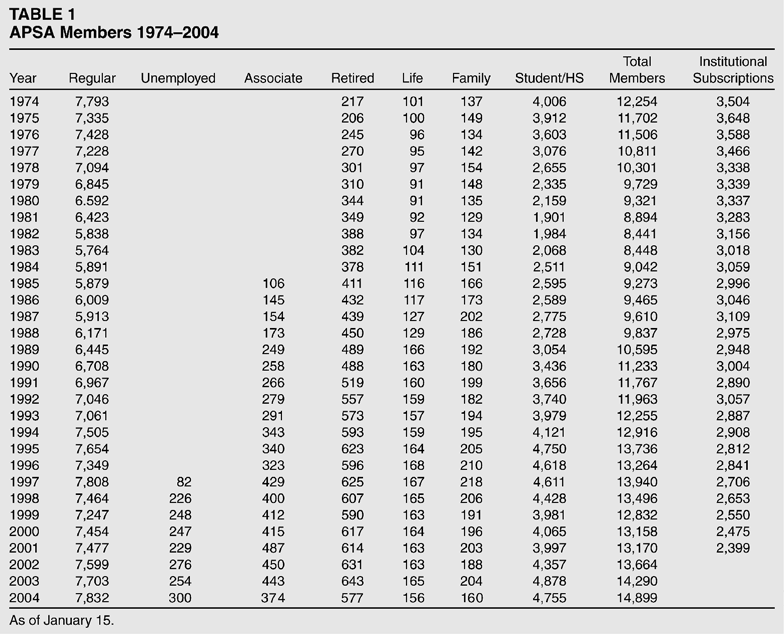
APSA Members 1974–2004
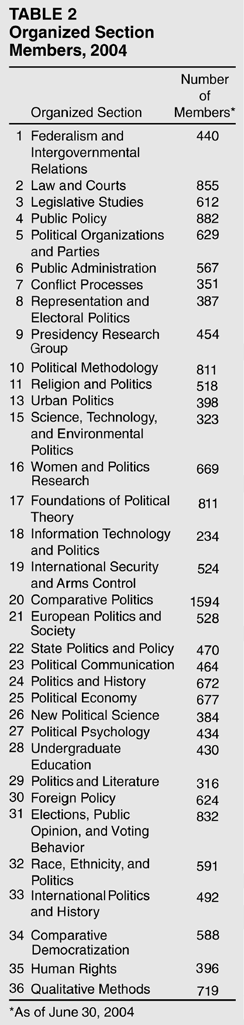
Organized Section Members, 2004
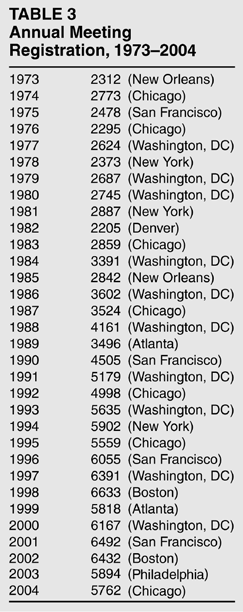
Annual Meeting Registration, 1973–2004
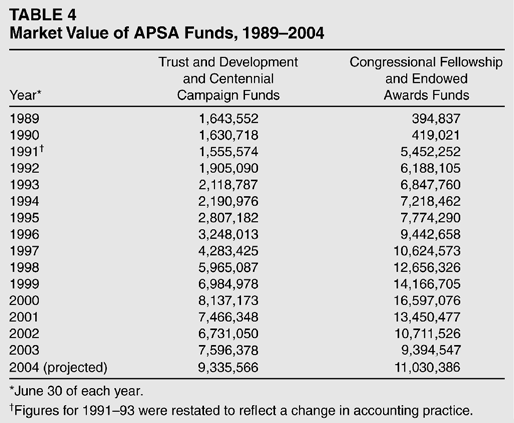
Market Value of APSA Funds, 1989–2004
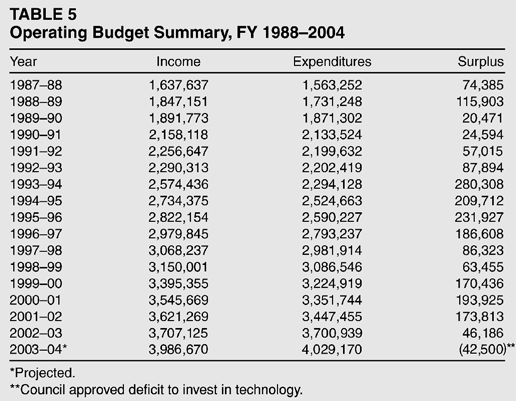
Operating Budget Summary, FY 1988-2004
 You have Access