




No CrossRef data available.
The Frontrunners—2008
Published online by Cambridge University Press: 06 October 2005
Extract
The final chapter on the 2004 presidential election may not yet bewritten, but it is not too soon to look ahead to the 2008 contest.Public pollsters have been assessing opinions about the 2008campaign for months already. Given the importance of frontrunnerstatus in an increasingly frontloaded presidential primary system(Mayer 2004), the 2008 race hasalready begun for many prospective candidates, parties, and voters.In this article I analyze early public opinion polling dataavailable from the Roper Center's IPOLL database about the 2008 raceto determine the frontrunning candidates (at least through June2005) and to reflect on the preliminary dynamics of the nextpresidential race.
Information
- Type
- Association News
- Information
- Copyright
- © 2005 The American Political Science Association
The final chapter on the 2004 presidential election may not yet be written, but it is not too soon to look ahead to the 2008 contest. Public pollsters have been assessing opinions about the 2008 campaign for months already. Given the importance of frontrunner status in an increasingly frontloaded presidential primary system (Mayer 2004), the 2008 race has already begun for many prospective candidates, parties, and voters. In this article I analyze early public opinion polling data available from the Roper Center's IPOLL database about the 2008 race to determine the frontrunning candidates (at least through June 2005) and to reflect on the preliminary dynamics of the next presidential race.
The Democrats
Data presented in Table 1 show that New York Senator Hillary Clinton is far and away the leading Democrat in the field. A Fox News/Opinion Dynamics survey conducted in June 2005 shows that most Democratic partisans (44%) prefer Clinton over any other Democratic contender. Clinton is consistently the most popular Democratic option in each of the other polls. Moreover, her support amongst Democrats appears have increased between September 2004 and June 2005: an early Ipsos poll conducted in September 2004 shows Clinton with 33% of the Democratic primary vote, which increased to 39% support in a Marist poll from February 2005, to 40% in a Gallup survey fielded in February 2005, and to 40% in an April 2005 Marist survey. Massachusetts Senator and 2004 Democratic Nominee John Kerry places second in all five polls, but he trails Clinton substantially. The gap between the two Democrats is widening: Clinton leads Kerry by 27 points in the most recent Fox News/Opinion Dynamics survey, 22 percentage points in the April 2005 Marist poll, 18 points in the February 2005 Marist survey, 15 points in the Gallup poll, and by 14 points in the Ipsos survey. Former North Carolina Senator and 2004 Vice Presidential Nominee John Edwards fares well in all five polls, although he trails both Clinton and Kerry. Edwards's support also appears to be diminishing, dropping from a high of 17% in February 2005 (Gallup) to a low of 13% in the June 2005 Fox News/Opinion Dynamics survey.
If the 2008 Democratic presidential primary were held today, whom would you support if the candidates are [see below]?

Senator Clinton's appeal extends beyond Democratic partisans. Most registered voters (49%) indicated, for the first time, in the April 2005 Marist poll, that they would like to see the senator run for president in 2008, up from 46% in a February 2005 Marist survey in which 49% indicated that they did not want to see her run. Clinton's momentum appears to be mounting as support for a Clinton run amongst registered voters nationally has climbed from the 38% recorded in a December 2004 Marist poll. (Survey details available upon request.)
The Republicans
Amongst Republicans, former New York City Mayor Rudolph Giuliani consistently emerges as the most popular contender. Data presented in Table 2 reveal that nearly one in three Republicans prefer Giuliani in the two most recent polls (29% in the June 2005 Fox News/Opinion Dynamics poll and 27% in the April 2005 Marist poll). Gallup finds that more than one in three (34%) Republicans prefer the former mayor in the February 2005 survey. Twenty-five percent designate Giuliani as their top choice in the Marist poll conducted in February 2005, and 29% prefer Giuliani in the September 2004 Ipsos poll. Arizona Senator John McCain trails Giuliani closely in all three surveys, garnering 26% of Republican support in the most recent survey (June 2005), up from a low of 20% in the April 2005 Marist poll. McCain captures 29% of Republican support in the CNN/USA Today/Gallup poll (February 2005), 21% in the Marist poll also conducted in February 2005, and 25% in the September 2004 Ipsos poll. Respondents were only surveyed on their preferences for Secretary of State Condoleezza Rice in the February 2005 Marist poll, where 14% of Republicans expressed support for her. Florida Governor Jeb Bush also emerges as a contender, capturing 10% support in the April 2005 Marist poll, 7% in the Marist (February 2005) and Ipsos (September 2004) polls, and 12% support in the CNN/USA Today/Gallup poll (February 2005). Another possible Republican candidate, former speaker of the U.S. House of Representatives Newt Gingrich, fares well amongst fellow partisans: Nearly one in 10 (9%) Republicans indicate they would support Gingrich in the Republican primary in the June 2005 Fox News/Opinion Dynamics poll, essentially doubling his support from the February 2005 Marist poll in which 5% of Republican respondents noted Gingrich as their top choice.
If the 2008 Republican presidential primary were held today, whom would you support if the candidates are [see below]?

The data indicate there is far greater—and growing—uncertainty amongst Republicans than amongst Democrats about the 2008 nomination. Whereas the proportion of undecided Democrats ranges from 6% (CNN/USA Today/Gallup , February 2005) to 13% (Fox News/Opinion Dynamics, June 2005), the proportion of undecided Republicans ranges from 7% (CNN/USA Today/Gallup , February 2005) to 24% (Marist, April 2005).
Furthermore, support for a Giuliani candidacy amongst all registered voters appears to have wavered between late-2004 and mid-2005. Whereas 50% of respondents expressed support for a Giuliani run in a September 2004 poll conducted by PSRA/Newsweek, a poll conducted by Quinnipiac shows that support dropped substantially to 39% in January 2005. Marist finds, in December 2004, that only 32% of registered voters wanted to see Giuliani run (compared to 42% who indicated they would prefer he not run in the same survey), even as the April 2005 Marist poll finds support for a run at 49% of registered voters (compared to 43% who would not like to see him run for president in 2008). (Survey details available upon request.)
Democrats vs. Republicans: Pairwise Matches
A series of surveys conducted by various organizations (data not displayed is available upon request) probes registered voters; preferences in hypothetical match-ups between various candidates. A series of six separate polls conducted by various survey organizations between November 2004 and April 2005 presented pairwise matches to respondents between the two leading contenders, Democrat Hillary Rodham Clinton and Republican Rudolph Giuliani. The results suggest that a Clinton-Giuliani race would be close (Table 3). Most polls indicate the match is a statistical dead-heat, even though Clinton trails Giuliani by at least 1 point in all five polls. More telling perhaps are the dynamics of preferences indicated by the data: Clinton's support amongst registered voters appears to be mounting, up from 38% in November 2004 to 46% in April 2005 (Clinton registered a high of 47% support in the February 2005 Marist poll), while Giuliani's support appears to be unsteady, dropping from 49% in September 2004 to 44% in March 2005, then growing to 47% in the most recent survey. Despite widespread speculation about the high-profile match-up between the two New Yorkers, substantial numbers of voters claim to be undecided about a Clinton-Giuliani contest, ranging from 4% of respondents (Marist, February 2005) to 13% (Fox News/OD, November 2004). The two most recent surveys, conducted in April 2005 by Marist and Quinnipiac in March 2005 show 7% and 10%, respectively, are undecided between the two prospective contenders.
If the 2008 election for president were being held today, and the candidates were Hillary Rodham Clinton, the Democrat, and Rudolph Giuliani, the Republican, for whom would you vote?

Senator Clinton trails her Republican colleague John McCain consistently in four polls conducted between November 2004 and April 2005. In most cases, Clinton falls behind McCain by a wider margin than she does Giuliani, suggesting that McCain may be a stronger Republican contender against Senator Clinton than the former New York City mayor. The survey results presented in Table 4 indicate, however, that a Clinton-McCain contest seems to be drawing increasingly closer. Clinton trailed McCain by 16 points in a hypothetical match-up conducted by Fox News/Opinion Dynamics in November 2004. By March 2005 (Quinnipiac), Clinton had closed the gap significantly, trailing McCain by only 2 points in what amounts to a statistical tie between the two. Even as the gap appears to have widened to 8 points in the most recent April 2005 Marist survey, Clinton's disadvantage in a contest against McCain seems to have diminished by at least half.
If the 2008 election for president were being held today, and the candidates were Hillary Rodham Clinton, the Democrat, and John McCain, the Republican, for whom would you vote?

Survey results also suggest that Clinton would defeat Secretary of State Condoleezza Rice. In a poll conducted by Marist in February 2005, a majority of registered voters (51%) indicate that they would support Clinton if Rice became the Republican nominee. Clinton would also fare well against Republican Senator Bill Frist, winning 40% support in a December 2004 poll conducted by Fox News/Opinion Dynamics, compared to Frist's 33%. Over one in four (27%) respondents are undecided in this survey however, compared to only 6% undecided in a Clinton-Rice race. Results from a Fox News/Opinion Dynamics December 2004 poll show that Clinton also beats New York Governor George Pataki (by 6 percentage points) in a pairwise match-up, with 24% undecided. Data from the same survey reveal that Clinton would fare best in a race against Republican Governor of Florida Jeb Bush. Clinton beats Bush by 11 percentage points in a hypothetical pairing, with 19% undecided.
Marist surveys show that a race between Republican frontrunner Rudy Giuliani and 2004 Democratic Nominee John Kerry is tightening. Giuliani leads Kerry by only 2 points (48 to 46%, respectively) in the April 2005 poll, down from a 6 point advantage (50 to 44%, respectively) in the February 2005 survey. Six percent of respondents were undecided in each survey.
Results from the same two Marist surveys are less clear with respect to a match-up between Giuliani and 2004 Vice Presidential Nominee John Edwards, and suggest that Edwards is picking up steam against a Giuliani candidacy. The results of the April 2005 poll show Edwards would defeat Giuliani by 3 points (48 to 45%, respectively), even as the February 2005 survey indicated that 49% express support for Giuliani (compared to 43% for Edwards), with 8% undecided. These findings suggest that Edwards would be a stronger Democratic challenger than Kerry against Giuliani.
Survey results from registered voters in two Marist polls suggest that John McCain would also handily defeat John Kerry in a pairwise match-up by at least 10 points. Even as Kerry appears to be narrowing the gap, majorities of registered voters (55 to 37%, respectively, in February 2005 and 51 to 41%, respectively, in April 2005) would support McCain over Kerry, suggesting that McCain would be a stronger Republican nominee against Kerry than Giuliani.
Findings from the same two surveys indicate that McCain's support against Edwards is on the decline. In the February 2005 Marist poll, a majority of registered voters (51 to 39%, respectively) claimed that they would support McCain against Edwards. By April 2005, McCain support had dropped to 46%, and Edwards was favored by 43% of respondents. The data suggest McCain would be a stronger Republican contender than Giuliani against Edwards.
The news is not all bad for John Kerry. Kerry's strength is growing against both leading Republicans, even as he trails both. And the results of a December 2004 Fox poll show that Kerry would beat Jeb Bush in a race if Bush emerges as the Republican nominee. Forty-five percent of registered voters indicated that they would support Kerry in a contest against Bush, compared to 37% who would support Bush (18% undecided). The battle for Democratic support for the party's nomination appears more problematic for Kerry: he trails far behind Clinton in this measure, with an increasingly viable (with respect to Republican match-ups) Edwards on Kerry's heels.
Conclusions
If nothing more, experience has taught analysts to be cautious about electoral prognostications. Drawing conclusions from survey results, especially this early in the process, is a dangerous enterprise. Lessons from prior presidential elections should cause us pause. In a recent study, Berggren (2005) demonstrates that while Republicans typically nominate early favorites, the eventual Democratic nominee is rarely an early frontrunner. In fact, Berggren shows that since 1972, only two of the eight eventual Democratic nominees who competed in contested races led in Gallup polls one year before the Iowa and New Hampshire primaries (Mondale in 1984 and Gore in 2000). Carter trailed in every poll taken in 1979 until December, a month before the Iowa primary, and Clinton did not emerge as the 1992 frontrunner until the very last poll taken before the Iowa primary Republicans, on the other hand, nominate early frontrunners “with 100% accuracy” (29). If post-1968 patterns hold, the eventual Republican nominee will surely lead in the first Gallup poll taken one year from the Iowa caucuses and will most likely have an established national reputation, have served in a high-profile capacity, or have finished second in a prior nomination contest. He (or she) will be the frontrunner throughout the invisible primary, probably raise the most money by year's end, win either Iowa or New Hampshire, and win the first Southern primary (30). Democrats, however, are more likely to nominate an unknown newcomer from a medium-to-small state with single-digit support in early polls, unless, Berggren (31) speculates, Democrats manage to find “a nationally known candidate with experience in a previous Democratic administration, like a former vice president (or a first lady).” This analysis seems to indicate that Democrats are well on their way in identifying such a possible contender. Nevertheless, the volatility and uncertainty that have tended to characterize the Democratic nomination process suggest that a Hillary Clinton nomination is far from a fait-accomplis.
There is also the consideration of Burden's (2002) pessimistic expectations about the fate of senators—especially sitting senators—on the presidential campaign trail (they tend to lose) that may influence both parties; choices in 2008. Of course, this would be mitigated by a contest that featured two sitting U.S. Senators as nominees.
Though it may seem premature to reflect on the dynamics of a 2008 campaign, the results of early presidential preference polls help inform the strategies and decisions of voters, contributors, parties, prospective candidates, and interest groups and influence the dynamics of what ultimately becomes the 2008 presidential campaign. This analysis suggests that pollsters and voters are already engaged in thinking about the 2008 presidential race. It is not too early to begin to monitor, track, and assess developments in the evolution of public opinion about the 2008 election.
Author Bio
Costas Panagopoulos is a postdoctoral fellow at the Institution for Social and Policy Studies at Yale University. He served previously as an APSA Congressional Fellow (2004–2005).
References
Berggren, D. Jason. 2005. “The 2004 Presidential Primaries:
Typical or Atypical Year for Democrats?” Presented
at the 2005 Annual Meeting of the Midwest Political Science
Association, Chicago.Google Scholar
Burden, Barry. 2002. “United States Senators as
Presidential Candidates.” Political Science
Quarterly
117 (1): 81–102.CrossRefGoogle Scholar
Mayer, William, ed. 2004. The Making of the Presidential
Candidates, 2004. Lanham, MD: Rowman &
Littlefield.CrossRefGoogle Scholar
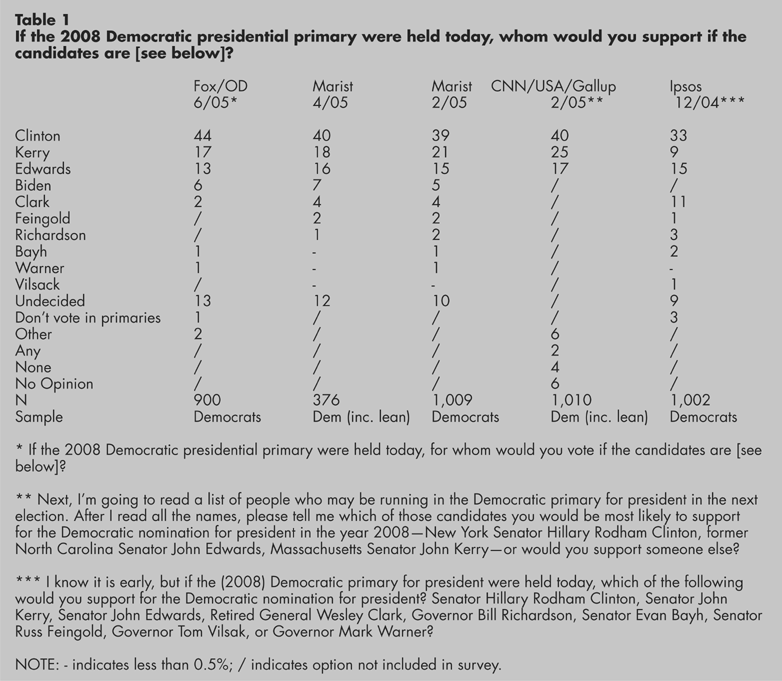
If the 2008 Democratic presidential primary were held today, whom would you support if the candidates are [see below]?
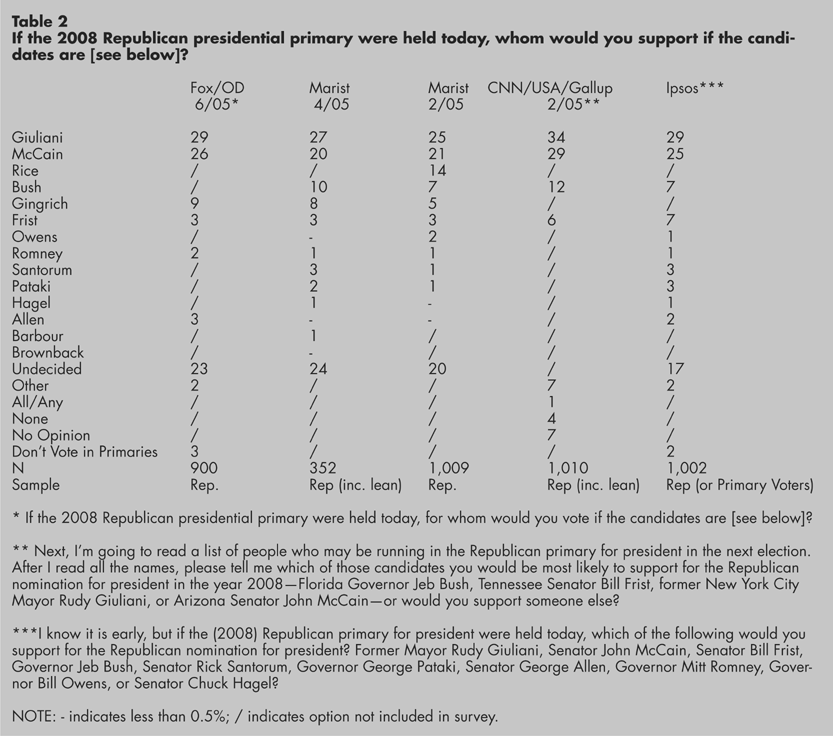
If the 2008 Republican presidential primary were held today, whom would you support if the candidates are [see below]?
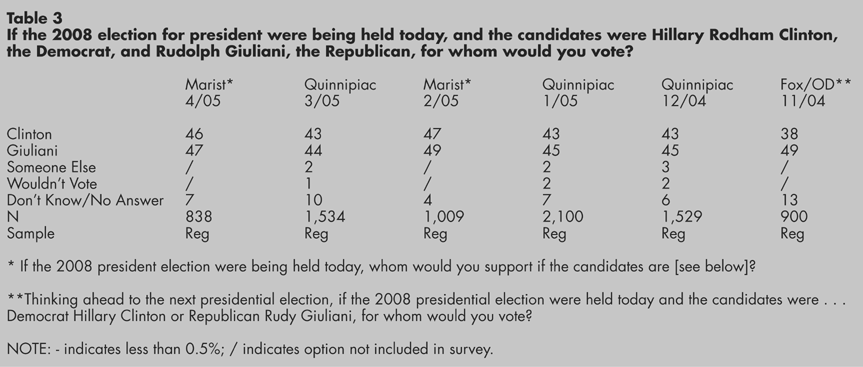
If the 2008 election for president were being held today, and the candidates were Hillary Rodham Clinton, the Democrat, and Rudolph Giuliani, the Republican, for whom would you vote?
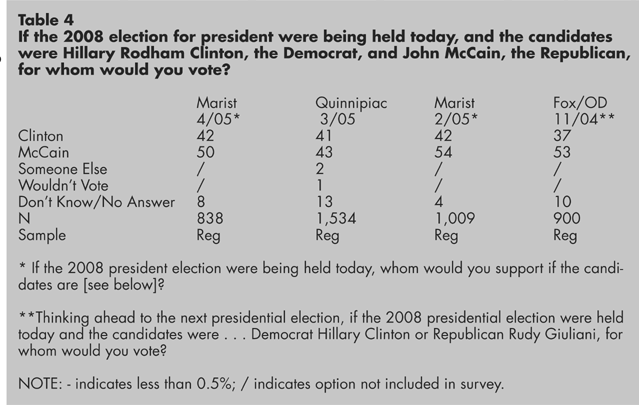
If the 2008 election for president were being held today, and the candidates were Hillary Rodham Clinton, the Democrat, and John McCain, the Republican, for whom would you vote?

S1049096505000429a.pdf

PDF 5.9 MB
 You have Access